Happy Good Friday! More Democrat voting fraud, Iran manages to shoot down a couple of planes, more California fraud under Governor Hairgel, Commies gonna commie, Microsoft behaving (and performing) badly, Pakistan’s nefarious actions backfire (yet again), the best rifle for a militia, and a list of bad actors in the job market.
This is Democrat Joel Caldwell of the “Coalition for the People’s Agenda,” a Fulton County ballot-harvesting NGO chief—caught on tape admitting it all.
Democrats are stuffing ballot drop boxes with fraudulent votes, and it’s all caught on videotape. He also admits this is how they rigged the 2020 election and why Democrats fight to the death against voter ID.
• They pay people to illegally ballot-harvest.
• They bribe ballot counters and election officials.
• They forge and falsify ballots.
And the Atlanta mayor straight-up stole the election.
He says it all himself—on tape.
Joel Caldwell:
“That’s what happened in 2020, ’cause that’s when the ballots—they started stuffing them ballots and people stuffing them ballots, and they got videotape of them, but nobody talks about it. That’s why Trump was making that big deal about it, because you see it on videotape. It’s like, come on. We see the man pull up and put a hundred ballots in this box. You know? You can’t do that sh*t.
So groups were paying people to do just that—drop off ballots.”
He continues: That’s why Democrats fight to the death against voter ID laws.
Joel Caldwell:
“That’s why the Republicans are always trying to fight the ballot—you know, that’s the whole argument, because Republicans are the ones who put out that kind of stuff, so they want voter IDs and stuff. Democrats are fighting voter ID laws. It’s a two-sided thing. That’s what they’re fighting over. Republicans are trying to say, ‘Hey, look, we got proof of this sh*t.’
And the Democrats are like, well, we don’t want voter ID laws, and we want to make it where you can just drop your ballot off—online voting and different things they try to come up with.”
Iran manages to shoot down both an F-15 and an A-10 on the same day. Two of the three downed airmen have already been rescued. It’s worth noting that neither of those planes are remotely stealthy.
Earlier this week, Jose Medina-Medina, an illegal immigrant whom the Biden administration caught and released at the border, murdered Loyola University freshman Sheridan Gorman. Medina-Medina had previously been arrested at least twice in Chicago, yet was released by local authorities, thanks to their sanctuary policies. According to reports, he approached her, raised a gun, and opened fire as she tried to flee. She was pronounced dead at the scene.
The Democratic Party’s response has been nothing short of horrific.
Snip.
The reaction from Democrats to Gorman’s death has been so despicable that Sen. John Fetterman (D-Pa.) unloaded on his own party over it.
“Why can’t we just talk about that life lost?” Fetterman told Fox News’s Bill Hemmer. “Why can’t we just acknowledge that this is serious, serious failure?”
Fetterman also invoked the Laken Riley Act, the legislation requiring the detention and deportation of illegal immigrants who commit crimes. Fetterman was one of only a handful of Democrats to vote for it — a fact he’s clearly not going to let his colleagues forget.
“I think only seven or eight Democrats even voted for [the] Laken Riley [Act],” he said. “Why can’t you just agree that if you’re breaking the law and you’re already here illegally, deport them? I just don’t understand.”
He continued, “Tragedies like what happened to that young woman, they are gonna continue to happen,” he said. “That’s beyond common sense.”
Hemmer pressed him on why Democrats can’t seem to get there, and Fetterman gave an honest, if uncomfortable, answer.
A Just the News investigation has detailed how a wealthy Marxist activist best known for the funding of a global financial network both inside the U.S. and around the world has extensive ties to Chinese Communist Party-linked organizations inside of China.
China-based entrepreneur Neville Roy Singham lives and works in Shanghai, — which the American businessman now calls home — where he runs his network of pro-CCP news sites and other China-linked endeavors. Singham, who sold his ThoughtWorks tech company in 2017, has used the money to fund openly communist endeavors worldwide. Just the News can show that inside of China, Singham and his network collaborate with an array of Chinese propaganda sites, Chinese universities, and other Chinese groups committed to advancing the CCP.
Singham leads and funds a global financial and activist network that operates inside the U.S. and many other countries, and while he rarely grabs the spotlight for himself in public speeches, he did so in November through the Chinese release of a report that sought to denigrate U.S. and Allied Power contributions to WWII.
Singham admitted during a CCP-backed forum in Shanghai in November that he had written the 174-page report to combat the U.S.-backed “international rules-based order” — which he called a “lie” — and to help the CCP and its longtime strongman Xi Jinping achieve a “new world order” more favorable to China. This report and the conference where it was introduced helped expose the extensive CCP-linked network in which Singham is ensconced within China.
Just the News reviewed hundreds of pages of Chinese business documents and U.S. tax records, English and Chinese language news sites, Chinese government websites, and more in an effort to provide the most comprehensive look yet at Singham’s operations from his perch in Shanghai.
Also: “Singham colludes with CCP to rewrite history of WWII to advance Xi Jinping’s ‘new world order.'”
The wealthy Marxist businessman behind a sprawling far-left network is collaborating with the Chinese Communist Party to denigrate the Allied actions in World War II in an effort to upend the U.S.-led international system and to advance Chinese leader Xi Jinping’s “new world order.”
China-based businessman Neville Roy Singham leads and funds a global financial and activist network that operates inside the U.S. and many other countries, and while he rarely grabs the spotlight for himself in public speeches, he did so in November through the release of a report that denigrates U.S. and Allied Power contributions to WWII.
Singham directly admitted during a CCP-backed forum in Shanghai in November that he had written the 174-page report to combat the U.S.-backed “international rules-based order” — which he called a “lie” — and to help the CCP and its longtime strongman Xi achieve a “new world order” more favorable to China.
The wealthy communist activist summed up the crux of his WWII argument thusly: “As we commemorate the 80th anniversary of the victory in the World Anti-Fascist War (WAFW), the Western powers spin their familiar tale: U.S. industrial might and British resolve saved the world from fascism. This is a lie. The truth burns in the numbers: while the Western powers calculated their economic advantage, the Soviet and Chinese peoples paid in blood. Fascism was defeated not by Anglo-American capital but by socialist leadership and mass heroism – a brilliant strategy from Moscow and Yan’an, unbreakable resilience from workers and peasants who refused to surrender, and a sacrifice that saved humanity from slavery.”
Multiple senior HHS officials estimate that, under Gavin Newsom, California’s state Medicaid program has lost 25 percent of its budget to fraud. This would mean it is currently losing $50 billion a year to scammers, fraudsters, and organized crime rings.
Snip.
We conducted interviews with public officials, fraud experts, and political figures, and reviewed hundreds of pages of government reports, state audits, criminal indictments, and other public records on California fraud. From unemployment insurance and Medicaid to failed homeless initiatives and welfare programs, seemingly every state program has been compromised by criminals. The best estimates suggest that, on the governor’s watch, fraudsters, scammers, and organized crime rings have stolen at least $180 billion from taxpayers.
In this firehose torrent of news, less attention than is proper has been paid to the fact that we’re finally going back to the moon. Or, technically, around it, since they’re doing the figure flyby of the dark side. They’re already halfway there…
Though the mainstream media will undoubtedly portray them as “mostly peaceful,” much of what we saw at the “No Kings” protests Saturday was anything but, whether through actions or symbols used during the demonstrations.
We’ll start off with New York City, where the Communist flags were in full effect:
BREAKING: Leftists in NYC chant “There is only one solution, Communist revolution” at the No Kings rally.
Communist flags at the NYC ‘No Kings’ protest pic.twitter.com/bIh2UiwkDI
— NJEG Media (@NJEGmedia) March 28, 2026
Snip.
Meanwhile, in Minnesota, Gov. Tim Walz (D) was pledging solidarity with the Somali community:
“We will never leave the side of our Somali Minnesotans. Here’s our pledge to you, our Somali Minnesotans, your grandchildren will still be here when that orange clown is in the dustbin of history.”
I guess its too much to ask a Democrat governor to stand with actual Americans. Plus rioting in Denver.
Earlier this week the U.S. Supreme Court heard oral argument in a case challenging a Mississippi statute allowing mail-in ballot received up to five days after Election Day to be counted.
The law appears to defy three federal laws that require that federal elections be held the first Tuesday after the first Monday of November. The question is what did Congress mean by Election Day. Was it a day, five days later, a month later. Does Election Day mean election season.
The 5th Circuit ruled against Mississippi, which brought the case to SCOTUS. It could have profound impact on Democrats’ mail-in ballot strategy if ballots must be received by election official by Election Day.
I discussed the case and oral argument, plus redistricting and the Equal Protection Projects challenge to discriminatory NY State education practices, with Jesse Kelly, who tweeted out the portion regarding NY State: “It appears Kathy Hochul is defying the Supreme Court.”
Pam Bondi is out as attorney general, President Trump announced Thursday, and Deputy Attorney General Todd Blanche will serve as acting attorney general.
“Pam Bondi is a Great American Patriot and a loyal friend, who faithfully served as my Attorney General over the past year,” Trump said in a statement on Truth Social. “Pam did a tremendous job overseeing a massive crackdown in Crime across our Country, with Murders plummeting to their lowest level since 1900.”
“We love Pam, and she will be transitioning to a much needed and important new job in the private sector, to be announced at a date in the near future, and our Deputy Attorney General, and a very talented and respected Legal Mind, Todd Blanche, will step in to serve as Acting Attorney General,” he added.
The announcement came just one day after Bondi was at the White House to attend Trump’s address to the nation on the Iran war. She had also accompanied Trump to the Supreme Court to watch oral arguments in a birthright citizenship case.
The handling of the Epstein files and the lack of progress on indicting anti-Trump conspirators like James Comey were suggested as reasons for Trump letting her go.
Target has gone from pushing the radical transsexual agenda to being boycotted by Randi Weingarten for not condemning ICE. I haven’t shopped there once since they started boosting the tranny agenda, but maybe it’s time to go back again…
Pakistani is enjoying a nice, rich dinner of blowback.
For decades, the Islamabad establishment has played a dangerous game, nurturing the Taliban as a strategic depth agent against India. Today, this plan backfires, and the resulting explosion of violence threatens to send a fresh wave of illegal immigration toward the already strained borders of the European Union.
The “open war” declared by Defence Minister Khawaja Asif marks the end of a thirty-year illusion. The apprentice has not only left the master. He has now turned openly against him. The March 16 strike on Kabul was the moment masks fell. When Pakistani warplanes hammered a rehabilitation centre in the heart of the Afghan capital, the “Islamic brotherhood” of the two neighbours officially ceased to be.
Islamabad claims it is hunting the TTP — the Pakistani Taliban who find sanctuary under the wings of their Afghan cousins. Kabul denies it. The result is a cycle of diplomacy-in-name-only, where the only language spoken is the language of the air strike, the AK-47 and the suicide vest. This is the reality of the post-American vacuum.
Critics of the Biden presidency, watching from America and Europe, see the vindication of their most cynical instincts. They warned that the vacuum left by the 2021 withdrawal would be filled by chaos. They were right. Just look at Bagram Airfield. It once was the crown jewel of American power. It has now become a trophy in a war between two states the West can no longer control.
While the world’s eyes are fixed on the Iranian plateau, South Asia is burning. The region’s most volatile border is no longer Kashmir. It is the frontier where the Taliban’s jihadist agenda meets Pakistani nuclear-armed desperation. How safe is the world when a nuclear power goes to war with a ghost? The answer is terrifying. Pakistan’s military capacity dwarfs that of the Taliban, yet the Taliban have time, resolve and a complete lack of accountability.
While the Pakistani economy teeters and its domestic security implodes with a second insurgency front up against Baloch separatists in the south, the Afghan Taliban are playing the long game. They see a Pakistan that is overextended and a West that is exhausted. They are not interested in ceasefires brokered by Qatar or Turkey. They are interested in survival and the expansion of their ideological reach.
Almost nobody talks about it, but we are witnessing the “Gaza-fication” of the Durand Line. The same knowhow of displacement and grazing the land is being applied to the tribal areas. Millions of thousands of people have already been displaced. But the humanitarian cost is only a footnote in a larger, more brutal calculation.
For Islamabad, this is an existential fight against the TTP thorn in its side. For Kabul, it is about defending the sovereignty they fought for twenty years to reclaim. Neither side can afford to blink. The light of the old order is fading. The era where the Pakistani military could manage Afghanistan like a colonial fiefdom is over. The trust is dead.
Trump’s “America First” doctrine means that if Pakistan wants to fight this war, it will do so without a blank check from the Pentagon. The bitter truth for the region is that old security guarantees are gone. We are entering an era of fluidity, where borders are written in fire. The “special relationship” between Islamabad and Kabul has become hatred. The Taliban have proven they can survive an American occupation. Surviving Pakistan’s aggression should not be that hard.
And then there are all of those “refugees” Euroelites seem bound and determined to import. (Hat tip: Director Blue.)
The attack involved a sophisticated mix of long-range unmanned systems, likely between eight and fifteen primary strike drones supported by smaller decoys designed to saturate Russian air defenses. These drones traveled approximately one thousand kilometers from Ukrainian territory, penetrating deep into Russian airspace and reaching the Gulf of Finland near the Estonian border. Evidence suggests the use of fixed-wing kamikaze drones optimized for endurance and precision. Ukrainians also utilized small prop-planes modified to fly as unmanned aircraft, mounting droppable Fab bombs on the bottom, which could be dropped on target, in addition to the craft being used as a kamikaze platform.
Also:
Ukraine has delivered a decisive strategic blow just as Russia expected to capitalize on soaring oil prices driven by the Iran war, but got its export system crippled instead. With unimaginable 40% of its oil export capacity wiped out, ports burning for days, and follow-up strikes continuing, the question is no longer whether Russia can recover quickly, but whether Ukraine will strike again before Russia has the chance to do so.
After over four years of war, Ukraine’s military says it’s testing an exoskeleton in the field that can help soldiers more easily load artillery and run at speeds of up to 12 mph over sustained periods. The tests would mark one of the first known examples of exoskeletons used on the front lines of an active military operation.
A Facebook video shared late last week by Ukraine’s 7th Air Assault Corps shows a handful of soldiers putting on the device while inside of a muddy artillery trench. The device itself wraps around a soldier’s waist and legs and is supported by a back brace. The military claims that it can reduce overall load on leg muscles by 30 percent. In practice, that means the devices should make it easier for soldiers to pick up and load heavy artillery rounds. Each round can weigh upwards of 100 pounds, depending on the particular caliber used. Since a soldier on the battlefield may load several dozen of those runs every day, all of that weight adds up and can increase the odds of injury or fatigue.
Not quite Heinlein’s powered armor, but we’re getting there…
Paxton’s office has now proposed detailed rules to implement the statute. The proposal was submitted to the Secretary of State on March 16 and published in the Texas Register on March 27, triggering a public comment period before the rules can be finalized.
The draft rules flesh out how SB 17 will work in practice, with the Office of the Attorney General as the central enforcement hub for the ban.
One of the most significant features is a new duty to report suspected violations.
Under the proposal, anyone involved in facilitating a real estate transaction—such as mortgage lenders, title insurance companies, property insurers, appraisers, and licensed real estate professionals—would be required to report any suspected SB 17 violations to the attorney general.
Complaints would have to be submitted either through an online complaint form on the OAG’s website or by mail to a designated address. Failure to report may subject entities to enforcement action once the rules are in place, potentially deputizing the real estate industry to help police foreign adversary land deals.
The rules would also place a tight lid on information that reaches Paxton’s office.
All complaints, civil investigative demands, and related materials submitted to or issued by the OAG would be treated as confidential and not subject to public disclosure, except when disclosure is required by law. That means Texans may see enforcement actions and lawsuits, but not necessarily the complaints and background investigation files that triggered them.
Wither Canada? “The 177,000 signature threshold has now been passed, officially clearing the requirement for an Alberta independence referendum on October 19th.”
John Cleese: “The British do not like the kind of diversity that intends to take over Britain and kill any infidel who does not convert to Islam.”
Weirdly, Microsoft is also saying that “Microsoft says Copilot is for entertainment purposes only, not serious use — firm pushing AI hard to consumers and businesses tells users not to rely on it for important advice.” Which is ironic, since right now its website touts Copilot as “AI built for work.”
Stephen Green: And the first piece of software to break on the moon mission? Microsoft Outlook.
And speaking of Microsoft woes, “Microsoft closes worst quarter on Wall Street since 2008 on AI concerns.”
Speaking of bad actors in the job market: “Outrage as Oracle makes thousands of foreign-worker requests amid layoff bloodbath.”
As thousands of Oracle employees awoke on Tuesday to an email informing them they were being laid off, the workers likely didn’t know the tech company had been busy trying to hire foreign staff.
According to U.S. Citizenship and Immigration Services data, Oracle filed for roughly 3,126 petitions to employ H-1B workers in fiscal years 2025 and 2026. Employers must submit the paperwork when seeking to hire foreign workers in specialty occupations like technology. Some 436 of those petitions were filed this year alone.
Amazon, which in January said it would axe 16,000 corporate employees, has filed for some 2,675 H-1B petitions during the same two-year fiscal period. That came on top of news in October that the retail giant was axing 14,000 corporate workers.
What’s the best gun for a militia? No surprise that three different gun experts (including Ian McCollum) all pick the AK-47.
Critical Drinker finally watches Mr. Inbetween, and really likes it. It’s been on my radar for a while, but there doesn’t seem to be a US DVD or Blu-Ray release of it, and I don’t have any streaming service.
The Iran war is one months old and the usual Negative Nellies in the Democrat Media Complex are whinging that the war’s not won yet, or suggesting that the Trump Administration is looking for an “off ramp.” Funny how it takes time to defeat a nation of 92 million, even one where the regime is hated by its citizens and whose prewar air force looked like a museum. Everything we hear from CENTCOM is that the air campaign is on schedule.
And the “off ramp” for the war is regime change in Tehran.
“The USS Tripoli and USS New Orleans arrived in the Middle East, carrying with them 2,200 Marines — with more on the way — hours after an Iranian strike left dozens of U.S. service members hurt at a Saudi air base. The Tripoli and New Orleans are two of several additional vessels and personnel the Pentagon has deployed to the region as the U.S.-Israeli war in Iran enters it’s second month. The Tripoli Amphibious Group brings with it F-35B Strike Fighters, as well as transport aircraft, amphibious assault vessels and other tactical assets.”
“Israel struck secret facility for production of Iran’s naval weapons and storage of boats and ships.”
“The facility located in the city of Yazd served as a key production center for advanced missiles and sea mines intended for Iran’s naval forces.”
“The site that was hit was reportedly involved in designing, assembling, and testing advanced missiles that could be launched from ships, submarines, and helicopters, targeting both moving and stationary vessels at sea.”
“The Israeli Defense Forces described the location as the central hub of Iran’s naval strike capabilities, noting that weapons produced there had been used in operations that posed a threat to navigation in the Strait of Hormuz.”
“Following the strike, the facility’s production infrastructure and stores of ready-to-use missiles were said to have been completely destroyed.”
“A reported Israeli airstrike on Tehran has killed Hassan Hassanzadeh, a senior commander of the Islamic Revolutionary Guard Corps’ Mohammad Rasul‑Allah Corps, which oversees security in Greater Tehran and counter‑ unrest operations.” I’ve also seen his name rendered “Hassan Hassan Zadeh,” for those playing IRGC Dirtnap Bingo at home…
“Majid Zakriyai, commander of the Iranian Army’s Natural Resources Organization protection unit, was killed.”
President Trump promised some absolute scorched earth on Iran if they don’t fall in line, promising to blow up their electric grid, their oil wells and Kharg Island…but then deleted the tweet. 🤷
E-3 Sentry and KC-135 destroyed at Prince Sultan Air Base in Saudi Arabia.
The anti-air capabilities of Prince Sultan Air Base still leave much to be desired.
The Houthis had been unusually quiet during the open stages of the war. Well, that’s ended, and they’re now tossing missiles at Israeli. Not sure how many they have, given that Iran has been both broke and busy…
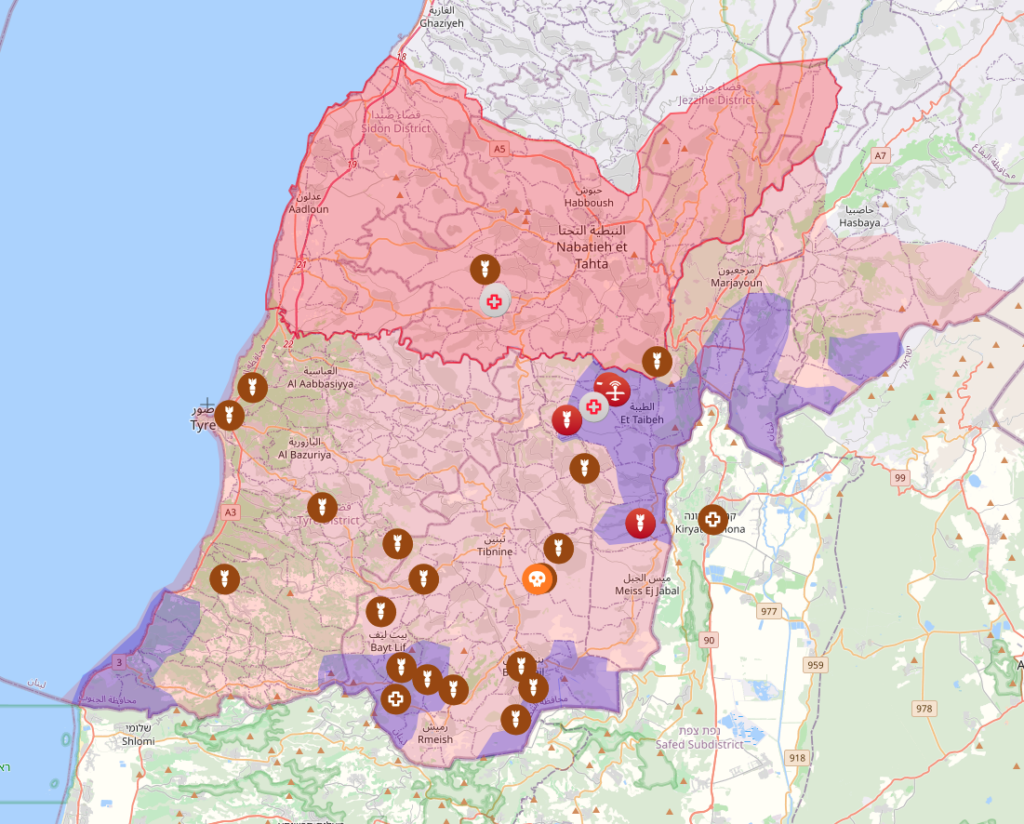
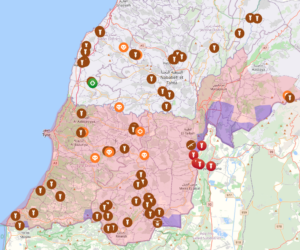
It’s always hard to tell what the state of the war in Lebanon is, but to my casual observation, it looks like the intensity of strike has lessened on both sides, but Hezbollah attacks seem to have fallen sharply. On the other hand, today’s status map show that Israeli forces are already at the Litani River in the eastern part of Lebanon:
“US military has been working on Iran ground raid plans for years.” One would hope.
Retired Gen. Frank McKenzie, the former commander of U.S. Central Command (Centcom), said Sunday that the U.S. military has been working on plans for a ground raid in Iran for years, as President Trump is reportedly considering sending troops into the war.
“Margaret, for many years we’ve considered options along the southern coast of Iran, seizing islands, seizing small bases. Typically raids. And a raid is an operation with a planned withdrawal. You’re not going to stay. But some of those islands you could seize and hold. That would have a couple effects,” McKenzie told CBS News’s Margaret Brennan on “Face the Nation.”
“First of all, it would be profoundly humiliating for Iran and would give us great weight in negotiations. The second, the example of Kharg Island, which everyone talks about, if you seize Kharg Island, you really can shut down the Iranian oil economy completely. And the beauty of seizing it is, you’re not destroying it,” he said.
Is China pushing Iran for a ceasefire?
“The risks to global trade through the Strait of Hormuz have surged and the dynamics of Iran’s relationships with Russia and China are constantly in the spotlight. Recently, both countries have pressured Iran, urging diplomatic solutions to the crisis. On March 24th, China’s foreign ministry reported that Foreign Minister Wang Yi held a phone call with Iran, calling for seizing the opportunity for peace and negotiating as soon as possible.” So did Russian Foreign Minister Sergei Lavrov.
“Analysts believe Russia has explicitly urged Iran to back down, signaling that Moscow views Iran as unable to continue fighting. Shortly afterward, China followed suit, aligning with Russia in terms of diplomatic timing. This indicates coordination between the two countries. Their shared goal is to maintain the stability of the Iranian regime, ensuring it continues to act as a strategic counterbalance to the United States.”
“From Beijing’s perspective, Iran is not only a major energy supplier, but also a key node in the Belt and Road Initiative. Chinese investments in the country amount to at least hundreds of billions of dollars, covering oil and gas field development, port construction, and transportation networks. If the Iranian regime were completely overthrown, it would directly threaten China’s energy and geopolitical interests. Therefore, Beijing must intervene diplomatically and urge Iran to turn to negotiations.” A lot of observers believe that Belt and Road is already moribund.
“A source close to China’s Foreign Minister, Wang Yi, revealed to the Epoch Times that Iran has refused any purely diplomatic arrangements and instead pressured Beijing with selective security, linking substantial aid to the safe passage of Chinese commercial ships through the Strait of Hormuz. This is soft extortion. Without military assistance, China cannot ensure the smooth passage of its trade routes. Beijing’s multiple secret negotiations have ended in failure and its efforts to profit from the geopolitical game are now facing the dual impact of diplomatic imbalance and economic stagnation.”
China also thought it could be a negotiating mediator between Washington and Tehran. Yeah, fat chance.
“This crisis is essentially the inevitable backlash of China’s ‘wolf warrior diplomacy” and camp confrontation mentality.”
“China’s leaders have fallen into a self-entangling dilemma. The forces they’ve supported are now cutting off their own economic lifelines. The disruption in the Straight of Hormuz is not only a rupture in global logistics, but also a microcosm of the complete collapse of China’s geopolitical strategy.”
“You’re starting to see the Iranian regime looking for an exit ramp.”
“USAF A-10s are arriving in the UK tonight as the U.S. surges more Warthogs to the Middle East.”
As usual, this is just the Iran news I felt significant enough to include in the roundup. If you think I’ve missed anything, feel free to share in the comments below.
The Iran war continues, with attacks on energy grids and refineries across the Persian Gulf, (maybe) another bunker buster strike, serious regime confusion, countries reporting impending shortages, and part of the 82nd Airborne moving into the theater.
ZeroHedge has piece up that starts with a nice state-of-play summary.
WSJ, Fox reporting 3,000 elite Army [82nd] Airborne soldiers to be ordered to Middle East. Axios says US awaits Iran response to proposed Thursday peace talks.
Backchannel diplomacy vs skepticism: Abbas Araghchi reportedly signaled openness to negotiations with the US via envoy Steve Witkoff, but Israel has appeared cool on deal prospects or offramp.
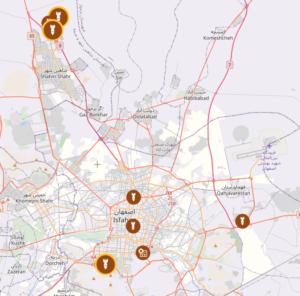
Heavy exchange of fire and testing red lines: Iran continues missile and drone waves targeting Israel and US bases, amid reports of overnight airstrikes on military and gas infrastructure near Isfahan.
Iran reshuffles its security leadership, appointing Mohammad Bagher Zolghadr: he’s a former IRGC commander and replaces the assassinated Ali Larijani.
Iran halts natural gas exports to Turkey: follows last week’s Israeli strike on the massive South Pars gas field; QatarEnergy declares force majeure on some LNG contracts due war.
“The Israeli Air Force recently struck an Iranian nuclear research and development site in Tehran, the military announces. According to the Israeli army, the “strategic” site at the Malek Ashtar University was used by Iran’s military industries to develop components for nuclear weapons. Malek Ashtar University, subordinate to Iran’s defense ministry, is under Western sanctions over its activities relating to Iran’s nuclear and ballistic missile programs.”
This falls into the “Big if true” category: “Three heavy bombers of the U.S. Air Force are currently conducting heavy strikes on the underground missile base of the IRGC Aerospace Force in Yazd, central Iran (Al-Qadir missile base). A total of six bunker-buster bombs have been dropped on the site by either B-1B heavy bombers flown from RAF Fairford in the United Kingdom or B-2A Spirit stealth bombers flown directly from Whiteman AFB in the United States.” I haven’t seen enough of Babak Taghvaee’s work to gauge the accuracy of this. (The few bits of his I’ve read have seemed accurate.) It seems like the sort target we would hit, but not knowing which bomber hit these targets suggests a source lacking firsthand knowledge. If anyone has a better bead on Taghvaee’s accuracy, feel free to share it in the comments below.
Not just over the Strait: The Warthog is also engaging Iranian back militias in Iraq.
USAF A-10 Warthogs spent most of the day strafing Iranian-backed militia positions around Mosul, Iraq. pic.twitter.com/5GLcm1XVnN
Victor Davis Hanson has spent fifty years studying how wars end. When he says the tide is turning, it’s worth listening to why.
His argument isn’t based on what the Pentagon is saying. It’s based on how everyone else is behaving.
𝗧𝗵𝗲 𝗘𝘂𝗿𝗼𝗽𝗲𝗮𝗻𝘀. VDH’s rule: Europeans never agree to go anywhere near a conflict unless they think the winning side has already been determined. They didn’t help in the early days. Now they’re starting to move. That movement is not idealism. It’s a calculation. They’ve looked at the battlefield and decided which way this ends.
𝗧𝗵𝗲 𝗚𝘂𝗹𝗳 𝗽𝗲𝘁𝗿𝗼-𝗻𝗮𝘁𝗶𝗼𝗻𝘀. The Saudis, the Emiratis, the Qataris — these governments have survived for generations by reading the regional climate with precision. When they expel Iranian military attachés, when they intercept Iranian missiles over their own capitals and say nothing about American strikes, when the UAE reaffirms its $1.4 trillion investment commitment to the United States mid-war — they are not making ideological statements. They are placing bets. And they are betting on the United States.
𝗔𝗹 𝗝𝗮𝘇𝗲𝗲𝗿𝗮. This is the one that should stop you cold. Al Jazeera — the Qatari state media network, historically critical of American military action, the network Tucker Carlson and the anti-war right love to cite against Israel — is now calling the U.S. bombing campaign brilliant and effective, and saying it has been underestimated. When the media outlet of a nation that hosts both the largest American air base in the Middle East and a Hamas political office starts praising American military effectiveness, the message is unmistakable: 𝘵𝘩𝘦𝘺 𝘵𝘩𝘪𝘯𝘬 𝘸𝘦’𝘳𝘦 𝘨𝘰𝘪𝘯𝘨 𝘵𝘰 𝘸𝘪𝘯.
𝗧𝗵𝗲 𝗺𝗶𝗹𝗶𝘁𝗮𝗿𝘆 𝘀𝗶𝗴𝗻𝗮𝗹. A-10 Warthogs and Apache helicopter gunships are now flying strike missions in Iranian airspace at will. VDH’s point: you only deploy those aircraft when there is effectively no air defense left to threaten them. They are slow, low-flying, close-support platforms. Their presence confirms what the Pentagon has been claiming — Iran has no meaningful air defense remaining.
Iran’s strategy now is rope-a-dope. Run out the clock. Wait for American public opinion to shift. Hope the midterms create political pressure on Trump to stop. It is the only play they have left.
VDH’s conclusion: if Trump sees it through — and he believes he will — the regime falls. Not in years. 𝗣𝗿𝗲𝘁𝘁𝘆 𝘀𝗼𝗼𝗻.
Since President Trump revealed contacts with the Islamic Republic, we’re seeing something very telling inside Iran: chaos at the top.
Regime officials are either turning on each other, pointing fingers, accusing one another of negotiating with the United States or in their own media and social platforms, they’re warning against character assassination of figures like Ghalibaf or Rouhani, because suspicion is spreading inside the regime itself.
Some are even calling for arrests or worse. Others are publicly shaming officials, accusing them of secret talks.
This is the atmosphere on the Islamic Republic’s side of social media. Total panic.
Jim Geraghty wonders “Why Are We Lifting Sanctions on Iranian Oil During a War with the Mullahs?” It’s a good question, though Trump seems to have a more intuitive grasp of alternating between carrots and sticks in negotiations than anyone I’ve ever seen. Also: “We have seen oil tankers carrying Russian oil divert from China to India in the aftermath of the Treasury Department’s lifting of sanctions on their cargo: ‘At least seven tankers carrying Russian oil have switched their destinations mid-voyage from China to India, according to Vortexa Ltd., with all of India’s major refiners now in the market for the country’s crude.'”
“Three explosions in Bushehr following attacks on the airbase and airport in Iran.” Bushehr is reasonably close to Kharg Island.
“Iran launches 10 million rial note.” Hyperinflation is rarely a sign of military strength. Also: The 5 million rial note was introduced “just weeks earlier.”
The Guardian (usual caveats apply) is saying that “Hundreds of petrol stations across Australia run out of fuel,” but Australian Energy Minister Chris Bowen states “Australia’s fuel supply remains strong and there are no immediate plans to ration fuel,” though the article admits “localized shortages.”
In Japan, gasoline prices have evidently hit record highs and the government is tapping national reserves, but tankers from UAE and Saudi Arabia bypassing the Strait of Hormuz are on the way.”
“Taiwan has about 11 days of liquefied natural gas reserves—a limited buffer that has become critical after Iran disrupted shipping through the Strait of Hormuz, cutting off key supplies from Qatar. Because Taiwan relies heavily on LNG to power its grid and semiconductor industry, any prolonged disruption could force energy rationing and threaten chip production.”
“Philippine president declares ‘national energy emergency‘, citing risks to fuel supply created by Middle East war.”
Another Iran update: More Jihadis dirtnaped, Iran’s neighbors want the Islamic regime finished off, Mossad gives regime members person-to-person call warnings, Uncle Sam fast-tracks a lot of weapon sales to the Middle East, and the BRRRRRRRTTTTTTTT of Freedom rings out over the Strait of Hormuz.
Israel Defense Forces killed top Iranian intelligence official Esmaeil Khatib and Hamas commander Yahya Abu Labda in separate airstrikes in the Middle East overnight.
The IDF confirmed Khatib, Iran’s intelligence minister, was killed in the strike in Tehran on Wednesday morning.
“Khatib played a significant role during the recent protests throughout Iran, including the arrest & killing of protestors and led terrorist activities against Israelis & Americans around the world,” the IDF wrote in a post announcing Khatib’s death. “Similarly, he operated against Iranian citizens during the Mahsa Amini protests.”
The Hamas commander was reportedly killed during an IDF airstrike in the Gaza Strip on Tuesday, according to the Times of Israel.
The strikes come a day after Israel killed Ali Larijani, secretary of Iran’s National Security Council, in an airstrike.
Abu Labda was a prominent figure in the development of Hamas’s precision missile project, according to the Times of Israel.
The Israeli Air Force (IAF) for the first time hit Iranian naval targets in the Caspian Sea on Wednesday, striking infrastructure and ships at the port of Bandar Anzali in northern Iran, at a distance of some 1,300 kilometers (over 800 miles) from Israel.
In addition, the IAF continued striking targets belonging to the Iranian regime’s Islamic Revolutionary Guard Corps (IRGC), the Basij militia, and the Air Force, among others.
The Israeli military confirmed on Thursday that the strikes in Bandar Anzali hit several ships, a repair facility, as well as a headquarters controlling naval operations in the Caspian Sea.
The US has deployed A-10 Warthogs attack jets, Ah-64 Apache helicopters, and 5,000-pound ground penetrator bombs to take out Iranian drones, boats, and mines to help secure the Strait of Hormuz, America’s top general said Thursday.
Gen. Dan Caine, chairman of the Joint Chiefs of Staff, vowed at a Pentagon news conference that the US would “hunt and kill” all of Tehran’s weapons facilities and assets being used against the strait, a critical trade route through which 20% of the world’s oil supply is transported.
“We continue to hunt and kill afloat assets, including more than 120 vessels and 44 minelayers,” Caine told reporters alongside War Secretary Pete Hegseth.
Simon Whistler has a meaty update on the war, including how all the Persian Gulf nations now agree that the Islamic Republic of Iran must go.
“Iran’s response to this war has managed to achieve something truly remarkable. [Ali Larijani]’s own neighbors, who had previously gone to bat for them, are now done dodging missiles and are reportedly pushing Washington to eliminate the Iranian threat for good, destroying the tools of repression.”
Skipping over the deaths of Ali Larijani and Gholam Reza Soleimani, previously reported here.
“Since the war began, American and Israeli forces have been running what amounts to a parallel campaign alongside the more headline grabbing strikes on nuclear sites and missile infrastructure. This campaign has been aimed squarely at the regime’s domestic repression capabilities and infrastructure, and it’s been accelerating massively in recent days. These targets should tell you something about what this part of the campaign is actually designed to do. Destroying missile launchers and stockpiles might degrade Iran’s ability to hit back, but destroying a law enforcement station and the men who run it degrades Iran’s ability to keep the lid on a country that it only barely had a grasp on before all of this kicked off.”
Skipping lightly over news of Iranians celebrating the traditional Chaharshanbe Suri fire festival, and the regime cracking down on same (no Zoroastrian fire festivals allowed in Islamic Iran), because it’s hard to get a sense of scale there.
“Noras, or Persian New Year falls on March 20th this year. This holiday is historically one of the largest public gatherings in Iranian life and has often been a flash point for protests against the regime. Last year, they arrested dozens of people across multiple provinces during Nar and that was before any of this broke out. this year. Suffice it to say, the situation has uh changed a bit. We don’t want to rest too much on Naras as a make or break moment, though. But it nevertheless represents a significant test of the coalition’s core theory for ousting or at least seriously pressuring the regime. Degrade their tools of oppression enough and the population will be able to do the rest.”
“The Guards have never been a domestic military force, but instead an ideologically driven group of hardliners explicitly set up to defend the Islamic Republic’s continued existence, no matter what the cost. Whatever comes next on the streets of Tehran, it does not appear likely that these men will simply lay down their weapons and go quietly into that good night.”
“The IRGC’s hardliner stance did not just reveal the power dynamics going on in Tehran, though. It helped to reshape the entire region’s posture in ways that would have been difficult to imagine just a few weeks ago. Before the war started, the Gulf States were the closest thing that Iran has to a coalition against American military action. Despite hosting US bases, most of them had adamantly pushed the White House not to strike Iran and were actively working to try and find common ground between Washington and Iran so they can avoid conflict.”
“While this was partially out of self-preservation interests, they knew the conflict in the region is never good for their bottom line, at least in the short term. They were still some of the best friends that Tehran had left. The Emirates had spent years rebuilding its relationship with Iran, and Aman’s foreign minister was in Washington discussing the matter with Vice President JD. Vance the day before the strikes took place. None of them doubted that Iran posed a threat. They hosted US bases for a reason, after all. But they calculated that living with the Iranian threat would be preferable instead of being largely defenseless in a war.”
“Iran’s response to Operation Epic Fury settled that debate in about 72 hours. Since February the 28th, Iran has launched over 1,800 projectiles split between ballistic missiles and drones at the UAE alone.”
“Bahrain took it even further, branding Iran treacherous. Bahrain even took the lead in sponsoring a UN Security Council resolution condemning Iran for its targets in this conflict which passed with unusually lopsided support. While not everyone throughout the Gulf was quite as forceful as that, they’ve all been moving in the same direction.”
“Behind the public statements urging peace, the private messaging to Washington has been far more direct: ‘Finish the job.'”
“Gulf officials have been pushing the Trump administration for what amounts to a permanent end to Iran’s ability to threaten their infrastructure.”
“In the space of three weeks, Iran has managed to turn every Gulf state that was lobbying Washington on its behalf into a partner actively backing the campaign to destroy its military capabilities. It is by almost any measure one of the most self-defeating foreign policy decisions a country has made in the modern Middle East.”
“A recent Goldman Sachs stress test published on March 15th showed that if the strait remained effectively closed through April, Qatar and Kuwait could see their full-year GDP contract by 14%, the worst since the 1990 Gulf War. The UAE and Saudi Arabia wouldn’t be quite as hard hit, but they’d both take a 5 and 3-point hit, respectively.”
Whistler also offers up a nice roundup of the current state of Israel’s incursion into Lebanon: “By March 16th, at least three separate IDF divisions were operating simultaneously inside of southern Lebanon, pushing through Kiam, Bins Jabel, and Marion in the most significant ground operations since their 2006 intervention. Evacuation orders are now covering everything south of the Latani, which when combines with the evacuated areas in the Bekaa Valley and southern Beirut totals to roughly 14% of the entirety of Lebanon’s territory.”
“Israeli Defense Minister [Israel] Katz has said at least parts of the operation are modeled explicitly on Gaza, offered no timeline for withdrawal, and some ministers are already floating the idea of a semi-permanent security zone. For now, there are no signs of a push toward Beirut or anything beyond the Litani.”
“In the last 48 hours alone, [Lebanese President Joseph Aoun] publicly called Hezbollah’s decision to enter the war a trap and an almost overt ambush serving Iranian interests, warned that the country is on the path to become a second Gaza, and floated a four-point plan calling for an immediate ceasefire, international backing for the Lebanese armed forces to oversee disarmament, direct negotiations with Israel, and long-term border security agreements.”
“While all of this is unprecedented for a Lebanese president, Beirut is currently falling short of Israeli expectations for two reasons. First, Lebanon has a long history of promising to finally get tough on Hezbollah that, well, hasn’t exactly materialized. Second, and more pertinently, the LAF [Lebanese Armed Forces] are already struggling to implement the ban on Hezbollah’s military operations that we reported on just a week ago. Hezbollah’s attack was earth-shattering for Beirut, which appeared to have finally found a moment of cross sectarian agreement that Hezbollah simply had to go. And while there were initially promising signs that the LAF was taking this seriously, the army has largely stalled. LAF commander [Rodolphe Haykal] has essentially refused to enforce the government’s ban on Hezbollah military activities, and the United States has even suspended some coordination with the LAF over it. The country’s prime minister has considered firing him for the whole debacle.”
“Now look, in fairness to Haykal, this isn’t just some random act of indifference where he’d rather sit around and watch Warfronts than go out and disarm the group. Though we couldn’t blame him if that was the case, could we? Rather, his calculation is that 20 to 30% of the LA Shia and would possibly refuse to mobilize against Hezbollah entirely, risking a total fracture of the military. Keep in mind that in Lebanon, sectarian identity is front and center just about everything that happens, especially in politics, and the LAF is broadly considered to be the last cross-sector institution in the country.”
“All that said, the inaction here is seriously jeopardizing the country’s sovereignty. The lesson that Israel took away from the October 7th attacks, rightly or wrongly, was that they couldn’t afford to allow a hostile force to exist along its borders anymore. In the aftermath of the 2024 ceasefire with Lebanon, Israel made it clear that disarmament of the group was an absolute bare minimum condition. And the tragic thing is that the LAF largely delivered on this. Earlier this year, they completed phase one of the operation. And while it was slowgoing, potentially so slow that Hezbollah was actually rearming faster elsewhere in the country than it was being disarmed, the LAF nevertheless demonstrated that it could deliver.”
“And all of this isn’t helped by the fact that even today, right now, Hezbollah continues to launch on Israel. While their stockpile has been severely reduced and seems likely to be further reduced in their ongoing clashes with the IDF, they don’t appear to be anywhere close to surrender.”
One of the reasons Iran was caught off guard at the opening of this war is that its leadership did not take Yahya Sinwar or Hassan Nasrallah’s approach. The Iranian regime—a state built on terror—was acting like a state and forgot what happens to those who spread terror. What Hezbollah and Hamas understood, and what Iran forgot, is that when you attack Israel, you become prey.
After the regime’s decapitation on the first day, Larijani grasped that reality. As Iran’s most senior surviving security official, he never stayed in the same place twice, and maintained exceptionally high security awareness.
In the end, it took a combination of precise intelligence, special ground capabilities, and rapid decision-making at both the political level and the by chief of staff to complete the operation. The time between the intelligence alert and the order for the strike was less than an hour; that’s an incredibly tight kill chain. This wasn’t a Hamas or Hezbollah target; exploiting this opportunity meant scrambling aircraft all the way to Iran.
Snip.
According to The Wall Street Journal, Israel is chasing internal repression forces from their headquarters to secret muster points at sports stadiums, even to neighborhood police stations. All in an effort to demonstrate to the Iranians that the regime’s fangs have been removed.
Meanwhile, Israel is calling mid- and low-level commanders, threatening them and their families if they don’t stand aside in the event of an uprising.
One conversation is worth recounting.
“Can you hear me?” a Mossad agent can be heard, speaking in Farsi. “We know everything about you. You are on our blacklist, and we have all the information about you.”
“OK,” the commander said in the recording.
“I called to warn you in advance that you should stand with your people’s side,” the Mossad agent said. “And if you will not do that, your destiny will be as your leader. Do you hear me?”
“Brother, I swear on the Quran, I’m not your enemy,” the commander said. “I’m a dead man already. Just please come help us.”
Last night, a very senior Israeli source outlined to me Israel’s five objectives in this war:
To act jointly with the United States to reopen the Strait of Hormuz.
To permanently deny any future Iranian regime the ability to again close the strait — including through the development of alternative pipelines.
To dismantle Iran’s weapons industry, with an emphasis on ballistic missile capabilities — this time targeting not just equipment but the factories that produce it.
To complete the destruction of Iran’s nuclear program.
Israeli Defense Minister Israel Katz has authorized the country’s military to kill Iranian and Hezbollah officials without explicit approval from higher-ups.
Katz announced the blanket order as he alerted Israeli residents that the military had taken out top Iranian intelligence official Esmaeil Khatib. Katz said he and Prime Minister Benjamin Netanyahu authorized the directive overnight.
The purpose of the authorization is to thwart the possibility of delays in Israel’s Operation Roaring Lion against Iran, according to Israeli network Channel 12. Katz vowed that there were more “significant surprises” to come as part of the development.
In the past several days, targeted Israeli strikes have assassinated several top Tehran officials, dealing a devastating blow to the Iranian regime’s power structure as the war moves well into its third week.
Snip.
The assassinations come as Israel has ramped up its attacks targeting Basij checkpoints and infrastructure. The Guard’s Basij unit has notably been targeted in the war, as the paramilitary force has long been seen as the leading military unit behind the deadly crackdown on Iranian protesters over the winter and behind repression in general against regime dissidents.
The Israeli military is targeting Basij personnel and facilities as the country seeks to weaken the Islamic regime enough to encourage Iranian citizens to topple the power structure.
“We’re undermining this regime in the hope of giving the Iranian people a chance to oust it,” Netanyahu said in a statement on Tuesday.
Next regime figure to get droned announced. “Hossein Dehghan, who was sanctioned in 2019 for his alleged role in an attack that killed 241 American troops, has been named to replace the assassinated Ali Larijani. According to a report by Iran International, Iran appointed former Defense Minister Hossein Dehghan on Thursday as the new secretary of the Supreme National Security Council,”
The Trump administration announced plans to sell more than $16.5 billion worth of radar systems, air defense equipment, and fighter aircraft weaponry to the United Arab Emirates, Kuwait and Jordan Thursday, as Iranian missiles and drones continued to hit sensitive infrastructure across the Gulf region.
US Secretary of State Marco Rubio issued an emergency waiver to bypass the mandatory congressional review period for the sales, the Pentagon said in its press release.
For the UAE, the State Department approved $2.1 billion worth of 10 FS-LIDS counter-drone interception systems, along with 240 Coyote backpack-carried drone interceptor systems, along with related sensors and munitions.
Another planned sale to the UAE includes a THAAD long-range discrimination radar, as well as Sentinel A-4 uplinkers and THAAD tactical operations and launch and control systems. A third sale set for Abu Dhabi includes $644 million worth of F-16 munitions and upgrades, including GBU-39/B small diameter bombs and Joint Direct Attack Munitions guidance systems (JDAMs), along with 400 AIM-120C AMRAAM air-to-air missiles and eight guidance sections, the Pentagon said.
Kuwait is set to receive $8 billion in Lower-Tier Air and Missile Defense Sensor (LTAMDS) radars, the administration further announced Thursday, along with a slew of accompanying electronic equipment. Jordan, meanwhile, is slated to receive $70.5 million worth of maintenance, logistics, and munitions support for its F-16s, C-130s and F-5 aircraft.
The planned sales come as Iran has targeted sensitive early warning and missile defense radar sensors in several US-aligned countries in the Gulf. Iran has also repeatedly struck civilian centers and, increasingly over the last 48 hours, oil and gas infrastructure with drones and missiles.
US Defense Secretary Pete Hegseth on Thursday praised Gulf states for their support for Washington’s war effort, saying Iran’s “reckless” pattern of counterattacks has brought some of those countries “squarely into our orbit.” He specifically named the UAE, Qatar, Bahrain, Kuwait and Saudi Arabia.
Speaking alongside Hegseth at the Pentagon, the US’ top-ranking general, Chairman of the Joint Chiefs of Staff Gen. Dan Caine, said the US military will continue to work with Gulf states “to help them to improve any defensive capabilities that they need.”
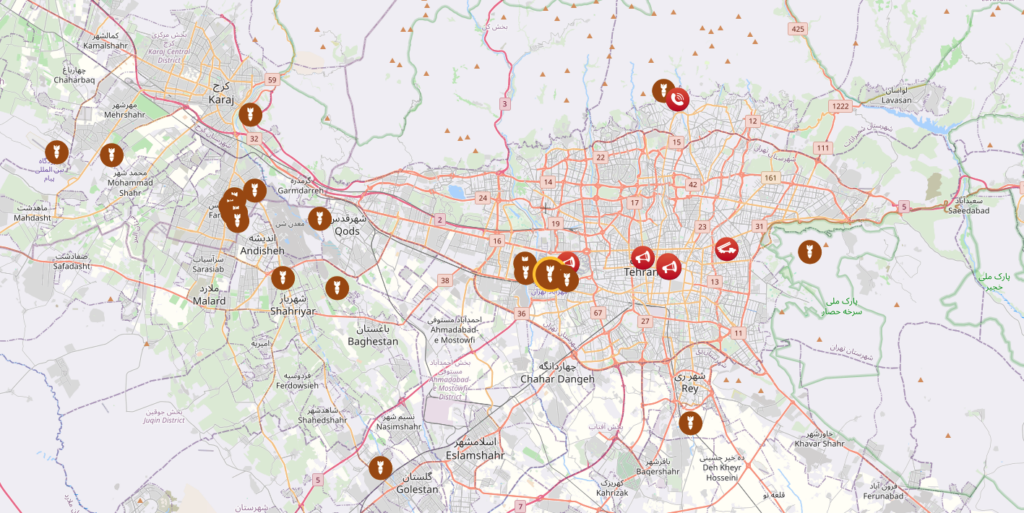
Missile plant hit: “Karaj Surface-to-Surface Missile Plant” destroyed by U.S. strikes. This was March 1, but CENTCOM only released the images today.
Iran evidently managed to damage an F-35:
“Likely hit by a Qaem-118 short range SAM.” The pilot returned to base safely and made an emergency landing.
Once again, this was just what I was able to gather from various sources. If you think I’ve missed something, feel free to share it in the comments below.
Day 10 of the Iran War: Oil spikes then falls, Iran gets a new theoretical Supreme Leader, China’s low cost GPS substitute is just as crappy as their other MilTech, the gulf states are investing in Ukrainian MilTech, and Habitual Linecrosser tries to cut through the fog of war.
He told CBS News “I think the war is very complete, pretty much”, and said the US was “very far ahead of schedule”
Speaking to NBC, he left open the prospect of acquiring Iranian oil, saying “certainly people have talked about it”
In an interview with the New York Post, he said the administration was “nowhere near” making a decision on whether to order US troops into Iran
Speaking to Republican lawmakers, Trump said the US was drawn into a “short-term” military operation in Iran to “get rid of some very evil people”
He went on to say: “We’ve already won in many ways, but we haven’t won enough”
Trump told the New York Post he is “not happy” with Iran’s new supreme leader, Mojtaba Khamenei, but at his press briefing later did not make clear who he wants to take his place – or how that will be achieved
At his press briefing, Trump reiterated that the operation in Iran has been a “tremendous success”, but also added that he wants to ensure Iran cannot develop nuclear weaponry “for a very long time” – a much bigger task
The US still has targets in Iran, Trump tells reporters, but they could be taken out “in one day”
Theoretically, Mojtaba Khamenei survived the leadership airstrike and is now the Iran’s new supreme leader. Maybe, but I wouldn’t put it past the people currently not running the country to announce him as leader even though he’s room temperature so they can continue to keep not running the country without U.S. and Israeli planes sending them to Allah.
“Third Iranian Shahid Soleimani-class Corvette Hit By America: At Bandar Abbas Port.”
The war between the U.S., Israel and Iran has entered a decisive phase that may determine the political future of the Middle East for decades to come.
President Trump declared that there will be no deal with the Iranian regime — nothing short of unconditional surrender. Tehran responded with predictable defiance, announcing that it would never surrender. Yet behind the regime’s rhetoric, reality appears very different.
Much of the leadership now reportedly communicates from undisclosed locations, hiding from sustained strikes while the propaganda machine attempts to project strength and resilience.
The scale of the military campaign has been extraordinary. In the first week alone, the U.S. reportedly struck approximately 3,000 Iranian targets across the country and the region. Israel has launched repeated waves of air strikes — more than twenty separate operations — systematically dismantling the regime’s military infrastructure. Missile launchers, air defense systems, command centers and naval facilities have been destroyed. Advanced weapons systems and new technologies, including next-generation laser defense platforms, are shaping the battlefield.
Israel has reportedly targeted and dismantled hardened command structures associated with the regime’s leadership, including the underground bunker networks linked to Supreme Leader Ali Khamenei. Several key figures may have been killed in these operations, though the regime has yet to publicly acknowledge casualties buried under the rubble of destroyed facilities.
Meanwhile, the Islamic Republic’s military capacity has been devastated. What once appeared to be a formidable regional force increasingly looks like what many analysts suspected all along: a paper tiger built on intimidation, propaganda and bluff.
For decades, the regime invested enormous resources in projecting power across the Middle East, building proxy networks and threatening neighboring states. Now it faces an unprecedented strategic crisis. Today, it is focused primarily on surviving.
The central question confronting policymakers in Washington and Jerusalem is not whether the regime’s military capabilities can be degraded — that process is already underway — but whether the campaign will stop short of dismantling the Islamic Republic itself. Anything short of regime-change risks allowing the system to recover, reorganize and once again threaten regional stability.
The military balance of power favors the U.S. and Israel. Iran’s conventional warfighting capabilities have been severely degraded. Air superiority allows continued targeting of strategic assets, meaning the regime’s ability to project military power beyond its borders will keep declining as long as the campaign persists. In the short run, this places the regime in a defensive posture.
But the weakening of Iran’s military does not automatically translate to the collapse of the regime. The Islamic Republic has historically relied less on conventional military strength and more on asymmetric tools — intelligence networks, ideological mobilization, proxy militias and global terrorism. Even if its missile forces, navy and air defenses are heavily damaged, the regime’s internal security structures — the Islamic Revolutionary Guard Corps, the domestic Basij security force, intelligence services and propaganda apparatus — can still function. Note that these institutions exist primarily to protect the regime rather than to defend the country.
LUCAS drones (“even cheaper than the Shahed, around $15,000”).
Ship-based anti-drone lasers (cost per kill: 50¢).
Tomahawk
Precision Strike Missile
Evidently American forces have found a way to jam China’s BeiDou system, their version of GPS:
Also, BeiDou seems to include its own text message system, which comes with a lot of drawbacks in an active combat environment…
A document circulating lays out the possibility of a limited campaign for U.S. ground forces to taking over Bandar Abbas and surrounding areas.
It is important to note that the United States does not currently maintain the ground force numbers in the region required for a full-scale invasion of Iran, nor has it established the logistical infrastructure that such a campaign would demand. Furthermore, there is no visible mobilization that would indicate preparation for a large occupation force. However, the US does have a large number of forward-deployed naval assets, rapid deployment units available back home, and special operations forces that could deploy within 18 to 48 hours to conduct a limited landing designed to seize specific objectives only.
The current goal of the ongoing air campaign appears to be to undermine the Iranian military and political leadership, to ignite internal dissent and local opposition movements, and whereafter, support these through air support and supply drops. Nevertheless, if current aerial efforts fail to create such a scenario, the US may consider scaling up its efforts.
One viable strategy could entail securing a foothold inside Iran to host a provisional government and facilitate overland supply routes instead. The most likely target for such a landing is Bandar Abbas, Iran’s primary southern port and a central node in its oil export system. In addition to establishing a bridgehead, capturing the city would allow US forces to obtain Iran’s main naval base. The accompanying port infrastructure, including cargo terminals and former fleet facilities, could then be repurposed to rapidly unload supplies and serve as a staging ground to support friendly forces inland.
Most importantly, Bandars Abbass’ is strategically located on the Strait of Hormuz. Following the attack, Iran is attempting to blockade the Strait, causing disruptions that are already affecting global shipping lanes. Securing Bandar Abbas would give the US a position from which to guarantee maritime passage to the major oil flows and deny Iran the ability to leverage the strait as a pressure tool.
In preparation for a landing, the US would shift focus to an air campaign aimed at degrading Iranian coastal defenses, displacing Iranian army units from the shoreline, and disrupting their ability to maneuver along the main logistics corridors leading into Bandar Abbas. With defenses disrupted, a numerically smaller landing force could then move into secure administrative buildings, port facilities, and the surrounding districts, in order to secure a perimeter and consolidate control. Infiltration routes through the mountains would be used to send small special forces groups to link up with local resistance networks as well as provide supplies and weaponry overland. Any landing would also force Iranian army units hiding in the surrounding mountains into the open terrain, if they want to contest the US bridgehead. However, any attempt to mass forces for a real counterattack would expose them to US and Israeli airstrikes almost immediately; with over 150 US combat aircraft, several cruisers, and guided-missile destroyers, ready to provide fire support to any landing party.
The alternative for the Iranian army would be a shift toward a guerrilla‑style resistance inside the city and surrounding area. But the operational impact of such a campaign would remain limited if the United States avoids expanding the offensive inland, and positions itself as a supporting force for a new government, instead of an occupying one. High local pro‑Western sentiment, visible in the large protests in the cities and towns here earlier this year, could additionally constrain the Iranian army’s ability to operate covertly.
Highly speculative, but it does contain a certain logic. Plus, with physical control of the oil export terminal, the U.S. could start selling oil in exchange for direct payment, promising to turn over any proceeds after a non-Jihadist government takes power…
Add the Royal Jordanian Air Force to the list of countries flying defensive missions over the Persian Gulf, specifically protecting Bahrain and UAE.
Azerbaijan has reportedly reopened the border with Iran, but the source is TASS, so several grains of salt are probably in order.
Jordan Peterson and Douglas Murray talk about what a scumbag death cult Hamas is.
UAE is investing in Ukrainian MilTech companies and buying Flamingo missiles to counter Iran.
“The United Arab Emirates-based Edge Group is set to purchase a 30 percent ownership stake in Fire Point, Ukraine’s combat-proven missile and drone manufacturer. The proposed deal of around 760 million US dollars will raise the total valuation of the Ukrainian defense firm to roughly 2.5 billion US dollars. Fire Point, which produces the FP-1 and FP-2 unmanned aerial systems as well as the Flamingo cruise missile, has risen to become Ukraine’s leading defense technology manufacturer within just two years, with production of drones currently reaching 6,000 per month.”
“The most interesting product in Fire Point’s arsenal is the Flamingo cruise missile, of which the company produces 1 to 2 units per day. With 30% share in the company and certain agreements, the UAE can receive around 10 to 20 such missiles and 1800 drones per month, significantly enhancing its ability not only to protect itself against enemies like Iran, but to carry out preventive strikes. Combat-proven with an estimated range of 3,000 kilometers and already successfully used to target critical Russian infrastructure within the 2,000 kilometer range, the missile is capable of reaching and destroying any target across Iran. Air bases, command centers, and missile storage facilities can be targeted with ease by its 1,150 kilogram warhead, forcing the Iranian command to change planning due to another deadly threat in the region.”
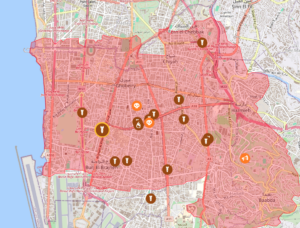
And what’s happening in the “southern front” of the war? In Lebanon, Israel seems to settling Hezbollah’s hash in both Beirut…
…and southern Lebanon.
Today’s Habitual Linecrosser:
As usual, if you think I missed any significant stories on the war, feel free to share them in the comments below.
The United States carried out “large-scale strikes” against Islamic State (ISIS) targets across Syria in response to a deadly terrorist attack on American soldiers in the country.
On Friday night, over 70 terrorist targets were hit using fighter jets, helicopters, and artillery as part of the “Operation Haw[k]eye Strike,” the U.S. Military confirmed. “U.S. Central Command said the strikes hit more than 70 targets across central Syria, adding that Jordanian fighter jets supported the operation,” Reuters reported. “One U.S. official said the strikes were carried out by U.S. F-15 and A-10 jets, along with Apache helicopters and HIMARS rocket systems.”
No F-35s or B-2s. Evidently 40- or 50-year old U.S. miltech is quite sufficient to eliminate remnants of the failed caliphate.
70 is not a small number of targets, and that number reminds the world that the United States military is in a different weight class than everyone else.
The overnight strikes were in retaliation for last week’s ISIS terror attack that killed three Americans, including two soldiers, in the city of Palmyra, central Syria.
Tonight, U.S. and Jordanian forces struck 70+ ISIS targets in Syria with 100+ precision munitions. Peace through strength. pic.twitter.com/XWWvfqBBFT
— U.S. Central Command (@CENTCOM) December 20, 2025
Ahead of the strike, in a Truth Social post, President Donald Trump promised a “very serious retaliation” against “ISIS thugs in Syria” for the terrorist attack on American personnel, saying: “All terrorists who are evil enough to attack Americans are hereby warned — YOU WILL BE HIT HARDER THAN YOU HAVE EVER BEEN HIT BEFORE IF YOU, IN ANY WAY, ATTACK OR THREATEN THE U.S.A.”
On Friday night, Secretary of War Pete Hegseth confirmed that the U.S. Military was conducting massive strikes “to eliminate ISIS fighters, infrastructure, and weapons sites.” It was “in direct response to the attack on U.S. forces that occurred on December 13th in Palmyra, Syria,” he wrote on X.
According to the War Secretary, the U.S. was not starting a war in the region, but exacting retribution for the act of terror against its soldiers. “This is not the beginning of a war — it is a declaration of vengeance,” he declared.
It’s hard to imagine Obama, Biden, or even the Bushes or Reagan using the “declaration of vengeance” rhetoric, the precise sort of Old Testament language guaranteed to send the chattering classes to their fainting couches. After all, why commit acts of vengeance when you can flood the Middle East with money routed through dodgy NGOs in futile efforts to convince the jihadist organizations to make friends with us?
Don’t be deceived by all the “Trump hates war” rhetoric. You know what Trump hates worse than war? Americans dead at the hands of Islamic terrorists.
Like I said, I usually don’t pay attention to the left-leaning MSM for anything, but is it just me, or is the usual wailing and rending of garments anytime a Republican president authorizes military action either muted or entirely absent here? The attacks seem to have invoked none of the usual histrionic outrage.
My working theory is that everyone who could trot out the usual liberal talking points is already on Christmas vacation and won’t be able to perform their usual regurgitation until January. If they’re not there to spew out press releases, then for all intents and purposes they cease to exist. It seems like if airstrike falls in the forest when they’re on vacation, it doesn’t make a sound.
That vaunted American foreign policy establishment has been wrong about the Middle East most of the time. Between the Abraham Accords and obliterating Iran’s nuclear program, it seems Donald Trump has racked up more successes in the region than they ever did.
Maybe it’s time to ignore crooked NGOs and foreign policy fossils who toil away in places with [Anything] Institute for Peace at the top of their resumes.
It’s time to treat the traditional foreign policy establishment as damage and route around it.
Here’s an under-reported aspect of Operation Rough Rider (i.e., the Trump Administration beating the Houthis with a very large stick): The deployment of A-10 Warthogs to teach the Houthis the error of their ways.
The successful missions displayed some interesting capabilities.
“After three years without a major combat deployment, America’s most rugged aircraft is back in theater, and this time, it’s not just covering troops; it’s striking mobile launcher teams before they escape.”
“On March 29, 2025, several A-10 Warthogs from the 124th Fighter Wing and 300 ground crew from the 190th Fighter Squadron deployed to the Middle East. This deployment marks the largest such deployment of this infamous aircraft in three years and it’s for more than just showing the flag. Operating out of Al Dhafra Air Base in the UAE, these aircraft are giving a big helping hand to the Navy as they battle a foe with ever revolving tactics.” Namely learning to shoot-and-scoot after launching their attacks on shipping.
The missiles Houthis fire are “are typically C-802s that carry a 165-kilogram armor-piercing payload and can reach targets up to 180 kilometers away.”
“The first confirmed strike came on April 1. After taking off from their air base, the Warthogs were on station within 18 minutes. Thanks to its 11,000-pound fuel tank captivity, the A-10s can loiter over target areas for up to 90 minutes before having to head back to base.”
Details of the formidable GAU-8/A Avenger rotary cannon snipped, because I think all of my readers are familiar with it by now.
“On that day, a circling RC-135 Rivet Joint intercepted Houthi radio signals that they were going to launch a strike soon. Because the US has destroyed practically every secure communications method the Houthis had, enemy commanders in the field have to rely on regular civilian cell phones to talk to each other, which makes finding these guys that much easier.”
“The attack was supposed to go down in less than 20 minutes, so the two A-10s punched it at full power to get there. With a max speed of about 420 miles per hour, it would take roughly 18 minutes to get there, with not a second to spare.” Yeah, this channel loves to make things overly dramatic.
“As the A-10s flew across the mountains and desert of central Yemen, the pilots are using this device to scan for the targets. This is called the AAN/AAQ-28 Litening pod [Yeah, that’s the way it’s spelled. -LP], and is how the pilot ensures that the A-10’s payloads make it on target.”
“The pod measures 87 inches long and is 16 inches in diameter. Inside this roughly 440-pound pod are a series of high-resolution forward-looking infrared sensors, laser designators, and CCTV cameras; the pilots can spot man-sized targets up to 28 miles away.”
“With no enemy radars up due to US forces knocking them out in prior strikes, the A-10s came in low and slow. At a distance of 6,500 meters away, they let loose with their cannons and gave ‘em the BRRT the aircraft is so famous for.”
“In those two seconds, the A-10s fired about 260 baseball-sized rounds, each going at 3,500 feet per second. As one can probably guess, the launcher was neutralized.”
“On April 2, an ISR satellite detected unusual heat signatures northeast of Sa’dah. Since very few people in Yemen own a car, much less a 5-ton truck, intelligence flagged it as a probable mobile launcher and passed it along to the Air Force for a closer look.”
“With the Houthis now fully aware the A-10s ere in theater, the call went out far and wide, and soon every Houthi radar left was scanning the skies, looking for an easy victory. Thankfully, these aircraft were not gonna let them. These planes are called EA-18G Growlers. If you think they look like F-18s, that’s because they kind of are. Built on the same body, these aircraft are specially modified with sensors and weapons specially designed for a mission called suppression of enemy air defenses or SEAD.”
“The Growlers’ main mission is taking out Houthi radars with systems with this. This system here on this Growler is called the Next Generation Jammer…As Houthi gunners turn on their radars, they send out a particular frequency. Since the Next Gen Jammers in service operate in the mid-band of frequencies around the 2–6 Gigahertz range, any radar pulsing in that range can get picked up. This is because the US maintains a mission library of every adversary search, surface, fire control, and missile radar in the world. When the system picks up these signals, it automatically knows what kind of system it is and uses basic geometry to figure out where the enemy radar is located.”
“The pilot then sends a continuous burst of about 270 kilowatts of power towards the Houthi radar. Because radars know the time when every radar wave is sent out and know what time it arrives, the radar uses that data to help figure out the position. However, when blasted with such a strong energy pulse, the radar can’t see any of its own emissions because this jammer is just overloading the system with a continuous stream of energy. Although some modern radars are jam-resistant, most Houthi ones are based on legacy Soviet or Iranian models that get fried.”
“Within 15 minutes, the Growlers from the USS Eisenhower had knocked out three Houthi radar installations.”
Using their Litening targeting pods, [the A-10s] picked up movement—three launchers, including one where the Houthis were putting a camouflaged tarp on to hide it again. The lead pilot fired a laser-guided AGM-65 Maverick from 26 miles away to prevent them from getting away. With its 125-pound-shaped charge, the Maverick struck the first launcher center mass. The secondary detonation from the missile on board was huge. Shrapnel tore through the other two nearby launchers and knocked fist-sized holes in them.”
“Their teams attempted to flee in a Toyota pickup, but they didn’t make it far. The trailing Warthog rolled in low. At just under 250 knots, the pilot squeezed the trigger. A half-second burst of the GAU-8 sent 50 rounds slamming into the truck and neutralized four more operators.”
“By April 10, Houthi activity had visibly shifted. Launch points previously active went cold.”
The Houthis grew even more cautious, but the A-10s sensors can even detect heat signatures coming from underground bunkers.
“On April 13, operating out of Jawf province, [Houthis] wheeled out a launcher preloaded with a C-802, set up near an irrigation berm, and awaited GPS lock from their Iranian handlers. Unfortunately for them, a US drone had spotted the movement 40 minutes earlier. A Warthog was already on station and soon inbound. At 3,000 feet, flying just over the mountain tops, the pilot waited just until he reached the Maverick’s ideal release range of around seven nautical miles. With the ability to carry six of these missiles, with three under each wing, the pilot let loose with two of them to neutralize thelauncher and its accompanying radar. Upon seeing the Warthog, the Houthi gunners abandoned their launchers and tried to run but the last thing they heard was a BRRT, and it was all over.”
“Strategically, the A-10’s success has reignited debates over close air support. While the Air Force still plans to retire the fleet by 2029, Marine and Navy commanders have petitioned for extended deployment rotations. This is because the numbers speak for themselves. From April 2 through April 17, the A-10s flew 218 sorties without a single US loss. According to CENTCOM, 47 confirmed missile systems have been knocked out, along with nine senior Houthi commanders neutralized. Because of this, the A-10 has proven itself a valuable asset in what many have considered a Navy-centric fight.”
Remember, the A-10 is the weapon the air force tried multiple times to kill, yet it’s still flying vital missions a quarter of the way through the 21st Century. The latest deployment may indicate there’s still some life left in the old hog yet…
Well, the Air Force is back to wanting to kill the A-10, and this time they may succeed.
“The US Air Force is charging ahead with plans to retire the old A-10 Warthog attack jet within the next five years, but there’s only one problem: there’s no dedicated close air support platform to replace it.”
“In the 2023 version of the National Defense Authorization Act, congress approved the Air Force requests to begin divestment of the current A-10 fleet, citing the aircraft is too old, too slow and too expensive to maintain.”
“The Air Force seems to be getting its way this time, with a set timetable to replace the 54 A-10s from Moody Air Force base with F-35a by 2028, and plans to retire the rest of the fleet soon to come.” As Jerry Pournelle once said, “USAF will always retire hundreds of Warthog to buy another F-35. Always, so long as it exists. And it will never give up a mission.” The F-35 is certainly a more modern, capable and flexible aircraft than the A-10, but it also costs about $79 million each, which makes me think that the Air Force is going to be very leery about letting it be used for close air support. By contrast, the lifetime cost of the A-10 is about $14 million per plane.
Back when the A-10 was first proposed, opponents argued that the role of close support could be handled by the F4 Phantom II, which brings home just how old the A-10 is, since the Phantom was retired from combat use in 1996.
Back when the GAU-8 30mm Gatling gun was developed, guided missile technology was new and finicky tech. That’s no longer the case. “When a laser-guided Maverick can hit a tank more accurately from 22km away, the 1.2 km range of the G8 looks a lot less impressive.”
The A-10 is easy to fly but slow, with a max speed of 439MPH.
Thick titanium armor provides solid protection to proximity explosions, less to direct hits. (Remember, in 2003 an A-10 managed to make it back to base even though it was missing most of a wing.)
The A-10 kicked ass in Desert Storm. “Final tally for the A10 in the first Gulf War was an impressive 987 tanks and 1,355 combat vehicles for only 6 planes lost. Another 14 A-10s were damaged but able to fly back to base, suggesting that the A-10 survivability was keeping pilots alive in that conflict.” Caveats: A lot of those kills were with Maverick missiles, and Desert Storm was 32 years ago.
In Iraq and Afghanistan, the A-10 was praised for how well it performed close air support, but also criticized for friendly fire and civilian casualties.
“Emphasis on keeping the A-10 and rugged and cheap delayed major upgrades to the plane sensor and fire control systems until the mid-2000s. The $2.2 billion A-10C upgrade program finally updated the
Warthog’s cockpit from the 1970s era tech it had first flown with.”
“The Warthog is almost 50 years old at this point, meaning that aircraft are having to undergo more and more maintenance each year. These costs are adding up, to the point where newer platforms are becoming cheaper to operate per flight hour.”
As new technology enables new means of war-fighting, the Air Force appears to have finally convinced congress that other aircraft can do the same job but better. A big part of the argument for retiring the A-10 is a mirror of the original survivability argument from the 1960s: There doesn’t seem to be much room for a big aircraft that flies low and slow in a near-peer conflict, and likely hasn’t been for some time the A-10 has been effective as long as it has thanks to the low intensity of counterinsurgency warfare that U.S. has been fighting for 20 years. Besides a few man-portable launchers, the Taliban and ISIS didn’t have much air defense that could threaten the A-10, and so the Warthog thrived in the asymmetric warfare conditions of Iraq and Afghanistan. Experts say that won’t be the case against a potential enemy like China.
“The gun’s tank busting abilities aren’t sufficient against modern tank armor. The 30 mm API rounds used by the cannon can penetrate around 69mm of steel armor at 500 meters, but modern Russian tanks like T72-B3 have 80mm or more on the hull and sides and way more protection on the front.”
As much as I hate to admit it, these arguments are probably correct. The Russo-Ukrainian War has shown that the threat environment is deadlier than ever, with Russia’s air force unable to achieve air superiority over Ukraine, and Russia has reportedly limited sorties to it’s own airspace due to Ukrainian air defenses. Ukraine has shot down at least 30 Russian Su-25s, the Soviet close air support plane most broadly comparable in role and age to the A-10, which is more than they’ve shot down of any other aircraft type. And the Su-25 is over 100 MPH faster than the A-10.
Also the rise in combat drone number, capability and variety means that the A-10’s close air support role is increasingly being taken over by cheaper, more flexible unmanned vehicles. A-10s would have been perfect for taking out those long convoys strung out on the road to Kiev, but a small swarm of drones with multiple missiles could have done the same thing if they were available, probably at lower cost and without losing pilots. (Some will point to the B-52 as example of older aircraft that are still useful on the modern battlefield, but their mission (high altitude and/or far away using standoff missiles) is the exact opposite of the A-10’s close air support mission.)
Technology marches on, and there’s no reason you couldn’t have drones half the size and one-tenth the cost of an A-10 armed with 10-12 smart missiles replacing most of the A-10’s mission capabilities. Whether the Air Force will let that happen is another question, as the Sky Warden shows the Air Force never wants to give up a mission, but drones have proven too valuable in Ukraine to shove that genie back inside the bottle.
We’ve already talked about the Battle of 73 Easting, so let’s talk about the battle that followed close on it’s heels, the Battle of Medina Ridge, the 32nd anniversary of which just passed, and which some regard as the largest tank battle of Desert Storm.
Following 73 Easting and the Battle of Norfolk, The Adnan Republican Guard division of motorized infantry launched an artillery spoiling attack against the U.S. First Armored to slow their advance, only to be slaughtered by MLRS cluster bombs, Apaches and A-10s.
This is simultaneous with the destruction of loot-laden Iraqi vehicles on the Highway of Death and the burning of Kuwaiti oil fields.
Despite the Iraqis believing that the rugged terrain south of the Euphrates valley is too difficult for an armored division to negotiate, the 24th Infantry Division reached their objective, securing Highway 8 east of where the 101st had done so a couple of days earlier. They blockade the highway, destroying over 100 vehicles retreating westwards with tank and TOE fire. Bedouin nomads watching from atop a nearby ridgeline politely applaud as tank rounds hit their targets.
The Medina Division of the Iraqi Republican Guard is the last organized combat force standing against the U.S. and its allies.
While the Iraqis have entrenched behind a small hill the Americans must crest, they’ve made the mistake of being just out of range of their T-72s.
“For the next 40 minutes, the engaged elements of the First Armored Division simply sit there picking off Iraqi tanks and armored vehicles with impunity. The Iraqis desperately call in artillery support, but the rounds fall behind the front line of Abrams tanks.”
“The 1st and 25th Field Artillery Regiments respond. Using artillery acquisition radars, the U.S. artillery is able to detect the firing of an Iraqi artillery piece, pinpoint its exact position, and return counter artillery fire on it before the Iraqi round has even landed. Within just a few minutes, two entire artillery battalions of the Medina division have been wiped out.”
“40 minutes after the battle began, the Medina’s right flank has been completely destroyed, and the right flank of the American force is just beginning to smash into the Medina’s left. In this sector, many Iraqi tanks are pointing southwest. The nearest tanks are destroyed before they can even rotate their turrets towards the Americans. Those that do fire back find that they are again outranged.”
Apaches and A-10s join in here as well.
“The battle would become known as The Battle of Medina Ridge. It lasts just two hours during which 186 Iraqi tanks and 172 armored vehicles are destroyed. Four American Abrams tanks are lost.”
I’m skipping over some secondary action and friendly fire incidents, but the Iraqis were complete routed and Americans took minimal casualties.
If more modern American and NATO tanks using combined arms operations took on even more antiquated Soviet tanks in Ukraine, the result is likely to be similar.
For those who feel my video offerings have been too tank-centric as of late, here’s a video featuring the design choices behind everyone’s favorite flying tank killer, the A-10 Warthog.