Today Instapundit Glenn Reynolds asks: “Back in 2008, the social-cons were all-in for Romney, to the point where Hugh Hewitt’s take became a running tagline (“You know who this is good for? Mitt Romney!”) that’s still used by by bloggers from time to time. Now, not so much. So what changed about Romney since 2008 to make him un-conservative?”
A good question, even though I wasn’t a Romney guy back in 2008. But three obvious answers occur to me:
The Tea Party Happened: The election of Obama and Obama’s extreme big-spending, big-government ways have “radicalized” Republican voters to the point that it’s no longer acceptable to campaign like a conservative and vote like a liberal. As the 2010 primary defeats of Charlie Crist and Mike Castle proved, Republican primary voters are no longer willing to give establishment Republicans a pass on their own free-spending, big government ways, and Mitt Romney is as Establishment as they come.
ObamaCare Happened: Before ObamaCare, Republicans might have been willing to downplay the socialistic, anti-freedom aspects of RomneyCare and its own individual mandate under the guise of state rights and the 10th Amendment. But after the passage of ObamaCare, RomneyCare has become a far greater political and ideological liability to Romney, and one that largely negates one of Republicans’ greatest attack issues against Obama, thus making it a much greater problem than it was in 2008.
Romney Isn’t Running Against john McCain: Despite John McCain’s many personal virtues, his voting record is far more that of an establishment Republican than a rock-ribbed conservative. Be it McCain-Feingold or the Gang of 14, McCain has constantly flirted with RINO-hood in his Senate career, making himself a media darling and infuriating the base. In 2008, there was a solid case to make that Mitt Romney was more conservative than McCain. It’s much harder to make the case that Romney is more conservative than Rick Santorum.
Bottom Line: Romney had flaws that were easier to overlook in 2008. You know whose conservative reputation the last four years have been bad for? Mitt Romney!
This piece by Dan McLaughlin encapsulates why the Tea Party exists, and why it has to fight a willfully heedless Republican establishment, so well that I’m going to quote whopping great chunks from it:
As anyone with a passing familiarity with Republican politics over the past four or five decades knows, conservative magazines and think tanks have been making detailed entitlement reform proposals for most of those years, and Republicans running for offices high and low have been running on platforms of reducing the size and cost of government for just as long. And then nothing happens.
That’s why Congress’ battles over the debt ceiling and related issues provide such a potent example. Basically all Republican Senators profess to be in favor of smaller government, and yet so few are willing to go to the barricades to make it a reality. Now, I’m a realist – there are limits to how much we could expect even a completely united GOP to bring home as long as Obama is the President and Harry Reid the Senate Majority Leader. But the repeated spectacle of leading pundits and Beltway Republicans tut-tutting Boehner and company for even trying to use their leverage to exact real concessions is a sign that the message Republican voters have been sending is not getting through to everyone.
(snip)
The related point here – and one that says much about why RedState has put so much energy into intra-party primary battles rather than the production of white papers – is that personnel is policy. The ideas are already there; what is lacking is the necessary corps of people with the will to fight for them.
(snip)
The point of my essay was not to denounce anyone, but to explain the history and depth of the current popular distrust on the Right of leaders who seem unwilling to lead. The battle to restrain runaway government spending is so much smoke and mirrors unless the people who profess to support it in word are dedicated to it in deed. No wealth of position papers, endorsements and Power Point presentations can demonstrate that. Voters and activists who have figured this out are rightly skeptical of those who don’t seem to “get it”. And they are more than willing to embrace flawed champions – even such a creature of the Beltway as Newt Gingrich – if they demonstrate the willingness to actually do something to stop the runaway train of federal spending. Every time some Beltway figure calls Newt or some Tea Party candidate crazy, voters think again, “he might actually be crazy enough to upset some applecarts to get things done.”
Paul Burka covers it as well. Ignore the usual Burka liberal hand-wringing and there’s actually a lot of useful information here. (Hat tip: Texas Iconoclast, which has stopped updating the main page, but still puts tidbits in their sidebar.)
The Texas Tribune offers a handy overview of the their tax returns.
Cruz wins another straw poll, this one at the Tarrant County Republican Party Candidate Fair.
Joe Holley profiles James. The most interesting takeaway for me is learning that James has two of Rick Perry’s longtime financial supporters backing him: Houston investor Jim Lee and Dallas insurance executive Roy Bailey. And the fact that James only set up Texans for a Better America in April, after his name was already floated as a potential Senate candidate.
Another Perry supporter, campaign manager Rob Johnson, lands a gig working for David Dewhurst’s Super PAC “Texas Conservatives Fund” to support his Senate campaign. That’s not the only Dewhurst PAC: “Former Harris County Republican Party chairman Gary Polland and San Francisco-based political consultant Bob Wickers recently formed the Conservative Renewal PAC.”
The Dewhurst campaign is crying foul on Cruz hitting them over the Super PAC, pointing out Cruz’s support from the Club for Growth PAC. The Cruz campaign retorts that The Club For Growth PAC has been around for years to help various candidates, while Dewhurst’s PACs exist only to serve David Dewhurst.
James calls for Eric Holder’s resignation, and says that Texas Attorney General Greg Abbott should be the next U.S. Attorney General. That’s interesting, because I got the impression that Abbott was pretty close to Cruz, though I don’t think he’s formally endorsed him.
Speaking of which, Paul Sadler appeared on WFAA, they of the crappy video embedding:
Salder raised $5,000 in Q4. Granted, he didn’t join the race until December 19, but that’s still pretty poor for the Anointed Democratic Establishment Candidate.
Even Daniel Boone raised more money, in Q4, raising $5,401.
David Dewhurst loaned his campaign another $2 million of his own money, according to his Q4 report. That’s a considerable chunk of change, but I imagine the Cruz campaign is breathing a sigh of relief that it wasn’t 5 times that much.
Another thing that strikes me about his Q4 report (which I have only given a cursory glance to, given there’s more than 800 pages to it) is Dewhurst’s incredibly high burn rate. He’s already spent $4,397,491. Some examples of what he’s spending money on:
He seems to be spending $500 a day each on Facebook and Google advertising. I’m not sure that’s money well spent at this stage of the campaign. Last two weeks? Sure. Now? Not so much.
Campaign manager James Bognet seems to be pulling down a cool $35,000 a month, plus reimbursement expenses.
Finance director Rebecca McMullin is pulling down a respectable $9,480 a month, plus expenses. Kevin Moomaw, an old Dewhurst hand he lured back from his cushy job as a UT professor, is making about the same, which is a goooooooooood salary. (Inside joke.)
He gave pollster Michael Baselice just over $24,000.
The nice thing about being the “bank” in the race is that you don’t have to worry about funding a top-heavy campaign if you’re getting results. Is he? So far the Dewhurst campaign hasn’t knocked me out with its organizational skill. It’s competent, but I think both the Cruz and Leppert campaigns have been more obviously focused and effective at communicating. But I’m probably not the type of voter the Dewhurst campaign is trying to reach (as far as I can tell, Team Dewhurst reachout to bloggers and new media (beyond the obligatory Facebook and Twitter accounts) is non-existent).
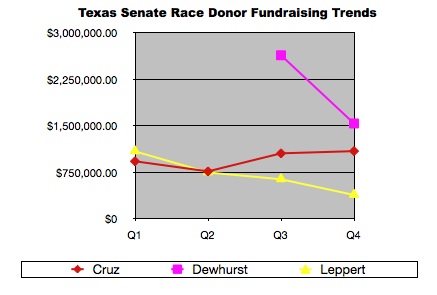
To make it easier to see how the fundraising race has progressed, I made a chart tracking donations to Ted Cruz, David Dewhurst and Tom Leppert:
Since this just tracks campaign donations, it doesn’t include self-funding, which both Dewhurst and Leppert have made extensive use of. After Dewhurst’s full Q4 FEC report is up, I’ll do another chart on those numbers.
Former Sheriff Richard Mack is launching a Republican primary challenge against Lamar Smith. He cites SOPA as his primary reason for running against Smith. (He has a website, but it’s currently 404.)
Mr. Mack seems to be a Ron Paul enthusiast, which is not my favorite flavor of conservatism, but even knowing nothing else about him, I would still regard him as a significant improvement over Lamar Smith at this point. His bio suggests he supports the Second Amendment, legalization of drugs, and the Tea Party, all of which I approve of. He has a personal website, and I sent him a query asking about his campaign. I’ll let you know more about when I hear back. As Matt Drudge is wont to say: Developing…
A long but informative breakdown of where things stand. The bottom line: The cases are still up in the air, Texas GOP is not directly involved in talks, and February 6 is the last day the case can be resolved and still have an April 3 primary.
I had both a wedding and a book release party to attend this weekend, so I haven’t had time until today to note that David Dewhurst and Ted Cruz have followed the lead of Craig James in releasing their tax returns.
The Dewhurst campaign announced they were releasing two years of tax returns (plus estimates for 2011)…and then failed to link to the returns from the announcement. (Perhaps it’s up somewhere on the Dewhurst site, but the lack of a press or social media contact listing makes such information difficult to ascertain.) They can be found at this Texas Tribune page. The Dewhurst campaign seems entirely too comfortable with letting the MSM continue in their role as information gatekeepers rather than allowing voters to access information directly.
And here’s the Tribune’s summary of those documents: “Dewhurst reported a total income of $1.01 million and tax payment of $281,188 in his 2010 report, and a $1.4 million loss and tax payment of $443,646 reported in his 2009 report.”
The Cruz campaign followed suite by releasing five years of tax returns, which can be found here. And here are links to the individual years:
(To be fair to the other candidates, I must note that there seems to be no way to find this from the Cruz website itself. However, unlike Dewhurst, the Cruz campaign is much better at giving contract addresses for the campaign team.)
Once again the Texas Tribune provides the too-lazy-to-flip-through-tax-forms overview: “Over the past five years, Cruz has increased his earnings with every filing. In 2006, he reported an income of $347,716. In 2007, that increased to $395,494. It jumped to $780,198 in 2008, and to $1.5 million in 2009.” Good for him. They also go on to note “With Cruz’s disclosure, this leaves only former Dallas Mayor Tom Leppert among the major Republican U.S. Senate candidates who has yet to release his tax returns.” The Leppert campaign has promised to do so, and it wouldn’t surprise me if it takes a few days to dig out and digitize his tax returns.
If I have time (a commodity in short supply right now), I’ll try to dig through the James, Dewhurst, and Cruz returns for nuggets of insight. Kudos to all three of the candidates for releasing their tax forms, and especially to James for getting the ball rolling.
No word on whether any of the Democrats in the race will follow suit. Maybe no one has asked them yet…
For those of you whom don’t regard paging through an ex-football player’s tax returns an exciting pastime, here’s the executive summary: James earned earned more than $9 million in the past five years, mostly from capital gains on investments. That means he’s Leppert rich, but not Dewhurst rich. Good for him. It’s always nice to see a professional athlete who saved and invested their money wisely, since there are so many who didn’t. He also seems to have given a fair amount to charities over the years.
In covering the American Jewish Committee/World Affairs Council of Houston senate candidate forum on foreign policy I mentioned previously, we have a news story that is demonstrably deficient in several areas:
You get told who wasn’t there (Craig James, Paul Sadler, and Lt. Governor Chupacabra), and even how many of each flavor were there (“six Republicans, three Democrats and one Libertarian”), but the article itself only lists five of those ten. That would be the very first “W” of the “Five Ws and an H,” assuming they still teach that at journalism school. (Maybe they’re replaced it with another class on “Reporting Social Justice.”)
However, because I’m so Old School, I actually went out and got a list of who attended the forum from the AJC: Republicans Ted Cruz, Tom Leppert, Glenn Addison, Lela Pittinger, Charles Holcomb, and Ben Gambini (yes, an actual Ben Gambini sighting!), Democrats Daniel Boone and Jason Gibson, Libertarian Jon Roland, and independent candidate Mike Champion. So it turns out that even the summary of candidate affiliations was wrong.
In an article on a foreign policy forum that runs just shy of 500 words, a grand total of 96 of them actually dealt with the candidate’s foreign policy views, and even those are essentially free of concrete information. Let’s repost those parts in their entirety:
Cruz also said that “President Obama has been the most anti-Israel president this nation has ever seen.”
[snip]
Leppert emphasized his experience as an international businessman familiar with issues of currency and international trade.
[snip]
Cruz and Leppert were the only two candidates who were able to respond with practiced ease to a series of sophisticated questions dealing with world affairs, ranging from Israel’s response to the Iranian nuclear threat to whether the United States should help bail out faltering European economies. Most of the others on the stage seemed unfamiliar with even the most basic foreign-policy issues.
That’s it. That’s the extent of coverage of the candidates’ foreign policy views in a forum dedicated to that very subject. We are no wiser as to what any candidate thinks of our troops levels in Afghanistan, what our relations with Pakistan should be, whether we should help topple the Assad regime in Syria, how to counter an increasingly bold China, or whether we should use military force to prevent the Islamic Republic of Iran from obtaining nuclear weapons. Were those topics covered? We don’t know, as Holley and the Chronicle do not deign to tell us.
Instead of giving the candidates’ actual views, Holley merely gives us his dismissive analysis of eight of the ten candidates, telling us they are “unfamiliar with even the most basic foreign-policy issues” without bothering to provide a single example of this ignorance.
The rest of the piece consists of horse race analysis, noting Dewhurst’s absence, audience attendance figures, and an interview with a random forum attendee. All of which would have been fine in a longer piece.
Joe Holley and/or his editor have missed a chance to actually inform their readers. I have a hard time thinking of a blogger who couldn’t have done a better job.