Here’s a pilot discussing the recent Southwest Airlines issues.
His points:
Time to haul this out again:

Here’s a pilot discussing the recent Southwest Airlines issues.
His points:
Time to haul this out again:
It seems that more and more airline employees are coming down with “Freedom Flu.”
American Airlines said they would be following Biden’s (as yet unissued) Flu Manchu mandate. Result:
American Airlines now has 883 cancelled or delayed flights today
— Jack Posobiec 🇺🇸 (@JackPosobiec) October 14, 2021
United Airlines said it was going to fire 600 employees over the Flu Manchu mandate. But a federal judge just bared United Airlines from putting workers on unpaid leave:
A federal judge has extended a ban on United Airlines putting employees on unpaid leave for seeking a medical or religious exemption from the airline’s requirement to get vaccinated against COVID-19.
U.S. District Judge Mark Pittman in Fort Worth, Texas, granted a restraining order Tuesday in favor of employees who are suing the airline over the mandate.
Lawyers for the employees and the airline agreed last month that United wouldn’t put the workers on unpaid leave, but the judge wrote that the agreement will expire before he can rule on the merits of the matter. That would leave “hundreds of workers” at risk of being put on indefinite unpaid leave or forced to get a vaccination that violates their religious beliefs or medical restrictions.
The restraining order expires Oct. 26.
I don’t think I’d undertake any air travel over the rest of the year…
What are we to make of Southwest Airlines CEO Gary Kelly?
In an interview with ABC News, he said that no employees would be fired over the Flu Manchu vaccine mandate:
During an interview with ABC News Tuesday, Gary Kelly, the CEO of Southwest Airlines, stated that no employees would be fired over the company’s vaccine mandate. However, the airline announced on October 4 that all 56,000 U.S. Southwest employees needed to get vaccinated against COVID-19 by November 24, or face termination.
Yet the very same day, we hear that Southwest is going to comply with Biden’s (still unissued) order:
Dallas-based Southwest Airlines will ignore a Texas Executive Order prohibiting any entity from imposing Covid-19 vaccine mandates on employees or customers.
Instead, the beleaguered airline will comply with a yet-to-be issued Biden federal mandate which requires that government employees and contractors get vaccinated, according to CEO Gary Kelly in a Tuesday interview with CNBC.
“I’ve never been in favor of corporations imposing that kind of a mandate. I’m not in favor that. Never have been,” Kelly told “Squawk on the Street,” adding “But the executive order from President Biden mandates that all federal employees and then all federal contractors, which covers all the major airlines, have to have a [vaccine] mandate … in place by December the 8th, so we’re working through that.”
How do you reconcile the difference between these two positions? They’re going to enforce the mandate but not fire people who don’t meet the mandate requirements? How? Keeping them on with unpaid leave until they quit?
Kelly still hasn’t come clean about the reasons behind the cancelled flights. He needs to do that, and to clarify Southwest’s positions on imposing vaccine mandates on their employees, at a bare minimum.
In related news, that non-existent mandate is now closer to existing because draft language has finally been submitted.
The Amish are having none of your Flu Manchu panic:
[Amish Mennonite Calvin Lapp]: There’s three things the Amish don’t like. And that’s government— they won’t get involved in the government, they don’t like the public education system— they won’t send their children to education, and they also don’t like the health system. They rip us off. Those are three things that we feel like we’re fighting against all the time. Well, those three things are all part of what Covid is.
After a short shutdown last year, the Amish chose a unique path that led to Covid-19 tearing through at warp speed. It began with an important religious holiday in May.
Lapp: When they take communion, they dump their wine into a cup and they take turns to drink out of that cup. So, you go the whole way down the line, and everybody drinks out of that cup, if one person has coronavirus, the rest of church is going to get coronavirus. The first time they went back to church, everybody got coronavirus.
Lapp says they weren’t denying coronavirus, they were facing it head on.
Lapp: It’s a worse thing to quit working than dying. Working is more important than dying. But to shut down and say that we can’t go to church, we can’t get together with family, we can’t see our old people in the hospital, we got to quit working? It’s going completely against everything that we believe. You’re changing our culture completely to try to act like they wanted us to act the last year, and we’re not going to do it.
Steve Nolt is a scholar on Amish and Mennonite culture, and Mennonite himself. He’s studying Amish news publications to analyze community-wide trends.
Sharyl: So, are you saying, as of about May of 2020, things kind of went back to normal in the Amish community?
Steve Nolt: For the most part, yeah, by the middle of May, it’s sort of like back to a typical behavior again.
That also meant avoiding hospitals.
Nolt: I know of some cases in which Amish people refused to go to the hospital, even when they were very sick because if they went there, they wouldn’t be able to have visitors. And it was more important to be sick, even very sick at home and have the ability to have some people around you than to go to the hospital and be isolated.
Then, last March, remarkable news. The Lancaster County Amish were reported to be the first community to achieve “herd immunity,” meaning a large part of a population had been infected with Covid-19 and became immune.
Nolt: Even those who believed that they had Covid tended not to get tested. Their approach tended to be, “I’m sick. I know I’m sick. I don’t have to have someone else telling me I’m sick.” Or a concern that if they got a positive test, they would then be asked to really dramatically limit what they were doing in a way that might be uncomfortable for them. So, we don’t have that testing number.
Lapp: We didn’t want the numbers to go up, because then they would shut things more. What’s the advantage of getting a test?
One thing’s clear: there’s no evidence of any more deaths among the Amish than in places that shut down tight— some claim there were fewer here. That’s without masking, staying at home, or another important measure.
No lockdowns.
No isolation.
No vaccine.
No mandates.
The Amish did everything the Democratic Media Complex said was anathema and came through just fine, with no notable excess deaths, and got on with living their lives. Also: “We made more money in the last year than we ever did. It was our best year ever.”
(Hat tip: Ann Althouse, who restored the comments sections to her blog posts.)
Supply chain problems have gotten so bad that Derek Thompson at The Atlantic deigns to notice them:
The coronavirus pandemic has snarled global supply chains in several ways. Pandemic checks sent hundreds of billions of dollars to cabin-fevered Americans during a fallow period in the service sector. A lot of that cash has flowed to hard goods, especially home goods such as furniture and home-improvement materials. Many of these materials have to be imported from or travel through East Asia. But that region is dealing with the Delta variant, which has been considerably more deadly than previous iterations of the virus. Delta has caused several shutdowns at semiconductor factories across Asia just as demand for cars and electronics has started to pick up. As a result, these stops along the supply chain are slowing down at the very moment when Americans are demanding that they work in overdrive.
The most dramatic expression of this snarl is the purgatory of loaded cargo containers stacked on ships bobbing off the coast of Los Angeles and Long Beach. Just as a normal traffic jam consists of too many drivers trying to use too few lanes, the traffic jam at California ports has been exacerbated by extravagant consumer demand slamming into a shortage of trucks, truckers, and port workers. Because ships can’t be unloaded, not enough empty containers are in transit to carry all of the stuff that consumers are trying to buy. So the world is getting a lesson in Econ 101: High demand plus limited supply equals prices spiraling to the moon. Before the pandemic, reserving a container that holds roughly 35,000 books cost $2,500. Now it costs $25,000.
The container situation is even weirder than it looks. With demand surging in the United States, shipping a parcel from Shanghai to Los Angeles is currently six times more expensive than shipping one from L.A. to Shanghai. J.P. Morgan’s Michael Cembalest wrote that this has created strong incentives for container owners to ship containers to China—even if they are mostly empty—to expedite the packing and shipping of freights in Shanghai to travel east. But when containers leave Los Angeles and Long Beach empty, American-made goods that were supposed to be sent across the Pacific Ocean end up sitting around in railcars parked at West Coast ports. Since the packed railcars can’t unload their goods, they can’t go back and collect more stuff from filled warehouses in the American interior.
And what about the truckers who are needed to drive materials between warehouses, ports, stores, and houses? They’re dealing with a multidimensional shortage too. Supply-chain woes have backed up orders for parts, such as resin for roof caps and vinyl for seats. But there’s also a crucial lack of people to actually drive the rigs. The Minnesota Trucking Association estimates that the country has a shortage of about 60,000 drivers, due to longtime recruitment issues, early retirements, and COVID-canceled driving-school classes.
In short, supply chains depend on containers, ports, railroads, warehouses, and trucks. Every stage of this international assembly line is breaking down in its own unique way. When the global supply chain works, it’s like a beautifully invisible system of dominoes clicking forward. Today’s omnishambles is a reminder that dominoes can fall backwards too.
However, there are two important words missing from Thompson’s analysis: “vaccine” and “mandate.”
Like other manufacturers, petrochemical companies have been shaken by the pandemic and by how consumers and businesses responded to it. Yet petrochemicals, which are made from oil, have also run into problems all their own, one after another: A freak winter freeze in Texas. A lightning strike in Louisiana. Hurricanes along the Gulf Coast.
All have conspired to disrupt production and raise prices.
“There isn’t one thing wrong,” said Jeremy Pafford, managing editor for the Americas at Independent Commodity Intelligence Services (ICIS), which analyzes energy and chemical markets. “It’s kind of whack-a-mole — something goes wrong, it gets sorted out, then something else happens. And it’s been that way since the pandemic began.’’
The price of polyvinyl chloride or PVC, used for pipes, medical devices, credit cards, vinyl records and more, has rocketed 70%. The price of epoxy resins, used for coatings, adhesives and paints, has soared 170%. Ethylene — arguably the world’s most important chemical, used in everything from food packaging to antifreeze to polyester — has surged 43%, according to ICIS figures.
The root of the problem has become a familiar one in the 18 months since the pandemic ignited a brief but brutal recession: As the economy sank into near-paralysis, petrochemical producers, like manufacturers of all types, slashed production. So they were caught flat-footed when the unexpected happened: The economy swiftly bounced back, and consumers, flush with cash from government relief aid and stockpiles of savings, resumed spending with astonishing speed and vigor.
Suddenly, companies were scrambling to acquire raw materials and parts to meet surging orders. Panic buying worsened the shortages as companies rushed to stock up while they could.
A global energy crunch caused by weather and a resurgence in demand is getting worse, stirring alarm ahead of the winter, when more energy is needed to light and heat homes. Governments around the world are trying to limit the impact on consumers, but acknowledge they may not be able to prevent bills spiking.
Further complicating the picture is mounting pressure on governments to accelerate the transition to cleaner energy as world leaders prepare for a critical climate summit in November.
Translation: Green energy mandates = blackouts.
In China, rolling blackouts for residents have already begun, while in India power stations are scrambling for coal. Consumer advocates in Europe are calling for a ban on disconnections if customers can’t promptly settle what they owe.
“This price shock is an unexpected crisis at a critical juncture,” EU energy chief Kadri Simson said Wednesday, confirming the bloc will outline its longer-term policy response next week. “The immediate priority should be to mitigate social impacts and protect vulnerable households.”
In Europe, natural gas is now trading at the equivalent of $230 per barrel, in oil terms — up more than 130% since the beginning of September and more than eight times higher than the same point last year, according to data from Independent Commodity Intelligence Services.
In East Asia, the cost of natural gas is up 85% since the start of September, hitting roughly $204 per barrel in oil terms. Prices remain much lower in the United States, a net exporter of natural gas, but still have shot up to their highest levels in 13 years.
Wait, you mean relying on Russian benevolence wasn’t an optimal strategy? Do tell.
Steel, roofing and insulation materials are some of the most difficult products to get right now, said Ken Simonson, chief economist at the Associated General Contractors of America. Bar joists, which are used to frame roofs, can have lead times of anywhere from 10 months to 14 months.
Costs have also soared, with the index for steel mill products rising 123% YoY in August, according to the Bureau of Labor Statistics’ Producer Price Index. Copper and brass mill shapes jumped 45.3% YoY, while plastic construction products saw increases of just under 30% YoY.
A few weeks ago I spoke with several people intimately involved with large companies in my industry and they all agree that we have probably another year of supply chain disruptions and problems. That wasn’t exactly music to my ears as the last year and a half has been an intense marathon trying to keep my buildings full of product that my dealers need. The reasons are everything that you have heard before here and on other media outlets – labor shortages, raw material issues and now, chip problems.
The chip problem could be a really big issue as those chips go into printed circuit boards that control furnaces – and we need furnaces now for Fall.
My one large exception mentioned above is that my inventory levels are absolutely enormous and we are setting new records daily. This is killing my turns and as a result cash, but this is the new model. We simply can’t predict when things will come in so we have to pile in sometimes a full years worth of a widget. We are absolutely bursting at the seams and it is extremely stressful trying to keep everyone happy. We don’t dare cancel any orders as we would go to the back of the line, so it is what it is.
Freight is a major issue right now. We get damage all the time and the LTL lines are all extremely slow and sloppy. Hardly a day goes by where we don’t have a freight problem.
Parts don’t really seem to be an issue. Sure, there are certain things that we have problems with, but in general the parts world is OK so there is that silver lining.
This year, a devastating drought in North American oat fields has resulted in the lowest harvest for the cereal grain in years, pushing prices to record highs, a warning sign that breakfast inflation is imminent.
Scorching heat waves in Candian oat fields slashed production to an 11-year low. Canada, the world’s biggest exporter, ships most of its oats to the US, its largest consumer.
The result so far has been a new record high in oats futures trading on the CME. The sudden spike in prices has yet to ripple through supply chains to affect consumers, though that will be coming.
According to Bloomberg, “the situation for North American farmers was so dire in the summer that many cut their losses and harvested damaged plants to be sold as feed for animals.”
What this means for consumers is that dwindling supplies and record-high prices will soon affect foods like cereals, oatmeal, and granola bars, all popular breakfast items.
Randy Strychar, president of Ag Commodity Research and Oatinformation.com, said Cheerios, the US’ most popular cereal, is made entirely of oats. He said there’s no substitute for the ingredient: “You can’t make a Cheerio out of barley.”
General Mills, the maker of Cheerios and Nature Valley granola bars, nor Quaker Oats Company, the maker of oatmeal, among others, have yet to announce price increase of their oat products, but that could be imminent or at least create an illusion of stable prices through shrinkflation.
Before retailers can make their sales, they need stuff to sell. That’s where the trouble is this year. Container ships are packed, ports are clogged, contracts with carriers are falling to the wayside. And the rush to ship goods for the holidays is only adding traffic to what was already intense congestion.
“There aren’t enough containers. There aren’t enough ships. There aren’t enough trucks or trains. There is more volume now than any part of the supply chain pipe can adequately handle,” Burlington Stores Chief Financial Officer John Crimmins told analysts in late August. Trying to accelerate and pull forward orders “even further increased the pressure on the supply chain, helping to drive even higher rates,” the executive added.
So not only are retailers competing with each other for sales, they are competing just to get cargo space to ship goods into the country. Freight has skyrocketed as a result, and shipments still lag or even fail to materialize. Many of the bottlenecks are tied to the unexpectedly swift surge in consumer demand in the U.S. this year, combined with capacity shortfalls at numerous points along the supply chain.
Look at all these backed up cargo ships pic.twitter.com/IqcmBHhBW6
— Steve Mudflap McGrew’s REMASCULATE Podcast! (@REMASCULATE) October 10, 2021
It appears that the Biden Administration vaccine mandate (for which no written rule actual exists) is doing for the American airline industry what it and other Flu Manchu restrictions have already done for the global supply chain.
BREAKING: Air Traffic Controllers In Jacksonville, FL Staged A Walkout Yesterday In Response To The Vaccine Mandate
It’s Being Reported That All Flights In & Out Of FL Were Cancelled As A Result
Mainstream Media Chose Not To Report On This As Of Yet pic.twitter.com/DCSqh8M1eq
— HeadlineHunter! 🚨 Alerts (@freehumanity911) October 9, 2021
Airline sources: mass “sickout” @FAANews center in Jacksonville – caused ripple effect and 1000+ flight cancellations mostly effecting @SouthwestAir – report “sickout” protesting #VaccineMandate
— Leland Vittert (@LelandVittert) October 10, 2021
This is all untrue info. This is not due to weather… All of our flights have been cancelled because employees are walking out due to the vaccine mandate. We were notified at midnight our second flight was cancelled and they won’t allow me to cancel the first leg. On hold 3.5 hrs
— Cindi Turner (@lognsmom) October 10, 2021
In what appears to be one of the first cases of a union pushing back against the new COVID vaccination requirements handed down by the Biden Administration, a union representing pilots at Southwest Airlines is suing to stop the vaccine requirement from being forced until a lawsuit is resolved.
Bloomberg reports that the union representing Southwest’s pilots has asked a court to grant a temporary stay against the federal vaccination rules until an ongoing lawsuit over what they allege are violations of US labor laws is resolved.
In a court filing on Friday, the Southwest Airlines Pilots Association also asked for an immediate hearing on the request before a federal court in Dallas, claiming the carrier has continued to take unilateral actions that violate terms of the Railway Labor Act, which governs relations between airlines and employee unions. The “unilateral action” in question is the company’s attempt (at the Biden Administration’s direction) to force workers to either get the jab, or be fired or sent on unpaid leave, Bloomberg reports.
“The new vaccine mandate unlawfully imposes new conditions of employment and the new policy threatens termination of any pilot not fully vaccinated by December 8, 2021,” the legal filing said. “Southwest Airlines’ additional new and unilateral modification of the parties’ collective bargaining agreement is in clear violation of the RLA.”
According to the guidelines set out by President Biden (and “voluntarily” embraced by most of the major airlines), Southwest has a deadline of Oct. 4 under the federal mandate for employees to get jabbed or have an approved medical or religious exemption. SW is affected by the mandate because it has contracts with the federal government (like many large businesses).
The union represents 9,000 pilots at the airline, and a strike could easily disrupt American air travel (remember the air traffic controllers strike in the 1980s?)
There’s something about vaccine mandates that are so holy to our leftwing ruling class that they’re willing to tear the country apart to impose them. Some have said money from drug companies, but that explanation seems too simple for how hard they’re fighting to impose them no matter the cost, and the lengths to which the Democratic Media Complex is willing to go to suppress any mention of disagreement with The Holy Narrative.
This is about control.
It must be resisted.
Whether you’re consumers or employees – you have the power to bankrupt any company.
Southwest Airlines is about to be first of many to learn this lesson.
Americans have had enough of this tyranny.
— Catturd ™ (@catturd2) October 10, 2021
Update: Southwest just cancelled 1,000 more flights. And I’m seeing rumors on Twitter that other airlines crews are joining in:
Way more to this Southwest thing
Other airline crews are joining in
— Jack Posobiec ☦️ (@JackPosobiec) October 10, 2021
Biden sinking, China stinking, Facebook’s fake whistleblower, and more border woes. Enjoy a special Saturday LinkSwarm!
Soldiers told us there have been cartel gunfights in Ciudad Miguel Aleman, the Mexican city across from Roma, TX, frequently in recent days and weeks. The soldiers heard gunfire and explosions two days ago and showed us this video of smoke billowing after the gunfight. pic.twitter.com/yow1pPvJS8
— Bill Melugin (@BillFOXLA) October 8, 2021
U.S. Attorney General Merrick Garland recently instructed the FBI to begin investigating parents who confront school board administrators over Critical Race Theory indoctrination material. The U.S. Department of Justice issued a memorandum to the FBI instructing them to initiate investigations of any parent attending a local school board meeting who might be viewed as confrontational, intimidating or harassing.
Attorney General Merrick Garland’s daughter is Rebecca Garland. In 2018 Rebecca Garland married Xan Tanner. Mr. Xan Tanner is the current co-founder of a controversial education service company called Panorama Education. Panorama Education is the ‘social learning’ resource material provider to school districts and teachers that teach Critical Race Theory.
So far, all we have is his press conference and other such made-for-media huff-puffing. No such rule even claiming to be legally binding has been issued yet.
That’s why nearly two dozen Republican attorneys general who have publicly voiced their opposition to the clearly unconstitutional and illegal mandate haven’t yet filed suit against it, the Office of the Indiana Attorney General confirmed for me. There is no mandate to haul into court. And that may be part of the plan.
According to several sources, so far it appears no such mandate has been sent to the White House’s Office of Information and Regulatory Affairs yet for approval. The White House, the Occupational Safety and Health Administration (OSHA), and the Department of Labor haven’t released any official guidance for the alleged mandate. There is no executive order. There’s nothing but press statements.
Let the lawsuits against private companies firing people for refusing the vaccine for which no mandate exists begin!
Scientists from Wuhan and the US were planning to create new coronaviruses that did not exist in nature by combining the genetic codes of other viruses, proposals show.
Documents of a grant application submitted to the US Defense Advanced Research Projects Agency (Darpa), leaked last month, reveal that the international team of scientists planned to mix genetic data of closely related strains and grow completely new viruses.
A genetics expert working with the World Health Organisation (WHO), who uncovered the plan after studying the proposals in detail, said that if Sars-CoV-2 had been produced in this way, it would explain why a close match has never been found in nature.
Here’s a novel thought: How about you not do that?
Masks are not mandatory now in classrooms in: UK, Iceland, Denmark, Sweden, Finland, Norway, Switzerland, Austria, Netherlands, Belgium (12 & under), Russia, Poland, Hungary, Bulgaria (up to 5th grade), most of South America, etc. Masking children in the U.S. isn't science.
— Kyle Lamb (@kylamb8) October 7, 2021
(Hat tip: Director Blue.)
WOW! This is the moment Acting Senior Sergeant Krystle Mitchell QUITS Victoria Police.
"I can't remedy in my soul anymore how the organisation I love is being used [to enforce health tyranny]… and the damage it's causing to the community."
FULL STORY: https://t.co/KpnvCWTmU7 pic.twitter.com/Zk3Z3bqcHI
— Avi Yemini 🇦🇺🇮🇱 (@OzraeliAvi) October 9, 2021
Message received
— Elon Musk (@elonmusk) May 11, 2020
If you’re wondering who Lorena Gonzalez, she’s a Democratic California assemblywoman…
OMG this is priceless 😂😂😂 pic.twitter.com/34mpSEUpPp
— Jewish Deplorable (@TrumpJew2) October 5, 2021
I’ll be smiling all day… pic.twitter.com/xccX0eJMDf
— James Woods (@RealJamesWoods) October 2, 2021
Spectrum is out right now, so the LinkSwarm is going to be extra late.
I mean, it was already going to be extra late, but now I have an excuse…
As Jerry Pournelle used to say “This day eaten by locusts.”
So: Open thread!

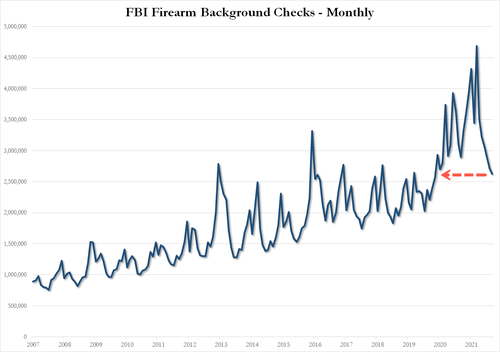
Background statistics suggest so:
September background checks for firearms conducted by the FBI were at the lowest in 22 months, suggesting the year and a half of panic buying guns has lost momentum.
FBI’s National Instant Criminal Background Check System (NICS) data shows background checks slumped 9.2% in September from a year ago. Unadjusted checks dropped to 2.63 million when compared with last September.
I sure hope so, because I would like to buy me some more guns. In particular, I’ve held off buying an AR-pattern rifle because prices got way crazy last year. Maybe I can finally pick up Smith & Wesson M&P15 in 5.56 NATO/.223 if they drop back to the $550-600 price range. (And not one of the crappy “legal for California” versions with the fixed magazine.)
Then again, maybe people have stopped buying guns because they need that money to buy food and gas thanks to the magic of Bidenomics.
Have readers noticed a drop in price and greater availability of popular models in their neck of the woods?