Trump’s winning in Iran, Russia’s losing in Ukraine, Democrats committing fraud left and right, the data center debate rages on, a crappy movie in China gain sudden popularity because it’s crappy, and Orlando PD get to wrestle an alligator.
The “rhetoric” coming from both sides of the conflict over the Strait of Hormuz has “caused considerable confusion and doubt,” CNN’s David Goldman understatedly observed. Yet, at present, “The evidence is clear,” he conceded: “Iran is losing much of its control over the critical waterway.”
One month ago, the number of commercial ships transiting through the strait via the U.S. approved route along the Omani coast was close to zero. Today, however, over 80 percent of the vessels that have made it through the strait are taking the U.S.-authorized lane. And even though the United States has not responded with kinetic force to every Iranian attack on commercial traffic in the strait, sometimes to the consternation of America’s Gulf partners, that has not dissuaded countries like Kuwait, Saudi Arabia, and the United Arab Emirates’ tankers from making “dark traffic” runs on the strait.
CNN could not independently verify Energy Secretary Chris Wright’s claim that “combined oil transits through the strait and rerouted around the waterway totaled around 15 million barrels per day,” which approaches the pre-war average of 20-million barrels. But it couldn’t gainsay the experts. As one industry analyst conceded, “It increasingly looks like Iran has at least partially lost control of the strait.”
The Iranian regime is feeling the pain. As Hot Air’s Duane Patterson explained, the economic conditions on the ground inside the Islamic Republic are catastrophic. “Iran’s economy is currently experiencing around 90 percent inflation, and it turns out the worst may be yet to come,” he wrote. Foundation for Defense of Democracies senior fellow Miad Maleki concurs. “Nearly every part of Iran’s oil economy,” he wrote, “owes massive, growing sums to each other, with no real money moving through the system to pay any of it back.”
The gas lines are growing, and the petrol that Iranians are allowed to buy may soon be rationed. Iranian authorities are triaging their resources by prescheduling hours-long blackouts. The regime is ramping up executions and cracking down on dissent as the prospect of economic collapse brings with it the risk of renewed civil unrest.
Brooklyn Assemblywoman Emily Gallagher (D-50th District) wants New Yorkers to believe that walking out of a CVS with a fistful of stolen toothpaste isn’t a crime. It’s a “biological need.”
Yes, really.
Gallagher, who represents Greenpoint and other parts of northern Brooklyn, made her case Thursday at a news conference outside Manhattan Criminal Court, flanked by fellow far-left officials and activists from Court Watch NYC. The group said it monitored 360 arraignments over four days and found that more than half involved misdemeanor offenses. Gallagher used those numbers to argue shoplifters swiping basic necessities shouldn’t be prosecuted at all.
“Most of what we saw were crimes of poverty-people who are stealing things like toothpaste, people who were stealing things like, you know, soap,” Gallagher said. “And that means if you’re stealing those things, you need them.”
Funny how all those films of riot never show people stealing soap and toothpaste, just flat screen TVs and Nikes. (Hat tip: Stephen Green at Instapundit.)
Salman Ahmed Elmi was charged last week with three counts of aiding and abetting by swindle and five counts of aiding and abetting by false representation.
He made his first court appearance on Monday. Authorities say some of Elmi’s co-conspirators at Reva Health in Golden Valley have connections to a sex trafficking ring bust last week.
Elmi is accused of billing Medicaid for more than $1 million in services that were not provided or not eligible. Reva Health provided autism services and adult rehabilitative mental health services.
“The Minnesota Department of Human Services awarded Elmi an ‘Outstanding Refugee Award’ in 2021.” Why do I have the sneaking suspicion that “Outstanding Refugee” is an award for those that stole the most taxpayer money to give to Democrats?
FBI agents seized electronic devices from former Representative Eric Swalwell (D., Calif.) at the San Francisco airport on Saturday and then raided his home in connection with an investigation into sexual assault allegations against him, according to several reports.
Federal authorities executed a search warrant at Swalwell’s home in Washington, D.C., on Sunday, law enforcement sources told CNN and the Associated Press.
The FBI declined to comment.
Swalwell resigned from Congress and suspended his campaign for California governor in April after a former staffer came forward with allegations that he had sexually assaulted her twice, including once at a hotel while he was in New York City for a charity gala in 2024.
Three other women then accused Swalwell of sexual misconduct as well. The Manhattan District Attorney’s Office and the Los Angeles Sheriff’s Department opened criminal investigations into Swalwell in response.
At the time, Manhattan District Attorney Alvin Bragg encouraged “survivors and anyone with knowledge of these allegations to contact our Special Victims Division.”
The reports that the FBI’s investigation into Swalwell is picking up steam comes days after the White House Transparency Task Force released FBI files indicating Swalwell previously admitted to having “physical relations” with suspected Chinese spy Christine Fang on a “handful of occasions,” providing confirmation of the public sphere’s longstanding suspicion that a sexual relationship had transpired.
Ukraine continues its war on Wildberries. “Best Wildberries Strike Yet! Koledino Near Moscow–Biggest Wildberries Hub in Russia.”
“Ukrainian forces hit at least five workshop buildings at Russia’s Kombinat Kamensky defense plant in Rostov region, penetrating several layers of air defenses from Pantsir to S-300 systems. The plant produces solid rocket fuel for Uragan, Smerch and Tornado-S MLRS, as well as other missile and aviation systems. Key workshops had anti-drone protection and were surrounded by earthworks. Several air-defense vehicles were also hit.”
The Russian fuel situation has gotten so bad that even Russian newspapers are talking about it. “As of the 16th of August, across Russia, 28.1% of petrol stations had fuel. A week before, it was 41%.” Imagine more than two thirds of stations having no gas and long lines at the ones that do.
The State Department worked with World Vision to distribute $2 billion in global health foreign assistance even though an Israeli court convicted the nonprofit’s Gaza affiliate operations manager of sending up to $50 million to Hamas in 2022. Separately, the Health and Human Services Department (HHS) provided nearly $80 million to 14 organizations linked to terrorism and extremism.
The Middle East Forum (MEF) recently reported that 14 terror-linked and extremist organizations, led by CAIR, collected nearly $80 million from HHS through the Refugee Resettlement, Health, and Mosque Renovation grants. Through this fund, the Council on American-Islamic Relations’ (CAIR) California chapter received the most of any Islamist group, collecting $42.2 million in funding from the HHS to provide legal and social services to Afghan refugees.
Concerning: “Chinese Spy Official Who Is Also A Trained Sniper Buys Property Overlooking White House.”
🚨CCP intel official Philip Qiu, who is trained as a SNIPER, bought an historic building overlooking the White House.
“Liberal white woman fights fascism by defacing national memorial to soldiers who died fighting Hitler.” ‘This morning, we are filing two felony charges, Depredation Against Property of the United States and Destruction of Veterans’ Memorials, in Federal District Court against Melissa L. Farris, offenses that carry penalties of up to ten years in prison.” TDS strikes again.
How is this legal? “Karen Bass brags that Los Angeles will use tax dollars to provide a 6:1 match for every dollar donated to her campaign.”
Karen Bass is very worried about losing her mayoralty to left-winger Nithya Raman, who squeaked past Spencer Pratt in the primary election due to a bunch of election shenanigans, and Bass has an interesting campaign strategy.
Using city tax dollars to fund her campaign!…
The city of Los Angeles “donates” money to Bass’s campaign in a matching program? If you give $10, the city chips in another $60? And she’s pushing this program?
Through the foreign-donation-taking ActBlue, no less.
Per the City Ethics Commission (I kid you not), the city charter allows for “public matching funds.”
Left-wing group Common Cause California brags about “strengthening” this public match fund in 2019.
The program is intended to help less-funded candidates get access to funding, but in actuality, all it does is take YOUR tax dollars to fund politicians you hate.
The Frankfurt School. You should know what it was, what it built, and why you are still living inside it.
1. The Institute for Social Research was founded in Frankfurt in 1923 and relocated to Columbia University in 1934 when Hitler came to power. The civilization they had decided to dismantle gave them refuge when another tried to kill them. They spent the next five decades producing the theoretical infrastructure for that dismantling. Western civilization itself was the problem: reason, the Enlightenment, the family, tradition, authority. Not reformed. Dismantled.
2. They called it Critical Theory – and the name is the program. Everything is to be criticized; nothing is to be built. In The Dialectic of Enlightenment (1944), Adorno and Horkheimer argued that Western reason — the reason that produced Newton and the rule of law — contained the seeds of Auschwitz. Not that reason had been misused, but that reason itself, taken to its conclusion, produces the death camp. This was not a critique of institutions. It was an indictment of the civilization itself.
3. Adorno gave them the psychological weapon. The Authoritarian Personality (1950) classified conservatism, religious faith, patriotism, and the traditional family not as political positions but as symptoms of a proto-fascist personality. If you believe in the nation or the father’s authority, you are pre-fascist. The opponent was no longer wrong – he was sick. You don’t argue with a pathology. You treat it.
This made dialogue impossible. You don’t persuade someone who is wrong; you diagnose someone who is sick. Politics becomes therapy, and disagreement becomes pathology.
4. Marcuse gave them the political weapon. Repressive Tolerance (1965) argued that tolerating wrong ideas is itself oppression. True tolerance therefore requires suppressing intolerant ideas. The left decides which ideas are intolerant. Everyone else is silenced – not despite tolerance, but “in its name.” Censorship dressed in the vocabulary of liberation.
5. The generation that read Marcuse at Columbia, Berkeley, and Yale went on to run universities, media, foundations, NGOs, content moderation departments, and the EU regulatory apparatus. They implemented the argument sincerely because they had been taught it as philosophy. This was the Frankfurt School’s greatest achievement: it produced true believers.
6. French Theory picked up the tools and made them aesthetic. Foucault made the critique of power literary. Derrida made the critique of meaning philosophical. Deleuze made the critique of identity elegant. A political program became a cultural sensibility. You can argue with a program. A sensibility is in the air you breathe. By the time these ideas reached the American campus through the French conduit, they were no longer ideology. They were the water. The fish did not know they were wet.
7. A civilization stands on three pillars: truth exists and is accessible to reason; good is distinguishable from evil; and there is an inheritance worth transmitting. The Frankfurt School attacked all three – systematically and with considerable intellectual sophistication. It produced a generation that knows how to deconstruct and has forgotten how to build. That sees power everywhere and beauty nowhere.
The ultimate achievement was to make destruction feel like progress. Every inherited institution became suspect; every constraint became oppression; every act of preservation became reactionary. Deconstruction became the default, while construction became something that needed to justify itself.
Kurt Schlichter: “The Death of Academic Fraud Jason Arday Won’t Shut Us Up.”
Fake Professor Jason Arday was found dead in the wake of being exposed as a complete fraud, and if it were my choice, he would still be alive and suffering the humiliation that should be the result of his crimes. I would prefer that he did not likely choose to kill himself instead of facing the consequences of his actions. My preference is irrelevant. If he decided to do himself in, it’s crushing for his wife and kids, and that was a selfish, cruel, and stupid decision. But it was his decision, as was his decision to commit fraud upon fraud. I don’t celebrate his death, and his death changes nothing. We’re not going to stop rooting out the charlatans.
Of course, the entirely predictable response of the institutional left to his cowardly and apparent self-deletion has been to insist, loudly and with quivering outrage, that his death is our fault. You see, we normal people pointed out that he lied about his background, his achievements, his credentials, and his work. The fact that we did what a functioning institution should’ve done itself outraged his boosters, so these moral illiterates now invert the moral calculus to keep the exposure of academic fraud from happening again. Arday lied pathologically and endlessly, enabled by a ridiculously solicitous academia, then likely killed himself when his lies were exposed. Obviously, the villains are the people who did not lie and did not choose to end his life.
And you’ll never guess their key accusation in a million years.
Okay, you guessed it: RACISM!
Snip.
Regardless, it was entirely predictable that the left would use his unfortunate demise to try to shut us up, to place all criticism of woke charlatans off limits because the subject of the critique might decide to do something desperate. They can’t help themselves but act out irrationally, you see. The fact that this tactic deprives the minority of any agency is no shock; there’s no racist like a leftist, who considers minorities to be nothing more than political marionettes unable to control their own actions. We’re supposed to give them a pass because the targets of our criticism have no agency. It’s like that NSFW scene in Blazing Saddles where the sheriff keeps the townspeople from lynching him by sticking a gun to his head—“He’s just crazy enough to do it!” Except this time the townspeople were not trying to lynch an innocent man and didn’t back off, and he did pull the figurative trigger.
We’re not going to play their game. We’re not going to hold fire for fear of feelz. We’re not going to ignore the truth lest the liar lash out at himself or others. Sometimes the truth hurts, but the only people the truth hurts are people exposed doing something they shouldn’t be doing. The truth is more important than feelings. And the truth is more important than Arday’s life. If the choice we are presented with is that Jason Arday will go on living a lie and degrading our civilization by doing so, or that Jason Arday might hurt himself, it’s Option 2 every day of the week. We’re not going to be held hostage or intimidated or shamed into silence and, therefore, complicity.
Texas has three federally recognized Native American tribes: Ysleta del Sur Pueblo, located in the western part of the state in El Paso; the Kickapoo Traditional Tribe of Texas, located near Eagle Pass along the Rio Grande; and the Alabama-Coushatta Tribe of Texas, located in the eastern part of the state near Livingston.
And two of those are along the Mexican border, which means drug smuggling is a big problem.
I’m going to quote a largish chunk here just so I can tag the various companies.
In June, Abbott directed the Public Utility Commission of Texas (PUC) and the Electric Reliability Council of Texas (ERCOT) to require data centers to pay for their own electric infrastructure costs, scuttling at least one project planned for East Texas.
Then, earlier this month, Abbott asked these agencies to audit all data center projects in the process of connecting to the Texas grid. According to his directive, data centers in the pipeline must provide and verify information about their water usage; their noise, light, and traffic mitigation efforts; how they plan to obtain electricity; whether they receive taxpayer money; and the real identities of their owners.
A flurry of affirmative replies ensued, including assurances from some of the best-funded users and most prolific developers of data centers in the world.
Many of these companies have already made use of a sales tax exemption for data center equipment — a 13-year-old state law passed before the remote work boom of the COVID-19 pandemic and the rise of generative artificial intelligence (AI) this decade propelled the industry well past the state’s expectations.
Here are the data center companies that have agreed to comply with Abbott’s standards, cross-referenced with the state’s list of companies that benefit from the tax break.
QTS Data Centers
On August 6, Virginia-based Quality Technology Services (QTS) “applauded” Abbott’s “efforts to increase transparency on power use, water and resource consumption, and community considerations associated with data center development.”
QTS data centers built after 2019 use fans rather than water for cooling, according to the company.
The company operates three facilities in Texas and has three more in the pipeline, according to its website. The Texas Comptroller of Public Accounts certified one QTS facility, a 56-acre campus in Irving, to benefit from the state sales tax exemption.
Vantage Data Centers
Vantage Data Centers sent a letter of support to Abbott on August 7.
The company, based in Denver, Colorado, only lists one active data center in Texas, at an undisclosed location in Shackelford County. However, it has secured a sales tax exemption for 12 projects listed by the comptroller, all for Oracle.
Skybox
Texas-based Skybox Datacenters agreed to Abbott’s standards on August 7.
The company has built nine data centers around the state. Besides one in Wichita Falls, all are in the Dallas, Austin, and Houston metropolitan areas, according to its website. The comptroller’s list of qualifying data centers doesn’t include a project with Skybox in the name or one associated with its address at 3131 Turtle Creek Boulevard in Dallas, based on a search of the state’s franchise tax database.
Digital Realty
Digital Realty stated on August 7 that it would comply with Abbott’s standards. The Austin-based company claimed in its statement to be “the world’s largest cloud- and carrier-neutral data center platform.”
Digital Realty operates more than 300 data centers that serve companies including Microsoft, Amazon Web Services, Nvidia and IBM. Twelve of its 14 Texas data centers are in the Dallas area, its website shows.
Stream Data Centers
Dallas-based Stream Data Centers agreed to Abbott’s standards on August 7.
Altogether, nine Stream data centers are either active or in development across Texas, with one on the outskirts of Houston, three in San Antonio, one in Austin, and four in the Dallas area.
Mara
Mara agreed to abide by Abbott’s standards on August 7.
The Florida-based company operates a Bitcoin mining fleet, and it “colocates data centers with power sources to convert stranded energy into digital capital,” its website states.
The company name doesn’t appear on the comptroller’s list of qualifying data centers, nor do any subsidiary companies registered under the address of its Florida headquarters.
Rowan
Rowan Digital Infrastructure, another developer based in Denver, issued a press release in support of Abbott’s orders on August 7.
The company owns and operates four data centers in Texas that benefit from the sales tax exemption, including one in Temple for Meta and another in Cinco for Google.
Meta
Meta, the California-based parent company of Facebook, pledged to comply with Abbott’s standards on Monday.
Meta’s three Texas data centers are in Fort Worth, Temple, and El Paso, according to its map.
Multiple data centers owned or used by Meta benefit from the state’s sales tax exemption. One subsidiary company, Polmer LLC, owns the certified data center in Temple and occupies two other data centers on the comptroller’s list of certified projects. The El Paso facility is owned by a Meta subsidiary, Wurldwide LLC, which also makes use of the exemption.
OpenAI and Oracle
California-based company OpenAI, which created ChatGPT, agreed to comply with Abbott’s standards on Monday. Oracle, also based in California, made the same commitment on Tuesday.
OpenAI is collaborating with Oracle and SoftBank on Stargate, a $500 billion AI infrastructure project based in Abilene and funded in part by chipmaker Nvidia. Lancium, a company backed by New York-based investment firm Blackstone, is constructing the facility, according to its website.
Eleven Lancium data centers and projects appear on the comptroller’s list, spanning Fort Stockton, Turkey, Childress, and Abilene. Seven projects in Abilene are associated with Stargate, with Oracle listed as an occupant.
Core Scientific
Core Scientific issued a press release in support of Abbott’s directives on Monday.
The company, based in Miami, Florida, operates three data centers in Texas: one in Austin, one in Denton, and one in the Callahan County town of Cottonwood, according to its website.
All three benefit from the state tax exemption, the comptroller’s list shows.
Google
The California-based Big Tech titan expressed support for Abbott’s standards on Monday.
The comptroller lists Google as the owner or user of nine data centers that benefit from the sales tax exemption.
CleanSpark
Data center developer CleanSpark Inc. agreed with Abbott’s standards on Monday.
The Nevada-based company doesn’t publish a comprehensive map or list of its data center locations, but as of February, it owned two plots of land in Brazoria County and Austin County with plans to develop facilities there, according to an investor relations press release.
Neither CleanSpark nor the only Texas entity registered to its corporate address, Eagles Nest 138 LLC, appear on the comptroller’s list of data centers.
EdgeConneX
Virginia-based EdgeConneX announced support for Abbott’s standards in its Tuesday press release.
The company doesn’t specify how many discrete data centers it operates in Texas, but it’s only active in the Houston and Austin areas, according to its online map.
The state has certified two EdgeConnex projects for the tax exemption, both in the Austin area.
SB Energy
SB Energy sent Abbott a letter on August 6 expressing support for his directives and publicized it on Tuesday.
The Redwood City, California-based company is building a facility in Milam County in support of Stargate, with Orion listed as an occupant on two projects that benefit from the state sales tax exemption.
Data Center Coalition
The Data Center Coalition, a trade association that represents data center companies, expressed support for Abbott’s directives on Tuesday.
David Morens, a former senior adviser at the National Institute of Allergy and Infectious Diseases, pleaded guilty on Tuesday to hiding federal records from Freedom of Information Act (FOIA) requests during the Covid-19 pandemic.
Morens, a senior adviser at NIAID’s Office of the Director from 2006 to 2022 under Dr. Anthony Fauci, was charged by the Department of Justice in April with five counts related to the scheme.
He agreed to a deal with federal prosecutors this week that would see him plead guilty to one count of conspiracy to commit offenses or to defraud the United States. The charge carries up to five years in prison.
Snip.
The indictment came after the House Select Subcommittee on the Coronavirus Pandemic found evidence that Morens had used his personal email to discuss Covid-19’s origins and National Institutes of Health grants with EcoHealth Alliance, including a terminated coronavirus grant, in an attempt to keep the communications hidden from hypothetical future FOIA requests.
The committee obtained a communication between Morens and EcoHealth President Peter Daszak in which Morens wrote, “I can either send stuff to Tony on his private gmail, or hand it to him at work or at his house. He is too smart to let colleagues send him stuff that could cause trouble.”
Why it was almost like their was a conspiracy of secrecy against the American people…
Abdulloi Toshpulodzoda left the Northern Virginia Mental Health Institute (NVMHI) on July 6 for an authorized 48-hour pass. He was required to return two days later, but he never did, FOX 5 reported, citing court documents.
Instead, Toshpulodzoda traveled to Washington Dulles International Airport and boarded a Turkish Airlines flight to Istanbul before continuing to Dushanbe, Tajikistan, court documents show.
Snip.
FOX 5 reported that Toshpulodzoda had previously been allowed to travel to Washington, D.C., in 2024 to obtain a passport, with support from the Commonwealth’s Attorney’s Office.
Sorry, a what? Passport? And then they gave him a 48-hour pass? And then they were surprised that he fled the country and never came back?
Well done, everyone.
You may not be surprised to learn that it was the office of far-left Steve Descano, the prosecutor for Fairfax County, that allowed him to get the passport.
The Trump admin is suing Descano for releasing violent criminals. You may recall that Descano went viral for allowing a registered sex offender to change in the girls’ locker room at multiple HIGH SCHOOLS because the sex offender now identifies as a woman.
Very suspicious: “Bastrop City Council Holds Official Workshop 100 Miles Away from their Constituents.”
On August 7th, the Bastrop City Council conducted official workshops not in Bastrop (where one might reasonably expect), but more than one hundred miles away in Fredericksburg. The posted agenda lists the location as the John Wm. Klein Meeting Room at 115 N. Crockett Street in Fredericksburg, roughly a two-hour drive from the city those officials were elected to serve.
And no, these were not informal “retreats” for city council members to relax and blow off steam. These were formal City Council workshops covering the very decisions that hit taxpayer’s wallets and daily lives hardest: the city budget, setting the tax rate, Hotel Occupancy Taxes, capital projects, the Master Transportation Plan (including an East/West connection north of Highway 71), water and wastewater planning, street projects, and “Future Goals” that include a recreation center, expanded fire and police service, data center policies, and Legislative “advocacy.” An extensive list of hot-button issues all to be discussed far away from their constituents.
State Rep. Stan Gerdes (R-Smithville), whose district includes Bastrop, correctly called out the problem: “The City of Bastrop is holding a City Council meeting hours away in Fredericksburg, making it nearly impossible for the people they represent to attend and participate.” He noted the agenda’s weight on budget, tax rate, data centers, and surveillance technology and announced plans to file legislation requiring city council meetings to be held inside the city they serve so residents can actually show up, speak, and hold officials accountable.
Security camera company Flock Safety has announced changes to its privacy safeguards amid public opposition to use of the devices and concerns about law enforcement abuse.
However, U.S. Rep. Keith Self (R–McKinney) told Texas Scorecard that although these changes are welcome, Flock is obviously “trying to gain acceptance and put lipstick on a pig amid the intense pushback they have received from Americans across the nation who are rightfully concerned about their privacy.”
“The bottom line is Americans do not want to be spied on, and they reject the surveillance state operating in America,” said Self. “The Fourth Amendment is not a suggestion. Federal and state legislation are still needed to ensure the government cannot access this data without a warrant—and that taxpayer dollars are not spent purchasing or installing this invasive spyware. That’s why Congress needs to pass my bill, the PRIVACY Act.”
Self filed the PRIVACY Act last month. It would require federal law enforcement to obtain official warrants before accessing or querying data collected by state and local systems, including automated license plate readers.
Powered by artificial intelligence, Flock cameras have been a hotly debated topic across the U.S., with concerned Texans requesting that state lawmakers create guardrails for the technology during the upcoming legislative session.
Since law enforcement officials do not need a warrant to access the Flock automated license plate reader (ALPR) database, citizens are raising concerns about potential Fourth Amendment violations.
Among the technology updates is a new default setting of 7-day data retention instead of the previous 30 days. This change is based on Flock’s analysis that all searches “without a full plate are done within a week.”
The Critical Drinker/Gamer covers a hacker group penetration of Rockstar games, evidently including full playable source code of the highly anticipated Grand Theft Auto 6. They’re even threatening to release the ending if Rockstar don’t promise to eschew the greedy enshitification of games (like ending physical media) that’s now standard practice in the industry.
Niu Lai is a sleeper hit in China, mainly because the animation is so bad, something that might have been a 3D animation demo reel in 1994. (Hat tip: Ann Althouse.)
In news that may be of interest only to me, both BattleSwarm and Futuramen had huge upticks in Views this week, at least ten times normal traffic, though a smaller uptick in unique Visitors, and I notice no single post generating such traffic. I can only assume some AI scanned the entirety of the site.
“DeSantis Explains To Newsom Secret To Counting Ballots In One Night Is Not Committing Fraud.”
“Kentucky Derby Convenes Committee To Determine What Is A Horse.”
Occasionally when wasting time on YouTube searching for content to post here, I come across videos that make an obvious pairing. Today’s topic: Death Rays!
First up: Simon Whistler on the U.S. military’s Songbow Laser Cannon:
“Lasers are not just a sci-fi prop anymore. They are at the heart of a global race to develop the most powerful and precise directed energy weapons. China, Russia, Israel, and the UK are all in on the game. But with Songbow, the US Navy’s new laser cannon, America probably thinks it’s won.”
“Songbow will feature a 400 kilowatt laser. That is a major step up from its older sibling, the 60 kilowatt Helios. This extra energy will allow it to hit bigger, tougher targets faster and from further away. As modern warfare evolves, it’s the weapons surface vessels need to counter serious aerial threats like drone swarms and incoming missiles. And where traditional interceptors can cost millions, a shot from a song bow could be as cheap as a dollar.”
“There’s been mounting concern in recent years about the survivability of the US Navy’s vessels. Countries like China are now armed with large numbers of drones and anti-ship missiles. The modernizing of China’s navy has been steadily underway for decades with the result that it’s now a formidable foe.” Sort of. They have a lot of ships, but they still don’t have a deep water navy, and none of their current aircraft carriers are nuclear powered.
“There’s been debate over whether America’s surface vessels might need to stay beyond the range of these weapons in future conflicts. And of course, China is no longer the only threat.”
“Up until now, there have been two key limitations affecting the US Navy in this arena. First, there’s the finite depth of its magazines. In response to airborne threats, surface ships are limited to how many surface-to-air missiles they can carry. And secondly, there’s the wildly disproportionate cost to kill. An unmanned aerial vehicle, also known as a drone, can be made very little, but it can cost literally a fortune to take it down.”
“Needless to say, these problems are not unique to the US Navy, and the solution to them isn’t either. It’s the same solution being explored by governments the world over: Lasers. Or to give them their full designation, high-powered directed energy weapons.”
“The US Navy has been investing in laser technology for a while now. Its interest goes right back to the days of Ronald Reagan’s strategic defense initiative. Publicly launched in 1983, this was the plan to pioneer a space-based missile defense system which would include a network of lasers to protect America from nuclear attack. The press nicknamed it Star Wars.”
“It was the start of a long flirtation with the possibilities of laser weapons. In the late 1990s, the US and Israel came up with the tactical high energy laser for military use, also known as Nautilus. This used a chemical laser, one that takes its energy from a chemical reaction.” That didn’t work.
“A much better solution seemed to lie in electricity. A beam would instead be generated and amplified through thin glass fibers. As an alternative to chemicals, fiber lasers are smaller, safer, and better suited to mobile applications. They might not have the raw power of chemical lasers, but in theory, they’re much easier to deploy. Think less death ray, and more laser pointer kind of. The main challenge was generating enough power with a fiber laser. So, in the late 2000s and early 2010s, researchers began creating combined beams and array systems using the collective power of several smaller lasers.”
“And this is where the technological leaps are now being made. But whatever has gone before, Songbow has the potential to eclipse its predecessors. It’s been designed in direct response to increasing aerial threats like drones, projectiles, and hypersonic missiles. It follows on from the Navy’s Helios, a high energy laser weapon that’s now been deployed on the Arleigh Burke class destroyer. But where Helios can fire at around 60 kW, Songbow will pack a much stronger punch at around 400 KW. It does this by combining multiple 50 kW fiber laser modules to form one beam.”
“It’s hoped that the power density of a 400 kW class beam will be able to do this to bigger targets at longer ranges. Songbow’s key function will be as a drone and missile defense system, but its pulseed fiber lasers will also assist with remote sensing and target illumination.”
“It’s expected to be installed on naval surface vessels, but could also be deployed on land, making it really rather versatile.”
“The Pentagon is directing billions of dollars into directed energy weapons. The US Navy, Army, Air Force, and Missile Defense Agency are all channeling money into high energy lasers, microwave systems, and battlefield power systems. In April this year, the Department of Defense unveiled a $ 1.5 trillion budget proposal for the fiscal year 2027, described as the most expensive military outlay in modern history. Because as more and more US adversaries and potential adversaries invest in their own capabilities, maintaining dominance is now a spending priority. Jules Hurst III, President Trump’s Under Secretary for War and chief financial officer, has hailed it as a generational investment in the United States military.”
“The US Navy has invested almost $30 million into the [Songbow] project, with funding coming from the US Office of Naval Research. In June 2025, it announced that the contract had been awarded to Coherent Aerospace and Defense in Moretta, California. Not long after, the division was sold to the private investor Advent International. Now renamed Atalon, the company is focused on this growing industry, precision optics and laser systems for aerospace and defense.”
“Beyond all the marketing speak, there are some real advantages to Songbow compared to other solutions. Let’s look at what makes the list of pros. We’ve already talked about that 400 kW beam. Achieving this higher power would mean a drastically increased range and destructive capability. It could even have the ability to eliminate threats that other systems can’t. These might include hypersonic glide vehicles, which move too quickly for traditional interceptors, and hardened cruise missiles, which can’t be beaten by less powerful lasers. It’s estimated that at least 300 kW are needed to burn through the structure of a cruise missile in flight, making a Songbow laser comfortably capable. Now, this is yet to be proved. It’s all aspirational, but it’s what we’ve got to go on.”
“Next up, there’s its cost effectiveness. Wars are cripplingly expensive, as you probably know…The Navy spent an estimated $2 billion in munitions while countering Houthi missile and drone attacks in the Red Sea and Gulf of Aiden. Most galling of all of this is that the threats they’re countering can be really cheap. In the Russia Ukraine war, drones costing a few hundred dollars have successfully taken out multi-million dollar combat systems. Even the more expensive drone options require a huge spend to neutralize. An Iranian one-way attack drone like the Shahead can cost between $20,000 and $50,000. But the interceptor missiles needed to take it down will set the US back millions. And it’s here that the Songbow and other laser weapons could make all the difference. Directed energy is much much cheaper per shot compared to traditional interceptors. Songbow costs somewhere between $1 and $10 for every shot because it’s only ammo is electricity.”
“This energy source also lends it another advantage. As long as a ship’s power supply lasts, it can keep going. With an unlimited magazine depth, there’s no fear of missile stocks running low. Logistically, it’s a lot easier. In contrast, a Patriot missile battery, for instance, typically contains between six and eight launching stations, each capable of holding 16 PAC3 missiles or four PAC2s. At most, it’s got 128 missiles ready to fire, depending on its configuration.”
“And of course, at sea, space is at a premium. A surface vessel can only carry so many interceptors. Running low on ammunition is also known as ‘going Winchester.’ Ships equipped with the Aegis combat system, the US Navy’s long-standing shield of the fleet, typically carry up to 96 missiles. This might sound like a lot, but it’s a known limitation. When they’re gone, they’re gone.”
“And there’s another thing in Songbow’s favor, too. In the face of threats, laser weapons are fast. Where missiles or bullets take seconds to reach their targets, the Songbow is instantaneous. As soon as it’s fired, it’s arrived. And unlike conventional weapons, you can go again and again. No reloading, no waiting around. This is obviously very handy if you’ve got multiple incoming projectiles and want to move straight onto the next one.”
“Modern warfare is often dictated by quantity rather than quality. Launching a large swarm of drones, decoys, or projectiles is an effective way of completely overwhelming defenses. These are what strategists call saturation attacks. There are just too many targets to handle all at once. There’s not enough time to reload and refocus, and missile stocks simply run out. But in theory, as long as electrical power lasts, directed energy weapons could keep going.”
“We need to be very wary of overhyping this, though. A high energy laser still needs time to disable a target and move on. So, there’s still a limit to what could be achieved in a large enough saturation attack. But with more than one laser weapon, the advantage would be pretty sizable.”
“Directed energy weapons can also stay on target continuously. They can follow a threat and maintain their beam while it’s maneuvering.”
“It’s even rumored that Songbow will be able to defeat hypersonic missiles. These, you see, are a real fly in the ointment for defenders like the US. Hypersonic missiles are able to fly at speeds exceeding Mach 5 and change course unpredictably, making them notoriously tricky to take down. Contrast this with an inbound ballistic missile. In this case, conventional air defense systems can track it and calculate its future flight path. It tends to be fairly predictable. They’ll then launch an interceptor to meet it where it’s likely to end up. Hypersonic missiles, though, don’t play by these rules. They’re faster and they change course mid-flight, making it much harder to calculate their flight path. In theory, Songbow’s winning combination of high power, speed of light engagement, and capacity for continuous firing could see it win the day.” Set aside for a moment that Russia and China’s “hypersonic” missiles are more hype than sonic.
“However cool and futuristic it sounds, Songbow still has its limitations and its critics.”
“One of the main obstacles to any laser weapon is nature herself. Atmospheric conditions like mist, fog, and rain can all absorb and scatter light, diffusing a laser’s beam. And the same goes for things like smoke, salt particles, and if it’s used on land, dust and sand. So, this is not an all-weather solution. And in time, seaborne enemy craft could even be fitted with devices that create smoke or other obscurants to protect themselves. This would be a very easy way to counter a laser. Extreme sea conditions will also pose a problem. Lasers follow a straight line of sight, which isn’t always possible on a constantly shifting terrain like water. Rough seas and swells can easily disrupt a beam, especially over longer distances.” With modern gyro-stabilization, I suspect this is largely a solved problem.
“Even a ship’s vibration can cause difficulties. High energy lasers rely on precision, but the general operation of a ship is pretty unstable. As well as waves and the motion of the ocean, you’ve got the vibrations from engines and onboard machinery. Maintaining a stable lock while taking all of these things into account is going to be really quite hard.”
“And in practical terms, the sky, or rather the horizon line, is the limit here. A laser is clever, but it can’t magically arc over the horizon. It’s a definite physical limitation compared to a combat system like Aegis.”
“Another downside to high-energy laser systems comes in the form of thermal blooming. This is basically when a continuously firing laser beam heats up the air around it, causing it to defocus and become less effective. It’s a bigger issue when the targets are coming head-on in a straight line, known as a down-throat shot. At times like this, the beam has to sustain itself in one direction for a long time. The more powerful a laser weapon, the more troublesome this is. So, it could be a real problem for the 400 kW Songbow.”
“Operationally, all that power is something of a double-edged sword. We talked about the advantages of a weapon that can run from a ship’s electrical supply. Said earlier, as long as a ship’s power supply lasts, it can keep going. High power lasers, you see, need a hefty electrical supply and advanced cooling capabilities. A large amount of the energy they generate is just lost as heat, which needs to be dissipated. If it isn’t, the weapon will ultimately become damaged and will stop working.”
“Managing the temperature of a directed energy weapon is crucial. This means a specialized cooling system, and this is asking a lot of shipboard power systems, especially when they’re already prioritizing output for things like radar and propulsion. As journalist Charles Mitchell has written, quote, ‘The challenge is to cause a warship to act as a stable power plant and a heatsink at the same time as it is operating high demand sensors, combat systems, hotel loads, and other auxiliaries.” End quote. He argues that the laser fight won’t so much be limited by a ship’s fuel tank, but by its electrical and thermal headroom. If a laser is continuously being shot, its effectiveness is going to come down to how quickly its ongoing heat buildup can be carried off. But according to one naval industry report, even the Navy believes the Arleigh Burke class fleet of destroyers has quote reached the limits of its growth capacity. This raises serious questions about how easily older ships like these would be able to take on the Songbow’s enormous electrical and cooling demands. And this seems to be a challenge the US Navy is well aware of.”
“Already next generation surface vessels are in the works with designs for expanded power generation that will accommodate directed energy weapons. In December 2025, Donald Trump announced the Navy’s plan to develop a new class of ‘largest we have ever built’ battleships. It’s hoped that the first, the USS Defiant, will be ready in the early 2030s. According to plans, the Defiant will be nuclear powered to provide the Navy’s fleet with quote a significant increase in combat power by longer endurance, higher speed, and advanced weapon systems required for modern wars.” This is also the reason the Gerald R. Ford class of aircraft carriers is powered by two nuclear reactors.
“Among these same plans, the Trump class battleship seems to include two 300 or 600 kW shipborne lasers and other laser systems for optical dazzling and sensor disruption.”
“Commentators have described directed energy weapons as central to the Trump class ship’s design, but this form of weaponry has always had its hurdles. Hurdles that have plagued the development of laser weapons since the 1980s. Even a Congressional Research Service report acknowledges the old saying, quoting again, “Lasers are X years in the future and always will be.”
“Only last year, one of the Navy’s top fleet commanders, Admiral Daryl Caudle, said the service should be embarrassed by its slow progress with the technology. Because although the theory behind their application carries weight, he believes the US still isn’t ready for prime time. Lasers might promise a lot, but they’re not yet a viable way to take out a missile. And at a symposium in 2024, Rear Admiral Fred Pyle told attendees the Navy had quote a tendency to overpromise and underdeliver.”
Skipping over the failure of the Army’s 300 kW Valkyrie laser system, which seemingly couldn’t hit milestones and was mothballed. “The Army decided the prototype would not be fielded to units. Instead, it’ll be used to inform the new joint laser weapon system. This laser initiative is a collaboration between the US Army and the US Navy. In theory, it’ll allow them to pull their research from past efforts to create a 150 kW system that could potentially be scaled up.”
“Similarly, in 2024, the US Air Force shut down its much vaunted SHIELD program, which had set out to introduce pod-mounted high energy lasers to fighter aircraft.”
“SHIELD had apparently been hit by many of these issues that we’ve already talked about. Technical difficulties, heat generation, harsh environments, all leading to claims that the technology still wasn’t developed enough for real world use. Of course, this doesn’t mean the whole concept of laser weaponry is being scrapped.”
“Despite the troublesome quirks of laser weapons, they’re in motion all over the world. The United States definitely isn’t the only global power taking part in this futuristic race.”
“You might remember our video about the UK’s Dragonfire laser. Like Songbow, Dragonfire has been designed to counter drones, missiles, and projectiles. And also like Songbow, it uses solid state fiber laser technology. The development of Dragonfire has been funded to the tune of million pounds.”
“In 2024, it successfully engaged an airborne target during an exercise. There at the Hebrides range in Scotland, the weapon took drones flying at 650 km/h down. Dragonfire is due to be fitted to a Royal Navy type 45 destroyer in 2027. Because of this, its exact range is still classified, but we do know that according to the official descriptions, the level of precision it offers is the equivalent of hitting a one pound coin that’s about the same size as a euro or a US quarter from a kilometer away. It’s capable of manifesting 50 kW of power.”
“And it’s a similar story with Israel’s Iron Beam, otherwise known as the laser dome, pioneered by the defense technology company Raphael. This is a 100 kilowatt high energy laser system. In Raphael’s glossy marketing, it claims that Iron Beam redefines modern warfare. And I mean, yeah, maybe it does. Reportedly, the Iron Beam is able to overcome the atmospheric challenges faced by other laser weapons. With lasers, the larger the beam, the more atmospheric interference you’re likely to face. The Iron Beam gets around this by shooting hundreds of small coinsized beams instead of one. These all converge on a target until it’s damaged or destroyed. It claims almost zero cost per interception, whatever that is. And significantly, it’s now up and running. In December 2025, the Iron Beam was officially deployed to the IDF after more than a decade in development. And in March 2026, social media footage seemed to show it in action intercepting a Hezbollah drone.”
“Israel may be the first, but it won’t be the last. Also hot on their heels are South Korea, Russia, Ukraine, India, and Japan. All are developing variations on the theme. And last year, China unveiled its own shipbourne weapon, the LY-1, a high energy laser weapon said to be an advanced testing.” China’s weapon systems seem to be long on hype and short on performance.
“Reading about high energy lasers, the term layered defense comes up a lot. At least for the time being, and probably for a long time to come, laser weaponry can’t be a one-stop shop solution. There’s simply too much to it and too many limitations to consider. And so, it will literally become just one weapon in a country’s arsenal. Systems like Songbow will sit alongside more proven interceptors so that if, for instance, sea conditions become rough, there’s still something a crew can do to deal with that pesky incoming drone.”
“Traditional projectiles might be fishily expensive, but they’re probably here to stay in some capacity.”
“As well as working alongside other defensive weapons, Songbow will also sit within the Navy’s laser family. If it’s successfully deployed, it’ll act as the big gun. But there are other smaller siblings there, too. Take ODIN, for example. It stands for Optical Dazzling Interdictor Navy. And at the time we’re writing this, there are seven ODIN systems on Navy ships. They’re there specifically to emit an infrared light that will scramble the optical sensors of a drone. Rather than shooting it down, they can effectively make it lose its way and crash.”
Helios, another laser defense system already deployed on the Arleigh Burke-class USS Prebel, successfully shot down Iranian drones this year.
“The global race to field directed energy systems is well and truly on, leading some to call this the age of laser weapons. It echoes past scrambles around stealth aircraft and precision missiles. Now, the question isn’t so much whether lasers will reach the maritime sphere, but how quickly countries can overcome the many hurdles to making this a success.”
Now the second death ray video. In my Black Friday/Prepper roundups, I’ve been including links for the IMALENT MS18, an insanely powerful flashlight that I don’t have a use case for, but which some people (say, ranchers or security guards for large complexes) might. Well, someone took its big brother, the IMALENT MS32, put a magnifier on it, and turned it into a death ray.
Now, as a death ray it’s inferior to a gun as a self-defense weapon, and about 1/100th as cost effective for lighting a fire than a cheap electric lighter. But it’s still pretty cool. Err, pretty hot, that is…
Every now and then a story comes along that you see isn’t quite right, and you correct it, knowing the correction will please absolutely no one, because truth is truth. This is one of those cases.
Sometimes, you have to be this guy.
In this case the subject is New York Times columnist Nicholas Kristof’s absurd contention that Israelis train dogs to rape Palestinians. Everyone and their dog (oops) has already piled on the absurdity of the claim and just how devoid of supporting evidence Kristof’s piece was, with even New York Times reporters saying they’re embarrassed by it.
That’s not what I want to talk about.
Many pieces have gone on to cite ludicrous Palestinian claims of all sorts of trained animals working for Israel, like in this piece from The Hill:
In 2015, the BBC published the ludicrous claim that Hamas had seized an “Israeli spy dolphin” off the Gaza coast. Earlier, CNN had publicized Sudanese claims that it had captured an Israeli “spy vulture” on a reconnaissance mission. The BBC also ran a headline in 2010 titled “Shark attacks not linked to Mossad says Israel” and the Telegraph reported “Shark ‘sent to Egypt by Mossad.’”
Tiny problem: The idea that Israel is training spy dolphins is not, in fact, ludicrous, because the U.S. Navy does it.
Back when the Navy dolphin program was a hush hush secret, a friend told me about it, saying they would never send a dolphin on a mission where it was likely to get killed because it took several million each to train them. “They’ll just send a diver instead.” He also said that once some Greenpeace types has cut through the underwater retaining fence to free the dolphins, but the dolphins simply swam right back because of how well they were fed in the program.
The Reconnaissance and Interdiction Division at NIWC Pacific manages the Navy’s Marine Mammal Program which trains bottlenose dolphins and California sea lions to detect, locate, mark and recover objects in harbors, coastal areas, and at depth in the open sea.
Everyone is familiar with security patrol dogs, and how some service dogs use their keen sense of smell to detect explosives on land. Since 1959, the U.S. Navy has trained dolphins and sea lions as teammates for our Sailors and Marines to help guard against similar threats underwater. The Navy’s Marine Mammal Program has been homeported on Point Loma since the 1960’s.
Now, I have no idea whether the Israelis train spy dolphins or not. It may not be cost-effective, since there are a lot more limited uses for them considering the regional threat domains they face. But the idea that the Israelis are training spy dolphins is neither “ludicrous” nor far-fetched.
Doesn’t mean Hamas captured one in 2015, since those Jihadi idiots lie about everything, but it’s definitely within the realm of possibility.
When else will I have a chance to generate a meme this obscure?
Tomorrow should see a return of non-Ackchyually content…
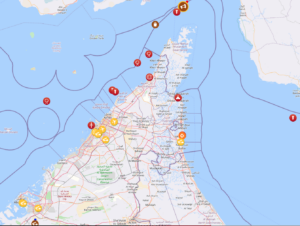
Taking a look at the activity in the Strait or Hormuz, it looks like our mostly peaceful pause is at an end and things are about to get kinetic again. Looking at the Iran Livemap, the Iranian Revolutionary Guard has resumed attacking both shipping and its neighbors.
Some incident entries:
“A South Korean vessel has reportedly been hit by the IRGC in the Strait of Hormuz.”
“Explosions near US bases in the UAE.”
“Once again UAE air defenses are dealing with a missile threat.”
“A missile attack on an ADNOC oil tanker in one of the UAE’s ports.”
“Flights in the United Arab Emirates have been suspended.”
“CENTCOM: U.S. Navy guided-missile destroyers are currently operating in the Arabian Gulf after transiting the Strait of Hormuz in support of Project Freedom. American forces are actively assisting efforts to restore transit for commercial shipping. As a first step, 2 U.S.-flagged merchant vessels have successfully transited through the Strait of Hormuz and are safely headed on their journey.”
“UKMTO reports an incident 36 nautical miles north of Dubai, United Arab Emirates.”
“IRGC spokesperson says vessels violating regulations announced by Guards in Strait of Hormuz ‘will be stopped by force.'”
It appears the IRCG regards Trump’s slow economic strangulation via blockade as a bigger threat to their tenuous hold on power than American and Israel bombs falling on them. They’re probably correct in that assumption. The operational pause has allowed U.S. and Israeli forces to resupply and rearm, and I suspect we’ll soon see what military and regime assets are left to hit.
This is very much an in-progress post put up before the big fireworks kick off again.
Something a little different than the usual Iran roundup: Two videos about Kharg Island, one an after-action report on a U.S. attack run, the other a description of what makes taking the island difficult.
The caveat for the after-action video, a recreation of an actual U.S. attack run, is that it’s done a breathless, overly-dramatic fashion, like something from Most Shocking. But the detailed, blow-by-blow account suggests it was taken from actual after-action reports.
Three B-1B Lancers carrying precision-guided bombs attempted the most surgically demanding strike of Operation Epic Fury — destroying Iranian military targets on Kharg Island without touching the crude oil infrastructure sitting meters away. Then the GPS jamming started, and the mission nearly came apart.
This video reconstructs the full tactical breakdown of the Kharg Island strike: how an Iranian GPS jammer degraded bomb accuracy toward the oil, how the F/A-18 Super Hornets sent to destroy it nearly got hit by friendly JDAMs when a deconfliction failure put them directly in the bomb fall line, and how one Mersad air defense commander’s final radio transmission turned inaccurate anti-aircraft fire into precision-guided shrapnel that bracketed B-1Bs mid-bombing run. We cover the AGM-158 JASSM cruise missile shot that eliminated the SAM battery, the burning missile propellant creeping toward thirty million barrels of crude oil, the IRGC patrol boat sprint toward the supertanker loading channel, and the F/A-18 pilots who descended into accurate anti-aircraft fire from guns they couldn’t suppress to stop a mining operation with laser-guided GBU-54 JDAMs.
The breathless nature of the narration makes me suspect that certain aspects have been embellished for dramatic effect.
Next up: Simon Whistler discusses how difficult it will be for the American military to take and hold Kharg Island. Consider it the pessimist case against the operation.
“The value of Kharg Island is obvious. Control the island, and you could throttle Iran’s oil dependent economy. Capture the island intact, and another nation could make Iran do anything to get it back. Destroy it outright and Iran would transform from a powerful rogue nation into an economic afterthought. And that’s if we’re being generous.”
“The export facilities on Kharg Island are the most important site in one of Iran’s most important regions, meaning that the region is especially important to the Iranian military. This is a region with a well-developed civilian infrastructure, a large presence from the Islamic Revolutionary Guard Corps or IRGC, and most likely the hidden weapons stockp match. Then there’s the island itself, a low-lying coral crop with an elevation of just 70m at its highest point. With a land area of roughly 20 square km, Kharg Island is basically flat, basically triangular in shape and surrounded by deep waters to enable the transit of oil tankers.”
Some pre-situated weapons and supply caches will likely survive any American bombardment.
“There’s no telling what the US will destroy and what it’ll fail to pick up on, but some of those mines and air defenses will survive, raising the possibility that they could claim the lives of US troops or shoot down vulnerable non-stalthy low-flying aircraft. That said, Kharg will not be an easy place to defend once US ground forces have established a foothold. Iranians on the island will either be left exposed or be forced to use refinery infrastructure as cover unless they allow themselves to be pushed into the island town where most residents live.”
“Iran’s objective is not victory in any conventional sense. Iran is able to accept the deaths of its political and military leaders and the destruction of its cities and mass casualties among its soldiers, paramilitaries, and civilian supporters. Iran’s focus is on regime survival, not the survival of the people who make up the regime, but the survival of the regime itself.” No, that’s the regime‘s goal. Most ordinary Iranians hate the regime’s guts.
He notes the difficulty of getting amphibious landing ships through the Strait of Hormuz. But America will likely have a screening force of destroyers and frigates in addition to overwhelming air superiority, and Iran probably has very little in the way of missiles that can reach across the strait, at night, without real air assets to spot and paint the target, in the face of American air and naval superiority. Given America and Israel’s attacks on their sensor and communication infrastructure, I also doubt the Iranian military is capable of efficient coordination and dissemination of any real-time information they may be receiving from Russian or Chinese satellites.
He’s still right that amphibious and aerial invasions are exceptionally difficult and fraught with peril.
But I believe there are multiple places where Whistler is unduly pessimistic about such an operation.
First and foremost, the military assets discussed in the media are not necessarily the assets such an operation would be limited to. Remember how the very public news of B-2s in route to Diego Garcia was a ruse to cover the fact that the real B-2 force was already headed to the target in the June strikes on Iran’s nuclear infrastructure. It’s entirely possible (even probable) that America already has assault assets in theater that media outlets don’t know about.
Some debatable assertions: “Iranian forces are nothing if not creative, and they are highly motivated to accept risk to their own lives in order to deliver damage to an adversary.” And “The first problem that the US would have to account for is the Iranian ground forces. Combination of roughly 350,000 soldiers in the Iranian army, about 150,000 soldiers across the ground forces of the Revolutionary Guard Corps, and another several hundred thousand paramilitary fighters of the Basij Resistance Force.” Whistler suggests virtues not necessarily in evidence for Iran’s forces. The IRCG has certainly shown itself highly motivated when it comes to launching terror rockets, supporting insurgencies, or slaughtering civilians, but not so much when it comes to an actual toe-to-toe fight against a real military, a domain in which they have zero experience or demonstrated competency. Likewise, there’s little evidence that Iranian military regulars are all that keen to die for the regime. They also did not notably distinguish themselves in the long, bloody slog of the Iran-Iraq War, a stalemate against an Iraqi military that the United States-led coalition would quickly and comprehensively dismantle in the Gulf War a few years later. And back then, Iran had some relatively modern air power. Likewise the Basij seem well equipped to beat defenseless women for immodesty, but I rather strongly suspect the overwhelming majority will cut and run when faced with trained soldiers who can fire back.
If America successfully takes Kharg Island, it will be impossible for Iranian forces to get ships across from the mainland to retake it in the teeth of overwhelming American air power, even if they try crossing at night.
Likewise, the difficulty in taking the island without damaging the critical oil infrastructure that makes it worth taking may cause Iran to avoid their usual inaccurate missile barrages. And Iranian forces will likely find it difficult to set up missile, artillery and drone systems on the coastline under withering American and Israeli attack.
“The American public is not willing to accept the loss of American troops, and it is not willing to accept long-term or severe economic pain just to see the Islamic Republic overthrown.” This assertion is not necessarily true. The American public can certainly be fickle, but thus far Astroturf protests against the war have modest and populated with the usual foreign-funded, elderly white lefty idiots. Americans over a certain age remember the Iranian Hostage Crisis, and may feel eliminating one of they key sources of jihad terror worldwide for good worth the cost. Also, unlike Iraq or Afghanistan, U.S. military and civilian leadership seems 100% dedicated to absolute victory.
Whistler seems to think that all of Iran’s military forces will fight with the same fanaticism of Imperial Japanese troops on Iwo Jima. Given how badly the regular armies of Muslim nations have fought against first world armies in standup fights, as opposed to fanatical insurgencies running year-long campaigns of attrition, I rather strongly suspect he’s mistaken.
U.S. forces pass the 5,500 targets mark, the regime starts emptying the bank accounts of citizens to stay afloat, China’s weapons are (still) garbage, more Iranian planes cratered on runways, a tanker burns off Iraq, Weekend at Mojtaba’s, and the idea that our troops in harm’s way might be eating well enrages the Democrat Media Complex.
CENTCOM operations briefing:
“Every day, we’re striking hard at Iranian ballistic missile and drones. To date, we have struck more than 5,500 targets inside Iran including more than 60 ships using a variety of precision weapon systems.”
“Since the first 24 hours of this campaign, Iranian ballistic missile and drone attacks have dropped drastically but it’s worth pointing out that Iranian forces continue to deliberately target innocent civilians in Gulf countries while hiding behind their own people as they launch attacks from highly populated cities in Iran.”
“Our warfighters are leveraging a variety of advanced AI tools. These systems help us sift through vast amounts of data in seconds, so our leaders can cut through the noise and make smarter decisions faster than the enemy can react. Humans will always make final decisions on what to shoot and what not to shoot and when to shoot, but advanced AI tools can turn processes that used to take hours and sometimes even days into seconds.
Note that YouTube’s auto-translate function renders Operation Epic Fury as “Operation Epicure,” so if you see that somewhere in any Iran reports, you know someone was asleep at the switch…
Iran’s attacks targeting radars and other missile defense equipment in the Gulf have not achieved the regime’s objective of degrading air defenses enough to reliably penetrate them. Interception rates of ballistic missiles have not changed significantly.
Iran likely seeks to preserve the option to threaten, disrupt, and selectively control traffic through the Strait of Hormuz without fully halting Iranian crude exports that still rely on the waterway by mining it heavily.
The combined force continues to target several key internal security sites in Tehran City and Kurdish-populated areas in northwestern Iran. An open-source intelligence (OSINT) analyst reported that the combined force struck several internal security sites in Marivan City, Kurdistan Province, which is about 10 miles east of the Iran-Iraq border in northwestern Iran. Marivan City and other mountainous cities in Kurdistan Province are hotspots for anti-regime protests and clashes between Iranian security forces and Kurdish anti-regime groups.
Russia is reportedly sharing advanced drone tactics with Iran to support Iranian attacks against US forces and assets in the Middle East, which highlights deepening cooperation between key US adversaries. The CNN report comes after three unspecified officials told the Washington Post on March 6 that Russia has provided Iran with the locations of US military assets, including warships and aircraft, since the war started on February 28.
China continues to supply Iran with precursors for solid fuel to support Iran’s ballistic missile program. An OSINT analyst reported on March 11 that the Iranian cargo vessel Barzin departed Gaolan Port in China, likely carrying a shipment of missile fuel precursors, and is now en route to Iran.
Some elements of Hezbollah’s political support appear to be fracturing due to Hezbollah’s participation in the war. Hezbollah ally, the Amal Movement, recently voted in favor of the Lebanese cabinet’s decision to ban Hezbollah’s military activity. The Amal Movement has been Hezbollah’s key political and strategic ally since 2005.
Not a lot new there if you’ve been following along here.
Has the regime run out of money and just started stealing?
The Iranian Mullah Regime cannot meet the payroll of the Regime Security Forces…
…so, it is stealing the next payroll from everyone else.
Food security issues started the last Iranian mass insurrection. The Mullah Regime just lit the short fuze for the next one. https://t.co/xIIQaxfTWe
Coalition air power continues to pound the greater Tehran area:
Iran got $5 billion in Chinese MilTech that proved absolutely worthless:
And it changes EVERYTHING about who's really fighting this war.
🚨 CHINA SECRETLY ARMED IRAN WITH $5 BILLION IN WEAPONS →EVERY SINGLE ONE FAILED 🚨
A secret oil-for-weapons deal between China and Iran has been exposed by Reuters. Beijing raided its own People's Liberation Army… pic.twitter.com/nesaOtWeKt
CHINA SECRETLY ARMED IRAN WITH $5 BILLION IN WEAPONS →EVERY SINGLE ONE FAILED 🚨
A secret oil-for-weapons deal between China and Iran has been exposed by Reuters. Beijing raided its own People’s Liberation Army inventory to fast-track delivery before the war started.
$5 BILLION. Pulled from China’s own military stockpile.
WHAT HAPPENED:
→ US-Israeli strikes destroyed the ENTIRE stockpile on DAY ONE
→ CM-302 missiles launched at US Navy – ZERO hits
→ Some malfunctioned mid-flight. Others intercepted by SM-3 and SM-6
→ 100% failure rate. Not a single US warship scratched.
💀 China’s “world’s best anti-ship missile” = couldn’t hit a destroyer
💀 CM-302 has NO data link, NO satellite guidance, NO active terminal tracking
💀 Once launched it flies BLIND — and the US Navy knew it
💀 $5 BILLION in Chinese weapons = DESTROYED in hours
⚠️ China denied the deal publicly. Reuters confirmed it.
⚠️ This violates the UN weapons embargo reimposed last September
⚠️ China pulled weapons from its OWN military – meaning its Pacific fleet is now WEAKER
They’re showing you Iran’s missile launches and calling it a threat.
They’re NOT showing you that China armed Iran with its best weapons → and they ALL failed against American destroyers.
You don’t secretly arm a country with $5 billion in weapons from your own military unless you’re betting on them winning. China bet everything on Iran. And lost.
Oil terminals at Iraqi ports on Thursday said they have suspended operations following attacks on tankers near its waters, according to Iraqi authorities cited by state media.
Farhan al-Fartousi, director general of the state-owned General Company for Ports of Iraq (GCPI), said was quoted by the Iraqi News Agency (INA) as saying, “The operation of oil ports has been suspended, commercial ports continue operations.”
Ships remain in the waiting area, and loading and unloading are ongoing at the North and South Um Qasr ports, the INA reported.
This decision, the news outlet reported, was taken after a tanker loaded with petroleum products – supplied by the Iraqi State Organization for Marketing of Oil (SOMO) to the Iraqi Oil Tankers Company, “was involved in an incident”.
Al-Fartousi said that the vessel was carrying a fuel supply tank in the Ship-to-Ship (STS) transfer area and was in the process of loading when it was hit by an explosion. He added that “one of the smaller tankers involved flies the Maltese flag.”
SOMO is Iraq’s national company responsible for marketing and exporting the country’s crude oil and fuel oil. Headquartered in Baghdad, it manages sales to international buyers.
As per the Iraqi News Agency, rescue teams from the company, in coordination with naval units in the SDS area, recovered 38 people, including one confirmed dead. Specialized firefighting tugs from Basra Oil Port were deployed to extinguish fires on both vessels, while search-and-rescue teams continue to look for missing crew members.
There’s video:
The US loses a KC-135 refueling tanker over Iraq, evidently due to an aerial collision with another friendly aircraft (which landed safely). Rescue efforts “ongoing.”
“An SAS base in Iraq was hit by a barrage of drones last night as top UK generals confirmed that Russia was ‘definitely’ helping Iran.”
I have to give leftists and Democrats some credit because they put in no effort to conceal their true feelings, objectives, or that their hatred for President Donald Trump blinds them.
They lost their minds when data showed that Secretary of War Pete Hegseth spent a lot of money to improve the lives of the military.
They latched onto the $20 million spent on steaks, lobster tails, and crab legs.
How Pete Hegseth spent taxpayer funds:
$225 million for furniture
$15.1 million for ribeye steak
$6.9 million on lobster tail
$5.3 million for new Apple devices
$2 million for Alaskan king crab
$139,224 on donuts
$124,000 for ice cream machines
$98,329 for a grand piano
— Melanie D’Arrigo (@DarrigoMelanie) March 10, 2026
Snip.
Also, who is “they?”
Didn’t Congress allocate the money for the Defense Department?
What does the allocated money have to do with healthcare costs, SNAP, and other services that do not fall under the defense budget?
Am I missing something here? Doesn’t Congress have to approve the budgets? How did the “they” cut those costs?
If Congress doesn’t want the military to eat well, have treats, and have a better life while serving, then maybe don’t hand the department billions.
More on that subject via Stephen Green at Instapundit:
I've heard Democrats complain more loudly about our soldiers being well fed than about fraud in California or Minnesota. They sure do have their priorities. They seem to only be upset about the military spending because they'd prefer the lobster and steak to go to illegal aliens.
As usually, this is just what I was able to collect from various sources. If you think I’ve missed anything important, feel free to share it in comments below.
Iranian ships reportedly laying mines go boom, as does another suspected Iranian nuclear site, Iran hits Jordan and Iraq, the Israelis dirtnap more Basij, VDH weighs in, the Saudis are buying Ukrainian MilTech, and a quick guide to drones.
Another day, another 429 error. This one cleared up while I was out riding my bicycle (which broke).
US forces obliterated several Iranian navy vessels — including 16 minelayers — near the Strait of Hormuz on Tuesday as President Trump warned the Islamic Republic against planting explosives along the critical global trade route.
The strikes came amid reports that Iran had already begun laying mines along the vital shipping lane — which carries about 20% of the world’s oil supply — despite Trump’s demands that it remain open and unaffected as tensions with the US and Israel escalate.
Trump himself doesn’t sound sure mines were actually laid: “If Iran has put any mines in the Hormuz Strait, and we have no reports of them doing so, we want them removed, IMMEDIATELY!”
And the video compilation of those same boats going boom:
Among the three cargo vessels that were hit in the strait was a Thai-flagged vessel, which was 11 nautical miles north of Oman. A fire broke out on board and the Royal Thai Navy said the 23 crew members were rescued.
Iran has claimed responsibility, saying the ship’s crew ignored warnings.
The second vessel was a Japanese-flagged container ship that was struck 25 nautical miles off the coast of the United Arab Emirates, sustaining minor damage.
A third cargo vessel was hit about 50 nautical miles north-west of Dubai, according to UK Maritime Trade Operations (UKMTO).
Also: “32 countries voted unanimously to the release of 400 million barrels of oil due to the “unprecedented” situation, the International Energy Agency (IEA) announced.” Including the U.S. (See below.)
Iran also threatened $200 a barrel oil, which will make them super popular with any country that isn’t Russia.
The Israel Defense Forces on Tuesday declared it had dismantled most key assets of Iran’s internal security forces in Ilam province, a western region that became a flashpoint during the anti-regime protests that swept the Islamic Republic earlier this year.
Security forces and members of the Basij—the Islamic Revolutionary Guard Corps’ volunteer militia—”carried out many terror attacks and brutally repressed internal protests during demonstrations that took place across Iran in the December–January period,” the IDF stated.
Since the start of “Operation Roaring Lion” on Feb. 28, Israeli Air Force jets struck the local headquarters of Tehran’s internal security forces, including barracks of a special forces unit; an office of the regime’s Intelligence Ministry; an IRGC command center responsible for battalions that suppress protests; and several Basij and IRGC infrastructures used to reinforce the regime’s control, it said.
The IDF noted that the damage to repression and control mechanisms in the Ilam province, which borders Iraq and has a significant Kurdish population, was just “one example of many” of its recent operations.
The security forces “form part of the Iranian regime’s security apparatus and have for years been responsible for executing terror activities,” said the army, noting that they also lead Tehran’s main “repression efforts against internal protests, particularly in recent periods, using severe violence, mass arrests, and force against civilian demonstrators.”
Israel reportedly hit an Iranian bank. I certainly hope not. We need to seize the records of all Iranian banks to find out what bribes were paid out to Obama and Biden Administration officials…
Until last year, for some 46 years, Iran enjoyed a North Korea-like reputation in the heart of the Middle East: always unpredictable, reckless, dangerous, inevitably to be nuclear, self-destructive, and nihilistic.
All that said, was it really ever all that formidable?
The mullahs came into power after the removal of the Shah and, subsequently, the interim secular socialists. They did so by taking American hostages, murdering opponents, executing former supporters, and transforming the most secular and modern of the Middle East Muslim nations into the most medieval that routinely hung homosexuals, adulterers, and almost anyone who questioned the authority of the ayatollahs. In other words, these were gruesome people, but they didn’t necessarily have a competent military.
The theocracy’s only constant with the prior monarchical Iran was that it inherited near limitless oil and natural gas reserves, sophisticated arms, and the Shah’s modernized cities. It controlled the key strategic chokepoint at the Strait of Hormuz and enjoyed a geostrategically critical location between Asia and the Middle East. It fueled Iran’s historical chauvinism and pique that the millennia-long historical preeminence of Middle Eastern Persia was not fully appreciated by its Arab neighbors. So there were lots of natural advantages—and all for the most part squandered.
Under the camouflage of Shiite puritanism and otherworldliness, the ayatollahs proved even more corrupt (and far more incompetent) than the Shah’s entourage. They fought a destructive eight-year war with Saddam Hussein’s overrated Iraqi dictatorship and showed they were mostly just as militarily incompetent.
Over decades, they killed and wounded thousands of Americans by bombing U.S. embassies, barracks, and bases in the Middle East—without directly confronting the American military. For years, they sent lethal shaped charge IEDs to the Shiite insurgents to slaughter and maim thousands of Americans in Iraq and to the Taliban to do the same in Afghanistan.
At the first sign of popular protests, the regime never hesitated to gun down thousands of unarmed protesters. And, of course, they were abject hypocrites—hating the West, damning the Great Satan—and sending their pampered children to universities in America. The apparat proved quite earthly in its desire for money, estates, foreign travel, and the good life.
Their general strategies were never hard to follow.
One, the theocrats’ prior familiarity with Americans under the Shah and in exile in Europe bred an irrational fixation with and hatred of the West in general that made them useful proxies for the grand designs of communist and then later oligarchic Russia, and later ascendant communist China.
Iranian realpolitik alliances with secular communists were based on the quid pro quo of granting Russia and China access to the Gulf, selling oil to China, and buying arms from both.
Two, they were endlessly chagrined that the Persian Shiites had been overshadowed by more populous Sunni Arab neighbors that supposedly lacked their own historical sophistication and more legitimate claims of embodying and speaking for global Islam.
So they would correct that historical travesty by doing their best to mobilize their clients and proxies to bully, isolate, and weaken Arab autocracies, especially those that are pro-Western.
Three, their planned eventual destruction of Israel would ensure that theocratic and Shiite Iran regained its lost prestige and honor by finally accomplishing what the Sunni world had failed to do. By arming murderous clients in Lebanon, Gaza, Syria, the West Bank, and Yemen, they fashioned a global network of death that compromised European foreign policy toward the Middle East and terrified Western leaders and many of their Arab neighbors.
Fourth and finally, they sought to diminish the role of the United States in the Muslim world, drive it from the Middle East, and wage a virtual 47-year opportunistic war against American citizens and soldiers, with help from their terrorist surrogates.
Iran’s zenith in power and prestige came during Obama’s presidency (2009–17), and the so-called “Iran Deal” that they believed would guarantee them eventual nuclear power status.
But far more importantly, their massive acquisitions of air, land, and sea weapons and the empowering of terrorists, coupled with their passive-aggressive claims to victimhood, both scared and enticed President Obama into dropping sanctions. Soon, he was apologizing for supposed past sins and nocturnally sending them millions of dollars in Danegeld.
But worse by far, Obama thought he had squared the circle of neutralizing the supposed Middle Eastern Iranian juggernaut by envisioning it as an empathetic victim—and eventual friend if not ally.
Iran was to be rebooted as the Persian and Shiite righteously aggrieved underdog—bullied unfairly by Western imperialists and their surrogate corrupt Arab petro-kingdom clients for its asceticism and courage in fighting the West since its own birth in 1979.
Obama would remedy this “injustice” by bolstering Iran as a counterweight to not just the Sunni Arab world but to Israel itself. The reset would include an American détente with the murderous pro-Iranian Assad regime in Syria, the supposedly benign neglect of Hezbollah’s takeover of Lebanon, and the championing of the “Palestinians,” which de facto had insidiously become indistinct from Hamas terrorists.
Such creative tension between the Iranian Shiite crescent and a diminished Arab world would be adjudicated from time to time by Obama himself, whose America would go from oppressor to ally of the oppressed.
Snip.
In sum, no one apparently realized—with the exception of Donald Trump and Benjamin Netanyahu—that beneath its rough, ugly shell, theocratic Iran was rotten and decayed inside. Its corruption and the hatred of its own people ensured that even its huge revenues and sophisticated Chinese and Russian weapons could never translate into a modern, lethal military.
And in summer 2025, the Israelis and Americans first proved that Iran was indeed hollow.
Saudi Arabia is preparing a “major deal” to purchase Ukrainian weapons, according to the Kyiv Independent
One source in the Ukrainian defense industry told the publication that Riyadh and Kyiv are negotiating a separate “huge agreement” for weapons supply, which could be… pic.twitter.com/LxmoipkZOt
Day 10 of the Iran War: Oil spikes then falls, Iran gets a new theoretical Supreme Leader, China’s low cost GPS substitute is just as crappy as their other MilTech, the gulf states are investing in Ukrainian MilTech, and Habitual Linecrosser tries to cut through the fog of war.
He told CBS News “I think the war is very complete, pretty much”, and said the US was “very far ahead of schedule”
Speaking to NBC, he left open the prospect of acquiring Iranian oil, saying “certainly people have talked about it”
In an interview with the New York Post, he said the administration was “nowhere near” making a decision on whether to order US troops into Iran
Speaking to Republican lawmakers, Trump said the US was drawn into a “short-term” military operation in Iran to “get rid of some very evil people”
He went on to say: “We’ve already won in many ways, but we haven’t won enough”
Trump told the New York Post he is “not happy” with Iran’s new supreme leader, Mojtaba Khamenei, but at his press briefing later did not make clear who he wants to take his place – or how that will be achieved
At his press briefing, Trump reiterated that the operation in Iran has been a “tremendous success”, but also added that he wants to ensure Iran cannot develop nuclear weaponry “for a very long time” – a much bigger task
The US still has targets in Iran, Trump tells reporters, but they could be taken out “in one day”
Theoretically, Mojtaba Khamenei survived the leadership airstrike and is now the Iran’s new supreme leader. Maybe, but I wouldn’t put it past the people currently not running the country to announce him as leader even though he’s room temperature so they can continue to keep not running the country without U.S. and Israeli planes sending them to Allah.
“Third Iranian Shahid Soleimani-class Corvette Hit By America: At Bandar Abbas Port.”
The war between the U.S., Israel and Iran has entered a decisive phase that may determine the political future of the Middle East for decades to come.
President Trump declared that there will be no deal with the Iranian regime — nothing short of unconditional surrender. Tehran responded with predictable defiance, announcing that it would never surrender. Yet behind the regime’s rhetoric, reality appears very different.
Much of the leadership now reportedly communicates from undisclosed locations, hiding from sustained strikes while the propaganda machine attempts to project strength and resilience.
The scale of the military campaign has been extraordinary. In the first week alone, the U.S. reportedly struck approximately 3,000 Iranian targets across the country and the region. Israel has launched repeated waves of air strikes — more than twenty separate operations — systematically dismantling the regime’s military infrastructure. Missile launchers, air defense systems, command centers and naval facilities have been destroyed. Advanced weapons systems and new technologies, including next-generation laser defense platforms, are shaping the battlefield.
Israel has reportedly targeted and dismantled hardened command structures associated with the regime’s leadership, including the underground bunker networks linked to Supreme Leader Ali Khamenei. Several key figures may have been killed in these operations, though the regime has yet to publicly acknowledge casualties buried under the rubble of destroyed facilities.
Meanwhile, the Islamic Republic’s military capacity has been devastated. What once appeared to be a formidable regional force increasingly looks like what many analysts suspected all along: a paper tiger built on intimidation, propaganda and bluff.
For decades, the regime invested enormous resources in projecting power across the Middle East, building proxy networks and threatening neighboring states. Now it faces an unprecedented strategic crisis. Today, it is focused primarily on surviving.
The central question confronting policymakers in Washington and Jerusalem is not whether the regime’s military capabilities can be degraded — that process is already underway — but whether the campaign will stop short of dismantling the Islamic Republic itself. Anything short of regime-change risks allowing the system to recover, reorganize and once again threaten regional stability.
The military balance of power favors the U.S. and Israel. Iran’s conventional warfighting capabilities have been severely degraded. Air superiority allows continued targeting of strategic assets, meaning the regime’s ability to project military power beyond its borders will keep declining as long as the campaign persists. In the short run, this places the regime in a defensive posture.
But the weakening of Iran’s military does not automatically translate to the collapse of the regime. The Islamic Republic has historically relied less on conventional military strength and more on asymmetric tools — intelligence networks, ideological mobilization, proxy militias and global terrorism. Even if its missile forces, navy and air defenses are heavily damaged, the regime’s internal security structures — the Islamic Revolutionary Guard Corps, the domestic Basij security force, intelligence services and propaganda apparatus — can still function. Note that these institutions exist primarily to protect the regime rather than to defend the country.
LUCAS drones (“even cheaper than the Shahed, around $15,000”).
Ship-based anti-drone lasers (cost per kill: 50¢).
Tomahawk
Precision Strike Missile
Evidently American forces have found a way to jam China’s BeiDou system, their version of GPS:
Also, BeiDou seems to include its own text message system, which comes with a lot of drawbacks in an active combat environment…
A document circulating lays out the possibility of a limited campaign for U.S. ground forces to taking over Bandar Abbas and surrounding areas.
It is important to note that the United States does not currently maintain the ground force numbers in the region required for a full-scale invasion of Iran, nor has it established the logistical infrastructure that such a campaign would demand. Furthermore, there is no visible mobilization that would indicate preparation for a large occupation force. However, the US does have a large number of forward-deployed naval assets, rapid deployment units available back home, and special operations forces that could deploy within 18 to 48 hours to conduct a limited landing designed to seize specific objectives only.
The current goal of the ongoing air campaign appears to be to undermine the Iranian military and political leadership, to ignite internal dissent and local opposition movements, and whereafter, support these through air support and supply drops. Nevertheless, if current aerial efforts fail to create such a scenario, the US may consider scaling up its efforts.
One viable strategy could entail securing a foothold inside Iran to host a provisional government and facilitate overland supply routes instead. The most likely target for such a landing is Bandar Abbas, Iran’s primary southern port and a central node in its oil export system. In addition to establishing a bridgehead, capturing the city would allow US forces to obtain Iran’s main naval base. The accompanying port infrastructure, including cargo terminals and former fleet facilities, could then be repurposed to rapidly unload supplies and serve as a staging ground to support friendly forces inland.
Most importantly, Bandars Abbass’ is strategically located on the Strait of Hormuz. Following the attack, Iran is attempting to blockade the Strait, causing disruptions that are already affecting global shipping lanes. Securing Bandar Abbas would give the US a position from which to guarantee maritime passage to the major oil flows and deny Iran the ability to leverage the strait as a pressure tool.
In preparation for a landing, the US would shift focus to an air campaign aimed at degrading Iranian coastal defenses, displacing Iranian army units from the shoreline, and disrupting their ability to maneuver along the main logistics corridors leading into Bandar Abbas. With defenses disrupted, a numerically smaller landing force could then move into secure administrative buildings, port facilities, and the surrounding districts, in order to secure a perimeter and consolidate control. Infiltration routes through the mountains would be used to send small special forces groups to link up with local resistance networks as well as provide supplies and weaponry overland. Any landing would also force Iranian army units hiding in the surrounding mountains into the open terrain, if they want to contest the US bridgehead. However, any attempt to mass forces for a real counterattack would expose them to US and Israeli airstrikes almost immediately; with over 150 US combat aircraft, several cruisers, and guided-missile destroyers, ready to provide fire support to any landing party.
The alternative for the Iranian army would be a shift toward a guerrilla‑style resistance inside the city and surrounding area. But the operational impact of such a campaign would remain limited if the United States avoids expanding the offensive inland, and positions itself as a supporting force for a new government, instead of an occupying one. High local pro‑Western sentiment, visible in the large protests in the cities and towns here earlier this year, could additionally constrain the Iranian army’s ability to operate covertly.
Highly speculative, but it does contain a certain logic. Plus, with physical control of the oil export terminal, the U.S. could start selling oil in exchange for direct payment, promising to turn over any proceeds after a non-Jihadist government takes power…
Add the Royal Jordanian Air Force to the list of countries flying defensive missions over the Persian Gulf, specifically protecting Bahrain and UAE.
Azerbaijan has reportedly reopened the border with Iran, but the source is TASS, so several grains of salt are probably in order.
Jordan Peterson and Douglas Murray talk about what a scumbag death cult Hamas is.
UAE is investing in Ukrainian MilTech companies and buying Flamingo missiles to counter Iran.
“The United Arab Emirates-based Edge Group is set to purchase a 30 percent ownership stake in Fire Point, Ukraine’s combat-proven missile and drone manufacturer. The proposed deal of around 760 million US dollars will raise the total valuation of the Ukrainian defense firm to roughly 2.5 billion US dollars. Fire Point, which produces the FP-1 and FP-2 unmanned aerial systems as well as the Flamingo cruise missile, has risen to become Ukraine’s leading defense technology manufacturer within just two years, with production of drones currently reaching 6,000 per month.”
“The most interesting product in Fire Point’s arsenal is the Flamingo cruise missile, of which the company produces 1 to 2 units per day. With 30% share in the company and certain agreements, the UAE can receive around 10 to 20 such missiles and 1800 drones per month, significantly enhancing its ability not only to protect itself against enemies like Iran, but to carry out preventive strikes. Combat-proven with an estimated range of 3,000 kilometers and already successfully used to target critical Russian infrastructure within the 2,000 kilometer range, the missile is capable of reaching and destroying any target across Iran. Air bases, command centers, and missile storage facilities can be targeted with ease by its 1,150 kilogram warhead, forcing the Iranian command to change planning due to another deadly threat in the region.”
And what’s happening in the “southern front” of the war? In Lebanon, Israel seems to settling Hezbollah’s hash in both Beirut…
…and southern Lebanon.
Today’s Habitual Linecrosser:
As usual, if you think I missed any significant stories on the war, feel free to share them in the comments below.
The more the Islamic Republic of Iran lashes out at other countries in the region, the more obvious it is that eliminating the regime and its nuclear ambitions was the right call. I once read a quote that if Hitler had possessed nuclear weapons in the in his bunker as the end drew near, he surely would have used him. That’s the sort of nihilistic death-spasm we’re seeing from the Iranian regime.
Some news:
U.S. submarine torpedoes Iranian frigate IRIS Dena off Sri Lanka:
Note that secretary of defense Pete Hegseth stated that we sunk the IRIS Shahid Soleimani, but the video he showed was that Suchomimus posted, which is clearly not a Soleimani-class ship with its distinctive duel prow. There’s obviously some confusion here. But maybe Hegseth just mixed up the videos, as this CENTCOM tweet des seem to show stills from a strike on a Soleimani-class ship.
U.S. forces have struck or sunk to the bottom of the ocean more than 20 ships from the Iranian regime. Last night, CENTCOM added a Soleimani-class warship to the list. pic.twitter.com/KgW8cS726P
With complete American/Israeli air superiority over Iran, the B-52 has joined the fight:
Also, F-22 Raptors have been stationed in Israel, possibly setting the stage for the greatest Habitual Linecrosser video ever.
There are conflicting reports on whether Kurdish rebel forces have launched a ground invasion into Iran or not. Kurdish sources seem to be denying it. But it wouldn’t surprise me if they’re infiltrating units.
“A citizen sent a video to IranWire, reporting several consecutive explosions in the city of Baneh. The United States and Israel extensively targeted some positions of the Islamic Republic in the city of Baneh today.” Location of Baneh? Kurdistan province.
Simon Whistler explains how Russia and China are going to do “jack” and “squat” to Iran. Or, more specifically, all the moral support you can pack into a roadside IED.
Russia is too busy with its quagmire in Ukraine, and China gets more oil from the Persian Gulf states Iran has been drone and missile attacking than from Iran.
“In a way, Russia and China have delivered Iran the ultimate geopolitical insult. They don’t hate Iran. They aren’t condemning Iran, but at the end of the day, they just don’t really care that much. After decades of loyal partnership, and recent years where Iran has clearly believed that its relationships with China and Russia were growing far deeper, Iran has been discarded. It’s too inconvenient to defend. It isn’t valuable enough to save. And for Moscow and for Beijing, it’ll be easy enough to forget.”
OK, that’s the news I’ve scraped today. If there’s something significant you think I’ve missed, feel free to share it in the comments.
Days 1 and 2 of Operation Epic Fury/Roaring Lion were filled with so much dramatic news and high value targets that it was hard to keep up. Day 3 is a bit less dramatic, just more U.S. and Israel strike packets hitting targets in the country with essential impunity. And some of those targets (like border posts and police stations) seem to be tertiary targets.
So here’s another round up news. I think all the tweets are from the Suchomimus Discord.
In what has to be the greatest hack since the beeper attack, the ingenious Israelis have had their cyber guys at work again and busted into the regime’s version of The Hallow app for Islamic Religious Fundamentalists.
Why is this important?
It’s state-sponsored, and everyone gets it.
So now, instead of saying ‘Allahu ackbar,’ the prayer app is telling Iranians across the country, ‘Hang in there – WE ARE COMING..’
Years before the air strike that killed Ayatollah Ali Khamenei, Israeli intelligence had been quietly mapping the daily rhythms of Tehran.
According to reporting by the Financial Times, nearly all of the Iranian capital’s traffic cameras had been hacked years earlier, their footage encrypted and transmitted to Israeli servers. One camera angle near Pasteur Street, close to Khamenei’s compound, allowed analysts to observe the routines of bodyguards and drivers: where they parked, when they arrived and whom they escorted.
That data was fed into complex algorithms that built what intelligence officials call a “pattern of life,” detailed profiles including addresses, work schedules and, crucially, which senior officials were being protected and transported. The surveillance stream was one of hundreds feeding Israel’s intelligence system, which combines signals interception from Unit 8200, human assets recruited by the Mossad and large-scale data analysis by military intelligence.
The result was Ali Khamenei and company getting express tickets to the afterlife.
— Babak Taghvaee – The Crisis Watch (@BabakTaghvaee1) March 2, 2026
Border post strikes:
NEW: Israeli jets have begun striking border guard positions along the Iraq-Iran frontier in what appears to be an effort to weaken Iranian control over the region and potentially clear a path for armed Iranian Kurdish opposition groups based in Iraq to move back into Iran. pic.twitter.com/srj7CWrGWr
#BREAKING: All detainees held at the Central Prison of (Kurdish town of) Marivan (Mariwan) were released shortly after Israeli and U.S. fighter jets bombed military and intelligence facilities in the city, according to information received by Hengaw. The development occurred on… pic.twitter.com/nPKpTKWoRa
— Wladimir van Wilgenburg (@vvanwilgenburg) March 2, 2026
The American military says it struck Iranian naval drone carrier IRIS Shahid Bagheri during the opening strikes on Iran on Saturday.
“The Iranian regime’s false messaging machine continues to falsely claim that it has sunk a US aircraft carrier. The only carrier that has been hit is the Shahid Bagheri, an Iranian drone carrier,” the US Central Command says.
“US forces struck the ship within hours of launching Operation Epic Fury,” CENTCOM adds.