A top commander for the Islamic State in the Greater Sahara (ISGS) was reportedly killed in a French military operation in northern Mali over the weekend.
The French military announced today that its forces carried out airstrikes and a ground operation yesterday in Mali’s northern Menaka region. The airstrikes reportedly killed Mohamed Ag Almouner, identified as a top commander for ISGS, as well as one of his bodyguards. In a move of transparency, the French also took responsibility for killing two civilians and wounding two others and expressed their “regret and condolences to the families and loved ones of the two victims.”
In May of this year, the US military identified an ISGS commander known as “Tinka Ag Almouner” as being involved in the deadly Oct. 2017 ambush in Tongo Tongo, Niger, in which four American Special Forces soldiers were killed. That Almouner was reported killed in the ensuing firefight during the ambush, however, FDD’s Long War Journal cannot independently verify the identity of the French target.
France has taken part in several operations against the jihadist group in the Menaka region, however, Almouner would be one of the highest level ISGS commanders reported killed by the French.
France’s statement did not disclose a specific location, but local sources reported the operation took place near Infoukaretane. That locality, which is south of the town of Menaka, has seen several clashes between pro-government forces and ISGS and is at the center of operations against the jihadist group and its supporters.
Two pro-Malian Tuareg militias, the Imghad and Allies Self Defense Movement (GATIA) and the Movement for the Salvation of Azawad (MSA), have launched numerous military operations against ISGS in the Menaka region since February. According to the militias, dozens of ISGS members have been killed or detained, including another high-ranking jihadist commander identified as Djibo Hamma.
After months of preparation, and while the world’s attention (such little of it that can still be focused on Syria) focused on Idlib in NW Syria, Syria Democratic Forces finally launched their much anticipated final push against the Islamic State’s Hajin pocket in SE Syria.
The final phase of the assault to capture the remaining Islamic State-held territory in eastern Syria has begun, according to the U.S.-led Coalition and Syrian Democratic Forces, its main partner on the ground in Deir Ezzor.
“The last phase of Operation Roundup kicks off soon with the Syrian Democratic Forces leading the way in the Lower Euphrates River Valley to destroy the final remnants of ISIS,” Colonel Sean Ryan, spokesperson for Operation Inherent Resolve, told The Defense Post on Monday, September 10.
“The Iraqi Security Forces have supported the SDF’s maneuver by establishing blocking positions along the southeast portion of the Iraqi-Syrian border and conducting precision strikes against ISIS targets.”
An SDF source told The Defense Post that an official announcement was imminent.
Earlier, AFP reported that the Coalition-backed Syrian Democratic Forces launched a fierce assault against the pocket of territory held by ISIS around Hajin in eastern Deir Ezzor province, citing an SDF commander.
An SDF commander said the assault, relying heavily on artillery and U.S.-led Coalition air strikes, had killed at least 15 ISIS fighters.
“Our forces today began attacking the last bastions of Daesh in Hajin, with intense artillery and air support,” said the SDF commander.
he US-backed Syrian Democratic Forces (SDF) captured 27 positions around the villages of al-Baghuz Fawqani and al-Kasrah, on the eastern bank of the Euphrates River, during the last 48 hours, the SDF’s media center reported on September 12.
According to the media center, US-backed forces killed 41 ISIS fighters and destroyed several artillery pieces and bulldozers. Furthermore, US-led coalition warplanes conducted 10 airstrikes on positions of the terrorist group in al-Baghuz Fawqani and al-Kasrah.
#Hajin#Syria: Fight to Retake Last ISIS Territory Begins: One senior SDF official estimates the battle will last two to three months https://t.co/18FRGITTIy
Hopefully this will be the final push to eliminate the last Islamic State-held Syrian territory east of the Euphrates, though there have been previous operations that looked to do exactly that. The biggest difference is that the SDF has now cleared the big remaining Islamic State pocket along the Iraq/Syria border. That means that all their forces in theater (as well as coalition aircraft and Iraqi artillery) can concentrate on eliminating the Hajin pocket. Despite all that concentrated firepower, expect urban warfare to be as grinding and bloody as it was in Raqqa and Mosul, albeit it in a much smaller area…
Leftist befuddled by how black men can join “white nationalist” groups like Proud Boys and Patriot Prayer. Here’s a hint, dumbasses: They’re not white nationalist groups.
Social Justice Warriors attempt to slip their usual political bullshit into open source licensing terms and get smacked down hard. “Less than 24 hours after I posted this, the license change was revoked and its committer expelled from the project.” (Hat tip: Dwight.)
#Gamergate Social Justice Warrior lunatic “Brianna Wu” lost her a bid for Massachusetts’ 8th U.S. congressional district by 49 points.
Theranos, the biotech company fraud built, is shutting down. Now all that remains is for Elizabeth Holmes to go to federal prison on pending wire fraud charges.
Principles of the Resistance: 1) When we get back in power there will be a purge and a blacklist and we will destroy the lives of anyone who in any way supported Trump! 2) We need to stop our nation's alarming drift into tribalism. https://t.co/3ktfRKP80S
In an NBC News interview yesterday, Cardinal Blase Cupich of Chicago insisted that it was more than acceptable for Pope Francis to refuse to discuss Archbishop Carlo Maria Viganò’s shocking testimony, which implicates a host of Catholic Church leaders — including the pope — in covering up sexual abuse and immorality.
“The pope has a bigger agenda,” Cupich told interviewer Mary Anne Ahern when asked about the pope’s refusal to discuss Viganò’s claims. “He’s got to get on with other things, of talking about the environment and protecting migrants and carrying on the work of the Church.
“What’s a few raped children when we might be able to lower global temperatures a fraction of a degree a century from now?”
“There’s a widespread consensus that at no time in the past 40 years, since Saddam Hussein acquired absolute power and led Iraq into a series of ruinous wars, has Baghdad been as free and as fun as it is now.” (Hat tip: Ann Althouse.)
Remember Russia’s new T-14 Armata tank? They were going to build 2,300 of them. Now? 132. And that number is split between the T-14 and the T-15 heavy infantry fighting vehicle, which shares the same chassis. Which means Russia will have to continue to rely on older T-72 and T-90 tanks as the mainstays of their armored forces for the foreseeable future. By comparison the United States has over 1,500 M1A2s and over 4,000 M1A1s, both of which proved capable of taking out T-72s in the Gulf War. As Stalin once put it, “Quantity has a quality all it’s own.” And the essential brokeness of Russia is why I’m not worried about their costly adventurism in Syria. (Hat tip: Stephen Green at Instapundit.)
John McCain was admired by liberals; that is, when they weren’t calling him a senile plutocrat warmonger.
Humphrey would be the last Democratic presidential nominee to represent the values of Truman and JFK: compassionate big government at home, and resolute anti-Communism abroad. Instead, a new Democratic party was born, one that increasingly reflected the radical views of the Chicago protesters: that America, not Communism, was the real force for evil that needed to be contained and transformed. That Democratic party would nominate George McGovern in its 1972 convention and become a party obsessed with social justice, identity politics, and America’s past sins — essentially the party it is today. Meanwhile mainstream Democratic voters began their flight to the Republican party, “Reagan Democrats” who would enable the GOP to win four of the next five presidential elections and who later became the foot soldiers of the Trump insurgency.
In June 1996 — after the staffer had begun working for Feinstein — the FBI detected that the Chinese government was attempting to seek favor with the senator, who at the time sat on the East Asian and Pacific affairs subcommittee of the Foreign Relations Committee, which oversees US-China relations. Investigators warned her in a classified briefing that Beijing might try to influence her through illegal campaign contributions laundered through front corporations and other cutouts.
The warning proved prescient.
One Chinese bagman, Nanping-born John Huang, showed up at Feinstein’s San Francisco home for a fundraising dinner with a Beijing official tied to the People’s Bank of China and the Communist Party Committee. As a foreign national, the official wasn’t legally qualified to make the $50,000-a-plate donation to dine at the banquet.
After a Justice Department task force investigated widespread illegal fundraising during the 1996 Clinton re-election campaign, Feinstein returned more than $12,000 in contributions from donors associated with Huang, who was later convicted of campaign-finance fraud along with other Beijing bagmen. The DNC and the Clinton campaign had to return millions in ill-gotten cash.
Still, Beijing got its favored trade status extended — thanks in part to Feinstein. In speeches on the Senate floor and newspaper op-eds, she shamelessly spun China’s human-rights violations, as when in 1997 she compared Beijing’s 1989 massacre of hundreds of young demonstrators to the 1970 Kent State shootings, calling for the presidents of China and America to appoint a human-rights commission “charting the evolution of human rights in both countries over the last 20 to 30 years,” that “would point out the successes and failures — both Tiananmen Square and Kent State — and make recommendations for goals for the future.”
Feinstein also led efforts to bring China into the World Trade Organization in 1999, which gave Beijing permanent normal trade relations status and removed the annual congressional review of its human-rights and weapons-proliferation records.
Feinstein, still among the Senate’s most influential China doves, travels to China each year. Joining her on those trips is her mega-millionaire investor husband, Richard C. Blum, who has seemingly benefited greatly from the relationship.
Starting in 1996, as China was aggressively currying favor with his wife, Blum was able to take large stakes in Chinese state-run steel and food companies, and has brokered over $100 million in deals in China since then — with the help of partners who sit on the boards of Chinese military front companies like COSCO and CITIC.
China investments have helped make Feinstein, who lives in a $17 million mansion in San Francisco and keeps a $5 million vacation home in Hawaii, one of the richest members in Congress.
Academic dogma postulates that white people cannot be the victims of racism, and such banal white demonization has now seeped into the larger liberal commentariat. With that bias comes the notion that one can smear the white working classes with impunity. Caputo, however, was not brave or stupid enough to visit a Trump rally and to suggest to the crowd around him to get to a Clear Smile clinic.
If you are a non-white purveyor of such prejudice, venom like Jeong’s is contextualized through the lens of compensatory historical grievances. Someone’s grandfather mistreated your grandmother, so you can invert and then replay the roles with impunity. Or less charitably, life’s disappointments are always due to past cosmic injustice, not one’s own perceived tragic shortcomings or bad luck or just cruel fate.
If you are an elite white liberal, you are a twofer: virtue signaling your identity politics bona fides, while psychologically squaring the circle of your own privilege. Those who ridicule less fortunate white others for their supposed racial privilege—themselves often the products of old boy networks, elite upbringings, inherited perks, prep schools and parental leveraging—end up as the privileged smearing the non-privileged for their privilege.
Jeong is a Harvard Law graduate. Strzok has a master’s degree from Georgetown. The ridicule of the white working class by NeverTrump conservative pundits is read on the pages of the nation’s premier newspapers or voiced in hallowed symposia.
Is such ignorance of an entire class because of, or in spite of such, elite training?
Snip.
“In answer to the now hackneyed question, who or what created Trump? All these purveyors of class and racial prejudice need only look in the mirror.”
That “Democratic Socialist wave” crested and broke-up before it ever hit the shore: Just about all Bernie bros go down in Democratic primary defeats. “Rather than demonstrate that his movement has a broad reach across the electorate, Sanders has instead demonstrated that’s a fringe movement even within the Democratic Party.” (Hat tip: Director Blue.)
It is because the left, while it currently seems ascendant in our houses of culture and art, has in fact entered its decadent late phase, and it is deeply vulnerable. The left is afraid not of Peterson, but of the ideas he promotes, which are completely inconsistent with identity politics of any kind. When the poetry editors of The Nation virtuously publish an amateurish but super-woke poem, only to discover that the poem stumbled across several trip wires of political correctness; when these editors (one of them a full professor in the Harvard English department) then jointly write a letter oozing bathos and career anxiety and begging forgiveness from their critics; when the poet himself publishes a statement of his own—a missive falling somewhere between an apology, a Hail Mary pass, and a suicide note; and when all of this is accepted in the houses of the holy as one of the regrettable but minor incidents that take place along the path toward greater justice, something is dying.
When the top man at The New York Times publishes a sober statement about a meeting he had with the president in which he describes instructing Trump about the problem of his “deeply troubling anti-press rhetoric,” and then three days later the paper announces that it has hired a writer who has tweeted about her hatred of white people, of Republicans, of cops, of the president, of the need to stop certain female writers and journalists from “existing,” and when this new hire will not be a beat reporter, but will sit on the paper’s editorial board—having a hand in shaping the opinions the paper presents to the world—then it is no mystery that a parallel culture of ideas has emerged to replace a corrupted system. When even Barack Obama, the poet laureate of identity politics, is moved to issue a message to the faithful, hinting that that they could be tipping their hand on all of this—saying during a speech he delivered in South Africa that a culture is at a dead end when it decides someone has no “standing to speak” if he is a white man—and when even this mayday is ignored, the doomsday clock ticks ever closer to the end.
In the midst of this death rattle has come a group of thinkers, Peterson foremost among them, offering an alternative means of understanding the world to a very large group of people who have been starved for one. His audience is huge and ever more diverse, but a significant number of his fans are white men. The automatic assumption of the left is that this is therefore a red-pilled army, but the opposite is true. The alt-right venerates identity politics just as fervently as the left, as the title of a recent essay reproduced on the alt-right website Counter-Currents reveals: “Jordan Peterson’s Rejection of Identity Politics Allows White Ethnocide.”
If you think that a backlash to the kind of philosophy that resulted in The Nation’s poetry implosion; the Times’ hire; and Obama’s distress call isn’t at least partly responsible for the election of Donald Trump, you’re dreaming. And if you think the only kind of people who would reject such madness are Republicans, you are similarly deluded. All across the country, there are people as repelled by the current White House as they are by the countless and increasingly baroque expressions of identity politics that dominate so much of the culture. These are people who aren’t looking for an ideology; they are looking for ideas. And many of them are getting much better at discerning the good from the bad. The Democratic Party reviles them at its peril; the Republican Party takes them for granted in folly.
The global influence of Europe continues to wane, at least as defined by demographic robustness, technological innovation, the quality of higher education, and the ability to defend its interests. Its aristocratic elite classes are currently under constant challenge from populist reformers. And 73 years of peace have been hard on Europe, in the sense that the postmodern European cultural ideal is to avoid childbearing, most religion, and national defense.
Snip.
Europe continues to believe that the “Palestinian issue” is key to “peace” in the Middle East — a euphemism for distancing itself from Israel. In truth, the Middle East is undergoing the greatest revolution since the end of colonialism. The worries about Arab security are not the tardiness of Palestinian statehood but the existential threats emanating from theocratic Shiite Iran and the neo-Ottomanism of Recep Tayyip Erdogan’s Turkey. In that sense, a conventionally strong and nuclear Israel is for now allied with an Arab world at odds with both Tehran and Ankara, and is likely in any major war to be on the side of an Egypt or Saudi Arabia. Yet for Europe, the Palestinians are the rusty key to peace, even as the latter are increasingly under suspicion by Arab nations as pro-Hezbollah and pro-Iranian.
Europe for now is on the wrong side of the energy revolution, perhaps best epitomized by the near-suicidal green policies of Germany. As it dismantles coal and nuclear plants, Angela Merkel’s government finds its subsidized wind and solar projects utterly incapable of meeting Germany’s competitive industrial needs. The result will likely be a continual and massive importation of natural gas, increasingly from NATO’s supposed archenemy, Vladimir Putin’s Russia. The dream of hydraulic fracturing of shale gas throughout Europe is now largely dead and buried by opposition from radical environmental groups. The result is not a self-sufficient Europe enjoying renewable energy but a continent increasingly dependent for its mounting conventional energy needs on costly imports, with resulting energy costs that are making it uncompetitive with North American industries. Again, the contrast with the United States is telling: The latter went from foreordained, “peak oil” fossil-fuel dependence to becoming the largest oil, gas, and coal producer in the world.
One symptom of European demographic decline, multiculturalism, and military impotence is massive illegal immigration from the Middle East and North Africa. The ensuing crisis of large unassimilated populations is said to be analogous to the influxes of illegal immigrants into the United States from Central America and Mexico. But there are key differences. As an immigrant nation without a hereditary aristocracy, the melting pot of the United States even in postmodern times has far better integrated, assimilated, and intermarried newcomers. Illegal immigrants to the United States are largely Catholic; challenges to assimilation are national, ethnic, and linguistic but not additionally religious as in Europe. Congressional and presidential policy reflects a majority opinion in the United States that now supports secure borders and measured, legal, meritocratic immigration. In Europe, official immigration policy is still at odds with voters.
Woman who was the daughter and granddaughter of women who used men simply as sperm donors wonders why men are suspicious of her. Also, from the comments: “What the writer only lets on, deep into the article, is that she was raised in a lesbian commune.”
This sign was on the door of a restaurant in Kansas. Me and my clients went in and enjoyed a very nice steak dinner. No one was harassed, asked to leave, or in fear for their lives. And I expect 80% of us were carrying. It’s become a regular stop because it is a safe space pic.twitter.com/3bRtPGQvxn
The only thing surprising about this story is that it didn’t happen two years ago.
Information Minister Jorge Rodriguez said in a live broadcast Saturday that several dronelike devices armed with explosives detonated near Maduro during his appearance at a military event, according to AP.
It quoted Rodriguez as saying Maduro was safe and unharmed. According to Reuters, seven National Guard soldiers were hurt.
Just think how much better off Venezuela might be if someone had taken out Maduro before he admitted socialism was a failure, or even before people started eating their dogs and children started dying because his socialist paradise can’t afford antibiotics?
Here’s footage of the attack. You can’t see the drone attack itself, but you can see reactions to it and people running from it.
It’s actually surprising we haven’t seen more drone assassination attempts. The technology is mature and the strike can be carried out from several blocks away, even out of line-of-sight with an onboard video camera. Get a medium-sized quadcopter, pack it full of Semtex and roofing nails, and detonate a few feet from your target.
Not only have we been using Predator drones since 1994, the Predator has actually been retired in favor of the much larger and faster MQ-9A Reaper…
The Syrian regime’s army and its allies have taken full control of the Yarmouk Basin in southwestern Syria after routing Daesh, the Hezbollah group’s Al Manar TV said on Tuesday.
The basin borders Israel and Jordan and had been the last embattled pocket of the southwest after a sustained advance by President Bashar Al Assad’s forces into the longtime rebel stronghold.
The Iranian-backed Hezbollah has fought alongside Al Assad’s forces as he has turned the tide of the civil war against rebels and militants with the help of Russian air power since 2015.
The regime’s army seized Daesh’s main redoubt in the town of Shajara on Monday, which left just a few villages in the hands of an Daesh-affiliated faction, the Khalid Ibn Al Walid army, that had controlled the Yarmouk Basin.
Israel is developing a new, Artificial Intelligence-equipped version of its Merkava tank that is also designed to fight in cities.
Israel’s Armored Corps likens the Barak (“lightning”) to the Israeli Air Force getting the F-35 stealth fighter.
The Barak, an advanced version of the current Merkava 4 tank, is scheduled for deployment by 2021. “The Merkava Mk. 4 Barak will be the first tank to have a smart mission computer that will manage the tanks’ tasks,” according to an Israel Defense Forces announcement . “This advanced artificial intelligence will reduce the team members’ workload and help them more accurately locate and strike targets.”
In addition, the Barak will have upgraded sensors, networking with other tanks, and a Virtual Reality system embedded into the tank, which the crew can access via special helmets. The VR equipment will allow the crew to perceive the environment around the vehicle, as well as conduct virtual training and mission rehearsal inside their tank rather than having to travel to a special training center.
“The helmet is called Iron View, and it will allow the combat soldiers to see the outside environment from inside the combat vehicle,” said a senior Armored Corps officer. The Barak will have systems to warn the driver of obstacles, similar to those found on luxury automobiles, as well as an active protection system (presumably the Trophy anti-missile system), an IDF commander told Israel’s Walla news site. The tank will also have improved logistics that will enable it to carry out missions that are 30 percent longer than current operations.
Most interesting is the Barak’s new target. Tanks traditionally have been designed to fight other tanks, or provide support to infantry, on a regular battlefield. But the IDF has designed Barak for urban warfare, especially against insurgents such as Hamas. During Operation Protective Edge, Israel’s 2014 incursion into Gaza, Israeli troops found themselves embroiled in fierce street fighting — including Hamas fighters popping up from tunnels — on a confined battlefield where enemy combatants and civilians were mingled.
Snip.
The 65-ton Merkava is a unique design built around Israel’s needs, in particular the overriding desire to protect the crew from harm. The engine is in the front of the vehicle, which provides additional protection, while the rear has an armored compartment to carry up to eight infantry or three stretchers. The Merkava 4 is armed with a 120-millimeter cannon and the Trophy active protection system, which fires a barrage of shotgun-like shells to destroy incoming anti-tank rockets.
The Merkava’s rear door also facilities rapid resupply of cannon rounds, which the Israel found to be a particularly pressing need after many tanks ran out of ammo during the course of the Six Day War. The 120mm main cannon is a smoothbore, very similar to the Rheinmetall M256 120mm smoothbore cannon mounted on the M1A2.
Here’s a not-completely-useless video on it that pulls some of the VR clips from the IDF video linked from the National Interest piece:
Speaking of the M1A2, to counter a possible Chinese invasion, Taiwan is buying 100 of them to replace Taiwan’s aging tanks (presumably M48s and M60s) at a cost somewhere between $650 million and $1 billion.
“T-14’s got a three-man crew,” one specialist said, sitting behind the .50-caliber gun atop the Abrams. “All the crews in the hole, so it sounds pretty safe.”
The specialist zeroed in on the T-14’s autoloader.
“You looked around in here,” he said. “You see how sandy it is? You need something that’s going to work in all terrain.”
“Generally, I think the Russians like to build things that — like the AK, you can throw it through the mud and it’ll keep shooting,” the specialist said. “I feel like with the T-14, they got their eye off the ball, trying to be fancy.”
The specialist also said a crew member could load the cannon faster than existing mechanical autoloaders — so I asked what the point of an autoloader was.
“If the ammunition is so heavy, and so long — it’s a small turret here,” the specialist said. “The T-14 has gotten around that by having an entirely automated turret. What happens, though, if something goes wrong in the middle of battle, and somebody’s gonna have to get up in there, get out of their position? I don’t know.”
“Let’s say there’s a misfire,” another crew member interjected. “How much work would it take to get that machine open, get that breach open, and get down in there?”
I then asked what they thought about the idea that the T-14 could eventually be an unmanned tank .
“Maintenance-wise, an unmanned tank is going to be really difficult,” the specialist said. “All I do is maintain tanks … and these tanks still go down.”
Despite unveiling the tank in 2015, Russia has still not mass-produced the T-14 because of the high cost of the platform. Moscow initially said it would produce 2,300 T-14s by 2020 , but last year, it said it would make only 100 in that time.
Not sure I agree on the autoloader speed part. Industrial automation has gotten plenty fast, so there’s no reason a properly designed autoloader wouldn’t be faster than a human crew. Whether the Russians got it both fast and reliable enough for all-terrain combat situations is another matter…
And here’s a piece on how China’s Type 99 tank stacks up against American and Russian tanks:
China’s Type-99 combines a hull that closely resembles an elongated T-72 with a Western-style turret inspired in part by the German Leopard 2. First appearing as the Type 98 prototype tank in a National Day parade in a 1999, the vehicle was re-designated the Type 99 and entered service in 2001. At 57 tons, it comes in between the 70-ton Abrams and the 48-ton T-90 in terms of weight. Several upgrades, including the new Type 99A2 variant, boast advanced new technologies. Beijing fields nearly 500 Type 99s in sixteen armored battalions, and has produced 124 of the newer 99As so far. The type is not offered for export, though some of its technology is used in China’s VT4 export tank.
The Type 99 and the T-90 rely on a 125 millimeter cannons using carousel autoloaders descended from Soviet-era designs. This weapon proved underpowered verses Abrams and Challenger tanks in the Gulf War, but new improved tungsten ammunition leaves it capable of piercing the frontal armor of an Abrams at shorter combat ranges.
The new Type 99A2 comes with a longer barrel main gun, which in theory should impart higher muzzle velocity to sabot shells and improve their armor penetration and accuracy. It also boasts fancy new stabilizer technology.
Reportedly, China intends to eventually install a larger 140 millimeter gun on the Type 99, but early tests have cracked up the weapon. This, incidentally, mirrors Russia’s plans to up-gun its new T-14 Armata tank to a similar caliber weapon.
China has developed its own depleted uranium ammunition for its 125 millimeter gun, which it claims can penetrate the M1 up to ranges of 1.4 kilometers.
The Abrams uses a fourth crewmember to load the gun, which American tankers argue is more reliable, offers a higher rate of fire, and gives the tank a spare hand if one of the other crew members is incapacitated. However, the space needed to accommodate a fourth crew member makes the M1 larger and heavier.
The Type 99 and T-90 both can fire anti-tank missiles from the gun tube, while the Abrams cannot. (The Type 99 uses AT-11 Refleks missiles licensed from Russia). This could theoretically be useful for combat at very long ranges, or against low-flying helicopters. However, tank-launched missiles have existed for fifty years without seeing much use.
Effective sensors for spotting and aiming are arguably as decisive in tank engagements as firepower. Russia has made some strides in tank sights and thermal imagers in recent years, though the general sentiment is that Western sights and sensors remain superior. The T-90A does not carry Russia’s best hardware (some have been upgraded with French Catherine thermal sights), while the T-90MS has an improved Kalina targeting system.
China is known for its excellent electronics, and the Type 99A2 supposedly carries a new infrared tracking system that enables it hunt enemy tanks efficiently and is believed to be superior to the systems on the T-90A.
The Type 99 benefits both from composite armor, and Explosive Reactive Armor (ERA), bricks of explosives onto the tank that prematurely detonate incoming shells. The new Type 99A2 variant uses a multi-layered system thought to be similar to the Relikt ERA developed by Russia, which uses a radar to detonate the ERA before hostile shells impact. It is intended to defeat tandem-charge missiles capable of overcoming older-generation ERA.
The T-90A uses the older Kontakt-5 ERA, while the new T-90MS tanks serving in India sport the Relikt system. Though most effective against anti-tank missiles, both systems also diminish the penetrating power of tank shells.
The Type 99 also comes with a Laser Warning Receiver which warns the tank commander if his vehicle is being painted with hostile targeting lasers, affording the driver a chance to back away out of danger. Given all the videos from Syria and Yemen of tanks sitting obliviously as anti-tank missiles meander towards them (often taking 20 seconds or more to impact), this could significantly improve survivability.
The Type 99 also is believed to come with its own unique high-powered ‘dazzler’ laser designed to jam laser- and infrared-guided missiles, damage enemy sights, and blind the eyes of hostile gunners, possibly with a permanent effect. Fortunately, high-power tank-mounted dazzlers have never been used in combat before, so we have no idea how well they would work.
The Abram’s Rheinmetal 120 millimeter gun, equipped with politically-controversial M829 depleted-uranium rounds, can penetrate around 15-25% more armor. The U.S. now produces new generations of M829 rounds capable of piercing the advanced Kontakt and Relikt reactive armor systems developed by Russia (more on those below).
All interesting stuff, but the author loses me here:
The M1 Abrams lacks its own Laser Warning Receiver, Active Protection Systems or Explosive Reactive Armor, though it is conceivable future upgrades will incorporate some of these features.
The author’s observation that the Type 99 is faster and less gas-guzzling than the M1A2 is, alas, probably accurate.
Instead of retiring the T-80, Russia is upgrading it:
In 2017 the T-80BVM, a deep modernization of the T-80BV, was revealed to the public. This included the new standard Sosna-U thermal sight, a new Relikt explosive reactive armor (ERA) fit and a general overhaul of the chassis, bringing the T-80BV up to the standard of the T-72B3.
The T-80BVM is even superior to the T-72B3 in some aspects, as the ergonomics of the gunner’s station are said to be better than the B3 as the Sosna-U station is placed directly in front of the gunner as opposed to off to the side on the T-72B3. The superior characteristics of the T-80BVM have resulted in it being assigned to the elite 4th Guards Tank Division “Kantemirovskaya” instead of T-72 or T-90 variants.
Canada is having trouble find a good home for its retired Leopard C2 tanks. While I would be happy to take delivery of one, I suspect the cannon muzzle would stick out in the street, and I fear the tank’s weight would degrade my driveway. Plus there are all those pesky federal regulations… (Hat tip: Ace of Spades HQ.)
Update: This is curious:
National Interest screwed up the byline here. I did not write the article on the Type 99. I couldn’t tell you who did.
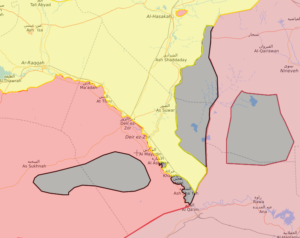
The ongoing destruction of what remains of the Islamic State in Iraq and Syria is more of a process than a series of discrete battles at this point. A story I’ve been watching develop the last few weeks has finally achieved fruition: The complete elimination of the large, thinly-populated Islamic State enclave in eastern Syria along the Iraqi border.
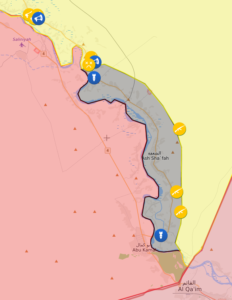
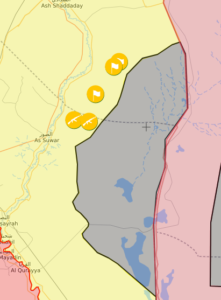
This was the situation at the start of Operation Jazerra Storm:
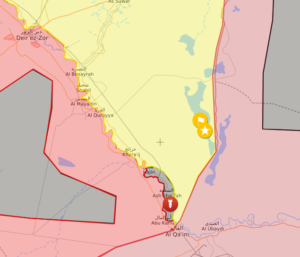
Here it was two weeks ago:
A tweet featuring a map of the operation a few days ago:
(And yes, those blue areas near the Syria-Iraq border on the Livemap are salt plains, not bodies of water.)
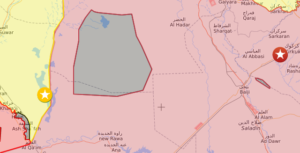
Now the pocket has been completely cleared:
The hard nut of the Hajin pocket has yet to be cracked, but that should be next on the SDF list, since the the Islamic State has been completely driven from the rest of Syria east of the Euphrates.
The US-backed Syrian Democratic Forces (SDF) are holding talks with the government in Damascus for the first time on the future of huge swathes of northern Syria under their control.
The Kurdish-majority SDF, founded with the help of the US to fight Islamic State of Iraq and the Levant (Isil) in northeastern Syria, now controls almost a third of the country and is looking to negotiate a political deal to preserve its autonomy.
“We are working towards a settlement for northern Syria,” said Riad Darar, the Arab co-chair of the Syrian Democratic Council, the SDF’s political wing.
“We hope that the discussions on the situation in the north will be positive,” Mr Darar said, adding that they were being held “without preconditions”.
The SDF now controls 27 per cent of the country, accord to the UK-based monitor Syrian Observatory for Human Rights, having seized Raqqa and much of the eastern province of Deir Ezzor from Isil militants with the help of US airpower.
The Kurds have used the cover of the Syrian war to carve out a semi-autonomous enclave in the northeast of the country, which it calls “Rojava”.
Rojava is also known as the Democratic Federation of Northern Syria.
This is a very interesting development: “Political wing of SDF to open offices in Latakia, Damascus, Hama, Homs.” The caveat here is that it comes from Al Masdar News, a notoriously pro-Assad outlet, and that I haven’t seen it anywhere else.
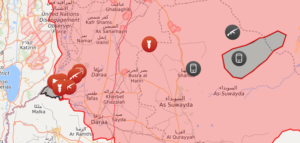
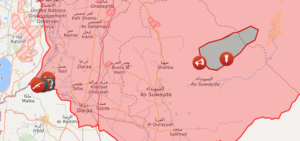
At the other end of Syria, Assad’s forces are methodically destroying the Islamic State pocket in the Yarmouk Basin (again the Al Masdar News caveat, but they have the most recent story on the fighting), hard against the Golan Heights and the Jordanian border.
The Yarmouk Basin pocket is one of three pockets of Islamic State control west of the Euphrates. There’s another large, sparsely populated pocket northeast of there, where the Islamic State is active enough to still commit atrocities, and the large, sparsely-populated pocket immediately to the west of Deir ez-Zor.
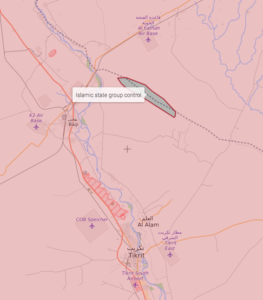
Likewise in Iraq, there are only two pockets of Islamic State control left: A large, sparsely-populated area east of the Syrian border in northwest Iraq, and a tiny sliver of land between Tikrit and Al Fatah Air Base.
That little sliver has been static for months, with no fighting indicated, so it may just be a map artifact, or an area no one has been able to verify if it’s liberated or not. Keep in mind that the Iraqi government declared that the Islamic State was defeated in Iraq back in December, but counterinsurgencies tend to take time. Espicially counterinsurgencies against Islamic terrorists. It took 14 years to end the original Moro insurgency in the Philippines, and some would argue that it was never entirely eradicated…