At lot of details of how Russia will carry out its projected 300,000 man mobilization discussed yesterday are unclear. Binkov’s Battlegrounds, which covers a lot of different military topics, discusses some of the details about how it would (theoretically) be carried out.
Takeaways:
“Officially, Putin said mobilization will draw on reservists: only those who served in the armed forces with a certain experience. He further stated those called upon will undergo additional military training.”
“He also said no students will get mobilized.”
“By law some two million Russians are kept listed as being qualified to serve as reservists. Those are people who had served in the military in the previously; several years, most of them, excluding officers and specialists, between six to eight years ago in theory.”
“Even 300 000 might be quite hard for Russia to pull off quickly.”
No refresher training for the vast majority.
“The social and political climate in Russia is such that many reservists will likely try to dodge service. Russian law was amended alongside the mobilization calling for greater prison sentences for such and similar transgressions. The fact the new law included the provision for prison sentences for voluntary surrenders may already mean even the Russian government expects some people will try to surrender outright to the enemy.” Hard to see how expecting reservists to fight to the death for Vlad’s Big Adventure will increase morale.
300,000 is the number of reservists who left in the last two years.
If almost all of those new reserves are to serve in the land forces, with the Army being a third of the overall military, it might mean people called upon will mostly be five years past their military service. [Defense Minister] Shoigu further said mobilization will also be limited to those with combat experience. All the Russian troops rotated in Syria since 2014 are unlikely to reach that figure, but there are veterans of operations in Ukraine 2014 of Georgia in 2008 and the wars in Chechnya. Those may indeed yield a force over 300 000, but it also may mean that some of those mobilized reservists will have not seen military training for 15 or more years.
Veterans of the Georgian war (which Russia won handily) probably won’t be a problem, but I doubt the others were such happy affairs that veterans of those campaigns will be eager to repeat the experience against the far better-armed and better-trained Ukrainians.
“In 2019, Russia had perhaps 5,000 reservists receive refresher training. A new push was done in 2021 with plans of 38,000 troops adjusting the Southern military District. But allegedly only 10% of the called upon men actually enlisted in the reserves.”
Conscripts can’t be sent outside of Russia, but surprise! When Russia announces that their sham referendum passed, that means they can be sent to Ukraine then.
“Seven months ago, such mobilization might have been more effective. But as Ukraine has a seven month lead in mobilization and training of reservists, it’s not likely Russia will be able to stop Ukrainian counter-offensives right away.”
Judging from how well Russia has previously run this war, expect badly equipped and under-trained reservists to be thrown piecemeal into the battle lines to be slaughtered.
Faced with the continued erosion of Russia’s military position in Ukraine, Vladimir Putin has chosen to double-down on failure.
Russian President Vladimir Putin on Wednesday announced the partial mobilization of military reservists, a significant escalation of his war in Ukraine after battlefield setbacks have the Kremlin facing growing pressure to act.
In a rare national address, he also backed plans for Russia to annex occupied areas of southern and eastern Ukraine, and appeared to threaten nuclear retaliation if Kyiv continues its efforts to reclaim that land.
It came just a day after four Russian-controlled areas announced they would stage votes this week on breaking away from Ukraine and joining Russia, in a plan Kyiv and its Western allies dismissed as a desperate “sham” aimed at deterring a successful counteroffensive by Ukrainian troops.
Before this announcement it was apparent that Russia basically had no reserves, so a mobilization isn’t a surprise. Why admit failure when you can simply get more of your countrymen slaughtered for doubling-down on your own mistake?
It won’t be easy or fast to call up that many reservists, according to military experts, because Russia basically doesn’t have a reserve.
A 2019 RAND study noted that “Russia has paid little attention to developing an effective and sizable active reserve system that might be immediately required in the event of a major war.” RAND estimates that Russia has an effective reserve of only 4,000-5,000 men.
The country’s former army reserve units had been disbanded from 2008-2010 as part of the military’s modernization program, with their equipment — all of it older — going into storage or scrapped.
That doesn’t mean that Russia can’t conscript, train, organize, and arm 300,000 new soldiers, but it won’t be quick or easy.
One problem, as Foreign Affairs analyst Oliver Alexander put it, is “effectively readying and equipping these reservists. Russia already has problems equipping its professional armed forces.”
Then there’s the speed problem. Dara Massicot wrote back in August — weeks before Kyiv’s stunning counteroffensive in Kharkiv — that “Even if the Kremlin pulls all levers available, declaring a general mobilization to call up sufficient armored equipment and trained personnel, that process would still take time.”
That’s because with something like 80% of Russia’s combat power already fighting in Ukraine, plus wartime losses to their NCO and officer corps, the Russian army will need to train more trainers before anything like 300,000 men can be mobilized.
Just last month, Putin ordered an increase in the size of the Russian military of 137,000 troops. But as I reported to you then, Putin’s order only meant that “Starting next year, the Russian military will be authorized to find another 137,000 troops.” The country has long had a problem with draft dodgers, one that Putin’s “special military operation” won’t help.
He also notes the problem of obtaining new equipment. Even the first wave of Russian invasion included troops who were armed with ancient rifles. With the sanctions in place, none of that is going to get any better. Plus the fact that Russia essentially used up all their smart ordinance during the first stage of the war and that sanctions ensure they can’t easily make more.
Is there a Peter Zeihan video on the topic? Of course there is.
Some takeaways:
Reiterates why everything in the Russia army travels by rail. “The Ukrainians were able to take a couple of re-up depots in eastern Ukraine and Kharkiv a couple weeks ago and the front just collapsed.”
“We might be seeing a repeat of that in the Donbas.”
“The Russians are now discovering that they’re actually outnumbered locally, and that with all the captured equipment, the Ukrainians actually now have more artillery and more ammo.”
“This is the sort of war the the Russians know how to fight: Just throw bodies after it.”
The influx of new troops “doesn’t mean that the nature of the war is
fundamentally changed,” but now they’ll be able to rotate fresher troops in, “and continue fighting the war more or less the way that they have been now, which is to say poorly.”
Russia is already crashing demographically, and the main cohort of this war is coming from the men who should be fathering children. “This is a potentially a country killer. Before I thought that this was Russia’s last war. Now I’m certain of it.”
Says Ukraine can still win, but they need to do the Kharkiv counteroffensive twenty times over.
Says they need to continue hitting Russian logistics nodes. “The one I am most interested in, of course, is Miriapol. Because if the Ukrainians can reach Mariupol, they basically isolate Russian forces throughout southern Ukraine, and then you’re talking about a hundred thousand Russian troops that are just stranded with no hope of resupply at all.” (Assuming his later mention of taking out the Kerch Strait Bridge.)
Nor are the sham referendums likely to make any difference either.
Russian-appointed occupation officials in Luhansk, Donetsk, Kherson, and Zaporizhia oblasts announced on September 20 that they will hold a “referendum” on acceding to Russia, with a vote taking place from September 23-27. The Kremlin will use the falsified results of these sham referenda to illegally annex all Russian-occupied parts of Ukraine and is likely to declare unoccupied parts of Donetsk, Kherson, and Zaporizhia oblasts to be part of Russia as well.
The Kremlin’s annexation plans are primarily targeting a domestic audience; Putin likely hopes to improve Russian force generation capabilities by calling on the Russian people to volunteer for a war to “defend” newly claimed Russian territory. Putin and his advisors have apparently realized that current Russian forces are insufficient to conquer Ukraine and that efforts to build large forces quickly through voluntary mobilization are culminating short of the Russian military’s force requirements. Putin is therefore likely setting legal and informational conditions to improve Russian force generation without resorting to expanded conscription by changing the balance of carrots and sticks the Kremlin has been using to spur voluntary recruitment.
Putin may believe that he can appeal to Russian ethnonationalism and the defense of purportedly “Russian peoples” and claimed Russian land to generate additional volunteer forces. He may seek to rely on enhanced rhetoric in part because the Kremlin cannot afford the service incentives, like bonuses and employment benefits, that it has already promised Russian recruits. But Putin is also adding new and harsher punishments in an effort to contain the risk of the collapse of Russian military units fighting in Ukraine and draft-dodging within Russia. The Kremlin rushed the passage of a new law through the State Duma on September 20, circumventing normal parliamentary procedures. This law codifies dramatically increased penalties for desertion, refusing conscription orders, and insubordination. It also criminalizes voluntary surrender and makes surrender a crime punishable by ten years in prison. The law notably does not order full-scale mobilization or broader conscription or make any preparations for such activities.
ISW has observed no evidence that the Kremlin is imminently intending to change its conscription practices. The Kremlin’s new law is about strengthening the Kremlin’s coercive volunteerism, or what Chechen leader Ramzan Kadyrov called “self-mobilization.”
The Kremlin is taking steps to directly increase force generation through continued voluntary self-mobilization and an expansion of its legal authority to deploy Russian conscripts already with the force to fight in Ukraine.
Putin’s illegal annexation of occupied Ukrainian territory will broaden the domestic legal definition of “Russian” territory under Russian law, enabling the Russian military to legally and openly deploy conscripts already in the Russian military to fight in eastern and southern Ukraine. Russian leadership has already deployed undertrained conscripts to Ukraine in direct violation of Russian law and faced domestic backlash. Russia’s semi-annual conscription cycle usually generates around 130,000 conscripts twice per year. The next cycle runs from October 1 to December 31. Russian law generally requires that conscripts receive at least four months of training prior to deployment overseas, and Russian President Vladimir Putin has repeatedly denied that conscripts will be deployed to Ukraine. Annexation could provide him a legal loophole allowing for the overt deployment of conscripts to fight.
Russian-appointed occupation officials in Kherson and Zaporizhia oblasts announced the formation of “volunteer” units to fight with the Russian military against Ukraine. Russian forces will likely coerce or physically force at least some Ukrainian men in occupied areas to fight in these units, as they have done in the territories of the Russian proxy Donetsk and Luhansk People’s Republics (DNR and LNR).
The Russian State Duma separately passed new incentives for foreign nationals to fight in Russia’s military to obtain Russian citizenship and will likely increase overseas recruitment accordingly. That new law, which deputies also rushed through normal procedures on September 20, allows foreign nationals to gain Russian citizenship by signing a contract and serving in the Russian military for one year. Russian law previously required three years of service to apply for citizenship.
Putin’s appeals to nationalism may generate small increases in volunteer recruitment from within Russia and parts of occupied Donetsk and Luhansk. However, forces generated from such volunteers, if they manifest, will be small and poorly trained. Most eager and able-bodied Russian men and Ukrainian collaborators have likely already volunteered in one of the earlier recruitment phases.
Local Russian administrators will continue to attempt to form volunteer units, with decreasing effect, as ISW has previously reported and mapped.
Russian forces and the Wagner Private Military Company are also directly recruiting from Russian prisons, as ISW has previously reported. These troops will be undisciplined and unlikely to meaningfully increase Russian combat power.
Putin likely hopes that increasing self-mobilization, and cracking down on unwilling Russian forces, will enable him to take the rest of Donetsk and defend Russian-occupied parts of Luhansk, Kherson, and Zaporizhia oblasts. He is mistaken. Putin has neither the time nor the resources needed to generate effective combat power. But Putin will likely wait to see if these efforts are successful before either escalating further or blaming his loss on a scapegoat. His most likely scapegoat is Defense Minister Sergei Shoigu and the Russian Ministry of Defense. Reports that Shoigu would accompany Putin while Putin gave a speech announced and then postponed on September 20 suggest that Putin intended to make Shoigu the face of the current effort.
That decree is every bit as popular as you would expect.
Takeaways:
“Today, people went to the streets from Moscow to the Far East to protest. Even though it only concerned those in reserve, everyone sees where this is going.”
“Former Security Minister of the Donetsk People’s Republic called on Russia’s military command to better supply existing units on the ground. He also added that lack of equipment is the main reason why the Ukrainians keep advancing in Kherson.”
He thinks the conscripts will work logistics jobs, free up contractors to do the fighting. I remain doubtful that the effective military contractor pool for this war is terribly deep.
Neither the mobilization nor the sham referendums change any immediate facts on the ground in Ukraine. It will take many months to take new “recruits” up to even the most basic soldiering standards. Or maybe they’ll just give them three days training and send them into battle with old rifles and old ammunition like they did before, with the same results.
Either way, it doesn’t solve any of Putin’s immediate problems…
I’ve extensively covered Hunter Biden’s extensive illegal activities, some of which involve his father Joe. With interference from the FBI, DOJ, and the entirety of the Democratic Media Complex, any real investigation into Hunter’s misdeeds and influence peddling was pushed back until after the 2020 presidential election.
U.S Sen. John Cornyn (R-TX) and 32 other Senate Republicans, including Sen. Ted Cruz (R-TX), wrote a letter to U.S. Attorney General Merrick Garland asking him to grant special counsel protections and authority to U.S Attorney David C. Weiss for his investigation into Hunter Biden.
Biden, son of President Joe Biden, is being investigated over his previous involvement with a Ukrainian gas company while his father was vice president; he’s facing allegations of tax code violations and unregistered lobbying.
Weiss is a Trump-appointed prosecutor who was kept on by the Biden administration. He is already leading the investigation into Hunter Biden, but these GOP Senators state that authority is not enough to limit political influence from the Department of Justice (DOJ).
The senators criticize Garland for “politicizing” the DOJ, stating that he promised to do the opposite.
“On October 4, 2021, you unleashed [the] DOJ’s National Security Division and the Federal Bureau of Investigation, among other criminal components, on millions of concerned parents across the country, who were exercising their First Amendment rights to be involved in decisions about their children’s education,” they wrote.
“We have received hundreds of pieces of correspondence detailing how your memorandum chilled constitutionally protected speech.”
The letter highlights the FBI’s raid of former President Donald Trump’s Mar-a-Lago home and criticizes the lack of “measurable efforts” to prevent violence against Supreme Court Justices in the wake of the Dobbs decision.
Some of the Hunter Biden controversy stems from his role as a board member of Ukrainian gas company Burisma from 2014 to 2018.
A joint report released by the U.S. Senate Homeland Security and Finance Committees allege that a significant conflict of interest arose as a result of Hunter Biden’s position and that of his father
At the time, the U.S. government was pursuing an anti-corruption investigation into Ukraine and Burisma owner Mykola Zlochevsky.
Hunter Biden is accused of lobbying U.S. officials for Burisma interests while then-Vice President Joe Biden was the “public face of the administration’s handling of Ukraine.” This was at the height of the anti-corruption investigation pursued by the U.S. government.
The report also states, “Hunter Biden was serving on Burisma’s board when Zlochevsky allegedly paid a $7 million bribe to officials serving under Ukraine’s prosecutor general, Vitaly Yarema, to ‘shut the case against Zlochevsky.’”
Hunter Biden is also accused of taking millions from a Chinese energy firm with connections to the Chinese Communist Party. President Joe Biden said on Sunday evening that the United States would directly engage China militarily if it invades Taiwan — a contrast from the administration’s previous position.
The senators’ letter states, “Given that the investigation involves the President’s son, we believe it is important to provide U.S Attorney Weiss with special counsel authorities and protections to allow him to investigate an appropriate scope of potentially criminal conduct, avoid the appearance of impropriety, and provide the additional assurances to the American people…that the investigation is free from political influence.”
“As detailed by Senator Grassley, ‘highly credible’ whistleblowers have come forward to detail a ‘widespread effort within the FBI to downplay or discredit negative information about’ Hunter Biden.”
“Instead of encouraging FBI and DOJ whistleblowers to report crimes and promote government transparency,” the senators wrote to Garland, “you took the inexplicable step of chilling lawful whistleblower activity.”
Actually, it’s super-duper explicable, if you assume that Garland’s number one priority is protecting members of the Democratic Party. Indeed, this seems to be the Prime Directive of the current DOJ, a few honest holdouts notwithstanding.
For that reason, I expect zero serious examination of Hunter Biden’s shady deals.
Unless, that is, the Obama Administration powers behind the throne (Ron Klane, Valerie Jarrett, Susan Rice, etc.) decide Biden must be eased out well before 2024.
The Pennsylvania House voted Tuesday to hold Philadelphia District Attorney Larry Krasner in contempt for refusing to comply with a subpoena issued by a legislative committee searching for grounds to impeach him.
The chamber voted 162 to 38 — with support from 10 Philadelphia Democrats — to approve the resolution holding the city’s top prosecutor in contempt, a highly unusual move that even the measure’s sponsor told House colleagues he’d never seen before.
State Rep. John Lawrence — a Republican who represents parts of Chester and Lancaster Counties and chairs the select committee investigating Krasner — said the DA had “willfully neglected” the subpoena and was treating it like “a worthless piece of paper.”
“According to DOJ whistleblowers, Facebook has been spying on Americans’ private messages and reporting them to the FBI if they express ‘anti-government or anti-authority’ statements – including questioning the legitimacy of the 2020 US election.” More: “It was done outside the legal process and without probable cause,” said one of the whistleblowers, who spoke on condition of anonymity. “Facebook provides the FBI with private conversations which are protected by the First Amendment without any subpoena. According to one Post source, ‘They [Facebook and the FBI] were looking for conservative right-wing individuals. None were Antifa types.'”
Anyone with even the slightest knowledge of the state of the American academy today knows that employment discrimination runs rampant on campus. Not the old-fashioned kind where women, blacks, Jews, Catholics, Asians, gays, or communists were excluded from employment opportunities, but the modern Kendian variety, in which overt discrimination against white men (and, in many disciplines, Asian men as well) is embraced as official university policy and as a necessary part of being “antiracist.”
As Mark Perry has documented in hundreds of complaints he has filed with the Department of Education’s Office for Civil Rights, such “discrimination for the ‘right’ reasons” is as common on campuses today as empty Red Bull cans. Nor does anyone with any actual knowledge of employment law dispute that such overt and intentional sex and racial discrimination is patently illegal under federal law, and usually state law as well.
Why is this so? If such “no white / Asian guys need apply” practices are clearly illegal, how have they been allowed to not only stand but spread to all corners of campus?
Part of the reason is that under Grutter and Fisher II, the Supreme Court gave universities the benefit of the doubt when using racial and other demographic characteristics in admissions decisions. Rather than use race sparingly in admissions decisions, and in the narrow, surgical method the Supreme Court envisioned, universities instead have taken those decisions as a mandate to do whatever they want in not only admissions, but also employment and other areas.
Indeed, as I have noted before, university administrators often admit to overt discriminatory reasons for their DEI employment initiatives (e.g., the need to provide “role models”), despite the fact that the Supreme Court rejected such reasons as illegal decades ago. (Such abuse of the limited leeway the Supreme Court gave universities in admissions decisions is why many observers are predicting that the Supreme Court will end it in the upcoming term, when it decides cases challenging admissions practices at Harvard and the University of North Carolina.)
However, the main reason for the ubiquity of such practices is that only people who are, in fact, victims of such discriminatory practices have standing to sue to stop them. Leaving aside the serious economic challenges of litigating such a suit against a wealthy university, what would happen if you actually did so? E.g., “I exceed the posted qualifications for a tenure-track position at Enormous State University, but ESU’s official policy is that only BIPOC candidates are eligible for the position. As a white [or Asian] man I am ineligible for the position because of my race, and so I am suing ESU for racial discrimination in employment.”
In the woke monoculture that pervades most campuses today, being known as someone who took legal action to challenge a DEI initiative would render you radioactive and unemployable, not only at ESU but across most of the American academy. And even if you prevail in your lawsuit, you would thereafter be known as the guy who got an “antiracist” affirmative action employment program shut down. Given what the campus cancel culture mobs have done to people like Dorian Abbot who merely question the legality or morality of such programs, what do you think they will do to someone who actually succeeds in having them declared illegal? Ask Allan Bakke.
With universities perceiving no real risk of being sued, and with the Biden administration having about the same interest in neutrally enforcing federal discrimination law as it does in securing the southern border, university administrators know there is no serious risk to giving in to the demands of “antiracist” activists for official, overt discrimination against white and Asian men. That many state officials (including some red-state officials such as Texas Governor Greg Abbott) are too cowardly to do anything to resist the campus wokesters further compounds the problem. Like the days of Mob-controlled garbage collection in New York City, university administrators can say, “Yeah, what we’re doing is illegal. Whaddya gonna do about it?”
But just as the law eventually destroyed the Mob’s garbage cartels in the Big Apple, the law may finally be coming for the overt employment discrimination practiced on most campuses today. The form of the destructor may be a test case filed on September 10: Lowery v. Texas A&M University System.
As described in the complaint:
8. The Texas A&M University System, along with nearly every university in the United States, discriminates on account of race and sex when hiring its faculty, by giving discriminatory preferences to female or non-Asian minorities at the expense of white and Asian men. This practice, popularly known as “affirmative action,” has led universities to hire and promote inferior faculty candidates over individuals with better scholarship, better credentials, and better teaching ability.
9. These race and sex preferences are patently illegal under Title VI and Title IX, which prohibit all forms of race and sex discrimination at universities that receive federal funds. But university administrators think they can flout these federal statutes with impunity because no one ever sues them over their discriminatory faculty-hiring practices and the Department of Education looks the other way.
10. These discriminatory, illegal, and anti-meritocratic practices have been egged on by woke ideologues who populate the so-called diversity, equity, and inclusion offices at public and private universities throughout the United States. The existence of these offices is subverting meritocracy and encouraging wholesale violations of civil-rights laws throughout our nation’s university system.
Specifically, the complaint avers that in July 2022, Texas A&M’s “office for diversity” announced a program for hiring professors that was limited to members of “underrepresented groups,” which it defined as “African Americans, Hispanic/Latino Americans, Native Americans, Alaskan Natives, and Native Hawaiians.” In other words, like many DEI initiatives that pervade most university campuses today, white and Asian men need not apply for this program. Texas A&M justified the program with the goal of establishing a faculty whose racial composition attains “parity with that of the State of Texas”—despite the fact that even Grutter recognized that such racial balancing was “patently unconstitutional.”
Philadelphia’s soda tax backfires. “People shopping for sodas outside city limits canceled out almost 40% of the decrease in sugar-sweetened beverage purchases. Additionally, the soda pop tax actually led to about a 4% increase in purchases of other high-sugar goods in Philadelphia and in neighboring towns. But compared to the sugar decrease from sodas in Philadelphia, additional sweetened food purchases offset an additional 40%.”
Russia acknowledges defeat in Kharkiv, ultranationalists start to turn on Putin, Lyman is the new battleground, and unconfirmed reports of Russian troops abandoning Melitopol.
The Kremlin has recognized its defeat in Kharkiv Oblast, the first defeat Russia has acknowledged in this war. The Kremlin is deflecting blame from Russian President Vladimir Putin and attributing it instead to his military advisors.
The Kremlin is likely seeking to use the defeat in Kharkiv to facilitate crypto mobilization efforts by intensifying patriotic rhetoric and discussions about fuller mobilization while revisiting a Russian State Duma bill allowing the military to send call-ups for the regular semiannual conscription by mail. Nothing in the Duma bill suggests that Putin is preparing to order general mobilization, and it is far from clear that he could do so quickly in any case.
The successful Ukrainian counter-offensive around Kharkiv Oblast is prompting Russian servicemen, occupation authorities, and milbloggers to panic.
Russia’s military failures in Ukraine are likely continuing to weaken Russia’s leverage in the former Soviet Union as Russia appears unwilling to enforce a violated ceasefire it brokered between Armenia and Azerbaijan or to allow Armenia to invoke provisions of the Russia-dominated Collective Security Treaty Organization in its defense.
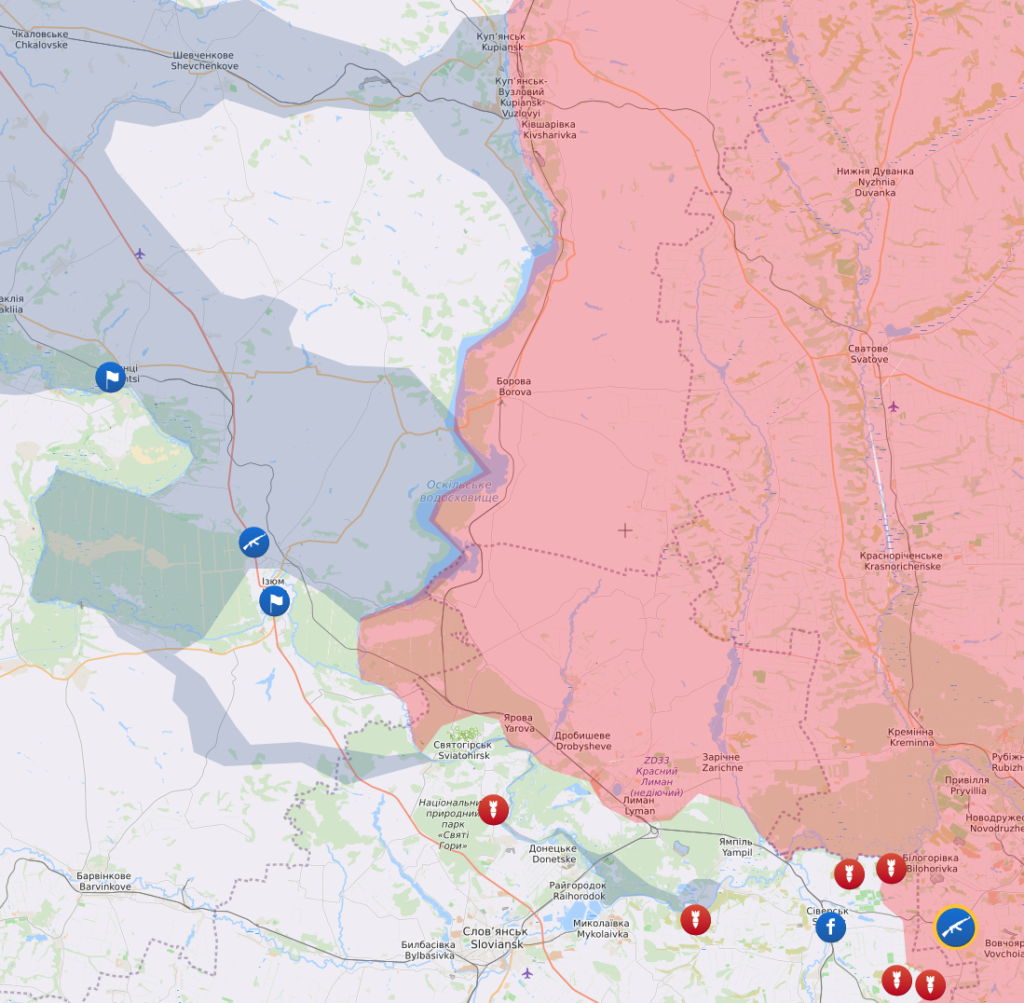
Ukrainian troops likely continued ground attacks along the Lyman-Yampil-Bilohorivka line in northern Donetsk Oblast and may be conducting limited ground attacks across the Oskil River in Kharkiv Oblast.
Russian and Ukrainian sources indicated that Ukrainian forces are continuing ground maneuvers in three areas of Kherson Oblast as part of the ongoing southern counter-offensive.
Russian troops made incremental gains south of Bakhmut and continued ground attacks throughout Donetsk Oblast.
Ukrainian forces provided the first visual evidence of Russian forces using an Iranian-made drone in Ukraine on September 13.
Oleksiy Arestovych, an adviser to Zelenskiy, said Ukrainian troops were now trying to retake the Russian-held town of Lyman in Ukraine’s Donetsk region and were eyeing territorial gains in the neighbouring Luhansk region which is under Russian control.
“There is now an assault on Lyman,” Arestovych said in a video posted on YouTube.
“And that is what they fear most – that we take Lyman and then advance on Lysychansk and Sievierodonetsk,” he said, referring to twin cities in the Luhansk region taken by Russia after fierce fighting in June and July.
The Ukrainian mayor of Melitopol said that Russians are evacuating Melitopol, the Zaporizhia Oblast city between Mariupol and Kherson, and heading to Crimea. I treat this report with a fair amount of skepticism, because if true it would essentially mean Game Over for Russia’s southern front.
I'm hearing more & more reports that Russians are evacing Melitopol. This remains UNCONFIRMED. If true, Ukr can reach the Black Sea, blow the Kerch bridge, & utterly destroy every Russia military unit in southern Ukraine and Crimea. And THAT would be a nation-ending event. pic.twitter.com/8cCDnDEbVl
DEEP STRIKE: Major explosions rocked the RU air station at Taganrog, followed by a number of secondaries & fires. Russian AWACs, including the including the newest A-100 platforms, are forward deployed at Taganrog. This strike will negatively affect RU air defense in the region. pic.twitter.com/iKPeaIW5w8
In the newly-liberated areas, relief and sorrow are intertwined – as accounts emerge of torture and killings during the long months of Russian occupation.
Artem, who lives in the city of Balakliya in the Kharkiv region, told the BBC he was held by Russians for more than 40 days, and was tortured with electrocution.
Balakliya was liberated on 8 September after being occupied for more than six months. The epicentre of the brutality was the city’s police station, which Russian forces used as their headquarters.
Artem said he could hear screams of pain and terror coming from other cells.
The occupiers made sure the cries could be heard, he said, by turning off the building’s noisy ventilation system.
“They turned it off so everyone could hear how people scream when they are shocked with electricity,” he told us. “They did this to some of the prisoners every other day… They even did this to the women”.
And they did it to Artem, though in his case only once.
“They made me hold two wires,” he said.
“There was an electric generator. The faster it went, the higher the voltage. They said, ‘if you let it go, you are finished’. Then they started asking questions. They said I was lying, and they started spinning it even more and the voltage increased.”
Artem told us he was detained because the Russians found a picture of his brother, a soldier, in uniform. Another man from Balakliya was held for 25 days because he had the Ukrainian flag, Artem said.
A school principal called Tatiana told us she was held in the police station for three days and also heard screams from other cells.
The disaster in Kharkiv is so massive and apparent that even some of the pro-war Russian pundits are realizing it.
Life comes at you fast: pundits on Russian TV realize that their military is failing and their country is in trouble. They are starting to play the blame game. Some of them finally understand that their genocidal denial of the Ukrainian identity isn't working in Russia's favor. pic.twitter.com/jNNn5xifI5
For Putin, losing ultranationalists is much more dangerous than criticism from more liberal segments of Russian society.
Their criticism is that Putin is not doing enough. That the special military operation is insufficient, and that Putin should declare full mobilization. These ultranationalists are largely represented by those Russian military bloggers that have become quite famous during the war. The most famous one is probably Igor Girkin. These bloggers make sometimes very good military analyses, and they clearly have a network of sources that provide information about the situation on the frontlines. And we also know that their views are shared by many of the soldiers. For example, there have been studies that show that these ultranationalist views are pretty common in spetsnaz units. And these ultranationalist voices are a real challenge for the Putin regime. Because obviously he can’t dismiss them as being unpatriotic or foreign agents or something like that. And what is happening now is that these ultranationalists are turning against Putin. And that is dangerous for him.
The shift has been from “If you support the troops, you have to support Putin” to “If you support the troops, you have to blame Putin for fucking things up so badly.”
Ben Hedges: Ukraine will retake all pre-February 23rd territory this year, and recapture Crimea next year. “It could be quicker.”
More scenes of captured equipment in Izyum.
Ukrainians issued Russian passports find out they’re worthless to get into Crimea or obtain government services.
Ukrainian troops using the Polish-built Krab self-propelled howitzer say it’s like night and day compared to their old Soviet equipment. “It’s like a Porsche vs. a Lada.”
Russian politician Dmitry Medvedev reacts well to suggestion the West give Ukraine security guarantees. “The land will be on fire and the concrete will melt.”
Things in Ukraine are moving so fast that the only thing I can be sure of is that what I post here will probably be obsolete before I press the Publish button.
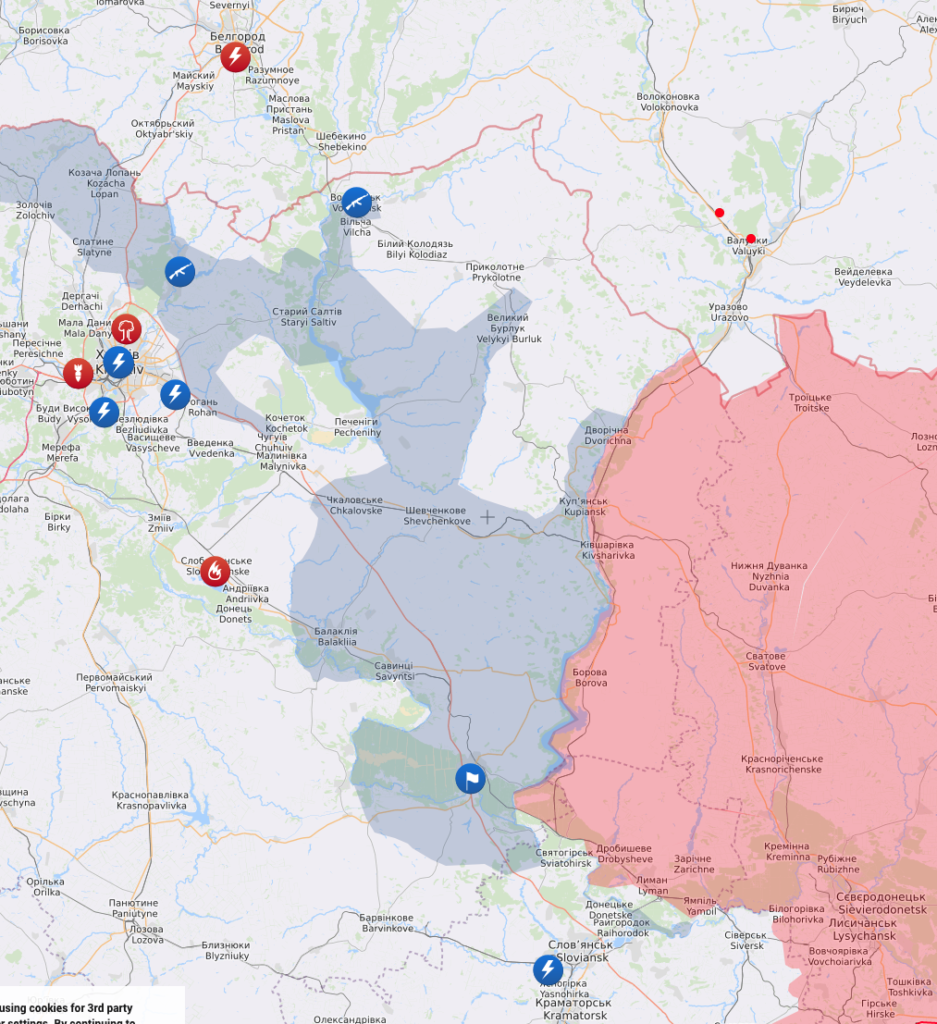
What was a very successful Ukrainian counter offensive in Kharkiv Oblast is now a massive rout of Russian forces throughout the extent of their northeast line. All of Kharkiv (save a tiny bit east of the Oskil River) has been liberated.
“Ukraine controls all the land west of the Oskil River.”
The Russians left massive amounts of equipment behind, too much for any sort of orderly withdrawal, and they don’t appear to have torched any of it, either. They just turned tail and fled. “This is an armored brigade worth of vehicles. Looking at this, I think Russia has given more military aid to Ukraine than the United States.” Also, Russian civilians are fleeing the captured territories, only to be refused entry at the border.
“Fuck, every one of us can get a tank.”
Rus, Rus, Rus of the Ukraine
Fleeing as fast as he can flee
Rus, Rus, Rus of the Ukraine
Watch out for that tree!
Got to disagree with the first video: it’s damn hard to see if you’re peering out the forward driver’s port, and it’s quite possible the tank driver was unaware troops were falling off.
It looks like logistical problems and those long-documented Russian morale problems have finally intersected to destroy the ability of numerous Russian units to function as effective fighting forces. Here’s a recorded Russian phone soldier’s phone call from back in August illustrating low morale and how much Russian soldiers hate the war:
Russian soldiers don’t seem to be eager to die for a mistake. The extent to which Russian forces in Kharkiv Oblast have been routed and broken makes it an open question whether any can be reconstituted as effective fighting forces and redeployed to Donbas. That may explain why Russia seems to be trying to carry out a stealth conscription mobilization:
On their way out, the Russian army has given Ukraine a parting gift: destruction of Kharkiv’s civilian infrastructure. “Kharkiv and Donetsk regions were cut off. In Zaporizhia, Dnipropetrovsk, Sumy there are partial problems with power supply.”
Total dick move, but not necessarily a war crime; power generating facilities are usually considered legitimate military targets. Russia obviously held off attacking them because they expected to control the territory.
Now that Ukraine has that territory back, a lot more Russian logistic routes (especially those out of Belgorod) are under threat of disruption from Ukrainian artillery. Indeed, Belgorod now loses a lot of value as a logistics hub, since it’s farther away from the frontlines, on worse roads. Russia may shift to routing everything through Kamensk-Shakhtinsky or Rostov-On-Don.
Ukraine continues to grind out more modest gains in the Kherson counteroffensive. As for the next phase of the war, it’s an open question whether to attempt to push Russian troops out of Luhansk next, or to apply more pressure toward the center of the Russian line and retake Lysychansk and Severodonetsk. But it’s clear that right now Ukraine enjoys the strategic initiative.
As Ukraine’s Kharkiv counteroffensive developed earlier this week, it was apparent that the occupied city of Izyum, the linchpin of Russia’s northeast line, was in danger of being encircled. I anticipated a few weeks of hard fighting while Ukraine slowly tightened the noose while pounding the besieged city with artillery.
Russian forces have withdrawn from key eastern towns, as a rapid Ukrainian counter-attack makes further gains.
Ukrainian officials said troops entered Kupiansk, a vital eastern supply hub for Russian forces, on Saturday.
Russia’s defence ministry then said its troops have retreated from nearby Izyum to allow them “to regroup”.
The ministry also confirmed the withdrawal of troops from a third key town, Balaklyia, in order to “bolster efforts” on the Donetsk front.
The Ukrainian advances – if held – would be the most significant since Russia withdrew from areas around Kyiv in April.
In his nightly video address on Saturday, President Volodymyr Zelensky claimed that Ukraine had now liberated 2,000 sq km (700 sq miles) from Russia since beginning a renewed counter-offensive earlier this month.
His claim would suggest that half of that area has been recaptured in the last 48 hours alone – as it istwice the area of territory Mr Zelensky said had been liberated when he spoke on Thursday evening.
The announcement by Russia that its troops had withdrawn from Izyum is also significant, as it was a major military hub for Moscow.
“A three-day operation was carried out on the drawdown and organised transfer of the Izyum-Balakliya group of troops to the territory of the Donetsk People’s Republic,” the Russian statement said.
Taking Kupiansk is also huge. It’s a major crossroads and an important crossing over the north end of the Oskil River.
Livemap confirms it:
See that little blue rifle down in the southeast corner of the map? That indicates that Ukrainian troops are just outside Lysychansk, the Ukrainian city Russia spent so much time and effort taking back in July. Suchomimus says Ukrainian troops are even on the edge of Severodonetsk.
Supposedly Russia left a lot of gear behind as well.
Ukraine is carving out big gains in Kharkiv, Texas is in the money, Biden taps Clinton’s bagman to divy up the graft manage climate change funds, more groomers unmasked, and some big changes in the UK. Plus a bit about tanks. It’s the Friday LinkSwarm!
Ukrainian successes on the Kharkiv City-Izyum line are creating fissures within the Russian information space and eroding confidence in Russian command to a degree not seen since a failed Russian river crossing in mid-May.
Ukrainian forces in the Kharkiv Oblast counteroffensives advanced to within 20 kilometers of Russia’s key logistical node in Kupyansk on September 8.
Ukrainian forces will likely capture Kupyansk in the next 72 hours, severely degrading but not completely severing Russian ground lines of communication (GLOCs) to Izyum.
Ukrainian forces are continuing to target Russian GLOCs, command-and-control points, and ammunition depots in Kherson Oblast.
On Thursday, the state comptroller reported that the Lone Star State’s tax revenue rocketed by 25.6% to a total of $75.21 billion.
It’s only the fifth time since 1988 that revenue grew by a double-digit percentage — and it’s double the next largest increase over that 34-year span.
“Revenues continue to outpace even our most recent forecast as All Funds tax collections closed the fiscal year $841 million above the projection in our Certification Revenue Estimate,” said state Comptroller Glenn Hegar in an official release.
That’s a stark contrast to California, which saw July revenue come in 12% below forecast.
Texas has been a major beneficiary of migration from California: Over the last census cycle, 34% of new Texans arrived from California alone. Meanwhile, New York saw personal income tax collection fall 3.2% from April 1 through July.
Joe Biden has hired John Podesta to be the new Clean Energy Czar, citing his experience in progressive causes….
Bottom line, John Podesta is being now being hired to divvy up the $316 billion in Green New Deal money recently authorized by congress. That is what Podesta specializes in, the distribution of taxpayer money to DNC allied groups and networks in advance of the 2022 midterms. Podesta, Hillary’s fixer, is a bagman, nothing more.
Worse, one of the many bag clients he’s adept at channeling money into Democratic pockets for is China.
President Joe Biden on Friday tapped John Podesta to oversee $370 billion in climate spending, a move that has China hawks on Capitol Hill concerned over Podesta’s encouragement of Chinese investment in American infrastructure and praise for the top U.S. adversary on climate change.
Podesta has called for Chinese investment in American infrastructure, arguing in 2013 that there are “great opportunities for Chinese firms to directly invest in this nation, to build American infrastructure, to create American jobs, and generate steady and handsome returns.” He added, “There’s also the ability for Chinese firms to invest here and learn best practices, and take those home to the tremendous and growing middle class market in China.”
Instead, in the intervening decade, the Chinese government has committed widespread economic espionage—one 2017 estimate found that China steals up to $600 billion in trade secrets a year. Engineers in China, meanwhile, use popular social media platform TikTok to access nonpublic data from U.S. users.
Podesta has also praised China’s efforts to combat climate change, arguing in 2015 that the Chinese “are beginning to do a fair amount.” China, which is the world’s top carbon emitter, went on to dramatically accelerate its coal consumption, which reached a record high in 2020.
That record has China hawks on the Hill concerned that America’s top adversary has a new—and powerful—ally in the White House. Podesta’s role will see the liberal consultant implement $370 billion in spending toward alternative energy, a sector that China dominates when it comes to raw materials. As such, alternative energy companies receiving the Podesta-steered funding could turn to China to secure supplies. The new Biden aide will likely take no issue with that dynamic, given that he has argued the United States and China should “align” on a green economy. Sens. Marsha Blackburn (R., Tenn.) and Ted Cruz (R., Texas) argued that the move reflects the White House’s soft-on-China stance.
Democratic County Administrator Robert Telles charged in the death of journalist Jeff German, “an investigative reporter with the Las Vegas Review-Journal who had spent the last few months exposing misdeeds and turmoil in the official’s office.” For all Sundown Joe’s dark mutterings about “UltraMAGA,” it seems like Democrats are the ones doing all the killing…
A now-former elementary school teacher previously charged with sexual abuse of a 7-year-old student was arrested again and charged with sexually assaulting a second victim.
Victor Moreno, 28, was charged in July with continuous sexual abuse of a child, a first-degree felony, and an improper relationship between a student and educator, a second-degree felony.
The accused pedophile’s victim was a second-grade girl in Irving Independent School District, where Moreno was a teacher at the time of the alleged assaults during the 2020-2021 school year.
Snip.
Meanwhile, a teacher’s aide in Mesquite Independent School District was arrested Tuesday after being accused of engaging in inappropriate relationships with students.
Bryan Garcia, 22, was charged with two counts of sexual assault of a child and one count of indecency with a child.
“Higher Ed’s New Woke Loyalty Oaths: A ballooning number of hiring and tenure decisions require candidates to express written fealty to political doctrines.” And you can bet those doctrines have nothing to do with constitutionally limited government based on universal rights…
Indeed, they’re talking about restarting old production lines to start manufacturing older BMP-2s. “The costs and challenges of bringing more modern designs into production are now surely aggravated by Western sanctions cutting access to many basic electrical components, requiring pricey and time-consuming workarounds.”
This is like a scene from a porn movie, only a lot creepier. “Las Vegas landlord requires tenant to sign sex contract in order to lease home.”
“Kim Kardashian Is Starting Her Own Private Equity Company.” Why not? But I’m betting being a genius at self-promotion doesn’t equate to being a genius at investing, especially since she’s starting in the middle of a fierce, widespread downturn…
Easiest way to win Dad of the Year? Pick your son up from school in a tank. Looks like a Scorpion light tank, most likely the FV107 Scimitar reconnaissance variant.
“FBI Drops Investigation After Discovering Trump’s Top Secret Nuclear Documents Were Just Print-Outs Of Hillary Clinton Emails.”
Defense analyst Anders Puck Nielsen says there’s a tendency for many to believe that, although Ukraine has put up a good fight, a Russian victory in the Russo-Ukrainian War is inevitable. (I assume he’s seeing these on the various MSM channels I stopped watching a long time ago, as the only place I see such assumptions these days is among comment trolls and the occasional ZeroHedge headline.)
Some takeaways:
“When Russia launched the invasion of Ukraine back in February, many people assumed that it was going to be an easy win. It was not only Vladimir Putin who believed that they could finish this war within days or weeks. Many people thought so. And even after it became clear that there would not be a quick victory, many people still carried over this assumption that Russia is going to win eventually because that is the only possible outcome.” (I too thought a Russian victory was the most likely (though not certain) outcome in the first few days, before it become apparent just how badly bungled the invasion planning was, how fragile Russian supply lines were, how poor the communication was between different branches of the Russian military, and how neglected even basic maintenance was for Russian equipment.)
“They think of Russia as a giant. And then they think about Ukraine as a small country. But that is not really a good comparison.”
Unmentioned by Nielsen is that one reason they thought so is just how much old Soviet military equipment Russia still had lying around. That assumption was somewhat overstated, and, again, a whole lot of that equipment was poorly maintained.
Russia’s massive display of incompetence didn’t change the minds of many who still saw Russian victory as inevitable. “The assumption was that this just means it’s going to take longer, and then Russia is going to figure it out, and they are going to win.”
“We still have analysts who say that Ukraine could never push Russia back from the occupied territories, and that there has to be a negotiated solution where Ukraine gives something to Putin to end the war. And then these analyst also often seem to take it at face value when Putin or Lavrov or somebody else comes with threats about escalation.” (True, but I don’t think anyone pays serious attention to such people any more, if they ever did.)
Nielsen says there are a number of reasons why Russia can’t just carry out a mass mobilization, or start tossing nukes around.
Putin launched the war due an entire chain of bad assumptions, including those about the inevitability of Russian greatness.
“Ukraine is winning the war of attrition, and they will start pushing Russia backwards.”
“That’s why I think this idea that a Russian victory is inevitable is so dangerous. On the Western side, it leads to the belief that it is dangerous to provide Ukraine with heavy weapons. And this can mean that Ukraine won’t be able to finish the war as quickly as they otherwise could. And on the Russian side it means that they won’t be motivated for peace talks, even if the situation on the battlefield is awful.” (Not sure I agree here; The U.S., UK, Germany, and Poland have all transferred significant heavy weapons to Ukraine.)
“It will be extremely hard for the Russian leaders to embrace the idea that a defeat is possible. Like, not even that it is going to happen, but just that it could be a possibility. Because that would require them to question everything they believe to be true about Russia and being a great power. So they will be able to live in denial for a very long time.”
“If we want the war to end, we need Putin to understand that a defeat is a real possibility. And the best way to do that is to equip Ukraine with the weapons they need to win.”