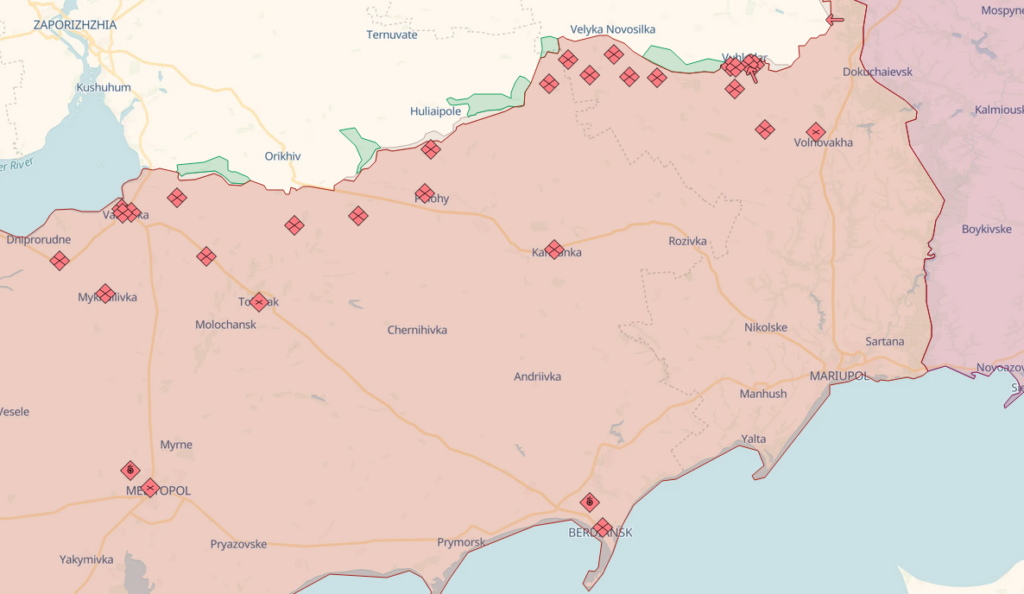
In this week’s LinkSwarm, I briefly touched on how Ukraine is absolutely hammering Russia’s logistics behind the front lines. So here are a couple of videos that go into more detail. First up: Task & Purpose.
“Right now, Ukraine is hammering away at Russia’s logistics in a big way.”
“Over the past several months, Ukrainian forces have been expanding what are being called middle strikes. Drone attacks against Russian logistics, air defenses, command posts, and support areas dozens of miles behind the front line. These attacks have been reported as typically happening between about 30 and 180 km behind the line of contact, which means roughly 19 to 112 miles.”
“They’ve branded this new campaign as ‘The Logistics Lockdown,’ and Kiev says it is allocating another five billion Hryvnias, or about $13 million, to expand their middle strike capabilities against Russian logistics, warehouses, equipment, command posts, and supply routes.”
“These middle strike drones are being used to hit the stuff that keeps the front line alive.”
“Ukrainian units are using systems like the Chaklun-B, B2, and Decrotia drones to hit Russian targets far from the trenches.”
“If a drone can reliably reach 80, 100 or 150 km behind the front, Russia has to reconsider where it places things that used to feel far enough in the rear. Fuel depots, ammo dumps, repair facilities, all those things that we’ve already mentioned may now have to be pulled back, dispersed, hardened, or used for shorter periods of time before relocating.”
“The farther you pull back, the more that you complicate logistics.”
“This is becoming a significant problem for Russia, especially in occupied southern and eastern Ukraine, where these routes connect Russia with occupied Donetsk, Zaporizhzhia, and Crimea. The Institute for the Study of War says that these Ukrainian strikes are hampering Russia’s ability to move personnel and material along key arteries like the M14 Highway from Rostov to Crimea.”
“More recently, Ukraine’s 412th Nemesis Brigade used a so-called new secret strike drone against the R-280 highway, also called by Russian occupation authorities, the Novorossiya route.” Novorossiya is in Russia’s extremely far east, so I think this is probably a joke. “This route runs through occupied Mariupol, Melitopol, and Simferopol, linking occupied southern Ukraine with Crimea and serving as a key logistics corridor for Russian military equipment and supplies. They claimed that these new strike drones destroyed dozens of trucks and fuel tankers and forced Russia to limit heavy equipment movement along the highway.”
“There are also reports about a drone called Hornet. Defense Express reported that Ukrainian forces have used Hornet strike drones against Russian logistics routes at depths of roughly 50 to 150 km. and they describe the system as a fixed-wing UAV associated with visual navigation and target detection or target capture algorithms.”
“If they’re using onboard terminal guidance through AI chips with cameras, then you really can’t jam them through the typical GPS spoofing or GNSS spoofing. So, these might be kind of a secretish weapon that they’re now using AI to guide to the target.”
“But whether the drone is Hornet, Decrotia—” I don’t which drone this is; the drone they’re showing on the screen is usually referred to as Shark; if you know what a “Decrotia” drone is, or how to properly spell it, feel free t0 share in the comments. “—Chaklun-B, B2, or something still being kept out of public view, it doesn’t really matter.”
Skipping over the section on fiber-optic drones, well-covered and I would be flabbergasted if they’re using them for such long strikes.
“Ukraine is showing what happens when cheap and medium-range drones start focusing on boring logistics trucks and support sites far from the front.”
“Logistics wins wars. So Ukraine is trying to and they’re succeeding in making Russian logistics slower, farther away, more expensive, and just more stressful. And if Russia wants to keep attacking and hold on to the ground that it has taken, it still has to solve the same basic problem that every army has always had to solve ever. Getting the right stuff to the right people at the right time.”
From Task & Purpose to the guy who used to present the Task & Purpose videos, here’s Cappy Army on the same topic.
“Ukrainian forces launched a new logistics lockdown campaign that’s systematically crippling Russian supply lines. Ukraine’s focused on destroying Russian supply trucks and disrupting logistics in a new approach that’s now causing severe problems for the Kremlin. As we’ll see today, I want to examine why this approach has experts licking their finger and saying the strategic winds are now blowing in Ukraine’s favor.”
“The reason why Russia’s supply lines are suddenly collapsing is because of a key concept called Battlefield Air Interdiction, or BAI. It refers to the broader military campaign of using air power or drone strikes to isolate the battlefield. It’s the strategy to destroy transportation arteries. BAI is about denying the enemy the use of crucial logistics lines to sustain immediate frontline operations.”
“Abstract concepts like BAI become reality when you look at the highways leading from Russia into Ukraine. They are just lousy with charred husks of Russian armored vehicles that now sit by the side of logistics roads. Footage has been flooding social media showing Ural heavy recovery trucks destroyed with their tires melted by drone strikes. Open source analysts have counted over 200 strikes just on Russian logistics vehicles.”
He too highlights the importance of attacks on the R-280 highway. “Ukraine has increased the rate of these attacks by five-fold in just a few months.”
“How were they able to do such a feat in mass production? Zelensky announced that they’re already mass-producing attack drones in four European countries, Germany, the United Kingdom, Denmark, the Netherlands, and there are plans to expand drone production into Norway and Sweden soon.” Plus expanding domestic production.
Medium range is also where soldiers rotate to and from the front-lines to decompress. “Middle- range strikes remove any feeling of safety for Russian troops. Ukraine now fires over 160 of these middle-range strikes per month, hitting logistics and ammo depots. They hit drone control points and command posts. It’s hard to appreciate how massive this change really is when you think about four times the amount of strikes compared to February.”
“The new mid-range drones have a payload of about 220 lb, 10 times more powerful and accurate than artillery shells.” The drones shown on screen are the FP-2 Fire Point, the AN-196 Liutyi, and the Peklo, none of which go all the way up to 220 pounds. But the new drones are now cost effective for going after logistics trucks.
“The middle range is the priority right now. Because Ukraine is hitting everything that’s feeding Russia’s front line, that constant pressure is causing some serious problems for the Russian army.”
“Ukrainian drone operators say that before middle-range strike campaign went into full gear, Russia was holding large portions of their supplies and ammunition in the range of between 60 to 80 km back from the front line. But now they’ve had to push all of their supplies twice the distance away to 120 km away. When you’re talking about having to feed Russian artillery teams to match their rate of fire of about 10 to 15,000 rounds a day during surge fighting, every additional kilometer moved back from the front is a huge cost.”
“The US government just signed off on a $370 million deal authorizing sending JDAM extended range glide bomb kits to Ukraine. It would send 1,500 of these glide bombs to Ukrainian fighter jets to fire at targets up to 75 kilometers away with 500 pound bombs. This is the kind of weapon system you send to support offensive operations.”
Back to the M-14 attacks. “The attacks have forced Kherson Oblast’s occupation head Vladimir Soldo to sign a decree restricting the movement of civilian vehicles to only Russian military vehicles here. As a result, Russia’s having an even harder time resupplying its entire southern grouping of forces. A Russian affiliated mil-blogger complained that restricting civilian trucks makes it more difficult for them because now Ukraine knows every vehicle on the highway is a military target. They don’t have to worry about hitting civilians if there are no civilians.”
“Artillery once accounted for 70% of casualties on the battlefield. It’s drones that now account for at least 70% of battlefield deaths.”
“Everyone was shocked when Ukraine’s 129th heavy mechanized brigade went on the offensive, assaulting the town of Odradne in Kharkiv. Armored vehicles pushed forward under artillery fire. Drone strikes blasted Russian soldiers out of trenches. Ukrainian infantry cleared out fortified fighting positions. When it was all said and done, it recaptured the town and 22km with it.”
“And it wasn’t a one-off. Ukraine’s ground forces recaptured 400km largely from the southern sector of Zaporizhzhia. Further east, soldiers retook the city of Kupyansk just when it looked like it was about to fall to Russia. These are just a few of the mounting signs that the momentum of the war is shifting.”
“The clearest indication of a shift came in April when the war hit a major milestone. Moscow lost more territory than they gained for the first time in two years, a net negative of 116km.”
“Russia’s forces [are] slowly losing the ability to sustain the war at the same intensity and momentum.”
There are signs Ukraine is preparing for a new offensive. “The Ukrainian army has started switching from a system of loose brigades with little coordination to a new command level of army corps. The concept puts about five brigades or 80,000 Ukrainian troops, all their drone units, artillery guys, infantry, intelligence officers under one unified command for the first time. The new roughly 18 to 20 something different corps, each report to one of four regional commands. It’s a clear sign that Ukraine is preparing to regain operational maneuver warfare capability.”
“What it means is Ukraine is finally moving away from the old Soviet era model to a NATO style command. This allows for joint planning between brigades for the first time.”
“The old brigade-centric army was good for holding front lines and plugging gaps. Now they will be able to coordinate assault actions. Ukraine is now offense maxing their army’s organization. Another indicator that Ukraine is preparing for localized counterattacks is that in 2026, Ukraine started building two new mechanized brigades, the 160th and the 50th. They’re converting old light infantry formations into mechanized units that ride into battle.”
Skipping over Clausewitz on the importance of morale. “When the Ukrainian war became longer than World War II and less than 1% of territory had been captured since 2023, this was a major turning point in the minds of many Russian troops.”
“Manpower and recruitment are becoming a problem for the Kremlin. Ukraine has come up with the new way to reduce the manpower advantage. They came up with a campaign to kill or wound 50,000 Russian troops per month. Then they gamified it so soldiers get points for every confirmed kill.” We covered the Gamification of the Russo-Ukrainian War here.
“Now evidence shows that the casualty rate is creeping up and retention and recruitment is creeping down. Russia is now struggling to match this rate with fresh recruits. Most open-source analysts have concluded that they’re losing more than they’re recruiting. Most analysts put the numbers at somewhere around 30,000 troops being recruited per month and roughly 35,000 lost each month.”
“This kind of high casualty rate has a negative impact on troops morale.”
“A 24-year-old Russian soldier was fighting in the Donbas last year and he deserted from his unit and spoke to the New York Times about it, saying they spent a month trying to establish a foothold in a small town outside of Pokrovsk, and his unit would move in and then they would get wiped out by Ukrainian drones. Then his commander ordered them to try something different, to start infiltrating in two-man teams to slip through. They eventually had some success with this, and then he deserted to avoid being sent on more assaults.”
Ukraine is also having manpower issues, “and this has led to widespread use of robotic ground systems. In April, Ukraine seized the battlefield position without humans on the ground for the first time of the war, and an estimated 20,000 missions were conducted by ground robots.”
Ukraine seems to winning the technology war. A “one-two punch of the Kremlin blocking telegram messaging apps for many Russian troops because they were unable to monitor it. But it has kneecapped Russian soldiers communications.”
“Then the second punch was Starlink was turned off for Russia by Elon Musk…After access was cut off, Russian commanders were forced to rely on inaccurate maps. They deployed with no means of communication or the ability to use their drones.”
“European countries have agreed to send $100 billion for Ukraine through 2027 to keep their war economy running. When Viktor Orban was defeated in his election recently in Hungary, it unlocked this because he was cock-blocking/vetoing for the deal for years.”
We’ll see if Ukraine can turn their technological advantage in mid-range strikes into more offensive gains.
More of the Democrat election fraud that doesn’t exist, more Democrat welfare state fraud, a commie scumbag gets indicted, Ukraine returns to hammering Russia’s oil infrastructure, a very busy week for Kash Patel, the BBC wants us to sympathize with Muslims who enable child rape, and the best bagels in America are found in…Dallas?
It’s the Friday LinkSwarm!
“Left’s election fraud denials crumble as DOJ exposes two-decade-long California cheating scheme. FBI Director Kash Patel says prior administrations looked the other way on election cheating but ‘those days are over.'”
Despite evidence to the contrary, liberal voting activists have spent years minimizing cheating concerns and portraying those who want to investigate such problems as “election deniers.”
But the FBI and the departments of Justice and Homeland Security are now systematically exposing electoral fraud – from non-citizen voting to ballot-box-stuffing schemes that are turning the table in epic fashion.
The latest strike came Monday when a longtime voting activist in California reached a deal with federal prosecutors to admit to illegally paying homeless people to sign election petitions and paying people to register to vote. The two-decade scheme allegedly leveraged the Democrat-run state’s lax mail-in voting system, which sends ballot forms to everyone whether they ask for them or not.
The felony charge and plea deal announced Monday against Brenda Lee Brown Armstrong, 64, of Marina Del Ray, Calif., not only signals an investigation into others, it likely will provide legal fodder to the Justice Department’s efforts to force California to turn over its voter registration database to look for other abuses.
That case, and others like it against blue states, are working their way through the federal courts in a major initiative led by Assistant Attorney General Harmeet Dhillon.
Prosecutors said Armstrong spent two decades collecting ballot registration forms, including in California’s high-profile voter initiatives. On occasion, Brown targeted homeless people on Skid Row in Los Angeles, offering them money to fill out forms, and even sometimes letting them use her own address to put on the forms.
The plea deal mentioned Armstrong was paid by “coordinators” to gather signatures for ballots, and she used some of that money to enlist people to register to vote and sign petitions.
“Because her coordinators only paid for signatures attributable to registered voters, Armstrong endeavored to ensure the people who signed her petitions were registered voters,” the DOJ said in announcing the plea deal.
“Armstrong regularly paid and offered to pay individuals cash, usually in amounts between $2 and $3, to induce them to sign her petitions,” DOJ said, adding in January she “knowingly and willfully paid another person to register to vote. She paid the person for the purpose of causing that person to register to vote in federal elections.”
Democrats have hundreds of ways to cheat in elections, and one by one the Trump Administration is shutting them down and prosecuting the perps.
A vast improvement: “Trump administration had full year of zero border releases.”
While campaigning in 2024, President Donald Trump pledged to fix the nation’s broken immigration system, a system exacerbated by the rogue incompetence of the Biden administration. Now, after 18 months into his second term, Trump has maintained his excellence in border security and upheld his campaign promise regarding illegal immigration, as the Trump administration has achieved a year of zero releases at the U.S.-Mexico border.
Whereas the Biden administration wantonly permitted, if not outright encouraged, border security agencies to release illegal immigrants into the United States, Trump has ensured such ineptitudes would not happen under his watch. After innocent victims such as Laken Riley, Rachel Morin, Jocelyn Nungaray, and many others were murdered by violent illegal immigrants, the Trump administration utilized every possible avenue to ensure that such atrocities would not recur. The first barrier to accomplishing this was limiting border releases.
It is a remarkable success that shows the country’s border security issues stem from failed leadership and a failed president. Biden’s atrocious border policies made the country more dangerous. Trump’s policies made the country safe again. It’s a success that should not go unrecognized.
Homeland Security Secretary Markwayne Mullin touted the historic feat in a press release.
“Twelve straight months of ZERO releases at the border. Under President Donald Trump’s leadership, we are delivering the most secure border in American history,” Mullin said. “The days of catch and release are over. We are enforcing the nation’s laws and sending illegal aliens back to their home countries.”
Today – 15 individuals have been indicted for over $90 million in an alleged massive healthcare fraud scheme in Minnesota, after a sweeping FBI investigation with @TheJusticeDept
and our Interagency Partners.
These charges involve the two LARGEST Medicaid fraud cases ever charged in this district and first-of-their kind charges involving 7 additional Medicaid programs.
As alleged, the defendants defrauded Minnesota public healthcare resources for tens of millions, targeting programs such as Housing Stabilization Services, Child Care, Medicaid programs, Individualized Home Supports (IHS), and more.
In one case, defendants even developed a scheme worth over $40 million to target the Early Intensive Developmental and Behavioral Intervention (EIDBI) – an autism healthcare program – paying kickbacks to parents who fraudulently used autism centers to diagnose children with autism regardless of medical necessity, and billing for services not actually provided. This not only defrauded taxpayers, but robbed valuable resources from families truly in need.
President Trump gave this law enforcement team a mandate to investigate and systematically dismantle this exact kind of public fraud in America – which grossly abuses and mismanages money from hardworking American taxpayers – and that’s exactly what we’re doing. Today’s indictment in a massive moment in this effort.
Gavin Newsom is, in many ways, the most corrupt governor in America.
By that, I don’t mean that he spends his time and effort skimming off the top to put money in his own pockets. I have no evidence that he does, although an awful lot of money flows to and through the fingers of his wife. His personal wealth is not staggering by California standards—estimated at a few tens of millions of dollars—and he has it through his relationship with the Getty Oil family. Sort of a nepo-baby once removed.
His corruption is more in the style of Putin—using power to make others rich and indebted to him, and he has pillaged the coffers of the City of San Francisco and the State of California in order to do so. The ultimate goal is ultimate power, and his path to that power has been to leverage the power he has gained at each step up the ladder to enrich a group of allies who will, in turn, fund his rise further.
In 2023 Newsom was given a bill to sign that would have required private insurers to cover hearing aids for children. Many other states require insurers to cover them.
According to NY Post, Newsom vetoed the bill and decided instead to have the state provide the hearing aids. The result was $23 million spent on hearing aids for 300 people. About $76,000 a person. About 20,000 children in CA still need hearing aids.
Well done Gavin.
The scale of Newsom’s corruption is almost beyond comprehension. California, if it were its own country, would have the fourth-largest economy in the world. Its economy is about twice the size of Russia’s, and its state budget is about 50% larger than Russia’s, despite having no war to fund against Ukraine or anybody else besides the taxpayers of California.
That gives a lot of room for corrupt spending, especially when nobody is looking to uncover it.
The other day, I took a look at Newsom’s Baby 2 Baby free diaper program, which is an obvious scam, paying highly inflated prices for cheap Mexican diapers to an NGO run by friends of his wife, who all make nice salaries.
The United States has indicted former Cuban President Raúl Castro, a senior Trump administration official confirmed. A federal grand jury in Florida indicted former Cuban President Raúl Castro along with five other defendants, according to court filings made public Wednesday.
The charges mark a major escalation in a long-running US legal case tied to the 1996 downing of two civilian aircraft, an incident that killed four people and has remained a flashpoint in US-Cuba relations for decades.
Castro, 94, served as Cuba’s defense minister at the time of the shootdown before becoming president in 2008, following the illness of his brother Fidel Castro. Fidel Castro died in 2016.
Remember that the commie rulers have a secret corporation (GAESA (Grupo de Administración Empresarial S.A.) that allows them to rob Cubans blind. “How is it possible for a military company to control 40% of the national economy, accumulate $14.5 billion in bank deposits, not publish financial statements, avoid paying taxes in foreign currency, and not be accountable to the National Assembly?”
Hope you enjoyed your Victory Day parade, Vlad. “Moscow Attacked By Drones: Oil Depot, Microchip Factory & Airport All Hit.” The chip factory is Angstrem, which was reportedly running some very ancient process technology indeed. But I bet a bunch of what they could produce was used by the Russian military.
Gary Grief, the former executive director of the Texas Lottery Commission, has been re-indicted in connection with a rigged jackpot following the dismissal of a prior indictment.
A summons was issued one day after Texas Scorecard originally reported that an initial indictment against Grief had been quietly dismissed by the Travis County District Attorney’s office.
The reissued indictment, a carbon copy of the first, and the new summons come amid ongoing scrutiny of the handling of the high-profile case.
Travis County District Attorney José Garza told Texas Scorecard Thursday he could not currently comment on the matter, but that his office would release more information on the case soon.
Before the latest indictment came to light, Gov. Greg Abbott called the initial dismissal “incomprehensible.”
Snip.
Court records posted to X by Dylan McKim with KXAN-AUSTIN indicate that not only was Grief summoned, but the Texas Lottery Commission itself is named. A separate indictment identifies Ed Rogers and Clay Kidd alongside Grief as “managerial agents” acting on behalf of the agency.
Notably, Ryan Mindell, Grief’s right-hand man at the Texas Lottery Commission in 2023 and his short-lived successor, is not currently summoned in connection with the case. Mindell quit the commission after lawmakers called for his removal during the 2025 legislative session.
The original indictment against Grief was secured in April 2026 on a first-degree felony charge of abuse of official capacity involving more than $300,000, stemming from a rigged $95 million jackpot.
The charge came after a year-long investigation by the Texas Rangers into Grief’s controversial authorization of third-party companies that resold lottery tickets on behalf of customers, effectively enabling the online sale of Texas lottery tickets without legislative approval.
During the 2023 legislative session, Grief misled members of the Senate about resellers operating openly in Texas. The practice was ultimately outlawed during the 2025 legislative session after revelations that couriers facilitated bulk purchases, leading to a $95 million Lotto Texas jackpot win in April 2023 that was reportedly rigged by an international gambling syndicate.
Farmer and former Navy SEAL Ed Gallrein prevailed over Representative Thomas Massie (R., Ky.) in a closely watched primary race on Tuesday evening, bringing to an end the most expensive U.S. House primary on record.
Massie, who has represented Kentucky’s fourth district since 2012, is one of several lawmakers to lose a seat this cycle thanks to a retribution campaign Trump has undertaken against legislators who have dared to cross him.
The bad blood between Massie and Trump dates back to the president’s first term. As early as 2020, Trump called the Kentucky Republican a “third-rate grandstander” after Massie voted against the president’s Covid-19 relief package.
While Trump and Massie seemed to make amends, with Trump endorsing Massie for reelection in 2022, the president’s second term has seen the pair butt heads repeatedly over a slew of issues, from the Iran war to tariffs.
Trump on Monday blasted Massie as an “obstructionist and a fool.”
Massie, who also controversially opposed Trump’s “Big Beautiful Bill,” worked with Democratic Representative Ro Khanna of California to advance a bill in Congress to compel the Trump administration to release government files on deceased sex trafficker Jeffrey Epstein.
Massie’s opposition to U.S. aid to Israel and his vote against a resolution condemning antisemitism made him a target of not only the president but the Republican Jewish Coalition and the American Israel Public Affairs Committee as well. Both groups have spent more than $4 million on anti-Massie ads.
You can stray from the party on an issue or two and still survive, but when you make a habit of working with Democrats against stated Republican priorities time after time, expect a reckoning.
Republicans have one thing going for them in the midterms: Fat stacks of cash.
The Republican National Committee ended the month of April with more cash on hand than at any other point in the group’s history, as closely contested midterm elections draw near and the fate of Republicans’s majority in the House and Senate hang in the balance.
The RNC raised $18.6 million in April, bringing its total cash on hand to $123.8 million, according to Federal Election Commission filings.
“Republicans have the candidates, resources, and momentum needed to win the midterms, but we cannot let up now,” RNC Chairman Joe Gruters said in a statement. “Democrats will spend whatever it takes to try to stop President Trump’s America First agenda, which is why the RNC is already investing aggressively in our ground game and election integrity operation, including deploying 34 State Directors and Election Integrity Directors across 17 key battleground states to drive turnout and secure victories this November.”
Democrats lie to everyone, including themselves: “Harris Campaign Didn’t Go Negative Enough on Trump, DNC Autopsy Concludes.”
A newly-released Democratic National Committee report looking back at how the party lost the 2024 election concludes that then-Vice President Kamala Harris lost, in part, because she failed to focus sufficient negative attention on President Trump.
“The national campaign did not effectively drive Trump’s negatives, and the White House did not effectively support Vice President Harris over three and half years to improve her standing before the candidate switch,” reads the autopsy, written by Democratic strategist Paul Rivera, who was asked by the DNC to investigate why the party failed to wing big in 2024.
Rivera goes on to suggest that Democrats failed to remind Americans why they disliked Trump in his first term.
“The idea Trump’s negatives were ‘baked in’ is a major failure of analysis and reality, given how his favorability has cratered less than a year into this term,” he adds.
Rivera’s finding that Harris wasn’t sufficiently negative is curious given that Harris and her surrogates incessantly depicted Trump as a threat to democracy who revealed his true colors on January 6.
Harris attacked Trump repeatedly during the campaign, calling her opponent “increasingly unhinged and unstable” and telling CNN that she believed he was a fascist who wanted “unchecked power.”
Party officials interviewed hundreds of Democrats in all 50 states to create the report. Democrats had asked DNC Chairman Ken Martin for months to publicly release the findings, but Martin chose to do so only after being “presented with CNN’s reporting about much of its contents,” according to the outlet, which first obtained the nearly 200-page report.
The report is littered with notes drafted by DNC editors pointing out that many of Rivera’s claims are unsubstantiated and/or contradict publicly available reporting.
Yay think? It wasn’t the fact that, oh, Harris was a cringingly bad candidate, that Biden was an ambulatory corpse whose headless administration was a disaster for ordinary Americans thanks to inflation and letting a flood of illegal aliens enter the country, or that actual voters hate transsexual madness and social justice lunacy? But no, telling the truth would offend the Party’s toxic cadres of intersectional grievance mongers. They’d rather lie to themselves and continue to lose rather than being dragged on BlueSky.
This trucker is in Eden, Ohio, and just parked at a truck stop where he got a bite to eat at an Indian restaurant.
(Sikh Indians now own 20% of all trucking businesses in North America.)
He says foreign truckers are being hit HARD after the Supreme Court ruled Thursday that logistics companies can be held liable for hiring unsafe drivers.
None of ‘em can get loads out of Ohio today. And I was talking to the Iman guy while I was in there at the Punjabi place getting something to eat, and he said that the reason they they can’t get freight out of Ohio today is because the freight workers won’t work with them anymore.
Apparently, what has happened, is yesterday they had the Supreme Court ruling that brokers could be held liable for accidents with carriers with red flags. Apparently, the trickle trickle-down effect happened like THAT.
A leftist might look at this and say it’s racist. An “inequitable” number of carriers with foreign drivers are being excluded??
Well, as it turns out, these truckers just so happen to be the ones that are the least safe.
I was looking up a few of these DoT numbers for these guys, and they do have pretty substantial track record of unsafe behavior – accidents, high out-of-service rates, things like that.
Many foreigners, even illegals, have been able to game the system, getting CDLs issued by Democrat-led states like New York and California even though they are not qualified. CDL schools run by migrants have participated in this fraud for years.
Meanwhile, the number of deaths involving 18 wheelers on U.S. roads has risen 50% in just the last 15 years. Thanks to SCOTUS, that might reverse very quickly in the near future.
As a bonus, Americans will have a chance to get back into a trucking industry that’s excluded them in favor of cheap, unsafe, illegal labor!!
The FBI announced on Wednesday that they were shutting down a scam call center in India which has defrauded hundreds of elderly Americans out of millions of dollars.
Snip.
Former CEO Adam Young, 42, of Miami, FL, and former CSO Harrison Gevirtz, 33, of Las Vegas, NV, admitted to operating a business that provided telecommunications-related services, including telephone numbers, call routing services, call tracking, and call forwarding services, to customers they knew were engaged in tech-support fraud schemes. Young and Gevirtz each pleaded guilty to misprision of a felony, in violation of federal law. They are scheduled to be sentenced on June 16, 2026. The sentences imposed will be determined by a federal district judge after consideration of the U.S. Sentencing Guidelines and other statutory factors …
Indian citizens Sahil Narang, Chirag Sachdeva, Abrar Anjum and Manish Kumar, were convicted of charges related to telemarketing fraud schemes based in the Republic of India that targeted and defrauded Americans of millions of dollars, many of them vulnerable to fraud schemes due to age or infirmity. The investigation also contributed to the conviction of another individual, Jagmeet Singh Virk, in the U.S. District Court for the Norther [sic] District of California. The investigation further revealed that call centers based in India utilized Young and Gervitz’s business to route their ‘tech fraud’ scheme calls and, in some instances, advised those fraudsters on methods intended to reduce complaints and prevent account terminations.
Now if they could just shut down every Indian company pretending to be an American company (a plague among temporary and contract work firms), that would greatly improve the situation for American job seekers.
“Texas Children’s Hospital Agrees to Create Detransition Clinic, Pay $10 Million in ‘Historic’ Settlement. The agreement stems from a years-long investigation into alleged Medicaid fraud tied to sex-change procedures on minors.”
A years-long controversy surrounding gender mutilation procedures at Texas Children’s Hospital have culminated in a sweeping settlement with Texas Attorney General Ken Paxton that will force the hospital to pay $10 million, fire five doctors, halt “gender-transition” procedures, and create the nation’s first “Detransition Clinic.”
According to Paxton’s office, the settlement resolves allegations that Texas Children’s improperly billed Texas Medicaid for sex-change interventions using false diagnosis codes despite longstanding state policy prohibiting Medicaid coverage for such procedures.
Under the agreement, Texas Children’s will establish a multidisciplinary clinic intended to provide care to patients who previously underwent “gender-transition” procedures. The hospital will fully fund the clinic for at least five years, with services provided free of charge to patients.
The settlement also requires Texas Children’s to terminate and permanently revoke privileges for five physicians accused of performing the procedures. The hospital further agreed not to provide “gender-transition” services moving forward and to adopt new ethics and compliance measures.
We asked the sick leftwing freaks not to mutilate children in the name of their perverse social justice religion, and they just couldn’t help themselves.
[sigh]: “Federal Judge Again Blocks Texas Law Allowing Arrest and Deportation of Illegal Immigrants.”
Just one day before a controversial Texas law on illegal immigration was set to take effect, a federal judge granted a new injunction saying most of the law would not pass constitutional muster before the U.S. Supreme Court.
U.S. District Judge David A. Ezra, who blocked implementation of Texas Senate Bill (SB) 4 in 2024, opined that the law “threatens the fundamental notion that the United States must regulate immigration with one voice.”
Approved by lawmakers in 2023, SB 4, filed by Texas Sen. Charles Perry (R-Lubbock), established a criminal offense for illegal entry into the state from a foreign nation, and provided a mechanism for judges to order offenders to return to their nation of origin.
Implementation was delayed until the U.S. 5th Circuit Court of Appeals dismissed a pending lawsuit last month on the grounds that the plaintiffs did not have standing to sue, clearing the way for the law to take effect on May 15.
Earlier this month, the American Civil Liberties Union (ACLU) and the Texas Civil Rights Project filed a new challenge on behalf of two unnamed individuals who said they could be arrested and subject to SB 4’s provisions.
Ezra’s injunction applies to four provisions of SB 4: criminal penalties for re-entry without authorization; authorizing magistrates to order deportation; criminalization of failure to comply with a Texas magistrate’s deportation order; and SB 4’s requirement that magistrates continue a prosecution even when a person has a pending immigration case under federal law.
In his opinion released last week, Ezra noted that while federal authorities can elicit help with immigration enforcement actions from state and local law enforcement, SB 4 would clash with precedent set in the U.S. Supreme Court’s 2012 ruling in Arizona v. United States.
The offences mainly took place in Dewsbury and Batley, north Kirklees, and involved three girls.
One was just 12 years old when the offences started in 1995. They ended in 2003.
The trials began in 2023 and the perps were convicted and sentenced in 2024 through late 2025. The reason we are only learning their sentences now is because there was a court-ordered ban on reporting (they can do this in England)
Reporting restrictions had been put in place to ‘safeguard the fairness and integrity of the court process.’
Translation: They were to ensure the safety of Labour poll numbers from outraged Britons…
California is the land of expensive, useless bureaucracies, which Democrats allow to do nothing but impose more regulations on Californians.
In 2023, California created a fast-food council to micromanage fast-food restaurants from wages to working conditions. The council, the first of its kind in the United States, exists to justify California’s fast-food minimum wage hike, which jumped to $20 an hour, and the council has the ability to increase over the coming years. By now, you know how this went: Fast-food restaurants shut down, cut jobs, cut worker hours, raised prices, or did some combination of those things.
More notably, though, the council that is required to meet at least twice a year does not really exist. The last subcommittee meeting for the council took place in February 2025. It has now been over a year since the council has done anything, and even then, it could not be bothered to gather all nine members. Gov. Gavin Newsom (D-CA) plucked the council’s chairman for a different state appointment after that last subcommittee meeting, and it hasn’t gathered since.
Despite this, the council was still allocated $1.1 million from the state budget.
Fender won a lawsuit (by default) in Germany, and now it’s suing every guitar maker in the world that makes guitars that look even remotely like Stratocasters. “The decision to enforce the EU-based ruling on US builders marks a huge development in the case, and the outcome of such legal battles could very well reshape the guitar industry as we know it.” I rather suspect this strategy isn’t going to work out well for them…
Google is about to ruin the Internet. “Google is changing its search engine to focus on AI recommendations and NOT links to websites, according to its Google I/O presentation. And it’s a wrap. That’s it for the free and open internet. Niche publications and independent voices will likely get completely shut out of organic search as the internet becomes pay-to-win.” Another reason to stick to DuckDuckGo.
And speaking of science fiction first editions, I’m going to be sending a new book catalog out next week. Drop me a line if you want a copy.
Critical Drinker reviews Pragmata, mostly enjoys it. If the terminally online left hadn’t freaked out about this game, I doubt I ever would have heard about it…
Once again, the Babylon Bee is doing straight up reporting from LA: “New Polls Show Dead Heat Between ‘Make Everything Worse’ Candidate And ‘Fix Everything’ Candidate.”
Happy Friday the 13th, everyone! Good job numbers drop, a court win for Trump on deportations, more California fraud, more Chinese researchers stealing secrets, and the cure for global warming is global warming.
It’s the Friday LinkSwarm!
Naturally, a week after I blog about the “no hire, no fire” economy, it comes out that the economy added 130,000 in January, the most since December 2024. “However, the report shows the U.S. only added 181,000 jobs in 2025.” And the numbers for previous months keep getting revised downwards.
As I’ve said before, I’ll believe we’re out of the Biden Recession when I have a job again…
Petitions for Habeas Corpus to release illegal aliens from detention, or at least grant them bond hearings, have overwhelmed the federal courts, with most district court judges who have ruled on the subject siding with the detained aliens. It was the practice of prior administration from both parties to grant bond hearings. But is it a legal requirement?
A ruling by the 5th Circuit Court of Appeals, which covers critical border state Texas, has rejected the argument that a bond hearing and release is required by law. To the contrary, it held that the applicable legislation passed by congress does not require such bond hearings or release. That prior administrations did not exercise their full powers of detention under the law did not mean the present Trump administration could not do so, the court ruled.
Another win for secure borders and the rule of law in the face of massive leftwing judicial resistance.
The House of Representatives on Wednesday night passed the new Republican-led Safeguard American Voter Eligibility (SAVE) America Act, which requires individuals to present proof of citizenship to register to vote and requires Americans to show ID when voting.
The House passed the legislation, which combined two bills, in a 218-213 vote. The bill saw little support from House Democrats, with Texas Rep. Henry Cuellar being the sole Democrat to join Republicans in passing the legislation.
“It’s just common sense,” House Speaker Mike Johnson told reporters of the legislation. “Americans need an ID to drive, to open a bank account, to buy cold medicine, to file government assistance. So why would voting be any different than that?”
Senate Democrats, of course, with the exception of John Fetterman, will do anything to prevent it from being passed. If they can’t cheat, they can’t win…
Stephen Green: California raked off $370M in taxpayer money to bankroll leftwing activism.
1. Californians voted to fund youth drug prevention through the Cannabis Tax. Instead, $370M in revenue is bankrolling leftwing activism.
2. The money flows through a single unelected nonprofit – The Center at Sierra Health Foundation’s Elevate Youth program.
3. The Center has gotten rich off this arrangement – growing from $11.8M in 2018 to $197M in 2024. The CEO makes over $600K.
4. The Center runs Prop 64 dollars through to a web of NGOs, including the Jakara Movement, Young Invincibles, and Asian Refugees United – for activism, organizing, and voter registration.
5. This is not drug prevention – it’s a taxpayer funded pipeline from the governor’s office to leftwing political organizing.
Snip.
“The state does not pick who gets the grants,” CAL DOGE said. “The intermediary does, bypassing the rigorous procurement processes mandated for direct government contracts under the Department of General Services and State Controller oversight.”
That’s a multimillion-dollar slush fund, in other words, in which tax dollars pass through to the well-connected for the purpose of maintaining Democrat control of the state. And, one presumes, lining pockets along the way —allegedly including Newsom’s:
According to the California Fair Political Practices Commission’s Behested Payment Transparency Report (pg.19-20), in 2020 alone, Sierra Health Foundation was the third-largest payor of behested payments statewide at $14,747,724 and the single largest payee of behested payments statewide at $30,869,901 — payments Newsom solicited from private companies.
“Newsom himself was the top behesting official in the state that year at $226.8 million total,” the report continued, “and Sierra Health Foundation ranked among his top three financial partners in the system.
Los Angeles spent about $418 million on homelessness programs in 2025, yet only a small share went toward helping people leave the streets for good, according to the New York Post. A recent City Hall report suggests most of the money supports short-term services that manage homelessness rather than resolve it.
The review, released as the city prepares major budget cuts, shows that hundreds of millions were directed to hygiene facilities, outreach teams, temporary housing, and vehicle-living programs with limited long-term success. These efforts often keep people in transitional situations instead of moving them into permanent homes.
The Post noted that councilwoman Monica Rodriguez condemned the system, saying, “We’re hemorrhaging money on a homelessness system that was never designed to succeed — and no one is being held accountable for the failure.”
She also argued that ineffective programs are protected instead of evaluated: “If we really wanted to do something about this crisis, we would be advancing real oversight, demanding results, and shutting down programs that don’t work — not protecting a system that keeps spending more while delivering less.”
It’s not designed to end homelessness, its designed to line the pockets of the Homeless Industrial Complex and leftwing activists.
Indeed, California’s entire NGO funding structure is designed to avoid scrutiny.
The money moves smoothly, the explanations pile up, and the ability to see end-to-end quietly disappears. The deeper the look went, the more consistent the pattern became. California doesn’t struggle to explain where the money goes. It has arranged things so the explanation never quite arrives.
Snip.
When the information is pulled in its entirety and organized outside the state’s presentation layer, the scope becomes impossible to miss. More than 1,100 vendors associated with humanitarian-related contracts. Roughly $8.8 billion flowing through them. Not scattered grants. Not pilot programs. An economy of vendors, operating continuously, funded at scale. The dashboard never highlights that universe. It doesn’t need to. It only needs to make seeing it difficult enough that most people never try.
At the same time, at the federal level, the Small Business Administration acknowledged what everyone working in procurement already understands. Billions of dollars under review. Tens of thousands of entities flagged for potential fraud exposure. Large systems, large sums, limited verification, delayed audits. The numbers don’t have to match perfectly to rhyme. They already do. When separate data streams begin pointing toward the same structural vulnerabilities, the story stops being about isolated actors and starts being about architecture.
Requests for clarity meet resistance long before they reach conclusions. Public records requests stall. Narrow questions expand into bureaucratic negotiations. Specific funding totals become “unavailable.” Amy Reihart’s experience in San Diego fits neatly into this rhythm. The data is said to be public, but pulling it cleanly proves elusive. The formal channels exist, but they lead nowhere quickly. What’s left is a familiar posture from the state: the information is technically available, practically unreachable, and always just one more step away.
The same rhythm shows up in how California moves money on the ground. Childcare subsidies offer a clean example. In many states, the government pays providers directly. The path is short. Attendance aligns with eligibility. Eligibility aligns with reimbursement rates. Payments can be checked against records without heroic effort. In California, that line bends. Funds are routed through intermediary NGOs charged with administering the program. The state pays the intermediary. The intermediary interfaces with providers. Documentation flows inward. Payments flow outward.
Following that path takes work. First, identify which NGO controls which geography. Then locate its audit filings, assuming they are current and complete. Then reconcile those filings with procurement records that are already difficult to interrogate. Only after that does the provider level come into view. Each step adds distance. Each handoff adds discretion. Sources describe monthly subsidy flows exceeding $1,400 per child with minimal verification. Whether every dollar is misused is unknowable from the outside. What is visible is how easily the structure absorbs misuse without producing alarms.
That same opacity shows up beyond childcare. Walk through downtown Los Angeles and the conversations repeat. Not policy debates. Observations. Barbers, bartenders, people who work late and walk home early. The homeless system comes up unprompted. Everyone knows how much money moves through it. Everyone knows how little seems to change. Deliveries arrive at storefronts with no customers. Benefits circulate with minimal identification. Stories circulate about organized applications and quiet laundering through approved channels. None of this appears on a dashboard. It doesn’t need to. It lives in the gap between official narratives and daily experience.
The system doesn’t rely on secrecy. It relies on diffusion. Money enters labeled as humanitarian assistance, housing support, community partnership. It passes through nonprofit layers that soften scrutiny and multiply explanations. By the time it reaches the ground, responsibility is spread thin enough that no single ledger tells the whole story. Each participant can point upward or downward and remain technically correct. Oversight exists everywhere in theory and nowhere in practice.
Organizations operating at the intersection of activism and public funding sit comfortably inside this environment. The Solidarity Research Center in Los Angeles, connected to broader political networks, is one example drawing attention. Not because of slogans or mission statements, but because proximity to power and insulation from scrutiny tend to travel together. When funding, politics, and moral language overlap, questions are framed as attacks and audits become optional. The structure does the work long before anyone has to defend it.
The contrast between damage and response is hard to ignore. Drive through the Palisades fire zone and the destruction remains visible. Burned properties. Long stretches untouched. The rebuild lags. The NGO signage does not. Clean placards promise recovery, resilience, and renewal, often paired with donation links. The messaging arrives faster than the materials. The branding arrives faster than the permits. Money is already being organized, even as the outcomes remain distant. It’s a familiar sight in California: urgency in fundraising, patience in results.
None of this happens by accident. The systems are too consistent. The barriers appear in the same places. Presentation layers substitute for access. Intermediaries substitute for accountability. Requests for detail meet friction rather than answers. The result is a machine that keeps moving regardless of whether anyone outside it can explain how. For the people inside, it works. For the public, it produces impressions instead of records.
The report’s overview notes the beaming confidence of Georgia Secretary of State Brad Raffensperger on the morning after the election. Appearing on the Today Show, Raffensperger said a record 4.7 million Georgia voters cast a ballot in the election. More importantly, the secretary of state said only 2 percent of the ballots remained to be counted. Trump, at that time, led Biden by nearly 104,000 votes, seemingly more than enough for a Georgia win. Raffensperger, at the time, said about 94,000 ballots had yet to be counted.
“We can see where the candidates are right now in both presidential, congressional, senatorial. When you look at how many votes are out there, even if one of the candidates got 100 percent it probably wouldn’t be enough to move it on way or another,” the elections official told the Today Show crew. He should know, the report notes. The secretary could see the numbers in real time through the state elections database.
Raffensperger added that his office would wait until everything was done.
When the dust settled, the confident secretary turned out to be very wrong. The final vote count — at least then — was an incredible 5.023 million. Between the time Fulton County’s polls closed on Election Day and the final ballot was tallied, the number of absentee ballots soared from 74,000 to more than 148,000, according to the report.
Trump went from the verge of winning a key battleground state to losing it. Just like that.
“At the time of this writing, no known explanation has been provided to justify” the surge in ballots, the report states.
Snip.
The number of absentee ballots counted doesn’t match the number of credited voters, the report notes. It draws from Fulton County and state records that show 148,318 ballots were counted in the 2020 election, although only 125,784 voters were recorded as casting an absentee ballot. That’s a difference of 22,534 votes between the absentee ballots tallied and the number of individuals given credit for voting.
“Remember: the margin between President Trump and Joe Biden was 11,779 votes…and that was the THIRD certified number and didn’t match either of the first two counts….the counties could not get their numbers to match from the first count to the second to the third…..
Ukraine also hit a GRAU arsenal in Volgograd with multiple missiles. GRAU is the umbrella organization for Russian logistics.
While Russia has continued to eek out ever smaller territorial gains at high cost, Ukraine just liberated 100 square kilometers of territory in Huliaipole, Zaporizhzhia oblast. “Ukrainian forces have liberated the towns of Dobropillia, Pryluky, Olenokostiantynivka and part of Varvarivka in an assault south on the Zaporizhzhia Frontline.”
Scientists at the University of California, Irvine have discovered that climate change is causing nitrous oxide, a potent greenhouse gas and ozone-depleting substance, to break down in the atmosphere more quickly than previously thought, introducing significant uncertainty into climate projections for the rest of the 21st century.
A recent watchdog report revealed that several top-ranked American universities have brought in Chinese academics who have links to Chinese military-linked technology firms like tech behemoth Huawei and other Chinese firms linked to the CCP’s state security endeavors.
A conservative non-profit watchdog group, the American Accountability Foundation, reported that it found nearly two dozen Chinese academics working at elite U.S. schools and labs “who, because of the dual-use threat of their research, close ties to the military research sector in China, and/or clear ties to the Chinese Communist Party” and as such “should be expelled from the United States or never be re-admitted.”
The new AAF report pointed out that multiple Chinese students working at American universities had previously collaborated on projects with researchers at Huawei, including working with researchers at the Internal Cybersecurity Lab at Huawei.
Just the News also found that at least one of the Chinese academics had also worked at iFlytek — a similarly blacklisted Chinese company which often collaborates with Huawei. The U.S. National Security Commission on Artificial Intelligence stated in 2021 that “national champion” firms such as Huawei and iFlytek help “lead development of AI technologies at home” and “advance state-directed priorities that feed military and security programs.”
Snip.
The AAF report argued that Guangyao Chen “poses a high national-security and dual-use risk due to his expertise in adversarial machine learning” and that “this risk is amplified by his training at Peking University, PRC government funding, and collaborations with PRC universities and Huawei, placing his work squarely within China’s military-civil fusion ecosystem.”
Chen currently appears to be affiliated with Cornell. The ResearchGate page for Chen says that his “top co-authors” include Lin Du, a researcher at Huawei. Chen appears to have conducted multiple research projects with the Huawei researcher. The Huawei scientist’s ResearchGate profile lists Du’s skills and expertise as being “computer vision,” “object recognition,” and “machine learning.”
Snip.
Meng Wanzhou, Huawei’s CFO and the daughter of the company’s founder, was arrested by Canadian authorities in December 2018 at the request of the U.S., indicted in the Eastern District of New York in January 2019, and charged with bank fraud and wire fraud as well as conspiracy to commit both, but was allowed to walk free by the Biden Administration in 2021 in a deferred prosecution agreement wherein she admitted violating U.S. law.
Snip.
Fengqui You, a Cornell professor, leads the Fengqui You Research Group at Cornell, which is “pushing the boundaries of systems engineering, artificial intelligence, and data science.”
Chen is listed as a member and Fengqui You is listed as the principal investigator for the lab. You attended Tsinghua University, which the House Select Committee on the CCP has warned about. You did not immediately respond to a request for comment.
Snip.
The report by AAF said that Cen Zhang’s “prior work with Chinese entities and his influential role at Georgia Tech is highly concerning given the nature of computer science’s impact on U.S. national security.”
Zhang co-authored a 2021 paper on “Practical Binary Fuzzing Framework for Programs of IoT and Mobile Devices” — related to security vulnerabilities for mobile phones and other smart devices — with co-authors Xiaoxing Luo and Miaohua Li from the Internal Cyber Security Lab at Huawei Technologies.
Zhang has also conducted research with Hongxu Chen, who now lists himself as a lead engineer at Huawei, and who also went to Nanyang Technological University.
Zhang’s personal curriculum vitae also says he was previously an algorithm and engine development engineer for iFlytek. Zhang says on his GitHub page that he won the “Best New Employee Award of Year” at iFlytek in 2017.
The firm has long received state support and recognition from China’s government. The company was named a national “AI champion” by the Chinese Ministry of Science and Technology in 2018.
The Commerce Department said in October 2019 that iFlytek was among more than two dozen Chinese entities added to a U.S. blacklist, saying they were “implicated in human rights violations and abuses in the implementation of China’s campaign of repression, mass arbitrary detention, and high-technology surveillance against Uighurs, Kazakhs, and other members of Muslim minority groups.” Liu Qingfeng, iFlytek’s founder and CEO, is also a deputy to the National People’s Congress, the CCP’s rubber-stamp national legislature.
There are problems with how this piece is organized, but I wanted to capture the names (some of which are are already familiar) to keep track of them. At this point, any organization that hires a Chinese national for scientific research should assume they’re stealing data.
The legislation raises the current $10 billion asset threshold that caps debit card fees for banks and index annually to inflation.
Sen. Cruz said, “The Durbin Amendment was not designed for the current economic and regulatory reality and subjects community banks to fee limits that the original language intended for much larger institutions. My legislation modernizes the interchange fee cap to reflect inflation, helping small banks support local economies while lowering banking costs for Americans.”
Sen. Britt said, “As we’ve seen in so many instances, countless regulations in the Dodd-Frank Act were not only onerous but set fixed thresholds that have become outdated over time, and the Durbin Amendment is no exception. The largest burden is on our smallest financial institutions who provide vital sources of credit to Main Streets that drive our local economies. This commonsense legislation would simply index, to both inflation and COLA, the outdated threshold in this provision of Dodd-Frank, ultimately providing relief for our community banks who were never intended to be burdened by this regulation.”
Companion legislation was introduced in the House by Rep. Andy Barr (R-KY-6).
Rep. Barr said, “The Durbin Amendment was sold as a win for consumers in the Dodd-Frank Act by Democrats. Instead, it’s hurt Kentucky’s community banks and credit unions that do so much for underserved communities by limiting their ability to grow and compete with larger financial institutions. I’m working with Senator Cruz to fix this — because Washington shouldn’t be picking winners and losers at the expense of our local banks and the families they serve.”
This bill is supported by Americans for Tax Reform, Independent Bankers Association of Texas, and the Texas Bankers Association.
A new political organization has launched with the stated goal of countering one of Austin’s most powerful and long-standing special interest groups.
Republicans Against Texans for Lawsuit Reform, a 501(c)(4) organization, announced its formation this week. It is positioning itself directly against Texans for Lawsuit Reform (TLR), the influential tort reform group that has played a major role in Texas politics for decades.
On its website, Republicans Against Texans for Lawsuit Reform (RATLR) accuses TLR of abandoning its original mission and becoming what it describes as a major player in the “Austin swamp.” The group argues that TLR, which began in the mid-1990s advocating civil tort reform, now prioritizes the interests of “big business, big pharma, and big insurance” over conservative policy outcomes and Texas citizens.
RATLR also points to millions of dollars in political donations—including contributions to Democrats and Republican incumbents it labels as “RINOs”—as evidence that TLR wields outsized influence at the Texas Capitol.
“Protecting big business, big pharma, and big insurance should never override protecting you, Texas’ citizens,” the group states.
RATLR says it plans to focus on grassroots education and outreach, including speaking engagements with conservative groups across the state. The executive director is James Wesolek, the former communications director for the Republican Party of Texas.
So here’s a longish essay by Hugh Hendry on gold, Bitcoin and fiat money. I don’t necessarily agree with everything, but he has a provocative argument that creation of fiat money was justified to keep the entire economic system from breaking down.
he defining monetary lesson of the twentieth century was not ideological. it was traumatic. it emerged not from debates about socialism versus capitalism, or keynes versus hayek, but from the lived experience of what happens when economic systems impose rigidity on societies already under extreme stress.
after the first world war, germany was not a failed society. it was bruised, diminished, politically unstable, and deeply resentful, but it remained functional. industry existed. labour existed. institutions existed. the system was strained, not yet broken. the collapse came later, and it was not inevitable.
versailles changed that.
the treaty was not merely punitive. it was vindictive and economically illiterate. reparations were demanded in hard terms, payable in gold, at precisely the moment germany’s productive capacity was being constrained. forgiveness was absent. flexibility was absent. economic reality was ignored.
when germany struggled to meet those obligations, the response was not renegotiation but enforcement. in 1923, french and belgian forces occupied the ruhr valley, seizing control of germany’s industrial heartland, its coal, its steel, its metal production, while still demanding gold payments to the allied victors. output was taken. gold was still required. rigidity was imposed from both ends.
this was the breaking point.
what followed was not ideological radicalisation in the abstract, but economic paralysis in practice. unemployment surged. production collapsed. a growing share of the adult population became economically useless. not inefficient. not underpaid. useless. idle. watching. waiting. that condition does not produce reflection or moderation. it produces rage. and hyper-inflation.
hard money did not cause the collapse of weimar germany. but it failed catastrophically to absorb the trauma. and when institutions fracture under mass unemployment, money fractures with them. hyperinflation wasn’t softness. it was panic. it was the monetary expression of legitimacy evaporating in real time.
that sequence mattered. and it was remembered.
a decade later, the world faced another shock that threatened to replay the same pattern at a far larger scale. the crash of 1929 produced mass unemployment, collapsing demand, and the genuine possibility that the american system would follow germany down the same path. the ingredients were familiar: idle men, shuttered factories, political stress, and a rigid monetary framework that transmitted pressure rather than absorbing it.
this time, the response changed.
gold was abandoned as the governing constraint, not because it was immoral or discredited, but because it was brittle. too rigid to cope with systemic trauma. under gold, pressure concentrates until something snaps. under fiat, pressure disperses. elasticity replaced purity. monetary doctrine abandoned to keep the system intact.
the response was ugly. it was unfair. it produced deserved anger. but it worked.
the united states survived intact. unemployment was brutal, but the political centre held. extremism remained marginal. fiat didn’t heal the trauma, but it prevented it from metastasising. that became the lesson: in moments of economic shock, hardness accelerates entropy, while monetary elasticity buys time. and time, in stressed societies, is the difference between repair and collapse.
this was not an argument against scarcity. it was an argument against rigidity in the wrong place, at the wrong time. fiat emerged not as an ideological triumph, but as an adaptive response to the catastrophic failure of hard constraints under conditions of mass unemployment.
that distinction matters, because bitcoin did not arrive to overturn this lesson. it arrived long after, in its aftermath.
fiat’s ugly success.
over the subsequent century, that logic has been tested repeatedly, and each time it has been reaffirmed under pressure.
the global financial crisis of 2008 was not a scare or a stress test. it was a system-wide cardiac arrest. the banking system was insolvent in any meaningful sense. the only open question was whether circulation could be restarted before institutional damage became permanent. the response was not elegant. rules were bent. balance sheets were expanded. losses were socialised. hard constraints were suspended to keep the system alive. it was ugly, unfair, and morally nauseating to me and many others. it also worked.
the same pattern repeated during the pandemic. supply chains froze. borders closed. hospitals filled. the phrase “human extinction” escaped the laboratory and entered the bloodstream of culture. belief alone was enough to threaten collapse. once again, fiat leaned in. too much some say. money expanded. credit expanded. time was frozen. people were paid to stay home while the system was held upright. once again, rigidity was rejected in favour of elasticity. once again, the worst tail events were avoided.
this is what fiat does well.
it absorbs shocks that hard systems transmit. it disperses pressure instead of concentrating it. it allows societies to survive periods of mass dislocation without forcing immediate liquidation of people, institutions, or legitimacy. in a world repeatedly exposed to financial crises, pandemics, and geopolitical shocks, this has proven to be a feature, not a bug.
elasticity, however, is not free.
the cost shows up as inflation. not as a temporary inconvenience, but as a ratchet. prices spike, settle, and then remain elevated. grocery bills do not return to their old levels. this is the mechanical consequence of pushing risk forward in time. fiat smooths the present by borrowing from the future.
this matters most for those without assets. for the disenfranchised, inflation is not a macroeconomic abstraction or a debate about models. it is a daily budgetary pressure. rent before wages. food before leisure. energy before dignity. when prices ratchet higher, there is no portfolio adjustment, no rebalancing, no clever hedge. there is only less room to breathe.
modern financial systems are exceptionally effective at protecting those who already participate in them. the franchise holders. equities rise with nominal growth. property absorbs inflation and then some. credit, leverage, index-linked instruments, real assets, productive ownership. the menu is broad, liquid, and proven. elasticity doesn’t destroy capital for insiders. it often enriches them. asset prices inflate faster than wages precisely because the system is designed to keep capital mobile and solvent.
the burden falls elsewhere.
what inflation punishes is not thrift in some moral sense, but exclusion. money left idle because it must be. capital that cannot move because it does not exist. patience without agency. this is not a judgment about behaviour. it is a structural outcome. fiat rewards participation and mobility, not fairness. and over long periods of sustained monetary elasticity, that distinction compounds into something corrosive. something unfair.
Although a lot of attention has been lavished on Ukrainian Forces getting Leopard 2, Challenger 2 and Abrams main battle tanks, we’ve also sent them 109 Bradley Fighting Vehicles. Many of those have been involved in the Zaporizhzhia counter-offensive, and early reports had several being destroyed in early fighting (though crews reportedly escaped). How do Ukrainian crews like the Bradley compared to the Soviet BMP series IFVs they were using before?
As Ukrainian forces continue their counteroffensive against Russia, some soldiers say an American-supplied vehicle is making a key difference in their advances, and more importantly, saving lives.
The U.S. has provided has provided Ukrainian forces with Bradley Fighting Vehicles as part of aid packages since the beginning of the year and they have been heavily used in the counteroffensive Ukraine that launched in early June.
Two Ukrainian soldiers from the 47th brigade, Serhiy and Andriy, told ABC News that they and their crew wouldn’t be alive today if Bradley didn’t protect them from a battle early on in the counteroffensive where they were struck by mines, high caliber guns and attack drones.
“We were hit multiple times,” Andriy, who drove one Bradley, said. “Thanks to it, I am standing here now. If we were using some Soviet armored personnel carrier we would all probably be dead after the first hit. It’s a perfect vehicle.”
The Bradleys are armed with a 25mm automatic cannon, a 7.62mm machine gun, and a TOW missile system that can hit armored targets more than two miles away.
While a Bradley is way undergunned compared to a modern MBT, remember that Bradleys killed T-72s with TOW missiles in the Battle of 73 Easting, even though that’s not the tasked it’s designed for. And while the Bradley’s 25mm autocannon can’t defeat Soviet/Russian tank armor thicknesses with any but lucky shots, consensus is that the tungsten or depleted uranium rounds can penetrate any Russian vehicle below a MBT.
Andriy and Serhiy’s brigade was part of one of the first major assaults using significant amounts of Western-supplied armored, launched against heavily fortified Russian lines in the Zaporizhzhia region in southern Ukraine at the start of June.
As they advanced towards the Russian positions, protected by dense minefields, the Ukrainian troops came almost immediately under heavy fire. The vehicle behind Andriy was struck by an attack drone, killing his unit’s commander.
Andriy’s Bradley was then hit first by a 120mm mortar. Two 150mm shells then struck both sides of the vehicle, he told ABC.
“Almost all of my guys were concussed, and they were really disoriented,” he said. But the squad inside bailed out and managed to safely escape back to cover.
Crew survivability seems to be one of the biggest advantages Bradleys have over their Russian BMP counterparts, as covered in this video:
“Bradley’s armor has multiple times saved lives of Ukrainian infantry. If we had used BMP during current military operation, our brigade would not be here.”
“Foreign military equipment has very strong armor and it really helps us. Thank God, when our vehicles get hit, personnel doesn’t get destroyed.”
“Bradley’s armor has multiple times saved lives of Ukrainian infantry during our operations. I personally once hit an anti-tank mine and it was a direct hit of a cumulative projectile to the tower. So it hit the sighting devices and shuttered triplexes and only driver suffered concussion all the rest of the crew and landing were OK.” “Landing” means “landing party,” i.e. the infantry troops carried to deploy and fight away from the vehicle.
“Many times Bradley vehicles hit anti-tank mines and only track and roller were damaged. Nevertheless, crew and landing were OK and carried out with their task.”
“If I was to compare Bradley to Soviet examples of vehicles, such as BMP or BTR, they have much lower level of protection. If we had used BMP during current military operation, our brigade would not be here. Considering the level of mine threat, every time BMP would hit the mine, it would result in minus personnel. People would be left disabled or dead. In our case, it means that the vehicle cannot operate for a few days.”
“It got hit, we get it, send it for repair, and in 3-4 days it is ready to carry out further tasks. When the vehicle gets hit, personnel doesn’t stop and continues to carry out the task.”
U.S./NATO doctrine has always placed a much higher value on crew survivability than Soviet/Russian doctrine. Ukrainians crewing Bradleys are keenly grateful for that difference.
The Ukrainian military has launched a long-anticipated counteroffensive against occupying Russian forces, opening a crucial phase in the war aimed at restoring Ukraine’s territorial sovereignty and preserving Western support in its fight against domination by Moscow.
Ukrainian troops, including specialized attack units armed with Western weapons and trained in NATO tactics, intensified their strikes on front-line positions in the country’s southeast on Wednesday night, according to four people in the country’s armed forces, beginning a significant push into Russian-occupied territory.
By “southeast” they mean “Zaporizhzhia,” where most observers have expected the main counteroffensive operational push to come.
Reasons for expressing some skepticism is the MSM source, but everyone has been expecting the counteroffensive to kick off for months. Another reason to assume the counter-offensive is real: Western armor has finally been definitively spotted among Ukrainian forces, including Leopard 2s, Bradleys and French AMX-10s.
“More worryingly was what we saw with the tactics of the armored group. Grouping vehicles closer together like that is just asking for trouble.” But Suchomimus notes we saw some stumbles like trhis at the beginning of the very successful Kherson offensive as well.
That’s the assertion of Reporting from Ukraine, who says that the counterattack is happening in Zaporizhzhia:
Reporting from Ukraine is pretty rah-rah for Ukraine, always putting a positive spin on things (“Ukrainian troops successfully withdrew from northern Bakhmut”), but he’s good on reporting the nitty gritty details of tactical movement and seems to have direct sources in the Ukrainian military.
Takeaways:
He’s seeing Ukrainian forces advance all across the Zaporizhzhia front.
“The freshest reports suggest that Ukrainians breached the Russian defense in the trenches in front of Novodanylivka and got closer to Nesterianka and Kopani from the east.”
“Ukrainian presence was also noted in the southern part of Kamianske, which means that Russians highly likely abandoned Piatykhatky as well.”
“Ukrainian Head of Melitopol reported that Russians announced an urgent evacuation from all settlements between Vasylivka and Tokmak, in fear that this may very soon become the most active battleground.”
“In order to prevent the accumulation of a critical amount of heavy equipment in the region, Russian forces started to actively use guided air bombs. These bombs weigh from 500 to 1500 kilograms and have a range of up to 40 kilometers, which poses a significant threat to Ukrainian plans. The craters from the explosions are enormous and can reach up to 50 meters in diameter.” I’m guessing these might be KAB-1500Ls.
“Ukrainians are trying to reciprocate the damage and are also identifying and destroying Russian warehouses with ammunition and equipment.”
“It looks like the same action is going to take place very soon in the Orikhiv direction because Russian reconnaissance recently reported that Ukrainians are actively demining significant clusters of land. Another indicator of the imminent Ukrainian offensive actions here is the fact that certain elements of the 71st Jager Brigade and 46th Assault Brigade recently arrived at Orikhiv, according Russian sources.”
“[The] Ukrainian 72nd Mechanized Brigade conducted a series of assaults in the vicinity of Vuhledar.”
“The intensification of fighting along the whole southern line has been noted by many analysts, but today, the Ukrainian Deputy Minister of Defense finally confirmed that the counteroffensive operation has started.”
Well, sort of: “She stated that it is incorrect to wait for a specific date because counteroffensive is a long process and it is only the culmination that happens quickly, but no one can predict when the culmination will happen, as it depends on the conditions on the ground.”
“Right now, Ukrainians are testing Russian defenses, letting the newly formed assault units gain combat experience and, for the most part, follow the path of lowest resistance – meaning they push where they can, leaving the strongest positions for later. Russian analysts are predicting that Ukrainians will make at least two huge attacks during the last week of April to test new tactics and then launch a full-scale counteroffensive during the first half of May.” Sounds like probing attacks for now, but I can see Ukraine moving quickly to exploit any gaps or pushing hard if there’s a sudden Russian line collapse.
Institute for the Study of War also has a similar confirmation-that’s-not-quite-a-confirmation: “Ukrainian Deputy Defense Minister Hanna Malyar reported on April 19 that Ukrainian forces are already conducting some counteroffensive actions. Malyar stated that Ukrainian forces will never preemptively announce when the counteroffensive starts and reiterated that Ukrainian forces aim to liberate all Ukrainian territory.”
Deep State shows some small recent-ish Ukrainian gains there:
— Geoff' The Frenchy Fella – War News 🇺🇦 (@Geoff_WarNews) April 20, 2023
So it’s hard to say for sure that this push is the much-anticipated Big Spring Counteroffensive. It could be a probing raid, or it could be a faint, with the main blow scheduled to fall elsewhere. Certainly Zaporizhzhia is the front section that has the most promise to split Russian forces in half and cut Russian forces in Kherson and Crimea off from resupply. Russia has to know this, and has been extending defense trenches throughout the area, but continues to throw troops into the Bakhmut meat-grinder rather than (as far as observers can tell) seriously reinforcing the area. Maybe Russia has reinforced it more than we know, but maybe not. It would be very far from the first time Russia made a stupid, obvious mistake in this war.
Maybe it’s more accurate to say that a counteroffensive is underway.
The rail bridge has two tracks going each way, and they ran a test 15-car train on the other span. I have a civil engineer/bridge inspector friend who thinks it’s probably unwise to use the rail bridge at all, as the fire has almost certainly weakened the structure through spalling. But Russia doesn’t have a lot of options.
The destroyed train hasn’t been cleared yet.
They’ve opened up the surviving lane for traffic. “It’s been said that the road span can handle 20 cars an hour and has a weight capacity of 3.5 tons.” That’s rural mail route capacity, not “support a major front in a war” capacity.
Russia is trying to repair the bridge.
They’re using passenger-only ferries to cross, but the run rate is so low they may only have one ferry in service.
Peter Zeihan says it’s potentially a turning point in the war:
“By far the most significant development of the war to date.” I would say that the failure to take Hostomel Airport in the opening phases of the war was bigger, as that meant Russia’s high risk/high reward decapitation strike had failed.
“The Kerch bridge is the only large-scale rail connection between mainland Russia and the Crimean peninsula, which is home to about two and a half million people.”
All other rail lines are under threat of Ukrainian artillery.
He reiterates that everything in Russia runs on rail, as they never built a modern road network in most of the country.
“With Kerch being the only real connection, it is the primary primary way that the Russians Supply Crimea in the southwestern front with not just troops and equipment, but with food and fuel.”
He estimates the bridge spans couldn’t be repaired without several months of work.
“Now that the Ukrainians know it can be done, you can bet they’re going to try to hit other parts of it to make sure the thing stays offline.”
“For the first time we have a path forward for the Ukrainians here to win that is not long and windy.”
Russia finally has a problem it can’t just shove bodies at. “You don’t throw a half a million people at logistics. This is something where either you have the connections or you don’t.”
Russian troops in Zaporizhzhia, Kherson and Crimea are “suddenly on their own.”
They can now only supply those regions in two ways. “One is by truck, and we know that because of all the Javelins that have been put into Ukraine, and all the RPGs, that the Russians are almost out of their entire military tactical truck fleet, and they’ve started using city buses and Scooby-Doo vans, and those just can’t take the volume of stuff that an active frontline needs.”
The second way is by ship, and if they can’t supply anti-ship missiles, then Ukrainians can Muscova “every single cargo ship that the Russians try to bring in.”
“Losing cargo ships in that volume, losing trucks and buses in that volume, is hollowing out the entirety of the Russian internal transport system. This is the sort of thing that if you bleed this fast, it takes a decade to recover from, and in a war zone that is not going to happen.”
And sanctions make everything harder.
There still seems to be some confusion over just what blew up the bridge. While truck bomb is still the most widely accepted theory, supposedly Russia scans all trucks before the enter the bridge. And Suchomimus has a video up showing something in the water just before the blast (what isn’t clear).
Finally, there are persistent reports of arrests of military personnel in Moscow. But the primary source for these reports seems to be Ukrainian, so several grains of salt are probably in order.
Ukraine’s Kherson counteroffensive appears to be making significant headway. The Institute for the Study of War has some summary goodness.
Ukrainian military officials announced the start of the Ukrainian counteroffensive in Kherson Oblast on August 29. Ukrainian officials reported that Ukrainian forces have broken through the first line of defenses in unspecified areas of Kherson Oblast and are seeking to take advantage of the disruption of Russian ground lines of communication caused by Ukrainian HIMARS strikes over many weeks. Ukrainian officials did not confirm liberating any settlements, but some Russian milbloggers and unnamed sources speaking with Western outlets stated that Ukrainian forces liberated several settlements west and northwest of Kherson City, near the Ukrainian bridgehead over the Inhulets River, and south of the Kherson-Dnipropetrovsk Oblast border. The Russian Defense Ministry (MoD), Russian proxies, and some Russian milbloggers denounced the Ukrainian announcement of the counteroffensive as “propaganda.”
Many Russian milbloggers nevertheless reported a wide variety of Ukrainian attacks along the entire line of contact, and the information space will likely become confused for a time due to panic among Russian sources. Russian outlets have also vaguely mentioned evacuations of civilians from Kherson Oblast, but then noted that occupation authorities in Kherson Oblast are calling on residents to seek shelter rather than flee. ISW will report on the Ukrainian counteroffensive in a new section below.
Let’s snip to that.
Ukrainian military officials announced that Ukrainian forces began a counteroffensive operation in Kherson Oblast on August 29 after severely disrupting Russian ground lines of communication (GLOCs) for weeks. Southern Operational Command Spokesperson Nataliya Gumenyuk stated that Ukrainian forces “began counteroffensive actions in many directions” and have broken through the first line of defense in an unspecified area. The Ukrainian operational group “Kakhovka” stated that Ukrainian forces have cut Russian GLOCs across the Dnipro River in Kherson Oblast and called the situation a “brilliant chance to return [Ukrainian] territories.” The “Kakhovka” group also reported that the Donetsk People’s Republic (DNR) 109th Regiment and Russian airborne troops have left their positions in an unspecified area of Kherson Oblast, and Ukrainian wires claimed that these elements withdrew from their positions around Kherson City. The DNR 109th Regiment had previously published an appeal to Russian President Vladimir Putin in late June identifying itself as a forcibly mobilized unit, complaining that it had not been rotated away from the front line for rest, and decrying poor conditions on the frontlines. Ukrainian military officials also released a DNR document dated July 24 that ordered the redeployment of the 109th, 113th, and 125th DNR regiments to Arkhanhelske, Vysokopillya, Zolota Balka, and Davydiv Brid in northwestern Kherson Oblast. “Kakhovka” also shared footage reportedly of a Russian serviceman seeking shelter on the ground amidst heavy artillery shelling while saying that Ukrainian forces have broken the first line of defense on August 29. Ukrainian officials did not discuss the directionality of Ukrainian counteroffensives.
Ukrainian and Russian officials called for civilians to evacuate or seek shelter in western Kherson Oblast on August 28-29. Ukrainian Kherson Oblast officials called on civilians to leave Kherson Oblast to get out of the way of Ukrainian forces and directed those choosing to stay in Kherson Oblast to seek shelter away from Russian military equipment. Occupation authorities of Nova Kakhkovka, where Ukrainian forces have frequently targeted Russian military infrastructure and GLOCS, called on civilians to seek shelter due to extensive Ukrainian strikes on August 28-29. Russian sources reported that Nova Kakhova occupation authorities do not plan to issue evacuation orders. Ukrainian Melitopol Mayor Ivan Fedorov stated that Russian forces evacuated their military hospital in Melitopol on August 29, indicating further fear of intensified Ukrainian activity even in rear occupied areas.
Paragraph of Russian “counteroffensive failed, everything is fine, nothing to see here, return to your homes” blather snipped.
Russian and Western sources claimed that Ukrainian forces liberated five settlements during the first day of the counteroffensive, but Ukrainian sources have not announced the liberation of any settlements at the time of this publication. An unnamed military official of an unspecified country told CNN that Ukrainian forces liberated Pravdyne (approximately 34km northwest of Kherson City), Novodmytrivka, and Tomyna Balka (both about 23km due west of Kherson City). The official also stated that Ukrainian forces liberated Arkhanhelske on the eastern bank of Inhulets River and south of the Kherson-Dnipropetrovsk Oblast border. ISW cannot independently verify CNN’s report and will update its maps if and when more sources confirm the report. The Ukrainian official report about the withdrawal of the 109th regiment that operates in northwestern Kherson Oblast may suggest that Ukrainians have crossed the Inhulets River into Arkhanhelske. Several Russian milbloggers amplified a report from the Telegram-based milblogger Grey Zone (about 276,000 followers) that Ukrainian forces advanced 6km from their bridgehead over the Inhulets River and seized the Sukhyi Stavok settlement (approximately 7km west of Russian GLOCs along the T2207 highway). Ukrainian Former Head of Foreign Intelligence Service Mykola Malomuzh made similar remarks about the liberation of Sukhyi Stavok.
Ukrainian forces also continued to conduct missile strikes on Russian ammunition depots, GLOCs, and strongholds on August 28 and August 29. Beryslav Raion Military Administration Head Volodymyr Litvinov reported that Ukrainian forces struck Russian manpower and equipment concentration point at the Beryslav Machine-Building Plant, resulting in a large fire at the plant. Odesa Oblast Military Administration Spokesperson Serhiy Bratchuk also reported that Ukrainian forces struck a Russian command post near the North Crimean Canal just east of Nova Kakhovka, a Russian river crossing in Lvove (west of Nova Kakhovka along the Dnipro River), and an ammunition depot in Havrylivka (approximately 33km south of the Kherson-Dnipropetrovsk Oblast border). Ukrainian Telegram channels also published footage reportedly showing a strike on the Antonivsky Bridge and a nearby barge. Social media users published footage of reportedly Ukrainian strikes on a Russian ammunition depot in Nova Kakhovka. The Ukrainian Southern Operational Command noted that Ukrainian forces launched eight airstrikes at Russian strongholds and manpower and equipment concentration points along the line of contact on August 28.
Russian forces are continuing efforts to restore their damaged GLOCs over the Dnipro River. Satellite imagery shows that Russian forces are attempting to build a pontoon crossing near the Antonivsky Bridge, which appeared to be halfway finished as of August 27. Geolocated satellite imagery also showed that the Kakhovka Bridge is still out of service with strike holes on the critical junctures of the bridge. Satellite imagery indicated that Russian forces are continuing to move military equipment mostly north toward Kherson City via the pontoon ferry. Satellite imagery showed the movement of 100 Russian military vehicles as of August 25, with few moving south. Such transfer of equipment via ferries is inefficient and vulnerable to further Ukrainian strikes. Russian forces reportedly continue to experience difficulties maintaining other GLOCs to southern Ukraine. Mariupol Mayoral Advisor Petro Andryushchenko stated that Russian logistics efforts relying on Mariupol rail transit will likely falter in the following days due to lack of electricity, damage to station cranes, and flooding that hinders rail operation in Mariupol.
Deutches Welle has a meaty segment on the conflict:
Some takeaways:
Ukraine seem to have three main prongs for their counterattack:
West of Kherson
The land bridge that collects it to Mykolaiv
“Further north, near the Kakhovka dam.” (For certain values of “near.”)
Still shelling near the Zaporizhzhia nuclear power plant. (Lots of time spent on this.)
Germany is sending Ukraine Vulcano (though the DW announcers pronounce it “volcano”) high precision artillery shells.
Ukrainian commander Yurii Bereza says that HIMARS and precision howitzer munitions have been a great equalizer.
More than 90 billion Euros pledged to Ukraine. Biggest donors are 1. U.S. (far and away the biggest), 2. UK, 3. EU, 4. Poland, 5. Germany. (Yeah, I know the last two are in the EU.)
There’s a lot of talk over Germany going soft due to gas shortages, but German Chancellor Olaf Scholz sounds pretty hardline here, talking about “Russia’s brutal war of aggression.”
Private foreign donors have also allowed Ukraine to buy millions in drones.
Concerns over rapid depletion of EU weapons supplies. (Also a concern in the US.)
Ben Hedges, former commander of U.S. forces in Europe, thinks Ukraine has done a good job of shaping the battlespace and building up forces for the counteroffensive.
“The Russians have not yet fixed the many problems [that] were on display back in February and March. Especially their command and control framework …It’s still a mess.”
“The logistical system is fragile, it’s exhausted, it’s gotten weaker by the week.”
On Putin announcing a 10% increase in troop levels: “I’d bet a large sum of money that there’s not 137,000 Russians willing to step up and join the military.”
“There’s a history in Russia of serious inflation in numbers. They’ve never had what they said they had. This is a classic means of corruption, to claim a certain number to draw salaries, when in fact you’re only paying half to three-quarters of that.”
“It’s an unhealthy population decreasing in size.”
Even if Putin gets the additional troops he wants, it will be months before they show up with equipment.
Not only was the Antonivsky Bridge hit again, but the in-progress pontoon bridge was also hit, as was a ferry.
OFFICIAL UPDATE from the #Ukraine's South Command on the offensive on the south: The UAF destroyed the Russian makeshift evacuation/supply bridge across the Dnipro river near Lvove village in Beryslav district of Kherson province. [Thread⬇️] pic.twitter.com/GEkAbZId2t
Ukraine says that all the bridges across the Dnipro River near Kherson are “unusable.” They do appear to have been badly damaged, but I’d take “unusable” with a grain of salt.
In-cockpit combat aircraft footage from a Ukrainian Mig-29 in Kherson theater:
Some tweets:
⚡️ Russia suffers heavy losses in southern Ukraine.
Operational Command “South” reported that they killed 82 Russian soldiers and destroyed 30 units of equipment, including tanks, howitzers, missile systems, self-propelled guns, armored vehicles, and other weapons.
KHERSON /0200 UTC 30 AUG/ UKR forces are maintaining a coordinated offensive along a broad front West of Kherson. UKR task units south of the M-14 HWY are said to have advanced as far as Tomnya Balka. RU telegram channels report that local occupation forces are in disarray. pic.twitter.com/eZal6TNj6g
A lot of questions have popped up about the much-talked about Ukrainian counteroffensive for Kherson, among the biggest of which is “Where is it?”
Anders Puck Nielsen, a military analyst at the Royal Danish Defence College, has some answers. What Ukraine is doing right now is not a traditional counteroffensive, but a prolonged attrition strategy to degrade Russian logistics and forces.
Some takeaways:
Usually you want some level of operational secrecy, but Ukrainian officials have been talking up the “Kherson Offensive” since at least June.
“I think it was meant as a kind of trap. It was not enough for Ukraine to liberate Kherson, but they also wanted to take out a lot of Russian soldiers in the process.”
“This area west of Dnipro is probably the one area in the whole operational theater where Ukraine has all the advantages, and Russia has all the disadvantages. So it is better for Ukraine to fight as many Russians as possible in this area than it is to fight them later on somewhere else.”
Putin was faced with withdrawing or reinforcing. “And of course Putin was not going to give up Kherson without a fight, so Russia started pouring reinforcements into the area.”
The phrase that describes Ukraine’s strategy is “accelerated attritional warfare.”
Ukraine’s strategy: “To cause the Russians to have as many casualties as possible rather than defending specific pieces of terrain. And then what we see around Kherson is that Ukraine has figured out a way to accelerate that attrition among the Russians by luring them into a trap where they send reinforcements into an essentially undefendable area.”
So the frontline isn’t moving, but “the Ukrainians expect them to run out of supplies eventually, and then it will be easy.”
“I talked about the bridges, and how Ukraine can target the Russian logistics by destroying the bridges. And I also talked about how this war seems to have entered into what can be called the third phase of the war.”
Phase 1: Russia invades, tries to take Kiev, and fails, because their logistics suck. Advantage Ukraine.
Phase 2: Russia grinds out gains in Dobas, with logistics adequate to the task. Advantage Russia.
Phase 3 (current): Ukraine starts degrading vulnerable Russian forces in the south. “So they are going very hard after the Russian logistics systems. And that is what the attacks in Crimea and other places long behind the frontlines are about.”
“But the point of the attacks is exactly to make the Russian logistics as complicated as possible. To make the supply lines as long as they can possibly be. Because Russia now has to pull the ammunition depots even further away from the frontline, and they have to use trucks instead of railroads and stuff like that.”
“And the supply lines in Kherson and Zaporizhzhia oblasts are actually beginning to look very much like they did in northern Ukraine in phase one of the war.”
“That accelerated attrition [and] the sustained attacks on the Russian supply lines will mean that Ukraine can be in a pretty good position after the battle of Kherson. They will have all the territory west of the Dnipro. And it will be very easy to defend afterwards, because Russia is not going to come back across the river once they have lost that foothold. And then Ukraine will have freed up all those forces from the Kherson area that they can redeploy for a new counteroffensive somewhere else. So that could for example be an attack from the north down toward the Melitopol area. And Russia would be in a really tough position for such a fight. Because they don’t have more forces they can move from the Donbas area, because they already did that for the battle for Kherson. And they don’t have good logistics because Ukraine will have been hitting the infrastructure for months.
Conclusion: There’s no guarantee of Ukrainian success, but it’s hard to see what Russia can do to counter this strategy. “After that Ukraine will redeploy and make a new counteroffensive somewhere else. Perhaps a Christmas offensive or something like that.”
Winter offenses are always a hard sledding in this part of Europe, but the rest of his analysis accords pretty closely with what we’ve been seeing.