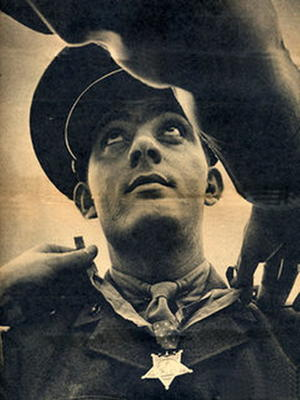
This Sunday before Memorial Day we honor the life of Cpl. Henry F. Warner, an antitank gunner who single-handedly destroyed three German tanks and killed the commander of a fourth:
Serving as 57-mm. antitank gunner with the 2d Battalion, he was a major factor in stopping enemy tanks during heavy attacks against the battalion position near Dom Butgenbach, Belgium, on 20-21 December 1944. In the first attack, launched in the early morning of the 20th, enemy tanks succeeded in penetrating parts of the line. Cpl. Warner, disregarding the concentrated cannon and machinegun fire from 2 tanks bearing down on him, and ignoring the imminent danger of being overrun by the infantry moving under tank cover, destroyed the first tank and scored a direct and deadly hit upon the second. A third tank approached to within 5 yards of his position while he was attempting to clear a jammed breach lock. Jumping from his gun pit, he engaged in a pistol duel with the tank commander standing in the turret, killing him and forcing the tank to withdraw. Following a day and night during which our forces were subjected to constant shelling, mortar barrages, and numerous unsuccessful infantry attacks, the enemy struck in great force on the early morning of the 21st. Seeing a Mark IV tank looming out of the mist and heading toward his position, Cpl. Warner scored a direct hit. Disregarding his injuries, he endeavored to finish the loading and again fire at the tank whose motor was now aflame, when a second machinegun burst killed him. Cpl. Warner’s gallantry and intrepidity at the risk of life above and beyond the call of duty contributed materially to the successful defense against the enemy attacks.
This Saturday before Memorial Day we honor the life of Gunnery Sergeant John Basilone, who was not only the first Medal of Honor winner in World War II for his actions on Guadalcanal, but left the cushy life of a Bond Drive hero to return to action in time for the invasion of Iwo Jima.
His actions on Guadalcanal put most movie action heroes to shame:
John Basilone was born on November 4th, 1916. Basilone was born and raised in Raritan, a small town in New Jersey. He was an adventurous and restless child always looking for something new and exciting. After finishing the 8th grade, Basilone elected not to go to high school. He searched for some adventure and excitement and, not finding any, he joined the Army in 1934. After his basic training Basilone was posted to the Philippines.
During his time at his base in Manila, Basilone developed a mechanical talent for working with guns, especially machine guns. Basilone also developed a talent for motivating and leading men. After his three year enlistment ended Basilone returned to Raritan. A couple of years later he once again found himself becoming restless and looking for new adventures. He decided to reenlist in the service but this time he joined the Marines.
Ten months into World War II, Basilone found himself on the island of Guadalcanal, it was August of 1942. The Americans had secured an airstrip that was vital to the war effort. The Japanese and Americans were involved in one of the fiercest battles of World War II. The Japanese were determined to take the airfield and had assigned an entire Japanese division to the task of capturing the airfield.
Standing between them was only one Marine Battalion. The odds were certainly not in favor of the Americans. Basilone, who was in charge of 16 men, established a defensive position with 4 heavy machine guns in front of Henderson Field. It was October 24th when the Japanese launched a massive attack. The strategy Basilone had established for his unit was to let the Japanese advance to within 30 yards. And then to “let them have it.”
The plan worked. They fired at the first group of attacking Japanese, successfully wiping them out. This first charge was only the beginning of the overall enemy attack. They charged several more times. Eventually this attack took its toll. Basilone, while manning the left two machine guns, heard a loud explosion come from the right setup of the machine guns. Moments later, one soldier from the right side crawled over and informed him that both right guns were knocked out and that the crew was all dead or injured.
Basilone knew he had to get to the knocked out guns to see if he could get them working. The first gun was beyond repair, but the second gun had a chance. There was no light to aid in examining the damaged gun. Basilone would have to troubleshoot the problem in the dark, it was now that Basilone’s expertise with machine guns would pay off. He was able to feel the parts to find out what was causing the gun not to fire. Basilone quickly had the gun working again. As soon as it was back in action, the enemy charged. With the extra gun now working, Basilone and his unit easily beat back the Japanese attack. The attacks kept coming. Basilone told two of his remaining Marines to keep the heavy machine guns loaded. Basilone would roll to one machine gun and fire until it was empty, then roll over to the other one that had been loaded while he was firing the first one. At about 3 AM they were almost out of ammunition.
The Marines had stored ammunition about 100 yards away. However, this would be a difficult 100 yards. There were enemy troops on both the sides and behind their position. Basilone ran and crawled through the jungle. Bullets flew off over his head and grenades exploded around him. But he continued and made it to the ammo dump. Basilone threw six heavy cartridge belts over his soldier.
As he started back to his men, bullets were whizzing all around him again. But he made it back and soon he found another challenge. One machine gun had been smashed. Basilone took parts from another knocked out gun and fixed it quickly. Later in the night, the ammunition ran low again. Basilone would need to go for more, but this time it would be to another ammunition dump, 600 yards away.
Once again the Japanese threw everything at him, but he snaked through the grass well enough so that the Japanese could not find a clear target. Basilone made it back with the much needed ammunition which held off the enemy attacks. Finally the attacks ended around sunrise.
The daylight revealed a scene of utter carnage on the ground. Hundreds of bodies laid dead in front of the American positions, In fact, the entire Japanese regiment, around 3000 men, had been “annihilated.” On this night of October 24th, and 25th the U.S. had turned the tide of the war and the previously undefeated Japanese were on their way to defeat. For his heroics that night Basilone was awarded the Medal of Honor.
He did his Bond Drive duty, but refused an officer’s commission and a chance to teach gunnery to return to active duty, shipping out of Camp Pendleton on August 11th, 1944…just a month after he had gotten married.
On February 19th, 1945 the Marines arrived at Iwo Jima and were ready to attack. The Navy had bombarded the island for 36 days. Some Marines hoped this intense bombing would allow them to take the island with little resistance. However, there were 22,000 Japanese warriors who were well dug in, heavily armed, and prepared to die.
The first U.S. invasion force landed on the beach at 9:05 AM. Basilone’s group landed around 9:30 AM. They were surprised to find little opposition. The Marines got up on the beach and noticed that their feet could barely move in the soft black volcanic sand of Iwo Jima.
For one hour, the U.S. was able to get their transports up to the beach and unload the men without major resistance. Then, with the beach crowded with U.S. soldiers, the Japanese began their counter attack.
Suddenly the Japanese from their hidden blockhouses began firing away at the exposed U.S. troops. The Marines were getting annihilated. Survivors later wondered how anyone survived the initial Japanese barrage. The U.S. forces were on the beach, but they had little or no cover, were still disorganized, and had not yet gotten enough heavy equipment ashore to defend against this type of attack.
The troops had trained for years, but nothing could prepare them for what was happening all around them. The soldiers would later say how frustrated they were that they could not see the enemy to fight back. The Japanese counterattack had stalled the U.S. invasion. Most Marines were hiding in the sand. The beach was littered with damaged vehicles, equipment, and dead soldiers. The invasion was not moving.
Brave men with leadership ability were needed to rally the troops. Basilone rose to the occasion. Many survivors of the battle recall that in the midst of the battle, with everyone hunkered down in the sand, there was one Marine out in the open, running around, directing men. It was Basilone. He first guided a tank out of a mine field. Only a few tanks came ashore and they were needed to knock out Japanese blockhouses.
Basilone had noticed a particular Japanese bunker had been effectively shooting mortar shells and raging deadly fire upon the U.S. troops. This enemy strong position “had to go”. Basilone found and organized some machine gunners along with demolition men and directed them toward the bunker. Basilone instructed a demolition man to blow a hole in the concrete structure, while others gave cover against other nearby enemy positions.
A large explosion went off opening part of the bunker. Basilone then told the enthused machine gunners to hold their fire and directed a flamethrower operator to charge the pit. The brave flamethrower charged the pit as quickly as he could, stuck his nozzle in the pit and ignited the flame. Some of the Japanese soldiers ran out of the pit screaming as they tried to wipe away the jellied gasoline that was burning them. Basilone cut them down with a machine gun. Fellow soldier, Charles Tatum, said “for me and others who saw Basilone’s leadership and courage during our assault, his example was overwhelming.”
After knocking out the bunker, Basilone led twenty men off the exposed beach area to a location where they could take some cover and plan their next move. He ordered the men to stay while he went back to get more men and some heavy machine guns. Basilone gathered some troops and weapons and started back across the beach to the waiting soldiers. But Basilone was hit with a Japanese mortar shell which landed right in the middle of him and the men he was leading. He died from his wounds around thirty minutes later.
For his actions that day, John Basilone was awarded The Navy Cross. The military paid tribute to Basilone by naming a ship after him. An anti-submarine Navy Destroyer, the U.S.S. Basilone was commissioned on July 26th, 1949. His home town of Raritan honors him every year with a parade…Basilone remains the only soldier (non-officer) in U.S. history to be awarded both The Medal of Honor and The Navy Cross. He is also the only Medal of Honor winner to go back into combat and be killed in combat.
In the wee hours of Wednesday evening, the U.S. Senate finally passed the $2 trillion coronavirus stimulus bill after a great deal of Democrat stalling and a futile effort by House Speaker Nancy Pelosi to put forward a separate bill jam-packed with liberal Christmas wish-list items. The bill provides crucial relief to businesses struggling with the social distancing strategy of stopping the spread of the coronavirus. It now heads to the House.
The stimulus bill is far from perfect, but its passage unmasked Pelosi’s tactics as a disgraceful waste of time during this crisis. House Minority Leader Kevin McCarthy (R-Calif.) slammed the speaker for her attempt to jam her liberal pipe dreams down Americans’ throats in the midst of a crisis.
“Democrats wanted to use the coronavirus response package to change election law & implement parts of their Green New Deal. The Senate just passed strong bipartisan legislation that scraps those items, & it’s clear. ⇨ Their delay achieved nothing but more pain for Americans,” McCarthy tweeted.
And far from perfect means it was stuffed with egregious special interest pork. Pelosi, of course, tried to block it because it just didn’t have nearly as much special interest pork as she would like.
Nevada’s governor has signed an emergency order barring the use of anti-malaria drugs for someone who has the coronavirus.
Democratic Gov. Steve Sisolak’s order Tuesday restricting chloroquine and hydroxychloroquine comes after President Donald Trump touted the medication as a treatment for the virus.
December 6: According to a study in The Lancet, the symptom onset date of the first patient identified was “Dec 1, 2019 . . . 5 days after illness onset, his wife, a 53-year-old woman who had no known history of exposure to the market, also presented with pneumonia and was hospitalized in the isolation ward.” In other words, as early as the second week of December, Wuhan doctors were finding cases that indicated the virus was spreading from one human to another.
December 21: Wuhan doctors begin to notice a “cluster of pneumonia cases with an unknown cause.”
Snip.
January 15: The Wuhan Municipal Health Commission begins to change its statements, now declaring, “Existing survey results show that clear human-to-human evidence has not been found, and the possibility of limited human-to-human transmission cannot be ruled out, but the risk of continued human-to-human transmission is low.” Recall Wuhan hospitals concluded human-to-human transmission was occurring three weeks earlier. A statement the next day backtracks on the possibility of human transmission, saying only, “Among the close contacts, no related cases were found.”
The Chinese Communist Party is using the pandemic to achieve its goal of supplanting the United States as the world’s leading economic, diplomatic, and military power.
Sounds unbelievable?
A new report from Horizon Advisory consultants details Beijing’s post-virus strategy—already operational—to leverage the pandemic to seize global market share in key industries, further global dependence on Chinese manufacturing, and reverse efforts in the United States and elsewhere to decouple from the People’s Republic.
“Beijing intends to use the global dislocation and downturn to attract foreign investment, to seize strategic market share and resources—especially those that force dependence, and to proliferate global information systems; to as Chinese sources put it, ‘leap-frog’ industrially, ‘overtake around the corner’ strategically, capture the ‘commanding heights’ globally. Beijing intends to reverse recent U.S. efforts to counteract China’s subversive international presence; at the same time to chip away at U.S.-Europe relations. In other words, Beijing will use COVID-19 to accelerate its long-standing, strategic offensive,” the Horizon report states.
We’re witnessing Beijing’s attempt to scrub its culpability for the pandemic from the world’s memory. Chinese Communist propagandists declare, “China is owed a thank you for buying the world time” and the New York Times dutifully repeats it.
After covering up the novel infection and unleashing it on the world, Beijing’s rulers bought up the world’s supply of protective gear and respirators.
Then they sell these critical goods to Italy while portraying themselves as the heroic humanitarian savior of the world, not unlike a pyromaniac who takes credit for calling the fire department.
To the degree that we are suffering death and economic hurt from COVID-19, we can also attribute the toll to the Chinese Communist Party. Had it just called in the international medical community in late November, instituted early quarantines, and allowed its own citizens to use email and social media to apprise and warn others of the new disease, then the world and the U.S. would probably not have found themselves in the current panic. The reasons China did not act more responsibly may be inherent in communist governments, or they may involve more Byzantine causes left to be disclosed.
Add in the proximity of a Level 4 virology lab nearby Ground Zero of COVID-19, which fueled Internet conspiracy theories; the weird rumors about quite strange animals such as snakes and pangolins birthing the infection in primeval open meat markets stocked with live animals in filthy conditions in cages; and pirated videos of supposed patients dropping comatose in crowded hospital hallways. With all of that, we had the ingredients of a Hollywood zombie movie, adding to the frenzy.
Plus, 2020 is an election year — echoing how the 1976 swine flu was politicized. The Left and its media appendages saw COVID-19 as able to do what John Brennan, James Clapper, James Comey, and Andrew McCabe, the Mueller team, and impeachment could not: destroy the hated Trump presidency.
China will rue what it begat.
That is, it will come to appreciate fully that the supposed efficiency, ruthlessness, and autocracy of the Communist Party — what had so impressed foolish American journalists who once marveled at Beijing’s ability to enact by fiat liberal pet projects such as high-speed rail and solar industries — were China’s worst enemies, ensuring that the virus would spread and that China’s international reputation would be ruined.
It is only since the outbreak of the pandemic that Americans have come to learn that China is the major supplier for U.S. medicines. The first drug shortages, due to dependence on China, have already occurred. Eighty percent of America’s “active pharmaceutical ingredients” comes from abroad, primarily from China (and India); 45% of the penicillin used in the country is Chinese-made; as is nearly 100% of the ibuprofen. Rosemary Gibson, author of “China Rx,” testified last year to the U.S.-China Economic and Security Review Commission about this critical dependence, but nothing has changed in this most vital of supply chains.
The medicine story is repeated throughout the U.S. economy and the world. The unparalleled economic growth of China over the past generation has hollowed out domestic industries around the globe and also prevented other nations, such as Vietnam, from moving up the value-added chain. Many industries are quite frankly stuck with Chinese companies as their only or primary suppliers. Thus, the costs of finding producers other than China, what is known as “decoupling,” are exorbitant, and few countries currently can replicate China’s infrastructure and workforce.
The world never should have been put at risk by the coronavirus. Equally, it never should have let itself become so economically dependent on China. The uniqueness of the coronavirus epidemic is to bring the two seemingly separate issues together. That is why Beijing is desperate to evade blame, not merely for its initial incompetence, but because the costs of the system it has built since 1980 are now coming into long-delayed focus. Coronavirus is a diabolus ex machina that threatens the bases of China’s modern interaction with foreign nations, from tourism to trade, and from cultural exchange to scientific collaboration.
Xi can best avoid this fate by adopting the very transparency that he and the party have assiduously avoided. Yet openness is a mortal threat to the continued rule of the CCP. The virus thus exposes the CCP’s mortal paradox, one which shows the paralysis at the heart of modern China. For this reason alone, the world’s dependence on China should be responsibly reduced.
ere are some people who are useless, especially now: Performance artists, diversity consultants, magic crystal healers, sociology TAs, members of the mainstream media, and gender-unspecified entities who brew kale kombucha.
Here are some people who matter, especially now: Soldiers, nurses, truckers, cops, the guy who stocks the shelves at Ralphs, farmers, and that dude rebuilding your roof.
The Chinese Bat Soup Flu has certainly clarified some of the blurred lines between what is important and what is frivolous garbage. Yet, in a time when millions of Americans are at risk of dying as a direct result of ChiCom conspiracies and the bizarre need of its serfs to eat any weird thing that crawls or slithers within reach of their chopsticks, our useless elite is fixated on making sure we don’t hurt the feelz of the very people who stuck us in this predicament.
Our elite is full of self-important morons who contribute nothing but more dumb in a time when the only thing we have a surplus of is dumb. The real hero is the guy who trucks in a load of whole wheat bread, ribeyes, and low-priced cabernet to the Trader Joe’s, not the Prius-piloting sissy with a Maddow fetish who shops there. The people our elite laughed at, scoffed at, poked at, are the very people who are going to rescue us from the mess that same elite helped make.
Hmm: “Fun facts about Covid Act Now, the org that is mobilizing press, politicians, & citizens to rally behind mass quarantine/lockdown: 1) They were founded by Dem activists. 1 of them, Igor Kofman, works full time to defeat Trump in 2020. Another is a Dem legislator.”
Ferguson’s model projected 2.2 million dead people in the United States and 500,000 in the U.K. from COVID-19 if no action were taken to slow the virus and blunt its curve. The model predicted far fewer deaths if lockdown measures — measures such as those taken by the British and American governments — were undertaken.
After just one day of ordered lockdowns in the U.K., Ferguson is presenting drastically downgraded estimates, crediting lockdown measures, but also revealing that far more people likely have the virus than his team figured.
“After the H1N1 influenza outbreak in 2009, which triggered a nationwide shortage of masks and caused a 2- to 3-year backlog orders for the N95 variety, the stockpile distributed about three-quarters of its inventory and didn’t build back the supply.”
That’s right, the shortage of N95 masks can be traced back to the H1N1 (swine flu) pandemic of 2009… when Barack Obama was president.
A different story from the Los Angeles Times published last week goes into more detail about what happened after the swine flu pandemic depleted the supply. According to their story, “After the swine flu epidemic in 2009, a safety-equipment industry association and a federally sponsored task force both recommended that depleted supplies of N95 respirator masks […] be replenished by the stockpile.” The problem is that didn’t happen. According to Charles Johnson, president of the International Safety Equipment Association, about 100 million N95 respirator masks were used up during the swine flu pandemic of 2009-2010, but, he said was unaware of any “major effort to restore the stockpile to cover that drawdown.”
A place that once gave Democratic native sons Hubert Humphrey and Walter Mondale 4-1 voting wins and considers the late Sen. Paul Wellstone a local hero has begun to embrace a president who bears little resemblance to them, except that he reversed the “injustice” of an Obama-era order that would have brought the nickel-copper project to a 20-year standstill. On top of that were the 25 percent tariffs Trump imposed on most foreign steel, which provided an initial boost to the 5,000 miners still employed in the region’s numerous iron-ore mines that have served as the backbone to the region’s economy.
All of that put Ely in the middle of a political transformation that makes Minnesota the president’s top target among states he lost in 2016 — and potentially a pivot point in the 2020 presidential race. Trump lost the state by 45,000 votes in 2016, a remarkable feat considering how entrenched Democrats have been in the state.
Remember Hershel “Woody” Williams, the Medal of Honor winner I highlighted last Veterans Day? The Navy just commissioned a ship named after him. “The Medal of Honor presented to Williams by President Harry S. Truman two months after the end of World War II is now enshrined in the galley of the ship named in his honor…The Williams, built at a cost of about $500 million, is the second of three Expeditionary Sea Base ships.” ESB ships are interesting multi-use ships built on oil tanker hulls:
The ESD and ESB ships were originally called the Mobile Landing Platform (MLP) and the MLP Afloat Forward Staging Base (AFSB), respectively. In September 2015, the Secretary of the Navy re-designated these hulls to conform to traditional three-letter ship designations.
The design of these ships is based on the Alaska class crude oil carrier, which was built by General Dynamics National Steel and Shipbuilding Company (NASSCO). Leveraging commercial designs ensures design stability and lower development costs
The USNS Montford Point (T-ESD 1) and USNS John Glenn (T-ESD 2) are configured with the Core Capability Set (CCS), which consists of a vehicle staging area, vehicle transfer ramp, large mooring fenders and up to three Landing Craft Air Cushion (LCAC) vessel lanes to support its core equipment transfer requirements. With a 9,500 nautical mile range at a sustained speed of 15 knots, these approximately 80,000 tons, 785-foot ships leverage float-on/float-off technology and a reconfigurable mission deck to maximize capability. Additionally, the ships’ size allows for 25,000 square feet of vehicle and equipment stowage space and 380,000 gallons of JP-5 fuel storage.
USS Lewis B. Puller (ESB 3), the first ESB delivered, along with follow ships Hershel “Woody” Williams (ESB 4) and Miguel Keith (ESB 5), are being optimized to support a variety of maritime based missions including Special Operations Force (SOF) and Airborne Mine Counter Measures (AMCM). The ESBs include a four spot flight deck, mission deck and hangar, are designed around four core capabilities: aviation facilities, berthing, equipment staging support, and command and control assets.
I would think this little tidbit would get more play, since the media repeatedly assured us that Wokescold Moppet was The Most Important Person In The World.
Still more efficient and straightforward than ObamaCare:
Thanks everybody for their entries and nominations…..but there’s one clear winner of the internet today…..round of applause please people…#WINternetpic.twitter.com/ToNA7bitpQ
Seventy five years ago, on December 16, 1944, Hitler’s last-ditch effort to stave off defeat in World War II got underway. Using the same trick Germany had used twice before (1914 and 1940), they launched a massive offensive push through the Ardennes that came to be known as the Battle of the Bulge. To quote Wikipedia, the source of all vaguely accurate knowledge:
The Germans’ initial attack involved 410,000 men; just over 1,400 tanks, tank destroyers, and assault guns; 2,600 artillery pieces; 1,600 anti-tank guns; and over 1,000 combat aircraft, as well as large numbers of other armored fighting vehicles (AFVs). These were reinforced a couple of weeks later, bringing the offensive’s total strength to around 450,000 troops, and 1,500 tanks and assault guns. Between 63,222 and 98,000 of these men were killed, missing, wounded in action, or captured. For the Americans, out of a peak of 610,000 troops, 89,000 became casualties out of which some 19,000 were killed. The “Bulge” was the largest and bloodiest single battle fought by the United States in World War II and the third deadliest campaign in American history.
Though well-planned and executed, achieving the element of surprise against outmanned and outgunned American forces, German forces soon bogged down due to harsh weather conditions and fiercer-than-anticipated resistance. In particular, the town of Bastogne, through which all seven main roads in the Ardennes highlands converged, was supposed to fall early in the campaign, paving the way to the Meuse River and the ultimate objective of Antwerp beyond. Instead, American forces held off the Germans just long enough for the 101st Airborne and other forces to mount a perimeter defense around Bastogne.
Surrounded on all sides, outnumbered 5-1, low on supplies and ill-equipped for cold weather fighting, American forces were asked to surrender. Brigadier General Anthony McAuliffe answered with one of the most famous replies in the history of warfare: “NUTS!” American forces would stave off repeated attacks, until a resupply airdrop on the 26th and elements of Patton’s Third Army arrived on the 27th to lift the siege of Bastogne.
Another hard month of fighting lay ahead (aided by better weather and America’s overwhelming air superiority) until the “bulge” was entirely eradicated, but after Bastogne, Hitler’s last great gamble had failed.
Welcome to another Friday LinkSwarm! Border control, Social Justice Warriors, Iran and Geto Boys all feature in today’s roundup…
The idea that we can go back to a “Pre-Trump Normal” is an illusion.
Washington sophisticates, and the DC press corps in particular, are deeply parochial. Trump didn’t create worldwide skepticism about globalism, resentment of sinecured elites, or frustration with an out-of-touch cultural vanguard. He merely rode them to power.
Politicians and pundits can disagree with this populist trend, but it’s electorally suicidal to ignore it. As I note in USA Today, one look around the globe shows that, in many ways, Trump is the new normal.
These actions on the part of Iran follow a series of sanctions from the US Treasury Department, which on Wednesday (June 12) imposed sanctions on a financial conduit of the Islamic Revolutionary Guard Corps-Qods Force, and last week (June 7) sanctioned Iran’s largest petrochemical holding group.
US officials are also considering sanctions against the Iranian financial body that was established as a trade channel with Europe – a move that would underscore US intolerance to any international workarounds to the Iran sanctions campaign.
You don’t need to read the tea leaves closely to know the administration’s plan for its “maximum pressure” campaign. But one thing the tea leaves don’t show are plans for war. And the reason is simple: the sanctions are working to help achieve President Donald Trump’s priority goal, which is to undermine Iran’s influence and support for terrorism in the Middle East.
The Treasury’s latest steps follow a State Department press briefing, during which its spokesperson, Morgan Ortagus, listed the negative effects Iran sanctions were having on that country’s terrorist proxies and on its other actions in the region. She pointed to the Lebanese group Hezbollah’s “pleas for public donations via billboards, posters and collection cans” and stressed that “Iran is withdrawing Hezbollah fighters from Syria and cutting or canceling their salaries.” This is a big deal.
She also pointed to Hamas’s austerity plan in Gaza and to the IRGC’s budget cuts for Iraq Shia militia groups. She highlighted fuel shortages in Syria due to the cut in Iranian oil supply and noted the IRGC cyber command “is short on cash.”
Others have also picked up on this emerging trend: that Iran sanctions are starving Iran’s proxies of critical funds. The Washington Post reported that US sanctions against Iran have “curtailed” Iran’s finances to Hezbollah, which “has seen a sharp fall in its revenue and is being forced to make draconian cuts to its spending.” A fighter with an Iranian-backed militia in Syria told The New York Times that he lost a third of his salary and other benefits, lamenting, “Iran doesn’t have enough money to give us.”
When he withdrew the United States from the Joint Comprehensive Plan of Action, or what is often called the Iran nuclear deal, last year, President Trump made his top goal clear. Before even addressing Iran’s nuclear capabilities or speaking about working toward a new agreement, he emphasised Iran’s support for terrorism and plans for regional influence as among his key concerns and reasons for withdrawing from the deal. Working to undermine that behavior has been the administration’s top priority in its Iran policy.
Sanctions are particularly taking a bite out of Hezbollah. One wonders, yet again, what the Obama Administration thought it was achieving with the insane and costly Iran deal…
This essay suggests that defeating Social Justice Warrior madness will be more difficult than we think, because it’s essentially a religious phenomena:
The shock presidential election of 2016 might have prompted partisans on both sides to ask whether the vocabulary on which they relied had become a lifeless hindrance. On the Left, the Clinton political machine suffocated every dissenting voice within the Democratic Party, which denied its members the opportunity to rethink the identity politics death-grip that was strangling them. Then as now, Sanders, more smitten by Marx than the halfway-Nietzscheanism of identity politics, invited his fellow Democrats to step back from the brink. Alas, itself guilty of class privilege, the donor class of the Democratic Party living in Hollywood, Silicon Valley, and in the wealthy enclaves surrounding New York City needed a fig leaf to cover its class sins—and, so did not, and will not, allow Sanders to win the Democratic nomination and thereby reveal their unrighteousness.
The Democratic Party will again double down on the rhetoric of identity politics, lose the 2020 presidential election, and conclude—as it did with Russiagate—that some demonic force temporarily bent the arc of history in the wrong direction. The demonic force responsible this next time around? “Hate speech” from the lips of those in the center and on the Right who refuse to rehearse the Red Letter political liturgy identity politics tirelessly repeats—or bow before the false gods that identity politics worships.
Partisans on the Right were given a gift: President Trump. He came into the Republican Party, and the Republican Party understood him not. Many did not want to receive this gift. Having read their Aristotle and Burke, and wishing to remain gentlemen, they withdrew from the political fray—preferring the decorous tyranny of candidate Clinton, the very paragon of identity politics, to the incivility of candidate Trump who, alone among Republican candidates, had the temerity to combat it. “Our tastes, not our ideas, define us”—that is what the 2016 election apparently taught the GOP.
Now forming a Conservative Book Club of sorts, these gentlemen ponder great ideas, entice donors to fund their conferences and think tanks, and all the while enjoin us to believe the vocabulary of the pre-2016 Republican Party continues to be adequate to the troubles we face. It is not.
Today, whether at conservative conferences or in conservative think tanks, the listener even moderately attentive to the conversation will hear of the perils of progressivism and of cultural Marxism, of the need to defend family values, of the importance of being pro-life, of the importance of free markets, and of the threat of multiculturalism. These terms—indeed the constellation these terms form—emerged during the Reagan Presidency, more than three decades ago. If the 2016 Presidential election tells us anything, it is that this verbiage has hardened into nearly lifeless political rhetoric, sustained on life support through institutional buy-in and the assurances of political philosophers sympathetic to conservatism who tirelessly promote the link between the veritable ideas they study and the political vocabulary that has been in place for decades is timeless.
Times have changed, however. Philosophy must gently persuade; that is its privilege and its weakness. Philosophers are concerned with eternal truth. Partisans, by contrast, are concerned with timely rhetoric, opinion, and persuasion. They must engage in comparatively immediate combat. So long as conservatives inattentively conflate philosophizing and partisanship, they will continue to produce partisan vocabularies that masquerade as eternal truth—and partisans unable to respond in a timely manner to shifting times. To win, partisans must know when the weapons of their enemies have changed. Wars—and this is a crucial point to understand—are not won using weapons from earlier engagements. Only armchair soldiers and Conservative Book Club members have the luxury of replaying those battles.
Neither liberals nor conservatives understand the weapon of identity politics, and the immense destruction it can cause. Identity politics does not simply parse different kinds of people. Identity politics is concerned with the relationship of transgression and innocence between different, purportedly monovalent, kinds of people. Identity politics is not just about who we are, it is about a moral stain or purity that defines who we are.
The language of stain and purity, of transgression and innocence, is Christian language. Other religions are concerned with these categories as well, but our long familiarity with Christianity in America means that the invocation of these categories by the practitioners of identity politics derives from Christianity, and from Protestantism in particular. Surveys may indicate that America has lost or is losing its religion; the fever of identity politics that now sweeps the nation suggests these surveys are looking in the wrong place and asking the wrong questions. America has not lost its religion. America has relocated its religion to the realm of politics.
Identity politics transforms politics. It turns politics into a religious venue of sacrificial offering. Ponder for a moment, Christianity. Without the sacrifice of the innocent Lamb of God, there would be no Christianity. Christ, the scapegoat, renders the impure pure—by taking upon Himself “the sins of the world.” By the purging of the scapegoat, those for whom He is the sacrificial offering purify themselves. Identity politics is a political version of this cleansing for groups rather than for individuals. The scapegoat in the case of identity politics is the white heterosexual male who, if purged, supposedly will restore and confirm the cleanliness of all other groups of communities. He is the transgressor; all others—women, blacks, Hispanics, LGBTQs—have their sins covered over by the scapegoat, just as the scapegoated Christ covered over the sins of all the descendants of Adam.
The theological perversity of replacing the Divine Scapegoat of Christianity with the all-too-mortal white heterosexual male scapegoat does not imply that he is innocent. Rather, in identity politics, the white heterosexual male becomes more than who he really is—a member of a scapegoated group who takes away the sins of the world, rather than a mortal, like everyone else, involved in transgression, and searching for redemption. The mystery of transgression and innocence, however, cannot be resolved at the level of groups, because in reality not one of them is univocally pure or stained. But identity politics stands or falls on the claim that groups are such unities of transgressors or innocents. Therein lies its weakness, at which all the armament allied against it must be aimed.
Charles Murray changes his mind. “I want to shut down low-skill immigration for a while.”
“Open borders advocates are panicking after the arrest of Irieno Mujihca, the leader of Pueblo Sin Fronteras, a pro-open borders group funded by globalist financier George Soros that has worked to undermine United States immigration policy and sponsor Central American caravans.”
“Tech reporter Peter Bright has been arrested for soliciting sex with children online. He was employed by Ars Technica until recently. A federal complaint alleges that Bright sought to molest a 7- and 9-year-old and met with an undercover agent for this purpose, at which point he was arrested. It also states that Bright claimed to be in a sexual relationship with an 11-year-old.” Was he a “male feminist” and “anti-#GamerGater”? Of course he was.
“The folks running The Bulwark must decide which they value more, being conservative or being anti-Trump. They have, I’d argue, already picked the latter.”
Texas Senator Ted Cruz and New York Representative Alexandria Ocasio Cortez team up again on a bill to make birth control available over the counter.
New York Times leftist: “Hey Rep. Dan Crenshaw! If you really cared about 9/11 victims, you would have co-sponsored the 9/11 Victims Compensation fund!” Rep. Dan Crenshaw: “I did.” New York Times leftist: “Uhhhhh….” DELETE DELETE DELETE. (Hat tip: The Other McCain.)
Woman kills boyfriend over alien reptile cult. “Shriner told NJ.com she believed Rogers was a ‘Vampire Witch Reptilian Super Soldier.'” Plus: liquor and firearms! Going to use the “David Icke” tag even though he’s nowhere mentioned, as that’s how I keep track of all the reptoid news…
Bad Idea Theater: Netflix Roast of Anne Frank. You’re probably thinking to yourself “Must be The Onion or The Babylon Bee.” No, this is an actual thing that people actually did. (Indeed, Jewish comics seemed to be the driving force behind it.) I suspect it’s only the second unfunniest spoof on the Holocaust, behind Heil Honey, I’m Home, which was also a real thing.
I’ve managed not to have any news about Houston rap group Geto Boys in a LinkSwarm ever, and now two pieces drop this week. First, dwarf frontman Bushwack Bill (legal name Richard Shaw) has died at age 52 from pancreatic cancer. Now Scarface, AKA Brad Jordan, is running for Houston City Council. (Hat tip for both: Dwight.)
“Say anything you want about this president – I get it, he can be vulgar, he can be crude, he can be undignified at times. I don’t care. I can’t spare this man. He fights.”
Remember the multi-million dollar corruption scandal involving UAW officials? Apparently, it was even more corrupt than previously reported. While the UAW-Chrysler National Training Center is suing both Fiat Chrysler and the union members involved, recent developments point to the money scheme being greenlit by former UAW President Dennis Williams.
As part of a plea agreement filed this week, ex-labor official Nancy Adams Johnson told investigators that Williams specifically directed union members to use funds from Detroit’s automakers, funneled through training centers, to pay for union travel, meals, entertainment, and more. If true, the accusation not only implicates the UAW of corruption at the highest level but also the potential involvement of staff from both Ford and General Motors — something the FBI is already looking into.
I believe the official industry term for something like this is a “shit show.”
Alt-right protestors call black police officers “f**king n****r” in Portland protest. Oh, wait, did I say “alt-right”? I meant “anti-ICE.” (Hat tip: Derek Hunter on Twitter.)
Retired Sgt. Maj. John Canley received a phone call from President Donald Trump telling him he was receiving the Medal of Honor for his heroism in the Battle of Hue in 1968.
Masculine fathers raise strong daughters. Plus this: “A glance at the public figures felled in the #MeToo purges—not to mention Bill Clinton —should cure us of the idea that progressive politics incline men to better treatment of women.”
“Sexual inequality makes marriage work.” Marriages work better when the husband earns more. Also: “The more traditional the division of labor, meaning the greater the husband’s share of masculine chores compared with feminine ones, the greater his wife’s reported sexual satisfaction.”
UK father who raped and fathered three children with his own daughter sentenced to only four years in jail. Guess the ethnicity of the rapist. (Hat tip: The Other McCain.)
American semiconductor company Qualcomm’s merger with Dutch company NXP collapses after regulatory approval withheld…by China. Earlier this year, Qualcomm’s attempted merger with Broadcomm was blocked by the Trump Administration.
Facebook just lost $120 billion in market cap. How about they stop worrying about censoring the news and stop switching the view from “Most Recent” to “Top Stories”?
Allegations of vote fraud in Mission mayoral runoff in Hidalgo County.
On this Memorial Day weekend, we remember Congressional Medal of Honor winner Captain Ben L. Salomon. His citation:
Captain Ben L. Salomon was serving at Saipan, in the Marianas Islands on July 7, 1944, as the Surgeon for the 2d Battalion, 105th Infantry Regiment, 27th Infantry Division. The Regiment’s 1st and 2d Battalions were attacked by an overwhelming force estimated between 3,000 and 5,000 Japanese soldiers. It was one of the largest attacks attempted in the Pacific Theater during World War II. Although both units fought furiously, the enemy soon penetrated the Battalions’ combined perimeter and inflicted overwhelming casualties. In the first minutes of the attack, approximately 30 wounded soldiers walked, crawled, or were carried into Captain Salomon’s aid station, and the small tent soon filled with wounded men. As the perimeter began to be overrun, it became increasingly difficult for Captain Salomon to work on the wounded. He then saw a Japanese soldier bayoneting one of the wounded soldiers lying near the tent. Firing from a squatting position, Captain Salomon quickly killed the enemy soldier. Then, as he turned his attention back to the wounded, two more Japanese soldiers appeared in the front entrance of the tent. As these enemy soldiers were killed, four more crawled under the tent walls. Rushing them, Captain Salomon kicked the knife out of the hand of one, shot another, and bayoneted a third. Captain Salomon butted the fourth enemy soldier in the stomach and a wounded comrade then shot and killed the enemy soldier. Realizing the gravity of the situation, Captain Salomon ordered the wounded to make their way as best they could back to the regimental aid station, while he attempted to hold off the enemy until they were clear. Captain Salomon then grabbed a rifle from one of the wounded and rushed out of the tent. After four men were killed while manning a machine gun, Captain Salomon took control of it. When his body was later found, 98 dead enemy soldiers were piled in front of his position. Captain Salomon’s extraordinary heroism and devotion to duty are in keeping with the highest traditions of military service and reflect great credit upon himself, his unit, and the United States Army.
Additionally, his body had 76 bullet wounds and numerous bayonet wounds, up to 24 of which may have been while he was still alive, and forensic evidence showed he moved the machine gun four times while fatally wounded.
Here’s a description in video form:
Quintin Tarantino should make a movie about this guy…
Ted Cruz has picked up plenty of notable endorsements in his race for President, but today he picked up endorsements from two very notable men:
Towering free market economist and writer Thomas Sowell:
Senator Ted Cruz has been criticized in this column before, and will undoubtedly be criticized here again. But we can only make our choices among those actually available, and Senator Cruz is the one who comes to mind when depth and steadfastness come to mind.
As someone who once clerked for a Chief Justice of the Supreme Court, he will know how important choosing Justice Scalia’s replacement will be. And he has the intellect to understand much more.
“This election is a turning point for our country,” said Meyer. “In these dangerous times we need a strong, principled conservative in the White House. We need a Commander-in-Chief who works with our allies and makes it known that certain actions against the United States and its allies will not be tolerated. I am confident that Ted Cruz has the ability and resolve to be Commander-in-Chief. His record of standing up and fighting for what he believes in shows that he is not someone who buckles under pressure. Ted is ready to led this country – and I look forward to help uniting conservatives and veterans behind this campaign.”
I note in passing that Sowell is 85, and Meyer is 27…
In summer 1950, Mr. Rubin was “volunteered” to defend a strategic hill while the rest of his company withdrew to safety near the Pusan Perimeter amid an onslaught by North Korean troops. He armed himself with grenades and guns and waited, knowing the sergeant had no intention of relieving him, ever.
The enemy attack began at dawn, and Mr. Rubin said he became “hysterical” as they swarmed the hill “like ants.”
He fired helter-skelter, lobbing grenade after grenade to create the impression of more than one man. “Pull the pin, boom, pull the pin, boom,” he said. Unable to see through the resulting smoke, he kept up the defense for a full day, defending his post until American-manned Corsairs repelled the remaining North Koreans from the air.
“He inflicted a staggering number of casualties on the attacking force during his personal 24-hour battle, single-handedly slowing the enemy advance and allowing the 8th Cavalry Regiment to complete its withdrawal successfully,” read his citation for the Medal of Honor, the military’s highest award for valor.
Later he was captured by the communist Chinese, and repeatedly risked his life sneaking out to find food for his fellow prisoners.
And after all that, he got screwed out of his medal until George W. Bush set it right in 2005.
America’s victory in Iraq broke the back of Al-Qaeda and left Osama bin Laden’s dream in ruins. He died a defeated fanatic in his Abbotabad hideaway; his dream was crushed in the Mesopotamian flatlands where he swore it would win…The tragedies of Iraq are real and well known. The victory is equally real—but the politically fastidious don’t want to look. The minimum we owe our lost and wounded warriors is to tell the story of what they so gloriously achieved.
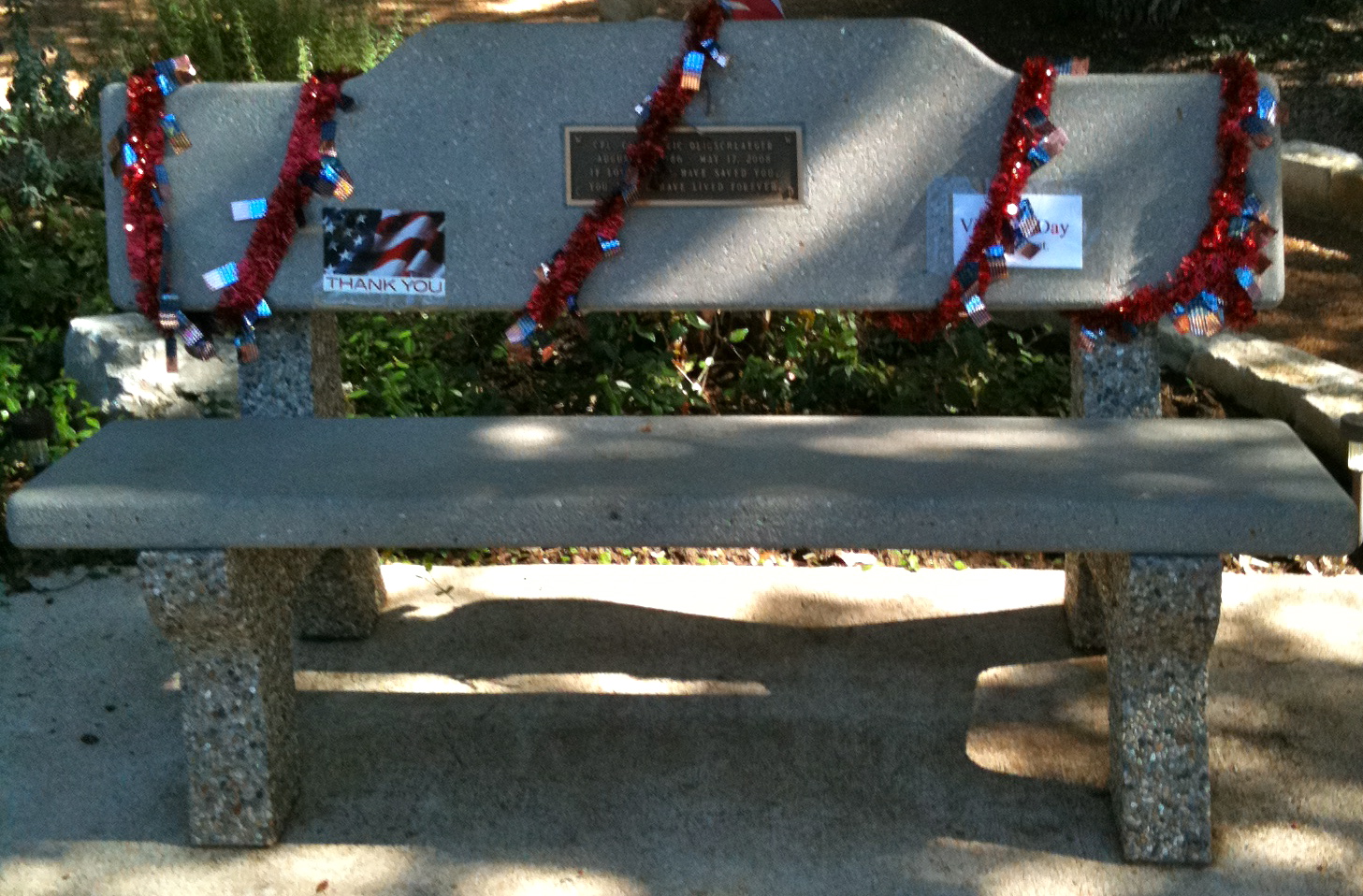
I walk my dog in the local park, and last year on Veteran’s Day I came across this memorial bench for Cpl. Chad Eric Oligschlaeger, which I had seen before, but which this time was festooned for the occasion:
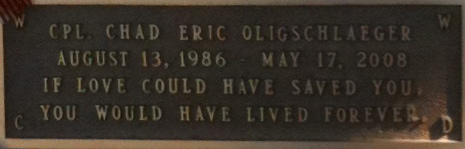
Here’s a closeup of the plaque on the bench:
I thought doing a post on the late Cpl. Oligschlaeger might provide a somber but uplifting story for Memorial Day, but in researching him, I found his story was a lot sadder than most. He didn’t die in combat (despite doing two tours in Iraq), but died due to “accidental death due to multiple drug toxicity,” the drugs in question being various prescription drugs he was taking to deal with post-traumatic stress disorder while waiting (over half a year) for a spot to open up in a PTSD treatment center.
A list of Texas casualties from Operation Iraqi Freedom can be found here.
One Texas Medal of Honor recipient who died recently was David H. McNerney, who died October 10, 2010. His citation reads:
Rank and organization: First Sergeant, U.S. Army, Company A, 1st Battalion, 8th Infantry, 4th Infantry Division. place and date: polei Doc, Republic of Vietnam, 22 March 1967. Entered service at: Fort Bliss, Tex. Born: 2 June 1931, Lowell, Mass. Citation: 1st Sgt. McNerney distinguished himself when his unit was attacked by a North Vietnamese battalion near polei Doc. Running through the hail of enemy fire to the area of heaviest contact, he was assisting in the development of a defensive perimeter when he encountered several enemy at close range. He killed the enemy but was painfully injured when blown from his feet by a grenade. In spite of this injury, he assaulted and destroyed an enemy machinegun position that had pinned down 5 of his comrades beyond the defensive line. Upon learning his commander and artillery forward observer had been killed, he assumed command of the company. He adjusted artillery fire to within 20 meters of the position in a daring measure to repulse ??enemy assaults. When the smoke grenades used to mark the position were gone, he moved into a nearby clearing to designate the location to friendly aircraft. In spite of enemy fire he remained exposed until he was certain the position was spotted and then climbed into a tree and tied the identification panel to its highest branches. Then he moved among his men readjusting their position, encouraging the defenders and checking the wounded. As the hostile assaults slackened, he began clearing a helicopter landing site to evacuate the wounded. When explosives were needed to remove large trees, he crawled outside the relative safety of his perimeter to collect demolition material from abandoned rucksacks. Moving through a fusillade of fire he returned with the explosives that were vital to the clearing of the landing zone. Disregarding the pain of his injury and refusing medical evacuation 1st Sgt. McNerney remained with his unit until the next day when the new commander arrived. First Sgt. McNerney’s outstanding heroism and leadership were inspirational to his comrades. His actions were in keeping with the highest traditions of the U.S. Army and reflect great credit upon himself and the Armed Forces of his country.