If you’ve read this previously linked article, you know that Russia is having real problems with air operations in their invasion of Ukraine. Here’s a short video that covers some of the highlights:
Key takeaways:
Ukraine has successfully moved its air assets around to keep them from being destroyed on the ground.
Russian equipment sucks. Pictures include Russian pilots using commercial GPS for guidance and strike coordinates written down on pieces of paper, which does rather limit tactical flexibility and pilot innovation. (Remember those crappy truck tires? How much better, if any, have Russian aircraft been maintained?)
Russian training sucks. Russian pilots get half as much training as NATO pilots, and practice less complex maneuvers. Thus:
Russia can’t coordinate large-scale air missions.
Thus the documented record of Ukrainian forces shooting down Russian airplanes:
#Ukraine: A Russian Su-25 jet managed to successfully land on an airfield after being hit with a Ukrainian MANPADS missile.
Guessing by the damage, the plane is likely to be decommissioned or at least will require serious repairing. pic.twitter.com/Ljv2gNkJ4m
— 🇺🇦 Ukraine Weapons Tracker (@UAWeapons) March 14, 2022
Russia has turned to China for military equipment and aid in the weeks since it began its invasion of Ukraine, U.S. officials familiar with the matter told The Washington Post.
The officials, who spoke on the condition of anonymity because of the sensitivity of the subject, did not describe what kind of weaponry had been requested, or whether they know how China responded.
The development comes as White House national security adviser Jake Sullivan plans to travel to Rome on Monday to meet with his Chinese counterpart, Yang Jiechi.
Sullivan told CNN that the administration was “communicating directly, privately to Beijing, that there will absolutely be consequences” for any Chinese efforts to assist Russia in evading sanctions.”
Do you see the problem? It’s right there in the first sentence.
Russia has turned to China for military equipment and aid in the weeks since it began its invasion of Ukraine, U.S. officials familiar with the matter told The Washington Post.
“Officials familiar with the matter.”
Remember that phrase?
Remember that phrase (and similar ones) a lot from those endless “sources say” hit pieces on President Trump that turned out to be complete garbage made up out of whole cloth?
Because of that, we can never take anonymously sourced pieces that promotes the latest Democratic Media Complex line at face value ever again. How can we be sure you’re not making things up again?
We can’t.
We can never take any anonymously sourced piece in the Washington Post at face value. So we have no idea if Russia sought military aid from China or not.
That’s the problem with institutional trust. Once it’s gone, it can’t easily be replaced.
Any time you read “source says” in a piece in an MSM outlet, you should read that as “just trust me, bro!”
And we don’t.
And absent a clean sweep in management and a complete turnover of current staff, we never will again.
There are a lot of small countries, especially in the southern and eastern areas of Europe for whom [a Russian invasion] may not have been a plausible scenario two weeks ago, but it’s kind of looking like one now. And if you are a small country close to the borders of Russia, you’re in this difficult defensive position. None of these countries have a military that can, with a straight face, suggests that it could simply put up a toe-to-toe, stand their ground fight and defeat a military the size of the Russian army.
I’m going to point out that this is not necessarily true. Finland did it in The Winter War in 1939-1940. But he gets to that.
Yet you want you have to provide some sort of plausible threat to an invading occupier like Russia to avoid being invaded in the first place. The whole point is that the best possible success in repulsing an invasion is to not get invaded in the first place. So how can you convince a country like Russia that your very small little republic is not worth invading, that it is too difficult to invade? A lot of these countries are looking around, and going “Would NATO actually step up and help us directly, help defend us in case of an invasion? Any maybe NATO would, maybe NATO wouldn’t.”
One big solution is civilian military firearms ownership and preparedness. And here modern Finland comes up:
There is a specific division called SRA which is essentially reservists shooting society, and it is it’s actually technically in some cases for gun, rifle, pistol, shotgun and precision rifle. In competition it requires competitors to essentially carry a military loadout; they have to wear armor, they have to carry water, they have to carry a minimum amount of ammunition during the stages…It’s specifically to encourage military readiness .
“Having a large community of competent civilian marksmen is something that can contribute a very real deterrent to invasion.”
True. Every nation in Europe should make civilian firearms ownership more widely and legally available, for this and other reasons.
Russia’s invasion of Ukraine grinds on, justice for Juicy, Italy’s truck drivers go Galt, giant spiders invade, and musicians are being screwed yet again. It’s the Friday LinkSwarm!
The Russian invasion of Ukraine had two goals. The first was to take control of Ukraine, intending to complete the task begun in Belarus – the task of rebuilding Russia’s strategic buffers and securing Russia from attack. The second goal was to demonstrate the capabilities and professionalism of the Russian military and to further deter hypothetical acts and increase Russia’s regional influence. The two goals were interlocked.
The occupation of Ukraine has not been achieved, but it is not a lost cause. Perceptions of the strength of Russia’s military, however, have been badly damaged. There is no question but that Russian planners did not want to fight the war Russia has been fighting. Rather than a rapid and decisive defeat of Ukraine, Russia is engaged in a slow, grinding war unlikely to impress the world with its return to the first ranks of military power. At this point, even a final victory in its first objective will not redeem the second. It is important to start identifying the Russian weaknesses.
The first problem was a loss of surprise. Carl von Clausewitz placed surprise at the top of warfare. Surprise contracts the time an enemy has to prepare for war. It also imposes a psychological shock that takes time to overcome, making it more difficult to implement existing plans. And it increases the perceived power of the enemy. In Ukraine, however, extended diplomacy gave Kyiv time to adjust psychologically to the possibility of war.
Moscow failed to understand its enemy. Russia clearly expected Ukrainian resistance to collapse rapidly in the face of the massive armored force it had gathered. It did not expect the Ukrainian populace to fight back to an extent that would at least delay completion of the war.
Snip.
Russian war plans centered on three armored groups based in the east, south and north…The three Russian armored battle groups were widely separated. They did not support each other. Instead of a single coordinated war, the Kremlin opted for at least three separate wars, making a single decisive stroke impossible. A single integrated command, essential for warfighting, seemed to be lacking.
The use of armor vastly increased the pressure on Russian logistics. Instead of focusing supplies on a single thrust, it had to focus on three, plus other operations. Logistics for the major armored forces seemed to have broken down, making war termination impossible and further extending the war.
In recent days, Russia has adapted and turned toward taking cities. This is generating an effective counterforce among fighters who understand the streets and alleys and use them to delay Russia’s progress. Fighting in cities is among the costliest and most time-consuming actions in war. Capturing cities takes resources and is not the key to victory. Cities take on importance only after the enemy force has been defeated and demoralizing the nation is essential. The city is the prize of war, not the military goal. Russia turned the conflict from a counter-military to a counter-population war, which increased resistance by sowing desperation in the cities.
The foolish ease with which Russia expected to win this war reminds me of the Southern dandies at the beginning of Gone With The Wind proclaiming how the Civil War would be over in weeks since the Yankees would “turn and run, every time.” Didn’t turn out that way. (Hat tip: Al Fin Next Level.)
Speaking of which, this seems like poor tactics and situational awareness:
The Biden administration’s bumbling on the matter of sending MiG-29 fighter jets from Poland to Ukraine is the result of both nations’ fears that the action would drag them directly into the war in Ukraine. Poland wanted to send the jets to Ramstein Air Base in Germany, and Washington shied away from the prospect of having fighter jets fly out of a U.S. base in a NATO country into the war zone in Ukraine. The thinking was that this would look too much like the United States and NATO carrying out a military operation against Russian forces in Ukraine.
In practical terms, the U.S. (and U.K.) prohibition of Russian oil imports probably will not have much of an economic effect — certainly not in comparison to the other measures that have been taken — but even largely symbolic gestures can have a powerful effect, and the Kremlin seems to be very much agitated by the boycott.
The Biden administration’s bumbling on the matter of sending MiG-29 fighter jets from Poland to Ukraine is the result of both nations’ fears that the action would drag them directly into the war in Ukraine. Poland wanted to send the jets to Ramstein Air Base in Germany, and Washington shied away from the prospect of having fighter jets fly out of a U.S. base in a NATO country into the war zone in Ukraine. The thinking was that this would look too much like the United States and NATO carrying out a military operation against Russian forces in Ukraine.
In truth, the United States is a belligerent if Vladimir Putin says the United States is a belligerent. He is perfectly capable of making up a pretext, however absurd, to justify whatever action he wants to take — that is why Russians are in Ukraine in the first place. His subjects in Russia are largely pliant and inclined to accept the propaganda they are fed, and those who aren’t can be jailed, terrorized into silence, or murdered. Putin can do what he chooses — it is not like he is worried about an upcoming election.
The MiG fiasco underlined the Biden administration’s predictable fecklessness and disorganization — America needed a Keystone pipeline but we got the Keystone Cops — and if there is any serious thinking going on in the White House about what Putin’s response to our “declaration of economic war” is likely to be, there isn’t any obvious evidence of it. The posture of the Biden administration by all appearances is one of wishful thinking: that while the United States and the world have rightly taken a side in this conflict, the fighting is going to stay in Ukraine.
What if it doesn’t?
A direct military attack by Russian forces on the United States is, of course, unlikely. But a Russian attack on Moldova is far from unthinkable. It is entirely possible that Putin will attack a NATO member such as Lithuania, Latvia, or even Poland, whose people have gone to such extraordinary lengths to assist the Ukrainians. There are already Americans fighting in Ukraine, as private volunteers rather than as part of our armed forces. If Putin is looking for a pretext, he will have no trouble finding one.
The United States is keenly interested in keeping the fighting in Ukraine. But the fighting will stay in Ukraine for only as long as Putin believes it is in his interest to keep it there. That may not be much longer. Putin already has failed to achieve his main political objective in Ukraine and will not achieve it no matter how long the conflict drags on; what was intended as a show of awesome military might has instead been a display of weakness and incompetence. A wider war — a glorious crusade — might soon suit Putin’s purposes better than does a quagmire in Ukraine, where the Russian army has been reduced to trying to substitute atrocities for victories.
President Joe Biden has said that U.S. forces will defend “every inch” of NATO territory. But Biden was there when the Obama administration offered a lot of big talk about “red lines” in Syria and then did nothing. Biden’s people right now are engaging in counterproductive (to say the least) negotiations with Tehran that serve no obvious U.S. interest, and going through Moscow to do so. Vladimir Putin calculates and, as he has just demonstrated, he sometimes miscalculates. Putin might be inclined to take an inch and put Biden to the test.
This seems unlikely, but the actual invasion of Ukraine seemed unlikely until it happened.
“Putin flirts with economic suicide.” “When a government declares that it will confiscate the assets of foreign companies and foreign investors and that it won’t pay its debts, severe and lasting economic calamity follows.”
“Special Counsel Finds Mark Zuckerberg’s Election Money Violated Wisconsin Bribery Laws.” “Nearly $9 million in Zuckerberg grant funds directed solely to five Democratic strongholds in Wisconsin violated the state’s election code’s prohibition on bribery. That conclusion represents but one of the many troubling findings detailed in the report submitted today by a state-appointed special counsel to the Wisconsin Assembly.”
“Manhattan merchant banker, 61, is charged with being a spy in the US: Dual US-Russia citizen ‘ran a propaganda center in NYC and communicated directly with Vladimir Putin…Elena Branson, or Chernykh, has been charged with six counts of failing to register as a foreign agent, among other crimes.” Also helped Russians obtain visas under false pretenses. (Hat tip: ColorMeRed.)
As voting for the Texas primaries has wrapped up, the eyes of the nation at large are on the Rio Grande Valley. Many observers expect 2022 to be a big year for Republicans and the GOP, predicting to see the party build on its 2020 inroads with Hispanic voters and believing it will have success in what has previously been Democrat stronghold. To that end, the GOP fielded a wide slate of candidates, and the party has data that suggests it may be successful.
The numbers suggest two trends that portend well for the GOP: enthusiasm and historic numbers among Republican voters, and depressed turnout for Democrats. Compared to the 2018 and 2020 primary elections, Republicans had significantly higher turnout. That trend is present across all four counties in the RGV, but especially in Starr County. In 2018, a total of 15 people voted in the Republican primary; in 2020, that number increased to 46. This year, a whopping 1,773 people in Starr County voted in the Republican primary.
Conversely, Democrats had generally lower turnout in the RGV Democrat primaries compared to 2018, and about a 7.83 percent lower turnout compared to 2020.
The Florida state Senate on Tuesday passed a parents rights bill, a media-maligned piece of legislation that will prohibit primary school teachers from talking about sexual orientation with children in pre-K through third grade.
Senate passage of the Parental Rights in Education bill by a vote of 21-17 marks a milestone in parents’ efforts across the nation to fight back against the radical left in the classroom. The legislation also represents a model for other states to use as they push back the woke tides.
The Florida House of Representatives passed the legislation last month, 69-47. It now goes to Gov. Ron DeSantis for his signature.
Opposition to the Parental Rights in Education bill has been fierce, with many on the left attempting to reframe the law as the “Don’t Say Gay” bill. The left has attempted for years to indoctrinate children with LGBT ideology in public schools, and now activists are furious at attempts by conservatives to push back.
To be clear, the Florida legislation is not an “anti-gay” bill. It is instead a bill aimed at protecting children—and preventing educators with an agenda from infecting young kids with radical ideology.
By all means, make Democrats defend lecturing kindergartners on transsexualism and anal sex in November. (Hat tip: Director Blue.)
Rapper Tom MacDonald complains about “The Biggest Music Industry Screw Job Ever!” No, given it’s the music industry, not even close. There are hundreds of artists who have been screwed worse. But the lengths to which Billboard and their data recording company go to in order to avoid certifying the sales of independent musicians is certainly eye-opening.
“Our gas prices are now higher than in zombie apocalypse films.” That would be the Will Smith I Am Legend (the classic Richard Matheson novel it was based on featured vampires, not zombies).
I know there’s a lot going on in the world today, but can we just take a moment to reflect on how crazy it is that the United States House of Representatives just passed a $1.5 TRILLION spending bill that no one has read?
The House passed an expansive $1.5 trillion spending bill on Wednesday night that includes funding for the government through the end of the fiscal year…
So that piddling, measly $1.5 trillion isn’t the full budget, it’s just through the end of the fiscal year, which is to say September 30. That’s more than Ronald Reagan’s first two budgets for their entire fiscal years combined.
…emergency aid for Ukraine’s war effort, but also a number of ambiguous programs abroad…
Really, who doesn’t like paying for “ambiguous programs abroad”?
..with pandemic relief funding being thrown out at the last minute.
The omnibus package was bifurcated into two votes, both of which received bipartisan support: one for defense spending and one for domestic social spending. For the former, which included funding for the Pentagon, Department of Homeland Security, and national security, the House voted 361-69. For the latter, the vote was 260-171. The renewal of funding for the government came before a federal funding was set to expire Friday.
Over 2,700 pages in length…
And here’s how you know that no single human being read all 2,700 pages, because it was unveiled yesterday. Of course, that’s the entire point, so no one can point out the graft and payouts earmarked for political cronies.
…the bill includes approximately $14 billion for humanitarian, security, and economic support for Ukraine and Eastern European countries as they counter the Russian invasion but also under $40 million for “democracy programs” for Venezuela, an authoritarian socialist country. Another provision allocates $6 million in spending to an international leadership fund with some Russian recipients that are “engaging in free market development, humanitarian activities, and civic engagement.” However, the money will “not be used for officials of the central government of Russia,” it specifies.
The $15.6 billion in Covid-19 funding was scrapped due to a disagreement between the parties over how to finance it. Republicans had proposed redirecting previously allocated pandemic funds from state governments to offset the federal cost of Covid-19 relief, which Democrats opposed. The White House and Democratic leaders were reportedly angered that the Covid-19 money was abandoned, with a number of members airing their discontents and potentially jeopardizing the entire spending measure. The removal of the funds came as a shock to many rank-and-file Democrats and delayed the legislative process for hours.
Inflation is hitting 40 year highs, and the U.S. budget deficit for this year is estimated at over a trillion dollars, but the federal budget never, ever undergoes a diet. The last balanced budget was back in 2001.
Uncontrolled spending is the root issue for many of our current woes, and if left unchecked will be the ruin of this nation.
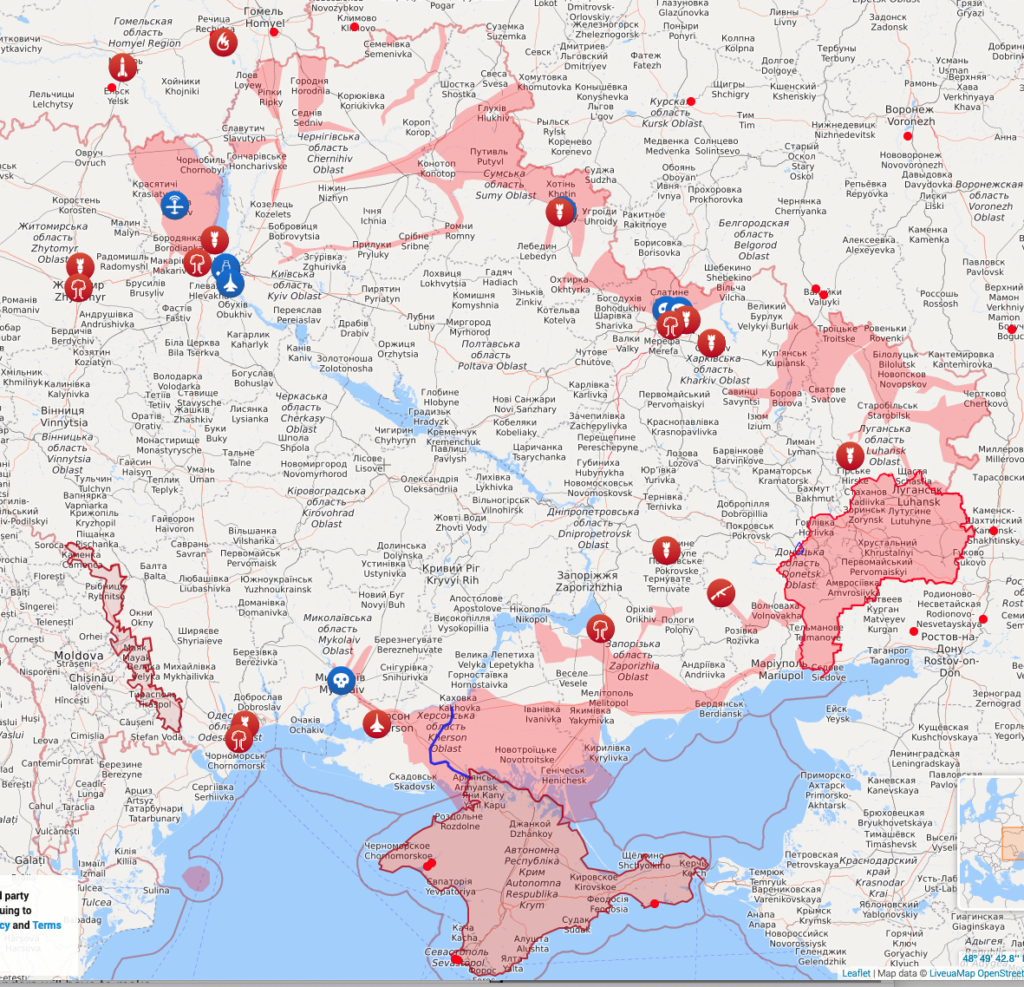
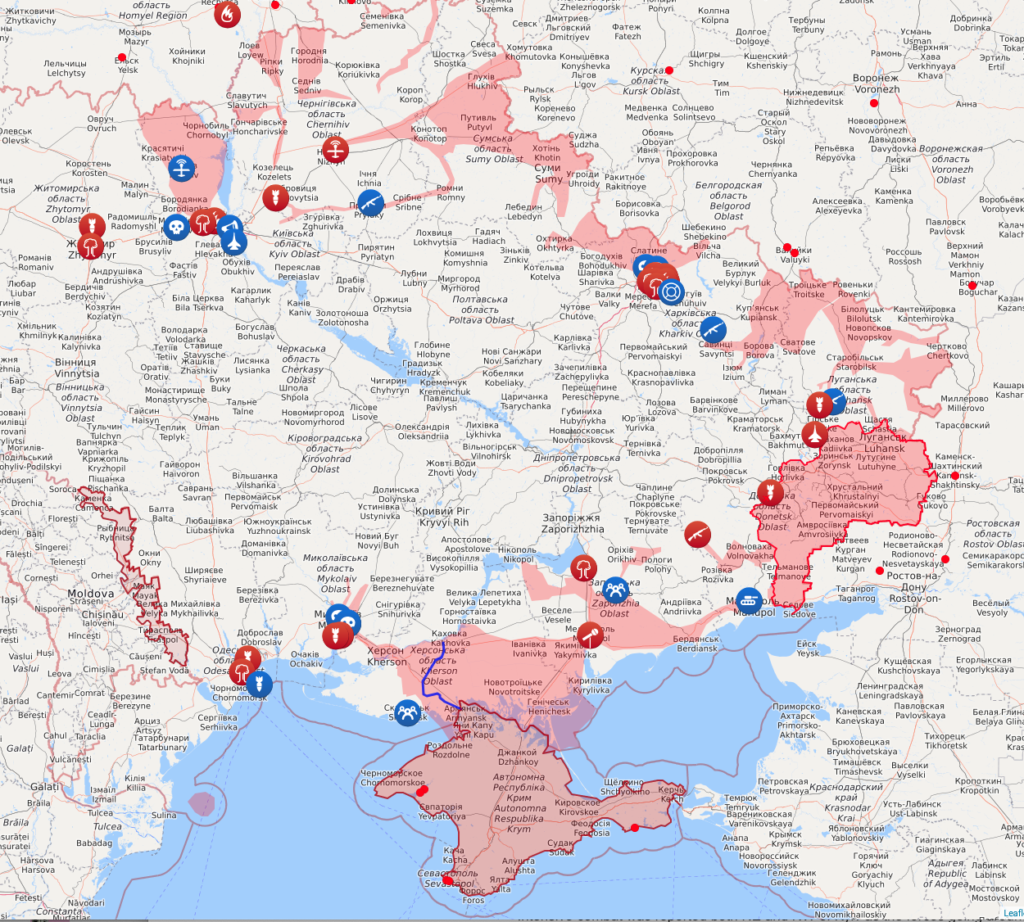
At this point, there seems to be no indication that Russian forces are measurably closer to their goal of controlling all of Ukraine.
Here’s a LiveMap snapshot.
From a pure strategic viewpoint, those Russian tendrils snaking toward Kiev from the northeast look like a bad idea, since there’s no way to protect their supply lines.
(Always remember that the map is not the territory, and that both sides are working hard to put out propaganda, though the Russians seem to be manifestly incompetent at it.)
Here’s a fascinating thread reportedly leaked from an active Russian FSB (successor to the KGB) analyst about how badly everything is screwed up.
Kadyrov's squad was absolutely demolished before they even had a chance to fight and they got blown to pieces. I do not have any info that it was an FSB leak to Ukraine, so I’d give it a 1-2% chance – but can’t exclude this possibility completely.
I assume that’s Ramzan Kadyrov, corrupt head of the Chechen Republic, former resistance fighter against Russia who defected in 1999 and was appointed by Putin in 2007. Bit of a jihadist scumbag to boot, and just a generally nasty piece of work. I assume by “Kadyrov’s squad” they mean the Kadyrovtsy, the militia forces under his direct control.
Our Blitzkrieg has totally collapsed. It is impossible to complete the task: If Zelensky and his deputies were captured in the first 3 days, all key buildings also captured, and they were forced to read an address of their surrender to the country,
Some tweets about who could they even get post-Zelensky to sign a treaty (Medvechuk? Tsaryova? Yanukovich?) snipped.
2) Our logistics are already over-extended today. We can send a much large contingent into Ukraine, and what would we get? Ukraine – a territorially enormous country, and their hate towards us is astronomical.
With regards to Russian military losses: I don’t know the reality – no one does. There was some information the first 2 days, but now no one knows what is happening in Ukraine. We’ve lost contact with major divisions. (!!)
Because all of this was planned at the top (in Russia), because we were told that such a scenario will not happen (Ukraine invasion) except only if we were to be attacked first.
Now, civilian losses in Ukraine will follow a geometric pattern progression, and resistance against us will only get stronger. Infantries already tried to enter cities – out of 20 paratrooper groups, only one had “provisional” success.
And so, with the Ukrainian question we lunged as if going for a 100m sprint, but turned out we’d signed up for a marathon. And this is a rather brief overview of the current events.
Cheap Chinese tires have been blamed for a Russian convoy of armoured vehicles being unable to reach Kyiv.
Yesterday, the Ministry of Defence issued an update revealing that a convoy of Russian tanks advancing on the capital of Ukraine remained 30km from the centre of the city having made little progress over the previous three days because of “Ukranian resistance, mechanical breakdown and congestion.”
Karl Muth, an academic based at the University of Chicago and a self-described tire expert, took to Twitter to set out a theory blaming cheap Chinese tires for the slow advance of Russian vehicles.
“Those aren’t Soviet-era heavy truck radials,” Muth said, commenting on a photo of a Russian army vehicle with ripped tires.
Instead Muth believes the trucks use “Chinese military tires, and I believe specifically the Yellow Sea YS20.”
“This is a tire I first encountered in Somalia and Sudan. it’s a bad Chinese copy of the excellent Michelin XZL military tire design,” he continued.
Former pentagon staff member Trent Telenko also got stuck into the debate and said “poor Russian army truck maintenance practices” has created a risk of equipment failure.
“When you leave military truck tires in one place for months on end. The side walls get rotted/brittle such that using low tire pressure setting for any appreciable distance will cause the tires to fail catastrophically via rips,” Telenko said.
Morgan Stanley analyst says that Russia is heading toward debt default as soon as April 15. Those are dollar-denominated bonds, which means they can’t be paid with devalued rubles.
There are reportedly more than 400,000 “volunteer hackers” helping Ukraine fight its cyberwar against Russia.
Victor Zhora, deputy chief of Ukraine’s information protection service, told Bloomberg last week that Ukraine was putting up a “cyber resistance” against its invasion that would work to try and weaken Russia.
Zhora said: “Our friends, Ukrainians all over globe, [are] united to defend our country in cyberspace. [Ukraine is working to do] everything possible to protect our land in cyberspace, our networks, and to make the aggressor feel uncomfortable with their actions.”
He also said that volunteers were helping Ukraine obtain intelligence in order to fight back at Russian military systems.
They are also trying to get the message out to Russian citizens, who have been Fed a starkly different narrative from their government than the rest of the world has seen play out. Volunteers are working to “address Russian people directly by phone calls, by emails, by messages” and “by putting texts on their services and showing real pictures of war.”
There aren’t 400,000 real hackers around the world. But 10,000 hackers and 390,000 script kiddies can sill do a lot of damage…
More than a week into the Russian invasion of Ukraine, the Russian Air Force has yet to commence large-scale operations. Inactivity in the first few days could be ascribed to various factors, but the continued absence of major air operations now raises serious capability questions.
One of the greatest surprises from the initial phase of the Russian invasion of Ukraine has been the inability of the Russian Aerospace Forces (VKS) fighter and fighter-bomber fleets to establish air superiority, or to deploy significant combat power in support of the under-performing Russian ground forces. On the first day of the invasion, an anticipated series of large-scale Russian air operations in the aftermath of initial cruise- and ballistic-missile strikes did not materialise. An initial analysis of the possible reasons for this identified potential Russian difficulties with deconfliction between ground-based surface-to-air missile (SAM) batteries, a lack of precision-guided munitions and limited numbers of pilots with the requisite expertise to conduct precise strikes in support of initial ground operations due to low average VKS flying hours. These factors all remain relevant, but are no longer sufficient in themselves to explain the anaemic VKS activity as the ground invasion continues into its second week. Russian fast jets have conducted only limited sorties in Ukrainian airspace, in singles or pairs, always at low altitudes and mostly at night to minimise losses from Ukrainian man-portable air defence systems (MANPADS) and ground fire.
Snip.
While the early VKS failure to establish air superiority could be explained by lack of early warning, coordination capacity and sufficient planning time, the continued pattern of activity suggests a more significant conclusion: that the VKS lacks the institutional capacity to plan, brief and fly complex air operations at scale. There is significant circumstantial evidence to support this, admittedly tentative, explanation.
First, while the VKS has gained significant combat experience in complex air environments over Syria since 2015, it has only operated aircraft in small formations during those operations. Single aircraft, pairs or occasionally four-ships have been the norm. When different types of aircraft have been seen operating together, they have generally only comprised two pairs at most. Aside from prestige events such as Victory Day parade flypasts, the VKS also conducts the vast majority of its training flights in singles or pairs. This means that its operational commanders have very little practical experience of how to plan, brief and coordinate complex air operations involving tens or hundreds of assets in a high-threat air environment. This is a factor that many Western airpower specialists and practitioners often overlook due to the ubiquity of complex air operations – run through combined air operations centres – to Western military operations over Iraq, the Balkans, Libya, Afghanistan and Syria over the past 20 years.
Second, most VKS pilots get around 100 hours’ (and in many cases less) flying time per year – around half of that flown by most NATO air forces. They also lack comparable modern simulator facilities to train and practise advanced tactics in complex environments. The live flying hours which Russian fighter pilots do get are also significantly less valuable in preparing pilots for complex air operations than those flown by NATO forces. In Western air forces such as the RAF and US Air Force, pilots are rigorously trained to fly complex sorties in appalling weather, at low level and against live and simulated ground and aerial threats. To pass advanced fast jet training they must be able to reliably do this and still hit targets within five to ten seconds of the planned time-on-target. This is a vital skill for frontline missions to allow multiple elements of a complex strike package to sequence their manoeuvres and attacks safely and effectively, even when under fire and in poor visibility. It also takes a long time to train for and regular live flying and simulator time to stay current at. By contrast, most VKS frontline training sorties involve comparatively sterile environments, and simple tasks such as navigation flights, unguided weapon deliveries at open ranges, and target simulation flying in cooperation with the ground-based air-defence system. Russia lacks access to a training and exercise architecture to rival that available to NATO air forces, which routinely train together at well-instrumented ranges in the Mediterranean, North Sea, Canada and the US. Russia also has no equivalent to the large-scale complex air exercises with realistic threat simulation which NATO members hold annually – the most famous of which is Red Flag. As such, it would be unsurprising if most Russian pilots lack the proficiency to operate effectively as part of large, mixed formations executing complex and dynamic missions under fire.
Third, if the VKS were capable of conducting complex air operations, it should have been comparatively simple for them to have achieved air superiority over Ukraine. The small number of remaining Ukrainian fighters, conducting heroic air-defence efforts over their own cities, are forced to operate at low altitudes due to long-range Russian SAM systems and consequently have comparatively limited situational awareness and endurance. They ought to be relatively easily to overwhelm for the far more numerous, better armed and more advanced VKS fighters arranged around the Ukrainian borders. Ukrainian mobile medium- and short-range SAM systems such as SA-11 and SA-15 have had successes against Russian helicopters and fast jets. However, large Russian strike aircraft packages flying at medium or high altitude with escorting fighters would be able to rapidly find and strike any Ukrainian SAMs which unmasked their position by firing at them. They would lose aircraft in the process, but would be able to attrit the remaining SAMs and rapidly establish air superiority.
Russia has every incentive to establish air superiority, and on paper should be more than capable of doing so if it commits to combat operations in large, mixed formations to suppress and hunt down Ukrainian fighters and SAM systems. Instead, the VKS continues to only operate in very small numbers and at low level to minimise the threat from the Ukrainian SAMs. Down low, their situational awareness and combat effectiveness is limited, and they are well within range of the MANPADS such as Igla and Stinger which Ukrainian forces already possess. The numbers of MANPADS are also increasing, as numerous Western countries send supplies to beleaguered Ukrainian forces. To avoid additional losses to MANPADS, sorties continue to be primarily flown at night, which further limits the effectiveness of their mostly unguided air-to-ground weapons.
How Russian propaganda has sold some of the Russian people on Project Z. But Russian troops are finding things quite a different story. Warning: Bodies, and at about 18 seconds in one, I think strewn body parts:
But once they realised that there will be resistance and the war looks like this, their enthusiasm started declining. Which means it will be much harder to find new volunteers to go fight to Ukraine. But you need them. What are you gonna do? pic.twitter.com/ItmwcYSwIe
“Sources have been telling me, sources that are well connected to the Russian Security Services, that the offensive is not going well, that some special forces, the Russian Spetsnaz, are furious because they have been sent into battle without proper support, and many of them have been killed. They say that the national guard forces and the regular army, the national guard forces include those Chechen units, that two of them are not coordinating on the field. And that the overall battle plan is somewhat disjointed in that it’s partly a plan for war and partly a plan for peacekeeping and so-called de-Nazification of this country. And it has led to a lack of cohesion,” Engel reported.
“A lot of this goes back to the man who’s behind it all, Vladimir Putin, who I’m told is now increasingly isolated, is just taking advice from his inner circle, that there are only about three people who matter right now,” Engel continued. “And that speech, you mentioned it a short while ago, that Putin gave yesterday — bizarre location, speaking at Aeroflot, to a group of flight attendants. He sounded incredibly angry. He sounded detached. He was talking about how the Ukrainians here are machine-gunning people, that they’re driving around in cars packed with explosives, jihadi-style. And he went very deep and repeatedly on this theme that they’re fighting against the Nazis. It was the angriest I’ve ever seen him.”
This is from a couple of days ago. Have Spetsnaz pissed off at you doesn’t seem like a good long-term survival strategy for a Russian leader. On the other hand, this report probably deserves some skepticism, since it fits too easily into what we would like to hear about the situation, so some salt is in order. (Hat tip: Director Blue.)
“Ukraine says it has RE-TAKEN Chuhuiv city and killed two high-ranking Russian commanders during the battle.” (Hat tip: Instapundit.)
“A Complete Summary Of All Russia Sanctions And Developments.” Read on for exciting blow-by-blow summaries of foreign exchange surcharges and debt repayment details…
What rolls down stairs/alone and in pairs/and up-armors your Russian truck? Caveat: They call this improvised armor, but it could also be on-hand materials for traction in muddy areas.
Busy day, so enjoy another Ukraine video. This is a good summary of the fight up until now:
Some takeaways:
We know what Russian plans were, based on captured documents and a pre-written “analysis” of Russia’s glorious victory someone found on file on a web server.
They expected to be at the gates of Kiev in three days and have everything conquered in two weeks.
Well, we’re almost two weeks in, and they haven’t achieved any of their major objectives. All major cities remain in Ukrainian hands.
One reason they didn’t: NATO alerted them to impending Russian action slightly before it began, so many commanders and units were already dispersed from bases.
They didn’t have enough trucks to begin with and have already lost 200 more.
Also, not only is the Ukrainian mud all but impassable, but their truck tires really suck. (More on this in a day or so.)
We need to pay more attention to the south, where Russian troops attacking from Crimea have done better (but still not great).
Time is not on Russia’s side, as sanctions are crashing their economy hard.
I’ve touched on some of the logistical difficulties Russia has experienced in its Ukrainian invasion. But this video goes into more detail about how Russia built up logistical support for the invasion, the importance of its rail systems, and how it hasn’t been able to keep up post-invasion.
Some takeaways:
Ukrainian forces destroyed all rail links between the two countries.
Russian forces are relying on analog, unsecured radio communications rather than scrambled digital channels, and Ukrainian forces are listening in and jamming.
Poor logistics also helped Soviet forces lose in Afghanistan.
Russia has 30,000 strong military rail organization.
“Russia doesn’t have enough trucks.” They can’t operate effectively more than 90 miles from supply dumps.
A large percentage of truck transport was dedicated to rocket resupply, not fuel and food.
Russia only had 3-5 days of supplies when they invaded. When those ran out, they were screwed.
Russia’s military works on a “push” logistic system rather than a “pull” system used by the U.S. military, meaning it’s not very flexible.
Russia has the capability to set up the infrastructure for a longer war, but it’s going to take time.
Russia’s failure to quickly achieve it’s objectives has seen it resort to more desperate and indiscriminate tactics.
And here’s a related Twitter thread that touches on rail network logistic issues.
The most logistically dangerous axis is east-west, because the rail runs that way direct from Russia without worrying about a seaport and sealift. That doesn't mean a southern thrust isn't dangerous but the UA must prioritize.
I’ve been too busy to post earlier today, and the Texas Primary voting day is TOMORROW, so this may be brief.
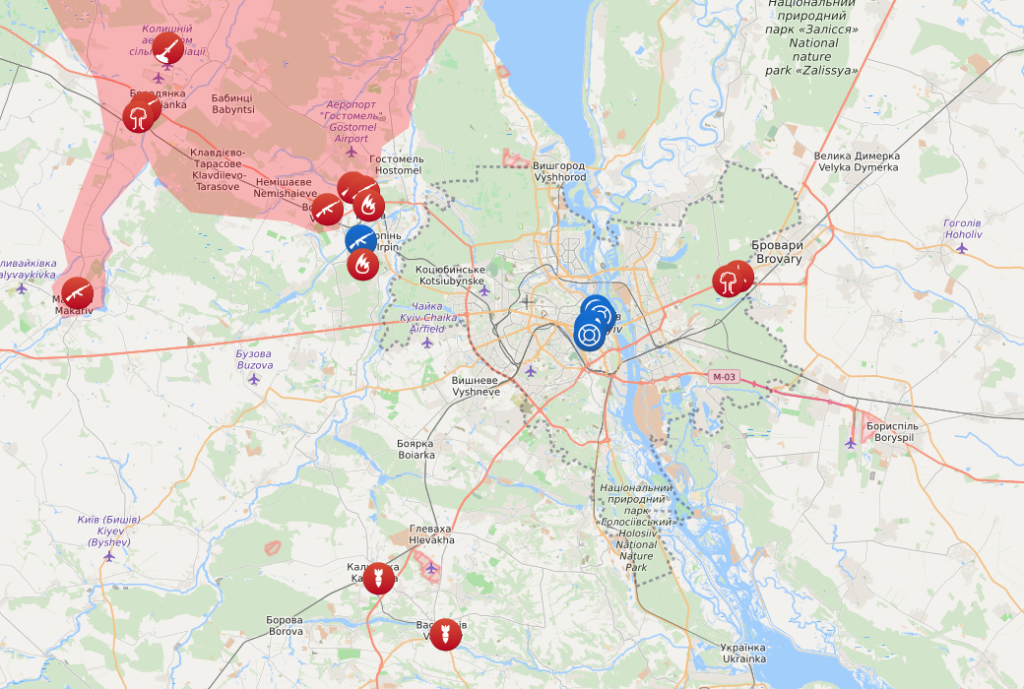
Yesterday’s post noted: “Russia has failed to encircle and isolate Kyiv with the combination of mechanized and airborne attacks as it had clearly planned to do. Russian forces are now engaging in more straightforward mechanized drives into the capital along a narrow front along the west bank of the Dnipro River and toward Kyiv from a broad front to the northeast.”
That’s what you can see on the Livemap of Kiev here, with that red area being controlled by Russian forces:
If Ukrainian forces can keep them from entering Kiev proper, that will go a long way toward stopping Putin’s invasion cold.
The “swift and severe” sanctions of the U.S. and its allies took a while to arrive, not taking effect until 96 hours or so after the first steps of the Russian invasion of Ukraine.
But to give credit where its due, once those sanctions did kick in, the consequences were indeed intense:
At one point, “The ruble plunged to a record low of less than one U.S. penny” — at one point 118 rubles to a dollar, before recovering to 84 rubles to a dollar.
The Economist noted, even with the recovery, that it was “one of the largest one-day slumps in the Russian currency’s modern history, similar in scale to the one-day declines recorded during the worst moments of the country’s financial crisis in 1998, when Russia defaulted on its debt. In mid-morning in Moscow, the Russian central bank raised its key interest rate from 9.5 percent to 20 percent in an effort to stem the ruble’s slump, and the country’s finance ministry ordered companies with foreign-currency revenues to convert 80 percent of their income into rubles.”
One analyst on CNBC summarized that the Russian currency has “pretty much lost all value outside of the country. . . . To me, it doesn’t really feel like we’re looking at or at least we’re going to see the bottom in the ruble here. I think there still is plenty more room for weakness to come.”
The Moscow stock exchange initially delayed its opening this morning, then declared it would be closed for the day.
Russians no longer have faith that their banks will remain solvent: “Russians waited in long queues outside ATMs on Sunday, worried that bank cards may cease to function, or that banks would limit cash withdrawals. ‘Since Thursday, everyone has been running from ATM to ATM to get cash. Some are lucky, others not so much,’ St Petersburg resident, Pyotr, who declined to give his last name, said.”
CNN reports that, “One early casualty was the European subsidiary of Sberbank, Russia’s biggest lender that has been sanctioned by Western allies. The European Central Bank said Sberbank Europe, including its Austrian and Croatian branches, was failing, or likely to fail, because of ‘significant deposit outflows’ triggered by the Ukraine crisis.”
It’s now five days since Russian President Vladimir Putin sent his mostly conscript army into Ukraine to overthrow the government of President Volodymyr Zelenskyy, and it hasn’t gone as planned. In what may signal frustration, Putin has put his nuclear forces on alert in one last desperate move to beat his chest and show the world who’s in charge.
Time has given some clarity to the operation and allows the drawing of some conclusions.
I’m a retired Army lieutenant colonel—an intelligence officer. My training, from 1983 to 2007, was a Cold War focus on the old Soviet Union, the predecessor state to the Russian Federation. Never in my time as an intelligence officer was I able to see the worst-case scenario of a large-scale conventional Russian attack in Europe—until now.
I’ve seen multiple reports of Russian conscripts who didn’t know they were invading Ukraine. They’re confused. They don’t know who to shoot at, as “Ukrainians look the same as us.” The Russian force appears to suffer from: Poor training; poor leadership (bad officers); and a cultural disregard for information-sharing down the chain of command, which prevents lower-ranking soldiers from making informed decisions in the chaos of war.
The result of all this is a lack of initiative from soldiers when non-commissioned officers and officers are killed or wounded.
It is important to note that the Russian army hasn’t fought a conventional war against a near-peer enemy since 1945. It’s out of practice, poorly trained, poorly led, and poorly motivated. It does have plenty of heavy armaments—very large thermobaric bombs. It can destroy, but it can’t fight effectively.
Regarding the “Father of Bombs,” a large thermobaric or “vacuum” bombs capable of destroying a city block, killing 10,000 or more civilians and soldiers. Using one on Kyiv would horrify the world and likely increase calls for war crimes charges on Russian leaders. The Russians have used smaller thermobaric weapons against Ukrainian bunkers.
This opens another question: How powerful are Russia’s reconstituted zampolit? Putin brought them back in 2018. The zampolit were political officers in the old Red Army, previously called “commissars” until 1942 when the position’s battlefield power was scaled back in response to negative military command implications.
If a Russian field commander is ordered to use a city-busting thermobaric bomb, will he? Or will he refuse to carry out the order, like German Gen. von Choltitz when Adolf Hitler ordered him to destroy Paris—unless a zampolit is looking over his shoulder with a pistol?
Logistics is also manifesting itself as a Russian weak spot. Logistics is hard—it’s harder in combat. It requires synchronizing the delivery of fuel, ammo, and food to frontline forces all while the enemy is shooting at your resupply trucks. At four days in, Russian forces are running out of basic supplies. This has a powerfully negative effect on morale.
Complicating Russian resupply efforts are indications that Ukrainian light forces hunkered down during the initial Russian wave passed by, only to reemerge when the lightly armored supply columns entered Ukraine. Also of note is the increasingly effective Ukrainian use of Turkish-designed BayraktarTB2 drones. These low-cost, slow, non-stealthy drones have scored dozens of kills on Russian columns. Ukraine has about 60 of them.
As Ukrainian resistance stiffens and tens of thousands of Ukrainian citizens rush to defend their nation, other nations in the region have been emboldened. Germany is sending 1,000 antitank missiles and 500 Stinger antiaircraft missiles. The Czech Republic and the Netherlands are sending small arms and ammunition.
His successor Shoygu knew better than that. Now who's Shoygu? Shoygu is the *only* single Russian minister who uninterruptedly worked in government since 1991, since the very beginning of Russian Federation. He worked for all presidents, all prime ministers avoided all purges pic.twitter.com/EOx5MH6lb3
There was another issue. Shoygu is ethnic Tuvan. In such a country as Russia minority member can hardly become the supreme leader. People don't perceive him as ethnic Russian (see his palace) which means he's not dangerous for the leader and you can safely delegate him the army pic.twitter.com/a4zJA1ePa0
He also says Russia is only using one echelon of troops:
How is a Blitzkrieg organised? By echelons. First echelon is moving forward as fast as they can. Ofc this means that lots of defenders will be left in their rear. But then the second echelon comes, then third, etc. They finish defenders, occupy territory, control the supply lines pic.twitter.com/AQtm8ntLfO
Secondly, launching several echelons would require long arduous preparation. You need to mobilise them, move to the borders, quarter, maintain and supply. It's not that easy. It's a hard job that should have been done well in advance to wage a Blitzkrieg. And it hadn't been done
The Russian offensive in Ukraine continues to bog down against stiff resistance, Putin puts his nukes on alert, a rumor of peace talks, momentum to suspend some Russian banks from SWIFT builds, and a whole lot of aid from the rest of the world is pouring into Ukraine.
Russia invaded Ukraine from three sides on Wednesday night Eastern time, and as of now, early afternoon Saturday, the Russian army has yet to seize any Ukrainian cities.
This morning, a senior defense official at the Pentagon briefed reporters and declared, “We continue to believe, based on what we have observed that this resistance is greater than what the Russians expected and we have indications that the Russians are increasingly frustrated by their lack of momentum over the last 24 hours particularly in the north parts of Ukraine… As of this morning we have no indication still that the Russian military has taken control over any cities. As of this morning we still believe that Russia has yet to achieve air superiority. Ukrainian air defenses including aircraft do continue to be operable and continue to engage and deny access to Russian aircraft in places over the country.”
There is an intriguing but unverified claim from Ukrainian intelligence that Putin is furious, that he expected a quick surrender from Kiev, and that the invading Russian forces weren’t equipped for a long war – and that after ten days, the Russian forces will face serious problems with supply lines, fuel, equipment, ammunition, etc. Maybe this is just Ukrainian propaganda, meant to keep up morale for the next week or so. But there are some intriguing anecdotes of Ukrainians hitting Russian supply columns and videos of Russian tanks running out of fuel. (It turns out supply chain problems are just everywhere these days!)
Sending in armored columns without dedicated infantry, artillery and air support is a big risk, big reward move. Patton did it successfully in the race across France in 1944, but he had air superiority, a friendly population, and the greatest war machine ever assembled in the history of mankind up to that time backing him, and even he had to halt when he outran his supply lines.
Putin’s initial goal, the Russian reabsorption of Ukraine or the transformation of it into a lackey state of a renewed Russian empire, is now probably impossible. Any Russian-backed Ukrainian puppet government is likely to be vehemently rejected by the Ukrainian people. Russian forces will find it difficult to go out on patrol when every citizen’s got a rifle and every grandma on every street corner is handing them sunflower seeds, telling them they are going to be fertilizer soon.
Russia may take large chunks of Ukraine, but they will have an exceptionally difficult time keeping it.
The last three days of combat should put a serious dent in the reputation of this new Russian army. We should, however, try to understand why the Russians are struggling. First, the Russian army’s recent structural reforms do not appear to have been sufficient to the task at hand. Second, at the tactical and operational level, the Russians are failing to get the most out of their manpower and materiel advantage.
There has been much talk over the last ten years about the Russian army’s modernization and professionalization. After suffering severe neglect in the ’90s, during Russia’s post-Soviet financial crisis, the army began to reorganize and modernize with the strengthening of the Russian economy under Putin. First the army got smaller, at least compared to the Soviet Red Army, which allowed a higher per-soldier funding ratio than in previous eras. The Russians spent vast sums of money to modernize and improve their equipment and kit — everything from new models of main battle tanks to, in 2013, ordering Russian troopers to finally retire the traditional portyanki foot wraps and switch to socks.
But the Russians have also gone the wrong direction in some areas. In 2008, the Russian government cut the conscription term from 24 to twelve months. As Gil Barndollar, a former U.S. Marine infantry officer, wrote in 2020:
Russia currently fields an active-duty military of just under 1 million men. Of this force, approximately 260,000 are conscripts and 410,000 are contract soldiers (kontraktniki). The shortened 12-month conscript term provides at most five months of utilization time for these servicemen. Conscripts remain about a quarter of the force even in elite commando (spetsnaz) units.
As anyone who has served in the military will tell you, twelve months is barely enough time to become proficient at simply being a rifleman. It’s nowhere near enough time for the average soldier to learn the skills required to be an effective small-unit leader.
Yes, the Russians have indeed made efforts to professionalize the officer and the NCO corps. Of course, non-commissioned officers (NCOs) have historically been a weakness of the Russian system. In the West, NCOs are the professional, experienced backbone of an army. They are expected to be experts in their military speciality (armor, mortars, infantry, logistics, etc.) and can thus be effective small-unit commanders at the squad and section level, as well as advisers to the commanders at the platoon and company level. In short, a Western army pairs a young infantry lieutenant with a grizzled staff sergeant; a U.S. Marine Corps company commander, usually a captain, will be paired with a gunnery sergeant and a first sergeant. The officer still holds the moral and legal authority and responsibility for his command — but he would be foolish to not listen to the advice and opinion of the unit’s senior NCOs.
The Russian army, in practice, does not operate like this. A high proportion of the soldiers wearing NCO stripes in the modern Russian army are little more than senior conscripts near the end of their term of service. In recent years, the Russians have established a dedicated NCO academy and cut the number of officers in the army in an effort to put more resources into improving the NCO corps, but the changes have not been enough to solve the army’s leadership deficit.
Now, let’s talk about the Russian failures at the operational and tactical level.
It should be emphasized again that the Russian army, through sheer weight of men and materiel, is still likely to win this war. But it’s becoming more and more apparent that the Russians’ operational and tactical choices have not made that task easy on themselves.
First, to many observers, it’s simply shocking that the Russians have not been able to establish complete air superiority over Ukrainian air space. After three days of hostilities, Ukrainian pilots are still taking to the skies and Ukrainian anti-air batteries are still exacting a toll on Russian aircraft. The fact that the Russians have not been able to mount a dominant Suppression of Enemy Air Defenses (SEAD) campaign and yet are insistent on attempting contested air-assault operations is, simply put, astounding. It’s also been extremely costly for the Russians.
To compound that problem, the Russians have undertaken operations on multiple avenues of advance, which, at least in the early stages of this campaign, are not able to mutually support each other. Until they get much closer to the capital, the Russian units moving north out of Crimea are not able to help the Russian armored columns advancing on Kyiv. The troops pushing towards Kyiv from Belarus aren’t able to affect the Ukrainians defending the Donbas in the east. As the Russians move deeper into Ukraine, this can and will change, but it unquestionably made the opening stages of their operations more difficult.
Third, the Russians — possibly out of hubris — do not appear to have prepared the logistical train necessary to keep some of their units in action for an extended period of time. Multiple videos have emerged of Russian columns out of gas and stuck on Ukrainian roads.
The classic saying is “Amateurs talk about tactics, but professionals study logistics” (attributed to Marines Corps commander Gen. Robert H. Barrow, but I suspect the general sentiment is much older). An army runs on its stomach, and a modern mechanized army runs on its gas tank, and something has clearly gone wrong in with Russian logistical support for this war.
Russia seemed to have expected Ukrainian President Volodymyr Zelenskyy to fold. He hasn’t.
America offered to evacuate Ukrainian President Volodymyr Zelenskyy. Zelenskyy replied, “The fight is here; I need ammunition, not a ride.”
Zelenskyy’s reply was reminiscent of past heroes in times of war: Gen. Anthony McAuliffe who replied in “NUTS” in response to the German demand for surrender at Bastogne during the Battle of the Bulge in 1944; and the Texans striving for independence from dictator Santa Anna’s Mexico with their “Come and Take it Flag,” which was itself appropriated from Spartan King Leonidas and his response the Persian surrender demand at the Battle of Thermopylae.
This bravery, in a day when modern communications allow all Ukrainians and the world to see it, has rallied Ukrainians to defend their nation. And now that the fighting has gone on for three days, what might that mean?
Russian President Putin is said to have assembled 200,000 troops for the invasion. It is estimated that half of them have been committed so far. Further, Putin has called on 10,000 battle-hardened Chechen mercenaries. More than half of Russian forces are likely committed to the battle of Kyiv.
Ukraine has 245,000 active-duty members, but most are in the east, facing the Russian-led and equipped militia in the separatist regions of Donetsk and Luhansk. Ukraine also has another 220,000 reservists. Many of these are spread across the nation slightly larger than the state of Texas.
The strategic target is Kyiv and its independent government. To move the reservists to the fight, they must contend with Russian air superiority, slowing their march. More importantly, given this struggle for national survival, 7,000,000 men of military age and fit for military service are taking up arms. Every day, many more older men — and many Ukrainian women — are also being issued weapons, making Molotov cocktails, and joining the fight.
The ongoing Ukrainian mobilization means that the Russian military will soon be outnumbered most everywhere on the battlefield. The Ukrainians may not have the same level of modern equipment — missiles, jets, helicopter — but they have numbers and will power. And, the Russians need to eat, they need fuel, and ammunition — their resupply trucks must get through. They won’t, not in large enough numbers; everyday Ukrainians will see to that.
Zelensky: ‘We successfully fought off enemy attacks. We are defending our country, our land, future of our children. Kyiv & key places near the capital are under our control. The occupiers wanted to capture our capital and install their puppets like Donetsk. We broke their idea.’ pic.twitter.com/3PtnzXmPoy
Russian forces’ main axes of advance in the last 24 hours focused on Kyiv, northeastern Ukraine, and southern Ukraine. Russian airborne and special forces troops are engaged in urban warfare in northwestern Kyiv, but Russian mechanized forces are not yet in the capital. Russian forces from Crimea have changed their primary axes of advance from a presumed drive toward Odesa to focus on pushing north toward Zaporizhie and the southeastern bend of the Dnipro River and east along the Azov Sea coast toward Mariupol. These advances risk cutting off the large concentrations of Ukrainian forces still defending the former line of contact between unoccupied Ukraine and occupied Donbas. Ukrainian leaders may soon face the painful decision of ordering the withdrawal of those forces and the ceding of more of eastern Ukraine or allowing much of Ukraine’s uncommitted conventional combat power to be encircled and destroyed. There are no indications as yet of whether the Ukrainian government is considering this decision point.
Ukrainian resistance remains remarkably effective and Russian operations especially on the Kyiv axis have been poorly coordinated and executed, leading to significant Russian failures on that axis and at Kharkiv. Russian forces remain much larger and more capable than Ukraine’s conventional military, however, and Russian advances in southern Ukraine may threaten to unhinge the defense of Kyiv and northeastern Ukraine if they continue unchecked.
Key Takeaways
Russia has failed to encircle and isolate Kyiv with the combination of mechanized and airborne attacks as it had clearly planned to do. Russian forces are now engaging in more straightforward mechanized drives into the capital along a narrow front along the west bank of the Dnipro River and toward Kyiv from a broad front to the northeast.
Russian forces have temporarily abandoned failed efforts to seize Chernihiv and Kharkiv to the northeast and east of Kyiv and are bypassing those cities to continue their drive on Kyiv. Russian attacks against both cities appear to have been poorly designed and executed and to have encountered more determined and effective Ukrainian resistance than they expected.
Russian movements in eastern Ukraine remain primarily focused on pinning the large concentration of Ukrainian conventional forces arrayed along the former line of contact in the east, likely to prevent them from interfering with Russian drives on Kyiv and to facilitate their encirclement and destruction.
Russian forces coming north from Crimea halted their drive westward toward Odesa, and Ukrainian forces have retaken the critical city of Kherson. Some Russian troops remain west of the Dnipro River and are advancing on Mikolayiv, but the main axes of advance have shifted to the north and east toward Zaporizhie and Mariupol respectively.
Russian forces have taken the critical city of Berdyansk from the west, threatening to encircle Mariupol even as Russian forces based in occupied Donbas attack Mariupol from the east, likely to pin defenders in the city as they are encircled.
Russian successes in southern Ukraine are the most dangerous and threaten to unhinge Ukraine’s successful defenses and rearguard actions to the north and northeast.
Russian troops are facing growing morale and logistics issues, predictable consequences of the poor planning, coordination, and execution of attacks along Ukraine’s northern border.
It appears that the various armored column incursions were secondary to or distractions from the attempted paratroop-powered decapitation strike to be launched from Antonov International Airport. When that went awry (as airborne assaults often do; see the SNAFU that was Operation Market Garden in World War II), there appeared to be no coherent backup plan.
Indeed, the entire operation seems to have been hastily planned and executed, which is odd, since Ukraine has obviously been much on Putin’s mind since 2014.
This is not the way competent troops act in hostile urban environments. It’s like the Russian army forgot all they learned from getting their asses kicked in the First Battle of Grozny, where driving ill-supported mechanized columns filled with untrained conscripts into the city resulted in horrible losses for the Russians.
The Kiev assault seems even less thought out, and their opponents appear much better equipped and trained than the Chechens were.
On the other hand, here’s a report that Kiev is surrounded. I’d take that with several grains of salt.
Putin puts Russian nuclear forces on alert. The idea that Putin would actually contemplate nuclear war with the west because his own ill-conceived and badly-executed invasion of Ukraine has gone off the rails is hardly credible. Russia would be annihilated.
“As you can see, not only do Western countries take unfriendly measures against our country in the economic dimension – I mean the illegal sanctions that everyone knows about very well – but also the top officials of leading NATO countries allow themselves to make aggressive statements with regards to our country,” Putin said on state television.
“Mommy, they’re saying bad things about me!” Those unfriendly measures would, of course, stop instantly if Putin were to withdraw his forces from the territory of other sovereign nations.
Here’s a video of Putin explaining himself:
Does that look or sound like an all-powerful conqueror at the top of his game? No, that’s the tone and the body language of a guy trying to explain why he just fucked up. “We had no other choice!” Yeah, except, you know, not invading another country.
There are evidently plans for talks between Ukrainian and Russian delegations on the Ukraine border with Belarus. Don’t expect much. Zelenskyy: “I do not really believe in the result of this meeting, but let them try, so that no citizen of Ukraine would have any doubt that I, as president, did not try to stop the war when there was even a small chance.”
The U.S. is sending $350 million in military aid. “The defense aid will include anti-armor, small arms and various munitions, and body armor and related equipment.” Let’s hope none of it disappears into the pockets of people connected to members of the Senate Foreign Relations Committee…
Speaking of reversing course, Germany has also done an about-face and is now in favor of removing some Russian banks from SWIFT. “The sanctions, agreed with the United States, France, Canada, Italy, Great Britain and the European Commission also include limiting the ability of Russia’s central bank to support the ruble.” I get the impression that the Eurocrats were hesitant to cut Russia off from SWIFT because they thought it would be a useless gesture. Now that Russia’s invasion has gone off the rails, they’re rethinking. The quick reverse also indicates how pissed they are at Russia right now.
Europe has effectively closed its airspace to Russia:
Based on published NOTAMs, adding Austria, Germany, Iceland, and Italy to the list of airspace unavailable to Russian flights — all in effect by 14:00 UTC. Based statements by government officials, we expect further prohibitions on Russian flights. https://t.co/3GtCYRmZUQpic.twitter.com/O0WTcsdRlz
A final word: There are a few Twitter pundits suggesting that some sort of “wag the dog” scenario of a fake war might be unfolding in Ukraine. I don’t buy it. There’s too much real reporting from too many points in Ukraine for such an elaborate, two-part deception to be unfolding. Lots of weird things happen in warfare.
I will say one thing: The manifest incompetence with which Russia has tried to carry out this assault suggests that Putin felt he had to launch it then due to some sort of time pressure or deadline, but I don’t know what it is. Maybe Putin has late stage cancer, or he felt Ukraine was about to join NATO, or a major Russian oilfield is about to run dry. Whatever it is, this war appears to be a panic move that’s gone very badly for Putin.