Rheinmetall has a new “GameChanger” drone (so they say) with an official “Rheinmetall Combat Drone” moniker that only a German company could love. I don’t see it as an actual gamecharger, but it is pretty interesting: a fixed-wing drone that can drop three other quadcopter drones (or, technically, loitering munitions), each of which can then be guided to the target.
The Rheinmetall Combat Drone is based on the German arms maker’s Luna NG reconnaissance drone and can carry the Hero-R type loitering munition.
“The Rheinmetall Combat Drone is the game changer for protecting your troops and fighting tactically relevant targets,” the company stated.
“Effectors as payloads transform the multipurpose drone from a sensor-to-shooter system into a highly efficient means of reconnaissance with com/network relay and SIGINT (Signals Intelligence) capabilities.”
The NG is the latest in the Luna family of reconnaissance drones, with an endurance of 12 hours and a data link range of 100 kilometers (62 miles). Satellite Communication would provide it with increased range.
The robust fiberglass composite drone has a take-off weight of 40 kilograms (88 pounds) and a service ceiling of 5,000 meters (16,404 feet).
The runway-independent vehicle can be launched with a rope hoist catapult and landed with a parachute and has stealth features with low acoustic, thermal, and radar signatures.
There’s an official video, but Rheinmetall has disabled embedding. So here’s a random Ukrainian guy (judged entirely from the trident on his hat) who’s evidently offering commentary on the drone, and has thus embedded most of the Rheinmetall video into his own. The relevant portion starts around 1:42 in.
Rheinmetall is a very solid MilTech company, but they tend to publicize things well in advance of commercial availability. (They’re hardly alone in this.) As such, I wouldn’t expect released versions to show up in the Russo-Ukrainian War. But they might send a few there for field testing.
I can see use cases for this weapon, especially for hunting down high value targets deep behind enemy lines. But this is sort of like the Cadillac Escalade of drones, while Ukraine’s flying yeet of death is more like an electric scooter: much shorter range, much more annoying, and much more cost effective for their intended task.
The Russo-Ukrainian War is probably cramming decades of drone development into white hot years of combat evolution (as wars tend to do), and every world military needs to be paying attention.
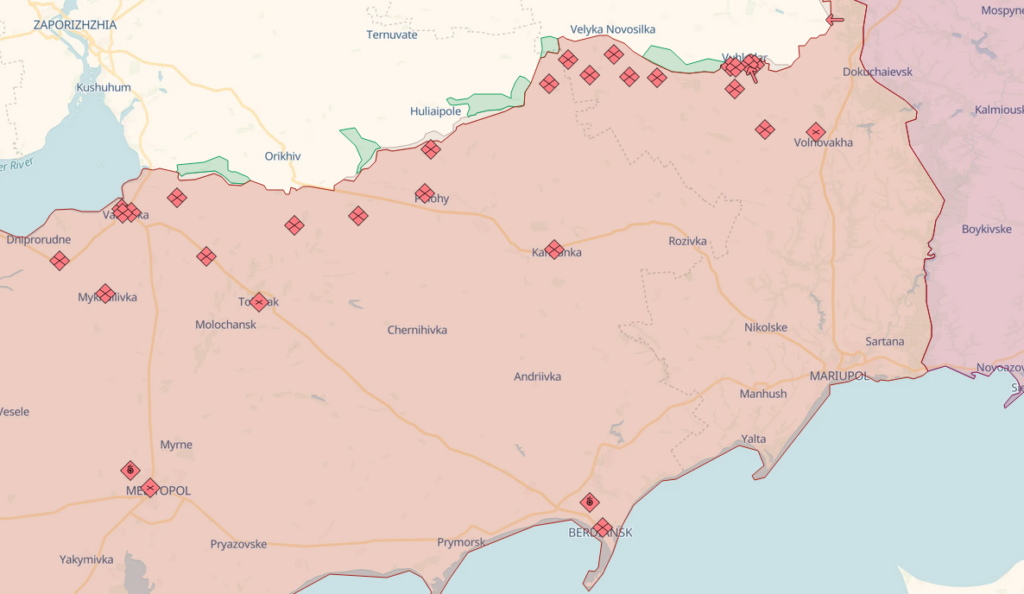
That’s the assertion of Reporting from Ukraine, who says that the counterattack is happening in Zaporizhzhia:
Reporting from Ukraine is pretty rah-rah for Ukraine, always putting a positive spin on things (“Ukrainian troops successfully withdrew from northern Bakhmut”), but he’s good on reporting the nitty gritty details of tactical movement and seems to have direct sources in the Ukrainian military.
Takeaways:
He’s seeing Ukrainian forces advance all across the Zaporizhzhia front.
“The freshest reports suggest that Ukrainians breached the Russian defense in the trenches in front of Novodanylivka and got closer to Nesterianka and Kopani from the east.”
“Ukrainian presence was also noted in the southern part of Kamianske, which means that Russians highly likely abandoned Piatykhatky as well.”
“Ukrainian Head of Melitopol reported that Russians announced an urgent evacuation from all settlements between Vasylivka and Tokmak, in fear that this may very soon become the most active battleground.”
“In order to prevent the accumulation of a critical amount of heavy equipment in the region, Russian forces started to actively use guided air bombs. These bombs weigh from 500 to 1500 kilograms and have a range of up to 40 kilometers, which poses a significant threat to Ukrainian plans. The craters from the explosions are enormous and can reach up to 50 meters in diameter.” I’m guessing these might be KAB-1500Ls.
“Ukrainians are trying to reciprocate the damage and are also identifying and destroying Russian warehouses with ammunition and equipment.”
“It looks like the same action is going to take place very soon in the Orikhiv direction because Russian reconnaissance recently reported that Ukrainians are actively demining significant clusters of land. Another indicator of the imminent Ukrainian offensive actions here is the fact that certain elements of the 71st Jager Brigade and 46th Assault Brigade recently arrived at Orikhiv, according Russian sources.”
“[The] Ukrainian 72nd Mechanized Brigade conducted a series of assaults in the vicinity of Vuhledar.”
“The intensification of fighting along the whole southern line has been noted by many analysts, but today, the Ukrainian Deputy Minister of Defense finally confirmed that the counteroffensive operation has started.”
Well, sort of: “She stated that it is incorrect to wait for a specific date because counteroffensive is a long process and it is only the culmination that happens quickly, but no one can predict when the culmination will happen, as it depends on the conditions on the ground.”
“Right now, Ukrainians are testing Russian defenses, letting the newly formed assault units gain combat experience and, for the most part, follow the path of lowest resistance – meaning they push where they can, leaving the strongest positions for later. Russian analysts are predicting that Ukrainians will make at least two huge attacks during the last week of April to test new tactics and then launch a full-scale counteroffensive during the first half of May.” Sounds like probing attacks for now, but I can see Ukraine moving quickly to exploit any gaps or pushing hard if there’s a sudden Russian line collapse.
Institute for the Study of War also has a similar confirmation-that’s-not-quite-a-confirmation: “Ukrainian Deputy Defense Minister Hanna Malyar reported on April 19 that Ukrainian forces are already conducting some counteroffensive actions. Malyar stated that Ukrainian forces will never preemptively announce when the counteroffensive starts and reiterated that Ukrainian forces aim to liberate all Ukrainian territory.”
Deep State shows some small recent-ish Ukrainian gains there:
— Geoff' The Frenchy Fella – War News 🇺🇦 (@Geoff_WarNews) April 20, 2023
So it’s hard to say for sure that this push is the much-anticipated Big Spring Counteroffensive. It could be a probing raid, or it could be a faint, with the main blow scheduled to fall elsewhere. Certainly Zaporizhzhia is the front section that has the most promise to split Russian forces in half and cut Russian forces in Kherson and Crimea off from resupply. Russia has to know this, and has been extending defense trenches throughout the area, but continues to throw troops into the Bakhmut meat-grinder rather than (as far as observers can tell) seriously reinforcing the area. Maybe Russia has reinforced it more than we know, but maybe not. It would be very far from the first time Russia made a stupid, obvious mistake in this war.
Maybe it’s more accurate to say that a counteroffensive is underway.
The big advantage that Carl-Gustav offers is that it’s much cheaper per round than smart munitions like Javelin.
“In the case of Ukraine [they’re] using these things for against everything from guys behind cover to light armored vehicles, soft skin vehicles and, of course, main battle tanks.”
Used by more than 40 countries.
Carl-Gustav can’t fill the top attack role NLAW and Javelin use against tanks. “But it can cripple a main battle tank. And with some of these advanced warheads, it can affect a not just a mobility kill, but an outright Kill, at least from the rear.”
“And if you blow off a track, the thing isn’t moving and it can then be killed perhaps another way, or the crew will simply abandon it.”
There are 15 different types of shells, including smoke and illumination.
They’re also working on guided munitions.
They’re also working on a confined-space munition with reduced back-blast, which sounds really useful for urban warfare.
Models produced are M1 (starting 1946) through M4 (2014).
A wide variety of rounds, including antipersonnel and two-phase charge designed to defeat reactive armor.
Most of NATO uses it, including the U.S., UK, Germany, Poland and all three of the Baltic states.
Ukraine managed to take out a T-90 with it.
Whether it’s better than an RPG-7 probably comes down to training and use case. The RPG-7 looks to be a lot more portable, but I’m betting the average Carl-Gustav build quality is better.
As Russia enters the 14th month of its 72 hour campaign to take Kiev, there are signs that its meat-grinder approach to combat is depleting the exact resources it needs to win.
First up: Anders Puck Nielsen on Russia’s likely manpower shortage:
He looks at various how and low counts for determining Russian casualty rates, then builds his arguments around one in the middle.
There is a rule of thumb that is often mentioned, that for every dead soldier there are three wounded. So if we take some round numbers, and remember it’s not actually important if they are a little bit off. It doesn’t change the point that I am getting to if you think real the number is a little lower. But say that on average about 500 Russian soldiers have been killed every day since the mobilization in September, when Russia also really started to have very big attrition numbers. And if we then make a conservative estimate and say that for every dead soldier, there have been two wounded, then we get that the Russian fighting force has been decreased by about 1500 soldiers every day. Then we can divide 300,000 by 1500, and we get that they have soldiers for about 200 days, until the Russian army will have consumed all those mobilized soldiers. This is not exact science. It’s just a rough estimate to illustrate Russia’s manpower problem. Putin announced the mobilization on 21 September, and incidentally 200 days after that is about now. It’s on 9 April 2023.
“Putin probably should have announced the second wave of mobilization months ago, but he didn’t. So that is why military analysts are talking about a Russian manpower shortage.”
“Those 300,000 soldiers that Russia mobilized in the fall are probably not there anymore.”
Second up is a report that both sides are rationing artillery shells in advance of Ukraine’s anticipated counteroffensive.
Artillery units on both sides of the line, despite the continued duels, are reportedly dialing back fire missions to save up ammunition for the long-awaited Ukrainian counteroffensive.
Russian milblogger Alexander Khodakovsky claims that those Russian units not involved in ongoing offensives have had ammunition supplies seriously curtailed. Khodakovsky attributed the rationing to concerns about the potential offensive.
At the same time, a frontline account from the Washington Post highlighted Ukrainian artillery crews similarly conserving shells. While embedded with an artillery platoon in Ukraine’s 56th Motorized Brigade, Isabelle Khurshudyan and Kamila Hrabchuk reported the unit’s 152mm howitzers used to fire more than 20-30 shells a day. That number has dwindled to fewer than three.
The nearby units equipped with NATO 155mm caliber guns are reportedly facing less of a shortage than the Warsaw Pact-era guns. Citing an anonymous Ukrainian military official, the report claimed Ukraine is still firing 7,700 shells a day. Russian shelling reportedly dwarfs even that figure. Ukraine’s incredible artillery consumption remains a concern for NATO as Western production lines struggle to keep supplies moving.
Russia’s grinding style of combat requires a fresh supply of bodies and artillery shells to function, and those are the things (along with money, high tech munitions and global sympathy) that Russia seems to be running short on…
Chris Copson of The Tank Museum has an in-depth look at the RPG-7 and its history as an effective hand-held tank-killing weapon and poor man’s artillery.
Some highlights:
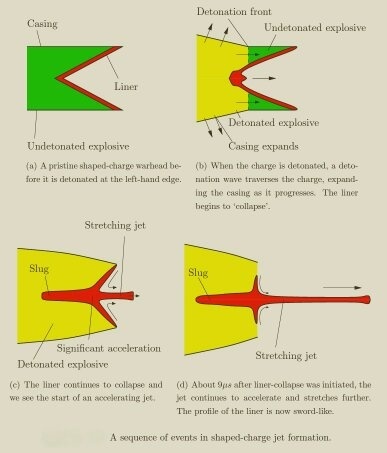
How a HEAT RPG charge works: “There is a trumpet-shaped liner in this section inside an aerodynamic fairing. And behind that is a copper cone, and underneath that is the RDX explosive charge. When that detonates, it fires what’s effectively an enormously powerful bolt of kinetic energy forward. That’s what’s called the Munroe effect, and it will penetrate up to 260mm of rolled homogeneous armor.”
The Russians were thought to have lost over 100 tanks in Grozny during the first Chechan War.
Seven of eight U.S. helicopters brought down in Afghanistan were from RPG fire.
Four Black Hawk helicopters taken down in Mogadishu were taken down by RPG fire.
Methods evolved to combat RPGs include explosive reactive armor, improvised outer armor, and slat armor.
“Can an RPG 7 round penetrate the composite frontal armor of the modern main battle tank? No, it can’t. But it was never intended to.” But the more modern RPG-29 can.
I’ve posted a lot of videos to help people understand the war in Ukraine. This is another one, though I’m not sure much understanding will ensue, as the tactics of both sides seem strange for those familiar with modern western combined arms combat.
It’s an interesting video because so much about it doesn’t make sense. (I believe it’s the one a commenter mentioned.) It shows a Ukrainian tank clearing a trench of Russian soldiers near a village with the mouthful name of Verkhn’okam’yans’ke (near Severodonetsk).
The video starts with two Ukrainian tanks advancing on a trench, one following the other’s tread tracks. (That part makes sense, as a way to pass through a minefield.) After that, a whole lot of the video seems very strange.
It’s a stark reminder, yet again, that the map is not the territory. We see the front lines on various map sites like Deep State, but the Russo-Ukrainian War is taking place across vast areas, some of which are quite thinly populated with troops. This tiny skirmish is probably more indicative of average troop density across the entire front line than dense urban areas like Bakhmut.
Save a trailing BMP and the hovering drone recording the footage, there’s no sign of Ukraine conducting any sort of combined arms operation for the trench clearing. (Though there are some artillery strikes in the background.)
In an age of automatic range finders and fire control computers, it’s something of a surprise to see both sides struggle to find their proper range, misses from each at about 3:45 in.
The tank continues to fire it’s main gun as it approaches, but doesn’t seem to use it’s secondary machine gun for supressing fire.
For those used to the mechanized maneuver warfare on display in Iraq, the approach the tank takes to the trench seems unusually slow and methodical.
Not sure what the tank is firing at 7 minutes in. Maybe part of the trench?
The same lack of combined arms is evident on the Russian side as well. Where are their own tanks? Their artillery support? Air support? Their own anti-tank weapons beyond that initial miss? None are in evidence.
In fact, nothing the Russians do as a tank approaches and blows up large chunks of their trench makes sense. They don’t run. They don’t use any anti-tank weapons. Maybe “vodka” is the reason they seem incapable of taking action.
They don’t retreat and flee, they only huddle further back in the same trench the tank has been methodically blowing up.
At around 10:07, one of them throws a grenade, which is not only a futile gesture on a tank, but the grenade isn’t even tossed in the right direction, but simply off to the side, like he was too scared to even look at the tank.
By the end of the video, I’m pretty sure every Russian in those trenches were goners.
As I was finishing this up, the Daily Mail put up a follow-up video. In that one the tank drove over the trench, just to make sure everyone there was dead…
“AK Guy” Brandon just dropped the fourth installment of his “Weird Guns Being Used in Ukraine Right Now” on YouTube, showing some of the funky, modified, and just plain ancient weapons be used in active combat there. The first installment is age limited and non-embeddable, but the other three are below.
Highlights:
Both sides are using he original Maxim belt-fed machine guns, a World War I mainstay “patented in 1883. Timeline-wise this weapon was designed closer to the beginning of the American revolution in 1776 than it was to the current Ukrainian conflict.”
PKM machine guns taken off armored vehicles and converted for individual use. Which is more difficult than it sounds, since the firing mechanism is triggered by an electric solenoid. “They had to rig up an entirely new firing system to rig up to these things, and quickly, and frankly I’m impressed. Ghetto gunsmith to ghetto gunsmith, crisp internet high five.”
Chechen soldiers (assuming there are any of them still around) are better equipped than Russian soldiers.
“You’re seeing all sorts of modern munitions, anti-armor stuff, aircraft drones. But then in the exact same confrontation, you’re also having guys that are carrying around weapons that are so old that their great grandfathers could have easily carried in the Great War to end all wars. And while the reality of war is obviously very tragic, the significance of some of the stuff being used in the field is extremely interesting.”
Highlights:
“Modified mortar RPG rounds…in guerrilla warfare, it’s always useful to have a couple of rednecks around.”
That ridiculous “six antipersonnel grenades attached to an RPG” thing.
“Some poor Ivan got handed a squirrel killer (a Chinese QB-57 single shot air rifle) and was thrown into the middle of 21st century combat with drones and tanks and was told good luck, have fun. It’s no wonder a lot of young Russian men are leaving the country rather than being conscripted…nothing says the government cares about your well-being quite like being tossed into fucking combat with a Red Ryder from A Christmas Story.”
Russia is also using World War II era DPM or DP-28 Degtyarev machine guns. “It’s basically like a PKM, if a PKM wasn’t belt fed and was instead fed by a pizza dish. It’s the closest thing to a full dinner plate most Soviets ever got to see.”
Other World War II era machine guns seeing combat: MP40s, Sturmgewehr (STG) 44s and MG 42s.
“There’s a lot of Russians now rolling around with
[American Thompson] .45 ACP submachine gun, AKA of course the Tommy Gun.” A legacy of Lend-Lease.
Plus: Anti-tank rifles! Including a PTRS-51 chamber in 14.5mm. “I guarantee you that shit will buttfuck the engine of any vehicle ever, as well as probably penetrate some of the light armor on some of the lightly armored armored personnel carriers.”
A suppressed Barrett M107, which is every bit as monstrously long (and no doubt heavy) as you would suspect.
Ukraine is also using everyone’s favorite space-alien looking FPS gun, the FN FS-2000.
Lots of ghetto gunsmithing.
A really funky glider with an RPG-7 on top. It actually looks slightly funkier than the flying yeet of death. Which comes next in the video.
Russians using old-fashioned sporting break action shotguns against drones.
More Maxims, including in duel, triple, and quad mounts. “We’re starting to get in the territory of like those mech things from Matrix Revolutions. [Now] we have something that is basically just a ghetto-rigged Minigun.”
If you’re interested in vintage, weird and improvised weapons, all the videos are worth taking a look at.
A couple of weeks ago, I posted a piece on how Russia was pulling ancient T-55s out of storage to send to Ukraine. In the interest of balance and fairness (to my readers, not to Russia), here’s a video on how Ukraine fielding their own upgraded T-55s.
“Ukraine has also had to look to the past, the distant past, for compatible tanks. The Ukrainians are fielding, since last autumn, a design of tank dating from over 70 years ago, the venerable T-55.”
“The 28 vehicles that the Ukrainians brought into service last autumn are a radically improved version of this model of tank called the M-55S obtained from Slovenia.”
“Taking standard T-55s into battle in 2023 would not be advisable. The 40-ton tank has a semi-stabilized 100mm d10 gun, a 500 horsepower diesel engine, and steel armor of a maximum thickness of just 200mm, meaning even old RPGs can knock them out. The gun site requires a semi-infrared spotlight that betrays the tank’s position, instant death on the modern battlefield.”
“The type also soldiers on in many armies around the world, particularly in the Third World, where T-55s saw action recently in the 2014-20 Libyan Civil War, the Yemeni Civil War from 2015 to present…and the Tigray War in Ethiopia, which ended last year.”
“Via Israel, [Slovenia] was able to heavily modernize its existing T-55s into something that is still fairly capable in 2023.”
“The old Soviet gun was replaced with the British Royal Ordnance L7 105mm rifled gun…Although the L7 is getting on in years it is still highly effective, and plenty of ammunition abounds for them.”
The tanks also received new fire control systems, incorporating a laser rangefinder and second generation night vision, a digital ballistic computer, new rubber metal tracks, an upgraded diesel engine increasing horsepower from 500 to 800, giving a maximum speed of 50 kph, and of course the tank is covered in reactive armor bricks, changing the entire look of the old tank and drastically increasing its ability to survive on the modern battlefield.
Even without knowing exactly what upgrades Russia is performing on its own T-55s, I feel safe in assuming that Israeli tech > Russian tech.
“No one is sensibly suggesting that the upgraded T-55s could deal with modern tanks deployed by Russia, but they will be lethal against all other non-tank armored vehicles the Russians deploy. And of course they can also fire high explosive rounds, which would be excellent support for Ukrainian infantry.”
As the plucky underdog in the fight, it’s no surprise that Ukraine is fielding older, upgraded tank designs as a stopgap (or supplement) until more modern western tanks can be fielded. The surprise is that Russia, with it’s reputed 12,500 or so tanks when the conflict began, having to resort to pulling out T-55s to send to Ukraine. So much of Russia’s equipment has been so poorly maintained that it’s difficult to tell how much might remain operational. And day by day, poor Russian tactic and Ukrainian precision weapons continue to whittle that number down…
In all the other various weapons being shipped to Ukraine to fight off Russia’s illegal war of territorial aggression, I missed that the U.S. has shipped 18 M109A6 Paladins.
The United States has announced a new military aid package for Ukraine, which includes the provision of 18 M109A6 Paladin 155mm tracked self-propelled howitzers.
The M109A6 Paladin is a modern version of an older unit that has been used in various conflicts worldwide, including Iraq and Afghanistan. Its 155mm gun has a maximum firing range of 14.9 miles (24 kilometers) with standard artillery ammunition and 18.6 miles (30 kilometers) with assisted rounds. This range makes it a valuable asset for the Ukrainian army, allowing them to strike enemy positions from a safe distance.
One notable feature of the M109A6 Paladin is its ability to fire M982 Excalibur extended-range precision guided projectiles. These projectiles have a range of up to 40 kilometers and are capable of hitting targets with a high degree of accuracy. This capability can be particularly useful when targeting enemy artillery positions or other high-value targets.
The M109A6 Paladin is also equipped with a secondary armament consisting of a roof-mounted 12.7 mm heavy machine gun. Some vehicles were fitted with a 40 mm automatic grenade launcher in place of the machine gun. This additional firepower can be used to defend the howitzer against enemy infantry or light armored vehicles.
To support the M109A6 Paladin, the US is also providing the Ukrainian army with the M992 ammunition supply vehicle. This vehicle can carry up to 93 rounds of ammunition and transfer them to the self-propelled howitzer via conveyor. This ensures that the howitzer has a steady supply of ammunition and can continue firing for extended periods without needing to reposition or resupply.
These are not the first M109s sent to Ukraine, as they’ve already received older variants from Italy, Norway, Latvia and the UK. Plus the Polish Krab, the French CAESAR, the UK AS-90, and the German PzH 2000, all of which are self-propelled 155mm howitzers. Plus Sweden has announced they’re sending their Archer system.
Russia doesn’t lack self-propelled artillery of its own, but last I checked they hadn’t fielded any smart artillery shells, and when (or if) they do, I would bet good money they won’t be nearly as capable as Excalibur.