I’ve been looking for a meaningful hook to talk about the Texas Attorney General race since Republican U.S. Congressman Louie Gohmert officially joined. Gohmert’s entry was a bit more puzzling than the others. Paxton is the incumbent, George P. Bush is attempting to move up from Land Commissioner, and Eva Guzman is attempting to move up from the Supreme Court. But from U.S. Congressman to Texas Attorney General is not a clear-cut move up. And I don’t particularly like his chances.
In just over a month, [incumbent Ken] Paxton will face the most significant primary challenge in his career with three other widely-known candidates in Texas politics: Land Commissioner George P. Bush, former Texas Supreme Court Justice Eva Guzman, and Congressman Louie Gohmert (R-TX-01).
The first financial reports to be released since the list of candidates were finalized for the ballot corroborate the viability of each of the candidates, as all raised over a million dollars in the period between July 1, 2021 and December 31, 2021 — more than any of the Democrats vying for the nomination.
Having been in the position for nearly two full terms, Paxton’s war chest is still the largest out of any candidate with $7.5 million cash-on-hand.
Becoming available a day past the due date, Paxton’s finance report showed that he raised $2.8 million and spent $2.1 million.
Over half of his expenditures — $1.3 million — was spent on direct mail. Of note, another $153,000 was spent on “campaign advertising services” and $130,000 was listed for “legal fees.”
Citing contributions from “ more than 5,000 grassroots conservative donors” with about half giving to Paxton for the first time, his campaign stated, “With these dominant fundraising numbers and the groundswell of grassroots support behind him, it’s clear Ken Paxton’s campaign has both tremendous enthusiasm and financial advantages over his challengers in the primary.”
“As the stakes get even higher moving forward, there is no question that Ken Paxton is the only candidate positioned to defeat the radical left’s candidate in November,” said Paxton’s campaign in a press release.
Though Paxton’s war chest is the largest, the candidate to receive the most contributions for the period was Guzman.
Backed by the powerful Texans for Lawsuit Reform (TLR) PAC, Guzman reported a haul of $3.7 million.
The majority of her contributions came from a handful of wealthy donors.
TLR PAC topped the list of contributors to Guzman’s campaign with a total of $626,000 listed. Richard Weekley, the chairman of the board of directors for TLR, contributed another $500,000, and another board member, Alan Hassenflu, contributed $250,000.
Guzman also reported receiving $500,000 from Harlan Crow, $500,000 from Robert Rowling, and $250,000 from Jan Duncan.
Advertising accounted for a large portion of the $2.6 million Guzman reported spending, with $1.2 million on media buys, a combined $555,000 on printing and postage for direct mail, and another $269,000 listed for political advertising.
Bush, who was the first challenger to jump in the race, reported raising $1.9 million, bringing him to a total of $3.2 million cash-on-hand at the beginning of January, the second-largest war chest behind Paxton.
“We have a good number of cash-on-hand, but the real factor in this campaign that’s different is the ‘Texas First Tour’ that we’re putting together,” Bush told The Texan at a meet-and-greet in Round Rock.
“We’ve got about 20 events lined up over the course of the next three weeks leading up to early voting, and then we have two weeks of early voting,” said Bush.
The focus on a more event-oriented ground game was reflected in Bush’s campaign expenditures as well. While $132,000 was categorized for consulting expenses and $154,000 was for advertising, $635,000 of the $1.8 million total expenditures went toward salaries for campaign employees and contractors.
Gohmert, the last candidate to enter the race who joined partway through the candidate filing period in November, also put more expenditures toward grassroots campaigning.
The East Texas congressman spent far less than the other candidates with only $126,000 in total expenditures. Of that, over half — $65,000 — was listed for the “purchase of campaign vehicle,” and another $32,000 was used for “yard signs/stakes.”
Gohmert’s total fundraising haul for the period tallied to slightly above $1 million, his target goal when he announced he was considering a bid for the position.
But the finance report I want to hone in on is not Gohmert’s, but Bush’s.
Going after an entrenched incumbent, this is the first race Bush has run where he’s a financial underdog. $3.2 million is only slightly more than the $2.8 million he raised at this point in his 2014 Land Commissioner run, where “his two main challengers, a Republican and a Democrat” had raised “a combined total of around $20,000.” To be running behind both Paxton and Guzman in the money derby in a higher profile race seems to be a setback for the candidate who garnered more votes than Greg Abbott in the 2014 general election. (In 2018, he ran some 220,000 votes behind Abbott.)
Conventional wisdom is that Paxton is vulnerable due to his pending state security fraud charges, but those charges have been pending for over six years despite the federal charges having been dismissed, and didn’t keep him from winning the general by almost 300,000 votes in The Year of Beto. These lengthy delays suggest that the case is all smoke and no fire, and that the case is more useful for Democratic county DAs as a club against Paxton than actually trying the case, and the indictment will probably run into Sixth Amendment issues if it hasn’t already.
But back to Bush. Back in 2014, there seemed to be an unspoken assumption among establishment types that George P. Bush was some sort of golden boy of Texas politics, destined for the Governor’s mansion at some point based on his last name, in much the same way that his father Jeb was seen as the likely 2016 GOP Presidential nominee. Well Jeb!’s campaign came a cropper, and Bush seems considerably less golden these days. The Bush dynasty’s one persistent advantage, their reputation of fundraising prowess, doesn’t seem to be working well enough thus far for George P.’s uphill charge against an entrenched incumbent.
Conservative activists have always been cool to Bush: The Third Generation, but were willing to give him a chance as Land Commissioner because, frankly, he was on the ballot. After the Alamo redesign controversy, the bloom was definitely off the Bush as far as conservative activists are concerned. But in a four-way race, Bush is at risk of missing the runoff, with Eva Guzman drawing a lot of the same moderate/business/Hispanic Republican support base that Bush needs. By contrast, Paxton’s record for being a strong advocate for conservative principles (and filing lawsuits against the Biden Administration) has a lot of activists still standing behind him.
Bush could still get into a runoff with Paxton, but right now it’s no sure thing.
Over the past year, DeSantis has emerged as one of the most articulate political spokesmen for the anti–critical race theory movement. His new policy agenda builds on successful anti-CRT legislation in other states but goes two steps further. First, it provides parents with a “private right of action,” which allows them to sue offending institutions for violations, gain information through legal discovery, and, if they win in the courts, collect attorney’s fees. Second, it tackles critical race theory in corporate “diversity, equity, and inclusion” training programs, which, DeSantis says, sometimes promote racial stereotyping, scapegoating, and harassment, in violation of state civil rights laws.
At heart, the battle against critical race theory is a fight against entrenched bureaucracies that have used public institutions to promote their own racialist ideology. “This is an elite-driven phenomenon being driven by bureaucratic elites, elites in universities, and elites in corporate America, and they’re trying to shove it down the throats of the American people,” DeSantis said. “You’re not doing that in the state of Florida.”
Following his speech, DeSantis invited me to address the crowd. I explained that the reason critical race theory has upset so many Americans is that it speaks to two deep reservoirs of human sentiment: citizens’ desire for self-government and parents’ desire to shape the moral and educational development of their children. Elite institutions have attempted to step between parent and child.
DeSantis has deftly positioned himself as a protector of middle-American families. One of the guest speakers, Lacaysha Howell, a biracial mother from Sarasota, said that left-wing teachers tried to persuade her daughter that the white side of their family was oppressive. Another speaker, Eulalia Jimenez, a Cuban-American mother from the Miami area, said that left-wing indoctrination in schools reminded her of her father’s warnings about Communism in his native Cuba. Both believed that critical race theory was poison to the American Dream.
As they begin their next session in January, Florida legislators have the opportunity to craft the gold standard for “culture war” policy. The governor’s team has worked with a range of interested parties, including the Manhattan Institute, which has crafted model language for prohibiting racialist indoctrination and providing curriculum transparency to parents. The battle is ultimately about shaping public policy in accord with public values. “I think we have an ability [to] just draw a line in the sand and say, ‘That’s not the type of society that we want here in the state of Florida,’” said DeSantis yesterday. The stakes are high—and all eyes are on Florida to deliver.
How the Democratic Media Complex managed to destroy what was left in the public’s trust in it:
That episode single-handedly destroyed trust in public health officials, proving they'd politicize their expertise when convenient.
Corporate media celebrated a douchebag-lawyer shaming families at deserted beaches, then — overnight! — cheered densely packed street protests. pic.twitter.com/DvOzIr5JX8
As usual, elite institutions — media, government, public health authorities — love to whine about the refusal of the public to trust their pronouncements, complaining people turn to other less credentialed and worthy sources.
Earlier this month, a federal grand jury in Houston indicted four men on charges of conspiracy, wire fraud, and money laundering in a scheme to rip off the Paycheck Protection Program (PPP) by submitting over 80 false applications for forgivable loans and writing checks to relatives and fictional employees, among other fraudulent activities.
The United States Department of Justice (DOJ) stated in a press release on December 15 that 29-year-old Hamza Abbas of Richmond, 55-year-old Khalid Abbas of Richmond, 55-year-old Abdul Fatani of Richmond, and 53-year-old Syed Ali of Sugar Land could be sentenced to up to 20 years on each count of wire fraud.
The indictments against them are the most recent in an apparent scheme that prosecutors say involved 15 defendants from Texas and Illinois, all of whom are accused of wire fraud and conspiracy to commit wire fraud.
The DOJ stated that Khalid Abbas, Fatani, Ali, and another defendant, Houston resident Amir Aqeel, 53, have been charged with money laundering in the superseding indictment. The money laundering counts carry potential sentences of up to 10 years.
Last year, a grand jury also indicted Aqeel on a charge of aggravated identity theft. The government accuses Aqeel of using stolen identities to apply for the PPP loans.
According to the DOJ, several of the accused have already pleaded guilty for their involvement, including Siddiq Azeemuddin, 42, of Naperville, Illinois, Richard Reuth, 58, of Spring, and Raheel Malik, 41, of Sugar Land, all of whom entered their pleas in October. Houston residents Abdul Farahshah, 70, Jesus Perez, 31, and Bijan Rajabi, 68, pleaded guilty in late November.
Rifat Bajwa, 53, of Richmond, Pardeep Basra, 52, of Houston, Mayer Misak, 41, of Cypress, and Mauricio Navia, 42, of Katy were also indicted last year on charges of participating in the conspiracy and committing wire fraud.
Why, it’s almost like just about all the defendants share some characteristic in common. If only I could put my finger on it…
Speaking of criminals, did mentioned that a second CNN employee was being investigated for child sex allegations? “The allegations against Rick Saleeby, a former senior producer for Jake Tapper’s “The Lead,” appear to be connected to reporting by Project Veritas. Saleeby resigned from CNN this month.” It’s hard to keep the media pedophiles straight without a scorecard…
The City of Austin’s director of the Office of Police Oversight (OPO), Farah Muscadin, abused her authority, a third-party arbitrator decided this week.
In a 31-page decision, Lynn Gomez, the arbitrator, ruled that Muscadin and the OPO violated Article 16 of the Austin Police Department’s employment contract that was negotiated in 2018. Article 16 governs the parameters of civilian oversight of the department, which progressive groups lobbied hard for during the labor standoff.
“Contrary to the city’s claim, Director Muscadin was not acting within the scope of her authority…[she] clearly was seeking to dictate some future outcome rather than simply making a recommendation as Art. 16 permits,” Gomez ruled.
“[T]he evidence and arguments raise[d] by the city indicate that the city does not consider itself or OPO bound by Article 16’s provisions.”
Has the Biden Amdenistration tipped its hand that considers Taiwan too strategically important to not defend it in the case of a Chinese attack?
Ely Ratner, assistant secretary of defence for Indo-Pacific security affairs, told a Senate hearing three weeks ago that Taiwan was “critical to the region’s security and critical to the defence of vital US interests”. In words strikingly similar to MacArthur’s, he emphasised the island’s location “at a critical node within the first island chain, anchoring a network of US allies and partners”.
This may well be remembered as the moment Washington came clean on its intentions regarding Taiwan. In Beijing at least, the statement is being read as dropping all pretence that the US could acquiesce to a unification of Taiwan with China.
Wu Xinbo, director of the Center for American Studies at Fudan University in China, believes that US strategic thinking regarding Taiwan has always followed the lines laid out by MacArthur.
Even after establishing diplomatic relations with China, the US “worked to ensure the continuation of a state of separation across the Taiwan Strait”, Wu said. “When we ask the US if they do not hope to see the unification of China, they deny that. But judging from the US’s concrete actions, it is clear that they indeed do not hope to see China unify. Ely Ratner has now said this out loud.”
In Washington, too, some observers think the testimony allows little conclusion other than that the US should not allow Taiwan to become part of China under any circumstances.
Hopefully true, but betting on Joe Biden’s stalwart fortitude is putting your hopes on an extremely weak horse…
Alexandria Ocasio Cortez spotted in Miami Beach while New York City Flu Manchu cases hit alltime highs. As always, Covid Theater rules are for the little people.
I really should have bought this for Dwight for Christmas.
The Critical Drinker is not thrilled at the latest Matrix film:
Ultimately The Matrix Regenerations fails on just about every level possible. It fails to properly honor the past by leaving it well enough alone. It fails to tell a compelling new story, or add new ideas to the world it created. It fails to establish interesting new characters, or take old ones in a new direction. It fails to surpass the spectacle, energy and originality of a 20 year old film. And most of all it fails to deliver a compelling reason for its own existence. The Matrix Retaliations is a film that never should have been made in the first place.
Left-wing sponsors vs. right-wing sponsors:
This satirical video is based on an undeniable truth: the bulk of mainstream corporate and billionaire money resides in and supports liberal-left, not right-wing, media. As the Dem Party became the preferred vehicle of oligarchs, their largesse goes to those urging votes for it. https://t.co/UpuF2ZuGxr
Another mandate injunction, Democrats continue their popularity freefall, China seals more dirty deals, and Turkey melts down. It’s another Friday LinkSwarm!
A federal judge in Texas has issued a preliminary injunction, stopping a new rule from the Biden administration requiring healthcare workers to receive the COVID vaccine as the case moves through the courts.
The injunction came from the U.S. District Court for the Northern District of Texas in Amarillo. The case was filed by Attorney General Ken Paxton on behalf of the State of Texas against Xavier Becerra, the U.S. Department of Health and Human Services secretary.
The injunction was sought against a federal rule that would have required employers that receive Medicaid and Medicare funds—namely hospitals and other healthcare providers—to require their employees to receive a COVID vaccine as a condition of employment.
Judge Matthew Kacsmaryk ordered that the federal government provide notice to all Medicaid and Medicare providers in Texas that the mandate “will not be implemented or enforced.”
“Healthcare facilities covered by the [Centers for Medicaid and Medicare Services] Mandate have a tremendous reliance interest in Medicare and Medicaid funds. Therefore, Defendants unconstitutionally use Congress’s spending powers to ‘commandeer a State’s . . . administrative apparatus for federal purposes’ by conditioning Medicare and Medicaid funds on state surveyor compliance with the mandate,” wrote Kacsmaryk. “As a result, not only would the CMS Mandate prohibit Plaintiffs from enforcing its duly enacted COVID-19 vaccination regulations, but it would likely force Plaintiffs to administer a federal mandate that has a dubious statutory basis.”
“It is a ‘gun to the head’ and an unconstitutional use of Congress’s spending powers to compel Plaintiffs through ‘financial inducement’ to forgo exercising their police powers to enforce a federal statute.”
Democrat support from independent voters has fallen near the crucial 40% line, while almost half of all independent voters tell Gallup that they’re leaning Republican.
“If you’re a Democrat and you’re not terrified,” says The Dispatch’s Avi Woolf, “you should be.”
Well, I’m neither a Democrat nor terrified, but I am conservative and — at least for now — quite giddy.
Gallup recently updated its long-term party affiliation poll, which asks American voters one or two simple questions:
In politics, as of today, do you consider yourself a Republican, a Democrat or an independent?
(If they ID as independents) As of today, do you lean more to the Democratic Party or the Republican Party?
Currently, 31% say they’re Republicans, up slightly from the usual mid-20s to 30%. 41% told Gallup that they’re independent voters, in line with the average swing. Only 27% self-ID as Democrats, which is down from the more typical 29-32%.
As recently as May, Democrats were at 32% and the GOP at a dismal 25%.
But that’s before Presidentish Joe Biden had had a chance to do much other than send out FREE! MONEY! (handouts that helped cause our present inflation) and smile for the glowing press coverage. Since then, important parts of his agenda have taken hold and the malign incompetence of his cabinet has been fully revealed.
Apparently, Americans don’t think much of either.
But it’s the second question that should have Washington Democrats changing their shorts.
Indies, asked whether they lean towards the Democrats or the GOP, broke for the GOP 47% to 41%.
At this time in Barack Obama’s first term, the breakdown was a much more Dem-friendly 25R/41I/32D. And the Indy swing was exactly reversed, 41R/47D.
Yet the Democrats still lost a whopping 63 seats in the House and seven more in the Senate in the following midterm election.
Obama enjoyed immensely more personal popularity than Biden does — I know, I don’t get it, either — but couldn’t stop a GOP tsunami when his agenda proved unpopular.
Biden has both an unpopular agenda and a high unfavorable rating draped around his neck like a lead life preserver. And now voters are leaving his party in droves.
The woke are coming for all that sweet, sweet Medicare money.
Buried in the Department of Health and Human Services’s fiscal planning for next year is a proposal to establish bonuses for physicians who “create and implement an anti-racism plan.”
“The plan should include a clinic-wide review of existing tools and policies, such as value statements or clinical practice guidelines, to ensure that they include and are aligned with a commitment to anti-racism and an understanding of race as a political and social construct, not a physiological one,” the HHS writes . “The plan should also identify ways in which issues and gaps identified in the review can be addressed and should include target goals and milestones for addressing prioritized issues and gaps. This may also include an assessment and drafting of an organization’s plan to prevent and address racism and/or improve language access and accessibility to ensure services are accessible and understandable for those seeking care.”
I’m sure this will go over great with Medicare patients. “Mam, I can’t check on your osteoporosis until you check your privilege!” (Hat tip: Mickey Kaus.)
After Democrats abandoned trying to pass Biden’s giant leftwing “Build Back Better” porkfest this year, is the bill actually dead forever? South Carolina Republican Senator Lindsey Graham thinks so.
The South Carolina Republican said that the Congressional Budget Office score, which found the $1.75 trillion bill would add $3 trillion to the deficit, is what led to its demise.
‘I think Build Back Better is dead forever and let me tell you why: Because Joe Manchin has said he’s not going to vote for a bill that will add to the deficit,’ he said on Fox News’ Hannity Wednesday night.
‘Well, if you do away with the budget gimmicks, Build Back Better, according to the CBO [Congressional Budget Office] adds $3 trillion to the deficit.’
‘This is b******t. You’re b******t,’ the West Virginia senator yelled at Arthur Delaney, a reporter for HuffPost Politics, who asked him about reports that the child tax credit has become a major sticking point in his talks with the White House.
‘I’m done, I’m done,’ Manchin fumed as the questions continued.
‘Guys, I’m not negotiating with any of you all. You can ask all the questions you want. Guys, let me go,’ he told the press as he walked through the basement of the Capitol, muttering ‘God almighty’ as he walked away.
What is behind recent pessimistic appraisals of democracy’s future, from Hillary Clinton, Adam Schiff, Brian Williams, and other elite intellectuals, media personalities, and politicians on the left? Some are warning about its possible erosion in 2024. Others predict democracy’s downturn as early 2022, with scary scenarios of “autocracy” and former President Donald Trump “coups.”
To answer that question, understand first what is not behind these shrill forecasts.
They are not worried about 2 million foreign nationals crashing the border in a single year, without vaccinations during a pandemic. Yet it seems insurrectionary for a government simply to nullify its own immigration laws.
They are not worried that some 800,000 foreign nationals, some residing illegally, will now vote in New York City elections.
They are not worried that there are formal efforts underway to dismantle the U.S. Constitution by junking the 233-year-old Electoral College or the preeminence of the states in establishing ballot laws in national elections.
They are not worried that we are witnessing an unprecedented left-wing effort to scrap the 180-year-old filibuster, the 150-year-old nine-person Supreme Court, and the 60-year tradition of 50 states, for naked political advantage.
They are not worried that the Senate this year put on trial an impeached ex-president and private citizen, without the chief justice in attendance, without a special prosecutor or witnesses, and without a formal commission report of presidential high crimes and misdemeanors.
They are not worried that the FBI, Justice Department, CIA, Hillary Clinton, and members of the Obama Administration systematically sought to use U.S. government agencies to sabotage a presidential campaign, transition, and presidency, via the use of a foreign national and ex-spy Christopher Steele and his coterie of discredited Russian sources.
They are not worried that the Pentagon suddenly has lost the majority support of the American people. Top current and retired officers have flagrantly violated the chain-of-command, the Uniform Code of Military Justice, and without data or evidence have announced a hunt in the ranks for anyone suspected of “white rage” or “white supremacy.”
They are not worried that in 2020, a record 64% of the electorate did not cast their ballots on Election Day.
Nor are they worried that the usual rejection rate in most states of non-Election Day ballots plunged—even as an unprecedented 101 million ballots were cast by mail or early voting.
And they are certainly not worried that partisan billionaires of Silicon Valley poured well over $400 million into selected precincts in swing states to “help” public agencies conduct the election.
What then is behind this new left-wing hysteria about the supposed looming end of democracy?
It is quite simple. The left expects to lose power over the next two years—both because of the way it gained and used it, and because of its radical, top-down agendas that never had any public support.
After gaining control of both houses of Congress and the presidency – with an obsequious media and the support of Wall Street, Silicon Valley, higher education, popular culture, entertainment and professional sports – the left has managed in just 11 months to alienate a majority of voters.
The nation has been wracked by unprecedented crime and nonenforcement of the borders. Leftist district attorneys either won’t indict criminals; they let them out of jails or both.
Illegal immigration and inflation are soaring. Deliberate cuts in gas and oil production helped spike fuel prices.
All this bad news is on top of the Afghanistan disaster, worsening racial relations, and an enfeebled president.
Democrats are running 10 points behind the Republicans in generic polls, with the midterms less than a year away.
President Joe Biden’s negatives run between 50% and 57%—in Trump’s own former underwater territory.
Less than a third of the country wants Biden to run for reelection. In many head-to-head polls, Trump now defeats Biden.
In other words, leftist elites are terrified that democracy will work too robustly.
After the Russian collusion hoax, two impeachments, the Hunter Biden laptop stories, the staged melodramas of the Kavanaugh hearings, the Jussie Smollett con, the Covington kids smear, and the Rittenhouse trial race frenzy, the people are not just worn out by leftist hysterias, but they also weary of how the left gains power and administers it.
Hey, remember all the way back to two weeks ago when I said that Turkey’s collapsing currency was something we should keep an eye on? Well, guess what? “Turkey Halts All Stock Trading As Currency Disintegrates, Central Bank Powerless To Halt Collapse.” ZeroHedge suggests that the collapse is engineered to disguise how much graft Recep Tayyip Erdogan and his cronies have stolen from the country.
The Chinese tech giant Huawei Technologies has long brushed off questions about its role in China’s state surveillance, saying it just sells general-purpose networking gear.
A review by The Washington Post of more than 100 Huawei PowerPoint presentations, many marked “confidential,” suggests that the company has had a broader role in tracking China’s populace than it has acknowledged.
These marketing presentations, posted to a public-facing Huawei website before the company removed them late last year, show Huawei pitching how its technologies can help government authorities identify individuals by voice, monitor political individuals of interest, manage ideological reeducation and labor schedules for prisoners, and help retailers track shoppers using facial recognition.
Citing both interviews and direct access to internal Apple documents about repeated visits by Cook to China in the mid-2010s, the report describes a $275 billion deal whereby Apple committed to investing heavily in technology infrastructure and training in the country.
The non-binding five-year deal was signed by Cook during a 2016 visit, and it was made partially to mitigate or prevent regulatory action by the Chinese government that would have had significant negative effects on Apple’s operations and business in the country.
The Information details the nature of the Chinese government priorities included in the 1,250-word deal:
They included a pledge to help Chinese manufacturers develop “the most advanced manufacturing technologies” and “support the training of high-quality Chinese talents.”
In addition, Apple promised to use more components from Chinese suppliers in its devices, sign deals with Chinese software firms, collaborate on technology with Chinese universities and directly invest in Chinese tech companies… Apple promised to invest “many billions of dollars more” than what the company was already spending annually in China. Some of that money would go toward building new retail stores, research and development centers and renewable energy projects, the agreement said.
“Disgrace: Biden abandoned over 60,000 Afghan interpreters, support personnel — along with 14,000 Americans.”
“Trump’s Social Media Platform Gets $1 Billion Investment Boost, Dems Get Nervous.” It will be interesting to see how quickly TRUTH Social can get off the ground.
In yesterday’s post, I forgot to link to these Log4J memes. Enjoy!
Why New York City lags the rest of the nation in unemployment. Thank lockdowns, shutdowns, and insane government. “The economy is not a light switch. The supply chain is not a light switch.” The money quote “New York City is just not that amazing!”
Popular Mexican singer Vincente Fernandez died, and the woke couldn’t wait to crap on his grave:
If you had to tell the story of why Hispanics are abandoning the Democrats in droves using a single image, it would look something like this.
Did you know that an Israeli airstrike hit a Syrian port last week? Did you see anything about that in the news? Seems like the sort of thing the media would cover before they decided that a bunch of lunatics shouting at J.K. Rowling is more important.
Texas House Speaker Dade Phalen attends fundraiser for quorum-busting Democrats in the Rio Grande Valley (including State Reps. Terry Canales, Sergio Munoz Jr., Oscar Longoria, Armando Martinez, and Bobby Guerra, and State Sen. Chuy Hinojosa) while skipping a Republican event a mile away. Remind me again why Phalen is speaker?
“Pasadena Mechanic Sues City Over Parking Space Regulation Prohibiting His Business from Operating.”
There’s nothing this Austin City Council can’t seem to ruin, including the Trail of Lights.
Speaking of science experiments: What happens when you hit a gong with a baseball traveling at Mach 1.5? And you know there’s super-slow motion involved…
Whoa:
A Hutchinson, KS business just West of the Airport destroyed during 80+ mph gusts around 4:30pm.#kswxpic.twitter.com/Yd6ul9EeBo
A few weeks ago there was Texas gubernatorial poll showing Beto O’Rourke running neck and neck with Greg Abbott. I took a deeper look to see how skewed the crosstabs were, but they don’t appear to have an actual numerical breakdown of Republican vs. Democratic voters. (The MSM loves oversampling Democrats for polls.)
Start at the top: The chairman is former Republican State Rep. Jason Villalba, who for a long time was a strong contender for “Least Conservative Republican in the House.” You may remember him from such hits as I Hate Photographers and Lawful Gun Owners and Lisa Luby Ryan Retired My Ass.
Regina Montoya was chairman of the board of the Mexican American Legal Defense & Educational Fund (MALDEF), a hard left Social justice group waging lawfare.
None of these people fill me with confidence. Some of those involved (former Rick Perry-appointed Secretary of State Hope Andrade, and Greg Abbott-appointed Secretary of State Carlos Cascos) appear to be more ostensibly Republican, but their personal political views are unclear.
Gates believes that climate change is a major threat to humanity, and has focused major Foundation attention and money to the issue. He wrote a book which is set for publication in 2021 about climate change. He supports Common Core education standards and opposed the Trump administration’s Mexico City Policy, which prohibits federal funds from supporting organizations that advocate for abortions.
Snip.
Gates also criticized the Trump administration’s withdrawal of money from the World Health Organization after the international organization used misleading Chinese government data about the COVID-19 pandemic. He and Melinda wrote in 2018 that they support same-sex relationships and self-described gender definitions. Gates has held meetings with President Donald Trump, including one in 2018 to urge the president to support greater U.S. foreign aid. He also discussed vaccines, innovation, education, and other issues with Trump in another meeting.
Gates is also supportive of the idea that Earth is overpopulated. He and Melinda responded in 2018 to the idea that by saving children’s lives in poor nations they are contributing to overpopulation. Gates’ father led a chapter of Planned Parenthood, and he has spoken well of the abortion group in addition to providing contraceptive and abortifacient funds to abortion groups internationally.
In February 2021, during an interview on “60 Minutes,” Gates told Anderson Cooper that the world should reduce its carbon emissions to zero, saying it would be “the most amazing thing mankind has ever done.” Just a month earlier, Gates joined a bidding war to buy the world’s largest private jet company, despite private jets being some of the world’s greatest carbon emitters.
More recently, Gates has been an outspoken Flu Manchu vaccine advocate. And, what do you know, two of THPF’s most recent press releases deal with vaccine policy polling.
Restoration and protection of plant and wildlife habitats
Public support for protecting environmental resources
Engagement of underrepresented populations in experiencing and protecting natural resources
Clean water and sound management strategies
Current and future climate change mitigation
In other words: Global warming, environmentalism and social justice. If I had to guess, the entire point of the Texas Hispanic Policy Foundation is using polling metrics to find better ways to sell Texas Hispanics on the sort of anti-conservative priorities favored by the Gates and Meadows foundations.
While the Texas Hispanic Policy Foundation claims to be “nonpartisan,” the funding behind it, and the people involved, don’t inspire a lot of confidence along those lines…
Celebrities (especially those as famous as McConnaughey) tend to be formidable candidates, but there was no guarantee he would even win a primary. His hetrodox views might prevent him from winning the Democratic primary over Robert Francis “Beto” O’Rourke, and a run against incumbent Greg Abbott (and his giant warchest) in the increasingly crowded Republican primary was no sure thing either.
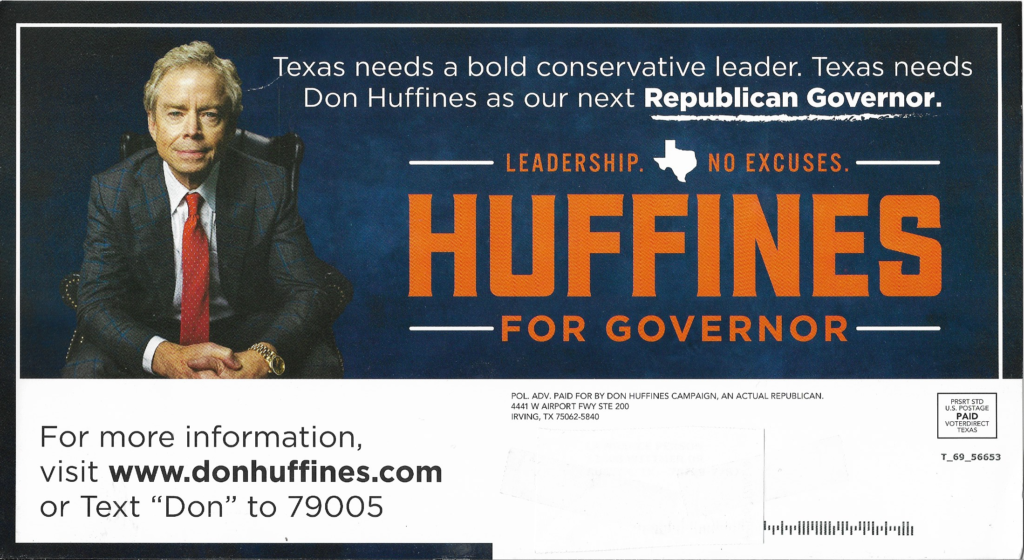
I recently received my first flyer in the race, from the Don Huffines campaign. As you can see from the scans below, the issues he’s emphasizing are controlling the border, ending property taxes and election integrity. Good as far as it goes, but he may have missed a bet by not supporting a special session for outlawing vaccine mandates.
Is it a bit early to be dropping direct mail flyers? A bit, but: A.) As a longshot challenger, Huffines has to raise his profile to have any chance at all, and direct mail probably offers a much bigger bag for the buck than broadcast media advertising. (There may be lots of online advertising as well, but I have so many online ads blocked that I almost never see them on my Mac.) And: B.) It’s not that early, as we’re roughly six months out from the May 1st primary date.
I haven’t received any campaign mailers from Team Abbott, but lord, have I received a lot of fundraising emails. Over 60 in November alone, some of which go out of their way to insult my intelligence. Like the one that claims to be from “Greg Abbott (iPhone).” Is there anyone stupid enough to believe that Abbott is personally emailing fundraising solicitations from his personal iPhone? Also annoying: “Your Order Confirmation” and “YOUR EXCLUSIVE OFFER.” Just stop…
It’s always intriguing when a well-known figure whom everyone understands has no chance of winning decides to run for office.
I doubt even Beto’s under illusions about his chances. He’ll be running in a red state facing a massive red midterm wave against a Republican who’s more popular than the one he ran against in 2018 and who’s raised more money than any governor in U.S. history. Why bother?
Some blather about the “hardness” of Abbott’s stand on vaccine mandates snipped, as Texas conservative activists have been all over Abbott for refusing to call a fourth special session to outlaw vaccine mandates by statute, not just decree.
A poll published last week found him rocking a 27/57 approval rating among independents in Texas. If the 2022 midterm environment was as favorable to Democrats as 2018 was, I’d give them an outside chance of pulling an upset.
More erroneous analysis snipped.
But 2022 isn’t 2018. And a candidate as far left as Beto O’Rourke isn’t the man to dethrone a longtime governor.
Team Abbott posted this ad featuring some of Beto’s greatest hits a few weeks ago. They’re going to attack him as too liberal for Texas, which he is:
O’Rourke’s defining issues when he ran for president two years ago were liberalizing America’s border and grabbing guns. Given the crush of migrants seeking asylum that the U.S. has seen this year, though, open borders is an especially toxic position to hold in Texas of all places. And gun-control is a perennial loser in a state with as robust a gun culture as Texas had. You would think today’s announcement would be an occasion for O’Rourke to say he’s rethought his previous positions on firearms. Instead, incredibly, he’s doubling down:
Abbott has already been campaigning against O’Rourke as too liberal for Texas, branding him “Wrong Way O’Rourke” and seizing on multiple positions he has taken since last running statewide. At the top of the list is O’Rourke’s proposal to require buybacks of assault weapons during his presidential campaign. That led to a memorable moment on the debate stage in which O’Rourke proclaimed that, “Hell yes, we’re going to take your AR-15, your AK-47.”
O’Rourke said he was not backing away from that proposal in his latest campaign.
“I think most Texans can agree — maybe all Texans can agree — that we should not see our friends, our family members, our neighbors, shot up with weapons that were originally designed for use on a battlefield,” said O’Rourke, whose hometown of El Paso was the site of an anti-Latino mass shooting in 2019 by a gunman who killed 23 people.
His progressive views during his 2020 presidential run appear to have stuck to him in Texas as he’s polled poorly there over the past few months. Last month a UT survey found his favorable rating at 35/50, including 22/48 among indies. O’Rourke trailed Abbott 46/37 in that same poll, a pitiful showing against a governor whose popularity had waned lately. Another poll taken a month earlier also put O’Rourke at 37 percent against Abbott. A third recent survey from Quinnipiac had a mere 33 percent willing to say they thought Beto would make a good governor.
I’ll give you a few possibilities. One, simply, is time. If O’Rourke had waited to challenge Ted Cruz for Senate again in 2024, he would have risked being perceived as old news, especially having failed in his two previous statewide runs. The 2024 Senate primary could be a competitive one for Democrats, with no guarantee of Beto winning. This year’s primary is easier for him since no one else wants to to face Abbott in a Republican-friendly cycle. Simply put, his political capital was depreciating. He could either use what was left of it for one more campaign or go bankrupt.
Two is fundraising. I’m skeptical that we’ll see the return of the “Betomania” money juggernaut in full force in Texas but it probably remains true that O’Rourke can raise cash more easily than the average Dem, if only by dint of name recognition. He’ll be at less of a money disadvantage against Abbott than any other prospective nominee would be. Of course, if Betomania does run wild among Democratic donors nationally, that’ll backfire on the party by drawing cash into Texas in a likely losing effort that could have gone to more competitive races elsewhere. Double-edged sword for Dems.
Three is enthusiasm. Between Biden’s troubles and the likelihood of a red wave, Democrats will have a hard time getting Texas liberals excited to vote in 2022. Having a charismatic well-known liberal at the top of the ticket who captivated them once before might boost turnout at the margins. And while that won’t be enough to make Beto governor, it might help Dems win a few state races downballot that they otherwise would have lost. His candidacy is a favor to the state party, in other words. He might even be able to steer some Latino voters who defected to Trump and the GOP last year back into the Democratic column.
Realistically, the best-case scenario for O’Rourke is that he raises a ton of money again, loses by a respectable margin, and is then targeted by Biden for some sort of national job either in the cabinet or at the DNC. Beto’s long-term challenge is staying politically relevant and another run for office advances the ball — albeit at the risk that he’s well and truly done politically if he gets blown out.
Actually, O’Rourke is already starting to tack right on border security, saying that Biden hasn’t done enough to secure the border.
O’Rourke has some Democratic Primary competitors (Larry Baggett, Michael Cooper, and Deirdre Dickson-Gilbert), but I can’t even find working websites for the first two.
Likewise, Chad Prather‘s campaign has been essentially invisible, and Allen West‘s all but invisible.
There’s also someone named Danny Harrison, who seems to be running on a “legalized gambling and weed” platform, an interesting choice for the Republican primary. Harrison actually has a bit of polish, so the guy is punching above his weight class (Gadfly). Like Prather, I get the impression he could actually make some noise in a lower-level race (State Rep., County Commissioner, etc.).
We touched on this last month: For a long time, Democrats have boasted that immigration (legal and otherwise) would make them the “natural majority party” in short order. Well, looking at the results from the 2020 and 2021 elections, there’s a lot of evidence to the contrary.
For years, progressives have prophesied that a more culturally diverse America would be a more Democratic America, with a grand coalition of African-Americans, Latinos, Asians, and Native Americans teaming up with liberal whites to put the Republican Party on a path to extinction. If anyone could have summoned this coalition into being, through opposition, it was Donald Trump, the president who made hardline stances on issues like immigration a cornerstone of his politics. Yet Trump actually increased his share of the minority vote in 2020. One exit poll suggested that he had received the highest share of the black vote of any Republican over the past 20 years. The GOP expanded its support among Hispanics, too, to its highest level since 2004.
Digging deep into neighborhood-level results, the New York Times unearthed some surprises. “Across the United States, many areas with large populations of Latinos and residents of Asian descent, including ones with the highest numbers of immigrants, had something in common this election: a surge in turnout and a shift to the right,” the paper noted. Much of this movement toward Trump occurred in heavily Hispanic communities in South Texas, many bordering Mexico. The liberal Democratic theory that a less-white America will be bluer politically appears less and less plausible. In fact, Joe Biden may owe his 2020 victory to shifts in the white vote.
This presents both an opportunity and a challenge for the Republican Party and conservatives more broadly. The 2020 election results suggest that they can find support among some immigrant communities, but the GOP is also home to America’s immigration skeptics, who worry that progressives have judged the situation correctly—that as America grows more diverse, it will also become more socially and culturally liberal. But if the progressive narrative about immigrants and their political allegiance is flawed, then so, too, is the electoral basis for conservative skepticism about immigration.
In 1996, California had one of the most contentious ballot-initiative fights in its history. Proposition 209 gave voters the choice to end the state’s system of racial preferences, used in the university system and elsewhere to extend opportunities to members of certain minority groups. The battle lines were clear: liberals overwhelmingly opposed Prop 209; conservatives supported it.
Voters went on to approve Prop. 209, and a Los Angeles Times exit poll conducted that year showed that white votes made the difference. Majorities of every other ethnic group opposed the referendum.
Last year, liberals organized to overturn Prop. 209 with Proposition 16, which would once again authorize the state explicitly to consider race in college admissions and public hiring. It’s easy to see why organizers were optimistic about their chances. For one, California was much more Democratic in 2020 than it was in 1996: Joe Biden won the state with 63 percent of the vote, compared with Bill Clinton’s 51 percent. The progressive narrative about demographic destiny provided even more reason for optimism. California was a majority-white state in 1996; by 2020, whites had become a minority, and Latinos a plurality, of residents.
Prop. 16’s endorsers included virtually every top Democratic official in the state, including now-vice president Kamala Harris, as well as major corporations like Uber, Twitter, and Facebook. This was also the year of America’s great racial reckoning, when liberals everywhere were openly encouraging institutions to transfer opportunities—even for cartoon voice actors— from whites to nonwhites.
Yet when the votes were counted, Prop. 16 had failed—and by a slightly larger margin than Prop. 209 succeeded in 1996 (57 percent in 2020 vs. just under 55 percent in 1996). California’s increased diversity had done nothing to improve the proposition’s chances. Even worse, polling conducted a few weeks before the vote suggested that just 37 percent of Latinos supported Prop. 16, only 3 percentage points higher than whites.
Though Prop. 16 supporters raised small sums of money compared with other referendum fights, they outraised the measure’s opponents by more than 16 to 1. The opposition to Prop. 16 was made up of a ragtag group of grassroots activists. Many were immigrants who came to America because of its promise that hard work and ingenuity would determine their success, not the color of their skin. Take Ronald Fong, a California-based doctor who emigrated with his parents to the United States from Hong Kong in the 1960s. “The public school system actually was pretty decent,” he said of the United States. “And there was a great deal of trust [among] my parents that the school system would educate us. And for the most part they did fine. It really was that sort of, you know, ethics of hard work, and keeping your nose to the grindstone, good things would happen,” he explained.
Over time, Asian-American immigrants like Fong came to believe that elite college admissions processes were designed to discriminate against them. They have sued institutions like Harvard, alleging that such schools are penalizing Asian applicants to balance student demographics. The campaign against Prop. 16 offered a chance to strike a blow against such a system.
Though Fong didn’t have much political experience, he reached out to others who felt similarly, both inside and outside immigrant communities. They set out to mobilize opposition to Prop. 16. “We did YouTube videos, we did a lot of . . . literal and figurative door-knocking,” he explained. “We had home-made signs, we tried to do car rallies as much as we could. It was . . . a bake sale and car wash mentality and tenacity in terms of getting our message out.”
Snip.
In 2018, Gallup released a set of global surveys asking people whether they wanted to relocate permanently to another country. Of the more than 750 million people whom Gallup estimated would like to move, about one in five (21 percent) preferred the United States as a destination. The second-most popular country, Canada, was the chosen destination for 6 percent of respondents.
This number may surprise Americans who get their views of global attitudes from cable news and social media, which often serve as the propaganda arms of the country’s oikophobic elite. But America’s immigrants take a different view. A 2019 Cato Institute study found that three out of four naturalized U.S. citizens said they were “very proud” to be American—higher than the 69 percent of native-born Americans who said the same. A higher percentage of immigrants also believed that “the world would be better if people in other countries were more like Americans” (39 percent of immigrants shared this view versus 29 percent of natives). Almost 70 percent of native-born Americans said they were “ashamed” of some aspects of America; only 39 percent of immigrants agreed. These differences also show within minority communities. Seventy-three percent of immigrant Muslims, for instance, told Pew they agreed that the “American people are friendly to Muslims,” compared with 30 percent of native-born Muslims who say the same.
We can only speculate about why these differences exist, but it’s important to recognize that immigrants have something most native-born people don’t: a basis for comparison.
My own parents came to this country from Pakistan in the 1970s. They described America to me as a country with some of the kindest, most welcoming people in the world. As a child, I had a hard time believing them. But the more I traveled abroad myself and studied global problems, the more I came to the same conclusion.
Immigrants don’t come to the United States just because they like the people. They largely come here to work, and many are a living testament to the American Dream. As a group of academics showed in one 2019 working paper, “children of immigrants have higher rates of upward mobility than their U.S.-born peers.”
There is, of course, a world of difference between assimilated, upwardly mobile legal immigrants and a permanent underclass of unassimilated illegal alien Mexican laborers, but it seems like Democrats fully expect the former to vote like the latter. And people who came to America for economic opportunity are really pissed off when you lock them out of earning a living for months on end.
The Democratic Party has historically taken Latinos for granted, something that we just witnessed play out in several elections across the country. Driven by two main issues–education and public safety–Latinos are emerging as a significant voting bloc capable of flipping blue seats red and realigning either party in regard to platform and policy.
In Virginia, Republican Glenn Youngkin defeated Clintonista Democrat Terry McAuliffe for governor. Youngkin ran on school choice, an issue dear to Latinos who understand that education is the key to prosperity and the middle class. A survey by AP VoteCast showed that black voters supported McAuliffe by nearly 8-to-1. Latino voters, on the other hand, appear to have favored Youngkin, who received 55 percent of the Hispanic vote, compared to only 43 percent supporting McAuliffe. If Latinos had voted in the same pattern as other minority voters, it would have guaranteed a Democratic victory. They didn’t, which does not portend well for the future of the Democratic Party, since President Joe Biden won Virginia by 10 percentage points a year earlier.
So did Latinos leave the Democratic party, or did the Democratic party leave them?
The Democrats have lurched left towards socialism, embracing values that vilify private property and individual rights. During Barack Obama’s 2008, 2012, and Hillary Clinton’s 2016 presidential campaigns, Latinos were solidly Democratic voters, second only to African Americans in their loyalty. However, the Barack Obama that ran in 2008 and captured the hearts of Americans would be considered a right wing Republican by today’s standards.
The Democratic Party and Latinos have changed over the past decade and now seem irreconcilable. This is especially worrisome to Democrats since Latinos are the largest of the fast-growing demographic groups in the nation, growing by 23 percent from 2010 to 2020. Latinos now account for 62.1 million or 18.7 percent of the U.S. population.
Last year, the Biden-Harris ticket won a comfortable majority of Latinos across the country, but the administration’s poor handling of the border crisis directly impacts Latinos, and it is a serious mistake for anyone to believe that Latinos favor open borders. In fact, polls routinely demonstrate that helping illegal immigrants achieve legal status is of low concern to most American Latinos, who list jobs, education, housing, crime, and other such matters as of higher importance.
In South Texas, which has long been seen as the gateway to the rest of the region, there have been signs that the Republican Party is making headway with Latinos. In the runoff for the 118th Texas House district, which includes San Antonino–a majority 73% Hispanic city–Republican John Lujan eked out an upset win against Democrat Frank Ramirez by 300 votes. Lujan is a veteran firefighter and former Bexar County sheriff’s deputy, and ran on a platform promising to fight efforts to “defund the police.” Democratic also-ran Robert “Beto” O’Rourke campaigned heavily for Ramirez, claiming that the nation is “watching and paying attention about what happens here, because national Republicans are saying this is a stepping stone to … South Texas.” He’s probably eating his words now.
It should be noted that O’Rourke—a white man of Irish descent who was given the nickname “Beto” as a child initially to distinguish him from his namesake grandfather—is not Latino.
For decades, Texas Democrats have banked on the growth of voters of color*, particularly Black and Latino voters, as the key to their eventual success in a state long dominated by Republicans.
But with less than a month left for candidates to file for statewide office in the 2022 elections, some in the party worry Democrats could see their appeal with those constituencies threatened by a Republican Party that is rapidly diversifying its own candidate pool.
The GOP slate for statewide office includes two high-profile Latinos: Land Commissioner George P. Bush and former Texas Supreme Court Justice Eva Guzman, who are both running for attorney general.
I bet it really sticks in the craw of Texas Democrats that a Bush is Hispanic and Beto isn’t.
It also includes two Black candidates who have previously held state or federal office: former Florida congressman Allen West and state Rep. James White, who are running for governor and agriculture commissioner, respectively.
By contrast, the Democrats’ most formidable candidates are white — Beto O’Rourke, who is running for governor, and Mike Collier, Matthew Dowd and Michelle Beckley, who are running for lieutenant governor.
They then list some Democratic Party minority candidates. If I every do a roundup on the Attorney General’s race we’ll cover them, but none of the people they mention look like they have a chance.
In MSM pieces on Democrats, it always seem to be the “messaging” that’s the problem, not the fact that their ideas are unpopular:
[Political scientist Sharon] Navarro said Democrats will have to perfect their messaging on this point to be successful, not simply rely on voters of color to side with them. Earlier this month, Republicans in Virginia flipped the major statewide offices by making the election about wedge issues like so-called critical race theory and forcing Democrats on the defensive. Texas Republicans could do the same on issues like border and election security.
“So-called” Critical Race Theory. As always, the Democratic Media Complex idea that they can warp the fabric of reality by insisting that only SJW-approved words can be used to frame the debate is another reason why they lose.
“Republicans have a better understanding of how to create the message and how to flip it for the audience,” Navarro said.
Jean Card, a Republican political analyst, said that strategy paid off in Virginia, where the GOP elected Winsome Sears, a Jamaican-born Black woman, as lieutenant governor and Jason Miyares, the son of a Cuban immigrant, as the state’s first Latino attorney general.
“What we saw here was policy over personality,” Card said. “That’s why they were so effective as candidates.”
Also, Republicans can actually address issues without worrying that telling the truth will offend some intersectional Democratic Party faction.
And truth is always a powerful weapon.
*”Voters of color” and “people of color” are both politically correct catchphrases intended to paper over the vast difference between different groups. These phrases essentially mean “minorities that should be voting for Democrats” and, as such, their use should be avoided. And it seems that an awful lot of Democrats recently decided that Asians are secretly white people…
In a sequel sure to be every bit as beloved as The Hangover Part III, failed Senatorial and Presidential candidate Robert Francis “Beto” O’Rourke has announced that he’s running for high office yet again, this time for Texas Governor.
For months, Texas Democrats have failed to field a single serious candidate to challenge Governor Greg Abbott’s reelection bid. But today, Beto O’Rourke is announcing in Texas Monthly that he is entering the 2022 gubernatorial race. The former three-term congressman from El Paso who had run losing bids for U.S. Senate against Ted Cruz in 2018 and for president in 2020, is not expected to face any serious challengers for his party’s nomination. He will seek to become the first Democrat to win statewide office in Texas since 1994, ending the longest statewide losing streak in America for either party.
It will be an uphill battle. Abbott, who has raised more money than any governor in U.S. history, had $55 million in his campaign treasury as of July 15, the last time he reported the size of his war chest. While polling has found that Abbott is not as popular as he once was, O’Rourke’s numbers are worse. A University of Texas poll conducted in October found 43 percent of Texans approved of the job Abbott is doing and 48 percent disapproved, but only 35 percent of respondents had a favorable opinion of O’Rourke against 50 percent who had an unfavorable view.
At this point O’Rourke is anything but a fresh face. But before we enumerate O’Rourke’s many negatives, let’s give Bobby Francis his due and list the assets he brings to the race:
First and foremost, he does the work. He’s an indefatigable campaigner who constantly gets out and meets potential voters. Given the fact that so many high profile statewide Democratic candidates have not done that over the last twenty plus years (I’m looking at you, Ricardo Sanchez), it’s no small thing.
His previous campaign organizations have tended to be more notably competent than other high profile Texas Democrats. (I’m looking at you, Wendy Davis.)
His “hyerpscale” outreach, IT, data and comms teams were particularly praised.
He has a high national profile, generating a ton of positive MSM press.
He has an huge, national list of previous contributors to raise money from.
He still has those “boyish, Kennedyesque good lucks” reporters love to swoon over.
He’s facing an incumbent whose popularity has taken a hit.
He currently has no serious competitor in the Democratic Party primary, allowing him to focus on the general election fight.
However, O’Rourke has an even more daunting list of disadvantages for this race:
See all those positives above? He had all those for his Senatorial and Presidential races as well (save the no serious competitors bit for the Presidential run), and it wasn’t enough to propel him to victory. In the heavyweight class, O’Rourke’s record is 0-2.
In his Senatorial run in particular, he has just about every single thing going his way (a clear nomination path, a midterm election with a polarizing Republican in the White House, an incumbent (Ted Cruz) damaged by his own unsuccessful run, and more fawning political coverage and money than any Democratic senate candidate in the history of the Republic), and it still wasn’t enough to win Texas.
In his presidential run, O’Rourke moved so hard left on a range of issues, from gun control to open borders to taxes, that he’s all but unelectable in Texas.
As I mentioned before, the very issues Abbott is must vulnerable on are the ones where O’Rourke doesn’t have the standing or positions to challenge him:
Border security? While the Rio Grande Valley is in the midst of a Republican upswell over the issue, Beto wants to tear down the border wall.
Ice storm? Beto wants to keep pouring money into the same green energy boondoggles that couldn’t keep the lights on.
If anything, Biden’s disasterous open borders policies have made Democrats even more unpopular in the Valley than they were in 2020.
Indeed, the 2022 electoral environment looks to be much more challenging for Democrats than 2018. Supply chain issues and inflation have ordinary Americans furious at a Democratic Party that promised a “return to normality” in 2020. Right now, Republicans enjoy a 10 point lead in generic ballot questions, the largest since they’ve done polling on the issue. All polls should be taken with a grain of salt, but those are substantial headwinds.
When O’Rourke and Abbott were both on the ballot in different races, Abbott got 600,000 more votes than O’Rourke. That’s an awful big gap to make up in a Republican-favorable year.
The issue that Democrats are most fired up about, abortion, didn’t seem to help Wendy Davis in 2014. Any single-issue pro-abortion voter was already backing O’Rourke over Cruz in 2018, and it wasn’t enough.
O’Rourke still has a reputation as an intellectual lightweight.
Very, very few American politicians have lost two profile races in a row only to go on to win a third. Richard Nixon is the only one that comes to mind, but 1968 was a long time ago.
Having hoovered up record amounts of cash only to lose two previous races, donors may be hesitant to keep throwing good money after bad. As a commenter here observed, “Beto Campaigns in Texas are where progressive money goes to die.”
With less than a year before election day, O’Rourke’s official entrance to the race is later than typical for a winning candidate. A relatively minor point, but O’Roruke may regret dithering for a couple of months rather than campaigning and fundraising.
Could the dynamics of the race change to be more favorable to O’Rourke? Sure. Things change all the time. If one of Abbott’s challengers catches fire, he might be forced to spend time and money on a runoff. Abbott could suffer a gaffe or high-profile medical problem. (Unlikely; Abbott has previously been a pretty hardy campaigner (wheelchair not withstanding), and he’s the sort of careful, polished politician that doesn’t tend to make gaffes.) The economy could improve. Inflation could indeed prove transitory, as it was 1980-1982. I rather doubt those last two, because the people in charge seem hellbent on making everything worse and Paul Volcker is dead.
In 2018, O’Rourke ran the most competitive statewide campaign any Democrat has run this century…and it wasn’t enough. That’s probably more of a ceiling than floor, and O’Rourke’s floor may turn out to be a lot lower than observers thought when he was a fresh-faced newcomer…
Biden is bumbling, borders are crumbling, bankers are plotting, and Art is out. Welcome to another Friday LinkSwarm!
Stephen Green finds out the real reason behind the supply chain SNAFUs: California Democrats changing the rules because they weren’t getting enough kickbacks and graft from an efficiently functioning transportation system.
The immediate problem, the one in Los Angeles, has been caused by the state’s vindictively regulatory state government.
We’ll get to the trucker shortage in just a moment, but California also faces a shortage of trucks for them to drive.
Twitter user Jerry Oakley reminds us that “Carriers domiciled in California with trucks older than 2011 model, or using engines manufactured before 2010, will need to meet the Board’s new Truck and Bus Regulation beginning in 2020.” Otherwise, “Their vehicles will be blocked from registration with the state’s DMV,” according to California law.
Snip.
As a result, trucks aren’t being purchased to replace the ones being regulated out of business.
But even if there were plenty of trucks in California, there wouldn’t be enough truckers to drive them — and it isn’t because the truckers are too old.
“Traditionally the ports have been served by Owner Operators,” Oakley says, who are non-union. But under AB-5, “California has now banned Owner Operators.”
Just like the union longshoremen, union truckers work under a whole host of work rules that simply can’t accommodate crisis conditions like the ones in Los Angeles.
In fact, those work rules helped create the crisis conditions.
The exact language of AB-5 was copied and pasted into Presidentish Joe Biden’s $5 trillion (Or: Five Million Million Dollar) “Build Back Better” bill currently stalled in the Senate.
It’s one thing for Californians to screw themselves over, but AB-5 is hurting the entire country’s economy — and Washington Democrats want to take AB-5 nationwide.
Social Justice doesn’t want to win, it wants to destroy you:
If you’re unaware, [David] Shor was canceled for accurately summarizing the contents of an academic paper. Shor made a point that he felt was important for the messaging of the Democrats. At the time the country was exploding in riots aligned with BlackLivesMatter and driven by anger over the deaths of George Floyd and Breanna Taylor. Shor linked to a paper that argued that riots have bad political consequences for Democrats. This would not seem to be particularly inflammatory; people indiscriminately burning and smashing shit has little obvious utility for the marginalized or anyone else. But Shor lost his job for tweeting that paper and agreeing with its thesis. Similarly, the Intercept’s Lee Fang was absolutely mobbed for the crime of recording an interview with a young Black man who was critical of the riots and the protest movement from which they sprang. He almost lost his job, as well.
(Here’s a fun tip for you all: if you have the power to get someone fired or otherwise ruin their life you are not a powerless, marginalized Other.)
Not that they had rebutted a particularly coherent pro-riot argument. There was little in the way of defense of riots in 2020 at all, really. Many attempted to invoke Martin Luther King in that regard, which is hilarious and bizarre concerning a man who among many other critiques of riots said that they “are not revolutionary but reactionary because they invite defeat; they offer an emotional catharsis, but they must be followed by a sense of futility,” and that close to the end of his life. (In their defense, almost no one who invokes MLK has actually read him.) But what Shor and Fang were guilty of was not of breaking with some intellectual mandate within liberalism but with speaking out of turn, with criticizing the wrong people. The difference between Shor and Fang’s criticism of the pro-riot side and the behavior of those who rose against them is that Shor and Fang never tried to destroy anyone, didn’t tweet at anyone’s boss in an attempt to get them fired, didn’t have the inclination or the power to punish those who dared to disagree with them. But those who targeted them were operating in a bizarre liberal discursive culture where, if you dress up what you’re doing in vague language about oppression, you can operate however you’d like without rebuke and attempt to ruin the life of whoever you please.
Snip.
The left-of-center is in a profoundly strange and deeply unhealthy place. In the span of a decade or less a bizarre form of linguistically-radical but substantively-conservative identity neoliberalism descended from decaying humanities departments in elite universities and infected social media like Tumblr and Twitter, through which it conquered the media and entertainment industries, the nonprofit industrial complex, and government entities as wide-ranging as the U.S. Department of Education’s Office for Civil Rights and the brass of the Pentagon. That movement now effectively controls the idea-and-story generating power of our society, outside of explicitly conservative media which exists in a large silo but a silo all the same. On any given day the most powerful institutions in the world go to great lengths to mollify the social justice movement, to demonstrate fealty, to avoid its wrath. It’s common now for liberals to deny the influence and power of social justice politics, for inscrutable reasons, but if the current level of control over how people talk publicly is insufficient, I can’t imagine what would placate them. Are most of these institutions false friends? Of course. But that, too, is not much of a defense.
This tendency to be promiscuous in enthralling elites and powerful institutions should be a clue to the fact that, despite its radical self-branding, the contemporary social justice movement fundamentally serves to empower the status quo. Effective left politics are about convincing various people who are unalike that they have a shared self-interest, that society can do best for them when we do best for others, too. That’s how you build a mass movement, by appealing to people’s sense of self-interest and showing them how they can help their neighbors while they help themselves. But because the social justice movement’s first dictate is to establish a hierarchy of suffering, and to tell those that are purported to suffer less that their problems aren’t problems, no such mass movement is coming. The social justice movement is not just incidentally antagonistic to organizing everyone and recognizing all kinds of people as worthy of our compassion and support. That antagonism is existential. When you ask many people within the movement, “what could we do to convert the white working class to our values?,” they will simply tell you that they don’t want to convert them, that they are not worthy of being a part of their movement. They would rather have targets than converts, to lose as an exclusive moral caste than win as a grubby populist coalition.
Core to understanding this moment is to realize that the vast majority of people who enforce these politics don’t actually believe in them. They don’t, that is, think that social justice politics as currently composed are healthy or just or likely to result in tangible positive change. There’s a core of true-believers who do, and there’s a group of those who profit directly from the hegemony of social justice politics in elite spaces. (The former two groups have some overlap, but it’s not a perfect circle.) There’s conservative critics, who are both the most natural targets of social justice ire and yet those the social justice movement seem least interested in targeting. There’s an island of misfit toys of left and leftish critics of social justice politics like me. And then there’s the great big mass of people who are just scared.
Do global elites have incentives for pushing “Green Energy”/”Climate Change” nonsense? $150 trillion of them.
Now, in case someone is still confused, none of these institutions, and not a single of the erudite officials running them, give a rat’s ass about the climate, about climate change risks, or about the fate of future generations of Americans (and certainly not about the rising water level sweeping away their massive waterfront mansions): if they did, total US debt and underfunded liabilities wouldn’t be just shy of $160 trillion.
So what is going on, and why is it that virtually every topic these days has to do with climate change, “net zero”, green energy and ESG?
The reason – as one would correctly suspect – is money. Some $150 trillion of it.
Snip.
How much would this green utopia cost, because if the “net zero”, “ESG”, “green” narrative is pushed so hard 24/7, you know it will cost a lot.
Turns out it does. A lot, lot.
Responding rhetorically to the key question, “how much will it cost?”, BofA cuts to the case and writes $150 trillion over 30 years – some $5 trillion in annual investments – amounting to twice current global GDP!
At this point the report gets good because since it has to be taken seriously, it has to also be at least superficially objective. And here, the details behind the numbers, do we finally learn why the net zero lobby is so intent on pushing this green utopia – simple answer: because it provides an endless stream of taxpayer and debt-funded “investments” which in turn need a just as constant degree of debt monetization by central banks.
Consider this: the covid pandemic has so far led to roughly $30 trillion in fiscal and monetary stimulus across the developed world. And yet, not even two years later, the effect of this $30 trillion is wearing off, yet despite the Biden’s admin to keep the Covid Crisis at bay, threatening to lock down society at a moment’s notice with the help of the complicit press, the population has made it clear that it will no longer comply with what is clear tyranny of the minority.
And so, the establishment needs a new perpetual source (and use) of funding, a crisis of sorts, but one wrapped in a virtuous, noble facade. This is where the crusade against climate change comes in.
Imagine a central banker, destroying your bank account through hyperinflation…forever.
Controlling (barely) all three branches of government, you wouldn’t expect Democrats to show this much panic.
he results in 2020 came as a shock to Democrats for several reasons. First, Joe Biden’s official margin of victory, while slightly larger than Obama’s in 2012 at 51.26% to 46.8%, was half the size that polls, such as Nate Silver’s 538, had showed, at 51.8% to 43.4%. But even more concerning for Democrats, the locations of the polling error tended to be not in places where Democrats were strong, but rather either in swing areas where they hoped for gains, or areas where Obama had done well in 2008 and 2012, but Trump had won in 2016. In effect, Democrats won areas they felt were moving in their direction such as Arizona, Pennsylvania, Nevada, and Wisconsin by far less than they expected, and lost states they thought were close such as Iowa, Ohio, and Florida by much larger margins.
The implications of this in the Presidential race were obscured by the fact that the numbers showed Biden won. But they were keenly felt in the Senate races, where Democrats lost races in Iowa and North Carolina where they believed they were favored, and their candidates did worse than Biden even where he won, such as in Michigan and Maine. The result at the time was to leave the Senate at 50 Republicans and 48 Democrats, a situation transformed by the victory of Democrats Jon Ossoff and Raphael Warnock against a dysfunctional Georgia GOP in January 2021. Nonetheless, it was ominous and it set the tone for Democratic behavior in 2021.
In light of these results, we can understand that the reason Democrats are now obsessing the filibuster is not because they have a mere 50 seats in the Senate. When Senator Chris Murphy of Connecticut calls out Joe Manchin and Kyrsten Sinema for blocking legislation that 48 Democrats support, he is doing so not because he believes they are likely to be 50 or 52 Senators for it in the future but because he is pretty sure 50 is as good as it is going to get. In 2008, Democrats won 60 Senate seats, and while with hindsight we can see this was a high-water mark, at the time Democrats dreamed bigger. After all, Mitch McConnell had only won 53%-47% in 2008. There were also open seats in states Obama had won in 2008 such as New Hampshire, North Carolina and Florida coming up in 2010, and there was a path to a Democratic supermajority.
That is not the case after 2020. In 2020, only Susan Collins won reelection in a state won by the Presidential candidate of the opposing party. Democratic challengers, including strong ones such as Montana’s two-term governor, Steve Bullock lost, and lost badly (by 10% in Bullock’s case). This was also not just a 2020 phenomenon. Despite a good year for Democrats overall in 2018, Democratic incumbent Senators lost in Florida, Indiana, and Missouri that year.
Biden’s underperformance scared Democrats because it indicated a ceiling, rather than a floor for their strength.
In 2022, Democrats will be defending Senate seats in Arizona, Georgia, Nevada, and New Hampshire, all states that went to Biden, but within margins whereby strong GOP challengers, which exist in all those states, could win. More problematically, the list of Democratic targets includes only Pennsylvania and Wisconsin among states Biden won, and North Carolina and Florida among states Trump won by less than landslide margins. Matching Biden exactly would get the Democrats a gain of two seats; but even in 2020 most Democratic candidates ran behind Biden, and Biden is himself deeply unpopular today.
The situation in the House is, if anything, worse for the Democrats. Democrats lost 12 House seats in 2020. The impact of redistricting is overblown – Republicans will gain a marginal advantage from the lines, but census results show the areas growing most quickly lean Democrat – yet nonetheless, the Democrat position is so weak that any deterioration in Biden’s position will be fatal to their 2022 hopes.
In effect, the 2021 Democratic majorities are on a “death watch,” and Democrats’ confused attempts to deal with that realization is determining their current erratic behavior.
The split in the party is not so much between the moderates and the progressives. It is between progressives and moderates who desire political futures and those who know they have none. Pelosi is able to generally pass left-wing legislation in the House despite her narrow majority because many of her moderates know they are doomed no matter what, and are willing to cast their votes for the progressive agenda. In turn, AOC and the Squad feel free to sabotage any compromises because their own seats are safe and they believe they have time to fight another day, even if it is ten years from now. By contrast, both Sinema and Manchin seem to resent the efforts of other Democrat officials to pressure them to commit political suicide or behave as if they personally are doomed, just because it is true of some of their colleagues. In particular, rhetoric out of the Democrat caucus that Manchin is “probably in his last term anyway” or that Sinema “won’t win reelection” seems predicated on the idea that both should act as if they are finished and behave accordingly.
But think about the deeper implications of that statement: All moderate Democrats (with the possible exceptions of Manchin and Sinema) are aching to do The Will of the Party and push the most radical, leftmost agenda possible if only it weren’t for the pesky problems of winning elections. Even moderate Democrats are leftwing radicals.
Biden: The war against terror is over! Supreme Court: Then why are you still doing all these things that are only legal if a war’s still on? Biden Administration: Yeah, when we said the war against terror was over, we didn’t mean it was over over…
You know Merrick Garland’s social justice warrior problem? It gets worse:
We learned, too, that Merrick Garland’s son-in-law, through his company, Panorama Education, sells CRT materials to public schools. And yesterday, it turned out that Panorama is also spreading material calling Trump and his supporters “white supremacists”
Alexander “Xan” Tanner, a very White man, is married to Merrick Garland’s daughter. Tanner co-founded Panorama Education, which purports to provide a data platform that delves into students’ psychosocial issues in order to help schools intervene in problems and improve the school climate. In a word, it’s creepy…
The educational workshop released by Panorama Education, co-founded by Alexander “Xan” Tanner, the group’s president, revolves around “systemic racism” and includes an article as a resource that states the Ku Klux Klan and attendees of Trump’s rallies are both “examples of white supremacy.”
Garland should be forced to resign.
“More Hunter Biden Questions: Art Gallery Repping Him Gets Big Federal COVID Loan.” Try to contain your shock.
A husband and wife were arrested for trying to sell U.S. submarine secrets. “Navy nuclear engineer Jonathan Toebe, 42, and wife, Diana, 49, were charged Saturday with selling secret information to an unidentified foreign country.” Bonus! “The woman arrested with her Navy nuclear engineer husband for allegedly selling secret information about nuclear submarines to an undercover FBI agent appears to be vocally in support of Black Lives Matter and ‘resistance’ movements on her social media.” There’s a lot of shocked face in this LinkSwarm…
Investigators determined Trenae Myesha Rainey, 28, a facility employee, did not contact residents as set by procedure and instead filled out the applications and forged the resident’s signature to each application….
Investigators determined Nancy Juanita Williams, 55, planned to control absentee ballots for legally incapacitated persons under her care by fraudulently submitting 26 absentee ballot applications to nine identified city and township clerks.
Morgan Freeman still isn’t having any of your defund the police lunacy. “I am not in the least bit for defunding the police.”
Democratic Virginia gubernatorial candidate and Clinton toady Terry McAuliffe lies again.
Democratic gubernatorial candidate Terry McAuliffe incorrectly stated on Thursday night that there were 1,142 children in Virginia’s intensive care unit beds, a gross overestimation of the virus’s current impact in the state.
“We in Virginia today, 1,142 children are in ICU beds,” McAuliffe stated during a roundtable discussion with local reporters. The statistic is a massive overestimation. Virginia Department of Health statistics show that there are a total of 443 people of all ages currently in ICU beds, a fraction of the figure McAuliffe put forth for children.
The state database shows the number of Virginians in ICU beds infected with COVID-19 has never come close to 1,142 since the first hospitalizations in March 2020—the peak of individuals hospitalized in the ICU with COVID-19 was on Jan. 13, when there were 587 cases. State records show that just 1,094 individuals younger than 19 years old have been hospitalized with COVID-19 since the beginning of the pandemic. Children, who rarely get seriously ill from the virus, have never made up a significant chunk of hospitalized individuals.
McAuliffe also said during the roundtable Virginia had “8,000 cases on Monday,” another exaggerated statistic. On Monday, Oct. 4, Virginia saw 1,220 “confirmed” cases and 864 “probable” cases, according to the Virginia Department of Health.
The state has never seen 8,000 confirmed cases in a day. According to the department, Virginia’s 7-day moving case average peaked at 5,904 on Jan. 8, 2021—a number thousands short of McAuliffe’s case assessment.
“Longtime politician Mark Ridley-Thomas and the former dean of the School of Social Work at a university in Southern California were indicted today on federal corruption charges that allege a bribery scheme in which a Ridley-Thomas relative received substantial benefits from the university in exchange for Ridley-Thomas supporting county contracts and lucrative contract amendments with the university while he served on the Los Angeles County Board of Supervisors.” This is the fed indictment notice, so it doesn’t mention that he’s a lifetime Democrat, in addition to being an LA City Councileman and former state rep.
Art Acevedo out in Miami. Sounds like a mixture of BS and real Acevedo stupidity. And it’s generally not a good idea to compare Miami Cubans to commies…
“Buy an electric vehicle,” they said. “They’re just as good and you’ll be saving the earth,” they said. Well surprise! “UK Readying New Law Mandating Home EV Chargers Be Shut Down During Peak Hours.” Also: “Beginning May 30, 2022, all chargers that are installed must be ‘smart’ chargers connected to the internet, allowing their functions to be limited between 8am to 11am and 4pm to 10pm.” Big brother in his squad car’s coming near…
Communist China demands that Christian pastor denounce himself for daring to preach the gospel in violation of state doctrine. Oh wait, did I say Communist China? I meant “Canada.”
Texas House passes Save Girls Sports act to keep them from having to compete against men.
UK: “Sir David Amess: Conservative MP stabbed to death. Police said a 25-year-old man was arrested on suspicion of murder after the attack at a church in Leigh-on-Sea.” Police seem awful tight-lipped on details about the murderer…
When the federal government banned sliced bread, supposedly due to helping the war effort in World War II. But nobody would admit who ordered it, or what scarce wartime commodities it was supposed to save, and the ban was lifted after two months. Sound familiar? Well, except for that whole “admitting the mistake and quickly reversing course” part…
Matthew Dowd, the chief strategist for George W. Bush’s presidential reelection campaign who later split with the former president publicly, is running for lieutenant governor as a Democrat.
Dowd also has worked for Bob Bullock, who in 1994 was the last Democrat elected as Texas lieutenant governor, and faces an uphill battle to unseat Republican Dan Patrick, the state’s second-highest-ranking official who has steered Texas politics into the far-right fringes of the GOP.
In a two-and-a-half minute campaign announcement video, Dowd said GOP politicians have failed the state, zeroing in on Patrick, who he called “cruel and craven” and denounced as a divisive figure who puts his political ambitions over the needs of everyday Texans.
“Enough is enough. We need more officials who tell the truth, who believe in public services, in common sense with common decency for the common good. … We need to expect more from our politicians,” Dowd says in the ad. “Dan Patrick believes in none of those and that is why I am running for the powerful office of lieutenant governor of this great state.”
In an interview with The Texas Tribune, Dowd said he started seriously considering running for office after the Jan. 6 attack on the U.S. Capitol by supporters of President Donald Trump who were trying to stop the certification of last year’s presidential election. But it wasn’t until after the state’s legislative session that Dowd really focused on Patrick as his target.
Well, that’s certainly a very swampy resume. When we last mentioned Dowd he was lying about jihad terror fatalities. And he seems to have scrubbed his Twitter history:
Does this mean that Democrats will have to swallow their pride, crank up the “strange new respect” machine, and embrace a Bushie in order to have a chance to beat Patrick?
Not necessarily. Mike Collier, who lost to Patrick by 400,000 votes in 2018, looks to be running again, has already spent half a million dollars and had over $200,000 on hand as of the last reporting cycle. He also ran ahead of Robert Francis “Beto” O’Rourke in 171 Texas counties in 2018.
Of course, at last count, Patrick had over $23 million on hand, a substantial warchest for a Republican incumbent in a Republican state in a Republican-favoring cycle that has no primary challengers to worry about.
Patrick seems formidable enough that George P. Bush forwent a primary run against him to run for Attorney General instead. Are we to believe that a turncoat Bush hanger-on has a better chance against Patrick than an actual Bush? I tend to doubt it. Especially since Dowd seems to have gone full Social Justice Warrior:
Turncoat candidates seldom do well in either party, at least since the Great Red Awakening that swept the south in the late 20th century. There’s no reason to believe a former Bushie is going to waltz into a high profile statewide Democratic Party nomination in Texas just because various swamp creatures are pushing his candidacy.
Spider-man 3. Aliens 3. Godfather Part III. Very rarely is the third installment in a series the best.
What brings this to mind is word that Robert Francis “Beto” O’Rourke, hot off losing a senate race and a Presidential primary, has decided to run for governor of Texas.
2018 was a perfect storm of fawning media coverage, peak Trump Derangement Syndrome, a Republican incumbent weakened by his own unsuccessful Presidential run, off-year presidential race dynamics, and more money than any Senate candidate had ever amassed in any race, ever. And all that managed to do was get him within three points of Ted Cruz. Then he ran for President, and flamed out well before Iowa.
Then he got out on the national campaign trail, where mainstream media outlets had already lined up behind candidates like Kamala Harris and Elizabeth Warren as their preferred favorites, and the nation found out what Texas conservatives had been saying all along: O’Rourke is a big bag of nothing. All the qualities that the media found “endearing” and “authentic” were now goofy and eminently mockable. The flaws were always there.
Quick, name a single signature issue O’Rourke stood out from other candidates on. Until his disasterous “I’m gonna grab your guns” moment, there wasn’t any. Warren was the candidate that wanted to socialize healthcare; O’Rourke was the candidate that Instagrammed his dental visit. The more a national audience saw of him the less they liked him. The harder he pandered to the hard left the more phony he seemed and the softer his poll numbers, racking up some perfect “0.0” scores, where not a single person polled planned to vote for him.
Faced with an obviously failing campaign, O’Rourke made the decision to pull the plug.
There’s little reason to believe he’s gotten better.
Incumbent Republican Governor Greg Abbott has been hurt by a variety of missteps over the last two years: The futile Flu Manchu lockdowns, the border crisis, the ice storm. On none of those issues does O’Rourke credibly represent positions closer to those of the average Texas voter than Abbott.
Border security? While the Rio Grande Valley is in the midst of a Republican upswell over the issue, Beto wants to tear down the border wall:
Beto O'Rourke when asked, since Rep. @DanCrenshawTX asked on Twitter, if he would tear down the walls that are already in place: Yes and I think a referendum to do so would pass. pic.twitter.com/ENZuYvdqEa
And that’s to say nothing of the myriad issues O’Rourke moved hard left on during his presidential run, from guns to taxes. “”In his Presidential bid, Beto veered so far to the left, he is probably an unelectable candidate in Texas.”
Moreover, off year elections typically benefit the party out of the White House, which benefited O’Rourke in 2018, but hinders him in 2022. From inflation to the border to Afghanistan to Sundown Joe’s whole sleepwalking presidency, all signs point to a very difficult electoral environment for Democrats in 2022.
Does O’Rourke have any strengths as a candidate? Yes. First and foremost, he does the work. He’s been a pretty indefatigable campaigner in his senate and presidential runs, and there’s no reason to believe his gubernatorial run will be any different. He has an army of leftwing fans across the state, most of whom will probably return, meaning adequate campaign volunteers won’t be a problem. He also built an organization that ran far more smoothly than the one Wendy Davis built in 2014. And he has a large list of campaign donors to work, though it remains to be seen how many will want to keep throwing money at him for his third big race in four years after losing the first two in such spectacular fashion.
Does O’Rourke have straight path to the nomination? Right now, yes. Should actor Matthew McConnaughey jump into the race, all bets are off.
The dynamics of the Democratic Party are going to make the 2022 Texas Gubernatorial Race a crusade for abortion. That didn’t exactly help Wendy Davis win in 2014, where she failed to garner 40% of the vote. And remember that in 2018, when they were both on the ballot, O’Rourke got 4,045,632 votes, while Abbott got 4,656,196. That’s a big gap to bridge.
Democrats haven’t won the Texas governor’s mansion in over a quarter century. I’m pretty sure O’Rourke is not the one who’s going to break that streak.
There are two kinds of people who want Beto O'Rourke to run for governor of Texas: conservatives who understand Texas politics and progressives who don't.