Today will be full of Stuff. And Things. So enjoy a LinkSwarm!
Posts Tagged ‘Middle East’
Israel Picks Perfect Time to Kick Hamas’ Ass
Sunday, July 13th, 2014Just a quick note to compliment Israel on a perfect sense of timing in picking this week to kick Hamas’ incompetent ass (yet again) in Operation Protective Edge:
Hamas has done more harm to the Palestinian movement in the past two decades, than any opponent of the Palestinians could have done. It has sabotaged relations with a sympathetic media through muddled press conferences and moronic bombastic statements about “opening the gates of hell.” It has driven out international supporters, managed to decrease the support it did have among various “free Gaza” committees and “shot its bolt” in its various ill-conceived wars with Israel.
Snip.
It gained a respite with the election of Mohammed Morsi in Egypt in 2012. But like Morsi, it over-reached and overestimated its military chances against Israel. It must have gained hope from Turkey’s Islamist government AK party and President Recep Tayyip Erdogan’s strong messages of support. But the Gaza flotilla incident of 2010 seems like a high point of Turkish resolve. Hamas’ other erstwhile friends in Iran and Hezbollah; although Shi’ite extremists, seemed like they might bolster the organization. The 2006 Lebanon War, which was roundly seen as a blunder for Israel, was a by-product of Hamas’ own kidnapping of Gilad Schalit that year. But Hezbollah and Iran were drawn into the Syrian quagmire and Hamas was left alone. The overthrow of Morsi by General Abdel Fatah al-Sisi in Egypt put another nail in the blockade around Gaza as Sisi sought to root out terror in Sinai. Pro-Gaza activists from the West were roughed up routinely in Egypt.
Whereas Hamas could once propagate stories about flour or electricity shortages in Gaza, the international media and activists began to shrug their shoulders. Another perennial sewage problem? In June of 2014 Reuters noted, “sewage at the beach, piles of garbage mar Gaza’s summer.” Various alarmist UN statements, such as a 2008 claim that the “blockage [by Israel and Egypt] is putting Gaza at risk of starvation” were met with a yawn. Hamas’ Gaza policy, with its need for international attention, has been marred particularly by the mass atrocities that have been taking place throughout the Middle East. Media outlets like the BBC caught on to the fact that images from Syria are routinely passed off as being from Gaza and there is less international outrage at Israel than in previous years as the European public is inured to suffering in the region.
This latest round of violence is indicative. Al-Jazeera cobbled together various world leaders’ reactions to the conflict. The usual suspects were there – but were markedly tepid in their criticism of Israel.
All that said, I bet we go through the whole thing again another two years from now…
More on ISIS
Tuesday, June 17th, 2014For those who haven’t been following every twist and turn of the Syrian Civil War, the sudden rise of Islamic State of Syria and Iraq probably came as quite a shock. Yesterday you’d never heard of them, and today they’re capturing Mosul and Tikrit and advancing on Baghdad. No terrorist or guerrilla force grows that quickly without some sort of major financial backing. My suspicion that they were bankrolled by the Saudis and some of the other Sunni oil sheikdoms appears to have been more or less accurate.
Over at The Daily Beast, Josh Rogin says that wealthy donors in Kuwait, Qatar, and Saudi Arabia are funding ISIS.
Under significant U.S. pressure, the Arab Gulf governments have belatedly been cracking down on funding to Sunni extremist groups, but Gulf regimes are also under domestic pressure to fight in what many Sunnis see as an unavoidable Shiite-Sunni regional war that is only getting worse by the day.
“ISIS is part of the Sunni forces that are fighting Shia forces in this regional sectarian conflict. They are in an existential battle with both the (Iranian aligned) Maliki government and the Assad regime.”
And therein lies the rub. The Syrian Civil War had already undertaken the character of a Sunni/Shia conflict that was drawing in Iran and Lebanon (and, by financial proxy, Saudi Arabia); their swift success in Iraq widens the scope of the war, but not the essential nature. Sunnis and Shiias have hardly needed an excuse to slaughter each other at the drop of a hat; indeed, the far more difficult task has always been to keep them from slaughtering each other.
For what it’s worth, the exceptionally cynical and always-entertaining War Nerd says that ISIS has already peaked:
This is one of those dramatic military reverses that mean a lot less than meets the eye. The “Iraqi Army” routed by ISIS wasn’t really a national army, and ISIS isn’t really a dominant military force. It was able to occupy those cities because they were vacuums, abandoned by a weak, sectarian force. Moving into vacuums like this is what ISIS is good at. And that’s the only thing ISIS is good at.
ISIS is a sectarian Sunni militia—that’s all. A big one, as militias go, with something like 10,000 fighters. Most of them are Iraqi, a few are Syrian, and a few hundred are those famous “European jihadis” who draw press attention out of all relation to their negligible combat value. The real strength of ISIS comes from its Chechen fighters, up to a thousand of them. A thousand Chechens is a serious force, and a terrifying one if they’re bearing down on your neighborhood. Chechens are the scariest fighters, pound-for-pound, in the world.
But we’re still talking about a conventional military force smaller than a division. That’s a real but very limited amount of combat power. What this means is that, no matter how many scare headlines you read, ISIS will never take Baghdad, let alone Shia cities to the south like Karbala. It won’t be able to dent the Kurds’ territory to the north, either. All it can do—all it has been doing, by moving into Sunni cities like Mosul and Tikrit—is to complete the partition of Iraq begun by our dear ex-president Bush in 2003.
Also this: “Insurgent groups go through leaders like Spinal Tap went through drummers.”
This analysis of the situation strikes me as just cynical enough to possibly be true, especially given his thoughts on our non-friends the Saudis. But the fact that ISIS probably won’t be able to take Baghdad doesn’t mean they won’t try. And there’s no reason the Sunni/Shia civil war can’t widen and drag even more countries into it.
Which is not to argue that we should be intervening at this point. Indeed, someone who was especially cynical might suggest that years of Sunnis and Shias killing each other might be just the thing to distract them from killing us…
Map of Muslim Riots Across the Globe
Friday, September 14th, 2012Map of Muslim unrest using Google maps. I think this is updated in real time but I’m not 100% sure.
Update: now embedded:
View Muslim Protests in a larger map
Dispatches from the Land of Smart Diplomacy: Islamists Storm American Embassy in Cairo
Tuesday, September 11th, 2012I think those parallels between the Carter and Obama Administrations are getting a bit too close for comfort. It’s gone from homage to plagiarism.
Radical Islamists storm American embassy in unstable Middle East country. I’m sure that’s not a headline anyone in the Obama Administration wanted to see less than two months before election day.
Hey, didn’t Obama make a speech in Cairo a few years back? Remember how liberal commentators hailed it as “masterful” and “inspiring”?
Remember all that talk of smart diplomacy?
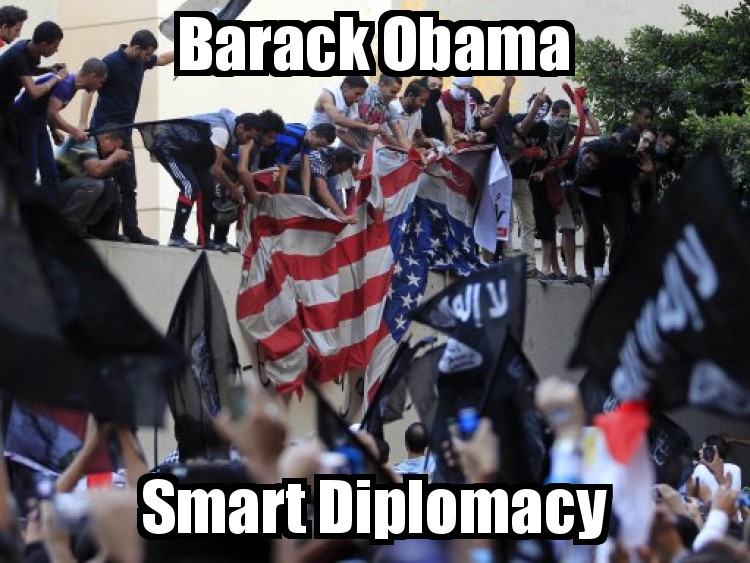
Now? Not so much.
Hey the Middle East is hard. It’s very, very easy to get things wrong. But it wasn’t any easier when Bush was President, and I don’t remember his liberal critics cutting him any slack.
I also don’t remember Islamsists storming an American embassy while he was President.
Syrian Rebels On Outskirts of Damascus
Monday, January 30th, 2012What the headlines says, although they were repulsed.
If President Hamlet was thinking about helping topple Assad, now would be a Real Good Time to jump off the fence.
Plus, unlike Libya and Egypt, not only would it be very hard for the next government to be worse than the current one. Plus it would be a blow to Iran and Hezbollah, and thus would dramatically improve the possibility of real peace and a stable government in Lebanon.
(Hat tip: Michael Totten)
France Recognizes Syrian Rebels
Thursday, November 24th, 2011“In a direct echo of previous events in Libya, France has formally recoginsed the opposition Syrian National Council and proposed that international troops should protect civilians.”
Meanwhile, those rebels are calling for international air strikes against the Assad regime.
It’s quite possible that the Assad regime could unravel much faster than Moammar Gadhafi’s regime in Libya did, since whole army units have already defected, and Assad is much more isolated from his country’s Sunni majority that Gadhafi was (at least ethnically) from his.
Syria Finally Ready to Blow?
Sunday, November 13th, 2011Maybe. News that the Arab league has suspended Syria indicates Bashar Assad may be on even shakier ground than previously thought. Getting suspended by the Arab League for oppressing your own people is only a couple of steps above getting kicked out of the Klu Klux Klan for being too racist.
And unlike Libya, even a hardline Islamist government would be a slight improvement on Assad, especially in Lebanon, if only because the Sunnis would break with Iran and cut off funding for the Shia Hezbollah.
But it’s hard to tell. When Syrian generals defected at the end of July, that looked like it might have been the final push, but wasn’t. never underestimate a cornered dictator willing to do anything to stay in power.
Frontline does a report from inside the Syrian uprising.
Will Obama decide to roll out drone strikes in Syria? Maybe, but I wouldn’t count on it, as Obama hasn’t seemed terribly interested in Syria, even by the lax standards of his foreign policy engagement. Also, the geography is more daunting than in Libya; to be effective, they’d have to come in over Lebanon or Israel to hit targets in Damascus, each of which presents (different) political problems.
Stay tuned…