Posts Tagged ‘Texas’

Pumping The Brakes On That “Natural Democratic Majority”

Monday, November 22nd, 2021

We touched on this last month: For a long time, Democrats have boasted that immigration (legal and otherwise) would make them the “natural majority party” in short order. Well, looking at the results from the 2020 and 2021 elections, there’s a lot of evidence to the contrary.

  • Why immigrants might not support left-wing causes.

    For years, progressives have prophesied that a more culturally diverse America would be a more Democratic America, with a grand coalition of African-Americans, Latinos, Asians, and Native Americans teaming up with liberal whites to put the Republican Party on a path to extinction. If anyone could have summoned this coalition into being, through opposition, it was Donald Trump, the president who made hardline stances on issues like immigration a cornerstone of his politics. Yet Trump actually increased his share of the minority vote in 2020. One exit poll suggested that he had received the highest share of the black vote of any Republican over the past 20 years. The GOP expanded its support among Hispanics, too, to its highest level since 2004.

    Digging deep into neighborhood-level results, the New York Times unearthed some surprises. “Across the United States, many areas with large populations of Latinos and residents of Asian descent, including ones with the highest numbers of immigrants, had something in common this election: a surge in turnout and a shift to the right,” the paper noted. Much of this movement toward Trump occurred in heavily Hispanic communities in South Texas, many bordering Mexico. The liberal Democratic theory that a less-white America will be bluer politically appears less and less plausible. In fact, Joe Biden may owe his 2020 victory to shifts in the white vote.

    This presents both an opportunity and a challenge for the Republican Party and conservatives more broadly. The 2020 election results suggest that they can find support among some immigrant communities, but the GOP is also home to America’s immigration skeptics, who worry that progressives have judged the situation correctly—that as America grows more diverse, it will also become more socially and culturally liberal. But if the progressive narrative about immigrants and their political allegiance is flawed, then so, too, is the electoral basis for conservative skepticism about immigration.

    In 1996, California had one of the most contentious ballot-initiative fights in its history. Proposition 209 gave voters the choice to end the state’s system of racial preferences, used in the university system and elsewhere to extend opportunities to members of certain minority groups. The battle lines were clear: liberals overwhelmingly opposed Prop 209; conservatives supported it.

    Voters went on to approve Prop. 209, and a Los Angeles Times exit poll conducted that year showed that white votes made the difference. Majorities of every other ethnic group opposed the referendum.

    Last year, liberals organized to overturn Prop. 209 with Proposition 16, which would once again authorize the state explicitly to consider race in college admissions and public hiring. It’s easy to see why organizers were optimistic about their chances. For one, California was much more Democratic in 2020 than it was in 1996: Joe Biden won the state with 63 percent of the vote, compared with Bill Clinton’s 51 percent. The progressive narrative about demographic destiny provided even more reason for optimism. California was a majority-white state in 1996; by 2020, whites had become a minority, and Latinos a plurality, of residents.

    Prop. 16’s endorsers included virtually every top Democratic official in the state, including now-vice president Kamala Harris, as well as major corporations like Uber, Twitter, and Facebook. This was also the year of America’s great racial reckoning, when liberals everywhere were openly encouraging institutions to transfer opportunities—even for cartoon voice actors— from whites to nonwhites.

    Yet when the votes were counted, Prop. 16 had failed—and by a slightly larger margin than Prop. 209 succeeded in 1996 (57 percent in 2020 vs. just under 55 percent in 1996). California’s increased diversity had done nothing to improve the proposition’s chances. Even worse, polling conducted a few weeks before the vote suggested that just 37 percent of Latinos supported Prop. 16, only 3 percentage points higher than whites.

    Though Prop. 16 supporters raised small sums of money compared with other referendum fights, they outraised the measure’s opponents by more than 16 to 1. The opposition to Prop. 16 was made up of a ragtag group of grassroots activists. Many were immigrants who came to America because of its promise that hard work and ingenuity would determine their success, not the color of their skin. Take Ronald Fong, a California-based doctor who emigrated with his parents to the United States from Hong Kong in the 1960s. “The public school system actually was pretty decent,” he said of the United States. “And there was a great deal of trust [among] my parents that the school system would educate us. And for the most part they did fine. It really was that sort of, you know, ethics of hard work, and keeping your nose to the grindstone, good things would happen,” he explained.

    Over time, Asian-American immigrants like Fong came to believe that elite college admissions processes were designed to discriminate against them. They have sued institutions like Harvard, alleging that such schools are penalizing Asian applicants to balance student demographics. The campaign against Prop. 16 offered a chance to strike a blow against such a system.

    Though Fong didn’t have much political experience, he reached out to others who felt similarly, both inside and outside immigrant communities. They set out to mobilize opposition to Prop. 16. “We did YouTube videos, we did a lot of . . . literal and figurative door-knocking,” he explained. “We had home-made signs, we tried to do car rallies as much as we could. It was . . . a bake sale and car wash mentality and tenacity in terms of getting our message out.”

    Snip.

    In 2018, Gallup released a set of global surveys asking people whether they wanted to relocate permanently to another country. Of the more than 750 million people whom Gallup estimated would like to move, about one in five (21 percent) preferred the United States as a destination. The second-most popular country, Canada, was the chosen destination for 6 percent of respondents.

    This number may surprise Americans who get their views of global attitudes from cable news and social media, which often serve as the propaganda arms of the country’s oikophobic elite. But America’s immigrants take a different view. A 2019 Cato Institute study found that three out of four naturalized U.S. citizens said they were “very proud” to be American—higher than the 69 percent of native-born Americans who said the same. A higher percentage of immigrants also believed that “the world would be better if people in other countries were more like Americans” (39 percent of immigrants shared this view versus 29 percent of natives). Almost 70 percent of native-born Americans said they were “ashamed” of some aspects of America; only 39 percent of immigrants agreed. These differences also show within minority communities. Seventy-three percent of immigrant Muslims, for instance, told Pew they agreed that the “American people are friendly to Muslims,” compared with 30 percent of native-born Muslims who say the same.

    We can only speculate about why these differences exist, but it’s important to recognize that immigrants have something most native-born people don’t: a basis for comparison.

    My own parents came to this country from Pakistan in the 1970s. They described America to me as a country with some of the kindest, most welcoming people in the world. As a child, I had a hard time believing them. But the more I traveled abroad myself and studied global problems, the more I came to the same conclusion.

    Immigrants don’t come to the United States just because they like the people. They largely come here to work, and many are a living testament to the American Dream. As a group of academics showed in one 2019 working paper, “children of immigrants have higher rates of upward mobility than their U.S.-born peers.”

    There is, of course, a world of difference between assimilated, upwardly mobile legal immigrants and a permanent underclass of unassimilated illegal alien Mexican laborers, but it seems like Democrats fully expect the former to vote like the latter. And people who came to America for economic opportunity are really pissed off when you lock them out of earning a living for months on end.

  • Democrats desperately need to amnesty illegal aliens, because American Hispanics are getting tired of their bullshit.

    The Democratic Party has historically taken Latinos for granted, something that we just witnessed play out in several elections across the country. Driven by two main issues–education and public safety–Latinos are emerging as a significant voting bloc capable of flipping blue seats red and realigning either party in regard to platform and policy.

    In Virginia, Republican Glenn Youngkin defeated Clintonista Democrat Terry McAuliffe for governor. Youngkin ran on school choice, an issue dear to Latinos who understand that education is the key to prosperity and the middle class. A survey by AP VoteCast showed that black voters supported McAuliffe by nearly 8-to-1. Latino voters, on the other hand, appear to have favored Youngkin, who received 55 percent of the Hispanic vote, compared to only 43 percent supporting McAuliffe. If Latinos had voted in the same pattern as other minority voters, it would have guaranteed a Democratic victory. They didn’t, which does not portend well for the future of the Democratic Party, since President Joe Biden won Virginia by 10 percentage points a year earlier.

    So did Latinos leave the Democratic party, or did the Democratic party leave them?

    The Democrats have lurched left towards socialism, embracing values that vilify private property and individual rights. During Barack Obama’s 2008, 2012, and Hillary Clinton’s 2016 presidential campaigns, Latinos were solidly Democratic voters, second only to African Americans in their loyalty. However, the Barack Obama that ran in 2008 and captured the hearts of Americans would be considered a right wing Republican by today’s standards.

    The Democratic Party and Latinos have changed over the past decade and now seem irreconcilable. This is especially worrisome to Democrats since Latinos are the largest of the fast-growing demographic groups in the nation, growing by 23 percent from 2010 to 2020. Latinos now account for 62.1 million or 18.7 percent of the U.S. population.

    Last year, the Biden-Harris ticket won a comfortable majority of Latinos across the country, but the administration’s poor handling of the border crisis directly impacts Latinos, and it is a serious mistake for anyone to believe that Latinos favor open borders. In fact, polls routinely demonstrate that helping illegal immigrants achieve legal status is of low concern to most American Latinos, who list jobs, education, housing, crime, and other such matters as of higher importance.

    In South Texas, which has long been seen as the gateway to the rest of the region, there have been signs that the Republican Party is making headway with Latinos. In the runoff for the 118th Texas House district, which includes San Antonino–a majority 73% Hispanic city–Republican John Lujan eked out an upset win against Democrat Frank Ramirez by 300 votes. Lujan is a veteran firefighter and former Bexar County sheriff’s deputy, and ran on a platform promising to fight efforts to “defund the police.” Democratic also-ran Robert “Beto” O’Rourke campaigned heavily for Ramirez, claiming that the nation is “watching and paying attention about what happens here, because national Republicans are saying this is a stepping stone to … South Texas.” He’s probably eating his words now.

    It should be noted that O’Rourke—a white man of Irish descent who was given the nickname “Beto” as a child initially to distinguish him from his namesake grandfather—is not Latino.

    And speaking of Beto and Texas…

  • Maybe Texas Democrats shouldn’t make such a show of proclaiming how they’re the party that represents Hispanic citizens if they’re unwilling to run and elect any of them statewide.

    For decades, Texas Democrats have banked on the growth of voters of color*, particularly Black and Latino voters, as the key to their eventual success in a state long dominated by Republicans.

    But with less than a month left for candidates to file for statewide office in the 2022 elections, some in the party worry Democrats could see their appeal with those constituencies threatened by a Republican Party that is rapidly diversifying its own candidate pool.

    The GOP slate for statewide office includes two high-profile Latinos: Land Commissioner George P. Bush and former Texas Supreme Court Justice Eva Guzman, who are both running for attorney general.

    I bet it really sticks in the craw of Texas Democrats that a Bush is Hispanic and Beto isn’t.

    It also includes two Black candidates who have previously held state or federal office: former Florida congressman Allen West and state Rep. James White, who are running for governor and agriculture commissioner, respectively.

    By contrast, the Democrats’ most formidable candidates are white — Beto O’Rourke, who is running for governor, and Mike Collier, Matthew Dowd and Michelle Beckley, who are running for lieutenant governor.

    They then list some Democratic Party minority candidates. If I every do a roundup on the Attorney General’s race we’ll cover them, but none of the people they mention look like they have a chance.

    In MSM pieces on Democrats, it always seem to be the “messaging” that’s the problem, not the fact that their ideas are unpopular:

    [Political scientist Sharon] Navarro said Democrats will have to perfect their messaging on this point to be successful, not simply rely on voters of color to side with them. Earlier this month, Republicans in Virginia flipped the major statewide offices by making the election about wedge issues like so-called critical race theory and forcing Democrats on the defensive. Texas Republicans could do the same on issues like border and election security.

    “So-called” Critical Race Theory. As always, the Democratic Media Complex idea that they can warp the fabric of reality by insisting that only SJW-approved words can be used to frame the debate is another reason why they lose.

    “Republicans have a better understanding of how to create the message and how to flip it for the audience,” Navarro said.

    Jean Card, a Republican political analyst, said that strategy paid off in Virginia, where the GOP elected Winsome Sears, a Jamaican-born Black woman, as lieutenant governor and Jason Miyares, the son of a Cuban immigrant, as the state’s first Latino attorney general.

    “What we saw here was policy over personality,” Card said. “That’s why they were so effective as candidates.”

    (Hat tip: TPPF’s Cannon.)

    Also, Republicans can actually address issues without worrying that telling the truth will offend some intersectional Democratic Party faction.

    And truth is always a powerful weapon.


    *”Voters of color” and “people of color” are both politically correct catchphrases intended to paper over the vast difference between different groups. These phrases essentially mean “minorities that should be voting for Democrats” and, as such, their use should be avoided. And it seems that an awful lot of Democrats recently decided that Asians are secretly white people…

  • Is Austin Community College Breaking Federal Law By Discriminating Based On Race?

    Thursday, November 18th, 2021

    The federal government is pretty clear on this point: If you accept federal money, you can’t discriminate on the basis of race for education under Title VI of the Civil Rights Act of 1964. There are other laws that prohibit it, and a fairly extensive number of post Brown vs. Topeka cases that all say the same thing

    So why does it look like ACC is doing just that?

    I emailed two addresses at ACC late yesterday asking for clarification on this. Thus far I have not received a reply. I’ll let you know if I do.

    Edited to add:

    Edited to add 2:

    This sounds a little ambiguous. Any current white or Asian ACC students interested in signing up for the BRASS cohort?

    Is La Joya, Texas The New Illegal Alien Crossing Hotspot?

    Wednesday, November 17th, 2021

    The answer to the above seems to be “Answer Cloudy, Ask Again Later.” But Bill Melugin, who did a lot of solid reporting on the Del Rio crossing crisis, is reporting a lot of activity there:

    La Joya is in Hidalgo County in the Rio Grande Valley, a much more densely populated part of the border than the Del Rio sector. Thanks to disasterous Biden Administration policies, illegal alien apprehensions hit a new October high.

    The Biden Administration’s refusal to secure the border is one of the many reasons Hispanics are switching to the GOP in record numbers. One sign of that is state Rep. Ryan Guillen (who represents part of the Valley) just switched from the Democratic to the Republican Party:

    Note that one of the reasons for his switch was “border security funding.”

    Guillen isn’t the first politician to switch parties because the Democrats have moved too far to the left, and he’s not going to be the last.

    Anti-CRT/SJW Roundup for November 16, 2021

    Tuesday, November 16th, 2021

    Was thinking about doing separate posts on several stories, and decided to shove them all into a roundup on the fight against Social Justice Warriors/Critical Race Theory/wokeness/etc. Because I’m just not doing enough roundups these days…

  • CRT-pushing, dossier-keeping, and possibly federal law breaking Jann-Michael Greenburg is out as president of the Scottsdale Unified School District.

    The Scottsdale Unified School District has elected a new interim president after allegations against President Jann-Michael Greenburg that he had distributed a “dossier” on some parents, including photos and personal finances.

    The SUSD board voted 4-1 at a Monday night meeting to elect Patty Beckman as interim president as parents gathered outside to call for Greenburg’s resignation.

  • Don’t let the left gaslight you on Critical Race Theory.

    The reality is that Critical Race Theory is being effectively smoked out. There was a time not so long ago when people actually tried to defend the use of CRT, like Marc Lamont Hill during his interview with Christopher Rufo.

    But now the playbook has changed. CRT is simply too toxic even to try to defend. This is why the National Education Association scrubbed Business Item #39 — which supported the use of CRT in K–12 schools across America — from its website in July. This is why the Biden administration removed the link to University of Georgia professor Bettina Love’s Abolitionist Teaching Network from the Department of Education’s website, claiming that the connection to the radical group (which aims to “disrupt Whiteness” in schools) was a mistake.

    Snip.

    [Defending CRT] would be to defend the “Color Line” exercise, a teacher training activity developed by Glenn Singleton’s Pacific Educational Group, which aims to help white educators identify their so-called “white privilege” so they can understand how this privilege is perpetuating white supremacy culture in K–12 schools as well as the rest of America. According to University of Alabama history professor David Beito, this exercise is a Maoist-style scheme that “publicly humiliate[s] dissenters by having them wear signs around their necks expressing shame for their ‘incorrect thoughts.'”

    It would be to support forcing third-graders to deconstruct their racial identities and rank themselves according to their power and privilege. It would be to teach educators that babies show the first signs of racism at three months old and that White children “remain strongly biased in favor of Whiteness” by age five. It would be to argue that the United States was founded on a Eurocentric, White supremacist, capitalist, patriarchal, homophobic, and anthropocentric paradigm brought from Europe. It would require teachers to locate themselves on an “oppression matrix” and accept that White heterosexual Protestant males are inherently oppressive and therefore must atone for their “covert White supremacy.”

    It would be to defend turning MLK’s “Dream” on its head, replacing judging a person by the “content of character” with judging a person by the color of his skin. It would be to defend replacing individualism with identity-based tribalism, with teaching children that race is the most important determinant of success, that meritocracy and American exceptionalism are evil, and that systemic racism is so deeply ingrained in our institutions that you are no longer the captain of your own ship.

    In other words, it would be to defend the indefensible.

    (Hat tip: The Other McCain.)

  • Among the places CRT is taught are Virginia schools.

    Throughout election night, as it became clear Republican Glenn Youngkin would win the Virginia governor’s race, numerous left-leaning media commentators insisted that critical race theory isn’t being taught in Virginia public schools.

    Various media personalities—some professing to be on the news side, others on the opinion side—repeated the assertion both before and after the election results came in.

    But a simple Google search would have shown these pundits that public documents from the Virginia Department of Education repeatedly mention the phrase “critical race theory,” as well as produced news stories about teacher training by consulting firms associated with critical race theory.

    Christopher Rufo, a contributor to City Journal and Fox News, is among those who have reported on the documents, as well as on Virginia counties implementing critical race theory into their curricula.

  • Here’s the Rufo thread referenced above:

  • Don’t believe in Critical Race Theory? You might get fired.

    How about firing anyone who won’t sign on to the racist, anti-American ideology of Critical Race Theory? Shockingly, that is now happening, all across corporate America. The current message is: believe in CRT, or more likely pretend to believe, or you are fired.

    The Upper Midwest Law Center, on whose board I serve, is representing several individuals who have been fired or demoted because they disagreed with Critical Race Theory. One of those plaintiffs is Chuck Vavra. Vavra was an engineer at Honeywell, which imposed mandatory Critical Race Theory-based training on its employees. The “curriculum” called America irredeemably racist and asserted that all whites are the same, and insisted that whites admit their inherent racism and status as evil oppressors, while blacks were characterized as victims, good people but intrinsically unable to lead successful lives due to white racism.

    Vavra objected to this bizarre Marxist world-view. The result? Honeywell fired him.

    It is notable that the “training” insisted upon by Honeywell was not a matter of compliance with federal civil rights statutes or other laws, nor did it have anything to do with Vavra’s job duties as an engineer. It was simply an effort to impose fealty to an extreme left-wing, anti-American agenda as a condition of employment at the company.

  • “North Dakota Becomes 13th State to Ban Critical Race Theory in Schools.”
  • Round Rock ISD is letting boys into girls restrooms in the name of transsexual rights.

    In the safe & suburban Central Texas city of Round Rock, a group of parents, staff, and students are raising red flags over the potentially dangerous environment at their local schools—and so far, district officials have only disregarded them.

    Round Rock Independent School District is situated in the northern suburbs of Austin, in a community long considered safe from the craziness of the state’s notoriously liberal capital city. Yet, based on a series of tips, Texas Scorecard has interviewed a handful of individuals experiencing a free-for-all locker room rule in the district’s schools; many of these individuals even know of school plans to place boys in girls’ hotel rooms during school trips.

    To protect the minors and their families from harassment or punishment, this report will refer to these students, parents, and responsible staff by pseudonyms.

    Two female high school students—referred to as Heather and Lauren—told Texas Scorecard about their first experiences in the troubling series of events.

    “I became aware of it about a month ago when I was getting dressed for school [in the locker room] out of my sweaty gym clothes, and I had just taken my shirt off,” said Heather, “when I noticed someone who looked a lot like a dude standing there using the sink and stuff. And I got really scared because I didn’t know that they were a biological male … so I quickly put my shirt back on then I immediately left with all my stuff.”

    Lauren relayed a similar story. “I remember I was going in [to the locker room] and I was getting changed when, out in the open, I saw an individual walk in who I know is a biological male,” Lauren said. “It just kind of really caught me by surprise; it caught me off guard. So, I just quickly got dressed and just got out really quickly.”

    Snip.

    Soon after, several parents got involved; for the sake of this story, we’ll refer to them as Crystal and Julie. They first sent an open records request to the district, asking for their bathroom/private facilities policy (with no response as of yet). They then sent their questions up the district food chain, first to a teacher (who replied they did not have the power to fix the situation), then to a high school principal, the school board, and finally the superintendent and his leadership team.

    “At Stone Bridge High School in Loudoun County, Virginia, where the school board’s policy on ‘gender expression’ provides a similar environment as presently experienced at RRISD schools, a ninth-grade girl was allegedly raped in a school bathroom by a so-called gender-fluid male student wearing a skirt,” wrote Julie to the school board.

    “Please take the time to craft, with parent input … a district-wide policy and action plan to address this dilemma.”

    Only two of the seven school board members—the same two who were the only ones fighting for parental rights and transparency in the district’s other recent tumultuous events—responded.

    “Yesterday Trustee [Mary] Bone and I both inquired to the superintendent, in writing, about this,” wrote RRISD Trustee Danielle Weston. “I seek to protect our students’ safety and do not want what happened in Loudon County to happen here.”

    Meanwhile, the parents and Lauren were able to meet with one of the district’s high school principals, who actually confirmed they will allow anyone inside any private room, including boys inside the girls’ dressing rooms.

    “That is what I’ve been told from [the legal department], that every student is permitted to use a restroom if they choose to,” the principal said.

    “So this policy comes from legal?” asked Julie.

    “Mhm,” the principal replied.

    Later in the conversation, Julie asked who in the district is creating the policy.

    “So does legal have a policy in place?” she asked.

    “No there’s no policy in place,” the principal replied. “The policy is this: Every one student at a time, every situation one at a time. And if the student chooses to use the restroom [of their choice], they’re going to be allowed to use that restroom.”

    The principal then suggested if they wanted to feel safer, the biological female students could make their own adjustments. He said they could go to a different locker room, change in a bathroom stall, go home, or even change inside a pop-up tent in the bathroom.

    You will be made to care, and you will be made to conform. How many fingers, Winston?

  • Texas Republican Gubernatorial challenger Don Huffines says that the Texas Department of Family and Protective Services is using Critical Race Theory in training.
  • Speaking of CRT in Texas, a pro-Critical Race Theory parent in the Fort Worth Independent School District told school board meeting attendees that “he has 1,000 soldiers ‘locked and loaded‘ for those who ‘dare’ question the need for race-based curricula.” Yeah, we saw some of those “soldiers” on display in Kenosha. They did not impress… (Hat tip: Gail Heriot at Instapundit.)
  • Beto III: The Betoing Officially Greenlit

    Monday, November 15th, 2021

    In a sequel sure to be every bit as beloved as The Hangover Part III, failed Senatorial and Presidential candidate Robert Francis “Beto” O’Rourke has announced that he’s running for high office yet again, this time for Texas Governor.

    For months, Texas Democrats have failed to field a single serious candidate to challenge Governor Greg Abbott’s reelection bid. But today, Beto O’Rourke is announcing in Texas Monthly that he is entering the 2022 gubernatorial race. The former three-term congressman from El Paso who had run losing bids for U.S. Senate against Ted Cruz in 2018 and for president in 2020, is not expected to face any serious challengers for his party’s nomination. He will seek to become the first Democrat to win statewide office in Texas since 1994, ending the longest statewide losing streak in America for either party.

    It will be an uphill battle. Abbott, who has raised more money than any governor in U.S. history, had $55 million in his campaign treasury as of July 15, the last time he reported the size of his war chest. While polling has found that Abbott is not as popular as he once was, O’Rourke’s numbers are worse. A University of Texas poll conducted in October found 43 percent of Texans approved of the job Abbott is doing and 48 percent disapproved, but only 35 percent of respondents had a favorable opinion of O’Rourke against 50 percent who had an unfavorable view.

    At this point O’Rourke is anything but a fresh face. But before we enumerate O’Rourke’s many negatives, let’s give Bobby Francis his due and list the assets he brings to the race:

  • First and foremost, he does the work. He’s an indefatigable campaigner who constantly gets out and meets potential voters. Given the fact that so many high profile statewide Democratic candidates have not done that over the last twenty plus years (I’m looking at you, Ricardo Sanchez), it’s no small thing.
  • His previous campaign organizations have tended to be more notably competent than other high profile Texas Democrats. (I’m looking at you, Wendy Davis.)
  • His “hyerpscale” outreach, IT, data and comms teams were particularly praised.
  • He has a high national profile, generating a ton of positive MSM press.
  • He has an huge, national list of previous contributors to raise money from.
  • He still has those “boyish, Kennedyesque good lucks” reporters love to swoon over.
  • He’s facing an incumbent whose popularity has taken a hit.
  • He currently has no serious competitor in the Democratic Party primary, allowing him to focus on the general election fight.
  • However, O’Rourke has an even more daunting list of disadvantages for this race:

  • See all those positives above? He had all those for his Senatorial and Presidential races as well (save the no serious competitors bit for the Presidential run), and it wasn’t enough to propel him to victory. In the heavyweight class, O’Rourke’s record is 0-2.
  • In his Senatorial run in particular, he has just about every single thing going his way (a clear nomination path, a midterm election with a polarizing Republican in the White House, an incumbent (Ted Cruz) damaged by his own unsuccessful run, and more fawning political coverage and money than any Democratic senate candidate in the history of the Republic), and it still wasn’t enough to win Texas.
  • In his presidential run, O’Rourke moved so hard left on a range of issues, from gun control to open borders to taxes, that he’s all but unelectable in Texas.
  • As I mentioned before, the very issues Abbott is must vulnerable on are the ones where O’Rourke doesn’t have the standing or positions to challenge him:
    • Border security? While the Rio Grande Valley is in the midst of a Republican upswell over the issue, Beto wants to tear down the border wall.
    • Ice storm? Beto wants to keep pouring money into the same green energy boondoggles that couldn’t keep the lights on.
    • Flu Manchu lockdowns? Beto wanted to keep them going longer.
  • Unlike the near perfect year of 2018, Hispanics in the Rio Grande Valley and elsewhere have taken a hard turn toward the Republican Party.

    If anything, Biden’s disasterous open borders policies have made Democrats even more unpopular in the Valley than they were in 2020.

  • Indeed, the 2022 electoral environment looks to be much more challenging for Democrats than 2018. Supply chain issues and inflation have ordinary Americans furious at a Democratic Party that promised a “return to normality” in 2020. Right now, Republicans enjoy a 10 point lead in generic ballot questions, the largest since they’ve done polling on the issue. All polls should be taken with a grain of salt, but those are substantial headwinds.
  • When O’Rourke and Abbott were both on the ballot in different races, Abbott got 600,000 more votes than O’Rourke. That’s an awful big gap to make up in a Republican-favorable year.
  • The issue that Democrats are most fired up about, abortion, didn’t seem to help Wendy Davis in 2014. Any single-issue pro-abortion voter was already backing O’Rourke over Cruz in 2018, and it wasn’t enough.
  • O’Rourke still has a reputation as an intellectual lightweight.
  • Very, very few American politicians have lost two profile races in a row only to go on to win a third. Richard Nixon is the only one that comes to mind, but 1968 was a long time ago.
  • Having hoovered up record amounts of cash only to lose two previous races, donors may be hesitant to keep throwing good money after bad. As a commenter here observed, “Beto Campaigns in Texas are where progressive money goes to die.”
  • With less than a year before election day, O’Rourke’s official entrance to the race is later than typical for a winning candidate. A relatively minor point, but O’Roruke may regret dithering for a couple of months rather than campaigning and fundraising.
  • Could the dynamics of the race change to be more favorable to O’Rourke? Sure. Things change all the time. If one of Abbott’s challengers catches fire, he might be forced to spend time and money on a runoff. Abbott could suffer a gaffe or high-profile medical problem. (Unlikely; Abbott has previously been a pretty hardy campaigner (wheelchair not withstanding), and he’s the sort of careful, polished politician that doesn’t tend to make gaffes.) The economy could improve. Inflation could indeed prove transitory, as it was 1980-1982. I rather doubt those last two, because the people in charge seem hellbent on making everything worse and Paul Volcker is dead.

    In 2018, O’Rourke ran the most competitive statewide campaign any Democrat has run this century…and it wasn’t enough. That’s probably more of a ceiling than floor, and O’Rourke’s floor may turn out to be a lot lower than observers thought when he was a fresh-faced newcomer…

    Supply Chain Update for November 10, 2021

    Wednesday, November 10th, 2021

    Thanks to California regulations and vaccine mandates, supply chain problems continue to plague America. Here’s an update on those disruptions and other topics related to the wondrous Biden Economy.

  • Inflation hits a 31 year high.
  • Not only is inflation bad, it’s about to get much worse. Unprocessed goods are up 56% from a year ago. “At the current rate of increase, regular unleaded gasoline will hit $6/gal (National Average) by Easter.”
  • It’s not just us: China’s prices are soaring as well.

    China’s trade balance may have just hit a record on the back of resurgent exports and slowing inflation, but the favorable impact to China’s mercantlist economy was more than wiped out by the just released record PPI and resurgent CPI.

    China’s National Bureau of Statistics reported that in October, CPI rose 1.5% Y/Y, higher than the 1.4% expected, and a 0.7% sequential increase from the September print; the CPI increase was evenly split between base effect and sequential growth.

    At the same time factory gate, or PPI, inflation hit a fresh all time high of 13.5%, steamrolling the 12.4% consensus estimate, and rising at the fastest pace since records began in November 1995.

    While the gradual increase in CPI is alarming, and the NBS said that it was affected by weather, commodities demand and costs – it was the producer price inflation that was far more alarming, soaring as a result of a tight supply of energy and resources. In reality, however, there was just one key variable – thermal coal, which as we said last month indicates that PPI will continue rising far higher, although judging by the recent sharp reversal in the price of Chinese thermal coal (if only for the time being), this may be as high as PPI gets.

    Or so Beijing should hope because with the spread between PPI and CPI hitting a new all time record, virtually no Chinese companies that use commodity inputs – which in China is a vast majority – are making any profits.

  • The situation at LA and Long beach ports is not getting better:

    DHL releases service announcements every week so shippers in their network know what to expect at ports all around the world. The most recent announcement came out today, and it shows that the situation at America’s top West Coast port complex is not improving. Here’s DHL’s summary of the port conditions at Los Angeles/Long Beach:

    Ships are waiting 13-22 days to catch a berth. Currently there are 72 vessels waiting for a berthing spot. Both ports are seeing record volumes month after month and the ships at anchor are delayed an average of 4 days. Delays forcing the ships to wait at anchor are expected to continue for the remainder of the year. All terminals remain extremely congested and evaluating a reduction on their window for export cargo acceptance from four to three days. The expected spike on imports generated by the peak season and cargo pre-shipped is already here making the operation more complex. Local trucking delays have been reduced and are being closely monitored. The LAX/LGB rail operations from all terminals and the off dock ramps continues to deteriorate as demand exceeds capacity, therefore inland moves by rail can suffer considerable delays.

    That’s not an encouraging description, and there has not been movement in the right direction. The waiting time and number of ships waiting have been steady for over a month now, according to DHL. If anything, they are getting slightly worse. Here’s how those estimates have changed over time:

    “Port congestion has been a problem for months now, and we’ve yet to see signs of improvement.”

  • “You Know Those Cargo Ships And Trains Waiting To Be Unloaded In California? Yeah, Now Homeless People Are Breaking In And Stealing Things From The Stopped Trains.”

    So, not only will you have to wait literal months for products you’ve ordered to finally make it to their destination, now it looks like you’ll be lucky if any of these things make it to your house because homeless people are stealing from unprotected parked trains.

  • Truckers should be making money hand-over-fist to solve the supply chain crisis. Port constraints mean They’re not:

    We have covered the ocean-carrier side of this crisis (‘In Deep Ship’), and the new fee equivalent to $1m a day, and rising $1m each following day, for a 10,000 TEU vessel whose cargo is stuck in LA/LB port. However, we stressed in that report that the supply chain issue is more systematic. So, allow me to share quotes from an article exposing there is ‘No Trucking Way’ we are about to return to normal:

    “Think of going to the port as going to WalMart on Black Friday, but imagine only ONE cashier for thousands of customers…Most port drivers are ‘independent contractors’, leased onto a carrier who is paying them by the load. Whether their load takes two hours, fourteen hours, or three days to complete, they get paid the same, and they have to pay 90% of their truck operating expenses…I honestly don’t understand how many of them can even afford to show up for work…In some cases they work 70 hour weeks and still end up owing money to their carrier.

    So when the coastal ports started getting clogged up last spring due to the impacts of COVID on business everywhere, drivers started refusing to show up. Congestion got so bad that instead of being able to do three loads a day, they could only do one. They took a 2/3 pay cut and most of these drivers were working 12 hours a day or more…Many drivers simply quit. However, while the pickup rate for containers severely decreased, they were still being offloaded from the boats. And it’s only gotten worse…The ‘experts’ want to say we can do things like open the ports 24/7, and this problem will be over in a couple weeks. They are blowing smoke, and they know it.”

    The author also points out a crippling shortage of truck chassis; warehouse workers, again due to low-pay and Covid, so unloading takes longer; and warns soon there will be less, not more truck drivers. Crucially, he bewails that ocean carriers, ports, trucking companies, warehouses, and retailers are all making great money – so won’t invest before the system collapses further. If so, this book-ends the 1980 deregulation of the US trucking industry under President Carter.

    Meanwhile, Senator Manchin just said ‘No Trucking Way’ to the White House’s fiscal plans, again, which already fail to address the above logistical problems. Perhaps it’s time for US economists to study what weak, share-cropper logistics and on-off fiscal and central-bank liquidity largesse do for emerging markets’ macroeconomic and financial stability?

    Indeed, Bloomberg reports: “Chinese households are encouraged to stock up on a certain amount of daily necessities, such as vegetables and meat, in preparation for the winter months, according to a notice from Ministry of Commerce aimed at ensuring supply and stabilizing prices of such items for the next few months. Major agricultural distributors are encouraged to sign long-term contracts with producers. Reserves of meat and vegetables will be released on a timely basis to replenish market supply.”

  • Another problem: Some 73,000 truck drivers taken off the roads due to newly implemented drug tests.

    The biggest number of clearinghouse violations by far — 56 percent — are for marijuana use, according to federal data. (Amphetamine and methamphetamine violations account for 18 percent, while cocaine and various opioids account for 15 percent and 4 percent, respectively.) Some argue that because marijuana can stay in the body for up to 30 days, testing does not accurately reflect whether a person is driving while under the influence.

    (Hat tip: Director Blue.)

  • Whoever is in charge of Slow Joe’s administration is making everything worse:
    • As Mario Loyola laid out, “The World Economic Forum rates America’s shipping-industry regulations as the most restrictive in the world, chiefly because of the Jones Act. Stifling regulations have left America with the most inefficient ports in the world. A recent review of container-port efficiency ranked the ports of Los Angeles and Long Beach below ports in Tanzania and Kenya, near the bottom of the list of 351 top ports. America’s ports are effectively third-world. The 50 most efficient ports in the world are mostly in Asia and the Middle East; none are in America.”
    • Loyola continues, “Above all, it is the shortage of truck drivers that’s causing the current crisis. And why do we have that shortage? One reason, according to truck drivers, is that the restrictions on their access to ports are too onerous. The Jones Act has made that problem worse, too. The Jones Act ‘has made coast-wise shipping prohibitively costly and therefore put additional pressure on alternative inland transit such as trucks and trains,’ Lincicome writes. “In practice, this means badly needed rigs that could be servicing U.S. ports currently are instead stuck on I-95 ferrying oranges from Florida to New York.”
    • Earlier this year, Heavy Duty Trucking reported that the Biden administration had imposed a tariff on truck chassis (the framework that provides the truck base that includes the wheels and axles) made in China; “chassis or sub-assemblies imported from China for the next five years will be subject to tariffs/duties that would add up to more than twice the value of the actual chassis itself.”
    • Weston LaBar, executive director of the Harbor Trucking Association in California, told Heavy Duty Trucking that that, “The [U.S. International Trade Commission] really botched their decision, at a time when our industry is needing to inject more equipment, both for capacity and for folks trying to retire older equipment. Now people have to stretch out the useful life of existing equipment, which isn’t an ideal thing from a safety standpoint. And now we’ve created scarcity and increased the cost.”
    • California imposed regulations requiring trucks built before a certain date to replace their engines or not operate in the state.
    • Our Dominic Pino observes that the Biden administration wants to make two-man crews for freight-train engines standard, forever — no matter what technological advances occur. The unions for the train crews argue that trains are like planes and require two engineers — unlike a freight truck, which can be safely driven by one person. “As the Association of American Railroads says, plenty of other trains operate just fine with only one person at the controls. In the European Union, Australia, and New Zealand, one-person crews are the norm, and even in the U.S., passenger trains are commonly driven by one person.”
  • A view from the trenches by (of all people) Dukakis campaign manager Susan Estrich:

    I’m exactly the sort of person who should be up-to-the-minute on what the senators from Arizona and West Virginia are doing and whether the progressives will go along and whatever else it is that has caused Congress to accomplish absolutely nothing under supposed Democratic control. But I’m not.

    I’m up-to-the-minute on the price of eggs. And the cost of cans for cranberry. And the likelihood of empty shelves when I shop for all the children in my life come December.

    I’m up-to-the-minute on all the big ships you can see lined up just waiting to unload at San Pedro, which is pretty far south of where we’re sitting.

    Twelve dollars for a dozen eggs. At the farmers market on Sunday, I did my own survey. Three stands were $11. The rest were $12. Ten minutes ago, they cost $6.

    One hundred dollars. That’s how much it cost my handyman to fuel up his truck.

    They’re warning that the price of canned cranberries is going to be 50% higher this year because of the scarcity of aluminum for the cans.

    Remember overnight deliveries from Amazon? Notice that all those overnight specials now take three days, and certain products are already being slated for January delivery.

  • The supply chain problems hits ordinary Texans:

    everyday items have started disappearing, leaving the stores with nothing to replace them with.

    Belton resident Laura Zarate said it started slowly.

    She’d go to her local store to buy groceries and the store didn’t have something she needed.

    Now her shopping list is getting lighter as more items move to her can’t get list.

    “When I walk in, on the shelves I see they don’t have a lot of things anymore that we used to buy. They’re kind of empty sometimes. It worries me,” Zarate said.

    And it should worry all of us. In a global economy that lives or dies by its dependence on consumer spending, transportation becomes a vital link in getting products to consumers through something called “the supply chain”.

    The supply chain is a network of transportation that takes goods from factories to airplanes and eventually to warehouses and eventually us.

    And what’s the weak link here?

    “The breakdown is in the supply chain in general,” a Port of Los Angeles longshoreman said.

    However, this supply chain didn’t just have weak links, it looked like a roving gang with bolt cutters tore into it.

    Take Christmas for instance, those decorations that didn’t show up in August could be the only thing we get.

    “The cut-off was probably about a month ago,” said a L.A. warehouse manager, talking about when most of Decembers merchandise should have been here.

    But that supply chain, that network, now has holes in it and empty store shelves prove it.

    What are stores doing about the supply chain problem?

    Frankly, everything they can and everything they can think of because if they aren’t selling, they aren’t making any money.

    Stores blame shipping companies and shipping companies blame overseas companies, who blame the shipping companies and it goes round and round until it just becomes background noise, leaving Laura Zarate, paying more for much less to buy.

    People started noticing it when ships mysteriously started dropping anchor off the coast of California.

    A backup caused by only so many parking spots and so many employees unloading the ships.

    “Everything. Everything on paper, your shirts, your shoes, your bike, computers, air conditioner, everything. Everybody’s waiting for,” said dock workers when asked about the growing problem.

    The world shutdown is the cause but experts say we added to the problem by believing stories shipping companies spun of how their super-efficient delivery system meant you didn’t need a stockpile of stuff.

    “We’ve had a lot of shortages, truck drivers and high utilization of our supply chains since the pandemic started. When you put all that together plus the shift of consumer spending from more services more towards goods, which has created more demand so it’s kind of like a perfect storm really says everything that could go wrong did go wrong and all at the same time,” said Michael Bomba, Ph.D., of the G. Brint Ryan College of Business, at the University of North Texas.

    He says we will soon have to address the issue of better pay for truck drivers, another by-product of shifting spending and COVID.

    (Hat tip: Vance Ginn.)

  • Among the items hit by supply chain shortages: Thanksgiving staples. (Hat tip: Stephen Green at Instapundit.)
  • “Now More Than 100 Container Ships Are Waiting outside the Ports of Los Angeles and Long Beach.” That’s back on November 1.
  • Today: 111 container ships at dock.
  • Supply Chain Dive has a Port of LA and Long Beach tracker, though right now it seems heavier on policy announcements than actual action to relive congestion. One positive change: “The City of Long Beach is waiving container stacking rules for 90 days to help with port congestion. Previously, stacks could only be two containers high. Now, the city is allowing stacks of up to four containers, or up to five with a special permit.”
  • Some tweets:

  • Locally, the luncheon meat shortage at HEB seems mostly over, but Sam’s doesn’t appear to be stocking 12 oz cans of Diet Dr Pepper, only 20 oz bottles and cans of Dr Pepper Zero Sugar, which has a different formula. So far I don’t like it as much…

    Anti-Woke Academics Announce New University of Austin

    Tuesday, November 9th, 2021

    Yesterday, a number of anti-woke intellectuals announced that they were starting a new university on Bari Weiss’ substack.

    Pano Kanelos:

    So much is broken in America. But higher education might be the most fractured institution of all.

    There is a gaping chasm between the promise and the reality of higher education. Yale’s motto is Lux et Veritas, light and truth. Harvard proclaims: Veritas. Young men and women of Stanford are told Die Luft der Freiheit weht: The wind of freedom blows.

    These are soaring words. But in these top schools, and in so many others, can we actually claim that the pursuit of truth—once the central purpose of a university—remains the highest virtue? Do we honestly believe that the crucial means to that end—freedom of inquiry and civil discourse—prevail when illiberalism has become a pervasive feature of campus life?

    The numbers tell the story as well as any anecdote you’ve read in the headlines or heard within your own circles. Nearly a quarter of American academics in the social sciences or humanities endorse ousting a colleague for having a wrong opinion about hot-button issues such as immigration or gender differences. Over a third of conservative academics and PhD students say they had been threatened with disciplinary action for their views. Four out of five American PhD students are willing to discriminate against right-leaning scholars, according to a report by the Center for the Study of Partisanship and Ideology.

    The picture among undergraduates is even bleaker. In Heterodox Academy’s 2020 Campus Expression Survey, 62% of sampled college students agreed that the climate on their campus prevented students from saying things they believe. Nearly 70% of students favor reporting professors if the professor says something students find offensive, according to a Challey Institute for Global Innovation survey. The Foundation for Individual Rights in Education reports at least 491 disinvitation campaigns since 2000. Roughly half were successful.

    On our quads, faculty are being treated like thought criminals. Dorian Abbot, a University of Chicago scientist who has objected to aspects of affirmative action, was recently disinvited from delivering a prominent public lecture on planetary climate at MIT. Peter Boghossian, a philosophy professor at Portland State University, finally quit in September after years of harassment by faculty and administrators. Kathleen Stock, a professor at University of Sussex, just resigned after mobs threatened her over her research on sex and gender.

    We had thought such censoriousness was possible only under oppressive regimes in distant lands. But it turns out that fear can become endemic in a free society. It can become most acute in the one place—the university—that is supposed to defend “the right to think the unthinkable, discuss the unmentionable, and challenge the unchallengeable.”

    The reality is that many universities no longer have an incentive to create an environment where intellectual dissent is protected and fashionable opinions are scrutinized. At our most prestigious schools, the primary incentive is to function as finishing school for the national and global elite. Amidst the brick and ivy, these students entertain ever-more-inaccessible theories while often just blocks away their neighbors figure out how to scratch out a living.

    The priority at most other institutions is simply to avoid financial collapse. They are in a desperate contest to attract a dwindling number of students, who are less and less capable of paying skyrocketing tuition. Over the last three decades, the cost of a degree from a four-year private college has nearly doubled; the cost of a degree from a public university has nearly tripled. The nation’s students owe $1.7 trillion in loans.

    And to what end? Nearly 40% of those who pursue a college degree do not attain one. We should let that sink in. Higher education fails 4 in 10 of its students. A system that so brazenly extracts so much from so many without delivering on its basic promises is overdue for a reckoning.

    The warped incentives of higher education—prestige or survival—mean that an increasing proportion of tuition dollars are spent on administration rather than instruction. Universities now aim to attract and retain students through client-driven “student experiences”—from trivial entertainment to emotional support to luxury amenities. In fact, many universities are doing extremely well at providing students with everything they need. Everything, that is, except intellectual grit.

    Snip.

    But we are done waiting. We are done waiting for the legacy universities to right themselves. And so we are building anew.

    I mean that quite literally.

    As I write this, I am sitting in my new office (boxes still waiting to be unpacked) in balmy Austin, Texas, where I moved three months ago from my previous post as president of St. John’s College in Annapolis.

    I am not alone.

    Our project began with a small gathering of those concerned about the state of higher education—Niall Ferguson, Bari Weiss, Heather Heying, Joe Lonsdale, Arthur Brooks, and I—and we have since been joined by many others, including the brave professors mentioned above, Kathleen Stock, Dorian Abbot and Peter Boghossian.

    We count among our numbers university presidents: Robert Zimmer, Larry Summers, John Nunes, and Gordon Gee, and leading academics, such as Steven Pinker, Deirdre McCloskey, Leon Kass, Jonathan Haidt, Glenn Loury, Joshua Katz, Vickie Sullivan, Geoffrey Stone, Bill McClay, and Tyler Cowen.

    We are also joined by journalists, artists, philanthropists, researchers, and public intellectuals, including Lex Fridman, Andrew Sullivan, Rob Henderson, Caitlin Flanagan, David Mamet, Ayaan Hirsi Ali, Sohrab Ahmari, Stacy Hock, Jonathan Rauch, and Nadine Strossen.

    It’s an interesting collection of people, running from conservatives to “mugged liberals,” all of which I think have objected to the epistemological closure of social justice.

    We are a dedicated crew that grows by the day. Our backgrounds and experiences are diverse; our political views differ. What unites us is a common dismay at the state of modern academia and a recognition that we can no longer wait for the cavalry. And so we must be the cavalry.

    It will surely seem retro—perhaps even countercultural—in an era of massive open online courses and distance learning to build an actual school in an actual building with as few screens as possible. But sometimes there is wisdom in things that have endured.

    Here’s the website for the new institution, which states the following principles:

    Universities devoted to the unfettered pursuit of truth are the cornerstone of a free and flourishing democratic society.

    For universities to serve their purpose, they must be fully committed to freedom of inquiry, freedom of conscience, and civil discourse.

    In order to maintain these principles, UATX will be fiercely independent—financially, intellectually, and politically.

    About funding:

    We’re completely rethinking how a university operates by developing a novel financial model. We will lower tuition by avoiding costly administrative excess and overreach. We will focus our resources intensively on academics, rather than amenities. We will align institutional incentives with student outcomes.

    The new university is located at 2112 Rio Grande Street in Austin, Texas. For those unfamiliar with Austin, that’s right in the West Campus area, AKA Fratville, immediately to the west of the University of Texas. Presumably they’ll be able to draw some students, talent, etc. from their location, not to mention a lot of nearby student amenities.

    It will be interesting to see how this experiment works out, but one university isn’t enough to stem the tide. All of American education needs a hard reboot, one where everyone pushing social justice down America’s throat lose both their jobs and funding.

    Did Austin Justice Coalition Break Federal Law?

    Monday, November 8th, 2021

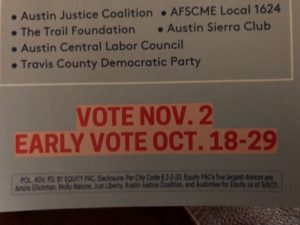
    With plenty of out-of-state money (including half a million from George Soros), Austin Justice Coalition and their allies managed to deliver a resounding defeat to Proposition A. There was a lot of signage against Prop A, and readers in Austin say they received anti-Prop A flyers. Here’s an example:

    And here’s a closeup of who funded it:

    There’s two places on the flyer it says it was partially funded by the Austin Justice Coalition.

    Tiny problem: The Austin Justice Coalition is a 501(c)(3) organization last time I checked, and 501(c)(3) have very specific prohibitions against engaging in certain types of political activity and advertising.

    (You might be wondering: Is that’s the case, how could SaveAustinNow legally campaign for Proposition A? Easy: They’re a 501(c)(4) organization, the rules for which are different.)

    Did Austin Justice Coalition violate federal law? Maybe. Austin Justice Coalition briefly lost their tax exempt for failing to proper documentation. (It’s easier to search for information on them when you have their tax ID number: EIN 81-3138826.) But I’m not a lawyer, and the IRS statute language specifically mentions that 501(c)(3) organizations can’t campaign for or against candidates. I am unsure whether this prohibition extends to campaigning for or against ballot propositions.

    Perhaps an expert in campaign finance law can shed some light on the issue…

    (Hat tip: Blog commenter Clinton.)

    Astrowhatthehell?

    Saturday, November 6th, 2021

    Astroworld was the name of a now-defunct Houston amusement park. Then it was the name of rapper Travis Scott’s album. Now it’s evidently the name of a rap festival in the parking lot of NRG stadium (close to where the Astroworld theme park used to be) where eight people just died:

    At least eight people are dead and dozens more injured after a sold-out crowd of roughly 50,000 surged during rapper Travis Scott’s performance late Friday at the Astroworld Festival outside NRG Park, overwhelming security forces and resulting in one of the deadliest concerts in U.S. history.

    As Scott’s performance started shortly after 9 p.m., the chaotic crowd seemingly swallowed everyone in it, Instagram user SeannaFaith wrote.

    “The rush of people became tighter and tighter. .. Breathing became something only a few were capable. The rest were crushed or unable to breathe in the thick hot air,” she wrote. “It was like watching a Jenga tower topple. Person after person were sucked down…. You were at the mercy of the wave.”

    “We begged security to help us, for the performer to see us and know something was wrong,” she continued. “None of that came, we continued to drown.”

    Then, one person fell. And another.

    “We had a mass casualty event here at Astroworld,” Houston Fire Chief Samuel Peña said.

    Seventeen people were taken to the hospital, 11 of whom Peña described as being in cardiac arrest. Eight are confirmed dead. Some of the victims might be children.

    Sounds quite similar to the tragic 1979 Who concert in Cincinnati, where 11 people died. It seems the lessons from that have been forgotten.

    The original Astroworld park also had a reputation as being deadlier than other parks in the Six Flags family. Two workers were killed during construction in 1968, and a maintenance worker was killed after being struck by a roller coaster car.

    There’s was also some weird scheme to build a virtual Astroworld theme park on blockchain technology. It always seemed more like buzzword bingo than a business plan, and I don’t think much has come of it.

    2021 Post-Election Tidbits

    Thursday, November 4th, 2021

    More post-election news:

  • Democrats take a good, hard, sober look at their policies to determine why voters abandoned them in drove. Ha, just kidding! It’s all racism all the way down:

    In response to Republican Glenn Youngkin’s win in yesterday’s Virginia gubernatorial race — as well as Republican wins all the way down the ballot — left-wing pundits and celebrities immediately began to assert that the Democratic losses were the result of voters’ white-supremacist sympathies.

    Yeah, that’s the reason voters turned out in droves to elect a black Republican Lt. Governor: white supremacy.

    Even Politico writers got in on the action, asserting in this morning’s newsletter that Youngkin’s strategy included “racial appeals to working-class white voters.” During elections results coverage last night, MSNBC’s Nicole Wallace asserted that “critical race theory, which isn’t real, turned the suburbs 15 points to the Trump-insurrection endorsed Republican.”

    Also on MSNBC last night, host Joy Reid spent much of the evening insisting that the education issue, an enormous part of Youngkin’s successful appeal to Virginia parents, was a dog whistle for racism. Plenty of progressives, including Reid herself, began pushing this line well before Election Day.

    And that worked out so well for them.

    Already, progressives are pointing to exit polls showing an enormous swing to the GOP among white working-class women, who voted for Joe Biden last fall but supported Youngkin this time around — the nasty implication being that these women were motivated to vote by Republicans’ supposedly racist agenda. Totally ignored, or even outright dismissed, are the many nonwhite voters who backed the GOP.

    McAuliffe himself obliquely indulged in this fantasy in his statement conceding the election.

    On several counts, progressives have begun to coalesce around a narrative that doesn’t hang together — one that displays a shocking unwillingness to grapple with the problems facing their party. For one thing, it makes little sense to assert both that critical race theory doesn’t exist and that parents who oppose it are doing so because they don’t want their children to learn about race or slavery.

    If progressives admit that CRT exists at all, they pretend that it’s merely an effort to teach school children about the complicated history of race in our country. In fact, a quick investigation reveals that the proposed curricula contain, in most cases, highly inaccurate history aimed at indoctrinating kids into racially divisive identity politics.

    Parents have legitimate concerns about such curricula, including understandable resistance to misrepresenting history, stoking guilt and division among children, and perhaps even encouraging race-based bullying. Dismissing these parents as white supremacists for having these concerns is unlikely to succeed either in persuading them to think differently about the curriculum in question or to vote for Democrats the next time around.

    Finally, the “white supremacist” theory for Democratic losses intentionally ignores that two of the top Republican candidates voted into office were Winsome Sears, a female Jamaican immigrant elected lieutenant governor, and Jason Miyares, a Cuban American who was elected attorney general. It’s hard to imagine why Virginians voting en masse for the GOP out of thinly veiled racial animus would throw in their lot with this ticket.

    Logic has never been the Democratic Party’s strong suit.

  • “Glenn Youngkin Defeated Terry McAuliffe Because Democrats Betrayed Parents.”

    While former Virginia Gov. Terry McAuliffe’s loss to Republican challenger Glenn Youngkin was cemented very late on election night, in practice the day that he forfeited the gubernatorial race was September 28. That was when, during a debate with Youngkin, McAuliffe, a Democrat, made the statement that “I don’t think parents should be telling schools what they should teach.”

    That was his response to questions about school curriculum and the fury that had taken hold at many local school board meetings, where irate parents assailed education leaders for allegedly supporting what has been termed “critical race theory” by right-wing activists who oppose it. CRT is a divisive concept, in part because progressives and conservative disagree sharply about what it even is. Many members of the liberal media don’t even believe it exists, and have accused the GOP of fabricating the issue. As Youngkin’s victory became apparent, MSNBC host Nicolle Wallace lamented that critical race theory, “which isn’t even real,” had swung the suburbs 15 points in Republicans’ favor.

  • Dr. Carol Swain on voter rejection of critical race theory:

    Well, they can’t really racialize it because a number of Black parents and immigrant parents have stood with their White brothers and sisters to reject critical race theory, which is very harmful to Black and minority children. It’s a violation of our civil rights laws. It’s un-American because it involves shaming and bullying children and it runs counter to our Constitution. And so, they can say what they want with their Marxist agenda and their false narratives but the American people spoke in my home state of Virginia and I could not be more proud of them.

    (Hat tip: TPPF.)

  • More Twitter reactions:

  • One Democratic not screaming racism: ragin Cajun James Carville:

    Democratic political strategist James Carville blamed his party’s recent losses and weak performance in state elections on “stupid wokeness” on Wednesday.

    “PBS NewsHour” host Judy Woodruff asked Carville what went wrong for the Democratic Party in the Virginia gubernatorial race in which Republican Glenn Youngkin beat former Gov. Terry McAuliffe.

    “What went wrong is just stupid wokeness. Don’t just look at Virginia and New Jersey. Look at Long Island, look at Buffalo, look at Minneapolis, even look at Seattle, Wash. I mean, this ‘defund the police’ lunacy, this take Abraham Lincoln’s name off of schools. I mean that — people see that,” Carville said.

    “It’s just really — has a suppressive effect all across the country on Democrats. Some of these people need to go to a ‘woke’ detox center or something,” he added. “They’re expressing a language that people just don’t use, and there’s backlash and a frustration at that.”

    Will Democrats heed his warning and abandon their suicidal drive for social justice, forced transgenderism and critical race theory?

  • Other news I missed: The Alexandria Ocasio Cortez-backed socialist running as a Democrat for mayor of Buffalo lost, despite being the only candidate on the ballot.

    The incumbent Democratic mayor of Buffalo, running as a write-in candidate, declared victory Tuesday night as he held a nearly 20-point lead over his Democratic Party opponent.

    India Walton, a socialist backed by many high-profile progressives, refused to concede to Mayor Byron Brown in the highly publicized contest until her campaign sees “all the votes,” her spokesman Jesse Myerson told The Post via text.

    Brown, 63, who lost to Walton in the June Democratic primary, claimed what would be a stunning victory in a speech to supporters from his campaign headquarters shortly after 11 p.m.

    “Today’s election, it’s not just a referendum on the future of the city of Buffalo, it was a referendum on the future of our democracy,” Brown said.

    Both Walton and Brown are black, so I’m sure the reason he won was racism…

  • Another sign of discontent with Democrats: Republicans win four New York City Council seats, and may pick up a fifth.

    Republicans won four contested City Council races in Brooklyn, Queens and Staten Island and had a shot at taking a fifth in a potential upset.

    Republican Inna Vernikov thumped her Democratic opponent Steve Saperstein for an open seat in southern Brooklyn’s 48th Council District by nearly 30 points.

    With 87 percent of the vote in, Vernikov, a 37-year-old lawyer and Ukraine native, garnered 10,768 votes, or 65 percent of the vote, to 5,870 votes, or 35 percent, for Saperstein.

    She will succeed ex-Councilman Chaim Deutsch, who forfeited his seat earlier this year when he was convicted of tax fraud.

    The district includes many Russian-speaking and Jewish immigrants in the communities of Brighton Beach, Manhattan Beach, Sheepshead Bay and Homecrest.

    Vernikov ran as an unabashed supporter of former President Donald Trump, and Donald Trump Jr. endorsed her in a robocall to voters. She also opposed coronavirus vaccine mandates.

    “I’m very excited. This election victory shows that the people are fed up with the progressive policies that have destroyed our city and district,” Vernikov told The Post last night.

    Snip.

    Vickie Paladino led former Democratic Councilman Tony Avella with 99 percent of the votes in. Paladino had the support of 12,143 votes, or 50 percent, to 10,490, or 43 percent, for Avella. John-Alexander Sakelos, running on the Conservative and Save Our City lines, received 1,729 votes or 7 percent.

    Snip.

    In another shocker, Democratic Councilman Justin Brannan, who is running to become the next council speaker, is fighting for political survival.

    With 95 percent of the vote in, Brannan was locked in a dead heat with Republican Brian Fox in the 43rd District that takes in communities including Bay Ridge and Dyker Heights.

    Other Republicans holding onto GOP seats: David Carr (not the former Texans quarterback) and Joann Ariola, who beat Alexandria Ocasio-Cortez-backed Felica Singh.

  • Another shocking loss for the hard left in deep-blue Seattle: “Republican Ann Davison is leading police- and jail-abolitionist Nicole Thomas-Kennedy in the race for city attorney.” Also, in the Mayor’s race, “Bruce Harrell, a former City Council president who urged adding police, including unarmed officers, rather than cutting funding, held a commanding lead of nearly 30 percentage points over current Council President Lorena González as additional ballots were counted Wednesday.” To be fair, Davison is a pretty nominal Republican.
  • Though it looks like Murphy will hold on to the governor’s mansion in New Jersey, “Republican Edward Durr, Truck Driver Who Spent $153 on Campaign, Defeats New Jersey Senate President Stephen Sweeney.”
  • Three of four Fort Worth bond packages fail.
  • Closer to home, Leander ISD voters turned down two of three bond issues:

    The second-largest school bond in the state faced a narrow defeat Tuesday night as Leander ISD voters rejected the $727.2 million proposition. The proposal would’ve financed the construction of new buildings, including five new schools, and the renovation of two existing schools to expand capacity.

    The final margin was one percentage point, amounting to 215 votes difference in the school district with over 40,000 students. Leander ISD said the bond, along with two others on the ballot Tuesday, was necessary for the population growth the district expects to come.

    Those other two finished with slim margins, as well. Proposition B, a $33 million bond to finance technology upgrades including laptops for students and faculty, passed by 805 votes, and Proposition C, a performing arts center upgrade, failed by 765 votes.

    (Hat tip: Holly Hansen)

  • Voters in The Woodlands reject incorporation, will remain a township.
  • Few things infuriate leftwing racists more than black republicans who refuse to bend the knee: