The battle for the Islamic State capital of Raqqa continues. The Kurdish-led Syrian Democratic Forces continue to advance, but recently met a fierce counterattack featuring drones, snipers, car bombs and minefields.
Here are some videos on the fighting, all from foreign sources, since the American MSM evidently cant be arsed to spare anyone from their Russian Conspiracy Story divisions to cover an actual war American-backed forces are fighting.
Reportedly the Syrian Democratic Forces are just a few hundred meters from the old city, where the Islamic State has dug in for a final battle, and has a network of tunnels to move throughout the city.
This is a longer video from about a week ago that also includes an interview with a French Middle East expert on the situation.
A former State Department employee was arrested Thursday and charged with espionage for allegedly transmitting Top Secret and Secret documents to a Chinese government agent, according to an affidavit filed with the U.S. District Court in Alexandria, VA.
Kevin Mallory, 60, of Leesburg is a self-employed consultant who speaks fluent Chinese. Court filings show that Mallory was an Army veteran who worked as a special agent for U.S. State Department’s Diplomatic Security Service from 1987 to 1990. Since then, Mallory has worked for various government agencies and defense contractors, maintaining a Top Secret security clearance. The Washington Post reports that Mallory was also an employee of the CIA.
We do know that Wednesday’s congressional attacker, James Hodgkinson, shared a conspiracy-tinged Change.org link on March 22, accompanied by the caption, “Trump is a traitor.” Once again, it has to be stressed that this information is woefully insufficient to conclude that the perpetrator was motivated by Russia-oriented conspiracy theories. Motivations are multifaceted, and often political beliefs “intersect” with mental distress, causing people to act violently. But the sharing of the link does indicate that Hodgkinson has been affected by the frenzied climate Democrats have stoked around the Russia issue.
Once again, for extra emphasis: calling attention to the link Hodgkinson shared is not to say that Democrats are directly culpable for this shooting. That would be ridiculous. But the shared link does show that he was to some extent enmeshed in the conspiratorial paranoia that Democrats have knowingly fostered, at full-blast, for approaching an entire year. One ancillary consequence of fostering conspiratorial paranoia for a full year is that certain people with unstable mental predispositions may latch on and commit violent acts. But Democrats and liberals, in their self-assuredness, have been reticent to acknowledge this byproduct of their current political strategy. Proclaiming that the president engaged in treason — as many members of Congress and media figures have — is going to have an influence on the broader public, and included in that broader public are people who might be deranged and/or have violent inclinations.
If you deny that the kind of overblown rhetoric that Democrats have specialized in over the past months — warning about traitorous subterfuge and foreign infiltration — can have any trickle-down effect on regular people, you’re deluding yourself.
Democrats want a resistance. They want to impeach the President. They want full-blown socialism. They want to go further to the left than the tea party wanted to go right. A lot of activist Democrats are already interpreting Jon Ossoff’s loss as him not being aggressively anti-Trump enough.
The Democrat base has moved way further left than where the American public is and at a time we seem to be in a pendulum swing back to the right, that could hurt them. As they start challenging Democrat incumbents with more liberal activists and start winning primaries in swing seats with radical progressives, they risk their ability to win.
What makes this fun to watch is knowing they reject that idea and think the more radical and more militant the more likely their candidates will win. I cannot wait to watch their slate of moonbat crazy challengers.
All those “Ossoff’s loss was a moral victory” excuses? Vox says don’t believe it: “Don’t sugarcoat it — Ossoff’s loss is a big disappointment, and a bad sign, for Democrats. Democrats need to outperform Hillary Clinton to take back the House. Ossoff did worse than her.”
“A professor at a Connecticut college said he was forced to flee the state after he received death threats for appearing to endorse the idea that first responders to last week’s congressional shooting should have let the victims ‘f**king die’ instead of treating them.” Step right up, Trinity College Professor Johnny Eric Williams! You’re the next contestant on “Trump Derangement Syndrome Ruined My Life!”
“This May was the Democratic National Committee’s worst May of fundraising since 2003. The DNC raised $4.29 million in May of this year, according to data recently released by the Federal Election Commission. It is the weakest take for national Democrats since May of 2003, when the party raised a paltry $2.7 million.” (Hat tip: Ace of Spades HQ.)
TPPF’s Chris Jacobs is not impressed with the Republican Senate ObamaCare replacement bill. TPPF’s Chip Roy said:
Simply put, the bill doubles down on the fundamentally flawed architecture of Obamacare and if implemented, will neither increase the actual care available to the people nor drive down the cost of care or insurance. It maintains Obamacare’s subsidy regime, retains almost the entirety of the regulatory architecture driving up people’s premiums and deductibles, continues the previous Administration’s unconstitutional bailouts to insurers, and maintains the Medicaid expansion for five more years before slowly attempting to reform the program.
Liberal lawyer Alan Dershowitz states that Presidnet Trump’s tape bluff is perfectly legal. “What President Trump did was no different from what prosecutors, defense attorneys, policemen, FBI agents and others do every day in an effort to elicit truthful testimony from mendacious witnesses.” Also: “We must declare an armistice against using our criminal justice system as a political weapon in what has become a zero-sum bloodsport.”
“Trump Imposes New Sanctions on Russia Over Ukraine.” Insert record scratch sound over derailment of the “Trump is Putin’s stooge” narrative here. Oh, also, New York Times: When you invade, occupy and annex territory, it’s not an “incursion,” it’s an “invasion.”
Helmut Kohl, the chancellor who oversaw German reunification, dead at age 87. (Hat tip: Dwight.)
“The amount of labor that once bought 54 minutes of light now buys 52 years of light. The cost has fallen by a factor of 500,000 and the quality of that light has transformed from unstable and risky to clean, safe, and controllable.”
“A mentally ill homeless woman in Florida is accused of vandalizing a policeman’s patrol car and smearing feces on a church where she left the walls defaced with nonsensical writings against ‘patriarchy.'”
The extraordinarily high prosecutorial burden of proof in any criminal trial is intentionally designed to heavily favor defendants, because we long ago embraced as a society Blackstone’s principle. Formulated in the seventeen-sixties by the English jurist William Blackstone, the presumption is that it is better to have ten guilty people go free than that one innocent person suffer. Hard as it is to stomach today, embracing that calculus means that we should even want ten rapists (not to mention terrorists and murderers) to go free in order to protect the one falsely accused. Unfortunately, Cosby is one of those to escape criminal punishment. And, to put a fine point on the over-all gendered impact of requiring proof “beyond a reasonable doubt,” the inevitable effect of the heavy tilt toward defendants is that in sexual-assault trials, which involve mostly male defendants and mostly female accusers, men are favored over women.
While the media was presenting wall-to-wall coverage of the Comey hearing, something a lit more momentous was happening in Syria: U.S.-backed forces entered the Islamic State capital of Raqqa:
At Raqqa’s eastern edge, a handful of Syrian fighters cross a river by foot and car, all the while relaying their coordinates to the U.S.-led coalition so they don’t fall victim to friendly fire.
This is their only way into al-Mishlab, the first district the Kurdish and Arab militias have swept into, in what the coalition says will be a long and difficult battle for Raqqa, Islamic State’s de facto “capital” in Syria.
The Syrian Democratic Forces (SDF) launched their assault to capture the city this week.
As artillery and coalition aircraft pounded targets in the city, SDF fighters moved in small groups into the district during a media trip organized by the SDF.
“The comrades are advancing and Daesh forces are collapsing in front of us, but there are snipers obstructing our movements, and they are also shelling our positions with mortars,” said an SDF fighter who gave his name as Khalil.
For months, air strikes and special forces from the U.S.-led coalition have helped them encircle Raqqa, which Islamic State seized in 2014 and has used as a base to plan attacks abroad.
In a statement sent to Reuters, coalition spokesman Colonel Joseph Scrocca said the militants’ resistance had been “minimal” outside the city and that they were retreating “to protect their fortifications inside the city”.
Kurdish and Arab forces backed by the US have entered Islamic State’s de facto capital of Raqqa, setting the stage for what could be a months-long campaign to reclaim the militants’ largest stronghold in Syria.
The Syrian Democratic Forces (SDF), a coalition of Kurdish and Arab fighters, breached the outer city limits of Raqqa, seizing a 1,000-year-old fortress in the west and a neighbourhood on the eastern side of the city, two days after announcing the start of the offensive.
“Raqqa to them is the capital of the caliphate, and they [Isis] have fortified it to a great extent,” Nouri Mahmoud, a spokesman for the People’s Protection Units (YPG), the Kurdish militia taking part in the assault, told the Guardian.
The operation – codenamed Operation Wrath of Euphrates – to reclaim Raqqa is led by the SDF, whose largest component is the YPG, and is backed by US air power. If successful, it would deprive Isis of its second largest city, with a simultaneous campaign to take back Mosul in Iraq also under way.
There’s been some confusion over the phrase “Did you hear what happened in the Philippines?”, as the answer to that question varies depending on which incident you’re talking about. One is jihad-related, the other not.
The gunman who went on a deadly rampage at a metro Manila gaming complex was a Filipino gambling addict who had been recently barred from the country’s casinos, Philippine police said.
On Sunday, police identified Jessie Carlos as the assailant in an early Friday gun-and-arson attack at Resorts World Manila that left at least 36 casino guests and employees dead of suffocation from smoke.
Philippine President Rodrigo Duterte said Saturday the tragedy didn’t resemble a terrorist attack by Islamic State, which has claimed the gunman was one of its fighters. Militants allied with Islamic State have been fighting Philippine troops in the country’s south for nearly two weeks, leaving more than 100 people dead. Also Saturday, dramatic security video footage of the attack was released to the public.
Manila Police Chief Oscar Albayalde, who spoke to the media Sunday alongside Mr. Carlos’s family at a hotel next to the casino, said the attacker had a gambling addiction and was deep in debt.
Police said the government-owned Philippine Amusement and Gaming Corporation banned Mr. Carlos from casinos in April at the request of Mr. Carlos’s family. Mr. Carlos, who was in his early 40s, was a father of three who lived with his wife in Manila, police said.
“This could have probably triggered him,” Mr. Albayalde said, describing Mr. Carlos as a high roller who typically played with a minimum bet of 40,000 Philippine pesos ($808). Mr. Albayalde said Mr. Carlos had been addicted to gambling for several years and had sold property to try to settle his debts.
President Donald Trump also pulled out of the Paris Agreement on Climate Change. You know, the one that was so anti-American Obama never bothered to even submit it to the Senate, sure in the knowledge they’d reject it. Naturally, liberals freaked out over the end of something that never actually had the force of law, much like they freaked out over the rollback of tranny bathrooms, another Obama “law” imposed entirely by judicial fiat. “My acts of executive fiat are sacred and immutable, yours are crimes against democracy.” Liberals seem to regard Climate Change Treaties not as something subject to cost/benefit analysis and the checks-and-balances of Constitutional law, but as Holy Writ, the failure of which to heed irreparably stains America’s soul.
A leading young Democrat and de Blasio administration employee has a secret taste for sickening kiddie porn that involves baby girls as young as 6 months old, court papers revealed Friday.
Jacob Schwartz, 29, was busted for allegedly keeping more than 3,000 disgusting images and 89 videos on a laptop after downloading the filth from the internet.
The illegal smut shows “young nude females between the approximate ages of 6 months and 16, engaging in sexual conduct… on an adult male,” court papers say.
Obama is the one who imposed what we might deem — in appropriately Maoist parlance — the “Three Authoritarianisms.” They were the Paris climate accord, the Iran deal, and US intelligence agencies being used to surveil American citizens.
All three of these “authoritarianisms” were entirely ex-Constitutional. The first two were in essence treaties on which Congress (and by extension the American people) never got to vote or, for that matter, discuss in any serious way. The Paris accord probably would have failed. As for the Iran deal, we still don’t know the full contents and therefore debating it is somewhat moot. We have, however, seen its consequences — corpses littered all across Syria, not to mention untold millions of refugees.
“Nothing that an Islamic terrorist can do will ever shake the left-wing commitment to open borders—not mass sexual assaults, not the deliberate slaughter of gays, and not, as in Manchester last week, the killing of young girls. The real threat that radical Islam poses to feminism and gay rights must be disregarded in order to transform the West by Third World immigration.”
“A federal grand jury has indicted 35 [St. Louis] store owners on federal conspiracy charges for trafficking contraband cigarettes, distributing controlled substances and money laundering.” The charges seem on the weak side to me, but see if you can notice a pattern in the names indicted… (Hat tip: Director Blue.)
“The Atomic Bomb Considered As Hungarian High School Science Fair Project.” Why so many math geniuses born in Budapest between 1890 and 1920? Simple: A high concentration of Jews. “In general Jews born in Europe after 1920 didn’t have a great life expectancy.”
Evergreen State College in Washington State remains shut down after a particularly virulent outbreak of Social Justice Warrior rage. It’s been hard to keep up with all the Stupid on display there…
A few heartland Democrats are trying to un-Pelosi the party. Good luck with that, but I suspect any variance from the Official Party Line on abortion, tranny bathrooms or illegal aliens will meet with swift punishment from the SJW faction controlling the levers of power in the party. (Hat tip: Director Blue.)
Jim Goad takes a stroll through the latest leftist “math is racist” garbage. “In the only way we know how to quantify such things—by scores on math tests, duh!—it would appear that if math is indeed ‘racist,’ it is biased strongly against non-Asians.” (Hat tip: Director Blue.)
The Dallas Court of Appeals has ordered Judge George Gallagher removed from the case and all orders he has issued since granting a motion to transfer venue vacated.
In April, Gallagher granted a motion to transfer venue in the case from Collin County to Harris County, the backyard of the three criminal defense attorneys who were appointed as special prosecutors in the case. The motion to transfer venue was legally baseless and centered on the prosecutors’ complaints about criticism they have received on social media. The decision to grant the motion followed months of bad rulings from Gallagher in which he had turned a blind eye to abuses of the grand jury process by the special prosecutors.
When Gallagher granted the motion to transfer venue, Paxton’s defense team immediately informed him that they would not consent to him continuing to preside over the case and cited to the Code of Criminal Procedure, which requires the consent of the defendant before a judge can continue on a case after venue is transferred.
Uber and Lyft are back running in Austin following Governor Greg Abbott signing a bill creating statewide ride-sharing rules superseding Austin’s draconian version.
New York Times offers buyouts to editors…and eliminates the “public editor.” But don’t worry; rumor has it that they left the Trump Conspiracy Theory Unit intact… (Hat tip: Dwight.)
Kathy Griffin fired from CNN’s New Year’s Eve duties for holding up severed Trump head prop. And just when she was cultivating that “Eldritch Undead Lich” look Dick Clark sported in his final years…
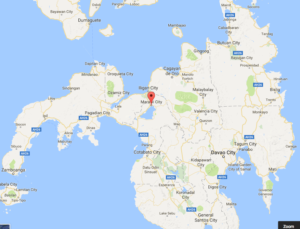
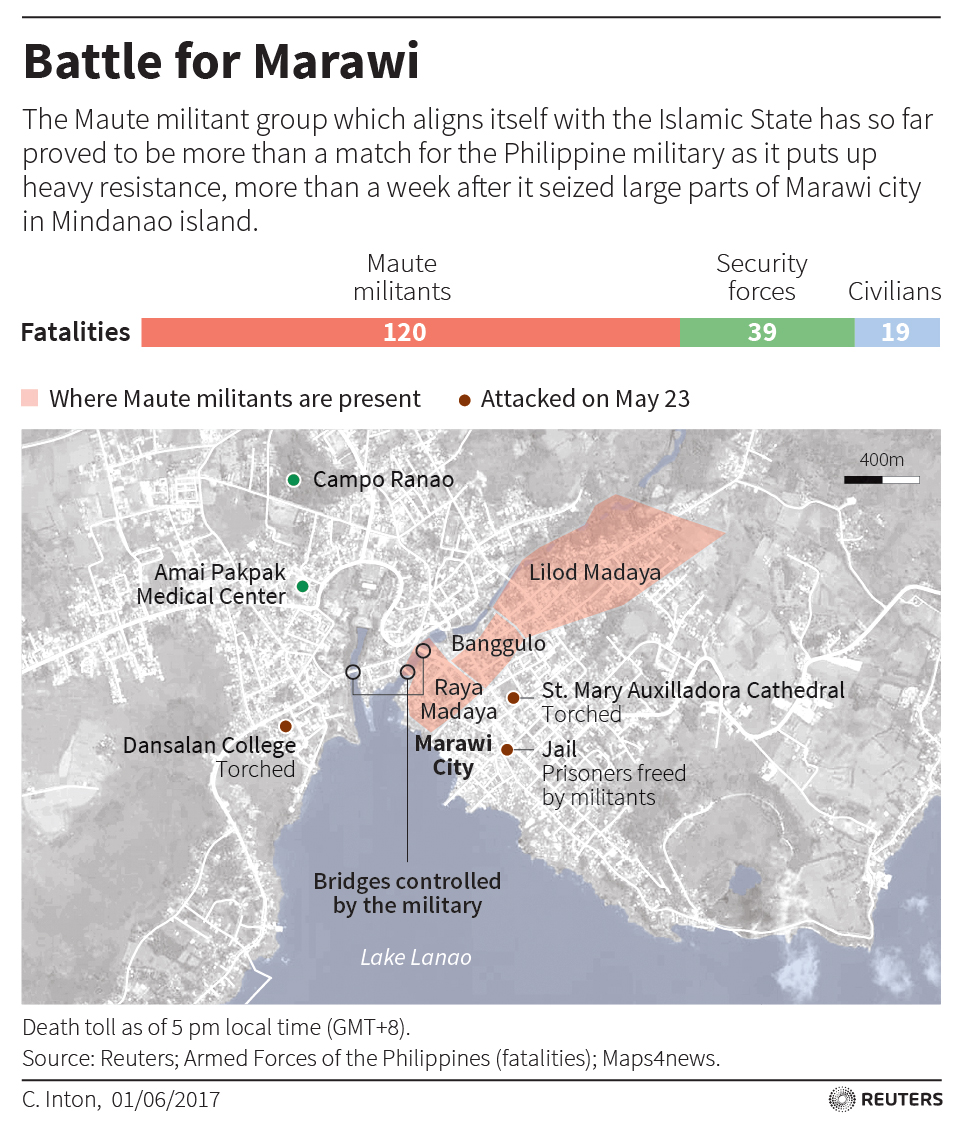
A Muslim militant group linked to ISIS attacked and took control of parts of Marawi city on Mindanao island in the southern Philippines last week. Philippine government troops have been evacuating civilians and fighting back, with soldiers on the ground and attack aircraft in the sky. Gunmen from local terrorist groups with ties to ISIS, called the Maute Group and Abu Sayyaf, overran the city, leading President Rodrigo Duterte to declare 60 days of martial law in Mindanao, as 85,000 residents fled to evacuation centers. While the government says it has now regained control of most of the city, fighting continues, and the death toll has climbed to nearly 100.
Seems like last week’s “at least 15 gunman” may be on the low side.
And the Maute fighters are bringing the Islamic State’s usual tidings of light and joy:
In Marawi City, the Maute showed that it can be as brutal as ISIS. It executed eight city residents and dumped their bodies into the ravine, their hands tied behind their backs and with a sign saying “Munafik” (meaning hypocrite). Eyewitnesses said the terrorists took away those who could not recite the Islamic prayers. They beheaded hostages, killed military men and police, burned government facilities, destroyed hospitals and schools, and in general acted like lunatics out to destroy the city.
The latest reports say that Philippines armed forces have cleared 90% of Marawi City. Maute also claims it holds 200 hostages, though it could be exaggerating quite a bit.
Here’s a WSJ video report that says the Islamic State assault on Marawi City may have been triggered by attempts to arrest Abu Sayyaf head Isnilon Hapilon (wanted by the FBI for beheading American Guillermo Sobero), and mentions the possible presence of foreign fighters:
A group of heavily-armed militants from a group linked to Isis have reportedly stormed a city in the Philippines and engaged in firefights with the national army.
Residents of Marawi City, in the south of the country, were urged to remain indoors as at least 15 gunmen from a Muslim rebel group called Maute stormed the streets brandishing assault rifles.
The group, which is also known as the Islamic State of Lanao, have reportedly received support from Isis.
Troops and a special police force were deployed to the city after residents in a nearby village raised the alarm and appealed for help.
Marawi City is the provincial capital of Lanao del Sur on the southern island of Mindanao.
Like many countries in Asia and the south Pacific, the Philippines has been fighting a Muslim insurgency on and off for quite a while. In fact, if you count the original Moro War fought and won by General Pershing, since 1899. Groups in the Philippines alone that have pledged allegiance to the Islamic State include the Abu Sayyaf Group, Ansar al-Khilafah (also on Mindanao), Bangsamoro Islamic Freedom Fighters (also on Mindanao), and Jemaah Islamiyah (a transnational Islamic terrorist group which which carried out the Bali bombing also has cells in in Thailand, Singapore, Malaysia). And that doesn’t count the Moro Islamic Liberation Front (also on Mindanao), with which the government signed a peace agreement in 2014.
The fight against the Islamic State is one war that extends across the entire globe. Hopefully President Trump understands this fact better than Obama did…
Another eventful week, and not just for the special-prosecutor and impeachment talk freakout Democrats are having. (Looks like they failed to learn the lesson of “Fitzmas.”)
Now the LinkSwarm:
“Almost every promise made eight years ago about Obamacare turned out to be a falsehood.”
No, you couldn’t keep your insurance plan, doctor or provider in many cases. No, it didn’t save $2,500 per family (more like cost $2,500 more per family). No, it didn’t lead to expanded patient choice. And yes, the tax increases and insurance mandates damaged the economy and cost jobs. We are now left with insurance markets that have entered a death spiral. The entire health insurance market will financially implode unless it’s changed.
“Several raids by federal and local authorities across Los Angeles on Wednesday led to the arrests of 44 MS-13 gang members, including murderers, CNN reported. The series of 50 raids occurred before dawn and were led by ATF agents and 1,000 other officers who have been working on the case for around three years. More than half of the 44 gang members arrested were undocumented immigrants, while three members are currently on the run.” (Hat tip: Director Blue.)
Boston prosecutors go out of their way not to deport a foreign national for bank robbery. Result? Two American citizens murdered.
Anthony Weiner pleads guilty. “Prosecutors said they would ask for 21 months to 27 months in prison for Weiner once his plea is entered. He will also be required to register as a sex offender.” That would put him safely past the 2018 midterm elections, but not the 2020 election…
In it are the self-proclaimed elites of government and media. The residents of the zeroth bubble reside in coastal enclaves and surrounded by elaborate systems that protect them from those who live in the first, second and third bubbles.
The residents of the zeroth bubble often secure permanent employment in the form of government sinecure or job-hopping between government, media, academia, lobbying, and public relations.
Their personal security is assured by heavily-armed forces that offer many of them around-the-clock protection.
There is little crossover from the zeroth bubble to the first. And certainly less still between the zeroth and the second.
It’s also safe to say that the device has yet to be invented that can measure the empathy that the elites feel for the residents of the third bubble.
Which helps explain why illegal immigration — from human- and drug-smuggling to MS-13 — is of no concern to the Chamber of Commerce, or your typical Senator, or Thomas Friedman of The New York Times.
The zeroth bubble people wouldn’t ever see the results of the open borders policies they espouse and support, nor can they even countenance them.
In fact, they’re sufficiently disconnected from the residents of the first bubble that they missed the entire Trump phenomenon.
President Donald Trump reversed another eleventh-hour Obama administration regulation, rolling back Democrats’ effort to push private sector workers into state government retirement plans.
Trump signed House Resolution 66 on Wednesday, undoing a regulation adopted by the Department of Labor on October 31, 2016. The department’s rule would have allowed state and local governments to create IRA accounts for private sector workers and automatically deduct contributions from their paychecks without the protections savers enjoy under the Employee Retirement Income Security Act.
Draining the swamp: Half of EPA advisory board dismissed. Also: “The Interior Department has also frozen the work of more than 200 advisory boards, committees and subcommittees last week.” Just think of all the damage they won’t be able to do to the American economy for a while…
I see increasing numbers of so-called liberals cheering censorship and defending violence as a response to speech. I see seemingly reasonable people wishing death on others and laughing at escalating suicide and addiction rates of the white working class. I see liberal think pieces written in opposition to expressing empathy or civility in interactions with those with whom we disagree. I see 63 million Trump voters written off as “nazis” who are okay to target with physical violence. I see concepts like equality and justice being used as a mask for resentful, murderous rage.
The most pernicious aspect of this evolution of the left, is how it seems to be changing people, and how rapidly since the election. I have been dwelling on this Nietzsche quote for almost six months now, “He who fights with monsters, should be careful lest he thereby become a monster. And if thou gaze long into an abyss, the abyss will also gaze into thee.” How easy is it for ordinary humans to commit atrocious acts? History teaches us it’s pretty damn easy when you are blinded to your own hypocrisy. When you believe you are morally superior, when you have dehumanized those you disagree with, you can justify almost anything. In a particularly vocal part of the left, justification for dehumanizing and committing violence against those on the right has already begun.
Signs of cognitive dissonance that show you’re winning the debate: “If you have been well-behaved in a debate, and you trigger an oversized personal attack, it means you won.”
One bitter December day in 2011, Jen was driving the children along a winding road near their home. Samantha had just turned 6. Suddenly Jen heard screaming from the back seat, and when she looked in the mirror, she saw Samantha with her hands around the throat of her 2-year-old sister, who was trapped in her car seat. Jen separated them, and once they were home, she pulled Samantha aside.
“What were you doing?,” Jen asked.
“I was trying to choke her,” Samantha said.
“You realize that would have killed her? She would not have been able to breathe. She would have died.”
“Rear Adm. Robert Gilbeau, the first admiral ever convicted of a federal crime while on active duty, was sentenced on Wednesday to 18 months in prison for lying to investigators about his involvement in a bribery scandal that has ensnared numerous Navy officers.” That would be for the Fat Leonard scandal. (Hat tip: Dwight.)
Senate Conservative Fund-backed Ralph Norman wins primary for South Carolina’s Fifth Congressional seat by 203 votes.
it becomes clear that what you’re seeing is the strange death of Labour Wales – one that goes back further and deeper than June 2016.
In its heartlands, Labour was always a working-class party, and what’s changed is that the working class has been smashed up. The physical traces of that are evident all over south Wales. The mines are now museum pieces. The Sony factory in Bridgend has long since gone, while the town’s Ford plant is reportedly preparing to shed over half its workers. What’s replaced those careers? A scan of the windows of the recruitment agencies tells you: fork-lift drivers, warehouse staff, “recycling operatives”. All at around minimum wage, and hardly any full-time.
For decades, Labour took this area and its other heartlands for granted – while it flirted with Mondeo Man and Worcester Woman. It parachuted in its plastic professional politicians – just think of the way Tristram Hunt was airlifted into Stoke – and ignored the need to nurture local talent. Now in Wales and elsewhere, it is paying the price of decades of ingrained arrogance.
“German Chancellor Angela Merkel has threatened the British government with ‘consequences’ if it were to restrict immigration from the EU member states after the country formally breaks away from the union.” This brings up a number of questions, foremost among them why does she care? First, why should the leader of one country care how another country sets its immigration policy? Second, this suggests that Frau Merkel thinks she’s President of the EU rather than Germany (to be fair, so does most of the world). Third, why would the EU fight to make it easier for their own citizens to leave the EU? Why it’s almost as if Merkel is more loyal to the interests of open borders elites than the German people. Or else the EU wants to dump more Islamic “refugees” on the UK…
Texas House Speaker Joe Straus seems to have finally met his match in Lt. Governor Dan Patrick:
Joe Straus looked like a speaker unquestionably in charge. Then things started falling apart.
The problems for the speaker have been caused by a small group of Republican legislators known as the Freedom Caucus. The core group is nine lawmakers out of the 150-member House, and sometimes they can get their vote up to nineteen. Even some conservative Republicans complain that the Freedom Caucus is not truly Republican, but rather a group of libertarians more bent on causing chaos in the House than anything else. Some of the most prominent members are Matt Schaefer of Tyler, Jeff Leach of Plano, and Matt Rinaldi of Irving. Their titular leader is Bedford Representative Jonathan Stickland, who uses parliamentary rules to kill other members’ bills and then strongly objects when his own legislation suffers a similar fate. The Freedom Caucus opposes Straus but have generally been an ineffective annoyance.
That changed on April 27, when the House endured sixteen hours of debate on an anti-immigration bill to address so-called sanctuary cities. In the course of the debate, Schaefer offered an amendment to prevent police chiefs from restricting their officers from asking people who have been detained about their immigration status. In a moment of conciliation, Schaefer offered to pull down his amendment if Democrats would stop offering their own amendments designed to make Republicans look heartless and cruel. Some Democrats wanted to take the deal, but Representatives Armando Walle of Houston, Cesar Blanco of El Paso and Roland Gutierrez of San Antonio argued against it. By refusing to compromise, the three guaranteed that the so-called “show me your papers” amendment would become part of the bill that Abbott eventually signed into law.
But undeniably, Straus had an opportunity to affect the outcome of that bill. He could have kept it bottled up as he was doing with the bathroom bill, though he had allowed a similar sanctuary cities bill to go through the House in 2011. Straus also could have demanded discipline out of his chairs to vote against Schaefer. The amendment went on the bill by a vote of 81-64, with fourteen of Straus’s committee chairs voting for the Schaefer amendment, while three other members of his leadership team were away at a conference committee on the budget. Straus needed to switch only a dozen votes to keep the most controversial language out of the bill.
The Freedom Caucus was empowered, at least in perception.
In the days that followed, caucus members got an amendment on a foster care bill to prevent the vaccination of children who have been removed from their homes until a court ordered the child’s permanent removal. And last week they used maneuvers to slow down the House calendar so that a “safety net” bill failed to pass to keep agencies subject to the sunset review process alive even if their reauthorization legislation failed. And finally, they won passage of an amendment to a State Bar of Texas bill to make it an affirmative defense for a lawyer under disciplinary review to claim he or she acted because of a sincerely held religious belief—an amendment that Democrats viewed as giving lawyers the ability to discriminate against the LGBT community.
After the religious beliefs amendment passed on a vote of 85-59, Representative Rafael Anchia of Dallas blurted out, “Last session these guys couldn’t pass gas. Now they’re running the floor.”
Several senior Republican members of the Straus leadership team have told me they don’t feel like anyone is in charge in the House. One called it a rudderless ship. None said they are ready to abandon Straus or revolt against him, though the frustration is rising.
With the Freedom Caucus suddenly finding some success in the House, Patrick no doubt saw an opportunity to reassert control of the session. The death of the House version of the “safety net” bill was important. It’s called a safety net bill because it allows agencies under sunset review to continue operating. It has to pass. With the demise of the House’s bill, the only option left is the Senate’s version. And Patrick made clear he intends to hold that bill hostage.
In his press conference Wednesday, flanked by the flags of Texas and the United States, Patrick noted that he had control of the Senate version of the safety net bill. Then he demanded the House surrender on using the state’s rainy day fund to pay for a revenue shortfall in the budget; that the House accept both a private school voucher program in a substantially reduced school funding plan, and a controversial property tax reform for cities and counties; and that some form of his bathroom bill receive House approval. Otherwise, Patrick would force a special session to get what he wants.
Ignore the analysis of the Freedom Caucus. What’s really going on here is that Patrick has emboldened House Republicans who previously lived in fear of Straus’ vengeance to actually start acting like Republicans again.
“Saudis to Make $6 Billion Deal for Lockheed’s Littoral Ships.” This is evidently just one component of a $110 billion arms deal negotiated by both the Trump and Obama Administrations. Though most famous for aircraft, Lockheed has built combat ships off and on for decades and, especially after their merger with Martin Marietta in 1995, has a lot of fingers in a lot of defense contracting pies. (Hat tip: Stephen Green at Instapundit.)
For previous occupants of the White House, close observers could guess what actions a President might take in any given situation based on his ideology, personality, personal history, etc.
No one seems to to have a working mental model for President Donald Trump.
Let’s take a look at two sequential posts by Dilbert-creator and dedicated Trump-watcher Scott Adams. (And I’m picking on Scott Adams not because of his failings, but because he and his “Master Persuader” theory has heretofore been the best predictor of what Trump would do or say in any given situation.)
My guess is that President Trump knows this smells fishy, but he has to talk tough anyway. However, keep in mind that he has made a brand out of not discussing military options. He likes to keep people guessing. He reminded us of that again yesterday, in case we forgot.
So how does a Master Persuader respond to a fake war crime?
He does it with a fake response, if he’s smart.
Watch now as the world tries to guess where Trump is moving military assets, and what he might do to respond. The longer he drags things out, the less power the story will have on the public. We’ll be wondering for weeks when those bombs will start hitting Damascus, and Trump will continue to remind us that he doesn’t talk about military options.
As I blogged yesterday, the claim that Assad ordered a chemical attack on his own people in the past week doesn’t pass my sniff test. For Assad to order a gas attack now – while his side is finally winning – he would have to be willing to risk his life and his regime for no real military advantage. I’m not buying that.
But let’s say the world believes Assad or a rogue general under his command gassed his own people. What’s an American President to do? If Trump does nothing, he appears weak, and it invites mischief from other countries. But if he launches 59 Tomahawk missiles at a Syrian military air base base within a few days, which he did, the U.S. gets several benefits at low cost:
1. President Trump just solved for the allegation that he is Putin’s puppet. He doesn’t look like Putin’s puppet today. And that was Trump’s biggest problem, which made it America’s problem too. No one wants a president who is under a cloud of suspicion about Russian influence.
2. President Trump solved (partly) for the allegation that he is incompetent. You can hate this military action, but even Trump’s critics will call it measured and rational. Like it or not, President Trump’s credibility is likely to rise because of this, if not his popularity. Successful military action does that for presidents.
3. President Trump just set the table for his conversations with China about North Korea. Does China doubt Trump will take care of the problem in China’s own backyard if they don’t take care of it themselves? That negotiation just got easier.
4. Iran might be feeling a bit more flexible when it’s time to talk about their nuclear program.
So in less than 24 hours, Adams went from “Trump is too smart to take that fishy bait” to “Trump is sure smart to have taken that fishy bait, and here’s why.”
I opposed the Syrian strike but, like Adams, think it may have beneficial results in strengthening Trump’s hand in dealing with other world leaders.
But the big takeaway here is that no one has a functioning mental model of what Trump is likely to do faced with any given situation. And that includes America’s foreign adversaries, who must of necessity tread more cautiously than they did under Obama.