U.S. forces pass the 5,500 targets mark, the regime starts emptying the bank accounts of citizens to stay afloat, China’s weapons are (still) garbage, more Iranian planes cratered on runways, a tanker burns off Iraq, Weekend at Mojtaba’s, and the idea that our troops in harm’s way might be eating well enrages the Democrat Media Complex.
CENTCOM operations briefing:
“Every day, we’re striking hard at Iranian ballistic missile and drones. To date, we have struck more than 5,500 targets inside Iran including more than 60 ships using a variety of precision weapon systems.”
“Since the first 24 hours of this campaign, Iranian ballistic missile and drone attacks have dropped drastically but it’s worth pointing out that Iranian forces continue to deliberately target innocent civilians in Gulf countries while hiding behind their own people as they launch attacks from highly populated cities in Iran.”
“Our warfighters are leveraging a variety of advanced AI tools. These systems help us sift through vast amounts of data in seconds, so our leaders can cut through the noise and make smarter decisions faster than the enemy can react. Humans will always make final decisions on what to shoot and what not to shoot and when to shoot, but advanced AI tools can turn processes that used to take hours and sometimes even days into seconds.
Note that YouTube’s auto-translate function renders Operation Epic Fury as “Operation Epicure,” so if you see that somewhere in any Iran reports, you know someone was asleep at the switch…
Iran’s attacks targeting radars and other missile defense equipment in the Gulf have not achieved the regime’s objective of degrading air defenses enough to reliably penetrate them. Interception rates of ballistic missiles have not changed significantly.
Iran likely seeks to preserve the option to threaten, disrupt, and selectively control traffic through the Strait of Hormuz without fully halting Iranian crude exports that still rely on the waterway by mining it heavily.
The combined force continues to target several key internal security sites in Tehran City and Kurdish-populated areas in northwestern Iran. An open-source intelligence (OSINT) analyst reported that the combined force struck several internal security sites in Marivan City, Kurdistan Province, which is about 10 miles east of the Iran-Iraq border in northwestern Iran. Marivan City and other mountainous cities in Kurdistan Province are hotspots for anti-regime protests and clashes between Iranian security forces and Kurdish anti-regime groups.
Russia is reportedly sharing advanced drone tactics with Iran to support Iranian attacks against US forces and assets in the Middle East, which highlights deepening cooperation between key US adversaries. The CNN report comes after three unspecified officials told the Washington Post on March 6 that Russia has provided Iran with the locations of US military assets, including warships and aircraft, since the war started on February 28.
China continues to supply Iran with precursors for solid fuel to support Iran’s ballistic missile program. An OSINT analyst reported on March 11 that the Iranian cargo vessel Barzin departed Gaolan Port in China, likely carrying a shipment of missile fuel precursors, and is now en route to Iran.
Some elements of Hezbollah’s political support appear to be fracturing due to Hezbollah’s participation in the war. Hezbollah ally, the Amal Movement, recently voted in favor of the Lebanese cabinet’s decision to ban Hezbollah’s military activity. The Amal Movement has been Hezbollah’s key political and strategic ally since 2005.
Not a lot new there if you’ve been following along here.
Has the regime run out of money and just started stealing?
The Iranian Mullah Regime cannot meet the payroll of the Regime Security Forces…
…so, it is stealing the next payroll from everyone else.
Food security issues started the last Iranian mass insurrection. The Mullah Regime just lit the short fuze for the next one. https://t.co/xIIQaxfTWe
Coalition air power continues to pound the greater Tehran area:
Iran got $5 billion in Chinese MilTech that proved absolutely worthless:
And it changes EVERYTHING about who's really fighting this war.
🚨 CHINA SECRETLY ARMED IRAN WITH $5 BILLION IN WEAPONS →EVERY SINGLE ONE FAILED 🚨
A secret oil-for-weapons deal between China and Iran has been exposed by Reuters. Beijing raided its own People's Liberation Army… pic.twitter.com/nesaOtWeKt
CHINA SECRETLY ARMED IRAN WITH $5 BILLION IN WEAPONS →EVERY SINGLE ONE FAILED 🚨
A secret oil-for-weapons deal between China and Iran has been exposed by Reuters. Beijing raided its own People’s Liberation Army inventory to fast-track delivery before the war started.
$5 BILLION. Pulled from China’s own military stockpile.
WHAT HAPPENED:
→ US-Israeli strikes destroyed the ENTIRE stockpile on DAY ONE
→ CM-302 missiles launched at US Navy – ZERO hits
→ Some malfunctioned mid-flight. Others intercepted by SM-3 and SM-6
→ 100% failure rate. Not a single US warship scratched.
💀 China’s “world’s best anti-ship missile” = couldn’t hit a destroyer
💀 CM-302 has NO data link, NO satellite guidance, NO active terminal tracking
💀 Once launched it flies BLIND — and the US Navy knew it
💀 $5 BILLION in Chinese weapons = DESTROYED in hours
⚠️ China denied the deal publicly. Reuters confirmed it.
⚠️ This violates the UN weapons embargo reimposed last September
⚠️ China pulled weapons from its OWN military – meaning its Pacific fleet is now WEAKER
They’re showing you Iran’s missile launches and calling it a threat.
They’re NOT showing you that China armed Iran with its best weapons → and they ALL failed against American destroyers.
You don’t secretly arm a country with $5 billion in weapons from your own military unless you’re betting on them winning. China bet everything on Iran. And lost.
Oil terminals at Iraqi ports on Thursday said they have suspended operations following attacks on tankers near its waters, according to Iraqi authorities cited by state media.
Farhan al-Fartousi, director general of the state-owned General Company for Ports of Iraq (GCPI), said was quoted by the Iraqi News Agency (INA) as saying, “The operation of oil ports has been suspended, commercial ports continue operations.”
Ships remain in the waiting area, and loading and unloading are ongoing at the North and South Um Qasr ports, the INA reported.
This decision, the news outlet reported, was taken after a tanker loaded with petroleum products – supplied by the Iraqi State Organization for Marketing of Oil (SOMO) to the Iraqi Oil Tankers Company, “was involved in an incident”.
Al-Fartousi said that the vessel was carrying a fuel supply tank in the Ship-to-Ship (STS) transfer area and was in the process of loading when it was hit by an explosion. He added that “one of the smaller tankers involved flies the Maltese flag.”
SOMO is Iraq’s national company responsible for marketing and exporting the country’s crude oil and fuel oil. Headquartered in Baghdad, it manages sales to international buyers.
As per the Iraqi News Agency, rescue teams from the company, in coordination with naval units in the SDS area, recovered 38 people, including one confirmed dead. Specialized firefighting tugs from Basra Oil Port were deployed to extinguish fires on both vessels, while search-and-rescue teams continue to look for missing crew members.
There’s video:
The US loses a KC-135 refueling tanker over Iraq, evidently due to an aerial collision with another friendly aircraft (which landed safely). Rescue efforts “ongoing.”
“An SAS base in Iraq was hit by a barrage of drones last night as top UK generals confirmed that Russia was ‘definitely’ helping Iran.”
I have to give leftists and Democrats some credit because they put in no effort to conceal their true feelings, objectives, or that their hatred for President Donald Trump blinds them.
They lost their minds when data showed that Secretary of War Pete Hegseth spent a lot of money to improve the lives of the military.
They latched onto the $20 million spent on steaks, lobster tails, and crab legs.
How Pete Hegseth spent taxpayer funds:
$225 million for furniture
$15.1 million for ribeye steak
$6.9 million on lobster tail
$5.3 million for new Apple devices
$2 million for Alaskan king crab
$139,224 on donuts
$124,000 for ice cream machines
$98,329 for a grand piano
— Melanie D’Arrigo (@DarrigoMelanie) March 10, 2026
Snip.
Also, who is “they?”
Didn’t Congress allocate the money for the Defense Department?
What does the allocated money have to do with healthcare costs, SNAP, and other services that do not fall under the defense budget?
Am I missing something here? Doesn’t Congress have to approve the budgets? How did the “they” cut those costs?
If Congress doesn’t want the military to eat well, have treats, and have a better life while serving, then maybe don’t hand the department billions.
More on that subject via Stephen Green at Instapundit:
I've heard Democrats complain more loudly about our soldiers being well fed than about fraud in California or Minnesota. They sure do have their priorities. They seem to only be upset about the military spending because they'd prefer the lobster and steak to go to illegal aliens.
As usually, this is just what I was able to collect from various sources. If you think I’ve missed anything important, feel free to share it in comments below.
The more the Islamic Republic of Iran lashes out at other countries in the region, the more obvious it is that eliminating the regime and its nuclear ambitions was the right call. I once read a quote that if Hitler had possessed nuclear weapons in the in his bunker as the end drew near, he surely would have used him. That’s the sort of nihilistic death-spasm we’re seeing from the Iranian regime.
Some news:
U.S. submarine torpedoes Iranian frigate IRIS Dena off Sri Lanka:
Note that secretary of defense Pete Hegseth stated that we sunk the IRIS Shahid Soleimani, but the video he showed was that Suchomimus posted, which is clearly not a Soleimani-class ship with its distinctive duel prow. There’s obviously some confusion here. But maybe Hegseth just mixed up the videos, as this CENTCOM tweet des seem to show stills from a strike on a Soleimani-class ship.
U.S. forces have struck or sunk to the bottom of the ocean more than 20 ships from the Iranian regime. Last night, CENTCOM added a Soleimani-class warship to the list. pic.twitter.com/KgW8cS726P
With complete American/Israeli air superiority over Iran, the B-52 has joined the fight:
Also, F-22 Raptors have been stationed in Israel, possibly setting the stage for the greatest Habitual Linecrosser video ever.
There are conflicting reports on whether Kurdish rebel forces have launched a ground invasion into Iran or not. Kurdish sources seem to be denying it. But it wouldn’t surprise me if they’re infiltrating units.
“A citizen sent a video to IranWire, reporting several consecutive explosions in the city of Baneh. The United States and Israel extensively targeted some positions of the Islamic Republic in the city of Baneh today.” Location of Baneh? Kurdistan province.
Simon Whistler explains how Russia and China are going to do “jack” and “squat” to Iran. Or, more specifically, all the moral support you can pack into a roadside IED.
Russia is too busy with its quagmire in Ukraine, and China gets more oil from the Persian Gulf states Iran has been drone and missile attacking than from Iran.
“In a way, Russia and China have delivered Iran the ultimate geopolitical insult. They don’t hate Iran. They aren’t condemning Iran, but at the end of the day, they just don’t really care that much. After decades of loyal partnership, and recent years where Iran has clearly believed that its relationships with China and Russia were growing far deeper, Iran has been discarded. It’s too inconvenient to defend. It isn’t valuable enough to save. And for Moscow and for Beijing, it’ll be easy enough to forget.”
OK, that’s the news I’ve scraped today. If there’s something significant you think I’ve missed, feel free to share it in the comments.
U.S. and Israeli are still hitting targets, and Iran is still retaliating by hitting every other country on the Persian Gulf. Here are some significant updates from the war in Iran:
The IDF targeted a building in which Tehran’s 88-member Assembly of Experts was meeting to choose Iran’s next supreme leader, Israeli sources told The Jerusalem Post on Tuesday.
Iranian news agencies reported that the building was “flattened” during the Israeli strikes.
No injuries or deaths resulting from the strike have been reported as of early Tuesday evening.
Earlier on Tuesday, Iran’s ISNA news agency cited a member of the Assembly of Experts as saying that choosing the successor to the previous supreme leader, Ayatollah Ali Khamenei, “won’t take long.”
So IDF wiped out not only the top guy and his successor, but also all the likely successors as well…
Suchomimus has damage assessment from coalition naval strikes:
Highlights:
IRINS Makran, a former tanker converted to a forward base ship and Iran’s largest naval vessel, is on fire.
A bunch of smaller ships at Bandar Abbas were also likely hit.
Several frigates likely sunk, and one possibly sunk for the third time.
Lots of stuff hit at Konark naval base in the southeast, both ships and base infrastructure, including a floating dock. IRINS Jamaran is no longer on fire, but is partially underwater.
Multiple targets hit at the Iranian naval base at Bandar-e-Jask.
The Qataris are already joining in the strikes against Iran, and the Saudis might follow suit. “These two countries have the largest and most capable air forces in the Gulf. Qatar can field 22 Eurofighter Typhoon, 40 F-15QA, and 36 Rafale aircraft. Saudi Arabia operates 68 F-15C/D, 149 F-15S/SR/SA, 71 Eurofighter Typhoon, and 77 Tornado aircraft.”
Did Iran hit UAE THAAD missile defense radar sites?
It looks like the IRGC did not lie and indeed destroyed the AN/TPY-2 radar of the THAAD Anti-Ballistic Missile (ABM) System at Al-Ruwais, UAE.
On Sunday, mobs of young practitioners of the Religion of Peace™ stormed the U.S. consulate in Karachi (Pakistan) and the U.S. embassy in Baghdad (Iraq).
Iraqi police managed to put down their riot before things got too spicy, but in Pakistan, the Marines got a chance to put their training into action, killing 10 and wounding dozens more as rioters pried open the consulate’s gate (local security forces were also on-site, including the Pakistan Rangers).
Another 12 people were killed by local police in the north of the country as a mob stormed U.N. offices.
Seeing lots of reports that the CIA is arming the Kurds to help overthrow the regime, but the source seems to be CNN, so naturally I’m treating that with several grains of salt.
That’s my quick impression of the news out of theater. If you think Imissed something significant, feel free to share it in the comments below.
Days 1 and 2 of Operation Epic Fury/Roaring Lion were filled with so much dramatic news and high value targets that it was hard to keep up. Day 3 is a bit less dramatic, just more U.S. and Israel strike packets hitting targets in the country with essential impunity. And some of those targets (like border posts and police stations) seem to be tertiary targets.
So here’s another round up news. I think all the tweets are from the Suchomimus Discord.
In what has to be the greatest hack since the beeper attack, the ingenious Israelis have had their cyber guys at work again and busted into the regime’s version of The Hallow app for Islamic Religious Fundamentalists.
Why is this important?
It’s state-sponsored, and everyone gets it.
So now, instead of saying ‘Allahu ackbar,’ the prayer app is telling Iranians across the country, ‘Hang in there – WE ARE COMING..’
Years before the air strike that killed Ayatollah Ali Khamenei, Israeli intelligence had been quietly mapping the daily rhythms of Tehran.
According to reporting by the Financial Times, nearly all of the Iranian capital’s traffic cameras had been hacked years earlier, their footage encrypted and transmitted to Israeli servers. One camera angle near Pasteur Street, close to Khamenei’s compound, allowed analysts to observe the routines of bodyguards and drivers: where they parked, when they arrived and whom they escorted.
That data was fed into complex algorithms that built what intelligence officials call a “pattern of life,” detailed profiles including addresses, work schedules and, crucially, which senior officials were being protected and transported. The surveillance stream was one of hundreds feeding Israel’s intelligence system, which combines signals interception from Unit 8200, human assets recruited by the Mossad and large-scale data analysis by military intelligence.
The result was Ali Khamenei and company getting express tickets to the afterlife.
— Babak Taghvaee – The Crisis Watch (@BabakTaghvaee1) March 2, 2026
Border post strikes:
NEW: Israeli jets have begun striking border guard positions along the Iraq-Iran frontier in what appears to be an effort to weaken Iranian control over the region and potentially clear a path for armed Iranian Kurdish opposition groups based in Iraq to move back into Iran. pic.twitter.com/srj7CWrGWr
#BREAKING: All detainees held at the Central Prison of (Kurdish town of) Marivan (Mariwan) were released shortly after Israeli and U.S. fighter jets bombed military and intelligence facilities in the city, according to information received by Hengaw. The development occurred on… pic.twitter.com/nPKpTKWoRa
— Wladimir van Wilgenburg (@vvanwilgenburg) March 2, 2026
The American military says it struck Iranian naval drone carrier IRIS Shahid Bagheri during the opening strikes on Iran on Saturday.
“The Iranian regime’s false messaging machine continues to falsely claim that it has sunk a US aircraft carrier. The only carrier that has been hit is the Shahid Bagheri, an Iranian drone carrier,” the US Central Command says.
“US forces struck the ship within hours of launching Operation Epic Fury,” CENTCOM adds.
Tiny problem: The city of Ilam is overwhelmingly Kurdish and very far from Tehran. So we can’t use Ilam as proof that the mullahs are on the brink of losing power, as much as that is a consummation devoutly to be wished.
But it’s an interesting data point, as is Kanal 13’s video on the Islamic regime losing control of Abdanan as well:
And wouldn’t you know it, Abdanan is another Kurdish city in western Iran.
It looks like the mullahs have a Kurdish problem. Or, more specifically, the mullahs can no longer repress the Kurdish problem they’ve always had.
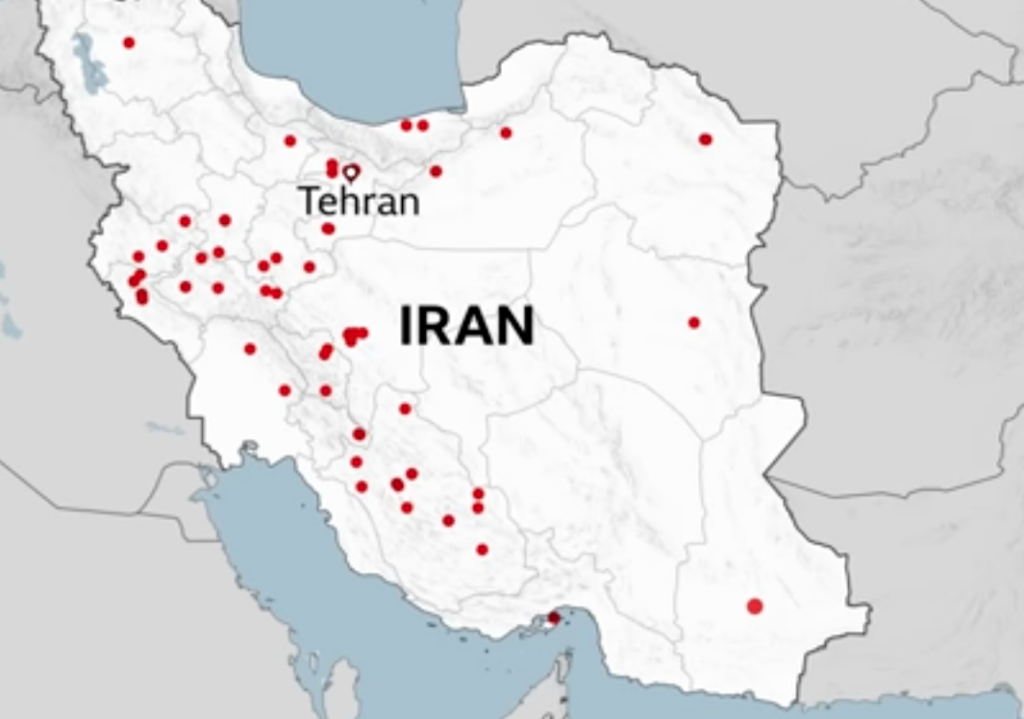
But it’s not just the Kurds! Take a look at this BBC report on where mass protests against the Islamic regime have broken out.
Notice how heavy protests are in the western part of the country:
Those clashes mapped in the upper, western part of the country are probably majority Kurds. But not the ones in the southwestern part of the country. Those are Lurs.
No, not that one.
You may not have heard of the Lurs, because they haven’t played a significant role in the war against the Islamic State, or any of the various other Iraqi and Syrian civil wars, the way the Kurds have. They’re an Iranian ethnic minority with their own language, and while they’re also Shia, they have a lot of syncretic elements from Yarsanism and Zoroastrianism, so naturally the mullahs consider them heretical.
So while having the Kurdish and Lur areas of the country rise up against the Islamic Republic isn’t necessarily a sign of the regime’s immediate demise, it does present a unique challenge to it. Right now, the regime probably needs all its military and security forces to keep a lid on Tehran and adjacent areas, and likely doesn’t have any to spare to bring restive western areas to heel.
Dictatorships with significant minority populations inside their country either need to repress them or buy them off. Vladimir Putin has used both approaches with the Chechens. With its currency in freefall, Iran is too broke and overextended to pay them off, but will be hard-pressed to scrounge up enough muscle to repress them, having to play whack-a-mole with outbreaks of resistance across the country.
And the longer the Kurds and Lurs stay free of Tehran, the more difficult and painful it will be to bring them to heel, even if the mullahs survive the most recent uprising.
There’s a raging debate on the right about whether the Trump Administration should back regime change in Iran or not. After holding off on killing Iranian Supreme Leader Ayatollah Ali Khamenei (reportedly at Trump’s behest), Israel seems quite open to taking him out along with any remnants of the rest of the regime. Somefigures on the right (Tucker Carlson and Candace Owens being two, though each have being moving, at various speeds, to the right’s fringes for a while now) are absolutely dead-set against regime change in Iran.
Over all of this, of course, hangs the specter of the Iraq War(s), in which the United States expended trillions of dollars and thousands of soldiers lives in order to gain very little (deposing Saddam and sorta, kinda, stabilizing post-Saddam Iraq). And for all this we got to endure three decades of heightened terrorist attacks due to having U.S. troops in “the land of the two mosques.” So it’s understandable that Americans would want to avoid another long slog of nation-building in a failed Middle East state to prevent it from becoming a haven for transnational Islamic terrorism.
Understandable, but not applicable to Iran, for the most basic of reasons. Iraq was an Arab state with Sunni minority leaders ruling over a restive Shiite minority. The Islamic Republic of Iran is a Persian nation currently ruled over by a Shiite theocratic dictatorship that is already one of the region’s main (if not the main) financial supporters of terrorism. There’s no danger of an Arab Sunni terrorist group like the Islamic State taking hold, because the population of Sunni Arabs in Iran is too small for such an insurgency to take hold. And there’s no nation in the Middle East that seems likely to pick up the mantle of funding Shiite fundamentalism in the region. (Qatar’s ruling family is Sunni, as is the overwhelming majority of Pakistan.) Ali Khamenei is the head of the snake, and when his regime dies, the snake dies as well.
If Israel can finish off Khamenei’s regime, what follows it will not be something worse, or even a failed state like Somalia. There is every sign that ordinary Iranians are weary to death of being under the heel of the Mullahs, and what will follow more likely to be more secular and western-oriented state than what is there now (which is, to be sure, a very low bar.) And though Iran is somewhat multi-ethnic, the minorities there (primarily Kurds and various Turkish ethnicities) are too small compared to the ethnic Persian majority to seriously contend for control of the Iranian state. (The Kurds could, in theory, launch a bid for independence (or, like in Iraq and Syria, quasi-independence), but without U.S. support are unlikely to make much headway. Their best play may be to negotiate broad autonomy with any new government.)
Could there be a civil war power struggle to rule post-theocratic Iran? Possibly. Still a better outcome for us than a theocratic, terrorist-supporting Islamic state with nuclear weapons. Ditto a military dictatorship, as long as they allowed an end to the nuclear weapons program. Ditto any number of other possible political outcomes, from a modern, secular democratic state to a (deeply unlikely) restoration of the Pahlavi monarchy. All are almost certainly improvements over the fanatical, institutional hostility to the west shown by the mullahs. (Not to mention the fanatical, institutional hostility to Israel. Historically, Persians and Jews have gotten along well, both being outsiders to the Turks and Arabs running the Ottoman Empire.)
There’s no reason to fear a post-theocratic Iran because we won’t be the one having to do nation-building or pick up the pieces.
Getting rid of a government than ritually chants “Death to America” and funds terrorists that have killed numerous Americans throughout the life of the regime must be considered a desirable outcome. The Abraham Accords indicated that a number of Sunni Arab states are abandoning their institutional hostility to Israel and the west, and toppling the mullahs will dry up funds for Shiite terrorism across the world as well. The result will not automatically make the Middle East peaceful and prosperous, but will probably calm things down enough to measurably move the region a bit closer to those admittedly very distant goals.
As a serious book collector and owner of two large dogs, I’m not a “van life” candidate. But this is a seriously cool and well-thought out conversion of a Dodge RAM ProMaster 3500 extended cab cargo van into a mobile full-time living space.
It’s pretty amazing that all that took only 4 months and $6,000.
A few things I would change:
If I were going to use it in Texas, I would need some sort of AC, even though I know those can be energy hogs, but there appear to be some options out there.
The propane set up for two stove burners and water heater for showers is cool, but I might want to opt for a microwave, tankless water heater and hot plate (though I know the first two of those can be energy hungry) just to simplify my energy logistics chain for true off-grid living.
I would need dedicated, concealed storage space built in for a few guns.
I’d need at least one bookcase (with retraining straps to keep the books from flying off in turns, naturally), because Me.
Possibly uses:
For real SHTF scenario, this sort of setup provides a pretty strong basis for a bug-out van that will let you live off the grid for quite a while. Drawbacks: It’s not a hybrid, so you can’t move the van off solar power once the gas runs out. You would probably want to add a switchable extra tank at a bare minimum for that use case, if not going with some sort of hybrid or solar conversion case. And it’s not armored against small arms fire, so some work in hardening parts of the van for that situation might be in order. Lots of weight/energy/cost tradeoffs to consider.
If you have a job where you have to be physically present at a high-cost location to work (like Silicon Valley), this looks like a really solid alternative to paying $3,000 a month in rent. And if you were an oilfield worker, this would let you really save money. (Again, you’d really need that AC if you were living in Odessa.)
Today’s theme: Two men succeeding in what they were trained to do in vastly different arenas through dint of training, perseverance and will.
First, President Donald Trump presented the Medal of Honor to Sergeant Major Thomas Payne, who helped rescue over 70 Kurdish prisoners held prisoner by the Islamic State in the Iraqi town of Hawija while under fire.
Payne’s team secured the area and prepared to free the trapped men. As they cut the lock on the prison door inside the building, Payne could see the expressions on the faces of the hostages turn from fear and desperation to excitement and joy once they realized they were being rescued.
As the hostages were being released, Payne received a call on his radio that the team in the second building needed help. The sound of the firefight just 30 yards away was intense, and Payne knew he needed to move quickly. “Let’s get into the fight,” he said to a teammate.
Payne and his teammates moved to the roof of the burning building where the second team had called for help. They continued to receive constant fire from the enemy, who had set up a position to their west, and from the enemy in the building directly below them.
The team attempted to enter from the roof using small arms and grenades, but were unsuccessful. As Payne heard screams of “Allahu akbar” below, followed by the explosions of suicide vests, he was able to move his team to the ground and look for another position to enter the building.
As his team attempted to breach the building’s fortified walls and windows, several of the Kurdish forces were wounded by enemy fire. Through the smoke and chaos, Payne looked into the building’s entryway and noticed the main prison door used the same type of lock he had seen in the first building. He knew he would be exposed to enemy fire if he attempted to cut the lock himself, but he also knew the hostages trapped inside the burning building would die if something wasn’t done.
Payne grabbed a set of bolt cutters and ran into the building to cut the first lock on the door. Smoke poured out of the entryway as Payne received enemy fire. After cutting the first lock, Payne moved back to a safer position to avoid incoming fire and recover from smoke inhalation, but there was still a second lock that needed to be cut. After the Kurdish forces tried unsuccessfully to cut the second lock, Payne again exposed himself to enemy fire and suffocating smoke to cut the lock and reach the hostages.
Once the second lock was cut, the combined force rushed into the burning building to reach the hostages and eliminate remaining threats. A call came over the radio that the building was beginning to collapse and the mandatory evacuation order was given. The hallways were thick with smoke and they were receiving enemy fire, but there were still hostages inside. Payne knew the team had to move quickly.
Many of the hostages were disoriented and unsure of what was happening. Payne directed the large group to safety, at one point grabbing a man and pulling him down the hallway, allowing the hostages to move out of the building. Still receiving fire, Payne went back in a second time, finding and dragging a large man out of the building to safety. Finally, after Payne entered and exited the building a third time to make sure everyone was out, he gave the “last man” call so the task force could prepare for extraction.
The combined force created a human wall so the hostages could be safely moved from the building as they continued to receive enemy fire. But when Payne and others returned fire, the hostages would stop running out of fear and confusion. Payne’s team held their fire and put themselves at risk to shield the hostages and safely get them out of the compound.
As the helicopters arrived, Payne was faced with another problem. With so many hostages rescued, they could not be sure they had enough seats on the helicopters. After some quick math, they were able to get everyone on board, but it was so cramped that Payne’s team would have to stand for the entire flight back.
The hostages, Payne’s task force and the partnered forces flew back to Erbil. They had just taken part in one of the largest hostage rescues in history, and for his actions that day, then-Sgt. 1st Class Thomas Payne would be recommended for the Medal of Honor.
🇺🇸 Delta Force soldier who helped save 70 ISIS hostages from execution in daring raid receives Medal of Honor from President Trump.
Sgt. Major Thomas Payne said he joined the military because of 9/11.
Rick Rescorla—born a Brit (in Cornwall) who became an American (and fought in Vietnam)—was worried about the safety of New York City’s World Trade Center. Ever since the 1993 terrorist attack, when a bomb blew-up in the building’s basement, Rescorla worried that it would happen again.
During the 1993 attack, Rescorla was upset that the building evacuation had gone so poorly. He vowed that such a muddled exodus would never happen again. Among the first to understand that a new kind of terrorism was targeting innocent office workers, he became the director of security for Dean Witter/Morgan Stanley in 1997.
Believing the Trade Center (where Morgan Stanley was headquartered) was a particularly vulnerable terrorist target, Rescorla recommended that his company find different space. Because of lease obligations, however, that alternative was not possible. Instead, Rick developed an emergency evacuation plan which he required the Morgan Stanley employees to practice over and over.
Rescorla could just not get out of his head that the Trade Center would be attacked again. When it happened, on September 11, he and his colleagues were ready.
When the Port Authority issued an announcement, via its PA system, that everyone in the South Tower of the World Trade Center should remain calm and stay at their desks, Rescorla couldn’t believe his ears. He immediately began an evacuation process.
With bullhorn in hand, he ordered the Morgan Stanley employees to evacuate the building. Before the second plane struck the South Tower, his colleagues were on their way down the stairs. Thousands of people—nearly 2700 to be precise— owe their lives to Rick Rescorla, and many are vocal about that fact…Because of Rick Rescorla’s foresight and belief that he knew what was right, nearly every Morgan Stanley employee made it safely out of the South Tower before it collapsed.
Rescorla died in the south tower collapse, and his body was never found.
Remember back when President Trump announced the withdrawal of U.S. troops from Northern Syria, and Democrats not only told us this was The Worst Thing In The World (at least until the next Worst Thing In The World) and would inevitably lead to Turkish genocide against the Syrian Kurds?
Given that the mainstream media has largely stopped covering the conflict, that does not appear to be the case. In announcing the withdrawal, President Donald Trump announced that Turkey’s intention was to set up a 20 mile buffer zone in Syria against Kurdish PKK terrorists that operated among the larger YPG/SDF forces there. Looking at a map of Syria today, more than a month into the incursion, that appears to be largely what they’ve done.
This doesn’t mean that things there are all hunky dory, or that it won’t change, or that the incursion was justified, or that Recep Tayyip Erdogan isn’t a power-hungry jihadist scumbag. It just means that when Turkey announced that their objectives in the incursion were just that 20 mile buffer strip, they may not have been lying. All this adds up to considerably less than the genocide Democrats and their MSM allies foretold.
And that’s why we’ve ceased to hear much about the Turkish incursion in Syria: the issue can no longer be used to bash President Trump, so it’s no longer “useful” to report on it…
Enjoy this roundup of links on the Islamic State in specific, and Syria, Turkey and the Kurds more generally, after Abu Bakr al-Baghdadi’s timely demise:
Abu Bakr al-Baghdadi, the hirsute rapist whom hundreds of thousands of Islamic State supporters considered their absolute leader, died yesterday during a U.S. military raid in northwestern Syria’s Idlib province, President Donald Trump announced on Sunday morning. Baghdadi became the head of ISIS in 2010 but was not seen in public until 2014, when the group designated him caliph and he addressed the world in a florid speech from the pulpit of the al-Nuri mosque in Mosul, Iraq. Since then he has shown himself only once, on a dull video filmed in a windowless room and released in April.
As with Osama bin Laden, the most intriguing fact about Baghdadi’s assassination was its location, deep in what was considered enemy territory. The dominant force in Idlib is not ISIS—which is no longer dominant anywhere—but Hay’at Tahrir al-Sham (HTS), an affiliate of al-Qaeda. Recall that ISIS broke from al-Qaeda in 2013, and since al-Qaeda’s leaders rebuffed Baghdadi’s invitation to bow before him, the groups have traded nonstop insults and their members have tried to kill one another. Some of these insults do not strike me as the type that either side could easily take back: accusations of apostasy, disloyalty, cowardice, and idiocy. For Baghdadi to seek refuge among people who want to kill him probably means that the places where he had more support, such as within his home country of Iraq or near its border with Syria, could no longer provide him with any measure of safety. Finding him in HTS territory is like finding Derek Jeter hiding out in South Boston, or Martin Bormann living quietly by a synagogue on the Upper East Side.
Snip.
Baghdadi was special. By calling for the allegiance of all Muslims—and actually being taken seriously by a large number of them—he accomplished something no previous terrorist leader had done. He channeled, for the masses, a collective sense of connection to a glorious fantasy of an Islamic past. Bin Laden had asked Muslims to rise up in defense of Islam. But his concerns were distinctly 20th-century: overthrowing Arab despotisms, snuffing out the Jewish state, knocking over skyscrapers.
Baghdadi possessed a dramatic vision, one that any Muslim could partake in, that placed himself and anyone brave enough to join him in a line of warriors that extended back to the Prophet Muhammad himself. He noted, ostentatiously, that he hailed from the tribe of Quraish, the Prophet’s own. Historically, Muslims have counted membership in that tribe as one of about half a dozen criteria required of a valid caliph. That criterion had lapsed in importance for literally centuries, with numerous caliphs having no plausible claim to Quraishi ancestry. But Baghdadi claimed that he was a caliph, sensu stricto, in the classical tradition going back to the Abbasids. Furthermore, he would bring back a version of classical Islamic law, including legalized sex slavery and other abominations, in which he partook personally.
And now, like the Abbasids, he is dead—smashed to bits, according to Trump, by a self-detonated suicide vest. (His death was less tidy than that of his immediate Abbasid predecessor, al-Musta’sim Billah, 1213–58. The Mongols who deposed him believed that splattering his blood on the streets of Baghdad would bring bad luck, so they wrapped him in a carpet and stampeded their horses over it until his corpse was nicely tenderized.) Killing al-Musta’sim ended a dynasty. The Islamic State will likely name a successor to continue Baghdadi’s line. But the second caliph of the modern Islamic State will begin his reign in an even more impotent and pathetic state than Baghdadi left it.
When I began speaking with ISIS supporters five years ago, they parroted all the points of propaganda that the group has since made famous. But they included one point that the Islamic State has since de-emphasized. To be a valid caliph, they said, one must have control over territory and implement Islamic law within it. A pledge of allegiance to a caliph (called bay’ah, both classically and by ISIS), they stressed, is a contract, an agreement between parties in which each offers something to the other. The caliph offers an Islamic state; his subject offers obedience. The contract evaporates when the caliph stops providing a state.
Abu Bakr al-Baghdadi has not provided a state for quite a while. Within the Islamic State, members have grumbled that he has been an absentee caliph, gone for months at a time, and not even clear in his instructions about whom to follow in his absence. The group long since stopped promising a paradise, and downgraded its territorial offering to a hellscape soon to be overrun by its enemies. It became ideologically split, with hard-liners accusing others of being softies, and both the softies and the hard-liners trying to kill one another. Baghdadi, it seems, was gone for much of this debate, and provided only vague guidance and little in the way of security or leadership. Some former supporters have felt abandoned, and have voiced their disgust.
His death will therefore definitively end an era that had already, in a sense, ended, if not with a whimper then with an inglorious bleating of complaints from his own flock. For years now, the hardest thing for outsiders to understand about the Islamic State has been its ability to inspire—to get some Muslims to leave comfortable circumstances to fight and die. For the past year, even as the world has diverted its attention from ISIS, the group’s ability to inspire has been severely diminished, and almost no one is leaving home to die for ISIS, or choosing to die in suicide attacks for ISIS at home. The inspiration is gone, and the party is over, for now. And although Baghdadi has obtained the martyrdom he sought, he got it in the end not as a caliph but as just another bloody hairball in a pile of rubble.
Legacy media outlets responded to President Trump’s announcement of the U.S. military’s successful mission against ISIS leader Abu Bakr al-Baghdadi with their trademark hostility and anger. That’s because the inarguably good news threatens corporate media goals for shaping foreign policy, impeaching the president, and defeating Trump in 2020.
Snip.
Corporate media have moved from at least projecting concern for reporting the actual news into unembarrassed political actors. That enables them to flamboyantly spin — as opposed to their previous method of subtly spinning — even major news with indisputable facts.
The 2016 campaign was a humiliating defeat for Hillary Clinton, but also for political media. Media outlets never understood the electorate they were paid big dollars to write and broadcast news about. They confidently asserted Trump had no chance to win, and convinced themselves that casting off journalistic standards was defensible because of the certain ruin Trump would bring.
Instead, President Trump’s administration has been marked by success in the domestic and foreign spheres. The economy is humming, including job and wage growth the media had previously said was unlikely to impossible to achieve. This is due to tax cuts, tax reform, and unprecedented deregulation. No new wars have been launched, much less the apocalyptic nuclear wars the media predicted. A long overdue recalibration with China is taking place.
What is good news for the country is bad news for the media and their political allies.
One of the tools they can utilize in their war on the president is to deny him honest media coverage of his successes, making it more difficult to clip news of them discussing those successes in an honest fashion. It’s not a conspiracy so much as a shared mindset that kicked into action this weekend.
Snip.
Trump Foreign Policy Successes Undermine Media Impeachment Drive
The biggest champions of impeachment are the media, seeking to save face after their 2016 and Russia collusion hoax failures. They have all but forced the Democrats to launch the proceedings even though their path is fraught with difficulties.
Yesterday’s Sunday Morning shows — no matter the outlet or the particular host — were all scheduled to throw more fuel on the impeachment fire. Instead, they were forced to cover a major success in the battle to defeat the Islamic State.
Impeaching the president who oversaw the operation looks even worse than just impeaching the president who has survived a non-stop, years-long campaign from the media, Democrats, and other Resistance members. For impeachment to have any chance of survival, the media need to both downplay and move quickly from the story back to their uncritical repetition of Democratic Party talking points.
Elsewhere, Syrian and Turkish forces are reportedly slugging it out with one another near Ras al-Ayn on the Turkish-Syrian border. Evidently that’s actual Syrian regulars engaged against actual Turkish regulars, not just their respective proxy forces (which are also involved), though I’m not sure that’s been verified. I fail to see how having a small contingent of U.S. troops there in harm’s way would improve the situation. (See here for my previous update.)