London: A Fourth Night of Violence Begins

August 9th, 2011

So newspapers are reporting. Maybe rioters are going back to pick up sound systems to go with their new plasma TVs, or going after those arrogant buildings that remain so rudely unburned.

Here are some pictures.

Says Brendan O’Neill at Spiked:

Painting these riots as some kind of action replay of historic political streetfights against capitalist bosses or racist cops might allow armchair radicals to get their intellectual rocks off, as they lift their noses from dusty tomes about the Levellers or the Suffragettes and fantasise that a political upheaval of equal worth is now occurring outside their windows. But such shameless projection misses what is new and peculiar and deeply worrying about these riots. The political context is not the cuts agenda or racist policing – it is the welfare state, which, it is now clear, has nurtured a new generation that has absolutely no sense of community spirit or social solidarity.

What we have on the streets of London and elsewhere are welfare-state mobs. The youth who are ‘rising up’ – actually they are simply shattering their own communities – represent a generation that has been more suckled by the state than any generation before it. They live in those urban territories where the sharp-elbowed intrusion of the welfare state over the past 30 years has pushed aside older ideals of self-reliance and community spirit. The march of the welfare state into every aspect of less well-off urban people’s existences, from their financial wellbeing to their childrearing habits and even into their emotional lives, with the rise of therapeutic welfarism designed to ensure that the poor remain ‘mentally fit’, has helped to undermine such things as individual resourcefulness and social bonding. The anti-social youthful rioters look to me like the end product of such an anti-social system of state intervention.

It would be nice not to have to do another update on this story, but I suspect I will…

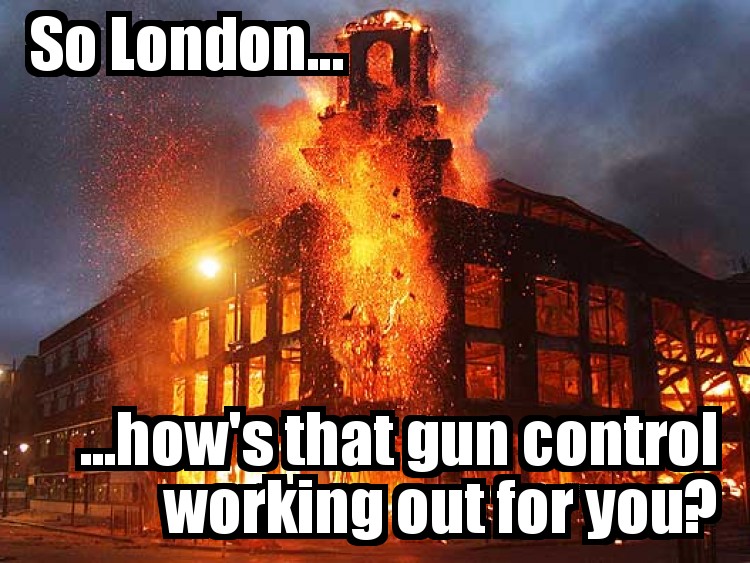
A Disarmed Society is a Violent Society

August 9th, 2011

It’s not yet sunset in the UK, so we don’t know if a fourth night of rioting will follow the first three. But the glee and impunity with which rioters torched and looted large sections of London are an indictment of two beloved projects of British and other European elites: a disarmed citizenry and an all-encompassing, cradle-to-grave welfare state.

It’s hard to imagine riots of these size going on for days on end in the American South or Midwest simply because so many armed, law-abiding citizens would stand ready to defend their lives, liberty and property. Once you’ve shot a few rioters dead, it does rather tend to put a damper on the festive mood of the others. An armed shop owner in Texas or Ohio wouldn’t have to stand idly by while his life work burned, waiting vainly for police that never come.

But London shopkeepers and home-owners never had that choice. As Instapundit noted, “Unlike L.A., there are no Korean shopkeepers with AR-15s to help contain the looting.” Since handguns were banned in the UK in 1997 (tightening already restrictive firearm laws), their per capita crime rate has skyrocketed compared to ours.

As Theodore Dalrymple and others have so depressingly documented, the welfare state has hollowed out the once redoubtable English character and replaced it with crime, inter-generational dole-dependency and general hopelessness. “These youths in hoodies and men in bandanas are not fighting for a principle, they’re trashing neighbourhoods for a plasma telly and a pair of new trainers. Masked gangs are looting department stores, not waving placards.”

Will this be a wake-up call for those pushing for an ever-larger welfare state? Of course not. My liberal British friends on Facebook are already trotting out the classic liberal phrases. “Underclass,” “powerless,” etc. Why “powerlessness” leads inevitably to someone looting a plasma TV is never adequately explained, nor how an ever-more-expansive welfare state would prevent this, unless they expect that taxpayers buying a plasma TV for every single person on the dole would remove the temptation.

Edited to Add: Greetings, Instapundit Readers! Take a look around and see if there’s anything else that might interest you, such as updates on the Texas Senate race or some tidbits on Rick Perry.

Quick update here.

Second update and videos here.

More on the nature of the rioters.

London Burning

August 8th, 2011

Riots in London continue to increase in size, spreading to most of the city. There seems to be no particular reason, except they provide the UK’s permanent dole chav culture a chance to burn and smash things and loot shops.

Here’s an interactive map of the rioting.

And here’s another.

What set it off was the death of black gang member Mark Duggan, who decided have a shoot-out after being stopped by the police while carrying a gun. (This being the UK, needless to say Mr. Duggan’s gun was illegal.)

I do not see any report of particular Jihadi involvement, though I would not be at all surprised to learn some joined in the opportunistic violence.

Here’s the Dead Kennedy’s “Riot,” for some old-school-punk perspective on the phenomena.

Stay safe, Londoners…

Dear Ricardo Sanchez: Happy Two Month Anniversary!

August 8th, 2011

That is to say, it’s been two months since you last updated your website’s news page.

Even though I’m on the other side of the political aisle, I thought I would offer you a “protip” for running for the Senate: Most people running a campaign for a high elected office actually, you know, campaign.

Just an FYI…

Rick Perry to Announce Presidential Campaign Saturday in South Carolina

August 8th, 2011

So says Politico.

I think Perry will jump in, will win the primary, and will beat Obama, primarily because I think he’s sharp enough and mean enough to win. Perry looks as good as Romney, has as much Tea Party support as Bachmann, and has record as Governor that puts both in the shade. He dismantled Kay Baily Hutchison in the 2010 Governor’s race, and then mopped the floor with Bill White. Also, I think there’s a better than 50% chance that Sarah Palin with endorse his candidacy.

And of course, Perry’s record on jobs and budgets blows Obama’s away. It’s like the difference between Peyton Manning and Ryan Leaf.

Hopefully more on Perry later in the week.

More on the Greek Euro U.S. World Debt Crises

August 8th, 2011

The Moody’s downgrade of Portuguese debt link was a quick blipvert for a current event, but I wanted to do a somewhat longer roundup of pieces on the Euro debt crises and the potential for more shocks down the line. Unfortunately for both me and pretty much everyone in the world, things have been moving too fast to get a good handle on before the next crisis erupts. And after the Obama downgrade, things are moving faster than ever.

Which is pretty fast indeed. The Eurocrats, in best shoot-the-messenger style, have decided to start ignoring bond rating services in the wake of Moody’s downgrade of Portugal. If that weren’t enough, Italian police raided the offices of Standard & Poors following their downgrade of Italian credit ratings.

How did Greece get in the position of being the first domino to fall in the Euro crisis? The election of Andreas Papandreou as Prime Minister helped start the ball rolling:

On October 18, 1981, a charismatic academic with rather limited government experience and with a one-word slogan, “Change,” was elected prime minister of Greece. His name was Andreas Papandreou. Greeks may now wish that 30 years ago they had had a Tea Party movement. Things could have turned out differently.

Thirty years ago, Greece was in an enviable position on the matter of national debt, with its debt just 28.6 percent of GDP. Few advanced countries can manage that kind of debt-to-GDP ratio. By the end of Papandreou’s first term in office, that ratio had nearly doubled, with debt at 54.7 percent of GDP. By the end of his second term, the figure was in the mid 80s.

But that was just the first step. The second was letting Greece join the Eurozone in 1999 despite their patent unwillingness to get their financial house in order. “Repeatedly, and for 30 years, the Greeks have played Europe like a harp.”

June’s European Union summit illustrated the chaos perfectly: a last-minute deal with Athens to raise the Greek income-tax threshold and increase levies on heating oil was hailed as a breakthrough even though everyone involved knows that this will buy, at best, a few months’ respite from Greece’s creditors. Thus are deck chairs rearranged, as the Greek pleasure yacht (classified, of course, as a fishing boat to escape taxes) sinks below the waves. The markets duly marked up the five-year probability of a Greek default to 80 percent.

The advice to Margaret Thatcher decades ago from the Foreign Office mandarin charged with European policy was clear: Greece was unfit to join what was then known as the European Community. The backward, chaotic archipelago would be an enduring drain on European coffers. Not only that: once through the door, Athens would bring nothing but trouble.

That foolish decision to allow Greece to join lies at the root of the crisis engulfing the euro zone and lapping America’s shores. Consciously, among its pampered political elite — and subliminally in society at large — Greeks got the idea that being Europe’s backward, indulged delinquent was a highly profitable game.

A piece quoting and summarizing two different Financial Times pieces (behind their paywall, alas), both of which predict a bad end to the Greek debt crises, albeit partially from differing reasons.

Andrew Butter makes parallels with Weimar Germany. Don’t agree with everything the author says, although you I do admire this sentence: “It’s getting harder to do the austerity thing these days, now that it’s considered politically incorrect to shoot at rioters with live ammunition, which wasn’t an issue in 1923.”

So if pretty much everyone agrees that Greek default is inevitable, why keep shuffling the deck chairs? Simple: So they can stick taxpayers with the bill. “Foreign financial institutions currently own 42 per cent of Greek debts, and foreign governments 26 per cent, the rest being owed domestically. By 2014, those figures will be 12 per cent and 64 per cent respectively. European banks, in other words, will have shuffled off their losses onto European taxpayers.”

So an effort to shield Euroelites from the worst effects of the debt crisis may end up destroying the Euro entirely.

Given the already considerable length of this post, I doubt I have time to address some of the ramifications of the Obama Downgrade, so that will have to wait for another post…

LinkSwarm for Friday, August 5, 2011

August 5th, 2011

The last six days of blogging have been pretty packed, so here’s a LinikSwarm for a lazy (and very hot) Friday:

  • Christopher Hitchens on Turkey. He glosses over the fact (maybe he only had so many words) that Mustafa Kemal Ataturk could be quite a murderous bastard himself when it suited his interests…
  • Amazon isn’t the problem in California. “How perverse is it when wanting to keep money that you’ve earned is considered being greedy?”
  • Either I missed this when it was announced, or the MSM didn’t cover it, but Mississippi NAACP executive Lessadolla Sowers was convicted of ten counts of voting fraud in April.
  • Meanwhile, in a completely unrelated story, Democrats continue to oppose Voter ID bills, and even trotted out Bill Clinton to play the race card.
  • Here’s a movie about an an Islamic punk band with female and gay members who drink beer and smoke pot. Sadly, and predictably, it’s completely fictional.
  • Fannie Mae is back to what it does best, i.e. losing taxpayer money.
  • You may remember my previous mention of the new definition of “flash mobs,” i.e. large groups of black youths that gather together to commit crimes and then disperse. Evidently they’re a big enough problem in Cleveland that they passed an ordinance to crack down on the phenomena, which was vetoed. Alas, from the description, the Ohio ACLU is probably correct in calling it “both ineffective and unconstitutional.”
  • Flash mobs also seem to be a problem in Philadelphia.
  • And Chicago.
  • And just last week in Greensboro, NC.
  • In fact, it’s a big enough issue that the National Retail Federation has issued guidelines on how to deal with it.
  • 85% of a Lucid Essay, or Why Walter Russell Mead Should Have Quit While He Was Ahead

    August 4th, 2011

    Everyone and their blogging dog have linked to this Walter Russell Mead essay on “The Progressive Crisis”, mainly because it’s a really good essay, at least until the last few paragraphs. (It is, in turn, partially a critique of Democratic pollster Stanley Greenberg’s piece on the puzzle of just why voters don’t think liberal policies are totally awesome.) After critiquing Greenberg’s suggestion that campaign finance reform is just the tonic to cure progressive ills, we get to the real meat of Mead’s juicy argument:

    Greenberg has not yet come to grips with the deepest and most difficult aspect of the crisis of liberal legitimacy. He roots the dangerous and corrupting special interests outside the state: with their money and their lobbying the corporations and the fat cats influence and pervert the state. But the state and its servants do not, in Greenberg’s story, constitute a special interest of their own.

    This is not how voters see it. For large numbers of voters the professional classes who staff the bureaucracies, foundations and policy institutes in and around government are themselves a special interest. It is not that evil plutocrats control innocent bureaucrats; many voters believe that the progressive administrative class is a social order that has its own special interests. Bureaucrats, think these voters, are like oil companies and Enron executives: they act only to protect their turf and fatten their purses.

    At this point Your Humble Blogger will now make the universal gesture of tapping his pointer finger to his nose, thus.

    It gets better:

    The problem goes even deeper than hostility toward perceived featherbedding and life tenure for government workers. The professionals and administrators who make up the progressive state are seen as a hostile power with an agenda of their own that they seek to impose on the nation.

    This perception, also, is rooted in truth. The progressive state has never seen its job as simply to check the excesses of the rich. It has also sought to correct the vices of the poor and to uplift the masses. From the Prohibition and eugenics movements of the early twentieth century to various improvement and uplift projects in our own day, well educated people have seen it as their simple duty to use the powers of government to make the people do what is right: to express the correct racial ideas, to eschew bad child rearing technique like corporal punishment, to eat nutritionally appropriate foods, to quit smoking, to use the right light bulbs and so on and so on.

    Progressives want and need to believe that the voters are tuning them out because they aren’t progressive enough. But it’s impossible to grasp the crisis of the progressive enterprise unless one grasps the degree to which voters resent the condescension and arrogance of know-it-all progressive intellectuals and administrators. They don’t just distrust and fear the bureaucratic state because of its failure to live up to progressive ideals (thanks to the power of corporate special interests); they fear and resent upper middle class ideology. Progressives scare off many voters most precisely when they are least restrained by special interests. Many voters feel that special interests can be a healthy restraint on the idealism and will to power of the upper middle class.

    The progressive ideal of administrative cadres leading the masses toward the light has its roots in a time when many Americans had an eighth grade education or less. It always had its down side, and the arrogance and tin-eared obtuseness of self assured American liberal progressives has infuriated generations of Americans and foreigners who for one reason or another have the misfortune to fall under the power of a class still in the grip of a secularized version of the Puritan ideal. But in the conditions of late nineteenth and twentieth century America, the progressive vanguard fulfilled a vital and necessary social role.

    The deep crisis of the progressive ideal today is that it is no longer clear that the American clerisy is wanted or needed in that role.

    At bottom, that is what the populist revolt against establishments of all kinds is about. A growing section of the American population wants to think and act for itself, without the guidance of the graduates of ivy league colleges and blue chip graduate programs.

    The fight for limited government that animates so many Americans today isn’t a reaction against the abuses and failures of government. It is a fight to break the power of a credentialed elite that believe themselves entitled by talent and hard work to a greater say in the nation’s affairs than people who scored lower on standardized tests and studied business administration in cheap colleges rather than political science in expensive ones.

    There are a few things to quibble with in those paragraphs. Saying that people “fear and resent upper middle class ideology” muddles two separate issues, namely the imposition of politically correct, anti-religious, environmentalist etc. ideology on the unwilling through government coercion favored by liberal coastal urban atheist elites vs. the inspirational upper middle class values of working for a living, getting (and staying) married, raising children, owning a house etc., which cannot be imposed. Also, a large portion of the Tea Party is indeed animated by the failures and abuses of Big Government, not to mention the corruption and self-dealing of Democratic elites who funnel taxpayer money to liberal constituencies (ACORN, unions, etc.), who then turn around and give it back to those same Democratic elite in the form of campaign contributions and cushy post-electoral sinecures. But those are relatively minor points.

    But the next paragraph in Mead’s essay is where the whole thing goes careening off the rails, thanks to his trotting out that most hoary and unwise cliche, comparing national politics to high school cliques. This is almost always a bad idea, and best left to the Maureen Dowds of the world. It’s a simplistic, reductio ad absurdum argument that will make it all too easy for liberals to dismiss the entire essay in toto rather than grappling with the real problems the American public has with them and their policies.

    As a commenter on the blog notes, “It is unfortunate that an article that is so insightful ends in an utter train-wreck of stupidity.”

    My Interview With Ted Cruz (And Related Thoughts)

    August 3rd, 2011

    Here’s the video edit of my interview with Ted Cruz (click for a larger version on YouTube):

    (I think I should have sucked in my gut more.)

    After the interview, Cruz said that he reads the blog (which I believe, as I’ve interacted with several members of his campaign who read the blog over the past few months). I said that I started covering the race so closely mainly because the MSM was doing such a poor job of it. He agreed, and said that people wouldn’t start paying attention until the last week. I think he’s right.

    Honestly, I have no real issue or ideological concerns with Cruz. If elected, I think he would easily be the best senator Texas has had since Phil Gramm. I do have some small minor concerns with him as a candidate (see this post for some context on the below points). A lot of the things I quibble over is Cruz following standard “How to Campaign 101.” However, I think they may not work as well as in the past for this year, and this particular race.

  • Frequently Cruz would take the question as asked and segue into one of his talking points, sometimes smoothly, sometimes not. I believe Cruz is right, that the general public is only paying attention to the race in the last week. But this is going to be a long campaign, and I believe Cruz is a bit too “on message” for this stage of the campaign. This part of the campaign, in addition to building a campaign infrastructure and raising money, is to convince Tea Party and Republican Party stalwarts that you’re their guy. Among the Tea Party especially, there’s a certain wariness with politicians being too slick and too programmed. In addition to conservative positions and record (which Cruz has in spades), I think Tea Party patriots are looking for genuine authenticity and sincerity. (“Sincerity – if you can fake that, you’ve got it made.” —George Burns). I think that’s a big reason Glenn Addison won the straw poll at the more recent forum. Cruz is a very good off-the-cuff speaker, and I think he needs a bit less scripting and a bit more continuity at this stage of the campaign.
  • I gave Cruz the opportunity to criticize his rival candidates and he declined, bringing the question around to his Proven Conservative bit. This is also standard practice: Let the candidate take the high road and let proxies and allies handle the attacks. But I’m not sure that wisdom holds anymore, especially in Texas. Rick Perry went negative early, hard and often on Kay Baily Hutchison, and it didn’t hurt his chances at all. I think the Tea Party is looking for a fighter, and don’t think it would hurt Cruz to engage Dewhurst and Leppert on their respective conservative records (or lack thereof) early and often.
  • Again, keep in mind this is coming from someone who’s observing Cruz more closely than 99.9% of primary voters ever will. I think Cruz is still far and away the candidate that most closely fits William F. Buckley’s definition of who people should vote for, namely “the most conservative viable candidate.”

    Thanks again to Ted Cruz (and his campaign) for allowing me the opportunity to interview him.

    I have a longer audio version of this interview, covering more topics, I hope to put up later this week

    Texas Senate Race Update for August 3, 2011

    August 3rd, 2011

    The Cruz campaign emailed to say they’ll be sending me the video file of the interview sometime in the next 24 hours, so here are a few race updates to tide you over until then.

  • Matt S. Dowling has his interview with Cruz up. I haven’t had a chance to watch all of it yet. Expect the setting to seem eerily familiar when you watch my interview…
  • And speaking on interviews with Cruz, here’s a snippet he did on a radio interview about the debt limit vote, which he was against.
  • David Dewhurst wasn’t wild about the debt deal either.
  • Nor was Tom Leppert.
  • Nor Glenn Addison.
  • Even Ricardo Sanchez and longshot Sean Hubbard are against it.
  • However, Elizabeth Ames Jones offered qualified support.
  • And naturally, after compiling all that, I found a roundup article on the same topic.
  • Yet another high-profile national conservative endorses Cruz, in this case Pennyslvania Senator Pat Toomey. Toomey will always have a place in the hearts of conservative everywhere for pushing the odious Arlen Specter out of the party and taking his Senate seat.
  • Cruz is also expected to get support from Sen. Mike Lee’s new Constitutional Conservatives Fund PAC.
  • Here’s a liberal handicapping the race. He had this to say about Cruz:

    I first encountered Ted Cruz in Laredo in 2003. As the state Senate Democrats’ 46-day Albuquerque quorum break ended, they boarded a plane and went to Laredo to attend a hearing on the matter in Federal court. I accompanied them on the plane, and attended the hearing in the Laredo courtroom. Ted Cruz, then the Solicitor General, was the state’s lawyer in court that day. In other words – ironically – he was Dewhurst’s lawyer in the suit. I have never seen a better courtroom performance, before or since. He was articulate, passionate, and flat-out out-lawyered the Democrats’ legal team. By the end of that hearing, not only was I convinced that Cruz had won the day (which he did), but he was so utterly great that I myself had serious doubts as to the merits of the Democrats’ suit. I’ve been a begrudging admirer of Cruz’ skills ever since.

  • Polifact says that Tom Leppert calling David Dewhurst a “career politician” is false. Because he’s only been in politics since 1998, not “most of [his] working life.” While I’m not sure I agree with that line of thinking, at least it’s less risible than some of the arguments Polifact has made in the last year…