Archive for the ‘Military’ Category

Things Crashing Into Other Things At High Speeds

Saturday, November 21st, 2020

It’s the weekend before Thanksgiving, and since lots of people will be driving home for Thanksgiving (despite the dictates of Obergroupenfuhers Newsom and Whitmer), so let’s look at some high speed crashes.

Here are the Mythbusters crashing cars into a concrete wall at various speeds:

Here’s UK car program Fifth Gear (AKA “the show the Top Gear guys are always ragging on”) crashing a Ford Focus at 120 MPH:

400gs would really ruin your whole day.

Here’s an F4 Phantom being crashed into a concrete wall at 500 MPH:

A reverse ballistic missile test, where they slam a rocket sled into a missile to see how it disintegrates:

That’s traveling at up to 6,000 feet per second, which translates into 4090 miles an hour.

Veterans Day: Celebrating Hiroshi H. Miyamura

Wednesday, November 11th, 2020

This Veterans Day we celebrate the life of Korean War Medal of Honor winner Hiroshi H. Miyamura:

Cpl. Miyamura, a member of Company H, distinguished himself by conspicuous gallantry and intrepidity above and beyond the call of duty in action against the enemy. On the night of 24 April, Company H was occupying a defensive position when the enemy fanatically attacked threatening to overrun the position. Cpl. Miyamura, a machine gun squad leader, aware of the imminent danger to his men unhesitatingly jumped from his shelter wielding his bayonet in close hand-to-hand combat killing approximately 10 of the enemy. Returning to his position, he administered first aid to the wounded and directed their evacuation. As another savage assault hit the line, he manned his machine gun and delivered withering fire until his ammunition was expended. He ordered the squad to withdraw while he stayed behind to render the gun inoperative. He then bayoneted his way through infiltrated enemy soldiers to a second gun emplacement and assisted in its operation. When the intensity of the attack necessitated the withdrawal of the company Cpl. Miyamura ordered his men to fall back while he remained to cover their movement. He killed more than 50 of the enemy before his ammunition was depleted and he was severely wounded. He maintained his magnificent stand despite his painful wounds, continuing to repel the attack until his position was overrun. When last seen he was fighting ferociously against an overwhelming number of enemy soldiers. Cpl. Miyamura’s indomitable heroism and consummate devotion to duty reflect the utmost glory on himself and uphold the illustrious traditions on the military service.

Miyamura actually signed up to fight in World War II.

Miyamura joined the US Army in January 1945.

Miyamura volunteered to be part of the all-Nisei 100th Infantry Battalion. This army unit was mostly made up of Japanese Americans from Hawaii and the mainland.

He was discharged from the active army shortly after Japan surrendered. Following the war, he enlisted in the U.S. Army Reserve, and was recalled to active duty following the start of the Korean War. He endured as a prisoner of war for 28 months.

Because he was captured by the North Koreans, his Medal of Honor was originally awarded in secret.

As Brigadier General Ralph Osborne explained to Miyamura and a group of reporters upon notifying them of his medal, “If the Reds knew what he had done to a good number of their soldiers just before he was taken prisoner, they might have taken revenge on this young man. He might not have come back.” Following his release on August 20, 1953, he was repatriated to the United States and honorably discharged from the military shortly thereafter. His medal was presented to him by President Dwight D. Eisenhower in October 1953 at the White House.

Here he is talking about his service:

Miyamura still lives in his hometown of Gallup, New Mexico. Last year he was one of the Grand Marshals for the 2019 New York City Veterans Day Parade.

Note: The two living World War II Medal of Honor recipients we celebrated last Veterans Day, Hershel “Woody” Williams and Charles H. Coolidge, are evidently both still alive. Williams is 97 and Coolidge is 99. And the ship named after Williams, Expeditionary Sea Base USS Hershel “Woody” Williams (ESB 4), recently visited Naples and Greece.

China Invading Taiwan Follow-Up: From Nukes to Knives

Tuesday, October 13th, 2020

There have been some interesting comments, both here and at Instpundit, on my Taiwan invading Taiwan scenarios piece.

First up, some commenters wondered if China would just nuke Taiwan rather than risk the uncertainties of a massive amphibious invasion. That’s never going to happen for the same reason you don’t torch a car you’re planning on stealing. China wants Taiwan not only as a symbol of its own power and territorial unity, but also for its wealth and technological leadership. A Taipei reduced to glowing rubble not only defeats that goal, but would encourage South Korea and Japan (and maybe even Vietnam and the Philippines) to start producing their own nuclear weapons, and might even prod atherosclerotic transnational bureaucracies to actually spring into action to sanction China on a variety of fronts. There are few upsides and an incredible number of downsides to China nuking Taiwan.

Second, as commenter Old Paratrooper noted, this year China launched only its second amphibious assault ship:

The Chinese Navy has now launched a second large amphibious assault ship engineered to carry weapons, helicopters, troops and landing craft into war, a move which further changes international power dynamics by strengthening China’s ability to launch expeditionary maritime attacks.

The ship is described at the second Type 075 Landing Helicopter Dock (LHD), somewhat analogous to the U.S. WASP-class. This Chinese amphibious assault ship reportedly displaces as much as 30,000 tons and is able to carry as many as 28 helicopters, a report from Naval News states. The report adds that the new People’s Liberation Army Navy LHD is likely powered by a diesel engine with 9,000kW, four Close In Weapons Systems and HQ-10 surface-to-air missiles. The new ship’s “aim is likely to increase the “vertical” amphibious assault capability with the very mountainous East Coast of Taiwan in mind,” the Naval News report writes.

The addition of more LHDs certainly increases China’s maritime attack power, making it a formidable threat along the Taiwanese coastline. Photos of the ship show well-deck in back, capable of launching ship-to-shore transport craft similar to the U.S. Navy Landing Craft Air Cushion or newer Ship-to-Shore Connector. Such a configuration makes it appear somewhat similar to U.S. Navy WASP-class which, unlike the first two ships of the America-class, also operates with a well-deck from which to launch large-scale amphibious assaults.

Wikipedia says a third ship of this type is under construction.

Three ships isn’t going to get a Taiwanese invasion done, no matter how advanced, even assuming all the helicopters and landing ships make it to shore. (They wouldn’t.) However, China also has has some 70 other Type 071 through 074 amphibious assault ships in it’s inventory, plus some 200 or so small landing craft, slightly larger than the ones that hit Omaha Beach, some almost 50 years old, many with hovercraft designs. (They have some even older, Soviet-derived crap, that I doubt they’d try to use unless they were really desperate.)

For comparison, the U.S. Navy used over 500 ships during the invasion of Iwo Jima, an island of 8 square miles, as opposed to Taiwan’s 973.

Maybe Chinese planning calls for a massive “set everything moving straight across the straits at once” push, which would explain why only April and October are suitable, because the smaller and older craft simply wouldn’t make it in rougher seas. Such a plan would also only work with massive air superiority over the strait, else they’re asking for a repeat of The Great Marianas Turkey Shoot, only with a lot more target and precision munitions.

Finally, over on Instapundit, user bigfire pointed out that the ChiComs shelled the outpost island of Kinmen (AKA Quemoy) for months. The result? The islanders use the steel from the bombs to make excellent knives:

The Five Worst Production Tanks Of All Time

Sunday, October 11th, 2020

Dwight and Borepatch have both weighed in on this one already, but as (I think) the only one of us who has actually visited the Tank Museum in Bovington, I though I would weigh in as well.

This is not a bad list, and since it’s production tanks only, it doesn’t include the the execrable Valiant. However, I think you have to bump one of those five out to include this:

That is the Italian Carro Veloce L3 flamethrower tank. A two man tank just over four feet high, today it’s been retroactively reclassified as a “tankette.” At the back right, you can barely see the edge of the 133 gallon tank it towed behind it on a two-wheel trailer. It deserves a place on this list due to the nasty tendency to roast the crew alive due to leaks in the gasoline lines.

So which of the five in that video come out? I’m going to say the Jagdtiger. Not because anything in the video is wrong: it was a tremendously resource-hungry tank that required another parallel supply chain for its massive 128mm gun. However, that wasn’t clear in 1942, when it was first conceived, or 1943, when the bulk of development occurred. The main concern was dealing with massive numbers of Soviet tanks on the Eastern front, and where heavier Soviet tanks like the KV-85 were just starting to come online. In that environment, making the tradeoffs necessary to build that massive tank-killer probably seemed more justified in 1943, and the first Jagdtiger’s were delivered in January 1944. And even for the first few months after Normandy, there probably would have been no way to reclaim the material already allocated in the supply chain to build them. But any of them built after, say, September, were indeed a bad use of resources.

In Tigers in the Mud, Panzer commander Otto Carius noted other flaws with Jagtiger (which are called “Hunting Tigers” in the English translation of the book), one of the biggest of which was the tendency of 128mm cannon to be jolted out of alignment during movement, which meant it had to be put into travel lock before maneuvers. Worse still, the travel lock “had to be removed from the outside during contact with the enemy!”

China Invades Taiwan: Two Scenarios

Saturday, October 10th, 2020

Two different pieces have come out recently, painting competing pictures of what a Chinese attempt to conquer Taiwan would look like. First up, this Samson Ellis piece for Bloomberg:

Beijing’s optimistic version of events goes something like this: Prior to an invasion, cyber and electronic warfare units would target Taiwan’s financial system and key infrastructure, as well as U.S. satellites to reduce notice of impending ballistic missiles. Chinese vessels could also harass ships around Taiwan, restricting vital supplies of fuel and food.

Airstrikes would quickly aim to kill Taiwan’s top political and military leaders, while also immobilizing local defenses. The Chinese military has described some drills as “decapitation” exercises, and satellite imagery shows its training grounds include full-scale replicas of targets such as the Presidential Office Building.

An invasion would follow, with PLA warships and submarines traversing some 130 kilometers (80 miles) across the Taiwan Strait. Outlying islands such as Kinmen and Pratas could be quickly subsumed before a fight for the Penghu archipelago, which sits just 50 kilometers from Taiwan and is home to bases for all three branches of its military. A PLA win here would provide it with a valuable staging point for a broader attack.

As Chinese ships speed across the strait, thousands of paratroopers would appear above Taiwan’s coastlines, looking to penetrate defenses, capture strategic buildings and establish beachheads through which the PLA could bring in tens of thousands of soldiers who would secure a decisive victory.

In reality, any invasion is likely to be much riskier. Taiwan has prepared for one for decades, even if lately it has struggled to match China’s growing military advantage.

Taiwan’s main island has natural defenses: Surrounded by rough seas with unpredictable weather, its rugged coastline offers few places with a wide beach suitable for a large ship that could bring in enough troops to subdue its 24 million people. The mountainous terrain is riddled with tunnels designed to keep key leaders alive, and could provide cover for insurgents if China established control.

Taiwan in 2018 unveiled a plan to boost asymmetric capabilities like mobile missile systems that could avoid detection, making it unlikely Beijing could quickly destroy all of its defensive weaponry. With thousands of surface-to-air missiles and anti-aircraft guns, Taiwan could inflict heavy losses on the Chinese invasion force before it reached the main island.

Taiwan’s military has fortified defenses around key landing points and regularly conducts drills to repel Chinese forces arriving by sea and from the air. In July outside of the western port of Taichung, Apache helicopters, F-16s and Taiwan’s own domestically developed fighter jets sent plumes of seawater into the sky as they fired offshore while M60 tanks, artillery guns and missile batteries pummeled targets on the beach.

Chinese troops who make it ashore would face roughly 175,000 full-time soldiers and more than 1 million reservists ready to resist an occupation. Taiwan this week announced it would set up a defense mobilization agency to ensure they were better prepared for combat, the Taipei Times reported.

Doesn’t sound like a cakewalk, does it?

This Tanner Greer piece in Foreign Policy like Beijing’s chances even less:

When Chinese President Xi Jinping spoke to the 19th Party Congress about the future of Taiwan last year, his message was ominous and unequivocal: “We have firm will, full confidence, and sufficient capability to defeat any form of Taiwan independence secession plot. We will never allow any person, any organization, or any political party to split any part of the Chinese territory from China at any time or in any form.”

This remark drew the longest applause of his entire three-hour speech—but it’s not a new message. The invincibility of Chinese arms in the face of Taiwanese “separatists” and the inevitability of reunification are constant Chinese Communist Party themes. At its base, the threat made by Xi is that the People’s Liberation Army has the power to defeat the Taiwanese military and destroy its democracy by force, if need be. Xi understands the consequences of failure here. “We have the determination, the ability and the preparedness to deal with Taiwanese independence,” he stated in 2016, “and if we do not deal with it, we will be overthrown.”

Snip.

Two recent studies, one by Michael Beckley, a political scientist at Tufts University, and the other by Ian Easton, a fellow at the Project 2049 Institute, in his book The Chinese Invasion Threat: Taiwan’s Defense and American Strategy in Asia, provide us with a clearer picture of what a war between Taiwan and the mainland might look like. Grounded in statistics, training manuals, and planning documents from the PLA itself, and informed by simulations and studies conducted by both the U.S. Defense Department and the Taiwanese Ministry of National Defense, this research presents a very different picture of a cross-strait conflict than that hawked by the party’s official announcements.

Chinese commanders fear they may be forced into armed contest with an enemy that is better trained, better motivated, and better prepared for the rigors of warfare than troops the PLA could throw against them. A cross-strait war looks far less like an inevitable victory for China than it does a staggeringly risky gamble.

Chinese army documents imagine that this gamble will begin with missiles. For months, the PLA’s Rocket Force will have been preparing this opening salvo; from the second war begins until the day the invasion commences, these missiles will scream toward the Taiwanese coast, with airfields, communication hubs, radar equipment, transportation nodes, and government offices in their sights. Concurrently, party sleeper agents or special forces discreetly ferried across the strait will begin an assassination campaign targeting the president and her Cabinet, other leaders of the Democratic Progressive Party, officials at key bureaucracies, prominent media personalities, important scientists or engineers, and their families.

The goal of all this is twofold. In the narrower tactical sense, the PLA hopes to destroy as much of the Taiwanese Air Force on the ground as it can and from that point forward keep things chaotic enough on the ground that the Taiwan’s Air Force cannot sortie fast enough to challenge China’s control of the air. The missile campaign’s second aim is simpler: paralysis. With the president dead, leadership mute, communications down, and transportation impossible, the Taiwanese forces will be left rudderless, demoralized, and disoriented. This “shock and awe” campaign will pave the way for the invasion proper.

This invasion will be the largest amphibious operation in human history. Tens of thousands of vessels will be assembled—mostly commandeered from the Chinese merchant marine—to ferry 1 million Chinese troops across the strait, who will arrive in two waves. Their landing will be preceded by a fury of missiles and rockets, launched from the Rocket Force units in Fujian, Chinese Air Force fighter bombers flying in the strait, and the escort fleet itself.

Confused, cut off, and overwhelmed, the Taiwanese forces who have survived thus far will soon run out of supplies and be forced to abandon the beaches. Once the beachhead is secured, the process will begin again: With full air superiority, the PLA will have the pick of their targets, Taiwanese command and control will be destroyed, and isolated Taiwanese units will be swept aside by the Chinese army’s advance. Within a week, they will have marched into Taipei; within two weeks they will have implemented a draconian martial law intended to convert the island into the pliant forward operating base the PLA will need to defend against the anticipated Japanese and American counter-campaigns.

This is the best-case scenario for the PLA. But an island docile and defeated two weeks after D-Day is not a guaranteed outcome. One of the central hurdles facing the offensive is surprise. The PLA simply will not have it. The invasion will happen in April or October. Because of the challenges posed by the strait’s weather, a transport fleet can only make it across the strait in one of these two four-week windows. The scale of the invasion will be so large that strategic surprise will not be possible, especially given the extensive mutual penetration of each side by the other’s intelligence agencies.

Easton estimates that Taiwanese, American, and Japanese leaders will know that the PLA is preparing for a cross-strait war more than 60 days before hostilities begin. They will know for certain that an invasion will happen more than 30 days before the first missiles are fired. This will give the Taiwanese ample time to move much of their command and control infrastructure into hardened mountain tunnels, move their fleet out of vulnerable ports, detain suspected agents and intelligence operatives, litter the ocean with sea mines, disperse and camouflage army units across the country, put the economy on war footing, and distribute weapons to Taiwan’s 2.5 million reservists.

There are only 13 beaches on Taiwan’s western coast that the PLA could possibly land at. Each of these has already been prepared for a potential conflict. Long underground tunnels—complete with hardened, subterranean supply depots—crisscross the landing sites. The berm of each beach has been covered with razor-leaf plants. Chemical treatment plants are common in many beach towns—meaning that invaders must prepare for the clouds of toxic gas any indiscriminate saturation bombing on their part will release. This is how things stand in times of peace.

As war approaches, each beach will be turned into a workshop of horrors. The path from these beaches to the capital has been painstakingly mapped; once a state of emergency has been declared, each step of the journey will be complicated or booby-trapped. PLA war manuals warn soldiers that skyscrapers and rock outcrops will have steel cords strung between them to entangle helicopters; tunnels, bridges, and overpasses will be rigged with munitions (to be destroyed only at the last possible moment); and building after building in Taiwan’s dense urban core will be transformed into small redoubts meant to drag Chinese units into drawn-out fights over each city street.

Interesting analysis of a PLA grunt’s disillusioning journey toward war snipped.

But by the time he reaches the staging area in Fuzhou, the myth of China’s invincibility has been shattered by more than rumors. The gray ruins of Fuzhou’s PLA offices are his first introduction to the terror of missile attack. Perhaps he takes comfort in the fact that the salvos coming from Taiwan do not seem to match the number of salvos streaking toward it—but abstractions like this can only do so much to shore up broken nerves, and he doesn’t have the time to acclimate himself to the shock. Blast by terrifying blast, his confidence that the Chinese army can keep him safe is chipped away.

The last, most terrible salvo comes as he embarks—he is one of the lucky few setting foot on a proper amphibious assault boat, not a civilian vessel converted to war use in the eleventh hour—but this is only the first of many horrors on the waters. Some transports are sunk by Taiwanese torpedoes, released by submarines held in reserve for this day. Airborne Harpoon missiles, fired by F-16s leaving the safety of cavernous, nuclear-proof mountain bunkers for the first time in the war, will destroy others. The greatest casualties, however, will be caused by sea mines. Minefield after minefield must be crossed by every ship in the flotilla, some a harrowing eight miles in width. Seasick thanks to the strait’s rough waves, our grunt can do nothing but pray his ship safely makes it across.

As he approaches land, the psychological pressure increases. The first craft to cross the shore will be met, as Easton’s research shows, with a sudden wall of flame springing up from the water from the miles of oil-filled pipeline sunk underneath. As his ship makes it through the fire (he is lucky; others around it are speared or entangled on sea traps) he faces what Easton describes as a mile’s worth of “razor wire nets, hook boards, skin-peeling planks, barbed wire fences, wire obstacles, spike strips, landmines, anti-tank barrier walls, anti-tank obstacles … bamboo spikes, felled trees, truck shipping containers, and junkyard cars.”

At this stage, his safety depends largely on whether the Chinese Air Force has been able to able to distinguish between real artillery pieces from the hundreds of decoy targets and dummy equipment PLA manuals believe the Taiwanese Army has created. The odds are against him: As Beckley notes in a study published last fall, in the 1990 to 1991 Gulf War, the 88,500 tons of ordnance dropped by the U.S.-led coalition did not destroy a single Iraqi road-mobile missile launcher. NATO’s 78-day campaign aimed at Serbian air defenses only managed to destroy three of Serbia’s 22 mobile-missile batteries. There is no reason to think that the Chinese Air Force will have a higher success rate when targeting Taiwan’s mobile artillery and missile defense.

But if our grunt survives the initial barrages on the beach, he still must fight his way through the main Taiwanese Army groups, 2.5 million armed reservists dispersed in the dense cities and jungles of Taiwan, and miles of mines, booby traps, and debris. This is an enormous thing to ask of a private who has no personal experience with war. It is an even great thing to ask it of a private who naively believed in his own army’s invincibility.

They know war would be a terrific gamble, even if they only admit it to each other. Yet it this also makes sense of the party’s violent reactions to even the smallest of arms sales to Taiwan. Their passion betrays their angst. They understand what Western gloom-and-doomsters do not. American analysts use terms like “mature precision-strike regime” and “anti-access and area denial warfare” to describe technological trends that make it extremely difficult to project naval and airpower near enemy shores. Costs favor the defense: It is much cheaper to build a ship-killing missile than it is to build a ship.

But if this means that the Chinese army can counter U.S. force projection at a fraction of America’s costs, it also means that the democracies straddling the East Asian rim can deter Chinese aggression at a fraction of the PLA’s costs. In an era that favors defense, small nations like Taiwan do not need a PLA-sized military budget to keep the Chinese at bay.

My feeling is that Greer’s analysis is probably more correct, though not to the extent that the United States or Taiwan can rely on it to guarantee victory over a Chinese invasion.

A few further thoughts:

  • One reason defending Taiwan is so vital is that TSMC is the most important semiconductor foundry in the world. Apple, AMD, Nvidia, Qualcomm, Broadcom and even Intel get their cutting-edge chips fabbed there, as does Huawei. Losing that would be a huge blow to the free world’s technological dominance, and a good 12-18 months of supply disruption at a minimum. TSMC’s announced Arizona fab won’t even start construction until next year, and won’t come online for production until 2024.
  • I am very far indeed from an expert on the weather in the Taiwanese straits, but I don’t think we can assume that the PLA won’t try an attack other times of the year if they think they can maintain the element of surprise, even if it means significant personnel loses due to inclement weather. Communist military doctrine has always been indifferent to high personnel loses if it means achieving important objectives. But achieving surprise for an amphibious invasion of this size is almost impossible.
  • The point about the leathality of modern precision munitions is well taken. As modern Marine Corps doctrine states: “To be detected is to be targeted is to be killed.” Amphibious invasions are extremely difficult things to pull off under the best of circumstances, and China will not be operating under the best of circumstances.
  • The precariousness of the situation is why U.S. arms sales to Taiwan for things like M1A2 tanks and Stinger missiles are so important. And we should also sell Taiwan F-35s. China may make noise about their miltech being equal to or better than our own, but ours is the gold standard for the rest of the world.

  • LinkSwarm for October 2, 2020

    Friday, October 2nd, 2020

    Welcome to the October country, one of my favorite months! It being 2020, things lean rather more heavily on tricks than treats…

  • Two important points from Tuesday’s debate:

    (1) If he wins, Biden will almost certainly sign off on ending the filibuster to pack the courts and add two new states for a permanent Democrat majority that will leave the Constitution behind.

    (2) Trump may have announced that he’s about to reveal that the Democrats, from Obama on down, engaged in a coup against an American president.

    (Hat tip: ZeroHedge.)

  • Is CIA Director Gina Haspel personally blocking the release of Russiagate documents?
  • New documents show that the goal of the Flynn investigation wasn’t a search for truth, it was to get him fired.
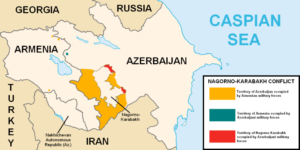
  • So, who had “Armenian Azerbaijani War Over Nagorno Karabakh” on their 2020 bingo card? Here’s a map I swiped from Wikipedia:

    And here’s the Livemap.

  • France has accused Turkey of sending Syrian jihadists there to fight for Muslim Azerbaijan. Remember that Turkey killed over 1.5 million Armenians during the rise of the Young Turks as part of the dissolution of the Ottoman Empire, so the bad blood there goes back a long ways.
  • Virginia passes law decreeing that Christians have no right to that pesky First Amendment and must align their theology with the tranny mafia or face fines. Is your Church government approved, comrade? (Hat tip: Stephen Green at Instapundit.)
  • Top Obama FBI official wants a commission to rule out any presidential candidates who threaten to bust their scams. Of course, he uses different language… (Hat tip: Ace of Spades HQ.)
  • Has a member of Mueller’s team flipped for Durham?
  • Australian blogger examines Wuhan coronavirus data:

    Quick conclusion: Relative to the number of infections fewer people have died in the US than in Australia. So for all the talk about not letting us have a US style health system, it has performed relatively better than ours did. True, Australian base levels of health are higher than US levels. Relatively fewer people got infected here than in the US. (We can argue about why that happened in the comments – probably policy errors in themselves at the State level in the US). Once infected, however, it looks like the chances of survival was higher in the US.

  • Kuwait’s ruler Emir Sheikh Sabah dead at 91.
  • “Clare Bronfman Becomes First NXIVM Sex-Slave Trafficker to Get Jail Time.” Namely six years and nine months. You know it’s a crazy year when you don’t have time to pay attention rich, powerful weirdos being tried for running a sex cult…
  • Coinbase SJW babies: We have to be woke! Coinbase CEO: There’s the door.
  • Hopefully Spotify will do the same to staffers demanding the right to censor Joe Rogan.
  • What things irritate the left the most during a nomination fight? Republicans nominating blacks, women, or Hispanics. (Hat tip: Director Blue.)
  • Things generating irrational hatred in Trump Derangement Syndrome suffers this week is (rolls dice)…bales of hay in Rappahannock County, Virginia, population 7,252.
  • The Texas House District 148 battle features a fight between a Hispanic Republican against a Democratic candidate with even more ties than usual to communism. “During a July 2018 presentation, “The Art and Science of Building the Communist Party,” Chairman of the Houston chapter of the Communist Party USA (CPUSA) Bernard Sampson boasted that his club had placed four communist party members on the Texas ballot, including Morales-Shaw who he specifically identified as a member of his group.”
  • NBA conference finals down 40% since last year, despite involving the Lakers.

    I think the explanation for plummeting viewership is fairly obvious, even if Strauss would rather not talk about it. Conservative America is disgusted with the NBA, and therefore is tuning it out. We’re disgusted with the way the league kowtows to China and even more disgusted with the embrace of the radical BLM movement by the league and its players.

    I didn’t watch a minute of the playoffs this year and rarely even checked the scores. Not because of what many of the players think about the police and about America, in general, as slanderous as those views are. And not even because players made pro-BLM gestures before the games began.

    My problem was what was allowed, indeed encouraged, during the games. I will not watch any sports event during which the preaching of politics or ideology occurs.

    I guess I’m not alone.

    Conservative America’s divorce from the NBA is a sign, I think, of things to come. Unless corporate America steps back from its embrace of woke leftism, we are going to have to divorce ourselves from large swathes of it. To the extent feasible, we may have to divorce ourselves from many of America’s public schools. And so forth.

  • New South Korean mini nuclear reactor that can’t melt down approved for use in the United States. First plant is scheduled to come online in Utah, but not until 2029. Faster, please.
  • How to disable the nightmarish bullshit that is the WordPress “Block” Editor.
  • And here’s the post I was tempted to write: “Fuck You WordPress, Yet Again (Block Editor).”
  • Ireland’s Supreme Court rules that Subway bread isn’t. You would think that if it used that much sugar it would taste better. Then again, I’m not sure I’ve bought a Subway sandwich since the heyday of the $5 Footlong era…
  • “See Inside a 1926 Rolls-Royce Phantom, the Most Expensive Rolls-Royce Ever Made.”
  • There would be an amusing Tweet here about a guy riding a wall of death with a lion, but some bastard hacked Iowahawk’s account.
  • The good news is that he’s back, the bad news is that right now he’s lacking all tweets after May 22. I hope they get that fixed soon.
  • Enjoy a movie review of The Abominable Dr. Phibes.
  • “Amy Coney Barrett Holds Press Conference In Handmaid’s Tale Costume Just To Mess With Liberals.”
  • “Democrats Prepare To Give Republicans Free Ad Footage Of Them Attacking Successful, Religious Mother Of 7.”
  • “Ninth Circuit Court Overturns Death of Ruth Bader Ginsburg.” (Hat tip: Stephen Green.)
  • “‘Coexist’ Molotov Cocktails Now Available.”
  • Looks like someone is worried about the competition:

  • Rheinmetall Unveils New 130mm Cannon With Autoloader

    Thursday, October 1st, 2020

    Germany’s Rheinmetall is now testing 130mm smoothbore cannon with a integral autoloader.

    German defense company Rheinmetall has unveiled a prototype of a 130mm smoothbore gun for a future main battle tank (MBT). Combined with a state-of-the-art auto-loader, this system is the latest evolvement in Rheinmetall’s, Main Battle Tank Advanced Technologies competence. According to the company, the increase of 8 percent in caliber results in 50 percent more kinetic energy over the 120mm smoothbore gun from Rheinmetall, installed in thousands of main battle tanks worldwide. The 130mm developmental cannon delivers leap ahead capabilities in lethality for next generation main battle tanks.

    A MBT equipped with the 130mm cannon would be capable of successfully engaging better-protected opponents at greater ranges with superior firepower. Rheinmetall developed its 130mm main gun technology demonstrator to address the emerging necessity of gaining significant performance enhancements against modern armored vehicles. The 130mm live fire demonstrator has completed developmental efforts that have showcased superior energy and output performance when compared to the standard 120mm L55/L55A1 cannon in a direct live fire test with modern targets. The 130mm/L51 smoothbore gun weighs (without mounting components) 3,000 kilograms with a barrel length of 6.63 meters.

    Here’s video of the cannon mounted on what appears to be its Challenger 2 demonstrator chassis:

    Since Rheinmetall currently supplies the L/55 120mm cannon used as the main gun on the M1A2 Abrams (as well as the German Leopard 2, Japan’s Type 90 and Korea’s K1A2), I expect the 130mm to get a serious look as an upgrade for the M1A2, or in the next-generation tank currently being designed under the Next Generation Combat Vehicle—Future Decisive Lethality project, though that effort is said to be looking at lighter and faster tanks.

    Dan Crenshaw And Texas GOP Drop This Year’s Coolest Campaign Ad

    Saturday, September 26th, 2020

    This is that rare political ad you actually enjoy watching. Enjoy Texas reloaded.

    Complete with Superhero Landing™!

    And because I offer a full service blog, here are links for each of the candidates in the ad (in order of appearance):

  • Rep. Dan Crenshaw (Texas Second Congressional District) (Twitter)
  • Wesley Hunt (Texas Seventh Congressional District) (Twitter)
  • August Pfluger (Texas Eleventh Congressional District) (Twitter)
  • Beth Van Duyne (Texas Twenty-Fourth Congressional District) (Twitter)
  • Tony Gonzalez (Texas Twenty-Third Congressional District) (Twitter)
  • Genevieve Collins (Texas Thirty-Second Congressional District) (Twitter)
  • Hunter Biden Has Been A Very, Very Bad Boy

    Thursday, September 24th, 2020

    And, this time, I don’t mean the “got thrown out of the Navy for doing blow” or “got pegged by prostitutes” things.

    No, this time it’s all about his and his father’s ties to corrupt Ukrainian and Chinese business deals, since the senate report on his dealings there came out yesterday. (That’s the official PDF, but here’s a more copy-and-paste-friendly version via The Federalist.)

    On April 16, 2014, Vice President Biden met with his son’s business partner, Devon Archer, at the White House. Five days later, Vice President Biden visited Ukraine, and the media described him as the “public face of the administration’s handling of Ukraine.” The next day, April 22, Archer joined the board of Burisma. Six days later, British officials seized $23 million from the London bank accounts of Burisma’s owner, Mykoloa Zlochevsky. Fifteen days later on May 13, Hunter Biden joined the board of Burisma, with public reports showing Hunter and his firm being paid $50,000 to $166,000 per month (totaling more than $3 million over five years) for his and Archer’s board participation.

    Let ye who has not taken $3 million for working for Ukrainian oligarchs cast the first stone.

    Also, with a full name like “Mykola Vladislavovich Zlochevsky,” this Tom Lehrer song keeps coming to mind, since the scansion is so close:

    Snip.

    Moreover, this investigation has illustrated the extent to which officials within the Obama administration ignored the glaring warning signs when the vice president’s son joined the board of a company owned by a corrupt Ukrainian oligarch. And, as will be discussed in later sections, Hunter Biden was not the only Biden who cashed in on Joe Biden’s vice presidency. Former Acting Deputy Chief of Mission at the U.S. Embassy in Kyic (sic) George Kent and State Department official Amos Hochstein raised concerns.

    From the conclusion:

    The records acquired by the Committees show that Hunter Biden and his family were involved in a vast financial network that connected them to foreign nationals and foreign governments across the globe. Hunter Biden and Archer, in particular, formed significant and consistent financial relationships with the corrupt oligarch Mykola Zlochevsky during their time working for Burisma and their firms made millions of dollars from that association while Joe Biden was vice president and the public face of the Obama administration’s Ukraine policy. Rosemont Seneca Thornton, an investment firm co-founded by Hunter Biden, received $3.5 million in a wire transfer from Elena Baturina, who allegedly received illegal construction contracts from her husband, the former mayor of Moscow. Moreover, Archer’s apparent receipt of money for a car from Kenges Rakishev of Kazakhstan while Vice President Biden was in Kyiv is especially concerning in light of the timing. And finally, Biden and Archer’s work with Chinese nationals connected to the Communist regime illustrate the deep financial connections that accelerated while his father was vice president and continued after he left office.

    Let he who has never received a $3.5 million wire transfer from the wife of the mayor of Moscow…

    Also, you know that bit up top where I said that this Hunter Biden scandal didn’t involve prostitutes? Yeah. Well, turns out it does:

    Records on file with the committee, the report says, “confirm that Hunter Biden sent thousands of dollars to individuals who have either: 1) been involved in transactions consistent with possible human trafficking; 2) an association with the adult entertainment industry; or 3) potential association with prostitution.”

    The report continued, detailing that some transactions were Russian- and Ukrainian-linked to what “appears to be an Eastern European prostitution or human trafficking ring.”

    Let ye who has never transferred money to an Eastern European sex trafficking ring…

    A few more tidbits:

  • Hunter Biden opened a bank account with Gongwen Dong to fund a $100,000 global spending spree with James Biden and Sara Biden. [I am trying to verify that the Gongwen Dong mentioned is the same Gongwen Dong who is CFO at Radiance Property Holdings Ltd. in Beijing. – LP]
  • Hunter Biden had business associations with Ye Jianming, Gongwen Dong, and other Chinese nationals linked to the Communist government and the People’s Liberation Army. Those associations resulted in millions of dollars in cash flow. [I believe the Ye Jianming in question is the founder and former Chairman of CEFC China Energy Company Limited (an energy and finance conglomerate) who has been in detention in China since 2018 on charges of bribery. -LP]
  • Let ye who has never opened a six-figure family slush fund with Communist Chinese officials…

    In addition highlighting these corrupt practices, the report highlights how Obama Administration officials knew about them, knew they were a problem, and swept them under the rug, even when they involved transfer of American military technology to communist China:

    The Chairmen’s investigation into potential conflicts of interest began in August 2019, with Chairman Grassley’s letter to the Department of Treasury regarding potential conflicts of interest with respect to Obama administration policy relating to the Henniges transaction. During the Obama administration, the Committee on Foreign Investment in the United States (CFIUS) approved a transaction that gave control over Henniges, an American maker of anti-vibration technologies with military applications, to a Chinese government-owned aviation company and a China-based investment firm with established ties to the Chinese government. One of the companies involved in the Henniges transaction was a billion-dollar private investment fund called Bohai Harvest RST (BHR). BHR was formed in November 2013 by a merger between the Chinese-government-linked firm Bohai Capital and a company named Rosemont Seneca Partners. Rosemont Seneca was formed in 2009 by Hunter Biden, the son of then-Vice President Joe Biden, by Chris Heinz, the stepson of former Secretary of State John Kerry, and others.

    Evidently exporting American military technology to China was just a business opportunity to corrupt family members of high-ranking Obama Administration officials.

    If we had a truly independent press corps, reporters would ask Democratic presidential nominee Joe Biden about his son’s financial shenanigans at his very next press conference.

    I wouldn’t hold your breath…

    China Perfidy Roundup for September 22, 2020

    Tuesday, September 22nd, 2020

    Time to zig while everyone else is zagging over the Supreme Court nomination fight, and once again offer up a roundup of Communist China’s ongoing perfidy:

  • Trump’s war against the China class:

    Chances are that by the time you get to the end of this article, there will be news of another information operation targeting Donald Trump. There’s one a day now—each trumpeting a new mortal threat to the republic or some dastardly revelation based on sources that are usually anonymous. Whatever it is, it will serve the same purpose as the hundreds of similar sallies launched over the last four years—namely, to preserve and protect the position and privileges of America’s ruling elite.

    Trump stories are rarely about Trump. The same stories, or versions of them, would have targeted anyone who threatened to sever the American political, corporate, and cultural elite’s economic lifeline to the Chinese Communist Party. It is largely because Trump sought to decouple the United States from the CCP that America’s China Class, which owns the platforms on which Americans communicate, has waged a relentless campaign of information warfare against him through its social media and prestige media brands.

    Consider the last two anti-Trump info ops: He gratuitously denigrated the historical suffering of African Americans, and he expressed contempt for America’s war dead. These are the sort of false allegations that political operatives are tasked to manufacture and disseminate during election season. Their purpose is to reinforce a negative impression of the opposing party among whatever cohort is being addressed, and make the target spend resources—time and money and sometimes blood—on defense. That’s politics 101, since the time of the Romans.

    What’s new is that this is now journalism too. Since the internet defunded the press at the end of the 20th century and social media became the dominant player in America’s information space, journalism has abandoned the traditional standards and practices that once defined reporting. For instance, the smear holding that Trump is contemptuous of the military was supposedly based on four anonymous sources recalling exchanges from three years ago, which have been contradicted by dozens of named sources, some of whom were physically present when the comments were supposedly made—and some of whom have been public Trump opponents. In traditional journalistic terms, that’s not a news story—that’s a failed attack line.

    The press that existed in America from the end of the 19th century until the turn of this one was designed to inform, influence, and sometimes inspire or inflame fellow citizens. But for people under 30, the only kind of “journalism” they’ve ever known is more like Pravda in the old Soviet Union or the kinds of party media found throughout the Third World. Journalism is an insider’s game, in which the stories are often outlandish, but rarely true; their actual news value is the hints they may offer about shadowy maneuverings that affect people’s lives but take place out of public view, like the rise or fall of a particular colonel who is pictured standing closer to or farther away from El Caudillo or Al Rais. Stories aren’t about the realities they purport to depict; the real stories are always the stories about the story.

    American journalists, who now draw their paychecks directly and indirectly from the country’s largest economic interest—technopolies like Amazon, Apple, Google, and Facebook—are now turning the public sphere into a phantasmagoria of conspiracy theories and hysteria to cement the politburo’s position and privilege.

    Accordingly, the debate in Washington, D.C., over which great power is feeding more disinformation into the 2020 election cycle isn’t real—it’s not Russia, as collusion impresario and Democratic Rep. Adam Schiff claims, nor, as Attorney General William Barr says, is it China, though he’s closer to the truth. The source of the purposeful disinformation pouring into the American public sphere like untreated sewage is the American elite, led by its tech oligarchs, who own the platforms on which information campaigns are staged and laundered to protect their core interests—foremost among them being cheap Chinese labor and access to Chinese markets.

    Snip.

    By the time the Clinton White House granted China most favored nation trade status in 2000, all of Washington knew that America was running a vast trade deficit that was destined to increase with accession to the World Trade Organization. The price for lifting tens of millions of rural Chinese peasants out of poverty through favorable trade arrangements would be tens of millions of American lives ruined, even as large American companies like Apple and Nike and bankers like JPMorgan and Goldman Sachs got richer. The elite reasoned that they had no choice: The rise of China was inevitable. Why fight it?

    American political and corporate elites didn’t choose decline. They chose to get rich. By shipping America’s manufacturing base off to China, they seized a business opportunity the likes of which had never been seen before—an enormous captive labor force controlled by an authoritarian regime that guaranteed the steady production of goods at a fraction of what it would cost at home. American cultural elites (Hollywood, sports, art, etc.) who exploited the increasingly large Chinese market for their products provided cover for the China Class cohort with messaging that dovetailed with CCP propaganda.

    Who were Americans to judge a great and ancient civilization like China’s for jailing dissidents and enslaving the Uighur minority? Doesn’t America have its own history of slavery and political prisoners? It’s racist to protect American jobs. Those jobs aren’t coming back and there is nothing to be done about it, as Barack Obama famously said—unless you have a magic wand …

    Calling out the American elite for betraying American interests in the service of their own personal and corporate bottom lines helped Donald Trump win the presidency. But it’s not clear that he truly understood how deeply entwined Beijing’s interests were with America’s China Class—and that trying to decouple the two would lead to an attempt at a permanent coup by the new techno-elite, targeting not just him and his supporters but the foundations of the republic, from our military to the media, and from our justice system to the institution of the presidency itself.

    The American elite’s financial relationship with China is the key to understanding what’s been happening in America the past four years. Any president, Democrat or Republican, who took on China would have been targeted by the China Class. Because it was Trump flying the Republican banner who sided with America’s working men and women, the Democrats resorted to alliances with powers that now threaten the stability and security of the country.

    Overstated? A bit. But there are several kernels of truth in there…

  • Related: Major U.S. media companies that have ties to China. It’s an extensive list…
  • “Coronavirus Shock Claim: Refugee Scientist Says Virus Came from Army Lab“:

    Hong Kong-based virologist Yan Li-Meng, currently in hiding at an undisclosed location, claims that the COVID-19 coronavirus came from a People’s Liberation Army lab, and not from a Wuhan wet market as Beijing has claimed.

    EconoTimes reports on Yan:

    Speaking on a live stream interview on Taiwan’s News Agency Lude Press, she said, “At that time, I clearly assessed that the virus came from a Chinese Communist Party military lab. The Wuhan wet market was just used as a decoy.”

    “I knew that once I spoke up, I could disappear at any time, just like all the brave protesters in Hong Kong. I could disappear at any time, even my name would no longer exist,” Yan said according to a translation.

    Yan has been in hiding in the U.S. after fleeing Hong Kong in April. She last made waves in July after an interview with Fox News:

    Yan told Fox News in an exclusive interview that she believes the Chinese government knew about the novel coronavirus well before it claimed it did. She says her supervisors, renowned as some of the top experts in the field, also ignored research she was doing at the onset of the pandemic that she believes could have saved lives.

    She adds that they likely had an obligation to tell the world, given their status as a World Health Organization reference laboratory specializing in influenza viruses and pandemics, especially as the virus began spreading in the early days of 2020.

  • Here’s a shocker: Twitter has suspended her account.
  • The Crimes of the Red Emperor:

    On July 30th, Chinese state media published details of the upcoming fifth plenary session. The Party’s leaders have traditionally used the conference to lay out their next five-year plan, but this time a new detail was included—a pointed reference to “targets for 2035.” The date may give us some indication of how long Xi Jinping intends to retain his position as president. China has reached a crucial stage of its development, with superpower status at last in sight, and Xi has decided that only one man can be trusted to guide the country through the final stages of its glorious journey. That man is himself, of course. He has assumed the role of Great Helmsman, famously ordering the removal of presidential term limits in 2018 to ensure that the inferior leaders of the future don’t botch the job.

    In the years since becoming president, Xi has drawn state powers to himself like no other Chinese leader since Mao. Today he oversees all aspects of economic, political, cultural, social, and military reform, and at the same time he directs all aspects of national, internet, and information security.1 This dramatic fortification of his personal power requires him to focus on the silencing of dissent—again, to a greater degree than any of his predecessors since Mao. But dissent crops up in many and varied forms, even in China, and as a result we find that the president’s power base is built on countless personal tragedies.

    Xi has authorised his secret police to kidnap, “interrogate” (torture), and detain for six months anyone charged with endangering state security, which means, in reality, anyone who has expressed heretical views. Tens of thousands have disappeared as a result. Others have been caught in his anti-corruption dragnet—a convenient cover for him to get rid of dissenting voices. And more than a million people have been locked in concentration camps, most of them guilty only of belonging to the wrong ethnic group. If Xi really does stay in power until 2035 then we can expect the casualties to keep piling up for another 15 years. We owe it to these victims to tell a few of their stories, and to remember some of their names.

    Xi’s Gestapo thugs will sometimes come for TV newscasters just before they are due to go on air, but in 2018 they came for an elderly professor while he was actually on the air. Six or seven policemen turned up to drag Sun Wenguang, 83, away from his live interview with Voice of America. These are cynical terror tactics. It’s one thing to read a detached news report about someone having been arrested; it’s quite another to actually hear the panic in the old man’s voice as he shouts: “What are you doing? What are you doing? It’s illegal for you to come into my home!” That interview will not quickly be forgotten by Chinese listeners to Voice of America.

    “Deng Xiaoping kept everyone together by promising to make them rich,” says Nicholas Bequelin, East Asia Director of Amnesty International. “What keeps things together under Xi is fear. Fear of the system, where no matter how high you are, from one day to the next you can disappear.” 243 Party officials are reported to have killed themselves during Xi’s first few years in office, apparently terrified at the prospect of investigation by his dreaded Central Commission for Discipline Inspection. It is not difficult to understand why they might have chosen this route. Both body and will are broken in the Party’s detention centres. Each of those officials knew that after just a few months in police custody, he would no longer be the same person.

    Several sad examples of Chinese individuals broken by torture snipped.

    Xi Jinping has more in common with an emperor of the ancient world than the chairman of a revolutionary vanguard party. Despite this, somewhat paradoxically, he has resurrected the language of Mao’s era. In the words of John Garnaut, one-time advisor to the Australian government, “Xi’s language of ‘party purity’; ‘criticism and self-criticism’; ‘the mass line’; his obsession with ‘unity’; his attacks on elements of ‘hostile Western liberalism,’ ‘constitutionalism,’ and other variants of ideological ‘subversion’—this is all Marxism-Leninism as interpreted by Stalin as interpreted by Mao.”

    The Communist Party of the 21st century is a classic Chinese dynasty rather than the temporary guardian of a workers’ revolution. Its leaders are concerned with the Party itself, not with communism. But Xi is using elements of Marxism-Leninism as the glue to hold society together—like a religion, perhaps, or like Confucianism in earlier dynasties. “Our red nation will never change colour,” he tells the people. And with the return of the old phrases comes the return of the old practices. Xi knows that Western ideas are forever infecting the minds of his subjects; always perverting the purity of students, of lawyers, of government officials. Like Stalin and Mao, he knows that regular purges are necessary in order to preserve the spiritual health of the people.

    Xi’s main legacy, however, is surely the Xinjiang nightmare. Over the past few years a million or more Uyghur Muslims (and smaller numbers of Kazakhs and Kyrgyz) have been shut in concentration camps scattered about the western province. This mass incarceration is a response to terrorist attacks carried out by Uyghur separatists in Kunming and Ürümqi in 2014—attacks that came at the end of decades of tension between Uyghurs and Han Chinese, the country’s dominant ethnicity.

    The camps are designed to stamp out extremist thinking. Unfortunately, as with so many of Xi’s policies, there is no concern for collateral damage. Party leaders have been given instructions to round up anyone acting suspiciously, but this definition of “suspicious” appears to have been provided by a paranoid schizophrenic. Uyghurs have been interned for growing a beard; making plans to travel abroad; praying too much (or, on other occasions, not praying enough); setting clocks to two hours after Beijing time; even simply having been born in the 1990s. The wrong skin colour is itself cause for suspicion.

    From the outset, Xi told his officials to show no mercy. They took him at his word, and now the personal tragedies are mounting.

    Read the whole thing.

  • A look at how quickly China has put up massive new concentration camp complexes for Uighurs. (Hat tip: Ed Driscoll at Instapundit.)
  • The biggest reason behind the Uighur genocide: One Belt One Road:

  • China as faltering contender:

    The conventional wisdom has long been that, if there is to be a major war involving China and the U.S., it will be the result of either of a rising China initiating war to displace the failing U.S. hegemon, or a declining U.S. initiating a war to stymie a rising China. But this ignores the possibility that systemic or hegemonic war between China and the U.S. may not have anything to do with a rising power. It ignores the possibility that such a war might be initiated by what I will call a faltering contender, a once-rising power whose ascent is running out of steam and whose leaders believe that it must decisively reshape the global order now while it still can.

    The logic linking a faltering bid for hegemony to systemic war is simple enough. Faced with the prospect that it is losing the demographic or developmental race with other potential challengers, or merely with non-hegemonic rivals, a faltering contender will sometimes launch what might be thought of as a war of desperation. In this kind of war, a faltering contender will initiate hostilities because, having realized that it has reached the peak of its relative power, it decides it must initiate war now, even under unfavorable circumstances, because if it doesn’t, it will not only fail to achieve predominance but will face the prospect of catastrophic defeat in the near future. Such wars are not caused by states leaping through open windows of opportunity created by the military advantage they enjoy over their potential rivals. Instead, they are caused by stalled rising powers, at a current or imminent military disadvantage, attacking despite this disadvantage because it is the least bad of several very bad options open to them.

    Analogies to Germany in World War I and Japan in World War II snipped.

    China’s explosive economic growth since the beginning of reform in 1979 is a unique success story, as is the concomitant growth of its military power and global influence. Few could have predicted that within one generation of Richard Nixon’s visit to Beijing in 1972, China would have risen to undisputed number two in the global pecking order. China now has the world’s second-largest economy, a world-class military with growing force projection capabilities, a worldwide network of ‘silk roads’ making it a central node in the global economy, and a diplomatic profile that makes it, if not an ‘indispensable nation,’ then something pretty close. And yet, at precisely the moment when its tide has reached heights not seen for centuries, the Chinese leadership has reason to believe that China’s star may not be in the ascendant much longer. President Xi’s failed One-Belt initiative, botched COVID-related ‘medical soft power’ play, abrogation of the ‘one-country, two-systems’ modus vivendi with Hong Kong, inconclusive border clashes with India, failure to sustain China’s economic momentum, policy-induced demographic time-bomb, and a growing sentiment that China is becoming less powerful and therefore less relevant player on the world stage suggest that China is no longer a rising power, but a faltering one. Viewed through this lens, the picture of the future that comes into focus is one of counterbalancing, containment, economic ‘decoupling,’ social turmoil, ethnic unrest, and general entropy culminating in collapse. Unless a forward-thinking Chinese leader might conclude, decisive steps are taken now to put things aright. And what might those steps be? Well, if history is any guide, they might include launching a war of desperation in the hope of securing the best geopolitical settlement possible before China is weakened to the point where it is simply condemned to another ‘hundred years of humiliation.’ What that war might look like – how it might erupt, whom it might involve, what course it might take – cannot be forecast with any certainty. But then neither could the war started by Germany in 1914 nor that by Japan in 1941. The point is that in those two earlier cases, the only rational course of action for the faltering challenger was the strategic Hail Mary pass. The question is, will a China whose rise is similarly stalling throw a comparably desperate strategic pass the early in the 21st century?

  • Chinese Antivirus Firm Was Part of APT41 ‘Supply Chain’ Attack.”

    The U.S. Justice Department this week indicted seven Chinese nationals for a decade-long hacking spree that targeted more than 100 high-tech and online gaming companies. The government alleges the men used malware-laced phishing emails and “supply chain” attacks to steal data from companies and their customers. One of the alleged hackers was first profiled here in 2012 as the owner of a Chinese antivirus firm.

    Charging documents say the seven men are part of a hacking group known variously as “APT41,” “Barium,” “Winnti,” “Wicked Panda,” and “Wicked Spider.” Once inside of a target organization, the hackers stole source code, software code signing certificates, customer account data and other information they could use or resell.

    APT41’s activities span from the mid-2000s to the present day. Earlier this year, for example, the group was tied to a particularly aggressive malware campaign that exploited recent vulnerabilities in widely-used networking products, including flaws in Cisco and D-Link routers, as well as Citrix and Pulse VPN appliances. Security firm FireEye dubbed that hacking blitz “one of the broadest campaigns by a Chinese cyber espionage actor we have observed in recent years.”

    Snip.

    One of the men indicted as part of APT41 — now 35-year-old Tan DaiLin — was the subject of a 2012 KrebsOnSecurity story that sought to shed light on a Chinese antivirus product marketed as Anvisoft. At the time, the product had been “whitelisted” or marked as safe by competing, more established antivirus vendors, although the company seemed unresponsive to user complaints and to questions about its leadership and origins.

    Those charged also include Zhang Haoran, Jiang Lizhi, Qian Chuan and Fu Qiang.

  • YouTube bans thousands of Chinese Astroturf accounts.
  • Is China stockpiling commodities?
  • Maybe because they’re on the brink of a major food shortage?
  • “Trump administration to soon end audit deal underpinning Chinese listings in U.S.

    The Trump administration plans to soon scrap a 2013 agreement between U.S. and Chinese auditing authorities, a senior State Department official said, a move that could foreshadow a broader crackdown on U.S.-listed Chinese firms under fire for sidestepping American disclosure rules.

    The deal, which set up a process for a U.S. auditing watchdog to seek documents in enforcement cases against Chinese auditors, was initially welcomed as a breakthrough in U.S. efforts to gain access to closely guarded Chinese financial information and bestowed a mark of legitimacy on Chinese regulators.

    But the watchdog, known as the Public Company Accounting Oversight Board (PCAOB), has long complained of China’s failure to grant requests, meaning scant insight into audits of Chinese firms that trade on U.S. exchanges.

    The lack of transparency has prompted administration officials to lay the groundwork to exit the deal soon, according to Keith Krach, undersecretary for economic growth, energy and the environment, in a sign the PCAOB will give up on efforts to secure information from the Chinese.

    Good.

  • Journalist debunks NBC puff piece on Wuhan biolab.
  • “U.S. charges two Chinese nationals over coronavirus vaccine hacking scheme, other crimes.” That would be Li Xiaoyu and Dong Jiazhi.
  • “Chinese database details 2.4 million influential people, their kids, addresses, and how to press their buttons.” I’m surprised it’s that small. The OPM breach under Obama alone exposed over 4 million people.
  • “How a Chinese agent used LinkedIn to hunt for targets.”

    His doctorate research was about Chinese foreign policy and he was about to discover firsthand how the rising superpower seeks to attain influence.

    After his presentation, Jun Wei, also known as Dickson, was, according to US court documents, approached by several people who said they worked for Chinese think tanks. They said they wanted to pay him to provide “political reports and information”. They would later specify exactly what they wanted: “scuttlebutt” – rumours and insider knowledge.

    He soon realised they were Chinese intelligence agents but remained in contact with them, a sworn statement says. He was first asked to focus on countries in South East Asia but later, their interest turned to the US government.

    That was how Dickson Yeo set off on a path to becoming a Chinese agent – one who would end up using the professional networking website LinkedIn, a fake consulting company and cover as a curious academic to lure in American targets.

    Five years later, on Friday, amid deep tensions between the US and China and a determined crackdown from Washington on Beijing’s spies, Yeo pleaded guilty in a US court to being an “illegal agent of a foreign power”. The 39-year-old faces up to 10 years in prison.

    Snip.

    In 2017, Germany’s intelligence agency said Chinese agents had used LinkedIn to target at least 10,000 Germans. LinkedIn has not responded to a request for comment for this story but has previously said it takes a range of measures to stop nefarious activity.

    Some of the targets that Yeo found by trawling through LinkedIn were commissioned to write reports for his “consultancy”, which had the same name as an already prominent firm. These were then sent to his Chinese contacts.

    One of the individuals he contacted worked on the US Air Force’s F-35 fighter jet programme and admitted he had money problems. Another was a US army officer assigned to the Pentagon, who was paid at least $2,000 (£1,500) to write a report on how the withdrawal of US forces from Afghanistan would impact China.

    In finding such contacts, Yeo, who was based in Washington DC for part of 2019, was aided by an invisible ally – the LinkedIn algorithm. Each time Yeo looked at someone’s profile it would suggest a new slate of contacts with similar experience that he might be interested in. Yeo described it as “relentless”.

    According to the court documents, his handlers advised him to ask targets if they “were dissatisfied with work” or “were having financial troubles”.

  • How China killed globalism:

    When globalism’s obituary is finally written, and the mourners file past in their crisp suits and pantsuits, the cause of death will almost certainly read, the People’s Republic of China.

    China is the most obvious offender. Even before the Wuhan virus cut off countries from each other, the communist oligarchy had abused the world economy with massive digital theft, even more massive counterfeiting, product dumping and every possible form of economic warfare.

    That’s why any halfway serious adult on the other side supports Trump’s fight against China.

    Last year, even George Soros, the uber-globalist, called Trump’s trade war with China his greatest achievement. This year, during the coronavirus crisis, Soros came out against working with the People’s Republic of China against the virus.

    This certainly doesn’t buttress my theory that both Soros and China are backing antifa/#BlackLivesMatter, but it doesn’t entirely invalidate either.

  • China threatens to retaliate to restrict drug exports to America in retaliation for America restricting semiconductor exports. I keep saying that semiconductor equipment exports are a lot more critical and less replaceable. (Hat tip: Stephen Green.)
  • Chinese-made phones were infected with money-stealing malware straight out of the box.
  • China is ramping up nuclear and missile forces to rival the U.S..
  • China war scenarios.
  • University of Pennsylvania can’t explain $3 million donation from China.
  • And they’re not the only ones still taking Chinese money.

    Dozens of universities, including Columbia and Stanford, are hosting the Chinese government-funded Confucius Institute despite increasing scrutiny from the federal government.

    Many elite universities with Confucius Institute programs appear to be unfazed by the Trump administration’s decision last week to designate the D.C-based headquarters of the program as a “foreign mission”—a label the U.S. government applies to entities it finds to be directly controlled by a foreign power. Despite the announcement, nearly 50 colleges and universities will continue their partnership with Confucius Institute programs, which comes with up to $1 million in Chinese government funding.

    The cushy partnership between American universities and the Chinese regime has restricted academic freedom on campus, frequently forcing administrators and faculty members to self-censor to avoid Beijing’s wrath. While many universities rely on the organization to support Mandarin language classes and Chinese culture lessons, the program also bars its staff from discussing topics considered taboo by the Chinese Communist Party, such as the Xinjiang concentration camps or the Hong Kong protests.

  • Former deputy mayor of Jixi city in northeastern Heilongjiang Province flees to the U.S., “reveals the tight control of speech and information in China, the regime’s cover-up of COVID-19 cases, [and] Communist Party officials secretly taking medicine to prevent virus infection.” (Hat tip: Director Blue.)
  • Ren Zhiqiang, former chairman of a state-owned real estate group who “openly criticized Beijing’s handling of the coronavirus pandemic was sentenced to 18 years in prison on corruption charges Tuesday, a court announced.”
  • India looks to ban 275 more Chinese apps.
  • Qualcomm lobbies for Chinese chips.
  • “Chinese miners in Hwange National Park put Zimbabwe wildlife at risk.” Particularly elephants.
  • Truth:

  • “Disney Editing Blunder: This Uighur Concentration Camp Can Be Clearly Seen In The Background Of ‘Mulan.'”