Posts Tagged ‘One Belt One Road’

Iran Strikes: Day 31

Monday, March 30th, 2026

The Iran war is one months old and the usual Negative Nellies in the Democrat Media Complex are whinging that the war’s not won yet, or suggesting that the Trump Administration is looking for an “off ramp.” Funny how it takes time to defeat a nation of 92 million, even one where the regime is hated by its citizens and whose prewar air force looked like a museum. Everything we hear from CENTCOM is that the air campaign is on schedule.

And the “off ramp” for the war is regime change in Tehran.

  • “The USS Tripoli and USS New Orleans arrived in the Middle East, carrying with them 2,200 Marines — with more on the way — hours after an Iranian strike left dozens of U.S. service members hurt at a Saudi air base. The Tripoli and New Orleans are two of several additional vessels and personnel the Pentagon has deployed to the region as the U.S.-Israeli war in Iran enters it’s second month. The Tripoli Amphibious Group brings with it F-35B Strike Fighters, as well as transport aircraft, amphibious assault vessels and other tactical assets.”
  • “Israel struck secret facility for production of Iran’s naval weapons and storage of boats and ships.”

    • “The facility located in the city of Yazd served as a key production center for advanced missiles and sea mines intended for Iran’s naval forces.”
    • “The site that was hit was reportedly involved in designing, assembling, and testing advanced missiles that could be launched from ships, submarines, and helicopters, targeting both moving and stationary vessels at sea.”
    • “The Israeli Defense Forces described the location as the central hub of Iran’s naval strike capabilities, noting that weapons produced there had been used in operations that posed a threat to navigation in the Strait of Hormuz.”
    • “Following the strike, the facility’s production infrastructure and stores of ready-to-use missiles were said to have been completely destroyed.”
  • Israeli also obliterated the Space Propulsion Engines Research Institute in Tabriz.
  • “An airstrike hit a petrochemical plant in Tabriz.”
  • “A reported Israeli airstrike on Tehran has killed Hassan Hassanzadeh, a senior commander of the Islamic Revolutionary Guard Corps’ Mohammad Rasul‑Allah Corps, which oversees security in Greater Tehran and counter‑ unrest operations.” I’ve also seen his name rendered “Hassan Hassan Zadeh,” for those playing IRGC Dirtnap Bingo at home…
  • “Majid Zakriyai, commander of the Iranian Army’s Natural Resources Organization protection unit, was killed.”
  • “IRGC General Abbas Karami killed in Tehran.”
  • President Trump promised some absolute scorched earth on Iran if they don’t fall in line, promising to blow up their electric grid, their oil wells and Kharg Island…but then deleted the tweet. 🤷
  • E-3 Sentry and KC-135 destroyed at Prince Sultan Air Base in Saudi Arabia.

    The anti-air capabilities of Prince Sultan Air Base still leave much to be desired.
  • Iran also hit the Bazan oil refinery in Haifa, Israel.
  • “One killed, severe damage caused following Iranian attack on a service building at a Kuwaiti power & water desalination station.” Nothing says “respect for life” like attacking a desalination plant…
  • The Houthis had been unusually quiet during the open stages of the war. Well, that’s ended, and they’re now tossing missiles at Israeli. Not sure how many they have, given that Iran has been both broke and busy…
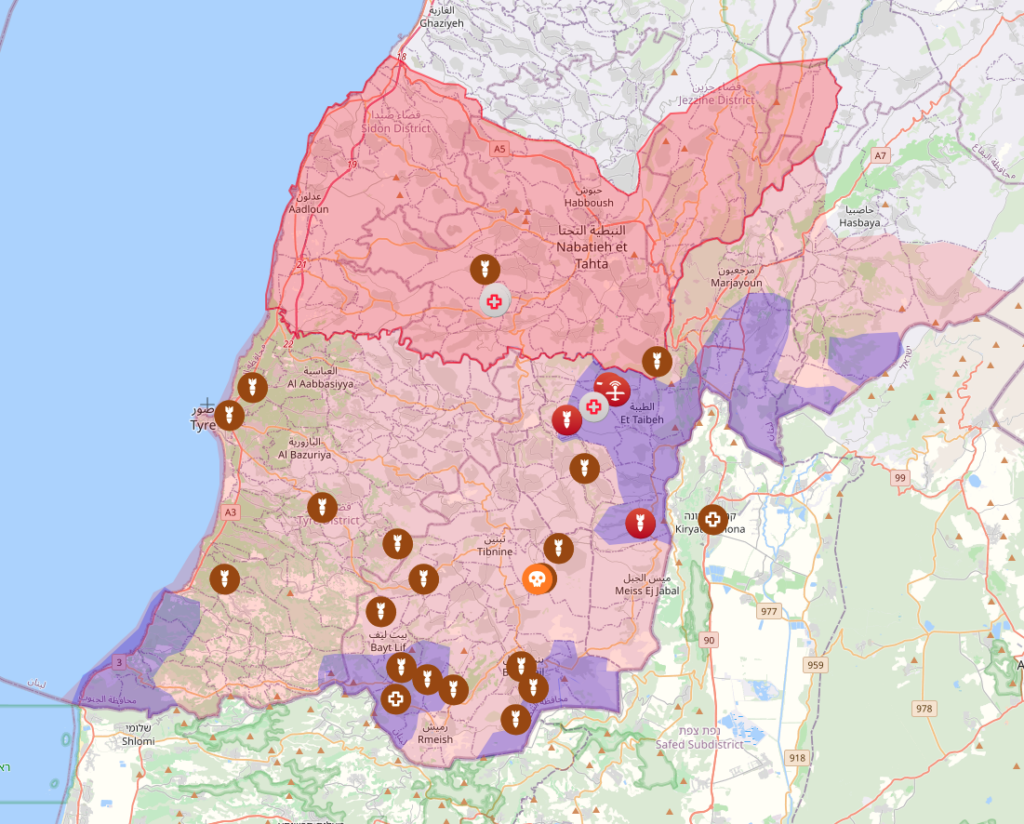
  • It’s always hard to tell what the state of the war in Lebanon is, but to my casual observation, it looks like the intensity of strike has lessened on both sides, but Hezbollah attacks seem to have fallen sharply. On the other hand, today’s status map show that Israeli forces are already at the Litani River in the eastern part of Lebanon:

  • “US military has been working on Iran ground raid plans for years.” One would hope.

    Retired Gen. Frank McKenzie, the former commander of U.S. Central Command (Centcom), said Sunday that the U.S. military has been working on plans for a ground raid in Iran for years, as President Trump is reportedly considering sending troops into the war.

    “Margaret, for many years we’ve considered options along the southern coast of Iran, seizing islands, seizing small bases. Typically raids. And a raid is an operation with a planned withdrawal. You’re not going to stay. But some of those islands you could seize and hold. That would have a couple effects,” McKenzie told CBS News’s Margaret Brennan on “Face the Nation.”

    “First of all, it would be profoundly humiliating for Iran and would give us great weight in negotiations. The second, the example of Kharg Island, which everyone talks about, if you seize Kharg Island, you really can shut down the Iranian oil economy completely. And the beauty of seizing it is, you’re not destroying it,” he said.

  • Is China pushing Iran for a ceasefire?

    • “The risks to global trade through the Strait of Hormuz have surged and the dynamics of Iran’s relationships with Russia and China are constantly in the spotlight. Recently, both countries have pressured Iran, urging diplomatic solutions to the crisis. On March 24th, China’s foreign ministry reported that Foreign Minister Wang Yi held a phone call with Iran, calling for seizing the opportunity for peace and negotiating as soon as possible.” So did Russian Foreign Minister Sergei Lavrov.
    • “Analysts believe Russia has explicitly urged Iran to back down, signaling that Moscow views Iran as unable to continue fighting. Shortly afterward, China followed suit, aligning with Russia in terms of diplomatic timing. This indicates coordination between the two countries. Their shared goal is to maintain the stability of the Iranian regime, ensuring it continues to act as a strategic counterbalance to the United States.”
    • “From Beijing’s perspective, Iran is not only a major energy supplier, but also a key node in the Belt and Road Initiative. Chinese investments in the country amount to at least hundreds of billions of dollars, covering oil and gas field development, port construction, and transportation networks. If the Iranian regime were completely overthrown, it would directly threaten China’s energy and geopolitical interests. Therefore, Beijing must intervene diplomatically and urge Iran to turn to negotiations.” A lot of observers believe that Belt and Road is already moribund.
    • “A source close to China’s Foreign Minister, Wang Yi, revealed to the Epoch Times that Iran has refused any purely diplomatic arrangements and instead pressured Beijing with selective security, linking substantial aid to the safe passage of Chinese commercial ships through the Strait of Hormuz. This is soft extortion. Without military assistance, China cannot ensure the smooth passage of its trade routes. Beijing’s multiple secret negotiations have ended in failure and its efforts to profit from the geopolitical game are now facing the dual impact of diplomatic imbalance and economic stagnation.”
    • China also thought it could be a negotiating mediator between Washington and Tehran. Yeah, fat chance.
    • “This crisis is essentially the inevitable backlash of China’s ‘wolf warrior diplomacy” and camp confrontation mentality.”
    • “China’s leaders have fallen into a self-entangling dilemma. The forces they’ve supported are now cutting off their own economic lifelines. The disruption in the Straight of Hormuz is not only a rupture in global logistics, but also a microcosm of the complete collapse of China’s geopolitical strategy.”
    • “You’re starting to see the Iranian regime looking for an exit ramp.”
  • “USAF A-10s are arriving in the UK tonight as the U.S. surges more Warthogs to the Middle East.”
  • Your guide to Iranian naval mines:

    Caveat: Not the best voiceover quality.

  • “Pope Leo Explains God Does Not Listen To People Who Wage War So Long As You Don’t Count Moses, David, Joshua, Elijah, Saul, Gideon, Samson, Or Anyone Else In Bible.”
  • As usual, this is just the Iran news I felt significant enough to include in the roundup. If you think I’ve missed anything, feel free to share in the comments below.

    China Perfidy Roundup for September 22, 2020

    Tuesday, September 22nd, 2020

    Time to zig while everyone else is zagging over the Supreme Court nomination fight, and once again offer up a roundup of Communist China’s ongoing perfidy:

  • Trump’s war against the China class:

    Chances are that by the time you get to the end of this article, there will be news of another information operation targeting Donald Trump. There’s one a day now—each trumpeting a new mortal threat to the republic or some dastardly revelation based on sources that are usually anonymous. Whatever it is, it will serve the same purpose as the hundreds of similar sallies launched over the last four years—namely, to preserve and protect the position and privileges of America’s ruling elite.

    Trump stories are rarely about Trump. The same stories, or versions of them, would have targeted anyone who threatened to sever the American political, corporate, and cultural elite’s economic lifeline to the Chinese Communist Party. It is largely because Trump sought to decouple the United States from the CCP that America’s China Class, which owns the platforms on which Americans communicate, has waged a relentless campaign of information warfare against him through its social media and prestige media brands.

    Consider the last two anti-Trump info ops: He gratuitously denigrated the historical suffering of African Americans, and he expressed contempt for America’s war dead. These are the sort of false allegations that political operatives are tasked to manufacture and disseminate during election season. Their purpose is to reinforce a negative impression of the opposing party among whatever cohort is being addressed, and make the target spend resources—time and money and sometimes blood—on defense. That’s politics 101, since the time of the Romans.

    What’s new is that this is now journalism too. Since the internet defunded the press at the end of the 20th century and social media became the dominant player in America’s information space, journalism has abandoned the traditional standards and practices that once defined reporting. For instance, the smear holding that Trump is contemptuous of the military was supposedly based on four anonymous sources recalling exchanges from three years ago, which have been contradicted by dozens of named sources, some of whom were physically present when the comments were supposedly made—and some of whom have been public Trump opponents. In traditional journalistic terms, that’s not a news story—that’s a failed attack line.

    The press that existed in America from the end of the 19th century until the turn of this one was designed to inform, influence, and sometimes inspire or inflame fellow citizens. But for people under 30, the only kind of “journalism” they’ve ever known is more like Pravda in the old Soviet Union or the kinds of party media found throughout the Third World. Journalism is an insider’s game, in which the stories are often outlandish, but rarely true; their actual news value is the hints they may offer about shadowy maneuverings that affect people’s lives but take place out of public view, like the rise or fall of a particular colonel who is pictured standing closer to or farther away from El Caudillo or Al Rais. Stories aren’t about the realities they purport to depict; the real stories are always the stories about the story.

    American journalists, who now draw their paychecks directly and indirectly from the country’s largest economic interest—technopolies like Amazon, Apple, Google, and Facebook—are now turning the public sphere into a phantasmagoria of conspiracy theories and hysteria to cement the politburo’s position and privilege.

    Accordingly, the debate in Washington, D.C., over which great power is feeding more disinformation into the 2020 election cycle isn’t real—it’s not Russia, as collusion impresario and Democratic Rep. Adam Schiff claims, nor, as Attorney General William Barr says, is it China, though he’s closer to the truth. The source of the purposeful disinformation pouring into the American public sphere like untreated sewage is the American elite, led by its tech oligarchs, who own the platforms on which information campaigns are staged and laundered to protect their core interests—foremost among them being cheap Chinese labor and access to Chinese markets.

    Snip.

    By the time the Clinton White House granted China most favored nation trade status in 2000, all of Washington knew that America was running a vast trade deficit that was destined to increase with accession to the World Trade Organization. The price for lifting tens of millions of rural Chinese peasants out of poverty through favorable trade arrangements would be tens of millions of American lives ruined, even as large American companies like Apple and Nike and bankers like JPMorgan and Goldman Sachs got richer. The elite reasoned that they had no choice: The rise of China was inevitable. Why fight it?

    American political and corporate elites didn’t choose decline. They chose to get rich. By shipping America’s manufacturing base off to China, they seized a business opportunity the likes of which had never been seen before—an enormous captive labor force controlled by an authoritarian regime that guaranteed the steady production of goods at a fraction of what it would cost at home. American cultural elites (Hollywood, sports, art, etc.) who exploited the increasingly large Chinese market for their products provided cover for the China Class cohort with messaging that dovetailed with CCP propaganda.

    Who were Americans to judge a great and ancient civilization like China’s for jailing dissidents and enslaving the Uighur minority? Doesn’t America have its own history of slavery and political prisoners? It’s racist to protect American jobs. Those jobs aren’t coming back and there is nothing to be done about it, as Barack Obama famously said—unless you have a magic wand …

    Calling out the American elite for betraying American interests in the service of their own personal and corporate bottom lines helped Donald Trump win the presidency. But it’s not clear that he truly understood how deeply entwined Beijing’s interests were with America’s China Class—and that trying to decouple the two would lead to an attempt at a permanent coup by the new techno-elite, targeting not just him and his supporters but the foundations of the republic, from our military to the media, and from our justice system to the institution of the presidency itself.

    The American elite’s financial relationship with China is the key to understanding what’s been happening in America the past four years. Any president, Democrat or Republican, who took on China would have been targeted by the China Class. Because it was Trump flying the Republican banner who sided with America’s working men and women, the Democrats resorted to alliances with powers that now threaten the stability and security of the country.

    Overstated? A bit. But there are several kernels of truth in there…

  • Related: Major U.S. media companies that have ties to China. It’s an extensive list…
  • “Coronavirus Shock Claim: Refugee Scientist Says Virus Came from Army Lab“:

    Hong Kong-based virologist Yan Li-Meng, currently in hiding at an undisclosed location, claims that the COVID-19 coronavirus came from a People’s Liberation Army lab, and not from a Wuhan wet market as Beijing has claimed.

    EconoTimes reports on Yan:

    Speaking on a live stream interview on Taiwan’s News Agency Lude Press, she said, “At that time, I clearly assessed that the virus came from a Chinese Communist Party military lab. The Wuhan wet market was just used as a decoy.”

    “I knew that once I spoke up, I could disappear at any time, just like all the brave protesters in Hong Kong. I could disappear at any time, even my name would no longer exist,” Yan said according to a translation.

    Yan has been in hiding in the U.S. after fleeing Hong Kong in April. She last made waves in July after an interview with Fox News:

    Yan told Fox News in an exclusive interview that she believes the Chinese government knew about the novel coronavirus well before it claimed it did. She says her supervisors, renowned as some of the top experts in the field, also ignored research she was doing at the onset of the pandemic that she believes could have saved lives.

    She adds that they likely had an obligation to tell the world, given their status as a World Health Organization reference laboratory specializing in influenza viruses and pandemics, especially as the virus began spreading in the early days of 2020.

  • Here’s a shocker: Twitter has suspended her account.
  • The Crimes of the Red Emperor:

    On July 30th, Chinese state media published details of the upcoming fifth plenary session. The Party’s leaders have traditionally used the conference to lay out their next five-year plan, but this time a new detail was included—a pointed reference to “targets for 2035.” The date may give us some indication of how long Xi Jinping intends to retain his position as president. China has reached a crucial stage of its development, with superpower status at last in sight, and Xi has decided that only one man can be trusted to guide the country through the final stages of its glorious journey. That man is himself, of course. He has assumed the role of Great Helmsman, famously ordering the removal of presidential term limits in 2018 to ensure that the inferior leaders of the future don’t botch the job.

    In the years since becoming president, Xi has drawn state powers to himself like no other Chinese leader since Mao. Today he oversees all aspects of economic, political, cultural, social, and military reform, and at the same time he directs all aspects of national, internet, and information security.1 This dramatic fortification of his personal power requires him to focus on the silencing of dissent—again, to a greater degree than any of his predecessors since Mao. But dissent crops up in many and varied forms, even in China, and as a result we find that the president’s power base is built on countless personal tragedies.

    Xi has authorised his secret police to kidnap, “interrogate” (torture), and detain for six months anyone charged with endangering state security, which means, in reality, anyone who has expressed heretical views. Tens of thousands have disappeared as a result. Others have been caught in his anti-corruption dragnet—a convenient cover for him to get rid of dissenting voices. And more than a million people have been locked in concentration camps, most of them guilty only of belonging to the wrong ethnic group. If Xi really does stay in power until 2035 then we can expect the casualties to keep piling up for another 15 years. We owe it to these victims to tell a few of their stories, and to remember some of their names.

    Xi’s Gestapo thugs will sometimes come for TV newscasters just before they are due to go on air, but in 2018 they came for an elderly professor while he was actually on the air. Six or seven policemen turned up to drag Sun Wenguang, 83, away from his live interview with Voice of America. These are cynical terror tactics. It’s one thing to read a detached news report about someone having been arrested; it’s quite another to actually hear the panic in the old man’s voice as he shouts: “What are you doing? What are you doing? It’s illegal for you to come into my home!” That interview will not quickly be forgotten by Chinese listeners to Voice of America.

    “Deng Xiaoping kept everyone together by promising to make them rich,” says Nicholas Bequelin, East Asia Director of Amnesty International. “What keeps things together under Xi is fear. Fear of the system, where no matter how high you are, from one day to the next you can disappear.” 243 Party officials are reported to have killed themselves during Xi’s first few years in office, apparently terrified at the prospect of investigation by his dreaded Central Commission for Discipline Inspection. It is not difficult to understand why they might have chosen this route. Both body and will are broken in the Party’s detention centres. Each of those officials knew that after just a few months in police custody, he would no longer be the same person.

    Several sad examples of Chinese individuals broken by torture snipped.

    Xi Jinping has more in common with an emperor of the ancient world than the chairman of a revolutionary vanguard party. Despite this, somewhat paradoxically, he has resurrected the language of Mao’s era. In the words of John Garnaut, one-time advisor to the Australian government, “Xi’s language of ‘party purity’; ‘criticism and self-criticism’; ‘the mass line’; his obsession with ‘unity’; his attacks on elements of ‘hostile Western liberalism,’ ‘constitutionalism,’ and other variants of ideological ‘subversion’—this is all Marxism-Leninism as interpreted by Stalin as interpreted by Mao.”

    The Communist Party of the 21st century is a classic Chinese dynasty rather than the temporary guardian of a workers’ revolution. Its leaders are concerned with the Party itself, not with communism. But Xi is using elements of Marxism-Leninism as the glue to hold society together—like a religion, perhaps, or like Confucianism in earlier dynasties. “Our red nation will never change colour,” he tells the people. And with the return of the old phrases comes the return of the old practices. Xi knows that Western ideas are forever infecting the minds of his subjects; always perverting the purity of students, of lawyers, of government officials. Like Stalin and Mao, he knows that regular purges are necessary in order to preserve the spiritual health of the people.

    Xi’s main legacy, however, is surely the Xinjiang nightmare. Over the past few years a million or more Uyghur Muslims (and smaller numbers of Kazakhs and Kyrgyz) have been shut in concentration camps scattered about the western province. This mass incarceration is a response to terrorist attacks carried out by Uyghur separatists in Kunming and Ürümqi in 2014—attacks that came at the end of decades of tension between Uyghurs and Han Chinese, the country’s dominant ethnicity.

    The camps are designed to stamp out extremist thinking. Unfortunately, as with so many of Xi’s policies, there is no concern for collateral damage. Party leaders have been given instructions to round up anyone acting suspiciously, but this definition of “suspicious” appears to have been provided by a paranoid schizophrenic. Uyghurs have been interned for growing a beard; making plans to travel abroad; praying too much (or, on other occasions, not praying enough); setting clocks to two hours after Beijing time; even simply having been born in the 1990s. The wrong skin colour is itself cause for suspicion.

    From the outset, Xi told his officials to show no mercy. They took him at his word, and now the personal tragedies are mounting.

    Read the whole thing.

  • A look at how quickly China has put up massive new concentration camp complexes for Uighurs. (Hat tip: Ed Driscoll at Instapundit.)
  • The biggest reason behind the Uighur genocide: One Belt One Road:

  • China as faltering contender:

    The conventional wisdom has long been that, if there is to be a major war involving China and the U.S., it will be the result of either of a rising China initiating war to displace the failing U.S. hegemon, or a declining U.S. initiating a war to stymie a rising China. But this ignores the possibility that systemic or hegemonic war between China and the U.S. may not have anything to do with a rising power. It ignores the possibility that such a war might be initiated by what I will call a faltering contender, a once-rising power whose ascent is running out of steam and whose leaders believe that it must decisively reshape the global order now while it still can.

    The logic linking a faltering bid for hegemony to systemic war is simple enough. Faced with the prospect that it is losing the demographic or developmental race with other potential challengers, or merely with non-hegemonic rivals, a faltering contender will sometimes launch what might be thought of as a war of desperation. In this kind of war, a faltering contender will initiate hostilities because, having realized that it has reached the peak of its relative power, it decides it must initiate war now, even under unfavorable circumstances, because if it doesn’t, it will not only fail to achieve predominance but will face the prospect of catastrophic defeat in the near future. Such wars are not caused by states leaping through open windows of opportunity created by the military advantage they enjoy over their potential rivals. Instead, they are caused by stalled rising powers, at a current or imminent military disadvantage, attacking despite this disadvantage because it is the least bad of several very bad options open to them.

    Analogies to Germany in World War I and Japan in World War II snipped.

    China’s explosive economic growth since the beginning of reform in 1979 is a unique success story, as is the concomitant growth of its military power and global influence. Few could have predicted that within one generation of Richard Nixon’s visit to Beijing in 1972, China would have risen to undisputed number two in the global pecking order. China now has the world’s second-largest economy, a world-class military with growing force projection capabilities, a worldwide network of ‘silk roads’ making it a central node in the global economy, and a diplomatic profile that makes it, if not an ‘indispensable nation,’ then something pretty close. And yet, at precisely the moment when its tide has reached heights not seen for centuries, the Chinese leadership has reason to believe that China’s star may not be in the ascendant much longer. President Xi’s failed One-Belt initiative, botched COVID-related ‘medical soft power’ play, abrogation of the ‘one-country, two-systems’ modus vivendi with Hong Kong, inconclusive border clashes with India, failure to sustain China’s economic momentum, policy-induced demographic time-bomb, and a growing sentiment that China is becoming less powerful and therefore less relevant player on the world stage suggest that China is no longer a rising power, but a faltering one. Viewed through this lens, the picture of the future that comes into focus is one of counterbalancing, containment, economic ‘decoupling,’ social turmoil, ethnic unrest, and general entropy culminating in collapse. Unless a forward-thinking Chinese leader might conclude, decisive steps are taken now to put things aright. And what might those steps be? Well, if history is any guide, they might include launching a war of desperation in the hope of securing the best geopolitical settlement possible before China is weakened to the point where it is simply condemned to another ‘hundred years of humiliation.’ What that war might look like – how it might erupt, whom it might involve, what course it might take – cannot be forecast with any certainty. But then neither could the war started by Germany in 1914 nor that by Japan in 1941. The point is that in those two earlier cases, the only rational course of action for the faltering challenger was the strategic Hail Mary pass. The question is, will a China whose rise is similarly stalling throw a comparably desperate strategic pass the early in the 21st century?

  • Chinese Antivirus Firm Was Part of APT41 ‘Supply Chain’ Attack.”

    The U.S. Justice Department this week indicted seven Chinese nationals for a decade-long hacking spree that targeted more than 100 high-tech and online gaming companies. The government alleges the men used malware-laced phishing emails and “supply chain” attacks to steal data from companies and their customers. One of the alleged hackers was first profiled here in 2012 as the owner of a Chinese antivirus firm.

    Charging documents say the seven men are part of a hacking group known variously as “APT41,” “Barium,” “Winnti,” “Wicked Panda,” and “Wicked Spider.” Once inside of a target organization, the hackers stole source code, software code signing certificates, customer account data and other information they could use or resell.

    APT41’s activities span from the mid-2000s to the present day. Earlier this year, for example, the group was tied to a particularly aggressive malware campaign that exploited recent vulnerabilities in widely-used networking products, including flaws in Cisco and D-Link routers, as well as Citrix and Pulse VPN appliances. Security firm FireEye dubbed that hacking blitz “one of the broadest campaigns by a Chinese cyber espionage actor we have observed in recent years.”

    Snip.

    One of the men indicted as part of APT41 — now 35-year-old Tan DaiLin — was the subject of a 2012 KrebsOnSecurity story that sought to shed light on a Chinese antivirus product marketed as Anvisoft. At the time, the product had been “whitelisted” or marked as safe by competing, more established antivirus vendors, although the company seemed unresponsive to user complaints and to questions about its leadership and origins.

    Those charged also include Zhang Haoran, Jiang Lizhi, Qian Chuan and Fu Qiang.

  • YouTube bans thousands of Chinese Astroturf accounts.
  • Is China stockpiling commodities?
  • Maybe because they’re on the brink of a major food shortage?
  • “Trump administration to soon end audit deal underpinning Chinese listings in U.S.

    The Trump administration plans to soon scrap a 2013 agreement between U.S. and Chinese auditing authorities, a senior State Department official said, a move that could foreshadow a broader crackdown on U.S.-listed Chinese firms under fire for sidestepping American disclosure rules.

    The deal, which set up a process for a U.S. auditing watchdog to seek documents in enforcement cases against Chinese auditors, was initially welcomed as a breakthrough in U.S. efforts to gain access to closely guarded Chinese financial information and bestowed a mark of legitimacy on Chinese regulators.

    But the watchdog, known as the Public Company Accounting Oversight Board (PCAOB), has long complained of China’s failure to grant requests, meaning scant insight into audits of Chinese firms that trade on U.S. exchanges.

    The lack of transparency has prompted administration officials to lay the groundwork to exit the deal soon, according to Keith Krach, undersecretary for economic growth, energy and the environment, in a sign the PCAOB will give up on efforts to secure information from the Chinese.

    Good.

  • Journalist debunks NBC puff piece on Wuhan biolab.
  • “U.S. charges two Chinese nationals over coronavirus vaccine hacking scheme, other crimes.” That would be Li Xiaoyu and Dong Jiazhi.
  • “Chinese database details 2.4 million influential people, their kids, addresses, and how to press their buttons.” I’m surprised it’s that small. The OPM breach under Obama alone exposed over 4 million people.
  • “How a Chinese agent used LinkedIn to hunt for targets.”

    His doctorate research was about Chinese foreign policy and he was about to discover firsthand how the rising superpower seeks to attain influence.

    After his presentation, Jun Wei, also known as Dickson, was, according to US court documents, approached by several people who said they worked for Chinese think tanks. They said they wanted to pay him to provide “political reports and information”. They would later specify exactly what they wanted: “scuttlebutt” – rumours and insider knowledge.

    He soon realised they were Chinese intelligence agents but remained in contact with them, a sworn statement says. He was first asked to focus on countries in South East Asia but later, their interest turned to the US government.

    That was how Dickson Yeo set off on a path to becoming a Chinese agent – one who would end up using the professional networking website LinkedIn, a fake consulting company and cover as a curious academic to lure in American targets.

    Five years later, on Friday, amid deep tensions between the US and China and a determined crackdown from Washington on Beijing’s spies, Yeo pleaded guilty in a US court to being an “illegal agent of a foreign power”. The 39-year-old faces up to 10 years in prison.

    Snip.

    In 2017, Germany’s intelligence agency said Chinese agents had used LinkedIn to target at least 10,000 Germans. LinkedIn has not responded to a request for comment for this story but has previously said it takes a range of measures to stop nefarious activity.

    Some of the targets that Yeo found by trawling through LinkedIn were commissioned to write reports for his “consultancy”, which had the same name as an already prominent firm. These were then sent to his Chinese contacts.

    One of the individuals he contacted worked on the US Air Force’s F-35 fighter jet programme and admitted he had money problems. Another was a US army officer assigned to the Pentagon, who was paid at least $2,000 (£1,500) to write a report on how the withdrawal of US forces from Afghanistan would impact China.

    In finding such contacts, Yeo, who was based in Washington DC for part of 2019, was aided by an invisible ally – the LinkedIn algorithm. Each time Yeo looked at someone’s profile it would suggest a new slate of contacts with similar experience that he might be interested in. Yeo described it as “relentless”.

    According to the court documents, his handlers advised him to ask targets if they “were dissatisfied with work” or “were having financial troubles”.

  • How China killed globalism:

    When globalism’s obituary is finally written, and the mourners file past in their crisp suits and pantsuits, the cause of death will almost certainly read, the People’s Republic of China.

    China is the most obvious offender. Even before the Wuhan virus cut off countries from each other, the communist oligarchy had abused the world economy with massive digital theft, even more massive counterfeiting, product dumping and every possible form of economic warfare.

    That’s why any halfway serious adult on the other side supports Trump’s fight against China.

    Last year, even George Soros, the uber-globalist, called Trump’s trade war with China his greatest achievement. This year, during the coronavirus crisis, Soros came out against working with the People’s Republic of China against the virus.

    This certainly doesn’t buttress my theory that both Soros and China are backing antifa/#BlackLivesMatter, but it doesn’t entirely invalidate either.

  • China threatens to retaliate to restrict drug exports to America in retaliation for America restricting semiconductor exports. I keep saying that semiconductor equipment exports are a lot more critical and less replaceable. (Hat tip: Stephen Green.)
  • Chinese-made phones were infected with money-stealing malware straight out of the box.
  • China is ramping up nuclear and missile forces to rival the U.S..
  • China war scenarios.
  • University of Pennsylvania can’t explain $3 million donation from China.
  • And they’re not the only ones still taking Chinese money.

    Dozens of universities, including Columbia and Stanford, are hosting the Chinese government-funded Confucius Institute despite increasing scrutiny from the federal government.

    Many elite universities with Confucius Institute programs appear to be unfazed by the Trump administration’s decision last week to designate the D.C-based headquarters of the program as a “foreign mission”—a label the U.S. government applies to entities it finds to be directly controlled by a foreign power. Despite the announcement, nearly 50 colleges and universities will continue their partnership with Confucius Institute programs, which comes with up to $1 million in Chinese government funding.

    The cushy partnership between American universities and the Chinese regime has restricted academic freedom on campus, frequently forcing administrators and faculty members to self-censor to avoid Beijing’s wrath. While many universities rely on the organization to support Mandarin language classes and Chinese culture lessons, the program also bars its staff from discussing topics considered taboo by the Chinese Communist Party, such as the Xinjiang concentration camps or the Hong Kong protests.

  • Former deputy mayor of Jixi city in northeastern Heilongjiang Province flees to the U.S., “reveals the tight control of speech and information in China, the regime’s cover-up of COVID-19 cases, [and] Communist Party officials secretly taking medicine to prevent virus infection.” (Hat tip: Director Blue.)
  • Ren Zhiqiang, former chairman of a state-owned real estate group who “openly criticized Beijing’s handling of the coronavirus pandemic was sentenced to 18 years in prison on corruption charges Tuesday, a court announced.”
  • India looks to ban 275 more Chinese apps.
  • Qualcomm lobbies for Chinese chips.
  • “Chinese miners in Hwange National Park put Zimbabwe wildlife at risk.” Particularly elephants.
  • Truth:

  • “Disney Editing Blunder: This Uighur Concentration Camp Can Be Clearly Seen In The Background Of ‘Mulan.'”