Archive for the ‘Military’ Category

All China’s Lies And the Sad Death of Hong Kong

Thursday, May 28th, 2020

Well, not all of them. No blog is big enough for all China’s lies. But here’s an update on the lies being told, and crimes being committed, by China’s ruling Communist Party.

  • First, China’s Communist Party announced that it was going to impose a new national security law on Hong Kong.

    There are plenty of direct ways the new national security law could backfire on economic freedom in Hong Kong.

    For example, it criminalizes “foreign interference” without specifying who the measure targets or where the boundaries lie. Might a Goldman Sachs report out of Hong Kong questioning China’s gross domestic product data put its business charter at risk? What about Nomura Holdings downgrading a key China Inc. company?

    International news organizations might feel paranoid about reporting on fraud at Hong Hong-listed companies or China corralling more than 1 million ethnic minority residents in Xinjiang province into “indoctrination camps.” It is hard to see how short sellers like Muddy Waters Research maintain Hong Kong offices when they spotlight alleged fraud at mainland companies, most recently Nasdaq-listed Luckin Coffee.

    The extradition bill that helped fuel the 2019 protests, which allowed people to be moved from Hong Kong to the mainland, could return, perhaps imposed by fiat from Beijing. What multinational corporate board or startup team eying an IPO wants to have that worry in the backs of their minds? Or the specter of the Chinese Communist Party remaking Hong Kong’s judiciary and banking system in its image?

    The more Xi damages China’s liberal financial zone, the more the foreign companies generating millions of jobs in Hong Kong will question why they should stay.

  • Next, Secretary of State Michael Pompeo declared that Hong Kong was no longer autonomous from China.

    The Trump administration said it could no longer certify Hong Kong’s political autonomy from China, a move that could trigger sanctions and have far-reaching consequences on the former British colony’s special trading status with the U.S.

    Secretary of State Michael Pompeo announced the decision Wednesday, a week after the government in Beijing declared its intention to pass a national security law curtailing the rights and freedoms of Hong Kong citizens.

    “Hong Kong does not continue to warrant treatment under United States laws in the same manner as U.S. laws were applied to Hong Kong before July 1997,” Pompeo said in a statement. “No reasonable person can assert today that Hong Kong maintains a high degree of autonomy from China, given facts on the ground.”

    Snip.

    A finding on Hong Kong’s autonomy was compelled by last year’s Hong Kong Human Rights and Democracy Act. The law signed by Trump requires such a certification each year.

    Pompeo’s decision opens the door for a range of options, from visa restrictions and asset freezes for top officials to possibly imposing tariffs on goods coming from the former colony.

    “The United States stands with the people of Hong Kong as they struggle against the CCP’s increasing denial of the autonomy that they were promised,” Pompeo said, referring to the Chinese Communist Party.

  • Chuck DeVore says we cannot wait to confront Communist China:

    As with Berlin, how the U.S., Western Europe and, more importantly, the key nations in the Indo-Pacific region react to the events in Hong Kong will end up determining the geopolitical course of this century.

    That Hong Kong is no more is a fact. The form of Hong Kong, with its culture forged by the productive union of British rule of law and individual rights with Chinese entrepreneurship and diligence, may last another year or two. But the idea of Hong Kong is dead, killed by the Chinese Communist Party’s (CCP) insatiable quest for total control.

    The proximate cause of Hong Kong’s demise is the CCP’s demand to use extrajudicial kidnappings, torture and executions to terrorize its 7.5 million people into submission—in short, to rule Hong Kong as it rules Turkestan (Xinjiang), Tibet and, someday soon it hopes, Taiwan.

    The people of Hong Kong saw this day coming, but they were powerless to stop it. Hong Kong’s Basic Law agreement, the contract acknowledging Hong Kongese’ human rights, was always subject to termination whenever the CCP felt powerful enough to do so. It is, as with any agreement the CCP signs, worthless.

    In the meantime, China’s communist leaders ramp up their paranoid rantings, claiming foreign “black hands” are behind the unrest in Hong Kong. Concurrently, China’s propaganda mouthpieces continue to press the absurd notion that America started the coronavirus pandemic.

    Thus, crushing Hong Kong’s spirit while murdering a few thousand student democracy activists will only embolden Beijing. How can it be otherwise, as it perceives fewer consequences than the slap on the wrist it received after the Tiananmen Square massacre in 1989?

    The problem with bombastic propagandistic lies is that they are sometimes believed. And the CCP appears predisposed to believing its own lies. To “defend” itself, the CCP may soon order its modernized armed forces into action along the first island chain, from the southern tip of Japan to the coast of Vietnam, with Taiwan and, to a lesser extent, the Philippines.

    The urgent task before our generation is to prevent a monstrous darkness from snuffing out freedom’s flame. We must deter the PRC from expanding its horizon to the first island chain while setting the conditions for victory—removing the CCP, as it exists today, from power. We win, they lose.

    This task has already started, when the Trump administration, for the first time since the Reagan-era effort to win the Cold War, declared that the U.S. will engage a “whole-of-government” strategic approach to the challenge presented by the PRC. This approach acknowledges that the CCP doesn’t merely present an economic threat, with its unfair trade practices and intellectual property theft, as well as a military threat—but that it also seeks to supplant our values.

  • “Based on information from German intelligence agencies, reports indicate that Chinese Leader Xi Jinping personally asked the World Health Organization to delay the release of critical information regarding its coronavirus outbreak.”
  • Just this morning Instapundit offered up this flashback to 2018: “As Biden and Kerry Went Soft on China, Sons Made Nuclear, Military Business Deals with Chinese Gov’t.”
  • Did you know that China is involved in a border standoff with India?

    Over the past month, China’s People’s Liberation Army (PLA) has reportedly moved at least 5,000 troops to the “Line of Actual Control,” which demarcates the border between China and India. The mobilization of troops to the Galwan River valley, on the westernmost border between the two countries, led to a clash on May 5, when Chinese and Indian forces engaged in fisticuffs and stone-throwing. In keeping with Sino–Indian border protocols, both sides were unarmed, but the skirmish — and another in the Naku La region near Tibet on May 12 — left several troops injured.

    Though the facts on the ground in the remote Himalayan border region are unclear, satellite imagery of the area confirms a rapid military buildup by Chinese forces since April. India has responded in kind, mobilizing troops and artillery to the area in recent days, according to Bloomberg News. An Indian policy analyst who requested anonymity adds that there is also evidence that the two sides have moved aircraft closer to the region.

    The apparent trigger for China’s military buildup is the completion of an Indian road in the Galwan River valley up to the Line of Actual Control, according to Indian national-security analyst Nitin Gokhale. The People’s Republic of China (PRC) has long held a superior position in this frontier region, with roads and electricity lines that far surpass those on the Indian side. However, “in the last few years, India has been playing catch-up, and has finally built roads up to the LAC,” according to Dhruva Jaishankar, the director of the Observer Research Foundation’s U.S. Initiative. India’s Border Roads Organization, which is currently constructing 61 roads, has now developed the infrastructure to compete with the PLA in the disputed territory. In turn, China has attempted to preserve its advantage by pushing back Indian development, leading to intermittent confrontations. Most recently, in 2017, China’s construction of a road through Doklam, near Bhutan, an ally of India, set off two months of brinkmanship, ending with a Chinese retreat but heightening caution on both sides.

    The border dispute pertains primarily to two contested territories: the Aksai Chin plateau to the west and the Indian state of Arunachal Pradesh to the east. Chinese offensives in the two areas ignited the 1962 Sino–Indian War, ending with an informal ceasefire as the two sides agreed to the loosely demarcated Line of Actual Control. To Beijing, the LAC granted territory claimed by Delhi on the western side of the border, which contains a strategically crucial road between Tibet and Xinjiang. In the eastern portion of the LAC, however, the PRC effectively ceded what it calls “South Tibet,” retreating to the McMahon Line, the Tibetan–Indian border drawn by British colonial officials in the early 20th century. But PRC officials still consider the McMahon Line a vestige of imperialism, and continue to lay claim to Arunachal Pradesh, an Indian state of 2 million people with strong cultural ties to Tibet.

    India PM Narendra Modi doesn’t strike me as the kind of person who willingly backs down…

  • Speaking of confronting China: “U.S. to Expel Chinese Graduate Students With Ties to China’s Military Schools.” “The Trump administration plans to cancel the visas of thousands of Chinese graduate students and researchers in the United States who have direct ties to universities affiliated with the People’s Liberation Army.”
  • “DOE probe into colleges finds $6B in unreported funds from China, Russia.” (Hat tip: Director Blue.)
  • “Chinese Yuan Suddenly Tumbling.” Wow, it’s almost as if cracking down on Hong Kong has negative repercussions for China’s economy…
  • YouTube deleting comments with two phrases that insult the Chinese communist party.” Comments left under videos or in live streams that contain the words “共匪” (“communist bandit”) or “五毛” (“50-cent party”) are automatically deleted in around 15 seconds, though their English language translations and Romanized Pinyin equivalents are not.”
  • Of course: “Twitter Fact Checks President Trump – But Not Communist China.” (Update: Evidently Twitter started to fact-check ChiCom statements literally this morning.)
  • China doesn’t like Texas Rep. Dan Crenshaw saying mean things about them. I’m sure he’s crushed.
  • GQ “reporter” Julia Ioffe seems really unclear on the concept that Pompeo’s declarations triggers sanctions. So naturally she got schooled. And naturally, she deleted her tweet rather than issuing a correction… (Hat tip: Ed Driscoll at Instapundit.)
  • “China Issues Stay-At-Home Order To Hong Kong To Prevent Spread Of Democracy.”
  • The Insane Engineering of the A-10

    Tuesday, May 26th, 2020

    For those who feel my video offerings have been too tank-centric as of late, here’s a video featuring the design choices behind everyone’s favorite flying tank killer, the A-10 Warthog.

    (Hat tip: Regular reader Brandon Byers.)

    Memorial Day: Remembering Henry F. Warner

    Sunday, May 24th, 2020

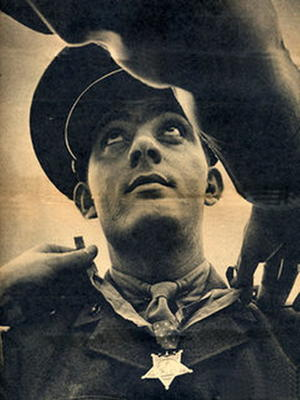
    This Sunday before Memorial Day we honor the life of Cpl. Henry F. Warner, an antitank gunner who single-handedly destroyed three German tanks and killed the commander of a fourth:

    Serving as 57-mm. antitank gunner with the 2d Battalion, he was a major factor in stopping enemy tanks during heavy attacks against the battalion position near Dom Butgenbach, Belgium, on 20-21 December 1944. In the first attack, launched in the early morning of the 20th, enemy tanks succeeded in penetrating parts of the line. Cpl. Warner, disregarding the concentrated cannon and machinegun fire from 2 tanks bearing down on him, and ignoring the imminent danger of being overrun by the infantry moving under tank cover, destroyed the first tank and scored a direct and deadly hit upon the second. A third tank approached to within 5 yards of his position while he was attempting to clear a jammed breach lock. Jumping from his gun pit, he engaged in a pistol duel with the tank commander standing in the turret, killing him and forcing the tank to withdraw. Following a day and night during which our forces were subjected to constant shelling, mortar barrages, and numerous unsuccessful infantry attacks, the enemy struck in great force on the early morning of the 21st. Seeing a Mark IV tank looming out of the mist and heading toward his position, Cpl. Warner scored a direct hit. Disregarding his injuries, he endeavored to finish the loading and again fire at the tank whose motor was now aflame, when a second machinegun burst killed him. Cpl. Warner’s gallantry and intrepidity at the risk of life above and beyond the call of duty contributed materially to the successful defense against the enemy attacks.

    Memorial Day: Remembering John Basilone

    Saturday, May 23rd, 2020

    This Saturday before Memorial Day we honor the life of Gunnery Sergeant John Basilone, who was not only the first Medal of Honor winner in World War II for his actions on Guadalcanal, but left the cushy life of a Bond Drive hero to return to action in time for the invasion of Iwo Jima.

    His actions on Guadalcanal put most movie action heroes to shame:

    John Basilone was born on November 4th, 1916. Basilone was born and raised in Raritan, a small town in New Jersey. He was an adventurous and restless child always looking for something new and exciting. After finishing the 8th grade, Basilone elected not to go to high school. He searched for some adventure and excitement and, not finding any, he joined the Army in 1934. After his basic training Basilone was posted to the Philippines.

    During his time at his base in Manila, Basilone developed a mechanical talent for working with guns, especially machine guns. Basilone also developed a talent for motivating and leading men. After his three year enlistment ended Basilone returned to Raritan. A couple of years later he once again found himself becoming restless and looking for new adventures. He decided to reenlist in the service but this time he joined the Marines.

    Ten months into World War II, Basilone found himself on the island of Guadalcanal, it was August of 1942. The Americans had secured an airstrip that was vital to the war effort. The Japanese and Americans were involved in one of the fiercest battles of World War II. The Japanese were determined to take the airfield and had assigned an entire Japanese division to the task of capturing the airfield.

    Standing between them was only one Marine Battalion. The odds were certainly not in favor of the Americans. Basilone, who was in charge of 16 men, established a defensive position with 4 heavy machine guns in front of Henderson Field. It was October 24th when the Japanese launched a massive attack. The strategy Basilone had established for his unit was to let the Japanese advance to within 30 yards. And then to “let them have it.”

    The plan worked. They fired at the first group of attacking Japanese, successfully wiping them out. This first charge was only the beginning of the overall enemy attack. They charged several more times. Eventually this attack took its toll. Basilone, while manning the left two machine guns, heard a loud explosion come from the right setup of the machine guns. Moments later, one soldier from the right side crawled over and informed him that both right guns were knocked out and that the crew was all dead or injured.

    Basilone knew he had to get to the knocked out guns to see if he could get them working. The first gun was beyond repair, but the second gun had a chance. There was no light to aid in examining the damaged gun. Basilone would have to troubleshoot the problem in the dark, it was now that Basilone’s expertise with machine guns would pay off. He was able to feel the parts to find out what was causing the gun not to fire. Basilone quickly had the gun working again. As soon as it was back in action, the enemy charged. With the extra gun now working, Basilone and his unit easily beat back the Japanese attack. The attacks kept coming. Basilone told two of his remaining Marines to keep the heavy machine guns loaded. Basilone would roll to one machine gun and fire until it was empty, then roll over to the other one that had been loaded while he was firing the first one. At about 3 AM they were almost out of ammunition.

    The Marines had stored ammunition about 100 yards away. However, this would be a difficult 100 yards. There were enemy troops on both the sides and behind their position. Basilone ran and crawled through the jungle. Bullets flew off over his head and grenades exploded around him. But he continued and made it to the ammo dump. Basilone threw six heavy cartridge belts over his soldier.

    As he started back to his men, bullets were whizzing all around him again. But he made it back and soon he found another challenge. One machine gun had been smashed. Basilone took parts from another knocked out gun and fixed it quickly. Later in the night, the ammunition ran low again. Basilone would need to go for more, but this time it would be to another ammunition dump, 600 yards away.

    Once again the Japanese threw everything at him, but he snaked through the grass well enough so that the Japanese could not find a clear target. Basilone made it back with the much needed ammunition which held off the enemy attacks. Finally the attacks ended around sunrise.

    The daylight revealed a scene of utter carnage on the ground. Hundreds of bodies laid dead in front of the American positions, In fact, the entire Japanese regiment, around 3000 men, had been “annihilated.” On this night of October 24th, and 25th the U.S. had turned the tide of the war and the previously undefeated Japanese were on their way to defeat. For his heroics that night Basilone was awarded the Medal of Honor.

    He did his Bond Drive duty, but refused an officer’s commission and a chance to teach gunnery to return to active duty, shipping out of Camp Pendleton on August 11th, 1944…just a month after he had gotten married.

    On February 19th, 1945 the Marines arrived at Iwo Jima and were ready to attack. The Navy had bombarded the island for 36 days. Some Marines hoped this intense bombing would allow them to take the island with little resistance. However, there were 22,000 Japanese warriors who were well dug in, heavily armed, and prepared to die.

    The first U.S. invasion force landed on the beach at 9:05 AM. Basilone’s group landed around 9:30 AM. They were surprised to find little opposition. The Marines got up on the beach and noticed that their feet could barely move in the soft black volcanic sand of Iwo Jima.

    For one hour, the U.S. was able to get their transports up to the beach and unload the men without major resistance. Then, with the beach crowded with U.S. soldiers, the Japanese began their counter attack.

    Suddenly the Japanese from their hidden blockhouses began firing away at the exposed U.S. troops. The Marines were getting annihilated. Survivors later wondered how anyone survived the initial Japanese barrage. The U.S. forces were on the beach, but they had little or no cover, were still disorganized, and had not yet gotten enough heavy equipment ashore to defend against this type of attack.

    The troops had trained for years, but nothing could prepare them for what was happening all around them. The soldiers would later say how frustrated they were that they could not see the enemy to fight back. The Japanese counterattack had stalled the U.S. invasion. Most Marines were hiding in the sand. The beach was littered with damaged vehicles, equipment, and dead soldiers. The invasion was not moving.

    Brave men with leadership ability were needed to rally the troops. Basilone rose to the occasion. Many survivors of the battle recall that in the midst of the battle, with everyone hunkered down in the sand, there was one Marine out in the open, running around, directing men. It was Basilone. He first guided a tank out of a mine field. Only a few tanks came ashore and they were needed to knock out Japanese blockhouses.

    Basilone had noticed a particular Japanese bunker had been effectively shooting mortar shells and raging deadly fire upon the U.S. troops. This enemy strong position “had to go”. Basilone found and organized some machine gunners along with demolition men and directed them toward the bunker. Basilone instructed a demolition man to blow a hole in the concrete structure, while others gave cover against other nearby enemy positions.

    A large explosion went off opening part of the bunker. Basilone then told the enthused machine gunners to hold their fire and directed a flamethrower operator to charge the pit. The brave flamethrower charged the pit as quickly as he could, stuck his nozzle in the pit and ignited the flame. Some of the Japanese soldiers ran out of the pit screaming as they tried to wipe away the jellied gasoline that was burning them. Basilone cut them down with a machine gun. Fellow soldier, Charles Tatum, said “for me and others who saw Basilone’s leadership and courage during our assault, his example was overwhelming.”

    After knocking out the bunker, Basilone led twenty men off the exposed beach area to a location where they could take some cover and plan their next move. He ordered the men to stay while he went back to get more men and some heavy machine guns. Basilone gathered some troops and weapons and started back across the beach to the waiting soldiers. But Basilone was hit with a Japanese mortar shell which landed right in the middle of him and the men he was leading. He died from his wounds around thirty minutes later.

    For his actions that day, John Basilone was awarded The Navy Cross. The military paid tribute to Basilone by naming a ship after him. An anti-submarine Navy Destroyer, the U.S.S. Basilone was commissioned on July 26th, 1949. His home town of Raritan honors him every year with a parade…Basilone remains the only soldier (non-officer) in U.S. history to be awarded both The Medal of Honor and The Navy Cross. He is also the only Medal of Honor winner to go back into combat and be killed in combat.

    Here’s a link to his official Medal of Honor page.

    LinkSwarm for May 22, 2020

    Friday, May 22nd, 2020

    The Wuhan coronavirus, and China, and deep state shenanigans, oh my! But first a PSA for Texas shoppers:

  • There’s an an “Energy Star” sales tax holiday in Texas Memorial Day weekend. Products you can buy tax free this weekend include:
    • Air conditioners (priced $6,000 or less)
    • Refrigerators (priced $2,000 or less)
    • Ceiling fans
    • Incandescent and fluorescent light bulbs
    • Washers
    • Dishwashers
    • Dehumidifiers

    Why water heaters, dryers and freezers aren’t eligible I couldn’t tell you, but if you needed to get any covered appliances, this weekend is a good time.

  • When was Michael Flynn unmasked? Wrong question. What if he was never masked in the first place?

    There is no such evidence in the unmasking list that acting national intelligence director Richard Grenell provided to Senators Chuck Grassley (R., Iowa) and Ron Johnson (R., Wis.). I suspect that’s because General Flynn’s identity was not “masked” in the first place. Instead, his December 29 call with Kislyak was likely intercepted under an intelligence program not subject to the masking rules, probably by the CIA or a friendly foreign spy service acting in a nod-and-wink arrangement with our intelligence community.

    “Unmasking” is a term of art for revealing in classified reports the names of Americans who have been “incidentally” monitored by our intelligence agencies. Presumptively, the names of Americans should be concealed in these reports, which reflect the surveillance of foreign targets, primarily under the Foreign Intelligence Surveillance Act. Broadly speaking, FISA governs two kinds of intelligence collection.

    The first is “traditional” FISA — the targeted monitoring of a suspected clandestine operative of a foreign power. If the FBI shows the Foreign Intelligence Surveillance Court (FISC) probable cause that a person inside the United States is acting as a foreign power’s agent, it may obtain a warrant to surveil that person. If the foreign power’s suspected agent communicates with Americans, the latter are incidentally intercepted even though they are not the targets of the surveillance.

    The second kind of FISA collection occurs under Section 702 of the statute. It brings under FISC jurisdiction various intelligence-collection programs that target categories of non-Americans outside the United States. These foreigners also communicate with Americans, so the latter are incidentally intercepted.

    Under federal law, both kinds of FISA collection are subject to so-called minimization procedures. These aim to safeguard the privacy of Americans who have been incidentally monitored. When raw intelligence is refined into intelligence reports (including transcripts of recorded conversations) that are disseminated to U.S. officials, the identities of these Americans do not appear. Rather, a designation such as “U.S. Person” is substituted — the “mask,” as it were.

    If, upon reviewing intel reports, an official with national-security or foreign-relations responsibilities believes that the reporting is critical, and that the identity of the U.S. person must be known in order for our government to reap the full benefit of the intelligence, then that official may request unmasking. Decisions on such requests are made by specialists assigned to the agency that reported the intelligence in question — usually the FBI or the NSA for intelligence collected, respectively, inside or outside the United States. Our intelligence agencies, led by the Office of the Director of National Intelligence (ODNI), keep records of these requests. This underscores that unmasking — because of its privacy implications, because foreign intelligence must never be a pretext for government spying on Americans — is a big deal that should be done only rarely and carefully.

    With that as background, let’s get back to Flynn.

    For three years, we’ve been led to believe that Flynn’s December 29 conversation with Kislyak was intercepted because the latter was “routinely” monitored. (Kislyak was replaced as ambassador in 2017.) That is, Kislyak was an overt agent of Russia, stationed at its embassy in Washington, so the FBI kept tabs on him. Indeed, the “routine”-surveillance story line was repeated by the New York Times just this week.

    The implication is that Kislyak was probably subjected to traditional FISA surveillance by the FBI; or, since he lived in Russia and traveled to other places when not in America, perhaps he was also a FISA Section 702 target. In either event (or both), Kislyak was interacting with Americans, who were thus incidentally intercepted.

    That, the story goes, is what must have happened to Flynn. Trump’s designated national security advisor was unmasked because, once intelligence agents intercepted the December 29 phone call, they decided it was essential to identify the person with whom the Russian ambassador was discussing sanctions that President Obama had just imposed against Moscow.

    I no longer buy this story. If it were true, there would be a record of Flynn’s unmasking. DNI Grenell has represented that the list he provided to Senators Grassley and Johnson includes all requested unmaskings of Flynn from November 8, 2016 (when Donald Trump was elected president) through the end of January 2017 (when the Trump administration had transitioned into power). Yet, it appears that not a single listed unmasking pertains to the December 29 Kislyak call.

    Timeline details and Strzok-Page comms snipped.

    Well, the possibility that first leaps to mind is: Maybe Flynn was a FISA surveillance target. That is, his interception was not incidental. Rather, the FBI was monitoring him under FISA because he was a suspected agent of a foreign power — the theory based on which the bureau opened their counterintelligence investigation of Flynn in August 2016. But that can’t be right. After an exhaustive investigation of the FBI’s abuse of FISA, Justice Department Inspector General Michael Horowitz concluded that there is no evidence the FBI “requested or seriously considered FISA surveillance of . . . Flynn.” (IG Report’s “Executive Summary,” p. vi.)

    It is more likely, then, that the Flynn–Kislyak call was captured by intelligence operations that are not governed by FISA.

    Snip.

    Readers of my book Ball of Collusion know I have argued that the Obama administration’s Trump–Russia probe/political-narrative long predated the FBI’s July 2016 opening of “Crossfire Hurricane.” I believe there were several strands of the Trump–Russia probe, and that they trace back to 2015, around the time of Donald Trump’s entry into the race for the Republican presidential nomination.

    The CIA played a central role. The agency collaborated — I’m tempted to say colluded! — with a variety of friendly foreign intelligence services, especially NATO countries that Trump made a habit of bashing on the campaign trail.

    Read the whole thing.

  • “How Russiagate Began With Obama’s Iran Deal Domestic Spying Campaign“:

    Barack Obama warned his successor against hiring Michael Flynn. It was Nov. 10, 2016, just two days after Donald Trump upset Hillary Clinton to become the 45th president of the United States. Trump told aide Hope Hicks that he was bewildered by the president’s warning. Of all the important things Obama could have discussed with him, the outgoing commander in chief wanted to talk about Michael Flynn.

    The question of why Obama was so focused on Flynn is especially revealing now. The Department of Justice recently filed to withdraw charges against the retired three-star general for making false statements to the FBI in a Jan. 24, 2017, interview regarding a phone call with a Russian diplomat. The circumstances surrounding the call and subsequent FBI interview have given rise to a vast conspiracy theory that was weaponized to imprison a decorated war hero and a strategic thinker whose battlefield innovations saved countless American lives. There is no evidence that Flynn “colluded” with Russia, and the evidence that Flynn did not make false statements to the FBI has been buried by the bureau, including current Director Christopher Wray.

    So if the Obama administration wasn’t alarmed by Flynn’s nonexistent ties to Russia, why was he Obama’s No. 1 target? Why were officials from the previous administration intercepting his phone calls with the Russian ambassador?

    The answer is that Obama saw Flynn as a signal threat to his legacy, which was rooted in his July 2015 nuclear agreement with Iran—the Joint Comprehensive Plan of Action (JCPOA). Flynn had said long before he signed on with the Trump campaign that it was a catastrophe to realign American interests with those of a terror state. And now that the candidate he’d advised was the new president-elect, Flynn was in a position to help undo the deal. To stop Flynn, the outgoing White House ran the same offense it used to sell the Iran deal—they smeared Flynn through the press as an agent of a foreign power, spied on him, and leaked classified intercepts of his conversations to reliable echo chamber allies.

    Again, read the whole thing. (Hat tip: Ed Driscoll at Instapundit.)

  • Matt Taibbi: “Democrats Have Abandoned Civil Liberties.” I wonder if Taibbi could pinpoint the last time Democrats actually supported civil liberties…
  • “House Dem criticizes her own party for shoving ‘wish list’ stimulus package: ‘It’s not a good look.'”

    Rep. Katie Porter, D-Calif., criticized her own party’s coronavirus legislation this week as House Speaker Nancy Pelosi, D-Calif., pressured the Republican-controlled Senate to adopt what Porter described as a Democratic “wish list.”

    “The HEROES Act is dead on arrival,” Porter said Tuesday, referring to the $3 trillion package the House passed last week as a follow-up to the CARES Act. Her comments during an online meeting hosted by the Tustin [Calif.] Democratic Club were first reported by the Washington Examiner.

    “There was no bipartisan negotiation here and no effort at bipartisan negotiation,

    Snip.

    But tucked into the legislation are provisions that rankled the Republicans, including expanding $1,200 checks to certain undocumented immigrants, restoring the full State and Local Tax Deduction (SALT) that helps individuals in high-taxed blue states, a $25 billion rescue for the U.S. Postal Service, allowing legal marijuana businesses to access banking services and early voting and vote-by-mail provisions.

    “I did find myself, Porter said, “on the House floor thinking [of] my Republican colleagues who said, ‘This bill is a Democratic wish list written by a handful of Democrats, and shoved down the throats of the rest of the Congress.’

    Restoring SALT is a giveaway to blue state billionaires. Sounds like the marijuana banking part should be passed, but there’s no reason to cram it into a coronavirus relief bill. And the early voting and vote-by-mail provisions are designed to help further voting fraud. Speaking of which:

  • A Philadelphia judge has pled guilty to helping Democrats commit voting fraud:

    A former Judge of Elections in Philadelphia, Pennsylvania, has been charged and pleaded guilty to illegally adding votes for Democrat candidates in judicial races in 2014, 2015, and 2016.

    On Thursday, the Department of Justice (DOJ) announced charges against former Judge of Elections Domenick DeMuro, 73, for stuffing the ballot box for Democrats in exchange for payment by a paid political consultant.

    The charges, and guilty plea, include conspiracy to deprive Philadelphia voters of their civil rights by fraudulently stuffing the ballot boxes for specific Democrat candidates in the 2014, 2015, and 2016 primary elections and a violation of the Travel Act.

    “The Trump administration’s prosecution of election fraud stands in stark contrast to the total failure of the Obama Justice Department to enforce these laws,” Public Interest Legal Foundation President Christian Adams said in a statement. “Right now, other federal prosecutors are aware of cases of double voting in federal elections as well as noncitizen voting. Attorney General William Barr should prompt those other offices to do their duty and prosecute known election crimes.”

    As Judge of Elections, DeMuro was paid to oversee the election process in the 39th Ward, which encompasses Philadelphia.

    DeMuro’s guilty plea states that he was paid by a political consultant to illegally add votes for particular Democrat candidates in primary judicial races. The political consultant who allegedly paid DeMuro had been hired by those Democrat candidates.

    According to the indictment, the political consultant allegedly solicited payments from Democrat candidates who hired him, classifying them as “consulting fees.” The payments — which ranged from $300 to $5,000 — were then allegedly used to pay Election Board Officials, such as DeMuro, in exchange for those officials illegally adding votes for the consultants’ Democrat candidates.

    (Hat tip: The President of the United States of America.)

  • In addition to certifying fraudulent results to help Democrats, DeMuro also took a hands-on approach to voting fraud: “Demuro fraudulently stuffed the ballot box by literally standing in a voting booth and voting over and over, as fast as he could, while he thought the coast was clear.” (Hat tip: Chuck DeVore.)
  • Several posts here suggested that Sweden’s model of reaching herd immunity might be a better method than what we were doing. Now that the data is in: not so much. “Sweden becomes country with highest coronavirus death rate per capita.”
  • Speaking of data, the way media dashboards count the numbers are skewed high. “At the time of Colorado’s announcement on Friday, the CDC-definition tally, used in CNN’s “dashboard” and all the other media reports, stood at 1,150 statewide. But only 878 of those, more than 23 percent less, are identified as deaths due to COVID-19.”
  • Democrats thinks the Wuhan coronavirus crisis will get worse. Of course they do.
  • “CNN Is Willing To Lie About Wuhan Virus in Texas If That’s What It Takes to Crash the Economy.”

    CNN has staked out a position in its coverage of Wuhan virus that can only be explained in one way. They perceive a drawn-out lock down of America as something that will damage President Trump’s reelection chances and therefore it is something to be preserved. The move by a handful of governors to re-open their states to normal life despite the latest pronouncement from the latest M.D. or Ph.D. who fancies himself as Galactic Commander, threatens to reveal the Wuhan virus’s new clothing, so to speak. Therefore, anything that can be done to discredit the incontrovertible data that shows whatever threat Wuhan virus presented is now largely abated must be discredited.

    More tests are being given, and the positives rate is actually declining.

  • Oregon’s Democratic governor Kate Brown: “No shopping in open counties for those in closed counties!”
  • “Why California Is In Trouble – 340,000 Public Employees With $100,000+ Paychecks Cost Taxpayers $45 Billion.” I believe the word you’re looking for is looting
  • Speaking of California: More suicides than coronavirus deaths? I know that “data” is not the plural of “anecdote,” but maybe somebody should run the numbers…
  • Is Tesla planning a Gigafactory near Austin? There are still big tracks of land available out near 130…
  • Wargaming a war between the U.S. and China in 2030. Don’t be so sure they could knock out our carriers with hypersonic missiles, and our drones and submarines would wreck havoc with their trade.
  • Another day, another college professor arrested for spying for China:

    Case Western Reserve University School of Medicine professor and former Cleveland Clinic employee was arrested Wednesday over his alleged ties to China.

    The Justice Department announced that Qing Wang was arrested at his Shaker Heights, Ohio home as part of a joint operation conducted by the FBI and the Department of Health and Human Service Office of the Inspector-General. Wang was charged with wire fraud related to more than $3.6 million in grant funding that Wang and his research team at the Cleveland Clinic had received from the National Institutes of Health.

    According to the criminal complaint, Wang failed to disclose affiliations with Chinese universities. He also allegedly failed to disclose that he had received grants from the National Natural Science Foundation of China for a nearly identical research project. He held the title Dean of the College of Life Sciences and Technology at Huazhong University of Science and Technology.

    Cleveland Special Agent-in-Charge Eric Smith said this wasn’t “a simple case of omission, ” adding that “Wang deliberately failed to disclose his Chinese grants and foreign positions and even engaged in a pervasive pattern of fraud to avoid criminal culpability.”

  • The 40-year old girlfriend of 74-year old former Texas Lt. Governor David Dewhurst cracked two of his ribs. (Hat tip: Dwight.)
  • Magazine publisher Conde Nast lays off about 100 employees. Maybe the entire Teen Vogue Anal Sex department got laid off. Hopefully there are some good Python courses available in their area…
  • Universally respected mystery expert Otto Penzler was let go as editor of the Best American Mystery Stories of the Year so the publisher could pick stories based on “affirmative action” criteria rather than excellence.
  • When the levee breaks there ain’t no place to—

  • “There’s a sale bankruptcy at Penny’s!”
  • Oopsie!


  • “Florida Ruled To Be In Violation Of Science For Not Having More People Die.”
  • “Democrat Governors Warn If Lockdowns Are Lifted They Won’t Get Nearly As Much Time In The Spotlight.”
  • “I Forced A Bot to Read 1,000 Jennifer Rubin Columns And Write A Jennifer Rubin Column of Its Own.” One step closer to the robot uprising…
  • “Not this time, cat!”

  • Should save this one for winter:

  • Antidepressant or Tolkien character?
  • The Chieftain Talks About His Time In An M1 Abrams

    Sunday, May 17th, 2020

    More tanks? More tanks!

    This time Moran climbs around an M1A1 Abrams tank and talks about his time serving inside one during (I’m assuming) Desert Storm [evidently the Iraq War]. Highlights include how an Iraqi bullet missed his head by three inches, and how a tank designer including a pressure sensor on a loading door kept it from taking his arm off when they forgot to throw the proper safety switch.

    Edited to add:

    Chinese Lies Update For May 6, 2020

    Wednesday, May 6th, 2020

    Time for another roundup of Chinese lies and perfidy!

  • Remember all that blather about how there was “no way” the Wuhan coronavirus could have come from the Wuhan Institute of Virology? Yeah, not so much:

    A US government analysis leaked to the Washington Times concludes that the Wuhan Institute of Virology or the Chinese CDC is the “most likely” source of the COVID-19 pandemic which has killed over 200,000 people worldwide in roughly four months.

    The document, compiled from open sources and not a finished product, says there is no smoking gun to blame the virus on either the Wuhan Institute of Virology or the Wuhan branch of the Chinese Center for Disease Control and Prevention, both located in the city where the first outbreaks were reported. -Washington Times

    And while we may not have a smoking gun proving that COVID-19 escaped from the Wuhan lab, “there is circumstantial evidence to suggest such may be the case,” according to the report.

    Also, it’s perhaps the world’s easiest game of connect-the-dots;

    • In 2013, scientists at the Wuhan Institute of Virology collected horseshoe bats at a cave 1,000 miles away infected with the virus that causes COVID-19. (Stored away and forgotten until January this year, the sample from the horseshoe bat contains the virus that causes Covid-19. -WSJ)
    • Peng Zhou, WIV’s head of Bat Virus Infection and Immunization, was researching “the molecular mechanism that allows Ebola and SARS-associated coronaviruses to lie dormant for a long time without causing diseases,” while a press release from his lab was titled “How bats carry viruses without getting sick.”
    • Zhou’s colleague, Shi Zhengli, has been involved in bioengineering bat coronaviruses – co-authoring a controversial 2015 paper which described the creation of a new virus by combining a coronavirus found in Chinese horseshoe bats with another that causes human-like severe acute respiratory syndrome (SARS) in mice.
    • In 2015, Nature magazine expressed concern over Zhengli’s experiments with bat coronavirus. The same year, the US government suspended funding to the lab due to their concern over risks of experimenting with bat coronavirus.
    • Meanwhile, the US State Department warned over safety standards at the Wuhan lab in a series of cables beginning in 2015, according to the Washington Post’s Josh Rogin.
  • China knew the Wuhan coronavirus was contagious but waited five days to tell anyone else:

    Chinese health officials were drawing up plans to combat the CCP virus, which they knew to be infectious, days before they informed the public about its potential to spread, according to internal government documents obtained by The Epoch Times.

    The CCP (Chinese Communist Party) virus, commonly known as the novel coronavirus, originated in the central Chinese city of Wuhan in late 2019. The virus has since spread to more than 200 countries and territories, causing more than 61,000 deaths in the United States alone.

    China officially confirmed that the virus could be transmitted between humans on Jan. 20, when top respiratory expert Zhong Nanshan made the announcement.

    Now, internal documents provided to The Epoch Times show that Beijing covered up what it knew, as central authorities were secretly providing directives to regional governments on how to cope with the outbreak.

    On Jan. 15, the regional health commission in northern China’s Inner Mongolia issued a “super urgent” emergency notice to its municipal counterparts, explaining how medical facilities should respond to a new form of pneumonia. The notice said that China’s National Health Commission had implemented treatment and prevention measures for local health agencies to deal with the new disease (now known as COVID-19).

  • “US intel believes China hid severity of coronavirus epidemic while stockpiling supplies.” Nothing says “neighborly” quite like selling you infected blankets while buying up all the small pox vaccines…
  • China arrests users for posting coronavirus memories to GitHub.
  • “Why Was the U.S. So Late to Recognize the China Threat?”

    During the Cold War, the U.S. foreign policy was largely based on assumptions that the Soviet Union’s leaders were determined to spread communism worldwide; they possessed strategic patience and were adaptive in pursuing their goal. The USSR would never be America’s partner but a long-term rival, and therefore it must be contained. Moreover, U.S. decision-makers assumed that American society would fully support this approach.

    However, after the end of that confrontation, strategists like former National Security Advisor and Secretary of State Henry Kissinger falsely assumed that Communist China could be changed into a benign actor, even a “responsible stakeholder,” or strategic partner of the U.S. were the U.S. to engage with China, believing that China’s rise was a positive thing.

    We argue that China is not just a rival but a formidable enemy. Its goal is not just to weaken America but supplant it and the liberal international order it created with a Communist ideology-based model of global governance. The PRC is more dangerous than the Soviet Union because it is unpredictable and more formidable. It is an amalgamation of a rapidly rising power and an ideological regime with an aggressive leader in Chairman Xi Jinping. Xi is both extremely ambitious and paranoid about his regime’s security as well as his own. These factors make this enemy far less certain than the Soviets.

    Additionally, China is far more formidable than the Soviet Union because it has learned key lessons from the USSR’s mistakes regarding competition with the United States. It is an extremely adaptive adversary. So adaptive that it has been seen as a partner rather than an enemy for a generation. Moreover, it was so highly valued as a partner that it was brought into the Western economic ecosystem to be allowed and encouraged to prosper. China’s rapid growth was made possible by the U.S. government, business, financial markets, and universities, as well as its own efforts. Close ties between the American elite and Chinese business interest remain strong, even in the wake of the coronavirus.

    Fundamentally, there remain sectors in U.S. government, business, and intellectual communities who still see China as a partner and want to return the Sino-American relationship to “normalcy.” Even in the wake of the coronavirus, close ties between the American elite and Chinese business interest remain strong, and there is an assumption that things will return to normal once Trump leaves office.

  • How did we get here?

    Decades ago, the political, corporate and industrial leaders of the West chose to enmesh the fate of their pliable people with that of the vigorous, voracious Chinese.

    Like the United States, another hard-hit region—Northern Italy, so progressive and tony—had swung its toll gates open. Italy outsourced whole production lines to China.

    Free trade in goods is great. But trade goods, not places. The toll gates were swung open to human trade, or population replacement.

    Since the Chinese had begun settling in Northern Italy and buying up assets, I hazard that, much like youngsters of King County, in Washington State—local Italian girls and boys have had a hard time affording life in their homeland.

    And now, their grandparents and parents are dying.

    Italy constructed gleaming tarmacs to accommodate the many direct flights to and from Wuhan. More than 100,000 Chinese citizens moved to Italy. As the Chinese accrued wealth over the past two decades, still more took up residence in Northern Italy, and bought up Italian firms.

    See if you can spot the trend. New York City, by Wikipedia’s telling, is home to far and away “the highest Chinese-American population of any city proper.”

    Courtesy of an Italian strain of COVID-19, the New York metropolitan area has been as badly struck as Italy. In early April, it was said that “coronavirus was killing a person roughly every four minutes in New York state, and about every six minutes in New York City.”

    In my state of Washington, the overwhelming majority of Chinese reside in King County and Snohomish County, where the infection was seeded and from where it spread.

    The West’s political and corporate leaders, not China’s, had opened their borders to the world’s flotsam and jetsam. Agreements to exchange goods and people reflected the choices of these gilded global elites, not those of their people.

    The sphinxly Bill Gates, we are told, foresaw the pandemic. Gates also pioneered the outsourcing of American lives to China (and India). I say “lives,” because, as it has become abundantly clear, in the wake of COVID, the very stuff of life has been outsourced to China. Not mere jobs; but careers, not just some products, but entire production lines; not one or two manufacturing plants, but the entire means of production.

    (Hat tip: Instapundit.)

  • “As China’s Economy Implodes, Trump Ratchets Up the Pressure“:

    As the Wuhan coronavirus continues to spread, stay at home orders have shut down commerce in many parts of the world. Some have predicted a 40% contraction in the U.S. economy in the 2nd quarter of 2020. This means that China’s economy, heavily dependent upon exports, will see no economic rebound for quite some time. In the mean time, the Trump administration has “turbocharged” its effort to relocate global supply chains from China to markets less hostile to the West.

    Details on manufacturing and commerce imploding in Q1 snipped.

    This gives the Trump administration more ammunition in its attempts to move global supply chains away from the Chinese Communist Party (CCP). Reuters reported on Sunday:

    Now, economic destruction and the massive U.S. coronavirus death toll are driving a government-wide push to move U.S. production and supply chain dependency away from China, even if it goes to other more friendly nations instead, current and former senior U.S. administration officials said.

    “We’ve been working on [reducing the reliance of our supply chains in China] over the last few years but we are now turbo-charging that initiative,” Keith Krach, undersecretary for Economic Growth, Energy and the Environment at the U.S. State Department told Reuters.

    The report describes a “whole-of-government” effort in which free trade advocates seem to be losing their struggle with China hawks inside the administration. Citing national security concerns, many departments have joined in the process to figure out how to incentivize U.S. firms to move their operations out of the Chinese mainland. Options reportedly include ‘reshoring’ subsidies, tax incentives, developing closer ties to Taiwan, and ever higher tariffs on goods produced in China.

  • China tells its government to get ready for possible war with the United States over the Wuhan coronavirus. As opposed to China’s illegal actions in Hong Kong or the South China Sea…
  • UC Davis shuts down commie-funded Confucius Institute. Only about 80 more to go.
  • Some universities are not so brave: “Harvard Canceled Human Rights Event as Its President Met With Xi Jinping.”

    Teng Biao, a former fellow at Harvard Kennedy School’s human rights center, attempted to host a panel discussion on Chinese human rights issues in 2015. A vice dean at Harvard Law School, however, ordered him in February of that year to cancel the event because it would have been “embarrassing” for the university, according to Teng.

    “He called me into his office and he told me that the Harvard president was meeting Chinese president Xi Jinping,” Teng told the Washington Free Beacon. “It seems that for Harvard leaders, it was very embarrassing if we had a talk at Harvard about human rights issues in China when the Harvard president just came back from China after meeting with the Chinese president.”

    Teng is a human rights lawyer who fled China after authorities kidnapped and tortured him for his participation in the 2014 Hong Kong protests. Professor William P. Alford, a vice dean at the Harvard Law School, played a role in bringing Teng to Harvard. He also ordered Teng to cancel the event, according to the Harvard Crimson. Alford confirmed with the Free Beacon that he told Teng to postpone the event, a decision he made on his own accord, rather than at the administration’s urging. He said that he allowed Teng to host other events during his time at Harvard. While Teng did participate in other events, he said the panel discussion was never rescheduled.

    Evidently having a $40 billion endowment just isn’t enough to keep you from having to suck up to communist China…

  • Europe: “Hey China, want to help us create a vaccine for this coronavirus of yours?” China: “Go flu yourself!
  • If you want to see exactly how China lies about the Wuhan Coronavirus, here’s an example:

    Compare those statements to this timeline to see everything they left out. (Hat tip: Neontaster.)

  • Speaking of propaganda:

  • Speaking of willing dupes: “POLITICO Peddles Red China Propaganda Attempting To Own Trump–Gets SLAMMED On Twitter.” “POLITICO promoted a piece praising the Chinese Communist Party’s handling of the coronavirus outbreak and blasting the Trump administration.” (Hat tip: Stephen Green at Instapundit.)
  • Sadly, foreign news outlets seem more immune to China’s influence than our own MSM:

  • Shermanpalooza!

    Tuesday, May 5th, 2020

    Not sooner do I start writing about Sherman tanks than suddenly all sorts of Sherman-related information starts popping up.

    First, here’s are two really detailed videos from Nicholas Moran, AKA The Chieftain, of the features of a Sherman M4A1:

    Second, Dwight sent me this twitter thread, that goes into a great deal of detail about how the Sherman’s later reputation for being Not So Great came almost entirely for the way they were deployed in roles they were not specialized for.

    Here’s a Tweet from that thread that talks about the weird (but highly effective) redesign that became the Sherman M4VC Firefly used by the British Army:

    (The way embedded tweets work is you’ll probably have to click on that to see the full meme.)

    The British 17 pounder/76.2mm gun used a much longer (and thus higher velocity) shell, powerful enough to take out a Tiger I from the front (though I don’t fancy its chances against the Tiger II), a gun about on par with the German 88mm L/56 on the Tiger I (but not the 88mm L/71 on the Tiger II).

    And speaking of the Firefly, Moran did a tour of the Firefly in these videos:

    And here’s Moran and Forgotten Weapons host Ian McCollum joining forces to fire the weapon systems on a Sherman:

    Finally, it being the Internet, there’s a site dedicated to Sherman tanks. This myths about Shermans post is particularly interesting.

    Marine Littoral Combat Regiment?

    Sunday, May 3rd, 2020

    In something of a follow-up to news that the Marine Corps is eliminating its tank regiments over the next decade, there are plans afoot to develop and field a Marine Littoral Combat regiment

    The Marine Corps’ current force design conversations and planning will help develop the littoral regiment concept, Stephenson said.

    If the past few months of public appearances by Berger and his top generals are any indication, a littoral regiment would likely find itself in the III Marine Expeditionary Force, headquartered in Okinawa, Japan, and consist of small teams of Marines armed with a host of unmanned air, ground and maritime assets along with long range fires and air defense systems.

    Sounds like the Marines are going to go heavy into drones.

    While details are not yet available, a regiment is a sizable unit to form in a limited manpower Marine Corps.

    An infantry regiment can include up to nearly 2,200 Marines divided into three battalions along with a headquarters and support company, depending on the mission and configuration.

    But there are different configurations for a regiment. The Corps also staffs combat logistics regiments to provide transport, communication and logistics assets to the ground combat forces.

    In October 2019, Brig. Gen. Benjamin Watson said that the Corps was “no longer going to stick or take an uncompromising position on the sanctity of the MAGTF,” [Marine Air-Ground Task Force, a basic Marine organizational structure since 1963] while speaking at the National Defense Industrial Association’s Expeditionary Warfare Conference in Annapolis, Maryland.

    “If what is needed is a piece of the Marine Corps that is not organized like a MAGTF or a capability the Marine Corps can bring that is not a MAGTF, then we are not too proud to provide that,” he said.

    A retired Marine Corps officer now a senior adviser for the Center for Strategic & International Studies shared analysis at the same conference showing “no growth” for personnel in future Marine budget planning.

    “Coastal defense, cyber, space,” Mark Cancian said. “They will have to take down existing capabilities to find the structure and the space to do that.”

    I rather doubt the Marines are going to field localized cyberwarfare units out in combat regiments beyond some basic signal corps countermeasures. I suspect we already have a cyberwarfare unit up and running out of one or more three initial agencies in the greater D.C. area.

    The Corps will need to cut and shift priorities for the next fight, Berger said at a November Marine Corps Association and Foundation dinner.

    “We may need to get smaller, trade some parts we’ve had for a long time but are not a good fit for the future,” Berger said.

    He looked to reduce or eliminate money going toward manned anti-armor ground and aviation platforms, manned and traditional towed artillery that can’t shoot hypervelocity rounds and short range mortar systems.

    All other efforts are leaning into conducting sea control and sea denial operations from the sea and maritime terrain, he said.

    To make that happen, the commandant said that he wants low cost, lethal air and ground unmanned platforms, unmanned long range surface and subsurface vehicles, mobile, rapidly deployable rocket systems, long range precision fires, loitering munitions across the echelons, mobile air defense and counter-precision guided munitions capabilities, signature management, electronic warfare and expeditionary airfields. [“Signature management,” in this context, means controlling your electronic emissions and observables. “To be detected is to be targeted is to be killed.”]

    And it appears, the Marine littoral regiment may be the formation for many of those new capabilities and manpower.

    All this seems both forward-looking and also very amorphous. It suggests “we’re adjusting our force mix to better face off against China, but we’re not sure quite how yet.” But China is just one part of the equation; the furious pace of technological change, budget pressures, and long simmering doctrinal debates all seem to be additional change drivers.

    It’s also interesting that they’re using the word “littoral,” as the Navy’s Littoral Combat Ship program was hardly a smashing success.

    Great power military conflicts of the future are likely to use weapons smarter, more autonomous, more lethal and probably lower cost than the weapons systems we’ve built our combat forces around today. Taking and holding contested shorelines is probably going to look less like Iwo Jima and more like battles between rival autonomous drone swarms.

    The question is how long it will take to get to that technological plateau, and what the Marine Corps will look like during the transition.

    The History of Firearms Development Part 1

    Saturday, May 2nd, 2020

    This Borepatch post got me thinking about the history of firearms development, and all the mistakes and blind alleys along the way. Plus I wanted to put up videos (where available) of how some of the weird firearms Borepatch described actually worked.

    But before I did that, I realized I needed to delve into the basics of gunpowder and early firearms development, to set out things in chronological order.

    Here’s a short one covering the invention of gunpowder in China, featuring primitive proto-firearms like the firelance, up through early European cannons, the hand-canon and the arquebus.

    Here’s a video of someone testing a home-built recreation firelance using bamboo. The first attempt does not go well, so they reinforced the bamboo on the second with electrical tape.

    A longer look at the development of early gunpowder weapons in Europe up through the early Napoleonic War:

    Highlights: the difficulty of getting saltpeter means Europeans needed to make it by boiling down animal waste, how “corning” vastly increased the power of gunpowder, how they made cannon bodies out of strips of metal bound with iron hoops (why they’re still know today as bun barrels), and how the Pumhart von Steyr is the largest siege cannon still existent, firing stones that weighed 1,533 pounds. Also, Henry Knox, George Washington’s master of artillery, was by profession a bookseller of military history. And the exploding shell was invented by British Lieutenant Henry Shrapnel.

    A short look at gun development from the hand-cannon to the musket: