“Smart rifle” technology seems to have finally arrived in the form of an “AI” enhanced scope that still requires you to pull the trigger, but picks the optimal time to actually fire to take out drones.
“High-tech, often AI powered scopes are something every major military has been working on for the past few years with more failures than successes. The [Smash] 2000L is arguably the most developed such system in existence. However, given the laughably poor records high-tech scopes have, it’s valid to ask if this new system currently in the process of testing and adoption with the US Marine Corps, the UK, Australia, and other countries, is actually worth the hype.”
It only works against small drones because, you know, rifle. “The drones of the Smash 2000L system are designed to take out a roughly the size of a DJI Mavic drone, a system used by both Ukraine and Russia before DJI blocked all exports to both countries, after which both sides continue to produce very similar drones domestically. This drone and other comparable designs are actually among the most used drones in the war, with either side launching around 10,000 of them every single month. That makes them the exact type of threat the Smash 2000L was designed to counter.”
“The Mavic E3 drone measures [roughly] 14 by 11 inches with a height of barely [4] inches. This makes it roughly the size of a large Domino’s pizza.”
“They’re capable of reaching and exceeding speeds of roughly 50 [miles] an hour. Some of them are even capable of doubling that.”
“Drones rarely operate individually. Swarm attacks are most effective as they guarantee results.”
“From February 2022 to today, Ukraine went from domestically producing a total of about 3,000 drones per year to being capable of producing 5 million of them. Russian figures are similar at around 3 and a half million drones a year.” I would like to know where these figures are coming from.
“The obvious solution is just jamming the living shit out of everything. Although autonomous drones are gaining ground in warfare nowadays, most drones are still operated in real time by an operator. That operator communicates with the drone via a radio link and by jamming that link, essentially flooding it with radio frequency, the drone is cut off from its operator. The jammers themselves exist in the form of rifles. One of which famously made an appearance at the funeral of Pope Francis in 2025, the
very first time such a weapon was fielded at a papal funeral.”
Skipping over the jamming/fiber optic drone arms race we’ve covered before.
“Large and small surface-to-air missiles were launched, depending on the size of the approaching drone, and even other drones were used to take down drones.”
“However, the last ditch option for a soldier to use is their own primary firearm. And this is exceptionally difficult for a number of reasons. To take down a drone with their own assault rifle, a soldier who is high on adrenaline and reasonably afraid for their safety, has to hit a target roughly the size of a volleyball at a distance of between 50 and 200 meters as it buzzes around erratically at highway speeds. And they have to do that with a projectile that’s 5.56 or 7.62 mm in diameter.
“Because of this, both Russian and Ukrainian infantry squads have adopted shotguns as their go-to last ditch anti-drone firearm.”
“Shotguns have proven to be much more effective against drones as a last resort, which is why some manufacturers like Benelli have developed anti-drone shotguns with special ammunition.”
“Ukraine has also developed a special 5.56 anti-drone rounds that fires several sub projectiles instead of a solid bullet. The soldier still needs to fire five or six rounds while tracking the target, but the round is far more effective than standard ammunition because of its shotgun principle.”
The main problem is that shooting at drones that are trying to kill you is highly stressful, and accuracy suffers. “Aiming perfectly in such a stressful scenario is just borderline impossible, no matter how accurate you are. And this, of course, is where the Smash 2000L comes in.”
“The idea behind Smash is very simple. Turn every soldier into a sharpshooter. Smash is essentially a very advanced scope that can be installed on most firearms, and it’s allegedly capable of hitting targets, even very small moving targets like drones, with a 95% hit probability. For comparison, experienced shooters using red dot sites at a distance of about 100 m average a 20% hit rate.”
“With a Smash 2000L, even trainees average an 80% hit rate, with experienced shooters reaching the aforementioned 95%. Which is really pretty impressive.”
“Smash consists of a digital camera with an attached display that’s seen by the shooter, a trigger guard, and most importantly, a computer. That computer does all the work. It locks onto a target, analyzes its speed, heading, distance, and environmental conditions such as wind and humidity to estimate the best time for a soldier to take a shot. When it locks onto a target, Smash tracks it until it calculates the best time to shoot.”
“As long as the computer estimates that the hit probability is low, it will block the trigger using the trigger guard. The shooter presses their finger against the trigger, even though it’s blocked. And when the shooter takes aim at the very specific spot on the target, which the computer deems the highest hit probability spot, the computer unlocks the trigger guard, the trigger is pulled and a drone is shot out of the sky.”
“The shooter can also wait for the computer to unblock the trigger before pulling it. But the high hit probability time window is of course very short when it comes to fast flying drones. That’s why it’s easier for the shooter to keep pressing the trigger the whole time and simply wait for the computer to unblock it at the appropriate moment.”
“When testing in the United States, Smash took down loitering drones surprisingly casually. Fast moving drones are likely going to be more difficult, but certainly not impossible and certainly much easier to hit with Smash than without it.”
“The system can also be used to eliminate ground targets such as other infantry troops, and even more easily at that. In that mode, it’s accurate up to 300 m or close to 1,000 ft during the day, while the small drone elimination mode is accurate up to 100 m or around 300 ft in both day and night.”
“Aside from just destroying small drones, Smash is also marketed as being capable of destroying micro drones. These drones are usually used for reconnaissance, not direct attacks, and they’re sometimes so small that they can fit in the palm of your hand.” Like the super-tiny, super-expensive Black Hornet drone.
“The Smash system itself can also fit in the palm of your hand. It weighs 740 g or 26 oz and is smaller than most magnification scopes, with a battery capable of running for 72 hours before needing recharging.”
“Smash is a line of sight system, which means that you have to be able to see the enemy for it to track the enemy. That means a couple of things. For one, you need to expose yourself at least a little bit for Smash to do its job. And secondly, Smash can’t track an enemy behind cover. It can’t see through walls. This also means it’s impossible for the shooter to aim from thick brush, for example, as there’s no way for Smash to get around that.”
“With this in mind, Smart Shooter came up with an addition to the Smash 2000L in the shape of the Smash Hopper 5000, a remote control weapon station, and another thing with a fantastic, very 1990scoded name. A soldier who prefers not to expose themselves to the enemy can mount their rifle with its 2000L system attached on the Hopper 5000 and control it from the safety of cover.”
“The system weighs a substantial 25 kilos or 55 lbs. It’s clunky, takes a while to set up, and it can never have the maneuverability of a soldier.”
“Does the Smash 2000L completely solve the drone problem? No, absolutely not. But it is a step in the right direction, isn’t it? Accuracy and speed of aiming are the biggest hurdles an infantryman has to tackle when shooting down a drone with their firearm. And Smash is essentially just a
system that does that job much more accurately and almost instantly.”
The IDF tried it with only one rifleman per squad. First problem? “Blue-on-blue incidents.”
“At the time of its introduction, the system could not tell the difference between friendly and enemy combatants.”
“Aside from the IDF, the Smash 2000L was purchased by the US primarily to be used by the Marine Corps, as well as the Netherlands, India, Germany, and the United Kingdom.”
“The Israeli manufacturer has since secured a $10.7 million contract with the US Army, making it the second service branch to join the program.
All well and good, but there were many previous “smart” scopes that didn’t work out.”
“Another one of those optic systems that came out of Israel is Arcus, an acronym for Assault Rifle Combat Application, developed by Elbert Systems. The system consists of an eyepiece that the operator attaches to their helmet and wears at all times. The second part is installed on the rifle, essentially acting as an extension of the operator’s eye, providing a live feed from the gun’s point of view.”
“Arcus is capable of recognizing the human body shape and marking the target on the operator’s eyepiece. It can easily detect motion. It provides the operator with a range estimation, and the feed is transmitted to command headquarters at the same time, allowing everyone to see what the operator sees.” Shades of “network-centric warfare.”
“The system also controls fire in a similar way to the Smash 2000L and improves accuracy in the field. It even provides the operator with a built-in compass that essentially allows them to navigate without having to constantly check a map or GPS. The two modes of operation, thermal or electrooptic, allow the operator to use the system in both daytime and nighttime. I mean, it even has a shot counter to let the operator know when they’re low on ammo, which is very video game-esque. It is an absolutely perfect solution for a lot of real problems that infantrymen truly do face, and it could change the way the wars are fought.”
“And yet, nobody’s using it. Not even Israel is using it, let alone any other military. Five years after presenting Arcus and no one has even tried adopting it, with its biggest accomplishment so far being just reminding everyone of the target tracking system from Aliens.”
“The story is not much more positive with the United States’s next generation squad weapon program, which includes the XM157 fire control system.”
“When it comes to the XM157, the test results are disappointing. During testing in 2024, the fire control system received negative reviews from soldiers who used it. To be more specific, the 2024 report says that quote, “The XM7 with mounted XM157 demonstrated a low probability of completing one 72-hour wartime mission without incurring a critical failure.” Is it Windows based?
“It seems like after years of hyping up the next fire control system, the scope has simply gone missing and we’re not going to see it fielded anytime soon because it’s simply not reliable.”
Skipping over the Russian example, since they can’t even get their SAM systems to work right.
“So when we draw the line under AI assisted high-tech scopes,the result is not proportional to the hype surrounding them. Russia’s not using them. The US Army’s not using them, in spite of really really wanting to spend a ton of money promoting them in the news. And even Israel, which has been developing several types of these scopes, is only kind of using them, nowhere close to issuing them across the board to the entirety of the IDF. And this brings us the most obvious question that we’ve been building to this entire video. Are these devices, which are hailed in the media as the next big thing that’s going to revolutionize the way wars are fought, just an endless money pit?”
“Even if scopes such as the XM157 on the Smash 2000L were perfected tomorrow and all their software glitches and battery issues were ironed out, there are still three main issues regarding high-tech optics that are keeping them from becoming the norm.”
“The first two problems relate to doctrine. Over-reliance on technology can only take a soldier or a unit a certain distance before achieving the adverse effect and nullifying their fighting capabilities with old school equipment. At the same time, decision-making tools cannot be blindly trusted. Taking the Smash 2000 as a direct example, what happens if infantrymen start relying on AI to do the aiming and trigger pulling jobs for them too much? Well, the result is that a soldier is demoted from a shooting combatant to somebody who just broadly handles a weapon and points it in roughly the right direction, with the most important part of the job being carried out by the fire control system.” Given current U.S./NATO/Israeli doctrine, I don’t see this as a problem anytime soon.
I’m cutting out a lot of Whistler’s “whatbouts,” as I assume a competent system will allow switchback to manual targeting. Indeed, he reaches much the same conclusion. “Using traditional scopes or iron sights will remain the norm in doctrine, and AI powered scopes will be used sparingly, mostly for specialized tasks such as taking down drones or targets that are particularly difficult for a traditional optic to get an angle on.”
His next point is that sea-based automatic systems still make mistakes as well, and still produce friendly fire incidents.
His conclusion: “It is easy to see why high-tech optics will never fully replace the Mark1 eyeball. They will, mind you, be introduced in huge numbers, and military forces will most definitely find use for them, such as taking down anti-infantry drones, for example, but it’s extremely unlikely that they will become the standard infantry fire control system anytime soon.”
He may be right, but possibly not for the reasons he thinks, namely that ground-based drones will probably take over more and more (but not all) infantry-based functions as those are further developed, though I doubt they will entirely replace infantry (AKA, the Queen of Battle) any time soon.
I just want to note that these wonderscopes are not really AI as we’ve come to understand it, they are merely souped-up, shrunk-down targeting computers that we’ve had for a while. There’s no theoretical reason they can’t, it’s a question of when the system crosses the threshold of cost-effectiveness.
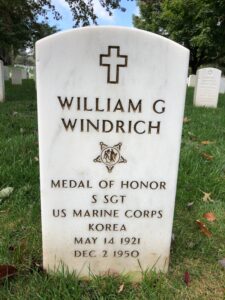
This Memorial Day weekend we honor the life of William Gordon Windrich, the Medal of Honor recipient who lost his life repulsing a North Korean attack.
For conspicuous gallantry and intrepidity at the risk of his life above and beyond the call of duty as a platoon sergeant of Company I, in action against enemy aggressor forces the night of 1 December 1950. Promptly organizing a squad of men when the enemy launched a sudden, vicious counterattack against the forward elements of his company’s position, rendering it untenable, S/Sgt. Windrich, armed with a carbine, spearheaded the assault to the top of the knoll immediately confronting the overwhelming forces and, under shattering hostile automatic-weapons, mortar, and grenade fire, directed effective fire to hold back the attackers and cover the withdrawal of our troops to commanding ground. With seven of his men struck down during the furious action and himself wounded in the head by a bursting grenade, he made his way to his company’s position and, organizing a small group of volunteers, returned with them to evacuate the wounded and dying from the frozen hillside, staunchly refusing medical attention himself. Immediately redeploying the remainder of his troops, S/Sgt. Windrich placed them on the left flank of the defensive sector before the enemy again attacked in force. Wounded in the leg during the bitter fight that followed, he bravely fought on with his men, shouting words of encouragement and directing their fire until the attack was repelled. Refusing evacuation although unable to stand, he still continued to direct his platoon in setting up defensive positions until weakened by the bitter cold, excessive loss of blood, and severe pain, he lapsed into unconsciousness and died. His valiant leadership, fortitude, and courageous fighting spirit against tremendous odds served to inspire others to heroic endeavor in holding the objective and reflect the highest credit upon S/Sgt. Windrich and the U.S. Naval Service. He gallantly gave his life for his country.
With his place of death recorded as Yudam-ni and the December 1, 1950 date, this would place Sgt. Windrich’s heroic actions as occurring during The Battle of Chosin Reservoir, one of the most bitter battles for UN/American forces of the entire war, occurring after Communist Chinese forces crossed the Yalu river.
Windrich was born May 14, 1921 in Chicago, and died from his wounds December 2, 1950.
Something a little different than the usual Iran roundup: Two videos about Kharg Island, one an after-action report on a U.S. attack run, the other a description of what makes taking the island difficult.
The caveat for the after-action video, a recreation of an actual U.S. attack run, is that it’s done a breathless, overly-dramatic fashion, like something from Most Shocking. But the detailed, blow-by-blow account suggests it was taken from actual after-action reports.
Three B-1B Lancers carrying precision-guided bombs attempted the most surgically demanding strike of Operation Epic Fury — destroying Iranian military targets on Kharg Island without touching the crude oil infrastructure sitting meters away. Then the GPS jamming started, and the mission nearly came apart.
This video reconstructs the full tactical breakdown of the Kharg Island strike: how an Iranian GPS jammer degraded bomb accuracy toward the oil, how the F/A-18 Super Hornets sent to destroy it nearly got hit by friendly JDAMs when a deconfliction failure put them directly in the bomb fall line, and how one Mersad air defense commander’s final radio transmission turned inaccurate anti-aircraft fire into precision-guided shrapnel that bracketed B-1Bs mid-bombing run. We cover the AGM-158 JASSM cruise missile shot that eliminated the SAM battery, the burning missile propellant creeping toward thirty million barrels of crude oil, the IRGC patrol boat sprint toward the supertanker loading channel, and the F/A-18 pilots who descended into accurate anti-aircraft fire from guns they couldn’t suppress to stop a mining operation with laser-guided GBU-54 JDAMs.
The breathless nature of the narration makes me suspect that certain aspects have been embellished for dramatic effect.
Next up: Simon Whistler discusses how difficult it will be for the American military to take and hold Kharg Island. Consider it the pessimist case against the operation.
“The value of Kharg Island is obvious. Control the island, and you could throttle Iran’s oil dependent economy. Capture the island intact, and another nation could make Iran do anything to get it back. Destroy it outright and Iran would transform from a powerful rogue nation into an economic afterthought. And that’s if we’re being generous.”
“The export facilities on Kharg Island are the most important site in one of Iran’s most important regions, meaning that the region is especially important to the Iranian military. This is a region with a well-developed civilian infrastructure, a large presence from the Islamic Revolutionary Guard Corps or IRGC, and most likely the hidden weapons stockp match. Then there’s the island itself, a low-lying coral crop with an elevation of just 70m at its highest point. With a land area of roughly 20 square km, Kharg Island is basically flat, basically triangular in shape and surrounded by deep waters to enable the transit of oil tankers.”
Some pre-situated weapons and supply caches will likely survive any American bombardment.
“There’s no telling what the US will destroy and what it’ll fail to pick up on, but some of those mines and air defenses will survive, raising the possibility that they could claim the lives of US troops or shoot down vulnerable non-stalthy low-flying aircraft. That said, Kharg will not be an easy place to defend once US ground forces have established a foothold. Iranians on the island will either be left exposed or be forced to use refinery infrastructure as cover unless they allow themselves to be pushed into the island town where most residents live.”
“Iran’s objective is not victory in any conventional sense. Iran is able to accept the deaths of its political and military leaders and the destruction of its cities and mass casualties among its soldiers, paramilitaries, and civilian supporters. Iran’s focus is on regime survival, not the survival of the people who make up the regime, but the survival of the regime itself.” No, that’s the regime‘s goal. Most ordinary Iranians hate the regime’s guts.
He notes the difficulty of getting amphibious landing ships through the Strait of Hormuz. But America will likely have a screening force of destroyers and frigates in addition to overwhelming air superiority, and Iran probably has very little in the way of missiles that can reach across the strait, at night, without real air assets to spot and paint the target, in the face of American air and naval superiority. Given America and Israel’s attacks on their sensor and communication infrastructure, I also doubt the Iranian military is capable of efficient coordination and dissemination of any real-time information they may be receiving from Russian or Chinese satellites.
He’s still right that amphibious and aerial invasions are exceptionally difficult and fraught with peril.
But I believe there are multiple places where Whistler is unduly pessimistic about such an operation.
First and foremost, the military assets discussed in the media are not necessarily the assets such an operation would be limited to. Remember how the very public news of B-2s in route to Diego Garcia was a ruse to cover the fact that the real B-2 force was already headed to the target in the June strikes on Iran’s nuclear infrastructure. It’s entirely possible (even probable) that America already has assault assets in theater that media outlets don’t know about.
Some debatable assertions: “Iranian forces are nothing if not creative, and they are highly motivated to accept risk to their own lives in order to deliver damage to an adversary.” And “The first problem that the US would have to account for is the Iranian ground forces. Combination of roughly 350,000 soldiers in the Iranian army, about 150,000 soldiers across the ground forces of the Revolutionary Guard Corps, and another several hundred thousand paramilitary fighters of the Basij Resistance Force.” Whistler suggests virtues not necessarily in evidence for Iran’s forces. The IRCG has certainly shown itself highly motivated when it comes to launching terror rockets, supporting insurgencies, or slaughtering civilians, but not so much when it comes to an actual toe-to-toe fight against a real military, a domain in which they have zero experience or demonstrated competency. Likewise, there’s little evidence that Iranian military regulars are all that keen to die for the regime. They also did not notably distinguish themselves in the long, bloody slog of the Iran-Iraq War, a stalemate against an Iraqi military that the United States-led coalition would quickly and comprehensively dismantle in the Gulf War a few years later. And back then, Iran had some relatively modern air power. Likewise the Basij seem well equipped to beat defenseless women for immodesty, but I rather strongly suspect the overwhelming majority will cut and run when faced with trained soldiers who can fire back.
If America successfully takes Kharg Island, it will be impossible for Iranian forces to get ships across from the mainland to retake it in the teeth of overwhelming American air power, even if they try crossing at night.
Likewise, the difficulty in taking the island without damaging the critical oil infrastructure that makes it worth taking may cause Iran to avoid their usual inaccurate missile barrages. And Iranian forces will likely find it difficult to set up missile, artillery and drone systems on the coastline under withering American and Israeli attack.
“The American public is not willing to accept the loss of American troops, and it is not willing to accept long-term or severe economic pain just to see the Islamic Republic overthrown.” This assertion is not necessarily true. The American public can certainly be fickle, but thus far Astroturf protests against the war have modest and populated with the usual foreign-funded, elderly white lefty idiots. Americans over a certain age remember the Iranian Hostage Crisis, and may feel eliminating one of they key sources of jihad terror worldwide for good worth the cost. Also, unlike Iraq or Afghanistan, U.S. military and civilian leadership seems 100% dedicated to absolute victory.
Whistler seems to think that all of Iran’s military forces will fight with the same fanaticism of Imperial Japanese troops on Iwo Jima. Given how badly the regular armies of Muslim nations have fought against first world armies in standup fights, as opposed to fanatical insurgencies running year-long campaigns of attrition, I rather strongly suspect he’s mistaken.
The Iran war is one months old and the usual Negative Nellies in the Democrat Media Complex are whinging that the war’s not won yet, or suggesting that the Trump Administration is looking for an “off ramp.” Funny how it takes time to defeat a nation of 92 million, even one where the regime is hated by its citizens and whose prewar air force looked like a museum. Everything we hear from CENTCOM is that the air campaign is on schedule.
And the “off ramp” for the war is regime change in Tehran.
“The USS Tripoli and USS New Orleans arrived in the Middle East, carrying with them 2,200 Marines — with more on the way — hours after an Iranian strike left dozens of U.S. service members hurt at a Saudi air base. The Tripoli and New Orleans are two of several additional vessels and personnel the Pentagon has deployed to the region as the U.S.-Israeli war in Iran enters it’s second month. The Tripoli Amphibious Group brings with it F-35B Strike Fighters, as well as transport aircraft, amphibious assault vessels and other tactical assets.”
“Israel struck secret facility for production of Iran’s naval weapons and storage of boats and ships.”
“The facility located in the city of Yazd served as a key production center for advanced missiles and sea mines intended for Iran’s naval forces.”
“The site that was hit was reportedly involved in designing, assembling, and testing advanced missiles that could be launched from ships, submarines, and helicopters, targeting both moving and stationary vessels at sea.”
“The Israeli Defense Forces described the location as the central hub of Iran’s naval strike capabilities, noting that weapons produced there had been used in operations that posed a threat to navigation in the Strait of Hormuz.”
“Following the strike, the facility’s production infrastructure and stores of ready-to-use missiles were said to have been completely destroyed.”
“A reported Israeli airstrike on Tehran has killed Hassan Hassanzadeh, a senior commander of the Islamic Revolutionary Guard Corps’ Mohammad Rasul‑Allah Corps, which oversees security in Greater Tehran and counter‑ unrest operations.” I’ve also seen his name rendered “Hassan Hassan Zadeh,” for those playing IRGC Dirtnap Bingo at home…
“Majid Zakriyai, commander of the Iranian Army’s Natural Resources Organization protection unit, was killed.”
President Trump promised some absolute scorched earth on Iran if they don’t fall in line, promising to blow up their electric grid, their oil wells and Kharg Island…but then deleted the tweet. 🤷
E-3 Sentry and KC-135 destroyed at Prince Sultan Air Base in Saudi Arabia.
The anti-air capabilities of Prince Sultan Air Base still leave much to be desired.
The Houthis had been unusually quiet during the open stages of the war. Well, that’s ended, and they’re now tossing missiles at Israeli. Not sure how many they have, given that Iran has been both broke and busy…
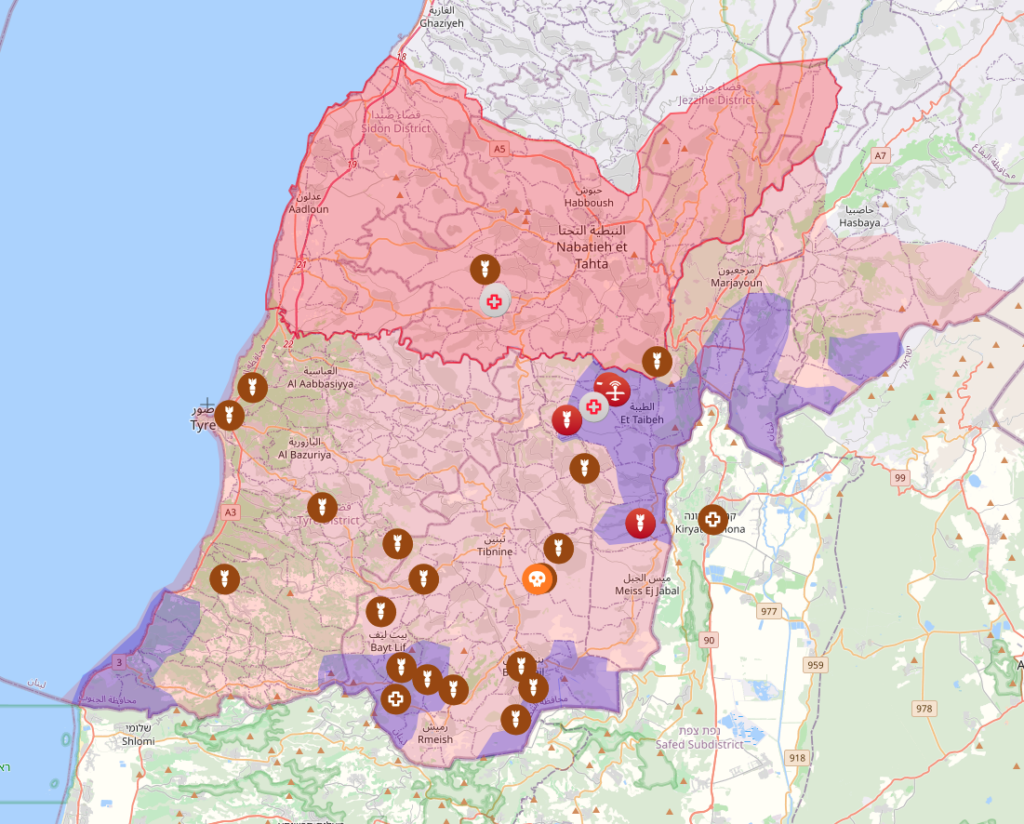
It’s always hard to tell what the state of the war in Lebanon is, but to my casual observation, it looks like the intensity of strike has lessened on both sides, but Hezbollah attacks seem to have fallen sharply. On the other hand, today’s status map show that Israeli forces are already at the Litani River in the eastern part of Lebanon:
“US military has been working on Iran ground raid plans for years.” One would hope.
Retired Gen. Frank McKenzie, the former commander of U.S. Central Command (Centcom), said Sunday that the U.S. military has been working on plans for a ground raid in Iran for years, as President Trump is reportedly considering sending troops into the war.
“Margaret, for many years we’ve considered options along the southern coast of Iran, seizing islands, seizing small bases. Typically raids. And a raid is an operation with a planned withdrawal. You’re not going to stay. But some of those islands you could seize and hold. That would have a couple effects,” McKenzie told CBS News’s Margaret Brennan on “Face the Nation.”
“First of all, it would be profoundly humiliating for Iran and would give us great weight in negotiations. The second, the example of Kharg Island, which everyone talks about, if you seize Kharg Island, you really can shut down the Iranian oil economy completely. And the beauty of seizing it is, you’re not destroying it,” he said.
Is China pushing Iran for a ceasefire?
“The risks to global trade through the Strait of Hormuz have surged and the dynamics of Iran’s relationships with Russia and China are constantly in the spotlight. Recently, both countries have pressured Iran, urging diplomatic solutions to the crisis. On March 24th, China’s foreign ministry reported that Foreign Minister Wang Yi held a phone call with Iran, calling for seizing the opportunity for peace and negotiating as soon as possible.” So did Russian Foreign Minister Sergei Lavrov.
“Analysts believe Russia has explicitly urged Iran to back down, signaling that Moscow views Iran as unable to continue fighting. Shortly afterward, China followed suit, aligning with Russia in terms of diplomatic timing. This indicates coordination between the two countries. Their shared goal is to maintain the stability of the Iranian regime, ensuring it continues to act as a strategic counterbalance to the United States.”
“From Beijing’s perspective, Iran is not only a major energy supplier, but also a key node in the Belt and Road Initiative. Chinese investments in the country amount to at least hundreds of billions of dollars, covering oil and gas field development, port construction, and transportation networks. If the Iranian regime were completely overthrown, it would directly threaten China’s energy and geopolitical interests. Therefore, Beijing must intervene diplomatically and urge Iran to turn to negotiations.” A lot of observers believe that Belt and Road is already moribund.
“A source close to China’s Foreign Minister, Wang Yi, revealed to the Epoch Times that Iran has refused any purely diplomatic arrangements and instead pressured Beijing with selective security, linking substantial aid to the safe passage of Chinese commercial ships through the Strait of Hormuz. This is soft extortion. Without military assistance, China cannot ensure the smooth passage of its trade routes. Beijing’s multiple secret negotiations have ended in failure and its efforts to profit from the geopolitical game are now facing the dual impact of diplomatic imbalance and economic stagnation.”
China also thought it could be a negotiating mediator between Washington and Tehran. Yeah, fat chance.
“This crisis is essentially the inevitable backlash of China’s ‘wolf warrior diplomacy” and camp confrontation mentality.”
“China’s leaders have fallen into a self-entangling dilemma. The forces they’ve supported are now cutting off their own economic lifelines. The disruption in the Straight of Hormuz is not only a rupture in global logistics, but also a microcosm of the complete collapse of China’s geopolitical strategy.”
“You’re starting to see the Iranian regime looking for an exit ramp.”
“USAF A-10s are arriving in the UK tonight as the U.S. surges more Warthogs to the Middle East.”
As usual, this is just the Iran news I felt significant enough to include in the roundup. If you think I’ve missed anything, feel free to share in the comments below.
Tanks rarely feature in Hollywood movies about the Vietnam War (Full Metal Jacket is the only exception that comes to mind), so you might be forgiven for thinking they didn’t play any role in the conflict. In fact, several armored vehicles were used by American and AVRN forces quite effectively there, as covered in this video from the UK Tank Museum:
The main armored vehicles used were:
The M48 Patton Tank:
It was the US Marine Corps that insisted on bringing them to Vietnam. “Deep ditches and steep grades are no problem for the Patton 48.” The M48 A3 had 110mm of frontal armor, but probably more important for its service in Vietnam was the construction. It’s cast, not welded. And this proved invaluable. The communist forces regularly used improvised anti-tank mines, often made from unexploded US ordinance, and the curved underside of the M48 was effective at deflecting the blast of such devices.
On top of that, the M48’s 90mm main gun, plus 50 cal and M60 secondary armament could lay down a withering field of fire, either in support of infantry in the open or in perimeter defense. It didn’t take the US Marine Corps long to prove the M48’s worth. In Operation Starlight in August 1965, the Marines destroyed the first Vietcong regiment on the Vatang Peninsula. A report on the action stated that tanks were the difference between expected heavy casualties and the light casualties we actually took.
By 1966, operations like Hastings and Prairie proved that tanks and marines working in close cooperation was the best way to destroy VC strong points and slash enemy supply routes in wide aggressive sweeps. Despite some continuing reluctance from MACV [Military Assistance Command, Vietnam], tanks were proving far more useful than previously thought.
Another major challenge in Vietnam was ambush. Communist forces would create killing zones up to a kilometer long stretching along key highways. They planted improvised mines to disable lead vehicles and anti-personnel mines and punji spikes at the side of the road to take out infantry dismounting from trapped and stationary vehicles. Once again, tanks proved themselves a huge asset in combating the problem. The M48s would place themselves front and rear of the convoy. The tanks at the rear would have their turrets facing after. If the convoy was attacked, the tanks could often ride through any initial blast or push damaged vehicles off the road, allowing the convoy to keep moving. The armor would then cloverleaf, swinging out from front and rear to envelop the enemy. If all went to plan, they could quickly turn the tables on the attackers as their firepower came into play.
Another counter ambush tactic was the thunderun. A pair of Pattons would take up position either side of the road with one track on the road surface and the other on the verge. They would then race ahead of the column, hosing down likely ambush sites. If they hit a mine, it seldom did more than throw a road wheel. And if they made it through unscathed, the route was considered safe for soft skin vehicles to follow.
As troop numbers grew, the army too began to deploy M48s in a fire support role. Either indirect fire, a substitute for artillery, or in a direct fire role using HE against enemy bunkers. In perimeter defense, tanks would be dug in behind an earth or sandbag berm, flanked by infantry and foxholes, and with a belt of overlapping trip flares, barbed wire, and claymore mines in front. From these defensive cocoons, the tanks could stand firm against human wave attacks, often with the help of one of the most controversial tank munitions ever devised: The beehive round.
The 90mm beehive or M580 AP anti-personal tracer to give it its full title was brutal. It contained 4,200 1/2 in., 5g razor sharp steel flechettes along with a time fuse and bursting charge. The crew would set the detonation range anywhere from 0 to 4,300 m. When the charge went off, the cloud of flechettes formed a 300 m long cone, a deadly swarm carving through jungle cover, wire imp placements, and attacking infantry with devastating effect. The nickname beehive came from a buzzing sound the flechettes made in flight. One M48 gunner described the round’s detonation as like God fired a shotgun.
The M113 ACAV
But the most numerous and arguably effective AFV on the Vietnam battlefield wasn’t a tank at all. It was this, the M113 armored personnel carrier. To the grunts on the ground, it was simply known as “tracks.” M113s were supplied to the South Vietnamese even before the US ground intervention began. And low on armor, the ARVN had to make use of whatever they could get their hands on.
Designed to be air portable, the M113 had aluminum armor. It weighed just 12 tons, had a top speed of 42 mph, was amphibious, had a crew of two, and it could carry up to 11 infantrymen. As an armored personnel carrier, the M113 was essentially a battle taxi designed to drop off its passengers and perhaps provide a bit of fire support from its pintle-mounted 50 cal. However, the ARVN hadn’t read the owner’s handbook. Rather than using M113s as APCs, they set about turning them into ersatz tanks. By adding extra M60 machine guns, recoilless rifles, and mortars.
We’ve seen similar upgrading and front-line use of M113s by Ukraine.
South Vietnamese troops used M113s in an armored assault role. To some extent, this worked. The M113’s mobility and amphibious capabilities were a godsend amongst the rivers, marshes, and rice patties. If a single vehicle couldn’t make it through, the ARVN created daisy chains, linking multiple M113s with steel hawsers. If one got stuck, the others would pull it out.
The problem was that 38 mm of aluminium wasn’t enough to keep out heavy machine guns, let alone RPGs. And with the earlier M113s that were supplied to the ARVN, they were petrol-driven, which meant that they burned a whole lot easier. Once they got over their initial fear of the Green Dragons, the VC realized that all they had to do was pepper the M113s with fire when they appeared and something bad was likely to happen to the ARVN on the inside. Multiple RPG hits would result in a penetration while the top cover gunners were horrendously exposed to small arms fire. In a single action Ap Bac on the 2nd of January 1963, 13 were killed.
With this experience, the vehicles were adapted with the creation of improvised weapon shields. Later formalized as one of the most iconic vehicles of the Vietnam War, the M113 AAV, the armored cavalry assault vehicle had extra belly armor to protect against mines, plus beefed up side armor. The 50 cal and the additional two M60s all had gun shields added to protect the crew. Suddenly, the battle taxis had real teeth, and the US forces started using them in an equally aggressive manner. Perfect for reconnaissance and mobility in the open terrain of the Mekong Delta and rubber plantation. The VC had nothing to match its firepower.
At Ap Bau Bang in March of 1967, the US First Infantry ambushed by Vietcong forces used AAVs in a wagon wheel formation, firing in all directions to break up enemy assaults. During the iconic siege of the Marine Corps base at Khe Sanh, the AAVs used their mobility and firepower to carve routes into the base, allowing infantry and engineer units to lift the blockade. Not bad for a little vehicle that was essentially modified on the hoof and operating way beyond its original combat purpose.
The M50 Ontos
But perhaps the strangest and in its niche most effective vehicle on the battlefields of Vietnam was the M50 Ontos. Ontos is the Greek word for thing, which is certainly less of a mouthful than its official title of Rifle Multiple 106mm Self-Propelled M50, but also an apt name for such an extraordinary looking vehicle.
It does indeed look pretty funky.
“The Marine Corps shows off its newest weapon. A speedy tank destroyer bristling with six powerful recoilless rifles, four smaller spotting rifles, and a machine gun. The Marines call it the Thing.”
The Ontos is small, only 12 1/2 ft long and lightweight at 9 1/2 tons, making it easy to move by air. Yet despite its diminutive size, the Ontos bristled with six M40 106 mm recoilless rifles with a 50 caliber spotting rifle on each side. They could fire a mixture of heat, HE or beehive rounds. For the three-man crew, the biggest challenge was reloading. The loader was holed up in the back of the Ontos and had to exit the vehicle through a hatch and reload the 106s from the outside. Not much fun in the heat of battle.
Despite this, the vehicle’s combination of mobility with ferocious firepower made them devastating in the right setting. Only 300 were built, but they punched way above their weight. In Hue City during the 1968 Tet Offensive, US Marines stood in awe as the Ontos weaved through the tightest urban environments, knocking out walls and cutting down entire squads of enemy soldiers. Such was the reputation of the Ontos that sometimes all that was required was for a 50 cal sighting rifle round to be fired into a building for the North Vietnamese to abandon the position. In the words of one veteran of Hue, “It was ugly, loud, and dangerous. Just what we needed.”
The Ontos would also play a significant role in killing an entirely different set of commies in the Dominican Civil War in 1965.
American M48s would go on to destroy North Vietnamese T-54s during the full-scale invasion of the south, but by then the American withdrawal meant the writing was on the wall for the ARVN…
More Biden corruption evidence, a would-be mass shooter turns out to be a pro-Palestinian Bernie Sis, a parent beats the snot out of a would-be child kidnapper, a top sniper dies, Disney gets sued, and Venus is feeling Zoove. It’s the Friday LinkSwarm!
Another “Try to contain your shock” headline: “Joe Biden’s Classified Docs Provide More Evidence Hunter’s Pay-To-Play Was A Family Affair.”
The special counsel report on Joe Biden’s unauthorized removal and disclosure of classified documents exposed much more than our president’s mental deficits and the breadth of his irresponsible handling of top-secret and classified information. The report revealed a close nexus between Hunter Biden’s influence peddling and his father’s responsibilities and access to intel during the elder’s term as vice president.
On Thursday, Special Counsel Robert Hur released the results of his investigation into the president stemming from the discovery of top-secret and classified documents at Biden’s D.C.-based Penn Biden Center, his private Delaware home, and the University of Delaware. While the specific details in the recovered documents remain unknown, the nearly 400-page report provided an extensive enough summary of the materials to confirm an overlap in the timing and topics of Joe Biden’s vice presidency and Hunter Biden’s “business” enterprises.
Ukraine Overlap
Appendix A of the report provided a table summary of the documents recovered. Many of the top-secret and classified documents concerned Ukraine during the time frame when Hunter Biden acted as an intermediary between Burisma’s owner, Mykola Zlochevsky, and the vice president. Recall that Hunter’s business partner, Devon Archer, told the House Oversight Committee that in early March 2014, he met Zlochevsky while in Moscow. And soon after, he and Hunter Biden joined Burisma’s board, receiving $83,000 per month.
The following month, Hunter Biden sent Archer an email dated April 13, 2014 — one week before Joe Biden would travel to Ukraine and meet then-Prime Minister Arseniy Yatsenyuk. Referring to “my guys upcoming travels,” Hunter then elaborated on “22 points about Ukraine’s political situation, with detailed information about the upcoming election and predicting an escalation of Russia’s ‘destabilization campaign, which could lead to a full-scale takeover of the eastern region, most critically Donetsk,’” according to the New York Post.
Among the material recovered from President Biden’s unauthorized storage locales were several top-secret and otherwise classified or confidential documents discussing Ukraine. One undated document discussed issues related to Russian aggression toward Ukraine. Another, dated Sept. 17, 2014, consisted of a “Memorandum for the Vice President from staff members, with subject ‘U.S. Energy Assistance to Ukraine.’” Also dated Sept. 17, 2014, was an “event memo” from a vice-presidential national security staffer, titled, “Lunch with Ukrainian President Poroshenko,” which was scheduled for the following day.
The overlap between Joe Biden’s Ukraine-related work and Hunter Biden’s Burisma profiteering became more pronounced in 2015. On Dec. 2, 2015, the lobbying firm Blue Star Group, which Hunter Biden had arranged to work with Burisma, wrote to Burisma that it had “participated in a conference call today with senior Obama Administration officials ahead of U.S. Vice President Joe Biden’s trip to Ukraine next week.” The memorandum provided a summary of the conference call, telling Burisma that “Michael Carpenter, Vice President Biden’s Special Advisor for Europe and Russia, and Dr. Colin Kahl, the Vice President’s National Security Advisor, presented the agenda for the trip and answered questions about current U.S. policy toward Ukraine.”
Two days after receiving this memorandum, Burisma executives Zlochevsky and Vadym Pozharskyi, on Dec. 4, 2015, pushed Hunter Biden to call his father. The Burisma executives, according to Archer, expressed concern over the pressure they were under from Ukrainian investigators.
And there’s more, though very little that will be surprising to BattleSwarm readers. (Hat tip: Stephen Green at Instapundit.)
Joe Biden met with the chairman of the Chinese energy firm CEFC shortly after Hunter Biden’s business associate Rob Walker received a $3 million payment from the firm as part of a joint venture the pair were then trying to develop, according to a newly released transcript of Walker’s closed-door congressional testimony.
Walker testified before the House Oversight and Judiciary Committees on January 26 about his role in Hunter Biden’s foreign business dealings with Chinese energy conglomerate CEFC.
Walker received roughly $3 million from CEFC in March 2017 through its State Energy HK account, bank records show. He recalled a meeting between Joe Biden and CEFC officials in spring 2017, around the time of the State Energy HK payment.
“Did Joe Biden ever attend any location or meeting or place where CEFC officials were also there?” a staffer asked Walker, according to a transcript of the interview released Tuesday morning.
“Yes,” Walker replied. He recalled the meeting took place in Washington, D.C., and Joe Biden, who had just left office as vice president, stopped by for lunch.
“I don’t know the exact — it was 20- probably -17 at some point, but I don’t know exactly when,” Walker said.
The meeting took place at a Four Seasons hotel in a private room. CEFC Chairman Ye Jianming and other associates were present at the meeting.
“I don’t know if Zang was there, but I believe that Ye was there. I’m certain of it,” Walker testified.
He did not know who the other CEFC associates were at the meeting. Walker firmly recalled Jianming and his translator, Hunter Biden, business associate James Gilliar, and Joe Biden attending the meeting.
Well, what do you know? “Mail-In Ballot Fraud Study Finds Trump ‘Almost Certainly’ Won In 2020.”
A new study examining the likely impact that fraudulent mail-in ballots had in the 2020 election concludes that the outcome would “almost certainly” have been different without the massive expansion of voting by mail.
The Heartland Institute study tried to gauge the probable impact that fraudulent mail-in ballots cast for both then-candidate Joe Biden and his opponent, President Donald Trump, would have had on the overall 2020 election results.
The study was based on data obtained from a Heartland/Rasmussen survey in December that revealed that roughly one in five mail-in voters admitted to potentially fraudulent actions in the presidential election.
After the researchers carried out additional analyses of the data, they concluded that mail-in ballot fraud “significantly” impacted the 2020 presidential election.
They also found that, absent the huge expansion of mail-in ballots during the pandemic, which was often done without legislative approval, President Trump would most likely have won.
“Had the 2020 election been conducted like every national election has been over the past two centuries, wherein the vast majority of voters cast ballots in-person rather than by mail, Donald Trump would have almost certainly been re-elected,” the report’s authors wrote.
Not news to those of us who watched returns into the wee hours, only to wake up to The Steal the next morning.
Ukraine bags another Russian ship. “Ukrainian Magura V5 Marine Drones have sunk the Ropucha-class landing ship Cesar Kunikov near Alupka in Crimea in the Black Sea.”
Putin says he prefers Biden to Trump in the White House because he’s more predictable. I’m sure he does. Notice that both his Ukraine invasions occurred during Democratic presidential administrations.
The woman who tried to shoot up Lakewood Church in Houston was a Bernie Sis who had “Free Palestine” written on her AR-15. “[Genesse I.] Moreno had a violent, extensive criminal history stretching back to 2005, according to court records reviewed by Townhall. She was previously arrested for assaulting a public servant, assault causing bodily injury, forgery, theft for stealing cosmetics from a store, evading police, and unlawfully carrying a weapon, among a slew of charges on Moreno’s decades-old rap sheet.”
Alan Winston Filion, 17, is suspected of targeting hundreds of high schools, mosques, historically Black churches, US senators and even the US Supreme Court with swatting attacks that placed thousands of people in the crosshairs of heavily armed police response teams.
Prosecutors say the 6ft 3in teenager advertised his services under the pseudonym Torswats on the encrypted messaging app Telegram, charging as little as $40 to get someone’s gas shut off, $50 for a “major police response”, and $75 for a “bomb threat/mass shooting threat”.
Mr Filion would then post chilling audio of the 911 calls on Telegram as a proof of purchase, according to court documents.
Among the hundreds of “swats” that Torswats allegedly claimed credit for were multiple hoax callouts at the home of Patrick S. Tomlinson, a Milwaukee-based science fiction author who says he has been swatted dozens of times in the past four years as part of a targeted harassment campaign by a group of “sociopathic” stalkers.
You’d think after five or six times, the guy would put up a sign in his front yard alerting police to the problem. (Hat tip: Dwight.)
“Court Orders Netherlands To Halt F-35 Parts For Israel As EU Says “Too Many People” Are Dying.” Excuse me? Does the Netherlands let their court interfere in foreign policy decisions and defense contracts based on events beyond their borders?
The US Army is cancelling its next generation Future Attack Reconnaissance Aircraft (FARA) program, service officials announced today, taking a potential multi-billion-dollar contract off the table and throwing the service’s long-term aviation plans into doubt.
In addition, the Army plans to end production on the UH-60 V Black Hawk in fiscal 2025, due to “significant cost growth,” keep General Electric’s Improved Turbine Engine Program (ITEP) in the development phase instead of moving it into production, and phase the Shadow and Raven unmanned aerial systems out of the fleet, the service added.
All told, it reflects a massive shift in the Army’s aviation strategy and upends years of planning. There is also an ironic sense of history repeating: the decision to end FARA comes two decades to the month after the Army ended its plans to procure the RAH-66 Comanche and nearly 16 years after it terminated work on the ARH-70A Arapaho, both aircraft designed to replace the Kiowa — the same helicopter FARA was supposed to, finally, replace.
The reason for ending FARA, Army leaders told a small group of reporters ahead of the announcement, is a reflection of what war looks like in the modern era.
“We absolutely are paying attention [to world events] and adjusting, because we could go to war tonight, this weekend,” head of Army Futures Command Gen. James Rainey told reporters at the Pentagon on Thursday.
“We are learning from the battlefield — especially Ukraine — that aerial reconnaissance has fundamentally changed,” Army Chief Gen. Randy George said in a press release. “Sensors and weapons mounted on a variety of unmanned systems and in space are more ubiquitous, further reaching and more inexpensive than ever before.”
Many commenters here feared the Pentagon wasn’t taking the drone threat seriously. Maybe they are…
The Marine Corps’ all-time deadliest sniper, Chuck Mawhinney, has died at age 75.
From 1968 to 1969, Mawhinney — still only a teenager — was credited with 103 confirmed kills.
An additional 216 kills were listed as “probable” since the enemies’ bodies were risky to verify in the active war zone.
Mawhinney had confirmed kills over 1,000 yards, with the average kill shot for snipers during the Vietnam War taken at a distance of 300 to 800 yards.
He received a Bronze Star with Combat Valor, Navy Achievement Medal, Navy Commendation Medal with Combat Valor, and two Purple Hearts.
Having more confirmed kills than Carlos Hathcock is pretty impressive. (Hat tip: Dwight.)
The CW Network (which evidently still exists) just launched a 12 channel free streaming platform. Including, evidently, a Mystery Science Theater 3000 channel.
This video, covering a scaled down prototype of the Ultra Heavy-Lift Amphibious Connector (UHAC) craft, caught my attention:
The UHAC drives across the water on treads that double as paddlewheel-style water propulsion.
That video dropped this week, but most of the UHAC testing seemed to have happened back in 2014. (Another sign that the video is old is the mention of the USS Bonhomme Richard as though it were still in service, when it infamously burned up in 2020. In fact, the arson trial of Ryan Sawyer Mays, the disgruntled SEAL washout accused of setting the fire, is going on this week.)
If the program is dead, I can understand why. The UHAC seen in the video is only one-fifth of the projected size of the final vehicle, which was supposed to be 84 ft long and 34 ft high. That’s roughly 75% as big as Nazi Germany’s contemplated but never-even-attempted Landkreuzer P. 1000 Ratte tank, a project remembered for being long on imagination and short on practicality. Things that large tend to be a big magnet for air and artillery targeting.
Another thing probably dooming it: the Marine Corp decision to move away from tanks. An amphibious assault vehicle that (as per the video) can carry three M1A1 Abrams tanks probably won’t be a priority if you don’t have any in inventory.
Sad news: Hershel “Woody” Williams, the last living Medal of Honor winner from World War II, has died at age 98.
Williams was a member of the U.S. Marine Corps and served in the Battle of Iwo Jima. He was awarded the Medal of Honor on Oct. 5, 1945, from President Harry S. Truman for his “valiant devotion to duty,” the Woody Williams Foundation said.
“Today at 3:15am, Hershel Woodrow Williams, affectionately known by many as Woody went home to be with the Lord. Woody peacefully joined his beloved wife Ruby while surrounded by his family at the VA Medical Center which bears his name,” the Woody Williams Foundation wrote.
Williams, who was born in Quiet Dell, West Virginia, served for 20 years in the Marine Corps and Marine Corps Reserves and then worked for the Department of Veterans Affairs for over 30 years as a veterans service representative.
The U.S. Navy commissioned a warship called the USS Hershel “Woody” Williams in his honor in Norfolk, Virginia, in 2020.
For conspicuous gallantry and intrepidity at the risk of his life above and beyond the call of duty as demolition sergeant serving with the 21st Marines, 3d Marine Division, in action against enemy Japanese forces on Iwo Jima, Volcano Islands, 23 February 1945. Quick to volunteer his services when our tanks were maneuvering vainly to open a lane for the infantry through the network of reinforced concrete pillboxes, buried mines, and black volcanic sands, Cpl. Williams daringly went forward alone to attempt the reduction of devastating machinegun fire from the unyielding positions. Covered only by 4 riflemen, he fought desperately for 4 hours under terrific enemy small-arms fire and repeatedly returned to his own lines to prepare demolition charges and obtain serviced flamethrowers, struggling back, frequently to the rear of hostile emplacements, to wipe out 1 position after another. On 1 occasion, he daringly mounted a pillbox to insert the nozzle of his flamethrower through the air vent, killing the occupants and silencing the gun; on another he grimly charged enemy riflemen who attempted to stop him with bayonets and destroyed them with a burst of flame from his weapon. His unyielding determination and extraordinary heroism in the face of ruthless enemy resistence were directly instrumental in neutralizing one of the most fanatically defended Japanese strong points encountered by his regiment and aided vitally in enabling his company to reach its objective. Cpl. Williams’ aggressive fighting spirit and valiant devotion to duty throughout this fiercely contested action sustain and enhance the highest traditions of the U.S. Naval Service.
Sometime in the next decade or two, the last living World War II veteran will die, and that epoch-changing conflagration will pass out of living memory.
This Memorial Day we honor Marine Corporal John Henry Pruitt, who not only won the Medal of Honor, he won two Medals of Honor (the Army and Navy versions) for the same action:
For extraordinary gallantry and intrepidity above and beyond the call of duty while serving with the 78th Company, 6th Regiment, 2d Division, in action with the enemy at Blanc Mont Ridge, France, 3 October 1918. Cpl. Pruitt, singlehandedly attacked two machine guns, capturing them and killing two of the enemy. He then captured 40 prisoners in a dugout nearby. This gallant soldier was killed soon afterward by shellfire while he was sniping at the enemy.
Here’s a short video on Pruitt, primarily voiceover narration over stock footage, but it does give additional information:
“He died from his wounds on October 4, 1918. It was his twenty second birthday.”
On November 27, 1950, Communist Chinese forces launched a surprise attack against United Nations forces (U.S., UK and South Korean) to begin the Battle of the Chosin Reservoir, one of the defining engagements of the Korean War.
In hard winter conditions with inadequate supplies and cold weather gear, allied forces found themselves surrounded by a communist Chinese force four times as large with orders to destroy them. Over 17 days, U.S. forces managed to break through the encirclement and carry out a fighting retreat to the port of Hungnam.
It was at Chosin that legendary First Marine Regiment commander Chesty Puller said: “We’ve been looking for the enemy for some time now. We’ve finally found him. We’re surrounded. That simplifies things.”
Thirteen servicemen earned Medals of Honor for their actions during The Battle of Chosin Reservoir.