Archive for the ‘Budget’ Category

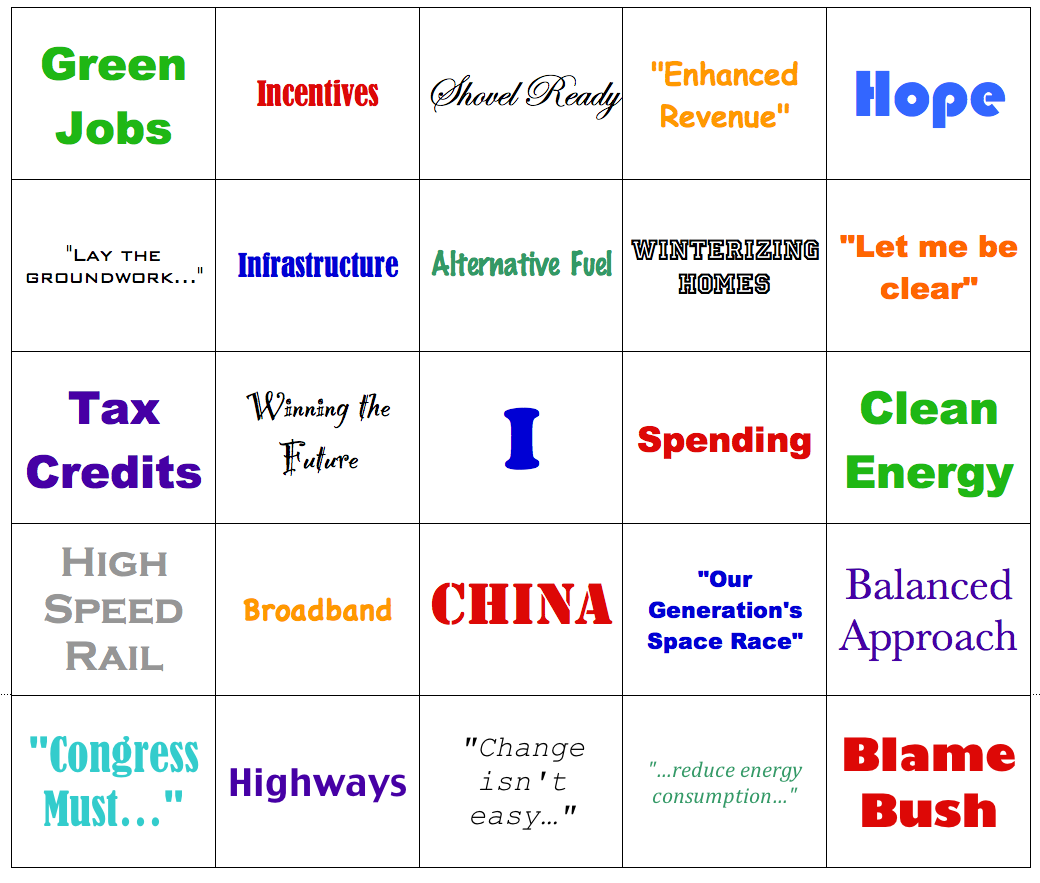
Obama Jobs Speech Bingo

Thursday, September 8th, 2011

Pity the pundit forced by duty to watch an Obama speech. Barring a Teleprompter malfunction, there are few events more tedious and predictable. When even uber-Democrat James Carville says that between an Obama speech and a Republican debate, “I would have watched the debate and I’m not even a Republican or even close to being a Republican,” you know you’re in store for some deep hurting.

So how can we assuage the agony of those poor, dedicated souls who will be watching Obama’s jobs speech tonight? Barring an announcement that he’s abandoning Big Government liberalism for budget and tax cuts, the chances for another Obama snoozefest are vast, while the possibility of anything new and substantive are slim. How can we keep their attention focused on the POTUS, and not on the desperate need for another highball or passing a sanity roll?

Simple: With my handy Obama Jobs Speech Bingo chart below! Just print out and place a marker every time Obama trots out one of his stock job speech phrases. Which I’m confident will be pretty darn often.

Which dedicated pundit will be the first to post “Bingo! #ObamaBingo” to Twitter tonight?

Click to embiggen

Edited to add: Welcome Powerline readers! As you can tell from the blogroll on the right, Powerline has long been one of my favorite blogs, so feel free to look around for news from the hot, dusty heart of Texas.

Revised Wildfire Prevention/Fighting Numbers Straight From the Horse’s Mouth

Wednesday, September 7th, 2011

Since my original post, there seems to have been some confusion over the exact budget numbers for Texas Forest Service and Wildfire Prevention/Fighting as enacted by the 82nd Legislature for the 2012-2013 biennium budget (which went into effect for Fiscal Year 2012 starting on September 1).

So I decided to go straight to the horse’s mouth.

I contacted my own State Representative, Larry Gonzales, who pointed me in the direction of Rep. John Otto, the legislative chairman for Article II of the state budget. One of his staffers was kind enough to get back to me with the following numbers.

It turns out that all the previous numbers were wrong, for various reasons. The numbers below all link to the official PDFs for the final budget numbers of the bills in question. And my liberal critics have, if not half a loaf, then at least a quarter-loaf.

The reason is that for the 2010-2011 biennium, the Forest service was allocated $54.5 million 2010 and $54.5 million for 2011. That amount was indeed reduced for the initial budget passed in the regular legislative session, to $37.7 million for 2012 and $37.5 million for 2013. But keep in mind that it was very clear that the budget was not finished at the end of the regular legislative session, as several outstanding issues (school funding, revenue enhancement, use or non-use of rainy day funds, etc.) still remained to be hashed out. That was why there was a special legislative session.

And in that special legislative session, two separate bills were passed which increased forest service/wildfire fighting and prevention funding: SB2, which added an additional $40 million to the forest service for FY 2012 specifically to fight wildfires (with any rollover, of which I’m pretty sure there will be none, to be carried into 2013), and HD4, which allocated an additional $81 million for fighting wildfires in the 2012-2013 biennium. (This is most likely where A&M got the $81 million figure for.) All those bills (and thus the funding increase) were passed and in the books months before the FY2012 budget started on September 1.

So, in summary:
Total 2010-2011 Biennium Forest Service/Wildfire Fighting Budget: $109 million.
Total 2012-2013 Biennium Forest Service/Wildfire Fighting Budget: $196.2 million.

So the Texas legislature authorized, and Governor Rick Perry signed, an 80% increase in wildfire fighting and prevention funding for the 2012-2013 biennium. Not quite double the amount I had in my original post, but pretty close.

Audio Interview With Ted Cruz: Part 1

Tuesday, September 6th, 2011

When I did this video interview with Ted Cruz on July 30, I also did an audio interview with him at the same time using an iPhone App called Recorder Pro. The video interview was done by Cruz’s staff (who have a much better camera than I do), and the resulting video was editing done to a sort of “Best of” piece emphasizing his campaign themes. I actually think the full interview will be more interesting to conservatives, as he goes into more detail about a number of topics, including border control, the budget deficit, and federal commerce clause overreach and the 10th Amendment, including a discussion of Wickard vs. Filburn.

It’s taken a good bit longer to get it the audio up here than I wanted to, mainly because I’ve been pretty busy, but also because it was something of a pain to edit the interview and get it up here. First, I had Recorder Pro record in CAF format, which isn’t particularly widely used, so I needed one program to convert it into a .WAV file, and then another to edit the file (there was about a minute and a half of extraneous setup noise I wanted to spare you). Then, after all that, I found out the resulting audio file was too large post all at once, so I’ve split it into two chunks. The first half of the interview is below as an MP3. I’ll try to put up the second half in the next day or so, assuming I don’t get distracted by shiny objects.

Ted Cruz Interview Part 1

Also, as a bonus, here’s an essay by Ted Cruz and Mario Loyola on Federalism that discusses Wickard vs. Filburn.

Another Left-Wing Lie: The 50% Cut in Texas Wildfire Funding That Wasn’t

Monday, September 5th, 2011

Note: My numbers below are somewhat off…but those of critical commentators are also off. See this post for the complete breakdown of Texas Forest Service/Wildfire Fighting and Prevention Funding. The bottom line is that it was increased by 80%.

You may have noticed several fires breaking out in Central Texas due to the prolonged drought and high winds. You may also have noticed liberals crowing about how the latest Texas budget cut wildfire response by 50%. That would indeed seem to be shortsighted, except for one tiny fact:

It isn’t true.

Evidently the myth arises from pieces like this one from earlier in the year, citing unnamed sources in the midst of budget negotiations saying such a cut was proposed. Not passed, mind you, but proposed. And it doesn’t say by who.

But when you look at the actual numbers for the passed budget, they tell a radically different story.

First, let’s look at funding for the 2010-2011 biennium passed by the 81st Legislature, where the Texas Forest Service was allocated $38,550,563, most of which was for wildfire fighting and prevention.

Next let’s look at the 2012-2013 biennium passed by the 82nd Legislature; sorry, I was only able to find a PDF, but the relevant information can be found near the top of page 15, where it states that the legislature allocated $81 million for the Texas Forest Service for wildfires.

So not only did the Texas state legislature and Governor Rick Perry not reduce the amount for wildfire fighting and prevention, they actually doubled the amount spent on it.

So a real natural tragedy is being used by opportunistic liberals to slander politicians (and let’s face it, a state) that they already hated. The original Think Progress etc. pieces were merely half-baked rumor. Repeating them today, however, makes them an actual lie.

Everyone is entitled to their own opinion, but no one is entitled to their own facts.

Edited to add: The Texas State Fiscal year starts on September 1st, so the state is operating under the 2012-2013 biennium budget now.

Rick Perry to Announce Presidential Campaign Saturday in South Carolina

Monday, August 8th, 2011

So says Politico.

I think Perry will jump in, will win the primary, and will beat Obama, primarily because I think he’s sharp enough and mean enough to win. Perry looks as good as Romney, has as much Tea Party support as Bachmann, and has record as Governor that puts both in the shade. He dismantled Kay Baily Hutchison in the 2010 Governor’s race, and then mopped the floor with Bill White. Also, I think there’s a better than 50% chance that Sarah Palin with endorse his candidacy.

And of course, Perry’s record on jobs and budgets blows Obama’s away. It’s like the difference between Peyton Manning and Ryan Leaf.

Hopefully more on Perry later in the week.

More on the Greek Euro U.S. World Debt Crises

Monday, August 8th, 2011

The Moody’s downgrade of Portuguese debt link was a quick blipvert for a current event, but I wanted to do a somewhat longer roundup of pieces on the Euro debt crises and the potential for more shocks down the line. Unfortunately for both me and pretty much everyone in the world, things have been moving too fast to get a good handle on before the next crisis erupts. And after the Obama downgrade, things are moving faster than ever.

Which is pretty fast indeed. The Eurocrats, in best shoot-the-messenger style, have decided to start ignoring bond rating services in the wake of Moody’s downgrade of Portugal. If that weren’t enough, Italian police raided the offices of Standard & Poors following their downgrade of Italian credit ratings.

How did Greece get in the position of being the first domino to fall in the Euro crisis? The election of Andreas Papandreou as Prime Minister helped start the ball rolling:

On October 18, 1981, a charismatic academic with rather limited government experience and with a one-word slogan, “Change,” was elected prime minister of Greece. His name was Andreas Papandreou. Greeks may now wish that 30 years ago they had had a Tea Party movement. Things could have turned out differently.

Thirty years ago, Greece was in an enviable position on the matter of national debt, with its debt just 28.6 percent of GDP. Few advanced countries can manage that kind of debt-to-GDP ratio. By the end of Papandreou’s first term in office, that ratio had nearly doubled, with debt at 54.7 percent of GDP. By the end of his second term, the figure was in the mid 80s.

But that was just the first step. The second was letting Greece join the Eurozone in 1999 despite their patent unwillingness to get their financial house in order. “Repeatedly, and for 30 years, the Greeks have played Europe like a harp.”

June’s European Union summit illustrated the chaos perfectly: a last-minute deal with Athens to raise the Greek income-tax threshold and increase levies on heating oil was hailed as a breakthrough even though everyone involved knows that this will buy, at best, a few months’ respite from Greece’s creditors. Thus are deck chairs rearranged, as the Greek pleasure yacht (classified, of course, as a fishing boat to escape taxes) sinks below the waves. The markets duly marked up the five-year probability of a Greek default to 80 percent.

The advice to Margaret Thatcher decades ago from the Foreign Office mandarin charged with European policy was clear: Greece was unfit to join what was then known as the European Community. The backward, chaotic archipelago would be an enduring drain on European coffers. Not only that: once through the door, Athens would bring nothing but trouble.

That foolish decision to allow Greece to join lies at the root of the crisis engulfing the euro zone and lapping America’s shores. Consciously, among its pampered political elite — and subliminally in society at large — Greeks got the idea that being Europe’s backward, indulged delinquent was a highly profitable game.

A piece quoting and summarizing two different Financial Times pieces (behind their paywall, alas), both of which predict a bad end to the Greek debt crises, albeit partially from differing reasons.

Andrew Butter makes parallels with Weimar Germany. Don’t agree with everything the author says, although you I do admire this sentence: “It’s getting harder to do the austerity thing these days, now that it’s considered politically incorrect to shoot at rioters with live ammunition, which wasn’t an issue in 1923.”

So if pretty much everyone agrees that Greek default is inevitable, why keep shuffling the deck chairs? Simple: So they can stick taxpayers with the bill. “Foreign financial institutions currently own 42 per cent of Greek debts, and foreign governments 26 per cent, the rest being owed domestically. By 2014, those figures will be 12 per cent and 64 per cent respectively. European banks, in other words, will have shuffled off their losses onto European taxpayers.”

So an effort to shield Euroelites from the worst effects of the debt crisis may end up destroying the Euro entirely.

Given the already considerable length of this post, I doubt I have time to address some of the ramifications of the Obama Downgrade, so that will have to wait for another post…
LinkSwarm for Friday, August 5, 2011

Friday, August 5th, 2011

The last six days of blogging have been pretty packed, so here’s a LinikSwarm for a lazy (and very hot) Friday:

  • Christopher Hitchens on Turkey. He glosses over the fact (maybe he only had so many words) that Mustafa Kemal Ataturk could be quite a murderous bastard himself when it suited his interests…
  • Amazon isn’t the problem in California. “How perverse is it when wanting to keep money that you’ve earned is considered being greedy?”
  • Either I missed this when it was announced, or the MSM didn’t cover it, but Mississippi NAACP executive Lessadolla Sowers was convicted of ten counts of voting fraud in April.
  • Meanwhile, in a completely unrelated story, Democrats continue to oppose Voter ID bills, and even trotted out Bill Clinton to play the race card.
  • Here’s a movie about an an Islamic punk band with female and gay members who drink beer and smoke pot. Sadly, and predictably, it’s completely fictional.
  • Fannie Mae is back to what it does best, i.e. losing taxpayer money.
  • You may remember my previous mention of the new definition of “flash mobs,” i.e. large groups of black youths that gather together to commit crimes and then disperse. Evidently they’re a big enough problem in Cleveland that they passed an ordinance to crack down on the phenomena, which was vetoed. Alas, from the description, the Ohio ACLU is probably correct in calling it “both ineffective and unconstitutional.”
  • Flash mobs also seem to be a problem in Philadelphia.
  • And Chicago.
  • And just last week in Greensboro, NC.
  • In fact, it’s a big enough issue that the National Retail Federation has issued guidelines on how to deal with it.
  • Iowahawk on the Coming Debt Limit Armageddon

    Thursday, July 28th, 2011

    He paints a picture of unimaginable horror:

  • Roving bands of outlaws stalk our streets, selling incandescent bulbs to vulnerable children.
  • Breadlines teeming with jobless Outreach Coordinators, Diversity Liaisons, and Sustainability Facilitators.
  • General Motors unfairly forced to build cars that people want, for a profit.
  • Chaos reigns at Goldman Sachs, who no longer knows who to bribe with political donations.
  • At-risk Mexican drug lords forced to buy own machine guns.
  • Oh the humanity!

    Pat Buchanan 1, David Brooks 0

    Friday, July 8th, 2011

    Since leaving the Reagan Administration, Patrick Buchanan has been, at best, an erratic conservative, on any number of issues (Israel, Iraq, Free Trade, etc.), flogging a philosophy (“paleoconservatism”) that failed to catch on with any but a tiny fringe, and carried out political adventures ill-advised at best and amazingly stupid a good portion of the time. (I mean, why would you even want to take over the Reform Party? That’s like stealing a half-chewed bone from a blind dog; even if you succeed, you’ve disgraced yourself for a worthless prize.)

    But on the debt limit debate, Buchanan has penned an essay that is coolly rational in articulating why House Republican must stand firm aginst Democratic promises of future spending cuts in exchange for tax hikes now.

    Behind the GOP opposition to tax hikes is the party’s word given to the country that elected it in 2010, its political principles, its traditional view of what not to do when the nation is in a slump, and party history.

    Fully 235 Republican House members signed a 2010 pledge not to raise taxes. And by giving their word they were rewarded with victory.

    Should they now dishonor that pledge, what would differentiate them from George H.W. Bush, who famously promised in 1988: “Read my lips! No new taxes!” then went back on his word and took the party down to defeat with him?

    It also does a fine job dissecting David Brooks’ panicked appeal for them to take Obama’s handful of magic beans in exchange for their good word:

    In 1982, President Reagan agreed to the same deal being offered the party today: three dollars in spending cuts for every dollar in tax increases to which he assented. As he ruefully told this writer more than once, he was lied to. He got one dollar in spending cuts for every three in tax increases.

    Buchanan at least has learned the lesson Brooks hasn’t: Future budget cuts are non-existent budget cuts, and only a sucker believes they’re real. The only budget cuts that count are the ones to this year’s budget. Democrat promises of future spending cuts are always lies to be taken back in the next budget session. Even ironclad budgetary mechanisms to limit spending (i.e. Gramm-Rudman) will be jettisoned at the first opportunity.

    No one should mistake Buchanan for a reliable mainline conservative these days, but he’s dead right on this issue. But given David Brooks’ swooning over Obama and his heresy on tax hikes, perhaps we should stop mistaking him for a conservative at all.

    Karl Rove: Why Obama Will Lose in 2012

    Thursday, June 23rd, 2011

    While hardly a disinterested observer, Karl Rove is far from an untutored one, and he offers up some compelling reasons why Obama will lose in 2012. Four, to be precise:

  • The economy is very weak and unlikely to experience a robust recovery by Election Day.
  • Key voter groups have soured on him.
  • He’s defending unpopular policies.
  • And he’s made bad strategic decisions.
  • The second point is the one he offers the most meat in terms of polling analysis. And the fourth is Obama’s decision to abandon Presidential distance and starting campaiging for reelection early.

    Read the whole thing.