Posts Tagged ‘Semiconductors’
Friday, May 15th, 2020
Greetings, and welcome to another Friday LinkSwarm! Today’s theme is Democratic Governor’s ignoring the constitution to keep their precious lockdowns going, Obamagate, spying (domestic and foreign), a bit about aircraft, and funny animals. Dig in!
The economy: is the worst over? Let’s hope.
Remember how Georgia lifting the lockdown and opening the economy was going to kill everyone’s granny? Yeah, not so much: “Georgia Records Lowest Number of Coronavirus Patients in over a Month.”
More medical hope:
Ever since President Trump expressed optimism about the use of hydroxychloroquine to treat COVID-19, the mere mention of that drug can elicit instantaneous, strident, and finger-wagging condemnation by the mainstream media and all those who are pulling for the pandemic to lay waste to the economy and pave the way for a fundamental progressive transformation of America. Despite its use by health-care providers across the country and around the world to successfully treat COVID-19, you will be mocked as either a fool or a snake oil salesman if you approvingly utter the word “hydroxychloroquine” or even express hope that it can be used to save lives. The word is simply not to be tolerated in polite, progressive society.
Well, it appears that the list of forbidden words is about to get longer. The new additions include “corticosteroids” and “Methylprednisolone.”
What do these widely available and relatively inexpensive drugs with known safety profiles have in common with hydroxychloroquine? Leading physicians are using them in addition to hydroxychloroquine to successfully treat COVID-19. And they are doing so without waiting two or three years for the results of randomized clinical trials.
(Hat tip: Ace of Spades HQ.)
“Wuhan Virus Watch: Over Half of All U.S. Deaths Have Occurred in Just Five States.” “New York, New Jersey, Massachusetts, Michigan and Pennsylvania. New York remains the hardest-hit state of any in the country by far, having logged nearly 27,000 deaths as of Saturday afternoon. The next-hardest-hit state, New Jersey, had recorded over 9,100.”
Speaking of Michigan:
It is difficult to describe, and impossible to exaggerate, just how badly Michigan Gov. Gretchen Whitmer’s COVID-19 response has been, and it has been a catastrophe from the very beginning. In early March, when the country was already becoming concerned about the spread of the virus, Whitmer did not cancel the Democratic presidential primary, and indeed, there was record turnout for the March 10 primary, which turned into a “super spreader” event in metropolitan Detroit. She has since bungled practically every aspect of the pandemic, including her deliberately punitive and irrational lockdown policy. Now she would have us believe that she is the real victim of all this:
Michigan Gov. Gretchen Whitmer (D) said Wednesday that the lockdown protests are “racist and misogynistic” and called on those with a platform to discourage the demonstrators.
Whitmer told ABC’s “The View” that the protests are “really political” as demonstrators have brought nooses, Confederate flags and Nazi symbolism.
“This is not appropriate in a global pandemic,” she said. “But it’s certainly not an exercise of democratic principles where we have free speech. This is calls to violence. This is racist and misogynistic.”
I have no idea who brought nooses, etc., to these protests, although I suspect these were false-flag agents provocateurs — leftists pretending to be part of the protest and acting in ways intended to discredit Whitmer’s opponents. None of this, however, justifies her policies.
Just in case you thought there was an end to her awful policies: “Michigan state Rep. Leslie Love (D-Detroit) is blasting Gov. Gretchen Whitmer’s (D) policy of returning coronavirus patients to nursing homes, making the Detroit lawmaker the second Democrat to criticize the governor publicly in less than a month.”
Speaking of which: “NY officials allowed COVID-positive workers to stay on the job at nursing homes — the facilities account for 25% of deaths in the state.” More of that brilliant one-party Democratic rule…
“Media Lies: Democrat Governors Doing Great Jobs Despite Higher Wuhan Death Rates.”
Continuing the theme (click to expand image):
Wisconsin Governor and bureaucracy: “Screw your rights. Stay at home.” Wisconsin Supreme Court: “Unconstitutional.” Wisconsin Governor and bureaucracy the very same day: “Oh yeah? Then screw your religion! No meetings for you God weirdos!” Every. Knee. Must. Bend.
That crap doesn’t fly in Texas:
Dallas County Commissioner Judge Clay Jenkins has repeatedly tried to act as the ruler of Dallas County by attempting to force his will on everyone within it and each time he’s been put back in his place by everyone from the citizens of Dallas County to his own fellow commissioners.
Jenkins has now awakened the wrath of Texas Attorney General Ken Paxton who issued a warning to him and other officials in other Texas counties who are trying to illegally prevent Texans from living doing things such as attending church.
According to Paxton’s office, a warning was issued to three county judges and two mayors telling them to back off their make-believe thrones, or else there will be consequences:
Attorney General Ken Paxton today issued letters to three Texas counties (Dallas, Bexar, and Travis) and two mayors (San Antonio and Austin), warning that some requirements in their local public health orders are unlawful and can confuse law-abiding citizens. These unlawful and unenforceable requirements include strict and unconstitutional demands for houses of worship, unnecessary and onerous restrictions on allowing essential services to operate, such as tracking customers who visit certain restaurants, penalties for not wearing masks, shelter-in-place demands, criminal penalties for violating state or local health orders, and failing to differentiate between recommendations and mandates.
The curve Democrats really want to flatten:
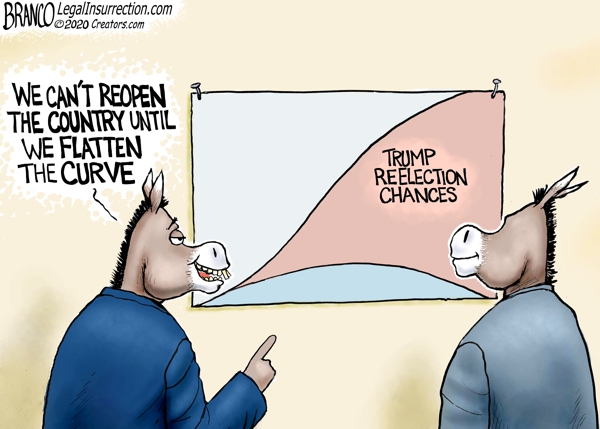
The government-imposed lockdown needs to end. But lot’s of people have (properly) set their own lockdown standards:
Many of the most important mitigation strategies are unknown to the general public because they’ve taken place behind closed doors on the initiative of employers, not bureaucrats, and have little or nothing to do with legal mandates (which are themselves, as I can attest is the case here in Canada, a contradictory, hastily-conceived patchwork of federal and provincial directives and advisories). To give but one example I happen to be familiar with: Many of the men and women you see driving delivery trucks and construction vehicles are now governed by all sorts of rules, at pickup and drop-off, that allow them to perform their functions without coming within six feet of others. In some cases, they’ve been enabled with apps on their phones or dash-mounted tablets that permit them to coordinate these functions without any direct on-site human interaction whatsoever. Or they might be subject to thermometer-gun screenings to determine if they have a fever. Having implemented these lockdown-lite policies at great cost and inconvenience, employers aren’t going to dump them the moment the government gives them permission to do so, even though these procedures have increased costs and decreased output.
Many employers I speak to are actually far more constricted by the concerns of their own employees than by the law itself. At one workplace that I know of, the boss announced that loosened provincial restrictions mean that everyone can come back to work this month. To his surprise, his employees announced that they’d voted on the issue through Facebook, and, no, they would not be coming back, at least not yet. And in Quebec, which is starting to let elementary-school students come back to class this month, thousands of parents—a majority at some schools—have decided to keep their children home. I am told by reliable sources within my own family that some of these parents are even pressuring their neighbours to do likewise, and are shaming dissenters on social media as bad parents. It’s lockdown by mob.
To some extent, I find this attitude of populist hyper-vigilance to be exasperating, because sending your young kids to school is now generally safe (and, selfishly, because I think my own seven-year-old could benefit from getting back to a structured education environment). But we got into this mess by letting our guard down, and so it’s not surprising that many ordinary people want to err on the other side of the equation for a month or three. Whatever your views, though, if you’re all in a fuss about lockdown policy, please remember that the real lockdown was never imposed by government. It turns out that it was inside each and every one of us all along.
Devin Nunes thinks that the entire Trump transition team was under surveillance by the Obama Administration. (Hat tip: Director Blue.)
Don Surber asked a question back in 2017 that we ought to take a fresh look at: Was Obama using the NSA to spy on Romney during the 2012 election? Given what we know of Crossfire Hurricane, would anyone put it past him?
Related:
Russia, Russia, Russia!
Oh, lovely. Crowdstrike admits that there was no evidence that Russia hacked the DNC server.
Lives better for the living:
Mexico’s president Andres Manuel Lopez Obrador would like to know the truth behind Obama’s Fast and Furious illegal gun running program. A lot of us would like to know the same thing…
EU and German courts (strangely two different things in this story) are having a pissing match over whose gavel is bigger.
Canadian Broadcasting Company can’t decide just how it wants to lie about The Epoch Times and its reporting on the Chinese Communist Party’s culpability in the Wuhan Coronavirus. (Hat tip: Ed Driscoll at Instapundit.)
TSMC to build chip foundry in Arizona. This is a pretty big deal, as TSMC currently has the best fab tech in the world, and this will be their first ground-up American foundry (they currently have (I think) two other American fabs as the result of acquisitions from WaferTech and TI).
“Arkansas Professor Arrested For Concealing Communist Chinese Funding.”
An engineering professor at the University of Arkansas has been arrested by the FBI and faces up to 20 years in prison for allegedly hiding funding that he received from the communist Chinese government.
The New York Times reports that “Simon Ang of the University of Arkansas, was arrested on Friday and charged on Monday with wire fraud.”
“He worked for and received funding from Chinese companies and from the Thousand Talents program, which awards grants to scientists to encourage relationships with the Chinese government,” the report notes, adding that “he warned an associate to keep his affiliation with the program quiet.”
The report explains that Ang’s alleged hiding of the funding enabled him to also get US government subsidies, specifically from NASA, to the tune of more than $5 million.
“Chinese Government Lays Off Entire Propaganda Team As American Media Doing Their Job For Them.
“CNN Replaces President Trump’s Press Briefings With President Xi’s.”
Capitalist fungus. (Hat tip: Ann Althouse.)
“Billy doesn’t respond well to pressure.”
“Why we at $FAMOUS_COMPANY Switched to $HYPED_TECHNOLOGY.”
Important safety tip: Don’t stand on an active airport runway. This was Austin, so odds are it was an adler.
For Rich:
The Los Angeles Rams uniforms are horrible garbage.
“Democratic States Deploy Greta Thunberg Drones To Lecture People Who Go Outside.”
Water sausage eats breakfast:
Goat rodeo:
This dog is on my wavelength:
Tags:2020 Presidential Race, aircraft, Andres Manuel Lopez Obrador, Andrew Cuomo, Arkansas, Austin, Babylon Bee, Brian Stelter, China, Clay Jenkins, coronavirus, corticosteroids, Crossfire Hurricane, Crowdstrike, Democrats, Devin Nunes, dogs, EU, fraud, Georgia, Germany, goats, Greta Thunberg, Gretchen Whitmer, homeless, hydroxychloroquine, Ken Paxton, Leslie Love, Los Angeles Rams, Massachusetts, Media Watch, Methylprednisolone, Mexico, Michigan, New Jersey, New York, NFL, Obamagate, otters, Pennsylvania, Regulation, Ron DeSantis, Ronald Shurer, Semiconductors, Simon Ang, spying, Texas, TSMC, Wisconsin, World War II, Wuhan, Xi Jinping
Posted in Austin, Democrats, Economics, Media Watch, Obama Scandals, Regulation, Texas, Waste and Fraud | 2 Comments »
Friday, April 24th, 2020
Welcome to another Friday LinkSwarm! It turns out that the Wuhan coronavirus has more tricks up its sleeve than we thought:
We knew about the viral pneumonia, but not about the blood clotting:
Craig Coopersmith was up early that morning as usual and typed his daily inquiry into his phone. “Good morning, Team Covid,” he wrote, asking for updates from the ICU team leaders working across 10 hospitals in the Emory University health system in Atlanta.
One doctor replied that one of his patients had a strange blood problem. Despite being put on anticoagulants, the patient was still developing clots. A second said she’d seen something similar. And a third. Soon, every person on the text chat had reported the same thing.
“That’s when we knew we had a huge problem,” said Coopersmith, a critical-care surgeon. As he checked with his counterparts at other medical centers, he became increasingly alarmed: “It was in as many as 20, 30 or 40 percent of their patients.”
One month ago when the country went into lockdown to prepare for the first wave of coronavirus cases, many doctors felt confident they knew what they were dealing with. Based on early reports, covid-19 appeared to be a standard variety respiratory virus, albeit a contagious and lethal one with no vaccine and no treatment. They’ve since seen how covid-19 attacks not only the lungs, but also the kidneys, heart, intestines, liver and brain.
Read the whole thing.
A coronavirus map based on self-reported symptoms. I note that Williamson County has only about 0.32%.
Over on Borepath, there’s a good discussion of all the known unknowns of the Wuhan Coronavirus, and all the data we don’t have.
Quillette writer Jonathan Kay looks at coronavirus “superspreader” events:
Only 38 of the 58 SSEs that I recorded were documented in a way that permitted me to determine their date with any specificity. (And even in these cases, I sometimes had to make educated estimates because of the vague nature of the reporting.) In the case of multi-day SSEs, such as religious festivals, I picked a day corresponding to the middle of the event. Unfortunately, some of the largest SSEs, such as those at North American meat processing plants, can’t be usefully pinpointed at all because the infections span multiple weeks (or even months), and the employers haven’t released detailed date-tagged data.
Of the 38 SSEs for which dates could be usefully identified, about 75 percent (29/38) took place in the 26-day span between February 25th and March 21st, roughly corresponding to the period when thousands of infected COVID-19 individuals were already traveling around the world, but before social distancing and event-cancelation policies had been uniformly implemented in many of the affected countries. (A notable early outlier is Steve Walsh, who spread COVID-19 from a Singapore corporate meeting to a French ski resort to his native UK in late January and early February.) No doubt, a vast number of SSEs occurred in January and February without being reported as such, because public-health officials and journalists weren’t alive to the nature or scale of the coming pandemic. But it is reassuring that, so far, April has been almost entirely bereft of publicly reported SSEs.
I was struck by how few of the SSEs originated in conditions stereotypically associated with the underclass (though a March outbreak at a Qatari migrant workers camp in the industrial area north of Doha offers one such example). Many of the early SSEs, in fact, centered on weddings, birthday parties, and other events that were described in local media as glamorous or populated by “socialites.” Examples here include a March 7th engagement party at a Rio de Janeiro “mansion” that attracted “high society” fly-ins from around the world, and a similarly described birthday party in Westport, CT.
It is theoretically possible that socioeconomically privileged individuals really do lack some immune-response mechanism that protects individuals who have been exposed to a wider array of infectious pathogens. (A recent report on COVID-19 surveillance testing at a Boston homeless shelter contained the stunning disclosure that 36 percent of 408 screened individuals tested positive for COVID-19. Yet the vast majority were asymptomatic, and even the few who were symptomatic did not diverge statistically from the 64 percent of tested individuals who were COVID-19-negative.) But absent more data, the more obvious explanation is that these early SSEs are linked to the intercontinental travel practices of the guests. (In the case of the Connecticut event, reports the New York Times, “a visitor from Johannesburg—a 43-year-old businessman—fell ill on his flight home.” And the Rio party was attended by guests who’d traveled recently from, or through New York, Belgium and Italy.) Moreover, COVID-19 outbreaks in poor communities are simply less likely to be reported, because the victims have less access to testing, high-end medical care, or media contacts.
In fact, the truly remarkable trend that jumped off my spreadsheet has nothing to do with the sort of people involved in these SSEs, but rather the extraordinarily narrow range of underlying activities. And I believe it is on this point that a close study of SSEs, even one based on such a biased and incomplete data set as the one I’ve assembled in my lay capacity, can help us:
- Of the 54 SSEs on my list for which the underlying activities were identified, no fewer than nine were linked to religious services or missionary work. This includes massive gatherings such as February’s weeklong Christian Open Door prayer meeting in Mulhouse, France, which has been linked to an astounding 2,500 cases; and a massive Tablighi Jamaat Islamic event in Lahore that attracted a quarter-million people. But it also includes much smaller-scale religious activities, such as proselytizing in rural Punjabi villages and a religious meeting in a Calgary home.
- Nineteen of the SSEs—about one-third—involved parties or liquor-fueled mass attendance festivals of one kind or another, including (as with the examples cited above) celebrations of weddings, engagements and birthdays.
- Five of the SSEs involved funerals.
- Six of the SSEs involved face-to-face business networking. This includes large-scale events such as Biogen’s notorious Boston leadership meeting in February, as well as one-on-one business meetings—from the unidentified “traveling salesperson” who spread COVID-19 in Maine to Hisham Hamdan, a powerful sovereign-wealth fund official who spread the disease in Malaysia.
All told, 38 of the 54 SSEs for which activities were known involved one or more of these four activities—about 70 percent. Indeed, the categories sometimes overlap, as with patient A1.1 in Chicago, who attended both a party and a funeral in the space of a few days; or the New Rochelle, NY man who covered the SSE trifecta of Bar Mitzvah party, synagogue services, and local funeral, all the while going to his day job as a lawyer in New York City.
But even that 70 percent figure underestimates the prevalence of these activities in COVID-19 SSEs, because my database also includes five SSEs involving two warships and three cruise ships—the USS Roosevelt, Charles de Gaulle, Diamond Princess, Grand Princess and Ruby Princess—at least three of which (and probably all five) featured onboard parties.
These parties, funerals, religious meet-ups and business networking sessions all seem to have involved the same type of behaviour: extended, close-range, face-to-face conversation—typically in crowded, socially animated spaces.
So you probably want to avoid such events for the near future. Snip.
In the case of religious SSEs, Sikhs, Christians, Jews and Muslims are all represented in the database. The virus makes no distinction according to creed, but does seem to prey on physically intimate congregations that feature some combination of mass participation, folk proselytizing and spontaneous, emotionally charged expressions of devotion. In the case of Islam, it is notable that the same movement, Tablighi Jamaat, has been responsible for massive outbreaks at completely separate events in Lahore (noted above), Delhi and Kuala Lampur. At Mulhouse, the week’s schedule included Christian “choir performances, collective prayer, singing, sermons from preachers, workshops, and testimony from people who said God had cured their illnesses… Many people came day after day, and spent hours there.” And in Punjab, dozens of Sikhs died thanks to the itinerant rural preaching of a single (now deceased) infamous septuagenarian named Baldev Singh.
Sporting events? Out. Choir performances? Out. Snip.
It’s worth scanning all the myriad forms of common human activity that aren’t represented among these listed SSEs: watching movies in a theater, being on a train or bus, attending theater, opera, or symphony (these latter activities may seem like rarified examples, but they are important once you take stock of all those wealthy infectees who got sick in March, and consider that New York City is a major COVID-19 hot spot). These are activities where people often find themselves surrounded by strangers in densely packed rooms—as with all those above-described SSEs—but, crucially, where attendees also are expected to sit still and talk in hushed tones.
Again, read the whole thing.
Speaking of things you’re not supposed to do: “Bangladesh: Over 100,000 gather for funeral of Islamic teacher, defying coronavirus lockdown.” What could possibly go wrong? (On the other hand, if this doesn’t turn into a superspreader event, then we have some valuable data about that seemingly invariant infection curve and/or the role of sunlight/warm climates in preventing infection.)
Speaking of superspreader events, want to guess who owned that South Dakota meat packing plant with the heavy infection rate? “In September 2013 Smithfield Foods was acquired by China’s biggest meat processor, Shuanghui International Holdings, in the largest acquisition ever of a U.S. company by a Chinese one.”
Speaking of China’s perfidy, while they rest of the world was struggling with the Wuhan coronavirus, they thought it was the perfect time to arrest dissidents in Hong Kong:
Fifteen activists between 24 and 81 years old were rounded up on suspicion of organizing, publicizing or taking part in several unauthorized assemblies between August and October and will face prosecution, the police said on Saturday without disclosing their names, following protocol.
The arrested democratic heavyweights included the veteran lawyers Martin Lee and Margaret Ng, the media tycoon Jimmy Lai and the former opposition legislators Albert Ho, Lee Cheuk-yan and Leung Kwok-hung, political parties and aides said.
Half the residents of a Boston homeless shelter had the Wuhan Coronavirus, but none showed any symptoms.
Democrats want a depression:
If the Malevolent Donkey Party was actively seeking to plunge the country into an economic tailspin, while still maintaining some level of deniability to the credulous suckers out there, exactly what would it be doing differently? It would be pretty much doing exactly what it is doing right now – shilling for the bat-gobbling ChiComs, delaying needed assistance to keep America working, and generally trying to keep us all locked in the dark in perpetuity.
It’s fair to assume that you intend the expected consequences of the actions you take, and the consequence of the actions the Democrats are taking is economic ruin. The indisputable fact is that they’re totally cool with that if that is what gets them back into power.
Democrats are never ones to let a good crisis go to waste, and this Wuhan Flu is a very good crisis indeed if your goal is leftist hegemony. The Trump economy was booming after the near-decade of the Obama doldrums, and people were getting a taste of prosperity. But a happy, prosperous America is something the Democrat dudes can’t abide. All the Democrats had to sell were recycled cries of “RACISM!” and “RUSSIA!” and their standard-bearer was that sinewy weirdo Grandpa Badfinger, who was promising to drag us all back into the nightmare of globalist failure. The future looked grim, which means it actually looked bright for the rest of us.
So, the Chinese coronavirus was a dream come true, a deus ex pangolin that finally, after an endless series of leaks, impeachments, investigations, and media meltdowns, might be the magic bullet that actually takes Trump down.
Am I saying that the Democrats are exploiting the pandemic for their own cheesy advantage? Well, yeah. Everything they are doing is consistent with that. Everything. No, in the abstract, many of them would probably not prefer that tens of thousands of Americans die (I get enough Twitter death wishes to know, from their own filthy mouths, that some absolutely do want us to die), but their attitude seems to be that if life gives you tens of thousands of dead Americans, make political lemonade.
How can Nancy Pelosi worry about your piddling lives when there’s so much ice cream to eat?
Democrats delayed emergency aid for ordinary Americans so they could maintain “leverage” to achieve Democratic Party priorities.
“Top Elections Lawyer: Vote-By-Mail Is ‘The Most Massive Fraud Scheme In American History.'”
“U.S. Intelligence Knew Russia Preferred Hillary to Trump, But John Brennan Hid the Truth, Ex-NSC Chief Says.” This story probably deserves more attention than I can give it right now…
Iran: Watch our tiny boats harass the Great Satan! President Trump: I hope you like your gunboats getting destroyed.
Masks are for the little people, not a Bill Clinton aide-turned “journalist.”
Even Fredo’s brother said that the federal Wuhan coronavirus response was “a ‘phenomenal accomplishment.'”
Speaking of Gov. Cuomo, he said that if you’re not an essential worker, sucks to be you. (Hat tip: The Other McCain.)
In New York, the death panels are already here. If you code, you’re cold…
How the CDC screwed up testing kits. (Hat tip: Director Blue.)
Another reminder: Don’t freak out over polls:
Least surprising news ever: “Dysfunction in Baltimore police homicide unit went unaddressed as killings hit historic levels.”
“Vindictive Detroit Democrats to Censure Lawmaker for Saying Trump Saved Her Life.” Given that State Rep. Karen Whitsett is black, by Democrat’s own rules, her censure must mean they’re racists. (Hat tip: Stephen Green at Instapundit.)
A look at Amity Shlaes’ book, Great Society: A New History.
Won’t someone please spare a moment to think about how the coronavirus outbreak has derailed the Austin politicians’ plans to spend billions on their toy trains? (Hat tip: Iowahawk.)
Speaking of Austin, the coronavirus has closed landmark Austin restaurants Threadgill’s…
…and Enchiladas Y Mas.
Is Apple moving to ARM for Mac? They’re planning to have their own Apple-designed chips fabbed at TSMC on the latter’s 5nm process. Intel, the current supplier for Mac CPUs, isn’t slatted to hit 5nm until 20203, and there’s long been talk that bringing up yield on their existing 10nm process has been in a world of hurt for a while.
“Respect my (round) authoritah!”
Stop having non-Party approved fun, drone!
We’re all in it together:
Heh:
Heh, BAM!
Whippet. Whippet Good!
Tags:2020 Presidential Race, Albert Ho, Andrew Cuomo, Apple Computer, Austin, Baldev Singh, Baltimore, Bangladesh, Boston, Center for Disease Control, China, Communism, coronavirus, Crime, Democrats, Devo, Foreign Policy, George Stephanopoulos, homeless, Hong Kong, Intel, Iran, Islam, Jimmy Lai, Jonathan Kay, Karen Whitsett, Kurt Schlichter, Lee Cheuk-yan, Leung Kwok-hung, LinkSwarm, Margaret Ng, Martin Lee, Nancy Pelosi, New York City, pandemic, polls, restaurants, Semiconductors, Shuanghui International Holdings, Smithfield Foods, South Dakota, TSMC, Voter Fraud, Williamson County, Wuhan
Posted in Austin, Communism, Crime, Democrats, Foreign Policy | No Comments »
Friday, March 20th, 2020
I hope you’re enjoying your splendid isolation on the first day of spring. As in previous weeks, the Wuhan coronavirus dominates the news with the reminder that the Gods of the Copybook Headings are never far away…
President Donald Trump invokes the Defense Production Act of 1950 to fight the Wuhan Coronavirus. “The legislation allows the president to require production and orders from certain industries to prioritize the response to a national emergency.”
Not just the flu. “On a scale of 1 to 10, he said, the pain was 15… Imagine your lungs turning solid. It’s like suffocating.” (Hat tip: Ann Althouse.)
Dr. Anthony Fauci: You better believe the China travel ban made a difference.
Don’t let the MSM revisionism fool you; President Trump was relentlessly slammed by Our Media Betters for that decision:
So many dead bodies in Iran that trenches for them can be seen from space.
The problem with the CDC isn’t underfunding, it’s refusing to focus on its actual job:
The Centers for Disease Control has a $6.6 billion budget and one job which it messes up every time.
The last time the CDC had a serious workout was six years ago during the Ebola crisis. Back then CDC guidelines allowed medical personnel infected with Ebola to avoid a quarantine and interact with Americans until they showed undeniable symptoms of the disease. There were no protocols in place for treating the potentially infected resulting in the further spread of the disease inside the United States.
At the height of the crisis, confidence in the CDC fell to 37%. Meanwhile, CDC personnel had managed to mishandle Ebola virus samples, accidentally sending samples of the live virus to CDC labs. And the heads of the health bureaucracy blamed the lack of funding for their failure to have an Ebola vaccine.
Snip.
During the Ebola crisis, the CDC had been spending a mere $2.6 million on gun violence studies. But the CDC has a history of wasting money on everything from a $106 million visitor’s center with Japanese gardens, a $200K gym, a transgender beauty pageant, not to mention promoting bike paths.
The occasional outbreak only calls the CDC’s general incompetence to everyone’s attention. The rest of the time its incompetence, like that of other government agencies, just ticks along wasting money.
In 1999, the CDC announced a plan to end syphilis in 5 years. The Clinton era National Plan to Eliminate Syphilis was an unserious social welfare proposal that wanted to battle racism and was such a success that by 2018, syphilis rates had hit a new record high. But Democrat presidential candidates using the CDC for imaginary proposals to end a disease, not by utilizing science, but social welfare, had become a bad habit under Obama, diverting resources from what the CDC could realistically do for political scams.
In 2011, Hillary Clinton had promised an “AIDS-free generation” by, in part, using the CDC. Like her presidency, the “AIDS-free generation” never arrived and was never going to.
The CDC isn’t prepared to fight epidemics because it’s too concerned with pushing gun control, fighting obesity, and waging social justice. (Hat tip: Zerohedge.)
If you calculate Wuhan Coronavirus deaths per capita, America is crushing it.
“Beijing Fears COVID-19 Is Turning Point for China, Globalization.” Ya think?
What Beijing cares about is clear from its sustained war on global public opinion. Chinese propaganda mouthpieces have launched a broad array of attacks against the facts, attempting to create a new narrative about China’s historic victory over the Wuhan virus. Chinese state media is praising the government’s “effective, responsible governance,” but the truth is that Beijing is culpable for the spread of the pathogen around China and the world. Chinese officials knew about the new virus back in December, and did nothing to warn their citizens or impose measures to curb it early on.
Instead of acting with necessary speed and transparency, the party-state looked to its own reputation and legitimacy. It threatened whistleblowers like the late Dr. Li Wenliang, and clamped down on social media to prevent both information about the virus and criticism of the Communist Party and government from spreading.
Unsurprisingly, China also has enablers abroad helping to whitewash Beijing’s culpability. World Health Organization Director-General Tedros Adhanom Ghebreyesus refused for months to declare a pandemic, and instead thanked China for “making us safer,” a comment straight out of an Orwell novel. This is the same WHO that has refused to allow Taiwan membership, due undoubtedly to Beijing’s influence over the WHO’s purse strings.
Most egregiously, some Chinese government officials have gone so far as to claim that the Wuhan virus was not indigenous to China at all, while others, like Mr. Tedros, suggest that China’s response somehow bought the world “time” to deal with the crisis. That such lines are being repeated by global officials and talking heads shows how effectively China’s propaganda machine is shaping the global narrative. The world is quickly coming to praise the Communist Party’s governance model, instead of condemn it.
The reality is that China did not tell its own people about the risk for weeks and refused to let in major foreign epidemiological teams, including from the U.S. Centers for Disease Control. Thus, the world could not get accurate information and laboratory samples early on. By then, it was too late to stop the virus from spreading, and other world capitals were as lax in imposing meaningful travel bans and quarantines as was Beijing.
Because of China’s initial failures, governments around the world, including democratic ones, now are being forced to take extraordinary actions that mimic to one degree or another Beijing’s authoritarian tendencies, thus remaking the world more in China’s image. Not least of the changes will be in more intrusive digital surveillance of citizens, so as to be able to better track and stop the spread of future epidemics, a step that might not have been necessary if Beijing was more open about the virus back in December and if the WHO had fulfilled its responsibilities earlier.
Are Chlorequine or Hydroxychloroquine a cure for the Wuhan Coronavirus? They just got approved for that use so I suspect we’re going to find out. Props to reader Greg Timoney for pointing out this post a few days before the news broke more generally.
Debunking Cornavirus lies about the Trump Administration.
Democratic Rep. Ilhan Omar endorses President Trump’s policies to combat the Wuhan Cornavirus:
And the moon became as blood… (Hat tip: Stephen Green at Instapundit.)
CNN praises Trump’s coronavirus leadership. And the stars of the heavens fell unto the earth…
“After this, whenever after is, we should never let the relationship with the Chinese state go back to normal.” (Hat tip: Director Blue.)
Pretty good thread on what is and isn’t available in various supermarkets in various parts of the country. This week week at my local HEB, chicken was low but ground beef was available, as well as bread and eggs. Lots of things were picked but usually alternates were available if you were willing to switch brands or sizes. Didn’t check toilet paper.
Texas-based used bookstore chain Half Price Books has closed all it’s stores due to the coronavirus.

I’ve bought a number of books there over the years…
List of which Austin-area employeers are letting their employees work from home, and which aren’t. I can well understand semiconductor manufacturers like Samsung and AMD keep running their fabs; an idle fab line can lose up to $1 million an hour, and you’re not going to catch coronavirus in a bunny suit in a cleanroom anyway…
Nancy Pelosi tried to slip taxpayer-funded abortions into the coronavirus relief bill, because of course she did.
Important data reminder:
Another professor caught shilling for China.
The Austin City Council has decided that there’s no need to clean up homeless encampments in the present crisis. “In the current situation, however, homeless encampments ought to be the first place you look to shut down transmission of infectious diseases. Instead, those are the one place that will be left completely alone.”
“GOP wins three special Pennsylvania [State] House races, including a ‘Hillary district.'” (Hat tip: Instapundit.)
Harris County finally settles a lawsuit to provide information on foreign nationals illegally registered to vote.
After two years of hiding public voter data, the state’s biggest county will finally disclose records of foreigners illegally voting in Texas elections, ending a court battle initiated by an election integrity group.
This week, Harris County settled a lawsuit brought against its top voter registration official and agreed to release all records of noncitizen voters requested by Public Interest Legal Foundation, a conservative law firm that specializes in fighting to enforce federal voter roll maintenance laws.
Snip.
PILF sued Harris County Tax Assessor-Collector and Voter Registrar Ann Bennett in 2018, after Bennett’s office refused access to records of registered voters identified as noncitizens, as well as actions taken by the county regarding those registrations.
“Baltimore Mayor Begs Residents To Stop Shooting Each Other So Hospital Beds Can Be Used For Coronavirus Patients.”

Production on Saturday Night Live shut down. I’m so old I remember when it was funny…
Christopher Hitchens, anti-identitarian:
Hitchens detested tribal and parochial feelings of any kind, which is why he was dismayed when he witnessed the emergence of identity as a catalyst for political mobilization in the late 1960s and early 1970s. In his memoir, Hitch-22, Hitchens attacked radicals who thought it was “enough to be a member of a sex or gender, or epidermal subdivision, or even erotic ‘preference,’ to qualify as a revolutionary.” When Hitchens first heard the expression “the personal is political,” he knew “as one does from the utterance of any sinister bullshit that it was—cliché is arguably forgivable here—very bad news.” As he put it in a 2008 article:
People who think with their epidermis or their genitalia or their clan are the problem to begin with. One does not banish this specter by invoking it. If I would not vote against someone on the grounds of ‘race’ or ‘gender’ alone, then by the exact same token I would not cast a vote in his or her favor for the identical reason.
Cancel culture comes for Woody Allen.
In the summer of 1992, actress Mia Farrow found out that her adopted daughter Soon-Yi was still romantically involved with Mia’s ex-long-time-boyfriend and collaborator, Woody Allen. According to then-21-year-old Soon-Yi, Mia responded by telling a psychologist that Woody was “satanic and evil,” and that she needed to “find a way to stop him.” Three days later, seven-year-old Dylan Farrow, Mia’s daughter, accused Allen of molesting her in Mia’s Connecticut house. But when the child’s accusations, which were captured on videotape with reported coaching from Mia, were investigated by the Connecticut State Attorney, the Child Sexual Abuse Clinic of Yale-New Haven Hospital and the New York Department of Social Services, no credible evidence could be found to support the allegations. As Kyle Smith reported in a definitive National Review article, Mia’s own nanny “quit the family rather than support Mia’s version of events.” And Dylan’s brother Moses wrote in 2018 that the Mia-Dylan abuse narrative simply made no sense given the architecture of the Connecticut house where the abuse allegedly took place. Yet Woody Allen was nonetheless smeared as a rapist and pedophile. And last week, his publisher, Hachette Book Group, announced it would cancel its deal to publish Allen’s memoirs.
The accusation always struck me as bunk. You can believe that Allen marrying his girlfriend’s stepdaughter is a creeper move without believing he’s a pedophile.
Former Ars Technica writer and Anti-GamerGater Peter Bright found guilty of attempted enticement of a minor for sex.
“Trump Says, ‘I Don’t Want Any Americans To Die’, NYT Quotes As ‘I… Want… Americans To Die.'”
Funny dog tweet the first:
For Dwight:
Tags:#GamerGate, Ann Bennett, Austin, Austin City Council, Baltimore, Center for Disease Control, China, Christopher Hitchens, CNN, coronavirus, Crime, Defense Production Act, Democrats, dogs, Ebola, Half Price Books, Harris County, homeless, Ilhan Omar, Iran, LinkSwarm, Nancy Pelosi, New York City, Peter Bright, Public Interest Legal Foundation, Saturday Night Live, Semiconductors, Social Justice Warriors, Texas, Woody Allen, Wuhan
Posted in Austin, Crime, Democrats, Foreign Policy, Social Justice Warriors, Texas | No Comments »
Friday, July 5th, 2019
I hope everyone had fun blowing things up on July 4th. Enjoy a Friday LinkSwarm
How President Donald Trump is kicking Iran’s ass without war:
Iran’s official press has recently bragged about its military prowess when downing a US drone worth about $130 million, touting it as a nasty black eye for the world’s military superpower.
But a recent Reuters report said Iran’s oil exports are down to a scant 300,000 barrels per day. In April 2018, before Trump exited the Iran deal, which provided the country with sanctions relief in exchange for its commitment to not build nuclear weapons or their key components, Iran was exporting 2.5 million barrels a day.
At today’s rate per barrel, the Trump-induced decline in exports has probably cost Iran $120 million a day from oil alone — almost the cost of the US’s pricey drone.
For the US, losing a drone is costly and destabilizing [?-LP] but not really a big deal for a country with a $718 billion annual defense budget. In Iran, the currency has crashed, and the country has become gripped by protests and strikes. And it has felt a crackdown on the financial freedom for all of its citizens.
Speaking of sanctioning Iran: “British Marines Seize Oil Tanker Headed For Syria.”
Martin Peretz reflects on the two towering achievements brought about by the Oslo Accords since 1993, namely “jack” and “squat”:
For years even after the failure of Oslo and of the 2000 summit at Camp David, D.C. notables and even some prominent Zionists had photos with Arafat displayed on their credenzas.
That sociology stuck in my mind. It testified to the tenaciousness in certain left-liberal circles of an idealizing impulse—one that altered the judgments of normally lucid people, leading them to make heroes of figures like Arafat who didn’t fit the bill. They justified this impulse with the old progressive belief in rational political improvement—a respectable belief when it’s applied in context, a misleading one when the context is altered to fit the wish. Their willed naiveté struck me, and not just on Oslo, as the place where effective progressivism goes to die.
Snip.
The counterpoint to this accommodation of Iran was the marginalization of Israel—the cutting-down-by-proxy of the country to what Obama saw as its physical and psychological size. True, it wasn’t a financial marginalization—as his defenders have said ad nauseam, Obama allowed Israel to buy more weapons than any other president before him. But by centering his policy on compromising with Iran, the one major Mideast power that had yet to reach some détente with Israel, and allowing Israel’s other enemy Assad to murder unimpeded, Obama shifted the strategic ground under Israel’s feet. Rhetorically, he did even more: He used the president’s bully pulpit to dramatically change the terms on which conversations about Israel would be conducted among Democrats and the world.
You can draw a line from his tepid 2009 justification of Israel to the speech he sent his towering shikying’l John Kerry to give to the United Nations in 2016: a refusal to block a U.N. resolution condemning Israel for its support of right-wing settlements in the West Bank. A lot of people—myself included—oppose some of the outlier settlements, without seeing them as a major cause of the current impasse. But Kerry’s speech made them equal—or greater than equal—problems to the Palestinian leadership’s endemic corruption, its weakness in the face of Hamas and refusal to accept peace offers made by four Israeli prime ministers from 1993 to 2009. (Actually, the Palestinians haven’t made a territorial compromise in 52 years—that is long enough for the Israelis to grow impatient.) Kerry’s speech, itself an instance of sacrificing the reality to the ideal through the principle of making Israeli and Palestinian histories equivalent, shifted the terms of the debate.
That rhetorical shift, coupled with Obama’s highly publicized, ultimately corrosive enmity towards Bibi Netanyahu—a partisan leader with a surer grasp of regional realities than the American president had—helped create the Democrats’ current political condition, which is not just counterproductively idealizing but supportive of the party’s most destructive foreign policy impulses. A party that defines itself by the chances it gives to marginalized groups always has, on its edges, radicals pushing in toward the center who define their politics by the principle of marginalization: the boiled-down Marxist dichotomy of oppressor and oppressed. When the center of the party shows weakness, the radicals naturally move in, and that’s what Obama’s rationalists allowed them to do: By shifting the party from its center and creating a rhetoric of false equivalence, they gave the hard leftists an opportunity they were only too happy to take.
“Netanyahu: Israel preparing for wide-scale campaign in Gaza.”
The Trump Administration is treating illegal aliens horribly. And by “horribly,” I mean “demonstrably better than the Obama Administration.”
Eastern Europe doesn’t have an immigration problem, it has an emigration problem.
In essence, the EU’s freedom of movement guarantees an absence of barriers for anyone looking for a job within the 28 countries and makes discrimination based on nationality in work or employment illegal. For many of the EU’s new entrants in the East—including Poland, Hungary and Romania—a future where capital and people could move more freely between themselves and France, the UK, or Germany looked like a fast-track to the top-tier of developed nations. But somewhat ironically, it has only accelerated the departure of those who are crucial to getting there.
In the last century, Eastern Europe has suffered the most dramatic population decline in recent history. According to one study, between 2013 and 2016, approximately 230,000 people left Croatia—a country with a population of only four million—for the 11 “core EU countries” of Western Europe. In the United States, this would be the equivalent of a city the size of Chicago leaving every year. This mass exodus of people is not lost on the country’s politicians; last year the Croatian President called the freedom of movement the “biggest drawback” of the EU. “Mobility is good, as long as people come back. But Croatia is now recording strong negative demographic trends,” she said during a visit to Brussels.
Since Latvia joined the EU, it has lost one-fifth of its population. Romania, a country that according to one organisation is due to see the most drastic population decline, has seen over three million leave the country since it joined the EU in 2007. It lost half of its doctors between 2009 and 2015, the vast majority to better-paid employ in the richer hospitals and surgeries of Western Europe, leaving its health service poorly staffed and on the brink of collapse. High mortality (including infant mortality) and low birthrates are only accelerating the decline.
Large-scale migration of healthcare workers from East to West has been an uncomfortable reality for over a decade, and the young needn’t travel long distances to drastically increase their standard of living. One Estonian doctor who graduated from medical school in 2001 was able to quadruple his salary by moving only 200 kilometres to Finland. In 2018, Denmark enjoyed the EU’s highest average gross annual pay at nine times that of the continent’s lowest in Bulgaria. Who can blame those who head for the greener pastures on the other side?
It’s not just highly skilled labor. When I visited London, it seemed that at least half the workers in restaurants and hotels were from eastern Europe.
Dwight found an amazing story of corruption in the Honolulu DS’s office. (One guess as to which party controls Hawaii.) The list of sleazy crimes Katherine Kealoha engaged in is staggering.
Engineer convicted of smuggling military computer chips to China.
Prosecutors alleged that Shih, alongside co-defendant Kiet Ahn Mai of Pasadena, California, conspired to gain access to a sensitive system belonging to an unnamed US firm which manufactured semiconductor chips and Monolithic Microwave Integrated Circuits (MMICs).
The victim company’s PC systems were accessed fraudulently after Mai posed as a potential customer, giving Shih the opportunity to obtain custom processors. While the firm in question believed the chips would only be used in the United States, Shih transferred the products to the Chengdu GaStone Technology Company (CGTC), a Chinese firm building an MMIC manufacturing plant.
Last time I checked, finding electrical engineers with experience designing RF circuits for mixed signal ICs is hard. I bet finding those that can design MMICs is even harder…
Speaking of Chinese espionage, it turns out that Cisco inadvertently embedded Huawei signing certificates deep within some of their switches. (Hat tip: Director Blue.)
“Amy Coney Barrett Strikes a Blow against Campus Kangaroo Courts:”
Whenever I read a court opinion describing a campus sexual-assault proceeding, I routinely find myself shocked at the staggering unfairness and ridiculous bias of campus kangaroo courts. Driven by the need to find more men guilty — and rationalized by a #BelieveWomen ideology — campus administrators have systematically discarded every fundamental notion of due process in American law.
Across the nation, courts on the right and on the left are saying no. They’re blocking biased sexual-assault adjudications, protecting basic fairness, and restoring a degree of sanity to colleges’ procedures. On Friday it was the turn of the Seventh Circuit Court of Appeals to protect the Fourteenth Amendment, and an all-woman panel, led by Judge Amy Coney Barrett, established a precedent that could be used against woke college administrators nationwide.
The facts of the case are extraordinary. After a female college student accused her ex-boyfriend of groping her in her sleep, Purdue University conducted an investigation and adjudication so amateurish and biased that it’s frankly difficult to imagine that human adults could believe it was fair or adequate. The plaintiff (John Doe) alleged that he was “not provided with any of the evidence on which decisionmakers relied in determining his guilt and punishment,” his ex-girlfriend didn’t even appear before the hearing committee, he had “no opportunity to cross-examine” his accuser, the committee found his accuser credible even though it did not talk to her in person, the accuser did not even write her own statement or provide a sworn allegation, and the committee did not allow the plaintiff “to present any evidence, including witnesses.”
After that farce of a process, Purdue found the student guilty and suspended him for a year. The suspension meant the automatic loss of the student’s Navy ROTC scholarship and expulsion from the ROTC program. Incredibly, the lower court dismissed the student’s claims. He appealed to the Seventh Circuit, and a unanimous panel resurrected his lawsuit.
The conclusion is that campuses are are blaming men as a class and this is a clear violation of Title IX. (Hat tip: Instapundit.)
“I have never met antisemitism in Britain…until now.”
I generally come to Britain from my home in Portugal whenever a new work of mine is released to give talks at bookshops, libraries and literary festivals. My publisher’s attempts to interest event organisers in me aren’t always successful, of course. But this year, for the first time, I have been turned down for being Jewish. A little context. Peter Owen Publishers launched my new novel, The Gospel According to Lazarus, in mid-April. An old friend of mine who is a part-time book publicist began trying to set up events for me three months earlier.
In early March, he called and confessed – in a distressed tone I’d never heard before – that he had just been turned down by two cultural organisations that had previously shown enthusiasm for hosting an event with me. “They asked me if you were Jewish, and the moment I said you were, they lost all interest,” he said. “They even stopped replying to my emails and returning my phone messages.”
Snip.
Has the Boycott, Divestment and Sanctions movement played a role in deepening this atmosphere of fear? That’s what my friends in the UK tell me. They also speak bitterly of the unwillingness of the Labour party to take a firm stand against antisemitic discourse. If cultural organisations are afraid of hosting events for Jewish writers, then Britain has taken a big step backwards.
Let’s not get sidetracked with references to Israel. Although it’s perfectly legitimate for those who oppose Netanyahu’s policies to protest against them, I have no connection with Israel. I have neither investments nor family there. And my most well-known books take place in Portugal and Poland. It’s true my new novel is set in the Holy Land, but it takes place 2,000 years before the foundation of the state of Israel.
Of course, that piece is from that notorious bastion of right-wing belief, The Guardian…
Broward Count Sheriffs office loses accreditation.
On the Betsy Ross Flag:
Guadalajara hit by several inches of golfball-sized global warming.
Mad magazine is shutting down.
Does the Navy have patents for UFO-like craft? Sure looks like it, but I suspect we’re just farking with the Chinese…
Think Progress is a money-losing rathole.
Invasion of the killer alien tick. (Hat tip: Woodpile Report.)
Attention everyone: Mess with our Blue Bell and we are coming for you. Signed, Texas.
Florida man find out the hard way that cocaine and fugu don’t mix. And they’re not great for you separately, either… (Hat tip: Instapundit.)
“Hillary Proposes Reparations To Anyone Who Ever Lost A Presidential Election To Trump.”
Tags:Amy Coney Barrett, anti-semitism, Benjamin Netanyahu, Border Controls, Broward County, Bulgeria, China, Cisco, cocaine, Crime, Croatia, Democrats, Estonia, feminists, Florida, Florida Man, Foreign Policy, Gaza, Global Warming, Hawaii, Hillary Clinton, Huawei, Iran, Israel, Jihad, Katherine Kealoha, Latvia, Mad, Middle East, Military, Navy, Oslo Accords, PLO, Romania, Scott Israel, Semiconductors, Social Justice Warriors, Syria, Texas, The Guardian, UK
Posted in Border Control, Crime, Democrats, Foreign Policy, Global Warming, Jihad, Military, Social Justice Warriors, Texas | No Comments »
Friday, June 28th, 2019
Man, it’s been a week. The clown car and NRA pieces have been blowing up my stats, and I’ve got a bunch of other things happening. I tried to watch the Group of Death debate last night, but the stream kept cutting out, so I’ll probably save the reactions for Monday’s Clown Car Update. This LinkSwarm features Dan Crenshaw, Google, and Dan Crenshaw grilling Google.
Pelosi caves, gets the House to pass the Republican Senate bill to address the crisis on the Southern border 305-102. The Senate bill isn’t perfect, but it’s a vast improvement on the House’s laughable effort. But the fact that 90% of the 2020 Democratic presidential contenders are demonstrably to the left of Nancy Pelosi on the issue might give a more reflective party pause…
Texas Rep. Dan Crenshaw says Democrats live in another world when it comes to the crisis on the border.
“In Emergency Bill, House Dems Vote To Send More Fake Tears To Address Border Crisis.”
Cuba runs out of other people’s money.
Trump’s latest accuser is loony toons.
But “David French Believes Her Implicitly, Because of Course He Does.”
It’s not all bad news on the gun rights front front: Gov. Abbott signed 10 pro-Second Amendment bills.
Kevin Williamson dissects Facebook’s attempts to float their own cryptocurrency.
Professor Posner is correct in pointing to the rivalrous nature of political power and market power. What is less well understood is that markets won that fight in a knockout a decade or more ago. The new reality is that markets — not corporations, but markets — are more powerful than states, and much of the angry, angsty, mob-inciting politics of the Left and the Right in the past decade is simply the emotional noise and churn generated as societies and governments readjust their affairs to accommodate themselves to that new reality. Bill Clinton spent much of his presidency bitching about the bond market, which was his shorthand for the ways in which global markets (especially financial markets) limited politicians’ effective scope of action. He was, uncharacteristically for a man of such modest imagination, ahead of his time.
The power of capital flows is a reality that has made itself known bit by bit to states both liberal and autocratic, from the members of the European Union to the caudillos in Beijing. Saudi Arabia is an absolute monarchy with no regard for life or property, brutal and vicious — and constantly getting slapped around by volatility in the energy market. Mohammed bin Salman can command almost anything — except the commodity markets that rule his world.
Much of the hysteria on display in the Democratic presidential primary is American progressivism’s shrieking protest of the new facts of life. Progressives such as Elizabeth Warren are intelligent enough to understand what’s happened: That just at the moment they were primed to take power, power was taken away from them.
Project Veritas reported on Google executives working behind the scenes to censor conservatives and prevent President Trump from being reelected. “People need to know what’s going on with Google, and that they are not an objective piece – they’re not an objective source of information. They are a highly biased political machine that is bent on never letting somebody like Donald Trump come to power again.” Result: Project Veritas was banned from Google-owned YouTube, then from ostensible YouTube competitor Vimeo. But you can watch it on BitChute.
Speaking of Google: “Rep. Dan Crenshaw grilled Google executives after an employee reportedly labeled Ben Shapiro, Jordan Peterson, and Dennis Prager as ‘Nazis.’ ‘Two of three of these people are Jewish, very religious Jews. And yet you think they are Nazis,’ the Texas congressman said in reference to Shapiro and Prager. ‘It begs the question, “What kind of education do people at Google have?”‘” (Hat tip: Director Blue.)
Speaking of Big Tech censorship of conservatives, Reddit has “quarantined” The_Donald subreddit for Trump fans, one of the largest and most heavily trafficked groups on Reddit. You can still reach The_Donald by following that link, but you get a warning and you can’t search for the content anymore.
People continue to flee high tax states and move to low-tax states, something that has only been accelerated by the limitation of state and local taxes in the 2017 tax reform. (Hat tip: TPPF.)
What people actually die of versus what types of deaths the media cover. (Hat tip: Say Uncle.)
“Overstock CEO Patrick Byrne Used To Hate Donald Trump. Now, He’s Kind of a Fan.” Also worries (if you listen to the podcast) about China’s rise as a techno-authoritarian hegemon.
Democratic congressmen Donald Norcross of New Jersey and Rep. Jim Himes of Connecticut hit with ethics violation charges for all-expense-paid trips to Qatar. You know, the same country that loves bribing people and bankrolling terrorists.
“Leaders Of Brooklyn And Manhattan Chapters Of The United Brotherhood Of Carpenters Charged In Rampant Admissions-Bribery Scheme.”
Colorado sees 4 to 10 inches of snow on Summer Solstice.
Huawei loses lawsuit against semiconductor designer CNEX (a fabless solid state storage firm), though it’s something of a pyrhic victory, as the judge awarded CNEX no damages. (Hat tip: Stephen Green at Instapundit.)
Herbert Meyer, RIP. You may not have heard of him, but he penned a famous memo in late 1983 that outlined how the U.S. was winning the cold war.
Rosanne Barr and Andrew “Dice” Clay to do a comedy tour together.
Speaking of comedy: “Louis CK’s audience must be punished.”
Stop laughing. This isn’t funny. Louis CK is now an unperson. You can no longer applaud him or enjoy his comedy hate speech. If you insist on supporting an enemy of the people, there will be consequences. You will be punished. Your life will be upended. If you care about your future, you will keep your excitement and happiness to yourself when presented with the verboten.
“Well, if you don’t like Louis CK, don’t listen to him. You can’t tell other people what they should and shouldn’t laugh at.” We hear that a lot from fascists, don’t we? They think hate speech is free speech, and they don’t think they need to do what they’re told. But they’ll learn. They will be corrected.
Today you’re cheering for an unapproved comedian. Tomorrow you’re marching with tiki torches and tweeting dank memes. The day after that, you’re annexing the Sudetenland. These people must be controlled before the fascism spreads.
Famed designer Jony Ive has has left Apple to form his own design group (but Apple will be a client). CNet looks at some of his most iconic designs, including the original iMac and the iPhone.
How many flatmates were there in the classic BBC sitcom The Young Ones? Five. If you count the creepy ghost.
“Major Cave-In As Democratic Candidates Rush To Far Left Side Of Debate Stage.”
A nice little compilation of train stunts in silent movies:
Tags:Andrew "Dice" Clay, Apple Computer, BBC, Ben Shapiro, Border Controls, China, CNEX, Colorado, Communism, Cuba, Dan Crenshaw, David French, Democrats, Dennis Prager, Donald Norcross, Donald Trump, Facebook, Foreign Policy, Global Warming, Google, Greg Abbott, Guns, Herbert Meyer, Huawei, Jim Himes, Jordan B. Peterson, Kevin D. Williamson, LinkSwarm, Louis C.K., Nancy Pelosi, Obituary, Patrick Byrne, Project Veritas, Qatar, Reddit, Roseanne Barr, Semiconductors, Taxes, Texas, The Young Ones, unions, YouTube
Posted in Border Control, Communism, Crime, Democrats, Economics, Foreign Policy, Guns, Texas, unions | No Comments »
Friday, May 24th, 2019
Welcome to another Friday LinkSwarm! This week: Texas legislative news, foreign elections, and a surprising amount on analog synthesizers…
Theresa May is out as British Prime Minister effective June 7. The only reason she’s not the worst prime minister of the last century is that she didn’t give Czechoslovakia to Hitler…
May’s refusal to offer the UK a real Brexit may result in the Tories being crushed by Nigel Farage’s Brexit Party:
Even before [EU Parliamentary] election results are known on Sunday, therefore, there’s a growing sense that the Brexit party may be a permanent factor in British politics. Opinion polls on how people would vote in a general election show that the party would do less well than in European elections but still run about level with the Tories and Labour. There are deep divisions on policy apart from Brexit that have allowed critics to argue that the party would fall apart once its main goal had been achieved. But the divisions don’t seem deeper than those of other parties, and power or its prospect is itself a unifying social glue. Farage’s rallies around the country are hugely successful — packed, good-humored, more diverse socially and politically than those of the other parties, full of confidence and optimism, and notably without rancor. As with Trump’s election rallies, people seem to find them enjoyable as well as genuinely serious. A kind of Brexit party spirit already exists with many different types of people happy to be together on the bandwagon. It seems less class-bound than any of the existing parties.
And if the Brexit party wins one-third or more of Britain’s votes this week from a standing start, it will change British politics. Such a result would have the effect of a second referendum victory for Leave. It simply would not be possible for Parliament and the mainstream parties to push through a Brexit that doesn’t get the effective consent of Farage and his party. If such a thing is attempted, it will be seen to be anti-democratic and will have to be abandoned quite quickly. It would force the EU to confront the fact that there is little chance of getting a deal like May’s withdrawal deal accepted, and that even if one were to make it into the statute book, it could never be effectively implemented. In those circumstances the EU might simply throw up its collective hands and declare that the U.K. has left without a deal.
The third effect of a Farage success in the European elections would be to realign political parties and, in particular, to place the Conservative party in mortal peril. Voting for a political party is a matter of both loyalty and habit. For lifelong Tories, the idea of voting for another party is anathema. Most people who think about it never actually get around to doing it. But the Tories have certainly given their traditional supporters and those new supporters who voted for them in order to achieve Brexit good reason to leave them on this occasion. Many will do so this week. And as with adultery, betraying your party for another is much easier the second time around.
Well:
You know who doesn’t want to impeach President Donald Trump? House Democratic Speaker Nancy Pelosi. (Hat tip: Jim Geraghty.)
But she may not be able to hold off her lunatic party much longer.
And all that despite ample evidence that voters are opposed to the whole charade. (Hat tip: Director Blue.)
Democrats lying about preexisting conditions again:
“A charity run by the wife of Rep. Elijah Cummings received millions from special interest groups and corporations that had business before her husband’s committee and could have been used illegally.”
Democratic Louisiana Governor John Bel Edwards is a rarity: an actual pro-life Democrat. When Edwards’ wife was “20 weeks pregnant with their first child, a doctor discovered their daughter had spina bifida and encouraged an abortion. The Edwardses refused. Now, daughter Samantha is married and working as a school counselor, and Edwards finds himself an outlier in polarized abortion politics.”
A succinct summary from across the pond:
If you look at what China is targeting in retaliatory tariffs, it’s obvious their hand is incredibly weak:
But based on what we know, what’s even more revealing about China’s choices are the U.S.-made products that haven’t made any tariff list. They include civilian aircraft and their engines and parts, which had a 2018 export total of $17.73 billion. They include semiconductors and their components, which last year had China shipments that totaled several billion additional dollars. They include the equipment needed to manufacture and inspect semiconductors and their parts, which racked up at least $850 million in 2018 exports to China; devices for conducting chemical and physical analyses (with $912 million in China exports last year); laser equipment ($304 million), motor vehicles, auto parts, and plastics resins and polymers (which each produced billions in exports to China); and billions of dollars’ worth of other products that the Chinese either can’t (yet) make or can’t make in the amounts that they need—or that consist of goods preferred by Chinese consumers over their Made in China counterparts.
As I’ve said before, semiconductor equipment is an area where it’s all but impossible for the Chinese to do without American technology.
Narendra Modi wins reelection in India. Forcing Pakistan to stand down over Kashmir probably clinched the victory for him. Modi’s Hindu ethononationalism is not good for India in the long-run, but he’s probably someone President Trump can trust to be a staunch ally against Islamic terrorism. (Hat tip: Stephen Green at Instapundit.)
The election was an outright disaster for Rahul Gandhi, “the scion of the Nehru-Gandhi dynasty and leader of India’s Congress party,” which is down to 52 seats as opposed to 303 for Modi’s Bharatiya Janata Party. (Remember that Indira Gandhi was the daughter on India’s first prime Minister, Jawaharlal Nehru, and is not related to Mahatma Gandhi.)
The Morganza Spillway on the Mississippi to be opened for only the third time in history. The Morganza Spillway is located downstream of the Old River Control Structure.
“60% of male managers are ‘uncomfortable‘ working around women,” a 32% increase over last year. You mean they don’t want false accusations of sexual harassment to derail their careers? Way to go feminists! Once again you’ve made things worse for women living in the real world!
People have known that Chinese manufacturer Huawei has been stealing American intellectual property for at least seven years. Former congressman Mike Rogers: “If I were an American company today, and I’ll tell you this as the chairman of the House Permanent Select Committee on Intelligence, and you are looking at Huawei, I would find another vendor if you care about your intellectual property, if you care about your consumers’ privacy, and you care about the national security of the United States of America.”
Social Justice Warriors are ruining Young Adult publishing.
How computer security is actually handled in the wild:
UK foreign minister to Iran: “Bitch, you try to throw down on T-Dog, he gonna go HAM upside yo dome!” Of course I’m paraphrasing a bit…
Good news! It looks like Texas taxpayers will finally be getting some meaningful property tax relief, to the tune of $5 billion, or half the projected surplus. (Kids, if you have any friends in California or Illinois, try to explain to them what a “budget surplus” is.) This follows months of waffling.
Good news! Texas passes constitutional amendment banning a state income tax, which will go before voters in November.
Bad news! Texas House kills election integrity bill.
Bad news! Texas House refuses to pass a taxpayer-funded lobbying ban.
Laredo passes Los Angeles as America’s largest port. (Hat tip: Matt Mackowiak.)
Coordinated Instagram troll farm attack on Trump. So the next time you see a Trump-Putin meme, be sure to post that link and ask “How the trolling, Trolly McTrollFace?”
Speaking of trolls: Twitter Permanently Bans Anti-Trump Krassenstein Brothers” for “operating multiple fake accounts and purchasing account interactions.” The overwhelming majority of conservatives I follow think Twitter should lift the ban so these idiots can keep talking, but it will be nice to no longer see these morons as the top reply on every Trump tweet.
Antifa activist ordered to pay Judicial Watch’s legal fees.
Speaking of legal fees, Harvey Weinstein will reportedly pay $44 million to settle various sexual harassment/etc. lawsuits, the money evidently coming from insurance, but will still face criminal prosecution over at least two sexual assault allegations.
“Florida man hid legless fugitive girlfriend in plastic tote.” She sounds like a real winner: “Anderson was wanted for failing to appear in court on charges including false imprisonment related to a 2015 incident when she allegedly held people hostage at a Burger King with a BB gun. It ended in a shooting with police and she lost both legs.”
Speaking of lunatics: “Trump is the devil!” Genuine loon, or suicide by cop? You make the call. (Hat tip: Ann Althouse.)
All teaching “white privilege” does is make leftists more contemptuous of poor white people. Which pretty much explains the Democratic Party’s decline in a nutshell…
Austin Mayor Steve Adler rolls out the welcome mat for antisemetic Democratic Representative Ilhan Omar.
Followup: “Medieval Sex Cult at Center of German Crossbow Murder Mystery. Police now say a German sex guru specializing in medieval bondage directed lesbian sex slaves in bizarre murder-suicide.”
Alexandria Ocasio Cortez frets over colonial cauliflower in her own garden. She really is an idiot. (Hat tip: Ann Althouse.)
Moogseum.
And speaking of analog synthesizers, they had features you don’t find on modern digital versions, like secret caches of LSD. (Hat tip: Dwight.)
“Facebook Claims Party Celebrating Candace Owens’s Suspension Was ‘An Honest Mistake.'”
A Song of Vanilla Ice and Fire.
Tags:2016 Presidential Race, 87th Texas Legislature, abortion, Alexandria Ocasio Cortez, antifa, Austin, Bharatiya Janata Party, Brexit, Brexit Party, Candace Owens, China, Conservatives, corrupt scumbags, corruption, Dan Crenshaw, data security, Democrats, Elections, Elijah Cummings, EU, Facebook, feminists, Florida, Florida Man, Foreign Policy, fraud, Harvey Weinstein, Huawei, Ilhan Omar, impeachment, India, Instagram, Iran, Jihad, John Bel Edwards, Judicial Watch, Laredo, LinkSwarm, Louisiana, Mississippi river, Morganza Spillway, music, Nancy Pelosi, Narendra Modi, Nigel Evans, Nigel Farage, Rahul Gandhi, Scandularity, Semiconductors, Social Justice Warriors, Steve Adler, Texas, Theresa May, UK
Posted in Austin, Communism, Democrats, Elections, Foreign Policy, Jihad, Obama Scandals, Social Justice Warriors, Texas, Waste and Fraud, Welfare State | 2 Comments »
Thursday, August 30th, 2018
GlobalFoundries has given up work on their 7nm process node. This is a direct result of AMD choosing TSMC over GlobalFoundries to fab their next generation microprocessor.
GlobalFounderies was always something of an odd duck. It was spun out from AMD in 2009 to turn their manufacturing arm into a foundry because AMD itself could no longer afford the huge upfront capital investment state-of-the-art wafer fabrication plants demanded. As it exists today, GlobalFounderies is a Frankenstein’s monster of agglomeration, having gobbled up Singapore-based Chartered Semiconductor and what remained of IBM’s fab infrastructure (back in the day, IBM had some of the best semiconductor design capabilities in the world) in New York and Vermont. (SK Hynix, NXP and ON Semiconductor, all integrated device manufacturers rather than foundries, are similar merger-assembled aggregations.) GlobalFounderies actual owner is the Emirate of Abu Dhabi.
With UMC screwing the pooch by letting Chinese spies walk out the door with Micron design IP, there was an opening for a (sorta, kinda) American chip foundry to provide a viable rival to TSMC, but GlobalFoundries evidently found it too difficult to do profitably.
TSMC has already broken ground on a fab that will theoretically take them down to 5nm and is expected to cost $500 billion NT, which works out to over $16 billion US at current exchange rates. That’s more outlay than all the profit TSMC made all of last year.
Some thoughts (partially based on scuttlebutt, gossip, etc.):
Right now there’s no non-TSMC foundry choice if a fabless chip company wants to attempt a sub 14nm design. It’s Taiwan or nothing.
To the best of my knowledge, no one outside TSMC, Intel and Samsung are even attempting 7nm. Word is that TSMC’s 7nm is actually closer to 10nm, and Intel is evidently in a world of hurt getting yields up on its 10nm process.
Samsung says they’re going to 7nm in 2019 using Extreme Ultraviolet (EUV) lithography, a long, long awaited technological shift that will probably involve its own painful learning curve. Others have speculated that, despite those plans, Samsung seems pretty happy sitting at 14nm with high yields for most of its own chip needs (as opposed to its foundry customers).
What this means is that the cutting edge of wafer fabrication technology is probably going to be centered on the Pacific rim for the foreseeable future. China won’t be on that cutting edge, because they can’t steal technology fast enough or hire enough enough qualified process techs to get it done.
We may finally have reached a point that building a cutting edge, state-of-the-art wafer fabrication plant is a money-losing proposition for everyone.
That means fabless chip designers working at the cutting edge will be dependent on Taiwan and South Korea for the foreseeable future, a fact that has a lot of foreign policy relevance, especially in relation to China…
Tags:Abu Dhabi, AMD, Economics, Foreign Policy, GlobalFoundries, Intel, Semiconductors, Taiwan, technology, TSMC, UMC
Posted in Economics, Foreign Policy | 1 Comment »
Friday, July 27th, 2018
Good economic news tops today’s LinkSwarm. Meanwhile, a passel of Middle East conflict news will have to wait until tomorrow…
The U.S. economy grew at 4.1% in Q2. Remember how Paul Krugman said the economy would “never” recover from Donald Trump being elected President?
Vice reports what I’ve been covering for quite a while: Twitter shadowbans mainstream conservatives and Republicans.
“Say anything you want about this president – I get it, he can be vulgar, he can be crude, he can be undignified at times. I don’t care. I can’t spare this man. He fights.”
Republican Rep. Jim Jordan has thrown his hate into the ring to replace Paul Ryan as Speaker of the House. (Hat tip: Ace of Spades HQ.)
“New UAW Corruption Scandal Details Implicate Union at Highest Level.” And not just the union:
Remember the multi-million dollar corruption scandal involving UAW officials? Apparently, it was even more corrupt than previously reported. While the UAW-Chrysler National Training Center is suing both Fiat Chrysler and the union members involved, recent developments point to the money scheme being greenlit by former UAW President Dennis Williams.
As part of a plea agreement filed this week, ex-labor official Nancy Adams Johnson told investigators that Williams specifically directed union members to use funds from Detroit’s automakers, funneled through training centers, to pay for union travel, meals, entertainment, and more. If true, the accusation not only implicates the UAW of corruption at the highest level but also the potential involvement of staff from both Ford and General Motors — something the FBI is already looking into.
I believe the official industry term for something like this is a “shit show.”
(Hat tip: Stephen Green at Instapundit.)
Attention everyone: They’re called “illegal aliens,” not “undocumented immigrants.” Deal with it…
Is the Trump Administration preparing to bomb Iranian nuclear facilities? A report worth taking with several grains of salt.
Alt-right protestors call black police officers “f**king n****r” in Portland protest. Oh, wait, did I say “alt-right”? I meant “anti-ICE.” (Hat tip: Derek Hunter on Twitter.)
Retired Sgt. Maj. John Canley received a phone call from President Donald Trump telling him he was receiving the Medal of Honor for his heroism in the Battle of Hue in 1968.
“Man Indicted for Threatening to Kill Rep. Diane Black, Tennessee Republican in high-profile governor race.” (Hat tip: Ed Driscoll at Instapundit.)
Masculine fathers raise strong daughters. Plus this: “A glance at the public figures felled in the #MeToo purges—not to mention Bill Clinton —should cure us of the idea that progressive politics incline men to better treatment of women.”
“Sexual inequality makes marriage work.” Marriages work better when the husband earns more. Also: “The more traditional the division of labor, meaning the greater the husband’s share of masculine chores compared with feminine ones, the greater his wife’s reported sexual satisfaction.”
“Challenger Tracy Booker Gray won the Republican nomination for Kaufman County Court at Law No. 1 over incumbent Dennis Jones in a July 21 do-over election. A judge ordered a new election after finding voter fraud and other irregularities tainted the outcome of the March 6 primary.”
Houston ISD spends almost $1 million on a school with no students.
UK father who raped and fathered three children with his own daughter sentenced to only four years in jail. Guess the ethnicity of the rapist. (Hat tip: The Other McCain.)
Texas lawn mowing company owner prints cards stating his company is an alternative to illegal alien labor. Good for him.
American semiconductor company Qualcomm’s merger with Dutch company NXP collapses after regulatory approval withheld…by China. Earlier this year, Qualcomm’s attempted merger with Broadcomm was blocked by the Trump Administration.
Meanwhile, the merger between Disney and 1st Century Fox was approved, which means we might finally get a Fantastic Four movie that doesn’t suck.
Facebook just lost $120 billion in market cap. How about they stop worrying about censoring the news and stop switching the view from “Most Recent” to “Top Stories”?
Allegations of vote fraud in Mission mayoral runoff in Hidalgo County.
“Confused Mueller Reminds Nation Russia Investigation Wrapped Up Months Ago.” (Hat tip: American Digest.)
The Magic Power of Socialism:
(Hat tip: Say Uncle.)
Trump Trolling: Master Class:
Every book I bought in the first half of this year.
Finally, the Hello Kitty Exorcism Kit.
Tags:21st Century Fox, Border Controls, China, Congressional Medal of Honor, Crime, Democrats, Dennis Williams, Disney, Facebook, Hidalgo County, Houston, Houston Independent School District, Immigration and Customs Enforcement, Iran, Jihad, Jim Jordan, John Canley, LinkSwarm, Military, Portland, Qualcomm, rape, Republicans, Russia, Semiconductors, shadowban, Tennessee, Texas, Twitter, UAW, unions, Vietnam War
Posted in Border Control, Crime, Democrats, Jihad, Republicans, Social Justice Warriors, Texas, unions | No Comments »
Friday, July 20th, 2018
Job interviews and book-related work have taken up the majority of my waking hours this week. Also, The Burning Time has fully arrived here in central Texas. It’s supposed to hit 108° on Monday…
There are plenty of risks with President Donald Trump’s trade strategy in China, but China faces risks of its own:
The smartest short-term decision Beijing can make is simply to absorb the next round of blows and hold its punches. For instance, if Washington moves ahead to impose 25% tariffs on $16 billion of Chinese imports, Beijing would withhold fire, in the hope of enticing Washington into a ceasefire, which in turn could create an opportunity to negotiate a face-saving way to avoid further and much more costly escalations.
The most compelling rationale behind this strategy of quick capitulation is to protect China’s centrality in the global manufacturing supply chain. About 43% of Chinese merchandise trade in 2017 (totaling $4.3 trillion) is, according to the Chinese Ministry of Commerce, “processing trade” (which involves importing intermediate goods and assembling the products in China). What China gains from processing trade is the utilization of its low-cost labor force, factories, and some technological spillover. Processing trade generates low value-added and profitability. For example, Foxconn, the Taiwanese company that assembles iPhones in China, had an operating margin of only 5.8% last year.
One of the greatest risks China faces in a prolonged trade war with the U.S. is the loss of its processing trade. Even a modest increase in American tariffs can make it uneconomical to base processing in China. Should the U.S.-China trade war escalate, many foreign companies manufacturing in China would be forced to relocate their supply chains. China could face the loss of millions of jobs, tens of thousands of shuttered factories, and a key driver of growth.
However, capitulating to a “trade bully,” as the Chinese media calls Trump, is hard for Xi, a strongman in his own right. Worse still, it is unclear what Trump wants or how China can appease him. The terms his negotiators presented to Beijing in early May were so harsh that it is inconceivable that Xi could accept them without being seen as selling out China.
Even if the trade war with the U.S. could be de-escalated with Chinese concessions, Beijing faces another painful decision. The trade war in general, and in particular the forced shutdown of the Chinese telecom equipment maker ZTE after Washington banned the company from using American-made parts have highlighted China’s strategic vulnerability from its economic interdependence with the U.S. Before the two countries became geopolitical adversaries, economic interdependence was a valuable asset for China. It could take advantage of this relationship to build up its strength while the mutual economic benefits cushioned their geopolitical conflict.
But with the overall U.S.-China relationship turning adversarial, economic interdependence is not only hard to sustain (as shown by the trade war), but also is rapidly becoming a serious strategic liability. As the economically-weaker party, China is particularly affected. In the technological arena, China now finds itself at the mercy of Washington in terms of access to vital parts (such as semiconductors) and critical technologies (operating systems such as Android and Windows). Should the U.S. decide to cut off Chinese access for whatever reason, a wide swathe of Chinese economy could face disruption.
China’s somewhat vulnerable on semiconductors, but it’s severely vulnerable on semiconductor equipment.
Democratic U.S. House candidate and socialist darling Alexandria Ocasio Cortez: “We need to occupy every airport.” Yeah. I can’t possibly see that backfiring. Sayeth Powerline’s John Hindraker:
Yes, please! Please go straight to LaGuardia and shut it down. But don’t stop there! “Every airport” needs to be occupied and shut down by Democrats. Between now and the midterm elections, Democrats should do all they can to make air travel inconvenient, and preferably impossible.
This actually happened not too long ago, in the fall of 2001. Ocasio-Cortez may be too young to remember it clearly, but all of America’s airports were closed for a few days as a result of al Qaeda’s terrorist attacks. Ocasio-Cortez is more ambitious, of course. She doesn’t just want to shut down “every airport” for a few days, she wants to make it long-term. Terrific, I say! Led by Ocasio-Cortez, the Democratic Party could be as popular as al Qaeda by November.
“A California man who allegedly attacked his wife with a chainsaw is an illegal alien who has been deported at least 11 times since 2005, immigration officials confirmed Friday.”
Congress breaks record confirming trump picks. Also, check out this from Sen. Dianna Feinstein (D-CA): Oldham’s record “could not be more extreme and overtly political.” Really? Did he order kittens to be slaughtered in his chamber so he could bath in their blood while invoking Satan? No? In that case, I’d say he his a lot of headroom on the “more extreme” front… (Hat tip: Instapundit.)
Baltimore is suffering an entirely predictable rise in violent crime:
The most difficult times I faced during my years with the LAPD were during the years Bernard Parks served as its chief. Parks, in an overreaction to the Rampart scandal (which, though a genuine scandal, was confined to a handful of officers at a single police station), had disbanded the LAPD’s gang units and instituted a disciplinary system that placed a penalty on proactive police work. It was under Chief Parks that I attended a supervisors’ meeting after a week in which my patrol division had seen four murders and a wave of lesser crimes. Despite these grim statistics, not a single word at this meeting touched on the subject of crime. What did we talk about? Citizen complaints. And even at that we didn’t discuss them in terms of the corrosive effect they were having on officer morale. Instead, we talked about the processing of the paperwork and the minutia of formatting the reports. Fighting crime, it seemed, had taken a back seat to dealing with citizen complaints, even the most frivolous of which required hours and hours of a supervisor’s time to investigate and complete the required reports.
As one might have expected, officers reacted to these disincentives by practicing “drive-and-wave” policing. Yes, they responded to radio calls as ever, but it became all but impossible to coax them out of their cars to investigate suspicious activity when they came upon it. As one might also have expected, the crime numbers reflected this change in police attitudes. Violent crime, which had been falling for seven years, began to increase and continued to increase until Bernard Parks was let go and replaced by William Bratton.
Which brings us back to Baltimore, where, USA Today informs us, 342 people were murdered in 2017, bringing its murder rate to an all-time high and making it the deadliest large city in America. (Baltimore’s population last year was about 611,000. In Los Angeles, by comparison, with a population of about 3.8 million, there were 293 murders last year.)
The Baltimore crime wave can be traced, almost to the very day in April 2015, that Freddie Gray, a small-time drug dealer and petty criminal, died in police custody. When Baltimore State’s Attorney Marilyn Mosby made the ill-considered decision to charge six officers in Gray’s death, she sent a clear message to the rest of the city’s police officers: concerns about crime and disorder will be subordinated to the quest for social justice.
As was the case in Los Angeles years ago, the result was entirely predictable. Officers disengaged from proactive police work, minimizing their risk of being the next cop to be seated in the defendant’s chair in some Marilyn Mosby show trial. The prevailing thought among Baltimore’s cops was something like this: They can make me come to work, they can make me handle my calls and take my reports, but they can’t make me chase the next hoodlum with a gun I come across, because if I chase him I might catch him, and if I catch him I might have to hit him or, heaven forbid, shoot him. And if that happens and Marilyn Mosby comes to the opinion that I transgressed in any way . . . well, forget it. Let the bodies fall where they may, and I’ll be happy to put up the crime-scene tape and wait for the detectives and the coroner to show up.
(Hat tip: Ed Driscoll at Instapundit.)
More from Borepatch on the same subject.
Texas Democrats are having trouble competing because they’ve been out of power so long there’s not a pool of experienced staffers to tap for campaigns, and the few that are around all gravitate to federal races. (Hat tip: Flight93_Militia’s Twitter feed.)
14 people stabbed on German bus. Bet it was those darn Lutherans again…
“Ninth Circuit Upholds Preliminary Injunction Against Magazine Confiscation in California.” Wait, the Ninth Circuit upholding the Second Amendment? Dogs and cats sleeping together! (Hat tip: Say Uncle.)
Andrew Cuomo fundraising tidbits. Cuomo has $31.1 million cash on hand and spent more on TV advertising ($1.5 million) than Cynthia Nixon has raised in total. Bonuses: Low-level shenanigans (one guy gave 69 donations totally $77) and Winklevoss twins!
The EU fines Google over $5 billion for antitrust violations in locking in Google services on Android devices.
UK’s Labour Party looks to oust pro-Brexit MPs Kate Hoey, Frank Field, John Mann and Graham Stringer. (Hat tip: Pat Condell on Gab.)
Social Justice Warrior mobs eat their own. (Hat tip: Stephen Green at Instapundit.)
Defeated Republican state representative Jason Villalba calls for President Trump’s impeachment. Thanks for reminding Republican primary voters, yet again, why they dumped you for Lisa Luby Ryan.
Williamson County officials behaving badly. (Hat tip: Dwight.)
“Those abused girls in Rotherham and elsewhere just need to shut their mouths. For the good of diversity.” (Hat tip: The Other McCain.)
Is Tesla storing cars rather than selling them? Channel stuffing?
How Jeff Immelt destroyed GE.
“Kicking, screaming, biting Kansas councilwoman finally taken down with Taser, arrested.” Bonus 1: She later bite a deputy’s thumb so hard she broke a bone. Bonus 2: She was elected to the Huron (population: 73) city council with a grand total of 2 votes.
Gun shop owner punks Borat.
There’s hot tortilla chips, and then there’s really hot tortilla chips. (Hat tip: Dwight.)
Iowahawk addresses the Allegra Budenmayer menace. (Hat tip: Director Blue.)
Heh:
Heh 2:
And I just posted a Ted Rall cartoon. And the moon became as blood…
Tags:2016 Presidential Race, 9th Circuit Court, Alexandria Ocasio Cortez, Andrew Cuomo, antitrust, Austin, Baltimore, Bernard Parks, Brexit, California, China, Communism, Crime, Cynthia Nixon, Democrats, Dianne Feinstein, EU, Foreign Policy, Frank Field, General Electric, Germany, Google, Graham Stringer, Guns, Iowahawk, Jason Villalba, Jeff Immelt, Jihad, John Mann, Kate Hoey, Labour, LAPD, LinkSwarm, Los Angeles, Robert Chody, Rotherham, Semiconductors, Social Justice Warriors, Ted Rall, Tesla Motors, Texas, Texas Democratic Party, trade, Williamson County, Xi Jinping
Posted in Austin, Communism, Crime, Democrats, Elections, Foreign Policy, Guns, Social Justice Warriors, Texas | No Comments »
Saturday, June 23rd, 2018
This is interesting:
Beijing is set to announce a new fund of about 300 billion yuan ($47.4 billion) for the development of China’s semiconductor industry, The Wall Street Journal reported Friday, citing sources familiar with the matter.
The government-backed China Integrated Circuit Investment Fund is heading up the new investment vehicle, the report said. The fund was not available for comment outside of Beijing business hours.
The 300 billion yuan fund would go toward improving China’s ability to design and manufacture advanced microprocessors and graphic-processing units, among other initiatives, the Journal said, citing one source. The size of the fund and other details could change, another source told the newspaper.
Last week, Chen Yin, spokesman and chief engineer of China’s Ministry of Industry and Information Technology, said the fund welcomes foreign investment.
“The second phase of fundraising is underway, and we welcome foreign companies to participate in this round of financing,” Chen said at a news conference in Beijing, according to a report from state-run English-language newspaper China Daily.
Beijing is seeking to develop domestic technological innovation in areas such as robotics and semiconductors through an initiative called “Made in China 2025.” One of the U.S. trade delegation’s aims in talks with China this week was to ask Beijing to stop subsidies of that program. The visit ended Friday with little apparent progress in resolving a trade dispute between the two countries.
Should we worry? About that, no. Semiconductors are a very complex and expensive game to play. China is already in the game, and goodly portion of any semiconductor spending in China goes into the pockets of American and Japanese fab equipment suppliers like Applied Materials, LAM Research and Tokyo Electron. China has a native semiconductor equipment industry, but it’s hardly setting the world afire.
Tsinghua Unigroup is already in the process of building three fabs at a cost of $70 billion, focused on the memory business. Samsung is currently the top player in this space, followed by Hynix and Micron, and right now that space is pretty profitable.
In China the question is always how much of that investment is real, and how much is illusion. A lot of those “under construction” fabs never materialize, either unable to attract investors or having their funds magically siphoned off to some other enterprise. Also, memory chips are an extremely volatile business: In boom times (like now), they make money hand-over-fist. During busts (which are always around the corner), memory fabs barely break even, which is a big problem if you’re trying to earn back your $10 billion investment in a cutting edge 300mm fab.
A bigger concern for any foreign investor who helps build a fab in China to serve the Chinese manufacturing market is the blatant intellectual property theft, and China retaliating when a foreign manufacturer blows the whistle:
Three weeks ago, Micron and South Korean chipmakers Samsung and SK Hynix all reported that the Chinese government had launched antitrust probes into their firms, and accused them of setting artificially high prices for memory chips.
Yes, but: American companies and the U.S. government have long been suspicious about the link between China’s anti-monopoly policies and its industrial goals.
“They want access to the intellectual property. They need us to teach them how to do it. Once they have the industry, they want to push us out,” an industry source familiar with China’s investigation into Micron tells Axios.
The price hikes, the source says, are largely due to a boom in demand for memory chips in everything from smartphones to autonomous vehicles. China’s investigation is “a clear indication that they’re not ready to make [semiconductors] work,” says the source.
Micron’s fight to protect its IP is not new. Other U.S. firms have run up against the same Chinese antitrust policies or regulations and have been forced to strike deals with Beijing.
The New York Times’ Paul Mozur dove into the story a heist of Micron’s crown jewel — its chip design — in Taiwan, where the company keeps its trade secrets.
Qualcomm tangled with China: “To get back in Beijing’s good graces, the company agreed to lower its prices in China, promised to shift more of its high-end manufacturing to partners in China, and pledged to upgrade the country’s technology capabilities,” the New York Times’ David Barboza reports.
The same thing has happened to IBM and Apple and others.
“‘I’m not sure who’s fought China and won, just like I’m not sure who’s fought a casino and won in the long run,” says Bruce Mehlman, who was an assistant secretary of commerce for technology policy under the Bush administration and now lobbies for several tech companies.
Worth noting: Japan, South Korea and Taiwan all have thriving semiconductor industries, too. The difference is, these countries accept competition, whereas Beijing wants to give its national champions the advantage, Jimmy Goodrich, vice president of global policy at the Semiconductor Industry Association, says.
The bottom line, per the industry source: “We’re all dependent on China because everything is assembled there.”
This is a bigger problem, and will remain a bigger problem until American companies commit to building the infrastructure for a full-blown American flexible manufacturing supply chain to rival China’s.
All that said, IP theft only gets you so far in semiconductors. By the time you’ve stolen all the IP you need for a current generation chip, chances are good your rivals have already started to fab the next generation of product. And it’s not just the chip design you need to steal; you also need to steal the hundreds, if not thousands, of process step tweaks you need to properly fab 50 layer, 7nm node chips at acceptable uniformity across 300mm wafers. Screw up any one of those steps and your wafer yields crash and you’re making really large, expensive coasters.
Equally challenging for China is hiring qualified semiconductor engineers in China, people with the knowledge and experience to correct process steps to improve yields. There aren’t nearly enough being produced domestically, so China has recently started setting up satellite offices in America and Japan.
Tawain, on the other hand, has all the pieces to the puzzle (save, once again, semiconductor equipment manufacturing), with TSMC dominating the global foundry market. Foundries don’t design their own chips, they manufacture chips designed by others, and TSMC’s mastery of process control is probably second only to Intel’s. This is one reason defending Taiwan is in America’s national interest.
The Trump Administration should continue to push China on the intellectual property issue, and if the cost of doing business in China is giving away your intellectual property, foreign companies should refrain from manufacturing in China. (Alas, a resolution that’s easier said than done…)
Tags:China, Economics, intellectual property, Ministry of Industry and Information Technology (MIIT), National Integrated Circuit industry investment Fund Company (ICF), Semiconductors, technology, TSMC
Posted in Economics | 5 Comments »