Posts Tagged ‘Budget’

UT Law Dean Resigns Over Slush Fund Payouts

Friday, December 9th, 2011

Keep in mind that’s not what the headline says, which is a more neutral “UT law dean forced to step down.” But what else do you call “a $500,000 forgivable loan” to UT Dean Larry Sager “at a time when deans, vice presidents and other top university officials were under a salary freeze”? When you give people money they don’t have to pay back, that’s not a loan, that’s a gift. (I also wonder whether Dean Sager declared this money on his taxes. Or did he not have to, because it was a “loan”?) And slush fund seems to be the proper term for a fund from which sums can be doled out without administrative accountability.

Or, to put it another way: If it were revealed that University of Texas head football coach Mack Brown had such a fund, to receive funds from or to dole out at his discretion, not only would we be calling it a slush fund, he would be fired, National Championship notwithstanding. Should the UT Law School be held to a lesser standard than the UT Athletics Department?

No wonder the Texas Public Policy Foundation continues to advocate for lower administrative costs in higher education, among many other needed reforms. This most recent incident shows such reform is still badly needed.

(Hat tip: Tax Prof Blog via Instapundit.)

Rick Perry’s Tax and Spending Reform Plan: Solid on Taxes, Timid and Unserious on Spending

Wednesday, October 26th, 2011

So Rick Perry unveiled his tax and spending reform plan. (His Wall Street Journal piece provides a brief overview.) It’s a serious compilation of a variety of solid conservative ideas for reforming the federal government. Serious, that is, in every area except spending.

But before we get to the sour let’s look at the sweet. There is a great deal to like in Perry’s proposals:

  • Repealing ObamaCare (though this is pretty much a requirement for every Republican office-seeker these days)
  • Repealing Dodd-Frank (which has held down the economy in many ways great and small)
  • A 20% flat tax is a vast improvement over the labyrinth complexities of our special-interest-group-carve-out-ridden Swiss cheese of a tax code. Also, you have to admire this graphic, which should have liberal knees jerking:

  • Eliminating the tax on dividends and long term capital gains is a big win that will help revive the economy and restore global competitiveness.
  • As is eliminating the death tax (although if it were possible to entirely fund the government from an estate tax rather than an income tax, that would be preferable, but it isn’t).
  • Eliminating corporate loopholes and tax breaks is also a great idea, but at this point it’s just a vague notion. Just about any candidate of any party could say the same thing, and without a list of the actual loopholes to be eliminated it’s fairly meaningless. This is also an area where few proposals survive contact with congress.
  • Reducing the corporate tax rate to 20% is a great idea, and one long championed by many free market economists.
  • The Perry plan has a lot of good ideas for reducing the regulatory burden on American business. A moratorium on all pending legislation, automatic sunset provisions, and a full audit of all regulations enacted since 2008 should go a long way toward undoing the Obama regulatory burden and getting American business and hiring back on track.
  • So outside of the budget provisions, there is an awful lot for conservatives to like about the Perry plan.

    Even when it comes to the budget section, there’s a lot of conservative red meat: a non-tax hike balanced budget amendment, an end to baseline budgeting and concurrent resolutions (which bake bigger government into the process), and an end to earmarks. All solid initiatives, though the problem here is less presidential will than getting them through congress.

    So, given all that, what am I complaining about?

    What makes the Perry budget timid and unserious is his proposal to “balance the budget by 2020.” Given the way Washington works, a promise to balance the budget eight years from now is a promise to never balance the budget. It’s tea so weak it might as well be water. A balanced budget target that far out means that Congress can keep putting off difficult decisions by passing bills that place imaginary savings in out years where they will soon be rendered moot by the next congress. It’s once again a chance to sell out budget discipline for a handful of magic beans.

    It’s, yet again, kicking the can down the road.

    It’s also a big step back from the Ryan plan, which demanded a balanced budget in the 2015 timeframe. This was the plan seen by conservative Republicans and Tea Party activists as the minimum necessary for a serious reduction in the federal budget deficit. Given serious action wasn’t taken for it this year, it’s reasonable to push it that deadline out one more year to 2016, but pushing the target out beyond that amounts to preemptive surrender.

    While Perry’s $100 billion first year down-payment would be an improvement over the weak, phony-baloney deficit reduction enacted as part of the debt limit deal, it’s a ridiculously small cut for the $1 trillion+ Obama deficits being racked up each fiscal year.

    Bad as it is as policy, the Perry 2020 date is utterly disasterous as an opening position for negotiations with congress. Perry is going to have to set hard, early deficit targets to have any chance of taming the Leviathan, and then use his veto pen early and often if he doesn’t get them. The truth is that Democrats will scream bloody murder at any attempt at deficit reduction, so the next President might as well (to use the classic Ronald Reagan analogy) “throw long.” Every debt ceiling vote will have to come with both serious budget cuts and the other budget-taming proposals in the Perry plan. Democrats may still filibuster, but then they’ll have to deal with the crushing realities of living under a budget that actual matches spending to revenues. Even with a Republican House and Senate, to actually balance the budget the next President will need to push relentlessly to pass the most stringent budget that can muster 51 senator votes via reconciliation. Setting a 2020 date does nothing to prepare the media and ideological battlespaces for those difficult choices.

    Out-of-control federal spending is at the heart of almost all our economic problems, and the single biggest factor behind Tea Party discontent. Thus it has to be at the top of the next President’s agenda. Despite many other solid economic idea, the Perry plan doesn’t meet the test for serious deficit reduction. The shame is that Perry accomplished real spending reform in Texas. To impose such discipline on the out-of-control federal budge will be an order of magnitude more difficult. But to achieve real spending reform, you first have to campaign for it. Setting a goal for a balanced budget at the end of a theoretical Perry presidency’s second term rather than the first actually hampers that goal.

    Red State, Blue State

    Sunday, October 16th, 2011

    Tax revenues in Texas rose 11.8% in September compared to September a year ago.

    Meanwhile, California took in 4 percent less than anticipated in September, falling $300 million short in September alone and $700 million short for the year.

    These numbers offer me a chance to offer up my long-in-gestation comparison between Texas and California.

    Both Texas and California share a number of similarities: They are the two most populous states in the Union, both are southern states with warm climates, both have long coastlines and important ports handling international trade, both share a border with Mexico, both have diverse populations and diversified economies, including extensive portions of the agriculture, energy, and high tech sectors.

    The biggest difference between the two is their respective governments. Texas, of course, is the paragon of the red state model (low tax, low spending, limited government, non-union) whereas California is the classic example of the blue state model (high tax, high spending, expansive welfare state, closed shop). Texas kept government small, tightened its belt and lived within its means. California spent like there was no tomorrow, jacked tax rates into the stratosphere, and gave generous contracts to public employee unions. Now Texas is doing well and California is going broke.

    Jay Ambrose asks:

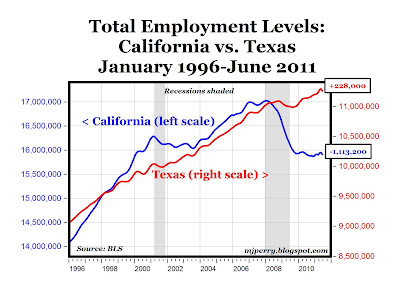
    So what example should America follow, that of deficit-slaughtering, budget-cutting, seriously limited government in Texas, which has added 730,000 jobs in the past decade, or that of regulation-happy, spend-mercilessly, owe-everything, flee-this-place-quickly California, which has lost 600,000 jobs during the same period?

    Texas has some of the best cities for jobs in the country. California? It “boasted zero regions in the top 150.”

    Chief Executive ranks Texas as the best state for business, and California as the worst.

    High tech companies are fleeing California for low tax states. In fact, high earners inevitably flee high tax states for low tax states:

    Examining IRS tax return data by state, E.J. McMahon, a fiscal expert at the Manhattan Institute, measured the impact of large income-tax rate increases on the rich ($200,000 income or more) in Connecticut, which raised its tax rate in 2003 to 5% from 4.5%; in New Jersey, which raised its rate in 2004 to 8.97% from 6.35%; and in New York, which raised its tax rate in 2003 to 7.7% from 6.85%. Over the period 2002-2005, in each of these states the “soak the rich” tax hike was followed by a significant reduction in the number of rich people paying taxes in these states relative to the national average. Amazingly, these three states ranked 46th, 49th and 50th among all states in the percentage increase in wealthy tax filers in the years after they tried to soak the rich.

    Here’s a comparison between California and Texas that explains, in great detail, how and why Texas is kicking California’s ass. Remember those job creation numbers, so ably depicted by WILLisms?

    Now compare Texas to California via this chart from Mark J. Perry’s Carpe Diem blog:
    Another reason Texas is thriving is that it doesn’t have overpaid, all-powerful public sector unions.

    High tech employees are fleeing California for Texas, because they can keep more of what they make, the government isn’t going bankrupt, and the roads and schools are now better in Texas. Despite all the money California spends on a a bloated public sector, the actual core services delivered are worse in California than they are in Texas:

    “Today, you go to Texas, the roads are no worse, the public schools are not great but are better than or equal to ours, and their universities are good. The bargain between California’s government and the middle class is constantly being renegotiated to the disadvantage of the middle class.”

    Just how broke California is became apparent in a recent Michael Lewis piece in Vanity Fair. It illustrates who irretrievably broken California’s politics and finances are, and just how little a dent Gov. Arnold Schwarzenegger made in fixing the problem:

    David Crane, the former economic adviser—at that moment rapidly receding into the distance—could itemize the result: a long list of depressing government financial statistics. The pensions of state employees ate up twice as much of the budget when Schwarzenegger left office as they had when he arrived, for instance. The officially recognized gap between what the state would owe its workers and what it had on hand to pay them was roughly $105 billion, but that, thanks to accounting gimmicks, was probably only about half the real number. “This year the state will directly spend $32 billion on employee pay and benefits, up 65 percent over the past 10 years,” says Crane later. “Compare that to state spending on higher education [down 5 percent], health and human services [up just 5 percent], and parks and recreation [flat], all crowded out in large part by fast-rising employment costs.” Crane is a lifelong Democrat with no particular hostility to government. But the more he looked into the details, the more shocking he found them to be. In 2010, for instance, the state spent $6 billion on fewer than 30,000 guards and other prison-system employees. A prison guard who started his career at the age of 45 could retire after five years with a pension that very nearly equaled his former salary. The head parole psychiatrist for the California prison system was the state’s highest-paid public employee; in 2010 he’d made $838,706. The same fiscal year that the state spent $6 billion on prisons, it had invested just $4.7 billion in its higher education—that is, 33 campuses with 670,000 students. Over the past 30 years the state’s share of the budget for the University of California has fallen from 30 percent to 11 percent, and it is about to fall a lot more. In 1980 a Cal student paid $776 a year in tuition; in 2011 he pays $13,218. Everywhere you turn, the long-term future of the state is being sacrificed.

    It’s even worse at the local level, where cities are going broke do to outrageous union pensions, such as in San Jose:

    It shows that the city’s pension costs when he first became interested in the subject were projected to run $73 million a year. This year they would be $245 million: pension and health-care costs of retired workers now are more than half the budget. In three years’ time pension costs alone would come to $400 million, though “if you were to adjust for real life expectancy it is more like $650 million.” Legally obliged to meet these costs, the city can respond only by cutting elsewhere. As a result, San Jose, once run by 7,450 city workers, was now being run by 5,400 city workers.

    What do the citizens of California get for some of the highest public sector wages in the country? Police and firefighters that stand around watching a man drown.

    San Jose is far from the worst:

    Back in 2008, unable to come to terms with its many creditors, Vallejo declared bankruptcy. Eighty percent of the city’s budget—and the lion’s share of the claims that had thrown it into bankruptcy—were wrapped up in the pay and benefits of public-safety workers.

    California has some of the highest taxes in the country, and it can’t make ends meet because it’s welfare state and public employee unions suck up every available dollar and more.

    You cannot tax your way to prosperity.

    You cannot spend your way to prosperity.

    Government can only create the conditions that allow the free market to create jobs.

    The red state model works.

    The blue state model doesn’t.

    Revised Wildfire Prevention/Fighting Numbers Straight From the Horse’s Mouth

    Wednesday, September 7th, 2011

    Since my original post, there seems to have been some confusion over the exact budget numbers for Texas Forest Service and Wildfire Prevention/Fighting as enacted by the 82nd Legislature for the 2012-2013 biennium budget (which went into effect for Fiscal Year 2012 starting on September 1).

    So I decided to go straight to the horse’s mouth.

    I contacted my own State Representative, Larry Gonzales, who pointed me in the direction of Rep. John Otto, the legislative chairman for Article II of the state budget. One of his staffers was kind enough to get back to me with the following numbers.

    It turns out that all the previous numbers were wrong, for various reasons. The numbers below all link to the official PDFs for the final budget numbers of the bills in question. And my liberal critics have, if not half a loaf, then at least a quarter-loaf.

    The reason is that for the 2010-2011 biennium, the Forest service was allocated $54.5 million 2010 and $54.5 million for 2011. That amount was indeed reduced for the initial budget passed in the regular legislative session, to $37.7 million for 2012 and $37.5 million for 2013. But keep in mind that it was very clear that the budget was not finished at the end of the regular legislative session, as several outstanding issues (school funding, revenue enhancement, use or non-use of rainy day funds, etc.) still remained to be hashed out. That was why there was a special legislative session.

    And in that special legislative session, two separate bills were passed which increased forest service/wildfire fighting and prevention funding: SB2, which added an additional $40 million to the forest service for FY 2012 specifically to fight wildfires (with any rollover, of which I’m pretty sure there will be none, to be carried into 2013), and HD4, which allocated an additional $81 million for fighting wildfires in the 2012-2013 biennium. (This is most likely where A&M got the $81 million figure for.) All those bills (and thus the funding increase) were passed and in the books months before the FY2012 budget started on September 1.

    So, in summary:
    Total 2010-2011 Biennium Forest Service/Wildfire Fighting Budget: $109 million.
    Total 2012-2013 Biennium Forest Service/Wildfire Fighting Budget: $196.2 million.

    So the Texas legislature authorized, and Governor Rick Perry signed, an 80% increase in wildfire fighting and prevention funding for the 2012-2013 biennium. Not quite double the amount I had in my original post, but pretty close.

    Another Left-Wing Lie: The 50% Cut in Texas Wildfire Funding That Wasn’t

    Monday, September 5th, 2011

    Note: My numbers below are somewhat off…but those of critical commentators are also off. See this post for the complete breakdown of Texas Forest Service/Wildfire Fighting and Prevention Funding. The bottom line is that it was increased by 80%.

    You may have noticed several fires breaking out in Central Texas due to the prolonged drought and high winds. You may also have noticed liberals crowing about how the latest Texas budget cut wildfire response by 50%. That would indeed seem to be shortsighted, except for one tiny fact:

    It isn’t true.

    Evidently the myth arises from pieces like this one from earlier in the year, citing unnamed sources in the midst of budget negotiations saying such a cut was proposed. Not passed, mind you, but proposed. And it doesn’t say by who.

    But when you look at the actual numbers for the passed budget, they tell a radically different story.

    First, let’s look at funding for the 2010-2011 biennium passed by the 81st Legislature, where the Texas Forest Service was allocated $38,550,563, most of which was for wildfire fighting and prevention.

    Next let’s look at the 2012-2013 biennium passed by the 82nd Legislature; sorry, I was only able to find a PDF, but the relevant information can be found near the top of page 15, where it states that the legislature allocated $81 million for the Texas Forest Service for wildfires.

    So not only did the Texas state legislature and Governor Rick Perry not reduce the amount for wildfire fighting and prevention, they actually doubled the amount spent on it.

    So a real natural tragedy is being used by opportunistic liberals to slander politicians (and let’s face it, a state) that they already hated. The original Think Progress etc. pieces were merely half-baked rumor. Repeating them today, however, makes them an actual lie.

    Everyone is entitled to their own opinion, but no one is entitled to their own facts.

    Edited to add: The Texas State Fiscal year starts on September 1st, so the state is operating under the 2012-2013 biennium budget now.

    Iowahawk on the Coming Debt Limit Armageddon

    Thursday, July 28th, 2011

    He paints a picture of unimaginable horror:

  • Roving bands of outlaws stalk our streets, selling incandescent bulbs to vulnerable children.
  • Breadlines teeming with jobless Outreach Coordinators, Diversity Liaisons, and Sustainability Facilitators.
  • General Motors unfairly forced to build cars that people want, for a profit.
  • Chaos reigns at Goldman Sachs, who no longer knows who to bribe with political donations.
  • At-risk Mexican drug lords forced to buy own machine guns.
  • Oh the humanity!

    Pat Buchanan 1, David Brooks 0

    Friday, July 8th, 2011

    Since leaving the Reagan Administration, Patrick Buchanan has been, at best, an erratic conservative, on any number of issues (Israel, Iraq, Free Trade, etc.), flogging a philosophy (“paleoconservatism”) that failed to catch on with any but a tiny fringe, and carried out political adventures ill-advised at best and amazingly stupid a good portion of the time. (I mean, why would you even want to take over the Reform Party? That’s like stealing a half-chewed bone from a blind dog; even if you succeed, you’ve disgraced yourself for a worthless prize.)

    But on the debt limit debate, Buchanan has penned an essay that is coolly rational in articulating why House Republican must stand firm aginst Democratic promises of future spending cuts in exchange for tax hikes now.

    Behind the GOP opposition to tax hikes is the party’s word given to the country that elected it in 2010, its political principles, its traditional view of what not to do when the nation is in a slump, and party history.

    Fully 235 Republican House members signed a 2010 pledge not to raise taxes. And by giving their word they were rewarded with victory.

    Should they now dishonor that pledge, what would differentiate them from George H.W. Bush, who famously promised in 1988: “Read my lips! No new taxes!” then went back on his word and took the party down to defeat with him?

    It also does a fine job dissecting David Brooks’ panicked appeal for them to take Obama’s handful of magic beans in exchange for their good word:

    In 1982, President Reagan agreed to the same deal being offered the party today: three dollars in spending cuts for every dollar in tax increases to which he assented. As he ruefully told this writer more than once, he was lied to. He got one dollar in spending cuts for every three in tax increases.

    Buchanan at least has learned the lesson Brooks hasn’t: Future budget cuts are non-existent budget cuts, and only a sucker believes they’re real. The only budget cuts that count are the ones to this year’s budget. Democrat promises of future spending cuts are always lies to be taken back in the next budget session. Even ironclad budgetary mechanisms to limit spending (i.e. Gramm-Rudman) will be jettisoned at the first opportunity.

    No one should mistake Buchanan for a reliable mainline conservative these days, but he’s dead right on this issue. But given David Brooks’ swooning over Obama and his heresy on tax hikes, perhaps we should stop mistaking him for a conservative at all.

    Karl Rove: Why Obama Will Lose in 2012

    Thursday, June 23rd, 2011

    While hardly a disinterested observer, Karl Rove is far from an untutored one, and he offers up some compelling reasons why Obama will lose in 2012. Four, to be precise:

  • The economy is very weak and unlikely to experience a robust recovery by Election Day.
  • Key voter groups have soured on him.
  • He’s defending unpopular policies.
  • And he’s made bad strategic decisions.
  • The second point is the one he offers the most meat in terms of polling analysis. And the fourth is Obama’s decision to abandon Presidential distance and starting campaiging for reelection early.

    Read the whole thing.

    Obama to Troops: Drop Dead

    Friday, April 8th, 2011

    When I first read on Ace of Spades that Obama intended to let our soldiers go without paychecks during the shutdown, I was somewhat incredulous. After all, even Obama should be able to see how lousy the “optics” are with withholding paychecks from troops involved in no less than three wars kinetic military actions overseas. Surely not even Obama could be that stupid?

    Evidently I was wrong. Obama would rather let our troops go without pay than stop taxpayer funding of abortions.

    To dramatize the issue, I’ve actually created a small film about the topic. I’ve taken the details of who all will still be getting checks in a shutdown from this piece up on Reason (which was, in turn, taken from The New York Times, saving you the 15 seconds it would have taken you to defeat the paywall…) Keep in mind that I’m putting it up in advance of the actual shutdown, so the details may vary…

    I did this quick and dirty, and I didn’t see any actually U.S. soldiers as part of any character sets…

    (Hat tips: Dwight, Ace, and Insta.)

    LinkSwarm for Wednesday, March 9, 2011

    Wednesday, March 9th, 2011

    It’s a busy week for me, so here are a few links to tide you over:

  • Wonder what a serious attempt at reducing the deficit looks like? It looks like this.
  • Thomas Sowell on Unions: “The biggest myth about labor unions is that unions are for the workers. Unions are for unions.”
  • The city of Bell, California, goes to the polls. Dwight has been all over the Bell corruption story.
  • ObamaCare’s vital signs start to fade.
  • “If NPR weren’t substantially left-leaning, Democrats wouldn’t be such huge fans of federal funding.”
  • California’s High Speed rail is a train wreck waiting to happen.
  • While you weren’t looking, the Utah legislature tried to sneak an illegal alien amnesty into law in the dead of night.