Despite increasing sanctions and scrutiny on hostile Chinese business practices and intellectual property theft, private equity firms have previously managed to mostly evade scrutiny for taking Chinese money. That may finally be changing.
Takeaways:
“The US is starting to wise up on Chinese investments. It’s been cracking down by closing loopholes But not all the loopholes have been closed, Which means China could be getting US trade secrets.”
“Better late than never. This feels like your grandparents finally learning how to unplug and plug back in the WiFi router. Shouldn’t have taken this long to figure out something so obvious, but glad they eventually got there.”
“After years of letting China buy up sensitive US technology, property, and companies, the US government is finally putting its foot down. In 2018, Trump signed the Foreign Investment Risk Review Modernization Act, or FIRRMA. This changed how the Committee on Foreign Investment, or CFIUS, screened investments in the US for national security issues.”
“Before, CFIUS could only review foreign investments if they resulted in a controlling stake. Now CIFIUS can review any investment.”
“When Biden got into office, he ordered CFIUS to look at all investments that affect critical aspects of the US supply chain, or Americans’ personal data, and several other things.”
“As you might imagine, this has not gone over well with Wall Street, which loves Chinese money more than Snoop Dogg loves marijuana.”
“‘Wall Street now stands as an increasingly lonely voice arguing for more engagement with China.’ This was going on even as China was taking a wrecking ball to its economy with its zero covid policy, committing genocide against an ethnic minority, and selling the organs of political prisoners for profit. Find someone that loves you the way Wall Street loves Chinese money. They’re ride or die…and the people that die are political prisoners.”
“Private equity and venture capital firms were able to get an exception granted in FIRRMA for limited partners. That means that if a foreign entity becomes a limited partner in, say, a private equity fund, CFIUS doesn’t have any jurisdiction over it. Should have seen something like this coming. Finding loopholes is what Wall Street does best.”
“The type of investments that private equity firms are involved in means that Chinese companies could get access to critical technology. Stuff that could affect national security. Portfolio details could hold national economic or intelligence value.”
“The China Investment Corporation or CIC. At $1.3 trillion US dollars, it’s the largest sovereign wealth fund in the world. ‘CIC has said repeatedly that it separates commercial activities from governmental functions and makes its investment decisions independently.'”
“CIC’s board of directors includes representatives from the Chinese government.”
“CIC’s Deputy General Manager Qi Bin has explained that cooperation with developed economies is to be leveraged to obtain advanced technology.”
“CIC is also partnering with large investment companies, like Goldman Sachs, Japan’s Nomura Holdings, and France’s BNP Paribas. CIC’s Deputy General Manager Qi Bin has talked about leveraging these partnerships for the ‘win-win’ ‘mutual benefit’…of Chinese companies. Somehow I’m getting the sense that “win win” has a different meaning in China. I think in English we would call this ‘short-term win for long-term loss.’ I’ll give you my money and you give me your trade secrets.”
There’s finally some efforts for CFIUS to close private equity loopholes.
Pardon me if I express deep skepticism that the Biden White House will actually constrict the inflow of Chinese money…
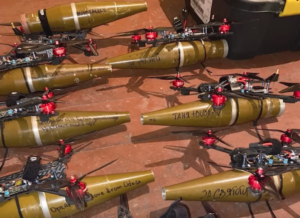
Given that the original video generated doubts as to its veracity, I thought I would post this followup that goes into more detail about Ukraine’s low-cost suicide drone/loitering munition.
These look considerably less jury-rigged than the previous drones.
“These are publicly funded…Ukraine’s Ministry of Defense made a public appeal for donations to buy 1,000 of these.”
There seem to be different types with different warhead sizes. “The technical details are a bit vague. I’ve seen mentioned ranges of just two kilometers to over 10 kilometers.”
We see the successful attacks, but not the failures.
“These cost around 200 to manufacture, so they’re also extremely cost effective.” Indeed, even more cost-effective than my original estimates.
Velma, if you haven’t heard, is HBO Max’s “re-imagining” of the animated Scooby-Doo TV show. And by “reimagined” I mean “mangled and mutilated to fit the angry, narrow confines of social justice warrior ideology.”
Since I don’t have cable, I can’t go out of my way to watch it for the sake of reviewing it, so let’s let The Critical Drinker take a whack at it:
If that weren’t enough, let’s let Ryan George of Pitch Meeting also take his turn at bat:
The original Scooby-Doo is hardly going to go down in the annals of television as a classic on the order of Hill Street Blues or I Love Lucy, but it was a solid, wholesome kid-vid TV show that made good use of its limited animation budgets to produce solid, fondly remembered shows that the franchise was strong enough to survive decades of tweaks (“with special guest Don Knotts”), soft reboots, a series of unlikely direct to video movies…
…two “meh at best” live action movies, and even inflicting The Vile Abomination on American viewers.
Even apart from the social justice idiocy, throwing away that legacy for derisive belittlement is just wrong. Moreover, these projects never seem to be profitable or even well-received (remember the disasterous Land of the Lost remake with Will Ferrell?). If you don’t treat the source material with a due amount of respect, all you’re doing pissing off generations of people that grew up watching the originals.
This sort of thing is natural meat for The Critical Drinker, who delights in tearing into Social Justice crap. But the pointed Pitch Meeting takedown seems far more significant, as George has never been one to wade in culture war commentary.
I’ve previously covered suicide drones and drones dropping RPGs. Now Ukraine is evidently cutting out the middleman and passing the savings on to Ivan by just strapping RPGs to light drones and guiding them in.
Here’s a screen-grab of this masterpiece of redneck engineering:
The is a great application of one of Murphy’s Military Laws: “If it’s stupid but it works, it ain’t stupid.” For the Russians, it must be quite embarrassing to get yeeted into the afterlife by Doogie Howser’s science fair project.
I’m somewhat surprised that drones that small can carry the RPG rounds effectively, but presumably they’re replacing camera gear or something close to the same weight.
An RPG-7 costs about $2,500 each, while a BMP-3 costs about $800,000 each. Even if you double the price for the quadcopter ($2,500 is a bit pricey, but not out-of-line for some pro rigs), you still get a hugely useful loitering munition for less than 1/100th the cost of the target you’re taking out…
The talks between the US, Japan, and the Netherlands over wider bans on exports of semiconductor technology to China have reportedly seen the three agree to concerted action.
As The Register has often chronicled, the US has restricted exports of critical chipmaking and silicon technologies to China, hoping to prevent its economic and strategic rival from developing military technologies – and to protest human rights abuses.
While the Home of the Brave has spawned many of Earth’s most significant chipmakers and designers – Intel, AMD, Qualcomm and many others have headquarters stateside – other nations also export semiconductor tech to China. The Land of the Free would rather put a stop to that if possible.
The Biden Administration also recognizes that its bans could be seen as creating an opportunity for other nations to cash in on the absence of US vendors in the Chinese market. The three-nation talks therefore have the extra dimension of making sure America’s policies have their desired effect against China and don’t harm the home team.
Those twin desires saw Japan and the Netherlands in talks with the US last week, and according to numerous reports the meetings produced a unified approach to restrict semiconductor exports to China.
Without equipment from the US, Japan and The Netherlands, you can’t equip and run a modern semiconductor fabrication plant.
Peter Zeihan (him again), who has evidently lost a bet requiring him to dress as Gimli, discusses the ramifications.
This is one case where Zeihan gets the generalities right, but is wrong on some specifics.
Right: The idea that China can just forge a complete “alternative” semiconductor supply chain out of thin air to replace western alternatives is indeed “hideously wrong.” “The nature of the semiconductor industry is more of an ecosystem. There are there’s very few places that without, significant industrial build out, could even pretend to do more than two or three steps of it, much less than a dozen or so steps that are necessary.”
However, in conflating semiconductor manufacturing and semiconductor equipment manufacturing (possibly to avoid contracting hypothermia) he’s muddied things up a bit. There are five essential semiconductor equipment manufacturers:
Applied Materials (USA)
ASML (The Netherlands)
KLA (USA)
LAM Research (USA)
Tokyo Electron (Japan)
If you’re building a modern, sub-10nm fab, chances are pretty good you need all five. You have to have an ASML EUV stepper, or else you have to go with trailing-edge machines from Canon and Nikon and deal with the computational pain and complexity of self-aligned quadruple patterning. You need KLA inspection tools to raise and maintain yields, and you need, at the very least, one of AMAT, LAM or TEL to provide the rest. Take away all three and you can’t equip a fab, period.
“We now have an agreement, and very soon the Dutch will formally be joining the sanction system against the Chinese.”
“The best [chips], these are 10 nanometer and smaller. This is typically what’s in your cell phone or in your high-end computers and servers those about 80% percent of them are actually fabricated in Taiwan, with another 20% in South Korea.” No. Although TSMC and Samsung are indeed leaders in this space, Intel has had 10nm processes running in their advanced fabs is Hillsboro and Chandler for a while, even though they’ve suffered yield problems.
His assertion that only China does legacy 90nm and above processes is false, as a look at this list of wafer fabs will attest, as there are a lot of companies (TI, TowerJazz, Oki, Mitsubishi, etc.) still profitably running older nodes, though many are comparatively funky technologies like BiCMOS, Analog, GaAs, etc.
Some quibbles about the details, but he gets the big picture right.
As for his suggestion that companies stick to over 10nm nodes, well, I don’t think much of it. Those that can do >10nm nodes will and push the technology forward, and those that can’t afford to won’t…
Jordan Peterson always makes a great Joe Rogan guest, and the new interview they did last week is no exception.
Discussing the Twitter files, Critical Race Theory and Marxism, victimhood identity politics, postmodern theory, and falseness of reducing everything to power dynamics.
On the World Economic Forum:
“Globalist Utopian Tyranny” is a great phrase.
They follow in the wake of “Paul Ehrlich, in the 1960s, who really believe, really believe, truly, that maybe the planet should only have 500 million people on it.”
There then follows a devastating take-down of the immortality of pushing 350 million of the world’s poorest to the brink of death through higher energy prices in the hope that maybe 100 years from now life for the poor will be better. I encourage you to watch the entirety of this segment for that.
“It’s a little bit too convenient for me that your prescriptions to save the planet are accompanied by this insistence that the only way forward to that is to give you all the power. It’s like there’s a bit of a moral hazard in, that don’t you think?”
“Do you want to save the planet, or do you want the power? And let’s let’s put the second one first, because the probability that you’re a saint or the messiah is pretty damn low. So that’s the danger of the Davos crowd.”
I suspect I’ll be putting up more snippets from this interview sometime this week…
One-Party Democratic California is so desperate for cash they want to tax people for leaving.
Desperate to stem the stampede of cash cows — affluent residents — out of their state, they are trying to pass an exit tax for households with assets of $50 million or more. Current residents would have to keep paying for years after they have decamped to less hostile states.
Heaven forbid that these legislators should instead come to terms with the reasons so many productive residents flee or what they could do to make their state a more attractive destination for people and businesses. They aren’t much concerned with that, merely with stopping the flight of all that revenue. If they cared about the livelihoods of the people leaving, they probably would have governed in a way that didn’t prompt people to head for the exits.
This is probably unconstitutional nine ways to Sunday. Wealth tax, Ex-Post Facto law, taxation without representation, etc. It’s also likely to be counterproductive, as rich people are not only likely to leave the state preemptively to avoid being subject to it, but are exactly the people that can hire top-notch lawyers to get it overturned.
Louis Rossmann, who recently fled New York City to Austin, has additional thoughts:
“They are showing and demonstrating here they have no confidence in their ability to govern better, or in their ability to actually give the customers of that state what they want, because they’re telling you ‘We’re not going to make things better. Rather, if you leave we are going to figure out a way to fine you.'”
“It demonstrates a sick ideology that’s both just authoritarian and disgusting in nature.”
“It’s not like [the tax rates in California and New York] just spiked up insanely over the past one or two years, they’ve been higher than the tax rate in Texas and Florida for as long as I’ve been alive, by a fairly large margin. This is not news. It’s something else in addition to that, and they don’t even appear to be interested in trying to figure out what that is.”
“Florida and Texas…have not had income tax for a very long time.”
“Maybe it would make sense to actually ask people what changed over the past two or three or five years that caused you to decide that you want to move your business and get the fuck out.”
“I could tell you from experience that losing half of your employees, putting all your stuff in a truck, carting it across the country. and spending months putting it all back together is insanely stressful, and not something that I’m going to do so I could save six or eight percent of my income tax.”
“Why are you then going to bake more taxes, and then have a fine for leaving that is then going to discourage anybody else that has the same concern from ever coming to your state thereby ensuring that the population of people that are productive and create value diminishes.”
“The idea of being taxed based on what you are worth at a particular time without actually cashing it out is insane to me.”
Long, correct discussion of why long-term capital gains are taxed at a lower rate snipped. (I doubt many of my readers don’t already understand, or disagree.) Ditto the discussion of how investment creates jobs.
“People deciding to defer their gratification, to decide ‘I will wait for the large payoff 10 to 20 years from now rather than make a decision that results in me getting more money right now,’ and I think that that it should be discussed more often because if it’s not, then we are going to end up with stuff like this.”
He discusses the slippery slope argument: The bill already states the tax will start at billionaires, but then in two years hit people with a net worth of $50 million or more. “Once it gets low enough like once this makes its way off to 10 million or a million, because again this is going to slip.”
And just wait until it hits the net worth not only of individuals, but of businesses.
It could take months to deliver the tanks because the U.S. has to purchase them through a procurement process.
The move marks a reversal for the Biden administration, which had resisted sending the tanks, and comes as German Chancellor Olaf Scholz announced his country would provide 14 Leopard 2 A6 tanks for Ukraine’s military. Britain said earlier this month it will provide 14 of its Challenger 2 tanks. France plans to contribute 10 armed fighting vehicles.
The Pentagon has long shown a reluctance to send their best miltech abroad for fear of it falling into enemy hands. However, for both the Leopard 2 and the Abrams, the question is which version of the tank are they sending to Ukraine? Any version of either is going to have more sophisticated and modern fire control systems than the majority of Russian tanks currently in theater. And any version of the Leopard 2 is going to feature a Rheinmetall 120mm smooth-bore gun, either the L/44 or the more powerful L/55. The L/44 should punch through the front armor of most Soviet/Russian tanks, and the L/55 should theoretically punch through all of them.
For the Abrams, the M1A1 and M1A2 are both armed with the L/44, and National Review is reporting that the Biden administration is sending M1A1s. (The original M1 uses the older 105mm rifled M68 gun. That’s thought to be able to penetrate any Soviet armor up to and including the early T-72 models, and possibly some later export models, but not later T-72s and more modern domestic Soviet/Russian tanks. In Desert Storm, even M60 Patton tanks with the 105mm gun were regularly reporting kills on T72s.) Thus Abrams and Leopard 2 120mm rounds of various sorts are fully interchangeable.
The Challenger 2 uses the Royal Ordnance L30 rifled 120mm gun, which uses different ammo.
Back to the BBC: “Germany also permitted other countries to send their Leopard 2 tanks to Ukraine – which was restricted until now under export regulations.”
Poland has been itching to send Leopard 2s to Ukraine since very early on in the conflict, but Germany had been dragging its feet until now. Previous German Defense Minister Christine Lambrecht was reportedly the clog in the process, and given this came down a week after her departure suggests that was in fact the case.
They’re getting enough Abrams for two plus tank companies (three tank platoons of four tanks each, plus two command tanks), but not enough for a full armor brigade. But add the 14 German Leopard 2s, and presumably you have a force that can rip a hole in any Russian line. Add the already announced Bradleys and other IFVs, and you have a mobile infantry force behind them that can then exploit those holes.
Ukrainian military blogger Denys Davydov seems pretty ecstatic at the news:
He says that Ukraine will be receiving Leopard 2A6 tanks, which are very modern indeed. There are a number of country-specific variants, but they all use the L/55 main gun and modern fire control systems, electronics and composite armor.
He repeats the rumor that Germany refused to send Leopard tanks unless America sends Abrams, which has a fair amount of plausibility. If Russia does go apeshit over the move (doubtful), Germany could always go “Hey, we just followed America’s lead!”
Correction: Davydov states that the Abrams requires jet fuel for the turbine engines. This is false. The Honeywell AGT1500 gas turbine engine powering the M1 does not require jet fuel to operate, it can run on jet fuel, diesel, gasoline, or marine diesel (which used to have a higher sulfur content than regular diesel, though I’m not sure that’s true anymore, and is probably not relevant to usage in Ukraine).
He says the Leopard 2s being sent are in active service with the German army, not in long-term storage.
“We have the common decision from many of the Western allies (Norway, Poland, Germany, and many others, UK obviously, and probably United States, will provide the tanks to Ukrainian.” Indeed, Norway just announced that it is also sending leopard 2 tanks to Ukraine.
As for his predictions that Ukraine will liberate Crimea come spring, and that this will, in turn, cause the collapse of the Russian federation and drive Putin from power, well, let’s just call them highly speculative.
So too Peter Zeihan (him again) is on the tank news as well:
Some takeaways:
As to why the Germans have been so hesitant, I don’t know if you know your history…
…but the last couple hundred years of history [doesn’t] necessarily put the Germans in the best light. And so the idea that the Germans would ever, in a peaceful environment, decide that they should take a leadership position on military affairs is something that is antithetical, not just to the German population in general, but the government of Scholz specifically. His party is the Social Democrats, and they have basically made their bones in geopolitics about making sure that Germany is never an offensive power at all.
The Leopard 2 is good, but “the Abrams should be more accurately thought of as the pinnacle of armored equipment development. This is a system that is not merely a tank, it’s a weapons system that has several integrated programs within it, some of which the Americans still consider top secret so anything that the United States sends from its arsenal is going to honestly have to be dumbed down a significant amount, and that is going to at a minimum take time.” I think he overstates the case here slightly, because the M1A1 isn’t on the cutting edge the way the M1A2 Sepv3 is, but it wouldn’t surprise me at all if their are some systems in there the Pentagon doesn’t want anyone outside to take a look at. On the other hand, there several other nation operators, so this is a solved problem. Also, Abrams have been deployed to Europe as recently as 2020 as part of Operation Atlantic Resolve.
“There are over a dozen countries in Europe that use [Leopard 2s], and everyone except for the Germans has been arguing for sending these things for weeks now. So these the Leopards can actually be on the front lines in Ukraine probably within two or three or four months, which means it can actually make a difference in the coming spring offensive, which will happen in May and June.” My caveat would be that it takes about as long to properly train a Leopard 2 crew as an Abrams crew, and if I were the government of the USA, Poland, etc., I would have already been secretly training Ukrainian crews on Abrams and Leopard 2 simulators.
“You’re talking a minimum of the year, probably closer to three, three to build out the physical support infrastructure to get an appreciable number of Abrams in play.” This is either false or only narrowly true in that it might take 1-3 years to train a single Ukrainian technician to master the complete suite of Abrams repair and maintenance skills. It uses the same main gun ammo, the same 7.62x51mm NATO machine gun ammo (though the Leopard 2 lacks the M2 .50 BMG machine gun, but .50 BMG is hardly difficult to get a hold of), and the same fuel as the Leopard 2, and we’re sending spare parts along. The logistical tail is real, but it overlaps heavily with the Leopard 2. A C-5 Super Galaxy can lift two Abrams tanks, so if it was absolutely a top priority, all 31 Abrams could be delivered tomorrow to Rzeszów–Jasionka Airport less than 100 miles from the Ukrainian border. (More likely is something like shipping from Charleston to Gdansk, which would be about 15 days after all the bureaucratic niceties are observed.)
As always, tank crew effectiveness comes down to training. A good tank crew takes a minimum of six months to become proficient enough to be effective in combat (and most would argue it takes longer). Even if you assume you can shave some time off for Ukrainian tanks crews experienced on Soviet equipment, it still takes a good deal of time to become proficient on either an Abrams or a Leopard 2; two to three months would seem to be the absolute minimum. So unless Ukrainians were already training on Leopard 2s and/or Abrams in secret, I wouldn’t expect to see in the field any until (at the earliest) late April.
Nothing to cheer you up quite like a discussion of potential genocide.
Takeaways:
He starts out talking about how Russia plans to add some 500,000 new troops and use them in a late spring offensive when the mud dries up. As I mentioned previously, that plan is only scheduled to produce new troops over several years, and I express grave doubts that Russia can train and equip new troops when it has singularly failed to do so thus far.
He reiterates from previous videos that Russia’s military is heavily dependent on rail, but they’ve had to make do with trucks, and those trucks have been heavily targeted by Ukraine.
“Russians began the war with 3,000 military support trucks they’re probably down to only about 500 now.”
“[Russians] are doing what they can to destroy morale, and destroy the Ukrainian economy, and kill as many Ukrainian civilians as possible. They’re using drones, they’re using fighter launch missiles, they’re using cruise missiles and they’ve started to use ballistic missiles, to target specifically Ukrainian physical infrastructure, most notably electricity generating plant.”
Ukraine is having trouble exporting grain. “Exports have fallen to almost nothing.”
The countries that would normally import from Ukraine, come October, November, December are going to realize it’s just not there. Most of those countries are in Africa, some are in South Asia. And the one I am, by far, the most worried about is Egypt. Egypt is poor and they import over half the grains they need to survive, mostly wheat. The wheat is already off-line, and so we should expect to see significant upheaval—economic, humanitarian, political—across the Arab world and into South Asia and in sub-Saharan Africa.
The mention of a second Holodomor is a reminder that not enough people know about the first Holodomor, when the Soviet Union starved some 5-7 million Ukrainians to death (and some 14.5 million total for the whole collectivization famine/”dekulakization”/suppression of the Kazakhs and Tartars/etc.
I would link to Clarkson’s blistering attack on Wokeness…but it appears that the Sunday Times has cravenly removed it from their website. The Daily Skeptic appears to have reprinted it.
How did a movement theoretically dedicated to “checking privilege” take as its sacred totem a woman who’s only accomplishment is marrying into the royal family?