In this follow-up to last Saturday’s post, Colin Furze chunks more stuff from his trebuchet:
The bearings finally gave out, but he says he’s going to rebuild it so he can make it even more powerful…
In this follow-up to last Saturday’s post, Colin Furze chunks more stuff from his trebuchet:
The bearings finally gave out, but he says he’s going to rebuild it so he can make it even more powerful…
Is China’s military a paper tiger that will fail miserably in real combat? So argues this video:
The narrator claims that some of the formidable picture we have of the Chinese military is due to China’s successful propaganda machine. He outlines three reasons to believe China’s military is weaker than it appears:
China is seldom as strong, or as weak, as it appears to be. The video only touches on a few aspects of China’s military, so it’s hard to making sweeping statements based solely on the points presented. Still, it does provide additional data points.
Everyone’s favorite insane British inventor has constructed quite a large trebuchet and used it to fling heavy objects considerable distances.
Here’s the build video:
The trebuchet looks to be about 10 meters high, which seems to be a fairly common height for medieval trebuchets. Here it is chunking stuff:
The largest trebuchet ever built was Warwolf, at a whopping 300-400 feet tall, built at the order of King Edward of England in 1304 for the siege of Stirling Castle in Scotland.
I’ll tag this with “Military,” because siege engine…
Lindybeige and The Chieftain talk about three of the worst tanks in the Bovington Tank Museum:
The three are:
See also: The Five Worst Production Tanks of All Time.
On November 27, 1950, Communist Chinese forces launched a surprise attack against United Nations forces (U.S., UK and South Korean) to begin the Battle of the Chosin Reservoir, one of the defining engagements of the Korean War.
In hard winter conditions with inadequate supplies and cold weather gear, allied forces found themselves surrounded by a communist Chinese force four times as large with orders to destroy them. Over 17 days, U.S. forces managed to break through the encirclement and carry out a fighting retreat to the port of Hungnam.
It was at Chosin that legendary First Marine Regiment commander Chesty Puller said: “We’ve been looking for the enemy for some time now. We’ve finally found him. We’re surrounded. That simplifies things.”
Thirteen servicemen earned Medals of Honor for their actions during The Battle of Chosin Reservoir.
Happy Thanksgiving!
Dwight put this up a while back, and I decided to tuck it away to use on Thanksgiving. It’s a speech by SR-71 pilot Brian Shul about going from being severely burned in a crash in the jungle in Vietnam and days away from death wasting away in a hospital to not only return to flying, but to fly the greatest airplane in history.
I first became aware of Shul a couple of decades ago, when I came across the fact that his book Sled Driver: Flying the World’s Fastest Jet brought eye-popping sums on eBay. He talks about the book some later in the speech.
It’s the weekend before Thanksgiving, and since lots of people will be driving home for Thanksgiving (despite the dictates of Obergroupenfuhers Newsom and Whitmer), so let’s look at some high speed crashes.
Here are the Mythbusters crashing cars into a concrete wall at various speeds:
Here’s UK car program Fifth Gear (AKA “the show the Top Gear guys are always ragging on”) crashing a Ford Focus at 120 MPH:
400gs would really ruin your whole day.
Here’s an F4 Phantom being crashed into a concrete wall at 500 MPH:
A reverse ballistic missile test, where they slam a rocket sled into a missile to see how it disintegrates:
That’s traveling at up to 6,000 feet per second, which translates into 4090 miles an hour.

This Veterans Day we celebrate the life of Korean War Medal of Honor winner Hiroshi H. Miyamura:
Cpl. Miyamura, a member of Company H, distinguished himself by conspicuous gallantry and intrepidity above and beyond the call of duty in action against the enemy. On the night of 24 April, Company H was occupying a defensive position when the enemy fanatically attacked threatening to overrun the position. Cpl. Miyamura, a machine gun squad leader, aware of the imminent danger to his men unhesitatingly jumped from his shelter wielding his bayonet in close hand-to-hand combat killing approximately 10 of the enemy. Returning to his position, he administered first aid to the wounded and directed their evacuation. As another savage assault hit the line, he manned his machine gun and delivered withering fire until his ammunition was expended. He ordered the squad to withdraw while he stayed behind to render the gun inoperative. He then bayoneted his way through infiltrated enemy soldiers to a second gun emplacement and assisted in its operation. When the intensity of the attack necessitated the withdrawal of the company Cpl. Miyamura ordered his men to fall back while he remained to cover their movement. He killed more than 50 of the enemy before his ammunition was depleted and he was severely wounded. He maintained his magnificent stand despite his painful wounds, continuing to repel the attack until his position was overrun. When last seen he was fighting ferociously against an overwhelming number of enemy soldiers. Cpl. Miyamura’s indomitable heroism and consummate devotion to duty reflect the utmost glory on himself and uphold the illustrious traditions on the military service.
Miyamura actually signed up to fight in World War II.
Miyamura joined the US Army in January 1945.
Miyamura volunteered to be part of the all-Nisei 100th Infantry Battalion. This army unit was mostly made up of Japanese Americans from Hawaii and the mainland.
He was discharged from the active army shortly after Japan surrendered. Following the war, he enlisted in the U.S. Army Reserve, and was recalled to active duty following the start of the Korean War. He endured as a prisoner of war for 28 months.
Because he was captured by the North Koreans, his Medal of Honor was originally awarded in secret.
As Brigadier General Ralph Osborne explained to Miyamura and a group of reporters upon notifying them of his medal, “If the Reds knew what he had done to a good number of their soldiers just before he was taken prisoner, they might have taken revenge on this young man. He might not have come back.” Following his release on August 20, 1953, he was repatriated to the United States and honorably discharged from the military shortly thereafter. His medal was presented to him by President Dwight D. Eisenhower in October 1953 at the White House.
Here he is talking about his service:
Miyamura still lives in his hometown of Gallup, New Mexico. Last year he was one of the Grand Marshals for the 2019 New York City Veterans Day Parade.
Note: The two living World War II Medal of Honor recipients we celebrated last Veterans Day, Hershel “Woody” Williams and Charles H. Coolidge, are evidently both still alive. Williams is 97 and Coolidge is 99. And the ship named after Williams, Expeditionary Sea Base USS Hershel “Woody” Williams (ESB 4), recently visited Naples and Greece.
There have been some interesting comments, both here and at Instpundit, on my Taiwan invading Taiwan scenarios piece.
First up, some commenters wondered if China would just nuke Taiwan rather than risk the uncertainties of a massive amphibious invasion. That’s never going to happen for the same reason you don’t torch a car you’re planning on stealing. China wants Taiwan not only as a symbol of its own power and territorial unity, but also for its wealth and technological leadership. A Taipei reduced to glowing rubble not only defeats that goal, but would encourage South Korea and Japan (and maybe even Vietnam and the Philippines) to start producing their own nuclear weapons, and might even prod atherosclerotic transnational bureaucracies to actually spring into action to sanction China on a variety of fronts. There are few upsides and an incredible number of downsides to China nuking Taiwan.
Second, as commenter Old Paratrooper noted, this year China launched only its second amphibious assault ship:
The Chinese Navy has now launched a second large amphibious assault ship engineered to carry weapons, helicopters, troops and landing craft into war, a move which further changes international power dynamics by strengthening China’s ability to launch expeditionary maritime attacks.
The ship is described at the second Type 075 Landing Helicopter Dock (LHD), somewhat analogous to the U.S. WASP-class. This Chinese amphibious assault ship reportedly displaces as much as 30,000 tons and is able to carry as many as 28 helicopters, a report from Naval News states. The report adds that the new People’s Liberation Army Navy LHD is likely powered by a diesel engine with 9,000kW, four Close In Weapons Systems and HQ-10 surface-to-air missiles. The new ship’s “aim is likely to increase the “vertical” amphibious assault capability with the very mountainous East Coast of Taiwan in mind,” the Naval News report writes.
The addition of more LHDs certainly increases China’s maritime attack power, making it a formidable threat along the Taiwanese coastline. Photos of the ship show well-deck in back, capable of launching ship-to-shore transport craft similar to the U.S. Navy Landing Craft Air Cushion or newer Ship-to-Shore Connector. Such a configuration makes it appear somewhat similar to U.S. Navy WASP-class which, unlike the first two ships of the America-class, also operates with a well-deck from which to launch large-scale amphibious assaults.
Wikipedia says a third ship of this type is under construction.
Three ships isn’t going to get a Taiwanese invasion done, no matter how advanced, even assuming all the helicopters and landing ships make it to shore. (They wouldn’t.) However, China also has has some 70 other Type 071 through 074 amphibious assault ships in it’s inventory, plus some 200 or so small landing craft, slightly larger than the ones that hit Omaha Beach, some almost 50 years old, many with hovercraft designs. (They have some even older, Soviet-derived crap, that I doubt they’d try to use unless they were really desperate.)
For comparison, the U.S. Navy used over 500 ships during the invasion of Iwo Jima, an island of 8 square miles, as opposed to Taiwan’s 973.
Maybe Chinese planning calls for a massive “set everything moving straight across the straits at once” push, which would explain why only April and October are suitable, because the smaller and older craft simply wouldn’t make it in rougher seas. Such a plan would also only work with massive air superiority over the strait, else they’re asking for a repeat of The Great Marianas Turkey Shoot, only with a lot more target and precision munitions.
Finally, over on Instapundit, user bigfire pointed out that the ChiComs shelled the outpost island of Kinmen (AKA Quemoy) for months. The result? The islanders use the steel from the bombs to make excellent knives:
Dwight and Borepatch have both weighed in on this one already, but as (I think) the only one of us who has actually visited the Tank Museum in Bovington, I though I would weigh in as well.
This is not a bad list, and since it’s production tanks only, it doesn’t include the the execrable Valiant. However, I think you have to bump one of those five out to include this:
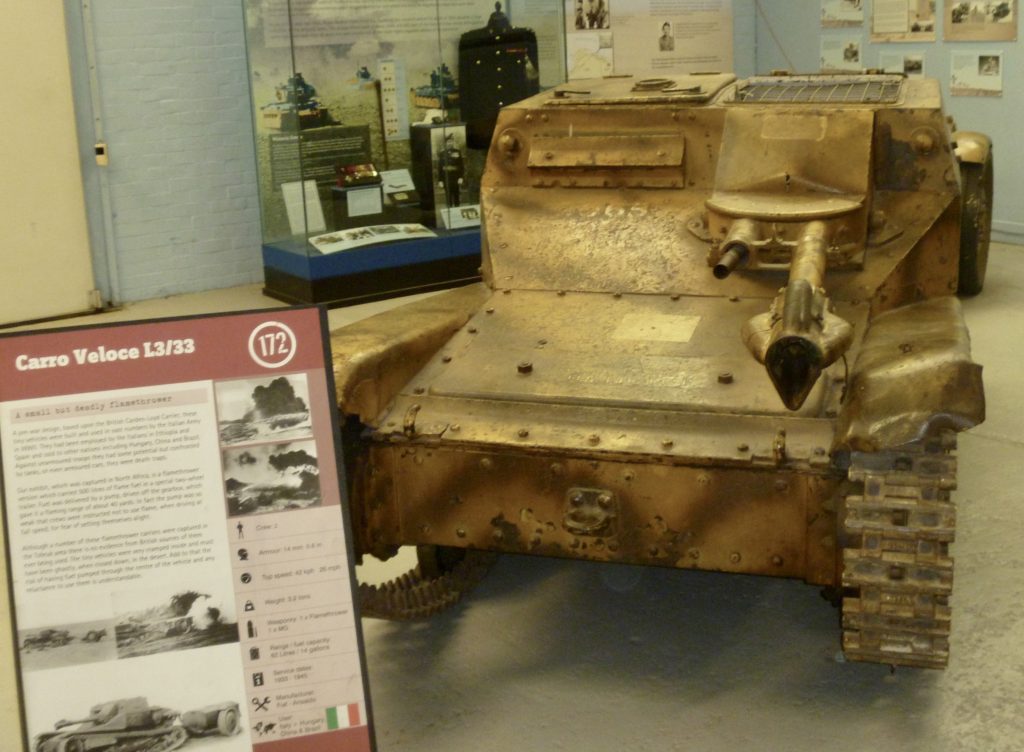
That is the Italian Carro Veloce L3 flamethrower tank. A two man tank just over four feet high, today it’s been retroactively reclassified as a “tankette.” At the back right, you can barely see the edge of the 133 gallon tank it towed behind it on a two-wheel trailer. It deserves a place on this list due to the nasty tendency to roast the crew alive due to leaks in the gasoline lines.
So which of the five in that video come out? I’m going to say the Jagdtiger. Not because anything in the video is wrong: it was a tremendously resource-hungry tank that required another parallel supply chain for its massive 128mm gun. However, that wasn’t clear in 1942, when it was first conceived, or 1943, when the bulk of development occurred. The main concern was dealing with massive numbers of Soviet tanks on the Eastern front, and where heavier Soviet tanks like the KV-85 were just starting to come online. In that environment, making the tradeoffs necessary to build that massive tank-killer probably seemed more justified in 1943, and the first Jagdtiger’s were delivered in January 1944. And even for the first few months after Normandy, there probably would have been no way to reclaim the material already allocated in the supply chain to build them. But any of them built after, say, September, were indeed a bad use of resources.
In Tigers in the Mud, Panzer commander Otto Carius noted other flaws with Jagtiger (which are called “Hunting Tigers” in the English translation of the book), one of the biggest of which was the tendency of 128mm cannon to be jolted out of alignment during movement, which meant it had to be put into travel lock before maneuvers. Worse still, the travel lock “had to be removed from the outside during contact with the enemy!”