Here’s a snippet on the Russo-Ukrainian War from an interview Joe Rogan did with former CIA officer Mike Baker last week.
Some takeaways:
Putin has been “pretty damn consistent over the years.”
If you look at what he did in Chechnya, if you look at what he did helping Assad in Syria, if you look at what he did annexing Crimea, if you look at Georgia, Abkhazia, South Ossetia. Every step of the way he’s been following in his mind this stated desire, that he’s made very public over the years, to rebuild his sphere of influence.
We were too optimistic, thinking that he was thinking like we do in a rational process.
Intelligence on what Putin actually wants is hard because his inner circle keeps getting smaller and smaller.
Human intelligence is hard, and despite movies, blackmail or a honeytrap are rarely the most effective methods.
Putin was a KGB officer for 15 years, and he served in East Germany rather than the west. “He doesn’t really understand how we think.”
The collapse of communism 1989-1991 was a great opportunity for recruiting spies behind the iron curtain.
Putin thinks “You guys have disrespected me, fuck you all. I told you I want my spirit a sphere of influence, and I don’t care whether I have to break it.”
“He called the collapse of the Soviet Union the greatest tragedy of the 20th century, and he’s he’s serious about that, he means that.”
He’s cut loose some of his own inner circle over the past couple of weeks.
“Was he given bad intel? Or was he given intel and choose to ignore it?” Like many dictators, Putin has a “thermocline of truth” (though Baker doesn’t use that phrase) between him and any possible bad news.
“They were gonna get in there, maybe within 48 hours, they were going to have control of Kiev, they would be welcomed by the population in Ukraine, and they would be able to establish a puppet regime.”
They’ve lost virtually all their international routes.
They’re basically back to Soviet-era route choices.
Aeroflot now has only one international flight route…into Belarus.
It’s not just flights to and from Russia that are affected. Lots of international flights between Europe and Asia transited now-closed Russian airspace. Flights from Helsinki to Tokyo now take three hours longer.
Russia has also been locked out of the Global Distribution System (GDS), which connects just about all global travel providers.
Middle East airlines are still flying too and from Russia, mainly Moscow. But without GDS, no one can directly book connecting flights to other Russian cities.
A majority of the world’s airliners are leased from an outside company. More than half of Russian airliners are leased from companies outside the country. All those are refusing to continue doing business in Russia.
The Cape Town Treaty governs aircraft repossession, and Russia is a signatory to the treaty.
But instead of following the terms of the treaty, Russia has just sanctioned the theft of those aircraft.
Both Boeing and Airbus have suspended all maintenance support with Russia. Without legitimate spare parts, even Russian-owned aircraft could be banned from flying internationally. And even Russian Sukhoi depends on German Lufthansa Technik for spare parts.
One side effect: Without outside airline ability to overfly Russian territory, Anchorage is likely to become an international hub again.
There’s just enough tank-specific news coming out of the Russo-Ukrainian War to justify a roundup. Despite supposedly having the largest tank army in the world, Russia’s tank corps is clearly taking it on the chin in Ukraine.
You know that “largest tank army in the world” bit? Not so much:
#Russia's active tank fleet is actually not 12,000 strong. In reality it is just over 2,500. By active tanks I mean tanks that are actually in service in an organised unit (i.e. a tank battalion, regiment, brigade etc.) and are not undergoing field tests (T-14 Armata). pic.twitter.com/fJYrGjc5L4
Can Russia pull reserve tanks out of its inventory and put them in active duty? Probably, but: A.) The truck tire issued showed that even active equipment hasn’t been well-maintained. How much worse shape are mothballed vehicles in? B.) How quickly can new tank crews be trained to work effectively? Speaking of maintenance problems:
Russia’s main tank factory has reportedly stopped production and repairs due to a lack of parts:
Russia’s largest tank manufacturer, Uralvagonzavod, has halted production because of supply shortages, according to Ukraine’s state media and Ukrainian armed forces.
The Kyiv Independent writes that Uralvagonzavod has stopped operations in its Chelyabinsk Tractor Plant in west-central Russia because of the lack of component parts supplied from foreign countries.
The claim was initially made by a report of the Armed Forces of Ukraine and confirmed by the Ukrainian Ministry of Defense on March 21, according to The Kyiv Independent.
Uralvagonzavod had his assets frozen in the U.K. on February 24 and was hit by European Union sanctions on March 15.
Two reasons to take this with a few grains of salt: A.) It’s a Ukrainian source, and B.) Uralvagonzavod is the company manufacturing the T-14 Armata tank as well as the T-90M, and they were only supposed to produce 100 T-14s total, of which none have been spotted in-theater.
One thing that seems notably absent from combat reports is accounts of Russian active protection systems defeating incoming rounds or missiles. Arena-M seems to be the current Russian APS (a replacement for the Afghanit system rumored to be slated for the T-14?), but previous APS systems (Drozd 2) were supposedly available for earlier Russian tanks. (Shtora is a passive protection system used on Russian armor.) But Arena was first tested in 1995, which would make it pretty long in the tooth on the software side. Would you trust your life to Windows 95?
The lack of effective active countermeasures is one reason so many Russian armored vehicles in Ukraine seem to sport improvised metal cages up top, which appear to be doing Jack and Squat.
A LOT OF Russian tanks involved in the invasion of Ukraine have strange cages welded over the roofs of their turrets. Strange and apparently useless—for many pictures have emerged of destroyed vehicles surmounted by them. Sometimes the cage itself has been visibly damaged by an attack that went on to hit the tank beneath.
Stijn Mitzer, an independent analyst based in Amsterdam, has looked at hundreds of verified photographs of destroyed Russian vehicles. He thinks that, far from acting as protection, the cages have done nothing save add weight, make tanks easier to spot, and perhaps give a false and dangerous sense of security to the crew inside. They have thus been mockingly dubbed by some Western analysts as “emotional-support armour” or “cope cages”.
Snip.
The new cages, the fitting of which seems to have begun late in 2021, appear to be a variant of so-called slat or bar armour. Such armour can provide effective lightweight protection if used correctly (as it is, for example, on American Stryker armoured personnel carriers). But in this case that seems not to have happened. They might thus be seen as symbols of Russia’s inadequate preparation for the campaign, as pertinent in their way as its failures to neutralise Ukraine’s air defences and to shoot down that country’s drones.
One of the main threats to armoured vehicles are HEAT (High Explosive Anti-Tank) weapons, such as the Russian-made but widely employed RPG-7. The warheads of these rocket-propelled grenades are shaped charges—hollow cones of explosive lined with metal. When the explosive detonates it blasts the metal lining into a narrow, high-speed jet that is able to punch through thick steel. According to Dr Appleby-Thomas an RPG-7 can penetrate 30cm of steel plate.
And RPG-7s are the babies of the bunch. Other, far more powerful shaped-charge anti-tank weapons used by Ukrainian forces include Javelins supplied by America, NLAWs (Next-generation Light Anti-tank Weapons) supplied by Britain, and drone-borne MAM-L missiles, supplied by Turkey.
HEAT warheads may be countered by what is known as explosive reactive armour, or ERA. When this is hit, a sheet of explosive sandwiched inside it blows up and disrupts an incoming warhead before it can detonate. Many Russian tanks are indeed fitted with ERA. However ERA may, in turn, be defeated by a so-called tandem warhead, in which a small precursor charge triggers the armour’s explosive before the main warhead detonates.
Slat and bar add-on armours are a lighter and cheaper way to counter RPGs, though even if used correctly they are, literally, hit or miss protection. The spacing of the bars or slats is crucial. If a rocket hits a bar it makes little difference, for its warhead will detonate anyway. But if it gets trapped between bars it will probably be damaged in a way which means that the signal from the nose-mounted fuse cannot reach the detonator.
This approach is known as statistical armour, because the protection it offers is all or nothing. It is typically quoted as having a 50% chance of disrupting an incoming RPG. But Dr Appleby-Thomas notes that it works only against munitions with a nose fuse, which Javelins, NLAWs and MAM-Ls do not have.
Russia has been fitting slat armour to vehicles since 2016, but the design of the new cages, seemingly improvised from locally available materials, is baffling. They appear to be oriented in a way that protects only against attacks from above. In principle, that might help against Javelins, which have a “top attack” mode in which they first veer upwards and then dive to punch through a tank’s thin top armour. But, as Nick Reynolds, a land-warfare research analyst at RUSI, a British defence think-tank, notes, even if the cage sets off a Javelin’s precursor warhead, the main charge is still more than powerful enough to punch through the top armour and destroy the tank—as the Ukrainian army itself proved in December, when it tested one against a vehicle protected by add-on armour replicating the Russian design. As expected, the Javelin destroyed the target easily.
Enjoy this Sad Trombone gif, unearthed from the archives of the ancient, terrible conflict known only as The Pony Wars
Speaking of the Javelin, it and other western-supplied anti-tank weapons are tearing up Russian armor.
Despite amassing an invasion force of nearly 200,000 troops and thousands of armored vehicles supported by combat aircraft and warships, the Russian military has failed to reach its primary objectives in the three weeks since its offensive into Ukraine began.
Russian military planners expected a blitzkrieg campaign that would last 48 to 72 hours and lead to a quick Ukrainian capitulation, but Ukrainian President Volodymyr Zelenskyy has led a fierce resistance, and major urban centers, including the capital, Kyiv, remain in Ukrainian hands, surprising Moscow and indeed the world.
Ukrainians’ grit and knowledge of the battlefield have played a large part in their effective defense, but weapons supplied by NATO and EU countries have also played a critical role in stalling the Russian advance.
Ukraine has received billions of worth of weapons from the West — the US has provided $1 billion in security assistance just this week — and among that aid, three weapon systems stand out.
Since the invasion began, US-made FGM-148 Javelins and FIM-92 Stingers and the Next Generation Light Anti-Tank Weapon (NLAW) designed by Britain and Sweden have been the terror of Russian troops.
Tanks and armored vehicles are at the heart of the Russian military doctrine.
Actually Russian military doctrine is usually described as artillary-centric, but tanks are a close second in importance.
Russia’s battalion tactical groups — 75% of which have been committed to the invasion, a US official said Wednesday — are largely mechanized formations meant to use heavy firepower to overcome resistance.
But BTGs are vulnerable to anti-tank defenses like the Javelin, a reusable, fire-and-forget guided missile.
Javelins have two parts: a launch tube and a command launch unit, which has the controls and optical sights for day and night use. The Javelin missile’s nose has a homing infrared guidance system that allows the operator to fire the weapon and then relocate in order to dodge return fire.
Snip.
Against a tank or another armored vehicle, the Javelin will strike from a high angle of attack, targeting the top of the vehicle, where the armor is thinnest.
Before the invasion, Russian tankers sought to counter that by building cages on top of their tanks to detonate the Javelin before it struck and reduce its force. Hundreds of destroyed Russian tanks suggest that has not been an effective countermeasure.
Against a stationary target, like a building or bunker, the Javelin will strike from a more direct line of attack.
Snip.
Ukrainian forces have been using the British-supplied NLAW anti-tank weapon. Although less sophisticated than its American counterpart, the NLAW is extremely easy to operate, and with a 150 mm high explosive anti-tank warhead, it’s deadly too.
Like the Javelin, the NLAW can strike targets from above, but its effective range of about 800 meters is more limited than the Javelin’s 2,000-meter range.
Information on Stinger use against Russian aircraft snipped.
The US on Wednesday announced another package of security assistance to Ukraine, which included 800 Stingers and 2,000 Javelins, bringing the total of each provided by the US to 1,400 and 4,600, respectively. The package also includes 1,000 light anti-armor weapons and 6,000 AT-4 unguided, man-portable anti-armor missiles.
Evidently, even some of the equipment Russian tanks supposedly have isn’t actually there:
The Russian military’s one-off T-80UM2 experimental main battle tank has been knocked out during recent fighting in Ukraine, marking one of the more unusual kills attributed to the country’s defenders, who continue to disrupt the Kremlin’s invasion plans. The fact that this unique fighting vehicle was even participating in combat in Ukraine is somewhat surprising, but it would not be the first example of new or experimental Russian weapons systems being deployed in the campaign.
The team of researchers at the Oryx blog, who have been compiling photo and video evidence of materiel losses on both sides of the conflict, identified the wreckage of the T-80UM2 and stated that it was destroyed on March 17, or that its remains were uncovered on this date. The tank is rumored to have been knocked out in Sumy Oblast, in northeastern Ukraine, apparently in the vicinity of the town of Trostyanets.
The T-80UM2 is said to have been part of a larger column of Russian vehicles that came under attack by the Ukrainian Armed Forces and photos show destroyed trucks alongside the T-80UM2. Its turret was knocked off and its hull burnt out, although it’s not immediately clear how it was hit and by what.
The story of the T-80UM2 is a complicated one, tied up with a new-generation tank project with the project name Objekt 640, better known as the Black Eagle. A mock-up of the Black Eagle appeared as long ago as 1997, at which point it was being promoted for the export market.
By 1998 it had become clear that work was also underway on the T-80UM2, as a further development of the Cold War-era T-80. There seems to be substantial overlap between the T-80UM2 and the Black Eagle, to the point that some sources consider them one and the same. If that’s the case, then the T-80UM2 may very well have been intended to serve as a prototype for the Black Eagle which, as it turned out, never entered production.
As for the T-80UM2, this vehicle was based on an upgraded T-80U chassis, the main new addition being a welded-steel turret with advanced armor protection, including Kaktus explosive reactive armor (ERA), panels of which were also applied to the front of the hull. More Kaktus was fitted to the track skirts, while there were anti-fragmentation screens around the front of the turret.
In its ultimate form, the T-80UM2 was also fitted with the Drozd-2 active protection system, a hard-kill system that uses radar to detect incoming anti-tank rockets and anti-tank missiles, before automatically firing high-explosive fragmentation munitions at them, with the aim of destroying, or at last disabling them, at a distance of 20-30 feet from the tank.
The T-80UM2 featured a different crew arrangement compared to the T-80U, with the gunner seated on the right and the commander on the left of the turret, swapping sides compared to the earlier tank.
Otherwise, the new tank used the same main armament as the earlier T-80 series, with a 125mm 2A45M smoothbore gun, but this was now fed ammunition via an improved type of automatic loading system. The magazine was moved from below the turret to the bustle, at the back of the turret, apparently in response to survivability concerns highlighted during fighting in Chechnya.
In western armies, prototypes are rarely pressed into combat service, they’re generally preserved in tank museums (like Tortoise at Bovington or the T-28 at the Patton Museum of Cavalry and Armor). The fact that this one was pressed into frontline service may suggest a whiff of desperation to throw everything into the fight. Then again, the Russian military has never been known for being overly sentimental…
“Hits” is perhaps too strong, but it did touch down and do some damage right at the I-35/TX-45 flyover in Round Rock, which is about eight miles from my house. It did some damage but I’m not seeing any reports of fatalities thus far. One woman did get pulled from the wreckage of the home she was renting. There were also some power outages.
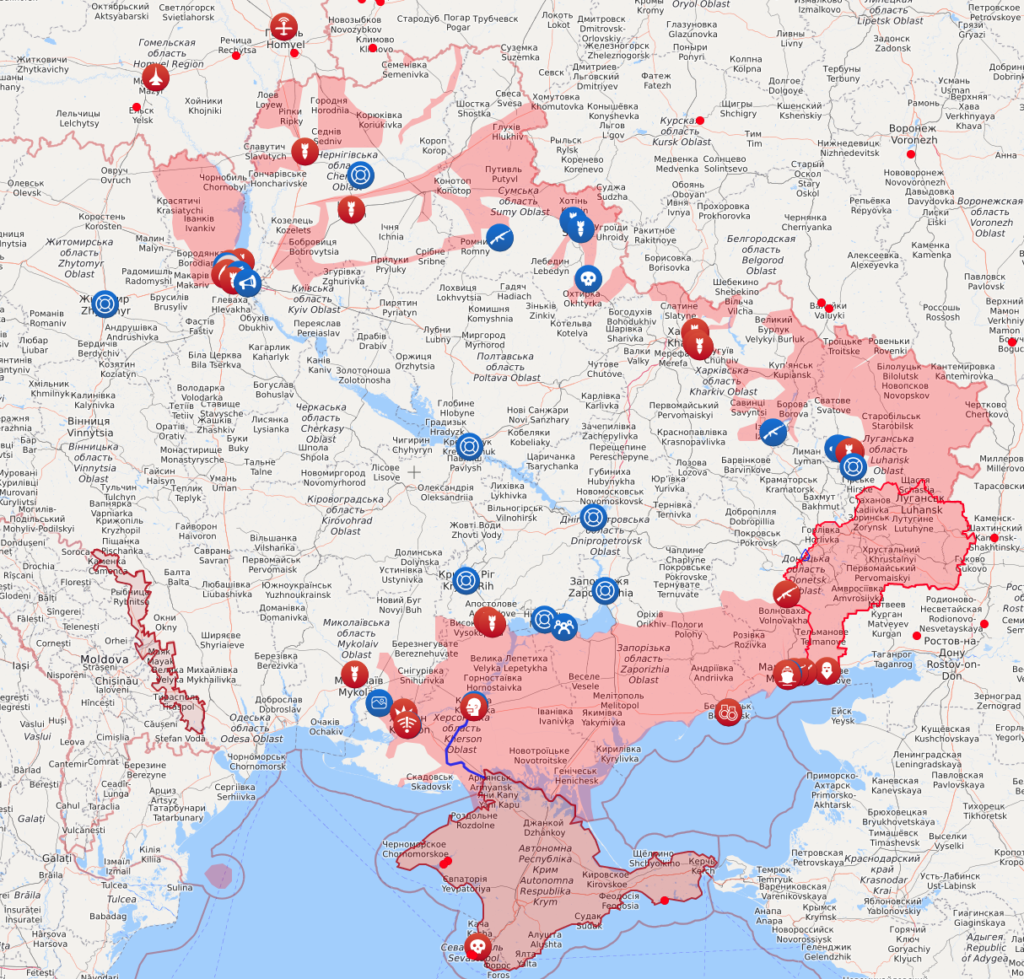
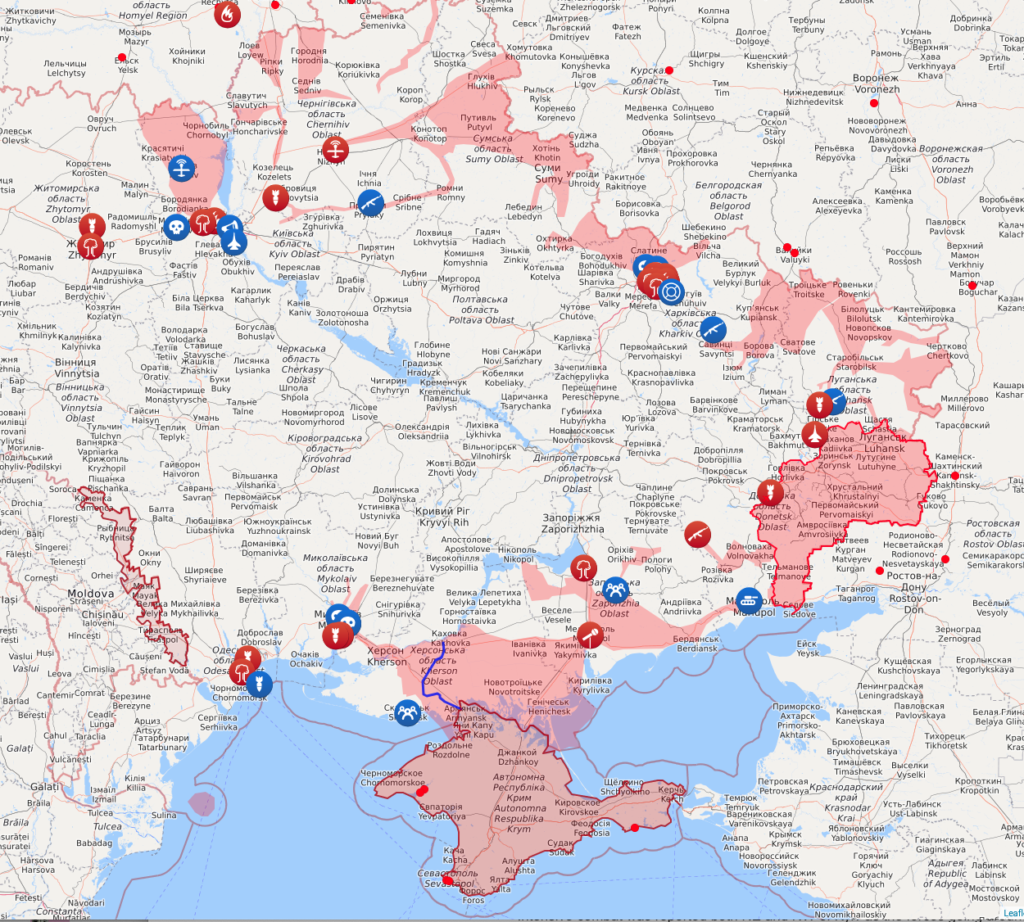
Some significant changes since the last update, mainly that Russian forces have finally taken Mariupol, allowing Russian forces in the east to linkup through Donetsk. But elsewhere a slow, grinding stalemate seems to prevail.
Ukrainian forces have defeated the initial Russian campaign of this war. That campaign aimed to conduct airborne and mechanized operations to seize Kyiv, Kharkiv, Odesa, and other major Ukrainian cities to force a change of government in Ukraine. That campaign has culminated. Russian forces continue to make limited advances in some parts of the theater but are very unlikely to be able to seize their objectives in this way. The doctrinally sound Russian response to this situation would be to end this campaign, accept a possibly lengthy operational pause, develop the plan for a new campaign, build up resources for that new campaign, and launch it when the resources and other conditions are ready. The Russian military has not yet adopted this approach. It is instead continuing to feed small collections of reinforcements into an ongoing effort to keep the current campaign alive. We assess that that effort will fail.
The ultimate fall of Mariupol is increasingly unlikely to free up enough Russian combat power to change the outcome of the initial campaign dramatically. Russian forces concentrated considerable combat power around Mariupol drawn from the 8th Combined Arms Army to the east and from the group of Russian forces in Crimea to the west. Had the Russians taken Mariupol quickly or with relatively few losses they would likely have been able to move enough combat power west toward Zaporizhiya and Dnipro to threaten those cities. The protracted siege of Mariupol is seriously weakening Russian forces on that axis, however. The confirmed death of the commander of the Russian 150th Motorized Rifle Division likely indicates the scale of the damage Ukrainian defenders are inflicting on those formations. The block-by-block fighting in Mariupol itself is costing the Russian military time, initiative, and combat power. If and when Mariupol ultimately falls the Russian forces now besieging it may not be strong enough to change the course of the campaign dramatically by attacking to the west.
Russian forces in the south appear to be focusing on a drive toward Kryvyi Rih, presumably to isolate and then take Zaporizhiya and Dnipro from the west but are unlikely to secure any of those cities in the coming weeks if at all. Kryvyi Rih is a city of more than 600,000 and heavily fortified according to the head of its military administration. Zaporizhiya and Dnipro are also large. The Russian military has been struggling to take Mariupol, smaller than any of them, since the start of the war with more combat power than it is currently pushing toward Kryvyi Rih. The Russian advance on that axis is thus likely to bog down as all other Russian advances on major cities have done.
The Russian military continues to commit small groups of reinforcements to localized fighting rather than concentrating them to launch new large-scale operations. Russia continues to commit units drawn from its naval infantry from all fleets, likely because those units are relatively more combat-ready than rank-and-file Russian regiments and brigades. The naval infantry belonging to the Black Sea Fleet is likely the largest single pool of ready reserve forces the Russian military has not yet committed. Much of that naval infantry has likely been embarked on amphibious landing ships off the Odesa coast since early in the war, presumably ready to land near Odesa as soon as Russian forces from Crimea secured a reliable ground line of communication (GLOC) from Crimea to Odesa. The likelihood that Russian forces from Crimea will establish such a GLOC in the near future is becoming remote, however, and the Russian military has apparently begun using elements of the Black Sea Fleet naval infantry to reinforce efforts to take Mariupol.
The culmination of the initial Russian campaign is creating conditions of stalemate throughout most of Ukraine. Russian forces are digging in around the periphery of Kyiv and elsewhere, attempting to consolidate political control over areas they currently occupy, resupplying and attempting to reinforce units in static positions, and generally beginning to set conditions to hold in approximately their current forward positions for an indefinite time. Maxar imagery of Russian forces digging trenches and revetments in Kyiv Oblast over the past several days supports this assessment.[1] Comments by Duma members about forcing Ukraine to surrender by exhaustion in May could reflect a revised Russian approach to ending this conflict on terms favorable to Moscow.
Stalemate will likely be very violent and bloody, especially if it protracts.
What the invasion revealed about the Russian military:
Lots of problems, including a reiteration of the inability of the Russian air force to conduct combined arms operations, especially given their limited flight training (8 hours a month).
Speaking of limitations:
#Russia's active tank fleet is actually not 12,000 strong. In reality it is just over 2,500. By active tanks I mean tanks that are actually in service in an organised unit (i.e. a tank battalion, regiment, brigade etc.) and are not undergoing field tests (T-14 Armata). pic.twitter.com/fJYrGjc5L4
Lots of tweets wonder aloud why there have been no confirmed T-14 Armata sightings in theater in Ukraine. We’ll know Russia is really desperate if they start hauling T-64s out of mothballs and into service. (Ukraine actually has a lot of modernized T-64 Bulats, as the original T-64 factory is there.)
“We Have Questions About Russia’s Claimed Kinzhal Hypersonic Missile Use In Ukraine.” “In the end, not everything adds up here. That’s just the reality. It is just as possible we are seeing a standard Iskander-M attack in the video as one by Kinzhal.” Russia had produced an awful lot of vaporware when it comes to wonderwaffen, and it wouldn’t surprise me to see their hypersonic missile fall into this category.
And since we’re talking hypersonic and eastern Europe:
Ukrainian civilian drone enthusiasts are carrying out realtime coordinated reconnaissance on Russian troops:
News from St. Petersburg:
St Petersburg, Russia tonight chanting "No to war", "Shame", and "Ukraine is not our enemy!" Russia has been arresting protesters all day and yet the crowd has grown. pic.twitter.com/V6ZtOIam2t
Will the international community’s sanctions succeed in bringing Russia to heel? Completely cutting them off from the world banking system has the potential to do a lot more damage to Russian oligarchs than previously, but it’s important to remember that the Russian economy was already sucking.
Some takeaways:
Russia’s transition to a market economy was badly bungled, with state enterprises being sold off to those well-connected oligarchs rather than people that could actually grow and modernize industry.
Foreign firms were largely excluded from the privatization process.
Lots of oligarchs took a look at the sad state of the Russian economy in the 1990s, and decided it was safer to park their money outside the country (hence all those Russians buying houses in London).
Russia still managed a lot of economic growth in the early 21st century, and was helped by rising oil prices.
By contrast, Russian banks were still so primitive that they weren’t hurt by the subprime meltdown of 2008, since they weren’t exposed to subprime mortgage bundles or derivatives. But they were hurt quite a bit by the subsequent decline in oil.
Limited economic sanctions following the invasion of Crimea did very little, because Russia was prepared for it with considerable foreign currency reserves, and most sanctions were quickly rolled back.
“Russia has never been a real democracy.”
Per capita GDP has dropped from $16,000 in 2013 to just over $10,000 today.
“Corruption, mismanagement and warmongering are rarely a recipe for success.” The Russian shrunk over the past decade.
There are a lot of small countries, especially in the southern and eastern areas of Europe for whom [a Russian invasion] may not have been a plausible scenario two weeks ago, but it’s kind of looking like one now. And if you are a small country close to the borders of Russia, you’re in this difficult defensive position. None of these countries have a military that can, with a straight face, suggests that it could simply put up a toe-to-toe, stand their ground fight and defeat a military the size of the Russian army.
I’m going to point out that this is not necessarily true. Finland did it in The Winter War in 1939-1940. But he gets to that.
Yet you want you have to provide some sort of plausible threat to an invading occupier like Russia to avoid being invaded in the first place. The whole point is that the best possible success in repulsing an invasion is to not get invaded in the first place. So how can you convince a country like Russia that your very small little republic is not worth invading, that it is too difficult to invade? A lot of these countries are looking around, and going “Would NATO actually step up and help us directly, help defend us in case of an invasion? Any maybe NATO would, maybe NATO wouldn’t.”
One big solution is civilian military firearms ownership and preparedness. And here modern Finland comes up:
There is a specific division called SRA which is essentially reservists shooting society, and it is it’s actually technically in some cases for gun, rifle, pistol, shotgun and precision rifle. In competition it requires competitors to essentially carry a military loadout; they have to wear armor, they have to carry water, they have to carry a minimum amount of ammunition during the stages…It’s specifically to encourage military readiness .
“Having a large community of competent civilian marksmen is something that can contribute a very real deterrent to invasion.”
True. Every nation in Europe should make civilian firearms ownership more widely and legally available, for this and other reasons.
Busy day, so enjoy another Ukraine video. This is a good summary of the fight up until now:
Some takeaways:
We know what Russian plans were, based on captured documents and a pre-written “analysis” of Russia’s glorious victory someone found on file on a web server.
They expected to be at the gates of Kiev in three days and have everything conquered in two weeks.
Well, we’re almost two weeks in, and they haven’t achieved any of their major objectives. All major cities remain in Ukrainian hands.
One reason they didn’t: NATO alerted them to impending Russian action slightly before it began, so many commanders and units were already dispersed from bases.
They didn’t have enough trucks to begin with and have already lost 200 more.
Also, not only is the Ukrainian mud all but impassable, but their truck tires really suck. (More on this in a day or so.)
We need to pay more attention to the south, where Russian troops attacking from Crimea have done better (but still not great).
Time is not on Russia’s side, as sanctions are crashing their economy hard.
I’ve touched on some of the logistical difficulties Russia has experienced in its Ukrainian invasion. But this video goes into more detail about how Russia built up logistical support for the invasion, the importance of its rail systems, and how it hasn’t been able to keep up post-invasion.
Some takeaways:
Ukrainian forces destroyed all rail links between the two countries.
Russian forces are relying on analog, unsecured radio communications rather than scrambled digital channels, and Ukrainian forces are listening in and jamming.
Poor logistics also helped Soviet forces lose in Afghanistan.
Russia has 30,000 strong military rail organization.
“Russia doesn’t have enough trucks.” They can’t operate effectively more than 90 miles from supply dumps.
A large percentage of truck transport was dedicated to rocket resupply, not fuel and food.
Russia only had 3-5 days of supplies when they invaded. When those ran out, they were screwed.
Russia’s military works on a “push” logistic system rather than a “pull” system used by the U.S. military, meaning it’s not very flexible.
Russia has the capability to set up the infrastructure for a longer war, but it’s going to take time.
Russia’s failure to quickly achieve it’s objectives has seen it resort to more desperate and indiscriminate tactics.
And here’s a related Twitter thread that touches on rail network logistic issues.
The most logistically dangerous axis is east-west, because the rail runs that way direct from Russia without worrying about a seaport and sealift. That doesn't mean a southern thrust isn't dangerous but the UA must prioritize.
Mary Katharine Ham has some choice words for members of the Democratic Media Complex who still don’t seem to understand why parents are so mad at them.
The doors of the school weren’t always closed! No, no, no! No, they opened public school buildings to paid child care programs so that the parents who weren’t getting the school that they paid for in taxes could pay more money to send their kids to a school building where they would be taught on zoom by teachers who weren’t there, while being supervised by people who were willing to be there. I can’t express how angry that made people. Meanwhile, school boards are renaming school buildings to right our historic wrongs and buying electric school buses.
They sent email after stupid email about how they might let your kids come back to school on such and such date, and you’d tell your kids, and they’d be excited, and then they backed out at the last minute, sending you a 7 PM email leaving you with no way to plan for the next day, over and over again.
“And the icing on this just terrible cake was that when parents had the temerity to get upset about any of this, they were treated like crap.”
“Hand me my mimosa, bitches, because this ride has just begun.”