Following redistricting, a whole lot of 2026 races are heating up, so let’s do a Texas election news roundup.
The early favorite for the most interesting 2026 race in Texas is the campaign for the state’s attorney general, and two new endorsements have ramped the intrigue up to 11.
Four candidates are vying for the spot: state Sens. Joan Huffman (R-Houston) and Mayes Middleton (R-Galveston), former Department of Justice appointee Aaron Reitz, and Congressman Chip Roy (R-TX-21).
Last week, Roy jumped into the race after a couple months of speculation — the same day that polling showed 73 percent undecided in the then-three person field.
Middleton remains far and away the frontrunner on the money front, being able to self-fund with an initial $10 million investment — and the intent to put another $10 million in if need be. He also has the backing of a large number of Republicans in the Texas House, where he served two terms before winning his Senate seat.
But each of the candidates has their own competitive advantages, making the race one of the most interesting to watch in the state so far.
Over the weekend, two established GOP figures broke their impartiality in the race and endorsed competing candidates. First, Sen. Ted Cruz (R-TX) backed Roy, his former chief of staff, saying, “There are several excellent candidates right now in the race for Texas Attorney General. All of them are friends of mine, and all of them have been strong supporters of mine for many, many years. Texas is blessed to have an abundance of strong conservatives stepping forward to lead, in such a time as this.”
“I am proud to endorse Chip Roy for Attorney General of Texas. As my very first chief of staff, Chip has been a close friend and ally of mine for over 12 years. We have been in more fights together than I can count, and I know Chip will always, always, always fight for conservative values.”
Reitz, whose campaign had picked up serious momentum since he launched in June, had served as Cruz’s chief of staff before taking a job in the Department of Justice under the second Trump administration earlier this year. The former Cruz staffer had also been seriously considering running for Roy’s congressional seat in light of the congressman’s entry into the attorney general race.
But Reitz decided to stay in, and unloaded his own top shelf endorsement on Monday. “One of the most frequent questions Texans ask me is: ‘Ken, who should succeed you as Attorney General?’ My answer is now definitive: Aaron Reitz,” Paxton said in a press release.
“Aaron Reitz is the only candidate who is fully vetted, battle-tested, proven, and ready to be Attorney General. He is loyal, fearless, trusted, and relentlessly committed to the Rule of Law. He has already proven himself as a defender of Texas, of Texans’ rights, and of the Constitution. That’s why President Trump called him a ‘true MAGA attorney’ and a ‘warrior for our Constitution’ — and I could not agree more.”

As a member of Congress, Chip Roy has been a steadfast ally for gun owners: he has opposed federal gun control, fought executive overreach, and stood shoulder-to-shoulder with GOA to defend your freedoms.
Chip’s record on the Second Amendment is rock solid. As a member of the powerful House Rules Committee, responsible for deciding which bills are sent to the House floor, Chip has been a brick wall to anti-gunners who aim to infringe on the Second Amendment. Chip will call out RINOs who compromise on the Second Amendment or empower the unconstitutional ATF.
Not only does Chip talk the talk, he shows it with sponsoring and cosponsoring pro-gun legislation!
Since January alone, he:
- Sponsored H.R. 962 — Defending Veterans’ Second Amendment Rights Act (Prohibits VA from disarming veterans with fiduciaries)
- Cosponsored H.R. 3228 — Constitutional Hearing Protection Act (Removes suppressors from the definition of firearms)
- Cosponsored H.R. 1643 — SAFER Voter Act (Reduces the age to buy a handgun from an FFL from 21 to 18)
- Cosponsored H.R. 1041 — Veterans 2nd Amendment Protection Act (Prohibits VA from disarming veterans with fiduciaries)
- Cosponsored H.R. 645 — National Constitutional Carry Act (Would establish Constitutional Carry nationwide)
- Cosponsored H.R. 563 — No REGISTRY Rights Act (Directs ATF to delete their illegal gun owner registry and certify to Congress that they have complied with the law)
In 2021, when Democrats attempted to insert unconstitutional red flag laws for our service members, it was Chip Roy along with key allies in Congress who prevented that from being signed into law.
The gap between Texas Attorney General Ken Paxton and Sen. John Cornyn (R-TX) in the 2026 U.S. Senate race is narrowing, according to new polling from Texas Southern University.
Cornyn trails five points behind Paxton in the GOP primary, according to a poll conducted by the Barbara Jordan Public Policy Research and Survey Center at Texas Southern University — the same survey which had the senator nine points behind Paxton three months prior.
The survey polled 1,500 likely 2026 Republican primary voters and 1,500 likely 2026 Democratic primary voters, with a margin of error of plus or minus 2.53 percent.
Various polls in the field have gauged Cornyn and Paxton in a head-to-head primary scenario, generally showing the latter to be in a comfortable lead. The Senate Leadership Fund estimates it to be about a 17-point gap, after averaging 13 polls taken over the past six months.
However, data from an Emerson College poll on Friday, alongside this most recent Texas Southern poll, paint a different picture for Cornyn’s odds. Emerson had Cornyn in the lead by one point with 30 percent, Paxton at 29 percent, “someone else” at five percent, and “undecided” at 37 percent.
Congressman Wesley Hunt (R-TX-38), who’s been flirting with a bid against Paxton and Cornyn through a number of campaign-style ads running across the state, was also measured in the poll. In a three-way matchup, Hunt collected 22 percent of the votes, contrasted with Paxton’s 35 percent and Cornyn’s 30 percent.
Congressman Ronny Jackson (R-TX-13), Hunt’s colleague who’s also lightly tested the waters, was also thrown into a three-way mix alongside Paxton and Cornyn. He garnered 15 percent of the vote, behind Cornyn’s 33 percent and Paxton’s 38 percent.
When faced against one another, Cornyn collected 43 percent of the vote against Jackson’s 35 percent. When placed against Paxton, Jackson got 33 percent while the attorney general led with 44 percent.
Hunt received 36 percent when faced against Paxton, who led with 43 percent — while 21 percent voted as “unsure.” Cornyn led with 43 percent against Hunt, while the latter received 36 percent. A similar 22 percent marked themselves as “unsure.”
Taking the usual poll caveats and triple them for a poll this far out. The caveat to the caveat is that the sample size is bigger than some previous polls, and Cornyn has been dropping media ad spends (an unusual move this early), so I can well imagine that he’s been able to close some of the gap. But all the polls have shown Paxton leading, which can’t be comforting for a four term incumbent. Remember, when Cornyn was first elected to the senate, Barack Obama was still an Illinois state senator…
Congressman Al Green (D-TX-09) has all but officially declared his candidacy for Congressional District (CD) 18, which largely holds his prior constituency following Texas’ mid-decade redistricting.
Green stated during a press conference on Tuesday afternoon that if he “made an announcement today, then there would be mass confusion about where I am. I’m serving the people of the 9th Congressional District,” after outlining how the “new” CD 18 more closely resembles his current CD 9.
“I live in the new 18 — I’m not moving into the new 18. I’ve lived in this house for more than 30 years. This is my home,” Green stated.
“So to those who say I am moving into the 18th Congressional District to run for office, not so. All I’m doing is staying where my constituents are.”
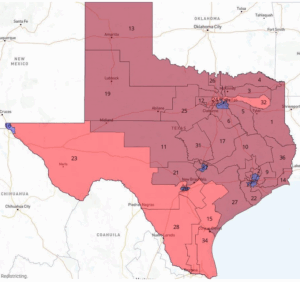
The Texas Legislature passed its new Republican-favored congressional map on August 20, following a two-week quorum break by members of the Texas House Democratic Caucus to prevent the vote. While Green’s CD 9 isn’t one of the five districts expected to flip from blue to red, as requested by President Donald Trump, a majority of CD 9 is now folded into the existing Democratic stronghold CD 18 — a move Green categorized as intentionally racist, as local Democratic lawmakers have also stated. Republicans argue that they are instead reworking the districts due to and in order to increase partisan performance.
“I have no relationships politically with the people in the new 9th Congressional District. The new 18th Congressional District is where I have my home and my constituents,” Green said.
He noted the passing of first Congresswoman Sheila Jackson Lee in 2024, then Lee’s successor, Congressman Sylvester Turner, this March, as well as referencing the special election which will be held in November to determine the candidate to represent CD 18.
“It’s important for people to know I’m not going to be in that special election,” Green continued.
“I’m not going to be in that special election for a multiplicity of reasons, but here is one: because if I chose to get in it, and should I win it, I would have to then vacate the 9th Congressional District.”