Greetings, and welcome to a rare Saturday LinkSwarm! This week: The Supreme Court stays the injunction against the Texas redistricting map, a bunch of Twitter fakes exposed, Trump drops the boom on Somali illegal alien scumbags,
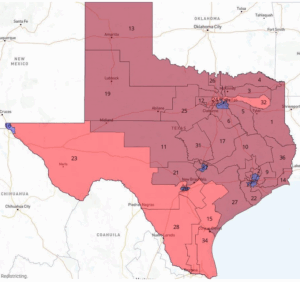
U.S. Supreme Court Justice Samuel Alito issued an administrative stay of Tuesday’s ruling by an El Paso panel of federal judges that rendered the new congressional map passed by Texas Republicans this summer unusable for the 2026 midterm election.
The order restored the new map, pending consideration of the appeal by the State of Texas, and directed the Democratic-aligned parties to submit their response by Monday.
Snip.
The ruling drew a particularly pointed dissent from Judge Jerry Smith, the lone dissenter on the panel, who asserted that the motivation behind the redraw was clearly partisan gain — a position that sits outside the jurisdiction of the court.
Following that ruling, Attorney General Ken Paxton appealed the ruling to the U.S. Supreme Court on Friday, asking for an administrative stay — which Alito granted.
“Compounding the harm, the district court entered its sweeping injunction far too late in the day — ten days after Texas’s candidate filing period had already opened. The injunction changes the boundaries of all but one of the State’s 38 congressional districts, enjoining Texas from using its duly enacted 2025 map and resurrecting the repealed 2021 map,” Texas wrote in its appeal.
“The chaos caused by such an injunction is obvious: campaigning had already begun, candidates had already gathered signatures and filed applications to appear on the ballot under the 2025 map, and early voting for the March 3, 2026, primary was only 91 days away. The lateness of the district court’s injunction (issued 38 days after the hearing) alone warrants a stay.”
As things stand, Texas Republicans’ map is back in effect while the U.S. Supreme Court considers the case in expedited fashion.
Texas’ candidate filing deadline is December 8, 2025.
Twitter/X turns on locations and it turns out a lot of “American” account pushing that “GOP civil war”` nonsense were foreign psyops.
There are thousands of accounts like this. Many of them explicitly claim to be American or Western, but are run by random people in Asia and Africa to sow chaos and get clicks.
BREAKING – Waves of Democrat influencers are being exposed as foreigners under X’s new location update, including leftist X agitator Alex Cole, who claimed he voted for Kamala but has now been revealed to be Canadian. pic.twitter.com/3LrAsYCiMw
Temporary Protected Status (TPS) is supposed to be used in extreme cases of humanitarian need for short terms (usually for 6, 12, or 18 months), allowing foreign refugees a safe haven in America.
As deportation efforts have ramped up, however, the American public has learned that some foreigners have remained in the country on TPS for decades. Some politicians and businesses have purposely imported large numbers of foreigners into small American towns, such as Haitians in Ohio and Pennsylvania, as cheap labor to replace Americans.
President Donald Trump’s initiative to eliminate government waste and fraud through a Department of Government Efficiency (DOGE) has quietly disbanded with a full 8 months still left on its charter.
Earlier this month when Reuters asked Office of Personnel Management Director Scott Kupor about the status of DOGE, Kupor replied, “That doesn’t exist.”
Representative Tim Burchett (R-TN) said that Elon Musk, who headed up the DOGE effort, was pushed out Washington D.C. because he was getting too close to exposing corrupt officials who are enriching themselves through dark money non-governmental organizations (NGOs).
Burchett told Benny Johnson, “NGO money pours into Washington and ends up in politicians’ pockets as dark money.”
DOGE had made dramatic impact on the federal government during the early months of Trump’s second term, shrinking the size of federal agencies and cutting their budgets or revealing astonishing amounts of questionable money flowing through NGO coffers.
Sound like a good reason to continue the work, not abandon it…
All that “don’t obey illegal orders” nonsense Democrats are regurgitating? Yeah, it’s Soros-funded, “Sponsored by Win Without War, a progressive advocacy group,” which in turn is funded by Soros’ Open Society Foundations.
Marjorie Taylor Greene resigned from congress. As in the NFL, there’s always someone that has to “set the edge,” and MTG was the person who did that in the Trump era.
What the hell? Is China committing war crimes in Philippines coastal waters?
The Philippine Navy recently caught Chinese Fishing Militia putting Cyanide in the water near the BRP Sierra Madre at the Second Thomas Shoal.
The incident that was recorded on camera demonstrates the brutality & destruction meted out by the Chinese Fishing Militia inside… pic.twitter.com/L7NCI0UIik
The apparent reason Armata failed is this: sanctions.
But there’s more to the story, too. In fact, several interlocking factors account for the T-14’s failure to materialize as intended.
Let’s first look at costs and priorities: the unit cost of the T-14 was estimated at several million dollars – far higher than Russia had budgeted for.
The increase in cost meant that it couldn’t actually be sustained at scale. And, faced with heavy losses in Ukraine and urgent demands to ramp up numbers, Moscow opted to modernize its legacy platforms, such as the T-90, rather than invest in an expensive and unproven system. A tough choice, but a logical one.
The domestic production line for the T-14 never actually achieved accurate serial output, in large part thanks to sanctions and industrial bottlenecks.
There was no assembly line. Yes, really: every vehicle was hand-built like a luxury car. Sanctions and supply-chain constraints further hindered the manufacture of key components and high-end electronics required for the platform.
But even if Russia had been able to assemble more of the tanks before the sanctions really kicked in, it might not have changed the reality on the battlefield. Even when the war in Ukraine created a burning need for armored vehicles, Russia hesitated to commit T-14 units to the frontline for one worrying reason: they were vulnerable.
With the rise of automated systems, drone warfare, and long-range combat, those tanks may have proven as vulnerable as older units – and losing tanks built pre-sanctions would mean replacing them with older tanks.
That wouldn’t have made sense.
For more than a decade, the T-14 Armata has embodied Russia’s ambition to leap ahead of the West in tank design and warfare.
But it failed.
The usual lefty sorts are trying to raise Maryland’s minimum wage to $25. Virginia’s minimum wage will be $12.77 in 2026. Which state will businesses choose?
Brown County Judge Shane Britton was suspended from office without pay on Tuesday, one day after he was arrested on multiple charges that included allegations he assaulted a female prosecutor and interfered with the prosecution of a family violence case.
According to indictments handed down by a grand jury last week, Britton has been charged with three felonies: tampering with a witness in a family violence case, assault of a public servant, and tampering with a government document.
To understand the difference, it helps to look at what each chip was originally built to do. A GPU is a “general-purpose” parallel processor, while a TPU is a “domain-specific” architecture.
The GPUs were designed for graphics. They excel at parallel processing (doing many things at once), which is great for AI. However, because they are designed to handle everything from video game textures to scientific simulations, they carry “architectural baggage.” They spend significant energy and chip area on complex tasks like caching, branch prediction, and managing independent threads.
A TPU, on the other hand, strips away all that baggage. It has no hardware for rasterization or texture mapping. Instead, it uses a unique architecture called a Systolic Array.
The “Systolic Array” is the key differentiator. In a standard CPU or GPU, the chip moves data back and forth between the memory and the computing units for every calculation. This constant shuffling creates a bottleneck (the Von Neumann bottleneck).
In a TPU’s systolic array, data flows through the chip like blood through a heart (hence “systolic”).
It loads data (weights) once.
It passes inputs through a massive grid of multipliers.
The data is passed directly to the next unit in the array without writing back to memory.
What this means, in essence, is that a TPU, because of its systolic array, drastically reduces the number of memory reads and writes required from HBM. As a result, the TPU can spend its cycles computing rather than waiting for data.
Google’s new TPU design, also called Ironwood also addressed some of the key areas where a TPU was lacking:
They enhanced the SparseCore for efficiently handling large embeddings (good for recommendation systems and LLMs)
It increased HBM capacity and bandwidth (up to 192 GB per chip). For a better understanding, Nvidia’s Blackwell B200 has 192GB per chip, while Blackwell Ultra, also known as the B300, has 288 GB per chip.
Improved the Inter-Chip Interconnect (ICI) for linking thousands of chips into massive clusters, also called TPU Pods (needed for AI training as well as some time test compute inference workloads). When it comes to ICI, it is important to note that it is very performant with a Peak Bandwidth of 1.2 TB/s vs Blackwell NVLink 5 at 1.8 TB/s. But Google’s ICI, together with its specialized compiler and software stack, still delivers superior performance on some specific AI tasks.
The key thing to understand is that because the TPU doesn’t need to decode complex instructions or constantly access memory, it can deliver significantly higher Operations Per Joule.
“TPU v6 is 60-65% more efficient than GPUs.”
Austin’s APL bookstore Recycled Reads will be closing in January and the stock distributed to individual library sales shelves. I doubt I’ll be visiting various library branches to book scout. Maybe they should go back to the book sale events they used to hold.
The rubber match between the progressive Austin City Council and the collection of opposition organizations headlined by Save Austin Now (SAN) has gone the latter’s way.
Proposition Q is a voter-approval tax rate election (VATRE) worth $110 million, intended to close the $33 million deficit gap in the City of Austin’s budget.
The ballot language states the item is “for the purpose of funding or expanding programs intended to increase housing affordability and reduce homelessness; improve parks and recreation facilities and services; enhance public health services and public safety; ensure financial stability; and provide for other general fund maintenance and operation expenditures included in the fiscal year 2025-2026 budget as approved or amended by City Council.”
Though it was not the only spending item within the proposition, the headliner was the homelessness response appropriation.
This is the third time the two sides — the city’s dominant political establishment and the insurgent opposition made up of Austin’s few Republicans, Independents, and even Democrats — have grappled over a ballot proposition.
The first was the May 2021 reinstatement of the public camping and lying ban, a rebuke of the progressive city council headlined by then-Mayor Steve Adler and then-Councilman Greg Casar; 57 percent of voters, including 40 percent of Democrats, voted to reinstate the camping ban.
Playing into SAN’s favor at that time was the visceral nature of the council’s policy. Overnight, encampments cropped up on Austin’s boulevards, under its overpasses, and within its creekbeds.
The next bout between the factions came on a November 2021 proposition from SAN that would have established a minimum staffing threshold for the city’s police department; a year earlier, the city council had cut and redirected $150 million from the Austin Police Department budget that included nixing financial authorization for 150 patrol positions.
SAN’s progressive opponents came out on top in that instance, with nearly 70 percent of voters rejecting the proposition.
It was a heavy blow to the group trying to build a bipartisan oppositional coalition in the city, but it set the table — along with other electoral skirmishes in the years since — for what came this year.
When it came to reinstating the camping ban, the message for SAN, led by Matt Mackowiak, was provided for them in the form of unsightly encampments on many street corners and increased confrontations between homeless individuals and pedestrians. That didn’t take much creativity.
But for the police staffing proposition, it was harder to fashion a winning message out of crime statistics that, while higher than the city’s historical levels, remained less tangible in what is still a historically low-crime city. The messaging cut the other way, too.
Opponents of the minimum staffing item framed it as a mandatory spending increase — which it was — and it worked to a prolific degree.
This November, the “spendthrift” theme fell squarely on the city council; SAN and its allies ran with it to a great effect.
SAN, with donations from donors like attorney Adam Loewy, purchased billboards across the city that read, “Stop the largest property tax increase in Austin history.”
Countermessaging by Proposition Q supporters focused heavily on President Donald Trump, including a mailer quote from City Councilwoman Vanessa Fuentes that read, “Passing Proposition Q tells Donald Trump and Greg Abbott they don’t call the shots in Austin. Our Community takes care of its own, and Proposition Q shows it.”
In short, the messaging dynamic was one of bipartisan opposition to more increased spending, versus a partisan rebuke of the GOP and its faces at the federal and state levels; the former won out, a remarkable feat in a city that has generally approved ramping up spending levels.
SAN’s $300,000, together with $120,000 from Ellen Wood’s Restore Leadership ATX, lapped the pro-Proposition Q Love Austin PAC’s $94,000 spent in the closing weeks of the campaign.
Snip.
With multiple elections of voter data to reference, SAN identified 70,000 likely supportive voters across both major parties and unaffiliated voters — and through early voting, that voter universe turned out at a rate of 2.3 times more than the rest of the voter universe.
SAN’s money paid for mail to 140,000 households, 300,000 text messages to voters, radio ads on five stations, a digital ad blitz, and billboards and small-scale signs across the city, per data shared with The Texan. Get-out-the-vote robocalls and digital ads continued along with the radio spots through the close of polls on Tuesday.
I didn’t cover Proposition Q because I live just outside the Austin city limits, I’ve had plenty of other stuff to blog about these past few months, and 40 years of experience has led me to believe that Austin voters will vote for pretty much any cockamamie spending increasing that comes down the line. So I didn’t have much hope they’d defeat Proposition Q, but I did see signs against it just about everywhere I went.
Through early voting, SAN’s internal modeling put “No on Prop Q” ahead 57 percent to 43 percent, basically the final breakdown of the camping ban reinstatement election. SAN reached that conclusion by extrapolating their polling from a couple of weeks ago that put “No on Prop Q” at 40 percent among Democrats, the largest voter universe in bright blue Austin.
More than 30 percent of the early vote turnout was modeled to be from SAN’s universe or a universe of strong Republican voters, all likely to be “Nos” on the proposition.
After initial results, Proposition Q went down in flames with over 60 percent of votes against it.
Maybe the lesson here is that bond issues are one thing, but tax increases are quite another. While the former almost inevitably leads to tax increases down the road, maybe even Austin’s notoriously left-wing voters have had enough of being taxed to death. Forcing governments to seek voter approval for tax increases means a whole lot less tax increases get enacted.
Finally, Austin voters may simply be sick and tired of their hard-earned money keeping drug-addicted transients shuffling down their streets. There’s evidently no homeless scheme the Austin City Council won’t throw money at, but actual voters seem tired of shoveling taxpayer money into the insatiable maw of the homeless industrial complex.
The top of the ticket on the Republican side in Texas is now a three-way race as Congressman Wesley Hunt (R-TX-38) made his long-rumored challenge to Sen. John Cornyn (R-TX) and Attorney General Ken Paxton official on Monday.
“What I’ve seen in polling over the past few months is people want an alternative, and I’m going to give it to them,” Hunt told the Associated Press.
Hunt, a U.S. Army veteran, is a second-term congressman from Harris County’s 38th Congressional District who’s allied himself with President Donald Trump since running for the new district in 2022 after the previous year’s post-Census redistricting.
Launching with a campaign video, Hunt said in a press release, “This campaign is about defending the timeless conservative values that built this state and this nation. My convictions do not waver, they do not falter, and they do not bend to political pressure. I will fight for Texas with the same courage and resolve with which I once fought for our country in combat.”
“Washington does not get to dictate what happens in Texas. Bureaucrats in D.C. do not choose Texas’ leadership; Texans do. This race will be settled by Texans, not entrenched political figures from inside the beltway.”
Cornyn campaign spokesman Matt Mackowiak told The Texan, “Senator Cornyn has soared ahead in the latest polling and will win this election. Wesley Hunt is a legend in his own mind. No one is happier this morning than the national Democrats who are watching Wesley continue his quixotic quest for relevancy, costing tens of millions of dollars that will endanger the Trump agenda from being passed.”
Nick Maddux, spokesman for Paxton’s campaign, told The Texan, “We welcome Wesley Hunt to the race. Primaries are good for our party and our voters, and Welsey and General Paxton both know that Texans deserve better than the failed, anti-Trump record of John Cornyn.”
Cornyn and Paxton have long established their campaign lanes — the former backed by Senate leadership and the more established part of the Republican Party; the latter supported by conservatives unhappy with the incumbent for various reasons. But Hunt’s is less clear, potentially taking from both candidates already in the race.
In the most recent poll from Ragnar Research that shows Cornyn and Paxton neck and neck just above 30 percent, Hunt polled at 17 percent.
Voters know how they generally feel about Cornyn and Paxton, both in single digits for the “don’t know enough” category of support and opposition in a recent survey from Texas Southern University; Hunt’s unknown category registered at 45 percent.
Hunt’s net favorability rating is +39 percent to Paxton’s +19 percent and Cornyn’s +5 percent among Republicans.
That’s a nice high favorability rating to start with, but Hunt has never run statewide. I’m guessing the average voter knows he’s a Republican, a congressman, and he’s black, but probably little more. A few more people may have heard about him due to his interview with Joe Rogan or that campaign ad that first introduced him. Hunt has a 97% conservative rating from CPAC, and an A from Gun Owners of America.
While Hunt has filed a good two months before the December 8 deadline, he’s getting in fairly late from an organizational and fundraising perspective. Paxton has led Cornyn in just about all polling, though by varying amounts. Through Q2 (haven’t seen any Q3 numbers yet), Cornyn has raised $8 million to Paxton’s $2.9 million. Hunt, whose congressional campaigns suggest he’s a solid middle-of-the-pack fundraiser, has a lot of catching up to do and not much time to do it.
After weeks of gridlock, the Texas House has approved a new congressional redistricting plan that Republicans say will strengthen their hold on Washington, adding five GOP-leaning seats across the state.
The issue has been a priority for Gov. Greg Abbott, who placed congressional redistricting on the call during the first special session earlier this summer. But Democrats brought the chamber to a standstill when they broke quorum and fled to Illinois and other states to prevent the map from advancing.
Their walkout effectively killed the first special session, but with Abbott calling lawmakers back for a second 30-day session, Democrats returned on Monday. By Wednesday, Republicans had rushed the proposal out of committee and onto the House calendar, where it passed on a party-line vote.
State Rep. Todd Hunter (R–Corpus Christi), who carried the legislation, defended the process while laying out the plan on the floor.
“This plan originated in the first called special session before the chamber left a quorum,” said Hunter. “In that session, we held three public hearings—we were not required to hold those hearings. At these hearings, we heard testimony from members of Congress and citizens alike. The underlying goal of this plan is straightforward: improve Republican political performance.”
The map, which reshapes districts in Dallas and Houston as well as Central and South Texas, is designed to reflect population growth while giving Republicans an even stronger advantage. Each new district is required to be nearly equal in population, with the ideal congressional size sitting around 766,900 residents.
Democrats blasted the proposal as “illegal and racially discriminatory.”
President Donald Trump, meanwhile, cheered the move on Truth Social, calling it “ONE BIG, BEAUTIFUL CONGRESSIONAL MAP!” He praised Abbott and House Speaker Dustin Burrows for restoring a quorum, writing, “With the Texas House now in Quorum, thanks to GREAT Speaker Dustin Burrows, I call on all of my Republican friends in the Legislature to work as fast as they can to get THIS MAP to Governor Greg Abbott’s desk, ASAP.”
The detailed county-by-county breakdown maps of the new districts can be found here. On a personal note, I am thankfully being moved out of Democrat Lloyd Doggett’s District 37 and into Republican August Pfluger’s District 11.
Here’s a snapshot of the new districts from The Texan.
“The final vote was 88 ayes — all Republicans including House Speaker Dustin Burrows (R-Lubbock), who normally doesn’t vote on legislation — to 52 nays.”
Republicans drew this new map at the behest of President Donald Trump and with his 2024 election performance top of mind, ensuring that each of the projected five GOP pickups were areas the president won last year by at least 10 points.
Those five seats are the 9th, 28th, 32nd, 34th, and 35th congressional districts; two are in South Texas, one in Dallas, one in Houston, and one on the outskirts of San Antonio.
The Democrats currently representing those districts are Al Green of Houston (9th), the currently indicted Henry Cuellar of Larado (28th), Julie Johnson of Farmers Branch (32nd), Vicente Gonzalez of McAllen (34th), and infamous commie twerp Greg Casar of Austin (35th).
My guess is that Cuellar and Gonzalez are simply gone, since the Rio Grande Valley was already trending Republican and there are no friendly districts anywhere nearby for them to run in. Green could quite conceivably run in the now-vacant 18th congressional district, previously represented by the deceased Sylvester Turner, and before that by the daughter of the also-deceased Sheila Jackson Lee, and before that by Lee. While Johnson could theoretically run in neighboring Marc Veasey’s 33rd congressional district, that’s a Hispanic and black majority district (and I suspect it’s getting even more so in the current redistricting), which is a tough hill to climb for any white candidate, much less a gay white girl in a suburban district, so I suspect she’s toast as well. The redistricting sets up a Thunderdome showdown between Doggett and Casar for the Austin-based 37th, unless Doggett (who is 79) retires.
Now on to the Texas Senate, where which passed its own redistricting bill handily in the first special session and will likely pass this one in quick order.
I have been (and will continue to be) quite critical of House Speaker Dustin Burrows’ membership in the Straus-Bonnen-Phelan cabal that stays in power thanks to Democrat votes and special interest/gambling money, but in this instance he has delivered on a very important Republican priority.
Remember: All this was set in motion by Petteway v. Galveston County, a lawsuit Democrats filed in order to save one Galveston County commissioner’s seat, whereupon the Supreme Court ruled that “black/brown” coalition minority districts carved out to benefit the Democratic Party were unconstitutional. So instead of saving one county commissioner’s seat, they’re going to lose five U.S. Congressional seats.
Democrats did this to themselves, and have no one else to blame…
The death toll from last week’s Texas flooding has passed 100.
For those who don’t understand how a flood this deadly developed so quickly, Brad Johnson in The Texan‘s Fourth Reading newsletter explains:
On Thursday, National Weather Service estimates projected between three and six inches of rain upstream on the Guadalupe River — a problem, but not a five-alarm fire for an area accustomed to that. But things changed rapidly between then and early Friday morning. By 4 a.m. Friday, the rain was falling at 12 inches per hour, according to officials briefed on the situation. Kerrville City Manager Dalton Rice said he was running along the river at 3 a.m. and while the river was high, it wasn’t an emergency.
But the storm, made up of remnants of Tropical Storm Barry that made landfall in southeastern Mexico, dumped far more in volume than expected on the area, and rather than move on past the county… it just sat there.
The Guadalupe River rose 20 feet in two hours.
The following video of the flood from the 480/San Antonio Street bridge in Center Point, just a bit downstream of Kerrville, shows the Guadalupe going from a damp trickle to a raging torrent overtopping the bridge in 30 minutes:
Certainly there’s room for improvement for warnings for extreme weather events like this (maybe automated up river flood gauges that alert authorities and endangered residents), but it’s hard to plan for something this extreme that happens in the middle of the night. Worse still: “Places like Camp Mystic, the 750-camper summer camp for girls, do not allow cell phones to be carried by the children.”
If you live near a river or in any sort of flood plain, you probably should have water leak detectors and a bugout bag ready for such emergencies.
Attorney General Ken Paxton continues to lead Sen. John Cornyn (R-TX) in polling for the 2026 U.S. Senate race, according to a new survey released on Wednesday.
The poll conducted by the Barbara Jordan Public Policy Research and Survey Center at Texas Southern University puts Paxton up 43 percent to Cornyn’s 34 percent in a head-to-head matchup among likely GOP primary voters.
The poll surveyed 1,200 registered voters, which is a pretty decent sample size this far out. The demographics of the poll (page 3) slightly oversamples women but otherwise isn’t too far out of line, and that mild oversample shouldn’t skew things Paxton’s way.
The race is already one of the most anticipated across the country with tens of millions of dollars expected to be spent just in the primary.
If Congressman Wesley Hunt (R-TX-38) — who is flirting with a run himself and is already running personal ads across the state — is thrown into the mix, Paxton polls at 34 percent to Cornyn’s 27 percent and Hunt’s 15 percent. Hunt is behind Paxton head-to-head by 30 points, while he’s only 8 points behind Cornyn.
Net favorable ratings among those Republican voters show Paxton at +46, Cornyn at +23, and Hunt at +30 — with 46 percent of respondents saying they don’t know enough about the last to have an opinion.
Cornyn has the highest percentage, 23 percent, of GOP respondents who said they would never vote for him, and Paxton has the highest percentage, 42 percent, of those who would “definitely consider” voting for him.
Half of GOP respondents said that an endorsement by President Donald Trump is likely to influence for whom they ultimately vote.
The survey included net favorable ratings for six potential 2026 U.S. Senate candidates — three Republicans and three Democrats — which showed among likely general election voters:
Colin Allred: +7, with 17 percent unknown
Ken Paxton: EVEN, with 12 percent unknown
Beto O’Rourke: -6, with 8 percent unknown
John Cornyn: -8, with 14 percent unknown
Joaquin Castro: +7, with 40 percent unknown
Wesley Hunt: +9, with 53 percent unknown
I really only want to focus on the Republican numbers but, man, sure seems like Texas voters are suffering from Beto fatigue, doesn’t it?
All three Republicans are ahead of each potential Democratic candidate in head-to-head matchups, with the closest margin coming between Paxton and Allred, the former being 2 points up on the latter.
So far, the only two candidates in the race are Cornyn and Paxton, while Allred, O’Rourke, and Hunt have publicly stated their consideration of a run; Castro has only been evaluating the prospect behind the scenes.
I often say that polls this far out are meaningless, but a poll showing a challenger up big over an entrenched incumbent is the exception to that rule. The usual dynamic is that potential donors sit on the sidelines when a challenger goes after an entrenched incumbent out of fear that they might be throwing their money away. A poll result like this, showing Paxton significantly ahead of Cornyn, is likely to knock those fundraising spigots wide open. If memory serves, at this point in 2011, Ted Cruz was polling single digits against David Dewhurst.
Some will point out that Paxton, having successfully run statewide before, goes into the race with significantly more statewide recognition than the average challenger. This is true, but it wasn’t sufficient for Kay Baily Hutchison in her 2010 gubernatorial run against Rick Perry; save one margin of error 2 point lead for Hutchison, the polls in the race constantly showed Perry ahead. Likewise, it didn’t help George P. Bush in his primary attempt against Paxton in 2022, and I don’t remember a single poll showing Bush ahead.
Some readers have been asking for an update on this race. Well, now you have one. Cornyn is in serious trouble.
Compared to most states, Texas has seen a very little recent change in office-holders elected statewide:
Republican John Cornyn has been a Senator since December 2, 2002.
Republican Ted Cruz has been a Senator since January 3, 2013.
Republican Greg Abbott has been Governor since January 20, 2015.
Republican Dan Patrick has likewise been Lieutenant Governor since January 20, 2015.
Republican Ken Paxton has been Attorney General since January 5, 2015.
Republican Glenn Hegar has been Comptroller of Public Accounts since January 2, 2015.
Republican Dawn Buckingham has only been Land Commissioner since January 10, 2023, since previous Land Commissioner George P. Bush unsuccessfully tried to primary Paxton for Attorney General in 2022.
Republican Sid Miller has been Agriculture Commissioner since January 2, 2015.
The Railroad Commission and statewide court races haven’t been quite as static. Republican Jim Wright managed to successfully primary Ryan Sitton for his Railroad Commission spot in 2020, and some retirements and federal appointments have resulted in a bit more change in the Texas Supreme Court and Court of Criminal Appeals, but even there reelection has been the norm.
This year, however, the logjam at the top of the ticket finally seems to be breaking up. Hegar is stepping down to become A&M system chancellor, with Railroad Commissioner Christi Craddick running to succeed him as Comptroller, along with former state senator Don Huffines. And now Paxton is saying that he might run for Cornyn’s senate seat in 2026.
Attorney General Ken Paxton is nearing a 2026 bid for U.S. Senate against Sen. John Cornyn (R-TX), depending on if he can obtain $20 million in fundraising commitments in the next couple of months.
On a trip to Washington, D.C. during which he met with various parties, including the White House, Paxton interviewed with Punchbowl News to discuss the long-rumored 2026 bid.
“I think I can win if I have $20 million. I’ve run these primaries in Texas before. I honestly don’t see how [Cornyn] overcomes his numbers,” he told Punchbowl.
Public polling has been fairly scant on the matchup. The Texas Politics Project’s poll earlier this month put Paxton’s net approval rating at +51 percent among Republicans compared to Cornyn’s +28 percent.
A Hobby School of Public Affairs poll from February showed both candidates registering around 70 percent among Republicans who said they’d “definitely consider” or “might consider” voting for them in the 2026 primary; 15 percent said they’d never vote for Cornyn in the primary, while 19 percent said that about Paxton.
Paxton added, “I think it’s just time. He’s had his chance. He hasn’t performed well, and the voters know it. You can go a long time without people paying attention. And they’re paying attention now. If the numbers were the other way, I wouldn’t be sitting here.”
The coveted endorsement from President Donald Trump will be key in the race. Three years ago, Paxton eventually received Trump’s backing after the then-former president very much considered backing his primary challenger George P. Bush. Cornyn received Trump’s backing in 2020 when he dispatched Dwayne Stovall and the GOP primary field by a mile.
Paxton has long cozied up to Trump, and has been among his most active allies in legal fights across the board. But Cornyn has increasingly appealed to Trump as the 2026 election gets closer, and he’s expected to have the backing of the National Republican Senatorial Committee with its deep pockets supplementing his own.
There’s long been disgruntlement about Cornyn among movement conservatives who think he’s a squish on a wide range of issues, from the Second Amendment to limiting illegal immigration, though Cornyn seems to have repented of his previous record of playing footsie with “comprehensive immigration reform” (i.e. illegal alien amnesty). Despite those misgivings, Cornyn has consistently trounced underfunded primary challengers like Dwayne Stovall and Steve Stockman by comfortable margins.
Paxton would be a different kettle of fish.
With his record of suing both the Obama and Biden Administrations for their unconstitutional, radical left-wing policies, Paxton is much more popular with the Republican base than Cornyn. Also, with all his previous legal issues resolved and the dramatic failure of the Dade Phelan-led impeachment effort against him, Paxton is better positioned to run than ever. But, as the above list of long-tenured officials shows, successfully primarying a statewide Republican in Texas is an extremely difficult proposition. Cornyn has already said that he’s running for a fifth term, and he’ll still have all the advantages of incumbency, including juicy campaign contributions from a wide variety of business and special interest PACs.
Another potential Cornyn primary challenger is U.S. Representative Wesley Hunt. Hunt is sufficiently conservative, but I don’t see him gaining much traction against two heavyweight opponents like Cornyn and Paxton, both of whom have already run multiple successful statewide campaigns.
If Paxton runs, the 2026 senate race will be very interesting…
House District (HD) 21 is the largest chip on the table and the warring sides in this raging intra-GOP trench war have gone all-in.
Including third-party groups, more than $12 million is likely to be spent on both sides of the clash between Speaker Dade Phelan (R-Beaumont) and David Covey. The challenger beat the incumbent by 3 points in the primary, but this round is winner-take-all.
Not only is a legislative seat on the line, but so is a speakership, one that comes with lots of influence for the area — a fact that’s been fashioned into an argument by Phelan and team.
The last time a speaker lost re-election was in 1972, though it was a substantially different circumstance.
Legislative hopes for next session are on the line — both in terms of what Phelan himself hopes to accomplish in 2025 and for everything that may end up on the chopping block should he and other incumbents survive, opening the door for a kind of revenge tour against Gov. Greg Abbott and Lt. Gov. Dan Patrick.
Patrick’s legacy as one of the most influential and powerful politicians in Texas history is already cemented. But he never likes losing a fight; he wouldn’t be where he is if he did. To that end, Patrick wants to ensure the speaker with whom he’s feuded so prolifically and publicly meets his political end on Tuesday…and Phelan hopes to deny Patrick what he wants yet again.
The lieutenant governor has likened the speaker to everything under the sun except the first over the wall at the Alamo. And the speaker has returned fire in-kind. Fences can always be mended, but this fence is more like the Great Wall of China or the Trump border wall that was never finished.
Should the speaker escape his political doom tonight, it’s more likely than not that slings and arrows will again be lobbed as the Legislature is eventually brought to a grinding halt.
Whether they’ll admit it publicly or not, more members than one might believe think Phelan will retain the speakership in that scenario; pour one out for all the “the King is dead”-type of columns written right after the primary.
And if Phelan loses tonight, that’ll mark the true beginning of the 2025 House speaker race. Jockeying for position behind the scenes has been going on since November, but at that point it would significantly ramp up.
The bomb-throwing contingent on the right of the House GOP caucus is bigger than it’s ever been and will have a legitimate run at pushing for various reforms. And after their faction won the Texas GOP chairmanship, the political relevance that waxed last year and during the primary waxed further.
Instead of “bomb thrower” I’d call them “the Republican wing of the Republican Party,” the one that actually wants to enact conservative policies and the one that doesn’t want to rule at the head of a Democrat-dominated coalition. Unlike Phelan.
Given widespread Republican dissatisfaction with Phelan’s faction, who is throwing money to keep Phelan’s toadies in office? Gambling interests.
Special interest casino gambling is spending big to protect incumbents who have carried their water in the Texas legislature.
According to campaign finance reports filed on Monday, Sands PAC donated nearly $650,000 in a mixture of races, including returning incumbents, failed candidates, and those taking part in primary runoff elections,
Already defeated incumbent Kronda Thimesch (R-Lewisville) received $54,000 from the PAC following her loss to attorney Mitch Little in the March primary. Drew Darby (R-San Angelo), who notched an unimpressive primary victory in March, received $25,000.
Embattled House Speaker Dade Phelan (R-Beaumont) received $100,000 in direct contributions from the Sands PAC and $512,163 in-kind spending, which the Speaker and other candidates obtained from a newly formed and well-funded vehicle for Sands and its owner.
Earlier this week, Texas Scorecard reported on the political spending of the “Texas Defense” PAC, a newly established committee funded by Miriam Adelson, the owner of Sands Casino.
Along with Phelan, the Texas Defense PAC supports embattled incumbents Frederick Frazier, Justin Holland, John Kuempel, and John McQueeney, a candidate for the open seat vacated by State Rep. Craig Goldman.
Frederick Frazier’s felony-plagued candidacy received $496,000 from the Defense PAC and $50,000 from Sands, as did Holland.
Seguin-based State Rep. John Kuempel also received $50,000 from Sands. Kuempel’s father, the late John Kuempel, was a proponent of expanded gambling and authored measures during his time in the legislature to that end.
Alan Schoolcraft, a former lawmaker, is challenging Kuempel and has the backing of Gov. Greg Abbott after Kuempel voted to strip school choice from an omnibus education bill in 2023.
All incumbent lawmakers forced into runoffs (Frazier, Holland, Kuempel) voted to expand gambling in Texas during the 2023 legislative session, despite the issue not being a priority for Texas voters. The only incumbent who missed out on funding and voted likewise was Gary VanDeaver (R-New Boston).
Democrats Jarvis Johnson and Nathan Johnson (no relation) received $50,000 and $9,000 in funding from Sands, respectively.
The Biden Administration, in its never-ending quest to punish the oil and gas industry for supplying cheap, reliable energy, tried to block the export of liquefied natural gas to Asia. Then Ted Cruz stepped in.
The U.S. Department of Energy (DOE) announced the approval of permits to export liquefied natural gas to Asia after Sen. Ted Cruz (R-TX) held four agency nominees hostage.
Two Sempra Energy facilities on the West Coast will now be able to ship Texas-produced liquefied natural gas (LNG) to Asia, increasing the supply that competes with Russia to fuel the rest of the continent. They will also allow the transport of LNG supplies by pipeline to Mexico.
The approvals come after the Biden administration’s reticence and Cruz’s corresponding holds placed on four nominees to positions in the DOE. Those nominees are David Crane, to work under DOE Secretary Jennifer Granholm; Jeffrey Matthew Marootian and Gene Rodrigues, both nominated to serve as assistant secretaries; and Evelyn Wang, up for director of the Advanced Research Projects Agency-Energy.
A Senate procedural tool, the hold is “an informal practice by which a senator informs Senate leadership that he or she does not wish a particular measure or nomination to reach the floor for consideration.”
Cruz used a similar maneuver back in May to force permit approvals, including one for a Port Arthur facility.
“This decision is a long overdue win for Texas and America,” Cruz spokesman Dave Vasquez said in a statement provided to The Texan.
“These permits will enable West Coast liquefied natural gas export facilities to send U.S. natural gas from Texas and other Western states by pipeline to Mexico, and from there export the LNG to Asia. As a result, American allies and partners in Asia will have access to newer and cleaner alternatives to the coercive energy blackmail pushed by Russia and China.”
The permits will enable the cheaper sale of Texas LNG supply to Asia; it also enables shippers to avoid the congested Panama Canal, thus expediting the supply. In total, the two permits will allow the exchange of 2.33 trillion cubic feet per year of LNG.
In 2021, Texas producers generated 10.3 trillion cubic feet of natural gas.
It’s good to have a senator on your side that knows how to play the game…
This is a small post-Uvalde-shooting story that I might not have posted had it not happened in Donna ISD.
Four students at a high school in Donna, TX were arrested last week for making terroristic threats towards their school just days after the Uvalde shooting.
Two 17-year-old males — Barbarito Pantoja and Nathaniel Montelongo — were arrested and charged with aggravated assault with a deadly weapon. Both were held on $750,000 bond. That charge, if convicted, carries with it up to 20 years in prison and a fine up to $10,000.
An anonymous tip was made on the same day as the Uvalde shooting in which 21 people, including 19 children, were murdered.
Police investigated the tip, which led to the arrest of Pantoja and Montelongo, along with two other students, to-date unnamed juveniles, who were also arraigned last week.
Classes resumed Tuesday in Donna Independent School District after the administration canceled classes for the week once discovering the threat. “We’ve received a credible threat of violence that is currently under investigation,” the district’s statement to parents read. “In light of the recent events and in an abundance of caution, we will be canceling school district-wide and staff will work from home.”
According to initial reports, an AK-47 and a “hit list” were found at the home of one of the students, but Donna Police Chief Gilbert Guerrero later said his department found no such list and did not specify whether a firearm was found.
Time to dig this handy visual aid out again:
Absent an actual weapon, I suspect there’s less to this story than meets the eye, and is probably nothing more than a case of disgruntled teenagers shooting their mouths off. What really caught my eye was the fact this happened in Donna ISD, which punches well above its weight for stories of weirdness and corruption. Previous Donna ISD stories: