It’s hard to know just what the state of the Chinese economy is, given the CCP’s constant lies, but this Joe Blogs video suggests that Chinese manufacturers are in a world of hurt, with four straight years of deflation and falling profit margins.
“Chinese businesses are continuing to suffer from margin erosion. And this is an absolute disaster from China’s perspective, because Chinese businesses have very thin margins in the first place. And if these margins are now being cut, then many businesses in China have now actually fallen into a loss-making situation.”
“More than 50% of the companies in China are now estimated to be banking losses.”
“If you’re posting losses, you don’t pay any taxes, and that will drag down GDP growth in China. The Chinese authorities have said that they’re going to hit 5% again in 2026, but I think there is a major question mark over whether or not that is realistically achievable.” My working assumption is they just lied about hitting that target last year as well. And probably meany years before that.
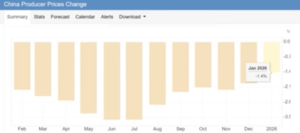
“If we have a look at this table, it shows what’s been happening with producer prices over the past 12 months. And the scale on the right hand side here starts at zero and goes down to minus 4%. And as you can see, in every single one of the past 12 months, Chinese producers have been cutting their prices. This chart is also referred to as the factory gate prices. So this is the price of products when they’re leaving Chinese factories. And the latest data for January 2026 shows that year on year prices were down by 1.4%.”
“If you put that into the context of your economy, if prices were going down by 1.4%, then you’d be very happy as a consumer, because that means that you’re paying less at the tills.”
“But as a company, this is an absolute disaster. Because the reason why we want some form of inflation in the economy is because it allows companies to pass on their cost increases.”
“But if your end price is going down by 1.4%, then clearly you can’t pass on those cost increases. You have to absorb them. And this is why Chinese businesses are seeing their profit margins being wiped out.”
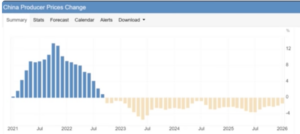
“And if we widen the scale of this chart to show the last five years, you can start to see the scale of the problem in China, because producer prices, factory gate prices have now been falling since May 2022.”
“What we’ve got here is a compounding of year-on-year falls in factory gate prices.”
“We have a look at this table I’ve put together. It shows what the impact of this has been on the sales price for a product. So if we assume that January 2022, which was the last time that we saw a price increase year-on-year in China, if we assume that a product that Chinese company was selling for $100 at that time, this shows what the impact has been on that product. So in the year to January 2023, prices fell by 8% producer prices. So that means that that $100 product would have then been selling for $99.20. In January 2024, the year-on-year fall was 2.5%. So that $100 product would then be have sold would have been been selling for $96.72. In 2025 there was a 2.3% fall in producer prices. So that product by then would have been down to $94.50. And the 1.4% that we’ve just seen posted means that that $100 product that was being sold in 2022 would now be selling for $93.17.”
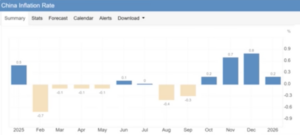
Is this deflation mirrored in Chinese consumer inflation prices? No. “It has been a bit of a mixed story. The scale on the right hand side here goes from 1% positive at the top to 1% negative at the bottom. And as you can see, in six out of the past 12 months, prices did actually fall, but they’ve been increasing over the past four months. And you can see that the latest data that we have for January 2026 shows that year on year prices are up by .2%. So that doesn’t explain the 1.4% fall in producer prices in January 2026.”
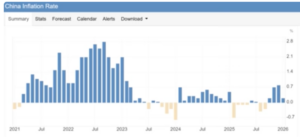
“And we widen the scale of this chart to show the past five years. You can see that whilst there has been a few months where we’ve seen deflation, it’s predominantly been inflation in China. It’s a relatively low level compared to other countries, we’re talking between 1% and 2%. So a lot less than we’ve seen in the West over the past five years. But we’ve still seen prices going up.”
“And if we have a look at this table, it shows what’s happened to prices over the same period. So if we assume the same $100 product in January 2022 that we just looked at for producer prices, in 2023 prices actually went up by 2.1%. So that product would have been selling for $102.10 at that time. We saw deflation in January 2024, which would have brought the price back down to $101.28. In 2025, we saw a year-on-year increase of .5%. So it would have pushed that that price to $101.79. And the most recent data for January 26 of 2% increase tells us that that product would now be selling for $101.99. So an increase in the price.”
“And if we have a look at the comparison between those two tables, then you can see here the producer prices between January 22 and 26, the $100 product has gone from $100 to $93.17. That’s what the companies are receiving for that same product. At the same time, inflation has gone up by 1.99% over that period. That pushed up the price to 101.99. So the gap between those two metrics, what’s been happening with inflation? If producer prices had just been moving at the same rate as inflation, the difference between the two is $8.82 over the past five years. That represents lost profit margin for Chinese businesses over the past five years of 8.6%. So that’s how much profit has been taken out by the fall in producer prices compared to what should have been happening if they were matching inflation.”
“Now why is this happening?”
“Why are Chinese businesses constantly cutting their prices when prices in the domestic market are going up? Well, there’s a number of reasons for it, but one of the main reasons is down to overcapacity.”
“Chinese industry has been gearing up heavily over the past 20 years. So in areas where China believes that it’s strong, it’s put a lot of investment and the government has subsidized a lot of these companies in many situations to enable them to grow rapidly to take a dominant global market position. So we have got some huge businesses in sectors where China has tried to become dominant.”
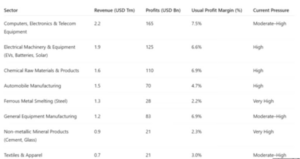
“If we have a look at this table, it shows the different industries in China that are the biggest in terms of revenue and what that should mean in terms of profitability for those businesses.”
“So the biggest sector in terms of manufacturing is computers, electronics, and telecom equipment. So I’m sure you’ve seen lots of different equipment that’s been made in China over the past 20 years. It’s estimated that that sector has revenue of around about $2.2 trillion US, and that should be equating to around about $165 billion of profits. The usual profit margin is around 7.5% for Chinese businesses in those sectors. But those sectors are currently under a lot of pressure.”
“Firstly, we’ve seen its biggest single market, the USA, applying tariffs against Chinese imports. So, that’s causing problems because it’s pushing up the price. And in order to counteract those tariff increases, some Chinese businesses have actually been cutting their cost to absorb some of those tariffs. But also, we’re seeing competition from the rest of the world.”
“So Chinese businesses are constantly slashing their prices to be the cheapest on the shelf because, realistically, that’s why a lot of consumers choose the Chinese option.”
“So that sector is under pressure at the moment. So that’s one of the reasons why those companies are cutting back on their prices.”
“Now another area which is absolutely huge for Chinese businesses is electric vehicles, batteries and solar. So this is an area that China has really specialized in. It’s cornered the market in batteries and solar panels. Most of them are made in China these days. But also electric vehicles. It decided to take a big slice of the global market and those electric vehicles are being sold at very low prices compared to local competition. So if you compare a Chinese electric vehicle the actual list price of that versus things like BMW, Volkswagen, Ford, they are a lot cheaper.”
“That’s one of the reasons why a lot of countries have been applying tariffs on the electric vehicles. So this is aside from Donald Trump’s tariffs. We’re talking about the whole industry globally is saying that it’s not fair that EVs are being subsidized. In terms of revenue, it’s around about $1.9 trillion for China and the usual profit margins around about 7% on that. But they’re under a lot of pressure because of the tariffs. Now a lot of countries are saying that China is trying to put the rest of the world out of business so that it can become completely monopolistic in these areas. So they’re under high pressure, and that’s another reason why Chinese companies are cutting their prices.”
“Jump down to some of the things that are related to property. Look at ferrous metals, which are basically steel. China has some of the biggest steel smelting plants in the world. It’s a big producer of steel. The revenue is about $1.3 trillion. Now the profit margin on steel is wafer thin. 2.2%. And the problem that China has is twofold at the moment.”
“Firstly, a lot of that steel was being sold into the Chinese market for the property market, because the property market over the past 25 years was booming the first 20 years of the 20th century. It was absolutely on fire. Lots of massive property developers like Evergrande were building whole cities all across China and they were using a huge amount of steel to do that. They building these huge tower blocks and you have to put a lot of steel in there.”
“The properties sector has absolutely crashed in China over the past few years, since the government changed the rules and made it more difficult for property developers to borrow money. There hasn’t been anywhere near as much production. So that’s caused a huge drop off in demand in China for steel itself.”
“So that’s meant that Chinese steel businesses have had to look to the export markets. But similar to what’s been happening in the electric vehicle market, a lot of countries, including the USA, have pushed back on Chinese steel imports because they are so cheap that they are killing local steel production. And in the UK, the British government had to recently take over the last virgin steel producer in the UK to make sure that it could actually produce steel that was needed for things like the defense sector. So we’ve seen a major attack globally on the whole steel industry, and lots of countries have pushed back on that.”
“So the steel industry in China is now under a lot of pressure. It’s struggling with regards to demand and those profit margins have been wiped out.”
“But we’ve got a lot of different sectors here that are under intense pressure at the moment from competition. And that’s one of the factors why Chinese businesses are cutting their prices.”
“In addition to that, Chinese businesses are also seeing weak demand at home. Chinese consumers are not buying as much stuff as they used to. So Chinese companies are cutting their prices to try to encourage consumers to keep buying.”
“And as that demand falls at home, what that means is that Chinese businesses are having to depend on the export markets more. So, Chinese companies are struggling with regards to its biggest single market, because the USA has hit all Chinese imports with additional tariffs. So, that’s led to a further cutting of prices and Chinese businesses basically across the board are geared up for high volume, low margin. And when demand starts to fall, then the only thing that you can do is cut your price.”
“Because if you’ve got a huge fixed cost business, if you’ve spent billions building up your business, maybe it’s lots of machinery, you’ve got lots of people, you’ve got huge factories, you need to hit those volume numbers just to keep the wafer thin profit margins going.”
“If demand starts falling, you can’t cut back on your costs because these are very high fixed cost businesses. So what Chinese businesses are doing instead is slashing their prices to maintain their volume of sales. But that is wiping out their profit margins. And that’s why many Chinese businesses, over 50%, are now banking losses.”
“And of course, this is an absolute disaster from the Chinese economy point of view, because it needs those companies to keep contributing to make profits to pay taxes to contribute to GDP in order to hit that 5% GDP total.”
“What we’re seeing from the data that’s just been published is that producer prices are continuing to fall.”
“Inflation is still very, very low in China. Consumer demand is very weak. So China remains dependent on the export markets. Many export markets are pushing back against Chinese imports.”
“Chinese businesses are having to cut their prices, which is further reducing their profit margins. Many have moved into losses, and this is a complete nightmare, vicious circle from many of these companies’ perspective. And I can’t see how they’re going to get out of this situation.”
China’s economy has long been smoke and mirrors all the way down. To be sure, China has made real gains, joining (and gaming) the world economic system just in time to see explosive growth thanks to global trade deals, the container ship era, rampant IP theft, and western capitalists eager to exploit cheap labor. But the rest of the world slowly caught on to China’s tricks, especially since China thought they could get away with belligerent, militarist, expansionist rule-breaking aggression against at the same time it was striving to become the world’s manufacturing hub.
Now that the world’s caught on, people are starting to realize that much of China’s “economic miracle” was an illusion. The opaque banking rules, the government subsidies, the insane “ghost cities” property boom and the regime’s strict currency controls all helped to hide the manipulations, making China’s economy look healthier than it actually is. But now the entire house of cards is tumbling down, and China has no one to blame but itself.
Everyone favors Voter ID except Democrats trying to cling to power, America’s big stick gets bigger, Trump’s tariffs hit a setback at the Supreme Court, another insane tranny shooter, Ukraine recaptures more land from Russia, another Pulitzer Prize winning leftist pedo, more Paxton lawsuits, and a new party rises on the right in the UK.
It’s the Friday LinkSwarm!
On the personal front, I may need to buy a new dryer. We’ll see what the repairman says Monday…
Are voter ID requirements considered a controversial idea in the eyes of US citizens? If you watch the establishment media or follow leaders in the Democratic Party then you might think bills like the SAVE Act are the end of freedom as we know it. However, outside the echo chambers of DNC propaganda, the vast majority of Americans have no problem whatsoever with people proving their US citizenship before they vote in local and federal elections.
The widespread support for voter ID is undeniable. Surveys from the past year including those from Pew and Gallup show that, regardless of party or ethnicity, Americans citizens want elections to be protected from manipulation through mass illegal immigration.
A Pew Research Center survey from August 2025 found that 83% of Americans favor requiring all voters to show government-issued photo ID to vote. This includes:
95% of Republicans
71% of Democrats
Only 16% of people oppose it.
A Gallup poll from 2024 shows 84% support for requiring photo ID to vote, with 98% of Republicans, 84% of independents and 67% of Democrats in approval.
A recent CNN segment featuring number cruncher Harry Enten confirms that the backing for the SAVE Act is also dominant regardless of ethnicity: 85% of white voter, 82% of Latino voters and 76% of black voters all want voter ID. It’s difficult to find many issues which the American public universally supports at this level.
Democrat leaders, however, don’t care that the majority of their own base wants voter ID laws. Party officials and the left-wing media have engaged in a shameless propaganda campaign designed to frighten the public into opposing the SAVE Act, despite their previous platforms defending majority rule.
That’s because they view voter integrity laws as an existential threat to their power. If they can’t cheat, they can’t win…
The big stick gets bigger. “Ford Carrier Group Enters Mediterranean To Join Biggest US Build-Up Since 2003 Iraq War.”
Open source monitors as well as US and Middle East media have confirmed that the USS Gerald R. Ford, the world’s largest aircraft carrier, has entered the Mediterranean Sea, having sailed passed the Strait of Gibraltar on Friday.
This is the second carrier strike group expected to soon operate directly in the CENTCOM area of responsibility, amid the massive military build-up and pressure campaign against Iran. It was sent from the Caribbean earlier this month, extending its planned deployment.
The USS Mahan Arleigh Burke-class destroyer, which is accompanying the USS Gerald R. Ford, is also now crossing the Strait of Gibraltar, maritime tracking analysis shows.
The aircraft carrier will likely take several more days to reach the Middle East and be poised to operate against Iran – so it looks to be in place by start of next week.
According to Bloomberg and other outlets, the US has now amassed the biggest force in the Middle East since the 2003 invasion of Iraq. There is administration talk of “limited strikes” – but clearly Washington is getting ready for all escalation scenarios.
The Supreme Court (6-3 in a majority opinion written by CJ Roberts) has ruled that Trump’s tariffs exceeded his authority.
We decide whether the International Emergency Economic Powers Act (IEEPA) authorizes the President to impose tariffs.
***
The President asserts the extraordinary power to unilaterally impose tariffs of unlimited amount, duration, and scope. In light of the breadth, history, and constitutional context of that asserted authority, he must identify clear congressional authorization to exercise it. IEEPA’s grant of authority to “regulate . . . importation” falls short. IEEPA contains no reference to tariffs or duties. The Government points to no statute in which Congress used the word “regulate” to authorize taxation. And until now no President has read IEEPA to confer such power. We claim no special competence in matters of economics or foreign affairs. We claim only, as we must, the limited role assigned to us by Article III of the Constitution. Fulfilling that role, we hold that IEEPA does not authorize the President to impose tariffs.
Trump says he has alternative means to impose tariffs. “Effective immediately, all national security tariffs under Section 232 and existing Section 301 tariffs remain in place… Today, I will sign an order to impose a 10% global tariff under Section 122 over and above our normal tariffs already being charged.”
In the past 12 months (January 2025 to January 2026) there are fewer foreign-born workers employed and more native-born workers in jobs. The time period roughly corresponds to the first year of Pres. Trump’s second term.
The murder-suicide at a Rhode Island hockey rink on Monday is just the latest in a recent string of murders allegedly carried out by self-identifying transgender perpetrators or by those seemingly inspired by transgender ideology.
Robert Dorgan — who police say shot and killed his ex-wife and one of their sons during a high school hockey game this week — had previously insisted he believed he was actually a transgender woman despite being a man. A local TV station said that “An unnamed woman, who identified herself as Dorgan’s daughter, has since come forward, telling WCVB that her father ‘has mental health issues.'”
“He shot my family and he’s dead now,” she reportedly said. Dorgan, who killed himself after the murders on Monday, had also expressed pro-Nazi sentiments, and according to The New York Post, was adorned with “vile neo-Nazi tattoos.”
He is only the most recent example of high-profile attacks linked to transgender perpetrators or transgender ideology, including mass shootings at Christian schools, the assassination of Charlie Kirk, and the attempted assassination of Supreme Court Justice Brett Kavanaugh.
Progress: “Major Manhattan Hospital, Massachusetts Health Care System End ‘Gender-Affirming Care’ for Minors.”
Setback: “Judge Orders California Hospital to Resume Gender Transition Procedures for Minors.” Democrats seem to love mutilating children too much to give it up.
“Kansas’ governor vetoed a bill that banned men from the women’s room. The legislature overrode her.” “Even in an uber-red state, Democrat governors are still going to toe the party line.”
Scott Pinkser thinks Trump’s deal with India spells doom for the Russian economy, because they won’t allow those shadow fleet tankers to continue on to China. Quoting Peter Zeihan:
If the Russians have lost their single largest source of income, that will manifest on the battlefield. The Chinese may be supplying the Russians with all the gear that they can pay for, but the key thing there is: pay for.
And if the Russians can’t [pay], then a drone war where the Russians can’t get enough drones is one where the Russians start losing territory.
Price of cucumbers double in Russia. I’m mildly fascinated by those per-country yearly cucumber consumption numbers. 12 kilograms about 26 pounds a year, which doesn’t seem high if you’re including pickles, as that’s only one small jar of pickles every other week. But China’s 55 kilograms a year works out to two pounds a year per person. That’s a lot of damn cucumbers…
Democracy dies in protecting sex offenders that check the right boxes:
Wow I missed that Wesley Lowrey, the ex-WaPo reporter who won a Pulitzer and wrote a famous editorial urging journos to forgo objectivity in lieu of ‘moral clarity,’ was chased out of his journalism professorship for multiple sexual assault allegations.
Attorney General Ken Paxton is suing Dallas officials, accusing them of defying a voter‑approved mandate to boost police funding under Proposition U.
Proposition U, approved by Dallas voters in November 2024, amended the city charter to require at least 50 percent of “excess” annual revenue be directed to public safety. The charter language earmarks those dollars first for the Dallas Police and Fire Pension System, then for increasing officer pay and growing the force to at least 4,000 sworn officers.
Paxton’s lawsuit, filed in a Dallas County district court, targets the City of Dallas, City Manager Kimberly Bizor Tolbert, and Chief Financial Officer Jack Ireland Jr. for allegedly underfunding public safety in violation of the charter.
The attorney general argues that city officials “acted beyond their legal authority” by using an improper calculation of excess revenue that drastically reduced the amount legally owed to police priorities.
For the 2025–26 fiscal year, the city’s own projections reportedly show about $220 million in excess revenue above the prior year. But Ireland told the Dallas City Council that excess revenue totaled only $61 million—roughly a quarter of that amount—after excluding large categories of city income from the calculation.
Paxton’s filing notes that the city did not cite any state or federal law restricting the use of the excluded revenue, which would be required to legally omit those funds from the Proposition U formula.
Because of this narrower calculation, the proposed city budget allocates far less money to police pensions, officer pay, and hiring than voters required, Paxton says. The lawsuit contends that Dallas’ current hiring plan leaves the department hundreds of officers short of the 4,000‑officer minimum mandated in the charter amendment.
Paxton’s lawsuit also points to another provision of Proposition U that city officials allegedly ignored altogether. The charter requires Dallas to hire an independent third‑party firm each year to conduct a police compensation survey comparing Dallas officer pay and benefits to those of other major North Texas departments.
According to information obtained by the state, no such survey was conducted, despite the charter’s mandatory language. That failure, Paxton argues, makes it impossible for city leadership to honestly claim they are meeting the voter‑approved requirement to make Dallas police pay competitive in the region.
Blue city functionaries hate funding the police because the hard left can’t get any of their sticky fingers into that pile of money…
Two former Harris County Tax Office employees and two local business owners are facing first-degree felony charges in connection with what authorities say was a coordinated vehicle registration fraud operation.
Court filings allege the group worked together to process registrations and title transfers that bypassed required state safeguards, collecting bribes in exchange for pushing transactions through the system.
Adriana De La Rosa, 43, owner of Bella’s Multiservices in South Houston, has been arrested. Oswaldo “Oz” Perez, 51, who is affiliated with the same business, remains wanted.
Former tax office employees Sarah Ambria Anderson, 31, and Renisha Touche Wilkins, 35, were also charged. Both were dismissed from their positions in April 2024.
Investigators allege the activity centered on the Scarsdale branch of the Harris County Tax Office, where nearly 200 questionable transactions were processed. According to reporting from KPRC 2, the employees allegedly accepted cash and gifts in exchange for overriding verification requirements tied to insurance coverage, emissions inspections, and residency. Some vehicles were allegedly coded as tax-exempt, allowing customers to avoid paying required fees.
Authorities further allege that Anderson charged approximately $300 per transaction and transported paperwork in a personal binder to avoid detection.
The case reportedly began after employees in another Texas county noticed Bella’s Multiservices promoting vehicle registration stickers on TikTok and Facebook. Social media posts advertised expedited service and claimed inspections were not necessary. That tip prompted an internal review, which eventually led to a criminal investigation.
This is not known as “keeping a low profile.” One wonders if they might also be charged as accessories for Grand Theft Auto.
The first priority is to control who comes to our country, and more importantly, who stays in our country. Restore Britain will not just stop mass immigration; we will reverse it.
Every single illegal migrant will be securely detained, and then deported. The message will be unrelenting: If you are in this country without permission, you will be removed. For the foreseeable future, far more people must leave Britain than arrive.
If a foreign national is unable to speak English, lives in social housing, claims benefits, refuses to work, fails to integrate, commits crime, or even actively hates our way of life and wishes to do us harm, then they must leave, or be made to leave…
Restore Britain will make our communities safe again for women and children. That I promise you. If that means millions go, then millions go.
We’re constantly told that the economy needs vast swaths of low-skilled migrants. We know that’s simply not true. What we need is to get millions of healthy Brits back into work – a radical overhaul of how welfare is delivered. Protecting those in genuine need, but not funding healthy shirkers to live off the back of hard working men and women. If you can work, you must work. It really is that simple.
There seems to be a lot of enthusiasm for Restore Britain, given their willingness to tackle the illegal alien invasion head on. The irony is the reform leader Nigel Farage looks poised to go from a fringe figure on the right to being ,i>outflanked on the right without ever being elected Prime Minister…
The face of evil: “This Karen called CPS on students’ parents because they chartered a TPUSA chapter at school…A liberal woman in Maryland, Nancy Krause, is facing mass calls to be charged after she weaponized CPS against Calvert County high school students for starting a TPUSA chapter at their school.”
I hope they sure her for every penny she has, and then some.
Stephen Colbert and James Talarico are lying about Trump blocking an interview. CBS merely told Colbert there were equal time considerations for such an interview, and that he might have to interview other Texasw Democratic senate candidates like Jasmine Crockett.
After text messages obtained by news media appeared to corroborate prior reports alleging that U.S. Rep. Tony Gonzales (R-TX-23) engaged in a relationship with his now-deceased regional director, Regina Ann Santos-Aviles — which would violate U.S. House rules — her husband has now come forward in a tell-all interview affirming the claims.
Gonzales, however, continues to deny the allegations and now says he is being “blackmailed” following a settlement request from the husband’s attorney.
Santos-Aviles died months after her husband discovered the affair and confronted Gonzales in what authorities ruled a suicide by self-immolation.
The story has set off a bombshell of controversy, with the most recent evidence being released at the beginning of early voting for the March primary election, where Gonzales faces three challengers in the GOP primary.
Santos-Aviles served as Gonzales’ regional director based in Uvalde, overseeing constituent affairs across 11 of the congressional district’s 23 counties near Texas’ southern border.
Emergency responders found her in the backyard of her home on the night of September 13. A gasoline can was nearby where she laid severely burned. She was taken to the hospital, where she was pronounced dead the next day.
News of the affair was first reported by Current Revolt, which was met with silence by Gonzales until an interview with the Texas Tribune wherein he claimed the reports were not true.
Fast forward, and the San Antonio Express News obtained text messages between Santos-Aviles and another former staffer that purportedly show her writing,“I had an affair with our boss.”
This prompted Gonzales’ main opponent in the GOP primary, Brandon Herrera, to call for his resignation, saying an affair would have violated House rules.
“Tony Gonzales must resign. He not only broke House ethics rules by having an adulterous affair with a member of his congressional staff and by using taxpayer money to fund the affair, but he also broke trust with the public by insisting that the initial reporting of the affair was false,” Herrera wrote in a press statement.
Speaking of Texas politicians behaving badly, here’s a story that doesn’t cover anyone in glory.
After personal details about U.S. Rep. Wesley Hunt were posted online by a senior John Cornyn advisor, the Houston Republican has filed a police report documenting what some are describing as a possible crime under federal or state law.
Cornyn advisor Matt Mackowiak posted images of documents late last week that purportedly listed Hunt’s address, Texas driver’s license number, and the last four digits of his Social Security number. What Mackowiak seems to have designed as a last-minute attack on Hunt has turned a spotlight on Cornyn’s struggle to remain relevant with Texas voters ahead of the March 3 Primary Election.
Mackowiak, who runs Save Austin Now and was head of the Travis County GOP, is someone I know casually. We followed each other on Twitter before my suspension there, and we’ve bumped into each other at various events. As a political consultant/head of Potomac Strategies Group, Mackowiak has worked for some pretty squishy, swampy Republicans.
Cornyn is being challenged by Attorney General Ken Paxton and Hunt for the GOP nomination. Most public polling has consistently shown Paxton leading the field, followed by Cornyn and Hunt. Recent polls have shown Hunt closing that gap. The “doxxing” of Hunt by a senior Cornyn advisor has led some to suggest that perhaps the incumbent’s polling is even worse.
“The only reason you direct fire at someone behind you in the polls is you thinking their momentum will overtake you,” explained a political consultant not working the race. “Whether Cornyn is worried or not, Mackowiak’s actions make their campaign look desperate.”
Yeah, that was pretty stupid of Mackowiak. His post was evidently designed to ding Hunt over some provisional ballot he wasn’t entitled to file in 2016, and frankly my care meter isn’t even twitching. A three-term incumbent attacking a third place candidate does indeed reek of desperation. That said, in my (admittedly limited) understanding of federal laws on personally identifiable information is that none of that stuff quite qualifies as actual PID, so the Hunt campaign is probably going to see that criminal complaint dismissed.
In one of his more unanticipated endorsements, Trump threw his support behind Republican candidate Alex Mealer in her bid for Congressional District (CD) 9, against state Rep. Briscoe Cain (R-Deer Park) and seven other GOP primary candidates.
The district, currently held by U.S. Rep. Al Green (D-TX-9), was heavily impacted by the GOP-favored redistricting map that passed the Texas Legislature during the summer of 2025 — legislation initiated at the White House’s request and voted for by Cain in the Texas House. CD 9 is one of the five congressional districts expected to flip from blue to red in 2026, with a majority of the current CD 9 folded into the new boundaries of the Democratic stronghold of CD 18, where Green is now running instead.
Trump stated in his endorsement of Mealer, “A West Point Graduate, and Combat Decorated Army Bomb Squad Officer, Alex knows the Wisdom and Courage required to Defend our Country, Support our Military/Veterans, and Ensure PEACE THROUGH STRENGTH.”
Cain was supported by Trump for re-election to the Texas House in a mass endorsement issued by the president for House Republicans who voted to pass education savings accounts legislation. The endorsement did not include any members’ pursuit of an alternative office.
According to a recent survey, Mealer leads the Republican primary for CD 9 with 34 percent of the vote, followed by Cain at 26 percent. When the poll was taken there were 10 candidates in the race, but one, Dwayne Stovall, ended his campaign on Tuesday and endorsed Dan Mims.
Among the other endorsements announced by Trump via Truth Social posts on Monday night was for Jon Bonck in his bid for CD 38, left open by U.S. Rep. Wesley Hunt’s (R-TX-38) run for U.S. Senate against incumbent U.S. Sen. John Cornyn (R-TX) and Texas Attorney General Ken Paxton in the Republican primary.
Bonck is up against nine other Republican candidates, including businesswoman Shelly deZevallos, businessman Larry Rubin, and Tomball Independent School District President Michael Pratt. The district’s partisan makeup did not alter after redistricting, remaining at R-65%, per The Texan’s Texas Partisan Index (TPI).
“Jon Bonck is an incredible Candidate,” Trump said in his endorsement.
“He is supported by many MAGA Patriots, including Senator Ted Cruz [(R-TX)], Congressmen ‘Doc’ Ronny Jackson [(R-TX-13)], Brandon Gill [(R-TX-26)], Jim Jordan [(R-OH-4)], and Tim Burchett [(R-TN-2)], among others.”
“A successful Business Executive, Jon knows the America First Policies required to Create GREAT Jobs, Cut Taxes and Regulations, Promote MADE IN THE U.S.A., Unleash American Energy DOMINANCE, and Champion our Nation’s Golden Age,” Trump added.
Trump also endorsed Carlos De La Cruz, brother of Congresswoman Monica De La Cruz (R-TX-15), in his bid for CD 35. The district is currently represented by U.S. Rep. Greg Casar (D-TX-35), but went from a TPI rating of D-70% to R-55% due to redistricting — drawing in a number of Republican candidates eyeing the new GOP-favored seat.
“A Brave, 20 Year Air Force Veteran, and now, as a successful Businessman, Carlos has a Proven Record of Success — He is a WINNER!” Trump posted.
“In Congress, Carlos will work tirelessly to Grow the Economy, Promote our Amazing Farmers and Ranchers, Cut Taxes and Regulations,” he continued, with similar language used in his several other endorsements that night.
He also endorsed in the race to replace retiring U.S. Rep. Morgan Luttrell (R-TX-8), throwing his support behind attorney Jessica Hart Steinmann, who served as the director for the Office of Victims of Crime in the U.S. Department of Justice during Trump’s first presidential term.
Steinmann, now with an edge up, is running in a field with five other Republican candidates, including U.S. Army veteran Nick Tran, Deddrick Wilmer, Jay Fondren, and Stephen Long. Businessman Brett Jensen suspended his campaign following Trump’s endorsement.
Trump said of Steinmann, “As a former appointee in my First Term, and now, as a Highly Respected Attorney, Jessica continues to prove that she has the Wisdom and Courage necessary to uphold our Constitution, and ensure LAW AND ORDER.”
Good news: “The Department of Veterans Affairs (VA) announced that the VA will no longer report veterans to the FBI’s National Instant Criminal Background Check System (NICS) solely because they have been assigned a fiduciary to assist them with their finances. Further, the VA is working with the FBI to remove all the names of veterans who have been unjustly reported to NICS under this guise.
Former Democratic Presidential candidate Jesse Jackson died. Oddly enough, President Trump had good things to say about him.
Well, I didn’t know Jackson, so I’ll always consider him a race-hustling poverty pimp who ran a shakedown operation. He’s probably among the five people most responsible for strained race relations in modern America, behind Obama, George Soros, Al Sharpton and Ibram X. Kendi.
Less frequently recalled is the distress Jackson’s rise caused within the American Jewish community during the 1980s. For many identifiable Jews, and especially for Orthodox Jews, his candidacy was not merely another political development but a moment of rupture. His reference to Jews as “Hymie” and to New York City as “Hymietown” was not dismissed as a careless aside. It was recognized as an anti-Jewish slur, and it left a lasting mark, even becoming the subject of an Eddie Murphy Saturday Night Live skit that captured the moment with uncomfortable precision, as comedy often can.
The episode revealed how quickly old language could reemerge, even from figures celebrated as moral leaders within liberal politics. Jackson’s campaigns compelled Jewish institutions to confront questions about alliance, dignity, and communal security that they had long preferred to manage discreetly. They did more than provoke private discomfort; they produced public argument. On the pages of Jewish newspapers, the debate unfolded in real time, week by week, as each issue went to print, and it was not confined to the usual institutional voices. Orthodox writers, in particular, entered the conversation with a directness that many establishment Jewish leaders found unwelcome but that the moment required.
Three figures responded with unusual clarity. Rabbi Emanuel Rackman, writing in The Jewish Week; Dr. Marvin Schick, writing in The Jewish World; and Rabbi Meir Kahane, writing both in The Jewish Press and in the periodical Kahane: The Magazine of the Authentic Jewish Idea all confronted the Jackson candidacy directly. Each treated Jackson’s candidacy not as an isolated controversy but as a diagnostic moment, asking what it revealed about Black-Jewish relations, the credibility of coalition politics, and the judgment of Jewish leadership itself. They disagreed about almost everything, but they shared one conclusion: The assumptions that had governed Jewish political alliance since the 1960s were beginning to fray.
The desire of western liberal elites to import unassimilated Muslims into the country would pretty much break those assumptions apart.
Dallas officials aren’t the only ones Paxton sued this week: “Texas Sues Temu for Deceptive Marketing and CCP‑Linked Data Harvesting.”
Attorney General Ken Paxton is escalating his campaign against China‑linked tech companies, filing a new lawsuit targeting one of the most downloaded shopping apps in the United States, Temu.
Paxton’s suit names PDD Holdings, Inc. and WhaleCo Inc., the companies behind Temu, alleging they deceptively market the platform as a simple discount marketplace while secretly using it as a vehicle for aggressive data harvesting.
Though PDD moved its principal executive offices from Shanghai to Dublin, Ireland, it still maintains significant operations in China, and Temu has rapidly grown to more than 80 million active users in the United States as of late 2023.
According to the lawsuit, the Temu app is not just a shopping tool—it runs “dangerous software functions” that are “completely inappropriate” for a normal e‑commerce platform.
Paxton characterizes Temu as a digital “trojan horse” capable of bypassing security protocols and creating backdoor access into a user’s private data, all while presenting itself as a harmless way to buy “affordable great products.”
The attorney general alleges that when Texans use Temu, they are unknowingly exposing themselves to a serious digital security threat.
The Temu security threat has been known for a while. Security-aware shoppers will have to forgo such great products as this:
Kurt Schlichter has a word of warning to dog-hating Muslims thinking of moving to the west:
2/16/26 – On Dogs And Those Who Hate Them
Some of us have lived in Muslim countries and understand how they treat dogs, @jaketapper. During one of my deployments, we had to inform the locals, in no uncertain terms, that no, they would not conduct their annual dog cull. In other… https://t.co/eVWowrKwkH
“This is not open to debate. We’re going to keep our dogs as we always have. If you come to our civilization, you’re going to respect our pets, or there’s going to be trouble. John Wick is the moderate position on this issue.”
A fungus among us: “Dangerous superbug spreads in US hospitals…Candida auris infections reported in more than half of US states as healthcare facilities struggle with containment.”
“Western Digital is completely sold out of hard drive production capacity through 2026 due to massive demand from—” (You know exactly what’s coming next, don’t you?) “—AI data centers.”
Microsoft’s AI CEO is joining a chorus of executives who say they anticipate widespread job automation driven by artificial intelligence.
Mustafa Suleyman, the Microsoft AI chief, said in an interview with the Financial Times that he predicts most, if not every, task in white-collar fields will be automated by AI within the next year or year and a half.
“I think that we’re going to have a human-level performance on most, if not all, professional tasks,” Suleyman said in the interview that was published Wednesday. “So white-collar work, where you’re sitting down at a computer, either being a lawyer or an accountant or a project manager or a marketing person — most of those tasks will be fully automated by an AI within the next 12 to 18 months.”
The CEO said the trend is already observable in software engineering, in which employees are using “AI-assisted coding for the vast majority of their code production.”
“It’s a quite different relationship to the technology, and that’s happened in the last six months,” he said.
I really, really doubt that. AI has been able to do surprisingly well on a number of programming tasks mainly because it was created by programmers. It’s no wonder that it should be good at something like, say, creating a program to ingest JSON REST data into an SQL database. But the further you get from technical domains, the further you’re getting from people who can correct the AI when it gets things wrong.
Not every white collar employee is absolutely necessary, but as a class they possess the vital wells of institutional knowledge that lie beyond the datasets AI have been trained on. They also understand exception handling, knowing what to do when things go wrong. AI systems generally do poorly when faced with input combinations they’ve never seen before, which is why you have those videos of dozens of Waymo taxis blocking roads in clumps.
Also, given how zealously IT teams work to secure company data, are they really going to just blithely set AIs loose in their databases? Especially when their jobs may be among the ones target for elimination? Especially when AI is still prone to notorious hallucinations?
There are places where where AI might replace experts, namely those that use wide but highly structured datasets for narrow decision points, like some areas of regulatory law. But are decision makers really going to remove the ability to blame underlings for mistakes? “Sure we lost $100 million, but the AI told me it was OK!” is probably not going to wash as an adequate ass-covering maneuver. And, as I noted before, who is going to put an AI in charge of Accounts Payable when a single glitch could drain your entire bank account?
Plus there are entire classes of white collar jobs (sales comes to mind) where I don’t see AI making any headway replacing the fleshy incumbents.
Second, even where AI might effectively replace some humans, I don’t see companies letting Microsoft AIs in the front door. Copilot is a product people hate so much that current users won’t even turn it on even though they’re getting it free. Maybe Microsoft will make money getting in the back door via investments in OpenAI and Anthropic, but I doubt that’s going to reflect glory on Mustafa Suleyman.
But finally, let’s assume that his prediction is true and that most white collar jobs will be automated out of existence in the next 18 months. Just how does Microsoft expect to profit in the inevitable widespread economic collapse? If you think New York City’s trajectory is dire under Mandami now, how much direr is it going to get when vast swathes of people who pay the most taxes (and buy the most stocks) lose their income almost overnight? The subprime meltdown will look like a cakewalk in comparison when everyone starts selling their investment holdings just to pay for food and rent.
And if it’s known that the big AI companies are the direct causes of their immediate penury, how are such grandees going to protect themselves from the fury of the newly unemployed mobs? There were probably just a few thousand of Ned Ludd’s boys smashing mill machinery in early 19th century England. If Suleyman’s prediction came to pass, there would be what, 30 or 40 million people hurled into unemployment at the same time? In that sort of environment, thousands of Luigi Mangiones would bloom. And if it’s a global phenomena, neither the French Riviera nor Davos will be safe from the fury of the mobs. And that’s assuming congress doesn’t step in with something like the Execute Mustafa Suleyma Live On National Television Act.
So I’m reasonably certain that Suleyman’s prophecy will not come to pass. (Wait, a Microsoft CEO’s predictions turning out to be wrong? What are the odds?)
And anyway, if his prediction does have a chance of coming true, the best move isn’t investing in Microsoft, it’s investing in canned goods and ammunition…
A bunch of AI-related news has popped up this week, so let’s do a roundup.
Some AI companies are complaining that TSMC is killing the AI boom by not expanding rapidly enough:
Asianometry notes that TSMC’s caution at expanding is amply justified by the boom-and-bust nature of the semiconductor industry:
“I’m hearing many similar views in the Silicon Valley Borg that TSMC is the break or limiter on the AI boom, as if they’re the reason why we don’t have AGI yet. Because they didn’t and still don’t believe.”
“If we can ever say that a company that spent $41 billion on capital expenditure in 2025, with another $53 to $56 billion in 2026 planned, is sitting on its hands, doing nothing.”
“TSMC having 90% share of the AI chip market looks pretty unhealthy. That should go down and it will. Samsung seems to be doing well so far.”
“The cold, hard reality is that shortages are a fact of life in semiconductors, as are horrific gluts.”
“What we are flippantly labeling as TSMC we really mean is the AI supply chain. And that supply chain is as complicated as you can possibly imagine. Like an iceberg, it looks big enough on the surface of the water, but goes way far deeper underneath. TSMC has thousands of suppliers in two categories: Equipment like the famed ASML lithography tools and materials like photoresist, silicon wafers, acid etch gases and so on. These are not generalized tools and materials. They are not fungeible like AWS compute units.”
“And then there are the memory guys. You cannot ship an AI system without memory. DRAM and NAND. Nvidia’s AI chips use a special form of DRAM called high bandwidth memory, and they use quite a lot of it. The memory industry is just as consolidated as the logic industry, with the major players being Samsung, SK Hynix and Micron.”
“The chip guys are last to know when the party is getting started, but first they get batoned in the face when the police shut things down.”
He points out that semiconductor manufacturers have log supply chains. He uses a different metaphor (the beer distribution game, or a bullwhip), but back when I was working at Applied Materials, it was described as trains linked together with slinkys. First software takes off, then hardware gets yanked along, then the chip manufacturers get yanked, and then, finally, semiconductor equipment manufacturers get yanked into motion, and shortly after that happens, the bust hits the front of the train, and the trailing cars all crash into each other. It’s a regular boom/bust cycle.
“From 1961 to 2006, electronics consumption in the United States grew positively but with wild volatility swings between 0 to 20%. But for the semiconductor makers, that translates to swings anywhere from 20% to 40%. And for the equipment makers, it is amplified even more, plus or minus 60%. The whip hits particularly hard in the semiconductor industry because of the industry’s long lead times. It takes 4.5 months to fabricate and package a chip. It takes 18 months to 2 years to build a fab. Meaning from shovels down to producing chips, and it takes 12 to 18 months to produce and install something like an EUV machine into the fab. Another 6 months before that machine actually starts patterning wafers.”
“Long lead times mean having to make very long demand forecasts, which leads to extreme volatility swings during up and downturns even if those up or downturns are relatively small.” People forget that in 1998, during the time we now think of as the DotCom Boom, there was a small semiconductor downturn that had Applied Materials forcing employees to take unpaid leave.
“ASML just reported 2025 earnings, and we see the bullwhip in full effect. TSMC raised capital expenditure 35% but ASML announced €13.2 billion of net new bookings. Analysts had expected just €6.32 billion. This is because ASML collected orders not just from TSMC, but also Samsung, Intel and the memory guys. When it rains it pours, right? Again, this is why I fear that another AI foundry would not mean our compute shortage is solved, because ultimately, when those foundries start scaling their capacity, they all go to the same suppliers.”
He goes over how car manufacturers cancelled orders during Flu Manchu, and then scrambled when the economy took off afterwards. “TSMC was trying to discern between double booked orders and real demand, which is not an uncommon experience for them. Customers lie about their own demand all the time, or at least we can say that they are eternally optimistic. TSMC tried to respond in 2022. The Taiwanese giant poured $36 billion into capital expenditure. They went to their suppliers and pushed like no tomorrow.”
“It turned out those customers really were double booking orders and artificially inflating demand. When the macro environment turned in 2022, the automotive, smartphone, and PC chips that were so hot during the COVID era fell out of vogue and customers started cutting orders.”
“Meanwhile, deeper down in the supply chain, TSMC and the rest of the semiconductor industry were getting bullwhipped by COVID hangover. Utilization at TSMC’s multi-billion dollar N7 fabs crashed, Semi analysis wrote in April 2023. Now, Semi analysis data indicates that the 7nm utilization rates were below 70% in Q1. Furthermore, Q2 gets even worse with 7nm utilization rates falling to below 60%. This is primarily due to weakness in both smartphones and PCs, but there is a broader weakness in most segments. A fab’s break even utilization rates are about 60% to 70%. So those N7 Taichung fabs were taking financial losses potentially on the order of hundreds of millions, maybe even billions. The financial burdens of low utilization are another reason why I’m skeptical another AI foundry could have rushed into the AI chip fray to save the day.”
He says that Intel incurred losses during this period due to an unnecessary fab expansion, which is probably true, but that was a secondary factor next to their longer running problem of getting their process wrong.
“ChatGPT was released in November 2022, and that kicked off a massive increase in capex amongst the hyperscalers in particular, but it sure seems like TSMC didn’t buy the hype. That lack of increased investment earlier this decade is why there is a shortage today and is why TSMC has been a de facto break on the AI buildout/bubble.”
“I recall news in mid 2024 of TSMC struggling with CoWoS capacity bottlenecks and yield problems, including one design issue that caused cracks in the Nvidia chips packaging.” CoWoS is Chip on Wafer on Substrate, which involves fabbing an interposer as a substrate for faster connections between your processing chips and memory.
“I also recall news in late 2024 noting how the vendors in charge of making the server racks for Nvidia’s Blackwell servers struggled with overheating, liquid cooling leaks, software bugs, and connectivity issues. Such technical difficulties delayed server deployment until early to mid 2025, creating a weird situation for several months where TSMC was pumping out chips that just went into storage. So that gated things, because you don’t scale until you first fix the technical problems.”
Then there’s the power-scaling issue, which is a whole ‘nuther can of worms.
There’s a lot of talk about a SaaSpocalypse going on thanks to a new AI tool. (SaaS is “Software as a Service.” Instead of hosting your own payroll or sales-tracking or whatever servers, you hire a company that already has cloud software setup to do it and you just tie into that, which can considerably reduce startup costs. A whole lot of successful new tech companies over the last decade plus have been SaaS companies.)
The software sector was jolted overnight with what analysts are calling a “SaaSpocalypse” — a sudden and severe selloff triggered by new artificial intelligence tools unveiled by US AI startup Anthropic. The episode has sharpened investor fears that AI is no longer merely helping software companies but may now begin replacing them.
Anthropic has expanded its enterprise AI platform, Claude Cowork, by launching 11 new plugins aimed at automating a wide range of professional tasks. Claude Cowork is an agentic, no-code AI assistant built for corporate users, allowing companies to automate workflows without writing software. The new plugins are designed to handle tasks across legal, sales, marketing and data analysis functions. The most recent addition is Anthropic’s Claude Legal agent, which can perform routine legal work such as document and contract review, and compliance checks.
Anthropic has said that the tool does not provide legal advice and that all AI-generated outputs must be reviewed by licensed attorneys. Even so, the breadth of automation signals a step change in how much white-collar work AI systems can now perform.
Productivity — Manage tasks, calendars, daily workflows, and personal context
Enterprise search — Find information across your company’s tools and docs
Plugin Create/Customize — Create and customize new plugins from scratch
Sales — Research prospects, prep deals, and follow your sales process
Finance — Analyze financials, build models, and track key metrics
Data — Query, visualize, and interpret datasets
Legal — Review documents, flag risks, and track compliance
Marketing — Draft content, plan campaigns, and manage launches
Customer support — Triage issues, draft responses, and surface solutions
Product management — Write specs, prioritize roadmaps, and track progress
Biology research — Search literature, analyze results, and plan experiments
A lot of those are already automated elsewhere, but I suspect a lot accountants and paralegals just felt a goose strut across their grave. On the other hand, who is really going to turn over, say, Accounts Payable to an AI? One glitch, and your entire bank account is drained…
If it works (a big if, give so many AIs are prone to hallucinations), this is potentially good news for Anthropic and the companies using their tools, and bad for SaaS companies and the employees currently doing those jobs.
I note there’s no plugin for technical writing…yet.
And Google Cloud ended 2025 at an annual run rate of over $70 billion, representing a wide breadth of customers, driven by demand for AI products.
We’re seeing our AI investments and infrastructure drive revenue and growth across the board. To meet customer demand and capitalize on the growing opportunities we have ahead of us, our 2026 CapEx investments are anticipated to be in the range of $175 to $185 billion.”
Remember how Nvidia was going to invest $100 billion in OpenAI? Yeah, not so much.
In September 2025, Nvidia and OpenAI announced a letter of intent for Nvidia to invest up to $100 billion in OpenAI’s AI infrastructure. At the time, the companies said they expected to finalize details “in the coming weeks.” Five months later, no deal has closed, Nvidia’s CEO now says the $100 billion figure was “never a commitment,” and Reuters reports that OpenAI has been quietly seeking alternatives to Nvidia chips since last year.
Reuters also wrote that OpenAI is unsatisfied with the speed of some Nvidia chips for inference tasks, citing eight sources familiar with the matter. Inference is the process by which a trained AI model generates responses to user queries. According to the report, the issue became apparent in OpenAI’s Codex, an AI code-generation tool. OpenAI staff reportedly attributed some of Codex’s performance limitations to Nvidia’s GPU-based hardware.
After the Reuters story published and Nvidia’s stock price took a dive, Nvidia and OpenAI have tried to smooth things over publicly. OpenAI CEO Sam Altman posted on X: “We love working with NVIDIA and they make the best AI chips in the world. We hope to be a gigantic customer for a very long time. I don’t get where all this insanity is coming from.”
Microsoft’s Copilot chatbot has become central to its artificial-intelligence strategy as the company’s close partnership with OpenAI diminishes. But the effort to build it up as a ChatGPT alternative has been tough going.
Confusing brand positioning and interoperability problems have frustrated users, current and former employees who have worked on Microsoft’s AI products said.
Interoperability problems? With a Microsoft product?
Only a small proportion of subscribers to Microsoft’s enterprise suite use Copilot, and the percentage who favor it over Google’s Gemini or other tools has decreased in recent months, according to data reviewed by the Journal.
The stakes are high for Microsoft because Copilot is core to a push by Chief Executive Satya Nadella to transform Microsoft into an AI-first company, much as he transformed it into a cloud-first company around a decade ago. Copilot is one of Nadella’s top priorities, current and former executives said.
Microsoft shares tumbled after its earnings report last week sparked investor concern that growth in its most important unit, the Azure cloud-computing business, is slowing, and that its AI business is reliant on OpenAI while Copilot remains unproven. Shares fell nearly 3% Tuesday amid a slide in software stocks prompted by fresh concerns that AI tools will make enterprise subscriptions less necessary.
For other AI companies, we merely suspect they’re evil. For Microsoft (and Google), we already know they’re evil…
Statistics show that, one year into Donald Trump’s second term, the economic lassitude of the Biden Recession is still weighing down the American economy, as it isn’t creating jobs.
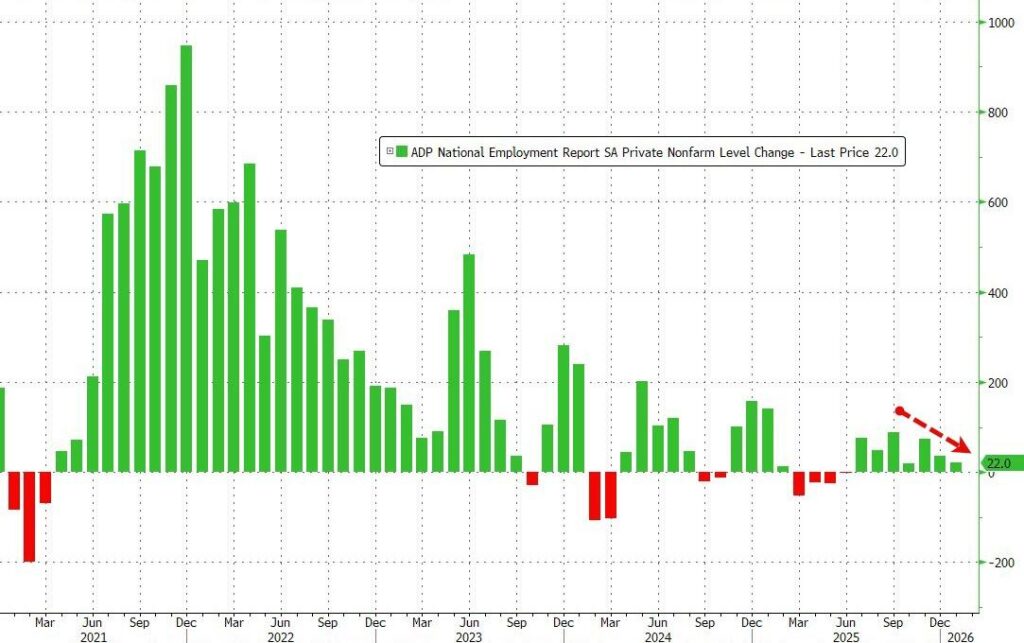
While we will not be getting the payrolls report this week (due to a very brief govt shutdown), ADP’s Employment report paints a poor picture for hiring (even if jobless claims paints a healthy picture for ‘not firing’) adding just 22k jobs (well below the 45k expected).
22 thousand jobs isn’t even a dead cat bounce, it’s a rounding error. And the low jobless claims are just because most of the workers fired/laid off during the Biden Recession have run out of eligibility.
Goods producing firms added just 1k jobs (Construction +9k, Manufacturing -8k – which has lost jobs every month since March 2024) while Services firms saw only 21k jobs added (with health care a standout, adding 74k job, while Professional Services lost 57k jobs).
“Job creation took a step back in 2025, with private employers adding 398,000 jobs, down from 771,000 in 2024,” said Dr. Nela Richardson Chief Economist, ADP.
Interestingly, small firms saw job additions while large firms saw job losses…
We’re not seeing the massive manufacturing job losses critics of President Trump’s tariffs predicted, but we’re also not yet seeing any gains from the lowering of foreign tariffs.
Job seekers are discouraged by a plague of ghost job listings intended to provide the illusion of growth, with no intention of anyone ever being hired.
Inflation is low, yet consumer confidence is at the lowest level in more than a decade. Stocks are booming, yet no one seems to be hiring. (This seems to be my personal experience as well.) Trump and congressional Republicans have managed to lower taxes, yet the “animal spirits” of the American economy do not seem like they’re been unleashed.
Is AI eliminating jobs? Maybe, especially in the service sector (those AI agents everyone hates have probably replaced some humans on support lines). But tech has been a job growth driver for much of this century, and an AI infrastructure build-out seems to be sucking up all available venture capital (and then some) with very little to show for it in the way of actual profits thus far.
Maybe job creation will only resume after California’s billionaires have finished fleeing to avoid the proposed wealth tax.
Would aggressive rate cutting by the Fed help? Probably, but outgoing Fed chair Jerome Powell seems to be pursuing rate cuts with all the vigor of Æthelred the Unready.
The American economy seems becalmed in Hell, and no one seems to know why.
“Experience keeps a dear school, yet Fools will learn in no other.” — Benjamin Franklin, Poor Richard’s Almanack, 1743
We all know why Hollywood makes crappy sequels: The first film in the series made money. Which is why Hollywood squeezed out the likes of Superbabies: Baby Genius 2, Highlander 2: The Quickening and The Concorde… Airport ’79 onto the innocent, unsuspecting heads of American movie-goers. But Hollywood, bless their blackened, cocaine-engorged, money-hungry hearts, knows enough not to make a sequel to a film that everyone hated the first time.
Remember when the whole banking system almost crashed when Bill Clinton’s sub-prime mortgage disaster caught up to us in 2008?
It turned out that loaning hundreds of thousands to people with shoddy credit history wasn’t sustainable, and you’d think we would have learned that lesson.
Yahoo Finance reports that starting in 2026, our two lending giants are once more relaxing their lending standards below a credit score of 620.
Fannie Mae eliminated its minimum credit score requirement on Nov. 15, 2025, as noted in an update to its Selling Guide.
‘Previously we used a minimum credit score to determine whether a borrower was eligible for a credit risk assessment,’ the government-sponsored enterprise said in a statement. Fannie Mae added that the update would ensure risk analysis is ‘agnostic of third-party credit scores.’
That’s like saying you want to make your highway safety decisions apart from highway death statistics.
The GSE also said that risk decisions would be based on ‘a broad set of factors, such as borrower reserves, debt levels, property characteristics, and loan purpose.’
In other words, risk will now be assessed by the need for high level executives to hit loan bonus targets.
Since Freddie Mac and Fannie Mae provide capital to the mortgage industry for more than half the mortgages in the U.S., the credit bureaus are also moving away from a traditional credit requirement.
We’ve seen this movie before, and the first time it hit screens, in 2008, it almost destroyed the western banking system and brought on the worst recession since The Great Depression.
I didn’t like that movie the first time, and I certainly have no desire to sit through it a second time.
I was watching this Dave Rubin clip of Bill Maher talking about why capitalism is superior to socialism. All of which is true, but he got something mostly wrong that I want to talk about, including the interesting truth he didn’t quite elucidate.
Here’s the quote I wanted to zero in on: “In 1990, Venezuela was wealthier than Poland. But then Poland, finally free of Soviet style economics, went all in on capitalism. And now their economy is as big as Japan and people there have high wages, low inflation, cars, vacations, homes. Meanwhile, Venezuela traded capitalism for Hugo Chavez’s socialism for the 21st century, which turned out to be like socialism in the last century or any century, a mess. It turned one of Latin America’s richest countries into one of its poorest.”
Emphasis added. And everything else Maher said is correct. But Poland does not have an economy as big as Japan.
According to Statista, the size of Japan’s 2025 economy is $4.186 trillion, while that of Poland is $979 billion. In terms of sheer size, Poland’s economy isn’t nearly as big as Japan’s, mainly because Japan has roughly three times Poland’s population.
I think what Maher meant to say is that Poland’s standard of living, as measured by per capita GDP, is now on par with Japan. Here’s a piece from National Review:
2026 — the year Poland’s GDP per capita is projected to surpass Japan’s, according to data from the World Bank and the International Monetary Fund.
Poland, a Soviet-dominated communist state until 1989, is expected by next year to have higher economic output per person than Japan. For perspective, according to the World Bank (all of these numbers are adjusted for inflation and purchasing power between countries), Poland’s GDP per capita was $12,810 in 1990. That was roughly the same as Brazil’s and over $4,000 behind Mexico’s. Japan’s was almost three times higher, at $35,306. In 2023, the most recent year with available data, Japan’s was $45,949 and Poland’s was less than $2,500 behind, at $43,585. A gap of over $30,000 per person, gone in one generation. According to the IMF, Japan’s economy slightly contracted in 2024, and projected growth is around 1 percent in 2025 and 2026. Poland grew at nearly 3 percent in 2024, and projected growth is greater than 3 percent in 2025 and 2026. Why have you heard little about this decades-long and ongoing economic success story? Probably because it wasn’t the result of industrial policy or some other government plan. Under the guidance of economist Leszek Balcerowicz, Poland went all in on free markets during its transition to democracy. It has averaged annual GDP growth of about 4 percent per year since 1990, blowing right past the “middle-income trap” and joining the ranks of the great developed economies such as Japan. As late as the early 1990s, it was still fashionable to believe that Japan was going to inherit the earth as a result of its industrial policy. Imagine explaining to someone then that in your lifetime the average Pole would become wealthier than the average Japanese. Be skeptical of industrial policies, and never underestimate the power of markets.
Other figures show Japan a bit farther ahead, but Poland’s per capita GDP is clearly now in the same neighborhood as Japan’s, thanks to decades of capitalist growth in Poland, and dropping population and ineffective Keynesian stimulus (AKA “Abenomics”) in Japan.
Although Habitual Linecrosser likes to call Poland “Little European Texas,” economically it’s closer to the state of Georgia, while Texas’ economy is closer in size to that of Italy (the eighth largest economy in the world).
So Maher’s statistic was wrong, but his implication was correct: By abandoning communism for capitalism, Poland has made remarkable strides, and is now a modern, wealthy, productive nation.
Having been out of work for a while, people ask me if I’ve been displaced by AI. My reply is “Not directly.” Indirectly, I think the factor is that just about all venture capital funds are throwing money at AI-related companies, meaning non-AI startups that might need technical writers aren’t being funded.
Having lived through the dotcom bust, I have to wonder how bad the fallout from the AI bubble bursting is going to be. The dotcom bubble wasn’t all beenz and pets.com…
…and it fueled a whole lot of subsidiary bubbles: PC and server manufacturers to run the software, Microsoft to run the PCs, semiconductor manufacturers to provide chips for the PCs and servers, semiconductor equipment manufacturers to build those same chips, network gear providers to connect the data centers, etc. And that only scratches the surface. Cisco, Dell, Compaq, Netscape, Yahoo, AOL, Oracle, Sun, HP, Intel, AMD, Applied Materials (where I worked 1997-2001), LAM Research, KLA-Tencor, all had huge growth spurts during the dotcom era as their customers spent big money to get “on the web.” Even dinosaurs like IBM, Motorola and DEC enjoyed business boosts from the era. All suffered in the wake of the dotcom bust, some being bought up or disappearing into other companies.
The same is true of today’s multi-trillion dollar AI boom. Companies like OpenAI may get the most ink, but a whole lot of other companies are getting boosted as well. Some of the names are even the same as the dotcom bubble: Microsoft, Oracle, AMD. Applied Material stock has gone through the roof now that I don’t own any. Cisco is just getting back to the level of their record stock highs during the dotcom era.
Data centers are supposedly planned or going up all around the country, and so many are buying Nvidia’s AI chips that they now boast a breathtaking $4.88 trillion market cap.
Someone is supposedly going to build a $165 billion data center in New Mexico near El Paso. That number is kind of insane, as you could build 5-10 cutting edge fabs for that kind of money. I don’t see how you get any sort of ROI on such a big upfront investment.
When the AI bubble busts (not if, when), a whole lot of these projects will likely come a cropper. A lot of people will have made a lot of money, AI will probably revolutionize a few industries and prove mostly hype in others, and retail investors and bondholders will be left holding the bag. Like the doctom bust, a lot of new companies will rise from the wreckage and start the cycle all over again.
And companies that can best take advantage of idle data centers and newly abundant nuclear power (assuming the boom even lasts that long) will be the ones poised to help build the next tech boom…
President Trump wins another huge (and hugely favorable) trade deal for America, more Obama/Clinton skullduggery exposed, a whole lot of sick perverts get arrested, Nigel Farage plays Cassandra, Russia gets hammered by both Ukraine and God, plus an unusually high amount of hypercars and Star Trek.
It’s the Friday LinkSwarm!
Winning: “Trump strikes massive trade deal with EU on energy, arms, tariffs.”
The United States has reached a trade deal with the European Union after President Donald Trump pressured the group of nations, as well as others, to open up trade with the US using the threat of tariffs.
While being joined by EU Commission President Ursula von der Leyen, Trump detailed the plans for the deal. “The European Union is going to agree to purchase from the United States $750 billion worth of energy.”
“They are going to agree to invest, into the United States, $600 billion more than they’re investing already. So they’re investing a large amount of money. … They’re agreeing to open up their countries to trade at zero tariff,” Trump added. “So that’s a very big factor, opening up their countries. All of the countries will be opened up to trade with the United States at zero tariff, and they’re agreeing to purchase a vast amount of military equipment.”
The president added that the number for the military equipment is not exact, and then also said the EU imports to the US will have a “straight across tariff of 15 percent” on automobiles and other goods. The tariffs on EU goods were previously in the single digits on average, according to the New York Times. The EU had hoped to reach an agreement for 10 percent across the board on tariffs.
The Very Best People repeatedly told us that President Trump’s tariff strategy would inevitably plunge us into a trade war and send the economy into a recession, if not a recession. It turns out, once again, that Trump has far better grasp of negotiating strategy than they do.
When Mr. Trump first unveiled his reciprocal tariffs, virtually all the important foreign countries flocked to make a deal with him; they ignored Communist China.
Why is that? Because America’s the greatest country in the world. With the best economy.
And nobody trusts the Chinese to do anything, much less honor a trade deal.
What’s more, Mr. Trump and his team have already made a number of deals with the United Kingdom, the European Union, Vietnam, Indonesia, the Philippines, Japan, and South Korea.
Talks with Mexico are constructive and will be extended.
We can’t be sure, but it’s likely that the China talks will be extended.
In general, Mr. Trump is charging a very modest 15 percent or 20 percent fee as the price for doing business with the greatest economy in the world.
That modest fee could generate something like $400 billion a year in tariff revenues.
And here’s his new wrinkle: vast foreign direct investment into America
For example, $600 billion from the EU, and perhaps another $600 billion from Japan. Maybe $750 billion from EU energy purchases. Think clean burning LNG produced by America’s first in the world energy industry.
Direct investment pledges of as much as $5 trillion or $6 trillion coming from governments and companies all around the world — including the Middle East. And even in Asia — with South Korea putting up $350 billion.
We’ll learn more about how this direct investment is going to work, but the point is — the stimulus from all of that vastly outweighs any fiscal drag from the mostly moderate reciprocal tariff rates.
That’s Mr. Trump’s brand-new wrinkle. And it’s a very clever ploy.
FBI Director Kash Patel found a trove of sensitive documents related to the origins of the Trump – Russia probe buried in multiple ‘burn bags’ in a secret room inside the bureau, sources told Fox News Digital.
Sources told Fox News Digital that the ‘burn bag’ system is used to destroy documents designated as classified or higher.
Sources told Fox News Digital that multiple burn bags were found and filled with thousands of documents.
Sources exclusively briefed Fox News Digital on some of the contents of the classified annex — including that the U.S. intelligence community had credible foreign sources indicating that the FBI would play a role in spreading the alleged Trump – Russia collusion narrative — before the bureau ever launched its controversial Crossfire Hurricane probe.
A source familiar with the contents of the classified annex told Fox News Digital that while it may not have been exactly clear in the moment what the intelligence collection meant, with the benefit of hindsight, it predicted the FBI’s next move ‘with alarming specificity.’
White House Press Secretary Karoline Leavitt took members of the press corps to task over their refusal to cover newly released evidence that shows Hillary Clinton approved the Russian collusion hoax against Donald Trump.
Leavitt’s comments come on the heels of a newly declassified appendix to the Durham Report that exposes a reported Clinton campaign plan to falsely accuse President Trump of collusion with Russia.
Leavitt chided members of the press, telling them, “This is a story that every outlet in this room should be covering,” and that “This is further evidence that Hillary Clinton approved the Russia Hoax against President Trump. Her campaign financed it.”
Leavitt added that “the FBI and the CIA were both weaponized to accelerate this hoax against then-candidate and former president Trump.”
The Press Secretary told reporters that, “The president wants to see justice served and he trusts the Attorney General and the Department of Justice to implement that justice and hold these people accountable.”
The so-called “Durham annex” to John Durham’s Special Counsel report was released yesterday by Senate Judiciary Committee Chairman Chuck Grassley (R-IA) and brings previously classified information to light regarding the Clinton campaign’s plans to falsely tie Trump to Russia.
In a press release, Grassley said, “History will show that the Obama and Biden administration’s law enforcement and intelligence agencies were weaponized against President Trump. This political weaponization has caused critical damage to our institutions and is one of the biggest political scandals and cover-ups in American history. The new Trump administration has a tremendous responsibility to the American people to fix the damage done and do so with maximum speed and transparency.”
Travel back in time to the year 2021 and you might find yourself in the middle of a bizarre debate over the virtues of “cancel culture”. At the time the political left was aggressively trying to secure long term power within the US through a multi-pronged psychological offensive – A war on the minds of the masses designed to force Americans into submission.
A big part of their strategy relied on the fundamentals of Cultural Marxism: The combination of Marxist mob tactics, artificial consensus and the exploitation of minority grievances as a vehicle for controlling speech. This was the rise of the “woke movement” to the halls of government.
The root of their power was not martial. In fact, the political left is weak and largely astroturf with minimal ability to project power in a physical way. If conservatives wanted to destroy them tomorrow the task would be relatively easy. We don’t because many of us still have hope that our problems can be solved through peaceful discourse.
What the leftists did have at their disposal was a massive institutional apparatus of government agencies, corporations, Big Tech and NGOs. The full might of the establishment cabal was on their side, which meant they had the means to enforce “cancel culture” and silence their ideological opponents.
I don’t think there has ever been a psychological war on a population that was more pervasive and tyrannical. Not since Mao’s Cultural Revolution in China has a citizenry been under such a siege by their own government. The fact that we survived this event, defeated the onslaught and actually grew a grassroots anti-woke movement without the use of social media forums is truly mind blowing.
Very few people today realize the level of victory that was achieved. We thwarted perhaps the largest 4th Generation “mind war” ever devised and we did it without any institutional access. We won by simple truth and word of mouth.
Another tool that the leftists and globalists used was the mobilization of illegal migrants, gays and minorities as a shield against criticism or counter-protest. If conservatives and moderates fought back with superior debate or our own protest groups, we were immediately accused of racism, xenophobia and homophobia. Merely presenting an opposing view to the progressive machine was considered an act of evil.
Large contingents within all of these groups were happy to go along with the agenda for numerous reasons.
First and foremost, DEI allowed them to easily game the system. They could snatch up grants, subsidies, welfare, and leapfrog over more talented and more intelligent competitors in education and business simply because of their “marginalized status”.
Secondly, the system under progressives was two-tier; leftists activists, illegals and minorities were given preferential protection while breaking the law and causing chaos. Conservatives were labeled terrorists for any act of defiance. We were banned from the largest web platforms. Some of us were targeted by the online mob and lost our jobs. Others were “de-banked” and threatened with ostracism from the economy. Still others were imprisoned.
This imbalance of the law bred a culture of entitlement, especially within the LGBT cult and the black community. Illegal aliens were given carte blanche to enter the country and feed like parasites. Not only that, but they were treated like heroes coming to save the US from “population decline” and “labor shortages”.
They all participated in the game willfully and joyfully. They were ALL part of the problem. But, of course, none of them ever thought the party would end or that they might end up facing consequences for their behavior. They joined in the feeding frenzy without considering the inevitable clap-back.
The primary argument that leftists would often use to defend the application of cancel culture was that there was “no such thing as cancel culture”, only the righteous utilization of “consequence culture”. This was, of course, a misdirection. The word “consequence” suggests that a person deserves punishment for wrongdoing and that the leftists canceling him (or her) have the right to do so.
Cancel culture was never about justice or karma, it was about suppression of anyone who disagreed with the political left. A corrupt group of psychopathic people with no support from the majority is in no position to dole out consequences. They can dole out harassment and intimidation, but not justice.
In recent months, however, I think these people are finally beginning to understand what “consequence culture” really is and clearly they don’t like it.
We told them over, and over, and over again that the left wouldn’t like it when the “new rules” they were creating got applied to them. And here we are.
Annals of human depravity: “FBI, DOJ arrest ringleaders of dark web child porn exploitation networks with over 120,000 users.”
The Justice Department has announced the results of Operation Grayskull, a sweeping joint investigation with the FBI that dismantled four dark web sites dedicated to child sexual abuse material (CSAM). The operation has so far resulted in 18 convictions across multiple federal districts and significant sentences for offenders involved in the distribution and advertisement of CSAM.
One of the most notable sentences came last week, when Thomas Peter Katsampes, 52, of Eagan, Minnesota, was sentenced to 250 months in prison, lifetime supervised release, and ordered to pay $23,000 in restitution. Katsampes pleaded guilty in February to conspiracy to advertise and distribute child pornography. According to court records, he joined one of the dark web sites in 2022, actively advertised and distributed CSAM, including material depicting prepubescent children, and eventually became a site moderator responsible for enforcing posting rules and advising others on sharing illegal content.
The Houston branch of the U.S. Immigration and Customs Enforcement (ICE) arrested 214 illegal aliens who have either been charged with or convicted of child sex offenses over the past six months — more than it arrested in all of Fiscal Year 2024.
Among the five illegal aliens captured and highlighted in an ICE press release published on Monday, four were from Mexico and were deported back there following their arrests. Forty-eight-year-old Jorge Zebra received convictions for two counts of sexual assault of a minor as well as “sexual indecency” with a minor. He was returned to Mexico in March.
Mexicans Sergio Rolando Galvan Guerrero and Jesus Gutierrez Mireles were convicted for “aggravated sexual assault of a child” as well as for Driving While Intoxicated.
Jose Guadalupe Meza, who’s been deported four other times, was convicted of both sexual assault of a child and theft. Meza was deported to Mexico on June 25.
The lone criminal from El Salvador was Manuel Antonio Castro-Juarez, who was convicted for both sexual assault of a child as well as illegal entry, twice. He’ll be sent back to El Salvador for the third time, but is in ICE custody until necessary proceedings are completed.
“Former Texas National Guardsman Convicted of Smuggling Aliens. Mario Sandoval now faces up to 10 years in federal prison.”
A Houston-based former member of the Texas National Guard who once served on the front lines of Operation Lone Star is now facing up to 10 years in prison after a federal jury convicted him of human smuggling.
Mario Sandoval, a 27-year-old Houston resident and former national guardsman, was deployed to the U.S.-Mexico border as part of Operation Lone Star, the Texas-led initiative launched in 2021 to curb illegal immigration. The operation mobilized both the Texas National Guard and Department of Public Safety.
Despite being released from his official orders, Sandoval remained in the Rio Grande Valley and, in July of last year, began smuggling illegal aliens north of the immigration checkpoint. Jurors were shown text messages confirming Sandoval’s coordination in the smuggling operation—including his role arranging drivers and alerting others to law enforcement locations. Surveillance footage also placed him near the checkpoint during the times those messages were sent.
Sandoval was discharged from the Texas National Guard in October 2024. Although he claimed the texts were taken out of context and that no conspiracy existed, a jury found him guilty after a one-day trial and less than an hour of deliberation.
“We live increasingly in a lawless Britain… most people think that Britain has become lawless”, Farage remarked Monday at a press conference to launch a new law and order policy platform.
“We’re actually facing, in many parts of our country, nothing short of societal collapse,” Farage warned, adding “People are scared to go out to the shops, scared to let their kids out. That is a society that is degraded, and it’s happening very, very rapidly.”
Farage further suggested that Britain should leave the European Court of Human Rights in order to restore effective criminal deterrence.
Farage maintains that the ECHR undermines the country’s ability to deport foreign criminals, terrorists, and illegal migrants, thereby weakening criminal deterrence.
He contends that exiting the system would remove legal barriers imposed by foreign judges, and allow the UK to swiftly remove dangerous individuals, free up prison space, reduce taxpayer burdens, and send a strong message that crime by non-citizens will result in certain expulsion.
This, in his view, would restore effective deterrence by ensuring consequences are enforced without interference, discouraging both criminal activity and illegal immigration.
Among a range of policies he outlined to avoid a descent into societal collapse, Farage suggested outsourcing hardened criminals to foreign jails and a hard-line three-strikes and you’re out rule, meaning after three convictions there would be no more rehabilitation for offenders.
He noted that one of the most egregious aspects of the collapse is that the government is obsessed with drilling it into the British people that everything is getting better when citizens can see the rampant degradation all around them.
“Huge numbers of law-abiding, taxpaying Britons have also lost respect for the police but in a different way. The idea, the concept that we’re living in a system of two-tier policing and two-tier justice under two-tier Keir has really taken hold,” Farage urged.
Farage noted that crimes such as shoplifting and drug taking have been allowed to become a part of everyday life in cities, and that one in three Londoners have now been victims of mobile phone theft.
He vowed that his party will work to halve crime in five years if elected to parliament by becoming “the toughest party on law and order and on crime that this country has ever seen”, and instituting “zero tolerance policing.”
Farage also floated the idea of Army run centres for repeat petty criminals to be held in and made to undergo a program of reform.
He pointed to Rudy Giuliani’s tenure as Mayor of New York City as an example of how to restore law and order in a broken down society.
The Tories could have been the party of border control and tough on crime policies, but their feckless wet leadership pissed the opportunity away.
Ukrainian troops also landed on the Tendrovo Spit, a long sandbar south of Kherson. I’m including this one because it includes a closer look at some of Russia’s drone jamming equipment.
Here’s some great outside-the-box thinking: A wounded Ukrainian soldier behind enemy lines was rescued by a drone lowering an E-bike to him.
It would take a heart of stone not to laugh: “‘Crisis’ at Media Matters, As It Cuts Staff, Struggles to Pay Legal Bills.” Golly, a whole lot of lefty outlets seem to be in trouble now that Trump47 is eliminating the graft at places like USAID… (Hat tip: Stephen Green at Instapundit.)
What too much winning looks like: “The Corporation for Public Broadcasting will shut down by September’s end, the private non-profit that is funded almost entirely by Congress announced on Friday.”
Soros-funded prosecutor = brothel boom in Fairfax County. “How did the state’s largest municipality, a wealthy and highly educated suburb of Washington, D.C., become a sanctuary county for pimps, madams, and whorehouse operators? All signs point to the Commonwealth’s attorney, self-styled progressive prosecutor Steve Descano.””County Supervisor Pat Herrity said that about 80 to 100 ‘illicit massage businesses’ are ‘operating in plain sight today’ in the county.”
The latest event that’s now too dangerous to attend: Jazz festivals, as a crowd of black people beat two white people unconscious. Then Cincinnati Police Chief Teresa Theetge tried to downplay the attack saying that the assault was taken “out of context.”
Candace Taylor, 35, of Slidell, was arrested Monday after investigators found she underreported her income to qualify for the program. The Louisiana Bureau of Investigation launched its probe after a complaint from the state health department.
The Fox News report says court records say Taylor ran six businesses that brought in over $9.5 million between 2020 and 2024. Bank records show deposits of $480,994, including more than $325,000 linked to her businesses.
“From 2021 through 2024, Ms. Taylor continued to transfer tens of thousands of dollars between her personal and business accounts, with personal inflows consistently exceeding the eligibility thresholds for Medicaid,” the affidavit states.
Despite this, Taylor allegedly kept renewing her benefits—most recently claiming $4,000 in monthly income without disclosing she owned the business.
Authorities say her spending included $45,086 in Audi vehicle payments, a $100,000 wire to an exotic car dealer, and $13,000 for a 2022 Lamborghini Urus. She also allegedly withdrew multiple six-figure cashier’s checks for property, cosmetic surgery, jewelry, and luxury services.
Unless it was very hot or very crashed, there’s no way she paid $13,000 for a Lamborghini Urus, as those things go for over $200,000. Maybe that was a down payment…
Progress on civil rights: “California Law Requiring Background Checks for Ammo Declared Unconstitutional.”
But the Democrat Party’s desire to disarm law-abiding American citizens never rests. Connecticut Senator Chris Murphy filed a bill to raise the National Firearms Act tax to $4,709. (Hat tip: Stephen Green at Instapundit.)
Entertainment economics: Stephen Colbert isn’t worth $20 million a year. but South Park is worth over $1 billion.
“Texas Democrat Candidate Flips Out During Hearing, Winds Up Getting Arrested.” “Isaiah Martin’s attempt to filibuster the redistricting hearing ended in cuffs as he was dragged away from the microphone by a capitol security official.” Martin is currently running in a special election for the 18th Congressional District following the death of Shelia Jackson Lee, and is currently polling at 3%.
Of the many self-inflicted dooms besetting the Democratic Party, the blue state exodus gets talked about far less than Trump Derangement Syndrome or the radical wokeness destroying the party (along with everything else it touches). But for a party that once crowed about “demographic destiny” making them the “permanent majority party,” the shifting demographics of people fleeing blue states due to lousy governance, and the resulting shift in electoral votes, is going make Democrats winning the presidency much more difficult in 2032.
“There is a year that should absolutely terrify Democrats. It’s not 2024 or 2026 or even 2028. It’s 2032.”
“The population movement right now is a flashing red warning sign for Democrats. The reason is the 2030 reapportionment. Every ten years, the US conducts the census. One big thing done with that data is the recalculation of how many seats each state gets in the House of Representatives, and how many votes it gets in the Electoral College. And those numbers move in tandem. You gain two House seats. You gain two electoral votes. If you lose a House seat, you lose an electoral vote.”
“Democratic states are losing population and Republican states are gaining.”
“Here’s one way to think about it. In 2020, Joe Biden won* a 306 to 232 victory in the Electoral College. Then, after 2020, the census was finished and representation was reallocated for the 2022 midterms and 2024 presidential election. Under the new map, winning those same states would have shrunk Biden’s victory margin by six electoral votes to 303 to 235.”
“The next census will happen in 2030, and the map will again change for the 2032 presidential election. And right now, the outlook for that map is a disaster for Democrats.”
“Blue states like California and New York shedding House seats and electoral votes, and red states like Texas and Florida gaining four new electoral votes and House seats each.”
“In 2024, Donald Trump won a 312 to 226 victory in the Electoral College. Under this projection, the exact same state and vote breakdown would swell that margin by 20 electoral votes to 322 to 216.”
“Right now the wind is absolutely blowing away from Democratic controlled states and towards Republican controlled ones. And it’s worth asking why.”
“The red areas of the country are becoming a bigger and bigger share of the pie, and it gets to a flashing red problem for Democrats, both for their political survival and brand identity.”
“For the most part, it is expensive as hell to live in a blue area governed by Democrats. The data is clear eight of the ten states with the highest rent prices are solid blue states, and eight of the ten states with the highest cost of living index are also solid blue states.”
“Having a high GDP or on-paper prosperity doesn’t mean much when most people can’t afford their lives.”
“So why are blue cities and states in such an affordability crisis right now? Well, to start, obviously we’re all thinking it 1, 2, 3: taxes. It’s just the fact that Democratic controlled states tend to impose higher tax rates. Sometimes that means taxes that some GOP states don’t even have, like the income tax.”
“Culture is another part. By now it’s clear that Covid in 2020 presented a particular challenge for blue states and cities. Many of which, took a much softer approach to urban disorder and unrest and are still trying to reverse the damage.”
“On a lot of stuff, Democrats also just tend to be more lax or more compassionate, depending on your point of view.”
“The upside might be that a homeless person is treated with more dignity, or you won’t get thrown in jail just for having a bag of marijuana. But the downside might be that now a public park is inaccessible to families wanting to use it, or people are doing hard drugs on the street without the law intervening, which isn’t actually compassionate to anyone.”
“But more than taxes or culture or anything else. The overwhelming majority of this issue stems from one big fact: housing. It has just become really expensive for people to buy or rent a place to live in many blue states. By any conceivable metric, the US overall is in an affordable housing crisis right now. The average renting American now spends over 30% of their income on rent. The ratio of income to housing prices is at a record high right now, and at its highest in blue states.”
“And we have clear data showing us that this has now become a direct drag on Democrats. An NBC analysis of the 2024 presidential race found that Trump made his biggest gains in the counties that have the worst housing markets. Remember those top ten most expensive states and how eight of them were blue states? Five of those eight were also in the ten states that swung the most towards Trump in 2024.”
“And even when people don’t move out of a blue city or state, the people that stay are increasingly reacting to the high cost of living. By losing faith in the Democratic Party. Again, especially middle and working class people. It’s not a coincidence that Trump’s biggest gains in 2024 were in diverse, working class congressional districts in California and the New York City area, places where the Democratic Party has full control and has failed to address the cost of living.”
“But we also know that there is a way to address this in cities, mainly because many blue cities in red states have done it. Take Austin, which is the seat of a county that voted for Kamala Harris by almost 40 points. It’s seen explosive growth over the past 15 years, partly because the city and state have been very successful in making housing more affordable. That’s not because every landlord there suddenly became a socialist or because they banned Blackrock, but because they fundamentally just built more housing, making more space and lowering the prices.” The City of Austin government proper had very little to do with that, though I’m sure it’s several orders of magnitude easier to build apartment buildings here than in San Francisco, and you see them going up all the time. But Austin is surrounding by bedroom communities in far more growth-friendly counties, and Texas beats the hell out of California for pro-growth policies.
“That’s the kind of thing that makes families move there, companies open there, students stay there. And remember, each one of those people is a tiny little piece of building another electoral vote every ten years. By contrast, cities like New York and LA and San Francisco and Boston are in an absolutely different spot. It is simply incredibly expensive to live there.”
“The Democratic Party sees its political power decrease when fewer people live in the states that it controls, but it is the policies of its own politicians which are preventing more people from living in them.”
The only “growth” that blue state politicians seem to embrace is that of their own bank accounts and the ranks of illegal aliens—the same illegal aliens that drive up the cost of housing for ordinary, non-subsidized citizens. The bluer the city or state, the more likely they are to pursue actively anti-growth policies on the assumption that more people equal more destruction of the environment. And how can Democrats create safe cities when the Soros-backed Democrats they elect are determined to keep violent felons on the street as long as they hail from designated victim groups?
How can Democrats pursue pro-growth policies when so many core ideological constituents are anti-growth?