Posts Tagged ‘Brandon Waltens’

Texas Redistricting Finally Passes House

Thursday, August 21st, 2025

After all the unnecessary and futile drama of the Democrat’s quorum break, the Texas House has finally passed the congressional redistricting bill.

After weeks of gridlock, the Texas House has approved a new congressional redistricting plan that Republicans say will strengthen their hold on Washington, adding five GOP-leaning seats across the state.

The issue has been a priority for Gov. Greg Abbott, who placed congressional redistricting on the call during the first special session earlier this summer. But Democrats brought the chamber to a standstill when they broke quorum and fled to Illinois and other states to prevent the map from advancing.

Their walkout effectively killed the first special session, but with Abbott calling lawmakers back for a second 30-day session, Democrats returned on Monday. By Wednesday, Republicans had rushed the proposal out of committee and onto the House calendar, where it passed on a party-line vote.

State Rep. Todd Hunter (R–Corpus Christi), who carried the legislation, defended the process while laying out the plan on the floor.

“This plan originated in the first called special session before the chamber left a quorum,” said Hunter. “In that session, we held three public hearings—we were not required to hold those hearings. At these hearings, we heard testimony from members of Congress and citizens alike. The underlying goal of this plan is straightforward: improve Republican political performance.”

The map, which reshapes districts in Dallas and Houston as well as Central and South Texas, is designed to reflect population growth while giving Republicans an even stronger advantage. Each new district is required to be nearly equal in population, with the ideal congressional size sitting around 766,900 residents.

Democrats blasted the proposal as “illegal and racially discriminatory.”

President Donald Trump, meanwhile, cheered the move on Truth Social, calling it “ONE BIG, BEAUTIFUL CONGRESSIONAL MAP!” He praised Abbott and House Speaker Dustin Burrows for restoring a quorum, writing, “With the Texas House now in Quorum, thanks to GREAT Speaker Dustin Burrows, I call on all of my Republican friends in the Legislature to work as fast as they can to get THIS MAP to Governor Greg Abbott’s desk, ASAP.”

The detailed county-by-county breakdown maps of the new districts can be found here. On a personal note, I am thankfully being moved out of Democrat Lloyd Doggett’s District 37 and into Republican August Pfluger’s District 11.

Here’s a snapshot of the new districts from The Texan.
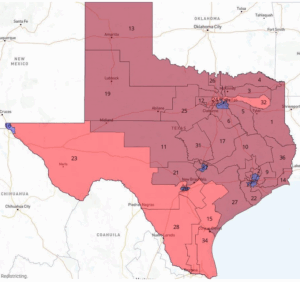
“The final vote was 88 ayes — all Republicans including House Speaker Dustin Burrows (R-Lubbock), who normally doesn’t vote on legislation — to 52 nays.”

Republicans drew this new map at the behest of President Donald Trump and with his 2024 election performance top of mind, ensuring that each of the projected five GOP pickups were areas the president won last year by at least 10 points.

Those five seats are the 9th, 28th, 32nd, 34th, and 35th congressional districts; two are in South Texas, one in Dallas, one in Houston, and one on the outskirts of San Antonio.

The Democrats currently representing those districts are Al Green of Houston (9th), the currently indicted Henry Cuellar of Larado (28th), Julie Johnson of Farmers Branch (32nd), Vicente Gonzalez of McAllen (34th), and infamous commie twerp Greg Casar of Austin (35th).

My guess is that Cuellar and Gonzalez are simply gone, since the Rio Grande Valley was already trending Republican and there are no friendly districts anywhere nearby for them to run in. Green could quite conceivably run in the now-vacant 18th congressional district, previously represented by the deceased Sylvester Turner, and before that by the daughter of the also-deceased Sheila Jackson Lee, and before that by Lee. While Johnson could theoretically run in neighboring Marc Veasey’s 33rd congressional district, that’s a Hispanic and black majority district (and I suspect it’s getting even more so in the current redistricting), which is a tough hill to climb for any white candidate, much less a gay white girl in a suburban district, so I suspect she’s toast as well. The redistricting sets up a Thunderdome showdown between Doggett and Casar for the Austin-based 37th, unless Doggett (who is 79) retires.

Now on to the Texas Senate, where which passed its own redistricting bill handily in the first special session and will likely pass this one in quick order.

I have been (and will continue to be) quite critical of House Speaker Dustin Burrows’ membership in the Straus-Bonnen-Phelan cabal that stays in power thanks to Democrat votes and special interest/gambling money, but in this instance he has delivered on a very important Republican priority.

Remember: All this was set in motion by Petteway v. Galveston County, a lawsuit Democrats filed in order to save one Galveston County commissioner’s seat, whereupon the Supreme Court ruled that “black/brown” coalition minority districts carved out to benefit the Democratic Party were unconstitutional. So instead of saving one county commissioner’s seat, they’re going to lose five U.S. Congressional seats.

Democrats did this to themselves, and have no one else to blame…

Paxton Wants To Shut Beto PAC Down

Monday, August 18th, 2025

Texas Attorney General Ken Paxton has stepped up pressure over Robert Francis “Beto” O’Rourke’s Powered by People PAC. Like Trump, he’s going after the left’s money when they misbehave, and now he’s asking for Powered by People to be shut down entirely.

Attorney General Ken Paxton has escalated his legal fight against Robert Francis “Beto” O’Rourke, filing an amended petition to strip the corporate charter of his group Powered by People.

Paxton says the organization been deceptively fundraising and doling out “Beto Bribes” to Democrat lawmakers who fled the state to break quorum.

“Robert and his unlawful influence scheme, Powered by People, have deceived donors, bought off Texas politicians, and unlawfully assisted runaway Democrats in avoiding arrest,” Paxton said Friday. “As much as Robert and the sell-out Democrats might wish to ignore them, we do have laws that must be followed. I have asked the court to enforce its previous TRO, throw Beto behind bars, and revoke Powered by People’s charter for its unlawful conduct. There must be consequences.”

Paxton first sued O’Rourke and Powered by People last week, accusing them of misleading donors by soliciting money through ActBlue under the guise of supporting Democrats’ political fight, while using the funds for personal expenses such as private jets, luxury hotels, and dining. That same day, a Tarrant County court issued a temporary restraining order prohibiting such fundraising.

According to Paxton, O’Rourke defied the order less than 24 hours later at a Fort Worth rally, telling the crowd, “there are no refs in this game, f*** the rules,” while directing them to donate via the same ActBlue link cited in the lawsuit. The attorney general responded with a motion for contempt, seeking fines and jail time.

Declaring that the stakes are so high that you don’t need to obey the rules would seem to be a particularly foolish approach when dealing with an Attorney General as determined and tenacious as Ken Paxton.

I can’t help but wonder if these actions haven’t handed state and national Republicans enough probable cause to take a deep dive into the structure and financing of ActBlue (which has been caught committing campaign financing fraud on numerous occasions) with the same digital forensic tools DOGE used so successfully to disentangle USAID graft conduits. That sort of discovery might turn up all sorts of shady financial shenanigans, of which illegal foreign contributions may only been the tip of the iceberg. Such a move could not only bring about a vast number of indictments, but also cripple already-lagging Democratic fundraising efforts into 2026 and beyond.

The new filing adds a quo warranto claim, asking the court to terminate Powered by People’s authority to do business in Texas for violating criminal laws, including felony bribery and hindering the apprehension of a fugitive.

A quo warranto claim is a fairly ancient legal revocation that basically says you done screwed up so bad that you no longer have the right to exist, hand over your charter.

The final cherry of irony on Beto’s Screw-up Sundae is that Democrats have just given up on their quorum break (just like the last two times they pulled this maneuver) for the just-started second special session, and it’s a near certainty that Gov. Abbott’s redistricting initiative (and a lot of his other legislative priorities) will pass despite Democrat grandstanding.

Good job all around, guys…

Special Session Agenda: Flood, THC, Redistricting

Thursday, July 10th, 2025

People were wondering what agenda items Texas Governor Greg Abbott would lay out for the forthcoming special session, and now we know.

Gov. Greg Abbott has officially released the agenda for the upcoming special legislative session, identifying 18 items for lawmakers to tackle when they return to Austin on Monday, July 21.

The announcement ends weeks of speculation about what issues would be included on the call and contains a mix of responses to both recent events and long-standing conservative priorities.

“We delivered on historic legislation in the 89th Regular Legislative Session that will benefit Texans for generations to come,” said Abbott. “There is more work to be done, particularly in the aftermath of the devastating floods in the Texas Hill Country. We must ensure better preparation for such events in the future.”

Included in the call are several flood-related items aimed at improving early warning systems, emergency communications, and local relief funding. The agenda also includes a sweeping review of rules related to disaster preparation and recovery.

Abbott is also calling for legislation to eliminate the STAAR test, cut property taxes, and overhaul regulations on THC products—an issue that has divided state leadership since Abbott vetoed a proposed ban last month. Instead of an outright ban, the governor is asking for new restrictions on potency and synthetic compounds without “banning a lawful agricultural commodity.”

We covered the issues surrounding marijuana and THC regulation here. The law that was vetoed would likely have clashed with federal legislation on the issue.

Several conservative priorities also made the list, including a ban on taxpayer-funded lobbying, a constitutional amendment granting the Attorney General the power to prosecute election crimes, and protections for women’s privacy in sex-segregated spaces. Legislation to further protect unborn children by strengthening the state’s ban on abortion-inducing drugs also made the cut.

Other agenda items include measures to protect victims of human trafficking from criminal liability, protections for law enforcement personnel files, and action on title theft and deed fraud. Abbott also called for legislation addressing judicial department operations and incentives for water conservation in building projects.

As expected, redistricting is officially on the agenda, following pressure from President Donald Trump’s team to secure additional Republican seats in Congress. The item calls for revisions to Texas’ congressional maps “in light of constitutional concerns raised by the U.S. Department of Justice.”

I have mixed feelings about redistricting. On the one hand, it would be nice to give House republicans a little more breathing room. On the other, Article I, Section 2 of the Constitution of the United States of America states that “The actual Enumeration shall be made within three Years after the first Meeting of the Congress of the United States, and within every subsequent Term of ten Years, in such Manner as they shall by Law direct,” and it has not been ten years since the last census and redistricting. Still, plenty of states have had to perform redistricting based on court orders, and for decades Democrats used them for partisan advantage, so this is a case of what’s good for the goose in good for the gander.

My understanding is that the Fifth Circuit Court ruling in Petteway v. Galveston County opens the door for redistricting to be performed in light of an altered reading of Voting Rights Act remedies (no longer need black and Hispanics be combined into the same district for “coalition” majority districts, much to the annoyance of the Democrat Party). Indeed, that is the precise outcome we discussed the last time we covered Petteway v. Galveston County. And Democrats were the ones who filed the lawsuit to try to save save one commissioners court seat in Galveston County.

We told them over and over again that they weren’t going to like living under the “New Rules” they instituted, and now they get to find out why, good and hard…

Soros Tries To Buy Texas Again

Tuesday, June 10th, 2025

“Turning Texas blue” is an idée fixe for Democratic Party operatives, and it’s easy to see why. Securing Texas’ 40 (and soon to be 43 or 44) electoral votes would go a long way toward ensuring presidential election dominance for the donkeys. Indeed, one (of many) big driving factors behind the headless Biden Administration opening the border was to secure enough illegal alien votes via amnesty to do just that. (Ironically, what it actually seem to do was turn the Rio Grande Valley red and add millions of Hispanics to the Trump coalition.) But the idea never goes away, and now moneybag social justice funder George Soros is trying to turn Texas blue.

​​A Democrat-aligned political group backed by billionaire George Soros is once again setting its sights on Texas, aiming to flip the reliably red state with a new multimillion-dollar campaign.

According to a Wall Street Journal report, Texas Majority PAC—bankrolled heavily by Soros—has launched a new initiative dubbed “Blue Texas,” partnering with the Texas Democratic Party and several county parties to organize volunteers, recruit candidates, and boost voter turnout ahead of the 2026 midterm elections.

Campaign finance records show Soros gave $2.1 million to Texas Majority PAC in 2024 and another $1 million in April.

The move marks the latest in a long line of efforts by Democrats to make inroads in Texas, a state Republicans have dominated for decades. Despite shifting demographics and repeated national predictions of a “blue wave,” Democrats haven’t won a single statewide race in Texas since 1994.

Soros and his political allies tried a similar approach in the last election cycle—pouring millions into Texas Majority PAC in an attempt to build a Democrat ground game—but came up short. In 2024, Republicans not only held their ground but made gains in both the Texas House and Senate. President Donald Trump, meanwhile, won 12 of the state’s 14 border counties and defeated Kamala Harris by nearly 14 percentage points.

I covered last year’s Soros funding attempts here.

The Texas Majority PAC, which describes its mission as growing the Democrat majority and winning statewide elections, is hoping for a different result this time.

Organizers say they’ll hold rallies across the state in June and visit more than two dozen cities in July to recruit candidates.

Rallies. Yeah. That will do the trick. I do wonder if they don’t actually mean “riots,” since that seems to be what Soros is best at funding.

Their long-term goal is to make Texas a competitive battleground state by 2032, when a new round of redistricting could further increase the state’s electoral significance.

“If a win is on the table in 2026, we don’t want to leave it there by not being organized,” Katherine Fischer, deputy executive director of Texas Majority PAC, told WSJ.

A win for Democrats is “on the table” in the same sense that a World Series championship is “on the table” for the Colorado Rockies in 2026: It’s theoretically possible, but no one is betting that way.

But past efforts like Battleground Texas—formed over a decade ago with similar ambitions—have largely failed.

Battleground Texas was a particularly spectacular flameout. And that was staffed with Obama retreads, i.e. the last actually successful Democratic presidential campaign that didn’t rely on mysterious 3 AM ballot dumps. What election experts are they going to bring in to turn Texas red? The supergeniuses behind the Kamala Harris campaign? What pearls of wisdom are Soros-funded cadres going to dispense on their presumably benighted Texas counterparts? They need to burn more police cars? They need to buy more Palestinian flags?

Texas Republicans are quite lucky nationwide liberals seem clueless about how to wisely allocate money to boost Democrats in Texas. Just think if that $160+ million Bobby Francis “Beto” O’Rourke wasted on his two losing statewide campaigns had been channeled into effective grassroots organizing instead of ill-fated media ad buys. Texas might look a lot more purple right now. Of course, that assumes it’s even possible for Democrats to carry out effective grassroots organizing, instead of shoveling money into the insatiable maws of hordes of social justice locusts looking to foment their own brand of self-serving revolution.

I think that literally just Scott Presler, by himself, has moved the electoral needle more than all the millions of dollars national Democrats have dumped into Texas all this century combined…

Two Texas Election Integrity Bills Pass

Monday, May 12th, 2025

Texas hasn’t suffered from the massive 3 AM ballot drops that plagued large Democratic-run cities in 2020, but there have been election irregularities, most notably in Democrat-controlled Harris County. To help remedy the situation, the Texas legislature has passed two separate bills giving the Texas Attorney General power to reign rein in election shenanigans.

First, a bill preventing judges from issuing last minute election rulings without informing the AG.

Both chambers of the Texas Legislature have approved a measure that will require notification to the Texas Office of the Attorney General (OAG) before a judge can issue a temporary restraining order in relation to an election, a bill that was prompted by a series of confusing judicial actions related to Harris County’s fraught 2022 general election.

“It was occasioned by an election in 2022 where a judge in Harris County held open the polls and didn’t tell the other side,” said Rep. Mike Schofield (R-Houston) of his House Bill (HB) 1475 during a committee hearing last month. “So only one party, which had moved for it, knew that the polls were being held open an additional hour.”

“I wish they’d hold a Super Bowl and not tell the other team the game was on, and my team would win,” quipped Schofield.

The new law stipulates that a district court judge considering an election-related TRO must notify the OAG, wait two hours after providing notification before holding a hearing, and permit OAG staff to participate in the hearing remotely. The two-hour delay may be waived by the OAG after notification, but any TROs issued by a judge in violation of the law will be void.

On Election Day in 2022, the Texas Organizing Project, a progressive civil rights group, sought an emergency hearing and temporary restraining order (TRO) to keep 10 Harris County polling locations open for an extra hour. Multiple county locations were delayed in opening that morning, experienced malfunctioning equipment, were missing personnel, or suffered a shortage of ballot paper.

Following a brief hearing early that evening, District Court Judge Dawn Rogers ordered all county polling sites to remain open until 8 p.m.

After learning of the TRO, Attorney General Ken Paxton’s office intervened and requested a reversal of the order, but the judge refused. The OAG then filed an emergency appeal with the Supreme Court of Texas, which reversed the lower court’s TRO just before 8 p.m. and ordered the county to keep the late-cast ballots separate.

During testimony before the House Elections Committee, Ken Moore said that when Rogers issued the TRO, neither the Harris County Republican Party (HCRP), nor the OAG, nor the Texas Secretary of State knew of the court proceedings.

“The AG moved with all haste to try to stop this, and they couldn’t get to the Supreme Court in time to stop the voting going beyond 7:00,” said Moore, who serves as a State Republican Executive Committee member. “A lot of [election] judges didn’t understand that anything after 7:00 is a provisional ballot, so a lot of these were votes that were regular votes that were regular cast and so it created a lot of chaos.”

The Texas House has also moved to restore to attorney general’s power to prosecute election crimes.

The Texas House has passed legislation to restore the state attorney general’s authority to prosecute election-related crimes—an issue that has taken center stage in the wake of a court ruling and a high-stakes political fight within the Republican Party.

House Bill 5138, authored by State Rep. Matt Shaheen (R–Plano), would allow the attorney general to step in and prosecute election law violations if a local prosecutor fails to act within six months of receiving a law enforcement report. The measure passed the House this week and now awaits further action in the Senate.

The bill comes in response to the 2021 State v. Stephens decision by the Texas Court of Criminal Appeals, which held that the attorney general did not have independent authority to bring criminal charges under the Election Code.

The ruling was met with fierce opposition from Attorney General Ken Paxton, who made the issue a central theme in last year’s Republican primaries.

All three Court of Criminal Appeals judges who supported the decision and were up for re-election were defeated by Paxton-endorsed challengers.

Election integrity has been one of the Texas GOP’s top legislative priorities this session, with the party supporting HB 5138. Christine Welborn, president of Advancing Integrity, praised the bill as a necessary step to ensure accountability.

“The relatively low number of convictions for election fraud is not due to a lack of fraud, but a lack of prosecutions by local district attorneys,” said Welborn. “HB 5138 would allow the attorney general to once again step in and protect voters when those DAs fail to act. Laws are meaningless unless they are enforced.”

The Texas Senate passed a similar, but not identical, bill last month, so the two versions need to be reconciled.

Naturally, all sorts of of liberal organizations have come out against these bills, to no avail. It seems that if Democrats can’t cheat, they can’t win in Texas…

School Choice Finally Passes Texas House

Thursday, April 17th, 2025

After seeing numerous attempts die at the hands of the Straus/Bonnin/Phelan/Burrows cabal over the years, the Texas House has finally passed school choice.

In a historic move, the Texas House gave initial approval today to Senate Bill 2, a school choice proposal backed by Gov. Greg Abbott.

The vote marks the first time a school choice bill has cleared the Texas House—a major shift from just last session when a similar proposal was voted down. The change comes after Abbott made the issue a defining battle in last year’s Republican primaries, endorsing challengers against GOP incumbents who had opposed school choice. Many of those incumbents were ousted, clearing the way for today’s vote.

Ahead of the floor debate, House Republicans met privately and heard from both Gov. Abbott and President Donald Trump, who called into the meeting and urged them to stay united.

“I just think it’s a really forward-thinking vote,” said Trump on the call. “There’s nothing complex about it. You’re not going to get hurt by it. It’s actually almost the opposite. People really want it.”

Snip.

The bill ultimately passed 86-63, with Phelan and State Rep. Gary Vandeaver (New Boston) being the only GOP members to vote against the measure.

Phelan still insists on being the turd in the punch bowl.

The bill now returns to the Senate, which can either concur with the House’s amendments or send the legislation to a conference committee.

Finally getting school choice passed is a direct result of slaughtering so many Dade Phelan cronies in the 2024 Republican primary (and runoff), the success of such efforts greatly aided by Abbott, Ted Cruz and Ken Paxton all campaiging to defeat anti-school choice (and pro-Paxton impeachment) reps.

It was a long time coming, but Texas voters finally got Republican representatives to vote like Republicans.

Dade Phelan Wants To Ban Memes

Tuesday, March 11th, 2025

After spending a great deal of special interest money to hang on to his Texas House seat and stepping down from the speakership after getting so many of his allies slaughtered in the primaries, Dade Phelan has decided on his next battle: outlawing memes.

Posting a political meme could soon land you in jail—if State Rep. Dade Phelan gets his way.

House Bill 366 would make it a crime to distribute altered media, including political memes, without a government-approved disclaimer. Violators could face up to a year in jail.

The State Affairs Committee will take up the bill by the former speaker of the House on Wednesday, alongside a slate of energy transmission legislation. It is the first hearing of the committee on legislation this session.

The bill specifically targets political advertising that features an “image, audio recording, or video recording of an officeholder’s or candidate’s appearance, speech, or conduct that did not occur in reality.” This broad language includes media altered using generative artificial intelligence technology. The Texas Ethics Commission would have the authority to determine the specific format, font, size, and color of the required disclaimer.

Critics say the legislation raises serious First Amendment concerns.

Ya think?

Fort Worth attorney Tony McDonald, who specializes in First Amendment litigation, blasted the measure, saying, “It’s amazing that this ridiculous bill is the top priority of the Texas House’s most powerful committee. This bill is obviously unconstitutional. It would criminalize protected speech on the basis of its content.”

Notably, the legislation could have sweeping implications beyond political advertising.

For example, the “Drunk Dade” parody call-ins on Michael Berry’s radio program would seemingly be criminalized under the proposed law, as they involve audio recordings that portray an officeholder’s speech in a way that “did not occur in reality.”

Additionally, the bill leaves questions about enforcement and selective prosecution.

Courts have routinely struck down laws that regulate political discourse based on content, citing the First Amendment’s strong protections for satire and parody.

Indeed. I’m guessing that this is precisely the sort of thing Phelan wants to outlaw:

The bill reeks of the sort of censorious rules against insulting a member of the ruling party you see in communist countries like China or Venezuela. Hell, even the traditionally prickly French repealed their law against insulting the dignity of the French president. The “published, distributed, or broadcast” clause alone is too broad to be constitutional. Even forwarding or reposting a meme is theoretically a crime.

It’s so poorly written and unenforceable bill that Babylon Bee piece “Media Scrambles To Fact-Check Image Of Trump Riding Hero Dog Into Massive Space Battle” could quickly result in actual government prosecutions, at least if Dade Phelan’s fragile ego has anything to say about it.

This is a stupid, unenforceable and unconstitutional bill that deserves to die a quiet death in committee.

Feel free to share your best Dade Phelan memes below.

Dade Phelan/Texas Speaker Race Update

Monday, September 16th, 2024

I’ve been needing to post a Dade Phelan/Texas Speaker’s Race update for a few weeks now, because I held off because I needed more information and I wasn’t sure what’s going on. Now a couple of tidbits of news have dropped that pretty much requires a post…but I’m still not sure what’s going on.

  • Now that Rep. John Smithee (R-Amarillo) has joined the race there are five Republican representatives who have declared they’re running for Speaker:
    • David Cook (Mansfield)
    • James Frank (Wichita Falls)
    • Tom Oliverson (Cypress)
    • Shelby Slawson (Stephenville)
    • John Smithee (Amarillo)
  • But wait! It’s not just republicans! Democrat Ana-Maria Ramos has also thrown her hat into the speaker’s race ring.

    State Rep. Ana-Maria Ramos has filed to run for Speaker of the House, becoming the first Democrat to do so in what is becoming a crowded race against incumbent Speaker Dade Phelan.

    Snip.

    With Republicans expected to maintain or even grow their current majority in the Texas House, Ramos is unlikely win her bid for speaker. It does, however, add to the ever-growing consensus that Phelan will not be speaker next session.

  • In theory, the Republican caucus will determine their speaker nominee by secret ballot.

    The vote for Speaker of the House will take place on the first day of the legislative session on January 14, 2025.

    The decision may be made long before that as part of the Republican Caucus’ nominating process.

    The process of Republican legislators nominating a unified speaker candidate ahead of the official vote at the start of the session in January was adopted in 2017, in an attempt to prevent Republican speaker candidates, like then-Speaker Joe Straus, from courting Democrat support for the position.

    In the years since, however, both the former Speaker Dennis Bonnen and the current Speaker Dade Phelan have released lists containing Democrat supporters ahead of the caucus vote, making the exercise a formality.

    This year appears to be shaping up differently as Phelan has already gained four challengers who have promised to appoint only Republicans as committee chairs and gain Republican support first. For the first time, the caucus nomination process could be significant.

    The caucus vote will take place in December as part of their retreat ahead of the session. To clench the caucus’ nomination, multiple rounds of voting can take place during a secret ballot. The winner must receive 2/3 support during the first two rounds of voting. If that does not occur, the threshold then drops to 3/5.

    The widespread disillusion with Phelan over the Paxton impeachment, the school choice vote, and so many Phelan loyalists getting slaughtered in the primary, plus the vocal opposition of Governor Greg Abbott, Lt. Governor Dan Patrick, and Senator Ted Cruz to Phelan continuing as speaker, plus a secret ballot, would seem to doom Phelan’s chances of being the Republican caucus choice.

  • But Texas speaker election rules run things on a top-two runoff basis, not round-by-round elimination, and the process is overseen by the Secretary of State. In combination with Ramos’s run, this would seem to eliminate Phelan’s chance to be elected speaker, as Democrats would presumably support Ramos on the first ballot, while Republicans would support whatever non-Phelan candidate gets the official GOP House Caucus nod, which means Phelan is left out of the top two.
  • Maybe Ramos is getting high on her own supply, actually believing that Democrats are ready to “turn Texas blue,” perhaps thanks to the Democratic Party’s relentless importation of illegal aliens. But since Ken Paxton has been hypervigilant in cracking down on potential voting fraud, that outcome seems…remote.
  • But since the cabal backing the Straus-Bonnen-Phelan speakership line is unlikely to go gently into that good night, I must be missing something. There must be some scheme to either keep Phelan in the speaker’s chair, or elect another cabal toady in his place, that I’m just not seeing.
  • Phelan shows every sign of trying to finagle another term, even going so far as to declare that now he he really is for school choice after working so hard to kill it last session. I don’t think anyone believes those new spots are genuine.
  • Another sign that Phelan is working to win is the announcement that former Republican Governor Rick Perry has hired as a senior advisor.

    Perry’s new position follows the announcement of Phelan’s new chief of staff, Mike Toomey, whose campaign finance records show numerous donations to Democrat lawmakers since 2015.

    Toomey, who previously served as chief of staff to Rick Perry, has been a casino lobbyist, which garnered him between $3.4 and $6.7 million this session alone. One of Toomey’s largest clients is the Las Vegas Sands Corporation, which seeks to legalize monopolistic casino gambling in Texas.

    Toomey has also represented Texans for Lawsuit Reform, the group that advocated for Phelan’s impeachment of Paxton last year. Notably, Perry’s name was on the by-line of a Wall Street Journal op-ed calling for Paxton’s impeachment and conviction; the article was ghost-written by TLR.

    As of 2022, Perry has warmed up to the expansion of gambling, becoming a spokesperson for Sports Betting Alliance, a group lobbying to legalize mobile sports gambling in Texas.

    Perry will advise Phelan in a “voluntary capacity” until the start of the 89th Texas Legislature in January, according to an official press release.

    Perry’s support of Phelan may seem inexplicable to Texas Republicans who remember him as a conservative stalwart, but Perry has long gone off on ill-advised tangents every now and them, from backing the Gardasil mandate for pre-teen girls to his love for expensive high speed rail subsidies to derailing his presidential campaign by debating while hopped up on goofballs for back surgery.

    Plus, I suspect that gambling money pipeline jets out a pretty lucrative stream…

  • Finally, I note for the record this Texas Scorecard “Speaker Phelan Used State Jet for Campaign Activities” article.

    A new investigative report revealed that House Speaker Dade Phelan used a state jet for campaign activities.

    KHOU 11 has reported that members of the Texas House have used TxDOT’s executive-style jets for activities that crossed the line between “official state business” into personal or political business.

    According to state law, the jets cannot be used for attending “an event at which money is raised for private or political purposes.”

    When Phelan (R-Beaumont) used the jet in September 2022 to attend a speaking engagement at the leftwing Texas Tribune Festival, he didn’t stop there. He then used the jet to attend a University of Texas versus Texas Tech football game in Lubbock.

    In a statement to KHOU 11, Phelan’s office said the trip was to meet with Tech officials and paid for by university donors.

    However, campaign finance records show that he accepted a $2,500 in-kind contribution for “food and beverage for campaign event” the day he got to Lubbock. He also had an $880 charge at a hotel for “staff lodging for political fundraiser.”

    KHOU 11 estimated that he raised at least $37,522 for his campaign on the trip.

    Yeah, probably a violation, but it seems pretty smallball stuff compared to Phelan’s other shenanigans…

  • Supreme Court: Yes, Texas Can Deport Illegal Aliens. 5th Circuit: Psych!

    Wednesday, March 20th, 2024

    Here I was all ready to with what I wanted to write about, only to have the judicial system throw me a curve. Yesterday, it looked like the Supreme Court was finally giving Texas the green light to deport illegal aliens.

    The Supreme Court on Tuesday lifted its freeze of a Texas immigration law which allows state and local law enforcement to arrest illegal immigrants and empowers state judges to deport them.

    The Court’s six conservative justices dismissed the Biden administration’s emergency appeal, allowing the law to remain in effect while the issue is adjudicated by lower courts. The majority did not explain its reasoning, as is typical, but Justice Amy Coney Barrett, joined by Justice Brett Kavanaugh, issued a concurring opinion explaining that Texas should be allowed to enforce its law until a lower court definitively strikes it down.

    “If a decision does not issue soon,” Barrett wrote, “the applicants may return to this court.”

    On X Tuesday, Texas Governor Abbott acknowledged that litigation over the law will continue in lower courts.

    “BREAKING: In a 6-3 decision SCOTUS allows Texas to begin enforcing SB4 that allows the arrest of illegal immigrants,” he wrote. “We still have to have hearings in the 5th circuit federal court of appeals. But this is clearly a positive development.”

    Texas Attorney General Ken Paxton celebrated the ruling on X.

    “HUGE WIN: Texas has defeated the Biden Administration’s and ACLU’s emergency motions at the Supreme Court,” he said. “Our immigration law, SB 4, is now in effect. As always, it’s my honor to defend Texas and its sovereignty, and to lead us to victory in court.”

    In court papers, Paxton said the Texas law does not undermine federal law but complements it regarding immigration enforcement, which the federal government is supposed to be fulfilling. The Biden administration for many months has been flouting federal immigration law by paroling illegal immigrants into the U.S. instead of detaining them.

    The Constitution “recognizes that Texas has the sovereign right to defend itself from violent transnational cartels that flood the state with fentanyl, weapons, and all manner of brutality,” Paxton said in filings, according to NBC News.

    Texas is “the nation’s first-line defense against transnational violence and has been forced to deal with the deadly consequences of the federal government’s inability or unwillingness to protect the border,” he added.

    Chalk one up for controlling the borders and the rule of law, right?

    Fifth circuit: Not so fast!

    A procedural victory for Texas allowing the state to enforce its new border security law while the Biden administration’s battle against the measure continues to work its way through the courts was short-lived.

    While the U.S. Supreme Court moved to allow the law to go into effect on Tuesday afternoon, hours later the Fifth Circuit Court of Appeals put the law on hold yet again.

    Senate Bill 4, which was set to go into effect earlier this month, creates a state crime for entering the country illegally, paving the way for state law enforcement to arrest illegal aliens.

    After the federal government challenged the measure in a lawsuit, U.S. District Judge David Alan Ezra blocked the law from going into effect. It has since been sent to the Fifth Circuit Court of Appeals.

    In the meantime, a procedural fight had taken place over whether the state could enforce the law awaiting final judgment in the case.

    In a 6-3 decision on Tuesday, the Supreme Court denied the Biden administration’s request to halt enforcement of the law, allowing Texas to begin enforcement immediately.

    At the time, Attorney General Ken Paxton called the decision a “huge win” for Texas.

    “Texas has defeated the Biden Administration’s and ACLU’s emergency motions at the Supreme Court. Our immigration law, SB 4, is now in effect. As always, it’s my honor to defend Texas and its sovereignty, and to lead us to victory in court,” said Paxton.

    That victory was short-lived, as late Tuesday night the Fifth Circuit Court of Appeals placed another stay on the law from being enforced.

    Frustrating, but it underscores the difficulty the Supreme Court faces, namely: How do you reign in an executive branch hellbent on ignoring clear laws on securing the border against illegal aliens that instead actual aids and abets illegal aliens breaking those same laws?

    What mechanisms can the Supreme Court use to reign in a rogue executive without causing a constitutional crisis?

    The Fifth Circuit had a hearing scheduled this morning on the issue but evidently haven’t issued a ruling. I’ll try to update this if it does…

    The Long Road To Texas Constitutional Carry

    Sunday, June 20th, 2021

    Though the 87th legislative regular session was a very mixed bag, among the good bills to actually make it to the end of the sausage factory was constitutional carry, and Texas Governor Greg Abbott signed that and a host of other Second Amendment bills this week:

    Gov. Greg Abbott signed a number of pro-Second Amendment bills that were approved by the state legislature earlier this year at a press conference at the Alamo on Thursday.

    “We gathered today at what truly is considered to be the cradle of liberty in the Lone Star State,” said Abbott.

    The governor said they were holding the press conference “where men and women put their lives on the line, and they lost their lives, for the ultimate cause of freedom.”

    “They fought for freedom. They fought for liberty, and that includes the freedom to be able to carry a weapon.”

    Legislation that the governor signed, which will all go into effect on September 1, includes:

    • Senate Bill (SB) 19: prohibits state agencies and political subdivisions from contracting with any business that discriminates against firearm businesses or organizations.
    • SB 20: requires hotels to allow guests to store their firearms in their rooms.
    • SB 550: removes the specific language in state code that handguns must be worn in a “shoulder or belt” holster, allowing individuals to utilize any type of holster.
    • House Bill (HB) 957: exempts Texas-made suppressors from federal regulations surrounding the noise-reducing accessories.
    • HB 1500: removes the governor’s ability in state code to regulate firearms during a disaster declaration.
    • HB 1927: the “constitutional carry” bill that allows nearly all Texans over the age of 21 who can legally possess a handgun to legally carry it in public without a special permit.
    • HB 2622: the “Second Amendment sanctuary” bill that prohibits state and local government entities from enforcing certain types of potential federal firearm regulations that are not included in state code.

    “[The Alamo defenders] knew the reason why somebody needed to carry a weapon was far more than just to use it to kill game that they would eat. They knew as much as anybody the necessity of being able to carry a weapon for the purpose of defending yourself against attacks by others,” said Abbott.

    The governor pointed to the ongoing border crisis as a reason for Texans needing to be armed to defend themselves “against cartels and gangs and other very dangerous people.”

    HB 1927, the Firearm Carry Act of 2021, takes effect September 1, so idiots blaming the Sixth Street shooting on it are talking out their ass.

    In an email, Gun Owners of America Texas Director Rachel Malone notes that it took a decade to reach this point:

    For me, the journey began ten years ago, in 2011. I became aware of the licensed open carry bill that the Texas Legislature was considering, and I figured that all the politically-involved people would do the work to pass it. How hard could that be? This is Texas, after all.

    I was shocked when I heard that the bill had died without even receiving a vote….

    When I showed up in 2013 for the legislative session, there were about half a dozen dedicated grassroots Texans who spoke up with me to end the permit requirement. That year, our words seemed to fall on deaf ears.

    However, when all the significant gun bills in 2013 died, many more Texans came to the same conclusion that I had in 2011: you shouldn’t take it for granted that someone else will do the work to protect your rights.

    During the next several legislative sessions, in 2015, 2017, and 2019, increasing numbers of Texans began showing up when it mattered — not merely at protests or rallies, but actually beginning to do the work inside the Capitol.

    It was a long, uphill battle that not only took a lot of work and effort, but one that was ignored or fought by state congressional leadership along the way:

    Constitutional carry has been a top priority for the Republican Party of Texas and gun owners across the Lone Star State for a long time.

    In fact, constitutional carry was the first “legislative priority” approved by the delegates to the Texas GOP’s convention a decade ago.

    Even as the list of party priorities expanded to eight over the years, constitutional carry has remained one of the party’s top goals for the legislature, as 20 other states—including Vermont—enjoy some form of permitless carry.

    Despite this fact, however, the bill had not received much traction in the Texas Legislature in recent sessions. In 2019, for example, the bill was sent by then-House Speaker Dennis Bonnen to a committee led by Democrat State Rep. Poncho Nevarez (Eagle Pass), where it was not even given a hearing. Bonnen himself even referred to supporters of the legislation as “fringe gun activists.”

    That same year, the legislation was not even filed in the Texas Senate.

    So entering the legislative session at the beginning of 2021, the fight to pass the bill looked like an uphill battle. As the session began, numerous bills were filed in the House to remove the permit requirement to carry handguns, while State Sen. Drew Springer (R–Muenster) filed similar legislation in the Senate.

    When committee assignments were announced in early February in the Texas House, new hope appeared for passing the bill.

    Instead of appointing a Democrat to chair the Homeland Security and Public Safety Committee that has traditionally blocked constitutional carry legislation in the past, House Speaker Dade Phelan appointed Republican State Rep. James White (Hillister).

    White, a known supporter of constitutional carry who had previously filed a bill to implement it in a previous session, was joined on the committee by four Republicans who had been endorsed by Gun Owners of America, an organization that has heavily advocated for constitutional carry, including State Reps. Cole Hefner (Mt. Pleasant), Matt Schaefer (Tyler), Jared Patterson (Frisco), and Tony Tinderholt (Arlington).

    Ultimately it was Schaefer’s House Bill 1927 that made its way out of the committee and onto the House floor.

    On Thursday, April 15, after several hours of debate and attempts by opponents to derail the legislation, the bill passed the House by a vote of 84 in support and 56 in opposition.

    While most Democrat efforts to amend the bill were rebuffed, so too were some efforts by Republicans to strengthen the bill. One amendment that would have lowered the age from 21 to 18, for example, was strongly rebuked.

    Notably, the lone Republican to vote against the bill was State Rep. Morgan Meyer (R–Dallas), while some Democrats like State Rep. Leo Pacheco (San Antonio) and Terry Canales (Edinburg) joined Republicans in support of the legislation

    With the bill having passed its first major hurdle, attention quickly turned to the other chamber.

    Just a few days after the bill’s passage in the House, Lt. Gov. Dan Patrick said the issue did not have enough votes to pass the Senate.

    Almost instantly, activists began to light up Senators’ phone lines, demanding to know which Republicans were secretly blocking the bill behind the scenes.

    Then, the Senate began to act.

    First State Sen. Charles Schwertner (R–Georgetown) filed a new bill on the subject that was almost immediately referred to the Senate Administration Committee, chaired by Schwertner himself.

    Then, seemingly overnight, Patrick created a new committee called the Senate Special Committee on Constitutional Issues. The only bill referred to the committee? HB 1927, the constitutional carry bill that passed the House the week prior.

    Patrick then promised a vote on the issue in the Senate, even if it didn’t have the votes to pass, a move that would be considered highly unusual in the chamber, where normally authors must show they have the votes to pass their bill before it is brought up for consideration.

    On May 5, the bill finally passed on an 18-31 party-line vote in the Senate. Due to amendments added in the Senate, the bill was sent to a conference committee, where members from House and Senate work to come to an agreement on which version of the bill will ultimately be sent to the governor.

    On May 24, with just a week left in the session, the bill received final approval by both chambers.

    Texas is actually fairly late to the game in passing Constitutional Carry:

    35 years ago, it was illegal in 16 states (including Texas) for a civilian to carry a concealed weapon. Only Vermont did not require a pistol permit.

    Working through the slow process of going state to state to change the law, the revolution happened.

    First came the switch from no permit to may permit. That placed the decision on issuing permits in the hands of elected sheriffs, which explains why California and New York have not budged. Democrat sheriffs pocket a lot of money from patrons who want to carry.

    Then came shall permit. This put the onus on law enforcement to show why a person should not carry a concealed weapon.

    Finally, came freedom. 19 states no longer require the state’s permission to carry a concealed weapon.

    What happens next? Well, as with open carry and campus carry, expect the gun grabbing crowd to predict horrific bloodshed from constitutional carry that never materializes, because it hasn’t happened in any other state that passed constitutional carry. Indeed, the three safest states in the union (Maine, Vermont and New Hampshire) are all Constitutional Carry states.

    It’s been a long, hard road to get to this point, but it shows that dedicated activists can overcome establishment opposition and inertia to pass pro-freedom laws. And every pro-freedom law passed makes it that much harder for the leviathan state to take away those rights in the future.

    There are no lost causes in American history because there are no won causes, and the price of freedom is eternal vigilance.