Greetings, and welcome to another Friday LinkSwarm! Looks like I may have to start doing BidenWatch again, given all the stupid things the newly ensconced Biden Administration has been up to…
US government debt now stands at $20 trillion, or roughly 100% of GDP. This should be a concern, but Democratic economists are not worried. A much-discussed November 30 paper by former Treasury Secretary Lawrence Summers and former Council of Economic Advisors Chairman Jason Furman suggests that Democratic thinking has veered into the paranormal, with an emphasis on levitation. Governments will be able to borrow and spend as much as they want for whatever purpose they want, the authors argue in so many words, and interest rates will remain low forever.
As Washington Post editorialist Charles Lane commented Dec. 7, “Far from burdening future generations, governments have a golden opportunity to fund long-standing needs by borrowing for investments in future prosperity—the list includes child care, early education, job training and clean water.”
The argument so easily refuted by casual reference to the facts that it takes a doctorate from Harvard (which both Summers and Furman hold) to suspend disbelief in the obvious. The authors aver:
We note that with massive increases in budget deficits and government debt, expansions in social insurance, and sharp reductions in capital tax rates, one would have expected to see increasing real rates if private sector behavior had remained constant. We suggest that changes in the supply of saving associated with lengthening life expectancy, rising uncertainty and increased inequality along with reductions in the demand for capital associated with demographic changes, demassification of the economy, and perhaps changes in corporate behavior have driven real interest rates down. This characterization is rather like Hamlet without the Ghost, for the ghost in the interest machine during the past decade has been the Federal Reserve Board’s multi-trillion-dollar purchases of Treasury and agency securities. Summers and Furman do not mention this in their 50-page excursus.
Today, President Biden doubled-down on critical race theory in the federal government.
In response, I am announcing a new coalition of legal foundations and private attorneys that will wage relentless legal warfare against race theory in America's institutions.
Thomas Zimmerman, who will serve as a Special Assistant to the President for Presidential Personnel under Joe Biden, formerly served as a visiting scholar at what the FBI has called a “front group for Chinese intelligence collection and overseas spy recruitment,” The National Pulse can reveal.
While at New York University’s Center on International Cooperation, Zimmerman also served as a fellow at the Shanghai Academy of Social Sciences, flagged by the Federal Bureau of Investigation (FBI) for its close ties to the Chinese Communist Party’s top spy agency, the Ministry of State Security.
The Shanghai Academy of Social Sciences (SASS), which the FBI views as a “front group for Chinese intelligence collection and overseas spy recruitment,” was involved in a 2019 criminal case involving a retired Central Intelligence Agency (CIA) operative selling classified U.S. defense documents to China.
The operative, Kevin Mallory, was contacted by a SASS official via LinkedIn to begin the relationship that culminated in a 20-year prison sentence for Mallory.
It must be understood that Critical Social Justice is an administrative and bureaucratic ideology by its very design. It was formulated by activist academics to train not just activists but, very specifically, either people who will go on to produce the culture industry (like in media and arts) or who will become administrative bureaucrats where they can produce a kind of unaccountable policy that we find in HR departments, where pushback is irrelevant unless it’s from the top down. These sorts of people dream of positions not specifically of power and influence, like the presidency, but of training and administrative roles where they will receive relatively little scrutiny or opposition while they engage in their favorite activity of all: telling other people what to do, not directly, but through a shield of very official and institutionally binding paper.
For any of his late and thin comments about the violence that has rocked our streets for the last half of this year, Biden has given us absolutely no indication that he’s going to resist any of this bureaucratic totalitarianism. In fact, he’s done the opposite, using the language of the ideology, like saying he has a “mandate” from the voters (in an election that hasn’t yet even been decided, two weeks later) to take on “systemic racism,” and tapping individuals like Mehrsa Baradaran (who believes in full reparations) for the Treasury Department and Margaret Salazar (whose focus is on “cultural responsiveness”) for Housing and Urban Development. These come among roughly 500 more appointments to his administrative bureaucracy—so far—who allegedly express a commitment to racial justice, in line with precisely the racial equity programs touted by Biden and Harris on their campaign and now transition websites. In few domains has it been signaled that this will be more powerfully considered than in public health and the Covid-19 response, which Biden has already indicated will lead to a permanent position: “At the end of this health crisis, it will transition to a permanent Infectious Disease Racial Disparities Task Force,” we’re told on the Covid-19 priorities page on Biden’s “Build Back Better” transition site.
This renders Biden and, perhaps, Harris largely irrelevant to the “Woke” impacts of their election. They are, if you’ll accept the metaphor, “not the room.” These administrators are the room. Biden (and Harris, maybe) can be as moderate as moderate gets, and if even a modest fraction of the administrators in key departments favor the Critical Social Justice style of policy, that’s most of what we’ll get. So far, we have reason to suspect that at least an eighth of Biden’s administrative apparatus will be in that vein, including in key and powerful sectors like public health—to say nothing of apparatuses like the FBI.
Tulsi Gabbard reveals why congress won’t attempt to reign in Big Tech:
"It goes to money… Google will have a big reception, members of Congress will go, and then they'll pick up their checks."@TulsiGabbard explains why Congress has failed to act on big tech censorship pic.twitter.com/i7TOJYQ7lv
He was made a martyr. Yes, die-hard anti-Trump Democrats always would hate him, and die-hard pro-Trump Republicans would love him no matter what. But the great American center, comprised of reasonable Democrats and Independents, flocked towards Trump during and after the prior impeachment. They saw he was being railroaded.
He now is being railroaded again. We still all are trees inside the forest, lacking the broader perspective that time will afford. Right now tensions are too high for people to step back a moment and to gauge objectively. But that is only today. The Democrats irresponsibly have just done something that perhaps is all but unprecedented in American history: they charged, tried, and convicted a person — the impeachment phase of the political drama — in less than a day. If impeachments are meant to be fit in during a coffee break, why did the last one drag on so long? Why did Clinton’s and Johnson’s? Last year’s annual Trump impeachment took weeks of testimony from witnesses all over the place. Remember their names — all your favorites — from last time? Kurt Volker. Marie Yovanovitch. Fiona Hill. George Kent. Gordon Sondland. Bill Taylor. Laura Cooper. Alex Vindman. His medals. Catherine Croft. It went on and on and on. If they had not shut it down for Christmas, Kato Kaelin would have been next.
But this time it was Darkness at Noon: instead of pretending honesty, Pelosi and her Democrats did the impeachment as Josef Stalin conducted his show trials in the Soviet Union: first declare the guilt, then type up some charges, and then vote to convict without so much as a meaningful hearing. She did not even bother with the souvenir pens — presumably just ink-refill cartridges this time.
“City councilman in Louisiana arrested for election fraud.” “Louisiana Attorney General Jeff Landry and Secretary of State Kyle Ardoin Thursday morning announced their offices have arrested an Amite City Councilman on eight counts of election fraud. Emanuel Zanders, III is accused of submitting voter registration applications that are known by the person to be materially false, fictitious, or fraudulent.” I know you’ll be shocked to learn he’s a Democrat.
As COVID-19 settled into its new home in NYC, my local coffee shop closed, my gym shuttered, I lost my job at SUNY, and everything I loved was temporarily put “on pause.” A term that nine months later now feels like a cruel joke. None of us knew what we were facing back in March, or how long it would last. The streets became quiet, the city became still. All the sounds, the familiar faces, the busy restaurants, the daily rituals, the very pace of our existence slowed to a full stop. The silence was deafening.
The homeless and mentally ill flourished in my Chelsea neighborhood overnight. Many residents fled our beloved city to safer suburbs and second homes. After a night in the West Village where I saw men looting cars, and a gunpoint robbery happen by the West 4th train station, I no longer felt comfortable here. I decided that I couldn’t abide the lawlessness and my first pandemic at the same time, so I spent the first wave of the pandemic upstate in a guest room at my family’s house, where at least I didn’t have to worry about the crime.
After spending three months in quarantine upstate, I decided it was time to start putting my NYC life back together. The idea of suffering through this time with my closest friends felt like a step in the right direction. Even if we didn’t have our bars and restaurants for an undetermined amount of time, at least we’d have each other.
I imagined my summer would be filled with long walks, bike rides on the West Side Highway, and small gatherings on rooftops. I imagined we’d get over COVID and that the energy of the city would come back slowly over the next six months. I was optimistic, loved my city and loved my life here with all my heart. I hopefully assumed most New Yorkers had the same feelings I did. And then the riots happened.
The dark tone of daily life here now seems permanent. For months after the riots, stores in my area were still being burglarized. The helicopters were so close they would shake my top-floor apartment all night. In peak summer there were always two or three homeless people on both sides of every street in my area. Every aspect of my life became about avoiding them and staying far enough away from anyone who might attack me. Someone broke into my building one night but fled when they accidentally set off the alarm on the roof. The whole summer felt like living in a war zone.
Dating used to be a pleasure for me, but during my summer in Chelsea there were so many stabbings and robberies within one block of my apartment, I no longer felt comfortable making plans that involved meeting anywhere. I’d walk to get coffee in the morning and get harassed and threatened by homeless people every day.
Six months after NYC’s first wave of riots, I was clearly wrong about my hopes of returning to the fast-paced yet wonderful life that I once loved.
The City of Houston wants to regulate your homes for looks. “Everything from what color you paint your home, to whether you put shutters on your windows, would be subject to government control.” Nuts to that.
In the end, it was not the British deep state, Darwinists, Jews, Freemasons or any of the sinister cabals that Adnan Oktar long railed against that defeated him. It was the Turkish judiciary.
On Monday, the notorious 64-year-old preacher, often referred to in salacious headlines as a “sex cult leader,” was sentenced to 1,075 years in jail for crimes including sexual assault, sexual abuse of minors, fraud, and attempted political and military espionage.
It marks the end of a long and bizarre career for the preacher, television host, author and filmmaker.
Beginning his career in the 80s as a firebrand orator, railing against Jews, Freemasons and Charles Darwin, he later became (in)famous for his shows on Turkish TV, in which he would discuss Islamic principles while scantily clad women with bleached blonde hair danced around him to popular music. These women Oktar referred to as his “kittens”.
Skipping over a lot, including the bit where he went from being a Holocaust denier to being a supporter of building the Third Temple in Jerusalem.
In July 2018, Oktar was arrested on a number of charges, including forming a criminal organisation, sexual abuse of children and sexual assault.
According to the Istanbul chief prosecutor’s office, he was caught while attempting to run away from the arresting officers. As he was led away, he told journalists that the charges were a conspiracy by the British deep state.
“They are thinking of covering the whole region with Christianity. They targeted me because they saw me as the effective inhibitor of this game,” he would later say in court.
Though “the British deep state” has yet to officially comment on the case, many have questioned the timing of Oktar’s arrest, considering accusations against him dated back decades.
In 1999, Oktar and a number of associates were arrested and charged with using threats for personal benefit and creating an organisation with the intent to commit a crime. A Turkish prosecutor listed a number of companies tied to BAV, which was accused of using blackmail and sex traps to generate revenue. The legal process against Oktar and BAV lasted two years, during which the majority of the complainants retracted their claims.
In the case file during his most recent trial, prosecutors presented an array of photos depicting sexual acts involving members of the organisation purportedly taken secretly at Oktar-owned properties for the purpose of blackmail. It also revealed WhatsApp messages involving male and female members of the group, in which they were given instructions to get used to anal sex.
Yuksel told MEE that he was aware of a number of senior politicians who had been involved with (or had relatives involved with) Oktar and were compromised by their association with him. However, he declined to offer any names.
In October 2017, the University of Texas at Austin announced that it had signed a new memorandum of understanding with the China University of Petroleum, a school directly affiliated with the Chinese Ministry of Education.
According to a statement released at the time by the Texas Bureau of Economic Geology, the agreement would “encourage academic cooperation through research and study in furtherance of the advancement of learning.”
But in October 2020, the U.S. Department of Education released a report critical of such foreign entanglements, specifically deeming contracts with China University of Petroleum a security risk.
“Academic research regarding oil and gas extraction should not be considered separate from the Chinese government’s geopolitical ambitions,” the Education Department report reads, adding, “China’s largest oil companies are state owned and dominate China’s oil market, so this could cross paths with Chinese government endeavors.”
The world has watched with shock over the past three years as the Chinese Communist Party constructed a vast, racist system of concentration camps, forced labor, and high-tech surveillance in the far-Western region of Xinjiang. Now, the U.S. government has decided to call these multifaceted horrors what they are: Crimes against humanity and genocide.
“Since the Allied forces exposed the horrors of Nazi concentration camps, the refrain ‘Never again’ has become the civilized world’s rallying cry against these horrors,” said Secretary of State Mike Pompeo in a statement announcing the decision. “Just because an atrocity is perpetrated in a manner that is different than what we have observed in the past, does not make it any less an atrocity.”
The barbaric conduct that Pompeo has now deemed crimes against humanity and genocide stems from the Communist Party’s desire to annihilate the Uyghurs and other Turkic Muslims it has sought to supplant with Han Chinese settlers. As senior administration officials put it this afternoon, China’s actions aren’t at first blush the same as the mass killings at Srebrenica and in Rwanda. They are instead “a very patient evil,” designed to erase the Uyghurs over time through methods both tried-and-true and experimental.
Since “there’s no evidence of systematic mass murder,” says Adrian Zenz, the researcher who has unearthed many of the revelations that led to today’s announcement, the Party’s forced-sterilization campaign “is the strongest piece of evidence, by far” of China’s genocidal campaign. It also seems to have had a huge influence on Pompeo, who, in a Wall Street Journal op-ed today, called it “key in my determination that the atrocities in Xinjiang rise to the level of genocide.”
In the present Convention, genocide means any of the following acts committed with intent to destroy, in whole or in part, a national, ethnical, racial or religious group, as such:
(a) Killing members of the group;
(b) Causing serious bodily or mental harm to members of the group;
(c) Deliberately inflicting on the group conditions of life calculated to bring about its physical destruction in whole or in part;
(d) Imposing measures intended to prevent births within the group;
(e) Forcibly transferring children of the group to another group.
Sadly, given Hunter Biden’s documented payoffs from China, my expectation is that the incoming Biden Administration will sweep Chinese under the rug…
Update: Incoming Biden Secretary of State Antony Blinken, when asked if China’s treatment of Uighurs was genocide, said “That would be my judgment as well.” We’ll see if any actions flow from those words…
If I were still doing BidenWatch, this piece would be a top link. It’s the story of why a hardcore anti-Trumper switched to being anti-Biden. The hook is that the writer is an ex-cocaine addict, and thus has an ideal vantage to talk about what the media is hiding from us about Hunter Biden:
At this exact moment I was still a zealous 100% anti-Trumper, willing to vote for anybody but Trump, even the Easter Bunny. Further, I thought that poor old Rudy Giuliani had completely lost his marbles. He was running around in the Ukraine acting all crazy. Looking for what? Maybe the Abominable Snowman?
And right here, at this exact moment one year ago, is when my faith in Biden, as the “anybody” in “anybody but Trump”, cracked.
As I was joking with my friend, and reading all this stuff about Hunter’s multiple trips to rehab, his binges, his dating his brother’s widow, his getting a stripper pregnant while dating his brother’s widow, and cheering it all on in locker-room style… that’s when the penny dropped.
From my own experience, there is no such thing as a functioning cocaine addict. The worse it gets, the faster it gets worse. One cannot function like that — at all. You lose stuff and break phones constantly. You’re always scrambling around trying to swindle some cash somehow, from this person and that; and then you’re trying to chase around your dealer; and then you’re getting your spot organized, so you can hide out and get high; plus you’re getting whatever else you might need.
Then you spend maybe 3–5 days getting deliriously high. Then a couple days deliriously tired and sleeping. You’re always moving in and out of hotels, and always losing stuff in the process. Plus, all the physical ailments — the puking, the paranoia, the eating, and the not eating. Wash, rinse and repeat. This is why crack houses looks like crack houses. Hunter is lucky to be alive, but there is no chance he’s been doing any work. None at all.
I lived this life so I know it, and it occurred to me right then — and this being about one year ago — that if Hunter’s addiction is worse than mine was, then he couldn’t bag a ham sandwich on a good day, and even when he could, he would be busy doing other things anyway. So there is no way he did any work whatsoever for Burisma. It is mathematically impossible. So, then, the question to me was, does it overlap? And, yes it does. His spiral started with his expulsion from the Navy in 2013, and carried on until 2019.
Snip.
Hunter’s Addiction Timeline Versus Bursima
Hunter served on the Burisma board from April 2014 until April 2019.
Here is what was going on in his life at that time:
Feb 2014 — discharged from Navy for cocaine use
Jun 2015 — Beau Biden’s funeral
Jul 2015 — checks in to Caron Treatment Centers
Aug 2015 — his name is among those leaked in Ashley Madison data breach
Oct 2015 — Kathleen Biden files divorce
Feb 2016 — checks in to Kolmac Outpatient Recovery Center
Aug 2016 — begins dating his dead brother’s widow
Oct 2016 — checks in to Grace Grove
Jan 2018 — gets stripper pregnant
I have no doubt, in my own heart, that Hunter couldn’t function in any way amid circumstance like these, and I think this timeline establishes that pretty clearly.
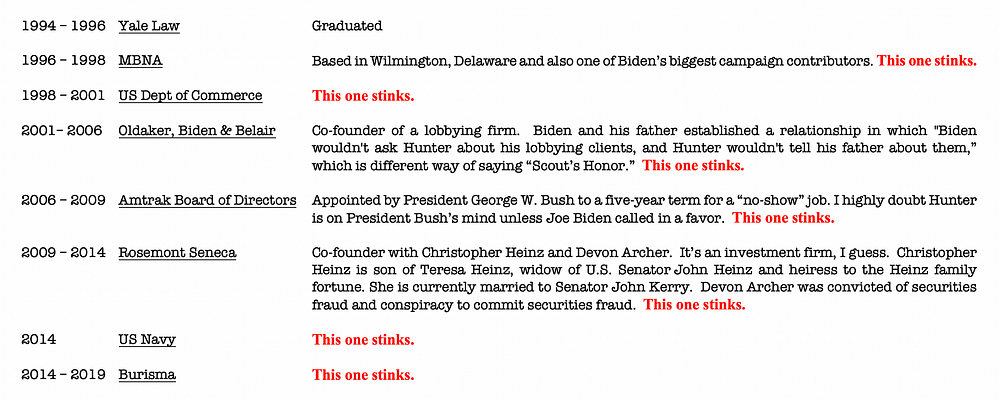
He looks at Hunter’s resume:
Every job on there was either a hook-up from his dad (MBNA, Dept Commerce, Amtrak, Navy) or has a huge conflict of interest embedded in it (Oldaker, Biden & Belair, Rosemont Seneca, and Burisma). The Amtrak job is a total handout. Hunter is 50 years old and he has never held any of these jobs for that long — i.e. it is job after job after job. So, then, Burisma paid him $80,000 a month for what?
Lying Through His Dentures
The media have gone so easy on Biden, dancing around Burisma. George Stephanopoulos, who ran Bill Clinton’s presidential campaign in 1992 and subsequently became White House communications director, didn’t come near this one at that “Wag the Dog” debate the other night. My mom asks me tougher questions these days, “Christian, what did you have for dinner?” The entire press corps have given Biden a 6 month “get out of jail free card” on this obvious hot spot, and that’s precisely because they know it is a hot spot.
And then come the Joe Biden evasions:
This is what flipped me to Trump:
Question: Hunter Biden, your son, was getting paid a lot of money to serve on the board of a Ukrainian energy company facing serious corruption charges. You were the Vice President, running point on the Ukraine. The Average Joe hears that and says ‘that sounds fishy.’ What’s your understanding of what your son was doing?
Answer: I don’t know what my son was doing. I know he was on the board. I found out he was on the board after he was on the board. And that was it. [Ok, like my mom couldn’t give you at least some thumbnail sketch of what I do for a living? Of course she can. Hunter “worked” at Burisma for 5 years, and he has no clue at all what he did? This is a barefaced lie.]
Re-direct Question: Well you’ve had a lot of time, isn’t this something you want to get to the bottom of?
Answer: No, because I trust my son. [This is where he lost me forever. There is a joke told in rehab: what’s the difference between a drug addict and an alcoholic? The drug addict will help you look for your wallet. I pawned my ex-wife’s jewelry and told her I was having it cleaned. You shouldn’t have trusted me any further than you could have thrown me back then. He doesn’t trust his son — that’s total BS. And if he does trust his son, after 30 years of drug addiction, then he’s the dumbest man on the planet. But the American public absolutely should not be asked to trust a drug addict. Period. This answer is manipulative, evasive and totally dishonest.]
Re-direct Question: That doesn’t pass the smell test, like when you’re Vice President, isn’t there a higher standard? Don’t you need to know?
Answer: No! Unless there was something that is on its face wrong. There’s nothing that was on its face wrong. [Another barefaced lie. Everything is wrong on its face here. As Vice President, he was assigned to the Ukraine. His son, meanwhile, has a huge conflict of interest in a job with a Ukrainian oil company that pays him way too much, and that he is unqualified for, and that he absolutely cannot perform due to the disability of his drug addiction. Everything is wrong with that.]
Answer-continued: Look, if you wanna talk about problems, let’s talk about Trump’s family. I’m mean come on! This is, you guys are amazing… [sneer] [His here deflection implies this: ‘ok, yes, fine, we are corrupt, but so are they!’ His anger betrays his guilt. The reason there is no answer, is that there can be no answer. Joe Biden has been bought and sold.]
Hunter’s Never Ending Spending
Why is divorce so expensive? Because it is worth it.
Why is a drug habit so expensive? Because you have to buy all the drugs, plus you have to buy all the other things you need, which in Hunter’s case is often hotels and professional company, plus there is the cost of all the crashed cars, broken mobile phones, lost property, late fees, etc that drug addict leave in their wake. Meanwhile, all your normal household expenses continue to accrue. Bottom line: being a drug addict sucks money out of your bank account like a bathtub with four drains.
Hunter has a divorce and a drug habit, and then some…
His itemized expenses in the last 3 years:
— a long-standing drug habit
— a divorce from a wife with whom he had three kids (2017)
— a $450,000 tax lean that he satisfied in 6 days (2020)
— a paternity settlement (2020)
— a $2.5 million home purchase in LA (2019)
— a recent marriage (2020)
— a fifth child on the way (2020)
A quick question… where is all this money coming from?
He concludes:
Drug addicts are not fit for work, and if Joe Biden putting his son to work while he was in downward spiral is what gets him busted, well then, it would be just desserts. If Biden was any kind of father, he should have cut his son off a long time ago and said, “Call me back when you get sober kiddo.”
Trump might be a jerk, but he doesn’t treat his kids like that. Trump may be a jerk but he never sold American influence for a price.
Apparently the media prefers a soulless fraud with a nice pair of dentures and a pressed suit who says oh so often “I care about you.” In the last election, a bombastic showman played the media like a fiddle to steal the show, and in this election the media is stealing America back, so they can return it to the hands of its rightful owner, a hollow hooker with a good smile who will sell it to which ever foreign interest is willing to pay the highest price for the night.
Read the whole thing, and especially take a look at that eye-opening picture of one of Hunter’s hotel rooms…
Am I losing my mind or is a country’s official government account tweeting about the jolly perks of locking humans in concentration camps and the lovely mental health benefits of forced sterilization?
The most ‘credible’ theory about the origin of COVID-19 is that it escaped from a Chinese laboratory, according to US National Security Adviser Matthew Pottinger, who made the comment during a Zoom meeting with UK officials.
“There is a growing body of evidence that the lab is likely the most credible source of the virus,” said Pottinger, referring to the Wuhan Institute of Virology, according to the Daily Mail, which notes that ‘even China’s leaders openly admit their previous claims that the virus originated in a Wuhan market are false.’
Pottinger was one of the first US officials to sound the alarm at the White House over the origins of the virus in January 2020, when he initially suspected that the outbreak originated in a Chinese lab – after which Pottinger ordered US intelligence agencies to search for evidence. Good thing he kept this theory to himself, or Twitter may have banned him.
Of course, our media and business elites have been working hard since the beginning of the outbreak to label the lab origin possibility as a “crackpot theory.” Probably because people earn significant money doing business with Communist China don’t want that sweet income stream imperiled by the fact China is running an illegal biological weapons programs responsible for the deaths of millions.
A major leak containing a register with the details of nearly two million CCP members has occurred – exposing members who are now working all over the world, while also lifting the lid on how the party operates under Xi Jinping, says Sharri Markson.
Ms Markson said the leak is a register with the details of Communist Party members, including their names, party position, birthday, national ID number and ethnicity.
“It is believed to be the first leak of its kind in the world,” the Sky News host said.
“What’s amazing about this database is not just that it exposes people who are members of the communist party, and who are now living and working all over the world, from Australia to the US to the UK,” Ms Markson said.
“But it’s amazing because it lifts the lid on how the party operates under President and Chairman Xi Jinping”.
Ms Markson said the leak demonstrates party branches are embedded in some of the world’s biggest companies and even inside government agencies.
“Communist party branches have been set up inside western companies, allowing the infiltration of those companies by CCP members – who, if called on, are answerable directly to the communist party, to the Chairman, the president himself,” she said.
“Along with the personal identifying details of 1.95 million communist party members, mostly from Shanghai, there are also the details of 79,000 communist party branches, many of them inside companies”.
I’ve poked around a bit to find a copy of that database, but all I could locate was an excerpt featuring the first 5,000 names or so. If anyone knows where I can find the full list, let me know in the comments.
Here’s a story so strange I wanted to turn it into a separate post, but details remain too murky: Fabless chip designer Arm Holdings fired the head of its Chinese business unit, but he’s refusing to leave:
Arm Ltd., the chip designer owned by SoftBank Group Corp., accused the ousted head of its China joint venture of hurting its business there, escalating a dispute that’s becoming a test of Beijing’s willingness to protect foreign investment in the world’s second-largest economy.
The U.K. chip giant in June announced it was firing Allen Wu, the head of its Chinese unit, over undisclosed breaches of conduct, but the executive has refused to step down and remains in control of the strategically important operation. Rather than the peaceful, rapid resolution that both sides have said they want, the situation has deteriorated.
Wu has hired his own security and won’t let representatives of Arm Ltd. or his board on the premises, said a person familiar with the situation. He’s refused to hold a planned event to connect Chinese chipmakers with Arm Ltd. and avoided negotiations despite public statements to the contrary, said the person, who asked not to be named.
Wu is “propagating false information and creating a culture of fear and confusion among Arm China employees,” the U.K.-based company said in a statement. “Allen’s focus on his own self-preservation has also put China semiconductor innovation at risk as he has attempted to block the critical communication and support our China partners require from Arm for ongoing and future chip designs.”
Arm China disputed the claims in an emailed response to queries, adding that Wu was open to talks and there have been no disruptions in business engagement between Arm Ltd. and its China clients.China is the largest market for semiconductors and the U.K. firm relies on Arm China to conduct business with local customers, including Huawei Technologies Co. The country accounts for a large proportion of the company’s global revenue and resolving the conflict will be crucial to SoftBank’s reported plans to sell Arm, a lynchpin in the global smartphone and computing industry that the Japanese firm bought for $32 billion in 2016.
In early June, Arm China’s board – which includes representatives from Arm Ltd. and Chinese investors – ousted Wu for setting up an investing firm that competes with its own businesses there. He refused to accept the decision, saying it was invalid and has remained in control at Arm China’s headquarters in Shenzhen.
The intricacies of Chinese rules confer an advantage to Wu as the holder of key registration documents. As the legal representative of Arm China, Wu holds the company’s registration documents and the company seal, or stamp. Changing the legal representative requires taking possession of the company stamp — something Wu has refused to give up.
It was once an accepted truth that China’s increased economic trade and participation in international bodies such as the World Trade Organization would benefit everyone.
China and its citizens would benefit through the jobs and wealth earned from their vast export market. Americans and Europeans would benefit from access to an ever-greater array of ever-cheaper goods. Asian, African, and other American nations would benefit from access to both sides of this market and the incentive to replicate a version of China’s export model. And the world’s democracies, the cornerstones of the post-Cold War international order, would benefit from China’s recognition that it would gain more by abiding the rules of the game than by breaking them.
To borrow from Shakespeare, “the jest of the truth savors but of shallow wit, now that thousands weep more than did celebrate it.”
The weeping is real. Each week brings us increasingly horrific stories of the suffering endured by China’s already impoverished Uighur population. More than 2 million of these innocent citizens have been forced into concentration camps over the past decade. They have been indoctrinated to believe that there is no ideology of value save that of the Communist Party and its god-emperor Xi Jinping. Some have been forcibly sterilized, others sent far from their homes and families. As reported just this month, hundreds of thousands of Uighurs are forced into annual servitude as cotton pickers.
There’s a defining lesson here. China was supposed to be a top partner to the liberal international order. Instead, it is now taking inspiration from the Antebellum South’s slave economy, using forced labor in support of an unaccountable elite. Even were it not beholden to China, Hollywood could not invent a better example than the Uighurs’ plight to expose the lie that China’s economic development would usher in a kinder and gentler policy on its part.
Of course, Hollywood’s pathetic deference to Beijing isn’t a solitary American corporate story. It is the story. Instead of markets leading to more economic and political freedom in China, they have led major U.S. corporations to self-censor in order to gain access to Chinese consumers and their cheap labor. As with the NBA, which rightly cares a great deal about black lives but apparently not one iota about Uighur lives, major corporations such as Disney, Dell, and Walmart deal with China even if they must do so with terrible strings attached.
Beijing is explicit in its expectation that trade opportunities come with the price of silent acquiescence. Where the Chinese Communist Party signs treaties — whether the rules of the WTO, promises on intellectual property regimes, or carbon emissions targets — its pledges must be greeted only with applause from the West, never with any enforcement or demands that Xi be held to his word.
US carriers and telecommunications companies receiving Universal Service funding are now required to remove all Huawei technology, by order of the federal government.
The US Federal Communications Commission has ordered certain carriers to “rip and replace” all equipment produced by Huawei. It follows continuing investigations into claims that Huawei represents a threat to national security, and Huawei’s application for a review of a similar ruling by the Public Safety and Homeland Security Bureau in June.
“A laundry list of evidence before us compels this result,” said FCC chairman Ajit Pal in a statement. “But to summarize some of the main points, Huawei has a long and well-documented history of close ties to the Chinese military and intelligence communities, as well as the Chinese Communist Party, at every level of the company— all the way up to its founder.”
“Huawei is subject to sweeping Chinese intelligence laws compelling Huawei’s assistance and cooperation with Chinese intelligence services and forbidding the disclosure of that assistance,” he continued. “Moreover, the concerns about Huawei aren’t just hypothetical: Independent entities have identified numerous security vulnerabilities in Huawei equipment and found it to be less secure than that of other companies— perhaps deliberately so.”
Speaking of crackdowns, President Donald Trump’s administration has added more Chinese companies to the blacklist:
The Trump administration is poised to add China’s top chipmaker SMIC and national offshore oil and gas producer CNOOC to a blacklist of alleged Chinese military companies, Reuters reported citing a document and sources, curbing their access to U.S. investors and escalating tensions with Beijing.
The latest crackdown comes after a report from Reuters earlier this month that the Department of Defense (DOD) was planning to designate four more Chinese companies as owned or controlled by the Chinese military, bringing the number of Chinese companies affected to 35. A recent executive order issued by President Donald Trump would prevent U.S. investors from buying securities of the listed firms starting late next year.
It was not immediately clear when the new tranche, would be published in the Federal Register. But the list comprises China Construction Technology Co Ltd and China International Engineering Consulting Corp, in addition to Semiconductor Manufacturing International Corp (SMIC) and China National Offshore Oil Corp (CNOOC), Reuters reported.
On paper the Chinese army looks pretty impressive, with 78 combat brigades and nearly as many specialized brigades. Over the last decade the Chinese army has been converting its divisions to brigades, many of them independent brigades like the American Brigade combat teams. That conversion is still underway, although by now nearly all the regiments that formerly comprised the major subunits of divisions have been converted to brigades.
The task of turning all those new brigades into well-equipped and trained ones is still underway. There are three types of combat brigades. The most potent is the heavy brigade, each with about a hundred tanks and dozens of tracked IFVs (infantry fighting vehicles) plus detachments of engineers and other specialists. The problem with these heavy brigades is that not all of them have the latest tanks. China has not built enough of its most modern tank to replace all the older models. As more of the latest tank enter service heavy brigades receive them and have to go through months of training to learn how to get the most out of them.
Snip.
The major problem with the army is that all the elite units (special operations and airborne) as well as key units stationed in the capital and a few other places have few conscripts. Nearly all the conscripts are assigned to the combat brigades and the support brigades assigned to each of the 13 Group Armies. Units with conscripts spend about half the year training the new ones and if there is a war these units would, half the time, have a large portion of their troops poorly trained and not fully integrated into the unit. This is a major problem for combat units that depend on well-trained troops who have been with their units long enough for commanders to know what they can get out of them.
As China pushes to become a blue-water power, nuclear-powered submarines are critically important to Beijing’s plan. Historically the Chinese Navy’s (PLAN) nuclear-powered submarine fleet has been constrained by its limited construction capacity. There is only one shipyard in the country up to the task. But that yard has been undergoing a massive enlargement. And now, recent satellite imagery suggests an additional capacity expansion.
China’s nuclear-powered submarine fleet was already expected to get much larger in the coming years. This latest development suggests that China could pump out submarines at an even greater rate.
Just how many nuclear submarines China will build over the next ten years is a hot topic. The Office of Naval Intelligence (ONI) recently forecast China’s submarine fleet to grow by six nuclear-powered attack submarines by 2030. Other observers, such as retired Capt. James Fanell who was Director of Intelligence and Information Operations for the U.S. Navy’s Pacific Fleet, place their estimates even higher.
A senior Chinese People’s Liberation Army officer, Lt. Gen. He Lei, penned an article explaining why China’s Korean War experience should guide its modern military strategy toward the United States.
The executive officer of the PLA’s Academy of Military Science, He is a known hard-liner on Taiwan and the U.S. In his present assignment, the general is responsible for training PLA officers and strategy development. His words carry weight both for what they say about evolving PLA doctrine and their influence on Beijing’s Central Military Commission. His arguments are certainly forward-leaning, referencing the PLA’s rising expectation that it will have to fight a near-term war with either the U.S., Taiwan, or both.
Beginning with a creative history of the Korean War, He explains that Mao Zedong’s deployment of the PLA against the U.S. military in North Korea shattered “the myth that U.S. imperialism is invincible.” Here, we see a presentation of the U.S. military as a force that can be both contested and defeated. The centrality of the Korean War to the Chinese military psyche takes on significant importance in the context of three factors. First, the war is seen as a necessary defense of the motherland against a great external threat. Second, the PLA has limited post-Korean War experience of major conflict. Third, China views the outcome of that war as being broadly in its favor. Taken together, He thus uses the Korean War to reinforce the idea that China can take on a more powerful foe and triumph.
China’s military might be shocked to find America’s military a wee bit more advanced and prepared than it was in 1950…
“China forced hundreds of thousands of children in Xinjiang, where the majority of the population belongs to the ethnic Uyghur minority, into ‘boarding schools‘ as they lost their parents to communist concentration camps.”
More than half a million Tibetan farmers and pastoralists have been placed in military training facilities to be turned into wage workers controlled by the authorities. This model replicates the one used in Xinjiang internment camps where more than a million Uyghur Muslims are imprisoned and indoctrinated.
A study by the Australian Strategic Policy Institute shows that the Chinese regime runs 380 “concentration camps” in the Xinjiang autonomous region. According to the Chinese Communist Party, Tibetans are a “lazy people” who need to be reprogrammed. To this end, Chinese leaders want to reduce the “negative influence” of the Buddhist religion.
The FBI is warning law-enforcement agencies to beware of cooperating with a Chinese government campaign to coerce U.S. residents to return to China to face criminal charges, according to a counterintelligence bulletin obtained by Yahoo News.
The bulletin comes after eight people, including a former New York Police Department officer, were indicted on charges of acting as illegal agents for Beijing.
“State and local public safety personnel should be aware that Chinese Government officials, such as diplomats and officials with China’s primary law enforcement agency, the Ministry of Public Security (MPS), may seek assistance to obtain sensitive US law enforcement or non-public personally identifiable information on individuals of interest,” which is marked for official use only and was distributed to law enforcement agencies around the country.
The warning concerns China’s long-standing policy of reaching beyond its borders to target people it accuses of financial crimes, even if they are permanently living abroad. The repatriations, often coerced by blackmail or threats, are part of Beijing’s anti-corruption campaign called Fox Hunt.
There has been an increasing number of allegations that China has coerced, even kidnapped, its citizens living abroad, and that it targets political dissidents as well as those accused of financial crimes.
When it comes to the impact of COVID-19 on the People’s Republic of China (PRC), the conventional wisdom seems to be that the emergence of the virus was mishandled and the Communist government has yet to be transparent about it, but that the spread was arrested through aggressive public-health practices and the economy has rebounded.
As usual with the PRC, the reality is more complex. In fact, recent signs of tension between President Xi Jinping and other leaders, notably Premier Li Keqiang, indicate the additional impact the pandemic had on an underlying soft economy and the country’s growing isolation because of Beijing’s poor handling of the crisis and other factors.
Snip.
In the past few years, Xi has centralized his personal authority to a degree not seen in a Chinese leader since Chairman Mao. In 2017, Xi took control of the country’s military and often appears in public in a military uniform. He is, in effect, the head of the National Security Council, the head of the foreign policy apparatus, and of multiple economic commissions. In recent public appearances, the state news agency Xinhua has referred to him as “People’s Leader.” Can “Chairman Xi” be far off? In additional to title inflation, in 2018, he imposed constitutional changes on the National People’s Congress that removed a term limit preventing him from seeking a third term in 2023. Xi’s moves and power consolidation mean he is responsible and accountable for both the good and the bad. And lately, there’s been far more bad than good.
Starting with the economy: However the government may have controlled the pandemic, the economy remains weak. Economic growth prior to the pandemic — according to China watchers skeptical of government numbers — was probably flat or negative, notwithstanding official statistics that had it closer to 6 percent. Government at every level and households had combined debt of about 300 percent of GDP. U.S. debt/GDP even after trillions in coronavirus relief spending is less than half China’s level, which leaves fewer levers for Beijing to pull to help stimulate the economy.
While the U.S. Federal Reserve and Congress have injected more than $6 trillion into the economy through massive purchases across many asset classes, the People’s Bank of China balance sheet has remained flat this year. The U.S. Congress provided about $630 billion in direct support to small businesses, compared with less than one-tenth that amount the PRC made available to small businesses in China. Retail sales in China for each month of 2020 are down compared with the same month the year prior. The real data are certainly worse than what the government discloses. In the U.S., retail sales in July were at all-time highs, eclipsing their pre-pandemic levels. According to economist Carlos Casanove at French insurer Coface, the PRC “recovery narrative has been overplayed.”
This is contributing to the tension between Xi and Li. At a press conference in May, the prime minister acknowledged that 600 million people in China — about half the population — subsist on 1000 yuan ($140) a month. This number includes the estimates of 80 million who lost work due to the virus who may have no income and no meaningful social safety net in China. Li’s data track with World Bank data which show a vast disparity in income between the urban elite and the mostly poor rural population. Even so, his comments were out of step with other government-touted figures, including a central bank survey in April of 30,000 urban residents who have an average of nearly half a million dollars in household assets. This figure generated so much controversy that the central bank withdrew it.
Read the whole thing.
“Chinese and European Union officials have agreed to an economic investment deal agreement despite international outrage over the communist regime’s human rights abuses and President-elect Joe Biden’s desire to coordinate an allied posture toward Beijing.” Also, get this: “‘This agreement will uphold our interests & promotes our core values,” European Commission President Ursula von der Leyen insisted Wednesday. ‘It provides us a lever to eradicate forced labour.'” Translation: “We know China engages in slave labor and we’re going to do business with it anyway, and just pretend we care about eliminating it.” (Hat tip: Director Blue.)
The Guardian newspaper in London had an exclusive story in which Victor Zhang, the vice president of Huawei, stated that in light of Trump’s defeat, Britain should review its decision to ban the telecoms giant from its 5G network. Zhang warned that this decision would have economic repercussions for Britain, adding: “As a global company, we want to work with governments to ensure they have the policies to secure growth. The decision was a political one motivated by U.S. perceptions of Huawei, and not those of the U.K. This is not really motivated by security, but about a trade war between the U.S. and China.”
Or consider the fact that this year, some British politicians have shown a certain amount of moral grit by expressing concerns about new authoritarian security laws in Hong Kong and China’s persecution of its Muslim Uyghur minority in Xinjiang. How have the Chinese reacted? This week, Fang Wenjian, chairman of the Chinese Chamber of Commerce in the U.K. and the Bank of China’s boss, issued another menacing warning. The Sunday Times and City A.M. have both published stories linking him to the threat that any decline in U.K.-China relations could force some Chinese firms out of the U.K. In other words: “Don’t criticize China’s abysmal human rights record, or you risk losing our business.”
Alarms bells are also ringing because of Citiking International, a Chinese-backed private equity firm with offices around the world and, it has been reported, possible ties to the Chinese Communist Party. It is trying to buy Eclipse Aerospace, a small firm based in Albuquerque, New Mexico, that employs 65 people. According to Defense News, Eclipse Aerospace produces “very light jets” that are used for intelligence, surveillance and reconnaissance. Defense News states that its planes feature “sophisticated avionics, engines (originally designed for cruise missiles) and a full authority digital engine control system that all contain sensitive national security design information.” Everybody should be deeply worried about the Chinese having access to this sensitive technology, for obvious reasons.
Snip.
The fact is, China has ruined the world in 2020 by its reckless handling of COVID-19. For this, it ought to pay very heavy reparations. It will not. Instead, the reverse is happening. China’s economy is powering ahead, and its leaders are bullying weaker Western nations. With Trump all but gone from the White House, and faltering Joe Biden preparing to move in, it now looks as though China’s quest for world domination is back on track. What a calamity.
“Apple’s longtime supplier accused of using forced labor in China.” “New documents show Lens Technology, which makes iPhone glass and is owned by China’s richest woman, received Uighur Muslim laborers transferred from Xinjiang.”
One of the oldest and most well-known iPhone suppliers has been accused of using forced Muslim labor in its factories, according to documents uncovered by a human rights group, adding new scrutiny to Apple’s human rights record in China.
The documents, discovered by the Tech Transparency Project and shared exclusively with The Washington Post, detail how thousands of Uighur workers from the predominantly Muslim region of Xinjiang were sent to work for Lens Technology. Lens also supplies Amazon and Tesla, according to its annual report.
Lens Technology is one of at least five companies connected to Apple’s supply chain that have now been linked to alleged forced labor from the Xinjiang region, according to human rights groups. Lens Technology stands out from other Apple component suppliers because of its high-profile founder and long, well-documented history going back to the early days of the iPhone.
Meng Yu, former chief investment officer of the California Public Employees’ Retirement System (CalPERS), received more than $1.7 million in total pay and benefits in 2019, according to the latest financial disclosures obtained by Transparent California, a taxpayer watchdog group. Under Meng’s leadership the pension fund, which covers two million members in the retirement system and 1.5 million members under its health program, has been subject to federal inquiries into its investments in Chinese government entities.
Meng took the lead at the pension fund after China’s Thousand Talents Program recruited him to serve as the deputy CIO of China’s State Administration of Foreign Exchange (SAFE), a state-controlled entity. The FBI considers the Thousand Talents Program an example of “China’s non-traditional espionage against the United States” that seeks to recruit people to transfer U.S. trade secrets and taxpayer-funded research into the hands of the Chinese government. Meng told the propaganda outlet People’s Daily that he worked for SAFE out of patriotic commitment to “the motherland.”
When a hacking organization’s secret tools are stolen and dumped online for anyone to pick up and repurpose, the consequences can roil the globe. Now one new discovery shows how long those effects can persist. Five years after the notorious spy contractor Hacking Team had its code leaked online, a customized version of one of its stealthiest spyware samples has shown up in the hands of possibly Chinese-speaking hackers.
At an online version of the Kaspersky Security Analyst Summit this week, researchers Mark Lechtik and Igor Kuznetsov plan to present their findings about that mysterious malware sample, which they detected on the PCs of two of Kaspersky’s customers earlier this year.1 The malware is particularly unusual—and disturbing—because it’s designed to alter a target computer’s Unified Extensible Firmware Interface, the firmware that is used to load the computer’s operating system. Because the UEFI sits on a chip on the computer’s motherboard outside of its hard drive, infections can persist even if a computer’s entire hard drive is wiped or its operating system is reinstalled, making it far harder to detect or disinfect than normal malware.
The malware the Kaspersky researchers discovered uses its UEFI foothold to plant a second, more traditional piece of spyware on the computer’s hard drive, a unique piece of code Kaspersky has called MosaicRegressor. But even if that second-stage payload is discovered and wiped, the UEFI remains infected and can simply deploy it again. “Even if you would take the physical disk out and replace it with a new one, the malware will keep reappearing,” says Lechtik, who along with Kuznetsov works as a researcher on Kaspersky’s Global Research and Analysis Team. “So I think to date, it’s the most persistent method of having malware on your device, which is why it is so dangerous.”
On 4 May 2016, a sudden mass death of fish in the Lichu River in Minyak Lhagang, Dartsedo County in Karze Prefecture brought hundreds of local Tibetans out on the street, protesting against a lithium mining company (Ronda Lithium Co Ltd) that released mine waste into the Lichu River, a tributary of Nakchu/Yalong river, the biggest river that merges with Yangtse downstream.
Yet another case of contaminated mine waste released into Tibetan rivers by a Chinese mining company clearly contradicts Beijing’s call for Green Development in their 13th Five Year plan. In recent years, there have been an increase in the number of cases of environmental degradation caused by Chinese mining companies in Tibet, resulting in more than 20 large scale mining-related protests since 2009.
China is also repressing Chinese Jews. I was unaware that Kaifeng, Henan, is home to a Jewish community dating back to the 9th century.
Speaking of which: “As the World Health Organization and other China puppets struggle to assemble a ‘natural origin’ theory for COVID-19, the CCP has been going to great lengths to quash non-sanctioned investigations that may instead point to a lab escape from research facilities which made international headlines in 2015 for dangerous ‘gain-of-function’ research – by which they were manipulating coronaviruses to better infect humans.”
More than a year since the first known person was infected with the coronavirus, an AP investigation shows the Chinese government is strictly controlling all research into its origins, clamping down on some while actively promoting fringe theories that it could have come from outside China.
The government is handing out hundreds of thousands of dollars in grants to scientists researching the virus’ origins in southern China and affiliated with the military, the AP has found. But it is monitoring their findings and mandating that the publication of any data or research must be approved by a new task force managed by China’s cabinet, under direct orders from President Xi Jinping, according to internal documents obtained by the AP. A rare leak from within the government, the dozens of pages of unpublished documents confirm what many have long suspected: The clampdown comes from the top.
As a result, very little has been made public. Authorities are severely limiting information and impeding cooperation with international scientists.
A host of corporate media outlets including CNN, The New York Times, The Washington Post, and MSNBC have participated in private dinners and sponsored trips with the China-United States Exchange Foundation, a Chinese Communist Party-funded group seeking to garner “favorable coverage” and “disseminate positive messages” regarding China, The National Pulse can reveal.
Other outlets involved in the propaganda operation include Forbes, the Financial Times, Newsweek, Bloomberg, Reuters, ABC News, the Economist, the Wall Street Journal, AFP, TIME magazine, LA Times, The Hill, BBC, and The Atlantic.
The relationship is revealed in the Department of Justice’s Foreign Agent Registration Act (FARA) filings, which reveal a relationship spanning over a decade between establishment media outlets and the China–United States Exchange Foundation (CUSEF).
The president of Columbia University is asking Joe Biden to end the monitoring of foreign-born students, especially those who are ethnically Chinese.
He characterized such monitoring as “paranoia.”
Columbia President Lee Bollinger issued the letter on December 3 as part of a broader statement asking Biden to “End the Trump Administration’s Assault on the International Exchange of Ideas.” In 2019, Bollinger wrote an op-ed in the Washington Post, warning that he would not “start spying” on foreign students.
Won’t someone please think of the plight Ivy league university presidents desperate to keep sucking China’s teat?
“How The Chinese Use Illegal Online Gambling And Tether To Launder Over $1 Trillion Yuan.” ‘Chinese citizens launder as much as $153 billion per year with the help of online gambling and such cryptocurrency as tether, which has long been rumored to be a key driver of upside into bitcoin.”
Huawei very much is the spearhead, because in the Chinese model of economic expansion and the development of world economic power, broadband is the opener to everything else.
It’s a company with a lot of very talented people. Ten years ago – if you asked people, “What Chinese products do you buy?” – you wouldn’t mention a single brand name. But everyone now knows Huawei. They produce the world’s best smartphones. They certainly dominate 5G internet. But Huawei is not a Chinese company. It is an imperial company.
The Chinese empire is doing better than us because it’s absorbed the talent of a very large number of others. Fifty percent of their engineers are foreign. They bankrupted their competition and hired their talent. They have 50,000 foreign employees, and a very disproportionate amount of their research and development (R&D) is conducted by foreign employees.
I’ve seen this personally. I worked for several years as an investment banker in Hong Kong for a Chinese-owned boutique. During that time, I collaborated with people from Huawei. I introduced them to foreign governments. Huawei was very clear about its objectives. They’d tell, for example, the government of Mexico, “Let us build a national broadband network. Once you get broadband, you get e-commerce and e-finance, and then we’ll supply the logistics and the financing for that, and we’ll integrate you into the world market.”
They’ve become one of the most connected societies on earth. China has, by far, the highest percentage of e-commerce of any society in the world. Electronic payment systems and electronic banking are much more advanced there than anywhere else.
Snip.
China has a set of weak spots. First, they’ve got a very rapidly aging population. Like all countries with aging populations, they need to export capital and employ young people and other countries to pay for the pensions of their own people. Germany does this, too. That’s part of the motivation for China’s strategy. They will have an enormous burden supporting the aged in the future. They’re hoping to deal with that through automation, through more efficient health care.
Their biggest problem is the ambitions of their young people. The Chinese created a generation of which 10 million people each year take the gaokao (university) exam. A third of them study engineering. They expect opportunities.
If China loses its edge in technology, if they fall behind the West, if the Communist Party is seen to have failed in competing with the West, I think that will be a significant threat to its power.
Worth reading, even if you take it with several grains of salt.
If I missed any China news, feel free to share in the comments.
Boko Haram asserted responsibility Tuesday for laying siege to a secondary school in northwestern Nigeria and abducting more than 300 boys, marking a striking leap from the extremist group’s usual area of operation.
Hundreds of gunmen on motorbikes surrounded a boarding school in Katsina state Friday night and opened fire on police, witnesses said, before rounding up students and dragging them into the woods.
Abubakar Shekau, the group’s leader, said in an audio message released in the early hours of the morning that militants stormed the school to discourage “Western education,” according to Nigerian media outlets and researchers who reviewed the recording.
Boko Haram, which roughly translates to “Western education is forbidden,” has fought since 2009 to rule the country’s northeast with an extreme form of Islam — one that Muslim leaders in the nation condemn. The group has killed more than 36,000 people and displaced millions.
Boko Haram is only the short-form name. The full original name is Jama’atu Ahlis Sunna Lidda’Awati Wal-Jihad (People Committed to the Prophet’s Teachings for Propagation and Jihad). However, in 2015, they pledged allegiance to the Islamic State, so they were briefly known as Islamic State in West Africa. But since the Islamic State designated Abu-Musab al-Barnawi as the leader of the group, it splintered (as jihadist groups are wont to do), with Shekau continuing as leader of the faction still known as Jama’atu Ahlis Sunna Lidda’Awati Wal-Jihad/Boko Haram. (Supposedly Abu-Musab al-Barnawi was replaced as leader of Islamic State in West Africa by Abu Abdullah Idris ibn Umar al-Barnawi, but for all we know other splinter factions may have arisen; African jihadist groups don’t tend to send out regular press releases on such things…)
“What happened in Katsina was done to promote Islam and discourage un-Islamic practices,” Shekau said in the audio.
The Nigerian president and other officials in Africa’s most populous nation initially blamed bandits for the mass kidnapping. Gangs in the area are known to abduct people for ransom. But Friday’s attack bore the hallmarks of a Boko Haram raid, signaling that Shekau’s reach has shifted nearly 500 miles west.
The Katsina governor told local reporters Tuesday that he had made contact with the abductors but did not provide details. It was unclear whether gang members had participated in the kidnappings.
Shekau — a commander known for bloodthirstiness even among the world’s deadliest extremist organizations — seemed to be sending a message, said Bulama Bukarti, a Boko Haram specialist at the Tony Blair Institute for Global Change in London.
We now pause for an aside that I do not think I’ve previously seen mention of “The Tony Blair Institute for Global Change,” and that the moniker inspires in me an immediate sense of distrust. However, Bukarti is not wrong; like the Islamic State itself, Boko Haram is particularly bloodthirsty and ruthless.
“He wanted to make a big political statement that we are attacking you in the northeast, we are abducting your children in the northeast, and now we are doing it in the northwest,” Bukarti said. “This is a huge announcement — an audacious demonstration of capacity.”
The Science School in the town of Kankara is now empty. More than 800 students studied there before the attack — all boys.
Now they risk being forced into Shekau’s army.
Boko Haram has swollen its ranks over the years by striking towns, kidnapping children and ordering them to join or die. Those who escape often speak of killing people against their will, leaving the children traumatized and subject to state punishment. They tend to face months of military detention after fleeing Boko Haram to return home, as authorities investigate them for signs of loyalty to the group.
Indeed, conscripting teenage boys into the army seems standard operating procedure for African insurgent groups, jihadist or otherwise. (Remember the inordinate attention paid to Ugandan warlord Joseph Kony back in 2012? He’s still out there in the Ugandan bush, albeit leading a much-diminished force.)
Is China’s military a paper tiger that will fail miserably in real combat? So argues this video:
The narrator claims that some of the formidable picture we have of the Chinese military is due to China’s successful propaganda machine. He outlines three reasons to believe China’s military is weaker than it appears:
Both former and current People’s Liberation Army personal feel extremely disgruntled by their treatment at the hands of the Chinese Communist Party, and their loyalty would not be assured in a serious crisis. They’re also not well-trained, and got their asses kicked by Indian Ghatak reconnaissance troops in the most recent border clash. “Reports indicated they snapped the necks of at least 18 Chinese soldiers.”
China’s air force is ill trained and badly equipped. “The Chinese pilots have very limited exposure when it comes to real battle in the skies or exercise like Red Flag. Unlike American, French, Russian, or Indian pilots they have not been exposed to different tactics implemented by different air forces and air defense battalions.” The Chengdu J-20 fighter, made with stolen American tech, is not particularly stealthy, has no export customers, and China is still buying Russian Su-35s. “Chinese avionics, sensor technology, and electronic warfare capabilities are generations behind American or European ones.”
China’s navy has multiple problems. Chinese subs are loud and easily tracked, and the Shenyang J-15 carrier plane (a copy of the Russian Su-33) “uses indigenous Shenyang Li Ming WS-10H engines which are underpowered.” I’m not sure how valid the last point is, as there are reports that Shenyang FC-31 carrier plane just started mass production.
China is seldom as strong, or as weak, as it appears to be. The video only touches on a few aspects of China’s military, so it’s hard to making sweeping statements based solely on the points presented. Still, it does provide additional data points.
The groupthink among America’s media elite has become so all-encompassing and stifling that lefty journalist Glenn Greenwald resigned from the outlet he co-founded because it refused to publish a piece critical of Democratic Presidential nominee Joe Biden.
Journalist Glenn Greenwald announced his resignation from The Intercept on Thursday, alleging that the outlet he co-founded was attempting to censor a column in which he criticizes Joe Biden.
Greenwald said he would continue publishing a freelance column, joining a number of journalists such as Matt Taibbi and Andrew Sullivan who have moved their work to the independent publishing platform Substack. Sullivan announced in July that he would leave New York Magazine, writing at the time that editors and writers at the publication were forced to commit to “critical theory in questions of race, gender, sexual orientation, and gender identity.”
Greenwald laid out the reasons for his own resignation in a Substack post.
“The final, precipitating cause [of resignation] is that The Intercept’s editors, in violation of my contractual right of editorial freedom, censored an article I wrote this week, refusing to publish it unless I remove all sections critical of Democratic presidential candidate Joe Biden,” Greenwald wrote. Lashing out at “all New-York-based Intercept editors” who “vehemently” support Biden, Greenwald claimed that “modern media outlets do not air dissent; they quash it. ”
Greenwald wrote that the article his editors wanted to censor referred to newly released documents pertaining to Joe Biden’s conduct in Ukraine and China. He criticized his former publication for “a deep fear of offending hegemonic cultural liberalism and center-left Twitter luminaries, and an overarching need to secure the approval and admiration of the very mainstream media outlets we created The Intercept to oppose, critique and subvert.”
It’s not enough to be on the left. You must embrace precisely those positions of which the Party approves. “For those inside the Party, everything. For those outside the Party, nothing.”
An attempt to assess the importance of the known evidence, and a critique of media lies to protect their favored candidate, could not be published at The Intercept
I am posting here the most recent draft of my article about Joe and Hunter Biden — the last one seen by Intercept editors before telling me that they refuse to publish it absent major structural changes involving the removal of all sections critical of Joe Biden, leaving only a narrow article critiquing media outlets. I will also, in a separate post, publish all communications I had with Intercept editors surrounding this article so you can see the censorship in action and, given the Intercept’s denials, decide for yourselves (this is the kind of transparency responsible journalists provide, and which the Intercept refuses to this day to provide regarding their conduct in the Reality Winner story). This draft obviously would have gone through one more round of proof-reading and editing by me — to shorten it, fix typos, etc — but it’s important for the integrity of the claims to publish the draft in unchanged form that Intercept editors last saw, and announced that they would not “edit” but completely gut as a condition to publication:
TITLE: THE REAL SCANDAL: U.S. MEDIA USES FALSEHOODS TO DEFEND JOE BIDEN FROM HUNTER’S EMAILS
Publication by the New York Post two weeks ago of emails from Hunter Biden’s laptop, relating to Vice President Joe Biden’s work in Ukraine, and subsequent articles from other outlets concerning the Biden family’s pursuit of business opportunities in China, provoked extraordinary efforts by a de facto union of media outlets, Silicon Valley giants and the intelligence community to suppress these stories.
One outcome is that the Biden campaign concluded, rationally, that there is no need for the front-running presidential candidate to address even the most basic and relevant questions raised by these materials. Rather than condemn Biden for ignoring these questions — the natural instinct of a healthy press when it comes to a presidential election — journalists have instead led the way in concocting excuses to justify his silence.
After the Post’s first article, both that newspaper and other news outlets have published numerous other emails and texts purportedly written to and from Hunter reflecting his efforts to induce his father to take actions as Vice President beneficial to the Ukrainian energy company Burisma, on whose board of directors Hunter sat for a monthly payment of $50,000, as well as proposals for lucrative business deals in China that traded on his influence with his father.
Individuals included in some of the email chains have confirmed the contents’ authenticity. One of Hunter’s former business partners, Tony Bubolinski, has stepped forward on the record to confirm the authenticity of many of the emails and to insist that Hunter along with Joe Biden’s brother Jim were planning on including the former Vice President in at least one deal in China. And GOP pollster Frank Luntz, who appeared in one of the published email chains, appeared to confirm the authenticity as well, though he refused to answer follow-up questions about it.
Thus far, no proof has been offered by Bubolinski that Biden ever consummated his participation in any of those discussed deals. The Wall Street Journal says that it found no corporate records reflecting that a deal was finalized and that “text messages and emails related to the venture that were provided to the Journal by Mr. Bobulinski, mainly from the spring and summer of 2017, don’t show either Hunter Biden or James Biden discussing a role for Joe Biden in the venture.”
But nobody claimed that any such deals had been consummated — so the conclusion that one had not been does not negate the story. Moreover, some texts and emails whose authenticity has not been disputed state that Hunter was adamant that any discussions about the involvement of the Vice President be held only verbally and never put in writing.
Beyond that, the Journal’s columnist Kimberly Strassel reviewed a stash of documents and “found correspondence corroborates and expands on emails recently published by the New York Post,” including ones where Hunter was insisting that it was his connection to his father that was the greatest asset sought by the Chinese conglomerate with whom they were negotiating. The New York Times on Sunday reached a similar conclusion: while no documents prove that such a deal was consummated, “records produced by Mr. Bobulinski show that in 2017, Hunter Biden and James Biden were involved in negotiations about a joint venture with a Chinese energy and finance company called CEFC China Energy,” and “make clear that Hunter Biden saw the family name as a valuable asset, angrily citing his ‘family’s brand’ as a reason he is valuable to the proposed venture.”
These documents also demonstrate, reported the Times, “that the countries that Hunter Biden, James Biden and their associates planned to target for deals overlapped with nations where Joe Biden had previously been involved as vice president.” Strassel noted that “a May 2017 ‘expectations’ document shows Hunter receiving 20% of the equity in the venture and holding another 10% for ‘the big guy’—who Mr. Bobulinski attests is Joe Biden.” And the independent journalist Matt Taibbi published an article on Sunday with ample documentation suggesting that Biden’s attempt to replace a Ukranian prosecutor in 2015 benefited Burisma.
All of these new materials, the authenticity of which has never been disputed by Hunter Biden or the Biden campaign, raise important questions about whether the former Vice President and current front-running presidential candidate was aware of efforts by his son to peddle influence with the Vice President for profit, and also whether the Vice President ever took actions in his official capacity with the intention, at least in part, of benefitting his son’s business associates. But in the two weeks since the Post published its initial story, a union of the nation’s most powerful entities, including its news media, have taken extraordinary steps to obscure and bury these questions rather than try to provide answers to them.
The initial documents, claimed the New York Post, were obtained when the laptops containing them were left at a Delaware repair shop with water damage and never picked up, allowing the owner to access its contents and then turn them over to both the FBI and a lawyer for Trump advisor Rudy Giuliani. The repair store owner confirmed this narrative in interviews with news outlets and then (under penalty of prosecution) to a Senate Committee; he also provided the receipt purportedly signed by Hunter. Neither Hunter nor the Biden campaign has denied these claims.
Publication of that initial New York Post story provoked a highly unusual censorship campaign by Facebook and Twitter. Facebook, through a long-time former Democratic Party operative, vowed to suppress the story pending its “fact-check,” one that has as of yet produced no public conclusions. And while Twitter CEO Jack Dorsey apologized for Twitter’s handling of the censorship and reversed the policy that led to the blocking of all links the story, the New York Post, the nation’s fourth-largest newspaper, continues to be locked out of its Twitter account, unable to post as the election approaches, for almost two weeks.
After that initial censorship burst from Silicon Valley, whose workforce and oligarchs have donated almost entirely to the Biden campaign, it was the nation’s media outlets and former CIA and other intelligence officials who took the lead in constructing reasons why the story should be dismissed, or at least treated with scorn. As usual for the Trump era, the theme that took center stage to accomplish this goal was an unsubstantiated claim about the Kremlin responsibility for the story.
Numerous news outlets, including the Intercept, quickly cited a public letter signed by former CIA officials and other agents of the security state claiming that the documents have the “classic trademarks” of a “Russian disinformation” plot. But, as media outlets and even intelligence agencies are now slowly admitting, no evidence has ever been presented to corroborate this assertion. On Friday, the New York Times reported that “no concrete evidence has emerged that the laptop contains Russian disinformation” and the paper said even the FBI has “acknowledged that it had not found any Russian disinformation on the laptop.”
The Washington Post on Sunday published an op-ed — by Thomas Rid, one of those centrists establishmentarian professors whom media outlets routinely use to provide the facade of expert approval for deranged conspiracy theories — that contained this extraordinary proclamation: “We must treat the Hunter Biden leaks as if they were a foreign intelligence operation — even if they probably aren’t.”
Even the letter from the former intelligence officials cited by The Intercept and other outlets to insinuate that this was all part of some “Russian disinformation” scheme explicitly admitted that “we do not have evidence of Russian involvement,” though many media outlets omitted that crucial acknowledgement when citing the letter in order to disparage the story as a Kremlin plot:
Despite this complete lack of evidence, the Biden campaign adopted this phrase used by intelligence officials and media outlets as its mantra for why the materials should not be discussed and why they would not answer basic questions about them. “I think we need to be very, very clear that what he’s doing here is amplifying Russian misinformation,” said Biden Deputy Campaign Manager Kate Bedingfield about the possibility that Trump would raise the Biden emails at Thursday night’s debate. Biden’s senior advisor Symone Sanders similarly warned on MSNBC: “if the president decides to amplify these latest smears against the vice president and his only living son, that is Russian disinformation.”
The few mainstream journalists who tried merely to discuss these materials have been vilified. For the crime of simply noting it on Twitter that first day, New York Times reporter Maggie Haberman had her name trend all morning along with the derogatory nickname “MAGA Haberman.” CBS News’ Bo Erickson was widely attacked even by his some in the media simply for asking Biden what his response to the story was. And Biden himself refused to answer, accusing Erickson of spreading a “smear.”
That it is irresponsible and even unethical to mention these documents became a pervasive view in mainstream journalism. The NPR Public Editor, in an anazing statement representative of much of the prevailing media mentality, explicitly justified NPR’s refusal to cover the story on the ground that “we do not want to waste our time on stories that are not really stories . . . [or] waste the readers’ and listeners’ time on stories that are just pure distractions.”
By “pure distractions,” of course, what they mean is “Distractions from the Democratic Party gaining power.”
To justify her own show’s failure to cover the story, 60 Minutes’ Leslie Stahl resorted to an entirely different justification. “It can’t be verified,” the CBS reporter claimed when confronted by President Trump in an interview about her program’s failure to cover the Hunter Biden documents. When Trump insisted there were multiple ways to verify the materials on the laptop, Stahl simply repeated the same phrase: “it can’t be verified.”
After the final presidential debate on Thursday night, a CNN panel mocked the story as too complex and obscure for anyone to follow — a self-fulfilling prophecy given that, as the network’s media reporter Brian Stelter noted with pride, the story has barely been mentioned either on CNN or MSNBC. As the New York Times noted on Friday: “most viewers of CNN and MSNBC would not have heard much about the unconfirmed Hunter Biden emails…. CNN’s mentions of “Hunter” peaked at 20 seconds and MSNBC’s at 24 seconds one day last week.”
On Sunday, CNN’s Christiane Amanpour barely pretended to be interested in any journalism surrounding the story, scoffing during an interview at requests from the RNC’s Elizabeth Harrington to cover the story and verify the documents by telling her: “We’re not going to do your work for you.” Watch how the U.S.’s most mainstream journalists are openly announcing their refusal to even consider what these documents might reflect about the Democratic front-runner:
These journalists are desperate not to know. As Taibbi wrote on Sunday about this tawdry press spectacle: ” The least curious people in the country right now appear to be the credentialed news media, a situation normally unique to tinpot authoritarian societies.”
All of those excuses and pretexts — emanating largely from a national media that is all but explicit in their eagerness for Biden to win — served for the first week or more after the Post story to create a cone of silence around this story and, to this very day, a protective shield for Biden. As a result, the front-running presidential candidate knows that he does not have to answer even the most basic questions about these documents because most of the national press has already signaled that they will not press him to do so; to the contrary, they will concoct defenses on his behalf to avoid discussing it.
The relevant questions for Biden raised by this new reporting are as glaring as they are important. Yet Biden has had to answer very few of them yet because he has not been asked and, when he has, media outlets have justified his refusal to answer rather than demand that he do so. We submitted nine questions to his campaign about these documents that the public has the absolute right to know, including:
whether he claims any the emails or texts are fabricated (and, if so, which specific ones);
whether he knows if Hunter did indeed drop off laptops at the Delaware repair store;
whether Hunter ever asked him to meet with Burisma executives or whether he in fact did so;
whether Biden ever knew about business proposals in Ukraine or China being pursued by his son and brother in which Biden was a proposed participant and,
how Biden could justify expending so much energy as Vice President demanding that the Ukrainian General Prosecutor be fired, and why the replacement — Yuriy Lutsenko, someone who had no experience in law; was a crony of Ukrainian President Petro Poroshenko; and himself had a history of corruption allegations — was acceptable if Biden’s goal really was to fight corruption in Ukraine rather than benefit Burisma or control Ukrainian internal affairs for some other objective.
Though the Biden campaign indicated that they would respond to the Intercept’s questions, they have not done so. A statement they released to other outlets contains no answers to any of these questions except to claim that Biden “has never even considered being involved in business with his family, nor in any business overseas.” To date, even as the Biden campaign echoes the baseless claims of media outlets that anyone discussing this story is “amplifying Russian disinformation,” neither Hunter Biden nor the Biden campaign have even said whether they claim the emails and other documents — which they and the press continue to label “Russian disinformation” — are forgeries or whether they are authentic.
The Biden campaign clearly believes it has no need to answer any of these questions by virtue of a panoply of media excuses offered on its behalf that collapse upon the most minimal scrutiny:
First, the claim that the material is of suspect authenticity or cannot be verified — the excuse used on behalf of Biden by Leslie Stahl and Christiane Amanpour, among others — is blatantly false for numerous reasons. As someone who has reported similar large archives in partnership with numerous media outlets around the world (including the Snowden archive in 2014 and the Intercept’s Brazil Archive over the last year showing corruption by high-level Bolsonaro officials), and who also covered the reporting of similar archives by other outlets (the Panama Papers, the WikiLeaks war logs of 2010 and DNC/Podesta emails of 2016), it is clear to me that the trove of documents from Hunter Biden’s emails has been verified in ways quite similar to those.
With an archive of this size, one can never independently authenticate every word in every last document unless the subject of the reporting voluntarily confirms it in advance, which they rarely do. What has been done with similar archives is journalists obtain enough verification to create high levels of journalistic confidence in the materials. Some of the materials provided by the source can be independently confirmed, proving genuine access by the source to a hard drive, a telephone, or a database. Other parties in email chains can confirm the authenticity of the email or text conversations in which they participated. One investigates non-public facts contained in the documents to determine that they conform to what the documents reflect. Technology specialists can examine the materials to ensure no signs of forgeries are detected.
This is the process that enabled the largest and most established media outlets around the world to report similar large archives obtained without authorization. In those other cases, no media outlet was able to verify every word of every document prior to publication. There was no way to prove the negative that the source or someone else had not altered or forged some of the material. That level of verification is both unattainable and unnecessary. What is needed is substantial evidence to create high confidence in the authentication process.
The Hunter Biden documents have at least as much verification as those other archives that were widely reported. There are sources in the email chains who have verified that the published emails are accurate. The archive contains private photos and videos of Hunter whose authenticity is not in doubt. A former business partner of Hunter has stated, unequivocally and on the record, that not only are the emails authentic but they describe events accurately, including proposed participation by the former Vice President in at least one deal Hunter and Jim Biden were pursuing in China. And, most importantly of all, neither Hunter Biden nor the Biden campaign has even suggested, let alone claimed, that a single email or text is fake.
Why is the failure of the Bidens to claim that these emails are forged so significant? Because when journalists report on a massive archive, they know that the most important event in the reporting’s authentication process comes when the subjects of the reporting have an opportunity to deny that the materials are genuine. Of course that is what someone would do if major media outlets were preparing to publish, or in fact were publishing, fabricated or forged materials in their names; they would say so in order to sow doubt about the materials if not kill the credibility of the reporting.
The silence of the Bidens may not be dispositive on the question of the material’s authenticity, but when added to the mountain of other authentication evidence, it is quite convincing: at least equal to the authentication evidence in other reporting on similarly large archives.
Second, the oft-repeated claim from news outlets and CIA operatives that the published emails and texts were “Russian disinformation” was, from the start, obviously baseless and reckless. No evidence — literally none — has been presented to suggest involvement by any Russians in the dissemination of these materials, let alone that it was part of some official plot by Moscow. As always, anything is possible — when one does not know for certain what the provenance of materials is, nothing can be ruled out — but in journalism, evidence is required before news outlets can validly start blaming some foreign government for the release of information. And none has ever been presented. Yet the claim that this was “Russian disinformation” was published in countless news outlets, television broadcasts, and the social media accounts of journalists, typically by pointing to the evidence-free claims of ex-CIA officials.
Worse is the “disinformation” part of the media’s equation. How can these materials constitute “disinformation” if they are authentic emails and texts actually sent to and from Hunter Biden? The ease with which news outlets that are supposed to be skeptical of evidence-free pronouncements by the intelligence community instead printed their assertions about “Russian disinformation” is alarming in the extreme. But they did it because they instinctively wanted to find a reason to justify ignoring the contents of these emails, so claiming that Russia was behind it, and that the materials were “disinformation,” became their placeholder until they could figure out what else they should say to justify ignoring these documents.
Third, the media rush to exonerate Biden on the question of whether he engaged in corruption vis-a-vis Ukraine and Burisma rested on what are, at best, factually dubious defenses of the former Vice President. Much of this controversy centers on Biden’s aggressive efforts while Vice President in late 2015 to force the Ukrainian government to fire its Chief Prosecutor, Viktor Shokhin, and replace him with someone acceptable to the U.S., which turned out to be Yuriy Lutsenko. These events are undisputed by virtue of a video of Biden boasting in front of an audience of how he flew to Kiev and forced the Ukrainians to fire Shokhin, upon pain of losing $1 billion in aid.
But two towering questions have long been prompted by these events, and the recently published emails make them more urgent than ever: 1) was the firing of the Ukrainian General Prosecutor such a high priority for Biden as Vice President of the U.S. because of his son’s highly lucrative role on the board of Burisma, and 2) if that was not the motive, why was it so important for Biden to dictate who the chief prosecutor of Ukraine was?
The standard answer to the question about Biden’s motive — offered both by Biden and his media defenders — is that he, along with the IMF and EU, wanted Shokhin fired because the U.S. and its allies were eager to clean up Ukraine, and they viewed Shokhin as insufficiently vigilant in fighting corruption.
“Biden’s brief was to sweet-talk and jawbone Poroshenko into making reforms that Ukraine’s Western benefactors wanted to see as,” wrote the Washington Post’s Glenn Kessler in what the Post calls a “fact-check.” Kessler also endorsed the key defense of Biden: that the firing of Shokhin was bad for Burima, not good for it. “The United States viewed [Shokhin] as ineffective and beholden to Poroshenko and Ukraine’s corrupt oligarchs. In particular, Shokin had failed to pursue an investigation of the founder of Burisma, Mykola Zlochevsky,” Kessler claims.
But that claim does not even pass the laugh test. The U.S. and its European allies are not opposed to corruption by their puppet regimes. They are allies with the most corrupt regimes on the planet, from Riyadh to Cairo, and always have been. Since when does the U.S. devote itself to ensuring good government in the nations it is trying to control? If anything, allowing corruption to flourish has been a key tool in enabling the U.S. to exert power in other countries and to open up their markets to U.S. companies.
Beyond that, if increasing prosecutorial independence and strengthening anti-corruption vigilance were really Biden’s goal in working to demand the firing of the Ukrainian chief prosecutor, why would the successor to Shokhin, Yuriy Lutsenko, possibly be acceptable? Lutsenko, after all, had “no legal background as general prosecutor,” was principally known only as a lackey of Ukrainian President Petro Poroshenko, was forced in 2009 to “resign as interior minister after being detained by police at Frankfurt airport for being drunk and disorderly,” and “was subsequently jailed for embezzlement and abuse of office, though his defenders said the sentence was politically motivated.”
Is it remotely convincing to you that Biden would have accepted someone like Lutsenko if his motive really were to fortify anti-corruption prosecutions in Ukraine? Yet that’s exactly what Biden did: he personally told Poroshenko that Lutsenko was an acceptable alternative and promptly released the $1 billion after his appointment was announced. Whatever Biden’s motive was in using his power as U.S. Vice President to change the prosecutor in Ukraine, his acceptance of someone like Lutsenko strongly suggests that combatting Ukrainian corruption was not it.
As for the other claim on which Biden and his media allies have heavily relied — that firing Shokhin was not a favor for Burisma because Shokhin was not pursuing any investigations against Burisma — the evidence does not justify that assertion.
It is true that no evidence, including these new emails, constitute proof that Biden’s motive in demanding Shokhin’s termination was to benefit Burisma. But nothing demonstrates that Shokhin was impeding investigations into Burisma. Indeed, the New York Times in 2019 published one of the most comprehensive investigations to date of the claims made in defense of Biden when it comes to Ukraine and the firing of this prosecutor, and, while noting that “no evidence has surfaced that the former vice president intentionally tried to help his son by pressing for the prosecutor general’s dismissal,” this is what its reporters concluded about Shokhin and Burisma:
[Biden’s] pressure campaign eventually worked. The prosecutor general, long a target of criticism from other Western nations and international lenders, was voted out months later by the Ukrainian Parliament.
Among those who had a stake in the outcome was Hunter Biden, Mr. Biden’s younger son, who at the time was on the board of an energy company owned by a Ukrainian oligarch who had been in the sights of the fired prosecutor general.
The Times added: “Mr. Shokhin’s office had oversight of investigations into [Burisma’s billionaire founder] Zlochevsky and his businesses, including Burisma.” By contrast, they said, Lutsenko, the replacement approved by Vice President Biden, “initially continued investigating Mr. Zlochevsky and Burisma, but cleared him of all charges within 10 months of taking office.”
So whether or not it was Biden’s intention to confer benefits on Burisma by demanding Shokhin’s firing, it ended up quite favorable for Burisma given that the utterly inexperienced Lutesenko “cleared [Burisma’s founder] of all charges within 10 months of taking office.”
The new comprehensive report from journalist Taibbi on Sunday also strongly supports the view that there were clear antagonisms between Shokhin and Burisma, such that firing the Ukrainian prosecutor would have been beneficial for Burisma. Taibbi, who reported for many years while based in Russia and remains very well-sourced in the region, detailed:
For all the negative press about Shokhin, there’s no doubt that there were multiple active cases involving Zlochevsky/Burisma during his short tenure. This was even once admitted by American reporters, before it became taboo to describe such cases untethered to words like “dormant.” Here’s how Ken Vogel at the New York Times put it in May of 2019:
“When Mr. Shokhin became prosecutor general in February 2015, he inherited several investigations into the company and Mr. Zlochevsky, including for suspicion of tax evasion and money laundering. Mr. Shokin also opened an investigation into the granting of lucrative gas licenses to companies owned by Mr. Zlochevsky when he was the head of the Ukrainian Ministry of Ecology and Natural Resources.”
Ukrainian officials I reached this week confirmed that multiple cases were active during that time.
“There were different numbers, but from 7 to 14,” says Serhii Horbatiuk, former head of the special investigations department for the Prosecutor General’s Office, when asked how many Burisma cases there were.
“There may have been two to three episodes combined, and some have already been closed, so I don’t know the exact amount.” But, Horbatiuk insists, there were many cases, most of them technically started under Yarema, but at least active under Shokin.
The numbers quoted by Horbatiuk gibe with those offered by more recent General Prosecutor Rulsan Ryaboshapka, who last year said there were at one time or another “13 or 14” cases in existence involving Burisma or Zlochevsky.
Taibbi reviews real-time reporting in both Ukraine and the U.S. to document several other pending investigations against Burisma and Zlochevsky that was overseen by the prosecutor whose firing Biden demanded. He notes that Shokhin himself has repeatedly said he was pursuing several investigations against Zlochevsky at the time Biden demanded his firing. In sum, Taibbi concludes, “one can’t say there’s no evidence of active Burisma cases even during the last days of Shokin, who says that it was the February, 2016 seizure order [against Zlochevsky’s assets] that got him fired.”
And, Taibbi notes, “the story looks even odder when one wonders why the United States would exercise so much foreign policy muscle to get Shokin fired, only to allow in a replacement — Yuri Lutsenko — who by all accounts was a spectacularly bigger failure in the battle against corruption in general, and Zlochevsky in particular.” In sum: “it’s unquestionable that the cases against Burisma were all closed by Shokin’s successor, chosen in consultation with Joe Biden, whose son remained on the board of said company for three more years, earning upwards of $50,000 per month.”
The publicly known facts, augmented by the recent emails, texts and on-the-record accounts, suggest serious sleaze by Joe Biden’s son Hunter in trying to peddle his influence with the Vice President for profit. But they also raise real questions about whether Joe Biden knew about and even himself engaged in a form of legalized corruption. Specifically, these newly revealed information suggest Biden was using his power to benefit his son’s business Ukrainian associates, and allowing his name to be traded on while Vice President for his son and brother to pursue business opportunities in China. These are questions which a minimally healthy press would want answered, not buried — regardless of how many similar or worse scandals the Trump family has.
But the real scandal that has been proven is not the former Vice President’s misconduct but that of his supporters and allies in the U.S. media. As Taibbi’s headline put it: “With the Hunter Biden Exposé, Suppression is a Bigger Scandal Than the Actual Story.”
The reality is the U.S. press has been planning for this moment for four years — cooking up justifications for refusing to report on newsworthy material that might help Donald Trump get re-elected. One major factor is the undeniable truth that journalists with national outlets based in New York, Washington and West Coast cities overwhelmingly not just favor Joe Biden but are desperate to see Donald Trump defeated.
It takes an enormous amount of gullibility to believe that any humans are capable of separating such an intense partisan preference from their journalistic judgment. Many barely even bother to pretend: critiques of Joe Biden are often attacked first not by Biden campaign operatives but by political reporters at national news outlets who make little secret of their eagerness to help Biden win.
But much of this has to do with the fallout from the 2016 election. During that campaign, news outlets, including The Intercept, did their jobs as journalists by reporting on the contents of newsworthy, authentic documents: namely, the emails published by WikiLeaks from the John Podesta and DNC inboxes which, among other things, revealed corruption so severe that it forced the resignation of the top five officials of the DNC. That the materials were hacked, and that intelligence agencies were suggesting Russia was responsible, not negate the newsworthiness of the documents, which is why media outlets across the country repeatedly reported on their contents.
Nonetheless, journalists have spent four years being attacked as Trump enablers in their overwhelmingly Democratic and liberal cultural circles: the cities in which they live are overwhelmingly Democratic, and their demographic — large-city, college-educated professionals — has vanishingly little Trump support. A New York Times survey of campaign data from Monday tells just a part of this story of cultural insularity and homogeniety:
Joe Biden has outraised President Trump on the strength of some of the wealthiest and most educated ZIP codes in the United States, running up the fund-raising score in cities and suburbs so resoundingly that he collected more money than Mr. Trump on all but two days in the last two months….It is not just that much of Mr. Biden’s strongest support comes overwhelmingly from the two coasts, which it does…. [U]nder Mr. Trump, Republicans have hemorrhaged support from white voters with college degrees. In ZIP codes with a median household income of at least $100,000, Mr. Biden smashed Mr. Trump in fund-raising, $486 million to only $167 million — accounting for almost his entire financial edge….One Upper West Side ZIP code — 10024 — accounted for more than $8 million for Mr. Biden, and New York City in total delivered $85.6 million for him — more than he raised in every state other than California….
The median household in the United States was $68,703 in 2019. In ZIP codes above that level, Mr. Biden outraised Mr. Trump by $389.1 million. Below that level, Mr. Trump was actually ahead by $53.4 million.
Wanting to avoid a repeat of feeling scorn and shunning in their own extremely pro-Democratic, anti-Trump circles, national media outlets have spent four years inventing standards for election-year reporting on hacked materials that never previously existed and that are utterly anathema to the core journalistic function. The Washington Post’s Executive Editor Marty Baron, for instance, issued a memo full of cautions about how Post reporters should, or should not, discuss hacked materials even if their authenticity is not in doubt.
That a media outlet should even consider refraining from reporting on materials they know to be authentic and in the public interest because of questions about their provenance is the opposite of how journalism has been practiced. In the days before the 2016 election, for instance, the New York Times received by mail one year of Donald Trump’s tax returns and — despite having no idea who sent it to them or how that person obtained it: was is stolen or hacked by a foreign power? — the Times reported on its contents.
When asked by NPR why they would report on documents when they do not know the source let alone the source’s motives in providing them, two-time Pulitzer Prize winner David Barstow compellingly explained what had always been the core principle of journalism: namely, a journalist only cares about two questions — (1) are documents authentic and (2) are they in the public interest? — but does not care about what motives a source has in providing the documents or how they were obtained when deciding whether to reporting them:
The U.S. media often laments that people have lost faith in its pronouncements, that they are increasingly viewed as untrustworthy and that many people view Fake News sites are more reliable than established news outlets. They are good at complaining about this, but very bad at asking whether any of their own conduct is responsible for it.
A media outlet that renounces its core function — pursuing answers to relevant questions about powerful people — is one that deserves to lose the public’s faith and confidence. And that is exactly what the U.S. media, with some exceptions, attempted to do with this story: they took the lead not in investigating these documents but in concocting excuses for why they should be ignored.
As my colleague Lee Fang put it on Sunday: “The partisan double standards in the media are mind boggling this year, and much of the supposedly left independent media is just as cowardly and conformist as the mainstream corporate media. Everyone is reading the room and acting out of fear.” Discussing his story from Sunday, Taibbi summed up the most important point this way: “The whole point is that the press loses its way when it cares more about who benefits from information than whether it’s true.”
Here’s the piece on Greenwald’s final communication with his editor that caused him to resign. Back and forth about various things the editor wanted cut from the piece snipped:
Given the obviously significant new developments in this story last night, as well as the benefit of re-reading your memo, I just want to add a few more points to my response:
1) I want to note clearly, because I think it’s so important for obvious reasons, that this is the first time in fifteen years of my writing about politics that I’ve been censored — i.e., told by others that I can’t publish what I believe or think — and it’s happening less than a week before a presidential election, and this censorship is being imposed by editors who eagerly want the candidate I’m writing about critically to win the election. Note that I’m not making claims there about motives: I’m just stating facts that are indisputably true.
I’m not saying your motive or anyone else’s is a desire to suppress critical reporting about the Democratic presidential candidate you support in order to help him win. I obviously can’t know your internal motives. It could be that your intense eagerness for Biden to win — shared by every other TI editor in New York — colors your editorial judgment (just as it’s possible that my view that the Democratic Party is corrupt may be coloring mine: that’s why no journalist has a monopoly on truth sufficient to justify censoring others).
But the glaring irony that I’m being censored for the first time in my career — and that it’s being done by the news outlet that I createdwith the specific and explicit purpose of ensuring that journalists are never censored by their editors — is disturbing to me in the extreme. What a healthy and confident news organization would do — as the New York Times recently did with its own Pulitzer-winning 1619 Project — is air the different views that journalists have about the evidence and let readers decide what they find convincing, not force everyone to adhere to a top-down editorial line and explicitly declare that any story that raises questions about Biden’s conduct is barred from being published now that he’s the Democratic nominee.
2) Last night, Tony Bobulinski gave an hour-long prime time interview detailing very serious allegations about his work not just with the Biden family but Joe Biden himself to pursue the very deals in China that Biden denied any involvement in. Who he is and the details he provided makes the story inherently credible – certainly enough for a news outlet to acknowledge that serious questions about Biden’s conduct have been raised. I’m obviously going to add a discussion of that interview in the draft for wherever I end up publishing it.
A ‘you said I said X, when I clearly said Y’ section snipped.
What’s happening here is obvious: you know that you can’t explicitly say you don’t want to publish the article because it raises questions about the candidate you and all other TI Editors want very much to win the election in 5 days. So you have to cast your censorship as an accusation — an outrageous and inaccurate one — that my article contains factually false claims, all as a pretext for alleging that my article violates The Intercept’s lofty editorial standards and that it’s being rejected on journalistic grounds rather than nakedly political grounds.
But your memo doesn’t identify a single factual inaccuracy, let alone multiple ones. And that’s why you don’t and can’t identify any such false claims. And that, in turn, is why your email repeatedly says that what makes the draft false is that it omits facts which — as I just demonstrated — the draft explicitly includes.
4) Finally, I have to note what I find to be the incredible irony that The Intercept — which has published more articles than I can count that contain factually dubious claims if not outright falsehoods that are designed to undermine Trump’s candidacy or protect Joe Biden — is now telling me, someone who has never had an article retracted or even seriously corrected in 15 years, that my journalism doesn’t meet the editorial requirements to be published at the Intercept.
It was The Intercept that took the lead in falsely claiming that publication by the NY Post was part of a campaign of “Russian disinformation” — and did so by (a) uncritically citing the allegations of ex-CIA officials as truth, and (b) so much worse: omitting the sentence in the letter from the ex-CIA officials admitting they had no evidence for that claim. In other words, the Intercept — in the only article that it bothered to publish that makes passing reference to these documents — did so only by mindlessly repeating what CIA operatives say. And it turned out to be completely false. This — CIA stenography — is what meets the Intercept’s rigorous editorial standards:
“The U.S. intelligence community had previously warned the White House that Giuliani has been the target of a Russian intelligence operation to disseminate disinformation about Biden, and the FBI has been investigating whether the strange story about the Biden laptop is part of a Russian disinformation campaign. This week, a group of former intelligence officials issued a letter saying that the Giuliani laptop story has the classic trademarks of Russian disinformation.”
The Intercept deleted from that quotation of the CIA’s claims this rather significant statement: “we do not have evidence of Russian involvement.”
Repeatedly over the past several months, I’ve brought to Betsy’s attention false claims that were published by The Intercept in articles that were designed to protect Biden and malign Trump. Some have been corrected or quietly deleted, while others were just left standing.
This rigorous editorial process emerges only when an article deviates from rather than recites the political preferences of The Intercept and/or the standard liberal view on political controversies. That The Intercept is now reduced to blindly citing the evidence-free accusations about foreign adversaries from John Brennan and James Clapper — and, worse, distorting what they said to make it even more favorable to Biden than these agents of disinformation were willing to do — is both deeply sad and embarrassing to me as one of the people on whose name, credibility and reputations the Intercept has been built and around which it continues to encourage readers to donate money to it.
I’m well aware of the gravity if what I’m saying about The Intercept. This is not the first time I’ve said it to Betsy. But obviously, telling me that I can’t publish a pre-election article about Joe Biden that expresses views that have been ratified by some of the nation’s most accomplished journalists — including but by no means limited to Matt Taibbi — is even more grave.
In response to this he received on of those carefully crafted “We are so disappointed in you, young man” editorial responses:
Response of Betsy Reed yesterday
Our intention in sending the memo was for you to revise the story for publication. However, it’s clear from your response this morning that you are unwilling to engage in a productive editorial process on this article, as we had hoped.
It would be unfortunate and detrimental to The Intercept for this story to be published elsewhere.
I have to add that your comments about The Intercept and your colleagues are offensive and unacceptable.
Betsy
Hence the resignation:
Subject: ResignationDate: Thu, 29 Oct 2020 10:01:59 -0300From: Glenn Greenwald To: Michael Bloom , Betsy Reed
Michael –
I am writing to advise you that I have decided that I will be resigning from First Look Media (FLM) and The Intercept.
The precipitating (but by no means only) cause is that The Intercept is attempting to censor my articles in violation of both my contract and fundamental principles of editorial freedom. The latest and perhaps most egregious example is an opinion column I wrote this week which, five days before the presidential election, is critical of Joe Biden, the candidate who happens to be vigorously supported by all of the Intercept editors in New York who are imposing the censorship and refusing to publish the article unless I agree to remove all of the sections critical of the candidate they want to win. All of that violates the right in my contract with FLM to publish articles without editorial interference except in very narrow circumstances that plainly do not apply here.
Worse, The Intercept editors in New York, not content to censor publication of my article at the Intercept, are also demanding that I not exercise my separate contractual right with FLM regarding articles I have written but which FLM does not want to publish itself. Under my contract, I have the right to publish any articles FLM rejects with another publication But Intercept editors in New York are demanding I not only accept their censorship of my article at The Intercept, but also refrain from publishing it with any other journalistic outlet, and are using thinly disguised lawyer-crafted threats to coerce me not to do so (proclaiming it would it would be “detrimental” to The Intercept if I published it elsewhere).
I have been extremely disenchanted and saddened by the editorial direction of The Intercept under its New York leadership for quite some time. The publication we founded without those editors back in 2014 now bears absolutely no resemblance to what we set out to build — not in content, structure, editorial mission or purpose. I have grown embarrassed to have my name used as a fund-raising tool to support what it is doing and for editors to use me as shield to hide behind to avoid taking responsibility for their mistakes (including, but not only, with the Reality Winner debacle, which I was publicly blamed despite having no role in it, while the editors who actually were responsible for those mistakes stood by silently, allowing me to be blamed for their errors and then covering-up any public accounting of what happened, knowing that such transparency would expose their own culpability).
But all this time, as things worsened, I reasoned that as long as The Intercept remained a place where my own right of journalistic independence was not being infringed, I could live with all of its other flaws. But now, not even that minimal but foundational right is being honored for my own journalism, surpessed by an increasingly authoritarian, fear-driven, repressive editorial team in New York bent on imposing their own ideological and partisan preferences on all writers while ensuring that nothing is published at The Intercept that contradicts their own narrow, homogenous ideological and partisan views: exactly what The Intercept, more than any other goal, was created to prevent.
I have asked my lawyer to get in touch with FLM to discuss how best to terminate my contract. Thank you – Glenn Greenwald
The incredible decision by Twitter and Facebook to block access to a New York Post story about a cache of emails reportedly belonging to Democratic nominee Joe Biden’s son Hunter, with Twitter going so far as to lock the 200 year-old newspaper out of its own account for over a week, continues to be a major underreported scandal.
The hypocrisy is mind-boggling. Imagine the reaction if that same set of facts involved the New York Times and any of its multitudinous unverifiable “exposes” from the last half-decade: from the similarly-leaked “black ledger” story implicating Paul Manafort, to its later-debunked “repeated contacts with Russian intelligence” story, to its mountain of articles about the far more dubious Steele dossier. Internet platforms for years have balked at intervening at many other sensational “unverified” stories, including ones called into question in very short order…
The flow of information in the United States has become so politicized – bottlenecked by an increasingly brazen union of corporate press and tech platforms – that it’s become impossible for American audiences to see news about certain topics absent thickets of propagandistic contextualizing. Try to look up anything about Burisma, Joe Biden, or Hunter Biden in English, however, and you’re likely to be shown a pile of “fact-checks” and explainers ahead of the raw information…
Other true information has been scrubbed or de-ranked, either by platforms or by a confederation of press outlets whose loyalty to the Democratic Party far now overshadows its obligations to inform.
Finally, here’s the entirity of the Joe Rogan interview with Greenwald that went up three days ago:
Haven’t watched all of it yet (for onething, it’s three hours), but the first part of it covers Edward Snowden and a leftwing history of South America and Brazil. He said President Trump being willing to get into a pissing contest with the CIA was “kind of cathartic.” A discussion of fake news. Some of the Biden stuff starts show up at 38 minutes in.
The fact that the Biden camapign hasn’t denied the authenticity of the Hunter Biden lap top fils is what Greenwald feels is “the key point” in establishing their authenticity. “There was never any evidence that Russia had the slightest thing to do with it….It’s definately true that these documents are authentic.”
“Everyone knows the reality…The reason is that [the media are] all desperate for Trump lose. That’s the reality. They all want Biden to win. And so they don’t want to report any information, and any stories, that might help Biden lose. In part because they want Biden to win, but also because, in their social circles, everyone essentially is anti-Trump and pro-Biden, and they don’t want to spend four years of being accused of having help Trump won [sic], like they were in 2016 when they reported on those emails that were linked by Wikileaks. And it’s just fear. They don’t want to be yelled at. They don’t want to be scorned in their social circles. And so they’re willing to abdicate their journalistic function, which is reporting on one of the most powerful people in the world in Joe Biden. In part because they want to manipulate and tinker with the election using journalism, but in a much bigger part because they’re scared of being yelled at on Twitter. It’s fucking pathetic. It’s going to ruin people’s faith in journalism for a long time, even more so than it already is ruined. For good reason. I now defend people who say ‘Fake news’…It’s just true”
The third and final presidential debate is in the books, Trump breaks 50% approval, and the hard left plans another riot and arson spree if they lose. It’s the Friday LinkSwarm!
That appeared to be one lesson from a Zoom focus group conducted after the debate by messaging expert Frank Luntz. Speaking to 15 undecided voters — and yes, they appeared to be really undecided — Luntz asked for a one- or two-word description of the candidates’ debate demeanor. For Biden, the words were mostly bad: among them were “vague,” “very vague,” “non-specific,” “cognitively impaired,” “old,” “uncomfortable,” “elusive,” “grandfatherly,” and “defensive.”
For Trump, they were mostly much better: among them were “controlled,” “composed,” “constrained,” “reserved,” “poised,” “con artist,” “surprisingly presidential,” “calmer,” and “restrained.”
There will be more coverage of the debate, of Biden’s promise to end the oil industry and, indeed, more about Mr. Luntz, in Monday’s BidenWatch.
President Trump just hit the “Holy Grail” of breaking the 50% approval rating, hitting 52% approval in Rasmussen polling. All the usual poll caveats apply.
The left is currently planning on how to peacefully protest if President Donald Trump wins. Ha, just kidding! They’re going to burn everything down:
An activist group is planning large-scale and widespread ‘disruptive activity’ starting on the night of the election, in an attempt to stop what it predicts will be an “attempted coup” by President Trump in the form of a refusal to accept the election results.
“Shut Down D.C.” is setting the stage for mass gatherings in D.C., noting that the “resistance” must begin during the “muddied” legal and political debate over the election outcome.
“We need to show that we’re ungovernable under a continued Trump administration…That can mean blocking traffic at major intersections and bridges, shutting down government office buildings (why should ICE or the FBI be able to keep doing Trump’s bidding when he’s leading with a coup?!?), or blockading the White House.”
The document bases its action plan upon the scenarios projected by the establishment leftist “Transition Integrity Project” for election night and sketches these activists’ response to each, explicitly rejecting the possibility that Trump could legitimately win. It continues:
We’ll keep it going until Trump concedes. We could be in the streets throughout the fall and into the winter– maybe as lots of rolling waves of action or possibly as a few major tsunamis! In other parts of the country, as vote counts conclude, our focus will turn from protecting the vote counts to themselves being ungovernable.
As it becomes clear that Trump’s coup is failing, institutions and the elites will start to abandon him – or we will approach them as part of the problem. Either Amazon will shut down AWS for the Trump loyalists in the government or we’ll shut down their fulfillment centers. Either governors will tell their national guards to stand down or we’ll shut down their state capitals as well. Over time, Trump will grow increasingly isolated and his empire will crumble down around him.
The new-old leftist aim is not to operate within either the existing parameters of the Constitution as written or the customs and traditions of America—a 150-year-long nine-justice Supreme Court, the Electoral College, a 50-state nation, a Senate filibuster, two senators per state, and a secure border. All are obstructions to the drive for power.
Given its redistributionist creed, socialism cannot afford to be patent and honest. If socialism were transparent, it never would gain majority support. Joe Biden cannot talk about the Electoral College or court packing, unequivocally condemn the violence in our urban centers, discuss the Green New Deal, name his likely Supreme Court appointments, be honest about his plans for fracking, or explain his views on the borders, because he is now owned lock, stock and barrel by the hard Left whose agendas were rejected even in his own Democratic primaries.
The Left seeks to transform America into something never envisioned by the founders, a huge all-encompassing, panopticon state, one run by anointed Platonic guardians. Our elite watchmen will use their unlimited power to force upon us an equality of result society—with themselves properly exempted.
The hard Left’s defense is that its mission is so critical, so morally superior, that all means can be justified to achieve its noble ends. And so almost every institution that the Left has in its line of vision is now petrifying.
Large swaths of the downtowns of America’s large cities—New York, Chicago, Los Angeles, San Francisco, Minneapolis, Seattle, Portland—are becoming unhygienic, unsafe, and uninhabitable. Substantial corridors swarm with the homeless. Crime is increasing but commensurately redefined as a sort of cry of the heart, no-bail social activism. The cities are broke and yet demand more bailouts to spend more money that will ensure things get worse.
Back in 2018, I wrote about the phenomenon of Great Southern Democratic Hopes — candidates with not-so-great chances of success running in a Republican-learning state who receive wildly optimistic coverage from national media organizations and reporters desperate to discover a Democrat who can win statewide races in the South and someday end up on a presidential ticket.
Prime past specimens of the Great Southern Democratic Hopes include Harold Ford Jr. in Tennessee, Alison Lundergan Grimes in Kentucky, and Michelle Nunn and Jon Ossoff in Georgia. But 2018 brought the modern king of the Great Southern Democratic Hopes, Texas Senate candidate Beto O’Rourke.
You notice none of those candidates actually won, although O’Rourke deserves some credit for performing better than any other Democrat in decades. Still, next spring, Ted Cruz will be in the third year of his second term, and O’Rourke, having completed a presidential bid that also didn’t live up to the initial hype, will be teaching at Texas State University.
This cycle: Amy McGrath.
after McGrath won the primary, the Washington Post’s Jennifer Rubin declared, “Democrats serious about winning chose Amy McGrath.” The Frankfort State Journal concluded, “McGrath has the name recognition and financial backing to give McConnell, well, a run for his money.” Fueled by Democrats across the country who are itching to see McConnell defeated, McGrath’s fundraising has been off the charts — $37 million in the last quarter, more than $82 million overall.
And yet it is mid October, and McConnell does not appear to be running for his money. The newest Mason-Dixon poll puts the Republican ahead, 51 percent to 42 percent. Nate Silver’s FiveThirtyEight gives McConnell a 96 percent chance of winning. In a year when Democrats are finding themselves in surprisingly strong shape from Maine to Colorado and from Montana to Arizona, McGrath is an afterthought and on pace to turn out like the last Democrat who took on McConnell. In 2013, Politico wrote of Grimes, “The fresh Democratic face could give the Senate minority leader the fight of his political life.” Mitch McConnell won reelection in 2014, 56 percent to 40 percent, in what was not the fight of his political life.
China is one of the most censorious societies on Earth. So what better place for Facebook to recruit social media censors?
There are at least half a dozen “Chinese nationals who are working on censorship,” a former Facebook insider told me last week. “So at some point, they [Facebook bosses] thought, ‘Hey, we’re going to get them H-1B visas so they can do this work.’”
The insider shared an internal directory of the team that does much of this work. It’s called Hate-Speech Engineering (George Orwell, call your office), and most of its members are based at Facebook’s offices in Seattle. Many have Ph.D.s, and their work is extremely complex, involving machine learning — teaching “computers how to learn and act without being explicitly programmed,” as the techy website DeepAI.org puts it.
When it comes to censorship on social media, that means “teaching” the Facebook code so certain content ends up at the top of your newsfeed, a feat that earns the firm’s software wizards discretionary bonuses, per the ex-insider. It also means making sure other content “shows up dead-last.”
Like, say, a New York Post report on the Biden dynasty’s dealings with Chinese companies.
To illustrate the mechanics, the insider took me as his typical Facebook user: “They take what Sohrab sees, and then they throw the newsfeed list into a machine-learning algorithm and neural networks that determine the ranking of the items.”
Facebook engineers test hundreds of different iterations of the rankings to shape an optimal outcome — and root out what bosses call “borderline content.”
It all makes for perhaps the most chillingly sophisticated censorship mechanism in human history. “What they don’t do is ban a specific pro-Trump hashtag,” says the ex-insider. Instead, “content that is a little too conservative, they will down-rank. You can’t tell it’s censored.”
In a joint press release issued early this morning, SK Hynix and Intel have announced that Intel will be selling the entirety of its NAND memory business to SK Hynix. The deal, which values Intel’s NAND holdings at $9 billion, will see the company transfer over the NAND business in two parts, with SK Hynix eventually acquiring all IP, facilities, and personnel related to Intel’s NAND efforts. Notably, however, Intel is not selling their overarching Non-Volatile Memory Solutions Group; instead the company will be holding on to their Optane memory technology as they continue to develop and sell that technology.
Per the terms of the unusual agreement, SK Hynix will be acquiring Intel’s NAND memory business in two parts, with the deal not expected to completely close until March of 2025. Under the first phase, which will take place in 2021 once all relevant regulatory bodies have approved the seal, SK Hynix will pay Intel the first $7 billion for their SSD business and Intel’s sole NAND fab in Dalian, China. This will see Intel’s consumer and enterprise SSD businesses transferred to SK Hynix, along with the relevant IP and employees for the SSD business, but not any NAND IP or employees. Similarly, while SK Hynix will get the Dalian fab, the first phase does not come with the employees that operate it.
Following the first phase, Intel will continue to develop and manufacture NAND out of the Dalian fab for roughly the next four years. This period is set to last until the rest of the deal fully closes in March of 2025. At that point, SK Hynix will pay Intel $2 billion for the rest of their NAND business. This will finally transfer all of Intel’s NAND IP and related employees over to SK Hynix, along with the Dalian fab employees.
NAND = Flash memory, and it’s a very profitable business to be in most times, but not part of Intel’s core microprocessor business. In Intel’s case, NAND is what you run once your fab is too old to crank out Microprocessors, and Fab 68 in Dalian was built in 2010 as a 65 nanometer fab. With Intel’s cutting edge currently at 7nm, you can see how it would be easy for them to part with, especially since the flash division was losing money despite record revenue in 2019. What Hynix gets out of the deal is harder to fathom. They’re buying a revenue stream in a sector that should be profitable, add another fab to their stable, and maintain parity with DRAM rivals Samsung and Micron. But that’s an awful lot to pay for a small revenue stream bump, a ten year old fab and no NAND IP until 2024.
“U.S. Sanctions Have Caused ‘Serious’ Damage to Iran, Tehran Says.” Good. Maybe they could stop being jihadist scumbags who oppress your people with a brutal theocracy? Just a thought…
Armenia-Azerbaijan truce breaks down within hours.
Chairman of the Georgetown County (South Carolina) Board of Voter Registration and Elections resignes after stealing Trump signs. Note: Repeatedly stealing the signs of political opponents isn’t a “lapse of judgement.”
The Nate Paul scandal has, at its heart, allegations that federal and state law enforcement officials abused the rights of an American citizen. The facts from all sides seem to indicate an unwillingness by the OAG staff to investigate Paul’s complaint; their unwillingness to do so must be explored.
If the 2019 raid was properly conducted, why has that not been confirmed? Why delay an investigation into the raid? If the raids were legitimate, why, after more than 13 months, has Nate Paul not been charged with a crime?
On the other hand, Nate Paul might—indeed—be a notorious villain. But in the current environment, shouldn’t state investigators be willing to double-check that the actions of law enforcement officials are conducted properly? Even accused criminals have constitutional rights.
Just as important, what if Mr. Paul is not a villain and merely a businessman targeted for less than honorable reasons? Is it merely a coincidence that U.S. Attorney Bash resigned from office three days after Mateer tendered his own resignation?
Likewise, it is possible—as the seven OAG employees allege—that Paxton was acting “under duress” in pushing for this investigation into the complaint made by his friend Mr. Paul. Whether or not Nate Paul’s allegations have merit, Texans need to be certain their elected officials are not acting improperly or unethically in the course of their jobs. Was Mr. Paxton simply pursuing justice for a Texan, or was he acting under undue influence?
Bret Weinstein kicked off Facebook, presumably for daring to voice anti-Social Justice Warrior thoughts.
I have been evicted from Facebook. No explanation. No appeal. I have downloaded "my information" and see nothing that explains it.
We are governed now in private, by entities that make their own rules and are answerable to no process. Disaster is inevitable. We are living it. pic.twitter.com/JBTFH2devl
I don't care who you are, but seeing your dog dressed as Chuckie, running towards you with his wig and little knife arm, is just funny….. pic.twitter.com/vwaX0as0qW