Another Iran update: More Jihadis dirtnaped, Iran’s neighbors want the Islamic regime finished off, Mossad gives regime members person-to-person call warnings, Uncle Sam fast-tracks a lot of weapon sales to the Middle East, and the BRRRRRRRTTTTTTTT of Freedom rings out over the Strait of Hormuz.
Israel Defense Forces killed top Iranian intelligence official Esmaeil Khatib and Hamas commander Yahya Abu Labda in separate airstrikes in the Middle East overnight.
The IDF confirmed Khatib, Iran’s intelligence minister, was killed in the strike in Tehran on Wednesday morning.
“Khatib played a significant role during the recent protests throughout Iran, including the arrest & killing of protestors and led terrorist activities against Israelis & Americans around the world,” the IDF wrote in a post announcing Khatib’s death. “Similarly, he operated against Iranian citizens during the Mahsa Amini protests.”
The Hamas commander was reportedly killed during an IDF airstrike in the Gaza Strip on Tuesday, according to the Times of Israel.
The strikes come a day after Israel killed Ali Larijani, secretary of Iran’s National Security Council, in an airstrike.
Abu Labda was a prominent figure in the development of Hamas’s precision missile project, according to the Times of Israel.
The Israeli Air Force (IAF) for the first time hit Iranian naval targets in the Caspian Sea on Wednesday, striking infrastructure and ships at the port of Bandar Anzali in northern Iran, at a distance of some 1,300 kilometers (over 800 miles) from Israel.
In addition, the IAF continued striking targets belonging to the Iranian regime’s Islamic Revolutionary Guard Corps (IRGC), the Basij militia, and the Air Force, among others.
The Israeli military confirmed on Thursday that the strikes in Bandar Anzali hit several ships, a repair facility, as well as a headquarters controlling naval operations in the Caspian Sea.
The US has deployed A-10 Warthogs attack jets, Ah-64 Apache helicopters, and 5,000-pound ground penetrator bombs to take out Iranian drones, boats, and mines to help secure the Strait of Hormuz, America’s top general said Thursday.
Gen. Dan Caine, chairman of the Joint Chiefs of Staff, vowed at a Pentagon news conference that the US would “hunt and kill” all of Tehran’s weapons facilities and assets being used against the strait, a critical trade route through which 20% of the world’s oil supply is transported.
“We continue to hunt and kill afloat assets, including more than 120 vessels and 44 minelayers,” Caine told reporters alongside War Secretary Pete Hegseth.
Simon Whistler has a meaty update on the war, including how all the Persian Gulf nations now agree that the Islamic Republic of Iran must go.
“Iran’s response to this war has managed to achieve something truly remarkable. [Ali Larijani]’s own neighbors, who had previously gone to bat for them, are now done dodging missiles and are reportedly pushing Washington to eliminate the Iranian threat for good, destroying the tools of repression.”
Skipping over the deaths of Ali Larijani and Gholam Reza Soleimani, previously reported here.
“Since the war began, American and Israeli forces have been running what amounts to a parallel campaign alongside the more headline grabbing strikes on nuclear sites and missile infrastructure. This campaign has been aimed squarely at the regime’s domestic repression capabilities and infrastructure, and it’s been accelerating massively in recent days. These targets should tell you something about what this part of the campaign is actually designed to do. Destroying missile launchers and stockpiles might degrade Iran’s ability to hit back, but destroying a law enforcement station and the men who run it degrades Iran’s ability to keep the lid on a country that it only barely had a grasp on before all of this kicked off.”
Skipping lightly over news of Iranians celebrating the traditional Chaharshanbe Suri fire festival, and the regime cracking down on same (no Zoroastrian fire festivals allowed in Islamic Iran), because it’s hard to get a sense of scale there.
“Noras, or Persian New Year falls on March 20th this year. This holiday is historically one of the largest public gatherings in Iranian life and has often been a flash point for protests against the regime. Last year, they arrested dozens of people across multiple provinces during Nar and that was before any of this broke out. this year. Suffice it to say, the situation has uh changed a bit. We don’t want to rest too much on Naras as a make or break moment, though. But it nevertheless represents a significant test of the coalition’s core theory for ousting or at least seriously pressuring the regime. Degrade their tools of oppression enough and the population will be able to do the rest.”
“The Guards have never been a domestic military force, but instead an ideologically driven group of hardliners explicitly set up to defend the Islamic Republic’s continued existence, no matter what the cost. Whatever comes next on the streets of Tehran, it does not appear likely that these men will simply lay down their weapons and go quietly into that good night.”
“The IRGC’s hardliner stance did not just reveal the power dynamics going on in Tehran, though. It helped to reshape the entire region’s posture in ways that would have been difficult to imagine just a few weeks ago. Before the war started, the Gulf States were the closest thing that Iran has to a coalition against American military action. Despite hosting US bases, most of them had adamantly pushed the White House not to strike Iran and were actively working to try and find common ground between Washington and Iran so they can avoid conflict.”
“While this was partially out of self-preservation interests, they knew the conflict in the region is never good for their bottom line, at least in the short term. They were still some of the best friends that Tehran had left. The Emirates had spent years rebuilding its relationship with Iran, and Aman’s foreign minister was in Washington discussing the matter with Vice President JD. Vance the day before the strikes took place. None of them doubted that Iran posed a threat. They hosted US bases for a reason, after all. But they calculated that living with the Iranian threat would be preferable instead of being largely defenseless in a war.”
“Iran’s response to Operation Epic Fury settled that debate in about 72 hours. Since February the 28th, Iran has launched over 1,800 projectiles split between ballistic missiles and drones at the UAE alone.”
“Bahrain took it even further, branding Iran treacherous. Bahrain even took the lead in sponsoring a UN Security Council resolution condemning Iran for its targets in this conflict which passed with unusually lopsided support. While not everyone throughout the Gulf was quite as forceful as that, they’ve all been moving in the same direction.”
“Behind the public statements urging peace, the private messaging to Washington has been far more direct: ‘Finish the job.'”
“Gulf officials have been pushing the Trump administration for what amounts to a permanent end to Iran’s ability to threaten their infrastructure.”
“In the space of three weeks, Iran has managed to turn every Gulf state that was lobbying Washington on its behalf into a partner actively backing the campaign to destroy its military capabilities. It is by almost any measure one of the most self-defeating foreign policy decisions a country has made in the modern Middle East.”
“A recent Goldman Sachs stress test published on March 15th showed that if the strait remained effectively closed through April, Qatar and Kuwait could see their full-year GDP contract by 14%, the worst since the 1990 Gulf War. The UAE and Saudi Arabia wouldn’t be quite as hard hit, but they’d both take a 5 and 3-point hit, respectively.”
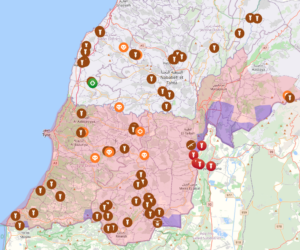
Whistler also offers up a nice roundup of the current state of Israel’s incursion into Lebanon: “By March 16th, at least three separate IDF divisions were operating simultaneously inside of southern Lebanon, pushing through Kiam, Bins Jabel, and Marion in the most significant ground operations since their 2006 intervention. Evacuation orders are now covering everything south of the Latani, which when combines with the evacuated areas in the Bekaa Valley and southern Beirut totals to roughly 14% of the entirety of Lebanon’s territory.”
“Israeli Defense Minister [Israel] Katz has said at least parts of the operation are modeled explicitly on Gaza, offered no timeline for withdrawal, and some ministers are already floating the idea of a semi-permanent security zone. For now, there are no signs of a push toward Beirut or anything beyond the Litani.”
“In the last 48 hours alone, [Lebanese President Joseph Aoun] publicly called Hezbollah’s decision to enter the war a trap and an almost overt ambush serving Iranian interests, warned that the country is on the path to become a second Gaza, and floated a four-point plan calling for an immediate ceasefire, international backing for the Lebanese armed forces to oversee disarmament, direct negotiations with Israel, and long-term border security agreements.”
“While all of this is unprecedented for a Lebanese president, Beirut is currently falling short of Israeli expectations for two reasons. First, Lebanon has a long history of promising to finally get tough on Hezbollah that, well, hasn’t exactly materialized. Second, and more pertinently, the LAF [Lebanese Armed Forces] are already struggling to implement the ban on Hezbollah’s military operations that we reported on just a week ago. Hezbollah’s attack was earth-shattering for Beirut, which appeared to have finally found a moment of cross sectarian agreement that Hezbollah simply had to go. And while there were initially promising signs that the LAF was taking this seriously, the army has largely stalled. LAF commander [Rodolphe Haykal] has essentially refused to enforce the government’s ban on Hezbollah military activities, and the United States has even suspended some coordination with the LAF over it. The country’s prime minister has considered firing him for the whole debacle.”
“Now look, in fairness to Haykal, this isn’t just some random act of indifference where he’d rather sit around and watch Warfronts than go out and disarm the group. Though we couldn’t blame him if that was the case, could we? Rather, his calculation is that 20 to 30% of the LA Shia and would possibly refuse to mobilize against Hezbollah entirely, risking a total fracture of the military. Keep in mind that in Lebanon, sectarian identity is front and center just about everything that happens, especially in politics, and the LAF is broadly considered to be the last cross-sector institution in the country.”
“All that said, the inaction here is seriously jeopardizing the country’s sovereignty. The lesson that Israel took away from the October 7th attacks, rightly or wrongly, was that they couldn’t afford to allow a hostile force to exist along its borders anymore. In the aftermath of the 2024 ceasefire with Lebanon, Israel made it clear that disarmament of the group was an absolute bare minimum condition. And the tragic thing is that the LAF largely delivered on this. Earlier this year, they completed phase one of the operation. And while it was slowgoing, potentially so slow that Hezbollah was actually rearming faster elsewhere in the country than it was being disarmed, the LAF nevertheless demonstrated that it could deliver.”
“And all of this isn’t helped by the fact that even today, right now, Hezbollah continues to launch on Israel. While their stockpile has been severely reduced and seems likely to be further reduced in their ongoing clashes with the IDF, they don’t appear to be anywhere close to surrender.”
One of the reasons Iran was caught off guard at the opening of this war is that its leadership did not take Yahya Sinwar or Hassan Nasrallah’s approach. The Iranian regime—a state built on terror—was acting like a state and forgot what happens to those who spread terror. What Hezbollah and Hamas understood, and what Iran forgot, is that when you attack Israel, you become prey.
After the regime’s decapitation on the first day, Larijani grasped that reality. As Iran’s most senior surviving security official, he never stayed in the same place twice, and maintained exceptionally high security awareness.
In the end, it took a combination of precise intelligence, special ground capabilities, and rapid decision-making at both the political level and the by chief of staff to complete the operation. The time between the intelligence alert and the order for the strike was less than an hour; that’s an incredibly tight kill chain. This wasn’t a Hamas or Hezbollah target; exploiting this opportunity meant scrambling aircraft all the way to Iran.
Snip.
According to The Wall Street Journal, Israel is chasing internal repression forces from their headquarters to secret muster points at sports stadiums, even to neighborhood police stations. All in an effort to demonstrate to the Iranians that the regime’s fangs have been removed.
Meanwhile, Israel is calling mid- and low-level commanders, threatening them and their families if they don’t stand aside in the event of an uprising.
One conversation is worth recounting.
“Can you hear me?” a Mossad agent can be heard, speaking in Farsi. “We know everything about you. You are on our blacklist, and we have all the information about you.”
“OK,” the commander said in the recording.
“I called to warn you in advance that you should stand with your people’s side,” the Mossad agent said. “And if you will not do that, your destiny will be as your leader. Do you hear me?”
“Brother, I swear on the Quran, I’m not your enemy,” the commander said. “I’m a dead man already. Just please come help us.”
Last night, a very senior Israeli source outlined to me Israel’s five objectives in this war:
To act jointly with the United States to reopen the Strait of Hormuz.
To permanently deny any future Iranian regime the ability to again close the strait — including through the development of alternative pipelines.
To dismantle Iran’s weapons industry, with an emphasis on ballistic missile capabilities — this time targeting not just equipment but the factories that produce it.
To complete the destruction of Iran’s nuclear program.
Israeli Defense Minister Israel Katz has authorized the country’s military to kill Iranian and Hezbollah officials without explicit approval from higher-ups.
Katz announced the blanket order as he alerted Israeli residents that the military had taken out top Iranian intelligence official Esmaeil Khatib. Katz said he and Prime Minister Benjamin Netanyahu authorized the directive overnight.
The purpose of the authorization is to thwart the possibility of delays in Israel’s Operation Roaring Lion against Iran, according to Israeli network Channel 12. Katz vowed that there were more “significant surprises” to come as part of the development.
In the past several days, targeted Israeli strikes have assassinated several top Tehran officials, dealing a devastating blow to the Iranian regime’s power structure as the war moves well into its third week.
Snip.
The assassinations come as Israel has ramped up its attacks targeting Basij checkpoints and infrastructure. The Guard’s Basij unit has notably been targeted in the war, as the paramilitary force has long been seen as the leading military unit behind the deadly crackdown on Iranian protesters over the winter and behind repression in general against regime dissidents.
The Israeli military is targeting Basij personnel and facilities as the country seeks to weaken the Islamic regime enough to encourage Iranian citizens to topple the power structure.
“We’re undermining this regime in the hope of giving the Iranian people a chance to oust it,” Netanyahu said in a statement on Tuesday.
Next regime figure to get droned announced. “Hossein Dehghan, who was sanctioned in 2019 for his alleged role in an attack that killed 241 American troops, has been named to replace the assassinated Ali Larijani. According to a report by Iran International, Iran appointed former Defense Minister Hossein Dehghan on Thursday as the new secretary of the Supreme National Security Council,”
The Trump administration announced plans to sell more than $16.5 billion worth of radar systems, air defense equipment, and fighter aircraft weaponry to the United Arab Emirates, Kuwait and Jordan Thursday, as Iranian missiles and drones continued to hit sensitive infrastructure across the Gulf region.
US Secretary of State Marco Rubio issued an emergency waiver to bypass the mandatory congressional review period for the sales, the Pentagon said in its press release.
For the UAE, the State Department approved $2.1 billion worth of 10 FS-LIDS counter-drone interception systems, along with 240 Coyote backpack-carried drone interceptor systems, along with related sensors and munitions.
Another planned sale to the UAE includes a THAAD long-range discrimination radar, as well as Sentinel A-4 uplinkers and THAAD tactical operations and launch and control systems. A third sale set for Abu Dhabi includes $644 million worth of F-16 munitions and upgrades, including GBU-39/B small diameter bombs and Joint Direct Attack Munitions guidance systems (JDAMs), along with 400 AIM-120C AMRAAM air-to-air missiles and eight guidance sections, the Pentagon said.
Kuwait is set to receive $8 billion in Lower-Tier Air and Missile Defense Sensor (LTAMDS) radars, the administration further announced Thursday, along with a slew of accompanying electronic equipment. Jordan, meanwhile, is slated to receive $70.5 million worth of maintenance, logistics, and munitions support for its F-16s, C-130s and F-5 aircraft.
The planned sales come as Iran has targeted sensitive early warning and missile defense radar sensors in several US-aligned countries in the Gulf. Iran has also repeatedly struck civilian centers and, increasingly over the last 48 hours, oil and gas infrastructure with drones and missiles.
US Defense Secretary Pete Hegseth on Thursday praised Gulf states for their support for Washington’s war effort, saying Iran’s “reckless” pattern of counterattacks has brought some of those countries “squarely into our orbit.” He specifically named the UAE, Qatar, Bahrain, Kuwait and Saudi Arabia.
Speaking alongside Hegseth at the Pentagon, the US’ top-ranking general, Chairman of the Joint Chiefs of Staff Gen. Dan Caine, said the US military will continue to work with Gulf states “to help them to improve any defensive capabilities that they need.”
Missile plant hit: “Karaj Surface-to-Surface Missile Plant” destroyed by U.S. strikes. This was March 1, but CENTCOM only released the images today.
Iran evidently managed to damage an F-35:
“Likely hit by a Qaem-118 short range SAM.” The pilot returned to base safely and made an emergency landing.
Once again, this was just what I was able to gather from various sources. If you think I’ve missed something, feel free to share it in the comments below.
More regime honchos dead, America and Irseal are (try to contain your shock) winning, a bad weekend for the KC-135, a Dem uber-lawyer backs Trump on Iran, and Israel is hunting Basij in the streets of Tehran. It’s your Iraq war update, incorporating news from late Friday until now.
Also, I keep getting the occasional 429 errors that require Bluehost support to snip long-running processes that they won’t give me access fix without handing them more money (which isn’t happening). An optimization scan brought up suggestions for improving performance, some highly impractical (no, I’m going to hand-optimize WordPress generated JavaScript), but one of the things spinning up long threads is Twitter embeds, so I’m going to try to do less of that and just link and summarize rather than embed. I’ve also updated and turned the caching plugin back on (turned off in a previous Bluehost troubleshooting session), so I’m hoping that will speed things up as well.
Israeli forces killed the Iranian regime’s security chief and de facto leader, Ali Larijani, in a Tuesday morning airstrike that has the potential to foment greater chaos within the Islamic Republic’s remaining leadership.
The IDF announced that Larijani was killed through “a precise strike” on his location near Tehran.
“His elimination adds to the elimination of dozens of senior commanders and leaders of the Iranian terror regime, who were eliminated by the IDF during Operation Roaring Lion, and constitutes a further blow to the Iranian regime’s abilities to manage and coordinate hostile activity against the State of Israel,” the IDF wrote in its statement.
After Ali Khamenei’s death, Larijani emerged as the country’s de facto leader, consolidating his power and overseeing combat operations against Israel and other Arab nations in the region. Along with his brother, Sadeq, Larijani waged outsized influence in the Iranian leadership and positioned himself as a successor after Khamenei’s death. He also served as secretary of the Iranian Supreme National Security Council, the body that orchestrated attacks on Israel and led efforts to violently suppress the Iranian people.
“During the most recent wave of protests against the Iranian terror regime, Larijani advanced violent enforcement measures and repression operations, and personally oversaw the massacre that was carried out against Iranian protestors,” the IDF said. “Larijani led the regime’s national-security coordination and directed its international activity, including engagement with members of the axis.”
Hilarious if true: “Missile hit Sepah Bank digital security center in Tehran.”
A missile strike hit the digital security center of Sepah Bank in Tehran early on Wednesday, according to information received by Iran International.
The building, located on Haghani Street, was destroyed in the attack while the bank was processing salary payments for military personnel.
The services at Sepah Bank and Melli Bank Iran remained widely disrupted for a second day, with online banking unavailable and only card-based services operating.
FACT 1: Iran’s missile capability has been functionally destroyed.
As of Day 6, Adm. Brad Cooper (CENTCOM) confirmed Iranian missile attacks declined roughly 90 percent since strikes began [ISW, March 5, 2026]. Per joint intelligence assessment (IDF/CENTCOM briefing), approximately 75% of all launchers destroyed; 100–200 remain. The IRGC Aerospace Force — Iran’s primary instrument of long-range conventional power projection — has been catastrophically degraded in nine days. “Hundreds” of warheads destroyed (conventional missile warheads — Iran has no deployed nuclear warheads). Defense industrial base under systematic attack. This is not a setback. This is the functional end of Iran’s power projection capability.
Fact 2 has been edited back from Iran’s nuclear program being 8-15 years to reconstitute, to being substantially destroyed for the the immediate future.
FACT 3: The Strait of Hormuz is closed — not by mines, but by insurance actuaries.
Seven of twelve International Group P&I Clubs cancelled war risk coverage on March 1–2, 2026. These seven clubs insure approximately 90% of the world’s ocean-going commercial tonnage. War risk premiums surged over 1,000%. The result: tanker traffic through Hormuz collapsed from a pre-conflict baseline of approximately 138–153+ vessels per day (figures vary by data provider: Lloyd’s List/Kpler cite ~138; CSIS/Starboard cite 153+) to as few as 3 commercial transits recorded by Windward.ai AIS tracking on March 7; a near-total shutdown. Iran achieved a de facto blockade by making the risk-reward calculation of commercial transit economically irrational, without firing a single mine.
FACT 4: The US is the primary economic beneficiary of this crisis.
Brent crude has risen from $72/barrel (pre-conflict) to $106.81/barrel on March 8, 2026 (Day 9), with an intraday spike to $110 when Asian markets opened Sunday evening — the first time Brent has exceeded $100 in nearly four years, and up 50%+ from the $60/barrel that started 2026. WTI (US crude futures) hit $106.57 (+17.2% on the day). A new cascade has begun: Gulf producers are being forced to cut output as storage fills — Iraq’s production has collapsed 60%, UAE and Kuwait have begun cuts. Goldman Sachs warned Friday night that the Hormuz shock is now “17 times larger” than the peak Russia disruption of April 2022 and projects Brent could reach $150/barrel by end of March if Hormuz flows remain depressed. The US is a net petroleum exporter. Every $10/barrel increase in oil costs China and Japan hundreds of millions per day while benefiting US shale producers and LNG exporters (Cheniere, Shell, ExxonMobil). Qatar suspended LNG production. CSIS senior fellow Clayton Seigle: “A deficit of 20 million barrels per day is hitting global oil market balances with no sign of relief.” The Washington Post confirmed explicitly: “The conflict has hit Europe and Asia harder than the United States.”
FACT 5: Ali Khamenei is dead. His son is not a legitimate successor.
Supreme Leader Ali Khamenei was assassinated February 28, 2026, in a joint US-Israeli airstrike on his Tehran compound — Israeli jets dropped 30 bombs in daylight with zero effective Iranian air defense response. Mojtaba Khamenei, his son, was named Supreme Leader by the Assembly of Experts on March 8. Mojtaba is a Hojjatoleslam (mid-ranking cleric), not an Ayatollah — his theological credentials are below what the constitution’s spirit requires. He has never held a formal government position. The regime has chosen dynastic succession in a self-described revolutionary republic. This legitimacy deficit is the long-term vulnerability. [CONFIRMED — NYT, Reuters, P1B]
DataRepublican assume there will be no land war. But she’s working from the assumption that such a land war will require occupying all of Iran, rather than, say, Tehran and various oil exporting ports.
FACT 7: China is losing 1.7 million barrels per day of discounted Iranian oil and faces secondary sanctions.
China bought approximately 90% of Iran’s oil exports at sanction-discount prices. That supply is gone. Higher global oil prices hit China’s economy directly. The February 2026 Executive Order imposes tariffs on any country purchasing Iranian oil — aimed directly at Chinese “teapot” refineries in Shandong Province. The US simultaneously disrupted both of China’s discounted petro-state suppliers (Iran and Venezuela). China is watching US military capabilities through its satellites and reading the Taiwan signal.
FACT 8: The Mosaic Defense kept Iran fighting but cannot project offensive power.
Iran’s 31 autonomous provincial IRGC commands, each with pre-delegated launch authority, are firing pre-authorized strike packages without central coordination. This means the regime cannot be decapitated; missiles keep flying. But the same decentralization that enables survival prevents the complex multi-axis offensive operations that would actually threaten US interests at scale. The 90% launch decline is the empirical proof: what remains is dispersed residue, not a coherent military campaign. [ASSESSED — CEPA, P1B, P2A mosaic paradox]
FACT 9: The Iranian economy was already at collapse threshold before the war began.
Pre-war data: rial at 1.45 million per US dollar (December 2025 peak); 49% inflation; negative GDP growth; government budget deficit at 6%+ of GDP. The January 2026 protests — the largest in Iranian history, with 3,000–30,000 killed by the regime — were triggered directly by rial collapse. The war adds destroyed infrastructure, disrupted trade, severed oil revenue, and accelerating secondary sanctions. The economic collapse is not a future risk; it is an ongoing reality that predates Operation Epic Fury.
FACT 10: The Axis of Resistance has been substantially degraded.
Syria land bridge severed (Assad fell December 8, 2024). Hezbollah “dramatically weakened” by 2024 Israeli offensive; Nasrallah killed September 2024; Iran-Hezbollah land corridor gone. Hamas catastrophically degraded after 18+ months of Israeli ground operations; IRGC’s Hamas portfolio manager Saeed Izadi killed June 2025. Houthis’ stockpiles reduced by Operation Rough Rider (2025); Houthis “staying out of the Iran-US fight for now” (Al Jazeera, March 7, 2026). Iraqi PMF taking active US strikes. Iran’s 40-year investment in regional proxy power has been substantially degraded — not dismantled. Hezbollah retains organizational structure, partial rocket inventory, and political control of southern Lebanon. Hamas retains organizational elements outside Gaza.
I feel that most of this is probably correct. And that’s just the topline analysis; there’s a lot more in-depth data and analysis at the link. (Hat tip: Borepatch.)
You know who likes the chances of America and Israel winning the war? Al Jazeera.
When you look at what has actually happened to Iran’s principal instruments of power – its ballistic missile arsenal, its nuclear infrastructure, its air defences, its navy and its proxy command architecture – the picture is not one of US failure. It is one of systematic, phased degradation of a threat that previous administrations allowed to grow for four decades….
The campaign has moved through two distinct phases. The first suppressed Iran’s air defences, decapitated its command and control, and degraded its missile and drone launch infrastructure. By March 2, US Central Command announced local air superiority over western Iran and Tehran, achieved without the confirmed loss of a single American or Israeli combat aircraft.
The second phase, now under way, targets Iran’s defence industrial base: missile production facilities, dual-use research centres and the underground complexes where remaining stockpiles are stored. This is not aimless bombing. It is a methodical campaign to ensure that what has been destroyed cannot be rebuilt.
Iran now faces a strategic dilemma that tightens every day. If it fires its remaining missiles, it exposes launchers that are promptly destroyed. If it conserves them, it forfeits the ability to impose costs of the war. Missile and drone launch data suggest Iran is rationing its remaining capacity for politically timed salvoes rather than sustaining operational tempo.
This is a force managing decline, not projecting strength.
The closure of the Strait of Hormuz is dominating the critical commentary. US Senator Chris Murphy has called it evidence that President Donald Trump misjudged Iran’s capacity to retaliate. CNN has described it as proof that the administration has lost control of the war’s escalation.
The economic pain is real: Oil prices have surged, a record 400 million barrels of oil will be released from global reserves, and Gulf states are facing drone and missile strikes on their energy infrastructure.
But this framing inverts the strategic logic. Closing the strait was always Iran’s most visible retaliatory card, and always a wasting asset. About 90 percent of Iran’s own oil exports pass through Kharg Island and then the strait.
China, Tehran’s largest remaining economic partner, cannot receive Iranian crude while the strait is shut. Every day the blockade continues, Iran severs its own economic lifeline and alienates the one major power that has consistently shielded it at the United Nations. The closure does not just hurt the global economy; it accelerates Iran’s isolation.
Meanwhile, the naval assets Iran needs to sustain the blockade – fast-attack boats, drones, mines, shore-based antiship missiles – are being degraded daily. Its naval bases at Bandar Abbas and Chahbahar have been severely damaged.
The question is not whether the strait reopens but when and whether Iran retains any naval capacity to contest it. Critics compare the challenge of escorting a hundred tankers daily to an impossible logistical burden. But you do not need to escort tankers through a strait if the adversary no longer has the means to threaten them. That is the operational trajectory.
Strait of Hormuz update: “War risk insurance peaks at 5% of hull value. Insurance costs reach highest level since Iran-Iraq Tanker War (1980s). Oil tanker valued at $100M now costs $5M to insure for single transit. Strait effectively closed despite technical navigation possibility.”
“Reports indicate clashes between security forces and citizens around Chaharbagh Square in Tehran. The sound of gunfire can be heard.” Not the only area where such clashes are reported.
Five KC-135 tankers damaged in an Iranian missile strike at Prince Sultan Air Base in Saudi Arabia:
Suchomimus notes that there’s simply not a lot of space to park at that base, so there’s going to be risk parking so many tankers (or other large aircraft) there. None of the planes were destroyed, and all are being repaired.
Iranian hovercraft base at Bandar Abbas hit:
I don’t get to use the “Hovercraft” tag nearly enough…
Famous Democrat lawyer David Boies thinks Trump is doing the right thing in Iran and “Democrats should get behind the President, and make sure that he finishes the job.”
Boies, a Democrat, argues passionately in favor of the war, and scolds people—mainly other Democrats—for, in his mind, letting their dislike of President Trump affect their opinion of attacking Iran. As he writes, “If we believe that Iran presents a serious threat, we need to support the president on this issue. There’s plenty to disagree with him about, and we don’t need to like or admire him. But on Iran we should be on common ground.”
Another successful Iranian strike (or possibly Iranian-linked militia) in Iraq:
BIG: A drone strike hit the U.S. Embassy compound in Baghdad’s Green Zone, damaging or disabling the embassy’s C-RAM air defense system (C-RAM's radar) and striking a helipad.
U.S. forces pass the 5,500 targets mark, the regime starts emptying the bank accounts of citizens to stay afloat, China’s weapons are (still) garbage, more Iranian planes cratered on runways, a tanker burns off Iraq, Weekend at Mojtaba’s, and the idea that our troops in harm’s way might be eating well enrages the Democrat Media Complex.
CENTCOM operations briefing:
“Every day, we’re striking hard at Iranian ballistic missile and drones. To date, we have struck more than 5,500 targets inside Iran including more than 60 ships using a variety of precision weapon systems.”
“Since the first 24 hours of this campaign, Iranian ballistic missile and drone attacks have dropped drastically but it’s worth pointing out that Iranian forces continue to deliberately target innocent civilians in Gulf countries while hiding behind their own people as they launch attacks from highly populated cities in Iran.”
“Our warfighters are leveraging a variety of advanced AI tools. These systems help us sift through vast amounts of data in seconds, so our leaders can cut through the noise and make smarter decisions faster than the enemy can react. Humans will always make final decisions on what to shoot and what not to shoot and when to shoot, but advanced AI tools can turn processes that used to take hours and sometimes even days into seconds.
Note that YouTube’s auto-translate function renders Operation Epic Fury as “Operation Epicure,” so if you see that somewhere in any Iran reports, you know someone was asleep at the switch…
Iran’s attacks targeting radars and other missile defense equipment in the Gulf have not achieved the regime’s objective of degrading air defenses enough to reliably penetrate them. Interception rates of ballistic missiles have not changed significantly.
Iran likely seeks to preserve the option to threaten, disrupt, and selectively control traffic through the Strait of Hormuz without fully halting Iranian crude exports that still rely on the waterway by mining it heavily.
The combined force continues to target several key internal security sites in Tehran City and Kurdish-populated areas in northwestern Iran. An open-source intelligence (OSINT) analyst reported that the combined force struck several internal security sites in Marivan City, Kurdistan Province, which is about 10 miles east of the Iran-Iraq border in northwestern Iran. Marivan City and other mountainous cities in Kurdistan Province are hotspots for anti-regime protests and clashes between Iranian security forces and Kurdish anti-regime groups.
Russia is reportedly sharing advanced drone tactics with Iran to support Iranian attacks against US forces and assets in the Middle East, which highlights deepening cooperation between key US adversaries. The CNN report comes after three unspecified officials told the Washington Post on March 6 that Russia has provided Iran with the locations of US military assets, including warships and aircraft, since the war started on February 28.
China continues to supply Iran with precursors for solid fuel to support Iran’s ballistic missile program. An OSINT analyst reported on March 11 that the Iranian cargo vessel Barzin departed Gaolan Port in China, likely carrying a shipment of missile fuel precursors, and is now en route to Iran.
Some elements of Hezbollah’s political support appear to be fracturing due to Hezbollah’s participation in the war. Hezbollah ally, the Amal Movement, recently voted in favor of the Lebanese cabinet’s decision to ban Hezbollah’s military activity. The Amal Movement has been Hezbollah’s key political and strategic ally since 2005.
Not a lot new there if you’ve been following along here.
Has the regime run out of money and just started stealing?
The Iranian Mullah Regime cannot meet the payroll of the Regime Security Forces…
…so, it is stealing the next payroll from everyone else.
Food security issues started the last Iranian mass insurrection. The Mullah Regime just lit the short fuze for the next one. https://t.co/xIIQaxfTWe
Coalition air power continues to pound the greater Tehran area:
Iran got $5 billion in Chinese MilTech that proved absolutely worthless:
And it changes EVERYTHING about who's really fighting this war.
🚨 CHINA SECRETLY ARMED IRAN WITH $5 BILLION IN WEAPONS →EVERY SINGLE ONE FAILED 🚨
A secret oil-for-weapons deal between China and Iran has been exposed by Reuters. Beijing raided its own People's Liberation Army… pic.twitter.com/nesaOtWeKt
CHINA SECRETLY ARMED IRAN WITH $5 BILLION IN WEAPONS →EVERY SINGLE ONE FAILED 🚨
A secret oil-for-weapons deal between China and Iran has been exposed by Reuters. Beijing raided its own People’s Liberation Army inventory to fast-track delivery before the war started.
$5 BILLION. Pulled from China’s own military stockpile.
WHAT HAPPENED:
→ US-Israeli strikes destroyed the ENTIRE stockpile on DAY ONE
→ CM-302 missiles launched at US Navy – ZERO hits
→ Some malfunctioned mid-flight. Others intercepted by SM-3 and SM-6
→ 100% failure rate. Not a single US warship scratched.
💀 China’s “world’s best anti-ship missile” = couldn’t hit a destroyer
💀 CM-302 has NO data link, NO satellite guidance, NO active terminal tracking
💀 Once launched it flies BLIND — and the US Navy knew it
💀 $5 BILLION in Chinese weapons = DESTROYED in hours
⚠️ China denied the deal publicly. Reuters confirmed it.
⚠️ This violates the UN weapons embargo reimposed last September
⚠️ China pulled weapons from its OWN military – meaning its Pacific fleet is now WEAKER
They’re showing you Iran’s missile launches and calling it a threat.
They’re NOT showing you that China armed Iran with its best weapons → and they ALL failed against American destroyers.
You don’t secretly arm a country with $5 billion in weapons from your own military unless you’re betting on them winning. China bet everything on Iran. And lost.
Oil terminals at Iraqi ports on Thursday said they have suspended operations following attacks on tankers near its waters, according to Iraqi authorities cited by state media.
Farhan al-Fartousi, director general of the state-owned General Company for Ports of Iraq (GCPI), said was quoted by the Iraqi News Agency (INA) as saying, “The operation of oil ports has been suspended, commercial ports continue operations.”
Ships remain in the waiting area, and loading and unloading are ongoing at the North and South Um Qasr ports, the INA reported.
This decision, the news outlet reported, was taken after a tanker loaded with petroleum products – supplied by the Iraqi State Organization for Marketing of Oil (SOMO) to the Iraqi Oil Tankers Company, “was involved in an incident”.
Al-Fartousi said that the vessel was carrying a fuel supply tank in the Ship-to-Ship (STS) transfer area and was in the process of loading when it was hit by an explosion. He added that “one of the smaller tankers involved flies the Maltese flag.”
SOMO is Iraq’s national company responsible for marketing and exporting the country’s crude oil and fuel oil. Headquartered in Baghdad, it manages sales to international buyers.
As per the Iraqi News Agency, rescue teams from the company, in coordination with naval units in the SDS area, recovered 38 people, including one confirmed dead. Specialized firefighting tugs from Basra Oil Port were deployed to extinguish fires on both vessels, while search-and-rescue teams continue to look for missing crew members.
There’s video:
The US loses a KC-135 refueling tanker over Iraq, evidently due to an aerial collision with another friendly aircraft (which landed safely). Rescue efforts “ongoing.”
“An SAS base in Iraq was hit by a barrage of drones last night as top UK generals confirmed that Russia was ‘definitely’ helping Iran.”
I have to give leftists and Democrats some credit because they put in no effort to conceal their true feelings, objectives, or that their hatred for President Donald Trump blinds them.
They lost their minds when data showed that Secretary of War Pete Hegseth spent a lot of money to improve the lives of the military.
They latched onto the $20 million spent on steaks, lobster tails, and crab legs.
How Pete Hegseth spent taxpayer funds:
$225 million for furniture
$15.1 million for ribeye steak
$6.9 million on lobster tail
$5.3 million for new Apple devices
$2 million for Alaskan king crab
$139,224 on donuts
$124,000 for ice cream machines
$98,329 for a grand piano
— Melanie D’Arrigo (@DarrigoMelanie) March 10, 2026
Snip.
Also, who is “they?”
Didn’t Congress allocate the money for the Defense Department?
What does the allocated money have to do with healthcare costs, SNAP, and other services that do not fall under the defense budget?
Am I missing something here? Doesn’t Congress have to approve the budgets? How did the “they” cut those costs?
If Congress doesn’t want the military to eat well, have treats, and have a better life while serving, then maybe don’t hand the department billions.
More on that subject via Stephen Green at Instapundit:
I've heard Democrats complain more loudly about our soldiers being well fed than about fraud in California or Minnesota. They sure do have their priorities. They seem to only be upset about the military spending because they'd prefer the lobster and steak to go to illegal aliens.
As usually, this is just what I was able to collect from various sources. If you think I’ve missed anything important, feel free to share it in comments below.
Day 10 of the Iran War: Oil spikes then falls, Iran gets a new theoretical Supreme Leader, China’s low cost GPS substitute is just as crappy as their other MilTech, the gulf states are investing in Ukrainian MilTech, and Habitual Linecrosser tries to cut through the fog of war.
He told CBS News “I think the war is very complete, pretty much”, and said the US was “very far ahead of schedule”
Speaking to NBC, he left open the prospect of acquiring Iranian oil, saying “certainly people have talked about it”
In an interview with the New York Post, he said the administration was “nowhere near” making a decision on whether to order US troops into Iran
Speaking to Republican lawmakers, Trump said the US was drawn into a “short-term” military operation in Iran to “get rid of some very evil people”
He went on to say: “We’ve already won in many ways, but we haven’t won enough”
Trump told the New York Post he is “not happy” with Iran’s new supreme leader, Mojtaba Khamenei, but at his press briefing later did not make clear who he wants to take his place – or how that will be achieved
At his press briefing, Trump reiterated that the operation in Iran has been a “tremendous success”, but also added that he wants to ensure Iran cannot develop nuclear weaponry “for a very long time” – a much bigger task
The US still has targets in Iran, Trump tells reporters, but they could be taken out “in one day”
Theoretically, Mojtaba Khamenei survived the leadership airstrike and is now the Iran’s new supreme leader. Maybe, but I wouldn’t put it past the people currently not running the country to announce him as leader even though he’s room temperature so they can continue to keep not running the country without U.S. and Israeli planes sending them to Allah.
“Third Iranian Shahid Soleimani-class Corvette Hit By America: At Bandar Abbas Port.”
The war between the U.S., Israel and Iran has entered a decisive phase that may determine the political future of the Middle East for decades to come.
President Trump declared that there will be no deal with the Iranian regime — nothing short of unconditional surrender. Tehran responded with predictable defiance, announcing that it would never surrender. Yet behind the regime’s rhetoric, reality appears very different.
Much of the leadership now reportedly communicates from undisclosed locations, hiding from sustained strikes while the propaganda machine attempts to project strength and resilience.
The scale of the military campaign has been extraordinary. In the first week alone, the U.S. reportedly struck approximately 3,000 Iranian targets across the country and the region. Israel has launched repeated waves of air strikes — more than twenty separate operations — systematically dismantling the regime’s military infrastructure. Missile launchers, air defense systems, command centers and naval facilities have been destroyed. Advanced weapons systems and new technologies, including next-generation laser defense platforms, are shaping the battlefield.
Israel has reportedly targeted and dismantled hardened command structures associated with the regime’s leadership, including the underground bunker networks linked to Supreme Leader Ali Khamenei. Several key figures may have been killed in these operations, though the regime has yet to publicly acknowledge casualties buried under the rubble of destroyed facilities.
Meanwhile, the Islamic Republic’s military capacity has been devastated. What once appeared to be a formidable regional force increasingly looks like what many analysts suspected all along: a paper tiger built on intimidation, propaganda and bluff.
For decades, the regime invested enormous resources in projecting power across the Middle East, building proxy networks and threatening neighboring states. Now it faces an unprecedented strategic crisis. Today, it is focused primarily on surviving.
The central question confronting policymakers in Washington and Jerusalem is not whether the regime’s military capabilities can be degraded — that process is already underway — but whether the campaign will stop short of dismantling the Islamic Republic itself. Anything short of regime-change risks allowing the system to recover, reorganize and once again threaten regional stability.
The military balance of power favors the U.S. and Israel. Iran’s conventional warfighting capabilities have been severely degraded. Air superiority allows continued targeting of strategic assets, meaning the regime’s ability to project military power beyond its borders will keep declining as long as the campaign persists. In the short run, this places the regime in a defensive posture.
But the weakening of Iran’s military does not automatically translate to the collapse of the regime. The Islamic Republic has historically relied less on conventional military strength and more on asymmetric tools — intelligence networks, ideological mobilization, proxy militias and global terrorism. Even if its missile forces, navy and air defenses are heavily damaged, the regime’s internal security structures — the Islamic Revolutionary Guard Corps, the domestic Basij security force, intelligence services and propaganda apparatus — can still function. Note that these institutions exist primarily to protect the regime rather than to defend the country.
LUCAS drones (“even cheaper than the Shahed, around $15,000”).
Ship-based anti-drone lasers (cost per kill: 50¢).
Tomahawk
Precision Strike Missile
Evidently American forces have found a way to jam China’s BeiDou system, their version of GPS:
Also, BeiDou seems to include its own text message system, which comes with a lot of drawbacks in an active combat environment…
A document circulating lays out the possibility of a limited campaign for U.S. ground forces to taking over Bandar Abbas and surrounding areas.
It is important to note that the United States does not currently maintain the ground force numbers in the region required for a full-scale invasion of Iran, nor has it established the logistical infrastructure that such a campaign would demand. Furthermore, there is no visible mobilization that would indicate preparation for a large occupation force. However, the US does have a large number of forward-deployed naval assets, rapid deployment units available back home, and special operations forces that could deploy within 18 to 48 hours to conduct a limited landing designed to seize specific objectives only.
The current goal of the ongoing air campaign appears to be to undermine the Iranian military and political leadership, to ignite internal dissent and local opposition movements, and whereafter, support these through air support and supply drops. Nevertheless, if current aerial efforts fail to create such a scenario, the US may consider scaling up its efforts.
One viable strategy could entail securing a foothold inside Iran to host a provisional government and facilitate overland supply routes instead. The most likely target for such a landing is Bandar Abbas, Iran’s primary southern port and a central node in its oil export system. In addition to establishing a bridgehead, capturing the city would allow US forces to obtain Iran’s main naval base. The accompanying port infrastructure, including cargo terminals and former fleet facilities, could then be repurposed to rapidly unload supplies and serve as a staging ground to support friendly forces inland.
Most importantly, Bandars Abbass’ is strategically located on the Strait of Hormuz. Following the attack, Iran is attempting to blockade the Strait, causing disruptions that are already affecting global shipping lanes. Securing Bandar Abbas would give the US a position from which to guarantee maritime passage to the major oil flows and deny Iran the ability to leverage the strait as a pressure tool.
In preparation for a landing, the US would shift focus to an air campaign aimed at degrading Iranian coastal defenses, displacing Iranian army units from the shoreline, and disrupting their ability to maneuver along the main logistics corridors leading into Bandar Abbas. With defenses disrupted, a numerically smaller landing force could then move into secure administrative buildings, port facilities, and the surrounding districts, in order to secure a perimeter and consolidate control. Infiltration routes through the mountains would be used to send small special forces groups to link up with local resistance networks as well as provide supplies and weaponry overland. Any landing would also force Iranian army units hiding in the surrounding mountains into the open terrain, if they want to contest the US bridgehead. However, any attempt to mass forces for a real counterattack would expose them to US and Israeli airstrikes almost immediately; with over 150 US combat aircraft, several cruisers, and guided-missile destroyers, ready to provide fire support to any landing party.
The alternative for the Iranian army would be a shift toward a guerrilla‑style resistance inside the city and surrounding area. But the operational impact of such a campaign would remain limited if the United States avoids expanding the offensive inland, and positions itself as a supporting force for a new government, instead of an occupying one. High local pro‑Western sentiment, visible in the large protests in the cities and towns here earlier this year, could additionally constrain the Iranian army’s ability to operate covertly.
Highly speculative, but it does contain a certain logic. Plus, with physical control of the oil export terminal, the U.S. could start selling oil in exchange for direct payment, promising to turn over any proceeds after a non-Jihadist government takes power…
Add the Royal Jordanian Air Force to the list of countries flying defensive missions over the Persian Gulf, specifically protecting Bahrain and UAE.
Azerbaijan has reportedly reopened the border with Iran, but the source is TASS, so several grains of salt are probably in order.
Jordan Peterson and Douglas Murray talk about what a scumbag death cult Hamas is.
UAE is investing in Ukrainian MilTech companies and buying Flamingo missiles to counter Iran.
“The United Arab Emirates-based Edge Group is set to purchase a 30 percent ownership stake in Fire Point, Ukraine’s combat-proven missile and drone manufacturer. The proposed deal of around 760 million US dollars will raise the total valuation of the Ukrainian defense firm to roughly 2.5 billion US dollars. Fire Point, which produces the FP-1 and FP-2 unmanned aerial systems as well as the Flamingo cruise missile, has risen to become Ukraine’s leading defense technology manufacturer within just two years, with production of drones currently reaching 6,000 per month.”
“The most interesting product in Fire Point’s arsenal is the Flamingo cruise missile, of which the company produces 1 to 2 units per day. With 30% share in the company and certain agreements, the UAE can receive around 10 to 20 such missiles and 1800 drones per month, significantly enhancing its ability not only to protect itself against enemies like Iran, but to carry out preventive strikes. Combat-proven with an estimated range of 3,000 kilometers and already successfully used to target critical Russian infrastructure within the 2,000 kilometer range, the missile is capable of reaching and destroying any target across Iran. Air bases, command centers, and missile storage facilities can be targeted with ease by its 1,150 kilogram warhead, forcing the Iranian command to change planning due to another deadly threat in the region.”
And what’s happening in the “southern front” of the war? In Lebanon, Israel seems to settling Hezbollah’s hash in both Beirut…
…and southern Lebanon.
Today’s Habitual Linecrosser:
As usual, if you think I missed any significant stories on the war, feel free to share them in the comments below.
Lots of news from the war in Iran, much of it in video form.
One reason I do these updates is that the vast majority of MSM reporting is of such poor quality. It’s all government talking heads said this or critics of Trump said that. In other words, lazy reporting crap no one cares about.
Back before American journalists became self-licking ice cream cones, war reporting used to include maps, unit movements, logistics, combat reports from journalists embedded with U.S. units, etc. The BBC still seems to do a little of that, but I’m not seeing that from American outlets, maybe because it’s hard work. They don’t even seem to be bothering to tell ChatGPT to do it for them.
Hence these roundups to fill the gap.
As a brief snapshot of the dysfunction at the highest levels of Iranian government, here’s the President of Iran saying “Sorry about all the droning, it won’t happen again,” and the IRGC saying “Shut the hell up, you weak little bitch!”
To many, it seems like an end-of-days scenario: Qatar and Israel on the same team.
Who would have thought? In September, Israel attacked in Qatar, targeting terrorist leaders the Gulf state was housing. But here we are. After five days of war with Iran, the Iranians have succeeded in putting Israel and Qatar on the same team – to say nothing of the United Arab Emirates, Kuwait, Oman, Bahrain, and even Saudi Arabia – all countries targeted over the past five days by Iranian missiles and drones.
By some estimates, Iran has fired more missiles and drones at Gulf states combined than at Israel.
What Iran may have done is something Israel has long struggled to achieve diplomatically: place Israel and several Sunni Arab states on the same side of a regional conflict. By striking the Gulf states directly, Tehran has widened the war in a way that forces governments across the region to reconsider where their interests truly lie.
Within the first 48 hours, Tehran launched missiles and drones not only toward Israel but toward every member of the Gulf Cooperation Council: the UAE, Saudi Arabia, Qatar, Kuwait, Oman, and Bahrain. What might initially have appeared to be a confrontation between Iran and the US and Israel quickly transformed into something wider – a regional conflict touching key Sunni Arab states.
And it was not only countries that have agreements with Israel that were targeted – the UAE and Bahrain – but also countries that have tried to maintain good relations with Iran, such as Qatar and Oman. Even Turkey announced on Wednesday that an Iranian missile was downed as it headed toward its airspace. By going after these countries, Iran is signaling that it wants everyone in the region to formally pick a side.
Tellingly, the strikes in the Gulf states were aimed largely at civilian targets rather than solely at US bases and facilities located in those countries. The strikes went far beyond American installations and hit airports, hotels, and oil infrastructure.
Why? The conventional wisdom is that Tehran hopes to sow chaos in the region and pressure those countries now under attack to lean on Washington to call off the campaign before the situation spirals even further out of control.
Having two aircraft carriers launching strikes at Iran evidently wasn’t enough, as the USS George H. W. Bush is now poised to join the party, joining the USS Abraham Lincoln and the USS Gerald R. Ford. Obviously you need ships named after Republican presidents to win wars. If you had the USS Barack Obama, it could only drop pallets of cash, and the USS Bill Clinton could only hit on underage Iranian girls…
Grand Ayatollah Abdollah Javadi-Amoli had issued a fatwa against President Trump, “says shedding blood of Zionists and Trump is mandatory.” Sounds like someone wants to be moved higher on the drone list.
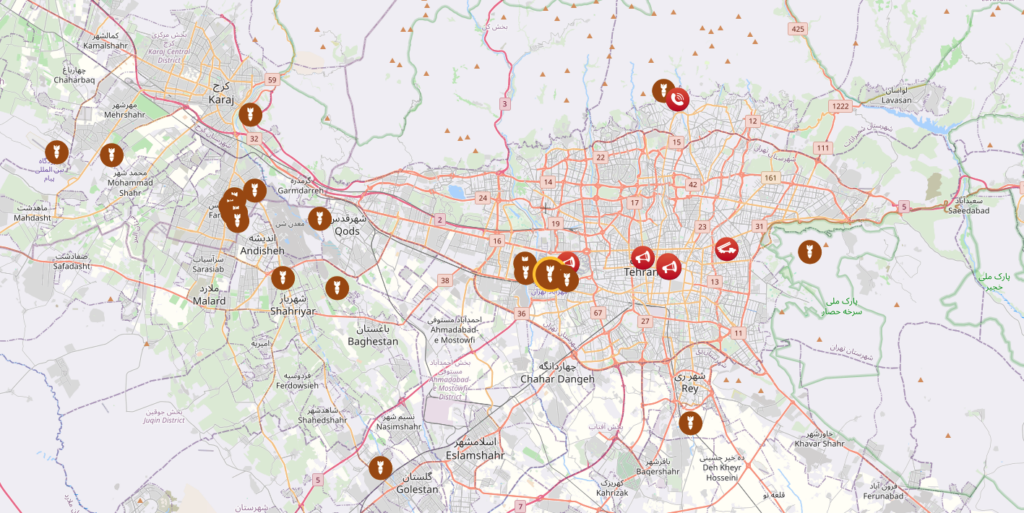
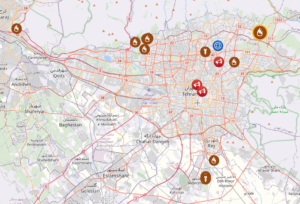
Since Iran has hit the oil facilities on Persian gulf nations, Israel hits oil storage facilities near Tehran. Those burning symbols on this Liveuamap snapshot are where airstrikes have hit oil facilities in and around Tehran.
For all the talk of Kurdish forces entering Iran, Trump has said he’s told them not to. But we have numerous reports of Israeli jets hitting targets like IRCG posts along the border and police stations in Iranian Kurdistan.
Reports of blinding Iranian satellites:
🇮🇷🇮🇱 As expected, the IDF claims to have targeted the ground control station for Iran's Russian-built Khayyam imaging satellite. I suspect that this is the first time that a satellite ground control station has been targeted in wartime.https://t.co/gL42aeVkc9https://t.co/Gx4kUodxXB
Possibly three new U.S. weapons have been seen in Epic Fury:
A black-coated Tomahawk variant, possibly for stealth.
The Precision Strike Missile (PrSM). This is a new Lockheed Martin missile to replace ATACMS.
Lots of lessons learned from the Russo-Ukrainian War and Ukraine’s use of Patriot there. Missiles are getting intercepted, but Shahed drones are still leaking through.
In addition to the B-2 and B-52, the B-1 is also hitting targets in Iran. I think this is the first war in which all the Bs were hitting targets…
Suchomimus does damage assessment on Iranian naval assets and other targets hit on both sides:
Azerbaijan closes the border crossing with Iran to cargo:
Iranian truck drivers had already started staging strikes against the regime even before the crossing shutdown. “Inside, 400,000 drivers have cut off contact and are known to be against the regime. While outside, thousands of trucks and drivers are stuck at sealed borders. This double squeeze means the collapse of the state’s control over the economy. The truck drivers mutiny is not just blocking roads. It is breaking the entire industrial backbone from steel to prochemicals, from food to logistics.”
Mark Felton asks whether Iranian missiles can hit London? Answer: Probably not.
“We can probably say that yes, Iran has at least one missile that has the legs to reach the UK [the Simorgg SLV, use to launch satellites into orbit], but not the systems to deliver a warhead successfully. At present, it is technically impossible for Iran to bombard the UK.”
U.S. and Israeli are still hitting targets, and Iran is still retaliating by hitting every other country on the Persian Gulf. Here are some significant updates from the war in Iran:
The IDF targeted a building in which Tehran’s 88-member Assembly of Experts was meeting to choose Iran’s next supreme leader, Israeli sources told The Jerusalem Post on Tuesday.
Iranian news agencies reported that the building was “flattened” during the Israeli strikes.
No injuries or deaths resulting from the strike have been reported as of early Tuesday evening.
Earlier on Tuesday, Iran’s ISNA news agency cited a member of the Assembly of Experts as saying that choosing the successor to the previous supreme leader, Ayatollah Ali Khamenei, “won’t take long.”
So IDF wiped out not only the top guy and his successor, but also all the likely successors as well…
Suchomimus has damage assessment from coalition naval strikes:
Highlights:
IRINS Makran, a former tanker converted to a forward base ship and Iran’s largest naval vessel, is on fire.
A bunch of smaller ships at Bandar Abbas were also likely hit.
Several frigates likely sunk, and one possibly sunk for the third time.
Lots of stuff hit at Konark naval base in the southeast, both ships and base infrastructure, including a floating dock. IRINS Jamaran is no longer on fire, but is partially underwater.
Multiple targets hit at the Iranian naval base at Bandar-e-Jask.
The Qataris are already joining in the strikes against Iran, and the Saudis might follow suit. “These two countries have the largest and most capable air forces in the Gulf. Qatar can field 22 Eurofighter Typhoon, 40 F-15QA, and 36 Rafale aircraft. Saudi Arabia operates 68 F-15C/D, 149 F-15S/SR/SA, 71 Eurofighter Typhoon, and 77 Tornado aircraft.”
Did Iran hit UAE THAAD missile defense radar sites?
It looks like the IRGC did not lie and indeed destroyed the AN/TPY-2 radar of the THAAD Anti-Ballistic Missile (ABM) System at Al-Ruwais, UAE.
On Sunday, mobs of young practitioners of the Religion of Peace™ stormed the U.S. consulate in Karachi (Pakistan) and the U.S. embassy in Baghdad (Iraq).
Iraqi police managed to put down their riot before things got too spicy, but in Pakistan, the Marines got a chance to put their training into action, killing 10 and wounding dozens more as rioters pried open the consulate’s gate (local security forces were also on-site, including the Pakistan Rangers).
Another 12 people were killed by local police in the north of the country as a mob stormed U.N. offices.
Seeing lots of reports that the CIA is arming the Kurds to help overthrow the regime, but the source seems to be CNN, so naturally I’m treating that with several grains of salt.
That’s my quick impression of the news out of theater. If you think Imissed something significant, feel free to share it in the comments below.
If it wasn’t clear from yesterday’s roundup, it appears that a whole lot of Islamic Republic of Iran leaders were physically meeting at Ayatollah Ali Khamenei’s bunker in Tehran when the successful decapitation strike was carried out as part of Operation Epic Fury/Roaring Lion. The operations are still ongoing, and here are some news updates.
“‘All’ of [Ali Khamenei’s] likely successors are ‘probably dead’ following US-Israeli strikes.”
Mick Mulvaney, former Trump OMB head and Chief of Staff: “A high risk, high reward type of operation.”
A “once in a lifetime opportunity” to both end the nuclear program and effect regime change. “All the [Iranian] senior leadership gathered together at one place at one time.”
The daylight attack must have meant we had really solid intel on the regime meeting. Most of our Middle East strikes happen at night during a new moon. “An opportunity they simply couldn’t pass up.”
“All of [Ali Khamenei’s] likely successors are probably dead as well.”
“The chances of getting a pro-Western, pro-American regime in Iran were as high as it ever was going to be.”
John Bolton was lamenting that these actions weren’t taken six or seven years ago, but the situation on the ground now is very different. “Everything has to come together at the same time for this to work.”
“This can’t be a forever war.”
Taking out the mullahs is “a step toward peace.”
New Guy steps into the leadership crosshairs. “Iranian Vice President Mohammad Reza Aref informed officials of plans to have him take charge of the nation during wartime, according to a report from the Iranian Students’ News Agency (ISNA) published on social media late Saturday night. There was no explicit note of President Masoud Pezeshkian’s ability to carry out presidential duties.”
Simon Whistler covers the strikes:
Much of this covers information included here yesterday, but here are a few new tidbits.
Whistler states Iran is claiming they hit Riyadh in Saudi Arabia. LiveUAMap shows a strike against Prince Sultan Air Base, which is over a 100 miles from Riyadh. I mean, they’re both in central Saudi Arabia, but, eh.
In Yemen, Houthis threaten retaliation. Nothing yet.
The gulf states are plenty pissed at Iran tossing drones and missiles at them.
Russia issued a single proforma condemnation of U.S. attacks. China, on the other hand, hasn’t even done that.
A lot of Chinese MilTech deals were supposedly in the works when things kicked off, but it looks like very little (if any) actually made it to Iran.
Suchomimus video the first:
“It is quite telling that [Khamenei]’s death is being celebrated on the streets.”
Khamenei was likely killed in the opening strike. “A few sources are now saying it was Israel that hit this.”
“Iran isn’t showing any signs of giving up. Well, these could just be the last temper tantrum of the finished regime. The generals and remaining politicians lashing out knowing their time is over and that a surrender is inevitable and just trying to inflict damage.”
Suchomimus sees regime change as unlikely without “boots on the ground.”
Suchomimus video the second, which is all damage assessment:
One Iranian frigate hit, but two more showing no signs of damage.
Bandar Abbas radar site hit. Bandar Abbas is the port city directly north of the Strait of Hormuz.
Four MiG-29 fighters destroyed out of 30 in service.
Israel took out a Basij installation in northern Tehran, they being the hated Iranian religious police. The video shows four large buildings all exploding in a matter of seconds. “Iran’s air defense is completely ineffective here.”
Iran’s counterstrikes have had some limited success. In Kuwait “Ali al-Salim air base was hit.” The image shows smoke rising up from three different points, one evidently from a fuel storage strike. “One of Iran’s most successful strikes to date.” Plus a car park and a support facility.
Iran also hit Erbil air base in Iraq, where a large fire was seen burning. No information yet on what was hit.
Iran also hit Al-Udeid air base in Qatar. “This is the largest American base in the Middle East.” Videos show Patriot intercepting Iranian vehicles, but also one miss and one Patriot interceptor wandering off course and hitting the ground.
I see Tomahawks, F-18s and F-35s, and a lot of Iranian targets going boom. And other American assets are poised to join the action:
B-2s will likely show up tonight, making direct attacks on key targets in a way no other platform can. Yes this could include MOPs, but also lots of JDAMs against less fortified targets. They can achieve massive effects in a single sortie. One B-2 can carry 80 500lb JDAMs. Entire… pic.twitter.com/d0ztfmHYVN
TAMPA, Fla. – As of 9:30 am ET, March 1, three U.S. service members have been killed in action and five are seriously wounded as part of Operation Epic Fury.
Several others sustained minor shrapnel injuries and concussions — and are in the process of being…
🚫Iran’s IRGC claims to have struck USS Abraham Lincoln with ballistic missiles. LIE. ✅The Lincoln was not hit. The missiles launched didn’t even come close. The Lincoln continues to launch aircraft in support of CENTCOM’s relentless campaign to defend the American people by… pic.twitter.com/AjaeHMemtA
Plus President Trump was stating that Iranian retaliation was less than expected.
Also this: “Imagery circulating points to Iranian attacks in the vicinity of France’s naval base in Abu Dhabi in the United Arab Emirates.” In other news, there’s a French naval base in Abu Dhabi…
Beware of Astroturf protesters. “CCP-Linked NGO Network Prepares “Emergency Protests” In US After Trump’s Iran Strikes Jeopardize Oil Flows To China.”
Planned demonstrations branded “Hands Off Iran” or “Stop The War On Iran” are scheduled to take place this afternoon in major cities across the U.S. From New York to Los Angeles, left-wing organizers have circulated digital flyers, coordinated social media blasts, and activated email lists urging supporters to mobilize within hours of the announcement. This activation alert for the protest-industrial complex occurred shortly after the Department of War’s “Operation Epic Furry” began in Iran.
To the average person, this afternoon’s protests may look like a groundswell of outrage over the U.S. strikes on Iran, especially given that the Trump administration campaigned on no new foreign wars. But the speed, uniform messaging, and coordinated national footprint suggest something highly more organized – and familiar for readers, as we’ve diligently followed the activities of the protest-industrial complex.
This is the same mobilization network that has repeatedly demonstrated its ability to move tens of thousands of social justice warriors into the streets in under 12 hours.
Earlier this year, that same protest infrastructure powered nationwide pro-Maduro demonstrations almost immediately after developments in Venezuela made national headlines. In the months prior, overlapping coalitions were instrumental in organizing the anti-Israel encampments at Columbia University and other campuses, as well as anti-ICE demonstrations in Los Angeles and other sanctuary cities. The causes shift. The slogans change. The logistical infrastructure – or the machine that makes this spark – remains the same.
What we are witnessing is not a loose collection of anti-war activists or 1970s-style hippies responding independently to global events. It is a coordinated ecosystem of dark-money funded nonprofits, advocacy groups, campus organizations, and ideological networks that can rapidly repurpose whatever geopolitical flashpoint dominates the news cycle. From the George Floyd riots to pro-Palestine protests to anti-Tesla protests to anti-Trump protests and anti-Elon Musk protests to anti-DOGE protests to anti-ICE protests/riots, these movements are not dedicated to a single issue. They are part of omni-cause mobilizers, sowing chaos deep within the nation’s core.
Whether the banner reads “Free Palestine,” “Hands Off Venezuela,” “Abolish ICE,” or now “Hands Off Iran,” the same names frequently appear on sponsorship lists. The same fiscal sponsors provide infrastructure. The same activist pipelines appear.
This brings us to far-left billionaire Neville Roy Singham, whom The New York Times recently described as “known as a socialist benefactor of far-left causes” and as someone who “works closely with the Chinese government media machine and is financing its propaganda worldwide.”
Singham’s network, shortly after Operation Epic Furry began, announced on X “New York City Emergency Protest” to “Stop The war On Iran.”
“The U.S. and Israel are carrying out an unprovoked, illegal bombing campaign on Iran. This war serves no one but a tiny elite and oil executives and is a continuation of more than two years of genocide in Palestine and US-Israeli aggressions throught the region,” the People’s Forum, a Manhattan far-left non-profit also linked to Singham, wrote on X.
Other left-wing groups on the flyer tied to Singham’s network include the ANSWER Coalition and CODEPINK. Also on the list are the Democratic Socialists of America, American Muslims for Palestine, the National Iranian American Council, the Palestinian Youth Movement, Black Alliance for Peace, and 50501.
November 4, 1979 — almost 47 years ago — Iran seized the American embassy in Tehran and held its staff hostage. Ever since then, American presidents have struggled with what to do.
Jimmy Carter temporized for many months, even as ABC’s newly created Nightline — a nighttime news show created specially to cover the hostage crisis — opened every night with “America held hostage, day XXX.” His wife, First Lady Rosalynn Carter, finally prodded him to do something. The “something” turned out to be a shambolic rescue mission that ended in disaster.
President Reagan intimidated the mullahs a bit, but never seriously retaliated for the Beirut barracks bombing that killed over 200 Marines along with over a score of other service personnel. George H.W. Bush invaded Iraq but left the mullahs largely alone. Bill Clinton did nothing of substance. George W. Bush had a chance to bring the Iranians to heel after the conquest of Iraq, but inexplicably failed to press his advantage. Barack Obama was, basically, complicit in their nuclear program, to the point of famously sending them pallets of cash totaling over a billion dollars.
President Trump, on the other hand, killed General Soleimani and told other Iranian leaders that they could be next. And now they are next.
So what have we learned, and what’s likely to happen in the future?
Well, first, with the capture of Maduro and now this, we’ve learned that our military can do things no one else can. We seized a leader of a hostile nation from his largest military base and brought him to custody without losing a single American life. Now we’ve killed the single biggest threat to American interests in the Mideast, along with much of his senior leadership, again without losing a single American life.
Why didn’t we do this before? And why could we do it now? The reason we can do it now is mostly leadership. Secretary of War Pete Hegseth quickly prioritized precision and lethality in the military; President Trump was willing to use the military in ways prior presidents were not.
Why didn’t we do this before? Part of that is because the foreign policy establishment, like the domestic policy establishment, doesn’t exist to solve problems. It exists to manage those problems in ways that keep its members cushily employed. To, in Myres McDougal’s words, “maintain tensions at a level short of unacceptable violence.”
Trump, on the other hand, wants to solve things, even if it involves inflicting unacceptable violence on the enemy. Also, he regards our enemies as actual enemies, not as “foreign colleagues” or “partners in peace.” To quote author Keith Laumer, “there’s nothing as peaceful as a dead troublemaker.” Khamenei is now peaceful.
In fact, Trump’s approach across the board, which has brought him success after success in his first 13 months back in office, is to solve problems the way the guys in the bar say they would do it. Too much illegal immigration? Close the border and deport the illegals. Problems with Iran? Kill their leaders and encourage a revolution. Venezuela shipping drugs and gangs to the U.S.? Capture their leader and encourage his successor to cooperate or share his fate. You can just do things.
The thing is, though, that there’s a subtlety in this approach. Just doing things turns out to work. But if you take a step back from these actions of Trump’s, the big picture shows a pretty coherent strategy. Trump wants to weaken China without going to war with China. He has now cut off two major suppliers of oil to the PRC, which produces hardly any oil of its own. (It’s worse than that, because China wasn’t paying for that oil with dollars, and now it will need dollars to buy oil elsewhere.) That applies a squeeze to an already squeezed CCP, and will make Xi’s position, domestically and internationally, weaker. Also the military excellence recently displayed has to inspire second, third, and fourth thoughts about invading Taiwan.
Trump’s tactics typically have two characteristics: He goes after his opponents’ source of sustenance (usually that means money, but not always) and he accomplishes more than one thing at a time. In neutralizing Iran, Trump accomplishes a lot of things. First, of course, he neutralizes a major hostile regional threat.
But second, he cuts the ground out from under what’s left of Hamas and Hezbollah. He also shuts off the pipeline of cash that was being used to bribe politicians and journalists in Europe (the Iranians have basically admitted that they do that) and support various NGOs and the like that serve anti-American and anti-Israeli ends. Iran has been a major sponsor of terrorism around the world; that will end.
With Iran gone (and India, thanks to tariffs, eager to be on our team) the threat of the BRICS has been sharply reduced. Brazil under Lula isn’t friendly, but isn’t a power house. Russia and China don’t like us but China needs oil and Russia is broke and mired in an endless and ruinous war of its own devising.
With Iranians free to say what they think of the mullahs’ regime, he also delegitimizes the left’s narrative that fundamentalist Islam somehow has some sort of anti-colonial virtue. In fact, the mullahs ran Iran as a Persian colony of an Arab ideology. The Iranian public is well aware of this, and will be saying that a lot.
And if he’s able to see a new pro-American government in Iran (distinctly likely) we’ll have a regional ally that will encourage the Arab states, currently friendly to us and Israel out of fear of Iran, to remain friendly to us and Israel out of a different sort of fear of Iran.
Iranian President Masoud Pezeshkian claims he’s alive and in charge:
Iranian President Masoud Pezeshkian is alive, stating this morning on state-run television that the Interim Leadership Council is now operational and has assumed constitutional control of the Islamic Republic of Iran. Pezeshkian adds that, “We will continue the path of the Leader… pic.twitter.com/QIhDTeRxub
Power struggle between him and Mohammad Reza Aref, or just confusion?
Iranian foreign minister is suggesting that no one is actually in charge, that the chain of command has broken down and the military is just sort of acting on general vibes:
Iranian Foreign Minister Araghchi:
What happened in Oman was not our choice.
We have already told our Armed Forces to be careful about the targets they choose.
Our military units are now, in fact, independent and somewhat isolated, and they are acting based on general… pic.twitter.com/g0l9Te2HNa
Which is not what you want to hear less than 48 hours into a shooting war…
Mojtaba Khamenei, Ayatollah heir apparent, is apparently dead as well.
Iranian media: Khamenei’s son, Mojtaba Khamenei, who has long been discussed as one of the potential successors, has been eliminated. pic.twitter.com/6Fy8mkHe47
That four building complex previously described as Basij headquarters is here described as “Sarallah Headquarters” or “security crisis management command center of the Islamic Revolutionary Guard Corps (IRGC) in Tehran”:
Israeli Air Force strikes that hit Tehran this morning targeted a complex the IDF described as the “headquarters of the terror regime.”
Now technically, the Basij is a subset of the IRGC, so that may be where the confusion comes in. Or the complex could be both. Google Maps isn’t helping me out here…
More of Iran’s classic aircraft destroyed:
Video published this morning by the Israeli Air Force showing the targeting and destruction of a two awaiting to takeoff F-4 Phantom IIs and an F-5 Tiger II with the Iranian Air Force, during strikes on Tabriz Air Base in the East Azerbaijan Province on Northwestern Iran. pic.twitter.com/n8NkNhGjle
Despite claims of not being involved, UK fighters are reportedly flying CAP over the Persian Gulf:
British Royal Air Force Typhoons officially started flying combat air patrols over the Persian Gulf today, have already shot down multiple Iranian drones headed towards Qatar. pic.twitter.com/hQ7WOiZYjr
"Iran’s chief of army staff and defense minister were killed in an airstrike targeting a meeting of the country’s defense council, Iranian state television reported Sunday.
Gen. Abdol Rahim Mousavi and Defense Minister Gen. Aziz Nasirzadeh were…
“Gen. Abdol Rahim Mousavi and Defense Minister Gen. Aziz Nasirzadeh were killed at the meeting alongside the head of Iran’s paramilitary Revolutionary Guard and security adviser Ali Shamkhani.”
❗️Iranian state media confirmed the killing of seven senior Armed Forces commanders in the US-Israeli strikes. Those killed include Supreme Leader's office chief Mohammad Shirazi, his deputy Akbar Ebrahimzadeh, Armed Forces intelligence deputy Saleh Asadi, logistics deputy Mohsen… pic.twitter.com/6ptzq6r06Q
“Iranian state media confirmed the killing of seven senior Armed Forces commanders in the US-Israeli strikes. Those killed include Supreme Leader’s office chief Mohammad Shirazi, his deputy Akbar Ebrahimzadeh, Armed Forces intelligence deputy Saleh Asadi, logistics deputy Mohsen Darreh Baghi, police intelligence chief Gholamreza Rezaeian, Armed Forces operations planning chief Bahram Hosseini Motlaq, and Armed Forces logistics chief Hasanali Tajik.”
More regime buildings go boom:
Iran's Ministry of Intelligence (VAJA/Vezarat-e Ettela'at Jomhuri-ye Eslami-ye Iran) has been struck in central Tehran. #Iranpic.twitter.com/aQjeTwoed4
U.S. President Donald Trump announced Sunday that nine Iranian naval ships have been sunk as part of combat operations against Iran.
“I have just been informed that we have destroyed and sunk 9 Iranian Naval Ships, some of them relatively large and important,” Trump wrote in a post on X, adding that Iran’s naval headquarters has been “largely destroyed” in a different attack.
“We are going after the rest — They will soon be floating at the bottom of the sea, also!” Trump wrote.
U.S. Central Command officials said earlier Sunday that an Iranian Jamaran-class corvette was struck by U.S. forces at the beginning of Operation Epic Fury.
“The ship is currently sinking to the bottom of the Gulf of Oman at a Chah Bahar pier,” the statement reads. “As the president said, members of Iran’s armed forces, IRGC and police ‘must lay down your weapons.’ Abandon ship.”
❗️A suspected strike has hit the British RAF Akrotiri base in Limassol, Cyprus, with a loud explosion heard in the area, alarms sounding at the base, and aircraft scrambled, Israeli Channel 14 journalist Hallel Bitton Rosen reported. #Iranpic.twitter.com/xB6mvhrbFt
Result: Craven jihad apologist Keir Starmer grows something vaguely resembling a spine and gives the U.S. permission to use Cyprus base for “defensive purposes.” With so many Middle East bases to chose from, I’m not sure the US actually has any assets they can usefully deploy there, but still.
Clarification: Here Starmer makes clear that “defensive purposes” includes letting American assets use British bases, including those in the Persian Gulf, to hunt Iranian missile launch sites and storage facilities:
A major leak containing a register with the details of nearly two million CCP members has occurred – exposing members who are now working all over the world, while also lifting the lid on how the party operates under Xi Jinping, says Sharri Markson.
Ms Markson said the leak is a register with the details of Communist Party members, including their names, party position, birthday, national ID number and ethnicity.
“It is believed to be the first leak of its kind in the world,” the Sky News host said.
“What’s amazing about this database is not just that it exposes people who are members of the communist party, and who are now living and working all over the world, from Australia to the US to the UK,” Ms Markson said.
“But it’s amazing because it lifts the lid on how the party operates under President and Chairman Xi Jinping”.
Ms Markson said the leak demonstrates party branches are embedded in some of the world’s biggest companies and even inside government agencies.
“Communist party branches have been set up inside western companies, allowing the infiltration of those companies by CCP members – who, if called on, are answerable directly to the communist party, to the Chairman, the president himself,” she said.
“Along with the personal identifying details of 1.95 million communist party members, mostly from Shanghai, there are also the details of 79,000 communist party branches, many of them inside companies”.
I’ve poked around a bit to find a copy of that database, but all I could locate was an excerpt featuring the first 5,000 names or so. If anyone knows where I can find the full list, let me know in the comments.
Here’s a story so strange I wanted to turn it into a separate post, but details remain too murky: Fabless chip designer Arm Holdings fired the head of its Chinese business unit, but he’s refusing to leave:
Arm Ltd., the chip designer owned by SoftBank Group Corp., accused the ousted head of its China joint venture of hurting its business there, escalating a dispute that’s becoming a test of Beijing’s willingness to protect foreign investment in the world’s second-largest economy.
The U.K. chip giant in June announced it was firing Allen Wu, the head of its Chinese unit, over undisclosed breaches of conduct, but the executive has refused to step down and remains in control of the strategically important operation. Rather than the peaceful, rapid resolution that both sides have said they want, the situation has deteriorated.
Wu has hired his own security and won’t let representatives of Arm Ltd. or his board on the premises, said a person familiar with the situation. He’s refused to hold a planned event to connect Chinese chipmakers with Arm Ltd. and avoided negotiations despite public statements to the contrary, said the person, who asked not to be named.
Wu is “propagating false information and creating a culture of fear and confusion among Arm China employees,” the U.K.-based company said in a statement. “Allen’s focus on his own self-preservation has also put China semiconductor innovation at risk as he has attempted to block the critical communication and support our China partners require from Arm for ongoing and future chip designs.”
Arm China disputed the claims in an emailed response to queries, adding that Wu was open to talks and there have been no disruptions in business engagement between Arm Ltd. and its China clients.China is the largest market for semiconductors and the U.K. firm relies on Arm China to conduct business with local customers, including Huawei Technologies Co. The country accounts for a large proportion of the company’s global revenue and resolving the conflict will be crucial to SoftBank’s reported plans to sell Arm, a lynchpin in the global smartphone and computing industry that the Japanese firm bought for $32 billion in 2016.
In early June, Arm China’s board – which includes representatives from Arm Ltd. and Chinese investors – ousted Wu for setting up an investing firm that competes with its own businesses there. He refused to accept the decision, saying it was invalid and has remained in control at Arm China’s headquarters in Shenzhen.
The intricacies of Chinese rules confer an advantage to Wu as the holder of key registration documents. As the legal representative of Arm China, Wu holds the company’s registration documents and the company seal, or stamp. Changing the legal representative requires taking possession of the company stamp — something Wu has refused to give up.
It was once an accepted truth that China’s increased economic trade and participation in international bodies such as the World Trade Organization would benefit everyone.
China and its citizens would benefit through the jobs and wealth earned from their vast export market. Americans and Europeans would benefit from access to an ever-greater array of ever-cheaper goods. Asian, African, and other American nations would benefit from access to both sides of this market and the incentive to replicate a version of China’s export model. And the world’s democracies, the cornerstones of the post-Cold War international order, would benefit from China’s recognition that it would gain more by abiding the rules of the game than by breaking them.
To borrow from Shakespeare, “the jest of the truth savors but of shallow wit, now that thousands weep more than did celebrate it.”
The weeping is real. Each week brings us increasingly horrific stories of the suffering endured by China’s already impoverished Uighur population. More than 2 million of these innocent citizens have been forced into concentration camps over the past decade. They have been indoctrinated to believe that there is no ideology of value save that of the Communist Party and its god-emperor Xi Jinping. Some have been forcibly sterilized, others sent far from their homes and families. As reported just this month, hundreds of thousands of Uighurs are forced into annual servitude as cotton pickers.
There’s a defining lesson here. China was supposed to be a top partner to the liberal international order. Instead, it is now taking inspiration from the Antebellum South’s slave economy, using forced labor in support of an unaccountable elite. Even were it not beholden to China, Hollywood could not invent a better example than the Uighurs’ plight to expose the lie that China’s economic development would usher in a kinder and gentler policy on its part.
Of course, Hollywood’s pathetic deference to Beijing isn’t a solitary American corporate story. It is the story. Instead of markets leading to more economic and political freedom in China, they have led major U.S. corporations to self-censor in order to gain access to Chinese consumers and their cheap labor. As with the NBA, which rightly cares a great deal about black lives but apparently not one iota about Uighur lives, major corporations such as Disney, Dell, and Walmart deal with China even if they must do so with terrible strings attached.
Beijing is explicit in its expectation that trade opportunities come with the price of silent acquiescence. Where the Chinese Communist Party signs treaties — whether the rules of the WTO, promises on intellectual property regimes, or carbon emissions targets — its pledges must be greeted only with applause from the West, never with any enforcement or demands that Xi be held to his word.
US carriers and telecommunications companies receiving Universal Service funding are now required to remove all Huawei technology, by order of the federal government.
The US Federal Communications Commission has ordered certain carriers to “rip and replace” all equipment produced by Huawei. It follows continuing investigations into claims that Huawei represents a threat to national security, and Huawei’s application for a review of a similar ruling by the Public Safety and Homeland Security Bureau in June.
“A laundry list of evidence before us compels this result,” said FCC chairman Ajit Pal in a statement. “But to summarize some of the main points, Huawei has a long and well-documented history of close ties to the Chinese military and intelligence communities, as well as the Chinese Communist Party, at every level of the company— all the way up to its founder.”
“Huawei is subject to sweeping Chinese intelligence laws compelling Huawei’s assistance and cooperation with Chinese intelligence services and forbidding the disclosure of that assistance,” he continued. “Moreover, the concerns about Huawei aren’t just hypothetical: Independent entities have identified numerous security vulnerabilities in Huawei equipment and found it to be less secure than that of other companies— perhaps deliberately so.”
Speaking of crackdowns, President Donald Trump’s administration has added more Chinese companies to the blacklist:
The Trump administration is poised to add China’s top chipmaker SMIC and national offshore oil and gas producer CNOOC to a blacklist of alleged Chinese military companies, Reuters reported citing a document and sources, curbing their access to U.S. investors and escalating tensions with Beijing.
The latest crackdown comes after a report from Reuters earlier this month that the Department of Defense (DOD) was planning to designate four more Chinese companies as owned or controlled by the Chinese military, bringing the number of Chinese companies affected to 35. A recent executive order issued by President Donald Trump would prevent U.S. investors from buying securities of the listed firms starting late next year.
It was not immediately clear when the new tranche, would be published in the Federal Register. But the list comprises China Construction Technology Co Ltd and China International Engineering Consulting Corp, in addition to Semiconductor Manufacturing International Corp (SMIC) and China National Offshore Oil Corp (CNOOC), Reuters reported.
On paper the Chinese army looks pretty impressive, with 78 combat brigades and nearly as many specialized brigades. Over the last decade the Chinese army has been converting its divisions to brigades, many of them independent brigades like the American Brigade combat teams. That conversion is still underway, although by now nearly all the regiments that formerly comprised the major subunits of divisions have been converted to brigades.
The task of turning all those new brigades into well-equipped and trained ones is still underway. There are three types of combat brigades. The most potent is the heavy brigade, each with about a hundred tanks and dozens of tracked IFVs (infantry fighting vehicles) plus detachments of engineers and other specialists. The problem with these heavy brigades is that not all of them have the latest tanks. China has not built enough of its most modern tank to replace all the older models. As more of the latest tank enter service heavy brigades receive them and have to go through months of training to learn how to get the most out of them.
Snip.
The major problem with the army is that all the elite units (special operations and airborne) as well as key units stationed in the capital and a few other places have few conscripts. Nearly all the conscripts are assigned to the combat brigades and the support brigades assigned to each of the 13 Group Armies. Units with conscripts spend about half the year training the new ones and if there is a war these units would, half the time, have a large portion of their troops poorly trained and not fully integrated into the unit. This is a major problem for combat units that depend on well-trained troops who have been with their units long enough for commanders to know what they can get out of them.
As China pushes to become a blue-water power, nuclear-powered submarines are critically important to Beijing’s plan. Historically the Chinese Navy’s (PLAN) nuclear-powered submarine fleet has been constrained by its limited construction capacity. There is only one shipyard in the country up to the task. But that yard has been undergoing a massive enlargement. And now, recent satellite imagery suggests an additional capacity expansion.
China’s nuclear-powered submarine fleet was already expected to get much larger in the coming years. This latest development suggests that China could pump out submarines at an even greater rate.
Just how many nuclear submarines China will build over the next ten years is a hot topic. The Office of Naval Intelligence (ONI) recently forecast China’s submarine fleet to grow by six nuclear-powered attack submarines by 2030. Other observers, such as retired Capt. James Fanell who was Director of Intelligence and Information Operations for the U.S. Navy’s Pacific Fleet, place their estimates even higher.
A senior Chinese People’s Liberation Army officer, Lt. Gen. He Lei, penned an article explaining why China’s Korean War experience should guide its modern military strategy toward the United States.
The executive officer of the PLA’s Academy of Military Science, He is a known hard-liner on Taiwan and the U.S. In his present assignment, the general is responsible for training PLA officers and strategy development. His words carry weight both for what they say about evolving PLA doctrine and their influence on Beijing’s Central Military Commission. His arguments are certainly forward-leaning, referencing the PLA’s rising expectation that it will have to fight a near-term war with either the U.S., Taiwan, or both.
Beginning with a creative history of the Korean War, He explains that Mao Zedong’s deployment of the PLA against the U.S. military in North Korea shattered “the myth that U.S. imperialism is invincible.” Here, we see a presentation of the U.S. military as a force that can be both contested and defeated. The centrality of the Korean War to the Chinese military psyche takes on significant importance in the context of three factors. First, the war is seen as a necessary defense of the motherland against a great external threat. Second, the PLA has limited post-Korean War experience of major conflict. Third, China views the outcome of that war as being broadly in its favor. Taken together, He thus uses the Korean War to reinforce the idea that China can take on a more powerful foe and triumph.
China’s military might be shocked to find America’s military a wee bit more advanced and prepared than it was in 1950…
“China forced hundreds of thousands of children in Xinjiang, where the majority of the population belongs to the ethnic Uyghur minority, into ‘boarding schools‘ as they lost their parents to communist concentration camps.”
More than half a million Tibetan farmers and pastoralists have been placed in military training facilities to be turned into wage workers controlled by the authorities. This model replicates the one used in Xinjiang internment camps where more than a million Uyghur Muslims are imprisoned and indoctrinated.
A study by the Australian Strategic Policy Institute shows that the Chinese regime runs 380 “concentration camps” in the Xinjiang autonomous region. According to the Chinese Communist Party, Tibetans are a “lazy people” who need to be reprogrammed. To this end, Chinese leaders want to reduce the “negative influence” of the Buddhist religion.
The FBI is warning law-enforcement agencies to beware of cooperating with a Chinese government campaign to coerce U.S. residents to return to China to face criminal charges, according to a counterintelligence bulletin obtained by Yahoo News.
The bulletin comes after eight people, including a former New York Police Department officer, were indicted on charges of acting as illegal agents for Beijing.
“State and local public safety personnel should be aware that Chinese Government officials, such as diplomats and officials with China’s primary law enforcement agency, the Ministry of Public Security (MPS), may seek assistance to obtain sensitive US law enforcement or non-public personally identifiable information on individuals of interest,” which is marked for official use only and was distributed to law enforcement agencies around the country.
The warning concerns China’s long-standing policy of reaching beyond its borders to target people it accuses of financial crimes, even if they are permanently living abroad. The repatriations, often coerced by blackmail or threats, are part of Beijing’s anti-corruption campaign called Fox Hunt.
There has been an increasing number of allegations that China has coerced, even kidnapped, its citizens living abroad, and that it targets political dissidents as well as those accused of financial crimes.
When it comes to the impact of COVID-19 on the People’s Republic of China (PRC), the conventional wisdom seems to be that the emergence of the virus was mishandled and the Communist government has yet to be transparent about it, but that the spread was arrested through aggressive public-health practices and the economy has rebounded.
As usual with the PRC, the reality is more complex. In fact, recent signs of tension between President Xi Jinping and other leaders, notably Premier Li Keqiang, indicate the additional impact the pandemic had on an underlying soft economy and the country’s growing isolation because of Beijing’s poor handling of the crisis and other factors.
Snip.
In the past few years, Xi has centralized his personal authority to a degree not seen in a Chinese leader since Chairman Mao. In 2017, Xi took control of the country’s military and often appears in public in a military uniform. He is, in effect, the head of the National Security Council, the head of the foreign policy apparatus, and of multiple economic commissions. In recent public appearances, the state news agency Xinhua has referred to him as “People’s Leader.” Can “Chairman Xi” be far off? In additional to title inflation, in 2018, he imposed constitutional changes on the National People’s Congress that removed a term limit preventing him from seeking a third term in 2023. Xi’s moves and power consolidation mean he is responsible and accountable for both the good and the bad. And lately, there’s been far more bad than good.
Starting with the economy: However the government may have controlled the pandemic, the economy remains weak. Economic growth prior to the pandemic — according to China watchers skeptical of government numbers — was probably flat or negative, notwithstanding official statistics that had it closer to 6 percent. Government at every level and households had combined debt of about 300 percent of GDP. U.S. debt/GDP even after trillions in coronavirus relief spending is less than half China’s level, which leaves fewer levers for Beijing to pull to help stimulate the economy.
While the U.S. Federal Reserve and Congress have injected more than $6 trillion into the economy through massive purchases across many asset classes, the People’s Bank of China balance sheet has remained flat this year. The U.S. Congress provided about $630 billion in direct support to small businesses, compared with less than one-tenth that amount the PRC made available to small businesses in China. Retail sales in China for each month of 2020 are down compared with the same month the year prior. The real data are certainly worse than what the government discloses. In the U.S., retail sales in July were at all-time highs, eclipsing their pre-pandemic levels. According to economist Carlos Casanove at French insurer Coface, the PRC “recovery narrative has been overplayed.”
This is contributing to the tension between Xi and Li. At a press conference in May, the prime minister acknowledged that 600 million people in China — about half the population — subsist on 1000 yuan ($140) a month. This number includes the estimates of 80 million who lost work due to the virus who may have no income and no meaningful social safety net in China. Li’s data track with World Bank data which show a vast disparity in income between the urban elite and the mostly poor rural population. Even so, his comments were out of step with other government-touted figures, including a central bank survey in April of 30,000 urban residents who have an average of nearly half a million dollars in household assets. This figure generated so much controversy that the central bank withdrew it.
Read the whole thing.
“Chinese and European Union officials have agreed to an economic investment deal agreement despite international outrage over the communist regime’s human rights abuses and President-elect Joe Biden’s desire to coordinate an allied posture toward Beijing.” Also, get this: “‘This agreement will uphold our interests & promotes our core values,” European Commission President Ursula von der Leyen insisted Wednesday. ‘It provides us a lever to eradicate forced labour.'” Translation: “We know China engages in slave labor and we’re going to do business with it anyway, and just pretend we care about eliminating it.” (Hat tip: Director Blue.)
The Guardian newspaper in London had an exclusive story in which Victor Zhang, the vice president of Huawei, stated that in light of Trump’s defeat, Britain should review its decision to ban the telecoms giant from its 5G network. Zhang warned that this decision would have economic repercussions for Britain, adding: “As a global company, we want to work with governments to ensure they have the policies to secure growth. The decision was a political one motivated by U.S. perceptions of Huawei, and not those of the U.K. This is not really motivated by security, but about a trade war between the U.S. and China.”
Or consider the fact that this year, some British politicians have shown a certain amount of moral grit by expressing concerns about new authoritarian security laws in Hong Kong and China’s persecution of its Muslim Uyghur minority in Xinjiang. How have the Chinese reacted? This week, Fang Wenjian, chairman of the Chinese Chamber of Commerce in the U.K. and the Bank of China’s boss, issued another menacing warning. The Sunday Times and City A.M. have both published stories linking him to the threat that any decline in U.K.-China relations could force some Chinese firms out of the U.K. In other words: “Don’t criticize China’s abysmal human rights record, or you risk losing our business.”
Alarms bells are also ringing because of Citiking International, a Chinese-backed private equity firm with offices around the world and, it has been reported, possible ties to the Chinese Communist Party. It is trying to buy Eclipse Aerospace, a small firm based in Albuquerque, New Mexico, that employs 65 people. According to Defense News, Eclipse Aerospace produces “very light jets” that are used for intelligence, surveillance and reconnaissance. Defense News states that its planes feature “sophisticated avionics, engines (originally designed for cruise missiles) and a full authority digital engine control system that all contain sensitive national security design information.” Everybody should be deeply worried about the Chinese having access to this sensitive technology, for obvious reasons.
Snip.
The fact is, China has ruined the world in 2020 by its reckless handling of COVID-19. For this, it ought to pay very heavy reparations. It will not. Instead, the reverse is happening. China’s economy is powering ahead, and its leaders are bullying weaker Western nations. With Trump all but gone from the White House, and faltering Joe Biden preparing to move in, it now looks as though China’s quest for world domination is back on track. What a calamity.
“Apple’s longtime supplier accused of using forced labor in China.” “New documents show Lens Technology, which makes iPhone glass and is owned by China’s richest woman, received Uighur Muslim laborers transferred from Xinjiang.”
One of the oldest and most well-known iPhone suppliers has been accused of using forced Muslim labor in its factories, according to documents uncovered by a human rights group, adding new scrutiny to Apple’s human rights record in China.
The documents, discovered by the Tech Transparency Project and shared exclusively with The Washington Post, detail how thousands of Uighur workers from the predominantly Muslim region of Xinjiang were sent to work for Lens Technology. Lens also supplies Amazon and Tesla, according to its annual report.
Lens Technology is one of at least five companies connected to Apple’s supply chain that have now been linked to alleged forced labor from the Xinjiang region, according to human rights groups. Lens Technology stands out from other Apple component suppliers because of its high-profile founder and long, well-documented history going back to the early days of the iPhone.
Meng Yu, former chief investment officer of the California Public Employees’ Retirement System (CalPERS), received more than $1.7 million in total pay and benefits in 2019, according to the latest financial disclosures obtained by Transparent California, a taxpayer watchdog group. Under Meng’s leadership the pension fund, which covers two million members in the retirement system and 1.5 million members under its health program, has been subject to federal inquiries into its investments in Chinese government entities.
Meng took the lead at the pension fund after China’s Thousand Talents Program recruited him to serve as the deputy CIO of China’s State Administration of Foreign Exchange (SAFE), a state-controlled entity. The FBI considers the Thousand Talents Program an example of “China’s non-traditional espionage against the United States” that seeks to recruit people to transfer U.S. trade secrets and taxpayer-funded research into the hands of the Chinese government. Meng told the propaganda outlet People’s Daily that he worked for SAFE out of patriotic commitment to “the motherland.”
When a hacking organization’s secret tools are stolen and dumped online for anyone to pick up and repurpose, the consequences can roil the globe. Now one new discovery shows how long those effects can persist. Five years after the notorious spy contractor Hacking Team had its code leaked online, a customized version of one of its stealthiest spyware samples has shown up in the hands of possibly Chinese-speaking hackers.
At an online version of the Kaspersky Security Analyst Summit this week, researchers Mark Lechtik and Igor Kuznetsov plan to present their findings about that mysterious malware sample, which they detected on the PCs of two of Kaspersky’s customers earlier this year.1 The malware is particularly unusual—and disturbing—because it’s designed to alter a target computer’s Unified Extensible Firmware Interface, the firmware that is used to load the computer’s operating system. Because the UEFI sits on a chip on the computer’s motherboard outside of its hard drive, infections can persist even if a computer’s entire hard drive is wiped or its operating system is reinstalled, making it far harder to detect or disinfect than normal malware.
The malware the Kaspersky researchers discovered uses its UEFI foothold to plant a second, more traditional piece of spyware on the computer’s hard drive, a unique piece of code Kaspersky has called MosaicRegressor. But even if that second-stage payload is discovered and wiped, the UEFI remains infected and can simply deploy it again. “Even if you would take the physical disk out and replace it with a new one, the malware will keep reappearing,” says Lechtik, who along with Kuznetsov works as a researcher on Kaspersky’s Global Research and Analysis Team. “So I think to date, it’s the most persistent method of having malware on your device, which is why it is so dangerous.”
On 4 May 2016, a sudden mass death of fish in the Lichu River in Minyak Lhagang, Dartsedo County in Karze Prefecture brought hundreds of local Tibetans out on the street, protesting against a lithium mining company (Ronda Lithium Co Ltd) that released mine waste into the Lichu River, a tributary of Nakchu/Yalong river, the biggest river that merges with Yangtse downstream.
Yet another case of contaminated mine waste released into Tibetan rivers by a Chinese mining company clearly contradicts Beijing’s call for Green Development in their 13th Five Year plan. In recent years, there have been an increase in the number of cases of environmental degradation caused by Chinese mining companies in Tibet, resulting in more than 20 large scale mining-related protests since 2009.
China is also repressing Chinese Jews. I was unaware that Kaifeng, Henan, is home to a Jewish community dating back to the 9th century.
Speaking of which: “As the World Health Organization and other China puppets struggle to assemble a ‘natural origin’ theory for COVID-19, the CCP has been going to great lengths to quash non-sanctioned investigations that may instead point to a lab escape from research facilities which made international headlines in 2015 for dangerous ‘gain-of-function’ research – by which they were manipulating coronaviruses to better infect humans.”
More than a year since the first known person was infected with the coronavirus, an AP investigation shows the Chinese government is strictly controlling all research into its origins, clamping down on some while actively promoting fringe theories that it could have come from outside China.
The government is handing out hundreds of thousands of dollars in grants to scientists researching the virus’ origins in southern China and affiliated with the military, the AP has found. But it is monitoring their findings and mandating that the publication of any data or research must be approved by a new task force managed by China’s cabinet, under direct orders from President Xi Jinping, according to internal documents obtained by the AP. A rare leak from within the government, the dozens of pages of unpublished documents confirm what many have long suspected: The clampdown comes from the top.
As a result, very little has been made public. Authorities are severely limiting information and impeding cooperation with international scientists.
A host of corporate media outlets including CNN, The New York Times, The Washington Post, and MSNBC have participated in private dinners and sponsored trips with the China-United States Exchange Foundation, a Chinese Communist Party-funded group seeking to garner “favorable coverage” and “disseminate positive messages” regarding China, The National Pulse can reveal.
Other outlets involved in the propaganda operation include Forbes, the Financial Times, Newsweek, Bloomberg, Reuters, ABC News, the Economist, the Wall Street Journal, AFP, TIME magazine, LA Times, The Hill, BBC, and The Atlantic.
The relationship is revealed in the Department of Justice’s Foreign Agent Registration Act (FARA) filings, which reveal a relationship spanning over a decade between establishment media outlets and the China–United States Exchange Foundation (CUSEF).
The president of Columbia University is asking Joe Biden to end the monitoring of foreign-born students, especially those who are ethnically Chinese.
He characterized such monitoring as “paranoia.”
Columbia President Lee Bollinger issued the letter on December 3 as part of a broader statement asking Biden to “End the Trump Administration’s Assault on the International Exchange of Ideas.” In 2019, Bollinger wrote an op-ed in the Washington Post, warning that he would not “start spying” on foreign students.
Won’t someone please think of the plight Ivy league university presidents desperate to keep sucking China’s teat?
“How The Chinese Use Illegal Online Gambling And Tether To Launder Over $1 Trillion Yuan.” ‘Chinese citizens launder as much as $153 billion per year with the help of online gambling and such cryptocurrency as tether, which has long been rumored to be a key driver of upside into bitcoin.”
Huawei very much is the spearhead, because in the Chinese model of economic expansion and the development of world economic power, broadband is the opener to everything else.
It’s a company with a lot of very talented people. Ten years ago – if you asked people, “What Chinese products do you buy?” – you wouldn’t mention a single brand name. But everyone now knows Huawei. They produce the world’s best smartphones. They certainly dominate 5G internet. But Huawei is not a Chinese company. It is an imperial company.
The Chinese empire is doing better than us because it’s absorbed the talent of a very large number of others. Fifty percent of their engineers are foreign. They bankrupted their competition and hired their talent. They have 50,000 foreign employees, and a very disproportionate amount of their research and development (R&D) is conducted by foreign employees.
I’ve seen this personally. I worked for several years as an investment banker in Hong Kong for a Chinese-owned boutique. During that time, I collaborated with people from Huawei. I introduced them to foreign governments. Huawei was very clear about its objectives. They’d tell, for example, the government of Mexico, “Let us build a national broadband network. Once you get broadband, you get e-commerce and e-finance, and then we’ll supply the logistics and the financing for that, and we’ll integrate you into the world market.”
They’ve become one of the most connected societies on earth. China has, by far, the highest percentage of e-commerce of any society in the world. Electronic payment systems and electronic banking are much more advanced there than anywhere else.
Snip.
China has a set of weak spots. First, they’ve got a very rapidly aging population. Like all countries with aging populations, they need to export capital and employ young people and other countries to pay for the pensions of their own people. Germany does this, too. That’s part of the motivation for China’s strategy. They will have an enormous burden supporting the aged in the future. They’re hoping to deal with that through automation, through more efficient health care.
Their biggest problem is the ambitions of their young people. The Chinese created a generation of which 10 million people each year take the gaokao (university) exam. A third of them study engineering. They expect opportunities.
If China loses its edge in technology, if they fall behind the West, if the Communist Party is seen to have failed in competing with the West, I think that will be a significant threat to its power.
Worth reading, even if you take it with several grains of salt.
If I missed any China news, feel free to share in the comments.