Russia acknowledges defeat in Kharkiv, ultranationalists start to turn on Putin, Lyman is the new battleground, and unconfirmed reports of Russian troops abandoning Melitopol.
The Kremlin has recognized its defeat in Kharkiv Oblast, the first defeat Russia has acknowledged in this war. The Kremlin is deflecting blame from Russian President Vladimir Putin and attributing it instead to his military advisors.
The Kremlin is likely seeking to use the defeat in Kharkiv to facilitate crypto mobilization efforts by intensifying patriotic rhetoric and discussions about fuller mobilization while revisiting a Russian State Duma bill allowing the military to send call-ups for the regular semiannual conscription by mail. Nothing in the Duma bill suggests that Putin is preparing to order general mobilization, and it is far from clear that he could do so quickly in any case.
The successful Ukrainian counter-offensive around Kharkiv Oblast is prompting Russian servicemen, occupation authorities, and milbloggers to panic.
Russia’s military failures in Ukraine are likely continuing to weaken Russia’s leverage in the former Soviet Union as Russia appears unwilling to enforce a violated ceasefire it brokered between Armenia and Azerbaijan or to allow Armenia to invoke provisions of the Russia-dominated Collective Security Treaty Organization in its defense.
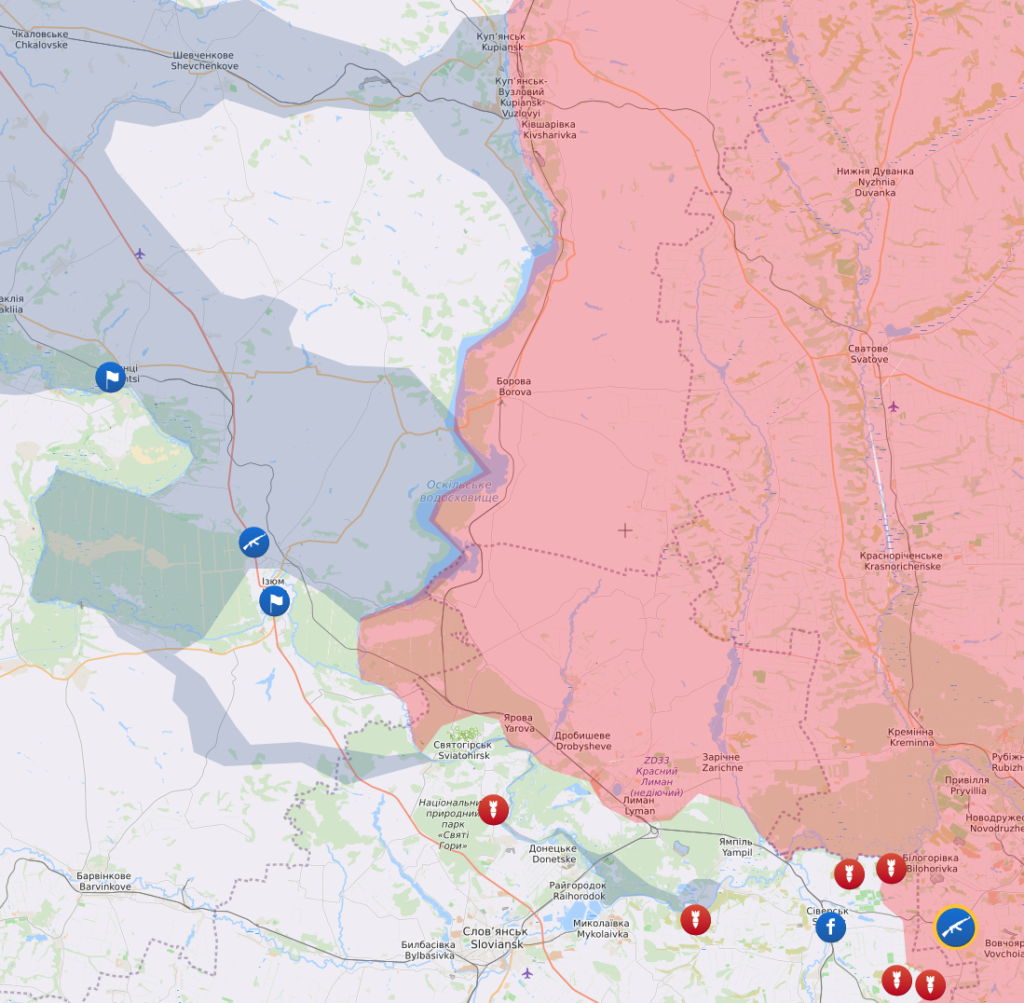
Ukrainian troops likely continued ground attacks along the Lyman-Yampil-Bilohorivka line in northern Donetsk Oblast and may be conducting limited ground attacks across the Oskil River in Kharkiv Oblast.
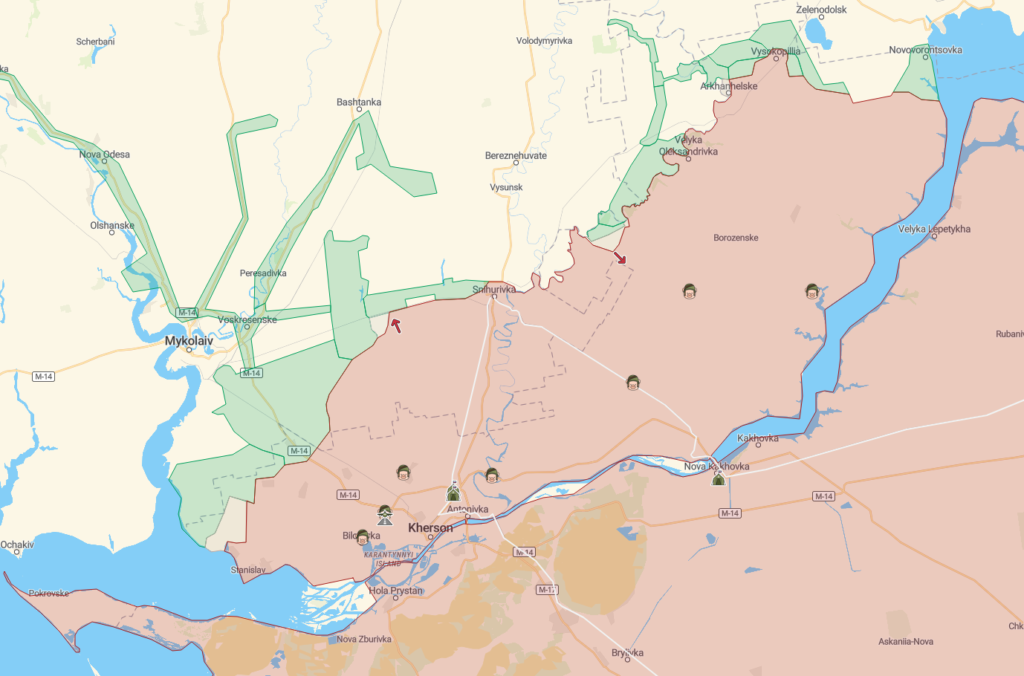
Russian and Ukrainian sources indicated that Ukrainian forces are continuing ground maneuvers in three areas of Kherson Oblast as part of the ongoing southern counter-offensive.
Russian troops made incremental gains south of Bakhmut and continued ground attacks throughout Donetsk Oblast.
Ukrainian forces provided the first visual evidence of Russian forces using an Iranian-made drone in Ukraine on September 13.
Oleksiy Arestovych, an adviser to Zelenskiy, said Ukrainian troops were now trying to retake the Russian-held town of Lyman in Ukraine’s Donetsk region and were eyeing territorial gains in the neighbouring Luhansk region which is under Russian control.
“There is now an assault on Lyman,” Arestovych said in a video posted on YouTube.
“And that is what they fear most – that we take Lyman and then advance on Lysychansk and Sievierodonetsk,” he said, referring to twin cities in the Luhansk region taken by Russia after fierce fighting in June and July.
The Ukrainian mayor of Melitopol said that Russians are evacuating Melitopol, the Zaporizhia Oblast city between Mariupol and Kherson, and heading to Crimea. I treat this report with a fair amount of skepticism, because if true it would essentially mean Game Over for Russia’s southern front.
I'm hearing more & more reports that Russians are evacing Melitopol. This remains UNCONFIRMED. If true, Ukr can reach the Black Sea, blow the Kerch bridge, & utterly destroy every Russia military unit in southern Ukraine and Crimea. And THAT would be a nation-ending event. pic.twitter.com/8cCDnDEbVl
DEEP STRIKE: Major explosions rocked the RU air station at Taganrog, followed by a number of secondaries & fires. Russian AWACs, including the including the newest A-100 platforms, are forward deployed at Taganrog. This strike will negatively affect RU air defense in the region. pic.twitter.com/iKPeaIW5w8
In the newly-liberated areas, relief and sorrow are intertwined – as accounts emerge of torture and killings during the long months of Russian occupation.
Artem, who lives in the city of Balakliya in the Kharkiv region, told the BBC he was held by Russians for more than 40 days, and was tortured with electrocution.
Balakliya was liberated on 8 September after being occupied for more than six months. The epicentre of the brutality was the city’s police station, which Russian forces used as their headquarters.
Artem said he could hear screams of pain and terror coming from other cells.
The occupiers made sure the cries could be heard, he said, by turning off the building’s noisy ventilation system.
“They turned it off so everyone could hear how people scream when they are shocked with electricity,” he told us. “They did this to some of the prisoners every other day… They even did this to the women”.
And they did it to Artem, though in his case only once.
“They made me hold two wires,” he said.
“There was an electric generator. The faster it went, the higher the voltage. They said, ‘if you let it go, you are finished’. Then they started asking questions. They said I was lying, and they started spinning it even more and the voltage increased.”
Artem told us he was detained because the Russians found a picture of his brother, a soldier, in uniform. Another man from Balakliya was held for 25 days because he had the Ukrainian flag, Artem said.
A school principal called Tatiana told us she was held in the police station for three days and also heard screams from other cells.
The disaster in Kharkiv is so massive and apparent that even some of the pro-war Russian pundits are realizing it.
Life comes at you fast: pundits on Russian TV realize that their military is failing and their country is in trouble. They are starting to play the blame game. Some of them finally understand that their genocidal denial of the Ukrainian identity isn't working in Russia's favor. pic.twitter.com/jNNn5xifI5
For Putin, losing ultranationalists is much more dangerous than criticism from more liberal segments of Russian society.
Their criticism is that Putin is not doing enough. That the special military operation is insufficient, and that Putin should declare full mobilization. These ultranationalists are largely represented by those Russian military bloggers that have become quite famous during the war. The most famous one is probably Igor Girkin. These bloggers make sometimes very good military analyses, and they clearly have a network of sources that provide information about the situation on the frontlines. And we also know that their views are shared by many of the soldiers. For example, there have been studies that show that these ultranationalist views are pretty common in spetsnaz units. And these ultranationalist voices are a real challenge for the Putin regime. Because obviously he can’t dismiss them as being unpatriotic or foreign agents or something like that. And what is happening now is that these ultranationalists are turning against Putin. And that is dangerous for him.
The shift has been from “If you support the troops, you have to support Putin” to “If you support the troops, you have to blame Putin for fucking things up so badly.”
Ben Hedges: Ukraine will retake all pre-February 23rd territory this year, and recapture Crimea next year. “It could be quicker.”
More scenes of captured equipment in Izyum.
Ukrainians issued Russian passports find out they’re worthless to get into Crimea or obtain government services.
Ukrainian troops using the Polish-built Krab self-propelled howitzer say it’s like night and day compared to their old Soviet equipment. “It’s like a Porsche vs. a Lada.”
Russian politician Dmitry Medvedev reacts well to suggestion the West give Ukraine security guarantees. “The land will be on fire and the concrete will melt.”
Azerbaijani forces shelled Armenia’s territory on Tuesday in a large-scale attack that killed at least 49 Armenian soldiers and fueled fears of even broader hostilities.
Azerbaijan and Armenia have been locked in a decades-old conflict over Nagorno-Karabakh, which is part of Azerbaijan but has been under the control of ethnic Armenian forces backed by Armenia since a separatist war there ended in 1994. Azerbaijan reclaimed broad swaths of Nagorno-Karabakh in a six-week war in 2020 that killed more than 6,600 people and ended with a Russia-brokered peace deal.
Moscow, which deployed about 2,000 troops to the region to serve as peacekeepers under the deal, moved quickly to broker a cease-fire on Tuesday morning, but it wasn’t immediately clear whether it was holding.
The hostilities erupted minutes after midnight, with Azerbaijani forces unleashing an artillery barrage and drone attacks in many sections of Armenian territory, according to the Armenian Defense Ministry.
Azerbaijan charged that its forces returned fire in response to “large-scale provocations” by the Armenian military, claiming that the Armenian troops planted mines and repeatedly fired on Azerbaijani military positions, resulting in unspecified casualties and damage to military infrastructure.
Azerbaijan’s ally Turkey also placed the blame for the violence on Armenia. Turkish Foreign Minister Mevlut Cavusoglu called for Yerevan to halt its “provocations” and Defense Minister Hulusi Akar condemned “Armenia’s aggressive attitude and provocative actions” following talks with their counterparts in Baku.
Speaking in parliament early Tuesday, Armenian Prime Minister Nikol Pashinyan said that Azerbaijani shelling has killed at least 49 Armenian soldiers.
He said the Azerbaijani action followed his recent European Union-brokered talks in Brussels with Azerbaijani President Ilham Aliyev that revealed what he described as Azerbaijan’s uncompromising stand.
Christian Armenia has a long, unhappy history with Turkey, including genocide at the hands of Muslim Turks in the waning days of the Ottoman Empire. Like the Balkans, the Caucuses are an unstable cauldron of mixed ethno-religious-nationalism, with a side-order of Jihadism thrown in for good measure (the Islamic State – Caucasus Province, the successor to the Caucasus Emirate, has been relatively quit recently, but such groups seldom wither away entirely). Russia still occupies the parts of Georgia it conquered in 2008, but the blooding it’s taken in Ukraine has probably weakened its hand regionally. And coming food and energy security issues (Azerbaijan in energy rich, but Armenia is energy-poor) are likely to exacerbate tensions in the coming months.
Putin’s Russia may be receiving a well-deserved comeuppance in Ukraine, but its resulting weakness could very well result in interesting times for many ex-Soviet states.
Things in Ukraine are moving so fast that the only thing I can be sure of is that what I post here will probably be obsolete before I press the Publish button.
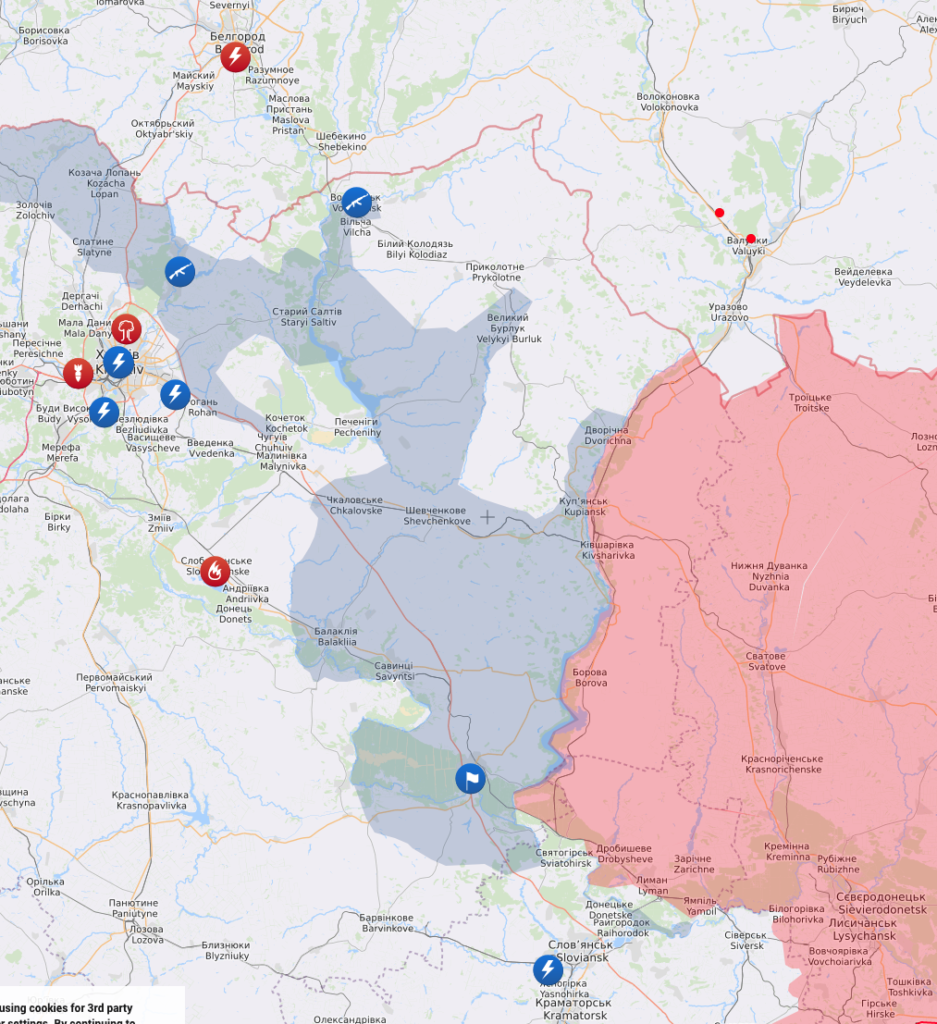
What was a very successful Ukrainian counter offensive in Kharkiv Oblast is now a massive rout of Russian forces throughout the extent of their northeast line. All of Kharkiv (save a tiny bit east of the Oskil River) has been liberated.
“Ukraine controls all the land west of the Oskil River.”
The Russians left massive amounts of equipment behind, too much for any sort of orderly withdrawal, and they don’t appear to have torched any of it, either. They just turned tail and fled. “This is an armored brigade worth of vehicles. Looking at this, I think Russia has given more military aid to Ukraine than the United States.” Also, Russian civilians are fleeing the captured territories, only to be refused entry at the border.
“Fuck, every one of us can get a tank.”
Rus, Rus, Rus of the Ukraine
Fleeing as fast as he can flee
Rus, Rus, Rus of the Ukraine
Watch out for that tree!
Got to disagree with the first video: it’s damn hard to see if you’re peering out the forward driver’s port, and it’s quite possible the tank driver was unaware troops were falling off.
It looks like logistical problems and those long-documented Russian morale problems have finally intersected to destroy the ability of numerous Russian units to function as effective fighting forces. Here’s a recorded Russian phone soldier’s phone call from back in August illustrating low morale and how much Russian soldiers hate the war:
Russian soldiers don’t seem to be eager to die for a mistake. The extent to which Russian forces in Kharkiv Oblast have been routed and broken makes it an open question whether any can be reconstituted as effective fighting forces and redeployed to Donbas. That may explain why Russia seems to be trying to carry out a stealth conscription mobilization:
On their way out, the Russian army has given Ukraine a parting gift: destruction of Kharkiv’s civilian infrastructure. “Kharkiv and Donetsk regions were cut off. In Zaporizhia, Dnipropetrovsk, Sumy there are partial problems with power supply.”
Total dick move, but not necessarily a war crime; power generating facilities are usually considered legitimate military targets. Russia obviously held off attacking them because they expected to control the territory.
Now that Ukraine has that territory back, a lot more Russian logistic routes (especially those out of Belgorod) are under threat of disruption from Ukrainian artillery. Indeed, Belgorod now loses a lot of value as a logistics hub, since it’s farther away from the frontlines, on worse roads. Russia may shift to routing everything through Kamensk-Shakhtinsky or Rostov-On-Don.
Ukraine continues to grind out more modest gains in the Kherson counteroffensive. As for the next phase of the war, it’s an open question whether to attempt to push Russian troops out of Luhansk next, or to apply more pressure toward the center of the Russian line and retake Lysychansk and Severodonetsk. But it’s clear that right now Ukraine enjoys the strategic initiative.
As Ukraine’s Kharkiv counteroffensive developed earlier this week, it was apparent that the occupied city of Izyum, the linchpin of Russia’s northeast line, was in danger of being encircled. I anticipated a few weeks of hard fighting while Ukraine slowly tightened the noose while pounding the besieged city with artillery.
Russian forces have withdrawn from key eastern towns, as a rapid Ukrainian counter-attack makes further gains.
Ukrainian officials said troops entered Kupiansk, a vital eastern supply hub for Russian forces, on Saturday.
Russia’s defence ministry then said its troops have retreated from nearby Izyum to allow them “to regroup”.
The ministry also confirmed the withdrawal of troops from a third key town, Balaklyia, in order to “bolster efforts” on the Donetsk front.
The Ukrainian advances – if held – would be the most significant since Russia withdrew from areas around Kyiv in April.
In his nightly video address on Saturday, President Volodymyr Zelensky claimed that Ukraine had now liberated 2,000 sq km (700 sq miles) from Russia since beginning a renewed counter-offensive earlier this month.
His claim would suggest that half of that area has been recaptured in the last 48 hours alone – as it istwice the area of territory Mr Zelensky said had been liberated when he spoke on Thursday evening.
The announcement by Russia that its troops had withdrawn from Izyum is also significant, as it was a major military hub for Moscow.
“A three-day operation was carried out on the drawdown and organised transfer of the Izyum-Balakliya group of troops to the territory of the Donetsk People’s Republic,” the Russian statement said.
Taking Kupiansk is also huge. It’s a major crossroads and an important crossing over the north end of the Oskil River.
Livemap confirms it:
See that little blue rifle down in the southeast corner of the map? That indicates that Ukrainian troops are just outside Lysychansk, the Ukrainian city Russia spent so much time and effort taking back in July. Suchomimus says Ukrainian troops are even on the edge of Severodonetsk.
Supposedly Russia left a lot of gear behind as well.
There are indications that Ukraine, in addition to the Kherson counteroffensive, is conducting a counteroffensive in Kharkiv Oblast, and has apparently captured Volokhiv Yar, Balakliya and Yakovenkove, towns between Kharkiv and Russian-occupied Izyum.
It’s unclear whether this is a feint, a spoiling attack or a full-blown counteroffensive, but the scale of the initial success suggests it’s too large to be a mere probing attack.
Ukrainian forces conducted a counterattack in Kharkiv Oblast near Balakliya that likely drove Russian forces back to the left bank (north side) of the Severskyi Donets and Serednya Balakliika rivers on September 6. Ukrainian forces likely captured Verbivka (less than 3 km northwest of Balakliya) on September 6. Geolocated footage posted on September 6 shows Ukrainian infantry in eastern Verbivka (less than 3 km from Balakliya). Multiple Russian sources acknowledged Ukrainian gains in Verbivka and reported that Russian forces demolished unspecified bridges in Balakliya‘s eastern environs to prevent further Ukrainian advances. Images posted on September 6 also show a destroyed Russian bridge over the Serednya Balakliika River—a geographic feature behind which the Russian front line in this sector likely lies. Social media users reported that Russian forces withdrew from checkpoints six kilometers west of Balaklia on September 6.
Russian forces likely no longer maintain their previous positions in Bairak and Nova Husarivka (just south of Balakliya on the right bank of the Seversky Donets River). Russian forces likely abandoned Bayrak and Nova Husarivka in late August. Images posted on August 30 show that Russian forces blew the bridge over the Seversky Donetsk River near Bayrak on an unspecified date. Bridge demolition activity indicates a planned Russian withdrawal. Ukraine’s General Staff reported on September 6 that Russian forces conducted air strikes against Bayrak, indicating that Ukrainian forces may have advanced in the area.
Russia’s deployment of forces from Kharkiv and eastern Ukraine to Ukraine’s south is likely enabling Ukrainian counterattacks of opportunity. The September 6 Ukrainian counterattack in Kharkiv was likely an opportunistic effort enabled by the redeployment of Russian forces away from the area to reinforce Russian positions against the Ukrainian counteroffensive in Kherson Oblast. Obituary data on Russian servicemen indicates that Russia deployed elements of the 147th Artillery Regiment of the 2nd Motorized Rifle Division of the 1st Guards Tank Army to Kherson Oblast no earlier than late August. This is the first time ISW has observed elements of Russia’s elite 1st Guards Tank Army operating in southern Ukraine. Elements of the 147th previously fought in Bucha in Kyiv in March and elements of the 1st Guards Tank Army were active primarily along the Kharkiv Axis after the Russian withdrawal from Kyiv.
Reporting from Ukraine (a pro-Ukrainian source) breaks down the counteroffensive.
Suchomimus analyzes the news as of yesterday. There are “reports that Russia is blowing up bridges, a sign that they are in a bit of a panic and expect Ukraine to advance.”
And here he shows a video of Ukrainian forces entering Yakovenkove further east, from which he surmises that they must have already taken Balakliya.
Bonus: Ukrainian aircraft shoots down a Russian Su-25:
Map snapshot, which is already slightly out of date:
Izyum is the linchpin of Russia’s north-central front. Losing it would not only spell an end to any further Russian advances in Kharkiv for the immediate future, but also put Russia’s hard-won conquest of Severodonetsk and Lysychansk in jeopardy.
With Russia reportedly buying artillery from North Korea (Caveat: This comes from Biden’s Pentagon, so grains of salt are in order) and two separate counteroffensives chewing up units, it’s possibly that Russia’s territorial gains in Ukraine have already peaked.
Edited to add: Reporting from Ukraine has a video up detailing how different thrusts of the counteroffensive developed:
Defense analyst Anders Puck Nielsen says there’s a tendency for many to believe that, although Ukraine has put up a good fight, a Russian victory in the Russo-Ukrainian War is inevitable. (I assume he’s seeing these on the various MSM channels I stopped watching a long time ago, as the only place I see such assumptions these days is among comment trolls and the occasional ZeroHedge headline.)
Some takeaways:
“When Russia launched the invasion of Ukraine back in February, many people assumed that it was going to be an easy win. It was not only Vladimir Putin who believed that they could finish this war within days or weeks. Many people thought so. And even after it became clear that there would not be a quick victory, many people still carried over this assumption that Russia is going to win eventually because that is the only possible outcome.” (I too thought a Russian victory was the most likely (though not certain) outcome in the first few days, before it become apparent just how badly bungled the invasion planning was, how fragile Russian supply lines were, how poor the communication was between different branches of the Russian military, and how neglected even basic maintenance was for Russian equipment.)
“They think of Russia as a giant. And then they think about Ukraine as a small country. But that is not really a good comparison.”
Unmentioned by Nielsen is that one reason they thought so is just how much old Soviet military equipment Russia still had lying around. That assumption was somewhat overstated, and, again, a whole lot of that equipment was poorly maintained.
Russia’s massive display of incompetence didn’t change the minds of many who still saw Russian victory as inevitable. “The assumption was that this just means it’s going to take longer, and then Russia is going to figure it out, and they are going to win.”
“We still have analysts who say that Ukraine could never push Russia back from the occupied territories, and that there has to be a negotiated solution where Ukraine gives something to Putin to end the war. And then these analyst also often seem to take it at face value when Putin or Lavrov or somebody else comes with threats about escalation.” (True, but I don’t think anyone pays serious attention to such people any more, if they ever did.)
Nielsen says there are a number of reasons why Russia can’t just carry out a mass mobilization, or start tossing nukes around.
Putin launched the war due an entire chain of bad assumptions, including those about the inevitability of Russian greatness.
“Ukraine is winning the war of attrition, and they will start pushing Russia backwards.”
“That’s why I think this idea that a Russian victory is inevitable is so dangerous. On the Western side, it leads to the belief that it is dangerous to provide Ukraine with heavy weapons. And this can mean that Ukraine won’t be able to finish the war as quickly as they otherwise could. And on the Russian side it means that they won’t be motivated for peace talks, even if the situation on the battlefield is awful.” (Not sure I agree here; The U.S., UK, Germany, and Poland have all transferred significant heavy weapons to Ukraine.)
“It will be extremely hard for the Russian leaders to embrace the idea that a defeat is possible. Like, not even that it is going to happen, but just that it could be a possibility. Because that would require them to question everything they believe to be true about Russia and being a great power. So they will be able to live in denial for a very long time.”
“If we want the war to end, we need Putin to understand that a defeat is a real possibility. And the best way to do that is to equip Ukraine with the weapons they need to win.”
As I did with Fury, here’s a review of another movie that follows a tank crew driving deep into enemy territory. But instead of an American Sherman driving deep into Germany in 1945, it’s a Soviet T-55 taking a wrong turn in Afghanistan in 1982.
Title: The Beast (AKA The Beast of War)
Director: Kevin Reynolds
Writer: William Mastrosimone
Starring: George Dzundza, Jason Patric, Steven Bauer, Stephen Baldwin, Don Harvey, Kabir Bedi, Erick Avari IMDB entry
The movie starts with three Soviet tanks blowing the shit out of an Afghan village, taking down a minaret, slaughtering unarmed civilians and even poisoning a well. One mujaheddin who manages to score a Molotov cocktail kill against one of the tanks is then positioned and crushed to death under the tread of the tank commanded by the hard-ass/borderline insane Daskal. (The genocidal brutality of the Soviet occupation of Afghanistan is well documented.)
Inside the tank, Jason Patric’s Konstantin play Mr. Christian to Daskal’s Bligh. He’s not a fan of the war, and doesn’t understand the contempt Daskal has for Afghan subordinate Samad (Erick Avari). “He’s doing his best he can, sir.” “That’s what worries me.”
Outside the tank, a posse of Afghans, carrying a lone RPG launcher and intent on Badal (revenge), pursues the tank, which has taken a fatal wrong turn into a long dead-end valley. The tank’s crew has to struggle not only against mechanical breakdowns (a busted radio, low fuel, overheating) and pursuing enemies who know the terrain better than them, but a brutal commander who seems willing to kill any of them to keep his tank moving. Eventually Daskal executes one and leaves another for dead, which turns out to be his undoing…
This is an excellent, taut war drama that delivers on the promise of its setup. Daskal may be insane, but he’s not stupid, and he knows how to use his tank against his enemies. Performances are universally good. Unlike Fury, The Beast eschews cliches and never drags, because it never stops for pithy speeches on how War Is Just No Damn Good, because it’s already shown you. It’s a very solid, small-cast film that runs a sprightly hour and forty seven minutes long, and is well worth tracking down on DVD or streaming.
Here’s the trailer, which is much lower quality than the movie:
When the Russo-Ukrainian war kicked off back in February, I relied on https://liveuamap.com/ to track military action in the war, just as I had used their similar map when tracking the war against the Islamic State. However, after the initial phase of the war, LiveUAMap seemed to update less and less frequently, and it’s been practically useless for tracking progress in the Kherson counteroffensive.
Today, most video commentators on the war seem to rely on https://deepstatemap.live. Here’s today’s snapshot from Kherson:
Better than nothing, but not as good as LiveUAMap used to be.
Here YouTuber Suchomimus compares different maps of the Kherson offensive, and how the differ on territory captured.
He mentions the War_Mapper Twitter account, which I haven’t been following due to my ongoing Twitter timeout.
Updates:
🇺🇦 have entered the settlement of Arkhanhelske, which is now contested.
🇺🇦 advanced from the Inhulets bridgehead, capturing Sukhyi Stavok and continuing to the outskirts of Kostromka and Brushkyns’ke, briefly cutting the supply route to Davydiv Brid. pic.twitter.com/x1ZiAg4Pig
He also mentions the official Russian-sourced map, which I’m not particularly interested in trusting.
The Institute for the Study of War includes a map with their daily assessment updates, but they’re not interactive or particularly detailed.
There are also a few YouTubers who do daily map updates. There’s Denys Davydov (“Hello, my friends…”). He’s Ukrainian and upfront about his bias, and covers the various clashes across the entire front (which makes his videos a bit long, and I tend to skip around for the bits I’m interested in). He suffers from “The map is the territory” syndrome, and isn’t a deep tactical thinker or versed in the intricacies of combined arms operations, but he’s useful if you understand his limitations.
One of the maps he relies on (in addition to DeepState) is the MilitaryLand map, which looks really useful.
Ukraine News TV relies on the DeepState map, and goes into considerable detail recount the day’s events.
War in Ukraine isn’t great in terms of voiceover, but seem to have a lot of unit-specific information on his maps.
For the sake of completeness, I note WeebUnion, who says he’s objective but seems pro-Russian (and his commenters even more so). He’s not a dynamic voiceover talent, and he begins this video with “Hello, comrades,” so…yeah, I don’t follow him.
For those who think I rely too much on Ukraine updates and Peter Zeihan videos, enjoy this Peter Zeihan video update on Ukraine!
Takeaways:
“Everything that the Russians were bad at before (propaganda, logistics, precision, training, maintenance, equipment), everything they were bad at before, they’re worse at now.”
Ukraine has moved from trying to stop the Russian advance with shoulder-mounted weaponry to longer-range heavy artillery, allowing them to hit ammo dumps, logistical hubs and high-value officers.
“The degree to which the Ukrainians are able to put targeting information, either from their own human network or signal intelligence that is provided by the Americans, and put it to use has been very impressive, and it has snarled the entirety of the Russian advance in both the east and the south.”
“Russia may be running out of ammunition.”
Russian doctrine calls for slow advances prepared by massive artillery barrages.
“They faced a massive industrial collapse in the 1990s that they never really covered recovered from.”
They have fought three artillery intensive wars since the Soviet collapse: two in Chechnya and then one in Syria. So now the Russians are attempting to advance over a front that’s a thousand miles long with a burn rate for their artillery in excess of 40,000 shells a day. Going through a relatively small by Soviet standards arsenal that has been acquired since the Soviet collapse, when the industrial system collapses. Well, any equipment any shells that they’re going to use that are not from that stack are things that were built before 1989, meaning that they’re in excess of 30 years old. We’ve seen reports several a year in Russia going back 30 years that, every once in a while, one of these shells [just] cooks off and the entire ammo dump goes up. It’s entirely possible that some of the explosions were seeing in places like Belograd or Western Russia are not actually being caused by the Ukrainians, but by the Russians manhandling of their own equipment. But regardless, that burn rate 40,000 a day is not something that anyone could maintain at length.
Thus Russia has been shooting at big static targets like train stations and malls. “They have the feel of being a little bit more than the Russians shooting at things to demonstrate to the world that the Russians can still shoot at things. Tanks and infantry are not following up on any of these attacks.”
“Kherson was the only major city that Ukrainians ever lost to the Russians, the only regional capital.”
“All the normal things that plague offensives are appropriate to think about here. They trigger higher casualties among the attackers than the defenders. They require more troops, They require better logistics. They’re more vulnerable to disruption. All of that stands. Also, you have to consider that this isn’t simply Ukraine’s first significant offensive in the war, but this is Ukraine’s first significant offensive ever.”
“The Ukrainians have continually surprised to the upside, and the Russians have continually surprised at the downside. So what should have been a wildly unbalanced war that should have been over four months ago all of a sudden, if not a conflict among equals, is suddenly looking like a little bit more of a fair-ish fight.”
Summary of the Kherson situation so far, including damage to the bridges, covered here and here.
No guarantee that the Ukrainians will win in Kherson, but it obviously offers them the best chance.
“If it proves that the Ukrainians are successful [Russian] forces are going to have to evacuate on foot, they are going to have to leave all of their gear behind…this would be the single biggest military transfer to Ukraine of the post-war environment, and certainly of this war…all of a sudden, the Ukrainians might actually have what they need.” Sometimes Zeihan has a tendency to overstate things, and I think he does that here. Yes, they’ll probably capture some usable heavy equipment, but the estimates I hear are some 20,000 Russian troops in Kherson, and I’m not sure how many functional military vehicles will be left in usable condition after such heavy fighting. They might well pick up significant quantities of towed artillery.
He talks about the importance of taking Nova Kakhkovka, and controlling the irrigation gates for the canals that feed occupied Crimea.
If Ukraine retakes Kherson, they might theoretically be able to take out the Kerch Strait Bridge. (Note that this is only true if they actually have the ATACMS missiles for their HIMARS that the Biden Administration says we haven’t given them yet, as I calculate a distance of roughly 179 miles from Nova Kakhkovka to the bridge.) “Crimea goes from being an incredibly strategically valuable platform that the Russians can use to launch into Ukraine proper, into the most significant military vulnerability that post-war Russia has ever had.” Eh, I think I have to go with the Atomic Bomb between 1945 and August of 1949.
“If Ukraine is going to win this war, this is how it’s going to start.”