Posts Tagged ‘Denys Davydov’

Ukraine And The Gamification Of Combat

Tuesday, January 27th, 2026

The Russo-Ukrainian War continues to accelerate military innovation at a furious rate. The latest innovation isn’t a better drone or newer hardware, but introducing a fundamentally new organizing principle: the gamification of combat.

This article from September lays out the basics.

The tall, bearded officer, code-named Prickly—like all Ukrainian fighters, he uses a call sign to protect his identity and his family from wartime retaliation—is proud as a peacock of what he has done in six months at the helm of his frontline drone unit. In an interview with me, Prickly gave some of the credit to Kyiv’s new “e-point” system, called the Army of Drones Bonus.

He and several of his men explained how the system works in an conversation near a former farmhouse in eastern Ukraine. The yard is littered with military equipment and junk, including the farmer’s much-worn living-room furniture, now arranged around a makeshift fire pit. Several stray cats and a mangy dog wandered around as we talked. “We’ve improved our performance by a factor of 10,” Prickly said. “We know that thanks to the drone points system, which measures how many men we kill and how much equipment we destroy.”

Snip.

The top brass in Kyiv struggle to keep up with this innovation—both the new technology and its use on a highly decentralized battlefield. Drone production is scattered and diverse, with the Ukrainian drone company DroneUA estimating that as many as 700 companies and 500 suppliers are now churning out UAVs of every description. Active-duty units control their own budgets. With drones and other military kit in short supply, most fighters supplement what they get from the government with items they buy themselves—their own clothing and vehicles, for example—crowdsourcing, and donations from charity foundations. Some units say they count on donations for more than two-thirds of their drones, and most modify the devices they receive to suit their unique battlefield circumstances.

Kyiv is working to tame this chaos with organizational reform—a corps-based command system aligned with NATO practices. But the armed forces also strive to take advantage of decentralization, harnessing it to drive innovation and effectiveness on the battlefield. That’s where the point system comes in—allowing fighters to bypass the bureaucracy in Kyiv and buy weapons directly from manufacturers.

Frontline commander Prickly said that drone pilots save video clips of the damage they do—whether destroying machinery or killing Russian soldiers. The unit prepares a daily montage and sends it to the Ministry of Defense, where experts comb over the footage to confirm the unit’s claims and confer points for verified destruction.

The allocation changes regularly, but as of June 2025, Business Insider reported that destroying a tank was worth eight points. A multiple launch rocket system counted for 10. Killing a regular Russian soldier earned 12 points. Wounding a drone pilot was valued at 15 and eliminating him netted 25. In the final step, the payoff, units use the points they’ve earned to purchase equipment—drones, drone jamming devices, ammunition, and other goods—on Brave1 Market, an online shopping platform not unlike Amazon.

For some battalions, including Prickly’s, this represents a sea change. In mid-summer, his unit, part of the 54th Separate Mechanized Brigade, ranked fifth in the nation in total points earned. “It keeps the weapons coming,” he said. “What’s different isn’t just how much you get. It’s also the choice available on the marketplace.” In the past, Kyiv sent what it sent—often the most rudimentary equipment—and units struggled to upgrade it for use on the changing battlefield. “Now we’re in direct contact with producers,” Prickly says. “We order exactly what we need, and it comes ready to use.”

Ukraine’s government-run media platform, United24, also reported that the Ukrainian government reaps data from the point system, enabling it to make better decisions about strategy. Varying the allocation—how many points, say, for a destroyed tank or for killing a drone pilot—gives Kyiv a new tool of command and control. Signals from the field about changing demand—what kinds of drones are selling best on the marketplace—help the armed forces make procurement decisions, and the system is a boon for manufacturers, who can lock in larger, longer-term contracts, enabling them to invest for the future.

Denys Davydov explains in more detail:

  • “The long-awaited reforms of Ukrainian army are being introduced just right now into the system under the new defense minister of Ukraine, Mykhailo Fedorov, who is a very talented young guy and who thinks absolutely openly towards the introduction of the new technologies, drones and every sort of the new features which could help to save the lives of Ukrainian soldiers and help Ukrainian army to win in this war.”
  • Fedorov was previously head of Digital Transformation of Ukraine where he oversaw creation DIIA, a digital app for Ukrainians to interact with a variety of government services. “It is not just useful and saves time for people, but it also helps to eliminate, or reduce it’s better to say, corruption, because you don’t have those bureaucrats, officials. Everything is happening automatically and digitally.”
  • “Fedorov is now ahead of the defense minister of Ukraine. He’s the fourth defense minister who got his position from the start of the war, full-scale war of Russia against Ukraine.”
  • “He applied E-points, [so-called] electronic points which our soldiers obtain if they target Russian soldiers, Russian BMPs, tanks, helicopters, rocket artillery systems. So the higher the price of the destroyed vehicle equipment, the more E-points they obtain.”
  • “They might spend those E-points for new drones or some special equipment that particular soldiers need in a special unit, brigade, regiment, whatsoever.”
  • “It’s similar to the gaming industry. [You] fight against virtual enemies. You earn the points which you spend for the better gear in the game. But it is happening in real life in Ukrainian army.”
  • “And it is very effective because total equality among all of the Ukrainian soldiers is not possible. Some units are more effective than others, and they should obtain better equipment and more drones. For example, Magyar Birds [414th Unmanned Strike Aviation Brigade], one of the most effective units, they have the most of those E-points. So the analogy is the same as with the game. The better the player, the better gear it usually has. But instead of each player fights its own separate enemy, now all of the players, all of the soldiers in Ukraine, all of the regiments, they fight against the common enemy.”
  • “So all of the people are interested for the top players to have this better gear. Like for example, vampire drones, also called Baba [Yaga] drones. It doesn’t mean that the rest of the brigades will obtain absolutely nothing. No, everyone has this chance to be successful to hurt lots of the Russian soldiers in some of the particular direction and earn those E-points.”
  • “For example, each Russian soldier costs [i.e., earns] six points. Each Russian tank costs 40 points. A Russian rocket artillery system, as for example, book 60 points. Before Russian soldier price was two points but then the price rose up to six, well, Russia start to lose way more of the infantry.”
  • He explains how Brave1 works. “You may buy the special gear out there on the shop order. The government itself, the defense ministry, will send it for you. They directly purchase drones from the developers. For now, this system works just for the drones, but it seems like it will be also implemented for artillery. And of course, commanders of brigades, they’re very interested.”
  • “So the system has been taken from video games and it is damn effective. Actually lots of the stuff is been taken from the video games, and the most successful drone operators, they used to be gamers before, they have this muscle memory. Then they used to play lots of the video games for them to get used to the flight controller. It’s way way easier than to teach from the scratch. and you have to put all of those neurons here to the small muscles and fingers. Well, gamers here as a rule are more successful than average guys just taken from the streets.”
  • We’ve already seen the U.S. military adopt some video game technology, such as video game controllers for the prototype M1E3 tank.

    Science fiction has been predicting video gamers making effective warriors for decades, from Orson Scott Card’s Ender’s Game to Michael Bishop’s “The Last Child Into the Mountain.” But I don’t think anyone ever thought up video game reward systems as the basis for advanced weapon distribution.

    Britain had one of the best professional military systems in the world, but by the end of World War II they found an American system focused on logistics and speed surpassing their results on actual battlefields. (Montgomery spent two months preparing to cross the Rhine in the meticulously planned Operation Plunder; Patton did it in one night using small boats without asking permission.) In the modern world, America’s “pull” logistical system runs rings around the Soviet/Russian “push” system. We’ve already covered how Ukraine now has a direct feedback loop between front-line units and MilTech equipment manufacturers.

    Ukraine’s gamification approach represents another potential logistics revolution, with the best units potentially making use of the best gear. But a significant amount of the gamefication approach’s effectiveness may be unique to the static, atomized, defense war of attrition Ukraine is fighting, as the system seems less suitable to, say, big offensive pushes. And there have to be guardrails in place to prevent drone operators from “going Rambo” rather than supporting more important mission objectives.

    Still, the ability of front-line units to interface directly with manufacturers for new gear is an approach I could see the U.S. military undertaking for some units.

    And if Russians are outraged about their soldier’s deaths being used in a video game-like scoring system, 1.) They sure don’t seem to have cared enough about their soldiers being killed in wasteful “meat wave” assaults and endless undermanned probing attempts, and 2.) Maybe they should have avoided launching an illegal war of territorial aggression in the first place…

    Kerch Crumples

    Wednesday, September 11th, 2024

    One year ago, the Kerch Strait Bridge was hit for the second time, following the October 2022 attack. Russians tried to repair that damage, but the results seem to be…subpar.

    I’m not an expert in bridge structural integrity, but that warping/sagging/bending doesn’t look good. In a video game, that looks like a structure you’d get once chance to jump off of before it collapses into the sea.

    Pro-Ukrainian resistance groups are saying that it’s not long for this world.

    The Kerch Bridge, a strategically vital structure used by Russia to connect with occupied Crimea, is in need of urgent repairs and cannot survive structural damage, according to a Crimean-based pro-Ukrainian group.

    “The Kerch Bridge is living its final days,” Atesh, a pro-Kyiv military partisan group of Ukrainians and Crimean Tatars, said in a post on Telegram on Sunday.

    A partisan source, so take it with a grain of salt.

    Denys Davydov covers the bridge damage in the first minute of this video:

  • “The Crimean Bridge looks very tired.”
  • “Those images appeared in Internet yesterday. Indeed, you may see some of the damages towards the railway part of the bridge. Which is quite strange, because there were no recent strikes reported. It means that this part of the construction wasn’t repaired properly after the first strike on the bridge.”
  • “You may say that those are just minor damages, and the bridge can still work. Yes, it works, but there is the feature which tells us that the bridge now has the limited capabilities for the transfer of the heavy cargo, and the structural damage of the bridge could be much more severe than we see just visually on those pictures.”
  • “So the clue that the bridge is not OK for the heavy cargo lies with this ferry, which Ukraine kaboomed around three weeks ago. Russia used this ferry to transfer the oil products, but somehow didn’t use the Kerch bridge. And with the new pictures that appeared on the Internet, we may understand that the bridge is not in a good shape.”
  • “So indeed, the Ukrainian attack on the Russian ferry fleet was a main destruction of the Russian supplies towards Crimea and the southern part of Ukraine, which is now partially occupied by the Russian Federation.”
  • From the limited information we have to go on, this analysis seems correct.

    It can be hard to determine the truth of things coming out of a warzone, even with Russia’s notoriously poor operational security. But absent photo manipulation (which we can’t rule out without more firsthand evidence), it does appear that that the Kerch Strait Bridge is clearly slumping and may even be unusable, which will severely complicate Russian logistics in southern Ukraine.

    Breaking: Iran Launches Drone Strike Against Israel

    Saturday, April 13th, 2024

    Not even sure that this is worth a breaking, since it’s drones rather than missiles or planes, but Iran just launched a drone attack at Israel.

    Iran launched a massive drone attack toward Israel Saturday night into Sunday morning local time, following through on its vow to retaliate against the Jewish state after several top Iranian commanders were killed in a suspected Israeli strike in Damascus earlier this month.

    The Israeli military estimates that the attack involves over 100 drones, which won’t arrive in Israel for another few hours. Some reports indicate that the airborne operation will also include missiles. This would mark the first direct Iranian attack on Israeli soil.

    On Friday, President Joe Biden said that Iran’s retaliatory attack against Israel was imminent and warned Tehran against carrying out the attack. “Don’t,” he said. U.S. officials believe the attack, once it hits Israel, will lead to a wider regional conflict that extends beyond Israel and Iranian proxies such as Hamas or Hezbollah.

    Airspace in Israel, Iraq, and Jordan have been closed as the attack unfolds. U.S. and Israeli officials said they plan on intercepting the Iranian drones before they reach Israel, according to reports.

    Early reports said “over 50,” now it’s “over 100,” and some Iranian sources say “500.”

    According to a Denys Davydov livestream, U.S. planes in Iraq have scrambled to shoot them down.

    It’s one thing to get drones past spread out Russian SAM systems, and quite another to get them past modern U.S. and Israeli aircraft, AWACS and Iron Dome.

    Iran claims ballistic missiles are on the way. We’ll see. Nazi Germany hit London with V2s back in 1944, so it’s not like the basics are out of Iran’s technological reach. Still, I wouldn’t expect anything more sophisticated than a SCUD, and it wouldn’t surprise me if Iron Dome could shoot those down as well.

    If it is just drones, it strikes me as more a performative strike than anything that will actually damage Israel. This was Iran gets to say “We struck back!” without actually committing serious assets.

    Livemap says “dozens” of rockets have been fired from Lebanon, which is honestly pretty by the standards of Hezbollah rocket attacks.

    Of course, Hamas isn’t launching any rockets, because they’ve contracted a terminal case of IDF.

    Developing…

    Update: Jordan has gotten in on the intercepting action.

    Update 2: Explosions in Damascus. It’s possible Israel has struck back before the drone even got there…

    Update 3: One missile hit the Negev and over 100 drones have been intercepted.

    Update 4: Boom!

    Update 5: Israel says that 99% of some 300 Iranian drones were intercepted. At least that’s 300 they can’t sell to Russia…

    Ukraine Celebrates Tanksgiving

    Wednesday, January 25th, 2023

    After almost a year of dithering, Germany has finally relented and is sending Leopard 2 tanks to Ukraine.

    After weeks of reluctance, Germany has agreed to send Leopard 2 tanks to Ukraine, in what Kyiv hopes will be a game-changer on the battlefield.

    Chancellor Olaf Scholz announced the decision to send 14 tanks – and allow other countries to send theirs too – at a cabinet meeting on Wednesday.

    But that’s not the only big tank news.

    US President Joe Biden’s administration is also expected to announce plans to send at least 30 M1 Abrams tanks.

    Biden just announced while I was writing this that the U.S. will provide 31 Abrams tanks to Ukraine.

    It could take months to deliver the tanks because the U.S. has to purchase them through a procurement process.

    The move marks a reversal for the Biden administration, which had resisted sending the tanks, and comes as German Chancellor Olaf Scholz announced his country would provide 14 Leopard 2 A6 tanks for Ukraine’s military. Britain said earlier this month it will provide 14 of its Challenger 2 tanks. France plans to contribute 10 armed fighting vehicles.

    They’re also sending parts and equipment and eight recovery vehicles.

    The Pentagon has long shown a reluctance to send their best miltech abroad for fear of it falling into enemy hands. However, for both the Leopard 2 and the Abrams, the question is which version of the tank are they sending to Ukraine? Any version of either is going to have more sophisticated and modern fire control systems than the majority of Russian tanks currently in theater. And any version of the Leopard 2 is going to feature a Rheinmetall 120mm smooth-bore gun, either the L/44 or the more powerful L/55. The L/44 should punch through the front armor of most Soviet/Russian tanks, and the L/55 should theoretically punch through all of them.

    For the Abrams, the M1A1 and M1A2 are both armed with the L/44, and National Review is reporting that the Biden administration is sending M1A1s. (The original M1 uses the older 105mm rifled M68 gun. That’s thought to be able to penetrate any Soviet armor up to and including the early T-72 models, and possibly some later export models, but not later T-72s and more modern domestic Soviet/Russian tanks. In Desert Storm, even M60 Patton tanks with the 105mm gun were regularly reporting kills on T72s.) Thus Abrams and Leopard 2 120mm rounds of various sorts are fully interchangeable.

    The Challenger 2 uses the Royal Ordnance L30 rifled 120mm gun, which uses different ammo.

    Back to the BBC: “Germany also permitted other countries to send their Leopard 2 tanks to Ukraine – which was restricted until now under export regulations.”

    Poland has been itching to send Leopard 2s to Ukraine since very early on in the conflict, but Germany had been dragging its feet until now. Previous German Defense Minister Christine Lambrecht was reportedly the clog in the process, and given this came down a week after her departure suggests that was in fact the case.

    They’re getting enough Abrams for two plus tank companies (three tank platoons of four tanks each, plus two command tanks), but not enough for a full armor brigade. But add the 14 German Leopard 2s, and presumably you have a force that can rip a hole in any Russian line. Add the already announced Bradleys and other IFVs, and you have a mobile infantry force behind them that can then exploit those holes.

    Ukrainian military blogger Denys Davydov seems pretty ecstatic at the news:

  • He says that Ukraine will be receiving Leopard 2A6 tanks, which are very modern indeed. There are a number of country-specific variants, but they all use the L/55 main gun and modern fire control systems, electronics and composite armor.
  • He repeats the rumor that Germany refused to send Leopard tanks unless America sends Abrams, which has a fair amount of plausibility. If Russia does go apeshit over the move (doubtful), Germany could always go “Hey, we just followed America’s lead!”
  • Correction: Davydov states that the Abrams requires jet fuel for the turbine engines. This is false. The Honeywell AGT1500 gas turbine engine powering the M1 does not require jet fuel to operate, it can run on jet fuel, diesel, gasoline, or marine diesel (which used to have a higher sulfur content than regular diesel, though I’m not sure that’s true anymore, and is probably not relevant to usage in Ukraine).
  • He says the Leopard 2s being sent are in active service with the German army, not in long-term storage.
  • “We have the common decision from many of the Western allies (Norway, Poland, Germany, and many others, UK obviously, and probably United States, will provide the tanks to Ukrainian.” Indeed, Norway just announced that it is also sending leopard 2 tanks to Ukraine.
  • As for his predictions that Ukraine will liberate Crimea come spring, and that this will, in turn, cause the collapse of the Russian federation and drive Putin from power, well, let’s just call them highly speculative.
  • So too Peter Zeihan (him again) is on the tank news as well:

    Some takeaways:

  • As to why the Germans have been so hesitant, I don’t know if you know your history…

    …but the last couple hundred years of history [doesn’t] necessarily put the Germans in the best light. And so the idea that the Germans would ever, in a peaceful environment, decide that they should take a leadership position on military affairs is something that is antithetical, not just to the German population in general, but the government of Scholz specifically. His party is the Social Democrats, and they have basically made their bones in geopolitics about making sure that Germany is never an offensive power at all.

  • The Leopard 2 is good, but “the Abrams should be more accurately thought of as the pinnacle of armored equipment development. This is a system that is not merely a tank, it’s a weapons system that has several integrated programs within it, some of which the Americans still consider top secret so anything that the United States sends from its arsenal is going to honestly have to be dumbed down a significant amount, and that is going to at a minimum take time.” I think he overstates the case here slightly, because the M1A1 isn’t on the cutting edge the way the M1A2 Sepv3 is, but it wouldn’t surprise me at all if their are some systems in there the Pentagon doesn’t want anyone outside to take a look at. On the other hand, there several other nation operators, so this is a solved problem. Also, Abrams have been deployed to Europe as recently as 2020 as part of Operation Atlantic Resolve.
  • “There are over a dozen countries in Europe that use [Leopard 2s], and everyone except for the Germans has been arguing for sending these things for weeks now. So these the Leopards can actually be on the front lines in Ukraine probably within two or three or four months, which means it can actually make a difference in the coming spring offensive, which will happen in May and June.” My caveat would be that it takes about as long to properly train a Leopard 2 crew as an Abrams crew, and if I were the government of the USA, Poland, etc., I would have already been secretly training Ukrainian crews on Abrams and Leopard 2 simulators.
  • “You’re talking a minimum of the year, probably closer to three, three to build out the physical support infrastructure to get an appreciable number of Abrams in play.” This is either false or only narrowly true in that it might take 1-3 years to train a single Ukrainian technician to master the complete suite of Abrams repair and maintenance skills. It uses the same main gun ammo, the same 7.62x51mm NATO machine gun ammo (though the Leopard 2 lacks the M2 .50 BMG machine gun, but .50 BMG is hardly difficult to get a hold of), and the same fuel as the Leopard 2, and we’re sending spare parts along. The logistical tail is real, but it overlaps heavily with the Leopard 2. A C-5 Super Galaxy can lift two Abrams tanks, so if it was absolutely a top priority, all 31 Abrams could be delivered tomorrow to Rzeszów–Jasionka Airport less than 100 miles from the Ukrainian border. (More likely is something like shipping from Charleston to Gdansk, which would be about 15 days after all the bureaucratic niceties are observed.)
  • As always, tank crew effectiveness comes down to training. A good tank crew takes a minimum of six months to become proficient enough to be effective in combat (and most would argue it takes longer). Even if you assume you can shave some time off for Ukrainian tanks crews experienced on Soviet equipment, it still takes a good deal of time to become proficient on either an Abrams or a Leopard 2; two to three months would seem to be the absolute minimum. So unless Ukrainians were already training on Leopard 2s and/or Abrams in secret, I wouldn’t expect to see in the field any until (at the earliest) late April.

    The Ukraine War Map Problem

    Saturday, September 3rd, 2022

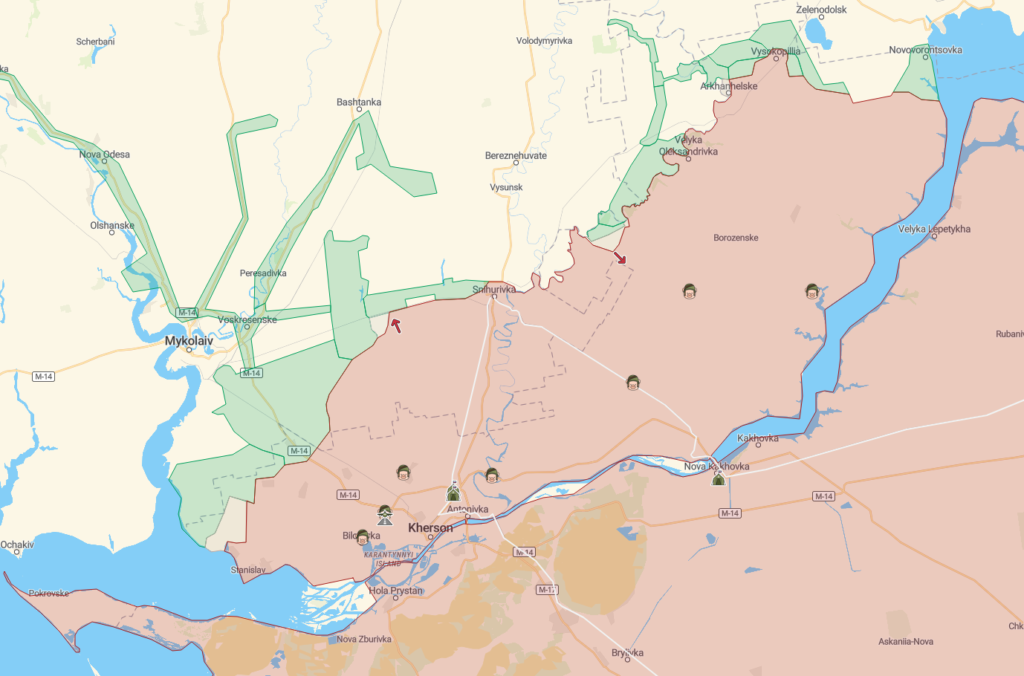
    When the Russo-Ukrainian war kicked off back in February, I relied on https://liveuamap.com/ to track military action in the war, just as I had used their similar map when tracking the war against the Islamic State. However, after the initial phase of the war, LiveUAMap seemed to update less and less frequently, and it’s been practically useless for tracking progress in the Kherson counteroffensive.

    Today, most video commentators on the war seem to rely on https://deepstatemap.live. Here’s today’s snapshot from Kherson:

    Better than nothing, but not as good as LiveUAMap used to be.

    Here YouTuber Suchomimus compares different maps of the Kherson offensive, and how the differ on territory captured.

    He mentions the War_Mapper Twitter account, which I haven’t been following due to my ongoing Twitter timeout.

    He also mentions the official Russian-sourced map, which I’m not particularly interested in trusting.

    The Institute for the Study of War includes a map with their daily assessment updates, but they’re not interactive or particularly detailed.

    There are also a few YouTubers who do daily map updates. There’s Denys Davydov (“Hello, my friends…”). He’s Ukrainian and upfront about his bias, and covers the various clashes across the entire front (which makes his videos a bit long, and I tend to skip around for the bits I’m interested in). He suffers from “The map is the territory” syndrome, and isn’t a deep tactical thinker or versed in the intricacies of combined arms operations, but he’s useful if you understand his limitations.

    One of the maps he relies on (in addition to DeepState) is the MilitaryLand map, which looks really useful.

    Ukraine News TV relies on the DeepState map, and goes into considerable detail recount the day’s events.

    War in Ukraine isn’t great in terms of voiceover, but seem to have a lot of unit-specific information on his maps.

    For the sake of completeness, I note WeebUnion, who says he’s objective but seems pro-Russian (and his commenters even more so). He’s not a dynamic voiceover talent, and he begins this video with “Hello, comrades,” so…yeah, I don’t follow him.

    This is the map he’s using.

    This is a quick rundown of the map resources I’ve run across. If you know of other useful source, feel free to share them in the comments below.