More Biden corruption comes to light, California gets even more crazy, and two former European Prime Ministers step out of the spotlight in different ways.
House Oversight Chairman James Comer revealed Thursday that he expects there is evidence of at least $20-$30 million being made in illegal payments by foreign nationals to the Biden family.
Appearing on Fox Business, Comer stated “We have more bank records coming in but we’re gonna exceed $10 million this week but I think we’ll get up to $20-$30 million.”
He further noted that it is becoming clear that the Bidens potentially engaged in bribery, influence peddling, and money laundering.
“This is going to be hard for Biden to explain, this is not going to go away, and I think eventually the mainstream media is going to start asking the real questions,” Comer added.
“They know there’s something wrong here. They know all the allegations have merit, because of where Joe Biden was, because of what we’ve seen on tape before, where Joe Biden bragged about firing that prosecutor,” he added,
“They know that this family created these shell companies. They know this family was money-laundering, they were profiting off Joe Biden’s influence,” Comer asserted, adding “The media knows that – they’re just not covering it.”
“I can assure you: there is more money that we’re going to be able to identify, that was transferred between foreign nationals in other countries and the Biden family,” Comer further emphasized, adding “I think, eventually, the mainstream media will turn on Joe Biden and start asking the real questions: ‘What did your family do to receive all this money?’”
Speaking of Biden family corruption: “House Oversight Panel Subpoenas Former Hunter Biden Associate Devon Archer…[The committee] is particularly interested in Archer’s involvement in the family’s international business deals, which included countries like China, Russia, and Ukraine.” Archer was in Global Seneca Partners with Hunter Biden and John Kerry’s stepson.
“Baltimore Police Commissioner Michael Harrison stepped down this week as the progressive-run city struggles with homicides, a drug crisis, and a troubling rise in violence involving teenagers.” Time to pull this out again:
Silvio Berlusconi, Italy’s longest-serving prime minister, dead at 86. Berlusconi revived Italy’s economy, but then couldn’t keep it out of the PIIGS. But for a whilehe kept the wolves at bay.
Also stepping out of the spotlight this week: Former UK Tory Prime Minister Boris Johnson resigned from Parliment. Other than getting Brexit accomplished, Johnson’s tenure seemed all sizzle and no steak.
In April 2023, an unelected Board in California voted to force trucking companies to buy zero-emission trucks. This technology is at early-stage adoption in limited segments, and infrastructure buildout is lagging behind what is required to support electrification in our industry. The Board unanimously advanced the Advanced Clean Fleet rule to accompany California’s equally tough electric vehicle sales mandate regulation, the Advanced Clean Truck rule, that would require truck manufacturers to sell zero-emission vehicles. These two regulations together are designed to create an artificial electric vehicle market sooner rather than later.
This new rule was made at the behest of the environmental lobby, which pushed for unrealistic targets and unachievable timelines that will undoubtedly lead to higher prices for goods delivered to the state and fewer options for consumers. ATA has strongly opposed this rule from the outset and testified at a hearing in Sacramento to express the trucking industry’s concerns directly to the Board.
Snip.
Today’s clean diesel trucks can spend 15 minutes fueling anywhere in the country and then travel about 1,200 miles before fueling again. In contrast, today’s zero-emission trucks:
Have significantly less range of about 150-330 miles between charging or refueling;
Need to be charged or refueled more often and for longer periods of time leading to unproductive downtime;
Cost two to three times more than a comparable clean-diesel truck; and
Weigh thousands of pounds more, reducing payload capacity and requiring more trucks and drivers to move the same amount of freight.
Also: “The California Energy Commission estimates that 157,000 chargers will need to be installed by 2030 to support California’s heavy-duty vehicle electrification goals.” Assuming there’s enough Lithium in the world for the batteries… (Hat tip: TPPF.)
Hope for San Francisco? Residents replace drug-addicted transients on their local sidewalks with large planters.
If you want to look at a big story the mainstream media continues to suppress, the entire contents of Hunter Biden’s infamous “Laptop from Hell” are now online.
And not only his laptop, but stuff from his iPhone as well.
There are the salacious photos you would expect (pics of his dick and what appear to be naked, under-aged girls, pics of a woman giving him a blowjob in-between puffs on her cigarette, etc., all censored).
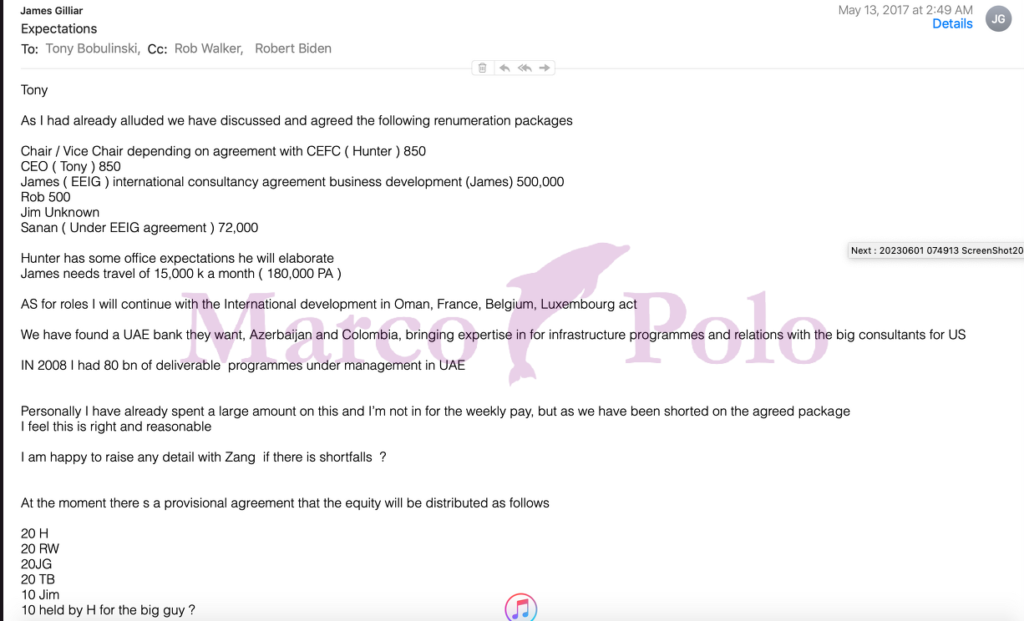
Some of it is suggestive of Biden Family corruption, like the famous “Big Guy” memo.
Some of it is innocuous: Map snaps, pics of food, pics of sunsets, vacation photos, pictures of kids (presumably some his own, and presumably ones he’s not having sex with), etc.
Some of it is just weird. There seem to be dozens of pictures of a flashlight beam shining through what I assume are crack pipe fumes in a darkened room.
Arty
There’s no doubt this is a rich treasure trove for bloggers and investigative reporters with some free time to dig through. (Alas, that’s not me right now, because books.)
We’ve already covered why Russia’s T-14 Armata tank isn’t all that. Here’s a somewhat more balanced look from David Willey of The Tank Museum:
The first ten minutes covers the basics of Soviet tank design (the philosophy of favoring firepower over just about everything else, and how political rivalries led to various Soviet tank designs). Then he goes into the details of the Armata.
Much of the Armata comes from the abandoned T-95 project. “Although the T14 is looked at as new, it actually relies on systems and ideas from some much earlier projects.”
“The smoothbore 2A821M 125mm cannon is an upgrade from the weapon on the T-90. Russian sources claim its muzzle energy is far greater compared to the Rheinmetall 120mm gun.”
The unmanned turret means no need for a fume extractor.
Theoretical fire rate of 10-12 rounds a minute. I suspect this is highly optimistic and the fire rate is probably the slower one round every ten seconds we already covered.
“The new Vacuum One armor-piercing, fin-stabilized, discarding-sabot round is fitted with a 90cm [900mm] long rod penetrator. That’s unusually long. It is said to be capable of penetrating one meter of rolled homogeneous armor at about 2000 meters.” That is quite long. The rod penetrator on the U.S. M829 APFSDS round is 684mm long. Western consensus seems to be that the Vacuum One and Vacuum Two penetrator cores are made of depleted uranium or tungsten.
“The A853 engine was a copy of a German x-shaped engine from the war years…the A853 was not however a reliable product, and from all reports it seems to have had major issues.”
When working, it theoretically has twice the horsepower of a T-72 engine and capable of reaching 56 miles and hour with a range of 500 kilometers.
“The T14 has new 70 centimeter diameter road wheels, and an electronically adjustable suspension system on at least the first two road wheels, and possibly the last ones, and [that’s] called an active suspension system but is fitted over a main torsion bar suspension. It also has rubber-blocked tracks.”
The Armata’s sealed crew compartment will have air conditioning, which was introduced in Russian tanks with the T-90M in 2016. (Starting with M1A2 SEPv2, the Abrams has cooling, but it’s mainly geared toward cooling the electronics.)
Digital screens with remote cameras.
“The gunner can see his target, but he can also choose through those screens a relevant ammunition type.”
“The chassis and turret are equipped with a ‘Malachit’ dual explosive reactive armor system, and on the front sides and the top there’s stealth coatings.” Assuming the ERA is actually there and not fake, as on so many captured and destroyed Russian tanks in Ukraine.
“The active protection system has a radar to detect and tract incoming anti-tank munitions it states a maximum speed of incoming interceptable target is 1700 meters a second, or Mach 5.” Let’s just say I have grave doubts that it actually works. The Pentagon went with Israel’s Trophy active protection system over Raytheon’s homegrown Quick Kill system for M1A2 SEPv3, and Raytheon is good at developing reliable, high tech weapons. Unlike Russia.
“The top of the vehicle is still vulnerable to top attack munitions.” So much for defense against Javelin. Which first entered service in 1996.
“However, on closer inspection a number of these technologies and features are not fitted to some of the vehicles. Some you can see there’s covers where the technology or that piece of equipment should be on others is fitted for, but not with.” And that was on parade demonstration vehicles before sanctions. Odds that Russia would have enough parts to fully equip high tech parts to all Armatas supposedly in Ukraine would appear to be slim.
Though reusing a lot of features from the abandoned T-95 project, “the new T14 tank is a radical departure in sense of its scale, its layout, its design features and technology from that era of evolutionary Soviet-designed vehicles.”
“Originally intended to replace all Russian army tanks, the Russian military had planned to acquire about 2,300 T-14s between 2015 and 2020…but by 2018, delays were announced until at least 2025. Subsequently announcements indicated the apparent cancellation of the main production run.” In between it announced it was going to build 100 of them, though that number may have included other armored vehicles using the same platform.
“The [Russian] Deputy Minister of Defense said, quote, there is currently no need to mass produce the Armata when it’s older predecessors, namely the latest variants of the T-72, remain effective against American, German, and French counterparts.” Here the Deputy Minister of Defense is engaged in a time-honored Russian rhetorical device known as “lying his ass off.”
“The gradual tightening of sanctions, and then with the Russian invasion of Ukraine, the problem of sourcing the essential microelectronics has come to the fore. Russian industry has been critically dependent on foreign microelectronics and associated technologies. These are no longer available due to sanctions.”
“The sights from France and other components are no longer available.”
“Other issues come into play that affect the wider Russian defense industries. One is the perennial Russian problem of corruption. Since 2011, a staggering 72,000 officials have appeared before the course on corruption charges.”
“The mythic way many Russian military systems and products have been promoted and sold has met a crushing reality in Ukraine.”
Even though there may only be 20 test vehicles available, there is an expectation they will make appearance in the battle. A British ministry defense statement said, and I quote, any T-14 deployment is likely to be a high-risk decision for Russia. 11 years in development, the program has been dogged with delays reduction in planned Fleet size and reports of manufacturing problems. If Russia deploys a T-14 it will likely primarily be for propaganda purposes. Production is probably only in the low tens, while commanders are unlikely to
trust the vehicle in combat.
So even a balanced, objective analysis of the T-14 Armata isn’t particularly optimistic about its chances in combat.
Target loses $9 billion in market cap for trying to tranny dress toddlers. I would boycott them over that, but I was already boycotting them over the tranny bathrooms.
“‘There’s Poop Everywhere’: San Francisco’s Office District Not Only A Ghost Town, It’s Also Covered In Sh*t.”
Everyone knows that San Francisco is the nation’s largest public toilet – requiring the city to employ six-figure ‘poop patrol’ cleanup team, however a new report from the city Controller’s Office really puts things in poo-spective.
For starters, feces were found far more often in commercial sectors, covering “approximately 50% of street segments in Key Commercial Areas and 30% in the Citywide survey,” second only to broken glass as can be seen in the ‘illegal dumping’ section.
If you’re wondering about the city’s fecal methodology, look no further than a footnote on page 43;
Feces also includes bags filled with feces that are not inside trash receptacles. Feces that are spread or smeared on the street, sidewalk, or other objects along the evaluation route are counted. Stains that appear to be related to feces but have been cleaned are not counted. Bird droppings are excluded.
As far as where most of the poo is found, Nob Hill takes the top spot, followed by the Tenderloin and The Mission districts.
“After California health authorities in 2014 imposed a mandate requiring requiring churches to provide elective abortion coverage to its employees, four churches sued, and after a long court battle, have now won a $1.4 million settlement.” (Hat tip: Sarah Hoyt at Instapundit.)
In a classic case of bad timing, Tim Scott also announced that he’s running for president. I don’t see him making much headway against Trump or DeSantis, but he’s a serious veepstakes contender.
C. Boyden Gray, RIP. Among his most important tasks was spearheading the campaign for Clarence Thomas’ nomination to the Supreme Court.
It’s weird to be on the same side of an issue as Taco Bell. Namely that no one should be able to trademark “Taco Tuesday.”
Citing air-worthiness concerns, the FAA grounds the…B-17? Good to know they’re finally working through that 1946 backlog… (Hat tip: Dwight.)
The first rule of baggage claim fight club is you don’t talk about baggage claim fight club. The second rule of baggage claim fight club is that the blue zone is for loading and unloading only.
What is it like to cross the Darien Gap by car? A green hell.
The Biden family and its business associates created a complicated web of more than 20 companies, according to bank records obtained by the House Oversight Committee — a system, GOP lawmakers say, that was meant to conceal money received from foreign nationals.
Sixteen of the companies were limited liability companies formed during Joe Biden’s tenure as vice president, the committee said in a press conference on Wednesday. The Biden family, their business associates, and their companies received more than $10 million from foreign nationals’ and their related companies, the records show. These payments occurred both while Biden was in office as vice president and after his time in office ended.
In what Representative Nancy Mace called an act of “financial gymnastics,” many payments were routed from foreign companies to the Biden family’s business associates’ companies which then doled out payments to the Bidens in incremental payments to different bank accounts in an alleged attempt to hide the source of the funds.
At least nine Biden family members received payments, according to committee chairman James Comer. That includes Hunter Biden; James Biden; James Biden’s wife, Sara Jones Biden; the late Beau Biden’s wife, Hallie Biden; Hunter Biden’s ex-wife, Kathleen Buhle; Hunter Biden’s wife, Melissa Cohen; and “three children of the president’s son and the president’s brother.”
Much of the money came from Chinese nationals and companies with ties to the Chinese Communist Party. Multiple Biden family members received money after it passed through an associate’s account. Comer said of the countries the Biden family was influence peddling in, China is “the most reputable.”
The committee revealed Wednesday that records suggest the Biden family and its associates’ business dealings in Romania “bear clear indication of a scheme to peddle influence” from 2015 to 2017.
At the time, then-Vice President Biden spoke out against Romanian corruption while the Biden family received more than a million dollars from a company controlled by a Romanian national, Gabriel Popoviciu. Popoviciu, who has been accused of corruption, sent the money through a Biden family associate, according to the committee. Sixteen of the seventeen payments involved in the deal occurred while Biden was still in office. The money “stops flowing from the Romanian national soon after Joe Biden leaves the vice presidency,” Comer said.
The Bidens also received “millions of dollars from China,” with Comer saying it is “inconceivable that the president did not know” about the payments.
Comer said the information revealed Wednesday is the result of subpoenas to four different banks and stressed that the committee is still early in its investigation and believes there are as many as 12 banks with records relevant to its investigation.
Naturally, the mainstream media are doing their very best to ignore these revelations…
You might have noticed a meme floating around the media about how Britons could become “no better off than people living in Poland”. “If the UK continues with the same level of growth it has seen for the last decade,” writes Sam Ashworth-Hayes, “Poland will be richer than Britain in about 12 years’ time”:
It sounds like an absurd idea that in 2040 we might see complaints in the Polish press about a flood of British plumbers undercutting wages, or Brytyjski Skleps lining the rougher areas of Warsaw, but it isn’t beyond the realms of possibility.
This talking point has also appeared in the Telegraph, the Express and the Financial Times. It often comes with a sense of vague alarm and bewilderment. Poland? The post-communist place? Don’t they live entirely off vodka and potatoes? Don’t they have horses clippety-cloppeting down the streets selling women’s underwear pinched off a truck in Germany? Poland?
Having lived in Poland for nine years, I can say that I am not at all surprised by these projections. To be clear, that is all they are — projections. A lot can change in nine years, in Britain and in Poland.
Still, I think a lot of British people would be surprised by how much better things can be in the land of Lech Wałęsa and John Paul II. Equally, a lot of Polish people would be surprised by how much worse things can be in Britain — given that a lot of Poles of my acquaintance appear to think that getting rich in the U.K. is as easy as walking outside with a wheelbarrow and catching the banknotes that rain down from the sky.
Britain has had minimal economic growth for years. Poland has long been enjoying some of the highest economic growth in Europe. It even emerged from the pandemic better off than other European nations with, as Paweł Bukowski and Wojtek Paczos wrote for the LSE, “a relatively lax approach to economic lockdown and a bit of sheer luck”.
Institutions often seem to work better as well. I can generally visit a GP on the day I call. Britons often have to wait for more than a week. Maternal mortality is higher in the UK — and infant mortality is about the same, despite Britain being much richer overall. Actually, Polish life expectancy as whole is just a touch shorter than British life expectancy, despite the nation having a lot more smokers.
Polish kids have ranked higher on the PISA education rankings than British kids — ranking, indeed, the third highest in Europe in science and maths, and the fourth in reading comprehension. Poland is a more peaceful place than Britain, with murder and rape generally being rarer (granted, statistics in the latter case are famously difficult to trust). Terrorism, for reasons I leave to the reader, has been almost non-existent in Polish society.
Some Polish achievements are more difficult to quantify. In Britain, the 20th century was marked by a curious habit of ripping down beautiful buildings and constructing ugly ones. Poland, meanwhile, has been beautifully renovating and reconstructing many of its urban spaces, pursuing a philosophy of “preservation meets modernisation”. Warsaw and Kraków are famous enough, but travellers could also visit lovely towns and cities like Wrocław, Toruń and Gdańsk — or my own, Tarnowskie Góry.
Also, Poland seems to have actual conservatives who aren’t afraid to push for the right policies, instead of timid functionaries scared of their own shadow.
Last quarter, Disney+ lost 2.4 million subscribers. But this quarter is different! This quarter, Disney+ lost 4 million subscribers.
Related. “They got these ulterior motives, and you know, it’s about this this sort of political shit. And, yeah, I guess that’s part of it. But a lot of it is just these guys are just fucking stupid.”
Remember Democratic County Judge and de-facto Queen of Harris County Lina Hidalgo, she of the numerous staff corruption charges? There have been a lot of Freedom of Information Act requests coming her way over all the alleged crooked dealings, so she went to her legal counsel to thwart transparency.
With the state’s largest county already facing at least one lawsuit over refusal to comply with public records requests, a leaked memo from Harris County officials appears to outline a strategy for avoiding the release of documents related to County Judge Lina Hidalgo’s travel and taxpayer-funded expenses.
Investigative reporter Wayne Dolcefino reported this week on a leaked chain of emails that began with a January 25, 2023 open records request from Houston Chronicle reporter Jen Rice seeking travel records for Hidalgo and “her entourage” between January 2019 and January 2023.
After requesting clarification, Hidalgo’s legal counsel Kathryn Kase forwarded the request and instructions for handling it to several Hidalgo staffers and Glenn Smith of Affinity Dynamics. The county auditor’s office lists payments totaling $35,000 to Smith’s company in 2020, but none this year.
“The law does not require us to create documents in response to this PIA request and I ask that you not create such documents,” wrote Kase. “For example, if we do not have a list of the Judge’s trips outside Harris County that the County paid for in whole or part between 1/1/ 2019 and 1/25/2023, then the law does not require us to create such a list, nor do I want you to create one.”
Kase also stated that staffers do not have to ask other departments for documents responsive to the request.
“If, for example, the Auditor or the Treasurer have copies of reimbursements to Judge Hidalgo, do not ask the Auditor or the Treasurer to provide them to you.”
Rice’s request likely stems from reports of Hidalgo taking private security, paid for by Harris County taxpayers, on her personal vacations to Mexico, Columbia, and according to sources familiar with the matter, Thailand, earlier this year.
Until last April, the Precinct 1 constable’s office provided security for Hidalgo, but in a 3 to 2 vote the commissioners court approved a no-bid contract to private security company XMi Protection at a price of $121,524 for three months. The commissioners later approved a budget of up to $500,000 for XMi, although reportedly Hidalgo’s security is now provided by the Harris County Fire Marshal’s Office while XMi continues to cover other employees.
Remember that Queen Lina’s previous legal troubles stemmed from handing out contracts to connected Democrat firms and not wanting public scrutiny for that either.
As far as I can tell, XMi Protection seems to employee exactly one person: Cortez Emilio Richardson. (Maybe he hires temps to round out his team?) Also strange: The listed address for XMi protection is 9900 Spectrum Drive, Austin, TX, 78717, which is the address of Integreon, a “global outsourcing partner” that doesn’t list “executive protection” among its services, as well as LegalZoom, which seems to be a “one stop set-up-your-business” shop. (Maybe he set up his LLC through them?) However, Richardson’s LinkedIn profile says that he’s in Houston, and XMi Protection is based in nearby Spring. Two other LinkedIn accounts that show XMi Protection entries are a Paquita Bailey who lives in Detroit and is evidently working four different jobs at the same time (lot of sidehustle they’ve got going on there), and the following private listing:
Which is for a pharmacy technician from Anna, Texas (which is north of Dallas), both of whom would seem to be deeply unlikely to be working a protection detail in Houston.
$40,000 a month is an awful lot of cheddar for one guy.
Jim “Mattress Mack” McIngvale and Dolcefino have also filed a lawsuit against the county, seeking access to public election records that the county has refused to release on the grounds that they are related to litigation and a criminal investigation of Tatum and the elections department.
In response to multiple complaints over delay and evasion tactics employed by government agencies across the state, Sen. Paul Bettencourt (R-Houston) has pushed legislation that would punish those using the appeals process to delay compliance. His Senate Bill 1579 has been approved in committee, but it has not yet been scheduled for a vote on the Senate floor.
According to attorney Bill Aleshire, public information requests must be carefully tailored so as not to offer any loopholes. Aleshire opined that instead of asking for a “list,” Rice should have requested specific documents and included multiple departments in her original demand.
“Having said that, a public office devoted to transparency would not quibble with a requestor seeking travel records; it would just provide the records they’ve got, in good faith,” Aleshire told The Texan.
Snip.
In another leaked internal Harris County memo, legal fees approved by the Harris County Commissioners Court last March totaling $671,383 are described as covering legal costs for Kase, [County Commissioner Rodney] Ellis, and other county employees related to the investigation of a since-canceled $11 million COVID-19 vaccine outreach contract and allegations that Ellis had stored an African art collection at taxpayer expense.
The memo also includes “talking points” from “GS” that former Justice Administration Director Jim Bethke and other county officials, including Tatum, have been harassed by District Attorney Kim Ogg.
Payments for legal expenses appear to have been approved for McClees Law Firm, PLLC; Rusty Hardin and Associates, LLP; and Khalil Law PLLC. In addition to Ellis, Hidalgo, and other employees, the memo notes expenses were also covered for Commissioner Adrian Garcia (D-Pct. 2).
Something stinks in Harris County government, and there are a whole lot of questions about how Lina Hidalgo is spreading around taxpayer money that she really doesn’t want to answer…
In addition to getting over a cold, I spent most of the non-work day trying to assemble a pressure washer so I could attach a water-jetting attachment so I can clean out a blocked exterior line so I can run my dishwasher without it overflowing my sink.
The result of all this labor is that I still need to call a plumber. So enjoy yet another abbreviated LinkSwarm.
Hmmmmmm! “Hunter Biden Business Partner Flips, Now ‘Cooperating’ With GOP Investigators.”
Eric Schwerin, a close business associate of Hunter Biden who also dealt with Joe Biden’s business and tax affairs, is now working with House GOP investigators looking into Biden family dealings – particularly in Ukraine and China, where the family collected millions of dollars, Just the News reports.
Eric Schwerin, a close business associate of Hunter Biden who also dealt with Joe Biden’s business and tax affairs, is now working with House GOP investigators looking into Biden family dealings – particularly in Ukraine and China, where the family collected millions of dollars, Just the News reports.
“He is cooperating with us,” House Oversight and Accountability Committee Chairman James Comer (R-KY) told the outlet.
“His attorneys and my counsel are communicating on a regular basis. Now, I feel confident that he’s going to work with us, and provide us with the information that we have requested,” Comer continued. “I think that Schwerwin is going to be a very valuable witness for us in this investigation.”
Of note, Schwerin, the former president of Hunter Biden’s now-dissolved investment firm Rosemont Seneca Partners, visited the White House at least 19 times from 2009 to 2015, according to White House visitor log records reviewed by The Epoch Times and first reported by the New York Post.
Patrick L. Wojahn, the Democratic mayor of College Park, MD, resigns over child porn charges. Name that party: His political affiliation only shows up in the 19th paragraph of the piece. (Hat tip: Dwight.)
Illnesses to Democratic senators Dianne Feinstein and John Fetterman mean that Democrats have temporarily lost their senate majority. That will teach you to rely to Octagenerians and visibly impaired stroke victims to carry your water. (Hat tip: Stephen Green at Instapundit.)
“Rockets owner Tilman Fertitta submits $5.5 billion bid for NFL’s Commanders.” He should move them to Austin and change the name back to the Redskins, just to spite them.
Did MacKay get Tulipmania wrong? It turns out he was also an enthusiast for the far more destructive “Railway Bubbles” that struck England in the 19th century.
Due to issues of politics, congestion, or just plain corruption, nations get the bright idea to build brand new capital cities far away from existing urban areas. Sometimes it works out (as with Washington D.C.), and sometimes it doesn’t. China’s Xi Jinping is trying something different with Xiongan, which is being built not so much a replacement to Beijing but as sort of “mini-me” Beijing to relieve overcrowding by offloading functions to the new built-from-scratch city in Hebei* province.
About 60 miles south of the center of Beijing, a new city is being built as a showcase of high-tech ecologically friendly development. Its massive high-speed rail station and “city brain” data center have been heralded by Chinese state media as evidence of the speed and superiority of China’s growth model—not least because the city is a “signature initiative” of Chinese President Xi Jinping.
Commies (and their American fans) do love their high speed rail projects. Never mind that high speed rail in China has mostly been a trillion dollar, money losing sinkhole.
Xiongan New Area is also a test for whether China can boost domestic innovation and climb into the ranks of advanced nations in the face of slowing economic growth and efforts by the United States and others to restrict its access to advanced technology.
Xiongan offers a window into what Xi’s vision of state-led innovation looks like on the ground. Xi has called the city his “personal initiative” and a qiannian daji, or “thousand-year plan of national significance.”
You know who else had a thousand year plan?
Sorry, I just can’t resist a good Hitler meme when you pitch a slow ball right over the center of the plate…
The plan for Xiongan, which was formally unveiled in 2017 to relieve pressure on Beijing and promote the “coordinated regional development” of the Beijing-Tianjin-Hebei region, has faced financial struggles due to the huge investment costs—even more of a problem given China’s mounting real estate crisis. Overall, the new area encompasses about 650 square miles, with a planned population of around 3 million; currently, the three counties comprising the zone have around 1.4 million long-term residents. As of September 2022, 400 billion yuan (about $57 billion) in completed investment had been reported in the city overall.
While Xi has stacked the new Politburo Standing Committee with officials loyal to him, he has also elevated those with strong science and engineering backgrounds. In his speech at the 20th Party Congress last October, Xi declared that “innovation will remain at the heart of China’s modernization drive” and that China has “worked hard to promote high-quality development and pushed to foster a new pattern of development.” Nevertheless, a confluence of factors including COVID-19 lockdowns and trade tensions is contributing to overall slower growth in China.
In Xi’s vision, however, party control is not a hindrance to innovation. Rather, Xi’s vision of innovation is one in which the state and party play a leading role. Xi has led a crackdown on private technology firms such as Alibaba but has also promoted policies, such as his Made in China 2025, that aim to boost research-and-development spending and subsidies to give Chinese firms competitive advantages in industries including biotechnology, robotics, artificial intelligence, and semiconductors.
We know from experience that this approach almost never works, because the profit motive of capitalism is always a superior discovery mechanism for innovation than top-down bureaucratic mandates. We know that the state-led approach has already been a colossal failure for semiconductors even before the sanctions came down, and it’s a good bet that it’s been just as colossal a failure in all the other areas mentioned.
Xi’s policies favor “hard tech” over software-based platform app companies. The first party secretary of Xiongan was Chen Gang, who oversaw Beijing’s Zhongguancun high-tech park before being transferred to Guizhou, where under Xi ally Chen Miner he helped turn the southwestern province into a center of big data and cloud computing.
The approach to innovation in Xiongan involves embedding technology within the fabric of the city as well as innovation processes within the party-state. Xiongan Group was created as the investment vehicle for the area’s overall development, under the control of Hebei province but backed partially by loans from China Development Bank. The first central state-owned enterprises to begin construction of offices in the new area were China Satellite Communications Co., the energy giant China Huaneng Group, and Sinochem Holdings. Others now include the big three telecoms and China State Grid, as well as China Mineral Resources Group, a conglomerate set up last year to centralize China’s coal mining industry. These state-owned enterprises could use Xiongan as a test bed for new technologies. Research institutes and satellite branches of several Beijing universities are planning to open in the area around 2025. The relocation of these major units and their thousands of employees will determine how quickly Xiongan’s development proceeds.
Even as China’s economy has slowed during COVID-19 lockdowns and the global downturn, construction of the first phase of Xiongan has marched on: A huge high-speed rail station to connect the city with Beijing opened in 2020, followed by residential slabs, massive underground utility corridors, and the city brain data center, which will serve as the nerve center of the city’s digital systems. The first section, Rongdong, has been mostly completed, with housing for 170,000 people. Media reports of new schools opening show the effort to build high-quality public amenities to attract residents to the city: Branches of Beijing institutions such as Shijia Primary School and Tsinghua University High School are among the new educational institutions being built in Xiongan.
The Foreign Policy piece is OK as a sort of sanitized, high level overview, but lacks several key words (“shoddy,” “rotten,” “unsafe,” “tofu dregs,” etc.) that reflect the grittier reality of Xi Jinping’s dream:
Takeaways:
“This is arguably the world’s biggest rotten tail project.”
“The project, which was billed as a Millennium Project and a major national event, fell apart after only five years.”
“According to the official website of Xiongan New Area, in 2021 the area arranged more than 230 key projects with a planned investment of more than 200 billion RMB. In 2022, 232 key projects were arranged with an investment of another 200 billion RMB and the cumulative total investment has exceeded 700 billion RMB, i.e. nearly 100 billion US dollars.”
Add area rail and road infrastructure investments and the total rises to $150 billion.
“Located 105 kilometers from both Beijing and Tianjin, the new area is positioned to decongest Beijing’s non-capital functions and will host administrative and institutional units, corporate head offices financial institutions, universities, research institutes and other organizations evacuated from Beijing.” I bet workers who have already gone through the expensive and difficult process of buying their own condos in Beijing will just love being forced to move an hour away.
“The initial planning area is about 100 square kilometers, with plans to slowly expand to an eventual area of about 2,000 square kilometers.” 2,000 square kilometers works out to about 772 square miles, or larger than Houston, one of America’s most sprawling cities.
“Average folks have wondered why did the central government put this new area…in a sparsely populated and heavily polluted poor rural area.”
The idea seems to be to bring Beijing, Tianjin and Xiongan into a single economic circle with a population of 130 million.
Deng Xiaoping, Jiang Zemin, and Hu Jintao each decreed creation of their own special areas, and Xi is following in their footsteps.
After the new area was announced, “real estate speculators from all over the country flocked overnight. The local property price soared from 4 000 RMB per square meter to 40,000 RMB, catching up with the first tier cities such as Beijing and Shanghai.”
There was an explosion of construction, but then it stopped.
“For more than five years, the large-scale construction of the Xiongan New Area didn’t move. The streets were empty, and people from outside had left one after another.”
A high speed rail station said to be the largest in Asia the size of “66 soccer stadiums” has only one train a day.
“In August 2021, the CCP issued a regulation that downgraded Xiongan to a regional level jurisdiction.” So instead of being it’s own special area, it’s now run by Hebei province, which means “this ‘Millennium Project’ is no longer possible, and the central government has simply dumped this hot potato on the local government.”
Official use words like “expedite, start construction, registering land, basically confirmed, etc didn’t explain any more specific progress. This actually allowed the public to read its true meaning, that is there is no substantial progress.”
The same pagoda seems to have been constructed several times.
“No one wants to go there at all. Even if you force them out of Beijing, they still don’t want to go there. There are no actions from the universities either.”
Chinese people think the area has bad “Feng Shui,” and it’s in a low-lying area near a lake that used to be flooded. The local lake and river also have very poor water quality. “However, the [water] treatment project hasn’t yet been completed.”
“Xiongan New Area is like building a mansion in a garbage dump, and people don’t want to live there.”
“More than five years later, no decent state-owned enterprises have really moved to Xiongan.”
“Given China’s objection to objective reality, the only way to make people move to Xiongan is by force. This is what happened in 2017, when the Beijing government forcibly evicted the so-called low-end population and people took to the streets in protest.”
Shenzhen New Area benefited from China’s opening, foreign investment and proximity to Hong Kong. “The dysfunctional mechanism of the CCP which had suppressed economic momentum for decades was released at the moment when the country opened its doors, so that Shenzhen could rise with the momentum.”
By contrast, Xiongan suffers from global economic headwinds and local finances are “very poor.”
Banks poured money into the area, accompanied by corruption. Natives forced out of their homes got low compensation and the new homes were shoddy. Many still haven’t found new homes.
“Videos provided by local residents show that the most common problems with homes are water leaks cracked exterior walls and sinking floors in some homes water leaked all over the floor.” A video shows a stairway turning into a waterfall during heavy rain.
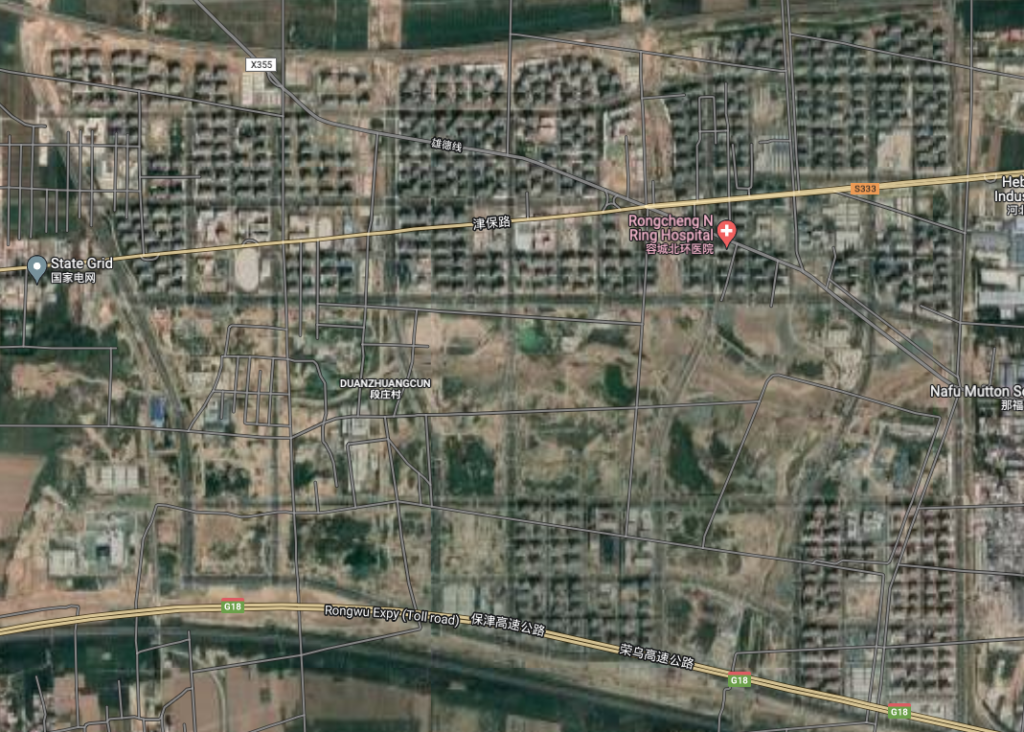
It’s hard to find on Google maps, but I think this spot shows the same cookie cutter buildings seen in the video.
Ghost city, tofu dregs, rotten tail; parts of Xiongan seem to check all three boxes.
*Note: Hebei Province is completely different from Hubei Province further south…
As revelations continue to roll out about a third set of classified documents being illegally kept by Joe Biden, and crackhead son Hunter Biden paying The Big Guy $50,000 a month to rent his house (which would have meant that Hunter only got to keep $33,333 of his Burisma salary…assuming there was no other graft being passed on) a question occurs to me: Which Democratic Kingmaker(s) want to force Biden out of office?
With midterms safely past, news about the classified documents (which was known in advance of the midterms) was allowed to leak out, indicating that whoever arranged Slow Joe’s greased-skid path to the White House has lost confidence in his ability not to screw things up so badly that Democrats get slaughtered in 2024. And this despite the decided unpopularity both of VP Kamala Harris and backup catspaw Pete Buttigieg. My working theory is that the same people who installed Biden will try to install Gavin Newsom in 2024.
But the question is who is calling the shots in the Democratic Party? George Soros? Barack Obama? Valerie Jarrett? Ron Klain? Randi Weingarten? (I might previously have included Tom Steyer on this list, but if he really were calling the shots he wouldn’t have tried that disasterous presidential run.)
If you have good theories and solid evidence on who is actually calling the shots in the Democratic Party these days (and thus the likely candidate for wanting to push Biden out), let me know in the comments below. As Instapundit noted, those that foisted Joe Biden on us have an awful lot to answer for…
Early on, a lot of observers predicted that Russia, with it’s vast store of Soviet-era aircraft, would quickly achieve air-superiority over Ukraine. That hasn’t been the case.
This video from the British Imperial War Museum lists some reasons why.
Takeaways:
They failed to hit Ukrainian aircraft on the ground in the opening phases of the war.
A “great deal of mismanagement, kleptocracy, you know, favored projects over some kind of strategic effect.” Note how Putin is always announcing some sort of awesome wonderwaffen while neglecting basic needs like logistics.
“The level of corruption in Russia itself has had an impact on its ability to have a tactical or even strategic effect without support from the air. Russia’s ground forces have been largely unable to mount effective combined arms operations.”
“The key reason for Russia’s inability to effectively use its air force has been its failure to take out Ukraine’s mobile surface to air missile systems. They have been unable to suppress enemy air defenses.”
Ukraine made an early effort to obtain SAM systems from the west.
Both mobile tracked systems like S-300 and MANPADS have been used.
Failure to achieve air superiority has both sides investing in drones.
“What you do is you flood the airspace, almost like a denial of service attack, as we see on the Internet. As you attack a server, for instance, by having so many pings against it, it essentially shuts down the server. And what we see in the case of Russia is that it’s doing the same thing. It’s trying to flood the air defense systems.”
“The relatively low cost of these drones is one of the main reasons for Russia to deploy them, and in such numbers. Each drone reportedly costs around $20,000. And so losing an expensive advance guided missile to these drones is not an ideal strategy for Ukraine.”
One reason not covered: Russia seems to have used up a good portion of it’s high tech weapons in the opening phases of the war, and western sanctions mean that it can’t easily replace them. Sophisticated fighter bombers are a whole lot less effective when they’re reduced to dropping gravity bombs rather than guided munitions.