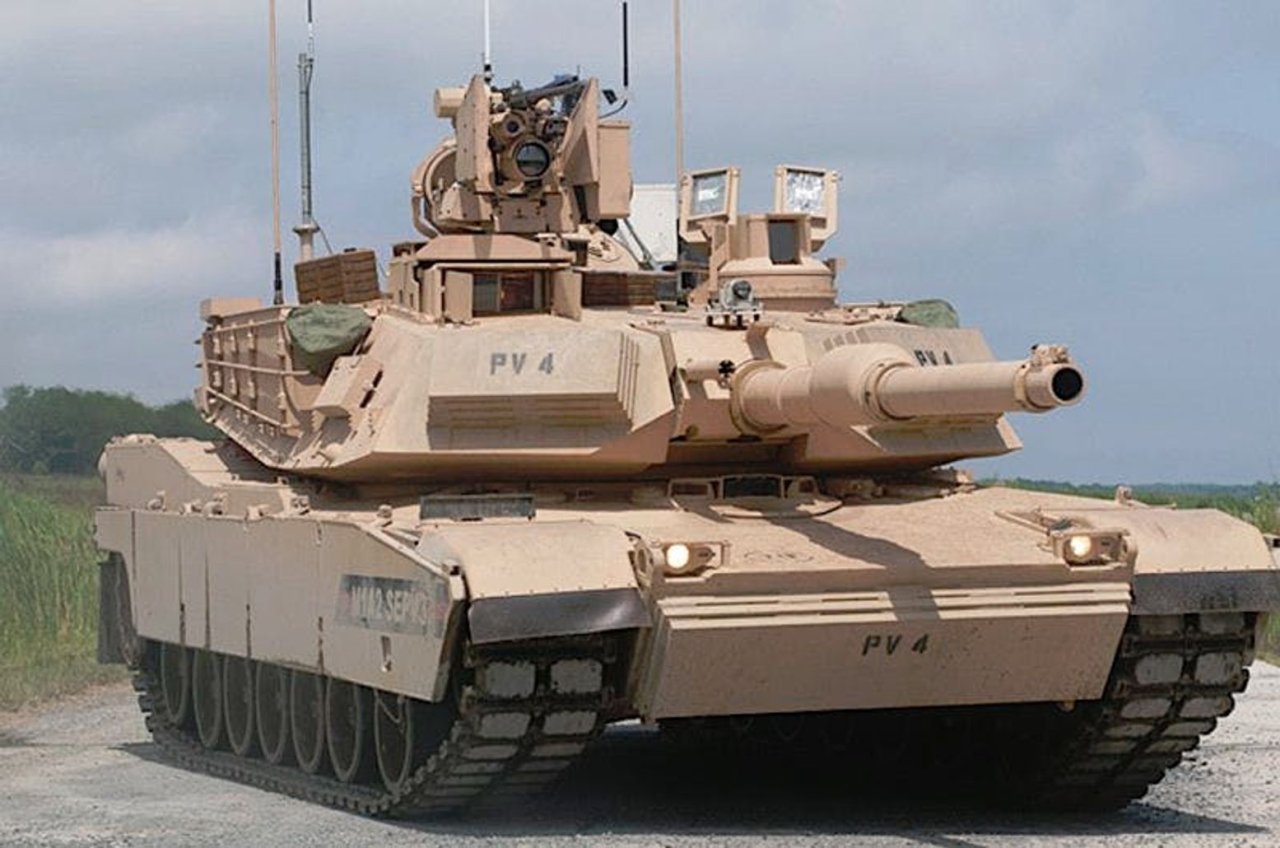
This time Moran climbs around an M1A1 Abrams tank and talks about his time serving inside one during (I’m assuming) Desert Storm [evidently the Iraq War]. Highlights include how an Iraqi bullet missed his head by three inches, and how a tank designer including a pressure sensor on a loading door kept it from taking his arm off when they forgot to throw the proper safety switch.
Edited to add:
Desert Storm? Why do people keep thinking I'm that old…? Add about 13 years to the story….
Time for another roundup of Chinese lies and perfidy!
Remember all that blather about how there was “no way” the Wuhan coronavirus could have come from the Wuhan Institute of Virology? Yeah, not so much:
A US government analysis leaked to the Washington Times concludes that the Wuhan Institute of Virology or the Chinese CDC is the “most likely” source of the COVID-19 pandemic which has killed over 200,000 people worldwide in roughly four months.
The document, compiled from open sources and not a finished product, says there is no smoking gun to blame the virus on either the Wuhan Institute of Virology or the Wuhan branch of the Chinese Center for Disease Control and Prevention, both located in the city where the first outbreaks were reported. -Washington Times
And while we may not have a smoking gun proving that COVID-19 escaped from the Wuhan lab, “there is circumstantial evidence to suggest such may be the case,” according to the report.
Also, it’s perhaps the world’s easiest game of connect-the-dots;
In 2013, scientists at the Wuhan Institute of Virology collected horseshoe bats at a cave 1,000 miles away infected with the virus that causes COVID-19. (Stored away and forgotten until January this year, the sample from the horseshoe bat contains the virus that causes Covid-19. -WSJ)
Peng Zhou, WIV’s head of Bat Virus Infection and Immunization, was researching “the molecular mechanism that allows Ebola and SARS-associated coronaviruses to lie dormant for a long time without causing diseases,” while a press release from his lab was titled “How bats carry viruses without getting sick.”
Zhou’s colleague, Shi Zhengli, has been involved in bioengineering bat coronaviruses – co-authoring a controversial 2015 paper which described the creation of a new virus by combining a coronavirus found in Chinese horseshoe bats with another that causes human-like severe acute respiratory syndrome (SARS) in mice.
In 2015, Nature magazine expressed concern over Zhengli’s experiments with bat coronavirus. The same year, the US government suspended funding to the lab due to their concern over risks of experimenting with bat coronavirus.
Meanwhile, the US State Department warned over safety standards at the Wuhan lab in a series of cables beginning in 2015, according to the Washington Post’s Josh Rogin.
Chinese health officials were drawing up plans to combat the CCP virus, which they knew to be infectious, days before they informed the public about its potential to spread, according to internal government documents obtained by The Epoch Times.
The CCP (Chinese Communist Party) virus, commonly known as the novel coronavirus, originated in the central Chinese city of Wuhan in late 2019. The virus has since spread to more than 200 countries and territories, causing more than 61,000 deaths in the United States alone.
China officially confirmed that the virus could be transmitted between humans on Jan. 20, when top respiratory expert Zhong Nanshan made the announcement.
Now, internal documents provided to The Epoch Times show that Beijing covered up what it knew, as central authorities were secretly providing directives to regional governments on how to cope with the outbreak.
On Jan. 15, the regional health commission in northern China’s Inner Mongolia issued a “super urgent” emergency notice to its municipal counterparts, explaining how medical facilities should respond to a new form of pneumonia. The notice said that China’s National Health Commission had implemented treatment and prevention measures for local health agencies to deal with the new disease (now known as COVID-19).
During the Cold War, the U.S. foreign policy was largely based on assumptions that the Soviet Union’s leaders were determined to spread communism worldwide; they possessed strategic patience and were adaptive in pursuing their goal. The USSR would never be America’s partner but a long-term rival, and therefore it must be contained. Moreover, U.S. decision-makers assumed that American society would fully support this approach.
However, after the end of that confrontation, strategists like former National Security Advisor and Secretary of State Henry Kissinger falsely assumed that Communist China could be changed into a benign actor, even a “responsible stakeholder,” or strategic partner of the U.S. were the U.S. to engage with China, believing that China’s rise was a positive thing.
We argue that China is not just a rival but a formidable enemy. Its goal is not just to weaken America but supplant it and the liberal international order it created with a Communist ideology-based model of global governance. The PRC is more dangerous than the Soviet Union because it is unpredictable and more formidable. It is an amalgamation of a rapidly rising power and an ideological regime with an aggressive leader in Chairman Xi Jinping. Xi is both extremely ambitious and paranoid about his regime’s security as well as his own. These factors make this enemy far less certain than the Soviets.
Additionally, China is far more formidable than the Soviet Union because it has learned key lessons from the USSR’s mistakes regarding competition with the United States. It is an extremely adaptive adversary. So adaptive that it has been seen as a partner rather than an enemy for a generation. Moreover, it was so highly valued as a partner that it was brought into the Western economic ecosystem to be allowed and encouraged to prosper. China’s rapid growth was made possible by the U.S. government, business, financial markets, and universities, as well as its own efforts. Close ties between the American elite and Chinese business interest remain strong, even in the wake of the coronavirus.
Fundamentally, there remain sectors in U.S. government, business, and intellectual communities who still see China as a partner and want to return the Sino-American relationship to “normalcy.” Even in the wake of the coronavirus, close ties between the American elite and Chinese business interest remain strong, and there is an assumption that things will return to normal once Trump leaves office.
Decades ago, the political, corporate and industrial leaders of the West chose to enmesh the fate of their pliable people with that of the vigorous, voracious Chinese.
Like the United States, another hard-hit region—Northern Italy, so progressive and tony—had swung its toll gates open. Italy outsourced whole production lines to China.
Free trade in goods is great. But trade goods, not places. The toll gates were swung open to human trade, or population replacement.
Since the Chinese had begun settling in Northern Italy and buying up assets, I hazard that, much like youngsters of King County, in Washington State—local Italian girls and boys have had a hard time affording life in their homeland.
And now, their grandparents and parents are dying.
Italy constructed gleaming tarmacs to accommodate the many direct flights to and from Wuhan. More than 100,000 Chinese citizens moved to Italy. As the Chinese accrued wealth over the past two decades, still more took up residence in Northern Italy, and bought up Italian firms.
See if you can spot the trend. New York City, by Wikipedia’s telling, is home to far and away “the highest Chinese-American population of any city proper.”
Courtesy of an Italian strain of COVID-19, the New York metropolitan area has been as badly struck as Italy. In early April, it was said that “coronavirus was killing a person roughly every four minutes in New York state, and about every six minutes in New York City.”
In my state of Washington, the overwhelming majority of Chinese reside in King County and Snohomish County, where the infection was seeded and from where it spread.
The West’s political and corporate leaders, not China’s, had opened their borders to the world’s flotsam and jetsam. Agreements to exchange goods and people reflected the choices of these gilded global elites, not those of their people.
The sphinxly Bill Gates, we are told, foresaw the pandemic. Gates also pioneered the outsourcing of American lives to China (and India). I say “lives,” because, as it has become abundantly clear, in the wake of COVID, the very stuff of life has been outsourced to China. Not mere jobs; but careers, not just some products, but entire production lines; not one or two manufacturing plants, but the entire means of production.
As the Wuhan coronavirus continues to spread, stay at home orders have shut down commerce in many parts of the world. Some have predicted a 40% contraction in the U.S. economy in the 2nd quarter of 2020. This means that China’s economy, heavily dependent upon exports, will see no economic rebound for quite some time. In the mean time, the Trump administration has “turbocharged” its effort to relocate global supply chains from China to markets less hostile to the West.
Details on manufacturing and commerce imploding in Q1 snipped.
This gives the Trump administration more ammunition in its attempts to move global supply chains away from the Chinese Communist Party (CCP). Reuters reported on Sunday:
Now, economic destruction and the massive U.S. coronavirus death toll are driving a government-wide push to move U.S. production and supply chain dependency away from China, even if it goes to other more friendly nations instead, current and former senior U.S. administration officials said.
“We’ve been working on [reducing the reliance of our supply chains in China] over the last few years but we are now turbo-charging that initiative,” Keith Krach, undersecretary for Economic Growth, Energy and the Environment at the U.S. State Department told Reuters.
The report describes a “whole-of-government” effort in which free trade advocates seem to be losing their struggle with China hawks inside the administration. Citing national security concerns, many departments have joined in the process to figure out how to incentivize U.S. firms to move their operations out of the Chinese mainland. Options reportedly include ‘reshoring’ subsidies, tax incentives, developing closer ties to Taiwan, and ever higher tariffs on goods produced in China.
Teng Biao, a former fellow at Harvard Kennedy School’s human rights center, attempted to host a panel discussion on Chinese human rights issues in 2015. A vice dean at Harvard Law School, however, ordered him in February of that year to cancel the event because it would have been “embarrassing” for the university, according to Teng.
“He called me into his office and he told me that the Harvard president was meeting Chinese president Xi Jinping,” Teng told the Washington Free Beacon. “It seems that for Harvard leaders, it was very embarrassing if we had a talk at Harvard about human rights issues in China when the Harvard president just came back from China after meeting with the Chinese president.”
Teng is a human rights lawyer who fled China after authorities kidnapped and tortured him for his participation in the 2014 Hong Kong protests. Professor William P. Alford, a vice dean at the Harvard Law School, played a role in bringing Teng to Harvard. He also ordered Teng to cancel the event, according to the Harvard Crimson. Alford confirmed with the Free Beacon that he told Teng to postpone the event, a decision he made on his own accord, rather than at the administration’s urging. He said that he allowed Teng to host other events during his time at Harvard. While Teng did participate in other events, he said the panel discussion was never rescheduled.
Evidently having a $40 billion endowment just isn’t enough to keep you from having to suck up to communist China…
Europe: “Hey China, want to help us create a vaccine for this coronavirus of yours?” China: “Go flu yourself!”
If you want to see exactly how China lies about the Wuhan Coronavirus, here’s an example:
— Ambassade de Chine en France (@AmbassadeChine) April 30, 2020
Compare those statements to this timeline to see everything they left out. (Hat tip: Neontaster.)
Speaking of propaganda:
The past 6 months have seen a massive uptick in new Twitter accounts from Chinese diplomats & embassies around the world. Many post accusations, boasts & name-calling directed at governments & individuals they feel have insulted China. @BethanyAllenEbrhttps://t.co/kml5BkNKbd
Speaking of willing dupes: “POLITICO Peddles Red China Propaganda Attempting To Own Trump–Gets SLAMMED On Twitter.” “POLITICO promoted a piece praising the Chinese Communist Party’s handling of the coronavirus outbreak and blasting the Trump administration.” (Hat tip: Stephen Green at Instapundit.)
Sadly, foreign news outlets seem more immune to China’s influence than our own MSM:
Phenomenal: Very much worth watching. Germany’s largest newspaper shows courage & clarity. Is ANYBODY at NBC, ABC, CBS, CNN, WaPo, NYT, Bloomberg willing to demonstrate even a fraction of this journalistic integrity? Or are the $$ from the Chinese market all you care about? https://t.co/KgR7o1nrks
Not sooner do I start writing about Sherman tanks than suddenly all sorts of Sherman-related information starts popping up.
First, here’s are two really detailed videos from Nicholas Moran, AKA The Chieftain, of the features of a Sherman M4A1:
Second, Dwight sent me this twitter thread, that goes into a great deal of detail about how the Sherman’s later reputation for being Not So Great came almost entirely for the way they were deployed in roles they were not specialized for.
Here’s a Tweet from that thread that talks about the weird (but highly effective) redesign that became the Sherman M4VC Firefly used by the British Army:
The story of the Sherman Vc's development is amazing (and look I've fixed the meme for you)… but they arrive at units with a shitty No. 43 Telescope with 3x magnification.
It's marginally better than the standard offering, but isn't really even remotely suitable. /27 pic.twitter.com/ZrHOtGM0Qr
The Marine Corps’ current force design conversations and planning will help develop the littoral regiment concept, Stephenson said.
If the past few months of public appearances by Berger and his top generals are any indication, a littoral regiment would likely find itself in the III Marine Expeditionary Force, headquartered in Okinawa, Japan, and consist of small teams of Marines armed with a host of unmanned air, ground and maritime assets along with long range fires and air defense systems.
Sounds like the Marines are going to go heavy into drones.
While details are not yet available, a regiment is a sizable unit to form in a limited manpower Marine Corps.
An infantry regiment can include up to nearly 2,200 Marines divided into three battalions along with a headquarters and support company, depending on the mission and configuration.
But there are different configurations for a regiment. The Corps also staffs combat logistics regiments to provide transport, communication and logistics assets to the ground combat forces.
In October 2019, Brig. Gen. Benjamin Watson said that the Corps was “no longer going to stick or take an uncompromising position on the sanctity of the MAGTF,” [Marine Air-Ground Task Force, a basic Marine organizational structure since 1963] while speaking at the National Defense Industrial Association’s Expeditionary Warfare Conference in Annapolis, Maryland.
“If what is needed is a piece of the Marine Corps that is not organized like a MAGTF or a capability the Marine Corps can bring that is not a MAGTF, then we are not too proud to provide that,” he said.
A retired Marine Corps officer now a senior adviser for the Center for Strategic & International Studies shared analysis at the same conference showing “no growth” for personnel in future Marine budget planning.
“Coastal defense, cyber, space,” Mark Cancian said. “They will have to take down existing capabilities to find the structure and the space to do that.”
I rather doubt the Marines are going to field localized cyberwarfare units out in combat regiments beyond some basic signal corps countermeasures. I suspect we already have a cyberwarfare unit up and running out of one or more three initial agencies in the greater D.C. area.
The Corps will need to cut and shift priorities for the next fight, Berger said at a November Marine Corps Association and Foundation dinner.
“We may need to get smaller, trade some parts we’ve had for a long time but are not a good fit for the future,” Berger said.
He looked to reduce or eliminate money going toward manned anti-armor ground and aviation platforms, manned and traditional towed artillery that can’t shoot hypervelocity rounds and short range mortar systems.
All other efforts are leaning into conducting sea control and sea denial operations from the sea and maritime terrain, he said.
To make that happen, the commandant said that he wants low cost, lethal air and ground unmanned platforms, unmanned long range surface and subsurface vehicles, mobile, rapidly deployable rocket systems, long range precision fires, loitering munitions across the echelons, mobile air defense and counter-precision guided munitions capabilities, signature management, electronic warfare and expeditionary airfields. [“Signature management,” in this context, means controlling your electronic emissions and observables. “To be detected is to be targeted is to be killed.”]
And it appears, the Marine littoral regiment may be the formation for many of those new capabilities and manpower.
All this seems both forward-looking and also very amorphous. It suggests “we’re adjusting our force mix to better face off against China, but we’re not sure quite how yet.” But China is just one part of the equation; the furious pace of technological change, budget pressures, and long simmering doctrinal debates all seem to be additional change drivers.
It’s also interesting that they’re using the word “littoral,” as the Navy’s Littoral Combat Ship program was hardly a smashing success.
Great power military conflicts of the future are likely to use weapons smarter, more autonomous, more lethal and probably lower cost than the weapons systems we’ve built our combat forces around today. Taking and holding contested shorelines is probably going to look less like Iwo Jima and more like battles between rival autonomous drone swarms.
The question is how long it will take to get to that technological plateau, and what the Marine Corps will look like during the transition.
This Borepatch post got me thinking about the history of firearms development, and all the mistakes and blind alleys along the way. Plus I wanted to put up videos (where available) of how some of the weird firearms Borepatch described actually worked.
But before I did that, I realized I needed to delve into the basics of gunpowder and early firearms development, to set out things in chronological order.
Here’s a short one covering the invention of gunpowder in China, featuring primitive proto-firearms like the firelance, up through early European cannons, the hand-canon and the arquebus.
Here’s a video of someone testing a home-built recreation firelance using bamboo. The first attempt does not go well, so they reinforced the bamboo on the second with electrical tape.
A longer look at the development of early gunpowder weapons in Europe up through the early Napoleonic War:
Highlights: the difficulty of getting saltpeter means Europeans needed to make it by boiling down animal waste, how “corning” vastly increased the power of gunpowder, how they made cannon bodies out of strips of metal bound with iron hoops (why they’re still know today as bun barrels), and how the Pumhart von Steyr is the largest siege cannon still existent, firing stones that weighed 1,533 pounds. Also, Henry Knox, George Washington’s master of artillery, was by profession a bookseller of military history. And the exploding shell was invented by British Lieutenant Henry Shrapnel.
A short look at gun development from the hand-cannon to the musket:
In the next decade, the Marine Corps will no longer operate tanks or have law enforcement battalions. It will also have three fewer infantry units and will shed about 7% of its overall force as the service prepares for a potential face-off with China.
The Marine Corps is cutting all military occupational specialties associated with tank battalions, law enforcement units and bridging companies, the service announced Monday. It’s also reducing its number of infantry battalions from 24 to 21 and cutting tiltrotor, attack and heavy-lift aviation squadrons.
The changes are the result of a sweeping months-long review and war-gaming experiments that laid out the force the service will need by 2030. Commandant Gen. David Berger directed the review, which he has called his No. 1 priority as the service’s top general.
“Developing a force that incorporates emerging technologies and a significant change to force structure within our current resource constraints will require the Marine Corps to become smaller and remove legacy capabilities,” a news release announcing the changes states.
By 2030, the Marine Corps will drop down to an end strength of 170,000 personnel. That’s about 16,000 fewer leathernecks than it has today.
In a certain way it makes sense, as the Marine Corps is a branch of the Navy and focused on amphibious operations, and you can’t fit a lot of M1A2 Abrams tanks on a Wasp class amphibious assault ship. On the other hand, the Marine 1st Tank Battalion predates Pearl Harbor. That’s a lot of tradition to leave behind.
The decision to de-emphasize rotor craft (presumably both helicopters and the V-22 Osprey) is also interesting, especially since the Marines are the only users of the new AH-1Z Viper.
“The future Fleet Marine Force requires a transformation from a legacy force to a modernized force with new organic capabilities,” it adds. “The FMF in 2030 will allow the Navy and Marine Corps to restore the strategic initiative and to define the future of maritime conflict by capitalizing on new capabilities to deter conflict and dominate inside the enemy’s weapon engagement zone.”
Existing infantry units are going to get smaller and lighter, according to the plan, “to support naval expeditionary warfare, and built to facilitate distributed and Expeditionary Advanced Base Operations.”
The Marine Corps will also create three littoral regiments that are organized, trained and equipped to handle sea denial and control missions. The news release describes the new units as a “Pacific posture.” Marine expeditionary units, which deploy on Navy ships, will augment those new regiments, the release adds.
In addition to more unmanned systems and long-range fire capabilities, the Marine Corps also wants a new light amphibious warship and will invest in signature management, electronic warfare and other systems that will allow Marines to operate from “minimally developed locations.”
Berger has called China’s buildup in the South China Sea and Asia-Pacific region a game changer for the Navy and Marine Corps. He has pushed for closer integration between the sea services, as the fight shifts away from insurgent groups in the Middle East and to new threats at sea.
Tanks and armored vehicles have had trouble surviving against the threat of precision strike and the plethora of drone and reconnaissance systems flooding conflict zones across the Middle East.
For recent evidence, a Turkish launched operation targeting Syrian regime army troops in late February decimated more than a hundred tanks and armored vehicles, dozens of artillery pieces and hundreds of Syrian forces, according to the Turkish National Ministry of Defense.
Turkey posted videos highlighting a mixed role of drones, Paladin artillery systems and aircraft pounding Syrian armor from the skies over the course of several days. The Syrian army appeared helpless to defend from the onslaught of long range systems. Even tanks camouflaged by buildings and bushes were no match for sensors and thermal imaging watching from the skies.
The problem is exacerbated by the number of sophisticated anti-tank systems flooding counterinsurgency conflicts across the globe and access to long range drones once only in control by state actors are now being operated by militia groups.
In Libya, the Libyan National Army has the upper hand in its drone war with the UN-backed Tripoli government. It’s equipped with an alleged UAE-supplied Chinese drone known as the Wing Long II that boasts a 2,000 km range through a satellite link and is reportedly armed with Chinese manufactured Blue Arrow 7 precision strike air-to-surface missiles.
So it once again gets back to China.
In a way it’s heartening that the U.S. military is preparing to fight the next war rather than remain stuck in the paradigms of the last one. But history shows that the next war has way of popping up where we didn’t expect it. U.S. and Soviet armor never faced off in the Fulda Gap, and in 1989, no one was expecting U.S. forces to be fighting in Iraq.
We still have the best military in the world, I just hope we retain the tactical and strategic flexibility to meet all the challenges of the 21st century.
Yesterday’s post featured Sherman tanks facing Panzers on the Golan Heights in 1967, so let’s do a review of a movie about a Sherman tank crew late in World War II to make it an All Sherman Tank Weekend, because why the hell not? (Plus it’s a chance not to talk about the Wuhan coronavirus, China or the lockdown.)
Title: Fury
Director: David Ayer
Writer: David Ayer
Starring: Brad Pitt, Shia LaBeouf, Logan Lerman, Michael Pena, Jon Bernthal IMDB entry
Fury is the story of the crew of a M4A2 Sherman tank crew driving deep into Germany in April of 1945. It starts with the aftermath of a battle where where the crew had to haul a dead crewmate out and every other American tank but the titular Fury was wiped out. Soon tank commander ‘Wardaddy’ Collier (Brad Pitt) welcomes green recruit Norm (Logan Lerman) as their new assistant driver/machinegunner. They’re sent with a new platoon of tanks to rescue a trapped unit and the lead tank is promptly taken out by a panzerfaust. Fury leads an assault on a German antitank unit in a treeline, then participates in taking a large German town, where the tank crew spends some occasionally tense R & R with two German fraulieins before moving out to help defend a key crossroads. On the way, all the tanks in the platoon but Fury are destroyed in an encounter with a Tiger tank. The last 45 minutes or so of the film depict Fury’s crew, one tread taken out by a mine, defending the crossroads against an SS company.
Fury succeeds when it focuses on being a World War II tank film, and loses momentum when tries to Make Serious Statements About The Human Condition And How War Is Hell.
The scenes that work best are the everyday lives of the crew. They used real Shermans in the film, and the scenes inside the tank have the convincing claustrophobia of a real tank interior. (Though they vastly understate how noisy a tank interior is; some of that is inevitable, as no audience would want to watch an entire tank movie with the noise as loud as an actual tank, but the nosiebed here should have been louder to at least give a hint of the real thing.) The battle scenes are gripping, and the attention to detail pretty good; I especially liked the improvised log armor on the sides, and the use of different types of main gun ammunition for different purposes, including laying down smoke just like in the instructional videos.
A video tour of the interior of a Sherman (with some clips from the movie) is here:
Ignore the guy in the knight’s helmet.
On the other hand, no World War II unit used that many tracer rounds in daylight, and they didn’t look like lasers.
It’s the Deep Meaning Of It All Scenes that drag the movie down. Norm fails to machine-gun teenage German troops with the panzerfausts, with Dire Consequences. Collier forces Norm to shoot a German prisoner to Prove His Loyalty. A burning soldier shoots himself in the head. Another falls on a live grenade. After Norm makes out with a hot frauliein, want to guess who gets killed in a random artillery barrage?
No cliche will be left behind.
Despite that, the acting is very good. Pitt is fine as Hardened Stoic Leader Who Will Get His Men Through. Lerman is good in the green ostensible-viewpoint character role. Michael Pena (Luis in the Ant Man films) is solid as driver (and semi-comic relief) Gordo. Jon Berenthal does fine in the thankless “rude redneck with bad hygiene” role of gun-loader Coon-Ass.
Weirdly enough, the actor who comes out best is Shia LaBeouf as gunner Boyd “Bible” Swan. He brings a quiet, understated dignity to a role as a devout Christian, and “quiet,” “understated” and “dignity” are adjectives that seldom accrue to LaBeouf in any aspect of his life, and whose acting usually tops out at “only mildly annoying.” Jason Isaacs is also excellent in a supporting role as a gritty, unsentimental, matter-of-fact Captain.
Fury is worth watching, but it really could have been about 45 minutes shorter. The best war movies tend to be those that focus on soldiers just trying to do The Task At Hand (Das Boot being the classic example) and not worrying about making Deep Meaningful Statements.
6/10
Also, Hollywood needs to make more movies about tanks.
When would you think the last World War II German Panzer IVs saw combat? The Battle of Berlin in 1945?
Try the Golan Heights in 1967:
Syria had sourced leftover Panzer IV from all over Europe (along with a handful of Sturmgeschütz III assault guns and Jagdpanzer IV tank destroyers), which they deployed to the Golan Heights. Ironically, some of the tanks they faced were uparmed “Super Sherman” M4 tanks, some with 105mm guns. But the Israelis were also using British Centurion tanks (also with 105mm guns), which handily outclassed the German tanks, and the better trained and equipped Israeli forces routed the Syrians from the Golan Heights as part of the Six Day War. At least 10 of the 25 operational Panzer IVs were knocked out by the Israelis. “Not one Israeli tank was knocked out by a German Panzer.”
Some Super Shermans were pressed into service in the Yom Kippur War in 1973, and some even found their way to Israeli-supported factions in the Lebanese Civil War that stretched into the early 1980s.
Believe it or not, Paraguay was still using not only Sherman tanks, but M3 Stuart light tanks in 2016.
The Wuhan Cornavirus shutdown may kill off a lot of legacy media. No one is going to be sad to see Buzzfeed die, but the Chicago Tribune is another thing. Still, for the last twenty years or so, newspapers have had a chance to choose to be profitable or liberal, and an overwhelming majority choose liberal.
Airlines are farked. United “will fly fewer people during all of next month than on a single day in May 2019.”
Know who else is screwed? China. Not just from the lies and the virus and the killing and the GLAVIN, but also the $1 trillion bursting debt bubble of their smoke and mirrors economy.
668 sailors infected with the Wuhan coronavirus on France’s Charles de Gaulle aircraft carrier. The de Gaulle has had numerous maintenance issues over the years, but last year it helped fly strike packets against the last remnants of the Islamic State at Baghuz Fawqani.
Speaking of China and aircraft carriers, a Chinese naval group featuring the Shandong, their newest carrier, is carrying out maneuvers near Taiwan.
Among the complaints was that Whitmer had prohibited sale of seeds and other garden supplies, at a time when vegetable gardens need to be planted. Executive Order 2020-42 is titled, “Temporary requirement to suspend activities that are not necessary to sustain or protect life,” and is quite specific about which activities are and are “not necessary.” Stores with “more than 50,000 square feet” (e.g., Walmart, Lowes, Home Depot) are ordered to close areas of the store “by cordoning them off, placing signs in aisles, posting prominent signs, removing goods from shelves, or other appropriate means” that sell carpet or flooring, furniture, and “garden centers and plant nurseries.” So if Grandma went to Walmart for groceries and hoped to pick up some tomato plants or cucumber seeds while she was there — sorry, Grandma! You could get a thousand-dollar fine and 90 days in jail for disobeying Whitmer’s orders.
Posting photos from a Walmart in Grand Rapids showing the now-banned seeds cordoned off with yellow tape, one Twitter user declared: “@GovWhitmer has banned us from growing our own food. This is [bleeping] insane.” Another user posted a photo indicating that it’s now apparently forbidden to sell American flags in Michigan. Barbecue grills, lawn chairs — anything in the garden section is now streng verboten in Michigan. References to Whitmer as a “dictator” proliferated on social media over the weekend, as Michigan residents came to grips with the consequences of the governor’s draconian order.
“The Only 2016 Campaign That Deliberately Colluded With Russians Was Hillary Clinton’s”:
or more than two years, the campaign, presidential transition, and official government administration of Donald Trump operated under a cloud of suspicion that they had engaged in a treasonous conspiracy to steal the 2016 election from former secretary of state Hillary Clinton. Trump and his top associates were accused of collusion and of conspiring with the Russians to subvert American democracy.
The former director of the Central Intelligence Agency publicly declared Trump to be guilty of treason, an offense punishable by death. The former head of the Federal Bureau of Investigation, the country’s premier law enforcement agency, intimated that the president had illegally obstructed justice.
In the end, none of it was true. After a nearly two-year-long investigation that issued 2,800 subpoenas, interviewed 500 witnesses, and used nearly 300 wiretaps and pen registers, Special Counsel Robert Mueller concluded that there was no evidence of collusion by Trump or his associates.
But that doesn’t mean 2016 was free of Russian collusion. To the contrary, there is clear evidence that a 2016 presidential campaign willfully and deliberately colluded with Russians in a bid to interfere with American elections. It wasn’t Trump’s campaign that colluded with shady Russia oligarchs and sketchy Russian sources to subvert American democracy: it was Hillary Clinton’s.
In fact, the entire Russian collusion conspiracy that held the nation hostage for more than two years was the brainchild of a foreign national who was working on behalf of a sanctioned Russian oligarch with close ties to the Kremlin. At the same time he was telling the media that Trump was the undisclosed agent of Russia, that foreign national was lobbying the U.S. Department of Justice (DOJ) to ease up on his Russian benefactor.
As it turns out, the DOJ official being lobbied was the spouse of one of that foreign national’s co-workers at the firm that hired the two of them to foment Russian hysteria on behalf of the Clinton campaign. And in a twist almost too absurd for even the most bizarre Franz Kafka novel, that firm was itself working on behalf of a Russian billionaire’s corporation that had been charged by U.S. federal prosecutors with illegally evading U.S. sanctions.
Feverish Wuhan coronavirus-infected Fredo Cuomo breaks quarantine and complains that he’s not allowed to punch strangers out because he’s a celebrity.
Black Georgia State Democratic Rep. Vernon Jones says he’s going to vote for President Trump. “President Trump’s handling of the economy, his support for historically black colleges and his criminal justice initiatives drew me to endorse his campaign…When you look at the unemployment rates among black Americans before the pandemic, they were at historic lows. That’s just a fact.”
Links have been continuing to build up questioning the official “wet market” Wuhan Coronavirus origin story. This Epoch Times video presents the case that the Wuhan Institute of Virology is the likely source of the virus.
Bats were not sold in the Huanan Seafood Market.
A third of the early Chinese victims had no connection to the Huanan Seafood Market.
If we are to believe the two experts cited, evidence from the coronavirus amino acids and protein spikes suggests an artificial origin in the original SARS completely separate from the postulated bat origin.
In early January, the Chinese government ordered all existing Wuhan coronavirus samples to be destroyed.
Prominent mention of Shi Zhengli, AKA The Bat Lady, of the Wuhan Institute of Virology, as previously discussed here. She’s been researching coronavirus since 2003. “From 2010 onward, the focus of Shi and her team, was redirected to identifying the capacity for coronavirus transmission across species, specifically putting the spotlight on the S [spike] protein of coronaviruses.”
“In November, 2015, Shi and her team at the Wuhan lab once again published a paper, this time in the British journal, Nature Medicine. They discussed the creation of a synthetic virus, a self-replicating Chimeric virus. This virus had the SARS virus as the framework, with the key S protein replaced by the one they had found in a bat coronavirus she mentioned in her 2013 paper. This new virus demonstrated a powerful ability for cross-species infection.”
Her next research was on primates.
On November 14, 2018, Shi gave a speech at a Chinese university on bat coronavirus and its cross-species infection. “reports of this event have since been deleted from the university website.”
As part of the Thousand Talents program, China took coronavirus samples from Canada and the United States and sent them to the Wuhan Institute of Virology.
” January 2nd, an email from the Director-General of the Institute to all internal staff was circulated. The subject was “Notice regarding the strict prohibition of disclosure of any information related to the Wuhan unknown pneumonia.”
“February 3rd, Dr. Wu Xiaohua blew the whistle using his real name, that Shi Zhengli’s haphazard laboratory management may have led the Wuhan virus to leak from the lab. February 4th, Chairman of Duoyi, Xu Bo, blew the whistle using his real name, that the Wuhan Institute of Virology was suspected of manufacturing and leaking the Wuhan virus. February 7th, top biochemical weapon expert of the People’s Liberation Army, Chen Wei, officially assumed control over Wuhan Institute of virology’s P4 laboratory.”
Notes the previously discussed mysterious scrubbing of alleged Patent Zero Huang Yanling from the institute’s website.
“February 17th, institute researcher Chen Quanjiao blew the whistle using her real name, that Director General of the institute, Wang Yanyi was suspected of leaking the virus.”
There’s a “Military Management Office” at the institute.
There follows a lot more analysis of China’s geopolitical strategy of unrestricted warfare.
“Every person that it kills, every person that it harms is directly attributable to the Chinese Communist Party.”
Caveat: I’m not a virologist, and have no knowledgebase with which to evaluate the claims presented here. I also note that the video only cites two virology experts, which makes their conclusions less than iron-clad. I would also like more background on the various Chinese whistleblower assertions about the institute.