Sometimes two stories come out demonstrating different aspects of the same issue. First President Trump announced stricter SNAP eligibility requirements.
Families applying for food assistance through the federal Supplemental Nutrition Assistance Program (SNAP) will, beginning Thursday, face changes to payments, eligibility requirements and how the benefits are administered.
Most families will initially see a slight bump in their monthly payments to support grocery purchases from a cost-of-living adjustment, but in the coming months, households will face stricter eligibility requirements, meaning fewer people will receive the benefits, ABC News reported.
Under new work requirements imposed by the “The Big Beautiful Bill Act,” able-bodied adults ages 18 to 64 who don’t have dependents will be required to work. Previously, the age limit was 54. Families with children age 14 or older are no longer exempt from the work requirements.
The “The Big Beautiful Bill Act” also requires states to pay for a larger share of SNAP administrative costs, and states with SNAP recipient error rates above 6% will be required to fund a portion of the benefits themselves.
Second, Nick Shirley demonstrates just how easy it is to commit EBT card (Electronic Benefits Transfer, the primary means by which welfare recipients receive and spend SNAP benefits) fraud.
“Food stamp fraud. A type of fraud that steals from the poor and hungry and has become one of the easiest fraud schemes in America.”
“How many people I’ve seen sell food stamps to get their hair done, nails done, their toes done, buy an outfit to go to the club, drugs. A lot.”
“More than 42 million Americans receive food stamps and over 100 billion dollars from your taxes fund this program.”
“With over 250,000 stores accepting food stamps, it’s become one of the easiest programs to defraud. And it’s actually pretty simple. Each month, the government funds people’s food stamp cards with a certain amount of money, and then people will trade the money on the card at a discounted price.” A guy with $306 on his EBT card offers to sell it for $120 cash.
“The food stamp card is essentially just like an ATM for a lot of these homeless people here inside of Seattle.”
“There’s a a foreign person usually and they’ll take the money to buy food for cheaper.” “So a foreigner will come in and offer somebody cash for the EBT.” Evidently committing Food Stamp fraud has become another of those jobs Americans won’t do.
EBT cards are so ubiquitous you can find them lying on the ground in homeless encampments. “Some of these folks who use these cards, they’re trying to sell them or trade them and they just forget about them, so they just throw them. So, you have hundreds of dollars on the streets, if not thousands of dollars worth of food stamp cards, and you can find them in almost any encampment.” Maybe here’s another clue as to why the left loves homeless encampments: They help facilitate EBT fraud, which offers another chance for the Homeless Industrial Complex to cash in.
“So, people can buy these for cash and then that drug addict will then actually have the money to buy his drugs.” “Yeah. And that’s the problem, right? You can’t buy drugs with food stamp cards. So, these have to be sold for pennies on the dollar. They’ll take whatever cash and they’ll immediately go to their dealer, who’s on pretty much every single corner here.” Is fentanyl really only 50¢ on the streets of Seattle? No wonder heroin use is declining.
There are several minutes of negotiating with various Seattle street people. Everyone seems aware of the scam.
They go to a Asian-owned store where they try to run a charge of $120 for a can of spam and a plate of prepared sushi. The woman who leads them there seems to be from Vietnam.
The video ends with Shirley’s team ending up in a brawl with a bunch of Seattle street people. “Nick, if I didn’t see you on the street here running right now, I don’t know what would have happened. I don’t know where you would have gone. You’re being targeted right now. Everyone’s saying Nick Shirley’s here. Nick Shirley’s here.”
Food Stamp fraud is evidently an industry, and the people running it don’t like it being threatened by any nosy citizen journalists…
Here’s a short video on why the ruling Vietnamese Communist Party gave up on Communism. Short answer: It didn’t work.
“Why did communists in Vietnam end up adopting the economic system of the country they spent 20 years fighting a war against?
“After the fall of South Vietnam’s capital of Saigon in April 1975, they finally got their wish. The result was a disaster.”
“After taking over the country, the communists collectivized the farms. Farmers didn’t get paid based on how much they grew, but rather how many days they showed up, and because there was no connection between effort and reward, the collective farming campaign ended in total failure. Famine swept the country whenever harvests were poor.” Just like what happened in the Soviet Union and Communist China when they tried collectivizing agriculture.
“Throughout the 1980s, Vietnamese families were given ration cards that determined how much food they were allowed to eat. People lined up for hours, sometimes overnight, at government food distribution centers.”
“In less than a generation, the entire country’s economy had collapsed. Nearly 80% of the population lived in poverty, while annual inflation exceeded 100%. By the end of the 1980s, Vietnam was one of the poorest countries on Earth.”
“Now, contrast that with the Vietnam of today. It’s one of the fastest growing economies in Asia with less than 2% of the population still living in extreme poverty. What’s more, a famine hasn’t happened in over 40 years, and Vietnam is now a net exporter of rice.”
“Turns out the ruling party didn’t fix Vietnam by successfully implementing Marxism Leninism. Vietnam was saved because the Communist Party actually abandoned Marxism.”
“With the country facing total collapse, the VCP did something that is incredibly rare in politics. They admitted they were wrong.”
“At the Sixth Party Conference in 1986, the VCP itself declared, ‘The reasons for the current situation are to be sought above all in mistakes and errors of leadership and direction by the Party and the State.”
“In a desperate bid to pull the country out of an economic depression, a series of radical reforms was proposed and adopted. The Vietnamese called it ‘Renewal,’ but in many ways it was revolutionary.”
“Businesses that had previously operated on the black market were allowed to open up and hire workers. The state’s monopoly on foreign trade was dissolved. Internal customs checkpoints were dismantled. Almost all subsidies and price controls were lifted. Land and businesses that had been nationalized in the 1970s were returned to their former owners, or their relatives, and foreign investment was welcomed into the country for the first time since the war.”
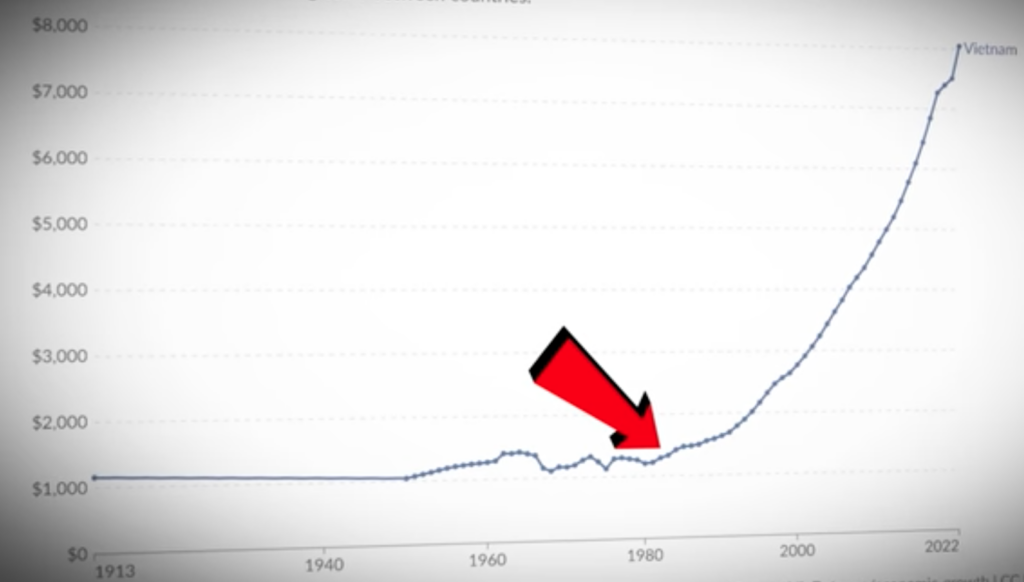
“And when you look at the history of Vietnam’s GDP per capita, you can see the exact moment that Renewal took place.”
“The result has been an economic miracle. GDP grew at nearly 8% a year through the 1990s. Inflation fell from 100% to less than 10% and poverty rates plummeted for more than 30 years straight.”
“Now, this doesn’t mean that Vietnam is a paradise. The country is still a long way off from being as wealthy as other East Asian nations like South Korea or Japan. Corruption is still a major problem and it’s still an authoritarian single party state.”
“But ironically, the story of Vietnam’s economic collapse and the miracle that happened next is perhaps best summarized by what the Vietnamese Communist Party admitted at their own Party congress in 1986 when a delegate stood up and told the room what nobody in the Party had ever said out loud before. ‘The people have lost faith in the Party.'”
“And the only thing that can save it was abandoning everything the Party stood for.”
Tanks rarely feature in Hollywood movies about the Vietnam War (Full Metal Jacket is the only exception that comes to mind), so you might be forgiven for thinking they didn’t play any role in the conflict. In fact, several armored vehicles were used by American and AVRN forces quite effectively there, as covered in this video from the UK Tank Museum:
The main armored vehicles used were:
The M48 Patton Tank:
It was the US Marine Corps that insisted on bringing them to Vietnam. “Deep ditches and steep grades are no problem for the Patton 48.” The M48 A3 had 110mm of frontal armor, but probably more important for its service in Vietnam was the construction. It’s cast, not welded. And this proved invaluable. The communist forces regularly used improvised anti-tank mines, often made from unexploded US ordinance, and the curved underside of the M48 was effective at deflecting the blast of such devices.
On top of that, the M48’s 90mm main gun, plus 50 cal and M60 secondary armament could lay down a withering field of fire, either in support of infantry in the open or in perimeter defense. It didn’t take the US Marine Corps long to prove the M48’s worth. In Operation Starlight in August 1965, the Marines destroyed the first Vietcong regiment on the Vatang Peninsula. A report on the action stated that tanks were the difference between expected heavy casualties and the light casualties we actually took.
By 1966, operations like Hastings and Prairie proved that tanks and marines working in close cooperation was the best way to destroy VC strong points and slash enemy supply routes in wide aggressive sweeps. Despite some continuing reluctance from MACV [Military Assistance Command, Vietnam], tanks were proving far more useful than previously thought.
Another major challenge in Vietnam was ambush. Communist forces would create killing zones up to a kilometer long stretching along key highways. They planted improvised mines to disable lead vehicles and anti-personnel mines and punji spikes at the side of the road to take out infantry dismounting from trapped and stationary vehicles. Once again, tanks proved themselves a huge asset in combating the problem. The M48s would place themselves front and rear of the convoy. The tanks at the rear would have their turrets facing after. If the convoy was attacked, the tanks could often ride through any initial blast or push damaged vehicles off the road, allowing the convoy to keep moving. The armor would then cloverleaf, swinging out from front and rear to envelop the enemy. If all went to plan, they could quickly turn the tables on the attackers as their firepower came into play.
Another counter ambush tactic was the thunderun. A pair of Pattons would take up position either side of the road with one track on the road surface and the other on the verge. They would then race ahead of the column, hosing down likely ambush sites. If they hit a mine, it seldom did more than throw a road wheel. And if they made it through unscathed, the route was considered safe for soft skin vehicles to follow.
As troop numbers grew, the army too began to deploy M48s in a fire support role. Either indirect fire, a substitute for artillery, or in a direct fire role using HE against enemy bunkers. In perimeter defense, tanks would be dug in behind an earth or sandbag berm, flanked by infantry and foxholes, and with a belt of overlapping trip flares, barbed wire, and claymore mines in front. From these defensive cocoons, the tanks could stand firm against human wave attacks, often with the help of one of the most controversial tank munitions ever devised: The beehive round.
The 90mm beehive or M580 AP anti-personal tracer to give it its full title was brutal. It contained 4,200 1/2 in., 5g razor sharp steel flechettes along with a time fuse and bursting charge. The crew would set the detonation range anywhere from 0 to 4,300 m. When the charge went off, the cloud of flechettes formed a 300 m long cone, a deadly swarm carving through jungle cover, wire imp placements, and attacking infantry with devastating effect. The nickname beehive came from a buzzing sound the flechettes made in flight. One M48 gunner described the round’s detonation as like God fired a shotgun.
The M113 ACAV
But the most numerous and arguably effective AFV on the Vietnam battlefield wasn’t a tank at all. It was this, the M113 armored personnel carrier. To the grunts on the ground, it was simply known as “tracks.” M113s were supplied to the South Vietnamese even before the US ground intervention began. And low on armor, the ARVN had to make use of whatever they could get their hands on.
Designed to be air portable, the M113 had aluminum armor. It weighed just 12 tons, had a top speed of 42 mph, was amphibious, had a crew of two, and it could carry up to 11 infantrymen. As an armored personnel carrier, the M113 was essentially a battle taxi designed to drop off its passengers and perhaps provide a bit of fire support from its pintle-mounted 50 cal. However, the ARVN hadn’t read the owner’s handbook. Rather than using M113s as APCs, they set about turning them into ersatz tanks. By adding extra M60 machine guns, recoilless rifles, and mortars.
We’ve seen similar upgrading and front-line use of M113s by Ukraine.
South Vietnamese troops used M113s in an armored assault role. To some extent, this worked. The M113’s mobility and amphibious capabilities were a godsend amongst the rivers, marshes, and rice patties. If a single vehicle couldn’t make it through, the ARVN created daisy chains, linking multiple M113s with steel hawsers. If one got stuck, the others would pull it out.
The problem was that 38 mm of aluminium wasn’t enough to keep out heavy machine guns, let alone RPGs. And with the earlier M113s that were supplied to the ARVN, they were petrol-driven, which meant that they burned a whole lot easier. Once they got over their initial fear of the Green Dragons, the VC realized that all they had to do was pepper the M113s with fire when they appeared and something bad was likely to happen to the ARVN on the inside. Multiple RPG hits would result in a penetration while the top cover gunners were horrendously exposed to small arms fire. In a single action Ap Bac on the 2nd of January 1963, 13 were killed.
With this experience, the vehicles were adapted with the creation of improvised weapon shields. Later formalized as one of the most iconic vehicles of the Vietnam War, the M113 AAV, the armored cavalry assault vehicle had extra belly armor to protect against mines, plus beefed up side armor. The 50 cal and the additional two M60s all had gun shields added to protect the crew. Suddenly, the battle taxis had real teeth, and the US forces started using them in an equally aggressive manner. Perfect for reconnaissance and mobility in the open terrain of the Mekong Delta and rubber plantation. The VC had nothing to match its firepower.
At Ap Bau Bang in March of 1967, the US First Infantry ambushed by Vietcong forces used AAVs in a wagon wheel formation, firing in all directions to break up enemy assaults. During the iconic siege of the Marine Corps base at Khe Sanh, the AAVs used their mobility and firepower to carve routes into the base, allowing infantry and engineer units to lift the blockade. Not bad for a little vehicle that was essentially modified on the hoof and operating way beyond its original combat purpose.
The M50 Ontos
But perhaps the strangest and in its niche most effective vehicle on the battlefields of Vietnam was the M50 Ontos. Ontos is the Greek word for thing, which is certainly less of a mouthful than its official title of Rifle Multiple 106mm Self-Propelled M50, but also an apt name for such an extraordinary looking vehicle.
It does indeed look pretty funky.
“The Marine Corps shows off its newest weapon. A speedy tank destroyer bristling with six powerful recoilless rifles, four smaller spotting rifles, and a machine gun. The Marines call it the Thing.”
The Ontos is small, only 12 1/2 ft long and lightweight at 9 1/2 tons, making it easy to move by air. Yet despite its diminutive size, the Ontos bristled with six M40 106 mm recoilless rifles with a 50 caliber spotting rifle on each side. They could fire a mixture of heat, HE or beehive rounds. For the three-man crew, the biggest challenge was reloading. The loader was holed up in the back of the Ontos and had to exit the vehicle through a hatch and reload the 106s from the outside. Not much fun in the heat of battle.
Despite this, the vehicle’s combination of mobility with ferocious firepower made them devastating in the right setting. Only 300 were built, but they punched way above their weight. In Hue City during the 1968 Tet Offensive, US Marines stood in awe as the Ontos weaved through the tightest urban environments, knocking out walls and cutting down entire squads of enemy soldiers. Such was the reputation of the Ontos that sometimes all that was required was for a 50 cal sighting rifle round to be fired into a building for the North Vietnamese to abandon the position. In the words of one veteran of Hue, “It was ugly, loud, and dangerous. Just what we needed.”
The Ontos would also play a significant role in killing an entirely different set of commies in the Dominican Civil War in 1965.
American M48s would go on to destroy North Vietnamese T-54s during the full-scale invasion of the south, but by then the American withdrawal meant the writing was on the wall for the ARVN…
Last Wednesday, we made the decision to suspend production on the show to avoid further inflaming a tense situation at an emotional moment for our country. It is a decision we made because we felt some of the comments were ill-timed and thus insensitive. We have spent the last days having thoughtful conversations with Jimmy, and after those conversations, we reached the decision to return the show on Tuesday.
As a reminder, Jimmy Kimmel’s ratings trail behind Stephen Colbert, and Stephen Colbert’s show will be wrapping up soon because it is losing CBS a whopping 50 million a year.
In fact, Kimmel’s audience was down 43% from earlier in 2025, averaging only 1.1 million viewers in August 2025.
Is ABC really going to bring back a huge financial liability because Barack Obama and a bunch of liberal elites got mad? Did advertisers think a week-long suspension was enough? Did the woke executives at Disney not actually find Kimmel’s lies about Charlie Kirk’s assassination offensive?
Will Kimmel even be required to apologize?
So liberals were finally able to prevent consequences for one liberal for their horrible lies over Charlie Kirk, and the hill they chose to die on was…Jimmy Kimmel.
The question is: Why? Obviously, the answer is that the left thinks none of their ranks should ever be allowed to be cancelled for anything nasty they’ve ever said about anyone on the right, no matter how dishonest and slimy, ever. But the deeper question is: Why Jimmey Kimmel? Why was this failing talk show, the one that ratings show the vast majority of them don’t even watch, the Khazad-dûm upon which the hate-filled orcs of the left brandished their pre-printed talking points and screamed “You shall not pass!”?
Nexstar and Sinclair have confirmed that Jimmy Kimmel Live will not be returning to the air on their affiliates after Kimmel’s lies about Charlie Kirk’s assassination, so all Disney/ABC will do by bringing it back is to temporarily mollify outraged leftists while losing even more money.
It’s rather like French general Henri Eugene Navarre fixing his hopes of defeating the Viet Minh on establishing an isolated fortress at Dien Bien Phu, some 120 miles from the nearest French base and resupplied solely by air, to interdict supply lines running into Laos. It was a tremendously bad idea, as Dien Bien Phu had no strategic value on its own, French forces did not control the highlands, and Viet Minh commander Vo Nguyen Giap declined to engage in the all-out climatic battle by which Navarre sought to shatter Viet Minh forces. Instead, Giap conducted a methodical siege, hauled in artillery to pound French positions, and used sappers to undermine the French perimeter. This strategy gradually contracted the French perimeter until air resupply became impossible, and French forces surrendered after just under two months of siege on May 7, 1954, a decisive defeat that resulted in them abandoning Vietnam entirely, resulting in the partitioning of French Indochina and setting the stage for American involvement in the Vietnam War.
Like Dien Bien Phu, Jimmy Kimmel Live is of no particular strategic importance of its own. It’s a money-losing show that’s lost 72% of its audience over the last decade, an increasingly irrelevant legacy media leftover on a network whose ratings fall behind not only Fox, but Fox News and ESPN, and part of a media conglomerate that’s already acquiesced to conservative demands to end its DEI programs.
It’s likely all the leftwing shouting and foot-stomping will accomplish is to delay the unemployment of Kimmel and his murder horny crew to a few months down the road. My guess is that they will quietly cancel the show over the Christmas holidays and have a less controversial replacement ready to go in January.
As mentioned in yesterday’s LinkSwarm, Trump has offered temporary tariff relief for everyone…except China. China got hit with even higher tariffs. Evidently the only “trade war” that is happening right now is with China…and China is losing.
Behind the global economic chaos provoked by president Trump’s tariff tsunami, there are growing indications of a strategic purpose. It is now conceivable that plunging into, and then retreating from, a generalised trade war was actually a deliberate means to a truly geostrategic end: to thwart China’s ambition to replace the US as the dominant world superpower.
While Trump’s public statements still chiefly concern the need to impose economic measures to correct decades of unfair foreign trade, senior US officials, including Pete Hegseth, defence secretary, and Scott Bessent, treasury secretary, are increasingly taking a more strategic geopolitical line.
In late January, Hegseth told the US armed forces that America would “work with allies and partners to deter aggression in the Indo-Pacific by communist China”. In Panama, he said that Beijing was investing in the region for military and economic advantages. “War with China is certainly not inevitable … But together we must [deter] China’s threats in this hemisphere.”
Bessent has linked recent US tariff tactics with a shared geostrategic pushback against China, stating that “we can probably reach a deal with our allies, and then we can approach China as a group”.
In this light, the suspension of tariff combat for 90 days with most countries, while doubling down on the levies imposed on China, leaves Beijing isolated and in the firing line.
So far, after reciprocal gestures and vowing to “fight to the end”, Beijing has focused mainly on rallying anti-US sentiment across the globe. But India and Australia declined to join forces with China. ASEAN remains caught between opposing powers. The EU, in a quandary over Russia and Ukraine, likewise continues to hedge.
China has long sought to frame the West as a feeble, fragmented anachronism. Is it conceivable that, by unleashing economic fire and fury on friends and then provisionally reining it in, Trump might succeed, where Western multilateral diplomacy failed, in forcibly forging a credible consensus of opposition to the threat of global Chinese hegemony?
One assumes that Washington understands that it cannot prevail over China alone and a substantive US pivot to the Asia Pacific to press home a contest with China is starting to emerge. Trump has already reached out to Japan and South Korea, and US officials have tackled Vietnam. The Philippines, in striking distance of any hostilities over Taiwan, support the US and talk about preparing for war.
Taiwan, South Korea, India, Japan, Vietnam, Philippines: It’s like a greatest hits of nations that have bad blood with China. It’s no wonder they’ve chosen to trade with the world’s biggest economy rather than a historical enemy with designs of territorial expansion.
The developing world now faces a binary choice, and ruthlessly exploited debt and resource dependencies are not a firm basis for loyalty. This remains the case despite decades of nugatory US investment and engagement.
Under Trump’s tariffs, it is too soon to know how far China will be able to maintain the global supply lines on which its aspirations to become the world leader of innovative consumer production depend. Nor will it be easy to develop export markets big enough to compensate for declining sales to the West and its allies. Beijing’s military influence has begun to expand, but remains localised.
Most importantly, the question of Taiwan is now implicit in US language about deterring Chinese aggression. How does Trump’s assault on China’s geostrategic ambitions affect the threat of an imminent blockade, or even a full-scale invasion? The widespread view that an invasion isn’t inevitable now gives little real assurance.
Indeed, with the US taking an active stance, the status quo based on “ambiguity” is gone. Preparations to besiege Taiwan, let alone to invade, would be spotted in time for pre-emptive action.
104% tariffs on China are not enough, I’m advocating 400%. I do business in China, they don’t play by the rules. They’ve been in the WTO for decades. They have never abided by any of the rules they agreed to when they came in for decades. They cheat, they steal, they steal IP, I can’t litigate in their courts. They take product, technology, they steal it, they manufacture it and sell it back here …
I want Xi on an airplane to Washington to level the playing field. This is not about tariffs anymore. Nobody has taken on China yet … As someone who actually does business there, I’ve had enough. I speak for millions of Americans who have IP that have been stolen by the Chinese … the government cheats and steals and FINALLY an administration … that puts up and says “enough!” …
Xi can only stay the supreme leader if people are employed … It’s time to squeeze Chinese heads into the wall NOW!
Or check out this video from Chris Chappell of China Uncensored.
“The CCP wants to defend global trade. But they’re the ones who destroyed it in the first place.”
“The Chinese Communist Party is freaking out about US tariffs. They’ve launched a full-on propaganda blitz, calling the tariffs abuse. And blackmail. And if anyone is an expert on abuse and blackmail, it’s the CCP. The CCP is also claiming to be the defender of global trade. Yes, China is going to safeguard multilateralism and the multilateral trading system. And they totally are! I’m not being sarcastic here. They really are.”
“The CCP is going to fight for the current global trading system. It’s not because they love international cooperation, which is just propaganda BS. It’s because the CCP has spent decades manipulating global trade to their advantage. So there’s no way they’re going to let all that lying and cheating go to waste. Plus, global trade is basically the only thing keeping China’s economy afloat.”
“China is an export economy. That means their economy relies on manufacturing stuff for the rest of the world to buy. Chinese manufacturing exploded after China joined the World Trade Organization in 2001. Because China was able to make stuff more cheaply than other countries, consumers around the world benefited from lower prices on Chinese imports. But countries also lost tons of manufacturing jobs to China. The US alone lost more than two million jobs between 1999 and 2011 as a result of Chinese imports.”
“Besides manufacturing, the other big driver of China’s recent economic growth was real estate investment. Which became a problem after China’s real estate market started to collapse in 2020. So, the CCP decided to double down on manufacturing. They pumped billions of dollars into building more factories and exporting more goods to keep China’s economy from crashing. Which did work, but now China is making way more stuff than the rest of the world can buy. That’s called overcapacity.”
“China is making way more batteries, solar panels, and electric vehicles than the rest of the world wants. And because China has so much overcapacity, it also doesn’t import much from other countries. Which means China now has a trade surplus of almost a trillion dollars. That’s more than any country’s trade surplus in the past century, even adjusted for inflation. And China doesn’t show signs of stopping. Its export volume is growing three times as fast as global trade. That’s insane.”
“So what happens when China exports more and more stuff? They have to cut prices to be able to sell it all. Which means other countries lose even more jobs to China. Entire industries shut down. There are now certain products you can only buy from China. And when those are critical things like medical supplies, that gives China massive political and economic leverage on other countries. Remember when China stopped exporting medical goods during the early days of Covid? Yeah, that, but on an even bigger scale.”
“So that’s why the Chinese Communist Party is fighting to maintain the global trading system. They dominate it. And without it, China’s economy would fail. And their political control would crumble.”
“But how did China get here? It’s not just about cheap labor. The CCP has built an entire economic system to dominate global trade. Back when China joined the World Trade Organization in 2001, they promised to follow rules to ensure fair trade practices. To be fair to the CCP, something I never thought I’d say, they did make a bunch of economic reforms in order to get into the WTO. But after they joined, they violated the WTO rules repeatedly. They’ve been cheating the system for decades. And largely getting away with it. You see, the WTO rules are set up to prevent government intervention that would artificially distort global trade. But in a communist system, it’s government intervention all the way down.”
He brings up the example of honey producers getting subsidies at every step of production.
“This industrial policy is incredibly effective for the CCP. It’s how the CCP jump-started its entire electric vehicle industry. And they’re now flooding the rest of the world with cheap EVs.”
“Yes, these are all things that other countries do, too. But no one does them on the same scale as the CCP. In 2019, the CCP spent almost $250 billion dollars on its industrial policy. That’s massive.”
“But it’s not just industrial policy. There are also ways China’s entire financial system distorts global trade. Like everything in China, the financial system is political. All banks in China are either state-owned or state-linked, so the CCP controls how they give out loans. Which means state-owned banks give lots of loans to state-owned enterprises, and to other companies the CCP wants to support. And if those companies can’t pay them back? The banks just keep extending the loans. Because it’s better to take the financial risk than to risk getting on the CCP’s bad side.”
“The CCP’s industrial policy and financial system is destroying the global trading system. More countries have stopped relying on the World Trade Organization to stop the CCP’s unfair trade practices. Instead, they’re putting their own tariffs on Chinese goods. Like Europe’s tariffs on China’s EVs. Or President Trump’s tariffs on China’s…everything.”
Then there’s China’s use of transshipping to other countries to get around tariffs and sanctions. “The US has had anti-dumping tariffs on Chinese honey since 2001. So Chinese exporters have tried to get around it with what’s called ‘honey laundering.'”
“So that’s how the CCP’s industrial policy, their financial system, and their export system are all designed to manipulate global trade. They’ve kept China’s economy going, while hurting other countries. Both advanced economies and developing economies are dealing with the fallout. But it’s gotten so bad, that the rest of the world has no choice but to fight back. Not just the US, but also Europe. And as a result, we may be watching the collapse of global free trade. And it’s the CCP’s fault.”
Also, Trump has the upper hand in the fight because China’s factories had already been closing left and right before he took office, due to rising labor costs and dwindling foreign customers. Here’s a China Observer video from 11 months ago speculating that 90% of Chinese factories might have to close.
And that was before Trump’s tariffs.
Trump is going to win his trade showdown with Xi because American has a much stronger economy than China, one that supports vastly higher domestic consumption, and because he holds all the cards.
Are Trump’s tariffs working? Falling stock prices and gloom and doom MSM posts may suggest otherwise, but there’s a growing body of anecdotal evidence that suggests the tariff announcement already has a host of foreign nations eager to make a deal to eliminate tariffs.
So right now, let’s say: Maybe
First up, a whole lot of countries seem eager to strike trade deals with the Trump Administration. “More than 50 countries have reached out to the White House to negotiate on tariffs, Kevin Hassett, the White House’s national economic council director, said on Fox News on Monday.”
The European Union has offered the United States an agreement on the reciprocal lifting of all tariffs on industrial goods, European Commission President Ursula von der Leyen announced on Monday, days before 20% tariffs on EU exports enter into force.
“Europe is always ready for a good deal, so we keep it on the table,” von der Leyen told reporters in Brussels.
The EU remains ready to negotiate a solution despite US President Donald Trump’s tariff decisions, she said, after an exchange with representatives from the steel and metals industries.
The US imposed tariffs of up to 25% on imports of steel, aluminium and related derivative products from the EU and other trading partners in March.
Note that agricultural products weren’t mentioned. I’m guessing that will be a sticking point for the Trump Administration.
Then there’s Vietnam, which says it’s ready to eliminate all tariffs.
Confirming that Trump’s “dealmaking” was about to shine, on Friday Trump posted on his Truth Social account, announced that he had a “very productive” call with the head of the Vietnamese communist party, adding that if Vietnam wants to cut their tariffs to “ZERO”, all they have to do is “make an agreement with the U.S.”…
Fast forward just one day, and we have an example of the first official capitulation by a trading counterparty as Bloomberg reports that Vietnam has offered to remove all tariffs on US imports after Donald Trump announced a 46% levy on the Southeast Asian nation, according to an April 5 letter from Vietnam’s communist party.
The offer was made by party chief To Lam to the US president in a letter that was seen by Bloomberg. In the letter, Lam requested that the US not apply any additional tariffs or fees on Vietnamese goods and asked to postpone the implementation of the tariff announced by Trump last week by at least 45 days after April 9.
The letter confirms comments made by Trump on Friday on his Truth Social network, following a call between the two leaders. Vietnam, which has increasingly become a key manufacturing and export alternative to China, was slapped with one of the highest tariff rates worldwide last Wednesday.
Expect all the companies profiled as the biggest casualties from the Vietnam tariffs to soar, as the market realizes that for all the posturing, Trump’s tariffs were just that: a negotiating chip to minimize trade barriers against the US, which as Vietnam so aptly demonstrated, are now well on their way out.
Also coming to the table: Taiwan.
In addition to the news about Vietnam bending the knee, The Epoch Times’ Jacob Burg reports that Taiwan’s President Lai Ching-te on April 6 said his nation would offer zero tariffs and no retaliation as the start of negotiations with the United States while vowing to remove trade barriers.
Lai said Taiwanese companies will also increase their investments in the United States. The comments were made in response to sweeping import tariffs announced by President Donald Trump on April 2. Taiwan has a trade surplus with America and will see a 32 percent tariff on its imports into the United States.
The new tariffs do not, however, affect semiconductors, one of Taiwan’s largest exports.
It’s less than a week since Trump’s announcement, and a whole lot of countries seem extremely eager to make a deal and remove tariffs on American goods. Trump has long been hailed as a master negotiator, and one of his main tactics to to directly threaten one of the most precious things the other side has in order to bring them to the table to make a deal.
As far as retaliatory tariffs from other countries, there’s a lot of muttering, but evidently only China has threatened an immediate 34% tariff, and Trump is threatening another 50% tariff on China on top of the previous ones as a retaliation to the retaliation. Honestly, I don’t think Trump much cares whether China signs up to eliminate tariffs. China was already cheating so many ways on trade, and is obviously America’s greatest strategic rival, that Trump probably wouldn’t mind completely decoupling red China from the American trade system.
A feature, not a bug.
There are enough facets to that last point that it may be worth a separate post…
President Trump announced his tariffs on countries, especially those that tariff goods from the United States.
President Donald Trump on Wednesday imposed sweeping new tariffs on all imported goods and unveiled a detailed list of reciprocal duties targeting more than 60 countries, asserting that the move is necessary to combat trade imbalances and restore U.S. manufacturing.
“This is Liberation Day,” Trump said during a Rose Garden ceremony, holding up a printed chart of countries and their new tariff rates. “For decades, our country has been looted, pillaged, raped and plundered by nations near and far, both friend and foe alike.”
The tariffs, which he described as “reciprocal,” fulfill a key campaign pledge and are aimed at pressuring trade partners to lower their own barriers. The administration expects the new rates to remain in place until the U.S. narrows a $1.2 trillion trade imbalance recorded last year.
But the extensive list of tariffs also threatens to upend the U.S. economy, as many — but not all — economists say they amount to taxes on American companies that will be passed down to consumers.
Trump held up a chart while speaking at the White House, showing the United States would charge a 34 percent tax on imports from China, a 20 percent tax on imports from the European Union, 25 percent on South Korea, 24 percent on Japan and 32 percent on Taiwan.
The centerpiece of the announcement is a 10 percent universal baseline tariff on all imports, effective immediately. For instance, Chinese imports are now subject to cascading tariffs of 10, 20 and 34 percent, for a total of 54 percent.
In addition, Trump’s administration imposed country-specific reciprocal tariffs on nations it accuses of unfair trade practices — including India, Vietnam, and the European Union, in adding to China. The rates are calibrated at approximately half the rate those countries impose on U.S. goods.
For example, China, which Trump said charges 67 percent in tariffs on U.S. goods when factoring in non-tariff barriers, will now face a 34 percent reciprocal tariff under the new system, in addition to the 10 percent baseline tariff and the 20 percent tariffs already in effect. Vietnam, assessed at 90 percent, will face a 46 percent tariff; India at 52 percent will now see 26 percent duties; and the EU, which imposes 39 percent, will be met with a 20 percent response, according to the White House chart.
This is a “devil in the details” issue that has a lot of ramifications depending on how the directives are written. But several of those countries are big players in semiconductors, so here’s a quick and dirty look at winners and losers if those tariffs stay in place a significant amount of time.
The main countries here, along with the reciprocal tariffs being applied to them:
Taiwan (32%)
South Korea (25%)
China (34%)
European Union (not a country, but they play one on TV) (20%)
Japan (24%)
Singapore (10%)
Israel (17%)
Save a few smaller, older fabs here and there, that’s pretty much 99% of semiconductor manufacturing, though Vietnam (46%) and the Philippines (17%) do a lot of semiconductor package assembly work, and the tariffs may apply to them, depending on wording.
So let’s look at the business Losers and Winners in the space. (Note: You might find this post useful, as it defines some of the semiconductor industry terms used here.)
Losers
TSMC: As the world’s biggest and most important chip foundry, the Taiwanese tariffs will hit TSMC hard. Their U.S. fab in Arizona isn’t ready for production yet, so all their chips will (theoretically) get hit with tariffs, assuming Trump doesn’t grant them a waiver because they’re already constructing a plant. But if they do go into effect, possibly even more heavily impacted will be:
TSMC customers, including Apple, Nvidia and AMD. All three get their very highest-end, cutting edge, sub-10nm chips fabbed there. For Apple, the M-series and A-series chips made there form the heart of all their Macs and iPhones. Likewise, Nvidia gets its highest end GPU/AI/etc. chips fabbed by TSMC. AMD’s most powerful CPU’s are also fabbed by TSMC, though some lower end chips are made elsewhere (like GlobalFoundries).
Tokyo Electron: Japan’s biggest semiconductor equipment manufacturer assembles pretty much all their equipment in their home country. 24% tariffs may make their equipment uneconomical compared to rivals Applied Materials and LAM Research.
South Korean DRAM manufacturers Samsung and SK Hynix: 25% tariffs will definitely impact sales in a market segment whose overall margins (robust in booms, and barely breaking even during busts) are thinner than others.
Every American electronics company that uses DRAM. Which is pretty much every American electronics company.
Every American AI boom company. Their data center costs are going up, while those of their foreign competitors are not.
Korean flat panel display manufacturers Samsung and LG Semicon, who between them control over 50% of the market.
Every American TV and monitor manufacturer, the vast majority of which have their devices manufactured overseas.
UMC: They’d fallen woefully behind TSMC for foundry work, and they won’t be winning much additional American business now.
Every company trying to build a sub-10nm fab in the U.S., as steppers from Netherlands-based ASML just got more expensive and the competition to obtain them might have increased.
Pretty much every fab in China just got more screwed…but they were pretty screwed (and trailing badly) before.
American fabless chip startups: Their costs for getting chips to market probably increased.
Winners
Applied Materials, LAM Research and KLA Tencor. Buying competing Tokyo Electron equipment just got more expensive, and a bunch of companies now have incentives to build fabs in America.
Intel: Assuming they’ve finally got their process technology sorted out (a big if), they’re well-positioned to take CPU market share from AMD and to grow their under-performing foundry business.
Micron (sort of): As the only American DRAM manufacturer, they can probably earn more per each chip produced domestically. But Micron has a lot of overseas fabs these days, and building new domestic DRAM fabs will take years.
GlobalFoundries: The costs of their global competitors just increased, so they can probably win more business for their domestic foundries…if they have the available wafer starts. But they have a lot of foreign fabs as well.
Samsung‘s US foundry business. Presumably the wafer starts for their Austin and Taylor fabs will see increased demand.
Maybe Texas Instruments, but I’m not sure how much mixed-signal and analog competition they have, and that’s their bread and butter.
Neutral
ASML: Being in the Netherlands and having TSMC as their biggest customer, you figure they’d be hurt, but no. You can’t get EUV steppers from anyone else, and I get the impression they’re building EUV steppers as fast as they possibly can already. Anyone building a cutting-edge fab will just have to pay more to get them.
Tower Semiconductor: Half their foundries are in Israel and half in the U.S., so I figure it’s a wash.
That’s my quick and dirty analysis. Of course, Trump is using tariffs like a battering ram to smash foreign tariffs, and if he’s immediately successful, there probably will only be minor hiccups in the global supply chain. But if not, a whole lot of disruption might lie ahead, and it usually takes a minimum of 3-5 years to bring a new fab online.
I’m pretty much over my cold, except the occasional cough and continued draining of the Strategic Mucus Reserve.
The USAID revelation continues, with every left-wing, anti-American cause getting their snout into the trough of taxpayer money. Plus blows against the illegal alien and tranny pander brigades. It’s the Friday LinkSwarm!
Second Amendment advocates have long know that “Everytown for Gun Safety” was, like all the other branches of the Brady Bunch hydra, pure Astrotruf, but thanks to database revelations, we now know that taxpayers were footing the bill.
Have you ever heard of NEO Philanthropy? They’re a left-wing group that has been around for more than 40 years. NEO wants folks to believe it is a partnership between “changemakers and funders.” They claim to provide “resources to groups accelerating change.” Race, gender and DEI are huge for them, but guns are a problem.
An incredible website database has outed NEO Philanthropy’s actual duties, and those of thousands of other similar groups. NEO, it turns out, is nothing more than a middleman. It receives money and funnels some of it to Everytown for Gun Safety as well as other leftwing, anti-gun groups.
The website database is called DataRepublican.com, and it will forever change the way nonprofits handle their funding, especially those on the left.
Snip.
On Wednesday, pro-gun official Hannah Hill “exposed taxpayer money flowing to Bloomberg gun control orgs.”
The next day, she used the website to link USAID funds that went to Everytown, Giffords and more gun-control organizations.
👀 Yesterday, @hannahhill_sc exposed taxpayer money flowing to Bloomberg gun control orgs.
Today, @DataRepublican's tool helped 2A advocates link USAID funds to Everytown, Giffords & more.
George Soros got his nose in the trough as well. Who was bankrolling the campaign to appoint pro-crime Soros DAs? You were.
Beginning about a decade ago, George Soros began funding campaigns for people who became known as the “Soros prosecutors.” Local prosecutorial races, which once had a few thousand spent on them, suddenly started seeing hundreds of thousands, and even millions of dollars pouring in, totaling about $50 million to elect 75 prosecutors nationwide.
Every one of those prosecutors is a radical leftist who immediately set about remaking the local justice system in accordance with leftist values: Criminals are victims of the system and should not be prosecuted; Republicans are enemies of the people and should be prosecuted. Some of these prosecutors are wreaking havoc on a scale that doesn’t make the news; others have done such horrible things that their names hit the headlines:
Kim Gardner, the woman who used false charges to destroy Eric Greitens, Missouri’s Republican governor, and whose tenure was distinguished by slandering the police, violating open records laws, persecuting the McCloskeys for defending their property against BLM rioters, discriminating against employees on racial grounds, and letting the most egregious criminals walk free.
Lawrence Krasner, the Philadelphia DA who just promised to prosecute the pardoned January 6ers. He couldn’t name a crime, though. He seemed to be operating on the Lavrentiy Beria principle of “show me the man, and I’ll show you the crime.”
Andrew Warren, the Florida prosecutor who announced that he would no longer prosecute entire categories of criminal activities because he didn’t like the Florida laws. Governor Ron DeSantis fired him.
George Gascón, a District Attorney who managed to break both the San Francisco and Los Angeles criminal justice systems. He was finally voted out of office in L.A. this past November.
Kimberly Foxx, the Cook County Chicago prosecutor who turned the criminal justice system into a revolving door, creating a staggering wave of violence in already beleaguered Chicago.
And then there’s Manhattan’s Alvin Bragg, who brought an utterly spurious and quite obviously political case against Donald Trump for allegedly criminal hush money payments to Stormy Daniels.
Without exception, the Soros prosecutors, most of whom received money from the Tides organizations, have been disastrous for their communities and, in Bragg’s case, for America as a whole. (Although one could argue that Bragg’s manifest political persecution of Donald Trump helped return Trump to the White House, which, to date, has been an incredibly good thing.)
Thus, there’s a straight line from Soros to Tides to corrupt prosecutors.
But what does this have to do with USAID? Well, back in October 2020, when no one was paying too much attention (COVID, BLM, the election), and USAID-funded mainstream media outlets were busy quashing stories that harmed Democrat interests, USAID was Funding the Tides Center:
Nearly $170 million in government grants has passed through a liberal dark money behemoth that houses numerous left-wing groups, including the Black Lives Matter Global Network Foundation, tax forms show.
The taxpayer-funded grants were disbursed to groups through the Tides Center, a San Francisco-based nonprofit incubator that wealthy liberal donors use to bankroll progressive causes. A number of radical left-wing groups have fallen under the auspices of the Tides Center, which acts as a “fiscal sponsor” to nonprofits by providing its 501(c)(3) tax and legal status. This arrangement lets the groups under its umbrella avoid registering with the IRS.
[snip]
[Scott] Walter [president of the Capitol Research Center] noted that the Tides Center’s recipient profile on USASpending.gov, which posts government grants, shows $34 million in federal funding since 2008. The grants were primarily from the U.S. Agency for International Development and the Department of Health and Human Services.
And Stephen Green discovered that USAID was also funding #BlackLivesMatter so they could help burn down your city.
More than $1.3 billion in taxpayer funds from the Biden administration ended up helping groups that sponsored or committed terrorism.
Federal watchdog reports and other documents show former President Joe Biden’s aid programs funneled the money toward a network of terrorism in the Muslim world — largely by reversing Trump-era policies.
Snip.
The Biden administration gave $1,053,400,000 in taxpayer money to the United Nations Relief and Works Agency (UNRWA), which claims to help war-afflicted Palestinian civilians but is tied to terrorists fighting Israel, according to U.S. and Israeli intelligence. Biden reversed a Trump-era ban on UNRWA funding in 2021 but brought back the ban last year after Israel accused UNWRA workers of participating in Hamas’s Oct. 7, 2023, attacks.
Intelligence officials later revealed that more than 1,000 UNRWA employees, or around 10%, were linked to the groups Hamas and Palestinian Islamic Jihad, according to documents found on the bodies of dead terrorists and other evidence. A dozen took part in the Oct. 7 massacre, including a Hamas commander who was teaching in elementary school for UNRWA and led a siege against an Israeli kibbutz that killed almost 100 people.
UNWRA’s schools have long used curriculum for Palestinian children that glorifies terrorists and martyrdom, a March 2023 report from UN Watch found.
The curriculum comes from the Palestinian Authority (PA), a governing body in the West Bank that the Biden administration considered more friendly to American interests than Hamas. The PA also made a profit from Biden’s presidency despite its program that pays Palestinians and their families as a reward for acts of terror against Jews.
Trump and Congress passed a law in 2018 blocking economic support funds for the PA due to its program. Trump later paused all remaining funding for the PA before Biden took office and resumed it.
The Biden administration in part revived the economic support fund that Trump’s law restricts. The State Department claimed in documents from 2021 that “most” of the money did not “directly benefit the PA” in violation of the law. However, officials sent $265 million straight to the PA for its “security forces and justice sector institutions” throughout Biden’s presidency, according to the Congressional Research Service.
Under Biden, the PA agreed to pay more than $97 million to reward the perpetrators of the Oct. 7 attacks, the Washington Free Beacon reported.
The @DOGE team discovered, among other things, that payment approval officers at Treasury were instructed always to approve payments, even to known fraudulent or terrorist groups.
They literally never denied a payment in their entire career.
So Treasury official David A. Lebryk resigned rather than testifying. Sounds like he should be subpoenaed and/or indicted…
Another media beneficiary of USAID taxpayer subsidies: Christianity Today. Render unto Caesar what is Caesar’s, and also render unto Caesar what is God’s…as long as Caesar is paying you enough.
You’ve never heard of the “Zizians,” and neither had I until this afternoon, but you’re probably going to be hearing a lot more about them now that this weirdo California cult has been connected to the shootout in Vermont last week that left a Border Patrol agent dead. Credit to Andy Ngo for putting together the pieces of this bizarre puzzle. When the shootout went down in Vermont on January 20, the initial reports were very thin, but piece by piece, we’ve learned more about the two suspects, Teresa Youngblut, a 21-year-old from Seattle, and Felix Bauckholt, a math genius from Germany who had worked in the financial industry on an H1B visa. About seven months ago, Youngblut’s parents had reported her missing, saying she had cut off contact with them and they were concerned she might be in a coercive relationship. The police didn’t do anything, saying that as an adult, she couldn’t be considered a runaway.
Youngblut and Bauckholt showed up in Vermont a couple of weeks ago and attracted suspicion because they were wearing black “tactical” gear and Youngblut had a pistol in a visible holster. Eventually, this led to an attempted traffic stop on I-91 in which both Youngblut and Bauckholt pulled pistols. Bauckholt was killed in the resulting shootout, but Younglut survived and will face charges.
The Department of Justice will ensure that, consistent with law, ‘sanctuary jurisdictions’ do not receive access to Federal funds from the Department,’ Bondi’s first-day memo says.
‘Consistent with applicable statutes, regulations, court orders, and terms, the Department of Justice shall pause the distribution of all funds until a review has been completed, terminate any agreements that are in violation of law or are the source of waste, fraud, or abuse, and initiate clawback or recoupment procedures, where appropriate.’
It’s no secret that Chicago has forsaken its own low-income residents to virtue signal as a so-called ‘sanctuary city’ for illegal immigrants – to the point where local residents have been excoriating city officials during official meetings, and major businesses such as Ken Griffin’s Citadel moved to Miami due to the city devolving into “Afghanistan.”
Now, the Trump DOJ is suing Chicago, the state of Illinois, local officials over laws creating said ‘sanctuary,’ and have accused the defendants of impeding federal immigration enforcement efforts. In their complaint, the DOJ has asked a judge to declare the state and local measures unconstitutional due to the federal government’s supremacy.
One of the laws challenged by the Wednesday lawsuit prohibits officials from complying with federal immigration detainers and providing certain information about noncitizens.
“The challenged provisions of Illinois, Chicago, and Cook County law reflect their intentional effort to obstruct the Federal Government’s enforcement of federal immigration law and to impede consultation and communication between federal, state, and local law enforcement officials that is necessary for federal officials to carry out federal immigration law and keep Americans safe,” reads the lawsuit.
Named in the case are Illinois Gov. JB Pritzker (D), Chicago Mayor Brandon Johnson (D), as well as the city’s police superintendent and other city officials.
The case, filed in federal court in Chicago, marks one of the first major cases brought by the Trump administration in such a case, and comes after the Wednesday confirmation of Attorney General Pam Bondi, who issued a same-day memo restricting sanctuary cities from accessing DOJ funds.
The U.S. will take over the Gaza Strip and we will do a job with it, too. We’ll own it, and be responsible for dismantling all of the dangers, unexploded bombs, and other weapons on the site, level the site, and get rid of the destroyed buildings, level it out, create an economic development that will supply unlimited numbers of jobs and housing for the people of the area.
Trump’s affinity for beachfront property aside, I don’t see how rebuilding Gaza is a proper use of American tax dollars.
Sudden Putin Death Syndrome strike again. “Russian singer who donated to Ukraine and called Putin an ‘idiot’ mysteriously falls to his death from a window.” (Hat tip: Dwight.)
Kamala Harris team lied about Joe Rogan’s attempt to get her on his show. Of course they did. The whole campaign was built on lies and an attempt to install Harris in the White House without enduring any scrutiny from voters.
Speaking of which, remember when CBS swore up and down they didn’t deceptively edit the Kamala Harris video They lied.
Winning. “President Trump Signs Executive Order Barring Men from Women’s Sports.”
On Wednesday, National Girls and Women in Sports Day, President Donald Trump signed an executive order barring men from women’s sports through Title IX, withholding funding from universities that insist on allowing male athletes to encroach on women’s competition.
The order will also empower women who are forced to compete against men to sue their schools and directs the Department of Homeland Security to deny visa applications from foreign athletes who identify themselves as the opposite sex in order to compete in the U.S.
At the signing ceremony, Trump specifically cited the importance of protecting female athletes at the upcoming 2028 Olympics in Los Angeles and the World Cup.
“My administration will not stand by and watch men beat and batter female athletes. We’re just not going to let it happen,” Trump said.
J.K. Rowling had something to say about it as well:
Congratulations to every single person on the left who’s been campaigning to destroy women’s and girls’ rights. Without you, there’d be no images like this. pic.twitter.com/mzR7l5k1OW
Our vile media: “Newsweek runs puff piece on gender transition of man who held family hostage, raped them, and killed their kids.
More dictates from the Texas House Cabal: “Speaker Burrows Confirms House Rules Were Written by Democrat Lawyer. The new rules mandate that all House committee vice-chairs be Democrats and expand their authority.”
Follow-up: Charges against Aaron Dunn and Wallis Nader, two of the Lina Hidalgo’s aides indicted for vote rigging, have been been dismissed by the Texas Office of the Attorney General, and a third against Alex Triantaphyllis is expected to be dismissed as well, though it’s unclear why.
Chris Williamson, as part of a longer interview with Eric Weinstein, asks what he thinks of Kamala’s vacuous, much-repeated phrase “What can be, unburdened by what has been.”
He traces it directly back to Marxist thought.
EW: “There’s a line in Marx where [pause] Sometimes you hear certain phrases Like ‘A World to Win.’ AOC uses the phrase ‘We Have A World to Win,’ which comes from the end of The Communist Manifesto.”
EW: “It basically says you have to wipe out what has been to arrive in the new. And where’s it from what can be unburdened by what has been. It’s not a direct translation, but it occurs in Karl Marx.”
EW: “If you think about what Mao had to do to wipe out Chinese history, what Pol Pot had to do, you’re trying to wipe out memory, because the memory has all of this burden.”
EW: “Why do you think is it important to go after doctors and lawyers and teachers and professors? Because in some sense they are going to resist the New Order that you’re about to impose. You’re looking for a blank slate.” That’s why after the Khmer Rouge took over, they called it “Year Zero.”
On a trip to Vietnam, Weinstein sees the complex Dan Bau musical instrument in a window.
I become transfixed by it, and a woman says “I see you looking at this” in English. “Would you like to come in?” I said I don’t want to impose. She says “No, no, no, it’s not mine.” So she invites me in, and there’s this guy who appears to be brain dead. He’s like deformed. I’m not going to get through this. And he’s speaking very haltingly and I don’t know who he is. Something about music, something about journalism, something about a professional. I can’t really make out what’s happening. I’m asking about the instrument, and this woman brings him a guitar, and this deformed man starts playing some transcription, like Chopin, or some piano concerto on the guitar, at some incredible level. And I can’t even imagine that his body can do it, and so I have no idea where I am or what’s happening. And then he motions for like a book, and she brings a book. And it has all of these articles about this man tortured for his principled stand against communism. This man has been destroyed mind, body, to the point where it’s just painful to watch him.
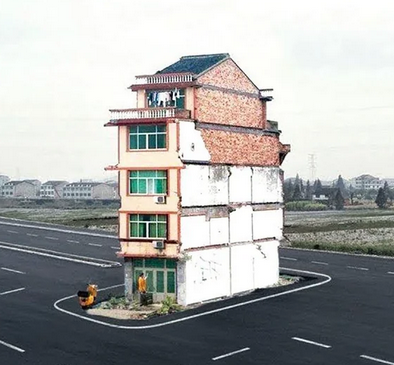
Weinstein brings up the topic of a “nail house,” a house where the owner refuses to leave, so Chinese authorities literally build a road around their house.
EW: “They’ll build a highway to screw over the person who stands up and says ‘I will not move,’ and the idea is that that road is the future unburdened by what has been, and then there’s some hold out who won’t go along with the program.” Or as the Maoist proverb puts it, “The nail that stands up shall be hammered down.”
Weinstein asks Williamson if he knows what Harris’ father did for a living. He does not, but we know that her father was a Marxist professor. “As a man whose family comes from the far left, you recognize certain sorts of commonalities.”
Weinstein asserts that the Democratic Party is not communist, “But it is welcomed in a lot of neo-Marxian thought.” I would go further and say that the current ideological core of the Democratic Party is are true believers in Marxist social justice. “I would say AOC is straight up Marxist. I think Kamala is everywhere between crony finance and Marxism.”
Williamson thinks Harris is “unsophisticated,” but Weinstein disagrees. “Nothing in politics happens by accident.”
I believe that most Americans would prefer not to live through a Khmer Rouge Year Zero.
For conspicuous gallantry and intrepidity in action at the risk of his life above and beyond the call of duty. Sgt. Yntema, U.S. Army, distinguished himself while assigned to Detachment A-431, Company D. As part of a larger force of civilian irregulars from Camp Cai Cai, he accompanied two platoons to a blocking position east of the village of Thong Binh, where they became heavily engaged in a small-arms firefight with the Viet Cong. Assuming control of the force when the Vietnamese commander was seriously wounded, he advanced his troops to within 50 meters of the enemy bunkers. After a fierce 30-minute firefight, the enemy forced Sgt. Yntema to withdraw his men to a trench in order to afford them protection and still perform their assigned blocking mission. Under cover of machine-gun fire, approximately one company of Viet Cong maneuvered into a position which pinned down the friendly platoons from three sides. A dwindling ammunition supply, coupled with a Viet Cong mortar barrage which inflicted heavy losses on the exposed friendly troops, caused many of the irregulars to withdraw. Seriously wounded and ordered to withdraw himself, Sgt. Yntema refused to leave his fallen comrades. Under withering small-arms and machine-gun fire, he carried the wounded Vietnamese commander and a mortally wounded American Special Forces adviser to a small gully 50 meters away in order to shield them from the enemy fire. Sgt. Yntema then continued to repulse the attacking Viet Cong attempting to overrun his position until, out of ammunition and surrounded, he was offered the opportunity to surrender. Refusing, Sgt. Yntema stood his ground, using his rifle as a club to fight the approximately 15 Viet Cong attempting his capture. His resistance was so fierce that the Viet Cong were forced to shoot in order to overcome him. Sgt. Yntema’s personal bravery in the face of insurmountable odds and supreme self-sacrifice were in keeping with the highest traditions of the military service and reflect the utmost credit upon himself, the 1st Special Forces, and the U.S. Army.
Sgt. Yntema died January 18, 1968. The Medal of Honor was presented to his widow on November 18, 1969.