In the last few days, Egyptian and UAE military officers visited the contested north Syrian town of Manbij. They toured the town and its outskirts, checked out the locations of US and Kurdish YPG militia positions, and took notes on how to deploy their own troops as replacements. On the diplomatic side, the White House is in continuous conversation with the UAE Crown Prince Sheikh Muhammed Bin Ziyad (MbZ) and Egyptian President Abdel-Fatteh El-Sisi. The deal Trump is offering, is that they take over US positions in Manbij, where the Kurds have sought protection against a Turkish invasion, and American air cover will be assured against Russian, Syrian or Turkish attack.
As DEBKAfile has noted, the Egyptian president, during his four years in power, was the only Arab leader to consistently side with Bashar Assad against the insurgency against his regime. Assad may therefore accept the posting of Egyptian forces in Manbij so long as Syrian officers are attached to their units. The Syrian president would likely also favor a UAE military presence. Not only was the emirate the first Arab nation to reopen its embassy in Damascus after long years of Arab boycott, but unlike most of its Arab League colleagues, the UAE can well afford to contribute funding for the colossal reconstruction task needed for getting the war-devastated country on its feet.
Approval of the Egyptian-UAE forces to Manbij would kick off the stationing of mixed Arab forces in other parts of Syria, including the border with Iraq. If the Trump administration’s plans mature, then countries like Saudi Arabia, Morocco and Algeria would send troops to push the Iranian military presence out of key areas where they have taken hold.
That sounds swell. So swell that I’m suspicious that Syrian, Turkish and Russian leaders will actually let it happen. (Hat tip: Stephen Green at Instapundit.)
I would take this pronouncement with several grains of salt.
Even after Hajin falls, there are still large tracts of uninhabited land in Syria and Iraq the Islamic State hasn’t been cleared from. Just today, U.S. special forces conducted an operation near Kirkuk, Iraq that killed three Islamic State fighters who had reportedly been attacking the country’s electrical transmission infrastructure.
The week between Christmas and New Years is always odd. Work slows down with so many people on vacation, but there’s always a personal rush to get things done before the end of the year.
If you want to see what a bunch of half-baked idiots and kettle-corn psalmists in a political march are up to, the easiest thing to do is to march around with them, as I did for a while in Portland. I do not look much like Tucker Carlson, and I remain, for the moment, able to blend in with such groups.
Which I did — and a funny thing happened: As the march began to peter out, a group of Antifa loitered for a bit on a street corner, and I loitered with them for a while, observing. And then I got tired and decided to bring my labors to an end and go on my merry. As I walked off, a contingent, apparently believing that we were once again on the move against fascism, began to follow me, pumping their fists and chanting, until they figured out that I wasn’t leading them anywhere. And thus did a National Review correspondent end up briefly leading an Antifa march through Portland.
Of course they followed me. They’ll follow anything that moves.
There has never been any vacuum in Syria (or Iraq). Sharia supremacism fills all voids. In focusing on ISIS, David discounts sharia supremacism as “an idea.” But it is much more than that. It is a cultural distinction — even, as Samuel Huntington argued, a civilizational one. It will always be a forcible enemy of the West. It doesn’t matter what the groups are called. You can kill ISIS, but it is already reforming as something else. In fact, it may no longer even be the strongest jihadist force in Syria: Its forebear-turned-rival al-Qaeda is ascendant — after a few name changes (the latest is Hayat Tahrir al-Sham, the Levant Liberation Organization) and some infighting with other militant upstarts. There is a better chance that ISIS will reestablish ties with the mothership than fade away.
The fact that al-Qaeda, which triggered the “War on Terror,” does not factor into American clamoring about Syria is telling. The anti-ISIS mission David describes was not always the U.S. objective in Syria. First we were going to pull an Iraq/Libya redux and help the “moderates” overthrow Assad. But the “moderates,” in the main, are Muslim Brotherhood groups that are very content to align with al-Qaeda jihadists — and our fabulous allies in Syria, the Turks and the Saudis, were only too happy to abet al-Qaeda. Syria had thus become such a conundrum that we were effectively aligning with the very enemies who had provoked us into endless regional war.
When ISIS arose and gobbled up territory, beheading some inhabitants and enslaving the rest, Obama began sending in small increments of troops to help our “moderate” allies fend them off. But the moderates are mostly impotent; they need the jihadists, whether they are fighting rival jihadists or Assad. Syria remains a multi-front conflict in which one “axis” of America’s enemies, Assad-Iran-Russia, is pitted against another cabal of America’s enemies, the Brotherhood and al-Qaeda factions; both sides flit between fighting against and attempting to co-opt ISIS, another U.S. enemy. The fighting may go on for years; the prize the winner gets is . . . Syria (if it’s the Russians, they’ll wish they were back in Afghanistan).
Degrading ISIS into irrelevance would not degrade anti-American jihadism in Syria into irrelevance. If sharia didn’t ban alcohol, I’d say the old wine would just appear in new bottles. It was, moreover, absurd for President Trump to declare victory just because ISIS has been stripped of 95 percent of the territory it once held. Caliphate aspirations notwithstanding, ISIS’s mistake was the attempt to be an open and notorious sovereign. It was always more effective as a terrorist underground, and it still has tens of thousands of operatives for that purpose.
If we stayed out of the way, America’s enemies would continue killing each other. That’s fine by me. I am not indifferent to collateral human suffering, but it is a staple of sharia-supremacist societies; we can no more prevent it in Syria than in Burkina Faso. And I am not indifferent to the challenge David rightly identifies: terrorists occupying safe havens from which they can plot against the West. But that is a global challenge, and we handle it elsewhere by vigilant intelligence-gathering and quick-strike capabilities. We should hit terrorist sanctuaries wherever we find them, but it is not necessary to have thousands of American troops on the ground everyplace such sanctuaries might take root.
Trump campaigned on his promise to build a wall. He told Frisco Nancy and Chuck Odd that he would shut down the government if he didn’t get his wall money. The Republican establishment, which does not really want a wall because the GOP corporate donor class doesn’t want to turn off the spigot of cheap foreign peasant labor even though those illegals are all future Democrat voters, led Trump on and on. They put continuing resolution after continuing resolution in front of him, each time promising to really, truly, cross-my-heart-and-hope-you-die fight next time. He gave them a chance. He gave them too many chances. And they expected he’d go along again this time. But conservatives drew the line and Trump realized that he needed to do what he did best to get back inside the ruling class’s decision cycle.
He needed to disrupt, so he kept his promise. He refused to play along with the wall scam anymore. And the gleeful Dem senators singing carols as they expected to get away with another grift ended their serenade with a sad trombone. Now the government is going to shut down, and Trump has zero to lose by holding out.
Then he cranked up the disruption when he announced he was getting out of Syria, and it’s clear that Afghanistan is probably next. The establishment reacted with surprise and horror. It’s hard to understand the “surprise” part, since he campaigned on getting us the hell out of foreign hellholes and has always wanted to. Again, he played along, giving the establishment a chance. And another. And nothing happened. So now he’s done. He’s doing what he promised.
Is this withdrawal a good idea? That depends – we definitely need to provide for the safety of our Kurdish allies, and how that will happen remains unclear at this writing. ISIS is a danger; departing necessarily accepts risk. While the conservative anti-nation building attitude is blind to our successes doing it (like in Kosovo), neither Syria nor Afghanistan seem particularly fertile soil for it. And who is eager to dump more money into them after all the trillions we’ve wasted since 2001?
But beyond the substantive considerations is the fact that the overwrought reaction of the establishment to the idea of actually ending a war supports Trump’s plan. What is our objective anyway? What’s the endstate? In the War College they taught us we should have those things. But the screamers never tell us – instead, it’s always invective about how we love Putin, or how we are stupid or whatever, when we ask, “Okay, how much more in time, money and American lives should we devote to these projects?” We never get a timeline, or a dollar figure, or the number of coffins that they consider whatever their unarticulated objective happens to be is worth.
We keep hearing ISIS might return and we have to stay to stamp out those creeps again, and fine, killing jihadists is cool, but if the goal is to keep Mideastern jerks from being themselves then we will never, ever leave. The elite always denies it wants us to be the world’s policemen, but then it always demands that we keep walking a beat that never ends.
President Trump hasn’t destroyed free trade, he’s split it into two: One set of trading partners for us and our allies, and another set for China:
The status quo with China is crumbling. Businesses have grown disillusioned with China’s restrictions on their activities, forced technology transfer and intellectual-property theft, all aimed at building up domestic competitors at foreign expense. Meanwhile, legislators in both parties are alarmed at increased military assertiveness and domestic repression under President Xi Jinping.
Dan Sullivan, a Republican senator from Alaska, personifies these broader forces reshaping the U.S. approach to the world. Mr. Sullivan has followed the rise of China for decades—as a Marine sent to the Taiwan Strait in 1996 in a response to Chinese provocations; as an official in George W. Bush’s National Security Council and State Department; and for a time as Alaska’s commissioner of natural resources.
When Mr. Xi visited the U.S. in 2015, Mr. Sullivan urged his colleagues to pay more attention to China’s rise. On the Senate floor, he quoted the political scientist Graham Allison: “War between the U.S. and China is more likely than recognized at the moment.”
Last spring, Mr. Sullivan went to China and met officials including Vice President Wang Qishan. They seemed to think tensions with the U.S. will fade after Mr. Trump leaves the scene, Mr. Sullivan recalled.
“I just said, ‘You are completely misreading this.’” The mistrust, he told them, is bipartisan, and will outlast Mr. Trump.
While delivering one message to China, Mr. Sullivan gave a different one to the administration and its trade negotiators: Don’t alienate allies needed to take on China.
“Modernize the agreements but stay within the agreements,” he says he counseled them. “Then we have to turn to the really big geostrategic challenge facing our country and that’s China.”
His was one voice among many urging Mr. Trump to single out China for pressure. Presidents Obama and George W. Bush sought to change China’s behavior through dialogue and engagement. Obama officials had begun to question engagement by the end of the administration. Last year, in its National Security Strategy, the Trump administration declared engagement a failure.
The Trump administration regards economic policy and national security as inseparable when it comes to Beijing, because China’s acquisition of Western technology both strengthens China militarily and weakens the U.S. economically.
“We don’t like it when our allies steal our ideas either, but it’s a much less dangerous situation,” said Derek Scissors, a China expert at the American Enterprise Institute whose views align with the administration’s more hawkish officials. “We’re not worried about the war-fighting capability of Japan and Korea because they’re our friends.”
Snip.
Michael Pillsbury, a Hudson Institute scholar close to the Trump team who has long warned of China’s strategic threat, sees three plausible scenarios. At one extreme is a new cold war with drastically curtailed economic ties. At the other, the U.S. and China resolve their tensions, continue to integrate and run the world together.
Between those extremes, Mr. Pillsbury sees a more likely and desirable middle path—a transactional U.S.-China relationship of the sort that prevailed during the 1980s in which the two decide, case by case, when to do business and when to decouple.
Stray thought: With the U.S. disengagement with various Middle Eastern conflicts, there’s a possibility that the less-Trump Derangement Syndrome-besotted ranks of the neocons might pivot to back Trump against China. After all, there was no end to neocon Jeremiads against China prior to the 2016 election…
These reporters can’t even begin a news account of a presidential visit to a military base without working in a compilation of Mr. Trump’s controversies, contradictions, and failings.
The point isn’t to feel sorry for Mr. Trump, whose rhetorical attacks on the press have often been contemptible. The point is that such gratuitously negative reporting undermines the credibility of the press without Mr. Trump having to say a word.
Speaking of scumbag sexual abusers, Kevin Spacey has finally been indicted for sexual assault. The one tiny bright spot is that it was an 18-year old man, so it’s slightly less reprehensible than the statutory rate charges made against him. [Insert innocent until proven guilty disclaimer here.]
Shocking news: Washington Post readers actually blame the illegal alien father who brought his son along as a pawn in his plan to enter the U.S., only to see him die. “Reading these comments, I believe the American culture has changed radically since the fall of 2016, when Trump was painted as a racist for saying the situation at the border had to change. I think, for all the press resistance to Trump’s fight against illegal immigration, minds have changed.”
Speaking of Brit Hume: Six days after hip replacement surgery and he’s already walking around:
Wonders of modern medicine: Here I am just six days after my right hip was replaced. I’m still sore, but so grateful for the work of Dr. Anthony Unger and his team at Sibley Memorial Hospital in D.C. Merry Christmas indeed! pic.twitter.com/onB87keKtT
This is not correct. While Hajin itself has just been taken, a core of Islamic State fighters still remains in the remainder of the Hajin pocket:
If President Trump actually means it, this withdrawal is probably some 4-8 weeks premature if the goal is to crush the last remnants of the Islamic State and stabilize SDF territory. Maybe we can let Syria crush the remaining Islamic State remnants, and maybe we can’t. Will we be leaving the Kurds enough weapons and supplies to stand up for themselves against an emboldened Syria, Russia and Turkey? It’s unclear that we will.
Note that the phrase “returning United States troops home as we transition to the next phase of this campaign” leaves a lot of wiggle room. There may well remain a small troop contingent to support SDF forces and direct coalition air power based in Iraq, where some 5,000 U.S. troops are still supporting Operation Inherent Resolve. Also, the British governemnt noted: “Much remains to be done and we must not lose sight of the threat they (ISIS) pose…. (but) as the United States has made clear, these developments in Syria do not signal the end of the Global Coalition or its campaign.” The French still have a hand in as well.
This comes two days after the Trump-skeptical David French called Trump’s previous policy in Syria both wise and unconstitutional. “The Trump administration is doing the right thing the wrong way, and that matters. The failure to follow the constitutional process means that American forces are in harm’s way without the necessary congressional debate and the necessary congressional approval.”
Cue Bunk Moreland:
Assuming it is a complete and almost immediate withdrawal of all U.S. troops from Syria, I view President Trump’s move with some skepticism, and suspect that it is slightly premature. Clearly we need to exit Syria at some point, probably sooner rather than later, but I’d prefer Trump to wait just long enough (again, another four weeks) to make sure the Islamic State holds no significant territory upon which to claim the legitimacy of its caliphate. I fear we’re inviting more instability by leaving slightly too early.
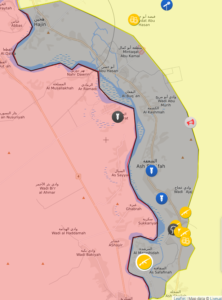
I’ve needed to write this for a few weeks, but the torrent of election news and general busyness kept me from it. Instead of gradually being crushed as I (and most observers) expected, an Islamic State counterattack against Syrian Democratic Forces has actually expanded the Hajin pocket:
A sandstorm settled on areas of the Syria-Iraq border over the last week. It turned the air into a reddish soup, where people could not see more than a few meters in front of their faces. Through the haze and dust, Islamic State launched a coordinated counter-attack along a front line near the Euphrates in an area known as the Hajin pocket. This is the last area that ISIS holds in Syria; the US-led coalition and its Syrian Democratic Forces partners have been seeking to defeat ISIS in Hajin for the last two months.
On October 29, the SDF sent special forces to bolster the front line, according to a spokesman for the coalition. “The SDF is engaged in a difficult battle and fighting bravely to protect and free their people from ISIS. We salute the martyred SDF heroes as the intense fight against evil continues,” the spokesman wrote. More than a dozen SDF fighters were killed in the clashes; the Syrian Observatory for Human Rights said up to 40 had been killed.
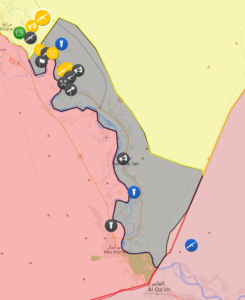
This is what the Hajin pocket looked like back when the Islamic State started their counterattack back on October 15:
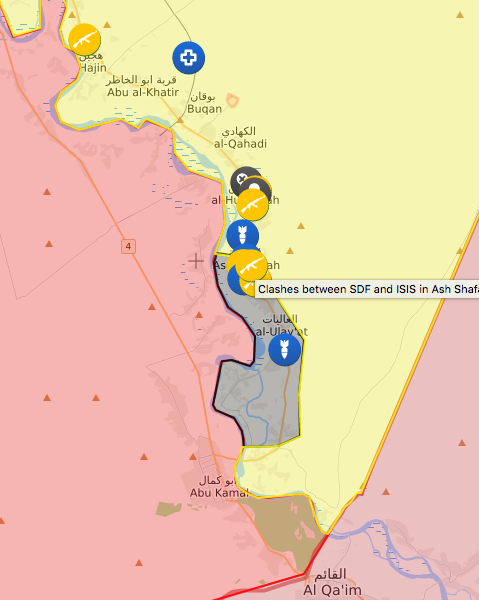
The Islamic State has retaken areas to the north and south and expanded the southernmost portions east to the Iraqi border. There U.S. troops are supporting Iraqi troops fighting the Islamic State.
The biggest question is how the Islamic State pocket in Hajin continues to get resupplied with men and material despite theoretically being surrounded on all sides.
Saudi Arabia and the UAE have sent military forces to areas controlled by the Kurdish YPG group in north-east Syria, Turkey’s Yenisafak newspaper reported.
The paper said the forces will be stationed with US-led coalition troops and will support its tasks with huge military enforcements as well as heavy and light weapons.
Quoting the Syrian Observatory for Human Rights, the newspaper reported that a convoy of troops belonging to an Arab Gulf state recently arrived in the contact area between the Kurdish PKK/YPG and Daesh in the Deir Ez-Zor countryside.
All Turkish news on the Syrian conflict should be taken with several grains of salt.
American and Russian forces have clashed a dozen times in Syria — sometimes with exchanges of fire — a U.S. envoy told Russian journalists in a wide-ranging interview this week.
Ambassador James Jeffrey, U.S. Special Representative for Syria Engagement, offered no specifics about the incidents on Wednesday, speaking to the Russian newspaper Kommersant and state-owned news agency RIA Novosti.
Jeffrey had been asked to clarify casualty numbers and details of a February firefight in which U.S. forces reportedly killed up to 200 pro-Syrian regime forces, including Russian mercenaries, who had mounted a failed attack on a base held by the U.S. and its mostly Kurdish local allies near the town of Deir al-Zour. None of the Americans at the outpost — reportedly about 40 — had been killed or injured.
Jeffrey declined to offer specifics on that incident, but said it was not the only such confrontation between Americans and Russians.
“U.S. forces are legitimately in Syria, supporting local forces in the fight against Da’esh and as appropriate — and this has occurred about a dozen times in one or another place in Syria — they exercise the right of self-defense when they feel threatened,” Jeffrey said, using an Arabic term for the Islamic State group. “That’s all we say on that.”
Asked to clarify, he said only that some of the clashes had involved shooting and some had not.
That’s all from Stars and Stripes, so presumably it’s not complete garbage.
The outcome of the investment of the Hajin pocket seemed perfectly clear: As in Raqqa and Mosul, U.S. backed forced would slowly but surely reduce the pocket in grinding urban warfare until all of its Islamic State defenders were dead or captured.
War has a way of throwing wrenches into the gears of things that seem perfectly clear.
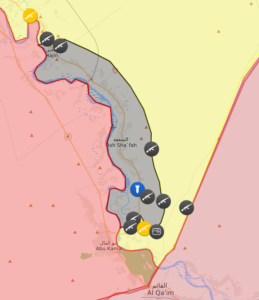
Every black rifle below represents an Islamic State counterattack:
At least some of those positions the Islamic State took seem to have been retaken, but the situation right now is unclear and fluid.
Jerry Pournelle used to say “In war, everything is very simple, but simple things are very difficult.” The Islamic State may be all-but-dead as a territory-holding entity, but it’s not dead dead yet..
There are multiple problems reporting on the ongoing war against the Islamic State. First, the mainstream media hates reporting on any success that might give credit to President Donald Trump. Second, related to the first, none of the national media even seem to have reporters “in theater” where the Syrian Democratic Forces are slowly crushing the life out of the remnants of the Islamic State, and even the international press seems to have curtailed their coverage in the last few months. Third, everything seems to have three or four different names (Baghuz vs. al-Baghuz vs. al-Baghuz Fawqani, etc.), depending on the Arabic transliteration method used. Fourth, the war has reached the stage of “SDF has taken [village you’ve never heard of] from the Islamic State, has met stiff resistance in [another village you’ve never heard of], while also moving into [still a third village you’ve never heard of].”
As of now, the SDF has taken al-Baghuz Fawqani, has met stiff resistance in Marashidah, and moved into the town of Sosah. Those lie (respectively) south-to-north in the Haijin pocket along the Euphrates just north of the Syrian-Iraqi border, in Deir ez-Zor province.
Here’s an SDF video on the investment of Sosah, AKA Sousse, which shows footage of the SDF combat bulldozers that have evidently played a key roll in the fight.
More video showing the liberation of Al-Shajla, a small village between Baghuz and Sosah:
The general plan seems to be to roll up the pocket south-to north supported by coalition artillery and air support.
Earlier combat footage:
Expect more grinding combat in tiny villages you never heard of as the last Islamic State pocket in Syria is slowly, methodically destroyed.
After months of preparation, and while the world’s attention (such little of it that can still be focused on Syria) focused on Idlib in NW Syria, Syria Democratic Forces finally launched their much anticipated final push against the Islamic State’s Hajin pocket in SE Syria.
The final phase of the assault to capture the remaining Islamic State-held territory in eastern Syria has begun, according to the U.S.-led Coalition and Syrian Democratic Forces, its main partner on the ground in Deir Ezzor.
“The last phase of Operation Roundup kicks off soon with the Syrian Democratic Forces leading the way in the Lower Euphrates River Valley to destroy the final remnants of ISIS,” Colonel Sean Ryan, spokesperson for Operation Inherent Resolve, told The Defense Post on Monday, September 10.
“The Iraqi Security Forces have supported the SDF’s maneuver by establishing blocking positions along the southeast portion of the Iraqi-Syrian border and conducting precision strikes against ISIS targets.”
An SDF source told The Defense Post that an official announcement was imminent.
Earlier, AFP reported that the Coalition-backed Syrian Democratic Forces launched a fierce assault against the pocket of territory held by ISIS around Hajin in eastern Deir Ezzor province, citing an SDF commander.
An SDF commander said the assault, relying heavily on artillery and U.S.-led Coalition air strikes, had killed at least 15 ISIS fighters.
“Our forces today began attacking the last bastions of Daesh in Hajin, with intense artillery and air support,” said the SDF commander.
he US-backed Syrian Democratic Forces (SDF) captured 27 positions around the villages of al-Baghuz Fawqani and al-Kasrah, on the eastern bank of the Euphrates River, during the last 48 hours, the SDF’s media center reported on September 12.
According to the media center, US-backed forces killed 41 ISIS fighters and destroyed several artillery pieces and bulldozers. Furthermore, US-led coalition warplanes conducted 10 airstrikes on positions of the terrorist group in al-Baghuz Fawqani and al-Kasrah.
#Hajin#Syria: Fight to Retake Last ISIS Territory Begins: One senior SDF official estimates the battle will last two to three months https://t.co/18FRGITTIy
Hopefully this will be the final push to eliminate the last Islamic State-held Syrian territory east of the Euphrates, though there have been previous operations that looked to do exactly that. The biggest difference is that the SDF has now cleared the big remaining Islamic State pocket along the Iraq/Syria border. That means that all their forces in theater (as well as coalition aircraft and Iraqi artillery) can concentrate on eliminating the Hajin pocket. Despite all that concentrated firepower, expect urban warfare to be as grinding and bloody as it was in Raqqa and Mosul, albeit it in a much smaller area…
In June 1996 — after the staffer had begun working for Feinstein — the FBI detected that the Chinese government was attempting to seek favor with the senator, who at the time sat on the East Asian and Pacific affairs subcommittee of the Foreign Relations Committee, which oversees US-China relations. Investigators warned her in a classified briefing that Beijing might try to influence her through illegal campaign contributions laundered through front corporations and other cutouts.
The warning proved prescient.
One Chinese bagman, Nanping-born John Huang, showed up at Feinstein’s San Francisco home for a fundraising dinner with a Beijing official tied to the People’s Bank of China and the Communist Party Committee. As a foreign national, the official wasn’t legally qualified to make the $50,000-a-plate donation to dine at the banquet.
After a Justice Department task force investigated widespread illegal fundraising during the 1996 Clinton re-election campaign, Feinstein returned more than $12,000 in contributions from donors associated with Huang, who was later convicted of campaign-finance fraud along with other Beijing bagmen. The DNC and the Clinton campaign had to return millions in ill-gotten cash.
Still, Beijing got its favored trade status extended — thanks in part to Feinstein. In speeches on the Senate floor and newspaper op-eds, she shamelessly spun China’s human-rights violations, as when in 1997 she compared Beijing’s 1989 massacre of hundreds of young demonstrators to the 1970 Kent State shootings, calling for the presidents of China and America to appoint a human-rights commission “charting the evolution of human rights in both countries over the last 20 to 30 years,” that “would point out the successes and failures — both Tiananmen Square and Kent State — and make recommendations for goals for the future.”
Feinstein also led efforts to bring China into the World Trade Organization in 1999, which gave Beijing permanent normal trade relations status and removed the annual congressional review of its human-rights and weapons-proliferation records.
Feinstein, still among the Senate’s most influential China doves, travels to China each year. Joining her on those trips is her mega-millionaire investor husband, Richard C. Blum, who has seemingly benefited greatly from the relationship.
Starting in 1996, as China was aggressively currying favor with his wife, Blum was able to take large stakes in Chinese state-run steel and food companies, and has brokered over $100 million in deals in China since then — with the help of partners who sit on the boards of Chinese military front companies like COSCO and CITIC.
China investments have helped make Feinstein, who lives in a $17 million mansion in San Francisco and keeps a $5 million vacation home in Hawaii, one of the richest members in Congress.
Academic dogma postulates that white people cannot be the victims of racism, and such banal white demonization has now seeped into the larger liberal commentariat. With that bias comes the notion that one can smear the white working classes with impunity. Caputo, however, was not brave or stupid enough to visit a Trump rally and to suggest to the crowd around him to get to a Clear Smile clinic.
If you are a non-white purveyor of such prejudice, venom like Jeong’s is contextualized through the lens of compensatory historical grievances. Someone’s grandfather mistreated your grandmother, so you can invert and then replay the roles with impunity. Or less charitably, life’s disappointments are always due to past cosmic injustice, not one’s own perceived tragic shortcomings or bad luck or just cruel fate.
If you are an elite white liberal, you are a twofer: virtue signaling your identity politics bona fides, while psychologically squaring the circle of your own privilege. Those who ridicule less fortunate white others for their supposed racial privilege—themselves often the products of old boy networks, elite upbringings, inherited perks, prep schools and parental leveraging—end up as the privileged smearing the non-privileged for their privilege.
Jeong is a Harvard Law graduate. Strzok has a master’s degree from Georgetown. The ridicule of the white working class by NeverTrump conservative pundits is read on the pages of the nation’s premier newspapers or voiced in hallowed symposia.
Is such ignorance of an entire class because of, or in spite of such, elite training?
Snip.
“In answer to the now hackneyed question, who or what created Trump? All these purveyors of class and racial prejudice need only look in the mirror.”
That “Democratic Socialist wave” crested and broke-up before it ever hit the shore: Just about all Bernie bros go down in Democratic primary defeats. “Rather than demonstrate that his movement has a broad reach across the electorate, Sanders has instead demonstrated that’s a fringe movement even within the Democratic Party.” (Hat tip: Director Blue.)
It is because the left, while it currently seems ascendant in our houses of culture and art, has in fact entered its decadent late phase, and it is deeply vulnerable. The left is afraid not of Peterson, but of the ideas he promotes, which are completely inconsistent with identity politics of any kind. When the poetry editors of The Nation virtuously publish an amateurish but super-woke poem, only to discover that the poem stumbled across several trip wires of political correctness; when these editors (one of them a full professor in the Harvard English department) then jointly write a letter oozing bathos and career anxiety and begging forgiveness from their critics; when the poet himself publishes a statement of his own—a missive falling somewhere between an apology, a Hail Mary pass, and a suicide note; and when all of this is accepted in the houses of the holy as one of the regrettable but minor incidents that take place along the path toward greater justice, something is dying.
When the top man at The New York Times publishes a sober statement about a meeting he had with the president in which he describes instructing Trump about the problem of his “deeply troubling anti-press rhetoric,” and then three days later the paper announces that it has hired a writer who has tweeted about her hatred of white people, of Republicans, of cops, of the president, of the need to stop certain female writers and journalists from “existing,” and when this new hire will not be a beat reporter, but will sit on the paper’s editorial board—having a hand in shaping the opinions the paper presents to the world—then it is no mystery that a parallel culture of ideas has emerged to replace a corrupted system. When even Barack Obama, the poet laureate of identity politics, is moved to issue a message to the faithful, hinting that that they could be tipping their hand on all of this—saying during a speech he delivered in South Africa that a culture is at a dead end when it decides someone has no “standing to speak” if he is a white man—and when even this mayday is ignored, the doomsday clock ticks ever closer to the end.
In the midst of this death rattle has come a group of thinkers, Peterson foremost among them, offering an alternative means of understanding the world to a very large group of people who have been starved for one. His audience is huge and ever more diverse, but a significant number of his fans are white men. The automatic assumption of the left is that this is therefore a red-pilled army, but the opposite is true. The alt-right venerates identity politics just as fervently as the left, as the title of a recent essay reproduced on the alt-right website Counter-Currents reveals: “Jordan Peterson’s Rejection of Identity Politics Allows White Ethnocide.”
If you think that a backlash to the kind of philosophy that resulted in The Nation’s poetry implosion; the Times’ hire; and Obama’s distress call isn’t at least partly responsible for the election of Donald Trump, you’re dreaming. And if you think the only kind of people who would reject such madness are Republicans, you are similarly deluded. All across the country, there are people as repelled by the current White House as they are by the countless and increasingly baroque expressions of identity politics that dominate so much of the culture. These are people who aren’t looking for an ideology; they are looking for ideas. And many of them are getting much better at discerning the good from the bad. The Democratic Party reviles them at its peril; the Republican Party takes them for granted in folly.
The global influence of Europe continues to wane, at least as defined by demographic robustness, technological innovation, the quality of higher education, and the ability to defend its interests. Its aristocratic elite classes are currently under constant challenge from populist reformers. And 73 years of peace have been hard on Europe, in the sense that the postmodern European cultural ideal is to avoid childbearing, most religion, and national defense.
Snip.
Europe continues to believe that the “Palestinian issue” is key to “peace” in the Middle East — a euphemism for distancing itself from Israel. In truth, the Middle East is undergoing the greatest revolution since the end of colonialism. The worries about Arab security are not the tardiness of Palestinian statehood but the existential threats emanating from theocratic Shiite Iran and the neo-Ottomanism of Recep Tayyip Erdogan’s Turkey. In that sense, a conventionally strong and nuclear Israel is for now allied with an Arab world at odds with both Tehran and Ankara, and is likely in any major war to be on the side of an Egypt or Saudi Arabia. Yet for Europe, the Palestinians are the rusty key to peace, even as the latter are increasingly under suspicion by Arab nations as pro-Hezbollah and pro-Iranian.
Europe for now is on the wrong side of the energy revolution, perhaps best epitomized by the near-suicidal green policies of Germany. As it dismantles coal and nuclear plants, Angela Merkel’s government finds its subsidized wind and solar projects utterly incapable of meeting Germany’s competitive industrial needs. The result will likely be a continual and massive importation of natural gas, increasingly from NATO’s supposed archenemy, Vladimir Putin’s Russia. The dream of hydraulic fracturing of shale gas throughout Europe is now largely dead and buried by opposition from radical environmental groups. The result is not a self-sufficient Europe enjoying renewable energy but a continent increasingly dependent for its mounting conventional energy needs on costly imports, with resulting energy costs that are making it uncompetitive with North American industries. Again, the contrast with the United States is telling: The latter went from foreordained, “peak oil” fossil-fuel dependence to becoming the largest oil, gas, and coal producer in the world.
One symptom of European demographic decline, multiculturalism, and military impotence is massive illegal immigration from the Middle East and North Africa. The ensuing crisis of large unassimilated populations is said to be analogous to the influxes of illegal immigrants into the United States from Central America and Mexico. But there are key differences. As an immigrant nation without a hereditary aristocracy, the melting pot of the United States even in postmodern times has far better integrated, assimilated, and intermarried newcomers. Illegal immigrants to the United States are largely Catholic; challenges to assimilation are national, ethnic, and linguistic but not additionally religious as in Europe. Congressional and presidential policy reflects a majority opinion in the United States that now supports secure borders and measured, legal, meritocratic immigration. In Europe, official immigration policy is still at odds with voters.
Woman who was the daughter and granddaughter of women who used men simply as sperm donors wonders why men are suspicious of her. Also, from the comments: “What the writer only lets on, deep into the article, is that she was raised in a lesbian commune.”
This sign was on the door of a restaurant in Kansas. Me and my clients went in and enjoyed a very nice steak dinner. No one was harassed, asked to leave, or in fear for their lives. And I expect 80% of us were carrying. It’s become a regular stop because it is a safe space pic.twitter.com/3bRtPGQvxn
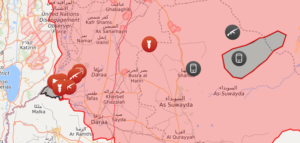
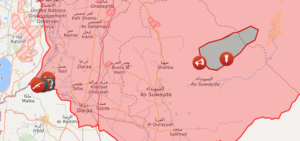
The Syrian regime’s army and its allies have taken full control of the Yarmouk Basin in southwestern Syria after routing Daesh, the Hezbollah group’s Al Manar TV said on Tuesday.
The basin borders Israel and Jordan and had been the last embattled pocket of the southwest after a sustained advance by President Bashar Al Assad’s forces into the longtime rebel stronghold.
The Iranian-backed Hezbollah has fought alongside Al Assad’s forces as he has turned the tide of the civil war against rebels and militants with the help of Russian air power since 2015.
The regime’s army seized Daesh’s main redoubt in the town of Shajara on Monday, which left just a few villages in the hands of an Daesh-affiliated faction, the Khalid Ibn Al Walid army, that had controlled the Yarmouk Basin.
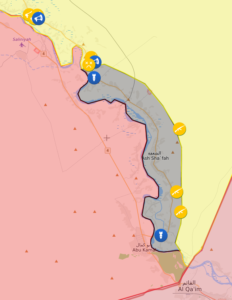
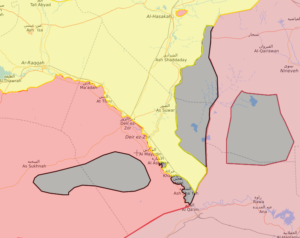
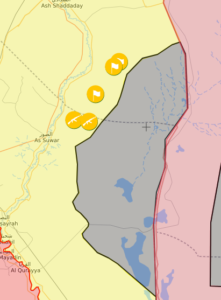
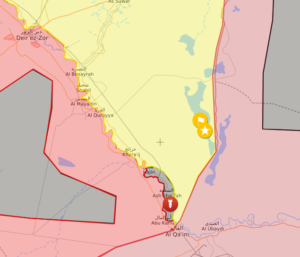
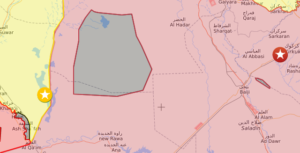
The ongoing destruction of what remains of the Islamic State in Iraq and Syria is more of a process than a series of discrete battles at this point. A story I’ve been watching develop the last few weeks has finally achieved fruition: The complete elimination of the large, thinly-populated Islamic State enclave in eastern Syria along the Iraqi border.
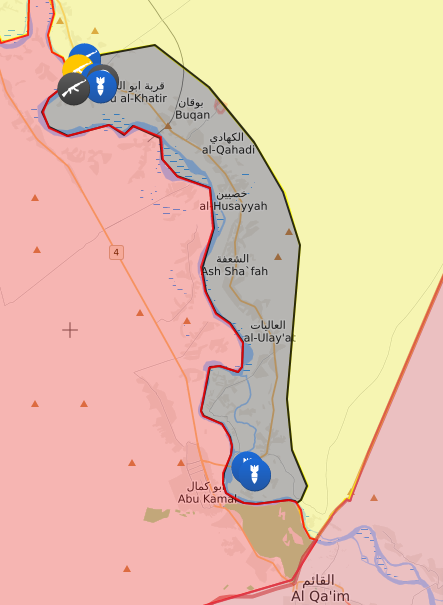
This was the situation at the start of Operation Jazerra Storm:
Here it was two weeks ago:
A tweet featuring a map of the operation a few days ago:
(And yes, those blue areas near the Syria-Iraq border on the Livemap are salt plains, not bodies of water.)
Now the pocket has been completely cleared:
The hard nut of the Hajin pocket has yet to be cracked, but that should be next on the SDF list, since the the Islamic State has been completely driven from the rest of Syria east of the Euphrates.
The US-backed Syrian Democratic Forces (SDF) are holding talks with the government in Damascus for the first time on the future of huge swathes of northern Syria under their control.
The Kurdish-majority SDF, founded with the help of the US to fight Islamic State of Iraq and the Levant (Isil) in northeastern Syria, now controls almost a third of the country and is looking to negotiate a political deal to preserve its autonomy.
“We are working towards a settlement for northern Syria,” said Riad Darar, the Arab co-chair of the Syrian Democratic Council, the SDF’s political wing.
“We hope that the discussions on the situation in the north will be positive,” Mr Darar said, adding that they were being held “without preconditions”.
The SDF now controls 27 per cent of the country, accord to the UK-based monitor Syrian Observatory for Human Rights, having seized Raqqa and much of the eastern province of Deir Ezzor from Isil militants with the help of US airpower.
The Kurds have used the cover of the Syrian war to carve out a semi-autonomous enclave in the northeast of the country, which it calls “Rojava”.
Rojava is also known as the Democratic Federation of Northern Syria.
This is a very interesting development: “Political wing of SDF to open offices in Latakia, Damascus, Hama, Homs.” The caveat here is that it comes from Al Masdar News, a notoriously pro-Assad outlet, and that I haven’t seen it anywhere else.
At the other end of Syria, Assad’s forces are methodically destroying the Islamic State pocket in the Yarmouk Basin (again the Al Masdar News caveat, but they have the most recent story on the fighting), hard against the Golan Heights and the Jordanian border.
The Yarmouk Basin pocket is one of three pockets of Islamic State control west of the Euphrates. There’s another large, sparsely populated pocket northeast of there, where the Islamic State is active enough to still commit atrocities, and the large, sparsely-populated pocket immediately to the west of Deir ez-Zor.
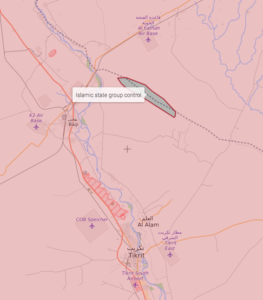
Likewise in Iraq, there are only two pockets of Islamic State control left: A large, sparsely-populated area east of the Syrian border in northwest Iraq, and a tiny sliver of land between Tikrit and Al Fatah Air Base.
That little sliver has been static for months, with no fighting indicated, so it may just be a map artifact, or an area no one has been able to verify if it’s liberated or not. Keep in mind that the Iraqi government declared that the Islamic State was defeated in Iraq back in December, but counterinsurgencies tend to take time. Espicially counterinsurgencies against Islamic terrorists. It took 14 years to end the original Moro insurgency in the Philippines, and some would argue that it was never entirely eradicated…