Or to put it another way, everything in the Middle East is blowing up slightly more than usual:
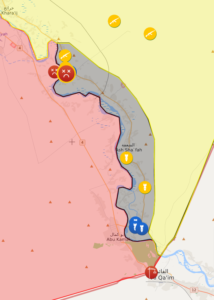
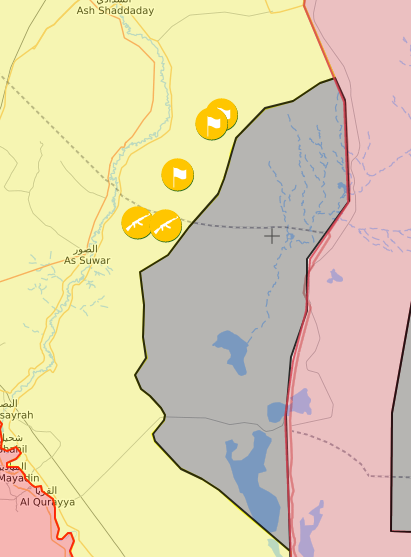
Or to put it another way, everything in the Middle East is blowing up slightly more than usual:
After Deir Ez-Zor fell in early November of 2017, it looked like the war against the Islamic State in its own, self-professed caliphate was all but over.
But then a funny thing happened. That theater of the war seemed to go into a sort of hibernation as other theaters in Syria (the Turkish incursion, the continued war in western Syria, and recently Israel bombing Iranian positions) heated up. That left several disjointed enclvaes of Islamic State control. Here’s what things looked like in at the end of 2017:
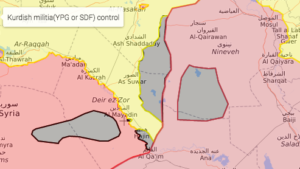
Notice that little Islamic State pocket along the Euphrates southeast of Deir ez-Zor running from Hajin to Abu Kamal on the Iraqi border. One of the great mysteries of the war is why that enclave wasn’t crushed following the fall of Deir Ez-Zor. Instead, it remained there, largely unchanged, for half a year.
That finally appears to be changing.
In operation called #JazeeraStorm (I’m also seeing #CizireStorm), the Syrian Democratic Forces have finally launched an offensive aimed at crushing that pocket.
Here’s a tweet with a very useful map:
The #JazeeraStorm operation aims at clearing the ISIS pocket in the northeast of Syria near Deir Ezzor. Syrian Democratic Forces are leading the charge under the cover of Coalition and Iraqi jets. The fight will be hard, but all struggles against tyranny are. Map via @Gargaristan pic.twitter.com/ZehICEla70
— Anthony Avice Du Buisson ♔ (@StoicViper) May 9, 2018
Today the village of Baqhous, directly on the Iraqi border, was captured, meaning the SDF have successfully pushed to the Euphrates there and are cooperating with Iraqi army troops to secure the border.
#Syria #CizireStorm#YPG and #Iraq|i soldiers together along Iraq-Syria border in order to accelerate the deafeat of #Isis. pic.twitter.com/IYFyVvxkFb
— Mr. Revinsky (@MrKyruer) May 12, 2018
Here’s a map of what the pocket looks like now:
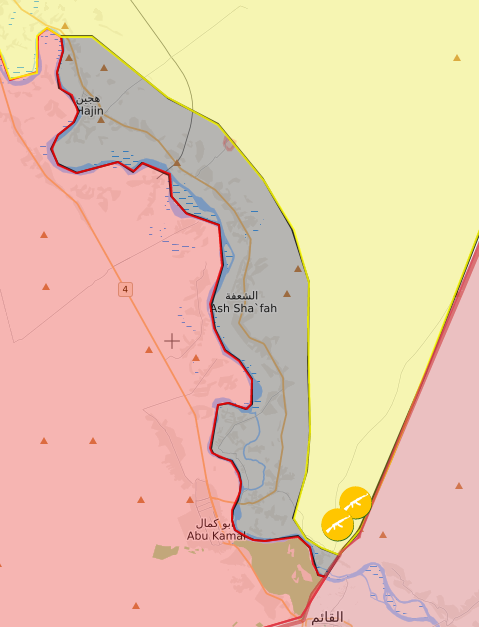
It’s possible that Islamic State leader Abu Bakr al-Baghdadi may be hiding in the Euphrates pocket. Given how elusive al-Baghdadi has been in previous phases of the war, I’ll believe it when we announce his capture.
Following several weeks of Israel hitting (primarily Iranian) targets inside Syria, Syria (and Iran) struck back, firing missiles (reportedly from Iranian Quds forces) at Israeli positions on the Golan Heights, while Israel responded by stepping up missile and aircraft strikes, and launched an artillery barrage against Hezbollah forces just inside Syria.
What all did Israel hit?
An IDF statement said fighter jets had struck “dozens of military targets” belonging to Iran inside Syria. They included:
Intelligence sites associated with Iran and the “Radical Axis” – a term Israeli officials use to refer to an alliance between Iran, Syria, Lebanon’s Hezbollah movement and Palestinian militant groups such as Hamas A logistics headquarters belonging to the Quds Force A military logistics compound in Kiswah, a town south of Damascus An Iranian military compound north of Damascus Quds Force munition storage warehouses at Damascus International Airport Intelligence systems and posts associated with the Quds Force Observation and military posts and munition in the Golan demilitarised zone The Iranian launcher from which the rockets were fired overnight .
The IDF said it had also targeted several Syrian military air defence systems after they fired at the Israeli fighter jets despite an Israeli “warning”.
Meanwhile, Iran’s missile attack was reportedly a massive failure. “Four of its missiles were intercepted by the Iron Dome defense system and the rest fell in Syrian territory.”
Let’s get the obligatory meme out of the way:
How real remains to be seen. It’s not remotely 1947, 1967, or 1973 real, or even Lebanon 2006 real. It’s probably more real right now than Bekaa Valley 1982 real, which was plenty real enough.
So, I dunno. A three, maybe?
Livemap shows the activity in the theater:
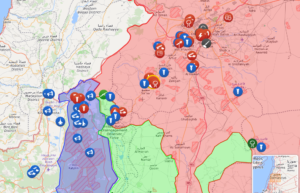
So what happens now? Does the situation escalate or deescalate? I suspect deescalate, mainly because Israel may have run out of Iranian targets in Syria to bomb…
Yesterday wasn’t a good day for the mullahs.
First President Donald Trump withdraws from the United States from Obama’s asinine “Iran Deal”:
resident Trump’s withdrawal from the Iran nuclear deal is the greatest boost for American and global security in decades.
If you think that is an exaggeration, then you evidently think the Obama administration’s injection of well over a hundred billion dollars — some of it in the form of cash bribes — into the coffers of the world’s leading state sponsor of anti-American terrorism was either trivial or, more delusionally, a master-stroke of statecraft.
Of course, there’s a lot of delusion going around. After repeatedly vowing to prevent Iran from obtaining nuclear weapons (with signature “If you like your health insurance, you can keep your health insurance” candor), President Obama, and his trusty factotum John Kerry, made an agreement that guaranteed Iran would obtain a nuclear weapon.
They rationalized this dereliction with the nostrum that an unverifiable delay in nuclear-weapons development, coupled with Iran’s coup in reestablishing lucrative international trade relations, would tame the revolutionary jihadist regime, such that it would be a responsible government by the time the delay ended. Meantime, we would exercise an oh-so-sophisticated brand of “strategic patience” as the mullahs continued abetting terrorism, mass-murdering Syrians, menacing other neighbors, evolving ballistic missiles, crushing domestic dissent, and provoking American military forces — even abducting our sailors on the high seas.
And, of course, the most risible self-deception of all: The only alternative to this capitulation was war.
In point of fact, war was not the alternative to the Joint Comprehensive Plan of Action. War was the result of the JCPOA.
Obama said the mullahs would use the windfall to rebuild their country (while Kerry grudgingly confessed that a slice would still be diverted to the jihad). Instead, billions of dollars poured into Iran by Obama’s deal promptly poured out to Syria, where it funded both sides of the war. Cash flowed to the Taliban, where it funded the war on the American-backed government. It flowed to Hamas and Hezbollah for the war on Israel. It flowed to Yemen, funding a proxy war against Saudi Arabia.
The JCPOA made Iran better at war than it has ever been — and that’s saying something.
The challenge of Iran has never been the specter of nukes. The challenge is the jihadist regime. But the JCPOA was a lifeline to a regime whose zeal to acquire mass-destruction weapons betrays its fear of internal revolt. The regime came to the bargaining table knowing Obama could be rolled, but it was driven to the table by a global economic-sanctions framework, principally constructed by the U.S. Congress. The sanctions choked the pariah regime, providing the great mass of Iranian dissenters with hope that their tormentors could be overthrown — hope that Obama had dashed in 2009, when he turned a deaf ear as the regime brutalized protesters.
The JCPOA empowered the totalitarians. Trump’s exit squeezes them.
The deal was a farce that literally obligated the United States not merely to accede to Iran’s enrichment of uranium but to help protect Iran’s nuclear facilities. (See JCPOA Article 10, Annex III, Sec. 10 (“Nuclear Security”): obliging the U.S. to help strengthen Iran’s ability to “prevent, protect and respond to nuclear security threats to nuclear facilities,” including “sabotage.”) As I’ve previously outlined, every time the president recertified the deal, as federal law required, he had to make two representations, neither of which was ever true: (a) that Iran was “transparently, verifiably, and fully implementing the agreement,” and (b) that continuing the JCPOA was “vital to the national security interests of the United States.” The Obama administration spared Iran from revealing the history of its nuclear program, which would have been necessary to establish a baseline for compliance purposes; it cut side deals — concealed from Congress — that made verification procedures an impenetrable private arrangement between Iran and the U.N.’s International Atomic Energy Agency; and it agreed to limits on what IAEA was allowed to report about Iranian violations.
There was plenty of coverage of that yesterday, with the Obamanations shaking their tiny fists at their “achievements” being undone, and the parliament of the Islamic Public of Iran chanting “Death to America” and burning an American flag, which is pretty much their go-to move for anything.
Second, in a story not nearly as well-reported, Israel once again hit Iranian targets in Syria, this time around Damascus.
Here’s video of the aftermath:
(At this point the armies of the world should be asking themselves exactly what good are Russian air defense systems, since they certainly don’t seem to be capable of detecting or shooting down Israeli planes or missiles…)
All of Iran’s recent gains in regional influence and power have come on the heels of a vacuum in American leadership, the foolish lifting of sanctions, and Obama airlifting the mullahs pallets of cash. Those days are over,
Another weekend, another Israeli strike on Syria. This time the result was that something huge blew up:
Syrian military positions in the province of Hama and Aleppo were targeted Sunday by a series of strikes that caused an explosion reportedly strong enough to trigger an earthquake observed by neighboring countries.
Citing an unnamed military source, the official Syrian Arab News Agency reported that military positions in villages of Hama and Aleppo were hit by a still unidentified rocket attack at around 10:30 p.m. local time (3:30 p.m. EDT), causing loud explosions. Al Jazeera said one of its correspondants confirmed explosions at a Syrian military base at Al-Bahouth mountain in southern Hama.
Bassam Jaara, a supporter of the Syrian opposition, shared to social media pictures of what appeared to be flames and smoke rising from the Syrian countryside, saying “a large number” of casualties were incurred by an attack on what was believed to be an Iranian military position at “mountain 47” in southern Hama.
It appears that the strike targeted Iranian surface-to-surface missiles. The resulting explosion measured 2.6 on the Richter scale.
And here’s video of the explosion:
Here’s another video. The quality is fairly crappy, but you can see the secondary explosions the main explosion set off, suggesting that whatever the Israelis hit was filled with munitions:
It’s got to be frustrating to be the Islamic Republic of Iran. You spend all that time and effort schlepping massive amounts of ordinance into Syria, only to see Israel blow it all up with ease.
And once again Russian air defense systems were as good at keeping Israel out of Syria’s airspace as Jerry Seinfeld’s door was at keeping Kramer out of his apartment…
Finished my taxes! Now I need to go back and do all the stuff I let slide while I was doing my taxes…
The attack on April 13th went up against a 21st-century Russian superweapon–the S-400 Triumf air-defense system, a mobile state-of-the-art anti-aircraft and missile network featuring four distinct missile types targeting aircraft in any performance envelope from treetop level to high altitude – including stealth aircraft (at a range of 150 miles, yet). For a decade we have been assured by military analysts that the S-400 is a game-changer – a system that could rend the heavens in twain and call into question the very concept of air power under battlefield conditions.
And yet, last Friday, the epoch-making Triumf failed to let out so much as a peep as 105 cruise missiles trashed Bashar Assad’s chemical warfare plants. Not a single SAM left the rack while the attack was proceeding. (The Syrians did fire over 40 missiles at nothing, but only after the attack was completed. This is standard behavior among Arab armed forces – the Libyans and Iraqis did the same thing.) The Russians claim to have shot down over 70 of the attacking cruise missiles. How do we know this isn’t true? First, because the targets were utterly destroyed, and second, because the French were involved. If the Russians had shot down any U.S. missiles at all we would be hearing from Paris that American “missiles de croisière” are useless, and that’s why we had to turn to the French, who invented the cruise missile in 1689. (This is scarcely an exaggeration – Emmanuel Macron has gone on record to state that it was he, le président de la France, who persuaded Donald Trump to carry out the strike.)
Some might argue that the new AGM-158 JASSM stealth missile foxed the S-400, but half the missiles launched were actually thirty-year-old BGM-109 Tomahawks, the equivalent of Colt Peacemakers as far as the world of missile development is concerned. If the mighty S-400 can’t shoot down a thirty-year-old missile, what can it do?
Also this: “Russia today is what it always was – a Potemkin village hiding a nation in a state of suspended collapse.” (Hat tip: Ace of Spades HQ.)
Hours after being alerted by KrebsOnSecurity, Facebook last week deleted almost 120 private discussion groups totaling more than 300,000 members who flagrantly promoted a host of illicit activities on the social media network’s platform. The scam groups facilitated a broad spectrum of shady activities, including spamming, wire fraud, account takeovers, phony tax refunds, 419 scams, denial-of-service attack-for-hire services and botnet creation tools. The average age of these groups on Facebook’s platform was two years.
Former presidential candidate Evan McMullin owes his former campaign staff members tens of thousands of dollars and most believe he has no intention of ever paying them, a former campaign worker tells The Daily Caller News Foundation.
Right before McMullin’s failed bid for president in 2016 as the conservative alternative to President Donald Trump, the campaign was inundated with debt. The disastrous fiscal situation was a combination of frivolous spending by McMullin and his campaign manager Joel Searby, according to the former staffer.
McMullin received news weeks before Election Day 2016 about how dire the campaign’s finances were, and he had “no remorse” and said “I have qualms about this thing ending badly in debt,” the former staffer claimed. McMullin’s cavalier attitude towards the campaign’s spending struck many as a surprise, particularly because he billed himself as a fiscal conservative, he added.
The staffer also claims the campaign never paid him somewhere between 12-15 thousand dollars on top of a few thousand dollars in reimbursements. While he has since recovered, he expressed concern about former staffers with “families and children.”
I’ll never forget the first time I went to a steakhouse here. I thought I’d eaten steak before. I was expecting this small, flat circle of meat, maybe a couple of fries on the side. Fine. C’est bon.
So in Texas, steak is a different thing. I’m at this restaurant and they put this plate in front of me, and, well, there was barely any plate visible — all I saw was this was this big, big piece of meat. I look around, maybe I had been mistaken in what I ordered. Maybe this waiter was playing a prank on me. It looked like a whole farm animal in front of me. But everyone with me laughed and nodded and told me that in Texas, this is a steak.
Then I was introduced to these other foods I’d never seen before but were totally amazing. Mac and cheese, man. Guys, you are blessed for having mac and cheese here. It’s a work of art. Bravo, guys.
And that was the first time I thought, O.K. O.K., I think I can get used to this place.
But if he really wants to be “King of Books,” he should know that road runs through me…
In the Southern California's high desert, people are calling 911 for help because of an invasion of tumbleweeds. Read the story: https://t.co/LafXGcRPoz pic.twitter.com/X1KSj0VYdn
— AP West Region (@APWestRegion) April 18, 2018
Colonel demoted, immediately retired from Air National Guard over dinosaur puppet video https://t.co/IXp9yqn2SM pic.twitter.com/HhFdQp2arK
— Air Force Times (@AirForceTimes) April 18, 2018
Seems an overreaction. Let he who has never taken a sacred oath using a dinosaur handpuppet cast the first stone…
Syria has sworn up and down that missiles from the United States, the UK and France only hit peaceful sites of toys for crippled orphans a baby milk factory a cancer research center (no really, that’s their story this time) rather than a chemical weapons facility.
So naturally, they would have no problem with UN inspector’s visiting the site, right?
We all know exactly how that movie turned out:
The international chemical weapons watchdog that sent a fact-finding team to Syria said Monday that Syrian and Russian officials blocked efforts to reach the site where rebels claim government forces unleashed chemical weapons against civilians.
The Organization for the Prohibition of Chemical Weapons (OPCW) said the team arrived in Damascus on Saturday and met with government officials to work out a plan for deployment to Douma.
The Syrian and the Russian officials informed the team that “pending security issues” needed to be worked out before the group went to Douma, the organization’s director general, Ahmet Üzümcü, told an emergency meeting of the group’s executive council in The Hague, Netherlands.
Of.
Course.
Some other Syria strike news:
Israel has hit a wide range of sites, including convoys of Hezbollah or Iranian fighters near the Golan, trucks ferrying missiles and rockets destined for Hezbollah en route to Lebanon, bases for Iranian drones, and an Iranian command-and-control center.
“We are facing now a determined decision by Iran to take advantage of the vacuum in Syria, the coming victory of Assad, and the defeat of ISIS to extend Hezbollah’s stand in Lebanon at the expense of Syrian territory, especially in the Golan Heights,” Amos Gilead, a retired Israeli major general who now heads the Institute for Policy and Strategy in Herzliya, told me. “This is a strategic threat. It’s an intolerable plan. We are trying to preëmpt them and protect Israel.”
President Donald Trump orders U.S. military to attack Syrian chemical weapons sites, in coordination with France and the UK.
Here’s President Trump’s announcement:
I’m on record as stating that the United States has no compelling national interest at stake in Syria after the destruction of the Islamic State. that said, anyone predicting that Russia is willing to risk World War III over Syria is having a case of the vapors.
It’s ironic that President Trump is the one actually enforcing Obama’s foolish “red lines”…
Edited to add: Tweet showing airstrikes in Damascus:
#BREAKING: Airstrikes continue to pound target in #Damascus, Syria.pic.twitter.com/i9yIdYaBKh
— Ryan Saavedra 🇺🇸 (@RealSaavedra) April 14, 2018
In the video it appears to have taken out the power grid.
Somebody hit a Syrian airbase near Homs last night; we’re denying it was us, and both Syria and Russia are pointing the finger at Israel:
The Syrian government and its ally Russia have blamed Israel for a deadly attack on a Syrian military airport.
Monday’s attack hit the Tiyas airbase, known as T4, near the city of Homs. Observers say 14 people were killed.
Israel, which has previously hit Syrian targets, has not commented. Syria initially blamed the US for the strike.
The incident comes amid international alarm over an alleged chemical attack on a Syrian rebel-held town. The US and France had threatened to respond.
US President Donald Trump said there would be a “big price to pay” for the alleged chemical attack in Douma, in the Eastern Ghouta region, near the capital Damascus. He branded Syria’s President Bashar al-Assad an “animal”.
Snip.
Syrian state news agency Sana, quoting a military source, reported that air defences had repelled an Israeli missile attack on T4, saying the missiles were fired by Israeli F15 jets in Lebanese airspace.
If true, these would likely be F-15I Strike Eagles firing Israeli Popeye missiles.
Russia’s defence ministry said that, of eight missiles, five were shot down and three reached the western part of the aerodrome.
I would take any sort of Russian claims about Israel missiles being shot down with several grains of salt. Maybe they were, and maybe they weren’t. Either way, Russian air defense systems have not exactly covered themselves in glory in the Syrian conflict.
Israel rarely acknowledges carrying out strikes, but has admitted attacking targets in Syria dozens of times since 2012. Its heaviest air strike on Syria, in February this year, included targeting the T4 air base.
That followed an incursion by an Iranian drone into Israel and the shooting down by Syrian air defences of an Israeli F16 fighter jet.
Israel has said it will not allow Iran, its arch-foe, to set up bases in Syria or operate from there, something Israel considers a major threat.
The Israeli military said Iran and its Revolutionary Guards had long been active in the T4 base, and were using it to transfer weapons, including to Lebanese Shia militant group Hezbollah, an enemy of Israel.
Israel also hit a Hamas military compound in Gaza.
One interesting aspect to the strike was that all the major new services seemed asleep at the switch while reports of the strike from sources on the ground in Lebanon and Syria went out in real time. So if you want to launch a military strike in the Middle East, Sunday night seems to be the time to do it…