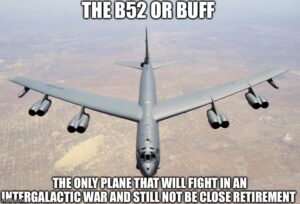
Simon Whistler takes a look at why BUFF is eternal. That longevity is amazing, considering how many times the Air Force tried to cancel the B-52 project before it ever saw the light of day.
“Even though it’s the longest serving strategic bomber in the world with more than 70 years of service behind it, and despite the coming introduction of the brand new B-21 Raider, which will retire both the B-2 Spirit and the B-1B Lancer, the Stratofortress is nowhere near finished. The now ancient airframe was simply built to last. Thanks to its incredible capacity of modifications and upgrades, its impressive range, and its obscene weapons payload, the Stratofortress has outlived a dozen newer and technologically more advanced bombers.”
The plane’s legendary longevity is surprising because “the Air Force tried to cancel it about a dozen times before the first design was ever even drawn.”
“Fun fact that sounds insane today: The number of planes destroyed in World War II is bigger than the number of planes in existence today. German, British, and American bomber losses amounted to almost 40,000 aircraft. And that is only the bombers.”
“The Air Force wanted to replenish the numbers and improve capability because it really needed to be able to deliver the power of the sun to Soviet homes if it ever came down to that. This is where the B-52 Stratofortress came in. In November of 1945, the Air Force submitted a design request for a longrange bomber that could have an operating radius of 5,000 mi or 8,000 km at a speed of 300 mi or 480 km an hour and with a payload capacity of 10,000 lb or 4 1/2 tons.”
“Boeing initially submitted a straight wing design that weighed a fantastic 360,000 pounds or 160 tons, which checked all of the boxes except for the range, which was limited to 3,110 mi or just over 5,000 km. Nevertheless, it was the closest thing to what the Air Force was looking for. So, Boeing won the contract in 1946. Unbeknownst to Boeing, by signing that contract, the company was boarding a roller coaster of rejections and design changes.”
“Firstly, the Air Force didn’t like the size of the bomber. So, Boeing cut it down to 230,000 pounds, or 100 tons, and cut the number of engines from the original six to four. Just two months later, the Air Force said that a cruising speed of 400 m or 640 km an hour was imperative, which prompted Boeing to once again enlarge the design, now returning with a third 300,000 pound, 140 ton model.”
“A month after that, the Air Force was actively looking to give Boeing’s engineers design whiplash when it requested a ridiculous range of 12,000 mi or 19,000 km. This was an insane request at the time because no other bomber in the world could boast that kind of endurance or anything even close to it. The closest rival would only arrive in the mid-1950s in the shape of the Tupalev Tu-95, which is essentially the Soviet equivalent of the Stratofortress. Boeing, unsurprisingly, couldn’t meet such a requirement, but it could deliver a heavy bomber with extended range, one capable of using both conventional and nuclear weapons.”
“By the time Boeing agreed on this with the Air Force, however, it was already 1947 and almost two years had passed since the original request was submitted. The Air Force was now very close to introducing the Convair Peacemaker into its ranks. The general feeling was that if the Stratofortress couldn’t blow the leadership away with its range, it wouldn’t be useful at all, and it would most likely be obsolete and inferior to the Peacemaker before it was ever completed. Boeing was given a six-month grace period to figure out how to improve the Stratofortress, and the company returned with an improved design with an operating radius of 5,000 mi or 8,000 km, notably better than the Peacemakers.”
“Believe it or not, not even that redesign would satisfy the Air Force. While Boeing’s engineers were ripping their hair out, thinking it was all just a very elaborate prank, the Air Force gained independence from the Army and held its first heavy bombardment committee, where it evaluated all its programs. The committee concluded that speed was now as important as range. And the Air Force changed the characteristics for the millionth time, asking for a special purpose bomber with a range of 8,000 mi or almost 13,000 km, and capable of a cruise speed of 500 mi or just over 800 km an hour. The Air Force then tried to cancel Boeing’s contract, something that was only prevented because Boeing’s president personally protested to the Secretary of the Air Force, who caved in and didn’t rip up the contract.”
“Following that, the Air Force looked into alternatives such as a medium-sized bomber that would rely on mid-air refueling or flying wing designs. But it was ultimately decided that these avenues weren’t explored enough and therefore weren’t as reliable as a conventional bomber, extremely begrudgingly and to the disappointment of many within the Air Force. In March of 1948, two and a half years after the initial design request for a heavy bomber and seemingly a billion rejections later, Boeing was finally allowed to move into the second phase of development, which would include design, construction of two prototypes, and testing.”
“With that green light, the Air Force delivered its final set of demands. The gross weight of the bomber would not exceed 280,000 lb or 127 tons. The bomber should have a range of 6,900 mi or 11,000 km. and it should be able to carry 10,000 pounds of bombs*. Little did they know that the Stratofortress would not only fulfill but exceed all of those requirements.”
“The biggest design issue outside of the scope of the range, speed, and will it be made on time conversation was the engines. When the initial design request was first issued in 1945, the instruction was not to use jet engines because their high fuel consumption, much less efficient than that of modern jet engines, would limit the bombers’s range dramatically. However, since the Air Force decided to play ping pong with Boeing’s designs for almost 3 years, the technology had matured by 1948, and the thinking was now different. The Air Force asked Boeing’s engineers, who had submitted their last design without even thinking about jet engines, to now find a way to fit jet engines into their design.”
“The decision to use turbo jet engines and the process of figuring out how to fit them aboard happened over a weekend. Boeing’s representatives and engineers met with the Air Force’s representatives on Thursday, October the 21st, 1948 to hold one last meeting and agree on some specifications surrounding the Stratofortress when the Air Force dropped the turbo jet bomb on them. Boeing’s representatives retired to a hotel room for the weekend, and by Monday, they had a brand new bomber model and a 33-page report on the use of turbo jet engines. This would seal the B-52’s fate, as the report convinced the Air Force to greenlight the use of jet engines. The very first Stratofortress would have eight Pratt and Whitney J57 turbo jet engines propelling them forward. The first iteration of these engines, the J57P1W, provided the Stratofortress with 10,000 lb force each for a total of 80,000 lb force or 392 tons.”
“Aside from just powering the Stratofortress, the engines act as wing fences. Wing fences are objects fixed on the leading edge of wings, usually seen on swept wing aircraft such as the Stratofortress, which act as devices to prevent stall-related issues.”
” Aside from acting as wing fences, it was believed that the new jet engines could improve altitude and speed performance, eliminate some unresolved issues with propeller aerodynamics and control, and likely extend the Stratofortress’s operational life. And that last part, as it turns out, was right on the money, wasn’t it?”
“In 1949, it seemed like eight turbo jet engines would only give the Stratofortress a combat range of about 3100 mi or 5,000 km, which is less than half of what was promised. Because of that, the Air Force’s vice chief of staff, General Fairchild, seriously considered cancelling the program while the first two prototypes were being built. Incredibly, the Air Force was now looking to cancel the Stratofortress for the nth time.”
“Boeing responded with yet another model of the aircraft. This one weighing 390,000 lb and with a range of almost 4,400 mi while promising that with coming upgrades of both the engines and the airframe, it would exceed 4,800 mi or 7,700 km. The Air Force accepted this proposition and this was, believe it or not, the very last attempt at cancelling the Stratofortress.”
Skipping over early production variants.
“When it comes to armament, Stratofortress can be configured for different mission sets. There are cruise missile carriers which can carry 12 missiles, with both conventional and thermonuclear warheads, with Boeing’s AGM86 air launch cruise missile being the go-to weapon of choice during the Stratofortresss’s glory days. Some bombers were modified to carry anti-ship missiles. Others carried air-to-ground missiles while more than 80 of the latest Stratofortress, the H variants, were modified to carry missiles in the bomb bay and release them from a rotary launcher. This is a technology that the USAF has since taken full advantage of and is currently introducing for transport plane.”
“When the last of the older variants was retired in the 1990s, the H variant of the Stratofortress went through a modification program to widen its weapons capabilities by adding modified underwing pylons. The B-52H could also carry anti-ship missiles and new generation weapons such as the JDAM equipped bombs, joint standoff glide bombs, and the joint air-to-surface standoff missile.”
“With time, however, the Stratofortress was removed from the list of aircraft capable of delivering nuclear gravity bombs due to its lack of stealth. In case you hadn’t noticed, it’s a big airplane and it wasn’t exactly built to hide. Gravity bombs require a bomber to penetrate enemy airspace, ideally without being detected, and drop them from above. This would be a suicide mission for a Stratofortress in a modern combat environment, given that it sticks out like a sore thumb. Nevertheless, the Stratofortress is still very valuable because of its payload capacity. Although it can theoretically carry 70,000 or 32 tons of bombs, the realistic total is around 62,000 or 28 tons, which is on par with the B-2 Spirit. The only American bomber that seriously outperforms it is the B-1B Lancer, which can in theory by you, carry a payload of 125,000 pound. This has, however, never happened, as the aircraft would be extremely slow and difficult to maneuver with the Lancer more realistically maxing out at around 75,000 pounds.”
“Older variants carried the .50 caliber M3, but that was later changed for the 20mm M61 Vulcan rotary cannon.”
“A grand total of 744 Stratofortress were produced over the course of no more than 10 years, with the G variant being the most numerous, and only 72 H variant Stratofortress staying in service until this day. The reason they were produced in such huge numbers hides in the bombers’s performance and ease of maintenance.”
Skipping over most of the plane’s operational history, though I was surprised to learn that “15 Stratofortresses were shot down during Operation Linebacker 2” in the Vietnam War.
“During the aforementioned operation, two Stratofortresses were engaged by two MiG-21s which were a gift from the Soviet Union. Both MiGs were shot down by four .50 caliber machine guns located at the tail of the Stratofortresses, which makes the B-52 the largest aircraft to ever accomplish an air-to-air kill.”
“The G&H variants were modified to carry supersonic short-range nuclear missiles which replaced gravity bombs, as they simply weren’t an option any longer due to the aforementioned lack of stealth. This allowed them to attack targets without penetrating behind their defenses.”
“A new electro-optical viewing system was installed to make low altitude operations easier and safer for the pilots, with a new electronic countermeasure system improving the B-52’s self-defense capabilities. As Desert Storm started, B-52Gs flew from Louisiana to Iraq, destroyed around 90% of their targets, and returned home within a 35-hour window, which was the longest combat mission ever flown at the time. The B-52’s role was instrumental in the Gulf War, as it quite literally turned the lights out in Baghdad, and Iraqi troops have on several occasions surrendered after the strike, with the B-52 seen as a bringer of doom.”
“About 40% of all weapons dropped by coalition forces were dropped by American B-52s.”
“Later on, with the fall of the Soviet Union, the H variant would be the only one left standing as the G variant had to be destroyed in accordance with the Strategic Arms Reduction Treaty with a total of 365 remaining B-52s being torn into pieces.”
“The B-52 will stay until at least the 2040s, although many believe that it will reach the 100-year milestone before officially retiring. And now, after all this talk, we get to the core question of this video. How the hell is the Stratofortress, a bomber older than the Cuban Revolution, NASA, and the Civil Rights Movement, not only still in service, but actually about to become more important than ever, as it will be a one of the two bombers in the Air Force’s possession?”
The B-1 and B-2 are being replaced by the B-21 due to the former’s expensive operating costs. “The B-2 is notorious for how difficult it is to keep in its operational state. Its bleeding edge stealth technology is extremely demanding, and it requires environmentally controlled hangers, not to mention a trained team to take care of it all the time. Because of this, it can’t be deployed from forward airfields. And if an upgrade or a fix is needed, you can count on it being out of commission for several months, if not longer. The B-2 requires 60 maintenance hour per 1 hour of flight time, which is why its readiness rate in the early 2000s averaged a mere 30%. The B-52 averaged 80%.”
“The [B-1] Lancer story is similar. The development and production of this bomber was obscenely expensive to start with, and even the newest, most streamlined variants of the B-1B require about 48 maintenance hours per 1 hour of flight time. Not as bad as the B-2, but not much better either. The Lancer is also extremely expensive to operate, as a 12-hour mission sets the American taxpayer back about a million dollars, not including weapons costs. This is, believe it or not, about 14% cheaper than the B-2 flight costs.” Plus early B-1s had reliability issues, like “a cutting-edge radar jammer that, uh, jammed its own radar.”
“The reason the B-52 will survive the initial phase of the Air Force’s bomber fleet modernization is because it too is relatively inexpensive in comparison to its ability. It can carry anything from gravity bombs to hypersonic missiles, which makes the constant upgrades worth it. These upgrades and the fact that the Stratofortress is so modifiable are perhaps the most important reason the legendary bomber is still alive. This is a thread that you can trace all the way back to the beginning of the video and the story of the Stratofortress. Even before the first prototype was built, the B-52 was extremely modifiable, and this flexibility allows it to live on in a modern combat environment.”
“The airframe may be old, yes, but that’s the only old thing about it. Modern B-52s are equipped with modern electronic countermeasure systems and top-of-the-line communications technologies, which transmit and receive data the same way any other modern combat aircraft does. The Stratofortress has weapons capabilities that are also in line with new technology. The modern H variants was upgraded with a 66% increase in weapons payload, and it can carry eight 2,000lb JDAM bombs, cruise missiles, or decoy missiles internally.”
He also mentions the forthcoming engine upgrade, which I covered here. “Once these engines are installed, the new fleet will be designated the B-52J, which means [they are] nowhere close to retirement.”
“More than 700 Stratofortress were built over time, and there are only around 70 in active service today. This means that the Air Force’s engineers have access to a massive boneyard of spare parts, which they can use to keep the active B-52s flying for a very long time.”
The B-52 “has to fill a strategic hole in the Air Force’s plans. The B-21 Raider’s range and payload are incomparable with the B-52 at around 6,500 mi and a payload of around 30,000 lb. Sure, the newer bomber may be equipped with technology that was only imaginable in the realm of science fiction when the first Stratofortress was built, but the B-52 can deploy weapons from a standoff range without needing to penetrate enemy defenses. It can loiter for quite a long time, and it can deliver a massive munitions unimaginable to the new Raider.”
“Of course, with time, the Stratofortress will age out. That’s an inevitable certainty, because time beats everyone. For the foreseeable future though, the longest serving bomber of all time will keep flying because of just how efficient, powerful, modifiable, flexible, and above all enduring the design has proven to be over the last three-quarters of a century.”
*In one of the best transcription errors ever, YouTube’s automatic transcription rendered this as “£10,000 of bonds.”