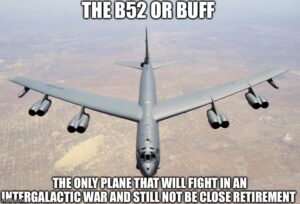
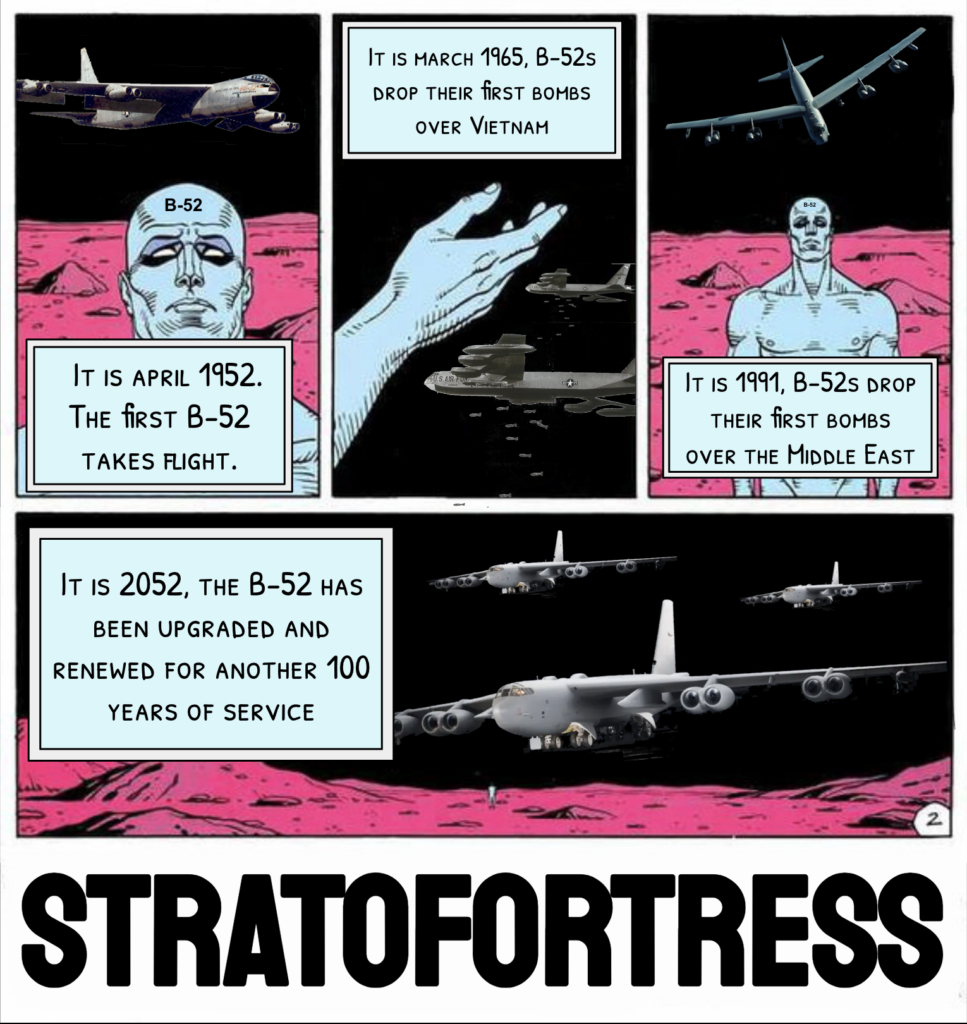
Simon Whistler takes a look at why BUFF is eternal. That longevity is amazing, considering how many times the Air Force tried to cancel the B-52 project before it ever saw the light of day.
“Even though it’s the longest serving strategic bomber in the world with more than 70 years of service behind it, and despite the coming introduction of the brand new B-21 Raider, which will retire both the B-2 Spirit and the B-1B Lancer, the Stratofortress is nowhere near finished. The now ancient airframe was simply built to last. Thanks to its incredible capacity of modifications and upgrades, its impressive range, and its obscene weapons payload, the Stratofortress has outlived a dozen newer and technologically more advanced bombers.”
The plane’s legendary longevity is surprising because “the Air Force tried to cancel it about a dozen times before the first design was ever even drawn.”
“Fun fact that sounds insane today: The number of planes destroyed in World War II is bigger than the number of planes in existence today. German, British, and American bomber losses amounted to almost 40,000 aircraft. And that is only the bombers.”
“The Air Force wanted to replenish the numbers and improve capability because it really needed to be able to deliver the power of the sun to Soviet homes if it ever came down to that. This is where the B-52 Stratofortress came in. In November of 1945, the Air Force submitted a design request for a longrange bomber that could have an operating radius of 5,000 mi or 8,000 km at a speed of 300 mi or 480 km an hour and with a payload capacity of 10,000 lb or 4 1/2 tons.”
“Boeing initially submitted a straight wing design that weighed a fantastic 360,000 pounds or 160 tons, which checked all of the boxes except for the range, which was limited to 3,110 mi or just over 5,000 km. Nevertheless, it was the closest thing to what the Air Force was looking for. So, Boeing won the contract in 1946. Unbeknownst to Boeing, by signing that contract, the company was boarding a roller coaster of rejections and design changes.”
“Firstly, the Air Force didn’t like the size of the bomber. So, Boeing cut it down to 230,000 pounds, or 100 tons, and cut the number of engines from the original six to four. Just two months later, the Air Force said that a cruising speed of 400 m or 640 km an hour was imperative, which prompted Boeing to once again enlarge the design, now returning with a third 300,000 pound, 140 ton model.”
“A month after that, the Air Force was actively looking to give Boeing’s engineers design whiplash when it requested a ridiculous range of 12,000 mi or 19,000 km. This was an insane request at the time because no other bomber in the world could boast that kind of endurance or anything even close to it. The closest rival would only arrive in the mid-1950s in the shape of the Tupalev Tu-95, which is essentially the Soviet equivalent of the Stratofortress. Boeing, unsurprisingly, couldn’t meet such a requirement, but it could deliver a heavy bomber with extended range, one capable of using both conventional and nuclear weapons.”
“By the time Boeing agreed on this with the Air Force, however, it was already 1947 and almost two years had passed since the original request was submitted. The Air Force was now very close to introducing the Convair Peacemaker into its ranks. The general feeling was that if the Stratofortress couldn’t blow the leadership away with its range, it wouldn’t be useful at all, and it would most likely be obsolete and inferior to the Peacemaker before it was ever completed. Boeing was given a six-month grace period to figure out how to improve the Stratofortress, and the company returned with an improved design with an operating radius of 5,000 mi or 8,000 km, notably better than the Peacemakers.”
“Believe it or not, not even that redesign would satisfy the Air Force. While Boeing’s engineers were ripping their hair out, thinking it was all just a very elaborate prank, the Air Force gained independence from the Army and held its first heavy bombardment committee, where it evaluated all its programs. The committee concluded that speed was now as important as range. And the Air Force changed the characteristics for the millionth time, asking for a special purpose bomber with a range of 8,000 mi or almost 13,000 km, and capable of a cruise speed of 500 mi or just over 800 km an hour. The Air Force then tried to cancel Boeing’s contract, something that was only prevented because Boeing’s president personally protested to the Secretary of the Air Force, who caved in and didn’t rip up the contract.”
“Following that, the Air Force looked into alternatives such as a medium-sized bomber that would rely on mid-air refueling or flying wing designs. But it was ultimately decided that these avenues weren’t explored enough and therefore weren’t as reliable as a conventional bomber, extremely begrudgingly and to the disappointment of many within the Air Force. In March of 1948, two and a half years after the initial design request for a heavy bomber and seemingly a billion rejections later, Boeing was finally allowed to move into the second phase of development, which would include design, construction of two prototypes, and testing.”
“With that green light, the Air Force delivered its final set of demands. The gross weight of the bomber would not exceed 280,000 lb or 127 tons. The bomber should have a range of 6,900 mi or 11,000 km. and it should be able to carry 10,000 pounds of bombs*. Little did they know that the Stratofortress would not only fulfill but exceed all of those requirements.”
“The biggest design issue outside of the scope of the range, speed, and will it be made on time conversation was the engines. When the initial design request was first issued in 1945, the instruction was not to use jet engines because their high fuel consumption, much less efficient than that of modern jet engines, would limit the bombers’s range dramatically. However, since the Air Force decided to play ping pong with Boeing’s designs for almost 3 years, the technology had matured by 1948, and the thinking was now different. The Air Force asked Boeing’s engineers, who had submitted their last design without even thinking about jet engines, to now find a way to fit jet engines into their design.”
“The decision to use turbo jet engines and the process of figuring out how to fit them aboard happened over a weekend. Boeing’s representatives and engineers met with the Air Force’s representatives on Thursday, October the 21st, 1948 to hold one last meeting and agree on some specifications surrounding the Stratofortress when the Air Force dropped the turbo jet bomb on them. Boeing’s representatives retired to a hotel room for the weekend, and by Monday, they had a brand new bomber model and a 33-page report on the use of turbo jet engines. This would seal the B-52’s fate, as the report convinced the Air Force to greenlight the use of jet engines. The very first Stratofortress would have eight Pratt and Whitney J57 turbo jet engines propelling them forward. The first iteration of these engines, the J57P1W, provided the Stratofortress with 10,000 lb force each for a total of 80,000 lb force or 392 tons.”
“Aside from just powering the Stratofortress, the engines act as wing fences. Wing fences are objects fixed on the leading edge of wings, usually seen on swept wing aircraft such as the Stratofortress, which act as devices to prevent stall-related issues.”
” Aside from acting as wing fences, it was believed that the new jet engines could improve altitude and speed performance, eliminate some unresolved issues with propeller aerodynamics and control, and likely extend the Stratofortress’s operational life. And that last part, as it turns out, was right on the money, wasn’t it?”
“In 1949, it seemed like eight turbo jet engines would only give the Stratofortress a combat range of about 3100 mi or 5,000 km, which is less than half of what was promised. Because of that, the Air Force’s vice chief of staff, General Fairchild, seriously considered cancelling the program while the first two prototypes were being built. Incredibly, the Air Force was now looking to cancel the Stratofortress for the nth time.”
“Boeing responded with yet another model of the aircraft. This one weighing 390,000 lb and with a range of almost 4,400 mi while promising that with coming upgrades of both the engines and the airframe, it would exceed 4,800 mi or 7,700 km. The Air Force accepted this proposition and this was, believe it or not, the very last attempt at cancelling the Stratofortress.”
Skipping over early production variants.
“When it comes to armament, Stratofortress can be configured for different mission sets. There are cruise missile carriers which can carry 12 missiles, with both conventional and thermonuclear warheads, with Boeing’s AGM86 air launch cruise missile being the go-to weapon of choice during the Stratofortresss’s glory days. Some bombers were modified to carry anti-ship missiles. Others carried air-to-ground missiles while more than 80 of the latest Stratofortress, the H variants, were modified to carry missiles in the bomb bay and release them from a rotary launcher. This is a technology that the USAF has since taken full advantage of and is currently introducing for transport plane.”
“When the last of the older variants was retired in the 1990s, the H variant of the Stratofortress went through a modification program to widen its weapons capabilities by adding modified underwing pylons. The B-52H could also carry anti-ship missiles and new generation weapons such as the JDAM equipped bombs, joint standoff glide bombs, and the joint air-to-surface standoff missile.”
“With time, however, the Stratofortress was removed from the list of aircraft capable of delivering nuclear gravity bombs due to its lack of stealth. In case you hadn’t noticed, it’s a big airplane and it wasn’t exactly built to hide. Gravity bombs require a bomber to penetrate enemy airspace, ideally without being detected, and drop them from above. This would be a suicide mission for a Stratofortress in a modern combat environment, given that it sticks out like a sore thumb. Nevertheless, the Stratofortress is still very valuable because of its payload capacity. Although it can theoretically carry 70,000 or 32 tons of bombs, the realistic total is around 62,000 or 28 tons, which is on par with the B-2 Spirit. The only American bomber that seriously outperforms it is the B-1B Lancer, which can in theory by you, carry a payload of 125,000 pound. This has, however, never happened, as the aircraft would be extremely slow and difficult to maneuver with the Lancer more realistically maxing out at around 75,000 pounds.”
“Older variants carried the .50 caliber M3, but that was later changed for the 20mm M61 Vulcan rotary cannon.”
“A grand total of 744 Stratofortress were produced over the course of no more than 10 years, with the G variant being the most numerous, and only 72 H variant Stratofortress staying in service until this day. The reason they were produced in such huge numbers hides in the bombers’s performance and ease of maintenance.”
Skipping over most of the plane’s operational history, though I was surprised to learn that “15 Stratofortresses were shot down during Operation Linebacker 2” in the Vietnam War.
“During the aforementioned operation, two Stratofortresses were engaged by two MiG-21s which were a gift from the Soviet Union. Both MiGs were shot down by four .50 caliber machine guns located at the tail of the Stratofortresses, which makes the B-52 the largest aircraft to ever accomplish an air-to-air kill.”
“The G&H variants were modified to carry supersonic short-range nuclear missiles which replaced gravity bombs, as they simply weren’t an option any longer due to the aforementioned lack of stealth. This allowed them to attack targets without penetrating behind their defenses.”
“A new electro-optical viewing system was installed to make low altitude operations easier and safer for the pilots, with a new electronic countermeasure system improving the B-52’s self-defense capabilities. As Desert Storm started, B-52Gs flew from Louisiana to Iraq, destroyed around 90% of their targets, and returned home within a 35-hour window, which was the longest combat mission ever flown at the time. The B-52’s role was instrumental in the Gulf War, as it quite literally turned the lights out in Baghdad, and Iraqi troops have on several occasions surrendered after the strike, with the B-52 seen as a bringer of doom.”
“About 40% of all weapons dropped by coalition forces were dropped by American B-52s.”
“Later on, with the fall of the Soviet Union, the H variant would be the only one left standing as the G variant had to be destroyed in accordance with the Strategic Arms Reduction Treaty with a total of 365 remaining B-52s being torn into pieces.”
“The B-52 will stay until at least the 2040s, although many believe that it will reach the 100-year milestone before officially retiring. And now, after all this talk, we get to the core question of this video. How the hell is the Stratofortress, a bomber older than the Cuban Revolution, NASA, and the Civil Rights Movement, not only still in service, but actually about to become more important than ever, as it will be a one of the two bombers in the Air Force’s possession?”
The B-1 and B-2 are being replaced by the B-21 due to the former’s expensive operating costs. “The B-2 is notorious for how difficult it is to keep in its operational state. Its bleeding edge stealth technology is extremely demanding, and it requires environmentally controlled hangers, not to mention a trained team to take care of it all the time. Because of this, it can’t be deployed from forward airfields. And if an upgrade or a fix is needed, you can count on it being out of commission for several months, if not longer. The B-2 requires 60 maintenance hour per 1 hour of flight time, which is why its readiness rate in the early 2000s averaged a mere 30%. The B-52 averaged 80%.”
“The [B-1] Lancer story is similar. The development and production of this bomber was obscenely expensive to start with, and even the newest, most streamlined variants of the B-1B require about 48 maintenance hours per 1 hour of flight time. Not as bad as the B-2, but not much better either. The Lancer is also extremely expensive to operate, as a 12-hour mission sets the American taxpayer back about a million dollars, not including weapons costs. This is, believe it or not, about 14% cheaper than the B-2 flight costs.” Plus early B-1s had reliability issues, like “a cutting-edge radar jammer that, uh, jammed its own radar.”
“The reason the B-52 will survive the initial phase of the Air Force’s bomber fleet modernization is because it too is relatively inexpensive in comparison to its ability. It can carry anything from gravity bombs to hypersonic missiles, which makes the constant upgrades worth it. These upgrades and the fact that the Stratofortress is so modifiable are perhaps the most important reason the legendary bomber is still alive. This is a thread that you can trace all the way back to the beginning of the video and the story of the Stratofortress. Even before the first prototype was built, the B-52 was extremely modifiable, and this flexibility allows it to live on in a modern combat environment.”
“The airframe may be old, yes, but that’s the only old thing about it. Modern B-52s are equipped with modern electronic countermeasure systems and top-of-the-line communications technologies, which transmit and receive data the same way any other modern combat aircraft does. The Stratofortress has weapons capabilities that are also in line with new technology. The modern H variants was upgraded with a 66% increase in weapons payload, and it can carry eight 2,000lb JDAM bombs, cruise missiles, or decoy missiles internally.”
He also mentions the forthcoming engine upgrade, which I covered here. “Once these engines are installed, the new fleet will be designated the B-52J, which means [they are] nowhere close to retirement.”
“More than 700 Stratofortress were built over time, and there are only around 70 in active service today. This means that the Air Force’s engineers have access to a massive boneyard of spare parts, which they can use to keep the active B-52s flying for a very long time.”
The B-52 “has to fill a strategic hole in the Air Force’s plans. The B-21 Raider’s range and payload are incomparable with the B-52 at around 6,500 mi and a payload of around 30,000 lb. Sure, the newer bomber may be equipped with technology that was only imaginable in the realm of science fiction when the first Stratofortress was built, but the B-52 can deploy weapons from a standoff range without needing to penetrate enemy defenses. It can loiter for quite a long time, and it can deliver a massive munitions unimaginable to the new Raider.”
“Of course, with time, the Stratofortress will age out. That’s an inevitable certainty, because time beats everyone. For the foreseeable future though, the longest serving bomber of all time will keep flying because of just how efficient, powerful, modifiable, flexible, and above all enduring the design has proven to be over the last three-quarters of a century.”
*In one of the best transcription errors ever, YouTube’s automatic transcription rendered this as “£10,000 of bonds.”
The B-52, America’s unkillable Cold War-era strategic bomber, just got the green light for a big upgrade.
The Air Force’s program to replace the B-52H Stratofortress’s 1960s-era engines cleared its critical design review, the service announced May 4, setting the stage for Boeing to begin modifying the first two aircraft into the B-52J configuration later this year.
The Commercial Engine Replacement Program will swap the bomber’s eight Pratt & Whitney TF33 turbofans for Rolls-Royce F130 engines on each of the 76 B-52Hs in the active fleet.
Here’s the old engine:
Here’s the new one:
As the original TF33s from the early 1960s continue to wear down and spare parts become increasingly scarce, the Air Force says the engines will be “unsustainable” beyond 2030. The new engines offer better fuel efficiency, longer range, lower sustainment costs and additional electrical power for modern weapons and sensors.
The Air Force launched CERP in 2018 and selected the F130 in 2021 after a three-way competition that also included GE Aviation and Pratt & Whitney.
The F130, built in Indianapolis, is derived from Rolls-Royce’s BR725, the engine that powers the Gulfstream G650 business jet and has accumulated more than one million flying hours since entering service in 2012.
The upgrade underpins the Air Force’s plan to shrink its bomber force to two types, the B-52J and the B-21 Raider, with the B-1B Lancer and B-2 Spirit retiring as B-21 deliveries ramp up.
As we see from the A-10 and the B-52, some Air Force planes are notoriously hard to kill, and they just restored another B1-B Lancer from the boneyard. A mildly obsolete plane you have beats a perfect, updated plane you don’t every time.
The B-52, a key part of the U.S. nuclear triad’s air leg, is expected to fly into the 2050s, which would push some individual airframes toward 100 years of service.
“This CERP critical design review is the culmination of an enormous amount of engineering and integration work from Boeing, Rolls Royce, and the Air Force that will enable the B-52J to remain in the fight for future generations,” Lt. Col. Tim Cleaver, the program manager within the Air Force Life Cycle Management Center’s Bombers Directorate, said in the release. “It’s that point that you go from having a concept turned into a design, to then turning that design into something physical.”
Boeing, the integration prime contractor, will perform the modification work at its San Antonio facility, the release said.
Texas for the win again!
The strategic bomber predecessor to the B-52, the B-47 Stratojet, was retired from active bomber duty in 1966. Meanwhile, B-52s hit Iranian targets in Operation Epic Fury earlier this year.
Something a little different than the usual Iran roundup: Two videos about Kharg Island, one an after-action report on a U.S. attack run, the other a description of what makes taking the island difficult.
The caveat for the after-action video, a recreation of an actual U.S. attack run, is that it’s done a breathless, overly-dramatic fashion, like something from Most Shocking. But the detailed, blow-by-blow account suggests it was taken from actual after-action reports.
Three B-1B Lancers carrying precision-guided bombs attempted the most surgically demanding strike of Operation Epic Fury — destroying Iranian military targets on Kharg Island without touching the crude oil infrastructure sitting meters away. Then the GPS jamming started, and the mission nearly came apart.
This video reconstructs the full tactical breakdown of the Kharg Island strike: how an Iranian GPS jammer degraded bomb accuracy toward the oil, how the F/A-18 Super Hornets sent to destroy it nearly got hit by friendly JDAMs when a deconfliction failure put them directly in the bomb fall line, and how one Mersad air defense commander’s final radio transmission turned inaccurate anti-aircraft fire into precision-guided shrapnel that bracketed B-1Bs mid-bombing run. We cover the AGM-158 JASSM cruise missile shot that eliminated the SAM battery, the burning missile propellant creeping toward thirty million barrels of crude oil, the IRGC patrol boat sprint toward the supertanker loading channel, and the F/A-18 pilots who descended into accurate anti-aircraft fire from guns they couldn’t suppress to stop a mining operation with laser-guided GBU-54 JDAMs.
The breathless nature of the narration makes me suspect that certain aspects have been embellished for dramatic effect.
Next up: Simon Whistler discusses how difficult it will be for the American military to take and hold Kharg Island. Consider it the pessimist case against the operation.
“The value of Kharg Island is obvious. Control the island, and you could throttle Iran’s oil dependent economy. Capture the island intact, and another nation could make Iran do anything to get it back. Destroy it outright and Iran would transform from a powerful rogue nation into an economic afterthought. And that’s if we’re being generous.”
“The export facilities on Kharg Island are the most important site in one of Iran’s most important regions, meaning that the region is especially important to the Iranian military. This is a region with a well-developed civilian infrastructure, a large presence from the Islamic Revolutionary Guard Corps or IRGC, and most likely the hidden weapons stockp match. Then there’s the island itself, a low-lying coral crop with an elevation of just 70m at its highest point. With a land area of roughly 20 square km, Kharg Island is basically flat, basically triangular in shape and surrounded by deep waters to enable the transit of oil tankers.”
Some pre-situated weapons and supply caches will likely survive any American bombardment.
“There’s no telling what the US will destroy and what it’ll fail to pick up on, but some of those mines and air defenses will survive, raising the possibility that they could claim the lives of US troops or shoot down vulnerable non-stalthy low-flying aircraft. That said, Kharg will not be an easy place to defend once US ground forces have established a foothold. Iranians on the island will either be left exposed or be forced to use refinery infrastructure as cover unless they allow themselves to be pushed into the island town where most residents live.”
“Iran’s objective is not victory in any conventional sense. Iran is able to accept the deaths of its political and military leaders and the destruction of its cities and mass casualties among its soldiers, paramilitaries, and civilian supporters. Iran’s focus is on regime survival, not the survival of the people who make up the regime, but the survival of the regime itself.” No, that’s the regime‘s goal. Most ordinary Iranians hate the regime’s guts.
He notes the difficulty of getting amphibious landing ships through the Strait of Hormuz. But America will likely have a screening force of destroyers and frigates in addition to overwhelming air superiority, and Iran probably has very little in the way of missiles that can reach across the strait, at night, without real air assets to spot and paint the target, in the face of American air and naval superiority. Given America and Israel’s attacks on their sensor and communication infrastructure, I also doubt the Iranian military is capable of efficient coordination and dissemination of any real-time information they may be receiving from Russian or Chinese satellites.
He’s still right that amphibious and aerial invasions are exceptionally difficult and fraught with peril.
But I believe there are multiple places where Whistler is unduly pessimistic about such an operation.
First and foremost, the military assets discussed in the media are not necessarily the assets such an operation would be limited to. Remember how the very public news of B-2s in route to Diego Garcia was a ruse to cover the fact that the real B-2 force was already headed to the target in the June strikes on Iran’s nuclear infrastructure. It’s entirely possible (even probable) that America already has assault assets in theater that media outlets don’t know about.
Some debatable assertions: “Iranian forces are nothing if not creative, and they are highly motivated to accept risk to their own lives in order to deliver damage to an adversary.” And “The first problem that the US would have to account for is the Iranian ground forces. Combination of roughly 350,000 soldiers in the Iranian army, about 150,000 soldiers across the ground forces of the Revolutionary Guard Corps, and another several hundred thousand paramilitary fighters of the Basij Resistance Force.” Whistler suggests virtues not necessarily in evidence for Iran’s forces. The IRCG has certainly shown itself highly motivated when it comes to launching terror rockets, supporting insurgencies, or slaughtering civilians, but not so much when it comes to an actual toe-to-toe fight against a real military, a domain in which they have zero experience or demonstrated competency. Likewise, there’s little evidence that Iranian military regulars are all that keen to die for the regime. They also did not notably distinguish themselves in the long, bloody slog of the Iran-Iraq War, a stalemate against an Iraqi military that the United States-led coalition would quickly and comprehensively dismantle in the Gulf War a few years later. And back then, Iran had some relatively modern air power. Likewise the Basij seem well equipped to beat defenseless women for immodesty, but I rather strongly suspect the overwhelming majority will cut and run when faced with trained soldiers who can fire back.
If America successfully takes Kharg Island, it will be impossible for Iranian forces to get ships across from the mainland to retake it in the teeth of overwhelming American air power, even if they try crossing at night.
Likewise, the difficulty in taking the island without damaging the critical oil infrastructure that makes it worth taking may cause Iran to avoid their usual inaccurate missile barrages. And Iranian forces will likely find it difficult to set up missile, artillery and drone systems on the coastline under withering American and Israeli attack.
“The American public is not willing to accept the loss of American troops, and it is not willing to accept long-term or severe economic pain just to see the Islamic Republic overthrown.” This assertion is not necessarily true. The American public can certainly be fickle, but thus far Astroturf protests against the war have modest and populated with the usual foreign-funded, elderly white lefty idiots. Americans over a certain age remember the Iranian Hostage Crisis, and may feel eliminating one of they key sources of jihad terror worldwide for good worth the cost. Also, unlike Iraq or Afghanistan, U.S. military and civilian leadership seems 100% dedicated to absolute victory.
Whistler seems to think that all of Iran’s military forces will fight with the same fanaticism of Imperial Japanese troops on Iwo Jima. Given how badly the regular armies of Muslim nations have fought against first world armies in standup fights, as opposed to fanatical insurgencies running year-long campaigns of attrition, I rather strongly suspect he’s mistaken.
The Iran war continues, with attacks on energy grids and refineries across the Persian Gulf, (maybe) another bunker buster strike, serious regime confusion, countries reporting impending shortages, and part of the 82nd Airborne moving into the theater.
ZeroHedge has piece up that starts with a nice state-of-play summary.
WSJ, Fox reporting 3,000 elite Army [82nd] Airborne soldiers to be ordered to Middle East. Axios says US awaits Iran response to proposed Thursday peace talks.
Backchannel diplomacy vs skepticism: Abbas Araghchi reportedly signaled openness to negotiations with the US via envoy Steve Witkoff, but Israel has appeared cool on deal prospects or offramp.
Heavy exchange of fire and testing red lines: Iran continues missile and drone waves targeting Israel and US bases, amid reports of overnight airstrikes on military and gas infrastructure near Isfahan.
Iran reshuffles its security leadership, appointing Mohammad Bagher Zolghadr: he’s a former IRGC commander and replaces the assassinated Ali Larijani.
Iran halts natural gas exports to Turkey: follows last week’s Israeli strike on the massive South Pars gas field; QatarEnergy declares force majeure on some LNG contracts due war.
“The Israeli Air Force recently struck an Iranian nuclear research and development site in Tehran, the military announces. According to the Israeli army, the “strategic” site at the Malek Ashtar University was used by Iran’s military industries to develop components for nuclear weapons. Malek Ashtar University, subordinate to Iran’s defense ministry, is under Western sanctions over its activities relating to Iran’s nuclear and ballistic missile programs.”
This falls into the “Big if true” category: “Three heavy bombers of the U.S. Air Force are currently conducting heavy strikes on the underground missile base of the IRGC Aerospace Force in Yazd, central Iran (Al-Qadir missile base). A total of six bunker-buster bombs have been dropped on the site by either B-1B heavy bombers flown from RAF Fairford in the United Kingdom or B-2A Spirit stealth bombers flown directly from Whiteman AFB in the United States.” I haven’t seen enough of Babak Taghvaee’s work to gauge the accuracy of this. (The few bits of his I’ve read have seemed accurate.) It seems like the sort target we would hit, but not knowing which bomber hit these targets suggests a source lacking firsthand knowledge. If anyone has a better bead on Taghvaee’s accuracy, feel free to share it in the comments below.
Not just over the Strait: The Warthog is also engaging Iranian back militias in Iraq.
USAF A-10 Warthogs spent most of the day strafing Iranian-backed militia positions around Mosul, Iraq. pic.twitter.com/5GLcm1XVnN
Victor Davis Hanson has spent fifty years studying how wars end. When he says the tide is turning, it’s worth listening to why.
His argument isn’t based on what the Pentagon is saying. It’s based on how everyone else is behaving.
𝗧𝗵𝗲 𝗘𝘂𝗿𝗼𝗽𝗲𝗮𝗻𝘀. VDH’s rule: Europeans never agree to go anywhere near a conflict unless they think the winning side has already been determined. They didn’t help in the early days. Now they’re starting to move. That movement is not idealism. It’s a calculation. They’ve looked at the battlefield and decided which way this ends.
𝗧𝗵𝗲 𝗚𝘂𝗹𝗳 𝗽𝗲𝘁𝗿𝗼-𝗻𝗮𝘁𝗶𝗼𝗻𝘀. The Saudis, the Emiratis, the Qataris — these governments have survived for generations by reading the regional climate with precision. When they expel Iranian military attachés, when they intercept Iranian missiles over their own capitals and say nothing about American strikes, when the UAE reaffirms its $1.4 trillion investment commitment to the United States mid-war — they are not making ideological statements. They are placing bets. And they are betting on the United States.
𝗔𝗹 𝗝𝗮𝘇𝗲𝗲𝗿𝗮. This is the one that should stop you cold. Al Jazeera — the Qatari state media network, historically critical of American military action, the network Tucker Carlson and the anti-war right love to cite against Israel — is now calling the U.S. bombing campaign brilliant and effective, and saying it has been underestimated. When the media outlet of a nation that hosts both the largest American air base in the Middle East and a Hamas political office starts praising American military effectiveness, the message is unmistakable: 𝘵𝘩𝘦𝘺 𝘵𝘩𝘪𝘯𝘬 𝘸𝘦’𝘳𝘦 𝘨𝘰𝘪𝘯𝘨 𝘵𝘰 𝘸𝘪𝘯.
𝗧𝗵𝗲 𝗺𝗶𝗹𝗶𝘁𝗮𝗿𝘆 𝘀𝗶𝗴𝗻𝗮𝗹. A-10 Warthogs and Apache helicopter gunships are now flying strike missions in Iranian airspace at will. VDH’s point: you only deploy those aircraft when there is effectively no air defense left to threaten them. They are slow, low-flying, close-support platforms. Their presence confirms what the Pentagon has been claiming — Iran has no meaningful air defense remaining.
Iran’s strategy now is rope-a-dope. Run out the clock. Wait for American public opinion to shift. Hope the midterms create political pressure on Trump to stop. It is the only play they have left.
VDH’s conclusion: if Trump sees it through — and he believes he will — the regime falls. Not in years. 𝗣𝗿𝗲𝘁𝘁𝘆 𝘀𝗼𝗼𝗻.
Since President Trump revealed contacts with the Islamic Republic, we’re seeing something very telling inside Iran: chaos at the top.
Regime officials are either turning on each other, pointing fingers, accusing one another of negotiating with the United States or in their own media and social platforms, they’re warning against character assassination of figures like Ghalibaf or Rouhani, because suspicion is spreading inside the regime itself.
Some are even calling for arrests or worse. Others are publicly shaming officials, accusing them of secret talks.
This is the atmosphere on the Islamic Republic’s side of social media. Total panic.
Jim Geraghty wonders “Why Are We Lifting Sanctions on Iranian Oil During a War with the Mullahs?” It’s a good question, though Trump seems to have a more intuitive grasp of alternating between carrots and sticks in negotiations than anyone I’ve ever seen. Also: “We have seen oil tankers carrying Russian oil divert from China to India in the aftermath of the Treasury Department’s lifting of sanctions on their cargo: ‘At least seven tankers carrying Russian oil have switched their destinations mid-voyage from China to India, according to Vortexa Ltd., with all of India’s major refiners now in the market for the country’s crude.'”
“Three explosions in Bushehr following attacks on the airbase and airport in Iran.” Bushehr is reasonably close to Kharg Island.
“Iran launches 10 million rial note.” Hyperinflation is rarely a sign of military strength. Also: The 5 million rial note was introduced “just weeks earlier.”
The Guardian (usual caveats apply) is saying that “Hundreds of petrol stations across Australia run out of fuel,” but Australian Energy Minister Chris Bowen states “Australia’s fuel supply remains strong and there are no immediate plans to ration fuel,” though the article admits “localized shortages.”
In Japan, gasoline prices have evidently hit record highs and the government is tapping national reserves, but tankers from UAE and Saudi Arabia bypassing the Strait of Hormuz are on the way.”
“Taiwan has about 11 days of liquefied natural gas reserves—a limited buffer that has become critical after Iran disrupted shipping through the Strait of Hormuz, cutting off key supplies from Qatar. Because Taiwan relies heavily on LNG to power its grid and semiconductor industry, any prolonged disruption could force energy rationing and threaten chip production.”
“Philippine president declares ‘national energy emergency‘, citing risks to fuel supply created by Middle East war.”
Lots of news from the war in Iran, much of it in video form.
One reason I do these updates is that the vast majority of MSM reporting is of such poor quality. It’s all government talking heads said this or critics of Trump said that. In other words, lazy reporting crap no one cares about.
Back before American journalists became self-licking ice cream cones, war reporting used to include maps, unit movements, logistics, combat reports from journalists embedded with U.S. units, etc. The BBC still seems to do a little of that, but I’m not seeing that from American outlets, maybe because it’s hard work. They don’t even seem to be bothering to tell ChatGPT to do it for them.
Hence these roundups to fill the gap.
As a brief snapshot of the dysfunction at the highest levels of Iranian government, here’s the President of Iran saying “Sorry about all the droning, it won’t happen again,” and the IRGC saying “Shut the hell up, you weak little bitch!”
To many, it seems like an end-of-days scenario: Qatar and Israel on the same team.
Who would have thought? In September, Israel attacked in Qatar, targeting terrorist leaders the Gulf state was housing. But here we are. After five days of war with Iran, the Iranians have succeeded in putting Israel and Qatar on the same team – to say nothing of the United Arab Emirates, Kuwait, Oman, Bahrain, and even Saudi Arabia – all countries targeted over the past five days by Iranian missiles and drones.
By some estimates, Iran has fired more missiles and drones at Gulf states combined than at Israel.
What Iran may have done is something Israel has long struggled to achieve diplomatically: place Israel and several Sunni Arab states on the same side of a regional conflict. By striking the Gulf states directly, Tehran has widened the war in a way that forces governments across the region to reconsider where their interests truly lie.
Within the first 48 hours, Tehran launched missiles and drones not only toward Israel but toward every member of the Gulf Cooperation Council: the UAE, Saudi Arabia, Qatar, Kuwait, Oman, and Bahrain. What might initially have appeared to be a confrontation between Iran and the US and Israel quickly transformed into something wider – a regional conflict touching key Sunni Arab states.
And it was not only countries that have agreements with Israel that were targeted – the UAE and Bahrain – but also countries that have tried to maintain good relations with Iran, such as Qatar and Oman. Even Turkey announced on Wednesday that an Iranian missile was downed as it headed toward its airspace. By going after these countries, Iran is signaling that it wants everyone in the region to formally pick a side.
Tellingly, the strikes in the Gulf states were aimed largely at civilian targets rather than solely at US bases and facilities located in those countries. The strikes went far beyond American installations and hit airports, hotels, and oil infrastructure.
Why? The conventional wisdom is that Tehran hopes to sow chaos in the region and pressure those countries now under attack to lean on Washington to call off the campaign before the situation spirals even further out of control.
Having two aircraft carriers launching strikes at Iran evidently wasn’t enough, as the USS George H. W. Bush is now poised to join the party, joining the USS Abraham Lincoln and the USS Gerald R. Ford. Obviously you need ships named after Republican presidents to win wars. If you had the USS Barack Obama, it could only drop pallets of cash, and the USS Bill Clinton could only hit on underage Iranian girls…
Grand Ayatollah Abdollah Javadi-Amoli had issued a fatwa against President Trump, “says shedding blood of Zionists and Trump is mandatory.” Sounds like someone wants to be moved higher on the drone list.
Since Iran has hit the oil facilities on Persian gulf nations, Israel hits oil storage facilities near Tehran. Those burning symbols on this Liveuamap snapshot are where airstrikes have hit oil facilities in and around Tehran.
For all the talk of Kurdish forces entering Iran, Trump has said he’s told them not to. But we have numerous reports of Israeli jets hitting targets like IRCG posts along the border and police stations in Iranian Kurdistan.
Reports of blinding Iranian satellites:
🇮🇷🇮🇱 As expected, the IDF claims to have targeted the ground control station for Iran's Russian-built Khayyam imaging satellite. I suspect that this is the first time that a satellite ground control station has been targeted in wartime.https://t.co/gL42aeVkc9https://t.co/Gx4kUodxXB
Possibly three new U.S. weapons have been seen in Epic Fury:
A black-coated Tomahawk variant, possibly for stealth.
The Precision Strike Missile (PrSM). This is a new Lockheed Martin missile to replace ATACMS.
Lots of lessons learned from the Russo-Ukrainian War and Ukraine’s use of Patriot there. Missiles are getting intercepted, but Shahed drones are still leaking through.
In addition to the B-2 and B-52, the B-1 is also hitting targets in Iran. I think this is the first war in which all the Bs were hitting targets…
Suchomimus does damage assessment on Iranian naval assets and other targets hit on both sides:
Azerbaijan closes the border crossing with Iran to cargo:
Iranian truck drivers had already started staging strikes against the regime even before the crossing shutdown. “Inside, 400,000 drivers have cut off contact and are known to be against the regime. While outside, thousands of trucks and drivers are stuck at sealed borders. This double squeeze means the collapse of the state’s control over the economy. The truck drivers mutiny is not just blocking roads. It is breaking the entire industrial backbone from steel to prochemicals, from food to logistics.”
Mark Felton asks whether Iranian missiles can hit London? Answer: Probably not.
“We can probably say that yes, Iran has at least one missile that has the legs to reach the UK [the Simorgg SLV, use to launch satellites into orbit], but not the systems to deliver a warhead successfully. At present, it is technically impossible for Iran to bombard the UK.”
A review of existing federal laws makes clear that President Donald Trump has clear statutory authority to build a border wall pursuant to a declaration of a national emergency. Arguments to the contrary either mischaracterize or completely ignore existing federal emergency declarations and appropriations laws that delegate to the president temporary and limited authority to reprogram already appropriated funding toward the creation of a border wall between the United States and Mexico.
Gun homicides have dropped substantially over the past 25 years — but most Americans believe the opposite to be true. Why? Perhaps in part because of the media focus on multiple-victim shooting incidents in recent years. Perhaps, too, because of the number and deadliness of those incidents. We’ve noted before that the number of fatalities in major mass-shooting incidents has increased dramatically in recent years; it’s possible that people are conflating increases in frequency and deadliness of mass shootings with the United States getting more dangerous generally.
New York Democratic representative Alexandria Ocasio Cortez adapts quickly to the ways of Washington, puts her boyfriend on her congressional payroll. But that’s not all! She also featherbedded him on her campaign payroll by laundering the funds through a third party.
The time for division is not now. We need a strong NRA. If you quit NRA over bump stocks or red flag laws, you aren’t helping. I’m not saying we can’t have disagreement, but we all need to be rowing in the same direction and understanding what’s important. Miguel notes that activists in Florida are concentrating on Open Carry. I would advise concentrating on stopping the ballot measure Bloomberg is going to foist on you in 2020. NRA has to have money to fight that. We cannot write off the third most populous state. We will never be able to outspend Bloomberg, but we sure as hell can out-organize him. We have a blueprint, and last I heard the dude who pulled off defeating the Massachusetts handgun ban is still alive. The odds were stacked against him too.
Forget about the fucking bump stocks. It’s not where the fight is. That’s over. The fight is preserving the right to own semi-automatic firearms. That’s ultimately what they want, because they are well aware no state’s gun culture has ever come back from an assault weapons ban. Gun bans are a death blow to the culture. If you want to get the hard-core activists worked up over saving an impractical range toy, or in some misguided effort to (badly) get around the machine gun restrictions, you’re not paying attention to where the actual fight is.
The Supreme Court unanimously rules that there are limits to civil asset forfeiture under the Eighth Amendment. Good. Now congress should tackle such abuse legislatively.
Note the obvious truth that the media is overwhelmingly liberal? Expect to be attacked.
His army evidently relies on Cuban military personnel. Too bad for him that Cuba’s military intervention in Angola showed the world that Cuban troops sucked. (Hat tip: The Other McCain.)
Suppose that instead of one shepherd boy, there are a few dozen. They are tired of the villagers dismissing their complaints about less threatening creatures like stray dogs and coyotes. One of them proposes a plan: they will start using the word “wolf” to refer to all menacing animals. They agree and the new usage catches on. For a while, the villagers are indeed more responsive to their complaints. The plan backfires, however, when a real wolf arrives and cries of “Wolf!” fail to trigger the alarm they once did.
What the boys in the story do with the word “wolf,” modern intellectuals do with words like “violence.” When ordinary people think of violence, they think of things like bombs exploding, gunfire, and brawls. Most dictionary definitions of “violence” mention physical harm or force. Academics, ignoring common usage, speak of “administrative violence,” “data violence,” “epistemic violence” and other heretofore unknown forms of violence.
Philadelphia’s stupid soda tax has not reduced consumption, brought in less revenue than expected, and has cost Philadelphia over 200 jobs. Also, corrupt union officials helped push it through as a “screw you” to the Teamsters. (Hat tip: Director Blue.)
Trump-supporting comedian Terrance K. Williams recovering from a car accident:
Update! I want to thank everyone for all the love and support. Everything happened so fast & I thought it was the end so I’m thankful to be alive. My neck & back is out of commission so I can’t eat anything. Still in ER Trauma Care waiting to be admitted to a room. Love y’all! pic.twitter.com/QlJgfmgtRl