Archive for the ‘Economics’ Category

American Business And Chinese Money

Thursday, February 9th, 2023

Despite increasing sanctions and scrutiny on hostile Chinese business practices and intellectual property theft, private equity firms have previously managed to mostly evade scrutiny for taking Chinese money. That may finally be changing.

Takeaways:

  • “The US is starting to wise up on Chinese investments. It’s been cracking down by closing loopholes But not all the loopholes have been closed, Which means China could be getting US trade secrets.”
  • “Better late than never. This feels like your grandparents finally learning how to unplug and plug back in the WiFi router. Shouldn’t have taken this long to figure out something so obvious, but glad they eventually got there.”
  • “After years of letting China buy up sensitive US technology, property, and companies, the US government is finally putting its foot down. In 2018, Trump signed the Foreign Investment Risk Review Modernization Act, or FIRRMA. This changed how the Committee on Foreign Investment, or CFIUS, screened investments in the US for national security issues.”
  • “Before, CFIUS could only review foreign investments if they resulted in a controlling stake. Now CIFIUS can review any investment.”
  • “When Biden got into office, he ordered CFIUS to look at all investments that affect critical aspects of the US supply chain, or Americans’ personal data, and several other things.”
  • “As you might imagine, this has not gone over well with Wall Street, which loves Chinese money more than Snoop Dogg loves marijuana.”
  • “‘Wall Street now stands as an increasingly lonely voice arguing for more engagement with China.’ This was going on even as China was taking a wrecking ball to its economy with its zero covid policy, committing genocide against an ethnic minority, and selling the organs of political prisoners for profit. Find someone that loves you the way Wall Street loves Chinese money. They’re ride or die…and the people that die are political prisoners.”
  • “Private equity and venture capital firms were able to get an exception granted in FIRRMA for limited partners. That means that if a foreign entity becomes a limited partner in, say, a private equity fund, CFIUS doesn’t have any jurisdiction over it. Should have seen something like this coming. Finding loopholes is what Wall Street does best.”
  • “The type of investments that private equity firms are involved in means that Chinese companies could get access to critical technology. Stuff that could affect national security. Portfolio details could hold national economic or intelligence value.”
  • “The China Investment Corporation or CIC. At $1.3 trillion US dollars, it’s the largest sovereign wealth fund in the world. ‘CIC has said repeatedly that it separates commercial activities from governmental functions and makes its investment decisions independently.'”

  • “CIC’s board of directors includes representatives from the Chinese government.”
  • “CIC’s Deputy General Manager Qi Bin has explained that cooperation with developed economies is to be leveraged to obtain advanced technology.”
  • “CIC is also partnering with large investment companies, like Goldman Sachs, Japan’s Nomura Holdings, and France’s BNP Paribas. CIC’s Deputy General Manager Qi Bin has talked about leveraging these partnerships for the ‘win-win’ ‘mutual benefit’…of Chinese companies. Somehow I’m getting the sense that “win win” has a different meaning in China. I think in English we would call this ‘short-term win for long-term loss.’ I’ll give you my money and you give me your trade secrets.”
  • There’s finally some efforts for CFIUS to close private equity loopholes.
  • Pardon me if I express deep skepticism that the Biden White House will actually constrict the inflow of Chinese money…

    India’s Semiconductor Push: More Smoke Than Fire

    Wednesday, February 8th, 2023

    India has been trying to get into semiconductor fabrication for a while now, and after announcing a $10 billion investment fund, and with China locked out of so much semiconductor technology, there have been a lot of news bubbling up, but I want to focus on the Foxconn/Vedanta fab project.

    The Economic Times is reporting that Foxconn and Vedanta are seeking to bring in European chipmaker STMicroelectronics as their technology partner in their proposed India manufacturing unit. The two companies announced their joint venture February 2021, with Foxconn as lead partner. Vedanta are reportedly seeking to onboard a CXO to head their semiconductor business.

    Snip.

    Vedanta-Foxconn are set to finalize a location for their facility in the next few weeks. The consortium are reportedly seeking a 800-1000 acre land parcel that is also well connected with Ahmedabad. The Gujarat government, as of media reports on September 16, showing sites at Sanand and Mandal-Becharaji in Ahmedabad district, two locations near Vadodara in central Gujarat, Dholera, Himmatnagar, Jamnagar, and Kutch. The plant has to be located at a distance from national and state highways so to cut off any vibration from heavy traffic movement. Further, no other major industry should be located in its vicinity.

    Vedanta and Foxconn, in a 60-40 joint venture, will be setting up India’s first semiconductor production plant, a display fab unit, and a semiconductor assembling and testing unit over 1000 acres in Ahmedabad, state of Gujarat. The plant will begin production in two years as Foxconn plays the role of technical partner while Vedanta provides financial backing. The investment is worth over INR 1.54 trillion (approx. US$20 billion) and semiconductor manufacturing will be carried out by the holding company, Volcan Investments Limited.

    Foxconn is a serious tech player that has serious mastery over the value-added chain. $20 billion, assuming it actually materializes, is real money, even in semiconductors. It’s right around the threshold to build a state of the art sub-10nm fab, even though it’s apparent that that’s not what they’re aiming for.

    Vedanta, on the other hand, is another matter. They’re “a globally diversified natural resources company. We extract and process minerals, oil and gas.” Yeah, a natural resources company generally isn’t who you want running your fabs. Another strike is their talking about “Net Zero Carbon by 2050,” which suggests they may have their fingers in political scam pies.

    STMicroelectronics is a real chipmaker that runs real fabs, but not the first company I would turn toward to purchase cutting edge process technology from, nor even the tenth. The fact that STM has already announced plans to team up with Global Foundries to build a new 300mm fab next to their existing fab line in Crolles, France in June 2022 makes me even more suspicious. Information on that existing 300mm Crolles fab is sketchy, and I know that for a long time it was a pilot rather than a production line, and I can see no evidence that it was ever expanded to volume production.

    The fact that they plan to set set up a fab, a display fab, and a slice-and-dice packaging facility suggest a certain lack of focus. Flat Panel Display (FPD) fabs use familiar semiconductor steps, but the machines are very different because the substrates are different, and Samsung has huge dedicated display fabs. It’s setting up a modern chip fabrication plant that’s the difficult part, and while this combination could probably put together a solid trailing edge fab, like Bosch’s new 65nm fab. But that only cost $1.2B. Maybe they plan to build something in the 20-10nm range.

    “The plant will begin production in two years.” Yeah, that’s not happening. Even giant players like TSMC and Intel generally take 2.5-3 years to stand up a new fab from breaking ground to starting up the line.

    This could still happen, but the details are very sketchy. The slice and dice operation could be set up without too much difficulty, but it’s a low volume, low tech spinoff operation. A display fab would be more difficult, but it’s doable, though again, probably not in two years. But a real 300mm wafer, sub-65mn node microchip fabrication plant in India? I don’t see this set of players carrying that off well in three years. Five sounds more realistic, and that’s assuming the deal doesn’t fall apart.

    Other India semiconductor plays sound even more nebulous.

    Taiwan’s TSMC is also looking to set up a chip-fabricating factory in India, and is currently speaking to various government agencies to check the viability of setting up factory in India. TSMC already has one of its largest offices outside of Taiwan in India in Bengaluru, Karnataka, from where it provides support to its’ existing customers in Asia, Europe and North America and supports and encourages fabless companies in India in design and growth.

    Ever since news N Chandrasekaran – chairman of the Tata group, announced that Tata Electronics (TEPL) will set up an Outsourced Semiconductor Assembly and Test (OSAT) facility in India, there has a been a lot of speculation, according to which, TSMC and Tata may enter into a partnership.

    Besides TSMC, Powerchip Semiconductor Manufacturing Corporation, a Taiwanese chipmaker, is also in exploratory negotiations with several Indian companies to help establish new chip operations in the country, as per a report by Taipei Times. According to the newspaper, the memory chip maker’s announcement put an end to six months of speculation that it was planning to invest in India to diversify its operations despite Taiwan’s rising geopolitical tensions.

    “Speaking to,” “exploring plans,” etc. These are very wishy-washy terms. Powerchip is a memory manufacturer that’s hardly flush with cash. I’m sure TSMC is talking to a lot of countries about fabs, but their newest one is under construction in Arizona.

    International Semiconductor Consortium (ISMC), a joint venture between UAE’s Next Orbit Ventures and Israel’s Tower Semiconductor, was supposed to spend $3 billion to get started on a 40-65nm analog fab right about now, but I don’t see signs that’s actually happened. Tower is a real foundry, and the $3 billion pricetag and 4-5 year timeline seems realistic, but I’m not 100% sure they’re still interested in the project after Intel announced plans to buy them about a year ago. And having to bring in Arab petrostate funding for your venture is seldom a sign of strong financial viability.

    There’s no reason you can’t build one or more modern fabs in India, but so far no major chip manufacturer has chosen to do so, despite the supposed availability of $10 billion in government subsidies.


    Jordan Peterson on Joe Rogan: 2023 Edition

    Monday, January 30th, 2023

    Jordan Peterson always makes a great Joe Rogan guest, and the new interview they did last week is no exception.

    Discussing the Twitter files, Critical Race Theory and Marxism, victimhood identity politics, postmodern theory, and falseness of reducing everything to power dynamics.

    On the World Economic Forum:

  • “Globalist Utopian Tyranny” is a great phrase.
  • They follow in the wake of “Paul Ehrlich, in the 1960s, who really believe, really believe, truly, that maybe the planet should only have 500 million people on it.”
  • There then follows a devastating take-down of the immortality of pushing 350 million of the world’s poorest to the brink of death through higher energy prices in the hope that maybe 100 years from now life for the poor will be better. I encourage you to watch the entirety of this segment for that.
  • “It’s a little bit too convenient for me that your prescriptions to save the planet are accompanied by this insistence that the only way forward to that is to give you all the power. It’s like there’s a bit of a moral hazard in, that don’t you think?”
  • “Do you want to save the planet, or do you want the power? And let’s let’s put the second one first, because the probability that you’re a saint or the messiah is pretty damn low. So that’s the danger of the Davos crowd.”
  • I suspect I’ll be putting up more snippets from this interview sometime this week…

    California Hates Your Freedom So Much They Want To Tax You For Leaving

    Sunday, January 29th, 2023

    One-Party Democratic California is so desperate for cash they want to tax people for leaving.

    Desperate to stem the stampede of cash cows — affluent residents — out of their state, they are trying to pass an exit tax for households with assets of $50 million or more. Current residents would have to keep paying for years after they have decamped to less hostile states.

    Heaven forbid that these legislators should instead come to terms with the reasons so many productive residents flee or what they could do to make their state a more attractive destination for people and businesses. They aren’t much concerned with that, merely with stopping the flight of all that revenue. If they cared about the livelihoods of the people leaving, they probably would have governed in a way that didn’t prompt people to head for the exits.

    This is probably unconstitutional nine ways to Sunday. Wealth tax, Ex-Post Facto law, taxation without representation, etc. It’s also likely to be counterproductive, as rich people are not only likely to leave the state preemptively to avoid being subject to it, but are exactly the people that can hire top-notch lawyers to get it overturned.

    Louis Rossmann, who recently fled New York City to Austin, has additional thoughts:

  • “They are showing and demonstrating here they have no confidence in their ability to govern better, or in their ability to actually give the customers of that state what they want, because they’re telling you ‘We’re not going to make things better. Rather, if you leave we are going to figure out a way to fine you.'”
  • “It demonstrates a sick ideology that’s both just authoritarian and disgusting in nature.”
  • “It’s not like [the tax rates in California and New York] just spiked up insanely over the past one or two years, they’ve been higher than the tax rate in Texas and Florida for as long as I’ve been alive, by a fairly large margin. This is not news. It’s something else in addition to that, and they don’t even appear to be interested in trying to figure out what that is.”
  • “Florida and Texas…have not had income tax for a very long time.”
  • “Maybe it would make sense to actually ask people what changed over the past two or three or five years that caused you to decide that you want to move your business and get the fuck out.”
  • “I could tell you from experience that losing half of your employees, putting all your stuff in a truck, carting it across the country. and spending months putting it all back together is insanely stressful, and not something that I’m going to do so I could save six or eight percent of my income tax.”
  • “Why are you then going to bake more taxes, and then have a fine for leaving that is then going to discourage anybody else that has the same concern from ever coming to your state thereby ensuring that the population of people that are productive and create value diminishes.”
  • “The idea of being taxed based on what you are worth at a particular time without actually cashing it out is insane to me.”
  • Long, correct discussion of why long-term capital gains are taxed at a lower rate snipped. (I doubt many of my readers don’t already understand, or disagree.) Ditto the discussion of how investment creates jobs.
  • “People deciding to defer their gratification, to decide ‘I will wait for the large payoff 10 to 20 years from now rather than make a decision that results in me getting more money right now,’ and I think that that it should be discussed more often because if it’s not, then we are going to end up with stuff like this.”
  • He discusses the slippery slope argument: The bill already states the tax will start at billionaires, but then in two years hit people with a net worth of $50 million or more. “Once it gets low enough like once this makes its way off to 10 million or a million, because again this is going to slip.”
  • And just wait until it hits the net worth not only of individuals, but of businesses.
  • “Beijing Mini-Me” Xiongan Is China’s Largest “Rotten Tail” Project

    Sunday, January 22nd, 2023

    Due to issues of politics, congestion, or just plain corruption, nations get the bright idea to build brand new capital cities far away from existing urban areas. Sometimes it works out (as with Washington D.C.), and sometimes it doesn’t. China’s Xi Jinping is trying something different with Xiongan, which is being built not so much a replacement to Beijing but as sort of “mini-me” Beijing to relieve overcrowding by offloading functions to the new built-from-scratch city in Hebei* province.

    About 60 miles south of the center of Beijing, a new city is being built as a showcase of high-tech ecologically friendly development. Its massive high-speed rail station and “city brain” data center have been heralded by Chinese state media as evidence of the speed and superiority of China’s growth model—not least because the city is a “signature initiative” of Chinese President Xi Jinping.

    Commies (and their American fans) do love their high speed rail projects. Never mind that high speed rail in China has mostly been a trillion dollar, money losing sinkhole.

    Xiongan New Area is also a test for whether China can boost domestic innovation and climb into the ranks of advanced nations in the face of slowing economic growth and efforts by the United States and others to restrict its access to advanced technology.

    Xiongan offers a window into what Xi’s vision of state-led innovation looks like on the ground. Xi has called the city his “personal initiative” and a qiannian daji, or “thousand-year plan of national significance.”

    You know who else had a thousand year plan?

    Sorry, I just can’t resist a good Hitler meme when you pitch a slow ball right over the center of the plate…

    The plan for Xiongan, which was formally unveiled in 2017 to relieve pressure on Beijing and promote the “coordinated regional development” of the Beijing-Tianjin-Hebei region, has faced financial struggles due to the huge investment costs—even more of a problem given China’s mounting real estate crisis. Overall, the new area encompasses about 650 square miles, with a planned population of around 3 million; currently, the three counties comprising the zone have around 1.4 million long-term residents. As of September 2022, 400 billion yuan (about $57 billion) in completed investment had been reported in the city overall.

    While Xi has stacked the new Politburo Standing Committee with officials loyal to him, he has also elevated those with strong science and engineering backgrounds. In his speech at the 20th Party Congress last October, Xi declared that “innovation will remain at the heart of China’s modernization drive” and that China has “worked hard to promote high-quality development and pushed to foster a new pattern of development.” Nevertheless, a confluence of factors including COVID-19 lockdowns and trade tensions is contributing to overall slower growth in China.

    In Xi’s vision, however, party control is not a hindrance to innovation. Rather, Xi’s vision of innovation is one in which the state and party play a leading role. Xi has led a crackdown on private technology firms such as Alibaba but has also promoted policies, such as his Made in China 2025, that aim to boost research-and-development spending and subsidies to give Chinese firms competitive advantages in industries including biotechnology, robotics, artificial intelligence, and semiconductors.

    We know from experience that this approach almost never works, because the profit motive of capitalism is always a superior discovery mechanism for innovation than top-down bureaucratic mandates. We know that the state-led approach has already been a colossal failure for semiconductors even before the sanctions came down, and it’s a good bet that it’s been just as colossal a failure in all the other areas mentioned.

    Xi’s policies favor “hard tech” over software-based platform app companies. The first party secretary of Xiongan was Chen Gang, who oversaw Beijing’s Zhongguancun high-tech park before being transferred to Guizhou, where under Xi ally Chen Miner he helped turn the southwestern province into a center of big data and cloud computing.

    The approach to innovation in Xiongan involves embedding technology within the fabric of the city as well as innovation processes within the party-state. Xiongan Group was created as the investment vehicle for the area’s overall development, under the control of Hebei province but backed partially by loans from China Development Bank. The first central state-owned enterprises to begin construction of offices in the new area were China Satellite Communications Co., the energy giant China Huaneng Group, and Sinochem Holdings. Others now include the big three telecoms and China State Grid, as well as China Mineral Resources Group, a conglomerate set up last year to centralize China’s coal mining industry. These state-owned enterprises could use Xiongan as a test bed for new technologies. Research institutes and satellite branches of several Beijing universities are planning to open in the area around 2025. The relocation of these major units and their thousands of employees will determine how quickly Xiongan’s development proceeds.

    Even as China’s economy has slowed during COVID-19 lockdowns and the global downturn, construction of the first phase of Xiongan has marched on: A huge high-speed rail station to connect the city with Beijing opened in 2020, followed by residential slabs, massive underground utility corridors, and the city brain data center, which will serve as the nerve center of the city’s digital systems. The first section, Rongdong, has been mostly completed, with housing for 170,000 people. Media reports of new schools opening show the effort to build high-quality public amenities to attract residents to the city: Branches of Beijing institutions such as Shijia Primary School and Tsinghua University High School are among the new educational institutions being built in Xiongan.

    The Foreign Policy piece is OK as a sort of sanitized, high level overview, but lacks several key words (“shoddy,” “rotten,” “unsafe,” “tofu dregs,” etc.) that reflect the grittier reality of Xi Jinping’s dream:

    Takeaways:

  • “This is arguably the world’s biggest rotten tail project.”
  • “The project, which was billed as a Millennium Project and a major national event, fell apart after only five years.”
  • “According to the official website of Xiongan New Area, in 2021 the area arranged more than 230 key projects with a planned investment of more than 200 billion RMB. In 2022, 232 key projects were arranged with an investment of another 200 billion RMB and the cumulative total investment has exceeded 700 billion RMB, i.e. nearly 100 billion US dollars.”
  • Add area rail and road infrastructure investments and the total rises to $150 billion.
  • “Located 105 kilometers from both Beijing and Tianjin, the new area is positioned to decongest Beijing’s non-capital functions and will host administrative and institutional units, corporate head offices financial institutions, universities, research institutes and other organizations evacuated from Beijing.” I bet workers who have already gone through the expensive and difficult process of buying their own condos in Beijing will just love being forced to move an hour away.
  • “The initial planning area is about 100 square kilometers, with plans to slowly expand to an eventual area of about 2,000 square kilometers.” 2,000 square kilometers works out to about 772 square miles, or larger than Houston, one of America’s most sprawling cities.
  • “Average folks have wondered why did the central government put this new area…in a sparsely populated and heavily polluted poor rural area.”
  • The idea seems to be to bring Beijing, Tianjin and Xiongan into a single economic circle with a population of 130 million.
  • Deng Xiaoping, Jiang Zemin, and Hu Jintao each decreed creation of their own special areas, and Xi is following in their footsteps.
  • After the new area was announced, “real estate speculators from all over the country flocked overnight. The local property price soared from 4 000 RMB per square meter to 40,000 RMB, catching up with the first tier cities such as Beijing and Shanghai.”
  • There was an explosion of construction, but then it stopped.
  • “For more than five years, the large-scale construction of the Xiongan New Area didn’t move. The streets were empty, and people from outside had left one after another.”
  • A high speed rail station said to be the largest in Asia the size of “66 soccer stadiums” has only one train a day.
  • “In August 2021, the CCP issued a regulation that downgraded Xiongan to a regional level jurisdiction.” So instead of being it’s own special area, it’s now run by Hebei province, which means “this ‘Millennium Project’ is no longer possible, and the central government has simply dumped this hot potato on the local government.”
  • Official use words like “expedite, start construction, registering land, basically confirmed, etc didn’t explain any more specific progress. This actually allowed the public to read its true meaning, that is there is no substantial progress.”
  • The same pagoda seems to have been constructed several times.
  • “No one wants to go there at all. Even if you force them out of Beijing, they still don’t want to go there. There are no actions from the universities either.”
  • Chinese people think the area has bad “Feng Shui,” and it’s in a low-lying area near a lake that used to be flooded. The local lake and river also have very poor water quality. “However, the [water] treatment project hasn’t yet been completed.”
  • “Xiongan New Area is like building a mansion in a garbage dump, and people don’t want to live there.”
  • “More than five years later, no decent state-owned enterprises have really moved to Xiongan.”
  • “Given China’s objection to objective reality, the only way to make people move to Xiongan is by force. This is what happened in 2017, when the Beijing government forcibly evicted the so-called low-end population and people took to the streets in protest.”
  • Shenzhen New Area benefited from China’s opening, foreign investment and proximity to Hong Kong. “The dysfunctional mechanism of the CCP which had suppressed economic momentum for decades was released at the moment when the country opened its doors, so that Shenzhen could rise with the momentum.”
  • By contrast, Xiongan suffers from global economic headwinds and local finances are “very poor.”
  • Banks poured money into the area, accompanied by corruption. Natives forced out of their homes got low compensation and the new homes were shoddy. Many still haven’t found new homes.
  • “Videos provided by local residents show that the most common problems with homes are water leaks cracked exterior walls and sinking floors in some homes water leaked all over the floor.” A video shows a stairway turning into a waterfall during heavy rain.
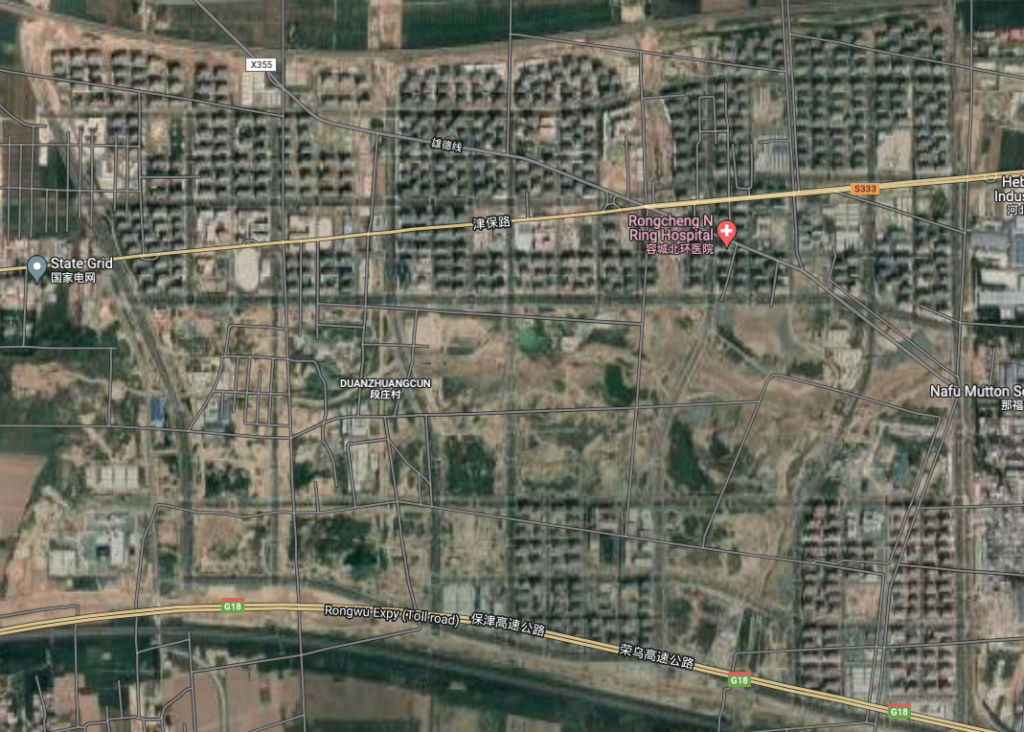
  • It’s hard to find on Google maps, but I think this spot shows the same cookie cutter buildings seen in the video.

    Ghost city, tofu dregs, rotten tail; parts of Xiongan seem to check all three boxes.

    *Note: Hebei Province is completely different from Hubei Province further south…

    LinkSwarm for January 20, 2023

    Friday, January 20th, 2023

    More Flu Manchu madness, DeSantis continues to drive the woke before him, and a guinea pig mystery. Plus: Monorail! It’s the Friday LinkSwarm!
    

  • Atlanta antifa types are very upset that shooting cops gets them dirtnapped.
    

  • “COVID Vaccines Are “Obviously Dangerous” And Should Be Halted Immediately, Say Senior Swedish Doctors.”

    The true character and scope of the harm caused by the unprecedented mass vaccinations for COVID-19 is just now beginning to become clear. Leading scientific journals have finally begun publishing data corroborating what the underground research community has observed over the last two years, especially in relation to complex problems of immune suppression.

    Truly concerning numbers pertaining to both births and mortality are also emerging.

    At this moment in time, a new, allegedly super-infectious Omicron variant is all over the headlines. A sub-variant of XXB, this strain is said to possess immune escape capabilities of precisely the type that some independent researchers predicted would follow on the heels of the mass vaccinations’ narrow antigenic fixation. 

    The WHO maintains that worldwide, 10,000 people still die due to Covid every single day, an implausible death toll more than ten times that of an average flu. It reiterates the urgent need for vaccinations, especially in light of China’s reopening and allegedly falsified data on mortality and infections.

    The EU has even called an emergency summit in light of the purported Chinese “Covid chaos” that “calls to mind how everything began in Wuhan, three years ago”.

    In Sweden, the Minister for Health and Social Affairs has said he cannot rule out new restrictions, and states that everyone must take “their three doses”, since “only” 85% of the population is ‘fully inoculated’.

    That such an extensive vaccine coverage has not yielded better results after nearly two years is a remarkable fact. Even more so in light of some individuals receiving four or more repeated exposures to the same vaccine antigen, yet still contracting the disease they are supposedly immunised against.

    At the same time, even more ominous warning signs abound.

    One such warning sign is the fact that average mortality in many Western states is still at a remarkably high level, in spite of the direct effects of the coronavirus being marginal for more than a year. Data from EuroMOMO indicate a marked excess mortality in the EU for all of 2022, and the German Bureau of Statistics reports that the country’s mortality in October was more than 19% over the median value of the preceding years.

    Is this due to Covid, as the WHO’s ’10 000 per day’ figure would seem to indicate?

    Blame is placed at the feet of ‘Long Covid‘ as well as the regular acute infections, but according to the EuroMOMO and Our World in Data stats, the bulk of the excess deaths in Europe during 2022 are actually not due to clinically manifest coronavirus infections.

    Moreover, we shouldn’t see continued excess deaths from a respiratory virus of this kind after three years of global exposure due to the inevitable consolidation of natural immunity.

    If such a situation persists, the hypothetical connection to a vaccine-related immunity suppression that just now has come into focus becomes pertinent to investigate in detail. 

    If, as has been argued, the vaccinations, and especially the boosters, alter the immune profile of recipients such that Covid infections get ‘tolerated’ by the immune system, it’s possible that vaccinated individuals will tend towards a situation of long-term, repeat infections that do not get cleared, and do not present with obvious symptoms, while still promoting systemic damage. 

    The literature now indicates an extensive substitution in the vaccinated of virus-neutralising antibodies for non-inflammatory ones, a ‘class switch’ from antibodies that work towards clearing the virus from our system, to a category of antibodies whose purpose is to desensitise us to irritants and allergens.

    The net effect is that the inflammatory response to Covid infection gets down-regulated (reduced). This means that full-blown infections will present with milder symptoms, and that they won’t get cleared as effectively (partly since fever and inflammation are essential to your body getting rid of a pathogen).

    That these developments alone aren’t cause for an immediate halt to the mass vaccinations, as well as thorough investigations, is astonishing.

    There is of course another, and more well-known, potential partial explanation of the surprising excess mortality. We have indications of clotting disorders connected to the Covid vaccines, evident in a new major Nordic study, while repeated studies evidence a clear correlation between heart disease and Covid vaccination (see Le Vu et al., Karlstad et al. and Patone et al.).

    A newly published Thai study moreover indicated that almost a third of the vaccinated youth enrolled exhibited cardiovascular manifestations, and a yet unpublished Swiss study suggests that as many as 3% of everyone vaccinated manifest heart muscle damage.

  • Oh, you’re serious? Let me laugh even harder. “San Francisco panel urges reparations of $5 million per black adult.”
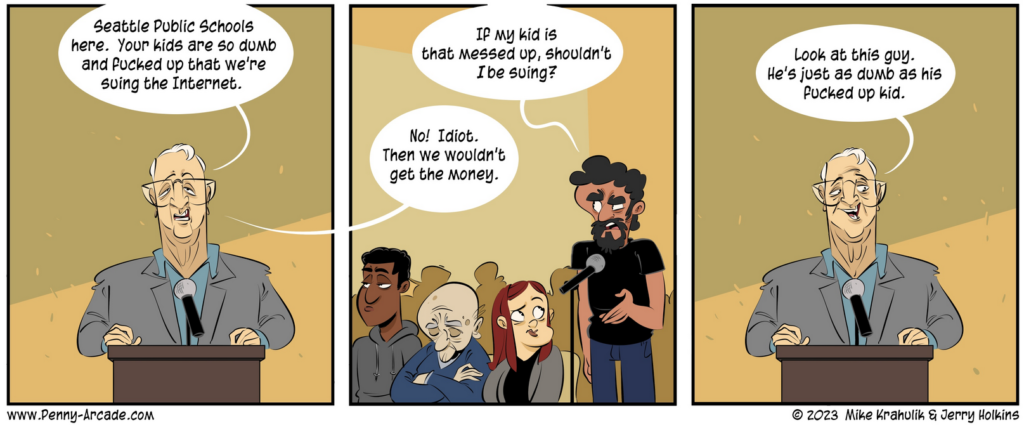
  • Seattle public schools sue Big Tech for ‘creating’ youth mental health crisis.” Well, we can’t blame the manifest failures of Social Justice-riddled unionized public education and Flu Manchu lockdowns, can we?

    Penny Arcade nailed this one.

  • Argentina’s inflation rate at 95%, highest since 1991.”
  • Austin 7-11 blares opera music to drive homeless away.
  • Florida Governor Ron DeSantis rejects AP’s social justice-ridden African-American Studies program for violating law on teaching critical race theory.
  • More DeSantis driving the woke enemy before him: “NHL Reverses Course On ‘Discriminatory’ Job Fair After DeSantis Warns It Won’t Be Tolerated In Florida.”
  • “College professor claims he’s being fired for asking questions during campus diversity meeting…. Tenured Bakersfield College history professor Matthew Garrett said he and other faculty members of a free speech coalition were targeted with false allegations after they asked questions during a campus diversity meeting last October.” (Hat tip: Sarah Hoyt at Instapundit.
  • Providence Public School District wants to discriminate based on race. Legal Insurrection Foundation sues.
  • China’s population is already shrinking. And that’s based on the official numbers; the actual numbers are far worse.
  • New Zealand’s Covid Zero fanatic prime minister Jacinda Ardern announces she’s stepping down. Good.
  • Seven missing in oil tanker explosion in Thailand.
  • The embezzlement and fake kidnapping were part of the unraveling of a coal company called Signal Peak Energy that also involved bribery, cocaine trafficking, firearms violations, worker safety and environmental infringements, a network of shell companies, a modern-day castle, an amputated finger and past links to President Vladimir Putin of Russia.” There’s also a weird part…
  • Telsa drops prices on some models $13,000 overnight.
  • Virginia rejects Ford battery plant plans over commie ties. “Virginia Governor Glenn Youngkin, who is a potential Republican candidate for the office of US President in 2024, rejected the $3.6 billion investment because it involved a partnership with China’s Contemporary Amperex Technology Co. Ltd., better known as CATL.” Hey Ford, have you considered possibly not teaming up with commies?
  • CNN closes its iconic Atlanta center building. (Hat tip: Stephen Green at Instapundit.)
  • 30 years ago: “Monorail! Monorail! Monorail!

    (Hat tip: Ann Althouse.)

  • Local news: “Someone is dumping dozens of guinea pigs in parks around Austin and nobody knows who or why.”
  • One thirsty dog:

    (Hat tip: Ace of Spades HQ)

  • Texas Aims To Rein In Rogue DAs

    Thursday, January 19th, 2023

    As George Soros-backed leftwing Democrats started capturing District Attorney offices across the country, a dangerous soft-on-crime ethos has taken hold in many blue-controlled cities. Prosecutors are letting violent felons back on the streets for minimal bond, no bond, or even failing to charge them entirely. Just this week comes news that Harris County Democratic Judge Josh Hill let a convicted felon accused of kidnapping, beating, and choking a woman out on $2 bail.

    The Texas Republican majority in the statehouse has had enough.

    In his victory speech on the first day of the Legislative session, Texas House Speaker Dade Phelan (R-Beaumont) said that “rogue district attorneys” who refuse to prosecute certain criminal offenses must be “rein[ed] in.” Legislation filed this week provides an initial glimpse at Texas Republicans’ plan to do that.

    “Carte blanche public pronouncements by district attorneys that laws we have on the books will be ignored renders the authority of the Legislature to determine what is and isn’t a crime, moot,” state Rep. David Cook (R-Mansfield) said in a statement provided to The Texan. “It is my intention to rein in renegade district attorneys and ensure the rule of law is respected in Texas.”

    Cook’s House Bill (HB) 1350 — with an identical version filed in the Senate by Sen. Tan Parker (R-Flower Mound) — would forbid district or county attorneys with criminal jurisdiction to “adopt or enforce a policy under which the prosecuting attorney prohibits or materially limits the enforcement of any criminal offense … [or] as demonstrated by pattern or practice, prohibit or materially limit the enforcement of any criminal offense.”

    Enforcement of the law would be granted to the Office of the Attorney General, and violators may face civil penalties up to $1,500 for an initial offense and then up to $25,500 for ensuing ones. Offending prosecutors may also be removed from office and their replacement would be appointed by the governor.

    Prosecutors and judges have a certain amount of discretion on when and what crimes to charge suspects with. But by ignoring the law entirely for far-left ideological reasons, Soros-backed DAs and judges are violating the equal protection rights of Texas citizens who are victimized by soaring crime. Securing the life, liberty and property of its citizens is the most basic and essential function of government.

    If they can’t do their job, they need to be removed from office.

    Why Commies Couldn’t Do Semiconductors

    Sunday, January 15th, 2023

    Asianometry has an interesting video up about East Germany expensive, strenuous efforts to catch up to the west in semiconductor manufacturing technology.

    Spoiler: They didn’t.

    Some takeaways:

  • “In the late 1980s, the German Democratic Republic, or East Germany, went all in on the monumental task of domestic semiconductor production. This semiconductor obsession failed, and the billions of marks spent on it eventually bankrupted the country’s failing economy.” I think he oversells the role the semiconductor push had on bankrupting the economy; everything in late commie East Germany was failing (just like the rest of the Warsaw Pact), they suffered a credit crunch for investment due to tightened western restrictions, couldn’t export Soviet oil as profitably due to the Reagan/Saudi created oil glut, and also were running into hard currency shortages to but the components their manufacturing sector needed to keep exporting.
  • The East German Uprising of 1953 kicked off what would be a persistent, and ultimately existential problem, for the GDR: Emigration. Throughout its history, its best and smartest people consistently sought a way out to the West. To convince its people to stay, the SED [Sozialistische Einheitspartei Deutschlands, AKA Socialist Unity Party of Germany] promised a better future through the use of technology. More than the Soviets, East Germany leaned on information technology as a pathway towards economic vitality and a glorious socialist future. The Party’s elites saw themselves locked in a technology race with the capitalists to see who can build a better society. Leader Walter Ulbricht called for an “industrial transformation” with the ultimate aim of “catching up with and surpassing capitalism in terms of technology.” A thriving computer industry was crucial towards making this ideology work. And in order to produce these superior computers, East Germany needed to learn and master microelectronics technology.

  • “Less than four years after the Americans invented the germanium transistor, East Germany moved quickly to build their own line of first generation semiconductors. In 1952, development work began at the VEB Works for Electrical Components for Communications Technology, or WBN, in the town of Teltow near the city of Berlin. This put them about even with West Germany. The FRG’s first semiconductor factory came about in 1952, built by Siemens.” Indeed, this is very early to get into the semiconductor game. It wasn’t until 1957 that Fairchild Semiconductor, widely considered as Company Zero for America’s semiconductor industry, was founded.
  • “WBN suffered from a lack of cooperation between its industrial and academic sides. The production teams lacked discipline, hands-on experience, and did not appreciate the scale and difficulty of the task they were facing. In one incident, the team dumped hot ashes right outside a factory window where they were producing a pilot run of semiconductors.” Ouch! A very uncleanroom…
  • “The state failed to give their young semiconductor team the resources it should have gotten. Administration – their chief accountant, in particular – seemed to care very little for semiconductors. When the team asked for money to purchase felt slippers to prevent static charge buildup in the clean room, their chief accountant denied the request.”
  • The Soviets didn’t help. “Despite being the GDR’s primary political backer, the Soviets were strangely wary. In 1958, two WBN staff members traveled to the Soviet Union to do technical exchanges. A year later, they came back complaining of limited cooperation. Much of what the Soviets had developed was created for military use. Thusly, the Soviets were concerned that transferring that to the East Germans would leak via scientists defecting to the West.”
  • They tried to get information from the U.S., but Cold War tech transfer policies were already falling into place. They had better luck in the UK. “Through the contacts of Arthur Lewis, a British Labour Party politician, the delegation saw plants owned by British Philips, Siemens-Edison, and British-Thompson-Houston. The latter is a descendant of the Vickers Company that sold oil equipment to the Soviets in the early 1900s. Just thought that was a nice connection. This visit was very successful. The East Germans learned a whole lot about industrial level semiconductor manufacturing. They even managed to purchase equipment for low-frequency transistors, a trailing edge technology.”
  • Despite that, the gap grew wider: “In 1958, WBN produced 100,000 germanium diodes, transistors, and rectifiers. Worse yet, some 98% of what they produced eventually needed to be discarded throughout their entire working lives.” Classic commie quality. “That same year in 1958, the United States alone produced 27.8 million transistors. Two years later in 1960, the US grew that production capacity five times over to 131 million.”
  • “Erich Apel, head of the Economic Commission of the Central Committee Politburo and an economic reformer – wrote in late April 1959: ‘Compared to … the American, Japanese, and West German industry, we lie in a state of backwardness that can scarcely be estimated … this backwardness will not decrease through 1961 at least, but will instead grow. Another inspection in 1960 identified more items of backwardness in semiconductor production. Workers tended to use rules of thumb rather than their instruments to measure. The various factory lines did not cooperate with one another.”
  • “Interestingly, when reporting these results to the Economic Commission of the Central Committee Politburo, that inspector softened his results. In his notes to state authorities, he said the GDR was 5 to 6 years behind. But in his analysis to the more politically charged Economic Commission, he cut it in half, 3 to 4 years.” Commies always institute thermoclines of truth to avoid being purged.
  • The brain drain to the west continued. The solution: The Berlin Wall. “For semiconductors however, the Wall pinched off what little technology the GDR had imported from the West.” The solution was to suck up even more to the Soviets, and to spy harder.
  • In 1963, the aging Walter Ulbricht launched a new initiative – called the New Economy System of Planning – to bring more market elements to the GDR economy. Now industrial groups, not bureaucrats, can actually decide how money can be spent. The reform also elevated the status of technology sectors like semiconductor manufacturing in the economy. R&D spending increased by over a third from 1959 to 1963. In 1965, nearly 40% of the electronics that the GDR produced by value were semiconductors – 82 million marks out of 223 million marks in total. Four years later in 1969, that number grew four-fold. Many of these transistors went into new consumer technical goods like radios, TVs and fridges. In 1971, semiconductor production reached 535 million marks by value. That year, East Germany began producing their first integrated circuits, some 10 years after Texas Instruments did it.

  • “Strange inequalities in policy planning meant that color televisions were widely available, but consumer items like toothbrushes and toilet paper were in short supply.” Communist planning at its finest!
  • One day in 1967, the Minister of Electrical Engineering and Electronics showed up to an East German electronics firm with a suitcase full of integrated circuits from TI. He told them to copy them exactly. The Ministry for State Security – better known as the Stasi – had been engaged in scientific and technology espionage since the 1950s – mostly related to atomic engineering and other sciences. Then in 1969, the Stasi’s Scientific and Technical Sector was reorganized and expanded with the goal of acquiring military technologies. After Honecker came into power in 1971, the Stasi’s job shifted from acquiring scientific knowledge to specific technologies – mostly via informants in the West who found and handed the goods over to East Germany. One such informant was Hans Rehder, a physicist working for the West German firms Telefunken and AEG. He handed over technical secrets for over 28 years and was never caught.

  • “Western companies knew about this copying of course. In one famous example, a GDR chip analyst looking at a stolen chip from the US firm Digital Corporation saw a message n Russian, roughly translating to: ‘When do you want to stop to swipe. Own design is better.'”
  • Stasi intellectual theft kept them from falling further behind, but couldn’t close the gap. “Because the Stasi were spymasters not technical experts, they frequently asked for the wrong item. Their methods of laundering the technology before passing it on made it harder to understand how to use it. Tightening embargoes from the West also interfered with industrial development. Stolen Western products got progressively older and more expensive to acquire. The embargoes gave other countries the chance to scam the Stasi, adding mark-ups frequently in the range of 30% to 80% to even 100%. This drained the East Germans’ already limited R&D budgets.”
  • “The wholesale copying also undercut the country’s ability to export its goods abroad. The Stasi did not want other countries to see what they had managed to acquire. And had they tried anyway, sales would have been blocked on patent infringement grounds. And finally, semiconductors were getting to the point that East German technicians struggled to replicate them. As early as 1976, an IC’s physical form no longer yielded secrets on how to produce them.”
  • “In 1981, with the GDR still about 7-10 years behind the West in microelectronics development, Erich Honecker announced a ten-point program to produce the majority of its semiconductors domestically by 1985. The 1970s were rough years for the GDR. Tighter export bans. The Oil Crises of the 1970s. Heavy borrowing from the West. Declining productivity and worsening competitiveness. It was all weighing heavily – grinding the country’s economy to a halt. Gerhard Schürer, head of the State Planning Commission, convinced Honecker that investing in semiconductors would bring the country out of its economic morass.”
  • They even struck a deal with Toshiba.

    In exchange for 25 million marks, Toshiba – a long running technology  partner with the GDR – would furnish the GDR with designs for their 256 kilobyte memory chips along with instructions on how to produce them. At the time, 256-kilobyte was leading edge stuff. The GDR was still struggling to produce 64 kilobyte memory. This would have been a game-changer. But in 1987, Toshiba got caught selling submarine propeller equipment to the Soviet Union. Huge scandal back then. Afraid of getting caught again, Toshiba offered the Stasi a 95% refund to destroy the evidence. [Spy Gerhardt] Ronneberger agreed. So in July 1988, he got the money back and dissolved the chip designs in a vat of acid in front of Toshiba’s people. But never trust a spy! Those were just copies, produced for exactly that purpose.

  • Finally in September 1988, Zeiss General Director Wolfgang Biermann triumphantly presented Erich Honecker with the first samples of that 1 megabit chip – the U61000. Honecker said that the chips were “convincing proof that the GDR is maintaining its position as a developed industrial country.” This technical “triumph” was the bitterest of them all. In semiconductors, prototypes mean nothing. Production means everything. Dresden produced just 35,000 chips throughout the entirety of 1988 and 1989 with a yield of 20%.

    To say this was “piss poor” would be an understatement. Those are ruinous, “fire everyone” numbers for actual semiconductor manufacturers.

    They planned to scale up to 100,000 1 megabit chips each year. Toshiba alone produced that many in a single day. Two months later in November 1988, the leading edge moved once more. Toshiba began shipping its 4-megabit DRAM in high volume, seeking to produce a million chips a month by March 1989.

  • Then history happened. “By then, the East German economy was in shambles,  scheduled to default on its debts by early 1990. It never even got there. In May 1989, Hungary opened its borders with Austria and East Germans swarmed through there en route to West Germany. Later in November 1989, a year after its one megabit technical triumph, the Berlin Wall fell.”
  • East Germany stole as many designs as they possibly could, but they couldn’t steal the intellectual expertise behind the numerous process tweaks, nor the furious swarm of technological innovation drive by Silicon Valley’s capitalist high risk/high reword startup culture that drove Moore’s Law for decades.

    Top-down communist command economies never had a chance to keep up.

    LinkSwarm For January 13, 2023

    Friday, January 13th, 2023

    Fallout from the House speaker’s race, Biden busted for mishandling classified files, more blue state teachers raping their students, Cadillac’s EV breaks into double digit sales, and the Imelda Marcos disco musical! It’s the Friday LinkSwarm!
    

  • Kevin McCarthy finally wins Speaker of the House race on 15th vote after offering concessions to the House Freedom Caucus.
  • How is McCarthy doing? Early signs are encouraging. “The House of Representatives passed a new rules package Monday that overhauls the way it functions by putting up more barriers to congressional spending and creating a more deliberate process for passing legislation, which were key demands of the more conservative members of the Republican Party.” (Hat tip: Sarah Hoyt at Instapundit.)
    

  • Shot: Texas Rep. Dan Crenshaw calls members of the House Freedom Caucus “terrorists” for opposing Kevin McCarthy for speaker. Chaser: “Freedom Caucus Member Mark Green Beats Dan Crenshaw in Race to Chair Homeland Security Committee.”
  • Heh:

    (Hat tip: Not the Bee.)

  • “After 15 Grueling House Speaker Votes, America’s Long National Nightmare Can Finally Begin.”
  • “Nation In Shock As Politicians Show Up To Work 4 Days In A Row.”
  • After the whole absurd raid on Trump because “OMG he has classified documents/nuclear codes/eleventy!!!!” it turns out that Biden kept at least two different batches of classified documents in insecure locations.

    House Speaker Kevin McCarthy (R., Calif.) used Thursday morning’s press briefing to criticize the Department of Justice’s handling of the issue.

    “They knew this happened to President Biden before the election, but they kept it secret from the American public,” McCarthy told a scrum of reporters on Capitol Hill.

  • A whole lot of Chicago teachers are sexually abusing the children in their care

    Chicago Board of Education Inspector General Will Fletcher reported 470 sexual complaints against Chicago Public School employees from students in 2022.

    “The report details students being abused, groped, groomed, assaulted and threatened by school officials.

    “One investigation found a former Junior ROTC staff member had sex with a 16-year-old high school student for a year. When he learned there was an investigation, the staff member threatened to kill the girl and her family if she cooperated with investigators.”

    (Hat tip: Instapundit.)

  • More on the same subject.

    The teachers’ union in Chicago, Randi Weingarten’s American Federation of Teachers, so praised by Joe Biden, has done nothing and said nothing about it so far as I can tell, and I did look, focusing instead on promoting critical race theory into the school system. Left unsaid is that the union ensures that firing any of these teachers involved in this activity is virtually impossible. Chicago’s public schools’s firing rate of bad teachers owing to their union membership, as of a few years ago, is 0.1%.

    What’s vivid here amid all this widespread predatory behavior from the teaching classes, which like Harvey Weinstein, are prolific campaign donors to Democrats, is that the low outrage factor stands in sharp contrast to the sexual abuse scandals of the Catholic Church, which was ordered by courts to pay billions in reparations to the victims, has seen its leaders publicly apologize for the abuses, and has many programs now to prevent child abuse by perverts in authority. This activity was evil and inexcusable and rightly punished.

    As for the more widescale abuse now seen in Chicago’s public schools, along with comparable scandals in the Los Angeles public school system, and other bad cases in New York and other blue cities, well, crickets. The perversion has gotten out of control in Chicago and the story barely makes the national news. 

  • West Virginia Law Restricting Sports By Biological Sex Is Constitutional.”
  • How Biden’s inflation is destroying family budgets:

    (Hat tip: Stephen Green at Instapundit.)

  • Federal appeals court strikes down bump stock ban.

    A federal appeals court on Friday struck down the Trump-era ban on bump stocks, a firearm accessory that enables a semi-automatic gun to shoot at an increased rate of fire.

    In a 13-3 decision, the 5th Circuit Court of Appeals in New Orleans held that the Bureau of Alcohol, Tobacco, Firearms and Explosives (ATF), acting under “tremendous” public pressure, short-circuited the legislative process by approving a rule to define bump stocks as “machineguns,” which are illegal to possess. The court said ATF did not have the authority from Congress to do so.

    Damn straight it doesn’t.

  • Pentagon ditches Flu Manchu vaccine mandate. Where do the wrongly discharged sue to get their careers back?
  • This is what a real pro-natalist policy looks like: “Hungary addresses falling birthrates by exempting moms under 30 from income tax for life.” More:

    Hungary has taken several measures in recent years to encourage its citizens to have more children, including three years of paid parental leave and state-funded daycare.

    The country previously suspended income tax for moms with four or more children, but this new policy specifically encourages women to have children sooner, which in the long run means a higher likelihood of having more children overall.

  • Arkansas governor Sarah Huckabee Sanders signs executive order banning Critical Race Theory in state schools.
  • Israel hit Syria again, and I heard just about nothing about it. Ukraine has really pushed Syria out of the headlines.
  • Speaking of Ukraine, Russia has largely captured the salt mining town of Soledar, though at a high cost in man. And good luck checking those hundreds of miles of salt tunnels for partisans…
  • Tesla plans Houston-area expansion with large new industrial site in Brookshire…Little is known about Tesla’s plans, but the Fortune 500 company signed a lease late last year for about 1.03 million square feet at 111 Empire West, part of the 300-acre Empire West Business Park in Brookshire.” A bold move, considering how radically car sales have dived this year.
  • Other EVs update: “GM delivers record Cadillac Lyriq deliveries in Q4 – 12 per month.”
  • Sequel to The Passion of the Christ about to start filming.” This is pretty much obligatory:

  • “David Byrne, Fatboy Slim Disco Musical ‘Here Lies Love’ Sets Broadway Debut. The musical, which has had a long journey to Broadway, centers on the life of Imelda Marcos, the former first lady of the Philippines.” They say the mirror ball shine bright on Broadway… (Hat tip: Dwight.)
  • “Celebrity Who Travels On Private Jets And Collects Luxury Sports Cars Says You’re The Reason For Climate Change.”
  • “Experts Say They Don’t Know What Thing Is Causing Everyone To Suddenly Collapse, But It’s Definitely Not That One Thing.”
  • Texas To Run Another Big-Ass Budget Surplus

    Thursday, January 12th, 2023

    One huge advantage Texas has over one-party Democrat-rule states is the salutary habit of running budget surpluses year after year after year. (Or, to be technically correct (“the best kind of correct!”), biennium after biennium after biennium.)

    Now Comptroller Glenn Hegar has officially forecast that the Texas budget for 2024-2025 (the one the legislature will pass in the just-started legislative session) will be a $32.7 Billion surplus.

    The historic Texas budget surplus estimate has grown even larger as Comptroller Glenn Hegar announced a $5 billion increase in an updated Biennial Revenue Estimate (BRE) on Monday.

    The Texas Legislature convenes for the first day of its 88th Regular Session on Tuesday and now appears to have at its disposal $32.7 billion — a sum that has more than its fair share of stipulations and restrictions. Hegar’s July 2021 projection pegged the number at $27 billion.

    “Even with constitutional spending limits and an inflation-influenced new normal, the enormous amount of projected revenue gives the state a remarkable, or a truly ‘once-in-a-lifetime,’ opportunity for historical actions this legislative session,” Hegar said, presenting the BRE Monday.

    Tempering reactions, he added, “Don’t count on me announcing another big revenue jump two years from now.”

    “The revenue increases that we’ve seen have been in many ways unprecedented and we cannot reasonably expect a repeat. We are unlikely to have an opportunity like this again.”

    Overall, the comptroller estimates $188 billion available in general-purpose spending for the 2024-2025 budget, a 26 percent increase from the current biennium. The state will also receive an estimated $176 billion in federal dollars and other revenues that are non-discretionary, earmarked already with specific purposes.

    Over half of the general revenue-related funds come from sales taxes and 13.2 percent from oil and gas severance taxes. Due to the high oil and gas prices over the last year, severance tax collections rose 116 percent in 2022; the average annual increase from 1996 to 2021 was just 7.5 percent.

    Without new appropriations, Hegar estimates the Economic Stabilization Fund to reach a balance of $27.1 billion, slightly constrained by a constitutional limit.

    Texas has had a Republican trifecta (House, Senate and Governor’s mansion) for two decades, and in that time it has followed the budget maxim of former governor Rick Perry: “Don’t spend all the money!” Conservative governance, free market policies, low taxes and fiscal prudence have all combined to keep the economy growing even in difficult times, a record few Democratic-dominated states even remotely approach.

    The Texas Public Policy Foundation has more thoughts on how Texas government can reduce the Texas tax burden even further.