Russia has turned to China for military equipment and aid in the weeks since it began its invasion of Ukraine, U.S. officials familiar with the matter told The Washington Post.
The officials, who spoke on the condition of anonymity because of the sensitivity of the subject, did not describe what kind of weaponry had been requested, or whether they know how China responded.
The development comes as White House national security adviser Jake Sullivan plans to travel to Rome on Monday to meet with his Chinese counterpart, Yang Jiechi.
Sullivan told CNN that the administration was “communicating directly, privately to Beijing, that there will absolutely be consequences” for any Chinese efforts to assist Russia in evading sanctions.”
Do you see the problem? It’s right there in the first sentence.
Russia has turned to China for military equipment and aid in the weeks since it began its invasion of Ukraine, U.S. officials familiar with the matter told The Washington Post.
“Officials familiar with the matter.”
Remember that phrase?
Remember that phrase (and similar ones) a lot from those endless “sources say” hit pieces on President Trump that turned out to be complete garbage made up out of whole cloth?
Because of that, we can never take anonymously sourced pieces that promotes the latest Democratic Media Complex line at face value ever again. How can we be sure you’re not making things up again?
We can’t.
We can never take any anonymously sourced piece in the Washington Post at face value. So we have no idea if Russia sought military aid from China or not.
That’s the problem with institutional trust. Once it’s gone, it can’t easily be replaced.
Any time you read “source says” in a piece in an MSM outlet, you should read that as “just trust me, bro!”
And we don’t.
And absent a clean sweep in management and a complete turnover of current staff, we never will again.
There are a lot of small countries, especially in the southern and eastern areas of Europe for whom [a Russian invasion] may not have been a plausible scenario two weeks ago, but it’s kind of looking like one now. And if you are a small country close to the borders of Russia, you’re in this difficult defensive position. None of these countries have a military that can, with a straight face, suggests that it could simply put up a toe-to-toe, stand their ground fight and defeat a military the size of the Russian army.
I’m going to point out that this is not necessarily true. Finland did it in The Winter War in 1939-1940. But he gets to that.
Yet you want you have to provide some sort of plausible threat to an invading occupier like Russia to avoid being invaded in the first place. The whole point is that the best possible success in repulsing an invasion is to not get invaded in the first place. So how can you convince a country like Russia that your very small little republic is not worth invading, that it is too difficult to invade? A lot of these countries are looking around, and going “Would NATO actually step up and help us directly, help defend us in case of an invasion? Any maybe NATO would, maybe NATO wouldn’t.”
One big solution is civilian military firearms ownership and preparedness. And here modern Finland comes up:
There is a specific division called SRA which is essentially reservists shooting society, and it is it’s actually technically in some cases for gun, rifle, pistol, shotgun and precision rifle. In competition it requires competitors to essentially carry a military loadout; they have to wear armor, they have to carry water, they have to carry a minimum amount of ammunition during the stages…It’s specifically to encourage military readiness .
“Having a large community of competent civilian marksmen is something that can contribute a very real deterrent to invasion.”
True. Every nation in Europe should make civilian firearms ownership more widely and legally available, for this and other reasons.
Russia’s invasion of Ukraine grinds on, justice for Juicy, Italy’s truck drivers go Galt, giant spiders invade, and musicians are being screwed yet again. It’s the Friday LinkSwarm!
The Russian invasion of Ukraine had two goals. The first was to take control of Ukraine, intending to complete the task begun in Belarus – the task of rebuilding Russia’s strategic buffers and securing Russia from attack. The second goal was to demonstrate the capabilities and professionalism of the Russian military and to further deter hypothetical acts and increase Russia’s regional influence. The two goals were interlocked.
The occupation of Ukraine has not been achieved, but it is not a lost cause. Perceptions of the strength of Russia’s military, however, have been badly damaged. There is no question but that Russian planners did not want to fight the war Russia has been fighting. Rather than a rapid and decisive defeat of Ukraine, Russia is engaged in a slow, grinding war unlikely to impress the world with its return to the first ranks of military power. At this point, even a final victory in its first objective will not redeem the second. It is important to start identifying the Russian weaknesses.
The first problem was a loss of surprise. Carl von Clausewitz placed surprise at the top of warfare. Surprise contracts the time an enemy has to prepare for war. It also imposes a psychological shock that takes time to overcome, making it more difficult to implement existing plans. And it increases the perceived power of the enemy. In Ukraine, however, extended diplomacy gave Kyiv time to adjust psychologically to the possibility of war.
Moscow failed to understand its enemy. Russia clearly expected Ukrainian resistance to collapse rapidly in the face of the massive armored force it had gathered. It did not expect the Ukrainian populace to fight back to an extent that would at least delay completion of the war.
Snip.
Russian war plans centered on three armored groups based in the east, south and north…The three Russian armored battle groups were widely separated. They did not support each other. Instead of a single coordinated war, the Kremlin opted for at least three separate wars, making a single decisive stroke impossible. A single integrated command, essential for warfighting, seemed to be lacking.
The use of armor vastly increased the pressure on Russian logistics. Instead of focusing supplies on a single thrust, it had to focus on three, plus other operations. Logistics for the major armored forces seemed to have broken down, making war termination impossible and further extending the war.
In recent days, Russia has adapted and turned toward taking cities. This is generating an effective counterforce among fighters who understand the streets and alleys and use them to delay Russia’s progress. Fighting in cities is among the costliest and most time-consuming actions in war. Capturing cities takes resources and is not the key to victory. Cities take on importance only after the enemy force has been defeated and demoralizing the nation is essential. The city is the prize of war, not the military goal. Russia turned the conflict from a counter-military to a counter-population war, which increased resistance by sowing desperation in the cities.
The foolish ease with which Russia expected to win this war reminds me of the Southern dandies at the beginning of Gone With The Wind proclaiming how the Civil War would be over in weeks since the Yankees would “turn and run, every time.” Didn’t turn out that way. (Hat tip: Al Fin Next Level.)
Speaking of which, this seems like poor tactics and situational awareness:
The Biden administration’s bumbling on the matter of sending MiG-29 fighter jets from Poland to Ukraine is the result of both nations’ fears that the action would drag them directly into the war in Ukraine. Poland wanted to send the jets to Ramstein Air Base in Germany, and Washington shied away from the prospect of having fighter jets fly out of a U.S. base in a NATO country into the war zone in Ukraine. The thinking was that this would look too much like the United States and NATO carrying out a military operation against Russian forces in Ukraine.
In practical terms, the U.S. (and U.K.) prohibition of Russian oil imports probably will not have much of an economic effect — certainly not in comparison to the other measures that have been taken — but even largely symbolic gestures can have a powerful effect, and the Kremlin seems to be very much agitated by the boycott.
The Biden administration’s bumbling on the matter of sending MiG-29 fighter jets from Poland to Ukraine is the result of both nations’ fears that the action would drag them directly into the war in Ukraine. Poland wanted to send the jets to Ramstein Air Base in Germany, and Washington shied away from the prospect of having fighter jets fly out of a U.S. base in a NATO country into the war zone in Ukraine. The thinking was that this would look too much like the United States and NATO carrying out a military operation against Russian forces in Ukraine.
In truth, the United States is a belligerent if Vladimir Putin says the United States is a belligerent. He is perfectly capable of making up a pretext, however absurd, to justify whatever action he wants to take — that is why Russians are in Ukraine in the first place. His subjects in Russia are largely pliant and inclined to accept the propaganda they are fed, and those who aren’t can be jailed, terrorized into silence, or murdered. Putin can do what he chooses — it is not like he is worried about an upcoming election.
The MiG fiasco underlined the Biden administration’s predictable fecklessness and disorganization — America needed a Keystone pipeline but we got the Keystone Cops — and if there is any serious thinking going on in the White House about what Putin’s response to our “declaration of economic war” is likely to be, there isn’t any obvious evidence of it. The posture of the Biden administration by all appearances is one of wishful thinking: that while the United States and the world have rightly taken a side in this conflict, the fighting is going to stay in Ukraine.
What if it doesn’t?
A direct military attack by Russian forces on the United States is, of course, unlikely. But a Russian attack on Moldova is far from unthinkable. It is entirely possible that Putin will attack a NATO member such as Lithuania, Latvia, or even Poland, whose people have gone to such extraordinary lengths to assist the Ukrainians. There are already Americans fighting in Ukraine, as private volunteers rather than as part of our armed forces. If Putin is looking for a pretext, he will have no trouble finding one.
The United States is keenly interested in keeping the fighting in Ukraine. But the fighting will stay in Ukraine for only as long as Putin believes it is in his interest to keep it there. That may not be much longer. Putin already has failed to achieve his main political objective in Ukraine and will not achieve it no matter how long the conflict drags on; what was intended as a show of awesome military might has instead been a display of weakness and incompetence. A wider war — a glorious crusade — might soon suit Putin’s purposes better than does a quagmire in Ukraine, where the Russian army has been reduced to trying to substitute atrocities for victories.
President Joe Biden has said that U.S. forces will defend “every inch” of NATO territory. But Biden was there when the Obama administration offered a lot of big talk about “red lines” in Syria and then did nothing. Biden’s people right now are engaging in counterproductive (to say the least) negotiations with Tehran that serve no obvious U.S. interest, and going through Moscow to do so. Vladimir Putin calculates and, as he has just demonstrated, he sometimes miscalculates. Putin might be inclined to take an inch and put Biden to the test.
This seems unlikely, but the actual invasion of Ukraine seemed unlikely until it happened.
“Putin flirts with economic suicide.” “When a government declares that it will confiscate the assets of foreign companies and foreign investors and that it won’t pay its debts, severe and lasting economic calamity follows.”
“Special Counsel Finds Mark Zuckerberg’s Election Money Violated Wisconsin Bribery Laws.” “Nearly $9 million in Zuckerberg grant funds directed solely to five Democratic strongholds in Wisconsin violated the state’s election code’s prohibition on bribery. That conclusion represents but one of the many troubling findings detailed in the report submitted today by a state-appointed special counsel to the Wisconsin Assembly.”
“Manhattan merchant banker, 61, is charged with being a spy in the US: Dual US-Russia citizen ‘ran a propaganda center in NYC and communicated directly with Vladimir Putin…Elena Branson, or Chernykh, has been charged with six counts of failing to register as a foreign agent, among other crimes.” Also helped Russians obtain visas under false pretenses. (Hat tip: ColorMeRed.)
As voting for the Texas primaries has wrapped up, the eyes of the nation at large are on the Rio Grande Valley. Many observers expect 2022 to be a big year for Republicans and the GOP, predicting to see the party build on its 2020 inroads with Hispanic voters and believing it will have success in what has previously been Democrat stronghold. To that end, the GOP fielded a wide slate of candidates, and the party has data that suggests it may be successful.
The numbers suggest two trends that portend well for the GOP: enthusiasm and historic numbers among Republican voters, and depressed turnout for Democrats. Compared to the 2018 and 2020 primary elections, Republicans had significantly higher turnout. That trend is present across all four counties in the RGV, but especially in Starr County. In 2018, a total of 15 people voted in the Republican primary; in 2020, that number increased to 46. This year, a whopping 1,773 people in Starr County voted in the Republican primary.
Conversely, Democrats had generally lower turnout in the RGV Democrat primaries compared to 2018, and about a 7.83 percent lower turnout compared to 2020.
The Florida state Senate on Tuesday passed a parents rights bill, a media-maligned piece of legislation that will prohibit primary school teachers from talking about sexual orientation with children in pre-K through third grade.
Senate passage of the Parental Rights in Education bill by a vote of 21-17 marks a milestone in parents’ efforts across the nation to fight back against the radical left in the classroom. The legislation also represents a model for other states to use as they push back the woke tides.
The Florida House of Representatives passed the legislation last month, 69-47. It now goes to Gov. Ron DeSantis for his signature.
Opposition to the Parental Rights in Education bill has been fierce, with many on the left attempting to reframe the law as the “Don’t Say Gay” bill. The left has attempted for years to indoctrinate children with LGBT ideology in public schools, and now activists are furious at attempts by conservatives to push back.
To be clear, the Florida legislation is not an “anti-gay” bill. It is instead a bill aimed at protecting children—and preventing educators with an agenda from infecting young kids with radical ideology.
By all means, make Democrats defend lecturing kindergartners on transsexualism and anal sex in November. (Hat tip: Director Blue.)
Rapper Tom MacDonald complains about “The Biggest Music Industry Screw Job Ever!” No, given it’s the music industry, not even close. There are hundreds of artists who have been screwed worse. But the lengths to which Billboard and their data recording company go to in order to avoid certifying the sales of independent musicians is certainly eye-opening.
“Our gas prices are now higher than in zombie apocalypse films.” That would be the Will Smith I Am Legend (the classic Richard Matheson novel it was based on featured vampires, not zombies).
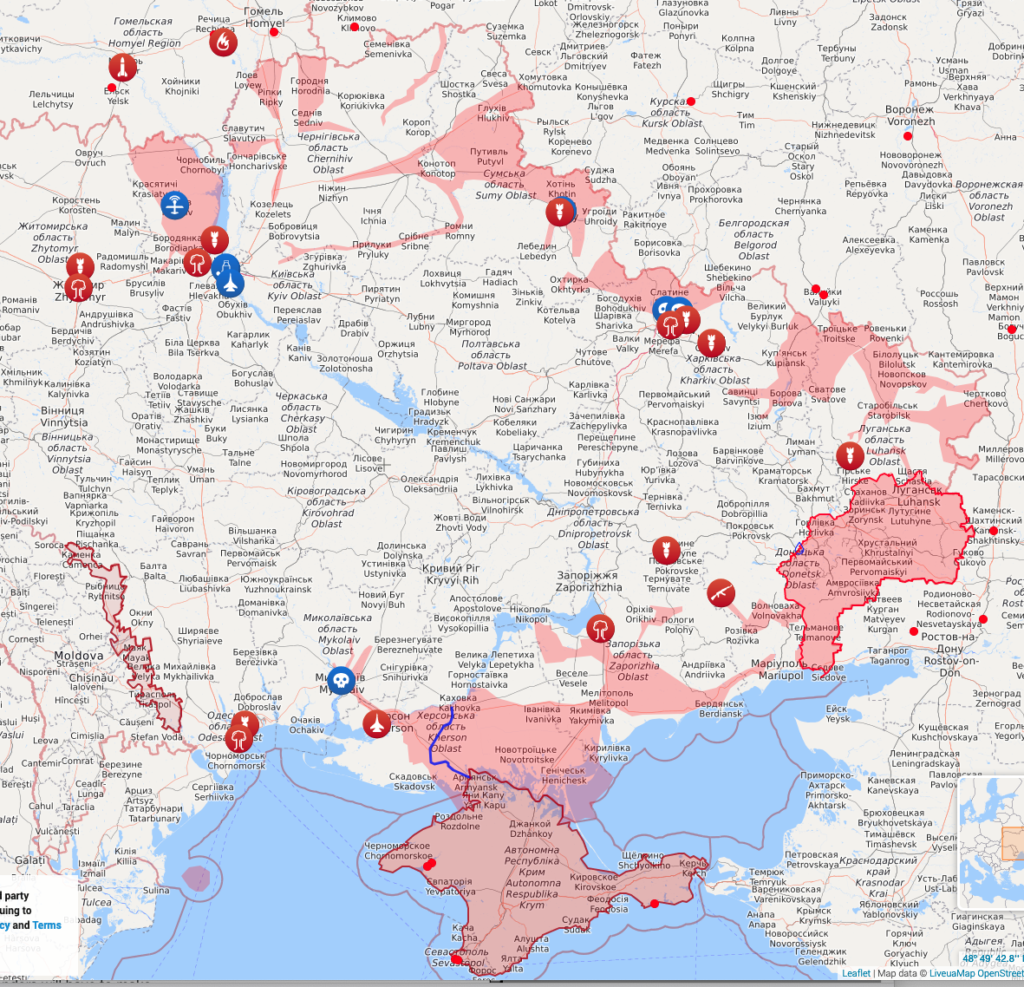
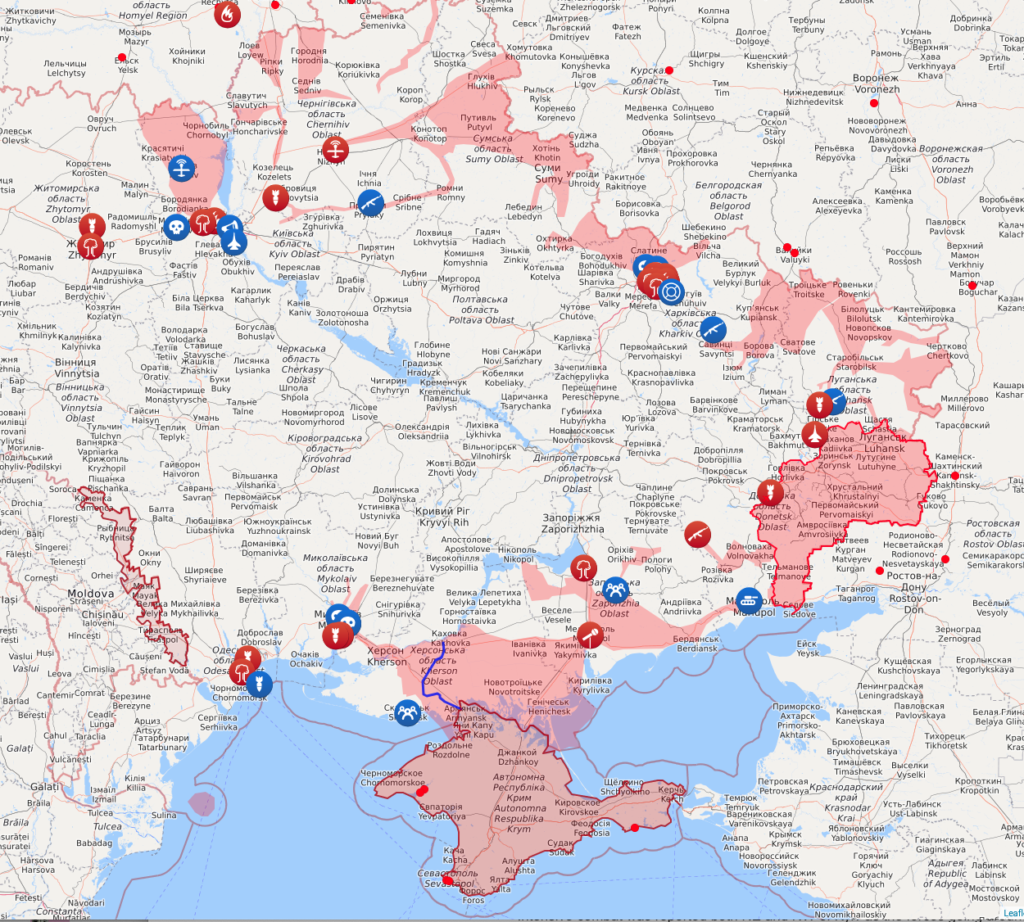
At this point, there seems to be no indication that Russian forces are measurably closer to their goal of controlling all of Ukraine.
Here’s a LiveMap snapshot.
From a pure strategic viewpoint, those Russian tendrils snaking toward Kiev from the northeast look like a bad idea, since there’s no way to protect their supply lines.
(Always remember that the map is not the territory, and that both sides are working hard to put out propaganda, though the Russians seem to be manifestly incompetent at it.)
Here’s a fascinating thread reportedly leaked from an active Russian FSB (successor to the KGB) analyst about how badly everything is screwed up.
Kadyrov's squad was absolutely demolished before they even had a chance to fight and they got blown to pieces. I do not have any info that it was an FSB leak to Ukraine, so I’d give it a 1-2% chance – but can’t exclude this possibility completely.
I assume that’s Ramzan Kadyrov, corrupt head of the Chechen Republic, former resistance fighter against Russia who defected in 1999 and was appointed by Putin in 2007. Bit of a jihadist scumbag to boot, and just a generally nasty piece of work. I assume by “Kadyrov’s squad” they mean the Kadyrovtsy, the militia forces under his direct control.
Our Blitzkrieg has totally collapsed. It is impossible to complete the task: If Zelensky and his deputies were captured in the first 3 days, all key buildings also captured, and they were forced to read an address of their surrender to the country,
Some tweets about who could they even get post-Zelensky to sign a treaty (Medvechuk? Tsaryova? Yanukovich?) snipped.
2) Our logistics are already over-extended today. We can send a much large contingent into Ukraine, and what would we get? Ukraine – a territorially enormous country, and their hate towards us is astronomical.
With regards to Russian military losses: I don’t know the reality – no one does. There was some information the first 2 days, but now no one knows what is happening in Ukraine. We’ve lost contact with major divisions. (!!)
Because all of this was planned at the top (in Russia), because we were told that such a scenario will not happen (Ukraine invasion) except only if we were to be attacked first.
Now, civilian losses in Ukraine will follow a geometric pattern progression, and resistance against us will only get stronger. Infantries already tried to enter cities – out of 20 paratrooper groups, only one had “provisional” success.
And so, with the Ukrainian question we lunged as if going for a 100m sprint, but turned out we’d signed up for a marathon. And this is a rather brief overview of the current events.
Cheap Chinese tires have been blamed for a Russian convoy of armoured vehicles being unable to reach Kyiv.
Yesterday, the Ministry of Defence issued an update revealing that a convoy of Russian tanks advancing on the capital of Ukraine remained 30km from the centre of the city having made little progress over the previous three days because of “Ukranian resistance, mechanical breakdown and congestion.”
Karl Muth, an academic based at the University of Chicago and a self-described tire expert, took to Twitter to set out a theory blaming cheap Chinese tires for the slow advance of Russian vehicles.
“Those aren’t Soviet-era heavy truck radials,” Muth said, commenting on a photo of a Russian army vehicle with ripped tires.
Instead Muth believes the trucks use “Chinese military tires, and I believe specifically the Yellow Sea YS20.”
“This is a tire I first encountered in Somalia and Sudan. it’s a bad Chinese copy of the excellent Michelin XZL military tire design,” he continued.
Former pentagon staff member Trent Telenko also got stuck into the debate and said “poor Russian army truck maintenance practices” has created a risk of equipment failure.
“When you leave military truck tires in one place for months on end. The side walls get rotted/brittle such that using low tire pressure setting for any appreciable distance will cause the tires to fail catastrophically via rips,” Telenko said.
Morgan Stanley analyst says that Russia is heading toward debt default as soon as April 15. Those are dollar-denominated bonds, which means they can’t be paid with devalued rubles.
There are reportedly more than 400,000 “volunteer hackers” helping Ukraine fight its cyberwar against Russia.
Victor Zhora, deputy chief of Ukraine’s information protection service, told Bloomberg last week that Ukraine was putting up a “cyber resistance” against its invasion that would work to try and weaken Russia.
Zhora said: “Our friends, Ukrainians all over globe, [are] united to defend our country in cyberspace. [Ukraine is working to do] everything possible to protect our land in cyberspace, our networks, and to make the aggressor feel uncomfortable with their actions.”
He also said that volunteers were helping Ukraine obtain intelligence in order to fight back at Russian military systems.
They are also trying to get the message out to Russian citizens, who have been Fed a starkly different narrative from their government than the rest of the world has seen play out. Volunteers are working to “address Russian people directly by phone calls, by emails, by messages” and “by putting texts on their services and showing real pictures of war.”
There aren’t 400,000 real hackers around the world. But 10,000 hackers and 390,000 script kiddies can sill do a lot of damage…
More than a week into the Russian invasion of Ukraine, the Russian Air Force has yet to commence large-scale operations. Inactivity in the first few days could be ascribed to various factors, but the continued absence of major air operations now raises serious capability questions.
One of the greatest surprises from the initial phase of the Russian invasion of Ukraine has been the inability of the Russian Aerospace Forces (VKS) fighter and fighter-bomber fleets to establish air superiority, or to deploy significant combat power in support of the under-performing Russian ground forces. On the first day of the invasion, an anticipated series of large-scale Russian air operations in the aftermath of initial cruise- and ballistic-missile strikes did not materialise. An initial analysis of the possible reasons for this identified potential Russian difficulties with deconfliction between ground-based surface-to-air missile (SAM) batteries, a lack of precision-guided munitions and limited numbers of pilots with the requisite expertise to conduct precise strikes in support of initial ground operations due to low average VKS flying hours. These factors all remain relevant, but are no longer sufficient in themselves to explain the anaemic VKS activity as the ground invasion continues into its second week. Russian fast jets have conducted only limited sorties in Ukrainian airspace, in singles or pairs, always at low altitudes and mostly at night to minimise losses from Ukrainian man-portable air defence systems (MANPADS) and ground fire.
Snip.
While the early VKS failure to establish air superiority could be explained by lack of early warning, coordination capacity and sufficient planning time, the continued pattern of activity suggests a more significant conclusion: that the VKS lacks the institutional capacity to plan, brief and fly complex air operations at scale. There is significant circumstantial evidence to support this, admittedly tentative, explanation.
First, while the VKS has gained significant combat experience in complex air environments over Syria since 2015, it has only operated aircraft in small formations during those operations. Single aircraft, pairs or occasionally four-ships have been the norm. When different types of aircraft have been seen operating together, they have generally only comprised two pairs at most. Aside from prestige events such as Victory Day parade flypasts, the VKS also conducts the vast majority of its training flights in singles or pairs. This means that its operational commanders have very little practical experience of how to plan, brief and coordinate complex air operations involving tens or hundreds of assets in a high-threat air environment. This is a factor that many Western airpower specialists and practitioners often overlook due to the ubiquity of complex air operations – run through combined air operations centres – to Western military operations over Iraq, the Balkans, Libya, Afghanistan and Syria over the past 20 years.
Second, most VKS pilots get around 100 hours’ (and in many cases less) flying time per year – around half of that flown by most NATO air forces. They also lack comparable modern simulator facilities to train and practise advanced tactics in complex environments. The live flying hours which Russian fighter pilots do get are also significantly less valuable in preparing pilots for complex air operations than those flown by NATO forces. In Western air forces such as the RAF and US Air Force, pilots are rigorously trained to fly complex sorties in appalling weather, at low level and against live and simulated ground and aerial threats. To pass advanced fast jet training they must be able to reliably do this and still hit targets within five to ten seconds of the planned time-on-target. This is a vital skill for frontline missions to allow multiple elements of a complex strike package to sequence their manoeuvres and attacks safely and effectively, even when under fire and in poor visibility. It also takes a long time to train for and regular live flying and simulator time to stay current at. By contrast, most VKS frontline training sorties involve comparatively sterile environments, and simple tasks such as navigation flights, unguided weapon deliveries at open ranges, and target simulation flying in cooperation with the ground-based air-defence system. Russia lacks access to a training and exercise architecture to rival that available to NATO air forces, which routinely train together at well-instrumented ranges in the Mediterranean, North Sea, Canada and the US. Russia also has no equivalent to the large-scale complex air exercises with realistic threat simulation which NATO members hold annually – the most famous of which is Red Flag. As such, it would be unsurprising if most Russian pilots lack the proficiency to operate effectively as part of large, mixed formations executing complex and dynamic missions under fire.
Third, if the VKS were capable of conducting complex air operations, it should have been comparatively simple for them to have achieved air superiority over Ukraine. The small number of remaining Ukrainian fighters, conducting heroic air-defence efforts over their own cities, are forced to operate at low altitudes due to long-range Russian SAM systems and consequently have comparatively limited situational awareness and endurance. They ought to be relatively easily to overwhelm for the far more numerous, better armed and more advanced VKS fighters arranged around the Ukrainian borders. Ukrainian mobile medium- and short-range SAM systems such as SA-11 and SA-15 have had successes against Russian helicopters and fast jets. However, large Russian strike aircraft packages flying at medium or high altitude with escorting fighters would be able to rapidly find and strike any Ukrainian SAMs which unmasked their position by firing at them. They would lose aircraft in the process, but would be able to attrit the remaining SAMs and rapidly establish air superiority.
Russia has every incentive to establish air superiority, and on paper should be more than capable of doing so if it commits to combat operations in large, mixed formations to suppress and hunt down Ukrainian fighters and SAM systems. Instead, the VKS continues to only operate in very small numbers and at low level to minimise the threat from the Ukrainian SAMs. Down low, their situational awareness and combat effectiveness is limited, and they are well within range of the MANPADS such as Igla and Stinger which Ukrainian forces already possess. The numbers of MANPADS are also increasing, as numerous Western countries send supplies to beleaguered Ukrainian forces. To avoid additional losses to MANPADS, sorties continue to be primarily flown at night, which further limits the effectiveness of their mostly unguided air-to-ground weapons.
How Russian propaganda has sold some of the Russian people on Project Z. But Russian troops are finding things quite a different story. Warning: Bodies, and at about 18 seconds in one, I think strewn body parts:
But once they realised that there will be resistance and the war looks like this, their enthusiasm started declining. Which means it will be much harder to find new volunteers to go fight to Ukraine. But you need them. What are you gonna do? pic.twitter.com/ItmwcYSwIe
“Sources have been telling me, sources that are well connected to the Russian Security Services, that the offensive is not going well, that some special forces, the Russian Spetsnaz, are furious because they have been sent into battle without proper support, and many of them have been killed. They say that the national guard forces and the regular army, the national guard forces include those Chechen units, that two of them are not coordinating on the field. And that the overall battle plan is somewhat disjointed in that it’s partly a plan for war and partly a plan for peacekeeping and so-called de-Nazification of this country. And it has led to a lack of cohesion,” Engel reported.
“A lot of this goes back to the man who’s behind it all, Vladimir Putin, who I’m told is now increasingly isolated, is just taking advice from his inner circle, that there are only about three people who matter right now,” Engel continued. “And that speech, you mentioned it a short while ago, that Putin gave yesterday — bizarre location, speaking at Aeroflot, to a group of flight attendants. He sounded incredibly angry. He sounded detached. He was talking about how the Ukrainians here are machine-gunning people, that they’re driving around in cars packed with explosives, jihadi-style. And he went very deep and repeatedly on this theme that they’re fighting against the Nazis. It was the angriest I’ve ever seen him.”
This is from a couple of days ago. Have Spetsnaz pissed off at you doesn’t seem like a good long-term survival strategy for a Russian leader. On the other hand, this report probably deserves some skepticism, since it fits too easily into what we would like to hear about the situation, so some salt is in order. (Hat tip: Director Blue.)
“Ukraine says it has RE-TAKEN Chuhuiv city and killed two high-ranking Russian commanders during the battle.” (Hat tip: Instapundit.)
“A Complete Summary Of All Russia Sanctions And Developments.” Read on for exciting blow-by-blow summaries of foreign exchange surcharges and debt repayment details…
What rolls down stairs/alone and in pairs/and up-armors your Russian truck? Caveat: They call this improvised armor, but it could also be on-hand materials for traction in muddy areas.
Busy day, so enjoy another Ukraine video. This is a good summary of the fight up until now:
Some takeaways:
We know what Russian plans were, based on captured documents and a pre-written “analysis” of Russia’s glorious victory someone found on file on a web server.
They expected to be at the gates of Kiev in three days and have everything conquered in two weeks.
Well, we’re almost two weeks in, and they haven’t achieved any of their major objectives. All major cities remain in Ukrainian hands.
One reason they didn’t: NATO alerted them to impending Russian action slightly before it began, so many commanders and units were already dispersed from bases.
They didn’t have enough trucks to begin with and have already lost 200 more.
Also, not only is the Ukrainian mud all but impassable, but their truck tires really suck. (More on this in a day or so.)
We need to pay more attention to the south, where Russian troops attacking from Crimea have done better (but still not great).
Time is not on Russia’s side, as sanctions are crashing their economy hard.
I’ve touched on some of the logistical difficulties Russia has experienced in its Ukrainian invasion. But this video goes into more detail about how Russia built up logistical support for the invasion, the importance of its rail systems, and how it hasn’t been able to keep up post-invasion.
Some takeaways:
Ukrainian forces destroyed all rail links between the two countries.
Russian forces are relying on analog, unsecured radio communications rather than scrambled digital channels, and Ukrainian forces are listening in and jamming.
Poor logistics also helped Soviet forces lose in Afghanistan.
Russia has 30,000 strong military rail organization.
“Russia doesn’t have enough trucks.” They can’t operate effectively more than 90 miles from supply dumps.
A large percentage of truck transport was dedicated to rocket resupply, not fuel and food.
Russia only had 3-5 days of supplies when they invaded. When those ran out, they were screwed.
Russia’s military works on a “push” logistic system rather than a “pull” system used by the U.S. military, meaning it’s not very flexible.
Russia has the capability to set up the infrastructure for a longer war, but it’s going to take time.
Russia’s failure to quickly achieve it’s objectives has seen it resort to more desperate and indiscriminate tactics.
And here’s a related Twitter thread that touches on rail network logistic issues.
The most logistically dangerous axis is east-west, because the rail runs that way direct from Russia without worrying about a seaport and sealift. That doesn't mean a southern thrust isn't dangerous but the UA must prioritize.
Russia’s invasion of Ukraine grinds on, Hunter Biden’s bestie’s going to the big house, a massive voting problem (and possible fraud) winds up in court in Harris County, and a tiny bits on both Amazon and anime.
It’s the Friday LinkSwarm!
Not in this LinkSwarm: links on the Zaporizhzhia Ukrainian nuclear reactor, since I’m not sure I can trust any of the information sent out by either side.
It is not foreordained that Russia wins and Ukraine loses. Winning a war is not merely an exercise in numbers or technology. As General George S. Patton observed, “Wars may be fought with weapons, but they are won by men. It is the spirit of men who follow and of the man who leads that gains the victory.”
Since Russian President Vladimir Putin failed to quickly topple the Ukrainian government and kill President Volodymyr Zelenskyy, the war has widened into a contest involving almost the entire border region shared by the combatants along with the stretch of border between Belarus and Kyiv some 80 miles to the north of Ukraine’s capital city.
Much media attention has been given to Russia’s advances along the Sea of Azov in the south and on the approach to Ukraine’s third-largest city, Odessa, on the shores of the Black Sea as well as the remarkable attack that captured Europe’s largest nuclear power plant in Zaporizhzhia. These Russian successes are discouraging for Ukrainian defenders but, in the grand contest, they matter far less than the battle for Kyiv.
Snip.
There are fascinating signs coming out of what may be a decisive battle to the northwest of Kyiv on the long, winding, secondary road from Chernobyl. This is the road where a 40-mile-long column of Russian vehicles was spotted by satellite. Most of the vehicles are supply trucks. They would be carrying fuel, ammunition, and food for the Russian forces that have advanced to the very outskirts of Kyiv itself but have seemingly been stalled for several days.
Snip.
Out of this come three reports that, if true, suggest the beginnings of a devastating reversal for Russian forces operating northwest of Kyiv.
First, reports today in multiple outlets that Russian Major General Andrei Sukhovetsky was killed in combat by a sniper. Sukhovetsky, 47, was an elite Russian Spetsnaz commando and veteran of Russia’s war in Syria. The commander of the Russian 7th Airborne Division, he was assigned the mission of leading the Russian thrust from Belarus to Kyiv. Men like Sukhovetsky have an outsized presence on the battlefield. They’re inspirational. Their personal leadership at the point of the spear often means the difference between victory and defeat during the fast-paced controlled violence of war. His loss would be devastating to his men and to the organizational momentum of the forces he commanded.
That Sukhovetsky was killed by a sniper suggests that he was personally trying to regain the initiative against Ukrainian forces who had fought him to a standstill.
The second report of merit is the heavy damage sustained in the town of Irpin on the northwest border of Kyiv’s city limits. The damage to this city suggests a major battle — an effort by the Russians to breakthrough. They didn’t.
The final piece of the puzzle is the Battle of Bucha. Ukrainian forces claimed the recapture of Bucha hours after the devastation visited on Irpin. The timing is important here. The Russians tried and failed to take Irpin and then the Ukrainians retook Bucha two miles to the northwest of Irpin.
The roughly 80-mile route from the Belarus-Ukraine border from the Chernobyl salient to Kyiv on the western side of the Dnieper River runs over a secondary asphalt road. This road frequently crosses rivers, runs through small villages, or is bordered on both sides by the eastern extent of the mighty Pripyat Marsh — the geographical feature which defines the border between Ukraine and Belarus.
The road is not able to support a large military force, even if unopposed in an exercise, especially during the spring and fall months during a time the locals call “Rasputitsa” — the mud season. Unfortunately for Russian President Vladimir Putin and his military commanders, Ukrainian soil never froze solid this winter, so the fall Rasputitsa is still a factor.
This is why there have been so many photos coming out from the conflict that show all manner of Russian military vehicles bogged down in the mud. As soon as a vehicle on a narrow road becomes disabled or is destroyed in combat, or as the vehicles maneuver off-road in response to combat, they risk becoming mired. Even if they don’t get stuck in the mud, they end up consuming far more fuel that must be delivered to them than they would were the ground frozen solid.
Thus, that 40-mile-long column of “tanks” is more likely mostly trucks carrying fuel, ammunition, and food to the advanced forces of the Russian 20th Combined Arms Army on the outskirts of Kyiv. That this column hasn’t apparently moved much may mean that the Russian forces just north of Kyiv are running low on basic supplies.
This greatly increases the importance for the Russian army to achieve success to the east of Kyiv where the road network is far more developed and, if the terrain is captured and secured, capable of bringing in the volume of supplies needed to properly surround Kyiv and place it under siege.
In the meantime, the forces near Kyiv may be vulnerable to a Ukrainian counterattack. While some of the Russian conscript soldiers and even the veteran contract troops may be more likely to surrender due to low morale exacerbated by a lack of food and fuel.
In about three weeks, we’ve seen a Vladimir who was “off” go from chess to raising on a busted flush in something that is well beyond “off.” The nuclear escalation is not exactly unexpected, at least if you know a bit about the Soviet playbook for such things. What matters is if he still has full control, and/or the extent to which Dead Hand has been brought online. All I will say is that if his ability to give certain orders has been unofficially curtailed, it would not be the first time. If it hasn’t, it is not a good idea to poke the crazy man with the button via official actions.
And there are a lot of official actions out there that are not going to help in regards the deteriorating man. Among others is Switzerland deciding that they are neutral, but not that neutral. Add to it firm allies who have told him no, even after he just helped them out literally a few weeks ago… Even Xi has said no on some fronts. None of this is likely to slow down the deterioration. Or provide enough of a reality check to get through to him as he rages in his bunker with his captive oligarchs.
And while we are at it, let’s look at the attack itself and the absolute fuck up that it, and subsequent actions by STAVKA (call it what it is), truly are. It was billed as a demonstration of the new Russian way of war, their version of “Shock and Awe.” Problem is, S&A or any other form of blitz is heavily dependent upon superior logistics, something the Soviets nor the Russians have ever had. You need massive amounts of ammo, fuel, parts, and replacement troops to pull it off. Replacement troops not only because of losses, but the need to detail out troops to hold key points as you go. It also requires highly trained troops who know land nav inside and out.
From what I am learning, the order went out to make this happen. The actual order, however, may not have even approached what would be given for a small-unit special ops strike. Contingency plans? Decap. No? Then try for decap again. Decap. Decap. Try it again damnit! There are differing reports on the number of Wagner troops killed or captured, but a good number were sent in on assassination missions. They were not alone. Problem was, they were all alone as the original push down got bogged down; the efforts to do airmobile and airborne ops were shot down (literally in some cases); and, the public is now on high alert to the saboteurs and assassins roaming major cities trying to mark targets, etc. Don’t expect rules of war for those caught marking civilian buildings for strikes. For now, expect a return to grinding Soviet bombardment, civilian casualties be damned.
The fact is, Vladimir has already lost simply because he didn’t win. He is committed, and is committing Russia and all its people, to a long, grinding, bloody slog that is going to have severe economic impacts. Just replacing ammunition, gear, people, is going to have a severe impact. Add to it the growing official and unofficial sanctions? The Russian people are going to feel this one, in ways they never have before. Current Vladimir does not care. He’s lost to that. He has no way to go in and control the country, or even the parts he’s tried so desperately to annex. Even those are likely to slip from him given the current state of “uppitiness” on the part of the Ukrainians.
The Ukrainians have not won. At best they have pushed things into a long grind with some chance of a stalemate. Yet, by doing this they have won. They have prevented the cheap and easy victory on which Vladimir counted. They have forced him into committing military and economic resources he does not have over the long term. Heck, even the short term. Russia’s economy was already teetering, current operations and responses are going to crater it unless something major happens. I’ve lived through a couple of power struggles in the Kremlin; under these circumstances, I hope we all do live through what is to come. A quick clean change of leadership seems unlikely given the Keystone gang we’ve seen so far, but it may be our best hope.
All we can do is wait and see what happens. While current circumstances are not new or unique on many levels, I will note that in my lifetime I’ve never seen a situation like this where key leadership was this insecure. Xi is in some ways hanging by a thread, and knows his enemies in the CCP are looking for any excuse to bring him down. Vladimir we’ve discussed. The Europeans, particularly the Germans? They are not secure either, especially since the Green policies have caused them to firmly place their mouth around Putin’s, er, finger, in regards energy. To see them decide to fund their own military, back off on the idiocy of green (maybe), and truly support the Ukraine strikes more as a desperation move than a rational push. Johnson is a non-entity right now, and not to be taken seriously. Our own dementia patient? Hell, he’s just waiting for his ice cream and to be allowed to go back upstairs to watch Matlock. Those behind him, however, are desperate beyond belief. Not one major stable leader anywhere in the world. That’s a new one and I thought I had about seen it all after watching the Soviets/Russians for more than 40 years now.
No NATO no-fly zone. Good. I very much want to see Putin defeated, but clearly NATO can’t be expected to respond to an attack on a non-member country, and that would be a dangerous escalation.
“More than a year” for $60 million in fraud? Seems a little lite.
The defendant, Devon Archer, was sentenced to one year and one day in federal prison by Manhattan Judge Ronnie Abrams, who said the crime was “too serious” to let him just walk.
“There’s no dispute about the harm caused to real people,” Abrams said, noting that the defrauded tribe, the Oglala Sioux, is one of the poorest in the nation.
Archer will also have to pay more than $15 million in forfeiture by himself and more than $43 million in restitution with his co-defendants in the case.
The convicted fraudster has maintained his innocence and intends to appeal the conviction and sentence, his attorney, Matthew Schwartz, said in court Monday.
In brief statements to Abrams just before Archer was sentenced, he and Schwartz claimed he was taken advantage of by corrupt businessmen who wanted to use him in the scheme.
“He came under the influence of a person he trusted too much and didn’t ask enough questions,” Schwartz said.
“Trusted too much.” Yeah, he trusted he wouldn’t get caught because of his powerful friends.
What are the odds this was the only crooked deal Archer had his fingers into? I’d say pretty close to zero.
The Democrats will suffer historic losses in the November midterms.
This disaster for their party will come about not just because of the Afghanistan debacle, an appeased Vladimir Putin’s invasion of Ukraine, the destruction of the southern border, the supply chain mess, or their support for critical race theory demagoguery.
The culprit for the political wipeout will be out-of-control inflation—and for several reasons.
First, the Biden Administration is in such denial of inflation that it sounds to Americans simply callous and indifferent to the misery it has unleashed.
Biden officials have scoffed at price spikes as “transitory.” Or they have preposterously claimed spiraling costs are a concern only to the elite. They blame the Ukraine crisis. Or they fault the out-of-office bogeyman, Donald Trump.
The administration assures us that consumer prices are only rising at an annualized rate of 7.5 percent—as if the steepest increase in 40 years actually is not all that bad.
Yet the middle class knows that inflation is far worse when it comes to the stuff of life: buying a house, car, gas, meat, or lumber.
Second, inflation is an equal opportunity destroyer of dreams. It undermines rich and poor, Democrats and Republicans, conservatives and liberals. It unites all tribes, all ideologies, all politics against those who are perceived to have birthed the monstrous octopus that squeezes everything and everyone it touches.
The conservative passbook holder sees his meager life savings eaten away. The liberal teacher’s car payments stretch from six to 10 years.
The prospective Republican home buyer sees his hard-earned potential down payment eaten away each month. The Democratic carpenter feels his new higher wages buy even less.
Third, inflation is ubiquitous, inescapable, omnipotent—and humiliating. It destroys personal dignity. And its toxicity is insidious, sort of like seeping, odorless, colorless, but nevertheless lethal carbon monoxide.
Unlike now-unpopular critical race theory, it cannot be avoided for a day. You cannot tune it out like one does the mess in Afghanistan or the now nonexistent southern border. Inflation attacks everyone in 24/7, 360-degree fashion.
It belittles you at the gas station. It downsizes you at the food market. It humiliates you in the obscene real estate market. It makes you look stupid when you are paying for a new car. It ridicules you when you buy lumber. Suddenly you apologize that you really cannot afford your child’s braces.
Fourth, inflation undermines a civil and ordered society. It unleashes a selfish “every man for himself” mentality, the Hobbesian cruelty of a “war of all against all.”
Inflation is the economic and emotional equivalent of smash-and-grab or carjacking. It is a brazen robber in broad daylight that so infuriates Americans by its boldness. It convinces them their very civilization is dying.
“Federal Court Declares Diversity Initiative At Thomas Jefferson High School To Be Unconstitutional.” “Judge Claude Hilton ruled that the county unconstitutionally engineered the reduction of Asian-American students to achieve greater racial diversity.”
Did you know that one of the biggest freight management companies in America was temporarily locked down by a cyberattack? “Expeditors International, a top-five freight management company by revenue, disclosed Wednesday that last month’s cyberattack will have a “material adverse impact” on finances and that it will be late filing its 2021 annual report because of difficulty accessing information on its accounting systems.”
Once again Harris County has drawn scrutiny over a slew of election day problems and may need a court order to continue counting votes beyond a state proscribed deadline.
Issues with elections procedures began days before March 1 as election judges found that supplies were not available for pickup at the appointed time on Friday, February 25. Even after the delayed distribution of supplies on Saturday, election workers complained that many kits were lacking essential equipment.
The situation worsened by Tuesday, and during a conference call with the Texas Secretary of State’s Office (SOS) and representatives from the local Democratic and Republican parties, Elections Administrator Isabel Longoria notified the state that her department may not be able to count all early and election day ballots by the statutory deadline of 7 p.m. Wednesday, March 2.
According to a statement from Secretary of State John Scott, the counting delay was “due only to damaged ballot sheets that must be duplicated before they can be scanned by ballot tabulators at the central count location.”
“Our office stands ready to assist Harris County election officials, and all county election officials throughout the state, in complying with Texas Election Code requirements for accurately tabulating and reporting Primary Election results. We want to ensure that all Texans who have cast a ballot in this year’s Primary Elections can have confidence in the accuracy of results.”
According to the state election code, however, any votes counted after the statutory deadline may not count unless the county obtains a court order. Furthermore, under laws in effect since 1986, failure to deliver precinct election returns by the deadline is a Class B misdemeanor.
Calling the county’s elections problems the “worst in 40 years,” Harris County Republican Party (HCRP) Chair Cindy Siegel told KPRC news, “This has been a complete mess. We’ve had equipment delays, we’ve had equipment problems, equipment wasn’t delivered, we had polls that were unable to be set up.”
In a statement to The Texan, HCRP said that after consulting with the SOS, “if the count does not appear to be near completion in all races by [Wednesday] afternoon, the parties have tentatively agreed to seek a court order to require the Harris County Election Administrator to continue counting beyond the 24-hour deadline required by law, and to enjoin the law to allow the count to continue.”
Responsibility for conducting primary elections falls to the two main political parties, but they have contracted with the Harris County elections division to administer the elections.
Sen. Paul Bettencourt (R-Houston) who formerly served as the Harris County voter registrar, called for immediate changes to the elections division.
“[Harris County Judge] Lina Hidalgo must fire her hand-picked election administrator,” Bettencourt told The Texan. “Because if she doesn’t, I don’t think we’re going to have an election in November.”
In 2020, the three Democrats on the Harris County Commissioners Court overruled objections from two Republican commissioners and the Democrat elected voter registrar Ann Harris Bennet to create the new office of elections administrator. Prior to the revamp, the elected county clerk and elected voter registrar managed elections in the state’s largest county.
The commissioners court then appointed Longoria, a former staffer for state Sen. Sylvia Garcia (D-Houston) who had previously run unsuccessfully for Houston City Council, with an annual salary of $190,000.
Under Longoria’s guidance, the county approved $54 million for the elections division last summer which included $14 million to purchase new voting equipment.
Earlier this year, Longoria told commissioners the March primary would cost more than $8.8 million.
In 2020, Harris County received nearly $10 million in grants from Mark Zuckerberg’s Center for Tech and Civic Life and another $1 million in 2021 just before the Texas Legislature restricted such private grants.
According to sources familiar with the equipment, the second page of the paper ballot has been jamming machines and now requires entry by hand. Allegedly, although the early voting period ended Friday,
The question, of course, is whether this is a sign of manifest incompetence, or a sign of widespread attempted vote fraud?
If it was a fraud attempt, we should be grateful that it was bungled so badly in the primary that a lot more attention will be paid.
And the judge didn’t sound pleased:
Update: the "court finds it is required…to impound the precinct election materials in the possession of Ms. Longoria and her staff and for the court to supervise the activities necessary to complete the count…" https://t.co/h1FL7F5XTn
Iowa Republican Governor Kim Reynolds signs bill banning men from women’s sports. I’ll take “Headlines no one would understand 20 years ago” for $400, Alex.
Democratic Party Gaslighting: The Continuing Journeys:
The party that painted this now wants you to believe they support Law Enforcement. Americans won’t forget this — especially not on Election Day. pic.twitter.com/nCBkDmI6yf
— Kari Lake for AZ Governor (@KariLake) March 3, 2022
I’ve been too busy to post earlier today, and the Texas Primary voting day is TOMORROW, so this may be brief.
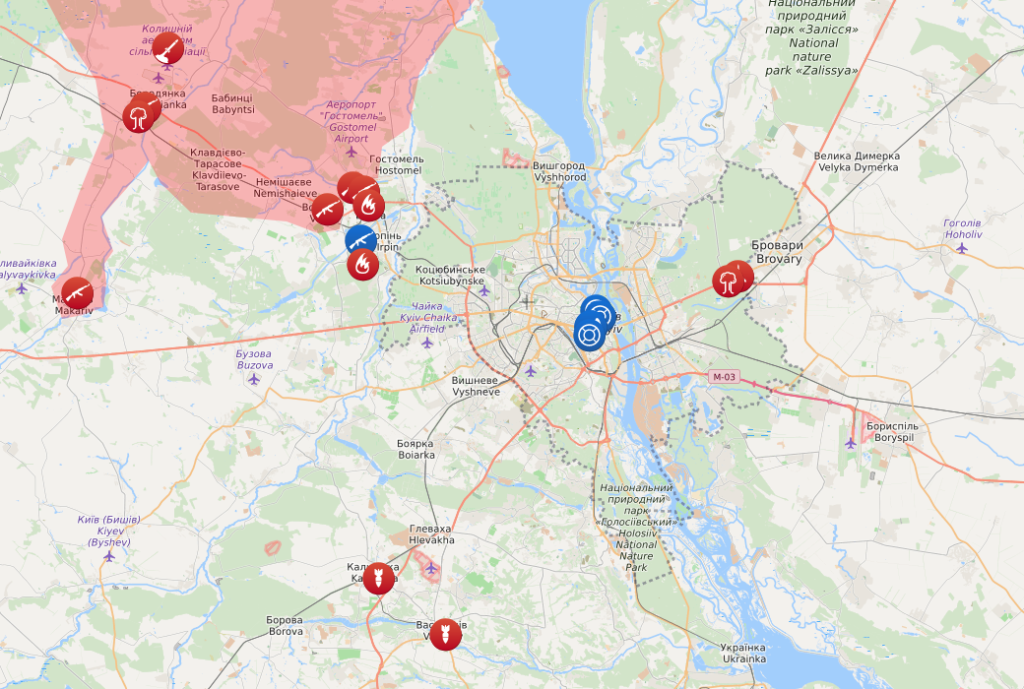
Yesterday’s post noted: “Russia has failed to encircle and isolate Kyiv with the combination of mechanized and airborne attacks as it had clearly planned to do. Russian forces are now engaging in more straightforward mechanized drives into the capital along a narrow front along the west bank of the Dnipro River and toward Kyiv from a broad front to the northeast.”
That’s what you can see on the Livemap of Kiev here, with that red area being controlled by Russian forces:
If Ukrainian forces can keep them from entering Kiev proper, that will go a long way toward stopping Putin’s invasion cold.
The “swift and severe” sanctions of the U.S. and its allies took a while to arrive, not taking effect until 96 hours or so after the first steps of the Russian invasion of Ukraine.
But to give credit where its due, once those sanctions did kick in, the consequences were indeed intense:
At one point, “The ruble plunged to a record low of less than one U.S. penny” — at one point 118 rubles to a dollar, before recovering to 84 rubles to a dollar.
The Economist noted, even with the recovery, that it was “one of the largest one-day slumps in the Russian currency’s modern history, similar in scale to the one-day declines recorded during the worst moments of the country’s financial crisis in 1998, when Russia defaulted on its debt. In mid-morning in Moscow, the Russian central bank raised its key interest rate from 9.5 percent to 20 percent in an effort to stem the ruble’s slump, and the country’s finance ministry ordered companies with foreign-currency revenues to convert 80 percent of their income into rubles.”
One analyst on CNBC summarized that the Russian currency has “pretty much lost all value outside of the country. . . . To me, it doesn’t really feel like we’re looking at or at least we’re going to see the bottom in the ruble here. I think there still is plenty more room for weakness to come.”
The Moscow stock exchange initially delayed its opening this morning, then declared it would be closed for the day.
Russians no longer have faith that their banks will remain solvent: “Russians waited in long queues outside ATMs on Sunday, worried that bank cards may cease to function, or that banks would limit cash withdrawals. ‘Since Thursday, everyone has been running from ATM to ATM to get cash. Some are lucky, others not so much,’ St Petersburg resident, Pyotr, who declined to give his last name, said.”
CNN reports that, “One early casualty was the European subsidiary of Sberbank, Russia’s biggest lender that has been sanctioned by Western allies. The European Central Bank said Sberbank Europe, including its Austrian and Croatian branches, was failing, or likely to fail, because of ‘significant deposit outflows’ triggered by the Ukraine crisis.”
It’s now five days since Russian President Vladimir Putin sent his mostly conscript army into Ukraine to overthrow the government of President Volodymyr Zelenskyy, and it hasn’t gone as planned. In what may signal frustration, Putin has put his nuclear forces on alert in one last desperate move to beat his chest and show the world who’s in charge.
Time has given some clarity to the operation and allows the drawing of some conclusions.
I’m a retired Army lieutenant colonel—an intelligence officer. My training, from 1983 to 2007, was a Cold War focus on the old Soviet Union, the predecessor state to the Russian Federation. Never in my time as an intelligence officer was I able to see the worst-case scenario of a large-scale conventional Russian attack in Europe—until now.
I’ve seen multiple reports of Russian conscripts who didn’t know they were invading Ukraine. They’re confused. They don’t know who to shoot at, as “Ukrainians look the same as us.” The Russian force appears to suffer from: Poor training; poor leadership (bad officers); and a cultural disregard for information-sharing down the chain of command, which prevents lower-ranking soldiers from making informed decisions in the chaos of war.
The result of all this is a lack of initiative from soldiers when non-commissioned officers and officers are killed or wounded.
It is important to note that the Russian army hasn’t fought a conventional war against a near-peer enemy since 1945. It’s out of practice, poorly trained, poorly led, and poorly motivated. It does have plenty of heavy armaments—very large thermobaric bombs. It can destroy, but it can’t fight effectively.
Regarding the “Father of Bombs,” a large thermobaric or “vacuum” bombs capable of destroying a city block, killing 10,000 or more civilians and soldiers. Using one on Kyiv would horrify the world and likely increase calls for war crimes charges on Russian leaders. The Russians have used smaller thermobaric weapons against Ukrainian bunkers.
This opens another question: How powerful are Russia’s reconstituted zampolit? Putin brought them back in 2018. The zampolit were political officers in the old Red Army, previously called “commissars” until 1942 when the position’s battlefield power was scaled back in response to negative military command implications.
If a Russian field commander is ordered to use a city-busting thermobaric bomb, will he? Or will he refuse to carry out the order, like German Gen. von Choltitz when Adolf Hitler ordered him to destroy Paris—unless a zampolit is looking over his shoulder with a pistol?
Logistics is also manifesting itself as a Russian weak spot. Logistics is hard—it’s harder in combat. It requires synchronizing the delivery of fuel, ammo, and food to frontline forces all while the enemy is shooting at your resupply trucks. At four days in, Russian forces are running out of basic supplies. This has a powerfully negative effect on morale.
Complicating Russian resupply efforts are indications that Ukrainian light forces hunkered down during the initial Russian wave passed by, only to reemerge when the lightly armored supply columns entered Ukraine. Also of note is the increasingly effective Ukrainian use of Turkish-designed BayraktarTB2 drones. These low-cost, slow, non-stealthy drones have scored dozens of kills on Russian columns. Ukraine has about 60 of them.
As Ukrainian resistance stiffens and tens of thousands of Ukrainian citizens rush to defend their nation, other nations in the region have been emboldened. Germany is sending 1,000 antitank missiles and 500 Stinger antiaircraft missiles. The Czech Republic and the Netherlands are sending small arms and ammunition.
His successor Shoygu knew better than that. Now who's Shoygu? Shoygu is the *only* single Russian minister who uninterruptedly worked in government since 1991, since the very beginning of Russian Federation. He worked for all presidents, all prime ministers avoided all purges pic.twitter.com/EOx5MH6lb3
There was another issue. Shoygu is ethnic Tuvan. In such a country as Russia minority member can hardly become the supreme leader. People don't perceive him as ethnic Russian (see his palace) which means he's not dangerous for the leader and you can safely delegate him the army pic.twitter.com/a4zJA1ePa0
He also says Russia is only using one echelon of troops:
How is a Blitzkrieg organised? By echelons. First echelon is moving forward as fast as they can. Ofc this means that lots of defenders will be left in their rear. But then the second echelon comes, then third, etc. They finish defenders, occupy territory, control the supply lines pic.twitter.com/AQtm8ntLfO
Secondly, launching several echelons would require long arduous preparation. You need to mobilise them, move to the borders, quarter, maintain and supply. It's not that easy. It's a hard job that should have been done well in advance to wage a Blitzkrieg. And it hadn't been done
The Russian offensive in Ukraine continues to bog down against stiff resistance, Putin puts his nukes on alert, a rumor of peace talks, momentum to suspend some Russian banks from SWIFT builds, and a whole lot of aid from the rest of the world is pouring into Ukraine.
Russia invaded Ukraine from three sides on Wednesday night Eastern time, and as of now, early afternoon Saturday, the Russian army has yet to seize any Ukrainian cities.
This morning, a senior defense official at the Pentagon briefed reporters and declared, “We continue to believe, based on what we have observed that this resistance is greater than what the Russians expected and we have indications that the Russians are increasingly frustrated by their lack of momentum over the last 24 hours particularly in the north parts of Ukraine… As of this morning we have no indication still that the Russian military has taken control over any cities. As of this morning we still believe that Russia has yet to achieve air superiority. Ukrainian air defenses including aircraft do continue to be operable and continue to engage and deny access to Russian aircraft in places over the country.”
There is an intriguing but unverified claim from Ukrainian intelligence that Putin is furious, that he expected a quick surrender from Kiev, and that the invading Russian forces weren’t equipped for a long war – and that after ten days, the Russian forces will face serious problems with supply lines, fuel, equipment, ammunition, etc. Maybe this is just Ukrainian propaganda, meant to keep up morale for the next week or so. But there are some intriguing anecdotes of Ukrainians hitting Russian supply columns and videos of Russian tanks running out of fuel. (It turns out supply chain problems are just everywhere these days!)
Sending in armored columns without dedicated infantry, artillery and air support is a big risk, big reward move. Patton did it successfully in the race across France in 1944, but he had air superiority, a friendly population, and the greatest war machine ever assembled in the history of mankind up to that time backing him, and even he had to halt when he outran his supply lines.
Putin’s initial goal, the Russian reabsorption of Ukraine or the transformation of it into a lackey state of a renewed Russian empire, is now probably impossible. Any Russian-backed Ukrainian puppet government is likely to be vehemently rejected by the Ukrainian people. Russian forces will find it difficult to go out on patrol when every citizen’s got a rifle and every grandma on every street corner is handing them sunflower seeds, telling them they are going to be fertilizer soon.
Russia may take large chunks of Ukraine, but they will have an exceptionally difficult time keeping it.
The last three days of combat should put a serious dent in the reputation of this new Russian army. We should, however, try to understand why the Russians are struggling. First, the Russian army’s recent structural reforms do not appear to have been sufficient to the task at hand. Second, at the tactical and operational level, the Russians are failing to get the most out of their manpower and materiel advantage.
There has been much talk over the last ten years about the Russian army’s modernization and professionalization. After suffering severe neglect in the ’90s, during Russia’s post-Soviet financial crisis, the army began to reorganize and modernize with the strengthening of the Russian economy under Putin. First the army got smaller, at least compared to the Soviet Red Army, which allowed a higher per-soldier funding ratio than in previous eras. The Russians spent vast sums of money to modernize and improve their equipment and kit — everything from new models of main battle tanks to, in 2013, ordering Russian troopers to finally retire the traditional portyanki foot wraps and switch to socks.
But the Russians have also gone the wrong direction in some areas. In 2008, the Russian government cut the conscription term from 24 to twelve months. As Gil Barndollar, a former U.S. Marine infantry officer, wrote in 2020:
Russia currently fields an active-duty military of just under 1 million men. Of this force, approximately 260,000 are conscripts and 410,000 are contract soldiers (kontraktniki). The shortened 12-month conscript term provides at most five months of utilization time for these servicemen. Conscripts remain about a quarter of the force even in elite commando (spetsnaz) units.
As anyone who has served in the military will tell you, twelve months is barely enough time to become proficient at simply being a rifleman. It’s nowhere near enough time for the average soldier to learn the skills required to be an effective small-unit leader.
Yes, the Russians have indeed made efforts to professionalize the officer and the NCO corps. Of course, non-commissioned officers (NCOs) have historically been a weakness of the Russian system. In the West, NCOs are the professional, experienced backbone of an army. They are expected to be experts in their military speciality (armor, mortars, infantry, logistics, etc.) and can thus be effective small-unit commanders at the squad and section level, as well as advisers to the commanders at the platoon and company level. In short, a Western army pairs a young infantry lieutenant with a grizzled staff sergeant; a U.S. Marine Corps company commander, usually a captain, will be paired with a gunnery sergeant and a first sergeant. The officer still holds the moral and legal authority and responsibility for his command — but he would be foolish to not listen to the advice and opinion of the unit’s senior NCOs.
The Russian army, in practice, does not operate like this. A high proportion of the soldiers wearing NCO stripes in the modern Russian army are little more than senior conscripts near the end of their term of service. In recent years, the Russians have established a dedicated NCO academy and cut the number of officers in the army in an effort to put more resources into improving the NCO corps, but the changes have not been enough to solve the army’s leadership deficit.
Now, let’s talk about the Russian failures at the operational and tactical level.
It should be emphasized again that the Russian army, through sheer weight of men and materiel, is still likely to win this war. But it’s becoming more and more apparent that the Russians’ operational and tactical choices have not made that task easy on themselves.
First, to many observers, it’s simply shocking that the Russians have not been able to establish complete air superiority over Ukrainian air space. After three days of hostilities, Ukrainian pilots are still taking to the skies and Ukrainian anti-air batteries are still exacting a toll on Russian aircraft. The fact that the Russians have not been able to mount a dominant Suppression of Enemy Air Defenses (SEAD) campaign and yet are insistent on attempting contested air-assault operations is, simply put, astounding. It’s also been extremely costly for the Russians.
To compound that problem, the Russians have undertaken operations on multiple avenues of advance, which, at least in the early stages of this campaign, are not able to mutually support each other. Until they get much closer to the capital, the Russian units moving north out of Crimea are not able to help the Russian armored columns advancing on Kyiv. The troops pushing towards Kyiv from Belarus aren’t able to affect the Ukrainians defending the Donbas in the east. As the Russians move deeper into Ukraine, this can and will change, but it unquestionably made the opening stages of their operations more difficult.
Third, the Russians — possibly out of hubris — do not appear to have prepared the logistical train necessary to keep some of their units in action for an extended period of time. Multiple videos have emerged of Russian columns out of gas and stuck on Ukrainian roads.
The classic saying is “Amateurs talk about tactics, but professionals study logistics” (attributed to Marines Corps commander Gen. Robert H. Barrow, but I suspect the general sentiment is much older). An army runs on its stomach, and a modern mechanized army runs on its gas tank, and something has clearly gone wrong in with Russian logistical support for this war.
Russia seemed to have expected Ukrainian President Volodymyr Zelenskyy to fold. He hasn’t.
America offered to evacuate Ukrainian President Volodymyr Zelenskyy. Zelenskyy replied, “The fight is here; I need ammunition, not a ride.”
Zelenskyy’s reply was reminiscent of past heroes in times of war: Gen. Anthony McAuliffe who replied in “NUTS” in response to the German demand for surrender at Bastogne during the Battle of the Bulge in 1944; and the Texans striving for independence from dictator Santa Anna’s Mexico with their “Come and Take it Flag,” which was itself appropriated from Spartan King Leonidas and his response the Persian surrender demand at the Battle of Thermopylae.
This bravery, in a day when modern communications allow all Ukrainians and the world to see it, has rallied Ukrainians to defend their nation. And now that the fighting has gone on for three days, what might that mean?
Russian President Putin is said to have assembled 200,000 troops for the invasion. It is estimated that half of them have been committed so far. Further, Putin has called on 10,000 battle-hardened Chechen mercenaries. More than half of Russian forces are likely committed to the battle of Kyiv.
Ukraine has 245,000 active-duty members, but most are in the east, facing the Russian-led and equipped militia in the separatist regions of Donetsk and Luhansk. Ukraine also has another 220,000 reservists. Many of these are spread across the nation slightly larger than the state of Texas.
The strategic target is Kyiv and its independent government. To move the reservists to the fight, they must contend with Russian air superiority, slowing their march. More importantly, given this struggle for national survival, 7,000,000 men of military age and fit for military service are taking up arms. Every day, many more older men — and many Ukrainian women — are also being issued weapons, making Molotov cocktails, and joining the fight.
The ongoing Ukrainian mobilization means that the Russian military will soon be outnumbered most everywhere on the battlefield. The Ukrainians may not have the same level of modern equipment — missiles, jets, helicopter — but they have numbers and will power. And, the Russians need to eat, they need fuel, and ammunition — their resupply trucks must get through. They won’t, not in large enough numbers; everyday Ukrainians will see to that.
Zelensky: ‘We successfully fought off enemy attacks. We are defending our country, our land, future of our children. Kyiv & key places near the capital are under our control. The occupiers wanted to capture our capital and install their puppets like Donetsk. We broke their idea.’ pic.twitter.com/3PtnzXmPoy
Russian forces’ main axes of advance in the last 24 hours focused on Kyiv, northeastern Ukraine, and southern Ukraine. Russian airborne and special forces troops are engaged in urban warfare in northwestern Kyiv, but Russian mechanized forces are not yet in the capital. Russian forces from Crimea have changed their primary axes of advance from a presumed drive toward Odesa to focus on pushing north toward Zaporizhie and the southeastern bend of the Dnipro River and east along the Azov Sea coast toward Mariupol. These advances risk cutting off the large concentrations of Ukrainian forces still defending the former line of contact between unoccupied Ukraine and occupied Donbas. Ukrainian leaders may soon face the painful decision of ordering the withdrawal of those forces and the ceding of more of eastern Ukraine or allowing much of Ukraine’s uncommitted conventional combat power to be encircled and destroyed. There are no indications as yet of whether the Ukrainian government is considering this decision point.
Ukrainian resistance remains remarkably effective and Russian operations especially on the Kyiv axis have been poorly coordinated and executed, leading to significant Russian failures on that axis and at Kharkiv. Russian forces remain much larger and more capable than Ukraine’s conventional military, however, and Russian advances in southern Ukraine may threaten to unhinge the defense of Kyiv and northeastern Ukraine if they continue unchecked.
Key Takeaways
Russia has failed to encircle and isolate Kyiv with the combination of mechanized and airborne attacks as it had clearly planned to do. Russian forces are now engaging in more straightforward mechanized drives into the capital along a narrow front along the west bank of the Dnipro River and toward Kyiv from a broad front to the northeast.
Russian forces have temporarily abandoned failed efforts to seize Chernihiv and Kharkiv to the northeast and east of Kyiv and are bypassing those cities to continue their drive on Kyiv. Russian attacks against both cities appear to have been poorly designed and executed and to have encountered more determined and effective Ukrainian resistance than they expected.
Russian movements in eastern Ukraine remain primarily focused on pinning the large concentration of Ukrainian conventional forces arrayed along the former line of contact in the east, likely to prevent them from interfering with Russian drives on Kyiv and to facilitate their encirclement and destruction.
Russian forces coming north from Crimea halted their drive westward toward Odesa, and Ukrainian forces have retaken the critical city of Kherson. Some Russian troops remain west of the Dnipro River and are advancing on Mikolayiv, but the main axes of advance have shifted to the north and east toward Zaporizhie and Mariupol respectively.
Russian forces have taken the critical city of Berdyansk from the west, threatening to encircle Mariupol even as Russian forces based in occupied Donbas attack Mariupol from the east, likely to pin defenders in the city as they are encircled.
Russian successes in southern Ukraine are the most dangerous and threaten to unhinge Ukraine’s successful defenses and rearguard actions to the north and northeast.
Russian troops are facing growing morale and logistics issues, predictable consequences of the poor planning, coordination, and execution of attacks along Ukraine’s northern border.
It appears that the various armored column incursions were secondary to or distractions from the attempted paratroop-powered decapitation strike to be launched from Antonov International Airport. When that went awry (as airborne assaults often do; see the SNAFU that was Operation Market Garden in World War II), there appeared to be no coherent backup plan.
Indeed, the entire operation seems to have been hastily planned and executed, which is odd, since Ukraine has obviously been much on Putin’s mind since 2014.
This is not the way competent troops act in hostile urban environments. It’s like the Russian army forgot all they learned from getting their asses kicked in the First Battle of Grozny, where driving ill-supported mechanized columns filled with untrained conscripts into the city resulted in horrible losses for the Russians.
The Kiev assault seems even less thought out, and their opponents appear much better equipped and trained than the Chechens were.
On the other hand, here’s a report that Kiev is surrounded. I’d take that with several grains of salt.
Putin puts Russian nuclear forces on alert. The idea that Putin would actually contemplate nuclear war with the west because his own ill-conceived and badly-executed invasion of Ukraine has gone off the rails is hardly credible. Russia would be annihilated.
“As you can see, not only do Western countries take unfriendly measures against our country in the economic dimension – I mean the illegal sanctions that everyone knows about very well – but also the top officials of leading NATO countries allow themselves to make aggressive statements with regards to our country,” Putin said on state television.
“Mommy, they’re saying bad things about me!” Those unfriendly measures would, of course, stop instantly if Putin were to withdraw his forces from the territory of other sovereign nations.
Here’s a video of Putin explaining himself:
Does that look or sound like an all-powerful conqueror at the top of his game? No, that’s the tone and the body language of a guy trying to explain why he just fucked up. “We had no other choice!” Yeah, except, you know, not invading another country.
There are evidently plans for talks between Ukrainian and Russian delegations on the Ukraine border with Belarus. Don’t expect much. Zelenskyy: “I do not really believe in the result of this meeting, but let them try, so that no citizen of Ukraine would have any doubt that I, as president, did not try to stop the war when there was even a small chance.”
The U.S. is sending $350 million in military aid. “The defense aid will include anti-armor, small arms and various munitions, and body armor and related equipment.” Let’s hope none of it disappears into the pockets of people connected to members of the Senate Foreign Relations Committee…
Speaking of reversing course, Germany has also done an about-face and is now in favor of removing some Russian banks from SWIFT. “The sanctions, agreed with the United States, France, Canada, Italy, Great Britain and the European Commission also include limiting the ability of Russia’s central bank to support the ruble.” I get the impression that the Eurocrats were hesitant to cut Russia off from SWIFT because they thought it would be a useless gesture. Now that Russia’s invasion has gone off the rails, they’re rethinking. The quick reverse also indicates how pissed they are at Russia right now.
Europe has effectively closed its airspace to Russia:
Based on published NOTAMs, adding Austria, Germany, Iceland, and Italy to the list of airspace unavailable to Russian flights — all in effect by 14:00 UTC. Based statements by government officials, we expect further prohibitions on Russian flights. https://t.co/3GtCYRmZUQpic.twitter.com/O0WTcsdRlz
A final word: There are a few Twitter pundits suggesting that some sort of “wag the dog” scenario of a fake war might be unfolding in Ukraine. I don’t buy it. There’s too much real reporting from too many points in Ukraine for such an elaborate, two-part deception to be unfolding. Lots of weird things happen in warfare.
I will say one thing: The manifest incompetence with which Russia has tried to carry out this assault suggests that Putin felt he had to launch it then due to some sort of time pressure or deadline, but I don’t know what it is. Maybe Putin has late stage cancer, or he felt Ukraine was about to join NATO, or a major Russian oilfield is about to run dry. Whatever it is, this war appears to be a panic move that’s gone very badly for Putin.
Ukraine fights back, Biden isn’t going to do jack about it, Kyle Rittenhouse is going to sue everyone, inflation soars, the Canadian “emergency” is ended, disaster looms for Democrats, and Ilhan Omar gets an unusual challenger. It’s the Friday LinkSwarm!
While reports of the battle are confused and preliminary, it appears that Ukrainian forces counterattacked, shot down some Russian helicopters, and have so far been able to prevent the Russians from landing reinforcements. Initial claims that the Russian force at the airfield had been “destroyed” were later clarified; it now seems that the battle at Gostomel is continuing. It’s easy to understand how crucial this battle is, simply by looking at a map. If the Russians could gain control of the Gostomel airfield, they could score a quick knock-out of the Ukrainian capital as part of what is being called their “decapitation” strategy.
Russian news services are claiming they’ve taken the airfield, but that may be stale news or propaganda.
Ukrainian forces take up positions in Kiev. Also: “Reports that the Ukrainian military has delivered a strike on a Russian airfield in Millerovo, Rostov Oblast have now been confirmed.”
The invasion of Ukraine by the armed forces of Russia at Russian President Vladimir Putin’s orders marks the first time since 1945 that Russia has engaged in a conventional war with a near-peer nation.
Ukraine isn’t restive Warsaw Pact nations, it isn’t Afghanistan, it isn’t Chechnya, it isn’t Georgia, and it isn’t Crimea.
The conflict launched by Putin is on a far grander scale than the invasion of Crimea in 2014, launched as Ukraine’s last pro-Russia president, Viktor Yanukovych, was driven from office in a popular uprising.
Putin, by choosing to reach beyond the ethnic-Russian majority separatist provinces of Donetsk and Luhansk in the Donbas Basin, has decided to end the independent, Western-looking Ukrainian government of President Volodymyr Zelenskyy and install a pro-Putin quisling.
And while the fog of war, some deliberate mis-and disinformation operations by the combatants, and the far-from-perfect filter of Western media leaves much unknown at this time, what is known is that Zelenskyy is still in power a day after the Russian offensive. Further, the Ukrainian military appears to be taking a toll on the Russians invading from three sides: south across the Pripyat Marshes from Russian satellite Belarus; west from Russia, including Donbas; and north from the Black Sea in the region of Odessa and Transnistria, a Russian client breakaway state in Moldavia.
Modern conventional war is extremely difficult to do well. Imagine being a conductor of an orchestra, all while the audience was lobbing soccer balls at you and your musicians as you perform J.S. Bach’s Chaconne in D — that’s modern warfare. Putin is attempting a highly complicated operation over large distances in the face of a determined foe. Further, he’s doing so with an army largely composed of conscripts serving for only one year.
Since Putin has decided to oust the Ukrainian government, this means that every day Zelenskyy remains in office is another day that adds to Ukrainian national confidence to resist — and another day that Putin looks to have miscalculated.
A Russian Military Ship telling 13 Ukrainian troops on Snake Island to surrender. They were met with a response of " Russian military Ship, go fuck yourself."
Both the EU and the Biden Administration offer sanctions they admit will not do Jack Squat.
FULL DOCUMENT: This is the general license that US Treasury has issued exempting any "energy" related dealings from the sanctions imposed on some of the biggest Russian banks. It's so wide ranging that even includes "wood" as a form of energy exempted | #Ukraine#OOTTpic.twitter.com/3X5t0LFi3W
WATCH: AP reporter roasts Biden's State Department spokesman over the "frankly huge" list of exemptions in Biden's sanctions on Russia.pic.twitter.com/gzAWB4LwMg
Taiwan joins sanctions against Russia, including their semiconductor industry. I don’t know if any fabless Russian chip design company gets their chips fabbed at TSMC, so I’m not sure how badly this hurts their economy in the long run.
It is the West’s wacko environmentalists who handed Russian President Vladimir Putin the leverage and money to invade Crimea in 2014 and Ukraine this week.
Without these wackos, Putin would be just another gangster in charge of a crumbling country, and maybe one on the verge of a revolution to depose him.
But the facts are the facts are the facts, and the facts are these… Thanks to the West’s environmentalists, those smug greenies who are more concerned with carbon output than world peace, this gangster controls much of the energy going to the European Union (E.U.).
Thanks a lot, Greta…
A great mystery:
Under Carter, Russia invaded Afghanistan. Under Obama, Russia took over Crimea. Under Biden, Russia is invading the rest of Ukraine. Russians do land grabs when Democrats control the White House. Democrats get pissed when you point it out. But it is still true.
Biden is demonstrably more hostile to American oil and gas companies than he is to Russian companies, having frozen oil and gas leasesdespite a court order otherwise.
Thanks to Biden’s inflation, the cost of everything is going up. “70 percent of Americans are living paycheck to paycheck.”
Fellow former finance reporter Chrystia Freeland — someone I’ve known since we were both expat journalists in Russia in the nineties — announced last week that her native Canada would be making Sorkin’s vision a reality. Freeland arouses strong feelings among old Russia hands. Before the Yeltsin era collapsed, she had consistent, remarkable access to gangster-oligarchs like Boris Berezovsky, who appeared in her Financial Times articles described as aw-shucks humans just doing their best to make sure “big capital” maintained its “necessary role” in Russia’s political life. “Berezovsky was one of several financiers who came together in a last-ditch attempt to keep the Communists out of the Kremlin” was typical Freeland fare in, say, 1998.
Then the Yeltsin era collapsed in corrupt ignominy and Freeland immediately wrote a book called Sale of the Century that identified Yeltsin’s embrace of her former top sources as the “original sin” of Russian capitalism, a “Faustian bargain” that crippled Russia’s chance at true progress. This is Freeland on Yeltsin’s successor in 2000. Note the “Yes, Putin has a reputation for beating the press, but his economic rep is solid!” passage at the end:
It looks as if we’re about to fall in love with Russia all over again…
Compared to the ailing, drink-addled figure Boris Yeltsin cut in his later years, his successor, Vladimir Putin, in the eyes of many western observers, seems refreshingly direct, decisive and energetic… Tony Blair, who has already paid Putin the compliment of a visit to Russia and received the newly installed president in Downing Street in return, has praised him as a strong leader with a reformist vision. Bill Clinton, who recently hot-footed it to Russia, offered the equally sunny appraisal that “when we look at Russia today . . . we see an economy that is growing . . . we see a Russia that has just completed a democratic transfer of power for the first time in a thousand years.”
To be sure, some critics have lamented Putin’s support for the bloody second war in Chechnya, accused him of eroding freedom of the press…and worried aloud that his KGB background and unrepenting loyalty to the honor of that institution could jeopardize Russia’s fragile democratic institutions. But many of even Putin’s fiercest prosecutors seem inclined to give him the benefit of the doubt when it comes to the economy…
Years later, she is somehow Canada’s Finance Minister, and what another friend from our Russia days laughingly describes as “the Nurse Ratched of the New World Order.” At the end of last week, Minister Freeland explained that in expanding its Financial Transactions and Reports Analysis Centre of Canada (FINTRAC) program, her government was “directing Canadian financial institutions to review their relationships with anyone involved in the illegal blockades.”
The Emergencies Act contains language beyond the inventive powers of the best sci-fi writers. It defines a “designated person” — a person eligible for cutoff of financial services — as someone “directly or indirectly” participating in a “public assembly that may reasonably be expected to lead to a breach of the peace.” Directly or indirectly?
She went on to describe the invocation of Canada’s Emergencies Act in the dripping-fake tones of someone trying to put a smile on an insurance claim rejection, with even phrases packed with bad news steered upward in the form of cheery hypotheticals. As in, The names of both individuals and entities as well as crypto wallets? Have been shared? By the RCMP with financial institutions? And accounts have been frozen? As she confirmed this monstrous news about freezing bank accounts, Freeland burst into nervous laughter, looking like Tony Perkins sharing a cheery memory with “mother.”
Angeleno’s tax dollars at work:
A city audit found LA spends $837,000 to house one homeless person. Perhaps this is why Newsom has done everything he can to block my statewide audit.
China is getting a good return on its investment in the Biden clan: “DOJ shuts down China-focused anti-espionage program. The China Initiative is being cast aside largely because of perceptions that it unfairly painted Chinese Americans and U.S. residents of Chinese origin as disloyal.” We can’t let national security stand in the way of political correctness…
In what may be remembered as one of the greatest miracles of all time, it seems that an upcoming American election cycle is set to put an end to the great COVID pandemic in regions that have been clinging to “mitigation” tactics despite them being proven ineffective long ago. What science couldn’t do for blue state governors, politics is about to. Meanwhile, much of the rest of the country has already adopted an “endemic” approach to COVID. In my Indiana community, for instance, school systems have been in-person and maskless for well over a year.
A combination of experience and common sense led local officials to recognize that while COVID was a serious virus, and an often-times unpleasant condition to endure, we just weren’t experiencing the kind of mortality rates or critical hospitalizations that would require the suspension of normal life. If I was guessing, I would say that there are more counties, cities, and communities in the United States like mine than not.
While mainstream media may be drawn like a moth to the bright lights of urban areas with all the restrictions, mandates, and panic-fueled policies enacted there, most Americans have been “living with” the virus for a long time now.
In fact, if my community is any bellwether for the nation, most Americans are already wondering why anyone is still attempting to take a non-endemic approach at this point. The virus has proven itself to be, like all other viruses, prone to seasonal surges that are largely unaltered by our theatrical mitigation techniques. Not that anyone with their head screwed on straight ever thought there was value in wearing a porous cloth mask while standing up at a restaurant, then taking it off while sitting down, but the comical nonsense of mask histrionics is now widely appreciated as a goofy spectator sport. Behold:
So silly. And so as opinion polls continue showing that an ever-increasing number of Americans are infuriated by this nonsense, and that they are done with all the aggressive pandemic restrictions that proved unnecessary a long time ago, a public pivot of massive proportions is underway amongst the political class.
Whether it’s big blue state governors like California’s Gavin Newsom hilariously announcing that he will be transitioning his state to the country’s first “endemic” virus policy – meaning they’re going to start doing some things that Texas, Florida, South Dakota, Indiana, and so many others have been doing for over a year – or whether it’s blue city school boards like San Francisco’s being recalled by angry voters for their abusive and needless shutdown and masking policies, it’s clear where we’re headed.
Despite that, the midterm news for Democrats is not good.
Democrats know that they should be preparing for a brutal showing in this November’s midterm elections. Glenn Youngkin’s victory in the Virginia gubernatorial race last year — and, more to the point, the substance and style of his successful campaign — were the first sign of it.
But the hits have kept on coming. In San Francisco last week, two progressive parents succeeded in their campaign to oust three school-board members for being . . . too progressive. Irked initially at how long it was taking for area schools to reopen for in-person learning during the pandemic, these two single parents did some digging and discovered even more to be upset about: an enormous budget shortfall, an intensive campaign to rename dozens of school buildings, and the replacement of a merit-based admissions program with a diversity-minded lottery, among other issues.
Suggesting just how central education has become to politics, San Francisco’s intensely progressive mayor, London Breed — who last fall violated her own mask mandate at a concert and defended herself by saying she was “feeling the spirit” — endorsed the school-board recall effort.
“My take is that it was really about the frustration of the board of education doing their fundamental job,” Breed said after the results were in. “And that is to make sure that our children are getting educated, that they get back into the classroom. And that did not occur. . . . We failed our children. Parents were upset. The city as a whole was upset, and the decision to recall school-board members was a result of that.”
San Francisco–based writer Gary Kamiya suggests in a piece for the Atlantic that the results of the recall seem to confirm the conservative narrative. Kamiya writes that conservatives have argued “that the Democratic Party is out of step not just with Republicans, but with its own constituents. . . . Progressives rejected such conclusions, insisting that the recall was simply about competence and was driven by an only-in-San-Francisco set of circumstances.” Kamiya concludes that the best way to read the outcome is “closer to the conservative view.” “At a minimum,” Kamiya writes, “the recall demonstrates that ‘woke’ racial politics have their limits, even in one of the wokest cities in the country.”
Over in Texas, meanwhile, failed Senate candidate and failed presidential hopeful Beto O’Rourke is gearing up to become a failed gubernatorial candidate, too. Running against incumbent Republican governor Greg Abbott, O’Rourke was most recently seen trying to pretend that he isn’t a fan of radical gun-control measures.
Asked about the promise he made during his run for president that he would “take away AR-15s and AK-47s,” O’Rourke attempted a hard about-face.
“I’m not interested in taking anything from anyone,” he said. “What I want to make sure that we do is defend the Second Amendment. I want to make sure that we protect our fellow Texans far better than we’re doing right now. And that we listen to law enforcement, which Greg Abbott refused to do. He turned his back on them when he signed that permitless-carry bill that endangers the lives of law enforcement in a state that’s seen more cops and sheriff’s deputies gunned down than in any other.”
As Charlie Cooke has noted, this is utter tripe. It also isn’t working. The latest poll of the race from the Dallas Moring News has Abbott up by seven points, 45 percent to 38 percent. O’Rourke himself remains underwater with voters: Only 40 percent view him favorably, while 46 percent say they have an unfavorable view of the candidate.
Republicans win a Jacksonville City Council race:
It's a citywide race, and this result will more or less match the average partisanship of the city for the past decade or so. But this was a Dem-held seat, and losing it in this fashion has to hurt the local party. And doesn't portend well in other races.
Kyle Rittenhouse is finally ready to sue, including lawsuits against Whoopi Goldberg and Cenk Uygur. I hope he bankrupts anyone who called him a white supremacist.
Former Houston Rockets draft bust Royce White is running for Congress as a Republican against “Squad” member Ilhan Omar. Hopefully he can be on the campaign trail more than he was on the floor for the Rockets…