Posts Tagged ‘Poland’

German Dam On Ukraine Aid Finally Bursts

Tuesday, January 17th, 2023

For most of last year there was a recurring pattern for German military aid to Ukraine:

  • The German government would talk about sending various types of modern military equipment to Germany.
  • The German government would actually send Ukraine numerous pallets of Diddly and Squat.
  • I almost did a post on “What’s holding up the German weapons pipeline?” Now, thanks to Peter Zeihan, we know that clog has a name: Christine Lambrecht, the German Defense Minister, who just resigned.

    Takeaways:

  • Lambrecht is not somebody with defense experience. She’s a politico. She has been up relatively high in Germany’s Social Democratic Party, which is a center-left party for decades. So it’s not that she’s a nobody, it’s just she doesn’t have a lot of skills that are appropriate to her current portfolio. This has not been a problem. In fact her specific, deliberate, intentional incompetence and defense matters in many ways was seen by the SPD as a plus.

    Until the Russo-Ukrainian War.

  • “The general position in Germany as a whole, and specifically in the SPD, was that the Defense Ministry itself is unnecessary, that in the aftermath of the Cold War, the threat to Germany is gone.”
  • Plus the deep-seated problem of all Germany’s Historical Unpleasantness.

  • So for the Germans, the post-cold war environment in Europe has been the best it’s ever been. You’re talking about a golden age, because NATO has provided defense, but all the countries that border Germany are either neutral, like Switzerland, or are members of NATO, which is basically everyone else. And in that sort of environment, the Germans can kind of dither and become pacifist socialists. Which, to be perfectly blunt, looking at the long stretch of German history is much, much, much, much, much, much better for everyone than the alternative.

  • “Lambrecht was put in charge of the Defense Ministry to basically continue slowly sliding it into functional oblivion.”
  • “That doesn’t work in an environment where the Russians are back on the warpath, and the Germans need to be starting thinking not just about 20th century military strategy, but 19th century military strategy, and Lambrecht was completely unprepared, professionally, personally and ideologically for this sort of shift.”
  • Indeed, she was a poor fit for a Germany doubling its defense budget. Plus, she hates the U.S.
  • “The Russians are not just mobilizing, but mobilizing in force. They’re finally beginning significant industrial upgrades. They’re finally starting to churn out missiles and ammo and tanks and numbers. And they are finally doing a full-scale mobilization. This isn’t the 300,000 that they did a few weeks ago. We’re talking about at least another half a million men likely being in the theater within a very few number of months.” Not sure where he’s getting this info, only see references to Russia considering it. (Unless my speculation that Russia was carrying out a full mobilization under the guise of a partial mobilization was on the mark.)
  • Germany may now finally move on approving other countries transferring Leopard 2 tanks to Ukraine. “There are a number of countries, specifically Denmark and Poland, who have been pressuring the Germans in order to allow them to take these exported tanks and then send them on to Ukraine. That requires Berlin’s approval, and Berlin at this point has been demurring. But the coalition now involves almost every single country that the Germans have sold the Leopards, to and so all of a sudden with Lambrecht gone, all of this is in motion, and I think we’re going to see the Germans relent.”
  • Faster, please.

    Finally, all of this is just an excuse to embedded this classic Norm Macdonald bit about Germany. “I’m not sure if any of you are history buffs…”

    Ukraine Update for November 15, 2022: Dnipro Crossed?

    Tuesday, November 15th, 2022

    Right after Kherson city was liberated and spans on the Antonivsky and Nova Kakhkovka bridges blown, a whole lot of commenters went “Well, Ukraine obviously isn’t going to try to cross the Dnipro there, it’s too wide.”

    Looks like that assumption might have been in error, as there are already reports that Ukraine has landed on the other side.

    The Kinburn Spit is a narrow finger of sand and scrub, barely three miles long, that juts from the wider Kinburn Peninsula into the Black Sea at the mouth of the Dnipro River south of Kherson. It and the adjacent peninsula also are the last parts of Ukraine’s Mykolaiv Oblast that remain under Russian occupation.

    Don’t expect that to last. The Kremlin on Wednesday ordered its battered forces on the right bank of the Dnipro to retreat to the river’s opposite bank.

    The order came six months after Ukrainian brigades, re-armed with European howitzers and American rocket-launchers, began bombarding Russian supply lines in the south—and two months after those same brigades launched a counteroffensive aimed at liberating Mykolaiv and Kherson Oblasts.

    The Ukrainians have the Kinburn Spit in their sights. They’ve got the troops, the equipment … and a plan.

    Russian troops seized the Kinburn Spit in mid-June as Russian advances in the south—having already overwhelmed Kherson city—ran into stiff resistance a few miles south of Mykolaiv city. Capturing the spit would turn out to be one of the Russian army’s last victories in the south. The four-month Ukrainian counterlogistics campaign that preceded Ukraine’s southern counteroffensive already was underway.

    Kinburn matters. Russian control of the sandy strip “will allow them to exert further control of the Black Sea coast,” the Institute for the Study of War in Washington, D.C. explained in June. For the Ukrainians, Kinburn is a back door—a way to get forces onto the left bank of the Dnipro without crossing the river, likely while under fire.

    As far back as April, U.K. intelligence agents were advising their government to support Ukrainian forces in any future attempt to “conduct beach reconnaissance” on the Kinburn Spit. The recon could “Identify good landing locations for a larger assault force for a future counterattack,” the agents explained in a presentation that later leaked to the press.

    It’s possible Ukrainian special operations forces riding in rigid-hull inflatable boats began reconnoitering the spit as early as September. In October, video circulated online reportedly depicting the Ukrainian navy’s last remaining big ship, the 240-foot amphibious vessel Yuri Olefirenko, apparently firing rockets at Russian forces on or near the spit.

    The Ukrainian military’s southern command on Saturday announced its intention to liberate Kinburn. Within a day, there were videos online possibly depicting Ukrainian commandos riding toward the spit in their small boats.

    Here’s a video of Ukrainian forces doing just that:

    Looks more like a commando raid or a reconnaissance in force. And here’s a video analyzing Russia defensive position on the Spit:

    There are unconfirmed reports of other river crossing zones. I’d take those with several grains of salt. But it seems possible. Indeed, there are reports confirming that Russia has indeed bugged out from towns in Kherson south of the Dnipro, like this video of apparently abandoned posts in Oleshky, directly south of the Antonovsky Bridge:

    The Ukrainian Defense Ministry has evidently confirmed Russia’s pullout from the banks of the Dnipro as well:

    Russia is preparing defensive positions in Crimea:

    Three areas they’ve prepared defensive lines are on the isthmus just south of Perekop, just south of the Chongar Strait, and even on the Arabat Spit, that tiny bit we talked about having a tiny dirt road here. Says Suchomimus: “It’s a bit of preparedness and foresight we haven’t seen from them so far.”

    Peter Zeihan thinks that Crimea is so hard to supply that Russia would be better off abandoning it:

    I suspect Putin would rather die that give up Crimea voluntarily.

    if all that weren’t enough. there’s the tiny little matter that a Russian missile reportedly strayed into Poland, killing two people.

    Pooty Poot certainly knows how to make friends and influence people…

    Update: Current thinking seems to be that the Polish missile strike was a Ukrainian ground to air missile that went astray trying to intercept a Russian missile.

    Peter Zeihan on the Ramifications of Russian Imperial Decline

    Thursday, September 15th, 2022

    Peter Zeihan says the abysmal performance of the Russian Army is going to have a whole lot of ramifications around the world, many in Russia’s own near abroad. “It means that the image of the Russians as a regional power, much less a global one, is gone, and it’s not coming back.”

    Some takeaways:

  • “The countries that had signed on to kind of a Russian Alliance, if you will, [they’re] on their own completely, and that provides opportunities for their rivals to take matters into their own hands.”
  • He covers the Armenia-Azerbaijan flare-up.
  • Belarus: “Here’s a country of 10 million people that has basically hitched itself to Putin’s star. And the Poles, the Latvians, the Lithuanians, the Estonians, the Finns, and the Swedes they have been chomping at the bit for years to try to take Alexander Lukashenko of Belarus down to size and basically peel Belarus out of the Russian orbit. They will now have the opportunity, and it’s unlikely that anyone in Europe or the United States is going to try to stand in the way.”
  • “Unless Lukashenko sues for peace with the Balts and the Nordics, very quickly we should count on seeing him being brought up on war crimes before very long. Because after all he did provide the access that was necessary for the assault on Kiev early in the war.”
  • Georgia: “Here I do expect things to be a little bit more circumspect. The Georgians tried to call Russia’s bluff and invade their former secessionist Republics of North Ossetia and Abkhazia several years ago in 2004, and it was a trap and the Russians were able to destroy the Georgian Army. So the Georgians are not going to do this until a couple of other countries in the region have already pulled this off successfully.”
  • Moldova:

    There’s a small secessionist republic there called Transnistra. It’s only 10 percent of the population of a country of like three and a half million people. There’s not much going on there, but the Russians intervened decisively right at the end of the Soviet collapse to basically make sure that Transnistra could be functionally independent under Russian sponsorship, but unlike the Georgian secessionist territories, which share a land border with Russia proper, Transnistra is on its own. The only way to supply it is through Ukraine, and that has obviously stopped. So the Moldovans and their sponsors in Romania have now a vested interest in ending this historical aberration, and I would expect to see that being wrapped up within a year or two.

  • Israel: Without big brother Russia providing help, Syria may be screwed.

    The Russians have very publicly, unfortunately for them, relocated a lot of hardware from Syria to Ukraine, specifically air defense equipment to help them with their assaults. Which means that if you are Israel, the only thing that is standing in your way of going after the Syrian regime is someone from the Biden Administration saying “You know what? We really don’t want a nuclear event to erupt because there are Russian troops involved.” Well, the tone of the Biden Administration in the last 72 hours has kind of changed. Now it’s more of “You kids go have fun” sort of vibe, so I expect us to see some very interesting pyrotechnics between the Israelis and the Syrians in a very short period of time, followed by the Syrians suing for peace. Which means that we get to revisit the entire Syrian Civil War now without the Russians being players.

    Two caveats from my viewpoint: 1. Given the history of Israeli striking Syria with impunity several times over the past decade, with possibly one Israeli plane hit during that period, I don’t think Russian anti-aircraft equipment have provided any significant deterrent to Israel doing whatever it wanted in Syria. I view it more likely that Israel views a weakened Assad continually beset by a grinding civil war against numerous enemies a preferable option to taking him out entirely. 2. Not sure where Zeihan is getting his information on a change in the Biden Administration’s messaging to Israeli, but I readily concede that he likely does have better sources than I do. It may also be that the most recent failure of the asinine Iran deal has changed the collective mind of whatever passes for a Biden brain trust.

  • Speaking of Iran: “Tehran has lost its primary weapons sponsor, and its primary Security Council sponsor, and that is going to force the Iranians to think differently and act differently in every theater.”
  • Plus possible policy changes in (or toward) Cuba and Venezuela.
  • LinkSwarm for September 2, 2022

    Friday, September 2nd, 2022

    Biden goes all Nuremberg Rally, more transexual madness, Gibson’s Bakery wins final victory, states subcontract their energy policies to crazy California, and more really stupid criminals. It’s the Friday LinkSwarm!

  • You would think that Biden’s team might have better sense than to dress his set like it’s Darth Maul’s bedroom:


  • What happens when people in the federal government are incompetent and refuse to do their job? Usually nothing. Or they get promoted. But in Florida? Governor DeSantis fires their asses.

    On Friday, Governor Ron DeSantis announced that he would be suspending four members of the Broward County School Board for their “incompetence, neglect of duty, and misuse of authority” at Marjory Stonemason Douglass High School.

    In a press release, the governor’s office stated that Patricia Good, Donna Korn, Ann Murray and Laurie Rich Levinson had been suspended following the recommendations of the Twentieth Statewide Grand Jury. DeSantis has been particularly active in education, going as far as endorsing school board members in their races across the state, and enacting laws on curriculum transparency and parental rights.

    “Even four years after the events of February 14, 2018, the final report of the Grand Jury found that a safety-related alarm that could have possibly saved lives at Marjory Stoneman Douglas High School ‘was and is such a low priority that it remains uninstalled at multiple schools,’ and ‘students continue to be educated in unsafe, aging, decrepit, moldy buildings that were supposed to have been renovated years ago,’” the press release states.

    “These are inexcusable actions by school board members who have shown a pattern of emboldening unacceptable behavior, including fraud and mismanagement, across the district,” the press release continued.

    “It is my duty to suspend people from office when there is clear evidence of incompetence, neglect of duty, misfeasance or malfeasance,” said DeSantis. “The findings of the Statewide Grand Jury affirm the work of the Marjory Stoneman Douglas School Safety Commission. We are grateful to the members of the jury who have dedicated countless hours to this mission and we hope this suspension brings the Parkland community another step towards justice. This action is in the best interest of the residents and students of Broward County and all citizens of Florida.”

    In their place, DeSantis has appointed Torey Alston, former Commissioner of the Broward County Board of County Commissioners and President of Indelible Solutions, Manual “Nandy” A. Serrano, member of the Florida Sports Foundation Board of Directors, Ryan Reiter, a US Marine Corps Veteran and Director of Government Relations for Kaufman Lynn Construction, and Kevin Tynan, Attorney with Richardson and Tynan, who previously served on the Broward County School Board and South Broward Hospital District, to take the suspended members’ places.

  • Undercover mom shocked by official transexual propaganda depravity.

    Rachel, a Brooklyn mom with a gender-dysphoric child…went undercover as a pre-teen in the chat, searching for resources for detransitioners. She found none.

    Instead, she opened a “Pandora’s box” of sexually perverse content, aggressive gender re-assignment referrals, adults encouraging minors to hide their transitions from their parents, and many troubled kids in need of psychological counseling. She shared screenshots of the chat with National Review.

    Rachel says she looked to the Trevor Project in desperation, “when I thought my child was going to kill herself.” The organization frequently claims that LGBT youth are more than four times more likely to attempt suicide than their peers. It claims to be a refuge for these people with its crisis services including TrevorLifeline, TrevorText, and TrevorChat.

    Under the advice of a “highly credentialed” medical and mental-health team, Rachel and her husband decided to socially transition their child a few years ago, she told National Review. After that, her child was hospitalized three times for self-harm and suicidality, including at least one suicide attempt. In New York, due to a ban on psychotherapy, so-called gender affirmation was the only legal option they could pursue, she said.

    They were at their wit’s end, until her spouse sat her down and presented her with a PowerPoint, showing statistics that people who transition are, by a huge factor, much more likely than the general public to commit suicide.

    “My jaw hit the floor. I said, ‘Oh my God we’ve been lied to’,” she says.

    Since then, Rachel, a lifelong Democrat and feminist, has been dedicated to exposing the child gender-transition craze, which she argues is driven by “predatory medicine” incentivized by the government.

    In TrevorSpace, she got a bird’s-eye view of the progressive non-profit giant that is claiming to save young lives but is really driving them further into existential rabbit holes, depravity, and potential danger, she said.

    She documented kids talking about how to buy binders, an undergarment that constricts breasts, behind their parents’ backs. “I know the way people usually do this is by ordering it to a friend’s house or something of the sort, but I don’t have anyone to do that with,” wrote a girl whose account says she’s under 18. “I have money and know where I want to get it from and all that. I just need a means of getting it.” Another user suggested she have the binder sent to a post office where she could pick it up without her parents’ knowledge. Other users were referred to eBay to purchase a packer, or an artificial appendage meant to mimic a penis.

    When people sign up for TrevorSpace, they have the option of placing themselves within the age ranges of “under 18” or “18-25.” The community is open to people 13-24, according to the site. There is no system in place to confirm a person’s age, Rebecca says and National Review confirmed. She also said she noticed entries from people claiming to be over 25 too, as well as guest accounts with no age listed.

    Other teens, presumably girls transitioning to boys, testified to the effectiveness of Minoxidil, an over-the-counter medication that stimulates facial hair growth. “Can I get and use Minoxidil without my parents knowing?” a girl asked.

    The kids Rachel followed on TrevorSpace spanned a diverse spectrum of gender disorientation, some confident in their belief that they were the opposite sex and some just gender curious. But, as Rachel observed, they were all pointed in one direction: gender transition. In a significant number of cases, adults gave minors this validation.

  • “5th Circuit Rules Govt Cannot Punish Religious Hospitals for Refusing to Perform Abortions, Gender Transitions.”
  • Queer Theory is Queer Marxism.”
  • Gibson’s Bakery finally wins complete victory in their case, as Ohio’s Supreme Court refused to hear Oberlin College’s appeal. “It means the Gibsons now can collect approximately $36 million.”
  • Argentina’s Vice President Cristina Fernandez de Kirchner survives an assassination attempt when the assailant’s gun jams.
  • Californians Told Not to Charge Electric Cars Days After Gas Car Sales Ban.”
  • Speaking of California’s delusional green agenda, a whole lot of Democrat-controlled states have adopted California’s green insanity by proxy, Virginia among them.
  • Poland is not going to get any recovery funds until they start electing leftwing politicians.
  • Anti-Immigrant, Eurosceptic Sweden Democrats Set To Become Nation’s 2nd Largest Party.”
  • Another day, another high profile Kamala Harris aide leaving. “Herbie Ziskend, a senior communications adviser, announced that he is leaving Harris’s side for the West Wing, where he will be the new White House deputy communications director.”
  • Bill Maher Slams Libs Defending Censorship Of Hunter Laptop: ‘He was selling the influence of his father, Joe Biden.'”
  • Joe Rogan tells listeners to ‘vote Republican,’ bashes Dems’ COVID-19 ‘errors.’” (Hat tip: Sarah Hoyt at Instapundit.
  • “Some people collect Pokemon cards, but this guy collects felonies.”
  • French tax agency deploys AI to find high ranking government official who are embezzling. Ha, just kidding! They’re using it to find and tax unreported pools.
  • Greg Gutfeld is driving the enemy before him and hearing the lamentations of Stephen Colbert. (Hat tip: Stephen Green at Instapundit.)
  • Texas Applies to Build Molten Salt Nuclear by 2025.”
  • Russian drone hacked midflight by Ukrainians.
  • The last Luftwaffe raid against the UK happened April 21, 1945, less than two weeks before Hitler committed suicide, and some three weeks before VE Day. The planes took off from occupied Stavanger, Norway, and it didn’t work out well for the Germans…
  • Critical Drinker is is not impressed with The Rings of Power. “It’s shiite.”
  • “Harvard To Pay Elizabeth Warren $400,000 To Teach Class On Why College Is So Expensive.”
  • You’d think the recent rains would have washed more dust out of the air…

    (Hat tip: Ace of Spades HQ.)

  • Kherson Counteroffensive: Day Two

    Tuesday, August 30th, 2022

    Ukraine’s Kherson counteroffensive appears to be making significant headway. The Institute for the Study of War has some summary goodness.

    Ukrainian military officials announced the start of the Ukrainian counteroffensive in Kherson Oblast on August 29. Ukrainian officials reported that Ukrainian forces have broken through the first line of defenses in unspecified areas of Kherson Oblast and are seeking to take advantage of the disruption of Russian ground lines of communication caused by Ukrainian HIMARS strikes over many weeks. Ukrainian officials did not confirm liberating any settlements, but some Russian milbloggers and unnamed sources speaking with Western outlets stated that Ukrainian forces liberated several settlements west and northwest of Kherson City, near the Ukrainian bridgehead over the Inhulets River, and south of the Kherson-Dnipropetrovsk Oblast border. The Russian Defense Ministry (MoD), Russian proxies, and some Russian milbloggers denounced the Ukrainian announcement of the counteroffensive as “propaganda.”

    Many Russian milbloggers nevertheless reported a wide variety of Ukrainian attacks along the entire line of contact, and the information space will likely become confused for a time due to panic among Russian sources. Russian outlets have also vaguely mentioned evacuations of civilians from Kherson Oblast, but then noted that occupation authorities in Kherson Oblast are calling on residents to seek shelter rather than flee. ISW will report on the Ukrainian counteroffensive in a new section below.

    Let’s snip to that.

    Ukrainian military officials announced that Ukrainian forces began a counteroffensive operation in Kherson Oblast on August 29 after severely disrupting Russian ground lines of communication (GLOCs) for weeks. Southern Operational Command Spokesperson Nataliya Gumenyuk stated that Ukrainian forces “began counteroffensive actions in many directions” and have broken through the first line of defense in an unspecified area. The Ukrainian operational group “Kakhovka” stated that Ukrainian forces have cut Russian GLOCs across the Dnipro River in Kherson Oblast and called the situation a “brilliant chance to return [Ukrainian] territories.” The “Kakhovka” group also reported that the Donetsk People’s Republic (DNR) 109th Regiment and Russian airborne troops have left their positions in an unspecified area of Kherson Oblast, and Ukrainian wires claimed that these elements withdrew from their positions around Kherson City. The DNR 109th Regiment had previously published an appeal to Russian President Vladimir Putin in late June identifying itself as a forcibly mobilized unit, complaining that it had not been rotated away from the front line for rest, and decrying poor conditions on the frontlines. Ukrainian military officials also released a DNR document dated July 24 that ordered the redeployment of the 109th, 113th, and 125th DNR regiments to Arkhanhelske, Vysokopillya, Zolota Balka, and Davydiv Brid in northwestern Kherson Oblast. “Kakhovka” also shared footage reportedly of a Russian serviceman seeking shelter on the ground amidst heavy artillery shelling while saying that Ukrainian forces have broken the first line of defense on August 29. Ukrainian officials did not discuss the directionality of Ukrainian counteroffensives.

    Ukrainian and Russian officials called for civilians to evacuate or seek shelter in western Kherson Oblast on August 28-29. Ukrainian Kherson Oblast officials called on civilians to leave Kherson Oblast to get out of the way of Ukrainian forces and directed those choosing to stay in Kherson Oblast to seek shelter away from Russian military equipment. Occupation authorities of Nova Kakhkovka, where Ukrainian forces have frequently targeted Russian military infrastructure and GLOCS, called on civilians to seek shelter due to extensive Ukrainian strikes on August 28-29. Russian sources reported that Nova Kakhova occupation authorities do not plan to issue evacuation orders. Ukrainian Melitopol Mayor Ivan Fedorov stated that Russian forces evacuated their military hospital in Melitopol on August 29, indicating further fear of intensified Ukrainian activity even in rear occupied areas.

    Paragraph of Russian “counteroffensive failed, everything is fine, nothing to see here, return to your homes” blather snipped.

    Russian and Western sources claimed that Ukrainian forces liberated five settlements during the first day of the counteroffensive, but Ukrainian sources have not announced the liberation of any settlements at the time of this publication. An unnamed military official of an unspecified country told CNN that Ukrainian forces liberated Pravdyne (approximately 34km northwest of Kherson City), Novodmytrivka, and Tomyna Balka (both about 23km due west of Kherson City). The official also stated that Ukrainian forces liberated Arkhanhelske on the eastern bank of Inhulets River and south of the Kherson-Dnipropetrovsk Oblast border. ISW cannot independently verify CNN’s report and will update its maps if and when more sources confirm the report. The Ukrainian official report about the withdrawal of the 109th regiment that operates in northwestern Kherson Oblast may suggest that Ukrainians have crossed the Inhulets River into Arkhanhelske. Several Russian milbloggers amplified a report from the Telegram-based milblogger Grey Zone (about 276,000 followers) that Ukrainian forces advanced 6km from their bridgehead over the Inhulets River and seized the Sukhyi Stavok settlement (approximately 7km west of Russian GLOCs along the T2207 highway). Ukrainian Former Head of Foreign Intelligence Service Mykola Malomuzh made similar remarks about the liberation of Sukhyi Stavok.

    Ukrainian forces also continued to conduct missile strikes on Russian ammunition depots, GLOCs, and strongholds on August 28 and August 29. Beryslav Raion Military Administration Head Volodymyr Litvinov reported that Ukrainian forces struck Russian manpower and equipment concentration point at the Beryslav Machine-Building Plant, resulting in a large fire at the plant. Odesa Oblast Military Administration Spokesperson Serhiy Bratchuk also reported that Ukrainian forces struck a Russian command post near the North Crimean Canal just east of Nova Kakhovka, a Russian river crossing in Lvove (west of Nova Kakhovka along the Dnipro River), and an ammunition depot in Havrylivka (approximately 33km south of the Kherson-Dnipropetrovsk Oblast border). Ukrainian Telegram channels also published footage reportedly showing a strike on the Antonivsky Bridge and a nearby barge. Social media users published footage of reportedly Ukrainian strikes on a Russian ammunition depot in Nova Kakhovka. The Ukrainian Southern Operational Command noted that Ukrainian forces launched eight airstrikes at Russian strongholds and manpower and equipment concentration points along the line of contact on August 28.

    Russian forces are continuing efforts to restore their damaged GLOCs over the Dnipro River. Satellite imagery shows that Russian forces are attempting to build a pontoon crossing near the Antonivsky Bridge, which appeared to be halfway finished as of August 27. Geolocated satellite imagery also showed that the Kakhovka Bridge is still out of service with strike holes on the critical junctures of the bridge. Satellite imagery indicated that Russian forces are continuing to move military equipment mostly north toward Kherson City via the pontoon ferry. Satellite imagery showed the movement of 100 Russian military vehicles as of August 25, with few moving south. Such transfer of equipment via ferries is inefficient and vulnerable to further Ukrainian strikes. Russian forces reportedly continue to experience difficulties maintaining other GLOCs to southern Ukraine. Mariupol Mayoral Advisor Petro Andryushchenko stated that Russian logistics efforts relying on Mariupol rail transit will likely falter in the following days due to lack of electricity, damage to station cranes, and flooding that hinders rail operation in Mariupol.

    Deutches Welle has a meaty segment on the conflict:

    Some takeaways:

  • Ukraine seem to have three main prongs for their counterattack:
    • West of Kherson
    • The land bridge that collects it to Mykolaiv
    • “Further north, near the Kakhovka dam.” (For certain values of “near.”)
  • Still shelling near the Zaporizhzhia nuclear power plant. (Lots of time spent on this.)
  • Germany is sending Ukraine Vulcano (though the DW announcers pronounce it “volcano”) high precision artillery shells.
  • Ukrainian commander Yurii Bereza says that HIMARS and precision howitzer munitions have been a great equalizer.
  • More than 90 billion Euros pledged to Ukraine. Biggest donors are 1. U.S. (far and away the biggest), 2. UK, 3. EU, 4. Poland, 5. Germany. (Yeah, I know the last two are in the EU.)
  • There’s a lot of talk over Germany going soft due to gas shortages, but German Chancellor Olaf Scholz sounds pretty hardline here, talking about “Russia’s brutal war of aggression.”
  • Private foreign donors have also allowed Ukraine to buy millions in drones.
  • Concerns over rapid depletion of EU weapons supplies. (Also a concern in the US.)
  • Ben Hedges, former commander of U.S. forces in Europe, thinks Ukraine has done a good job of shaping the battlespace and building up forces for the counteroffensive.
  • “The Russians have not yet fixed the many problems [that] were on display back in February and March. Especially their command and control framework …It’s still a mess.”
  • “The logistical system is fragile, it’s exhausted, it’s gotten weaker by the week.”
  • On Putin announcing a 10% increase in troop levels: “I’d bet a large sum of money that there’s not 137,000 Russians willing to step up and join the military.”
  • “There’s a history in Russia of serious inflation in numbers. They’ve never had what they said they had. This is a classic means of corruption, to claim a certain number to draw salaries, when in fact you’re only paying half to three-quarters of that.”
  • “It’s an unhealthy population decreasing in size.”
  • Even if Putin gets the additional troops he wants, it will be months before they show up with equipment.
  • Not only was the Antonivsky Bridge hit again, but the in-progress pontoon bridge was also hit, as was a ferry.

    Ukraine says that all the bridges across the Dnipro River near Kherson are “unusable.” They do appear to have been badly damaged, but I’d take “unusable” with a grain of salt.

    Ukraine also reportedly hit the Russian military headquarters in Kherson. Given Russia’s rigid top-down command structure, that’s potentially a huge blow.

    In-cockpit combat aircraft footage from a Ukrainian Mig-29 in Kherson theater:

    Some tweets:

    As always, the fog of war/grains of salt caveats apply…

    Edited To Update: Here’s a Ukrainian map guy covering the various thrusts of Ukrainian attacks in more detail.

    An End To The German Economic Engine?

    Monday, July 11th, 2022

    With Russia shutting down the NordStream gas pipeline for maintenance, Peter Zeihan wonders if the end of Germany’s vaunted economic engine is nigh.

    Some takeaways:

  • NordStream has made Germany “horrendously” dependent on Russia for energy.
  • Russia is blackmailing Germany to stop supporting Ukraine.
  • “Four things that the Germans rely upon to be the economic powerhouse that they are:”
    1. That cheap natural gas.

      Their economic model it is based on access to large volumes of cheap Russian energy, both in terms of for electricity, and as industrial inputs to power the entire German manufacturing model. So that all by itself could kill the German system almost overnight. Well, not overnight, but within a year.

    2. “The Germans rely on a large, robust, highly skilled workforce, but Germany has one of the fastest aging societies in the world…Germany will hit mass retirement this decade, and so the model was always in danger on demographic grounds.”
    3. Third: “Access to central European labor all the way from Poland to Romania and even further east…but that’s going away too. Because just as the Germans are rapidly aging, the central Europeans are aging even more rapidly…the birth rate in all of these countries is actually lower than it is in Germany, so it’s every bit as terminal.”
    4. Fourth, you need the global economic trading system that is now breaking down and America is backing away from.

    His conclusion:

    All of this put together suggests that the manufacturing model that has sustained Germany, that has provided the tax base, that has provided economic growth, that has made the population relatively happy with their situation, it’s gone. And it’s going to vanish within the next year. And a Europe that does not have a German motor at its heart is a Europe that all of a sudden needs to find a very very different way to function.

    As with a lot of Zeihan’s observations, he has a lot of fundamentals right but his conclusions seem overstated. Germany has the resources to abandon their green delusions and restart coal and nuclear plants, assuming they have the political will. And the degree to which globalization is breaking down is the significant subtraction of China and Russia from it. There’s still a lot of U.S./EU trade to be had, even if it does get a bit more expensive. And Germany, so high up on the value-added foodchain, is well-position to survive.

    The labor shortage is a trickier problem to solve, and probably was one of the main reasons Angela Merkel was so intent on raking in Islamic “refugees.” But maybe real refugees from the Russo-Ukrainian War might provide an opportunity. It would be pretty ironic if Ukrainians were to find their lebensraum in the bosom of Germany…

  • Russo-Ukrainian War Video Tank Update for May 26, 2022

    Thursday, May 26th, 2022

    It’s been three months since Russia invaded Ukraine, and there’s more tank news coming out as the main theater has shifted to eastern Ukraine. Here’s a (mostly) video roundup of the news:

  • We hear a lot about Russia has 20,000 tanks (or some other crazy high number) in reserve. This guy went through satellite photos of all Russian tank storage yards and came up with an estimate of 6,000, only 3,000 of which appear as if they could be made battle ready. (A lot of the photos show hulks with their turrets off).

  • Did Russia’s First Tank Army lose 130 tanks in the Battle of Kharkiv alone?

  • Ukraine appears to have knocked out a Russian T-90M tank, the most modern Russian tank that’s actually been fielded:

    (There’s still no sign of Russia’s T-14 Armata in-theater.)

  • Update: As of this writing, Russia has lost 729 tanks in Ukraine, and a total of 4,134 “vehicles” (including helicopters, UAVs, and even towed artillery pieces) in theater.
  • Is Russia demothballing T-62s to send to Ukraine?

    Remember, the Soviets stopped manufacturing the T-62 in 1975, the same year that the Captain & Tennille and “Rhinestone Cowboy” topped the charts and The Rocky Horror Picture Show debuted in theaters…

  • Ukraine has also taken delivery of the Brimstone anti-tank missile from the UK:

  • Not a tank, but built on a T-72 chassis, is the Russian T-2 “Terminator,” which sports duel 30mm auto-cannons for close support of tanks in urban warfare.

    That does look like it would but a world of hurt on urban defensive positions, but won’t be any more immune to NATO-sourced Ukrainian antitank weapons, and they reportedly only have a handful in-theater.

  • Also not a tank: Ukrainian forces take out a thermobaric (AKA “vacuum bomb”) missile launcher:

  • Turns out that the Russian military’s catastrophic performance in Ukraine is not a great advertisement for its weapon systems, and India is canceling some big deals.

  • And in tank news related to Russia’s invasion of Ukraine, the U.S. is accelerating it’s delivery of M1A2 Abrams tanks to Poland, to back-fill for the Soviet-era tanks Poland gave to Ukraine.
  • I See Hungary, I See France

    Tuesday, April 12th, 2022

    Let’s clear some tabs on recent European elections of note. First up: Hungary reelects Viktor Orban.

    Viktor Orbán, who has served as prime minister of Hungary since 2010 — and spent a stint in the same office from 1998-2002 — won yet again in Sunday’s much-anticipated elections. His party, Fidesz, won two-thirds of the seats in parliament. Fidesz’s closest competitor was United for Hungary, an amalgamation of parties which included socialists, greens, and Jobbik, which was recognized as an antisemitic, neo-Nazi outfit until recently. Now, it presents itself as a moderate, “modern,” alternative to Fidesz.

    Orbán’s triumph, we are meant to believe, represents a near-fatal blow to Hungarian democracy, and a painful one to the capital L, capital W, capital O, Liberal World Order.

    Snip.

    Now, Orbán is no saint, and yes, that is an understatement. He enjoys close relationships with both Vladimir Putin’s Russia (although he has denounced the invasion of Ukraine) and Xi Jinping’s China. As Jimmy Quinn detailed here, Orbán has helped China carry out its post-pandemic propaganda program, and pursued deeper financial ties between his country and the genocidal one to the east. This is not the behavior of a man keen on being what Rod Dreher calls “the leader of the West now — the West that still remembers what the West is.”

    Moreover, Orbán’s domestic behavior can fairly be called authoritarian. He has championed what he calls “illiberal democracy,” and enacted reforms to the country’s judicial system that undermine its independence. Evidence points to significant financial corruption on his watch as well.

    But the failure of many of Orbán’s critics to accurately report on his regime points to the weakness of many of their arguments. Take this piece from The Atlantic, which, as National Review alum Daniel Foster notes, doesn’t exactly describe Orbán as an autocrat. Its author argues that the formation of a private, pro-Orbán media conglomerate that receives government funding is damning evidence of the corrosion of democracy in the country at the hands of its leader. That’s not exactly convincing to those of us who have watched NPR hold a pillow to the face of the Hunter Biden-laptop story and erroneously smear Supreme Court justices.

    Orbán is not a U.S.-style conservative fusionist or anything especially close to it, and that’s a bad thing, in this writer’s opinion. But he is, quite obviously, the kind of conservative who appeals to Hungarians, and despite his many warts, that might just be okay. People in other countries are allowed to hold different opinions on LGBT issues, European integration, etc. than your average undergrad at Middlebury. Indeed, the implementation of those policies at the public’s will represents democracy in action, not its antithesis.

    Orbán, the prime minister of a nation with a population only slightly larger than New York City’s and something approximating a friend of the Chinese Communist Party, is no more the savior of Western Civilization than Joe Biden is. But he’s also no threat to self-government across the world, and his critics’ flubbing of basic terms they proclaim to love leaves the rest of us wondering if they even know what it is that they value.

    Orban’s victory has generated much consternation among the Euroelite:

    Viktor Orbán and his brand of conservatism faced a crucial popularity test in Sunday’s general elections, a test he passed with flying colors. The Hungarian premier and his Fidesz party thumped the opposition’s unity coalition—composed of liberals, greens, Communists, and the neo-Nazi Jobbik—by a humiliating margin of nearly 20 points; opposition leader Péter Márki-Zay was defeated even in his own district.

    Orbán also struck a painful blow against his critics in Brussels. Ever since he returned to power in Budapest in 2010, and especially in recent years, Orbán has played lightning rod for seemingly the entire EU establishment, even as he has galvanized populist and national-conservative forces on the Continent. Reviled, denounced, sanctioned, and banished from the European Parliament’s center-right bloc, he has gone from internal critic of Brussels to an outright dissident.

    In this, Orbán hasn’t been alone. For the past five years, the European Union has also locked horns with the national-conservative Law and Justice party, or PiS, in neighboring Poland. Both countries allegedly fail to uphold “rule of law,” as defined by Brussels. The European Commission charges Hungary and Poland with threatening media freedom and judicial independence, with not doing enough to tackle (or actively engaging in) systemic corruption, and with violating LGBT and minority rights—charges denied by political leaders in Budapest and Warsaw.

    Some paragraphs on Hungary’s largely neutral stance on the Russo-Ukrainian War snipped.

    Still, once the Russo-Ukrainian dust settles, it is likely that the older dynamic—Budapest and Warsaw together in the anti-EU trenches—will resume. PiS might have won some temporary favor with Western hawks by toeing a hawkish line on Russia, but the underlying tensions haven’t eased. Indeed, the issue that has received the most attention in recent years is the Polish government’s decision to establish, in 2017, a new judicial disciplinary body, composed of jurists appointed by the lower house of Parliament, to hear complaints against judges facing misconduct allegations. European officials claim, not entirely without reason, that this exposes the Polish judges to political control.

    This clash is often framed by both camps in stark culture-war terms. “Pro-European” liberals and EU officials themselves present it as a conflict between the liberal-democratic values of the union and the illiberal and undemocratic practices of the two countries’ nationalist governments. Partisans of Hungary and Poland, meanwhile, frame the contest as one between two traditional and religious nations and an imperialistic Brussels bent on pushing a left-wing, globalist, and anti-Christian agenda.

    Things are a little more complex. For starters, the crimes Hungary and Poland are accused of aren’t unique to those two countries, not by EU standards, at least. The high courts of EU states, where they exist, are all highly politicized, which usually means they hardly ever dare challenge the wisdom of EU legislation.

    As for corruption, it’s notoriously hard to measure. To the extent that some institutions try to gauge it, on the basis of people’s perception of the levels of corruption in their country, Poland’s and Hungary’s governments come out as significantly less corrupt than those of other Eastern nations, such as Romania, Slovakia, Slovenia, and Bulgaria; they also come out better than governments in Spain, Portugal, and Italy.

    Paragraphs on press freedom and “LGBT” issues snipped.

    In light of all of the above, the real question isn’t whether what’s happening in these two countries is indeed worrying, or whether an a-democratic, supranational body like the European Union has any right to lecture the governments of two democratic member states and the people who elected them. The more interesting question is why Brussels has singled out Hungary and Poland for problems common to the bloc as a whole.

    The answer has relatively little to do with the charges brought against the two countries, though of course they play a role. In the eyes of the European gatekeepers, the pair has committed a much more heinous crime: Hungary and Poland have openly challenged the authority and legitimacy of the European Union itself. More specifically, they have dared to reject what is arguably the most important article of faith of EU doctrine: the primacy of EU law over national law.

    Thus, when Brussels claimed that Poland’s judicial disciplinary body, created in 2017, violated EU law and should be revoked “in accordance with the principle of the primacy of EU law,” the Polish government refused to comply, contending that the demand represented an unacceptable infringement on the country’s national sovereignty. In an attempt to resolve the dispute, Polish premier Mateusz Morawiecki asked the Polish Constitutional Tribunal in Warsaw this question: If push came to shove, and EU law were ever to clash with the Polish constitution, which should prevail?

    The tribunal delivered its verdict in 2021: It voted 12 to 2 for the national constitution, holding that “the attempt by the [European Court of Justice] to involve itself with Polish legal mechanisms violates … the rules that give priority to the [Polish] constitution and rules that respect sovereignty amid the process of European integration.”

    The Polish tribunal, in other words, insisted that national law enjoys primacy over EU law—a principle without which “the Republic of Poland cannot function as a democratic and sovereign state.” More than that, the tribunal accused the European Union and the ECJ of violating EU treaties themselves by claiming otherwise. Quite the bombshell.

    Suffice to say, EU officials and pro-EU elites didn’t take it well. Luxembourg’s foreign minister, Jean Asselborn, claimed that the tribunal’s ruling put the very existence of the European Union in jeopardy. “The primacy of European law is essential for the integration of Europe and living together in Europe”, he said. “If this principle is broken, Europe as we know it, as it has been built with the Rome treaties, will cease to exist.”

    To understand why the ruling represents such an existential threat to the EU, one must comprehend the fundamental role of EU law in the bloc’s superstate-building project. Legal scholars have contested the supposed primacy of EU law for half a century. In practice, however, national courts and governments, which tend to have an engrained pro-EU bias, have hardly ever contested the primacy principle. This has allowed the ever-expanding body of EU legislation, the so-called acquis communautaire, to become the main engine for so-called integration by law—the hollowing out from above and within of national constitutional and legal systems.

    EU legal primacy has also bestowed huge powers upon the ECJ: Despite lacking the democratic legitimacy and accountability of national courts, the European court, by constantly creating new “laws” through its rulings, almost always in favor of “more Europe,” has effectively become the bloc’s most important legislative and, indeed, constitution-writing body. Alec Stone Sweet, an international-law expert, has termed this a “juridical coup d’état.”

    By going against this principle—and by asserting the primacy of national sovereignty over EU law—Hungary and Poland have thus dealt a potentially deadly blow to one of the bloc’s main empire-building tools. This is ultimately what the two countries are being punished for. And to do so, the European Union is resorting to the most powerful tool at its disposal: money. Last year, in a move clearly aimed at Hungary and Poland, Brussels adopted for the first time ever a Rule of Law Conditionality Regulation, which allows the European Commission to withhold the payment of EU funds to member states that are found to be in breach of the rule of law—as defined by the EU/ECJ itself, of course.

    The commission has already used the new rule to refuse to approve the Next Generation EU Covid-19 recovery funds for the two countries—€7 billion for Hungary and €36 billion for Poland. And more funds may be withheld in the future. Budapest and Warsaw challenged the new rule at the ECJ, which predictably dismissed the two governments’ complaints.

    Thou Shalt Have No Other Gods Before The EU.

    How this will pan out remains to be seen. The European Union isn’t new to this kind of blackmail. The European Central Bank has repeatedly choked member states, to bring recalcitrant eurozone governments to heel or even to force regime change (the removal of Silvio Berlusconi in 2011, the shutdown of Greece’s banks in 2015). EU leaders seek a similar coup in Hungary and Poland. Only, Hungary and Poland aren’t in the eurozone; they control their own currencies. The money the pair receives from the European Union is significant, but it isn’t a lifeblood: Between 2010 and 2016, annual net transfers from Brussels—the difference between the total expenditure received and contributions to the EU budget—amounted to 2.7 percent of GDP in Poland and 4 percent in Hungary. This puts the two countries in a very different position than, say, Greece.

    Meanwhile, over in France, incumbent Emmanuel Marcon and right-wing challenger Marine Le Pen head to a runoff. (Naturally, French antifa reacted to Le Pen making the runoff by rioting. If you’re a moron and all you have is a hammer…)

    Remember how self-described “Bonapartist” Eric Zemmour was supposed to be the new hotness? Yeah, he finished a distant fourth. Le Monde describes his failure thus:

    Eric Zemmour gathered 7.07% of the votes cast in the first round of the presidential election on April 10, according to official results. This defeat can probably be explained by several factors, which the far-right candidate saw creeping up on him over the past few weeks, leading him to seek supporters in all segments of the electorate.

    Eric Zemmour failed to unite “the patriotic bourgeoisie,” apart from some who voted for François Fillon in 2017 and the Catholics in the “Manif Pour Tous” organization [a group opposing same-sex marriage] and “the working classes,” who have remained for the most part loyal to Marine Le Pen (23.15% of the vote). His Reconquête ! party was already showing these weaknesses: Eric Zemmour has in fact built a new Rassemblement National (RN) party to the right of the RN, where support from Les Républicains (LR) is rare. The only people to join him from the traditional right-wing party Les Républicains are the obscure senator Sébastien Meurant, an unknown former MP, Nicolas Dhuicq, and Guillaume Peltier, the former number two of LR, who is known for switching parties a lot (he is a former member of the Front National, of Bruno Mégret’s Mouvement National Républicain (MNR), of Philippe de Villiers’ Mouvement pour le France (MPF), and also of the UMP).

    Yeah, for the most part I don’t know who those people and parties are either.

    Eric Zemmour had reason to believe in victory: With barely 7% of intended votes in September 2021, he rose to 17% and 18% in polls in mid-October, before plunging down the rankings. He has obviously succeeded in forcing his campaign issues to the forefront, including on the traditional right, building a movement from scratch that now gathers more than 100,000 supporters who are extremely active on social media and drawing crowds to rallies like no other candidate.

    “Extremely active on social media.” That should be a big ole red flag. Twitter is not the territory.

    But the excitement that he generates among his supporters has not translated into votes. “I believe that the momentum is on my side,” he repeated on April 6 on France Inter public radio. “All the objective elements: the full rooms, the excitement, the television ratings, the number of supporters; all of that is me.” His sycophants around him have greatly elevated the hubris of a man who had no shortage of it, and who didn’t mind becoming a kind of a guru whose mere presence electrified the crowds.

    Snip.

    In the end, it is the war in Ukraine that led the candidate to plummet in the polls. Due in part to his admiration for Vladimir Putin (“I dream of a French Putin,” he had said in 2018), his inability to call him a “war criminal,” and finally his reluctance to welcome Ukrainian refugees – unlike Marine Le Pen.

    Yeah, I’m not sure how much that had to do with it, since Le Pen is hardly tough on Putin herself.

    Is Le Pen a nasty piece of work? Well, she’s certainly not my cup of tea, and I doubt she has a translated copy of The Federalist Papers on her bookshelf. (Though thankfully, she seems to have abandoned her father’s antisemitism.) Macron is arguably more “free market,” though that phrase has very little meaning in the matrix of current French politics. Yellow Vest voters seem to favor Le Pen, and she wants to lower VAT taxes. She opposes Flu Manchu passports. She’s still a Euroskeptic, wants to reform the European Commission, wants a referendum on immigration restriction, and opposes jihad. She wants to abolish the International Monetary Fund. She’s a Russo-phile who wants to remove France from NATO. Like Orban, she would be a big thorn in the side of the EU. Unlike Ortban, she would also be a big thorn in the side of the US as well.

    Damned if you do and damned if you don’t.

    Those in the chattering classes proclaiming Orban a grave threat to democracy are wrong. Those proclaiming Le Pen a threat to democracy (and American interests) are slightly less wrong, but Le Pen is less a long-term threat to democracy than the EU’s own transnational globalist elite. NATO survived over 40 years of France’s withdrawal from NATO’s command structure under de Gualle, and (to the extent the alliance is relevant to the 21st century) could survive France’s withdrawal once again.

    As National Review once said of Jean Le Pen, “we have no frog in this fight.”

    Russo-Ukrainian War Update for March 17, 2022

    Thursday, March 17th, 2022

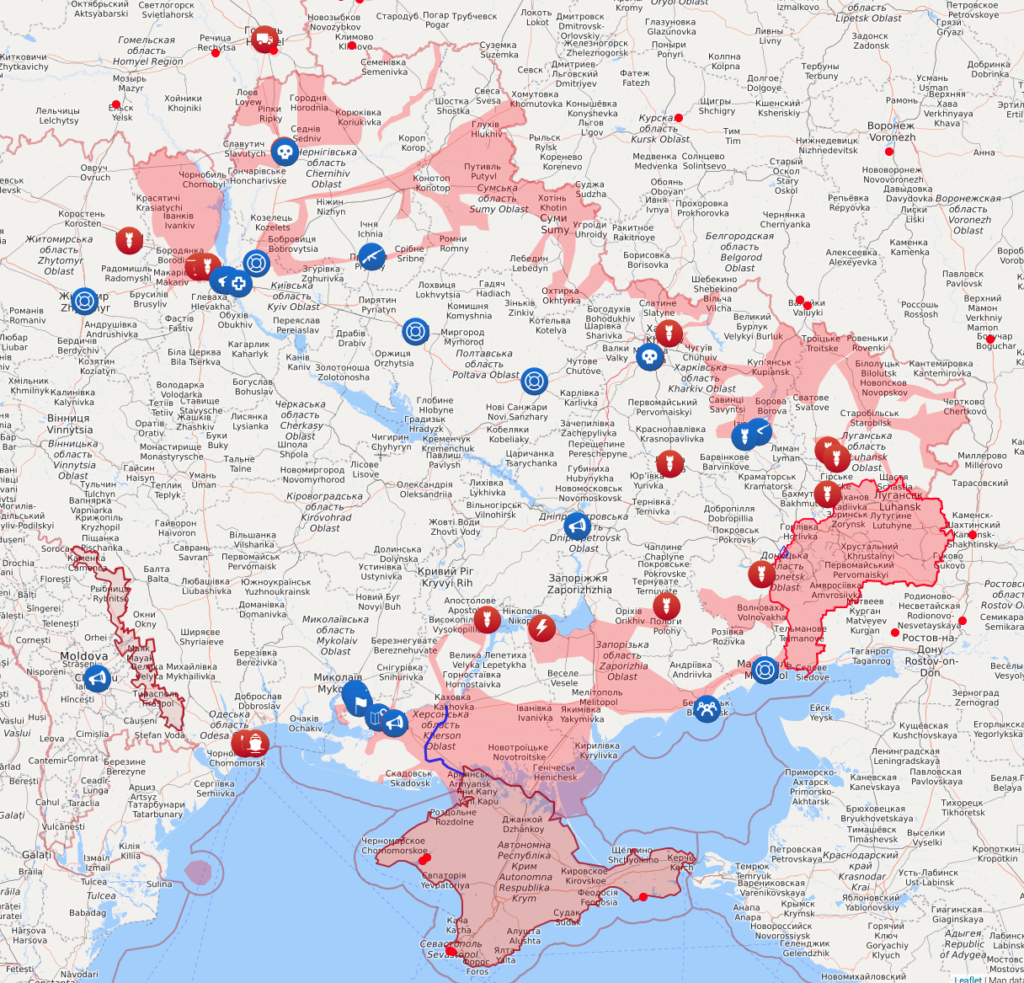
    Russia’s war against Ukraine grinds on. Here’s the Livemap snapshot:

    Given the usual caveats (the map is not the territory), it doesn’t seem like Russia has made much progress since my last update. Russian forces are taking high casualties as they creep closer to Kiev, and Mariupol is still in Ukrainian hands.

    Some perspective on the timelines of previous mechanized invasions:

  • In Desert Storm, the coalition forces destroyed most of the Iraqi army and air force and liberated Kuwait in 100 hours, taking less than 500 deaths. No tank personnel were killed in action.
  • In the Six-Day War, Israel seized control of Gaza, Sinai, the West Bank and the Golan Heights, some 42,000 square miles, and lost 776 soldiers in combat.
  • Twelve days after the German invasion of Poland on September 1, 1939, Germany controlled virtually all of Poland west of the Vistula and was rapidly surrounding the capital of Warsaw. (The Soviet Union would jump in five days later on September 17 to help the Nazis finish off the remainder of Polish resistance and annex much of Poland into the Soviet Union. I trust you know that a lot of what was Poland in 1939 is in Belarus today.) And that was back when the vast majority of German logistics support was still supplied via horse-drawn logistics. And if Gerd von Rundstedt and Fedor von Bock had trucks, and had used T-72s and T-80s rather than Panzer Is and IIs, they probably could have done it in half the time.
  • We’re now some 22 days into the Russian invasion of Ukraine, and its make other widescale mechanized land invasions look far more competent and successful.

    Now the links:

  • Here’s a quick assessment:
    • Russia is deploying reserves from Armenia and South Ossetia and cohering new battalion tactical groups (BTGs) from the remnants of units lost early in the invasion. These reinforcements will likely face equal or greater command and logistics difficulties to current frontline Russian units.
    • President Zelensky created a new joint military-civilian headquarters responsible for the defense of Kyiv on March 15.
    • Russian forces conducted several failed attacks northwest of Kyiv and no offensive operations northeast of Kyiv on March 16.
    • Russian forces continue to shell civilian areas of Kharkiv, but will be unlikely to force the city to surrender without encircling it—which Russian forces appear unable to achieve.
    • Russian forces continued to reduce the Mariupol pocket on March 16. Russian forces continue to commit war crimes in the city, targeting refugees and civilian infrastructure.
    • Ukrainian Forces claimed to have killed the commander of the 8th Combined Arms Army’s 150th Motor Rifle Division near Mariupol on March 15. If confirmed, Miyaev would be the fourth Russian general officer killed in Ukraine; his death would be a major blow to the 150th Motor Rifle Division, Russia’s principal maneuver unit in Donbas.
    • Russian warships shelled areas of Odesa Oblast on March 16 but Russian Naval Infantry remain unlikely to conduct an unsupported amphibious landing.

    (Hat tip: The Ethereal Voice.)

  • Estimates for deaths from Vlad’s Big Ukraine Adventure top 7,000:

    In 36 days of fighting on Iwo Jima during World War II, nearly 7,000 Marines were killed. Now, 20 days after President Vladimir V. Putin of Russia invaded Ukraine, his military has already lost more soldiers, according to American intelligence estimates.

    The conservative side of the estimate, at more than 7,000 Russian troop deaths, is greater than the number of American troops killed over 20 years in Iraq and Afghanistan combined.

    It is a staggering number amassed in just three weeks of fighting, American officials say, with implications for the combat effectiveness of Russian units, including soldiers in tank formations. Pentagon officials say a 10 percent casualty rate, including dead and wounded, for a single unit renders it unable to carry out combat-related tasks.

    With more than 150,000 Russian troops now involved in the war in Ukraine, Russian casualties, when including the estimated 14,000 to 21,000 injured, are near that level. And the Russian military has also lost at least three generals in the fight, according to Ukrainian, NATO and Russian officials.

    Pentagon officials say that a high, and rising, number of war dead can destroy the will to continue fighting. The result, they say, has shown up in intelligence reports that senior officials in the Biden administration read every day: One recent report focused on low morale among Russian troops and described soldiers just parking their vehicles and walking off into the woods.

    Insert the usual “anonymous sources” caveat. Though I suspect the estimates of overall Russian deaths is on the low side.

  • Ukrainian President Volodymyr Zelensky asks U.S. congress for a no-fly zone. I don’t blame him for asking one bit. But it would be a dangerous escalation on the part of the United States and NATO to attempt to implement one.
  • The tiny problem with offering Putin an “offramp” from his Ukraine invasion: he doesn’t want one.

    We’re witnessing a particularly unexpected set of circumstances.

    One: The vaunted Russian army is proving to be a shadow of its former self.

    While the Russian pounding of Ukrainian cities increases, Kyiv remains in Ukrainian control, and Ukrainian president Volodymyr Zelensky is still, at minimum, safe enough to record videos of himself walking to a hospital to visit wounded Ukrainian soldiers. In just three weeks, the Russian military has likely suffered more killed, wounded, and captured than the U.S. and U.K. did combined over the course of 20 years in Afghanistan. One site attempting to track the damage calculates that the Ukrainians have destroyed, damaged, or captured more than 1,200 Russian military vehicles and shot down or otherwise damaged 15 helicopters, 13 fixed-wing aircraft, six drones, two fuel trains, and more than 400 support vehicles.

    If the Russian army was marching across Ukraine as planned, the Russians would not be attempting to recruit Syrian mercenaries.

    This doesn’t mean that 200,000 Russian troops, with all their support vehicles, tanks, artillery, guided-missile systems, jets, helicopters, etc., cannot kill many Ukrainians and inflict extraordinary damage on the cities and homes and critical infrastructure of Ukraine. But it does mean that the Russian army is hampered by severe logistics problems, poor intelligence and tactics, persistent communications problems, awful morale, faulty equipment, and long-expired rations. Some significant portion of the great fortune that Russia spent to upgrade its military over the past two decades was skimmed off the top and diverted into someone’s pockets.

    Polina Beliakova, a senior research fellow at the Center for Strategic Studies at Tufts University, contends that Putin’s wealthy allies were stealing from the military and shortchanging the troops right under Putin’s nose:

    Most companies responsible for providing food to the Russian military are connected to Yevgeny Prigozhin — the patron of PMC Wagner, the mercenary organization, and sponsor of the Internet Research Agency, which has been accused of meddling in the United States elections. Several years ago, Prigozhin’s companies were accused by Russian opposition leader Alexei Navalny of forming a cartel and gaming the state’s bidding system for defense orders, receiving contracts for several hundred million dollars. The quality of food and housing in the Russian military is reportedly worse than in its prisons, with unreasonably small meals and some carrying harmful Escherichia coli bacteria.

    Putin is now learning that hard lesson of former U.S. secretary of defense Donald Rumsfeld, “You go to war with the army you have, not the army you might want or wish to have at a later time.”

    The army Russia has is nowhere near as effective as Putin thought it was. And the Eastern Europeans have noticed:

    “Today what I have seen is that even this huge army or military is not so huge,” said Lt. Gen. Martin Herem, Estonia’s chief of defense, during a news conference at an air base in northern Estonia with Gen. Mark A. Milley, the chairman of the U.S. Joint Chiefs of Staff. General Herem’s colleague and the air force chief, Brig. Gen. Rauno Sirk, in an interview with a local newspaper, was even more blunt in his assessment of the Russian air force. “If you look at what’s on the other side, you’ll see that there isn’t really an opponent anymore,” he said.

    Two: The Russian economy continues to freefall.

    The Russian government announced that they intend to pay back their debts in now-almost-worthless rubles. The Moscow Stock Exchange will stay closed until at least March 18. The Financial Times’ European banking correspondent, Owen Walker, says the Russian Ministry of Finance can keep the big Russian banks going for a while, but in the end, the Russian companies will have no money coming in from countries enacting sanctions.

    Maybe India can help with this problem, but it will cost Russia; the Indian government is reportedly interested in buying Russian oil at a discount. Russia not only wants economic assistance from China, but has reportedly asked for military assistance as well, in the form of drones.

    Three: Despite all of this, Putin is not only undeterred, he wants to double down.

    Back in 2014, when Russian military forces moved into Crimea and annexed it, then-secretary of state John Kerry and other Obama administration officials kept talking up the option of a “diplomatic off-ramp” that would end Russia’s military occupation. Those proposals never went anywhere; Kerry seemed to be in denial of the fact that Putin was on precisely the highway he wanted to be on, headed toward exactly the destination he wanted. Putin wasn’t looking for an “off-ramp.”

    Today, you hear the same refrain — that if the West just tried hard enough, it could find some “diplomatic off-ramp” that would be acceptable to Putin:

    Axios: “President Biden now faces a great unanswered question — how to give Vladimir Putin an off-ramp to avoid even greater calamity.” The Irish Times: “While the prospect of a ceasefire in the short-term may seem remote, there will come a point where Putin needs an off-ramp. The West can keep applying pressure on Putin while showing him that a negotiated peace is there for the taking.” NPR: “Diplomats are trying to find an off ramp to Putin’s war in Ukraine.”

    How can Putin make it any clearer? He doesn’t want an “off ramp!” He doesn’t want to end his war, he wants to win his war. He doesn’t care how gargantuan a price he or his country must pay in blood and treasure to achieve victory. To a certain degree, Putin is dealing with the sunken-cost fallacy. He has already committed so much, nationally and personally, into this war that he cannot accept a relatively modest prize of Donetsk and Luhansk and a guarantee that Ukraine would never join NATO. Russia’s big sacrifices in this war means Putin must bring home a big prize to justify the bloody endeavor.

  • A Chinese analyst is pretty grim in his analysis of Putin’s chances of success.

    1. Vladimir Putin may be unable to achieve his expected goals, which puts Russia in a tight spot. The purpose of Putin’s attack was to completely solve the Ukrainian problem and divert attention from Russia’s domestic crisis by defeating Ukraine with a blitzkrieg, replacing its leadership, and cultivating a pro-Russian government. However, the blitzkrieg failed, and Russia is unable to support a protracted war and its associated high costs. Launching a nuclear war would put Russia on the opposite side of the whole world and is therefore unwinnable. The situations both at home and abroad are also increasingly unfavorable. Even if the Russian army were to occupy Ukraine’s capital Kyiv and set up a puppet government at a high cost, this would not mean final victory. At this point, Putin’s best option is to end the war decently through peace talks, which requires Ukraine to make substantial concessions. However, what is not attainable on the battlefield is also difficult to obtain at the negotiating table. In any case, this military action constitutes an irreversible mistake.

    2. The conflict may escalate further, and the West’s eventual involvement in the war cannot be ruled out. While the escalation of the war would be costly, there is a high probability that Putin will not give up easily given his character and power. The Russo-Ukrainian war may escalate beyond the scope and region of Ukraine, and may even include the possibility of a nuclear strike. Once this happens, the U.S. and Europe cannot stay aloof from the conflict, thus triggering a world war or even a nuclear war. The result would be a catastrophe for humanity and a showdown between the United States and Russia. This final confrontation, given that Russia’s military power is no match for NATO’s, would be even worse for Putin.

    3. Even if Russia manages to seize Ukraine in a desperate gamble, it is still a political hot potato. Russia would thereafter carry a heavy burden and become overwhelmed. Under such circumstances, no matter whether Volodymyr Zelensky is alive or not, Ukraine will most likely set up a government-in-exile to confront Russia in the long term. Russia will be subject both to Western sanctions and rebellion within the territory of Ukraine. The battle lines will be drawn very long. The domestic economy will be unsustainable and will eventually be dragged down. This period will not exceed a few years.

    4. The political situation in Russia may change or be disintegrated at the hands of the West. After Putin’s blitzkrieg failed, the hope of Russia’s victory is slim and Western sanctions have reached an unprecedented degree. As people’s livelihoods are severely affected and as anti-war and anti-Putin forces gather, the possibility of a political mutiny in Russia cannot be ruled out. With Russia’s economy on the verge of collapse, it would be difficult for Putin to prop up the perilous situation even without the loss of the Russo-Ukrainian war. If Putin were to be ousted from power due to civil strife, coup d’état, or another reason, Russia would be even less likely to confront the West. It would surely succumb to the West, or even be further dismembered, and Russia’s status as a great power would come to an end.

    II. Analysis of the Impact of Russo-Ukrainian war On International Landscape

    1. The United States would regain leadership in the Western world, and the West would become more united. At present, public opinion believes that the Ukrainian war signifies a complete collapse of U.S. hegemony, but the war would in fact bring France and Germany, both of which wanted to break away from the U.S., back into the NATO defense framework, destroying Europe’s dream to achieve independent diplomacy and self-defense. Germany would greatly increase its military budget; Switzerland, Sweden, and other countries would abandon their neutrality. With Nord Stream 2 put on hold indefinitely, Europe’s reliance on US natural gas will inevitably increase. The US and Europe would form a closer community of shared future, and American leadership in the Western world will rebound.

    2. The “Iron Curtain” would fall again not only from the Baltic Sea to the Black Sea, but also to the final confrontation between the Western-dominated camp and its competitors. The West will draw the line between democracies and authoritarian states, defining the divide with Russia as a struggle between democracy and dictatorship. The new Iron Curtain will no longer be drawn between the two camps of socialism and capitalism, nor will it be confined to the Cold War. It will be a life-and-death battle between those for and against Western democracy. The unity of the Western world under the Iron Curtain will have a siphon effect on other countries: the U.S. Indo-Pacific strategy will be consolidated, and other countries like Japan will stick even closer to the U.S., which will form an unprecedentedly broad democratic united front.

    3. The power of the West will grow significantly, NATO will continue to expand, and U.S. influence in the non-Western world will increase. After the Russo-Ukrainian War, no matter how Russia achieves its political transformation, it will greatly weaken the anti-Western forces in the world. The scene after the 1991 Soviet and Eastern upheavals may repeat itself: theories on “the end of ideology” may reappear, the resurgence of the third wave of democratization will lose momentum, and more third world countries will embrace the West. The West will possess more “hegemony” both in terms of military power and in terms of values and institutions, its hard power and soft power will reach new heights.

    Nor is he thrilled at China’s chance might fare in this scenario:

    4. China will become more isolated under the established framework. For the above reasons, if China does not take proactive measures to respond, it will encounter further containment from the US and the West. Once Putin falls, the U.S. will no longer face two strategic competitors but only have to lock China in strategic containment. Europe will further cut itself off from China; Japan will become the anti-China vanguard; South Korea will further fall to the U.S.; Taiwan will join the anti-China chorus, and the rest of the world will have to choose sides under herd mentality. China will not only be militarily encircled by the U.S., NATO, the QUAD, and AUKUS, but also be challenged by Western values and systems.

    His advice to China? Cut Putin loose and join the west:

    China cannot be tied to Putin and needs to be cut off as soon as possible. In the sense that an escalation of conflict between Russia and the West helps divert U.S. attention from China, China should rejoice with and even support Putin, but only if Russia does not fall. Being in the same boat with Putin will impact China should he lose power. Unless Putin can secure victory with China’s backing, a prospect which looks bleak at the moment, China does not have the clout to back Russia. The law of international politics says that there are “no eternal allies nor perpetual enemies,” but “our interests are eternal and perpetual.” Under current international circumstances, China can only proceed by safeguarding its own best interests, choosing the lesser of two evils, and unloading the burden of Russia as soon as possible. At present, it is estimated that there is still a window period of one or two weeks before China loses its wiggle room. China must act decisively.

  • Speaking of China: “China has refused to supply Russian airlines with aircraft parts, an official at Russia’s aviation authority was quoted by Russian news agencies as saying on Thursday, after Boeing (BA.N) and Airbus (AIR.PA) halted supply of components.” Coincidence? Probably.
  • Analyst Ben Hedges says the next ten days (eight now) will decide the war.

    The Russians are in trouble, and they know it. That’s why they have reached out to China for help and why they are now recruiting Syrians.

    Russian generals are running out of time, ammunition, and manpower. That’s not based on any inside intelligence — it’s clear from open source information and my own experience. I could be way off, but I am confident of this assessment.

    An essential caveat to my assessment is that we, the West, led by the US, must accelerate and expand the support we are providing to Ukraine on the scale and with the sense of urgency of the Berlin Airlift (June 1948-May 1949). They need the weapons and ammunition to destroy the rockets, cruise missiles, and long-range artillery that are causing most of the damage to Ukrainian cities, as well as the intelligence to locate those systems, and the ability to hit Russian Navy vessels that are launching cruise missiles into cities from the Black Sea and the Azov Sea.

    The time challenge for Russia is not just military. The effects of sanctions are growing — Russia may soon default on $150bn of foreign currency debt —and Russian domestic resentment is also growing (we should remember that it’s unusual as well as extreme brave for ordinary people to protest in Putin’s Russia and for television editors to suddenly interrupt their own programs waving anti-war placards.) We should do all we can to fuel that discontent and to let courageous Russians know they have our support.

    Ammunition shortages

    The Russians are experiencing ammunition shortages. Their transition to attrition warfare is driving up consumption rates beyond what they had planned and what they can sustain. They will still have a lot of the conventional artillery and so-called dumb bombs. But as we know from past US military operations, the most sophisticated munitions are very expensive and so more limited in availability. The Russians are likely to be having the same experience; in addition, they thought the campaign would end within a few days so large stocks were probably not prepared. Wartime consumption always exceeds planning numbers, and urban combat exacerbates that. Sanctions will also have assisted —Finland and Slovenia used to provide some munitions to Russia, and those have now stopped.

    Manpower shortages

    The Pentagon has said that 50% of Russian combat power was committed in Ukraine. At the height of our wars in Iraq and Afghanistan, we were about 29% committed. And it was difficult to sustain that.

    This plays directly into the discussion of the encirclement of Kyiv. Russia does not have the manpower or firepower to encircle the Ukrainian capital, let alone capture it.  I have been to Kyiv several times.  I was there in Kyiv five weeks ago, met President Zelenskyy.  It is a very large, dense major urban center on the banks of one of Europe’s largest rivers. It is a difficult, complex urban terrain.

    The Ukrainians are going to be able to keep it open and prevent encirclement, especially if we can get the flow of weapons and ammunition up to the levels needed. There will be, unfortunately, be increasing attacks on the city by air and ground systems, and many more innocent Ukrainian citizens will be murdered, injured, or displaced.  But I don’t believe it will fall.

    Russia’s dilemma is only worsened by its combat casualties. Although I am always skeptical about enemy body counts, I do believe the numbers of dead are in the thousands (possibly in the 5,000-6,000 range suggested by US sources) and the numbers of wounded much higher. The modern battlefield is extremely lethal, especially for poorly trained or disciplined soldiers. These are very high numbers for just the first two weeks of war and many come from Russia’s elite units — they are hard to replace (and the Kremlin won’t be able to conceal these losses from the Russian public and all those for long.)

    Reports of low morale, dissension between commanders, mutiny on at least one vessel, desertion, and so on, all within the first two weeks are indicators of major manpower problems. And in pure numbers, the Ukrainian armed forces still outnumber or closely match Russian forces actually on the ground in Ukraine.

    There is no suggestion that the Russians have big units lurking in the woods somewhere (and the Pentagon has said it sees no signs of significant reinforcements.) So it’s apparent that the notional 900,000 strength of the Russian military is a hollow number.  Their public call for 16,000 troops from Syria and elsewhere indicates this. Employment of “stop loss” by Russia on conscripts whose time is about up is another indicator. The Ukrainian diaspora is flocking home to help the fight; Russians are not coming back home — and indeed, many are leaving to avoid Putin’s fight.

  • Related: “Ukraine Is Doubling Its Army, While Russia Scrapes The Barrel For Reinforcements.”

    Russia paused its offensive in Ukraine in recent days in order to rush in reinforcements and rebuild shattered units.

    The problem, for the Kremlin, is that Ukraine is doing the same—and potentially to much greater effect. As the wider war in Ukraine enters its fourth week, the Russian army might be able to restore some of the combat power it has lost to poor planning, poorer execution and heroic resistance by the Ukrainian armed services.

    But Ukraine almost certainly can double its fighting strength.

    That mobilization imbalance, the consequence of strong foreign support for Kyiv, the natural logistical advantages any defender enjoys against an attacker and—most importantly—Ukrainians’ incredible determination to fight, has led one analyst to a perhaps surprising conclusion.

    Russia “can’t win this war,” wrote Tom Cooper, an author and expert on the Russian military.

    The Russian army built up a force of nearly 200,000 troops with thousands of armored vehicles before launching its assault on southern, eastern and northern Ukraine on the night of Feb. 23.

    The invasion force encountered stiff resistance. Not only from the 145,000-person regular Ukrainian army, but also local territorial defense forces and even everyday people who improvised weaponry or found other ways to slow the Russians. Digging ditches. Destroying bridges. Texting Ukrainian artillery units with the locations of approaching Russian tanks.

    As the war enters its fourth week, the Russian offensive has stalled. And the scale of Russian losses is becoming clear. The Kremlin on March 2 copped to losing fewer than 500 troops killed in action and another 1,500 wounded. The Ukrainian defense ministry a few days ago posited a much higher total: a combined 12,000 Russians “lost”—presumably meaning killed, wounded or captured.

  • Kurt Schlichter suggests caution.

    From the perspective of someone who actually trained Ukrainian troops in Ukraine, commanded US forces, and attended the US Army War College – though it’s kind of the Chico State of war colleges – the whole way our elite is approaching the crisis is an epic clusterfark. Don’t believe anything anyone tells you – and certainly, sanity check whatever I’m telling you, too – most of these insta-experts on intra-Slavic conflict know absolutely squat-ski. Moreover, their remarkably dumb observations and credulous acceptance of conventional wisdom, which has proven long on conventional and short on wisdom, are being presented without any kind of strategic context. They don’t know where this crisis came from and certainly have no clear notion of where they want it to go beyond the vague and unhelpful idea that they want Putin (which they use interchangeably with Russia) to “lose” without knowing what that even means.

    Biases are important, and here are mine. I sympathize with the Ukrainian people, partly because I worked with them and partly because I was an end-stage Cold Warrior who came up training to fight Russians. I understand that this mess is not merely the result of Putin being bad or Trump being insufficiently anti-Putin, like LTC Sausage and the rest of the failed foreign policy elite and regime media insist. Putin’s badness plays a part, but he’s merely exploiting thousands of years of bloody history, of ethnic hatred, and of Orthodox mysticism, as well as totally misguided and poorly-considered Western interference. The idea that we could just make Ukraine part of NATO and the Russians would just lump it is remarkable for its dumbness, but it is fully in keeping with our foreign policy elite’s unbroken track record of failure since the old-school military’s victory in the Gulf War…

    The expectation was that the Russian forces would smash through, surround the Ukrainian forces pinned down facing the Russians in the occupied regions to the east, and isolate the main cities. I did not expect them to go into the cities immediately since Russians 1) generally bypass hard defenses; 2) they have bad experiences with city fighting (Stalingrad, Grozny); and 3) that would not necessarily be necessary. It would not be necessary if the idea was to neutralize the main Ukrainian combat formations and force the government in the cities to capitulate, then have the West pressure the Ukrainians to accept a ceasefire and “peace” that recognized Russian gains and ended the idea of Ukrainian allying with the West. In fact, that is pretty much what the Russian “peace plan” consists of. But that did not work for a couple of reasons.

    First, the Russians did not fight as well as expected. You should always treat the enemy as if it is the best possible enemy. We did in the Gulf. We prepared to fight elite Republican Guard divisions of highly trained and motivated soldiers using top-shelf Soviet equipment and tactics. None of that was so; we crushed an entire national army in 100 hours.

    The Russians are poorly-led, with very weak synchronization among maneuver forces and fires. Their plan is okay – in fact, you look at a map, and it’s obvious what they would do. But their gear is badly-maintained, and their troops are unsuited to the task of supporting a rapid advance. Look at all the evidently intact gear simply abandoned by the side of the road. Lots of it looks like it broke down (note all the flat tires). Much of it seems to have run out of gas. And, of course, lots of stuff had been blasted apart.

    That’s the second part of the equation – the Ukrainians fought back hard. If you are a Lord of the Rings nerd, think of the Ukrainians as the dwarves. Not super-sophisticated but tough and ready to fight, and also often drunk.

    If you want to see the future of this war, look at videos of Ukrainian infantry patrolling near the front. Every second guy has an anti-tank weapon, like a Javelin or some other system, and the rest are carrying spare missiles. Mechanized forces unprotected by infantry are vulnerable to ambush by anti-tank teams. The Russian armor outstripped its ground pounders and is getting pounded itself. Further, Ukrainians seem to have success with drones firing anti-tank weapons. The war is not going to be won by conventional battalions of Ukrainians operating with conventional aircraft. It will win with light infantry and drones armed with missiles.

  • The Russian occupation is none too gentle on Ukrainian civilians.

    Russian soldiers have shot people dead in the street as they took over Ukrainian villages, according to fleeing residents.

    Soldiers shot randomly at buildings, threw grenades down roads and went from house to house confiscating phones and laptops, witnesses said.

    Online groups created for family members or friends looking for information about people in affected areas are receiving hundreds or even thousands of requests a day.

    One witness, Mykola, described how soldiers arrived in Andriivka, a village near Kyiv. “They threw grenades down the street. One man lost his leg and the next day this person died,” he said. “They then came down the central street and started shooting at the windows and hit one woman. Her children managed to hide.”

    Mykola lived within walking distance of his brother, Dymtro. “My brother came out the house with his hands in the air. They beat him and then executed him in the street,” he said.

    Dymtro’s wife said she saw the killing of her husband from a window. She said she also witnessed their neighbour being killed in the same manner. Dymtro’s daughter believes both were shot because they had earlier helped the Ukrainian army as volunteers.

    Mykola said they wanted to bury his brother, but his wife feared the soldiers would shoot them. “The next day they went house by house, confiscating phones and laptops,” he said. At this point, 3 March, there was no electricity. “Those who came into our house behaved OK. But they told us that it’s good you have a cellar, collect some water, because you’re going to be bombed for six days.”

  • What happens if Putins lets his tacnukes fly.

    On Monday, United Nations secretary general António Guterres warned that, “Raising the alert level of Russian nuclear forces is a bone-chilling development. The prospect of nuclear conflict, once unthinkable, is now back within the realm of possibility.”

    As hyperbolic as that claim may seem, the circumstances that would spur the Russians to use a tactical nuclear weapon are starting to fall into place. As laid out yesterday, the war is going badly for the Russians. Advances are moving slowly, when they’re moving at all, and casualties are mounting. The Russian economy is collapsing. Something’s going to break; it’s just a question of what breaks first.

    This newsletter has repeatedly discussed the official Russian military doctrine, “escalate to deescalate” — that is, “If Russia were subjected to a major non-nuclear assault that exceeded its capacity for conventional defense, it would ‘de-escalate’ the conflict by launching a limited — or tactical — nuclear strike.” In other words, Russia’s official strategy when losing a war is to escalate it by using tactical battlefield nukes in order to “deescalate” it on terms favorable to Russia.

    It isn’t likely that Russia will launch or detonate a tactical nuclear weapon yet. But it also isn’t unimaginable anymore. Apparently, Putin and the Russian military have been thinking about this option for a long time. In 2014, Ukrainian defense minister Valeriy Heletey said that, “The Russian side has threatened on several occasions across unofficial channels that, in the case of continued resistance they are ready to use a tactical nuclear weapon against us.”

    This assumes, of course, his nukes still work. The United States is going to spend some $634 billion this decade maintaining its nuclear deterrent. Put it another way, the U.S. spends more money maintaining nuclear weapons in a given year than Russia spends annually on its entire military. Thermonuclear weapons (not fission-only tactical nuclear weapons) require regular Tritium refresh. Fission weapons still require battery and explosive refresh, and I’m not clear on the schedule.

  • Explosions reported in multiple Belarus cities. Could be supply hits. Could also be false flag operations
  • A Ukrainian Town Deals Russia One of the War’s Most Decisive Routs. In the two-day battle of Voznesensk, local volunteers and the military repelled the invaders, who fled leaving behind armor and dead soldiers.”

    A rapid Russian advance into the strategic southern town of 35,000 people, a gateway to a Ukrainian nuclear power station and pathway to attack Odessa from the back, would have showcased the Russian military’s abilities and severed Ukraine’s key communications lines.

    Instead, the two-day battle of Voznesensk, details of which are only now emerging, turned decisively against the Russians. Judging from the destroyed and abandoned armor, Ukrainian forces, which comprised local volunteers and the professional military, eliminated most of a Russian battalion tactical group on March 2 and 3.

    The Ukrainian defenders’ performance against a much-better-armed enemy in an overwhelmingly Russian-speaking region was successful in part because of widespread popular support for the Ukrainian cause—one reason the Russian invasion across the country has failed to achieve its principal goals so far. Ukraine on Wednesday said it was launching a counteroffensive on several fronts.

  • A fourth Russian general has been killed in fighting in Ukraine, according to reports on Tuesday. Ukrainian Interior Ministry adviser Anton Gerashchenko announced the death of Major General Oleg Mityaev.”
  • A look inside an abandoned Russian field kitchen truck. Hope you like onions:

  • Russia is headed toward a $150 billion default.
  • Though Russia did manage to pay $117 in dollar-denominated bonds today.
  • Another sign of how poorly things are going for Russia: “Kremlin arrests FSB chiefs in fallout from Ukraine chaos. The defenestration of several senior spies is a sign of Putin’s growing fury towards the intelligence services.” Traditionally the position of dictators who went to war with their own security service has been…precarious.
  • Other recent Russo-Ukrainian War links:

  • Why Russia Can’t Achieve Air Superiority
  • The Problem With That “Russia Sought Military Aid From China” Story
  • Ian McCollum on Russia’s Invasion of Ukraine and Civilian Firearms Ownership
  • LinkSwarm for February 19, 2022

    Saturday, February 19th, 2022

    Justin Trudeau’s storm troopers start arresting peaceful protesters, he wants to kidnap the children and dogs of free Canadian citizens who dared to bruise his fragile ego, Texas sends more lawsuits flying, and another case of Sudden Epstein Death Syndrome. It’s the Friday Saturday LinkSwarm!

  • The crackdown comes.

    Canadian Prime Minister Justin Trudeau cancelled parliamentary debate today as federal police began arresting protesting truckers and confiscating vehicles. Trudeau did not want to face government while the operation to break the back of the freedom protestors begins.

    Early this morning, federal police assembled a convoy of heavy tow trucks to begin the operation. The identities of the tow truck companies were masked by painting over the logos to avoid retaliation. RCMP and Ottawa police then brought in Armored Personnel Carriers (MRAP’s and APC’s) to support the operation.

    Media were told to leave the enforcement zone to help hide the optics of heavily armed RCMP tactical units, and they began breaking the windows of the trucks and forcibly removing the truck drivers. For the same reason, popular social media YouTuber’s, who had been broadcasting livestreams, were arrested as the operation began.


  • They’re also threatening to take children from protesting parents. “Just imagine the uproar that would ensue if Trump had taken children from Black Lives Matters protesters.”
  • They’re also threatening to take protestor’s dogs.
    

  • The Canadian Civil Liberties Unions has awoken from its slumber to file a lawsuit over Trudeau’s Emergencies Act.
  • “When Fascism Comes To America, It Will Look Like Justin Trudeau’s Canada. Trudeau’s dangerous not just because he’s abusing Canadians, but because he is providing the wish list for crackdowns by Democrats in the U.S.: Every single bank, credit union, investment broker and insurance provider in the country has been deputized to figure out if they have a blockader as a client, and to immediately freeze their accounts if so.”
  • “Ottawa Mounted Police Charge Horses Into Crowd, Disabled Elderly Woman Using Walker Trampled.”
  • Additional commentary:


  • The real terrorists Trudeau isn’t arresting. “Axe-Wielding Activists Cause Millions In Damage, Attempt To Torch Pipeline Workers.”
  • Public sector unions want a law to control everything.

    The Chicago Teachers Union provides a real-world example of what happens when a government union has too much power.

    CTU has gone on strike three times in three school years. In the latest work stoppage, over 330,000 schoolchildren missed five days of school. Parents were notified of the walkout after 11 p.m. on a school night, leaving them just hours to develop a back-up plan after the union decided not to show up.

    This shut-down follows the 2020-2021 school year, when Chicago Public Schools was fully remote for most of the year, rolling out hybrid options starting in February 2021. All told, Chicago students had gone 17 months without fully in-person education by the time they started the current school year Aug. 30, 2021.

    And students’ academic achievement suffered for it. One example: On the SATs, there was a 6.1 percentage point decrease in the number of Chicago students at least meeting standards in math – and a drop of 6.7 percentage points for the same category for low-income students – in 2021 compared to 2019.

    But CTU’s political muscle – and their willingness to flex it – could become the blueprint for schools and government at all levels if Illinois’ powerful government-sector unions get what they’re asking for at the polls in November. They want an amendment to the Illinois Constitution that would give unelected government union bosses more power than state law or the people elected to represent residents’ best interests.

    Snip.

    Amendment 1 is billed as a right-to-work ban in a state that already doesn’t allow right to work, but it’s much more than that. It would give unions a “fundamental” right to organize and bargain over wages, hours, working conditions, economic welfare and safety at work – i.e., virtually anything – and explicitly prohibit lawmakers from ever interfering with or diminishing those rights.

    Unions would be able to demand anything during negotiations and go on strike to get their demands met. Resulting contracts would carry the weight of the state constitution. Lawmakers wouldn’t be able to restrict what unions can negotiate or limit when they can go on strike without running afoul of the state constitution.

    What’s more, lawmakers would never be able to repeal a little-known Illinois provision that allows many union contracts to override conflicting state and local laws and regulations.

    Known in legal parlance as a “supercedence clause,” the practical effect is that a union will be able to rewrite laws it doesn’t like just by negotiating a contrary provision in its contract. If the employer doesn’t agree? The union goes on strike. And government officials’ hands will be tied.

    That includes laws in place to protect children.

    A provision requiring “background information” on employees of the Illinois Department of Children and Family Services – the department charged with protecting children who are reported abused or neglected – could be contradicted in the union’s contract with the state.

    So could the provision prohibiting employment of “sexually dangerous” persons.


  • Judicial Watch files a lawsuit to obtain records of CIA contacts with Clinton campaign lawyer Michael Sussmann. The ripples from the Durham probe revelations continue to spread.
  • Speaking of lawsuits: “Attorney General Ken Paxton, alongside the Texas Public Policy Foundation (TPPF) on behalf of Congresswoman Beth Van Duyne, sued the Biden Administration for its illegal mask mandate for airlines and airports.”
  • Paxton and Texas also sued Facebook over facial recognition. “Facebook unlawfully captured the biometric identifiers of Texans for a commercial purpose without their informed consent, disclosed those identifiers to others, and failed to destroy collected identifiers within a reasonable time.”
  • “San Francisco police linked a woman to a crime using DNA from her rape exam, D.A. Boudin says.” Though the charges were dropped, this seems like not only a clear Fourth Amendment violation, but an absolute abuse of trust. “Sure, just give your DNA to the government! There’s no way they would ever abuse that!” Can you believe that Soros-backed Boudin is the subject of a recall petition?
  • Joe Biden has nightmare low approval rates in battleground states. Including -26 in Georgia.
  • More on the same theme:

  • Let me see if I have the timeline on this story correct: 1. Leftwing racial justice activist Quintez Brown attempts to assassinate Louisville Democratic mayoral candidate Craig Greenberg, and 2. He’s almost immediately bailed out for a paltry $100,000 by #BlackLivesMatter? How often is bail set so low for attempted political assassinations?
  • “Biracial GOP Candidate Rips CRT in Front of North Carolina School Board.”

    CRT got blown away by a massive truth bomb dropped by North Carolina dad — and local GOP candidate — Brian Echevarria at his school board meeting on Monday.

    “As a parent, I speak to other parents,” he told Cabarrus County School Board members, “And there’s a few things we don’t want.”

    “I’m biracial, I’m multilingual, I’m multicultural. The fact is in America and North Carolina, I can do anything I want — and I teach that to my children. And the person who tells my little pecan-color kids that they’re somehow oppressed based on the color of their skin,” he justly insisted, “would be absolutely wrong and absolutely at war with me.”

  • Amazon suspends #BlackLivesMatter from its charity platform.
  • Another day, another leftwing activist exposed as a pedophile.
  • Illegal Aliens Ran Sex-Trafficking Ring in New York City, Using Minors From Mexico.”
  • Speaking of pedophilia: “Alternatively described as Jeffrey Epstein’s ‘best mate’ and ‘pimp’, Jean-Luc Brunel, a former French modeling agent who has been imprisoned since 2020 on charges he aided Epstein’s sex-trafficking enterprise, has committed suicide in his cell.” I think we’ve seen this movie before, and we didn’t believe the ending the first time…
  • New York City Democratic mayor Eric Adams fires over 1,400 city employees over their refusal to bend the knee to his vaccine mandate.
  • Speaking of Adams: “I want to discuss the new fuckface mayor of New York City that replaced the old fuckface mayor.” The mayor that wants to force employers to enforce vaccine mandates also wants them to force workers back to their NYC offices.

    What’s in it for those businesses that now realize that three hundred thousand dollars a month in office space “We don’t need it anymore.” What’s in it for those employees that figured out that they can have homes that are two or three times the size for half as much money and not have to deal with a commute every day? What’s in it for them?”

  • With oil prices up, so are U.S. rig counts, up to a four year high.
  • America’s electric grid is less stable than it was 20 years before.
  • U.S. sells 250 Abrams tanks to Poland in a deal worth $6 billion.
  • Levi’s brand ambassador turns down $1 million severance package because she refuses to stop talking about the need for school choice.
  • The Critical Drinker is not impressed with the teasers from Amazon’s Lord of the Rings. You can’t retcon it into generic diversity because “you don’t get to make that choice because you didn’t write Lord of the Rings.”
  • New Bloom County animated TV show in development for Fox. I view this with more trepidation than hope. There’s about a 95% chance the screw it up, and if they don’t, there’s a good chance Fox will cancel it anyway, since that’s their MO…
  • P. J. O’Rourke, RIP. I reviewed Holidays in Hell for Reason back in the day…
  • Also RIP: Col. Gail Halvorsen, the “Candy Bomber” from the Berlin Airlift.
  • In 2017, a pilot aborted takeoff after V1, the inflection point for when a safe abort was still possible. “Still traveling at 100 knots, but decelerating rapidly, the plane rumbled across the grass overrun area, plowed over the airport perimeter fence, struck a raised embankment, lost its landing gear, crossed a road, and ground to a halt straddling a ditch.” Post-incident analysis showed why that was the right call. (Hat tip: Dwight.)
  • Godzilla’s Jewish Hollywood Friend.” Now, with that excuse, here’s a picture of a Bob Eggleton painting I actually own.

  • Tippi Hedren beware:

  • “Canadian ATMs Now Asking Your Political Views Before Allowing You To Withdraw Money.”
  • Extra-fluffy mop:

  •