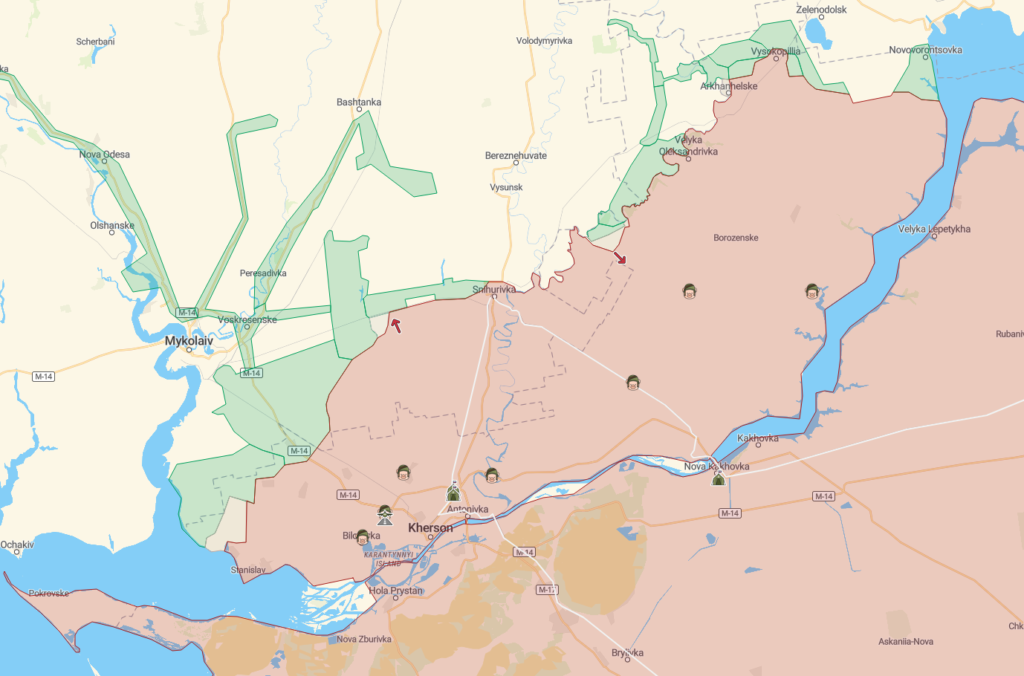
When the Russo-Ukrainian war kicked off back in February, I relied on https://liveuamap.com/ to track military action in the war, just as I had used their similar map when tracking the war against the Islamic State. However, after the initial phase of the war, LiveUAMap seemed to update less and less frequently, and it’s been practically useless for tracking progress in the Kherson counteroffensive.
Today, most video commentators on the war seem to rely on https://deepstatemap.live. Here’s today’s snapshot from Kherson:
Better than nothing, but not as good as LiveUAMap used to be.
Here YouTuber Suchomimus compares different maps of the Kherson offensive, and how the differ on territory captured.
He mentions the War_Mapper Twitter account, which I haven’t been following due to my ongoing Twitter timeout.
Updates:
🇺🇦 have entered the settlement of Arkhanhelske, which is now contested.
🇺🇦 advanced from the Inhulets bridgehead, capturing Sukhyi Stavok and continuing to the outskirts of Kostromka and Brushkyns’ke, briefly cutting the supply route to Davydiv Brid. pic.twitter.com/x1ZiAg4Pig
He also mentions the official Russian-sourced map, which I’m not particularly interested in trusting.
The Institute for the Study of War includes a map with their daily assessment updates, but they’re not interactive or particularly detailed.
There are also a few YouTubers who do daily map updates. There’s Denys Davydov (“Hello, my friends…”). He’s Ukrainian and upfront about his bias, and covers the various clashes across the entire front (which makes his videos a bit long, and I tend to skip around for the bits I’m interested in). He suffers from “The map is the territory” syndrome, and isn’t a deep tactical thinker or versed in the intricacies of combined arms operations, but he’s useful if you understand his limitations.
One of the maps he relies on (in addition to DeepState) is the MilitaryLand map, which looks really useful.
Ukraine News TV relies on the DeepState map, and goes into considerable detail recount the day’s events.
War in Ukraine isn’t great in terms of voiceover, but seem to have a lot of unit-specific information on his maps.
For the sake of completeness, I note WeebUnion, who says he’s objective but seems pro-Russian (and his commenters even more so). He’s not a dynamic voiceover talent, and he begins this video with “Hello, comrades,” so…yeah, I don’t follow him.
Biden goes all Nuremberg Rally, more transexual madness, Gibson’s Bakery wins final victory, states subcontract their energy policies to crazy California, and more really stupid criminals. It’s the Friday LinkSwarm!
You would think that Biden’s team might have better sense than to dress his set like it’s Darth Maul’s bedroom:
That was the most demagogic, outrageous, and divisive speech I have ever seen from an American president. Joe Biden essentially declared all those who oppose him and his agenda enemies of the republic. Truly shameful. pic.twitter.com/ZcJX2BbZlt
What happens when people in the federal government are incompetent and refuse to do their job? Usually nothing. Or they get promoted. But in Florida? Governor DeSantis fires their asses.
On Friday, Governor Ron DeSantis announced that he would be suspending four members of the Broward County School Board for their “incompetence, neglect of duty, and misuse of authority” at Marjory Stonemason Douglass High School.
In a press release, the governor’s office stated that Patricia Good, Donna Korn, Ann Murray and Laurie Rich Levinson had been suspended following the recommendations of the Twentieth Statewide Grand Jury. DeSantis has been particularly active in education, going as far as endorsing school board members in their races across the state, and enacting laws on curriculum transparency and parental rights.
“Even four years after the events of February 14, 2018, the final report of the Grand Jury found that a safety-related alarm that could have possibly saved lives at Marjory Stoneman Douglas High School ‘was and is such a low priority that it remains uninstalled at multiple schools,’ and ‘students continue to be educated in unsafe, aging, decrepit, moldy buildings that were supposed to have been renovated years ago,’” the press release states.
“These are inexcusable actions by school board members who have shown a pattern of emboldening unacceptable behavior, including fraud and mismanagement, across the district,” the press release continued.
“It is my duty to suspend people from office when there is clear evidence of incompetence, neglect of duty, misfeasance or malfeasance,” said DeSantis. “The findings of the Statewide Grand Jury affirm the work of the Marjory Stoneman Douglas School Safety Commission. We are grateful to the members of the jury who have dedicated countless hours to this mission and we hope this suspension brings the Parkland community another step towards justice. This action is in the best interest of the residents and students of Broward County and all citizens of Florida.”
In their place, DeSantis has appointed Torey Alston, former Commissioner of the Broward County Board of County Commissioners and President of Indelible Solutions, Manual “Nandy” A. Serrano, member of the Florida Sports Foundation Board of Directors, Ryan Reiter, a US Marine Corps Veteran and Director of Government Relations for Kaufman Lynn Construction, and Kevin Tynan, Attorney with Richardson and Tynan, who previously served on the Broward County School Board and South Broward Hospital District, to take the suspended members’ places.
Rachel, a Brooklyn mom with a gender-dysphoric child…went undercover as a pre-teen in the chat, searching for resources for detransitioners. She found none.
Instead, she opened a “Pandora’s box” of sexually perverse content, aggressive gender re-assignment referrals, adults encouraging minors to hide their transitions from their parents, and many troubled kids in need of psychological counseling. She shared screenshots of the chat with National Review.
Rachel says she looked to the Trevor Project in desperation, “when I thought my child was going to kill herself.” The organization frequently claims that LGBT youth are more than four times more likely to attempt suicide than their peers. It claims to be a refuge for these people with its crisis services including TrevorLifeline, TrevorText, and TrevorChat.
Under the advice of a “highly credentialed” medical and mental-health team, Rachel and her husband decided to socially transition their child a few years ago, she told National Review. After that, her child was hospitalized three times for self-harm and suicidality, including at least one suicide attempt. In New York, due to a ban on psychotherapy, so-called gender affirmation was the only legal option they could pursue, she said.
They were at their wit’s end, until her spouse sat her down and presented her with a PowerPoint, showing statistics that people who transition are, by a huge factor, much more likely than the general public to commit suicide.
“My jaw hit the floor. I said, ‘Oh my God we’ve been lied to’,” she says.
Since then, Rachel, a lifelong Democrat and feminist, has been dedicated to exposing the child gender-transition craze, which she argues is driven by “predatory medicine” incentivized by the government.
In TrevorSpace, she got a bird’s-eye view of the progressive non-profit giant that is claiming to save young lives but is really driving them further into existential rabbit holes, depravity, and potential danger, she said.
She documented kids talking about how to buy binders, an undergarment that constricts breasts, behind their parents’ backs. “I know the way people usually do this is by ordering it to a friend’s house or something of the sort, but I don’t have anyone to do that with,” wrote a girl whose account says she’s under 18. “I have money and know where I want to get it from and all that. I just need a means of getting it.” Another user suggested she have the binder sent to a post office where she could pick it up without her parents’ knowledge. Other users were referred to eBay to purchase a packer, or an artificial appendage meant to mimic a penis.
When people sign up for TrevorSpace, they have the option of placing themselves within the age ranges of “under 18” or “18-25.” The community is open to people 13-24, according to the site. There is no system in place to confirm a person’s age, Rebecca says and National Review confirmed. She also said she noticed entries from people claiming to be over 25 too, as well as guest accounts with no age listed.
Other teens, presumably girls transitioning to boys, testified to the effectiveness of Minoxidil, an over-the-counter medication that stimulates facial hair growth. “Can I get and use Minoxidil without my parents knowing?” a girl asked.
The kids Rachel followed on TrevorSpace spanned a diverse spectrum of gender disorientation, some confident in their belief that they were the opposite sex and some just gender curious. But, as Rachel observed, they were all pointed in one direction: gender transition. In a significant number of cases, adults gave minors this validation.
Gibson’s Bakery finally wins complete victory in their case, as Ohio’s Supreme Court refused to hear Oberlin College’s appeal. “It means the Gibsons now can collect approximately $36 million.”
Another day, another high profile Kamala Harris aide leaving. “Herbie Ziskend, a senior communications adviser, announced that he is leaving Harris’s side for the West Wing, where he will be the new White House deputy communications director.”
French tax agency deploys AI to find high ranking government official who are embezzling. Ha, just kidding! They’re using it to find and tax unreported pools.
The last Luftwaffe raid against the UK happened April 21, 1945, less than two weeks before Hitler committed suicide, and some three weeks before VE Day. The planes took off from occupied Stavanger, Norway, and it didn’t work out well for the Germans…
For those who think I rely too much on Ukraine updates and Peter Zeihan videos, enjoy this Peter Zeihan video update on Ukraine!
Takeaways:
“Everything that the Russians were bad at before (propaganda, logistics, precision, training, maintenance, equipment), everything they were bad at before, they’re worse at now.”
Ukraine has moved from trying to stop the Russian advance with shoulder-mounted weaponry to longer-range heavy artillery, allowing them to hit ammo dumps, logistical hubs and high-value officers.
“The degree to which the Ukrainians are able to put targeting information, either from their own human network or signal intelligence that is provided by the Americans, and put it to use has been very impressive, and it has snarled the entirety of the Russian advance in both the east and the south.”
“Russia may be running out of ammunition.”
Russian doctrine calls for slow advances prepared by massive artillery barrages.
“They faced a massive industrial collapse in the 1990s that they never really covered recovered from.”
They have fought three artillery intensive wars since the Soviet collapse: two in Chechnya and then one in Syria. So now the Russians are attempting to advance over a front that’s a thousand miles long with a burn rate for their artillery in excess of 40,000 shells a day. Going through a relatively small by Soviet standards arsenal that has been acquired since the Soviet collapse, when the industrial system collapses. Well, any equipment any shells that they’re going to use that are not from that stack are things that were built before 1989, meaning that they’re in excess of 30 years old. We’ve seen reports several a year in Russia going back 30 years that, every once in a while, one of these shells [just] cooks off and the entire ammo dump goes up. It’s entirely possible that some of the explosions were seeing in places like Belograd or Western Russia are not actually being caused by the Ukrainians, but by the Russians manhandling of their own equipment. But regardless, that burn rate 40,000 a day is not something that anyone could maintain at length.
Thus Russia has been shooting at big static targets like train stations and malls. “They have the feel of being a little bit more than the Russians shooting at things to demonstrate to the world that the Russians can still shoot at things. Tanks and infantry are not following up on any of these attacks.”
“Kherson was the only major city that Ukrainians ever lost to the Russians, the only regional capital.”
“All the normal things that plague offensives are appropriate to think about here. They trigger higher casualties among the attackers than the defenders. They require more troops, They require better logistics. They’re more vulnerable to disruption. All of that stands. Also, you have to consider that this isn’t simply Ukraine’s first significant offensive in the war, but this is Ukraine’s first significant offensive ever.”
“The Ukrainians have continually surprised to the upside, and the Russians have continually surprised at the downside. So what should have been a wildly unbalanced war that should have been over four months ago all of a sudden, if not a conflict among equals, is suddenly looking like a little bit more of a fair-ish fight.”
Summary of the Kherson situation so far, including damage to the bridges, covered here and here.
No guarantee that the Ukrainians will win in Kherson, but it obviously offers them the best chance.
“If it proves that the Ukrainians are successful [Russian] forces are going to have to evacuate on foot, they are going to have to leave all of their gear behind…this would be the single biggest military transfer to Ukraine of the post-war environment, and certainly of this war…all of a sudden, the Ukrainians might actually have what they need.” Sometimes Zeihan has a tendency to overstate things, and I think he does that here. Yes, they’ll probably capture some usable heavy equipment, but the estimates I hear are some 20,000 Russian troops in Kherson, and I’m not sure how many functional military vehicles will be left in usable condition after such heavy fighting. They might well pick up significant quantities of towed artillery.
He talks about the importance of taking Nova Kakhkovka, and controlling the irrigation gates for the canals that feed occupied Crimea.
If Ukraine retakes Kherson, they might theoretically be able to take out the Kerch Strait Bridge. (Note that this is only true if they actually have the ATACMS missiles for their HIMARS that the Biden Administration says we haven’t given them yet, as I calculate a distance of roughly 179 miles from Nova Kakhkovka to the bridge.) “Crimea goes from being an incredibly strategically valuable platform that the Russians can use to launch into Ukraine proper, into the most significant military vulnerability that post-war Russia has ever had.” Eh, I think I have to go with the Atomic Bomb between 1945 and August of 1949.
“If Ukraine is going to win this war, this is how it’s going to start.”
Ukraine’s Kherson counteroffensive appears to be making significant headway. The Institute for the Study of War has some summary goodness.
Ukrainian military officials announced the start of the Ukrainian counteroffensive in Kherson Oblast on August 29. Ukrainian officials reported that Ukrainian forces have broken through the first line of defenses in unspecified areas of Kherson Oblast and are seeking to take advantage of the disruption of Russian ground lines of communication caused by Ukrainian HIMARS strikes over many weeks. Ukrainian officials did not confirm liberating any settlements, but some Russian milbloggers and unnamed sources speaking with Western outlets stated that Ukrainian forces liberated several settlements west and northwest of Kherson City, near the Ukrainian bridgehead over the Inhulets River, and south of the Kherson-Dnipropetrovsk Oblast border. The Russian Defense Ministry (MoD), Russian proxies, and some Russian milbloggers denounced the Ukrainian announcement of the counteroffensive as “propaganda.”
Many Russian milbloggers nevertheless reported a wide variety of Ukrainian attacks along the entire line of contact, and the information space will likely become confused for a time due to panic among Russian sources. Russian outlets have also vaguely mentioned evacuations of civilians from Kherson Oblast, but then noted that occupation authorities in Kherson Oblast are calling on residents to seek shelter rather than flee. ISW will report on the Ukrainian counteroffensive in a new section below.
Let’s snip to that.
Ukrainian military officials announced that Ukrainian forces began a counteroffensive operation in Kherson Oblast on August 29 after severely disrupting Russian ground lines of communication (GLOCs) for weeks. Southern Operational Command Spokesperson Nataliya Gumenyuk stated that Ukrainian forces “began counteroffensive actions in many directions” and have broken through the first line of defense in an unspecified area. The Ukrainian operational group “Kakhovka” stated that Ukrainian forces have cut Russian GLOCs across the Dnipro River in Kherson Oblast and called the situation a “brilliant chance to return [Ukrainian] territories.” The “Kakhovka” group also reported that the Donetsk People’s Republic (DNR) 109th Regiment and Russian airborne troops have left their positions in an unspecified area of Kherson Oblast, and Ukrainian wires claimed that these elements withdrew from their positions around Kherson City. The DNR 109th Regiment had previously published an appeal to Russian President Vladimir Putin in late June identifying itself as a forcibly mobilized unit, complaining that it had not been rotated away from the front line for rest, and decrying poor conditions on the frontlines. Ukrainian military officials also released a DNR document dated July 24 that ordered the redeployment of the 109th, 113th, and 125th DNR regiments to Arkhanhelske, Vysokopillya, Zolota Balka, and Davydiv Brid in northwestern Kherson Oblast. “Kakhovka” also shared footage reportedly of a Russian serviceman seeking shelter on the ground amidst heavy artillery shelling while saying that Ukrainian forces have broken the first line of defense on August 29. Ukrainian officials did not discuss the directionality of Ukrainian counteroffensives.
Ukrainian and Russian officials called for civilians to evacuate or seek shelter in western Kherson Oblast on August 28-29. Ukrainian Kherson Oblast officials called on civilians to leave Kherson Oblast to get out of the way of Ukrainian forces and directed those choosing to stay in Kherson Oblast to seek shelter away from Russian military equipment. Occupation authorities of Nova Kakhkovka, where Ukrainian forces have frequently targeted Russian military infrastructure and GLOCS, called on civilians to seek shelter due to extensive Ukrainian strikes on August 28-29. Russian sources reported that Nova Kakhova occupation authorities do not plan to issue evacuation orders. Ukrainian Melitopol Mayor Ivan Fedorov stated that Russian forces evacuated their military hospital in Melitopol on August 29, indicating further fear of intensified Ukrainian activity even in rear occupied areas.
Paragraph of Russian “counteroffensive failed, everything is fine, nothing to see here, return to your homes” blather snipped.
Russian and Western sources claimed that Ukrainian forces liberated five settlements during the first day of the counteroffensive, but Ukrainian sources have not announced the liberation of any settlements at the time of this publication. An unnamed military official of an unspecified country told CNN that Ukrainian forces liberated Pravdyne (approximately 34km northwest of Kherson City), Novodmytrivka, and Tomyna Balka (both about 23km due west of Kherson City). The official also stated that Ukrainian forces liberated Arkhanhelske on the eastern bank of Inhulets River and south of the Kherson-Dnipropetrovsk Oblast border. ISW cannot independently verify CNN’s report and will update its maps if and when more sources confirm the report. The Ukrainian official report about the withdrawal of the 109th regiment that operates in northwestern Kherson Oblast may suggest that Ukrainians have crossed the Inhulets River into Arkhanhelske. Several Russian milbloggers amplified a report from the Telegram-based milblogger Grey Zone (about 276,000 followers) that Ukrainian forces advanced 6km from their bridgehead over the Inhulets River and seized the Sukhyi Stavok settlement (approximately 7km west of Russian GLOCs along the T2207 highway). Ukrainian Former Head of Foreign Intelligence Service Mykola Malomuzh made similar remarks about the liberation of Sukhyi Stavok.
Ukrainian forces also continued to conduct missile strikes on Russian ammunition depots, GLOCs, and strongholds on August 28 and August 29. Beryslav Raion Military Administration Head Volodymyr Litvinov reported that Ukrainian forces struck Russian manpower and equipment concentration point at the Beryslav Machine-Building Plant, resulting in a large fire at the plant. Odesa Oblast Military Administration Spokesperson Serhiy Bratchuk also reported that Ukrainian forces struck a Russian command post near the North Crimean Canal just east of Nova Kakhovka, a Russian river crossing in Lvove (west of Nova Kakhovka along the Dnipro River), and an ammunition depot in Havrylivka (approximately 33km south of the Kherson-Dnipropetrovsk Oblast border). Ukrainian Telegram channels also published footage reportedly showing a strike on the Antonivsky Bridge and a nearby barge. Social media users published footage of reportedly Ukrainian strikes on a Russian ammunition depot in Nova Kakhovka. The Ukrainian Southern Operational Command noted that Ukrainian forces launched eight airstrikes at Russian strongholds and manpower and equipment concentration points along the line of contact on August 28.
Russian forces are continuing efforts to restore their damaged GLOCs over the Dnipro River. Satellite imagery shows that Russian forces are attempting to build a pontoon crossing near the Antonivsky Bridge, which appeared to be halfway finished as of August 27. Geolocated satellite imagery also showed that the Kakhovka Bridge is still out of service with strike holes on the critical junctures of the bridge. Satellite imagery indicated that Russian forces are continuing to move military equipment mostly north toward Kherson City via the pontoon ferry. Satellite imagery showed the movement of 100 Russian military vehicles as of August 25, with few moving south. Such transfer of equipment via ferries is inefficient and vulnerable to further Ukrainian strikes. Russian forces reportedly continue to experience difficulties maintaining other GLOCs to southern Ukraine. Mariupol Mayoral Advisor Petro Andryushchenko stated that Russian logistics efforts relying on Mariupol rail transit will likely falter in the following days due to lack of electricity, damage to station cranes, and flooding that hinders rail operation in Mariupol.
Deutches Welle has a meaty segment on the conflict:
Some takeaways:
Ukraine seem to have three main prongs for their counterattack:
West of Kherson
The land bridge that collects it to Mykolaiv
“Further north, near the Kakhovka dam.” (For certain values of “near.”)
Still shelling near the Zaporizhzhia nuclear power plant. (Lots of time spent on this.)
Germany is sending Ukraine Vulcano (though the DW announcers pronounce it “volcano”) high precision artillery shells.
Ukrainian commander Yurii Bereza says that HIMARS and precision howitzer munitions have been a great equalizer.
More than 90 billion Euros pledged to Ukraine. Biggest donors are 1. U.S. (far and away the biggest), 2. UK, 3. EU, 4. Poland, 5. Germany. (Yeah, I know the last two are in the EU.)
There’s a lot of talk over Germany going soft due to gas shortages, but German Chancellor Olaf Scholz sounds pretty hardline here, talking about “Russia’s brutal war of aggression.”
Private foreign donors have also allowed Ukraine to buy millions in drones.
Concerns over rapid depletion of EU weapons supplies. (Also a concern in the US.)
Ben Hedges, former commander of U.S. forces in Europe, thinks Ukraine has done a good job of shaping the battlespace and building up forces for the counteroffensive.
“The Russians have not yet fixed the many problems [that] were on display back in February and March. Especially their command and control framework …It’s still a mess.”
“The logistical system is fragile, it’s exhausted, it’s gotten weaker by the week.”
On Putin announcing a 10% increase in troop levels: “I’d bet a large sum of money that there’s not 137,000 Russians willing to step up and join the military.”
“There’s a history in Russia of serious inflation in numbers. They’ve never had what they said they had. This is a classic means of corruption, to claim a certain number to draw salaries, when in fact you’re only paying half to three-quarters of that.”
“It’s an unhealthy population decreasing in size.”
Even if Putin gets the additional troops he wants, it will be months before they show up with equipment.
Not only was the Antonivsky Bridge hit again, but the in-progress pontoon bridge was also hit, as was a ferry.
OFFICIAL UPDATE from the #Ukraine's South Command on the offensive on the south: The UAF destroyed the Russian makeshift evacuation/supply bridge across the Dnipro river near Lvove village in Beryslav district of Kherson province. [Thread⬇️] pic.twitter.com/GEkAbZId2t
Ukraine says that all the bridges across the Dnipro River near Kherson are “unusable.” They do appear to have been badly damaged, but I’d take “unusable” with a grain of salt.
In-cockpit combat aircraft footage from a Ukrainian Mig-29 in Kherson theater:
Some tweets:
⚡️ Russia suffers heavy losses in southern Ukraine.
Operational Command “South” reported that they killed 82 Russian soldiers and destroyed 30 units of equipment, including tanks, howitzers, missile systems, self-propelled guns, armored vehicles, and other weapons.
KHERSON /0200 UTC 30 AUG/ UKR forces are maintaining a coordinated offensive along a broad front West of Kherson. UKR task units south of the M-14 HWY are said to have advanced as far as Tomnya Balka. RU telegram channels report that local occupation forces are in disarray. pic.twitter.com/eZal6TNj6g
This morning I’m seeing a lot of reports that that long-rumored Kherson counteroffensive is finally beginning.
The Odesa-based newspaper Dumskaya reports that the Units of the Defense Forces of Ukraine concentrated in the southern direction have launched a counteroffensive at night on the right bank of the Dnipro river in Kherson Oblast.
Dumskaya says that soldiers deployed on the front lines informed the newspaper that they have already managed to liberate several settlements and advance in the direction of Kherson.
This information, however, hasn’t yet been confirmed by the General Staff of the Armed Forces of Ukraine.
Update:
The Command of the Ukrainian operational group of troops Kakhovka reported that a Ukrainian counterattack knocked out the 109th regiment of the “people’s militia” of the so-called “DNR” from its defensive positions. The Russian paratroopers, who were sent to help them, reportedly fled from the battlefield under the pressure of Ukrainian troops.
The Kakhovka group command also noted that the Russian forces in Kherson Oblast have been cut off from the supply of weapons and troops from the territory of occupied Crimea.
Update:
According to information available to Dumskaya, Ukrainian troops are advancing in at least two directions towards Kherson.
Nataliia Humeniuk, Head of the United Coordination Press Center of the Defense Forces of Southern Ukraine, says that “the offensive actions are being carried out in many directions in the south of Ukraine.”
“The counteroffensive has been going on for a long time — it is exhausting the enemy and not giving him the opportunity to advance. And today we started offensive actions in different directions, including in Kherson Oblast,” Nataliia Humeniuk said.
Sources of Ukrainska Pravda in the Ukrainians Armed Forces stationed in the south note that in some areas there was a breakthrough of the Russian first line of defense, but “it’s too early to say anything concrete, the front is big.”
Update 13:48
Oleh Bratchuk, the Odesa Oblast Military Administration’s spokesman, says that so far today the Ukrainian troops hit the following facilities in occupied Kherson Oblast in the Russian rear:
Machine-building factory in Beryslav that was used as a Russian base
Having repeatedly announced plans for a counterattack on Kherson, it seems that today the Ukrainian army has begun implementing orders to liberate the South of Ukraine from Russian occupiers.
According to an operational group of Ukrainian troops, “Kakhovka,” on August 29, the Armed Forces of Ukraine broke through the occupying force’s first line of defense near Kherson, and the 109th DPR regiment withdrew from its positions. Russian paratroopers, who were the DPR regiment’s support, also fled the battlefield.
“Ukraine has a brilliant chance to regain the territories, with the help of HIMARS. Almost all the large bridges in Kherson have already been destroyed – the Russian army have been cut off from the supply of weapons and personnel from Crimea,” the message stated.
The Armed Forces of Ukraine have launched offensive actions in many directions in the south of Ukraine, the head of the joint press center of the Security and Defense Forces “South”, Nataliya Humenyuk, announced on Ukrainian T.V. news.
Explosions can be heard throughout Kherson region. Massive attacks on Russian bases in Beryslav and Nova Kakhovka, Kherson Region, have been recorded. There are also reports of strikes on Russian infantry.
Here’s a quick video from Suchomimus, a YouTuber who generally concentrates on analyzing weapon footage from the war:
He notes the reports of HIMARS hitting Russian infantry positions, something we haven’t seen before and which suggest a counteroffensive is indeed underway. Plus a video of a single Russian soldier freaking out and reporting that Ukraine troops are attacking in force.
Some relevant tweets:
So – the Ukrainian military has launched multiple attacks on Russian positions in the Kherson region. We’ll see how huge the situation is.
Something very serious is definitely happening in the Kherson direction. I do not remember such an intense flow of information about explosions and attacks on Russian positions during the entire war. There are also serious reports about a counteroffensive operations .
— Special Kherson Cat 🐈🇺🇦 (@bayraktar_1love) August 29, 2022
The Armed Forces of Ukraine have breached the occupiers' first line of defence near Kherson. They believe that Ukraine has a real chance to get back its occupied territories, especially considering the very successful use of Western weapons by the Ukrainian army.
This footage of Ukrainian planes pounding Russian positions is all over Twitter:
Ukrainian aviation covers the positions of the occupiers in the Kherson direction, video from a soldier from the 10th Mountain Assault Brigade. pic.twitter.com/DpiqeXcSXx
A lot of questions have popped up about the much-talked about Ukrainian counteroffensive for Kherson, among the biggest of which is “Where is it?”
Anders Puck Nielsen, a military analyst at the Royal Danish Defence College, has some answers. What Ukraine is doing right now is not a traditional counteroffensive, but a prolonged attrition strategy to degrade Russian logistics and forces.
Some takeaways:
Usually you want some level of operational secrecy, but Ukrainian officials have been talking up the “Kherson Offensive” since at least June.
“I think it was meant as a kind of trap. It was not enough for Ukraine to liberate Kherson, but they also wanted to take out a lot of Russian soldiers in the process.”
“This area west of Dnipro is probably the one area in the whole operational theater where Ukraine has all the advantages, and Russia has all the disadvantages. So it is better for Ukraine to fight as many Russians as possible in this area than it is to fight them later on somewhere else.”
Putin was faced with withdrawing or reinforcing. “And of course Putin was not going to give up Kherson without a fight, so Russia started pouring reinforcements into the area.”
The phrase that describes Ukraine’s strategy is “accelerated attritional warfare.”
Ukraine’s strategy: “To cause the Russians to have as many casualties as possible rather than defending specific pieces of terrain. And then what we see around Kherson is that Ukraine has figured out a way to accelerate that attrition among the Russians by luring them into a trap where they send reinforcements into an essentially undefendable area.”
So the frontline isn’t moving, but “the Ukrainians expect them to run out of supplies eventually, and then it will be easy.”
“I talked about the bridges, and how Ukraine can target the Russian logistics by destroying the bridges. And I also talked about how this war seems to have entered into what can be called the third phase of the war.”
Phase 1: Russia invades, tries to take Kiev, and fails, because their logistics suck. Advantage Ukraine.
Phase 2: Russia grinds out gains in Dobas, with logistics adequate to the task. Advantage Russia.
Phase 3 (current): Ukraine starts degrading vulnerable Russian forces in the south. “So they are going very hard after the Russian logistics systems. And that is what the attacks in Crimea and other places long behind the frontlines are about.”
“But the point of the attacks is exactly to make the Russian logistics as complicated as possible. To make the supply lines as long as they can possibly be. Because Russia now has to pull the ammunition depots even further away from the frontline, and they have to use trucks instead of railroads and stuff like that.”
“And the supply lines in Kherson and Zaporizhzhia oblasts are actually beginning to look very much like they did in northern Ukraine in phase one of the war.”
“That accelerated attrition [and] the sustained attacks on the Russian supply lines will mean that Ukraine can be in a pretty good position after the battle of Kherson. They will have all the territory west of the Dnipro. And it will be very easy to defend afterwards, because Russia is not going to come back across the river once they have lost that foothold. And then Ukraine will have freed up all those forces from the Kherson area that they can redeploy for a new counteroffensive somewhere else. So that could for example be an attack from the north down toward the Melitopol area. And Russia would be in a really tough position for such a fight. Because they don’t have more forces they can move from the Donbas area, because they already did that for the battle for Kherson. And they don’t have good logistics because Ukraine will have been hitting the infrastructure for months.
Conclusion: There’s no guarantee of Ukrainian success, but it’s hard to see what Russia can do to counter this strategy. “After that Ukraine will redeploy and make a new counteroffensive somewhere else. Perhaps a Christmas offensive or something like that.”
Winter offenses are always a hard sledding in this part of Europe, but the rest of his analysis accords pretty closely with what we’ve been seeing.
Previous stories on Ukraine hitting Russian military bases in Crimea have focused on the possibility of long-range missile strikes. As those strikes have continued, it’s now proven that some have been carried out by drone, and others appear to be the work of Ukrainian special forces or resistance fighters hitting the Russian deep behind the front lines.
None of these is good news for Russia.
Ukraine used a drone to hit the headquarters of the Black Sea fleet in Sevastopol:
Some takeaways:
It was a hit, not a drone shoot-down.
“The new Black Sea commander was there. There are some reports saying it’s his first day in office. So, welcome to the new job, Chuck.”
The author thinks that a number of Ukrainian special forces might be operating drone from a point inside Crimea.
He says another possibility is it’s controlled via repeaters across the Black Sea, but I don’t see why you couldn’t also control it via satlink from orbit.
Ukrainian forces also hit the nearby Belbek Airbase:
More targeted Russian military infrastructure:
The Ukrainians are hitting Russian facilities hard today
• Explosion at munitions depot, Timonovo, Belgorod • Explosion at Stary Oskol Airfield, Belgorod • Explosions in Nova Kakhovka, Kherson • Explosions at Belbek airport, Crimea • Air defence active near Kerch, Crimea pic.twitter.com/kzNleiN2rU
— Louis 🇬🇧 🇪🇺 〓〓 💙 Defend the right to vote (@LouisHenwood) August 18, 2022
Those attacks at Timonovo and Stary Oskol Airfield happened in Russia proper, not occupied Ukraine.
HOLY HIMARS WHAT IS GOING ON? Belgorod local telegram channels report a new explosion at the airfield in Stary Oskol. More than 150 km from front line. Presumably the video below is from there –#Ukraine#Russiapic.twitter.com/35xQAZrpK7
— Special Kherson Cat 🐈🇺🇦 (@bayraktar_1love) August 18, 2022
The Wall Street Journal has a Crimea 101 explainer up:
Russia used Crimea as a huge staging area for the southern part of the invasion.
Right now Ukraine is seeking to degrade Russian forces rather than battle them directly. “A thousand stings from a bee.”
Airfield strikes have forced Russia to move planes out of Crimea.
Despite air superiority, Russia clearly doesn’t have the manpower, organization and equipment to protect their rear echelon from ongoing supply and infrastructure attacks. This exacerbates Russia’s well-documented logistics problems, especially given the Russian doctrinal preference for smaller numbers of support personnel maintaining fewer, larger supply depots.
All that would tend to argue against Russia gaining much further territory in what remains of the summer.
Looks like more Russian bases in Crimea are blowing up despite being hundreds of miles from the front lines.
First up: France 24 reports explosions on a base in NE Crimea:
Caveat: The video map calls the location Mayskoye, which isn’t in Crimea, but across the Kerch strait in Russia proper. Later, they show a tweet with the location as Dzhankoi, which matches up with the location shown on the map.
More video, where you can see subsequent munitions explosions, and which says that Mayskoye is 14 miles from Dzhankoi:
I assume that the Crimean Mayskoye is a local town or subdivision too small to show up in Google Maps.
The Russian mass media report of clouds of black smoke over the military airfield in the village of Hvardiiske, Simferopol district of Russian-occupied Crimea.
Source: Kommersant publication with reference to local residents, Christo Grozev, head of Bellingcat on Twitter
Details: Local residents also confirm that clouds of black smoke are seen above the airbase in Hvardiiske.
According to them, several explosions were heard earlier on the territory of the military base.
According to the source, local military departments and law enforcement agencies assume it could be an attack by a small unmanned aerial vehicle that hit an ammunition storage.
Supposedly this is video of the explosion. Usual caveats apply.
3 seconds from flash to bang, she was about a kilometer from the explosion, gives you some idea how big this was ~ pic.twitter.com/Q8RIRIxYbz
The size of the explosions suggest that Ukraine continues to receive good location intelligence about Russian military infrastructure and ammo dumps.
From the beginning of Russia’s invasion to last week, reports of major Ukrainian strike on Crimea were all but non-existent. Since then we’ve had several. Clearly Ukraine sees a new need and/or ability to strike these farther targets.
This may be an attempt to cripple Russian supply lines and air support in support of Ukraine’s slow-developing Kherson counteroffensive.
I suppose I should clarify that the Russian fleeing Crimea are not Russian soldiers but civilians.
Videos posted to social media show Russian vacationers fleeing Crimea following blasts at a military air base in the region that Moscow seized from Ukraine in 2014.
Black smoke from the Saki air base located in the west of the peninsula was visible from the nearby packed beaches after the attack on Tuesday which the Russian-appointed head of Crimea, Sergei Aksyonov, said had left one person dead and 14 injured.
The explosion sparked an exodus from the area which has been a popular holiday resort for years with videos showing people driving over the Kerch Bridge that links Crimea with the Russian territory of Krasnodar.
In one video, a woman expressed gratitude that her car was at least moving in the traffic jam, although she tearfully lamented how she had to leave Crimea.
“Special operation. Everything goes according to plan. Russians are fleeing Crimea, there are huge traffic jams on the roads,” Twitter user Lieutenant Kizhe captioned the clip, which by Thursday morning had been viewed more than half a million times.
The news outlet Live Kuban described how Krasnodar residents faced inspections from law enforcement and cars were snarled up in an “incredible” traffic jam. One driver said he had been stuck for almost half an hour just before the bridge.
“The traffic jams toward the Kerch Strait Bridge connecting Crimea with Russia are now dozens of kilometers long.”
For all the talk of how Crimea is “inseparable” from Russia, it seems like an awful lot of actual Russians are separating from it as quickly as they possibly can. And all this after one missile strike. That would suggest that the locales know something that all the online trolls confidently and bombastically predicting inevitable Russian victory don’t. It’s also a far cry from the tenacious defense the Soviets put up in places like Leningrad and Stalingrad against actual (not pretend) Nazis, where every foot of advance was paid for in blood.
There are also reports of Russian military families living near occupied Kherson leaving.
An accurate picture of who’s winning the Russo-Ukranian War is hard to come by, but right now it sure seems like the Russians are spooked.
As images of large explosions in Russian-occupied Crimea flashed across social media, the Russian Ministry of Defense on Tuesday claimed they were the result of “several aviation munitions destroyed” at the Russian Navy’s Saki Air Base near the village of Novofedorivka.
The incident occured [sic] about 3:20 p.m. local time, according to an official Ministry of Defense (MOD) statement.
Snip.
A senior Ukrainian military official with knowledge of the situation told The New York Times that Ukrainian forces were behind the explosion.
“This was an air base from which planes regularly took off for attacks against our forces in the southern theater,” the official said, speaking on the condition of anonymity to discuss sensitive military matters. The official would not tell the Times what type of weapon used in the attack, saying only that “a device exclusively of Ukrainian manufacture was used.”
A top Crimean official earlier on Tuesday confirmed there were several explosions in Novofedorivka.
“So far, I can only confirm the very fact of several explosions in the Novofedorivka area. I ask everyone to wait for official messages and not to produce versions. Oleg Kryuchkov, adviser to the head of Crimea, said on Tuesday on his Telegram channel.
Viktoria Kazmirova, deputy head of the administration of the Saki district, also reported explosions at the airfield, according to Russian state-run media outlet TASS.
“Our airfield is exploding. Explosions at the airfield. Here all the windows were broken,” Kazmirova said.
The regional health ministry “reported that ambulances and medical aviation were sent to the site of the explosions, information about the victims is being specified.”
Saki Air Base, which Russia occupied when it took over Crimea in 2014, is home to the Russian Navy’s 43rd Independent Naval Attack Aviation Regiment (43 OMShAP). This regiment flies 12 Su-30SMs, six Su-24Ms, and six Su-24MRs, and came to prominence during several encounters with NATO forces in the Black Sea in 2021.
U.S. officials have told The War Zone in the recent past that targets in Crimea are fair game for Ukrainian forces using advanced U.S. weapons. The U.S. sees Crimea as illegally occupied by Russia and no different than the territory it holds in eastern Ukraine. As such, all military targets are fair game, as well as critical infrastructure it relies on to keep its war machine and occupation efforts running.
While some Ukrainian officials claim their military carried out an attack on the base, it is not unheard of for major accidents at Russian ammunition supply depots to occur, although the chances of that being the case are relatively slim in this instance.
However, Novofedorovka is about 124 miles (200 kilometers) from the front lines.
The Saki Air Base seems to be well beyond the range of Ukraine’s long-range fires.
Ukraine has 16 M142 High Mobility Artillery Rocket Systems, or HIMARS, provided by the U.S. as well as three M270 systems provided by the United Kingdom.
Both can fire a variety of 227mm rockets, including Guided Multiple Launch Rocket System (GMLRS) types made by Lockheed Martin, as well as the Army Tactical Missile System (ATACMS) short-range ballistic missiles. So far, the U.S. has only provided Ukraine with an unpublicized amount of M31 rockets with 200-pound class unitary warheads, which are GPS/INS guided and can hit targets at a distance of around 43 miles (70 kilometers.) The Biden administration is reluctant to provide longer-range and harder-hitting ATACMS out of concern that it might rile the Russians. In particular, it could provide a means for Ukraine to execute precision strikes on a large variety of targets well into Russia.
200km is well beyond the range of the missiles we’ve publicly given Ukraine (and of the UK-supplied MLRS system, but within the range of the ATACMS missiles we haven’t announced we’re supplying.
It’s possible this was a long-range drone strike, as 200km is well within the range of the Turkish TB2 Bayraktar drones that Ukraine is known to possess. It’s also possible that Ukraine has developed their own long-range missile system. After all, Germany had V1s and V2s that could attacked at that range all the way back in 1944. And it’s also possible that this was a ship-launched attached fired from closer in.
Whatever the actual weapon used, there seem to be very few locations in Russian-occupied Ukraine safe from further such attacks.