Posts Tagged ‘Russia’

Russo-Ukrainian War Update for March 8, 2022

Tuesday, March 8th, 2022

At this point, there seems to be no indication that Russian forces are measurably closer to their goal of controlling all of Ukraine.

Here’s a LiveMap snapshot.
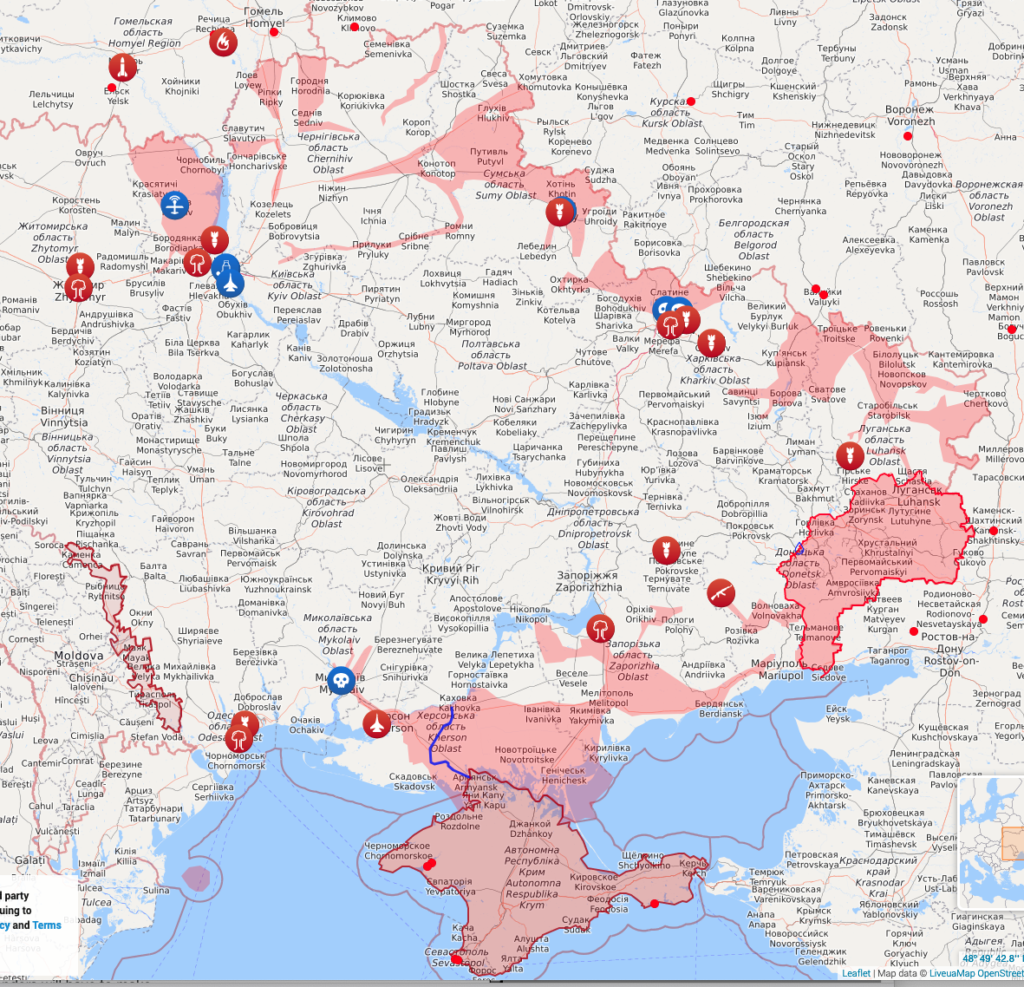
From a pure strategic viewpoint, those Russian tendrils snaking toward Kiev from the northeast look like a bad idea, since there’s no way to protect their supply lines.

(Always remember that the map is not the territory, and that both sides are working hard to put out propaganda, though the Russians seem to be manifestly incompetent at it.)

  • Here’s a fascinating thread reportedly leaked from an active Russian FSB (successor to the KGB) analyst about how badly everything is screwed up.

    I assume that’s Ramzan Kadyrov, corrupt head of the Chechen Republic, former resistance fighter against Russia who defected in 1999 and was appointed by Putin in 2007. Bit of a jihadist scumbag to boot, and just a generally nasty piece of work. I assume by “Kadyrov’s squad” they mean the Kadyrovtsy, the militia forces under his direct control.

    Some tweets about who could they even get post-Zelensky to sign a treaty (Medvechuk? Tsaryova? Yanukovich?) snipped.

    I don’t agree with every conclusion (I doubt the war will produce worldwide famine), but it’s still worth reading the whole thread.

  • Cheap Chinese tires blamed for Russian convoy unable to reach Kyiv.”

    Cheap Chinese tires have been blamed for a Russian convoy of armoured vehicles being unable to reach Kyiv.

    Yesterday, the Ministry of Defence issued an update revealing that a convoy of Russian tanks advancing on the capital of Ukraine remained 30km from the centre of the city having made little progress over the previous three days because of “Ukranian resistance, mechanical breakdown and congestion.”

    Karl Muth, an academic based at the University of Chicago and a self-described tire expert, took to Twitter to set out a theory blaming cheap Chinese tires for the slow advance of Russian vehicles.

    “Those aren’t Soviet-era heavy truck radials,” Muth said, commenting on a photo of a Russian army vehicle with ripped tires.

    Instead Muth believes the trucks use “Chinese military tires, and I believe specifically the Yellow Sea YS20.”

    “This is a tire I first encountered in Somalia and Sudan. it’s a bad Chinese copy of the excellent Michelin XZL military tire design,” he continued.

    Former pentagon staff member Trent Telenko also got stuck into the debate and said “poor Russian army truck maintenance practices” has created a risk of equipment failure.

    “When you leave military truck tires in one place for months on end. The side walls get rotted/brittle such that using low tire pressure setting for any appreciable distance will cause the tires to fail catastrophically via rips,” Telenko said.

  • Morgan Stanley analyst says that Russia is heading toward debt default as soon as April 15. Those are dollar-denominated bonds, which means they can’t be paid with devalued rubles.
  • Hundreds Of Thousands Of Global Hackers Are Banding Together To Disrupt Russian Military, Banking And Communication Networks.

    There are reportedly more than 400,000 “volunteer hackers” helping Ukraine fight its cyberwar against Russia.

    Victor Zhora, deputy chief of Ukraine’s information protection service, told Bloomberg last week that Ukraine was putting up a “cyber resistance” against its invasion that would work to try and weaken Russia.

    Zhora said: “Our friends, Ukrainians all over globe, [are] united to defend our country in cyberspace. [Ukraine is working to do] everything possible to protect our land in cyberspace, our networks, and to make the aggressor feel uncomfortable with their actions.”

    He also said that volunteers were helping Ukraine obtain intelligence in order to fight back at Russian military systems.

    They are also trying to get the message out to Russian citizens, who have been Fed a starkly different narrative from their government than the rest of the world has seen play out. Volunteers are working to “address Russian people directly by phone calls, by emails, by messages” and “by putting texts on their services and showing real pictures of war.”

    There aren’t 400,000 real hackers around the world. But 10,000 hackers and 390,000 script kiddies can sill do a lot of damage…

  • What breaks first?

    The Russian invasion of Ukraine will end when one or more of four things breaks:

    • the Russian supply lines;
    • the Ukrainian ability to effectively resist;
    • the Russian economy;
    • the patience of some armed individuals around Putin.

    We’re already seeing a lot of the first and third…

  • Is the Russian air force incapable of complex operations?

    More than a week into the Russian invasion of Ukraine, the Russian Air Force has yet to commence large-scale operations. Inactivity in the first few days could be ascribed to various factors, but the continued absence of major air operations now raises serious capability questions.

    One of the greatest surprises from the initial phase of the Russian invasion of Ukraine has been the inability of the Russian Aerospace Forces (VKS) fighter and fighter-bomber fleets to establish air superiority, or to deploy significant combat power in support of the under-performing Russian ground forces. On the first day of the invasion, an anticipated series of large-scale Russian air operations in the aftermath of initial cruise- and ballistic-missile strikes did not materialise. An initial analysis of the possible reasons for this identified potential Russian difficulties with deconfliction between ground-based surface-to-air missile (SAM) batteries, a lack of precision-guided munitions and limited numbers of pilots with the requisite expertise to conduct precise strikes in support of initial ground operations due to low average VKS flying hours. These factors all remain relevant, but are no longer sufficient in themselves to explain the anaemic VKS activity as the ground invasion continues into its second week. Russian fast jets have conducted only limited sorties in Ukrainian airspace, in singles or pairs, always at low altitudes and mostly at night to minimise losses from Ukrainian man-portable air defence systems (MANPADS) and ground fire.

    Snip.

    While the early VKS failure to establish air superiority could be explained by lack of early warning, coordination capacity and sufficient planning time, the continued pattern of activity suggests a more significant conclusion: that the VKS lacks the institutional capacity to plan, brief and fly complex air operations at scale. There is significant circumstantial evidence to support this, admittedly tentative, explanation.

    First, while the VKS has gained significant combat experience in complex air environments over Syria since 2015, it has only operated aircraft in small formations during those operations. Single aircraft, pairs or occasionally four-ships have been the norm. When different types of aircraft have been seen operating together, they have generally only comprised two pairs at most. Aside from prestige events such as Victory Day parade flypasts, the VKS also conducts the vast majority of its training flights in singles or pairs. This means that its operational commanders have very little practical experience of how to plan, brief and coordinate complex air operations involving tens or hundreds of assets in a high-threat air environment. This is a factor that many Western airpower specialists and practitioners often overlook due to the ubiquity of complex air operations – run through combined air operations centres – to Western military operations over Iraq, the Balkans, Libya, Afghanistan and Syria over the past 20 years.

    Second, most VKS pilots get around 100 hours’ (and in many cases less) flying time per year – around half of that flown by most NATO air forces. They also lack comparable modern simulator facilities to train and practise advanced tactics in complex environments. The live flying hours which Russian fighter pilots do get are also significantly less valuable in preparing pilots for complex air operations than those flown by NATO forces. In Western air forces such as the RAF and US Air Force, pilots are rigorously trained to fly complex sorties in appalling weather, at low level and against live and simulated ground and aerial threats. To pass advanced fast jet training they must be able to reliably do this and still hit targets within five to ten seconds of the planned time-on-target. This is a vital skill for frontline missions to allow multiple elements of a complex strike package to sequence their manoeuvres and attacks safely and effectively, even when under fire and in poor visibility. It also takes a long time to train for and regular live flying and simulator time to stay current at. By contrast, most VKS frontline training sorties involve comparatively sterile environments, and simple tasks such as navigation flights, unguided weapon deliveries at open ranges, and target simulation flying in cooperation with the ground-based air-defence system. Russia lacks access to a training and exercise architecture to rival that available to NATO air forces, which routinely train together at well-instrumented ranges in the Mediterranean, North Sea, Canada and the US. Russia also has no equivalent to the large-scale complex air exercises with realistic threat simulation which NATO members hold annually – the most famous of which is Red Flag. As such, it would be unsurprising if most Russian pilots lack the proficiency to operate effectively as part of large, mixed formations executing complex and dynamic missions under fire.

    Third, if the VKS were capable of conducting complex air operations, it should have been comparatively simple for them to have achieved air superiority over Ukraine. The small number of remaining Ukrainian fighters, conducting heroic air-defence efforts over their own cities, are forced to operate at low altitudes due to long-range Russian SAM systems and consequently have comparatively limited situational awareness and endurance. They ought to be relatively easily to overwhelm for the far more numerous, better armed and more advanced VKS fighters arranged around the Ukrainian borders. Ukrainian mobile medium- and short-range SAM systems such as SA-11 and SA-15 have had successes against Russian helicopters and fast jets. However, large Russian strike aircraft packages flying at medium or high altitude with escorting fighters would be able to rapidly find and strike any Ukrainian SAMs which unmasked their position by firing at them. They would lose aircraft in the process, but would be able to attrit the remaining SAMs and rapidly establish air superiority.

    Russia has every incentive to establish air superiority, and on paper should be more than capable of doing so if it commits to combat operations in large, mixed formations to suppress and hunt down Ukrainian fighters and SAM systems. Instead, the VKS continues to only operate in very small numbers and at low level to minimise the threat from the Ukrainian SAMs. Down low, their situational awareness and combat effectiveness is limited, and they are well within range of the MANPADS such as Igla and Stinger which Ukrainian forces already possess. The numbers of MANPADS are also increasing, as numerous Western countries send supplies to beleaguered Ukrainian forces. To avoid additional losses to MANPADS, sorties continue to be primarily flown at night, which further limits the effectiveness of their mostly unguided air-to-ground weapons.

    (Hat tip: Chuck Moss.)

  • How Russian propaganda has sold some of the Russian people on Project Z. But Russian troops are finding things quite a different story. Warning: Bodies, and at about 18 seconds in one, I think strewn body parts:

  • Report that Russian special forces are furious with Putin.

    “Sources have been telling me, sources that are well connected to the Russian Security Services, that the offensive is not going well, that some special forces, the Russian Spetsnaz, are furious because they have been sent into battle without proper support, and many of them have been killed. They say that the national guard forces and the regular army, the national guard forces include those Chechen units, that two of them are not coordinating on the field. And that the overall battle plan is somewhat disjointed in that it’s partly a plan for war and partly a plan for peacekeeping and so-called de-Nazification of this country. And it has led to a lack of cohesion,” Engel reported.

    “A lot of this goes back to the man who’s behind it all, Vladimir Putin, who I’m told is now increasingly isolated, is just taking advice from his inner circle, that there are only about three people who matter right now,” Engel continued. “And that speech, you mentioned it a short while ago, that Putin gave yesterday — bizarre location, speaking at Aeroflot, to a group of flight attendants. He sounded incredibly angry. He sounded detached. He was talking about how the Ukrainians here are machine-gunning people, that they’re driving around in cars packed with explosives, jihadi-style. And he went very deep and repeatedly on this theme that they’re fighting against the Nazis. It was the angriest I’ve ever seen him.”

    This is from a couple of days ago. Have Spetsnaz pissed off at you doesn’t seem like a good long-term survival strategy for a Russian leader. On the other hand, this report probably deserves some skepticism, since it fits too easily into what we would like to hear about the situation, so some salt is in order. (Hat tip: Director Blue.)
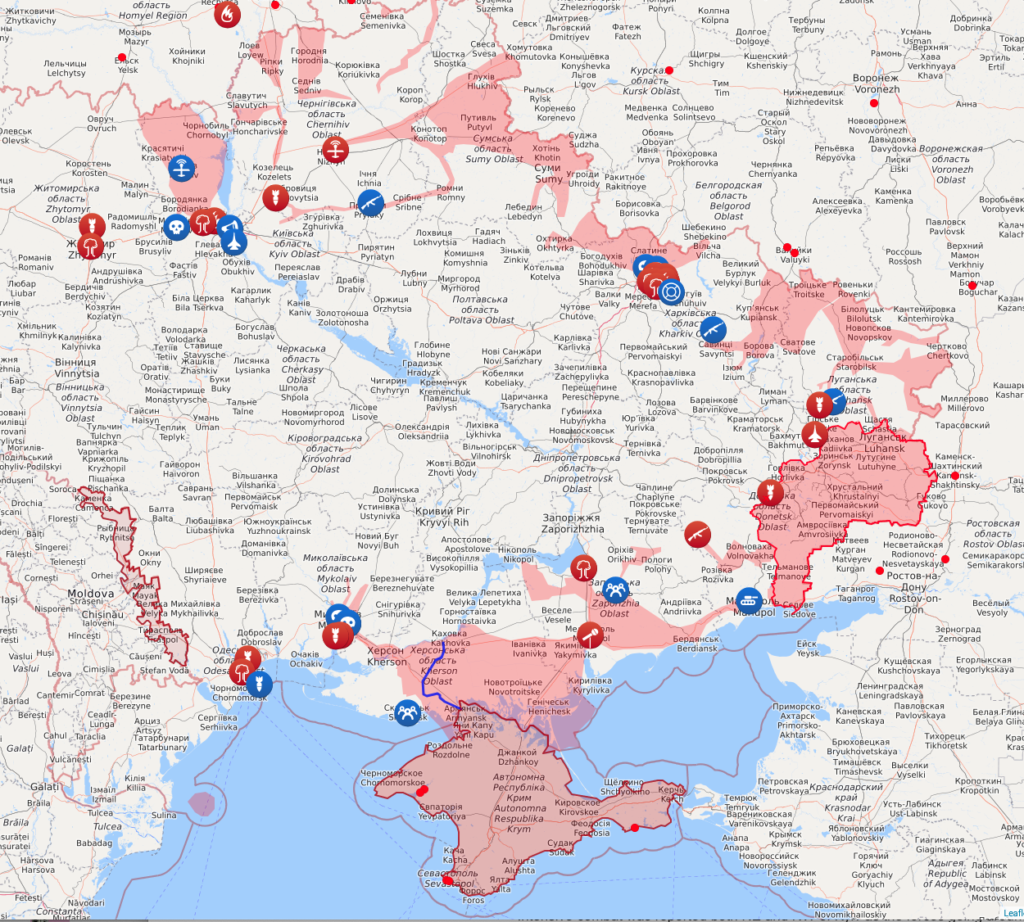

  • “Ukraine says it has RE-TAKEN Chuhuiv city and killed two high-ranking Russian commanders during the battle.” (Hat tip: Instapundit.)
  • After nearly two weeks of criticism, the Biden Administration just announced a ban on Russian oil and gas purchases.
  • “A Complete Summary Of All Russia Sanctions And Developments.” Read on for exciting blow-by-blow summaries of foreign exchange surcharges and debt repayment details…
  • Russia may nationalize foreign-owned factories.
  • Aeroflot stops flying to foreign destinations to keep most of their leased airliners from being repossessed.
  • What rolls down stairs/alone and in pairs/and up-armors your Russian truck? Caveat: They call this improvised armor, but it could also be on-hand materials for traction in muddy areas.
  • “Russia-Ukraine war to cripple semiconductor industry globally.” Ukraine supplies a lot of neon, which is used as a carrier gas in certain wavelength DUV lasers in photolithography. (Details here.)
  • Ukraine President Zelenskyy sounds like he may be ready to negotiate.
  • Can Ukraine Actually Win?

    Monday, March 7th, 2022

    Busy day, so enjoy another Ukraine video. This is a good summary of the fight up until now:

    Some takeaways:

  • We know what Russian plans were, based on captured documents and a pre-written “analysis” of Russia’s glorious victory someone found on file on a web server.
  • They expected to be at the gates of Kiev in three days and have everything conquered in two weeks.
  • Well, we’re almost two weeks in, and they haven’t achieved any of their major objectives. All major cities remain in Ukrainian hands.
  • One reason they didn’t: NATO alerted them to impending Russian action slightly before it began, so many commanders and units were already dispersed from bases.
  • They didn’t have enough trucks to begin with and have already lost 200 more.
  • Also, not only is the Ukrainian mud all but impassable, but their truck tires really suck. (More on this in a day or so.)
  • We need to pay more attention to the south, where Russian troops attacking from Crimea have done better (but still not great).
  • Time is not on Russia’s side, as sanctions are crashing their economy hard.

    Here’s a snapshot of the LiveMap.

    Can they win? Yes. Much stranger things have happened in war. But there’s still no guarantee of victory.

    The Failed Logistics Of The Russian Invasion

    Sunday, March 6th, 2022

    I’ve touched on some of the logistical difficulties Russia has experienced in its Ukrainian invasion. But this video goes into more detail about how Russia built up logistical support for the invasion, the importance of its rail systems, and how it hasn’t been able to keep up post-invasion.

    Some takeaways:

  • Ukrainian forces destroyed all rail links between the two countries.
  • Russian forces are relying on analog, unsecured radio communications rather than scrambled digital channels, and Ukrainian forces are listening in and jamming.
  • Poor logistics also helped Soviet forces lose in Afghanistan.
  • Russia has 30,000 strong military rail organization.
  • “Russia doesn’t have enough trucks.” They can’t operate effectively more than 90 miles from supply dumps.
  • A large percentage of truck transport was dedicated to rocket resupply, not fuel and food.
  • Russia only had 3-5 days of supplies when they invaded. When those ran out, they were screwed.
  • Russia’s military works on a “push” logistic system rather than a “pull” system used by the U.S. military, meaning it’s not very flexible.
  • Russia has the capability to set up the infrastructure for a longer war, but it’s going to take time.
  • Russia’s failure to quickly achieve it’s objectives has seen it resort to more desperate and indiscriminate tactics.
  • And here’s a related Twitter thread that touches on rail network logistic issues.

    LinkSwarm for March 4, 2022

    Friday, March 4th, 2022

    Russia’s invasion of Ukraine grinds on, Hunter Biden’s bestie’s going to the big house, a massive voting problem (and possible fraud) winds up in court in Harris County, and a tiny bits on both Amazon and anime.

    It’s the Friday LinkSwarm!

    Not in this LinkSwarm: links on the Zaporizhzhia Ukrainian nuclear reactor, since I’m not sure I can trust any of the information sent out by either side.

  • Have Ukrainians already won the first battle of Kiev? A closer look at The Battle of Bucha.

    It is not foreordained that Russia wins and Ukraine loses. Winning a war is not merely an exercise in numbers or technology. As General George S. Patton observed, “Wars may be fought with weapons, but they are won by men. It is the spirit of men who follow and of the man who leads that gains the victory.”

    Since Russian President Vladimir Putin failed to quickly topple the Ukrainian government and kill President Volodymyr Zelenskyy, the war has widened into a contest involving almost the entire border region shared by the combatants along with the stretch of border between Belarus and Kyiv some 80 miles to the north of Ukraine’s capital city.

    Much media attention has been given to Russia’s advances along the Sea of Azov in the south and on the approach to Ukraine’s third-largest city, Odessa, on the shores of the Black Sea as well as the remarkable attack that captured Europe’s largest nuclear power plant in Zaporizhzhia. These Russian successes are discouraging for Ukrainian defenders but, in the grand contest, they matter far less than the battle for Kyiv.

    Snip.

    There are fascinating signs coming out of what may be a decisive battle to the northwest of Kyiv on the long, winding, secondary road from Chernobyl. This is the road where a 40-mile-long column of Russian vehicles was spotted by satellite. Most of the vehicles are supply trucks. They would be carrying fuel, ammunition, and food for the Russian forces that have advanced to the very outskirts of Kyiv itself but have seemingly been stalled for several days.

    Snip.

    Out of this come three reports that, if true, suggest the beginnings of a devastating reversal for Russian forces operating northwest of Kyiv.

    First, reports today in multiple outlets that Russian Major General Andrei Sukhovetsky was killed in combat by a sniper. Sukhovetsky, 47, was an elite Russian Spetsnaz commando and veteran of Russia’s war in Syria. The commander of the Russian 7th Airborne Division, he was assigned the mission of leading the Russian thrust from Belarus to Kyiv. Men like Sukhovetsky have an outsized presence on the battlefield. They’re inspirational. Their personal leadership at the point of the spear often means the difference between victory and defeat during the fast-paced controlled violence of war. His loss would be devastating to his men and to the organizational momentum of the forces he commanded.

    That Sukhovetsky was killed by a sniper suggests that he was personally trying to regain the initiative against Ukrainian forces who had fought him to a standstill.

    The second report of merit is the heavy damage sustained in the town of Irpin on the northwest border of Kyiv’s city limits. The damage to this city suggests a major battle — an effort by the Russians to breakthrough. They didn’t.

    The final piece of the puzzle is the Battle of Bucha. Ukrainian forces claimed the recapture of Bucha hours after the devastation visited on Irpin. The timing is important here. The Russians tried and failed to take Irpin and then the Ukrainians retook Bucha two miles to the northwest of Irpin.

  • Also from DeVore: That long column of Russian vehicles we keep hearing about may mean that the Kiev offensive is bogged down.

    The roughly 80-mile route from the Belarus-Ukraine border from the Chernobyl salient to Kyiv on the western side of the Dnieper River runs over a secondary asphalt road. This road frequently crosses rivers, runs through small villages, or is bordered on both sides by the eastern extent of the mighty Pripyat Marsh — the geographical feature which defines the border between Ukraine and Belarus.

    The road is not able to support a large military force, even if unopposed in an exercise, especially during the spring and fall months during a time the locals call “Rasputitsa” — the mud season. Unfortunately for Russian President Vladimir Putin and his military commanders, Ukrainian soil never froze solid this winter, so the fall Rasputitsa is still a factor.

    This is why there have been so many photos coming out from the conflict that show all manner of Russian military vehicles bogged down in the mud. As soon as a vehicle on a narrow road becomes disabled or is destroyed in combat, or as the vehicles maneuver off-road in response to combat, they risk becoming mired. Even if they don’t get stuck in the mud, they end up consuming far more fuel that must be delivered to them than they would were the ground frozen solid.

    Thus, that 40-mile-long column of “tanks” is more likely mostly trucks carrying fuel, ammunition, and food to the advanced forces of the Russian 20th Combined Arms Army on the outskirts of Kyiv. That this column hasn’t apparently moved much may mean that the Russian forces just north of Kyiv are running low on basic supplies.

    This greatly increases the importance for the Russian army to achieve success to the east of Kyiv where the road network is far more developed and, if the terrain is captured and secured, capable of bringing in the volume of supplies needed to properly surround Kyiv and place it under siege.

    In the meantime, the forces near Kyiv may be vulnerable to a Ukrainian counterattack. While some of the Russian conscript soldiers and even the veteran contract troops may be more likely to surrender due to low morale exacerbated by a lack of food and fuel.

  • “Ukraine claims more than 5,800 Russian troops and 2,000 civilians killed.”
  • Russia has blocked Facebook, Twitter, BBC and Deutsche Welle.
  • Exxon Mobil, BP and Shell have all announced that they’ve stopped doing business with Russia.
  • Russian oil company Lukoil also called for an end to the war.
  • In one way Ukraine has already won.

    In about three weeks, we’ve seen a Vladimir who was “off” go from chess to raising on a busted flush in something that is well beyond “off.” The nuclear escalation is not exactly unexpected, at least if you know a bit about the Soviet playbook for such things. What matters is if he still has full control, and/or the extent to which Dead Hand has been brought online. All I will say is that if his ability to give certain orders has been unofficially curtailed, it would not be the first time. If it hasn’t, it is not a good idea to poke the crazy man with the button via official actions.

    And there are a lot of official actions out there that are not going to help in regards the deteriorating man. Among others is Switzerland deciding that they are neutral, but not that neutral. Add to it firm allies who have told him no, even after he just helped them out literally a few weeks ago… Even Xi has said no on some fronts. None of this is likely to slow down the deterioration. Or provide enough of a reality check to get through to him as he rages in his bunker with his captive oligarchs.

    And while we are at it, let’s look at the attack itself and the absolute fuck up that it, and subsequent actions by STAVKA (call it what it is), truly are. It was billed as a demonstration of the new Russian way of war, their version of “Shock and Awe.” Problem is, S&A or any other form of blitz is heavily dependent upon superior logistics, something the Soviets nor the Russians have ever had. You need massive amounts of ammo, fuel, parts, and replacement troops to pull it off. Replacement troops not only because of losses, but the need to detail out troops to hold key points as you go. It also requires highly trained troops who know land nav inside and out.

    From what I am learning, the order went out to make this happen. The actual order, however, may not have even approached what would be given for a small-unit special ops strike. Contingency plans? Decap. No? Then try for decap again. Decap. Decap. Try it again damnit! There are differing reports on the number of Wagner troops killed or captured, but a good number were sent in on assassination missions. They were not alone. Problem was, they were all alone as the original push down got bogged down; the efforts to do airmobile and airborne ops were shot down (literally in some cases); and, the public is now on high alert to the saboteurs and assassins roaming major cities trying to mark targets, etc. Don’t expect rules of war for those caught marking civilian buildings for strikes. For now, expect a return to grinding Soviet bombardment, civilian casualties be damned.

    The fact is, Vladimir has already lost simply because he didn’t win. He is committed, and is committing Russia and all its people, to a long, grinding, bloody slog that is going to have severe economic impacts. Just replacing ammunition, gear, people, is going to have a severe impact. Add to it the growing official and unofficial sanctions? The Russian people are going to feel this one, in ways they never have before. Current Vladimir does not care. He’s lost to that. He has no way to go in and control the country, or even the parts he’s tried so desperately to annex. Even those are likely to slip from him given the current state of “uppitiness” on the part of the Ukrainians.

    The Ukrainians have not won. At best they have pushed things into a long grind with some chance of a stalemate. Yet, by doing this they have won. They have prevented the cheap and easy victory on which Vladimir counted. They have forced him into committing military and economic resources he does not have over the long term. Heck, even the short term. Russia’s economy was already teetering, current operations and responses are going to crater it unless something major happens. I’ve lived through a couple of power struggles in the Kremlin; under these circumstances, I hope we all do live through what is to come. A quick clean change of leadership seems unlikely given the Keystone gang we’ve seen so far, but it may be our best hope.

    All we can do is wait and see what happens. While current circumstances are not new or unique on many levels, I will note that in my lifetime I’ve never seen a situation like this where key leadership was this insecure. Xi is in some ways hanging by a thread, and knows his enemies in the CCP are looking for any excuse to bring him down. Vladimir we’ve discussed. The Europeans, particularly the Germans? They are not secure either, especially since the Green policies have caused them to firmly place their mouth around Putin’s, er, finger, in regards energy. To see them decide to fund their own military, back off on the idiocy of green (maybe), and truly support the Ukraine strikes more as a desperation move than a rational push. Johnson is a non-entity right now, and not to be taken seriously. Our own dementia patient? Hell, he’s just waiting for his ice cream and to be allowed to go back upstairs to watch Matlock. Those behind him, however, are desperate beyond belief. Not one major stable leader anywhere in the world. That’s a new one and I thought I had about seen it all after watching the Soviets/Russians for more than 40 years now.

    (Hat tip: Stephen Green at Instapundit.)

  • No NATO no-fly zone. Good. I very much want to see Putin defeated, but clearly NATO can’t be expected to respond to an attack on a non-member country, and that would be a dangerous escalation.
  • Dramatic pictures of destroyed Russian armor. (Hat tip: Stephen Green at Instapundit.)
  • Mirya no more:

  • A former business partner of Hunter Biden was sentenced Monday to more than a year in prison for his role in a scheme to defraud a Native American tribe of some $60 million in bonds.”

    “More than a year” for $60 million in fraud? Seems a little lite.

    The defendant, Devon Archer, was sentenced to one year and one day in federal prison by Manhattan Judge Ronnie Abrams, who said the crime was “too serious” to let him just walk.

    “There’s no dispute about the harm caused to real people,” Abrams said, noting that the defrauded tribe, the Oglala Sioux, is one of the poorest in the nation.

    Archer will also have to pay more than $15 million in forfeiture by himself and more than $43 million in restitution with his co-defendants in the case.

    The convicted fraudster has maintained his innocence and intends to appeal the conviction and sentence, his attorney, Matthew Schwartz, said in court Monday.

    In brief statements to Abrams just before Archer was sentenced, he and Schwartz claimed he was taken advantage of by corrupt businessmen who wanted to use him in the scheme.

    “He came under the influence of a person he trusted too much and didn’t ask enough questions,” Schwartz said.

    “Trusted too much.” Yeah, he trusted he wouldn’t get caught because of his powerful friends.

    What are the odds this was the only crooked deal Archer had his fingers into? I’d say pretty close to zero.

  • One of the biggest reasons Democrats will get clobbered in November is bringing back the octopus of inflation.

    The Democrats will suffer historic losses in the November midterms.

    This disaster for their party will come about not just because of the Afghanistan debacle, an appeased Vladimir Putin’s invasion of Ukraine, the destruction of the southern border, the supply chain mess, or their support for critical race theory demagoguery.

    The culprit for the political wipeout will be out-of-control inflation—and for several reasons.

    First, the Biden Administration is in such denial of inflation that it sounds to Americans simply callous and indifferent to the misery it has unleashed.

    Biden officials have scoffed at price spikes as “transitory.” Or they have preposterously claimed spiraling costs are a concern only to the elite. They blame the Ukraine crisis. Or they fault the out-of-office bogeyman, Donald Trump.

    The administration assures us that consumer prices are only rising at an annualized rate of 7.5 percent—as if the steepest increase in 40 years actually is not all that bad.

    Yet the middle class knows that inflation is far worse when it comes to the stuff of life: buying a house, car, gas, meat, or lumber.

    Second, inflation is an equal opportunity destroyer of dreams. It undermines rich and poor, Democrats and Republicans, conservatives and liberals. It unites all tribes, all ideologies, all politics against those who are perceived to have birthed the monstrous octopus that squeezes everything and everyone it touches.

    The conservative passbook holder sees his meager life savings eaten away. The liberal teacher’s car payments stretch from six to 10 years.

    The prospective Republican home buyer sees his hard-earned potential down payment eaten away each month. The Democratic carpenter feels his new higher wages buy even less.

    Third, inflation is ubiquitous, inescapable, omnipotent—and humiliating. It destroys personal dignity. And its toxicity is insidious, sort of like seeping, odorless, colorless, but nevertheless lethal carbon monoxide.

    Unlike now-unpopular critical race theory, it cannot be avoided for a day. You cannot tune it out like one does the mess in Afghanistan or the now nonexistent southern border. Inflation attacks everyone in 24/7, 360-degree fashion.

    It belittles you at the gas station. It downsizes you at the food market. It humiliates you in the obscene real estate market. It makes you look stupid when you are paying for a new car. It ridicules you when you buy lumber. Suddenly you apologize that you really cannot afford your child’s braces.

    Fourth, inflation undermines a civil and ordered society. It unleashes a selfish “every man for himself” mentality, the Hobbesian cruelty of a “war of all against all.”

    Inflation is the economic and emotional equivalent of smash-and-grab or carjacking. It is a brazen robber in broad daylight that so infuriates Americans by its boldness. It convinces them their very civilization is dying.

    (Hat tip: Director Blue.)

  • New Zealand vaccine mandate struck down.
  • “Federal Court Declares Diversity Initiative At Thomas Jefferson High School To Be Unconstitutional.” “Judge Claude Hilton ruled that the county unconstitutionally engineered the reduction of Asian-American students to achieve greater racial diversity.”
  • Did you know that one of the biggest freight management companies in America was temporarily locked down by a cyberattack? “Expeditors International, a top-five freight management company by revenue, disclosed Wednesday that last month’s cyberattack will have a “material adverse impact” on finances and that it will be late filing its 2021 annual report because of difficulty accessing information on its accounting systems.”
  • The usual anti-cop lunatics want to abolish gang member databases.
  • Holly Hansen has been all over a story about Harris County being unable to count primary votes.

    Once again Harris County has drawn scrutiny over a slew of election day problems and may need a court order to continue counting votes beyond a state proscribed deadline.

    Issues with elections procedures began days before March 1 as election judges found that supplies were not available for pickup at the appointed time on Friday, February 25. Even after the delayed distribution of supplies on Saturday, election workers complained that many kits were lacking essential equipment.

    The situation worsened by Tuesday, and during a conference call with the Texas Secretary of State’s Office (SOS) and representatives from the local Democratic and Republican parties, Elections Administrator Isabel Longoria notified the state that her department may not be able to count all early and election day ballots by the statutory deadline of 7 p.m. Wednesday, March 2.

    According to a statement from Secretary of State John Scott, the counting delay was “due only to damaged ballot sheets that must be duplicated before they can be scanned by ballot tabulators at the central count location.”

    “Our office stands ready to assist Harris County election officials, and all county election officials throughout the state, in complying with Texas Election Code requirements for accurately tabulating and reporting Primary Election results. We want to ensure that all Texans who have cast a ballot in this year’s Primary Elections can have confidence in the accuracy of results.”

    According to the state election code, however, any votes counted after the statutory deadline may not count unless the county obtains a court order. Furthermore, under laws in effect since 1986, failure to deliver precinct election returns by the deadline is a Class B misdemeanor.

    Calling the county’s elections problems the “worst in 40 years,” Harris County Republican Party (HCRP) Chair Cindy Siegel told KPRC news, “This has been a complete mess. We’ve had equipment delays, we’ve had equipment problems, equipment wasn’t delivered, we had polls that were unable to be set up.”

    In a statement to The Texan, HCRP said that after consulting with the SOS, “if the count does not appear to be near completion in all races by [Wednesday] afternoon, the parties have tentatively agreed to seek a court order to require the Harris County Election Administrator to continue counting beyond the 24-hour deadline required by law, and to enjoin the law to allow the count to continue.”

    Responsibility for conducting primary elections falls to the two main political parties, but they have contracted with the Harris County elections division to administer the elections.

    Sen. Paul Bettencourt (R-Houston) who formerly served as the Harris County voter registrar, called for immediate changes to the elections division.

    “[Harris County Judge] Lina Hidalgo must fire her hand-picked election administrator,” Bettencourt told The Texan. “Because if she doesn’t, I don’t think we’re going to have an election in November.”

    In 2020, the three Democrats on the Harris County Commissioners Court overruled objections from two Republican commissioners and the Democrat elected voter registrar Ann Harris Bennet to create the new office of elections administrator. Prior to the revamp, the elected county clerk and elected voter registrar managed elections in the state’s largest county.

    The commissioners court then appointed Longoria, a former staffer for state Sen. Sylvia Garcia (D-Houston) who had previously run unsuccessfully for Houston City Council, with an annual salary of $190,000.

    Under Longoria’s guidance, the county approved $54 million for the elections division last summer which included $14 million to purchase new voting equipment.

    Earlier this year, Longoria told commissioners the March primary would cost more than $8.8 million.

    In 2020, Harris County received nearly $10 million in grants from Mark Zuckerberg’s Center for Tech and Civic Life and another $1 million in 2021 just before the Texas Legislature restricted such private grants.

    According to sources familiar with the equipment, the second page of the paper ballot has been jamming machines and now requires entry by hand. Allegedly, although the early voting period ended Friday,

    The question, of course, is whether this is a sign of manifest incompetence, or a sign of widespread attempted vote fraud?

    If it was a fraud attempt, we should be grateful that it was bungled so badly in the primary that a lot more attention will be paid.

    And the judge didn’t sound pleased:

  • Speaking of Texas turnout:

  • Iowa Republican Governor Kim Reynolds signs bill banning men from women’s sports. I’ll take “Headlines no one would understand 20 years ago” for $400, Alex.
  • Heh:

  • Democratic Party Gaslighting: The Continuing Journeys:

  • 54% inflation in Turkey.
  • Amazon closes all it’s physical bookstores. One wonders why they bothered trying to open them in the first place…
  • Funimation is being folded into Crunchyroll. If that sentence means nothing to you, feel free to keep scrolling.
  • Pro-Tip: Try not to wear your influencer shoes out when you’re out committing armed robberies. (Hat tip: Dwight.)
  • Fantasy writer Brandon Sanderson has successful Kickstarter. $22 million successful. And 27 days left to go…
  • Bill Burr sings the praises of Chuck E. Cheese.
  • Are Your Kids Going To Grow Up To Be Democrats? Know The Warning Signs.”
  • The Final Boss:

  • Russo-Ukrainian War Update for February 27, 2022

    Sunday, February 27th, 2022

    The Russian offensive in Ukraine continues to bog down against stiff resistance, Putin puts his nukes on alert, a rumor of peace talks, momentum to suspend some Russian banks from SWIFT builds, and a whole lot of aid from the rest of the world is pouring into Ukraine.

  • Russia evidently didn’t expect the fierce resistance they received in Ukraine:

    Russia invaded Ukraine from three sides on Wednesday night Eastern time, and as of now, early afternoon Saturday, the Russian army has yet to seize any Ukrainian cities.

    This morning, a senior defense official at the Pentagon briefed reporters and declared, “We continue to believe, based on what we have observed that this resistance is greater than what the Russians expected and we have indications that the Russians are increasingly frustrated by their lack of momentum over the last 24 hours particularly in the north parts of Ukraine… As of this morning we have no indication still that the Russian military has taken control over any cities. As of this morning we still believe that Russia has yet to achieve air superiority. Ukrainian air defenses including aircraft do continue to be operable and continue to engage and deny access to Russian aircraft in places over the country.”

    There is an intriguing but unverified claim from Ukrainian intelligence that Putin is furious, that he expected a quick surrender from Kiev, and that the invading Russian forces weren’t equipped for a long war – and that after ten days, the Russian forces will face serious problems with supply lines, fuel, equipment, ammunition, etc. Maybe this is just Ukrainian propaganda, meant to keep up morale for the next week or so. But there are some intriguing anecdotes of Ukrainians hitting Russian supply columns and videos of Russian tanks running out of fuel. (It turns out supply chain problems are just everywhere these days!)

    Sending in armored columns without dedicated infantry, artillery and air support is a big risk, big reward move. Patton did it successfully in the race across France in 1944, but he had air superiority, a friendly population, and the greatest war machine ever assembled in the history of mankind up to that time backing him, and even he had to halt when he outran his supply lines.

    Putin’s initial goal, the Russian reabsorption of Ukraine or the transformation of it into a lackey state of a renewed Russian empire, is now probably impossible. Any Russian-backed Ukrainian puppet government is likely to be vehemently rejected by the Ukrainian people. Russian forces will find it difficult to go out on patrol when every citizen’s got a rifle and every grandma on every street corner is handing them sunflower seeds, telling them they are going to be fertilizer soon.

    Russia may take large chunks of Ukraine, but they will have an exceptionally difficult time keeping it.

  • Why the Russians are struggling:

    The last three days of combat should put a serious dent in the reputation of this new Russian army. We should, however, try to understand why the Russians are struggling. First, the Russian army’s recent structural reforms do not appear to have been sufficient to the task at hand. Second, at the tactical and operational level, the Russians are failing to get the most out of their manpower and materiel advantage.

    There has been much talk over the last ten years about the Russian army’s modernization and professionalization. After suffering severe neglect in the ’90s, during Russia’s post-Soviet financial crisis, the army began to reorganize and modernize with the strengthening of the Russian economy under Putin. First the army got smaller, at least compared to the Soviet Red Army, which allowed a higher per-soldier funding ratio than in previous eras. The Russians spent vast sums of money to modernize and improve their equipment and kit — everything from new models of main battle tanks to, in 2013, ordering Russian troopers to finally retire the traditional portyanki foot wraps and switch to socks.

    But the Russians have also gone the wrong direction in some areas. In 2008, the Russian government cut the conscription term from 24 to twelve months. As Gil Barndollar, a former U.S. Marine infantry officer, wrote in 2020:

    Russia currently fields an active-duty military of just under 1 million men. Of this force, approximately 260,000 are conscripts and 410,000 are contract soldiers (kontraktniki). The shortened 12-month conscript term provides at most five months of utilization time for these servicemen. Conscripts remain about a quarter of the force even in elite commando (spetsnaz) units.

    As anyone who has served in the military will tell you, twelve months is barely enough time to become proficient at simply being a rifleman. It’s nowhere near enough time for the average soldier to learn the skills required to be an effective small-unit leader.

    Yes, the Russians have indeed made efforts to professionalize the officer and the NCO corps. Of course, non-commissioned officers (NCOs) have historically been a weakness of the Russian system. In the West, NCOs are the professional, experienced backbone of an army. They are expected to be experts in their military speciality (armor, mortars, infantry, logistics, etc.) and can thus be effective small-unit commanders at the squad and section level, as well as advisers to the commanders at the platoon and company level. In short, a Western army pairs a young infantry lieutenant with a grizzled staff sergeant; a U.S. Marine Corps company commander, usually a captain, will be paired with a gunnery sergeant and a first sergeant. The officer still holds the moral and legal authority and responsibility for his command — but he would be foolish to not listen to the advice and opinion of the unit’s senior NCOs.

    The Russian army, in practice, does not operate like this. A high proportion of the soldiers wearing NCO stripes in the modern Russian army are little more than senior conscripts near the end of their term of service. In recent years, the Russians have established a dedicated NCO academy and cut the number of officers in the army in an effort to put more resources into improving the NCO corps, but the changes have not been enough to solve the army’s leadership deficit.

    Now, let’s talk about the Russian failures at the operational and tactical level.

    It should be emphasized again that the Russian army, through sheer weight of men and materiel, is still likely to win this war. But it’s becoming more and more apparent that the Russians’ operational and tactical choices have not made that task easy on themselves.

    First, to many observers, it’s simply shocking that the Russians have not been able to establish complete air superiority over Ukrainian air space. After three days of hostilities, Ukrainian pilots are still taking to the skies and Ukrainian anti-air batteries are still exacting a toll on Russian aircraft. The fact that the Russians have not been able to mount a dominant Suppression of Enemy Air Defenses (SEAD) campaign and yet are insistent on attempting contested air-assault operations is, simply put, astounding. It’s also been extremely costly for the Russians.

    To compound that problem, the Russians have undertaken operations on multiple avenues of advance, which, at least in the early stages of this campaign, are not able to mutually support each other. Until they get much closer to the capital, the Russian units moving north out of Crimea are not able to help the Russian armored columns advancing on Kyiv. The troops pushing towards Kyiv from Belarus aren’t able to affect the Ukrainians defending the Donbas in the east. As the Russians move deeper into Ukraine, this can and will change, but it unquestionably made the opening stages of their operations more difficult.

    Third, the Russians — possibly out of hubris — do not appear to have prepared the logistical train necessary to keep some of their units in action for an extended period of time. Multiple videos have emerged of Russian columns out of gas and stuck on Ukrainian roads.

    The classic saying is “Amateurs talk about tactics, but professionals study logistics” (attributed to Marines Corps commander Gen. Robert H. Barrow, but I suspect the general sentiment is much older). An army runs on its stomach, and a modern mechanized army runs on its gas tank, and something has clearly gone wrong in with Russian logistical support for this war.

  • Russia seemed to have expected Ukrainian President Volodymyr Zelenskyy to fold. He hasn’t.

    America offered to evacuate Ukrainian President Volodymyr Zelenskyy. Zelenskyy replied, “The fight is here; I need ammunition, not a ride.”

    Zelenskyy’s reply was reminiscent of past heroes in times of war: Gen. Anthony McAuliffe who replied in “NUTS” in response to the German demand for surrender at Bastogne during the Battle of the Bulge in 1944; and the Texans striving for independence from dictator Santa Anna’s Mexico with their “Come and Take it Flag,” which was itself appropriated from Spartan King Leonidas and his response the Persian surrender demand at the Battle of Thermopylae.

    This bravery, in a day when modern communications allow all Ukrainians and the world to see it, has rallied Ukrainians to defend their nation. And now that the fighting has gone on for three days, what might that mean?

    Russian President Putin is said to have assembled 200,000 troops for the invasion. It is estimated that half of them have been committed so far. Further, Putin has called on 10,000 battle-hardened Chechen mercenaries. More than half of Russian forces are likely committed to the battle of Kyiv.

    Ukraine has 245,000 active-duty members, but most are in the east, facing the Russian-led and equipped militia in the separatist regions of Donetsk and Luhansk. Ukraine also has another 220,000 reservists. Many of these are spread across the nation slightly larger than the state of Texas.

    The strategic target is Kyiv and its independent government. To move the reservists to the fight, they must contend with Russian air superiority, slowing their march. More importantly, given this struggle for national survival, 7,000,000 men of military age and fit for military service are taking up arms. Every day, many more older men — and many Ukrainian women — are also being issued weapons, making Molotov cocktails, and joining the fight.

    The ongoing Ukrainian mobilization means that the Russian military will soon be outnumbered most everywhere on the battlefield. The Ukrainians may not have the same level of modern equipment — missiles, jets, helicopter — but they have numbers and will power. And, the Russians need to eat, they need fuel, and ammunition — their resupply trucks must get through. They won’t, not in large enough numbers; everyday Ukrainians will see to that.

  • General update from late yesterday:

    Russian forces’ main axes of advance in the last 24 hours focused on Kyiv, northeastern Ukraine, and southern Ukraine. Russian airborne and special forces troops are engaged in urban warfare in northwestern Kyiv, but Russian mechanized forces are not yet in the capital. Russian forces from Crimea have changed their primary axes of advance from a presumed drive toward Odesa to focus on pushing north toward Zaporizhie and the southeastern bend of the Dnipro River and east along the Azov Sea coast toward Mariupol. These advances risk cutting off the large concentrations of Ukrainian forces still defending the former line of contact between unoccupied Ukraine and occupied Donbas. Ukrainian leaders may soon face the painful decision of ordering the withdrawal of those forces and the ceding of more of eastern Ukraine or allowing much of Ukraine’s uncommitted conventional combat power to be encircled and destroyed. There are no indications as yet of whether the Ukrainian government is considering this decision point.

    Ukrainian resistance remains remarkably effective and Russian operations especially on the Kyiv axis have been poorly coordinated and executed, leading to significant Russian failures on that axis and at Kharkiv. Russian forces remain much larger and more capable than Ukraine’s conventional military, however, and Russian advances in southern Ukraine may threaten to unhinge the defense of Kyiv and northeastern Ukraine if they continue unchecked.

    Key Takeaways

    • Russia has failed to encircle and isolate Kyiv with the combination of mechanized and airborne attacks as it had clearly planned to do. Russian forces are now engaging in more straightforward mechanized drives into the capital along a narrow front along the west bank of the Dnipro River and toward Kyiv from a broad front to the northeast.
    • Russian forces have temporarily abandoned failed efforts to seize Chernihiv and Kharkiv to the northeast and east of Kyiv and are bypassing those cities to continue their drive on Kyiv. Russian attacks against both cities appear to have been poorly designed and executed and to have encountered more determined and effective Ukrainian resistance than they expected.
    • Russian movements in eastern Ukraine remain primarily focused on pinning the large concentration of Ukrainian conventional forces arrayed along the former line of contact in the east, likely to prevent them from interfering with Russian drives on Kyiv and to facilitate their encirclement and destruction.
    • Russian forces coming north from Crimea halted their drive westward toward Odesa, and Ukrainian forces have retaken the critical city of Kherson. Some Russian troops remain west of the Dnipro River and are advancing on Mikolayiv, but the main axes of advance have shifted to the north and east toward Zaporizhie and Mariupol respectively.
    • Russian forces have taken the critical city of Berdyansk from the west, threatening to encircle Mariupol even as Russian forces based in occupied Donbas attack Mariupol from the east, likely to pin defenders in the city as they are encircled.
    • Russian successes in southern Ukraine are the most dangerous and threaten to unhinge Ukraine’s successful defenses and rearguard actions to the north and northeast.
    • Russian troops are facing growing morale and logistics issues, predictable consequences of the poor planning, coordination, and execution of attacks along Ukraine’s northern border.

    Here’s a Livemap snapshot of the conflict:

    It appears that the various armored column incursions were secondary to or distractions from the attempted paratroop-powered decapitation strike to be launched from Antonov International Airport. When that went awry (as airborne assaults often do; see the SNAFU that was Operation Market Garden in World War II), there appeared to be no coherent backup plan.

    Indeed, the entire operation seems to have been hastily planned and executed, which is odd, since Ukraine has obviously been much on Putin’s mind since 2014.

  • Here’s a Twitter thread showing destroyed Russian (and occasionally Ukrainian) vehicles and equipment.
  • Here’s another one reportedly from Bucha, just north of Kiev:

  • From the same thread:

    This is not the way competent troops act in hostile urban environments. It’s like the Russian army forgot all they learned from getting their asses kicked in the First Battle of Grozny, where driving ill-supported mechanized columns filled with untrained conscripts into the city resulted in horrible losses for the Russians.

    The Kiev assault seems even less thought out, and their opponents appear much better equipped and trained than the Chechens were.

  • On the other hand, here’s a report that Kiev is surrounded. I’d take that with several grains of salt.
  • Putin puts Russian nuclear forces on alert. The idea that Putin would actually contemplate nuclear war with the west because his own ill-conceived and badly-executed invasion of Ukraine has gone off the rails is hardly credible. Russia would be annihilated.

    “As you can see, not only do Western countries take unfriendly measures against our country in the economic dimension – I mean the illegal sanctions that everyone knows about very well – but also the top officials of leading NATO countries allow themselves to make aggressive statements with regards to our country,” Putin said on state television.

    “Mommy, they’re saying bad things about me!” Those unfriendly measures would, of course, stop instantly if Putin were to withdraw his forces from the territory of other sovereign nations.

  • Here’s a video of Putin explaining himself:

    Does that look or sound like an all-powerful conqueror at the top of his game? No, that’s the tone and the body language of a guy trying to explain why he just fucked up. “We had no other choice!” Yeah, except, you know, not invading another country.

  • There are evidently plans for talks between Ukrainian and Russian delegations on the Ukraine border with Belarus. Don’t expect much. Zelenskyy: “I do not really believe in the result of this meeting, but let them try, so that no citizen of Ukraine would have any doubt that I, as president, did not try to stop the war when there was even a small chance.”
  • Ukraine says its been resupplied with air-to-air missiles.
  • The U.S. is sending $350 million in military aid. “The defense aid will include anti-armor, small arms and various munitions, and body armor and related equipment.” Let’s hope none of it disappears into the pockets of people connected to members of the Senate Foreign Relations Committee…
  • In a reversal of official policy, Germany is sending 1,000 anti-tank weapons and 500 Stinger missiles to Ukraine, and also allowing countries that have bought German military equipment to reexport to Ukraine.
  • They’re also sending RPGS.
  • Speaking of reversing course, Germany has also done an about-face and is now in favor of removing some Russian banks from SWIFT. “The sanctions, agreed with the United States, France, Canada, Italy, Great Britain and the European Commission also include limiting the ability of Russia’s central bank to support the ruble.” I get the impression that the Eurocrats were hesitant to cut Russia off from SWIFT because they thought it would be a useless gesture. Now that Russia’s invasion has gone off the rails, they’re rethinking. The quick reverse also indicates how pissed they are at Russia right now.
  • Sweden will send military aid to Ukraine, including anti-tank weapons, helmets and body armour.”
  • Australia is sending money for lethal aid.
  • Even broke Greece is sending aid.
  • Europe has effectively closed its airspace to Russia:

  • “Viral tweet about Republican senators voting to deny Ukraine military aid is thoroughly debunked.”
  • We could be heroes, just for one day.

  • A final word: There are a few Twitter pundits suggesting that some sort of “wag the dog” scenario of a fake war might be unfolding in Ukraine. I don’t buy it. There’s too much real reporting from too many points in Ukraine for such an elaborate, two-part deception to be unfolding. Lots of weird things happen in warfare.

    I will say one thing: The manifest incompetence with which Russia has tried to carry out this assault suggests that Putin felt he had to launch it then due to some sort of time pressure or deadline, but I don’t know what it is. Maybe Putin has late stage cancer, or he felt Ukraine was about to join NATO, or a major Russian oilfield is about to run dry. Whatever it is, this war appears to be a panic move that’s gone very badly for Putin.

    Russo-Ukrainian War Update for February 24, 2022

    Thursday, February 24th, 2022

    And the war came.

    BBC correspondents heard loud bangs in the capital Kyiv, as well as Kramatorsk in the Donetsk region of eastern Ukraine. Blasts have also been heard in the southern port city of Odesa.

    Ukraine’s President Volodymyr Zelensky said Russia had carried out missile strikes on Ukraine’s infrastructure and on border guards.

    Russia’s defence ministry has denied attacking Ukrainian cities – saying it was targeting military infrastructure, air defence and air forces with “high-precision weapons”.

    Tanks and troops have poured into Ukraine at points along its eastern, southern and northern borders, Ukraine says.

    Russian military convoys have crossed from Belarus into Ukraine’s northern Chernihiv region, and from Russia into the Sumy region, which is also in the north, Ukraine’s border guard service (DPSU) said.

    Belarus is a long-time ally of Russia. Analysts describe the small country as Russia’s “client state”.

    Convoys have also entered the eastern Luhansk and Kharkiv regions, and moved into the Kherson region from Crimea – a territory that Russia annexed from Ukraine in 2014.

    If multiple Russian convoys just crossed the border without significant opposition from ground troops (either tanks or hidden soldiers with antitank and RPGs) it’s quite the indictment of Ukrainian war-planning.

    The Russian offensive was preceded by artillery fire and there were injuries to border guards, the DPSU said.

    There have also been reports of troops landing by sea at the Black Sea port cities of Mariupol and Odesa in the south. A British resident of Odesa told the BBC many people were leaving.

    As I mentioned last night, Putin’s fiction that this is “a military operation in Ukraine’s eastern Donbas region” is an obvious lie. Here’s a tweet highlighting the wide range of Russia’s operations:

    Here’s a snapshot of the Livemap of the Russian invasion:

    Ukrainians are discovering that modern warfare isn’t a great respecter of conventions:

    (Some of the footage circulating on Twitter is evidently from previous conflicts. Hopefully the above are not among them, but if they are let me know.)

    There are conflicting reports on whether Antonov International Airport on the outskirts of Kiev is currently in Russian hands or not. The fighting there has reportedly gone back and forth.

    More from National Review:

    At least 16 cities in Ukraine are reporting explosions. Footage of cruise missiles flying over Ukrainian heads is appearing on social media. Apparently, a Russian soldier parachuting into Ukraine has posted video of himself on TikTok. There are reports that Belarusian military forces have joined the Russian forces in attacks on Ukrainian border guards.

    We are witnessing, on our television screens and through the web, the largest land war in Europe since 1945, an unprovoked attack by an autocratic superpower with nuclear weapons against a flawed but independent democracy that had committed no crime or provocation. The world is less safe today than it was at the start of the week. Many Ukrainians are already dead, some Russian forces have likely also been killed, and a lot more people will die in the near future.

    This is exactly the nightmare scenario that U.S., NATO, and European Union policy aimed to prevent; short of a Russian invasion of NATO member states, this is the worst-case scenario. This is not another relatively small-scale, minimal-conflict land grab like the Russian seizure and occupation of Crimea in 2014. This is the full wrath of the Russian war machine coming down like a ton of bricks on a country of 80 million people.

    Russian forces are also trying to take the Chernobyl nuclear power plant.

    Some links and observations:

  • Ukraine spent about one-fifth of its 2021 budget on security and self-defense, $9.6 billion of $47.65 billion. That’s not nothing, but it clearly wasn’t enough to deter Putin.
  • The grandees of the Democratic Party are treating the situation with the exact level of gravitas you would expect:

  • Here’s an essay by Stephen M. Walt on how this war came from liberal western policy delusions:

    At the most basic level, realism begins with the recognition that wars occur because there is no agency or central authority that can protect states from one another and stop them from fighting if they choose to do so. Given that war is always a possibility, states compete for power and sometimes use force to try to make themselves more secure or gain other advantages. There is no way states can know for certain what others may do in the future, which makes them reluctant to trust one another and encourages them to hedge against the possibility that another powerful state may try to harm them at some point down the road.

    Liberalism sees world politics differently. Instead of seeing all great powers as facing more or less the same problem—the need to be secure in a world where war is always possible—liberalism maintains that what states do is driven mostly by their internal characteristics and the nature of the connections among them. It divides the world into “good states” (those that embody liberal values) and “bad states” (pretty much everyone else) and maintains that conflicts arise primarily from the aggressive impulses of autocrats, dictators, and other illiberal leaders. For liberals, the solution is to topple tyrants and spread democracy, markets, and institutions based on the belief that democracies don’t fight one another, especially when they are bound together by trade, investment, and an agreed-on set of rules.

    After the Cold War, Western elites concluded that realism was no longer relevant and liberal ideals should guide foreign-policy conduct. As the Harvard University professor Stanley Hoffmann told Thomas Friedman of the New York Times in 1993, realism is “utter nonsense today.” U.S. and European officials believed that liberal democracy, open markets, the rule of law, and other liberal values were spreading like wildfire and a global liberal order lay within reach. They assumed, as then-presidential candidate Bill Clinton put it in 1992, that “the cynical calculus of pure power politics” had no place in the modern world and an emerging liberal order would yield many decades of democratic peace. Instead of competing for power and security, the world’s nations would concentrate on getting rich in an increasingly open, harmonious, rules-based liberal order, one shaped and guarded by the benevolent power of the United States.

    Had this rosy vision been accurate, spreading democracy and extending U.S. security guarantees into Russia’s traditional sphere of influence would have posed few risks. But that outcome was unlikely, as any good realist could have told you. Indeed, opponents of enlargement were quick to warn that Russia would inevitably regard NATO enlargement as a threat and going ahead with it would poison relations with Moscow. That is why several prominent U.S. experts—including diplomat George Kennan, author Michael Mandelbaum, and former defense secretary William Perry—opposed enlargement from the start. Then-Deputy Secretary of State Strobe Talbott and former Secretary of State Henry Kissinger were initially opposed for the same reasons, though both later shifted their positions and joined the pro-enlargement bandwagon.

    Proponents of expansion won the debate by claiming it would help consolidate the new democracies in Eastern and Central Europe and create a “vast zone of peace” across all of Europe. In their view, it didn’t matter that some of NATO’s new members were of little or no military value to the alliance and might be hard to defend because peace would be so robust and enduring that any pledge to protect those new allies would never have to be honored.

    Moreover, they insisted that NATO’s benign intentions were self-evident and it would be easy to persuade Moscow not to worry as NATO crept closer to the Russian border. This view was naive in the extreme, for the key issue was not what NATO’s intentions may have been in reality. What really mattered, of course, was what Russia’s leaders thought they were or might be in the future. Even if Russian leaders could have been convinced that NATO had no malign intentions, they could never be sure this would always be the case.

    One need not buy all of Walt’s assertions to realize that liberal foreign policy wonks got Russia badly wrong.

  • More on the point of traditional liberal foreign policy tools no longer working:

    One of the problems with using economic sanctions as your primary tool of deterrence in foreign policy is that eventually you’ll run into a hostile foe or force that does not care about trading with the U.S. or even money at all. In fact, it is fair to wonder how much money motivates any of America’s current foes.

    The Taliban certainly don’t particularly care about money; they think they’re on a mission from Allah. Iran has been hit with just about every sanction in the book, and no doubt it’s had an impact on the Iranian economy, but the mullahs don’t seem to care much. Kim Jong-un and the North Korean regime have been sanctioned many, many times, and they just keep getting better and better at evading them. The U.S. and China are too economically intertwined to easily enact sanctions that are serious enough to alter the decision-making in Beijing.

    And then there’s Vladimir Putin’s Russia — a government that foresaw the types of moves the West was likely to make, and prepared accordingly:

    Russia has drastically reduced its use of dollars, and therefore Washington’s leverage. It has stockpiled enormous currency reserves, and trimmed its budgets, to keep its economy and government services going even under isolation. It has reoriented trade and sought to replace Western imports.

    But even more than that, for a greedy kleptocrat, Putin doesn’t seem primarily motivated by money or his country’s economic prospects. Putin’s address yesterday was a long stream of grievances, and it is clear that what really enrages him is that Russia is not as powerful as it was when he was a younger man and the Soviet Union existed.

  • Many have called for Russia to be removed from SWIFT.

    The Society for Worldwide Interbank Financial Telecommunication, or SWIFT, is a cooperative of financial institutions formed in 1973 and headquartered in Belgium. It is overseen by the National Bank of Belgium with cooperation from other major central banks, including the U.S. Federal Reserve System, the Bank of England and the European Central Bank.

    But SWIFT is not a traditional bank and does not transfer funds. Rather, it acts as a secure messaging system that links more than 11,000 financial institutions in over 200 countries and territories, alerting banks when transactions are going to occur. (For instance, American banks have a unique SWIFT code that customers use for incoming wire transfers in U.S. dollars.)

    In 2021, SWIFT said it recorded an average of 42 million messages per day, an 11 percent increase from the year before. In 2020, Russia accounted for 1.5 percent of transactions.

    For the U.S. and its European allies, cutting Russia out of the SWIFT financial system would be one of the toughest financial steps they could take, damaging Russia’s economy immediately and in the long term. The move could cut Russia off from most international financial transactions, including profits from oil and gas production, which accounts for more than 40 percent of the country’s revenue.

    “But doing so, which some financial analysts have likened to a ‘nuclear option,’ would be an unprecedented move against one of the world’s largest economies.”

    No, a financial sanction for one nation invading another is not a “nuclear option.” When it comes to war, the nuclear option is literally the nuclear option.

  • A history of how Obama and Biden dismantled sanctions and deterrence against Putin’s Russia. “It’s no surprise that Putin invaded during Obama’s and Biden’s presidencies instead of Trump’s.” (Hat tip: Director Blue.)
  • Ben Shapiro dings the soft, materialist West:

  • Putin’s Big Ukrainian Adventure isn’t doing wonders for the Russian stock market.

  • Two final pieces from the Newspaper of Record: “Biden Announces He Will Move To Unfollow Putin On Twitter.”
  • “Biden Warns Russia That If They Don’t Stop He Will Deploy Deadly Trans Admiral.”
  • Though Russian forces are quite formidable on paper (especially now that Russia has reportedly achieved air superiority over most of Ukraine), a whole lot of variables are at play in this war. How well maintained are all those old Soviet weapons Russian has lying around? How much of it has been modernized? How long can they sustain this rapid pace of operation? How much has Soviet doctrine changed following what they learned in Grozny? Soviet/Russian experience in counter-insurgency operations has generally not been a happy one. How stiff a resistance can Ukraine put up against the Russian invasion?

    Finally, what is Putin’s real goal: Ukraine acquiescing to his previous territorial conquests, Findlandization and agreement never to join NATO, incorporation of all Russian-speaking areas into Russia proper, installing a Russian-friendly puppet government, or actual outright conquest of all of Ukraine? Which he’s aiming for will determine how much pain he’s willing to let Russia endure and how difficult the military task will be.

    More to come, I’m sure.

    BREAKING: Russia Attacks Ukraine

    Wednesday, February 23rd, 2022

    Not just Donbas, but missile strikes in Kiev and Odessa.

    Biden’s weakness and cognitive decline clearly emboldened Putin, and Ukrainians will be paying the price. It remains to be seen whether he just wants control over Russian-speaking portions of Ukraine, or actually wants to wipe it off the globe and incorporate the territory into Russia.

    More tomorrow.

    LinkSwarm for January 28, 2022

    Friday, January 28th, 2022

    More Democrats accepting foreign payola, Russia sabre-rattles over Ukraine, a Supreme Court justice retires, Canada revolts, Harris County’s soft-on-crime policies are getting cops killed, and the war over tranny madness spreads. It’s the Friday LinkSwarm.
    

  • “China’s Huawei Pays Tony Podesta $1 Million for White House Lobbying.”

    Long time Democratic power broker Tony Podesta has earned $1 million over the past half year lobbying the Biden White House at the behest of a blacklisted Chinese tech giant, recent federal disclosures show. Huawei, which was placed under trade sanctions during the Trump administration, paid Podesta $500,000 in the fourth quarter of 2021 in an attempt to shake off the trade impact of the restrictions, according to the disclosure form filed on the evening of Jan. 20.

    With the $500,000 Podesta made from the previous three months lobbying the White House, he has been compensated $1 million over a six-month period for the lobbying effort.

    Podesta’s latest lobbying campaign targeted the Executive Office of the President and centered around “telecommunications services and impacted trade issues,” the disclosure said.

    Huawei, once the world’s largest telecom makers, has been facing international scrutiny in recent years. U.S. authorities have flagged the China-based company as a national security threat, saying the company’s close ties with China’s ruling communist regime, as well as Chinese law, could make it a potential espionage tool for Beijing.

    A stream of U.S. sanctions since 2019—which have barred Huawei from using U.S. technology and software, and shut out its gears from critical U.S. infrastructure—have slashed the company’s annual revenue by a third. In November, President Joe Biden signed into law a bill that further tightened restrictions on Huawei by restricting it from receiving new equipment licenses from U.S regulators.

    Battered by the restrictions, Huawei has ramped up its U.S. influence operation in recent months. Podesta is one of half a dozen lobbyists the firm has engaged since July, which includes a former congressman and one former congressional aide, according to disclosure filings….

    Tony Podesta’s brother, John Podesta, served as White House chief of staff to former U.S. President Bill Clinton and the chairman of Hillary Clinton’s 2016 presidential campaign. He was also a former counselor to President Barack Obama, overseeing climate and energy policies.

    There’s your swampy Democratic Party corruption and graft, right there out in the open for all to see.

  • Speaking of open corruption: “Companies Linked to Putin’s Pipeline Contributed to Schumer Campaign.”

    Affiliates of two European companies that fund Russia’s Nord Stream 2 pipeline contributed to the campaign of Senate Majority Leader Chuck Schumer (D., N.Y.), who Republicans say has blocked sanctions on the Kremlin-backed project.

    ENGIE North America and BASF Corporation each gave $2,500 to Schumer in September through their corporate political action committees, according to newly disclosed Federal Election Commission records. ENGIE North America’s parent company and a BASF subsidiary are part of a consortium of five companies that finance Nord Stream 2, which will transport natural gas from Russia to Germany. While President Joe Biden has called the pipeline a geopolitical threat to Europe that helps Russian president Vladimir Putin, last year he waived sanctions on the project.

    Republicans have pushed for legislation to enforce sanctions only to be met with resistance from Senate Democrats and the White House. Schumer for months blocked Republican requests to vote on a sanctions bill. He approved a vote on sanctions legislation proposed by Sen. Ted Cruz (R., Texas) earlier this month in exchange for Cruz lifting holds on several State Department nominees. The bill received bipartisan support by a 55-44 vote, but Senate Democrats used filibuster rules to block its passage. Democrats say they want to use sanctions against the pipeline as a last resort should Russia invade Ukraine.

    (Hat tip: Mark Tapscott at Instapundit.)

  • Nor is this foreign influence peddling new: “Convicted Pedophile Funneled Millions In Foreign Cash Into Hillary Clinton’s 2016 Campaign.”

    Convicted pedophile, UAE adviser and central witness in former special counsel Robert Mueller’s Russia investigation, George Nader, has pleaded guilty to his role in helping the UAE funnel millions of dollars in illegal campaign contributions into US campaigns during the 2016 presidential election, according to The Intercept, citing federal court documents filed last month.

    In a December sentencing memo, federal prosecutors disclosed that Nader had agreed months early to plead guilty to a single count of felony conspiracy to defraud the US government by pumping millions in donations to Hillary Clinton’s campaign – concealing the foreign origin of the funds.

    Snip.

    Nader is accused of taking instructions from UAE Crown Prince [Mohammed bin Zayed], and gave regular updates on his efforts to get close to Clinton.

    In total, Nader transferred nearly $5 million from his UAE business to [Los Angeles businessperson Ahmad “Andy”] Khawaja – CEO of a Los Angeles-based payment processing company. According to prosecutors, the funds were disguised as a routine business contract between the two men. Of the total transferred, more than $3.5 million came from the UAE government and was given to pro-Clinton Democratic political committees. Prosecutors have yet to publicly identify what happened to the remaining $1.4 million Nader transferred to Khawaja.

    Khawaja’s money laundering for Democrats was previously mentioned in this LinkSwarm. How many of the travails of the last five years boil down to Democrats trying to avoid going to jail for their corruption?

  • Supreme Court justice Stephen Breyer announced he’s retiring. Biden, pandering as always, announces he’s going to nominate a black woman.
  • Speaking of the Supreme Court, the Biden Administration has reluctantly decided to obey its ruling on business vaccine mandates.
  • Canadian truckers have formed the largest convey in history to protest vaccine mandates and lockdowns. It seems pretty massive:

    How massive would the protest have to be to make Justin Trudeau change course? Leftists hate giving up government control of people’s lives, no matter how unpopular….

  • “Trudeau Claims Truckers Only Hate Him Because He’s Black.”
  • Speaking of which: “L.A. Schools Will Require Non-Cloth Masks (Even for Sports) and Vaccination Next Year.” As if parents even needed another reason to flee Los Angeles public schools…
  • School masking and closure policies are even driving liberal moms out of the Democratic Party.

    Tracy Compton, a mother of two in Fairfax, Virginia, had voted for Democrats for as long as she can remember, until the COVID-related school closures.

    ‘I tried and went to apply to work with the Democratic Party. I was told I was not allowed to become a member of the Democratic Party [in Fairfax].’

    A recording of a reorganization meeting showed fellow Democrats deeming Compton too ‘anti-school’ to be part of their political efforts.

    What made Compton anti-school?

    She wanted the public schools to fully reopen.

    When Compton worked to collect signatures for a recall petition for the local school board, she was welcomed out of the rain by a Republican party tent, even after telling them she was a Biden voter.

    In contrast, when Compton offered the petition to those inside the Democrat party tent, she was yelled at.

    Now? Given a hypothetical matchup between Kamala Harris or President Joe Biden vs. Florida Governor Ron DeSantis, she said she’d vote for the Republican in a heartbeat.

  • “Florida Is so Red, Democrats Can’t Even Field Candidates in Some 2022 Races.”

    All Florida trends are coming up sunshine for continued freedom from Covidstan. Recently Republican registrations surpassed Democrats in the state for the first time. Net domestic migration to the state also increased during COVID. Many commentators attribute both to Governor Ron DeSantis’s pandemic management policies. Just how bad does 2022 look for Democrats in the state? According to the Miami Herald:

    Evidence is piling up that Democrats in Florida have no clear bench of candidates willing to challenge Republican incumbents in South Florida, in what’s expected to be a daunting and expensive 2022 cycle for their party.

    Two first-time candidates who made early announcements they would run for South Florida House seats have both since dropped their bids to pursue runs for state office. A rumored likely candidate for federal office, former state Sen. José Javier Rodríguez, was recently nominated by President Joe Biden to serve as an assistant secretary at the Department of Labor.

    The three Florida seats in question represent districts in Miami, including Reps. Carlos Giménez, Maria Elvira Salazar, and Mario Diaz-Balart. Giménez is the former mayor of Miami-Dade County and an immigrant from Cuba. Salazar defeated Clinton ally Donna Shalala in 2020, and Diaz-Balart has represented his district since 2002. The Herald called these districts competitive and said redistricting provided Democrats an opportunity.

    However, the only potential candidates are a few retreads who lost in 2020. Reportedly, Shalala, who is knee-deep in Clinton ick, may be considering a rematch with Salazar. She served as Bill Clinton’s Secretary of Health and Human Services and as President of the Clinton Foundation from June 2015 to March 2017. Former representative Debbie Mucarsel-Powell, who lost to Giménez in 2020, may also jump in the race. To date, neither woman has announced their intentions.

    Unless you owe someone favors, why run an almost certainly losing campaign in a red wave year?

  • Masks don’t work:

  • Lockdowns don’t work:

  • “During the last year’s attempts to defund the police and reduce the number of violent encounters on the street, Baltimore kicked off what they call the Safe Streets Project.” Surprise! A Safe Streets worker was one of three people killed in a shootout. Dwight would be disappointed if I didn’t include this:

  • In addition to looting, murder and arson, the primary accomplishment of #BlackLivesMatter seems to be making donations disappear.

    No one appears to have been in charge at Black Lives Matter for months. The address it lists on tax forms is wrong, and the charity’s two board members won’t say who controls its $60 million bankroll, a Washington Examiner investigation has found.

    BLM’s shocking lack of transparency surrounding its finances and operations raises major legal and ethical red flags, multiple charity experts told the Washington Examiner.

    “Like a giant ghost ship full of treasure drifting in the night with no captain, no discernible crew, and no clear direction,” CharityWatch Executive Director Laurie Styron said of BLM.

    BLM co-founder Patrisse Cullors appointed two activists to serve as the group’s senior directors following her resignation in May amid scrutiny over her personal finances. But both quietly announced in September that they never took the jobs due to disagreements with BLM. They told the Washington Examiner they don’t know who now leads the nation’s most influential social justice organization.

    Paul Kamenar, counsel for conservative watchdog group the National Legal and Policy Center, said a full audit and investigation into Black Lives Matter Global Network Foundation, the legal entity that represents the national BLM movement, is warranted.

    “This is grossly irregular and improper for a nonprofit with $60 million in its coffers,” Kamenar said.

    You don’t say…

  • Fifty years ago yesterday, three Black Liberation Army gunman ambushed and murdered NYPD officers Gregory Foster, 22, and Rocco Laurie, 23.
  • Are illegal aliens being given fake IDs at the border? (Hat tip: Director Blue.)
  • Sundown Joe unwittingly greenlights a Russian invasion of Ukraine. Right now there’s a lot more jaw-jaw than war-war. I’ve avoid penning a thumbsucker on the situation because I’ve been too busy.
  • China deploys satellite grappling technology. Gee, if only an American president had created a special branch of the armed forces to handle space-related national security concerns… (Hat tip: Stephen Green at Instapundit.)
  • Virginia Republican Delegate Nick Freitas is done with having Critical Race Theory advocates calling all who oppose them racist:

    (Hat tip: Not The Bee.)

  • Pro-illegal alien amnesty Americans for Prosperity: Here, Republicans, have some endorsements. Republicans: Hard pass.
  • Illegal alien charged in murder of Harris County Constable Corporal Charles Galloway.
  • And three more Houston police officers were shot yesterday.
  • In California, 26 year old child molester sentenced to juvenile detention because he identifies as female. Another gift from Soros-backed DA George Gascon.
  • Today’s unexpected ally in the war on transgender madness: actor Sean Penn.

    Sean Penn is doubling down on his defense of traditional gender roles.

    In two separate interviews this month, the two-time Academy Award-winner and ex of Madonna made comments bemoaning his perception that men are becoming more feminine.

    “I am in the club that believes that men in American culture have become wildly feminized,” the 61-year-old told the UK-based publication The i in an interview ahead of the UK release of his new film “Flag Day.”

    “I don’t think that being a brute or having insensitivity or disrespect for women is anything to do with masculinity, or ever did. But I don’t think that [in order] to be fair to women, we should become them.”

    In a subsequent interview the “Milk” star did with The Independent this week, he dug his heels into the polarizing opinion, going even further in his critique of men who challenge gender norms.

    “There are a lot of, I think, cowardly genes that lead to people surrendering their jeans and putting on a skirt,” he told the publication. Furthermore, he noted that the women in his life don’t seem bothered by the patriarchy.

    “I have these very strong women in my life who do not take masculinity as a sign of oppression toward them,” he said.

    Penn is wrong about an awful lot, but he’s right about this.

  • Intel to build $20 billion chip manufacturing facility near New Albany, Ohio (near Columbus), starting with two fabs. Intel had already announced a big investment initiative, and announced their were building two new fabs in Arizona last year. The Ohio location is a surprise, since there’s no fab infrastructure there, but evidently Ohio is throwing lots of money at them.
  • Vegetarian “meat” company Impossible Foods just laid off a bunch of people. “Technocratic elites have decided in the so-called ‘Great Reset’ in a post-COVID world that peasants should eat plant-based meat instead of the real thing as a way for ‘sustainable nutrition.'”

  • Yikes!

  • Bill Burr contracts Flu Manchu, reacts to it in Bill Burr-esque ways.
  • The new Superman is a “bisexual climate warrior.” Those comic book issues aren’t exactly flying off the shelf.
  • Speaking of comics: This comic page just sold for $3.3 million. A wee bit rich for my blood. And is possibly more than the artist made over his entire career working at Marvel…
  • Heh.

  • “Biden Warns Russia That If They Invade Ukraine, America Will Evacuate Haphazardly And Leave $86 Billion In Weapons Behind.”
  • “Biden Administration Mounts Daring Mission To Evacuate Hunter’s Remaining Cash From Ukraine.”
  • “Amy Schneider’s Winning Streak Ended After Being Asked To Name The Gender That Has Two X Chromosomes.”
  • I’m sending out a new SF/F/H book catalog Real Soon Now. Drop me a line if you want a copy.
  • I think my dogs want me to step away from the laptop.

  • LinkSwarm for January 14, 2022

    Friday, January 14th, 2022

    Greetings, and welcome to another Friday LinkSwarm! Biden has a bad week, another high profile Democratic politician is indicted on federal charges, and a dog goes home.


  • After having his business mandate overturned by the Supreme Court, Joe Biden goes on TV to plead that they have to end the filibuster because Republican election fraud prevention laws are keeping Democrats from cheating. (I may be paraphrasing a little.) Whereupon…
  • West Virginia Democratic Senator Joe Manchin declares for the zillionth time “Nah, I’m good.” And…
  • Arizona Democratic senator Kyrsten Sinema said the same. You know, just like the last thousand times Democratic Media Complex mouthpieces asked them. “Are you sure? Are you really sure? Are you really really really sure? But we want it!”
  • But don’t let the focus on Manchin and Sinema fool you. Several other Democratic senators secretly opposed ending the filibuster as well.
  • Indeed, it sets up a no win scenario for some of them.

    If they vote with Schumer, Republicans will eat Kelly and Hassan alive this year and others later on, all for a vote that Manchin and Sinema have already insisted will go nowhere anyway. If they vote against the filibuster change, progressives will eat them alive in states where their support is critical. Even if these seats were salvageable, and that may not be the case already for Kelly and Hassan, Schumer’s move is guaranteed to lose seats for no purpose whatsoever. It’s the political equivalent of Pickett’s Charge.

  • Democrats handled Sinema’s refusal with tact and grace. Ha, just kidding! They called her a racist:

  • Baltimore Democratic State’s Attorney and Soros-tool Marilyn Mosby, “the city’s top prosecutor, was indicted on Thursday on federal charges of perjury and filing false mortgage applications related to her purchase of two Florida vacation homes.” You may remember Mosby from such previous hits as “How Soros-Backed Leftwing DAs Refuse To Enforce The Law” and “I want the FCC to investigate Tucker Carlson.”
  • Think the supply chain is screwed now? China just locked down several big ports over Flu Manchu.
  • “To staff, Kamala Harris is a clueless bully who refuses to do her homework.”

    Before she became vice president, Kamala Harris had a bad habit of ignoring prepared briefing materials.

    She does not appear to have kicked this habit, even after making it all the way to the White House.

    “Staffers who worked for Harris before she was vice president said one consistent problem was that Harris would refuse to wade into briefing materials prepared by staff members, then berate employees when she appeared unprepared,” the Washington Post reports.

    One former staffer told the paper, “It’s clear that you’re not working with somebody who is willing to do the prep and the work. With Kamala, you have to put up with a constant amount of soul-destroying criticism and also her own lack of confidence. So you’re constantly sort of propping up a bully, and it’s not really clear why.”

    (Hat tip: Stephen Green at Instapundit.)

  • “Google, Twitter employees flood Democrats with donations as companies are accused of censoring conservatives.” This is my shocked face. (Hat tip: Dr. Malone on Gettr.)
  • “J6 Hysteria Is How Media And Other Democrats Are Avoiding Accountability For Their Rigging Of The 2020 Election.”

    The 2020 presidential election was unlike any in American history.

    Hundreds of laws and processes were changed in the months leading up to the election, sometimes legally and sometimes not, creating chaos, confusion, and uncertainty. Tech oligarch Mark Zuckerberg, one of the world’s wealthiest and most powerful men, spent $419 million — nearly as much as the federal government itself — to interfere in the government’s management of the election in key states.

    Powerful tech oligarchs and corrupt propaganda press conspired to keep indisputably important news stories, such as allegations of corruption regarding the Biden family business, hidden from voters in the weeks prior to voting. Information operations were routinely manufactured about President Trump in the closing months of the campaign, including the false claim that Russians paid bounties for dead American soldiers and Trump didn’t care, and that Trump had called dead American soldiers losers. Both were disputed by dozens of on-the-record sources.

    Effective conservative voices were censored by the social media arms of the Democrat Party. And all this was done after the establishment spent years running an unprecedented “Resistance” that falsely claimed Trump was a traitor who had colluded with Russia to steal the 2016 election.

    It’s not surprising that polls show most Republicans are deeply concerned about the integrity of such an election. If anything, it’s surprising that all of them aren’t screaming from the rooftops about it. But it is interesting and telling how little the media and other Democrats are willing to talk about efforts to rig the election.

    With the exception of a single Time Magazine article admitting there was a “conspiracy” by a “a well-funded cabal of powerful people” who worked to “change rules and laws, steer media coverage and control the flow of information,” to create a “revolution in how people vote,” corporate media have largely kept silent about or downplayed how the establishment secured its victory for their man Joe Biden.

  • Why Democrats must make a mountain out of the molehill of January 6.

    The number of people killed by pro-Trump supporters at the January 6 Capitol riot is equal to the number of pro-Trump supporters who brandished guns or knives inside the Capitol. That is the same number as the total of Americans who — after a full year of a Democrat-led DOJ conducting what is heralded as “the most expansive federal law enforcement investigation in US history” — have been charged with inciting insurrection, sedition, treason or conspiracy to overthrow the government as a result of that riot one year ago. Coincidentally, it is the same number as Americans who ended up being criminally charged by the Mueller probe of conspiring with Russia over the 2016 election, and the number of wounds — grave or light — which AOC, who finally emerged at night to assure an on-edge nation that she was “okay” while waiting in an office building away from the riot at the rotunda, sustained on that solemn day.

    That number is zero. But just as these rather crucial facts do not prevent the dominant wing of the U.S. corporate media and Democratic Party leaders from continuing to insist that Donald Trump’s 2016 election victory was illegitimate due to his collusion with the Kremlin, it also does not prevent January 6 from being widely described in those same circles as an Insurrection, an attempted coup, an event as traumatizing as Pearl Harbor (2,403 dead) or the 9/11 attack (2,977 dead), and as the gravest attack on American democracy since the mid-19th Century Civil War (750,000 dead). The Huffington Post’s White House reporter S.V. Date said that it was wrong to compare 1/6 to 9/11, because the former — the three-hour riot at the Capitol — was “1,000 percent worse.”

    Indeed, when it comes to melodrama, histrionics, and exploitation of fear levels from the 1/6 riot, there has never been any apparent limit. And today — the one-year anniversary of that three-hour riot — there is no apparent end in sight. Too many political and media elites are far too vested in this maximalist narrative for them to relinquish it voluntarily.

    Snip.

    That the January 6 riot was some sort of serious attempted insurrection or “coup” was laughable from the start, and has become even more preposterous with the passage of time and the emergence of more facts. The United States is the most armed, militarized and powerful regime in the history of humanity. The idea that a thousand or so Trump supporters, largely composed of Gen X and Boomers, who had been locked in their homes during a pandemic — three of whom were so physically infirm that they dropped dead from the stress — posed anything approaching a serious threat to “overthrow” the federal government of the United States of America is such a self-evidently ludicrous assertion that any healthy political culture would instantly expel someone suggesting it with a straight face.

    Snip.

    Far too many centers of political and economic power benefit from an exaggerated and even false narrative about January 6 to expect it ever to end.

    The Democratic Party, eager to cling to their majoritarian control of the White House and both houses of Congress, knows it has no political program that is appealing and thus hopes that this concocted drama will help them win — just as they foolishly believed about Russiagate. With the threat of Al Qaeda and ISIS faded if not gone, and the attempt to scare Americans over Putin a failure, the U.S. security state, always in need of a scary enemy, has settled on the claim that right-wing “domestic extremists” are the greatest threat to U.S national security; though they claimed this before 1/6, casting 1/6 as an insurrection allows them to classify an entire domestic political movement as an insurrectionary criminal group and thus justify greater spying powers and budgetary authorities.

    CNN proudly announced that the most-watched day in the history of their network was 1/6. The dirty little secret of the liberal wing of the corporate media is that nobody benefited more from the Trump campaign, his presidency and its aftermath than they, and they are desperate to rejuvenate it and re-discover that glory. Meanwhile, coddled journalists who have never broken meaningful stories have finally found a way to claim that they stared down dangerous and risky situations — as if they spent years in the middle of an active war zone or were persecuted and prosecuted by a corrupt and authoritarian state for their intrepid reporting — and have converted Brian Stelter’s CNN show into a virtual therapists’s couch where they all get to go and talk about how they are still coping with the deep trauma of spending a few hours in the Capitol last year.

    The pettiness and absurdity of this Democrat/media narrative, laughable as it often is, does not mean it is free of danger. Asserting that the U.S. suffered an attempted coup by a still-vibrant armed faction of insurrectionists is a self-evidently inflammatory claim. It has been used to allocate billions more to the Capitol Police and to radically expand their powers; justify the increased domestic use of FBI tactics including monitoring and infiltration; and agitate for the mass imprisonment of political adversaries, including elected members of Congress. Hapless defendants who are not even accused of using violence have been held in harsh solitary confinement for close to a year, then sentenced to years in prison — while self-styled criminal justice reform advocates say nothing or, even worse, cheer. If one genuinely believes that the U.S. came close to a violent overthrow of American democracy and still faces the risk of an insurrection, then it is rational to sanction radical acts by the U.S. security state that, in more peaceful and normal times, would be unthinkable.

    (Hat tip: Director Blue.)

  • EU to exempt luxury yachts from carbon taxes because of course they are.
  • Hollywood’s new rules.

    A few years ago, the editor-in-chief of The Hollywood Reporter pitched a story to the newsroom. He had just come back from lunch with a well-known agent, who had suggested the paper take a look at the unintended consequences of Hollywood’s efforts to diversify. Those white men who had spent decades writing scripts—which had been turned into blockbuster movies and hit television shows—were no longer getting hired.

    The newsroom blew up. The reporters, especially the younger ones, mocked the idea that white men were on the outs. The editor-in-chief, normally self-assured, immediately backtracked. He looked rattled.

    Snipped.

    So, in September 2020, the Academy launched its Representation and Inclusion Standards Entry platform (or RAISE). For a movie to qualify for Best Picture, producers not only had to register detailed personal information about everyone involved in the making of that movie, but the movie had to meet two of the Academy’s four diversity standards—touching on everything from on-screen representation to creative leadership. (An Academy spokesperson said “only select staff” would have access to data collected on the platform.)

    The Academy explained that movies failing to meet these standards would not be barred from qualifying for Best Picture until 2024. But producers are already complying: In 2020, data from 366 productions were submitted to the platform.

    Meanwhile, CBS mandated that writers’ rooms be at least 40 percent black, indigenous and people of color (or BIPOC) for the 2021-2022 broadcast season and 50 percent for the 2022-2023 season. ABC Entertainment issued a detailed series of “inclusion standards.” (“I guarantee you every studio has something like that,” a longtime writer and director said.)

    Snip.

    The old-timers accustomed to being on the inside—and the (non-BIPOC) up-and-comers afraid they’d never get there—were one-part confused, one-part angry, and 10,000-parts scared.

    “Everyone has gone so underground with their true feelings about things,” said Mike White, the writer and director behind the hit HBO comedy-drama “The White Lotus.” “If you voice things in a certain way it can really have negative repercussions for you, and people can presume that you could be racist, or you could be seen as misogynist.”

    Howard Koch, who has been involved in the production of more than 60 movies, including such classics as “Chinatown” and “Marathon Man,” and is the former president of the Academy of Motion Pictures Arts & Sciences, said: “I’m all for LGBT and Native Americans, blacks, females, whatever minorities that have not been served correctly in the making of content, whether it’s television or movies or whatever, but I think it’s gone too far. I know a lot of very talented people that can’t get work because they’re not black, Native American, female or LGBTQ.”

    Another writer, who, like most of the writers we interviewed, was afraid to speak openly for fear of never working again, said: “I get so paranoid about even phone calls. It’s so scary. My close friends and my family are just like, ‘Don’t say anything.’ It is one of those things, ‘Will I be able to sleep at night if I say anything?’ Getting jobs in this town is so hard, and I’m very grateful to have a great job. If there’s any so-called ding on my record, that would just be an argument against hiring me.”

    It is, said Sam Wasson, the author of “The Big Goodbye: Chinatown and the Last Years of Hollywood,” not so different from the McCarthy era, when everyone in Hollywood professed to believe something that they thought everyone outside Hollywood—the country, their audience—believed. “Hollywood was never anti-Communist,” Wasson said. “It just pretended to be. In fact, Hollywood was never anti- or pro- anything. It was show business. There’s no morality here.”

    That amorality, coupled with a finely tuned sense of what the audience is hungry for, what’s trending, has left Hollywood more susceptible to the vagaries of the culture war.

    “Now, they’ll just say, ‘Sorry, diversity quotas. We’re just not allowed to hire you,’” said a 48-year-old white, male comedy writer who was recently dropped by his agent.

    Sounds like an opportunity to hire great talent on the cheap from someone outside the club. If only someone had the balls…

  • Steve Harvey says that wokeness has killed comedy.
  • Biden’s approval ratings hit new lows. Again.
  • Speaking of Biden, I wonder if this is what it’s like inside Biden’s head: A myriad of voices, and no independent will at the center.

  • Speaking again of Biden, remember that he backed a lot of economic turkeys other than Theranos.
  • Texas Attorney General Ken Paxton sues Planned Parenthood:

  • “Senate Democrats Block Cruz’s Effort to Sanction Russian Pipeline.”
  • Mike Rowe discusses why 4.5 million Americans quit their jobs, and the coming severe shortage in trades workers.
  • Speaking of Rowe, here he discusses why the nonstop panic porn has desensitized Americans.

  • And speaking of healthcare worker shortages:

  • For your 2024 “change” presidential candidate, would you believe none other than Grandma Death herself? If she actually gets the nomination, then we’ll know we’re living in the simulation…
  • Dwight has a good, deep dive on the course he took on how to survive a gunfight out at KR Training.
  • The Young Conservatives of Texas have their ranking of legislators out.
  • TPPF’s Joshua Trevino has a pretty swell essay about Midland-Odessa.

    What you do see are the fruits of the conquest. The admixture of confident aggression, roll-the-dice settlement, and entrepreneurial genius manifests itself with the first wells you see. The Permian is rich, a treasure-house stored up across one hundred million years, and the wells are everywhere. They appear, solitary or in pairs, and as you proceed westward they multiply. There is a particular mesa with a sharp escarpment on its south face, and every time I see it I marvel at the wells perched on its nearly vertical incline. There is new exploration and investment, too. The Permian has been exploited for nearly a century, but its yield is nowhere close to exhaustion. Yesterday, and the day before, I witnessed tremendous convoys — men, trucks, equipment — sallying forth to new wells in the creation. There is a cotton field with wells on it: acreage that produces everything America needs to keep warm. In Midland itself, there is a golf course with a well on it. There are roadside shoulders with wells on them. There are wells everywhere. Midland-Odessa works: they raise families and hell alike, and power the continent.

    All of this is set in the Llano Estacado, a region of Texas ordinarily hostile to life and settlement. Most of Texas outside the verdant east is hostile to life and settlement to some degree. The Llano Estacado, though, is nearly the hardest far place there is, exceeded only by the despoblado and desert of the trans-Pecos. The land is hard. The weather is hard. The enterprise is hard too. The oil-and-gas business makes some men rich, ruins more, and perennially frustrates still more. There are the handful of energy giants around the world — the ExxonMobils, the Shells, and the handful of other names you see on gas stations and giant tankers — but that isn’t who you see in the Permian. It isn’t who you see on the road to Midland. What you see are names and signs of firms that you don’t recognize, and wouldn’t unless this was your professional world. Some are well established. Others are just starting out. All of them are the names of dreams and gambles: ideas made real but not necessarily lasting, leaps without nets. There is something admirable to it.

    Spend time in Midland (and, if you’re raising hell, in Odessa) and you realize you’re seeing a way of life that is increasingly rare. It is a place where nearly everyone is working. I don’t mean sitting at a desk. I mean labor as it was once understood, things done with the hands, wearying the body, with the end product being something you could see, touch, feel. It is a single-industry town, yes, but that industry is in the business of real material creation. In our fathers’ time, we could say that about most of America. Now it it characterizes only a small proportion of our national life. Something is lost along with it. You see Midland, a town where the taquerias and coffee shops open at 3:30am, at 4am, at 5am to accommodate what passes for rush hour there — and you see a town that is too hard at work to ever indulge in the luxury of anxiety. Places where people hit the alarm at 6am, at 7am, spend an hour on a crawling commute, spend eight hours motionless in a cube, and then repeat: that’s where alienation and disconnect occur. That’s where the civic neuroses take root and blossom. That’s where we spawn the psychic illnesses peculiar to people who are physically safe and have in their whole lives risked nothing.

    Read the whole thing.

  • Heh:

  • Lunatic stabs police dog to death. Lunatic gets dirtnapped. (Hat tip: Dwight.)
  • Things that make you go “Hmmm.” Namely Austin police finding two submerged bodies in three days…
  • So you want to become a warlord! Here are some handy tips on ruling your patch of the post-apocalyptic wasteland! (Though sadly, there seems to be very little information on obtaining chrome face spray after the apocalypse…)
  • A list of Austin restaurants that closed in 2021.
  • Bill Burr remembers his friend Bob Saget.
  • Impressive!

  • Richard Hammond makes the case for classic cars.

    They are artifacts that have locked into them so many messages about the aspirations, hopes, needs, and restrictions of their time. They were incredibly expensive things, and they were used as opportunities to demonstrate something about yourself, to say something about yourself to the world…[The best art is] always composed within some sort of restraints. There’s always a limit to how far you can go, and it’s within those limitations that i think human ingenuity does best.

    I think this is true, and I think that the restraints and limits of various art forms are what help bring out their greatness.

  • “Supreme Court Sets Dangerous Precedent Of Letting The American People Make Medical Decisions For Themselves.”
  • “FBI Promises To Make Hoaxes Less Obvious This Year.”
  • Dog stolen from man on Christmas Day found and returned. Man, these winter allergies are real killers…
  • Kazakhstan, Hunter Biden And…A Bio Weapons Lab?

    Monday, January 10th, 2022

    What are my qualifications to write about Kazakhstan? Well, before the situation there boiled over last week:

    1. I knew it was an ex-Soviet republic, so…
    2. I knew it existed before Borat.
    3. I can find it on a map.
    4. I knew it was a majority Muslim nation, which made the Soviet Afghan War Very Unpopular there.

    So it’s a one-eyed, squinty, myopic man in the land of the blind sort of thing, but there’s a a whole lot of Kazakh news breaking, so let’s tuck in.

    ZeroHedge has additional information on its importance to Russia, some of which I knew and some of which I didn’t.

    Mass protests and anti-government violence have left dozens dead. Russia is deploying 3,000 paratroopers after Kazakh security forces were overrun. The largest city, Almaty, looks like a warzone. To appreciate why Russia is willing to deploy troops to Kazakhstan, it’s critical to understand the depth of Russia’s vital national interests inside the country. This isn’t just any former Soviet republic. It’s almost as important to Russia as Belarus or Ukraine.

    First, Russia and Kazakhstan have the largest continuous land border on planet earth. If Kazakhstan destabilizes, a significant fraction of the country’s 19 million residents could become refugees streaming across the border. Russia is not willing to let that happen.

    Second, roughly one-quarter of the population of Kazakhstan is ethnic Russians. Kazakh nationalists are overwhelmingly Muslims, who resent the Orthodox-Christian Russian minority. Russia believes that civil war would entail a non-trivial risk of anti-Russian ethnic cleansing.

    Third, the Baikonur Cosmodrome in Kazakhstan was the heart of the Soviet space program. Russia still uses it as its primary space-launch facility. The Vostochny Cosmodrome in Russia’s Far East will lessen that dependence, but it still isn’t complete.

    Fourth, Russia conducts its Anti-Ballistic Missile testing at the Sary-Shagan test site within Kazakhstan. This is where ongoing development of the S-550 ABM system is occurring, one of the foundations of Russia’s national security.

    Fifth, Russia’s nuclear fuel cycle is intimately linked to Kazakhstan. Russian-backed Uranium mining operations are active in the country. Uranium from Kazakhstan is enriched in Novouralsk, Russia and then returned to Kazakhstan for use in Chinese nuclear-fuel assemblies.

    Collectively, these security interests make Kazakhstan a region that Russia is willing to stabilize with force. The 3,000 troops it has already committed are not the maximum it is willing to deploy. If necessary, these will only be the first wave of RU forces in the country.

    3,000 troops for a country roughly three times as large as Afghanistan is not going to pacify a country if the country doesn’t want to be pacified.

    All that provides a thorny geopolitical problem for Kazakhstan’s neighbors (including China, where it borders Xinjiang, and for which it it would provide the ideal base for any Uigher insurgency), but isn’t why I’m writing about it. No, what caught my attention is The Hunter Biden connection:

    Among the boldest and eye-brow raising political moves by embattled Kazakh President Kassym-Jomart Tokayev within the past days that grabbed international headlines was his ordering the arrest of Kazakhstan’s powerful former intelligence chief, Karim Massimov, on the charge of high treason.

    Indicating that amid widespread fuel price unrest which quickly became aimed squarely at toppling Tokayav’s rule there’s a simultaneous power struggle within the government, Massimov had headed the National Security Committee (KNB) up until his Thursday sudden removal and detention. Massimov had served as the prior longtime strongman ruler Nursultan Nazarbayev’s prime minister and has long been considered his “right hand man”.

    Nazarbayev was essentially “president for life,” an Ex-Communist Party leader who transitioned to ruling the country after the breakup of the Soviet Union until resigning during a wave of protests in 2019.

    Shortly after, a photo has resurfaced, currently subject of widespread speculation which shows Joe Biden and Hunter Biden posing with the now detained Kazakh security chief Karim Massimov, along with well-connected oligarch Kenes Rakishev.

    With Hunter, it always seems to be oligarchs all the way down. I can only assume they have the best cocaine and teenage prostitutes.

    Further an email and communications have surfaced, previously subject of extensive reporting in The Daily Mail, and related to prior extensive commentary and questions concerning Hunter’s ‘laptop from hell’ – that appears to confirm that Hunter Biden and Massimov were “close friends”. Reporting at the time indicated that “when Biden was vice president, Hunter worked as a go-between between for Rakishev from 2012 until 2014. And further the emails were from “anti-corruption campaigners” in Kazakhstan showing that Hunter made contact with Rakishev. And more: “Per the report, Hunter successfully got a $1million investment from Rakishev to a politically-connected filmmaker.”

    According to a 2020 article in The New York Post written when the photo first began gaining attention among Western pundits, “The snap, first published by a Kazakhstani anti-corruption website in 2019, follows last week’s bombshell Post exposés detailing Hunter Biden’s overseas business dealings and a report claiming Rakishev paid the Biden scion as a go-between to broker US investments.” Concerning his relationship with Kazakh oligarchs and power-brokers, the NYPost story had detailed further:

    …Hunter Biden’s alleged work with Rakishev, claiming he dined regularly with the Kazakh businessman and attempted to facilitate investment for his cash in New York, Washington, DC, and a Nevada mining company.

    But Rakishev, who enjoys close ties to Kazakhstan’s kleptocratic former president, reportedly ran into trouble when Western business partners realized that the opaque origins of his reported $300 million fortune could become a “liability,” the Mail reported.

    This brings up a slew of questions, starting with: What is the nature of the ties between the Biden family and Kazakhstan’s kleptocratic former president and his circle of oligarchs and powerful security officials?

    That’s a darn good question.

    But today’s Kazakhstan revelations took a strange turn, when the government claimed that a U.S.-funded bio-weapons lab hadn’t been seized by protestors.

    Wait. A what???

    Officials in Kazakhstan have denied that a controversial ‘military biological laboratory’ was seized in the recent unrest, which has so far claimed 160 lives since starting on January 2.

    It is not clear if the 164 deaths refer only to civilians or if law enforcement deaths are included, but the number – provided by the health ministry to state news channel Khabar-24 – are a significant rise from previous tallies.

    Kazakh authorities said earlier on Sunday that 16 police or national guard members had been killed.

    Russian media highlighted claims that the US-funded facility near Almaty was compromised, resulting in a possible leak of dangerous pathogens.

    The airport, mayor’s office and secret services buildings fell briefly into the hands of rioters during a wave of protests backed by shadowy armed cells.

    The secret bio-laboratory funded by the US defence department – which has links to Russian and Chinese scientists – was also compromised in the disturbances, according to social media claims that it was seized.

    ‘This is not true. The facility is being guarded,’ said the health ministry which is responsible for the Central Reference Laboratory, in Almaty.

    Official Russian news agency TASS had highlighted alleged social media reports that it was taken over by ‘unidentified people’ and ‘specialists in chemical protection suits were working near the lab so a leak of dangerous pathogens could have occurred’.

    The laboratory’s existence has been controversial and in 2020 the country formally denied that it was being used to make biological weapons.

    At the time, the Kazakh government stated: ‘No biological weapons development is underway in Kazakhstan – and no research is conducted against any other states.’

    It was built in 2017 and is used for the study of outbreaks of particularly dangerous infections.

    Dangerous pathogens are stored here, it is reported.

    2017 date aside, there was already an ex-Soviet pathogens facility in the general vicinity (Almaty = Alma-Ata), so my suspicion is that it’s a more modern facility for an existing lab team.

    Maybe it’s not a bio-weapons lab. Maybe it’s just studying pathogens to better fight them.

    Just like the Wuhan Institute of Virology.

    So: It’s totally a bioweapons lab.

    Both the United States and Kazakhstan are signatories to the Biological Weapons Convention, which outlaws “the development, production and stockpiling of chemical and bacteriological (biological) weapons.”

    Is the CDC actually funding/working with a biological lab in Kazakhstan?

    No.

    It’s helping/funding 17 labs in Kazakhstan.

    CDC strengthens clinical and laboratory capacity to minimize biosecurity threats in the Central Asia region through collaboration with the Defense Threat Reduction Agency and its Cooperative Biological Engagement. CDC works with public health laboratories across Kazakhstan to build a robust and sustainable network of quality management systems, standard operating procedures, training requirements, disease surveillance and testing capacity, and necessary legal and regulatory framework. CDC and the Kazakhstan MOH also partner with hospitals to improve surveillance and testing of especially dangerous pathogens and antimicrobial drug-resistant pathogens.
    webicon-magnify

    CDC assisted all 17 regional laboratories within the National Center for Expertise in Kazakhstan to achieve ISO 15189 standard certification for laboratory quality management.

    That’s all from Infowars. Oh wait, did I say Infowars? I meant the CDC’s own website.

    Maybe we owe Alex Jones an apology.

    This is breaking story that sprawls out in dozens of directions, but I think Dr. Fauci has even more ‘splainin’ to do…