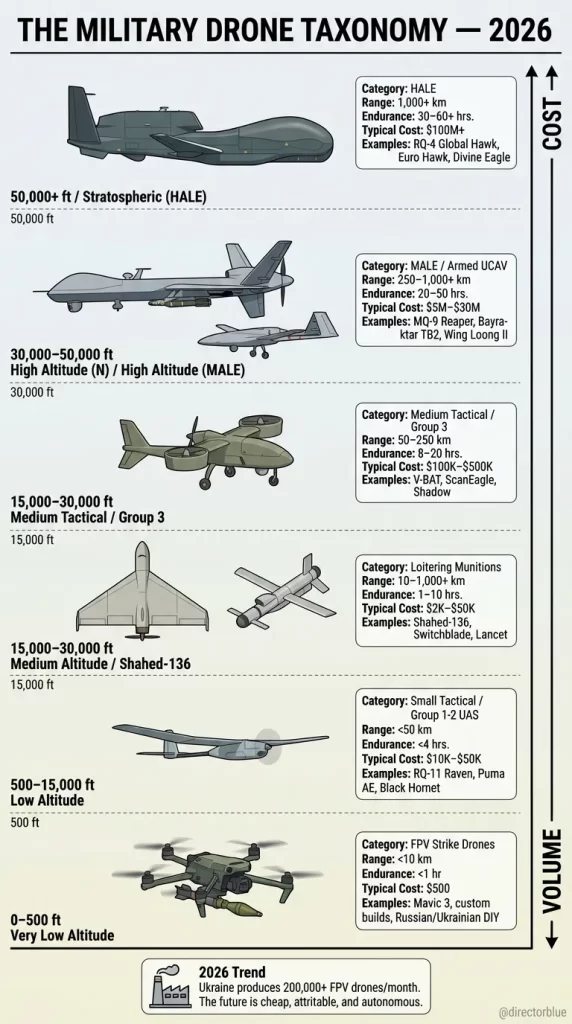
Iranian ships reportedly laying mines go boom, as does another suspected Iranian nuclear site, Iran hits Jordan and Iraq, the Israelis dirtnap more Basij, VDH weighs in, the Saudis are buying Ukrainian MilTech, and a quick guide to drones.
Another day, another 429 error. This one cleared up while I was out riding my bicycle (which broke).
US forces obliterated several Iranian navy vessels — including 16 minelayers — near the Strait of Hormuz on Tuesday as President Trump warned the Islamic Republic against planting explosives along the critical global trade route.
The strikes came amid reports that Iran had already begun laying mines along the vital shipping lane — which carries about 20% of the world’s oil supply — despite Trump’s demands that it remain open and unaffected as tensions with the US and Israel escalate.
Trump himself doesn’t sound sure mines were actually laid: “If Iran has put any mines in the Hormuz Strait, and we have no reports of them doing so, we want them removed, IMMEDIATELY!”
And the video compilation of those same boats going boom:
Among the three cargo vessels that were hit in the strait was a Thai-flagged vessel, which was 11 nautical miles north of Oman. A fire broke out on board and the Royal Thai Navy said the 23 crew members were rescued.
Iran has claimed responsibility, saying the ship’s crew ignored warnings.
The second vessel was a Japanese-flagged container ship that was struck 25 nautical miles off the coast of the United Arab Emirates, sustaining minor damage.
A third cargo vessel was hit about 50 nautical miles north-west of Dubai, according to UK Maritime Trade Operations (UKMTO).
Also: “32 countries voted unanimously to the release of 400 million barrels of oil due to the “unprecedented” situation, the International Energy Agency (IEA) announced.” Including the U.S. (See below.)
Iran also threatened $200 a barrel oil, which will make them super popular with any country that isn’t Russia.
The Israel Defense Forces on Tuesday declared it had dismantled most key assets of Iran’s internal security forces in Ilam province, a western region that became a flashpoint during the anti-regime protests that swept the Islamic Republic earlier this year.
Security forces and members of the Basij—the Islamic Revolutionary Guard Corps’ volunteer militia—”carried out many terror attacks and brutally repressed internal protests during demonstrations that took place across Iran in the December–January period,” the IDF stated.
Since the start of “Operation Roaring Lion” on Feb. 28, Israeli Air Force jets struck the local headquarters of Tehran’s internal security forces, including barracks of a special forces unit; an office of the regime’s Intelligence Ministry; an IRGC command center responsible for battalions that suppress protests; and several Basij and IRGC infrastructures used to reinforce the regime’s control, it said.
The IDF noted that the damage to repression and control mechanisms in the Ilam province, which borders Iraq and has a significant Kurdish population, was just “one example of many” of its recent operations.
The security forces “form part of the Iranian regime’s security apparatus and have for years been responsible for executing terror activities,” said the army, noting that they also lead Tehran’s main “repression efforts against internal protests, particularly in recent periods, using severe violence, mass arrests, and force against civilian demonstrators.”
Israel reportedly hit an Iranian bank. I certainly hope not. We need to seize the records of all Iranian banks to find out what bribes were paid out to Obama and Biden Administration officials…
Until last year, for some 46 years, Iran enjoyed a North Korea-like reputation in the heart of the Middle East: always unpredictable, reckless, dangerous, inevitably to be nuclear, self-destructive, and nihilistic.
All that said, was it really ever all that formidable?
The mullahs came into power after the removal of the Shah and, subsequently, the interim secular socialists. They did so by taking American hostages, murdering opponents, executing former supporters, and transforming the most secular and modern of the Middle East Muslim nations into the most medieval that routinely hung homosexuals, adulterers, and almost anyone who questioned the authority of the ayatollahs. In other words, these were gruesome people, but they didn’t necessarily have a competent military.
The theocracy’s only constant with the prior monarchical Iran was that it inherited near limitless oil and natural gas reserves, sophisticated arms, and the Shah’s modernized cities. It controlled the key strategic chokepoint at the Strait of Hormuz and enjoyed a geostrategically critical location between Asia and the Middle East. It fueled Iran’s historical chauvinism and pique that the millennia-long historical preeminence of Middle Eastern Persia was not fully appreciated by its Arab neighbors. So there were lots of natural advantages—and all for the most part squandered.
Under the camouflage of Shiite puritanism and otherworldliness, the ayatollahs proved even more corrupt (and far more incompetent) than the Shah’s entourage. They fought a destructive eight-year war with Saddam Hussein’s overrated Iraqi dictatorship and showed they were mostly just as militarily incompetent.
Over decades, they killed and wounded thousands of Americans by bombing U.S. embassies, barracks, and bases in the Middle East—without directly confronting the American military. For years, they sent lethal shaped charge IEDs to the Shiite insurgents to slaughter and maim thousands of Americans in Iraq and to the Taliban to do the same in Afghanistan.
At the first sign of popular protests, the regime never hesitated to gun down thousands of unarmed protesters. And, of course, they were abject hypocrites—hating the West, damning the Great Satan—and sending their pampered children to universities in America. The apparat proved quite earthly in its desire for money, estates, foreign travel, and the good life.
Their general strategies were never hard to follow.
One, the theocrats’ prior familiarity with Americans under the Shah and in exile in Europe bred an irrational fixation with and hatred of the West in general that made them useful proxies for the grand designs of communist and then later oligarchic Russia, and later ascendant communist China.
Iranian realpolitik alliances with secular communists were based on the quid pro quo of granting Russia and China access to the Gulf, selling oil to China, and buying arms from both.
Two, they were endlessly chagrined that the Persian Shiites had been overshadowed by more populous Sunni Arab neighbors that supposedly lacked their own historical sophistication and more legitimate claims of embodying and speaking for global Islam.
So they would correct that historical travesty by doing their best to mobilize their clients and proxies to bully, isolate, and weaken Arab autocracies, especially those that are pro-Western.
Three, their planned eventual destruction of Israel would ensure that theocratic and Shiite Iran regained its lost prestige and honor by finally accomplishing what the Sunni world had failed to do. By arming murderous clients in Lebanon, Gaza, Syria, the West Bank, and Yemen, they fashioned a global network of death that compromised European foreign policy toward the Middle East and terrified Western leaders and many of their Arab neighbors.
Fourth and finally, they sought to diminish the role of the United States in the Muslim world, drive it from the Middle East, and wage a virtual 47-year opportunistic war against American citizens and soldiers, with help from their terrorist surrogates.
Iran’s zenith in power and prestige came during Obama’s presidency (2009–17), and the so-called “Iran Deal” that they believed would guarantee them eventual nuclear power status.
But far more importantly, their massive acquisitions of air, land, and sea weapons and the empowering of terrorists, coupled with their passive-aggressive claims to victimhood, both scared and enticed President Obama into dropping sanctions. Soon, he was apologizing for supposed past sins and nocturnally sending them millions of dollars in Danegeld.
But worse by far, Obama thought he had squared the circle of neutralizing the supposed Middle Eastern Iranian juggernaut by envisioning it as an empathetic victim—and eventual friend if not ally.
Iran was to be rebooted as the Persian and Shiite righteously aggrieved underdog—bullied unfairly by Western imperialists and their surrogate corrupt Arab petro-kingdom clients for its asceticism and courage in fighting the West since its own birth in 1979.
Obama would remedy this “injustice” by bolstering Iran as a counterweight to not just the Sunni Arab world but to Israel itself. The reset would include an American détente with the murderous pro-Iranian Assad regime in Syria, the supposedly benign neglect of Hezbollah’s takeover of Lebanon, and the championing of the “Palestinians,” which de facto had insidiously become indistinct from Hamas terrorists.
Such creative tension between the Iranian Shiite crescent and a diminished Arab world would be adjudicated from time to time by Obama himself, whose America would go from oppressor to ally of the oppressed.
Snip.
In sum, no one apparently realized—with the exception of Donald Trump and Benjamin Netanyahu—that beneath its rough, ugly shell, theocratic Iran was rotten and decayed inside. Its corruption and the hatred of its own people ensured that even its huge revenues and sophisticated Chinese and Russian weapons could never translate into a modern, lethal military.
And in summer 2025, the Israelis and Americans first proved that Iran was indeed hollow.
Saudi Arabia is preparing a “major deal” to purchase Ukrainian weapons, according to the Kyiv Independent
One source in the Ukrainian defense industry told the publication that Riyadh and Kyiv are negotiating a separate “huge agreement” for weapons supply, which could be… pic.twitter.com/LxmoipkZOt
Another day of airstrikes against the Islamic Republic of Iran, another roundup of news.
Note that earlier in the day the blog went down with a 429 (too many requests) error. I rattled Bluehost’s cage and they fixed it. Hopefully it doesn’t happen again…
Secretary of War Pete Hegseth and Joint Chiefs of Staff Gen. Dan Caine held a press conference this morning with a few updates on Operation Epic Fury.
“On day ten of Operation Epic Fury, we are winning with an overwhelming and unrelenting focus on our objectives, which are the same as the day I gave my first briefing here on Operation Epic Fury,” said Hegseth. “They’re straightforward, and we are executing them with ruthless precision.”
Hegseth also reiterated the objectives: “One, destroy their missile stockpiles, their missile launchers, and their defense industrial base missiles and their ability to make them. Two, destroy their Navy, and three, permanently deny Iran nuclear weapons forever.”
Tuesday will be another bad day for Iran:
It’s a laser-focused, maximum authority mission, delivered with overwhelming and unrelenting precision. No hesitation, no half measures. As President Trump declared yesterday, we’re crushing the enemy in an overwhelming display of technical skill and military force. We will not relent until the enemy is totally and decisively defeated. But we do so — we do so on our timeline and at our choosing. For example, today will be yet again our most intense day of strikes inside Iran.
The most fighters, the most bombers, the most strikes, intelligence more refined and better than ever, so that’s on one hand. On the other hand, the last 24 hours have seen Iran fire the lowest number of missiles they’ve been capable of firing. Yet just the bifurcation, just the trend lines that we talked about on our first briefing. You see, this is not 2003. This is not endless nation-building under those types of quagmires we saw under Bush or Obama. It’s not even close. Our generation of soldier[ [sic] will not let that happen again. And nor will this President, who very clearly ran against those kinds of never-ending, nebulously-scoped missions. Those days are dead. Instead, we’re winning decisively with brutal efficiency, total air dominance, and an unbreakable will to accomplish the President’s objectives on our timeline. We stay locked on the target because here at the Department of War, that’s our job.
Stephen Green: “Iran’s Richest Oil Region Demands Freedom, Democracy.”
Khuzestan is Iran’s most oil-rich and ethnically diverse province — and the Arabs there have finally had it up to here with the theocrats who run things in Tehran. Whoever they are today, that is.
In a daring new statement, the Khuzestan Arab Tribes Assembly this week calling for “a free, democratic, and federal Iran,” and that they “firmly believe that the Islamic Republic’s system has violated the rights of the people of Iran.”
While Khuzestan borders Iraq and is roughly one-third Arab, the assembly called the province the “beating heart of Iran” and emphasized “the protection of Iran’s territorial integrity and reject any separatist or divisive project that harms the homeland of Iran.”
“We see ourselves in the transitional phase from the current repressive regime toward a free, democratic, and federal Iran. We can play a constructive role alongside other compatriots in building a prosperous and united Iran.”
“We, along with all Iranians—Persians, Kurds, Baluchis, Azeris, Lors, Turks, and others—stand hand in hand for freedom, prosperity, and the bright future of Iran.”
You don’t put out a statement like that one unless you enjoy at least some confidence that “security” troops won’t soon make a visit to explain to you the error of you ways. You know, in a dark cell somewhere from which you will only ever emerge feet-first. So whatever the real-world political efficacy of the assembly may or may not prove to be, the people behind it seem to believe that the IRGC’s reach no longer extends there.
And — this is kind of a big deal — Khuzestan holds about 80% of Iran’s onshore oil reserves, and also accounts for about the same percentage of Iran’s onshore production. That’s nearly 60% of all of Iran’s oil production.
But he also owes his position to the IRGC, unofficially making the ayatollah subordinate to the military for the first time in the Islamic state’s 47-year history.
And yet… Mojtaba’s figurehead status might be even less than it appears because there’s also the question of whether Mojtaba remains upright and breathing. Also on Monday, Iran state television confirmed that Mojtaba was wounded, presumably during an airstrike. AP reported: “The anchors read reports describing him as ‘janbaz’ or wounded by the enemy,” even as they parade him around — virtually only! — as the new boss.
Mojtaba has yet to be seen in public since his promotion. Strange way to reassure the public about the succession, yes?
In addition to Ali Khamenei, also believed dead in the compound airstrike is the elder Khamenei’s wife, a daughter, a grandchild, a son-in-law, and Mojtaba’s wife.
Maybe it’s a bit of a stretch to believe that coalition airpower took out so much of the Khamenei family, except for the one guy the IRGC needed as a well-known figurehead to consolidate its power during a chaotic time when one military and theocratic leader after another gets chalked up as KIA.
I also note that the IRGC will need to maintain the fiction of him alive if they want to access those untold billions the Khamenei clan withdrew from government funds to stash in international bank accounts…
IRGC Qods Force Colonel Majid Kashefi killed in Israeli drone strike:
BREAKING: This beast from the IRGC Qods Force, Colonel Majid Kashefi, who had the blood of many Iranians on his hands, was eliminated in an Israeli drone strike in Iran. State media of the regime has published his image and video.#OperationEpicFury#OperationLionsRoarpic.twitter.com/aNdkFc22xK
— Babak Taghvaee – The Crisis Watch (@BabakTaghvaee1) March 10, 2026
US intelligence has begun detecting indications that Iran may be preparing to deploy naval mines in the Strait of Hormuz, one of the world’s most critical energy chokepoints. Officials cited by CBS News say Tehran is believed to be using small boats capable of carrying two to three naval mines each. Estimates suggest Iran could possess between 2,000 and 6,000 naval mines, including Iranian-made systems as well as variants designed in China and Russia.
More recent intelligence reporting indicates that Iran has already begun laying a limited number of mines, with a few dozen reportedly placed in the waterway in recent days. However, the deployment remains limited for now. Officials say Iran still retains around 80% to 90% of its small boats and mine-laying vessels, meaning it could potentially place hundreds more mines if tensions escalate.
US intelligence has begun detecting indications that Iran may be preparing to deploy naval mines in the Strait of Hormuz, one of the world’s most critical energy chokepoints. Officials cited by CBS News say Tehran is believed to be using small boats capable of carrying two to three naval mines each. Estimates suggest Iran could possess between 2,000 and 6,000 naval mines, including Iranian-made systems as well as variants designed in China and Russia.
More recent intelligence reporting indicates that Iran has already begun laying a limited number of mines, with a few dozen reportedly placed in the waterway in recent days. However, the deployment remains limited for now. Officials say Iran still retains around 80% to 90% of its small boats and mine-laying vessels, meaning it could potentially place hundreds more mines if tensions escalate.
Given the indiscriminate nature of naval mines, I can’t imagine that China would be pleased if one of their cargo or tanker ships were hit.
Kyiv has dispatched three teams of military experts to the Middle East, President Volodymyr Zelensky said on March 10 amid Iran’s ongoing drone strikes in the region.
“This week, all three (teams) will be in three different countries… Qatar, the United Arab Emirates (UAE), and Saudi Arabia,” Zelensky said in a briefing with journalists.
Countries across the Middle East have come under fire from Iranian Shahed drones and missiles in the wake of Israeli-U.S. strikes against Iran on Feb. 28.
Ukraine has signalled readiness to share its extensive experience with countering the low-cost kamikaze drones, which Russia launches in daily attacks against Ukrainian cities and infrastructure.
MSM reporting on Iran sucks.
Iran Coverage
The headlines abound:
Iran Regime doing well, in control
Trump under pressure to end war
Khomeini son just as tough as Father
US responsible for missile on school
One headline after another essentially featuring Iranian propaganda as the news.
I suspect anyone reading this roundup already knew that…
Saudi Aramco is using their East-West pipeline to reroute oil exports away from the Strait of Hormuz to terminals on the Red Sea.
Iranian “numbers” station under attack. Numbers stations are mysterious radio stations that feature numbers spoken over the air, presumably to send coded messages to spies and other agents. But Iran seems to be jamming the station, suggesting someone other than the regime put it up.
Once again, if there are any bits of news you think I missed, feel free to share them in the comments below.
Day 10 of the Iran War: Oil spikes then falls, Iran gets a new theoretical Supreme Leader, China’s low cost GPS substitute is just as crappy as their other MilTech, the gulf states are investing in Ukrainian MilTech, and Habitual Linecrosser tries to cut through the fog of war.
He told CBS News “I think the war is very complete, pretty much”, and said the US was “very far ahead of schedule”
Speaking to NBC, he left open the prospect of acquiring Iranian oil, saying “certainly people have talked about it”
In an interview with the New York Post, he said the administration was “nowhere near” making a decision on whether to order US troops into Iran
Speaking to Republican lawmakers, Trump said the US was drawn into a “short-term” military operation in Iran to “get rid of some very evil people”
He went on to say: “We’ve already won in many ways, but we haven’t won enough”
Trump told the New York Post he is “not happy” with Iran’s new supreme leader, Mojtaba Khamenei, but at his press briefing later did not make clear who he wants to take his place – or how that will be achieved
At his press briefing, Trump reiterated that the operation in Iran has been a “tremendous success”, but also added that he wants to ensure Iran cannot develop nuclear weaponry “for a very long time” – a much bigger task
The US still has targets in Iran, Trump tells reporters, but they could be taken out “in one day”
Theoretically, Mojtaba Khamenei survived the leadership airstrike and is now the Iran’s new supreme leader. Maybe, but I wouldn’t put it past the people currently not running the country to announce him as leader even though he’s room temperature so they can continue to keep not running the country without U.S. and Israeli planes sending them to Allah.
“Third Iranian Shahid Soleimani-class Corvette Hit By America: At Bandar Abbas Port.”
The war between the U.S., Israel and Iran has entered a decisive phase that may determine the political future of the Middle East for decades to come.
President Trump declared that there will be no deal with the Iranian regime — nothing short of unconditional surrender. Tehran responded with predictable defiance, announcing that it would never surrender. Yet behind the regime’s rhetoric, reality appears very different.
Much of the leadership now reportedly communicates from undisclosed locations, hiding from sustained strikes while the propaganda machine attempts to project strength and resilience.
The scale of the military campaign has been extraordinary. In the first week alone, the U.S. reportedly struck approximately 3,000 Iranian targets across the country and the region. Israel has launched repeated waves of air strikes — more than twenty separate operations — systematically dismantling the regime’s military infrastructure. Missile launchers, air defense systems, command centers and naval facilities have been destroyed. Advanced weapons systems and new technologies, including next-generation laser defense platforms, are shaping the battlefield.
Israel has reportedly targeted and dismantled hardened command structures associated with the regime’s leadership, including the underground bunker networks linked to Supreme Leader Ali Khamenei. Several key figures may have been killed in these operations, though the regime has yet to publicly acknowledge casualties buried under the rubble of destroyed facilities.
Meanwhile, the Islamic Republic’s military capacity has been devastated. What once appeared to be a formidable regional force increasingly looks like what many analysts suspected all along: a paper tiger built on intimidation, propaganda and bluff.
For decades, the regime invested enormous resources in projecting power across the Middle East, building proxy networks and threatening neighboring states. Now it faces an unprecedented strategic crisis. Today, it is focused primarily on surviving.
The central question confronting policymakers in Washington and Jerusalem is not whether the regime’s military capabilities can be degraded — that process is already underway — but whether the campaign will stop short of dismantling the Islamic Republic itself. Anything short of regime-change risks allowing the system to recover, reorganize and once again threaten regional stability.
The military balance of power favors the U.S. and Israel. Iran’s conventional warfighting capabilities have been severely degraded. Air superiority allows continued targeting of strategic assets, meaning the regime’s ability to project military power beyond its borders will keep declining as long as the campaign persists. In the short run, this places the regime in a defensive posture.
But the weakening of Iran’s military does not automatically translate to the collapse of the regime. The Islamic Republic has historically relied less on conventional military strength and more on asymmetric tools — intelligence networks, ideological mobilization, proxy militias and global terrorism. Even if its missile forces, navy and air defenses are heavily damaged, the regime’s internal security structures — the Islamic Revolutionary Guard Corps, the domestic Basij security force, intelligence services and propaganda apparatus — can still function. Note that these institutions exist primarily to protect the regime rather than to defend the country.
LUCAS drones (“even cheaper than the Shahed, around $15,000”).
Ship-based anti-drone lasers (cost per kill: 50¢).
Tomahawk
Precision Strike Missile
Evidently American forces have found a way to jam China’s BeiDou system, their version of GPS:
Also, BeiDou seems to include its own text message system, which comes with a lot of drawbacks in an active combat environment…
A document circulating lays out the possibility of a limited campaign for U.S. ground forces to taking over Bandar Abbas and surrounding areas.
It is important to note that the United States does not currently maintain the ground force numbers in the region required for a full-scale invasion of Iran, nor has it established the logistical infrastructure that such a campaign would demand. Furthermore, there is no visible mobilization that would indicate preparation for a large occupation force. However, the US does have a large number of forward-deployed naval assets, rapid deployment units available back home, and special operations forces that could deploy within 18 to 48 hours to conduct a limited landing designed to seize specific objectives only.
The current goal of the ongoing air campaign appears to be to undermine the Iranian military and political leadership, to ignite internal dissent and local opposition movements, and whereafter, support these through air support and supply drops. Nevertheless, if current aerial efforts fail to create such a scenario, the US may consider scaling up its efforts.
One viable strategy could entail securing a foothold inside Iran to host a provisional government and facilitate overland supply routes instead. The most likely target for such a landing is Bandar Abbas, Iran’s primary southern port and a central node in its oil export system. In addition to establishing a bridgehead, capturing the city would allow US forces to obtain Iran’s main naval base. The accompanying port infrastructure, including cargo terminals and former fleet facilities, could then be repurposed to rapidly unload supplies and serve as a staging ground to support friendly forces inland.
Most importantly, Bandars Abbass’ is strategically located on the Strait of Hormuz. Following the attack, Iran is attempting to blockade the Strait, causing disruptions that are already affecting global shipping lanes. Securing Bandar Abbas would give the US a position from which to guarantee maritime passage to the major oil flows and deny Iran the ability to leverage the strait as a pressure tool.
In preparation for a landing, the US would shift focus to an air campaign aimed at degrading Iranian coastal defenses, displacing Iranian army units from the shoreline, and disrupting their ability to maneuver along the main logistics corridors leading into Bandar Abbas. With defenses disrupted, a numerically smaller landing force could then move into secure administrative buildings, port facilities, and the surrounding districts, in order to secure a perimeter and consolidate control. Infiltration routes through the mountains would be used to send small special forces groups to link up with local resistance networks as well as provide supplies and weaponry overland. Any landing would also force Iranian army units hiding in the surrounding mountains into the open terrain, if they want to contest the US bridgehead. However, any attempt to mass forces for a real counterattack would expose them to US and Israeli airstrikes almost immediately; with over 150 US combat aircraft, several cruisers, and guided-missile destroyers, ready to provide fire support to any landing party.
The alternative for the Iranian army would be a shift toward a guerrilla‑style resistance inside the city and surrounding area. But the operational impact of such a campaign would remain limited if the United States avoids expanding the offensive inland, and positions itself as a supporting force for a new government, instead of an occupying one. High local pro‑Western sentiment, visible in the large protests in the cities and towns here earlier this year, could additionally constrain the Iranian army’s ability to operate covertly.
Highly speculative, but it does contain a certain logic. Plus, with physical control of the oil export terminal, the U.S. could start selling oil in exchange for direct payment, promising to turn over any proceeds after a non-Jihadist government takes power…
Add the Royal Jordanian Air Force to the list of countries flying defensive missions over the Persian Gulf, specifically protecting Bahrain and UAE.
Azerbaijan has reportedly reopened the border with Iran, but the source is TASS, so several grains of salt are probably in order.
Jordan Peterson and Douglas Murray talk about what a scumbag death cult Hamas is.
UAE is investing in Ukrainian MilTech companies and buying Flamingo missiles to counter Iran.
“The United Arab Emirates-based Edge Group is set to purchase a 30 percent ownership stake in Fire Point, Ukraine’s combat-proven missile and drone manufacturer. The proposed deal of around 760 million US dollars will raise the total valuation of the Ukrainian defense firm to roughly 2.5 billion US dollars. Fire Point, which produces the FP-1 and FP-2 unmanned aerial systems as well as the Flamingo cruise missile, has risen to become Ukraine’s leading defense technology manufacturer within just two years, with production of drones currently reaching 6,000 per month.”
“The most interesting product in Fire Point’s arsenal is the Flamingo cruise missile, of which the company produces 1 to 2 units per day. With 30% share in the company and certain agreements, the UAE can receive around 10 to 20 such missiles and 1800 drones per month, significantly enhancing its ability not only to protect itself against enemies like Iran, but to carry out preventive strikes. Combat-proven with an estimated range of 3,000 kilometers and already successfully used to target critical Russian infrastructure within the 2,000 kilometer range, the missile is capable of reaching and destroying any target across Iran. Air bases, command centers, and missile storage facilities can be targeted with ease by its 1,150 kilogram warhead, forcing the Iranian command to change planning due to another deadly threat in the region.”
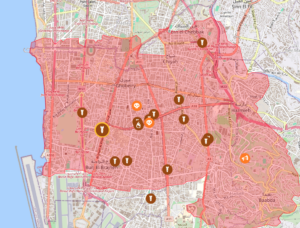
And what’s happening in the “southern front” of the war? In Lebanon, Israel seems to settling Hezbollah’s hash in both Beirut…
…and southern Lebanon.
Today’s Habitual Linecrosser:
As usual, if you think I missed any significant stories on the war, feel free to share them in the comments below.
Lots of news from the war in Iran, much of it in video form.
One reason I do these updates is that the vast majority of MSM reporting is of such poor quality. It’s all government talking heads said this or critics of Trump said that. In other words, lazy reporting crap no one cares about.
Back before American journalists became self-licking ice cream cones, war reporting used to include maps, unit movements, logistics, combat reports from journalists embedded with U.S. units, etc. The BBC still seems to do a little of that, but I’m not seeing that from American outlets, maybe because it’s hard work. They don’t even seem to be bothering to tell ChatGPT to do it for them.
Hence these roundups to fill the gap.
As a brief snapshot of the dysfunction at the highest levels of Iranian government, here’s the President of Iran saying “Sorry about all the droning, it won’t happen again,” and the IRGC saying “Shut the hell up, you weak little bitch!”
To many, it seems like an end-of-days scenario: Qatar and Israel on the same team.
Who would have thought? In September, Israel attacked in Qatar, targeting terrorist leaders the Gulf state was housing. But here we are. After five days of war with Iran, the Iranians have succeeded in putting Israel and Qatar on the same team – to say nothing of the United Arab Emirates, Kuwait, Oman, Bahrain, and even Saudi Arabia – all countries targeted over the past five days by Iranian missiles and drones.
By some estimates, Iran has fired more missiles and drones at Gulf states combined than at Israel.
What Iran may have done is something Israel has long struggled to achieve diplomatically: place Israel and several Sunni Arab states on the same side of a regional conflict. By striking the Gulf states directly, Tehran has widened the war in a way that forces governments across the region to reconsider where their interests truly lie.
Within the first 48 hours, Tehran launched missiles and drones not only toward Israel but toward every member of the Gulf Cooperation Council: the UAE, Saudi Arabia, Qatar, Kuwait, Oman, and Bahrain. What might initially have appeared to be a confrontation between Iran and the US and Israel quickly transformed into something wider – a regional conflict touching key Sunni Arab states.
And it was not only countries that have agreements with Israel that were targeted – the UAE and Bahrain – but also countries that have tried to maintain good relations with Iran, such as Qatar and Oman. Even Turkey announced on Wednesday that an Iranian missile was downed as it headed toward its airspace. By going after these countries, Iran is signaling that it wants everyone in the region to formally pick a side.
Tellingly, the strikes in the Gulf states were aimed largely at civilian targets rather than solely at US bases and facilities located in those countries. The strikes went far beyond American installations and hit airports, hotels, and oil infrastructure.
Why? The conventional wisdom is that Tehran hopes to sow chaos in the region and pressure those countries now under attack to lean on Washington to call off the campaign before the situation spirals even further out of control.
Having two aircraft carriers launching strikes at Iran evidently wasn’t enough, as the USS George H. W. Bush is now poised to join the party, joining the USS Abraham Lincoln and the USS Gerald R. Ford. Obviously you need ships named after Republican presidents to win wars. If you had the USS Barack Obama, it could only drop pallets of cash, and the USS Bill Clinton could only hit on underage Iranian girls…
Grand Ayatollah Abdollah Javadi-Amoli had issued a fatwa against President Trump, “says shedding blood of Zionists and Trump is mandatory.” Sounds like someone wants to be moved higher on the drone list.
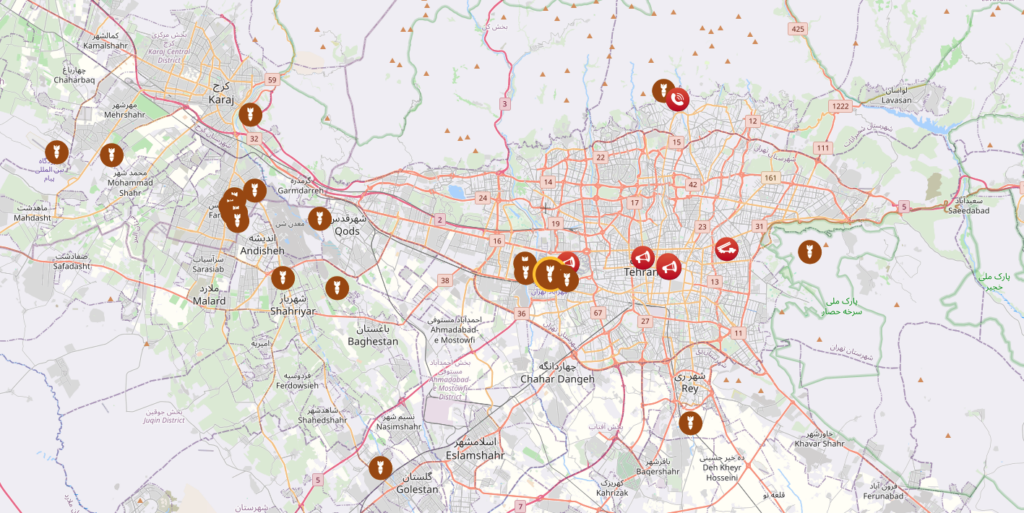
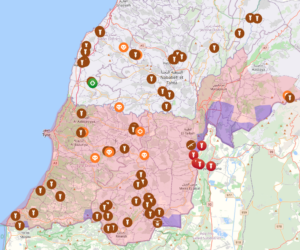
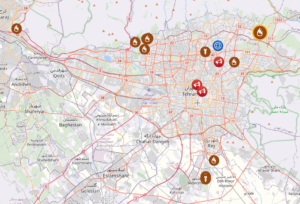
Since Iran has hit the oil facilities on Persian gulf nations, Israel hits oil storage facilities near Tehran. Those burning symbols on this Liveuamap snapshot are where airstrikes have hit oil facilities in and around Tehran.
For all the talk of Kurdish forces entering Iran, Trump has said he’s told them not to. But we have numerous reports of Israeli jets hitting targets like IRCG posts along the border and police stations in Iranian Kurdistan.
Reports of blinding Iranian satellites:
🇮🇷🇮🇱 As expected, the IDF claims to have targeted the ground control station for Iran's Russian-built Khayyam imaging satellite. I suspect that this is the first time that a satellite ground control station has been targeted in wartime.https://t.co/gL42aeVkc9https://t.co/Gx4kUodxXB
Possibly three new U.S. weapons have been seen in Epic Fury:
A black-coated Tomahawk variant, possibly for stealth.
The Precision Strike Missile (PrSM). This is a new Lockheed Martin missile to replace ATACMS.
Lots of lessons learned from the Russo-Ukrainian War and Ukraine’s use of Patriot there. Missiles are getting intercepted, but Shahed drones are still leaking through.
In addition to the B-2 and B-52, the B-1 is also hitting targets in Iran. I think this is the first war in which all the Bs were hitting targets…
Suchomimus does damage assessment on Iranian naval assets and other targets hit on both sides:
Azerbaijan closes the border crossing with Iran to cargo:
Iranian truck drivers had already started staging strikes against the regime even before the crossing shutdown. “Inside, 400,000 drivers have cut off contact and are known to be against the regime. While outside, thousands of trucks and drivers are stuck at sealed borders. This double squeeze means the collapse of the state’s control over the economy. The truck drivers mutiny is not just blocking roads. It is breaking the entire industrial backbone from steel to prochemicals, from food to logistics.”
Mark Felton asks whether Iranian missiles can hit London? Answer: Probably not.
“We can probably say that yes, Iran has at least one missile that has the legs to reach the UK [the Simorgg SLV, use to launch satellites into orbit], but not the systems to deliver a warhead successfully. At present, it is technically impossible for Iran to bombard the UK.”
Jobs are down, more Minnesota fraud uncovered, a bunch of military action outside the Persian Gulf, an Austin jihad shooter, Noem gets the Old Yeller treatment, Bill Clinton remains Bill Clinton, and Microsoft, amazingly, manages to get even worse.
It’s the Friday LinkSwarm!
Also consider this your “Iran Strikes: Day 7” update with a smattering of news as well. There are reports that Kurdish forces have entered Iran from Iraq, but I’m not seeing sufficient evidence for that yet.
Interesting chart showing Iran has likely “blown its wad” on missiles and drones, as day by day fewer and fewer are being launched.
Update Numbers as of Mar. 6, 12.00 AM The numbers are rounded and compiled from various media reports, with a margin of error of ±10% 15% **Corrected previous Post there was a Mistake https://t.co/eDlVfc3nzApic.twitter.com/UiHAU0yNHe
The Supreme Court upheld the standard for reviewing asylum cases, keeping it in the hands of immigration agencies.
Yes, even the leftist justices agreed. 9-0.
“We granted certiorari to determine whether the Court of Appeals applied the appropriate standard of review under the INA [Immigration and Nationality Act],” wrote Justice Ketanji Brown-Jackson. “We conclude that the statute requires application of the substantial evidence standard to the agency’s conclusion that a given set of undisputed facts does not constitute persecution.”
Top officials in Minnesota were made aware of fraud concerns surrounding government assistance programs as early as 2019 but failed to take action as billions of dollars were stolen and warnings piled up.
Former Minnesota state officials testified to the House Oversight Committee that Governor Tim Walz and Attorney General Keith Ellison were first informed that the state’s social services programs had been compromised by widespread fraud in 2019 and 2020, according to a new report from the committee.
“Testimony obtained by the Committee reveals that Governor Tim Walz and Attorney General Keith Ellison were aware of widespread fraud in social service programs, lied about their knowledge of the fraud, and retaliated against employees who dared to raise concerns. Instead of protecting vulnerable Americans, they handed over billions in taxpayer dollars to fraudsters and threw their own state employees under the bus,” said House Oversight Committee chairman James Comer (R., Ky.).
Several different entities and state-level programs are implicated in Minnesota’s fraud scandal. The most prominent program is Feeding Our Future, which fraudsters targeted during the Covid era to steal $300 million from the Minnesota Department of Education that had been designated to provide food to poor children. Feeding Our Future is now dissolved and dozens of defendants have been convicted in connection with the scheme since 2022.
According to the committee report, Minnesota Department of Education officials first received allegations of fraud against Feeding Our Future from the U.S. Department of Agriculture in 2019. The USDA alleged Feeding Our Future was created with forged signatures and misled sponsored food distribution sites about certain federal requirements. Minnesota officials dismissed the allegations at the time. By April 2020, Walz and Ellison’s offices were briefed about the Minnesota Department of Education’s concerns regarding Feeding Our Future, Assistant Commissioner Daron Korte testified to the committee. State officials contacted the USDA about Feeding Our Future in late 2020, but the agency’s inspector general did not act, a failure that emboldened the scammers at Feeding Our Future.
The Oversight Committee report asserts that Minnesota officials could have suspended payments to Feeding Our Future but chose not to because of potential litigation and racism accusations. Minnesota officials blamed the USDA and Feeding Our Future for perpetuating the large-scale fraud. In March 2021, the Minnesota Department of Education stopped payments to Feeding Our Future, but resumed payments voluntarily the following month after a court hearing on the matter. A court order was never issued requiring the payments, contradicting Walz’s 2022 assertion to the contrary. The lack of a court order was confirmed during the course of the Oversight Committee’s investigation.
In early 2019, Walz’s administration became aware of fraud tied to two programs administered by Minnesota’s Department of Human Services, former agency commissioner Tony Lourey testified. Another former commissioner, Jodi Harpstead, testified that Walz’s administration believed fraud connected to a child care program run out of the Department of Human Services had already been resolved. But the Oversight Committee report references two auditor reports showing otherwise, both of which were issued in 2019. The Department of Human Services lacked fraud mitigation mechanisms and felt pressure to get money out the door to justify state appropriations, the committee found. Despite credible allegations of fraud, the agency failed to act on the warnings and unilaterally stop making payments to the social services programs in question.
The Oversight Committee’s report is based on testimony from nine top current and former state officials, documents and communications, and briefings with federal and state officials. The Minnesota U.S. Attorney’s office recently speculated that the interwoven fraud schemes totaled nearly $9 billion in misallocated funds. Of the fraud defendants, 85 percent of them come from Minnesota’s Somali-American immigrant community. Social services programs that provide food, child care, housing, and special education have all come under scrutiny as federal investigators unravel the fraud scheme.
I know it’s been easy to overlook in all the other military news this week, but Afghanistan and Pakistan have been going at it as well, though only at a border skirmish level rather than a full-scale conflict. Since the Pakistani ISI helped create the Taliban, this is what’s known as “blowback.”
Rene Campos, a registered sex offender, is seeking elected office in California – launching a campaign for Fresno City Council amid fierce backlash and renewed questions about whether someone with his record should hold public office.
Campos was arrested in 2018 following a cyber tip to the Central California Internet Crimes Against Children Task Force. He was found in possession of child sex abuse material, according to court records. In 2021 he entered a no-contest plea to a single misdemeanor charge of possessing and controlling child pornography/child sex abuse material (likely under California Penal Code § 311.11). He served only one month in prison and a two year probation period.
Campos describes himself as a gay man who is running for office on the platform of “reduced crime and rehabilitation.”
Possession of child pornography is typically treated as a felony, even in a woke haven like California. How the Fresno candidate was able to make a deal for a misdemeanor charge and spend only one month in prison is a mystery, but this does help to confirm ongoing suspicions that California’s legal system is falling into steep decline.
California is notoriously soft on child sex abusers. Recently, a Sacramento parole board released Daniel Allen Funston, who was convicted in 1999 of sixteen counts of kidnapping and child molestation after a horrific crime spree in Sacramento County, during which he kidnapped, raped, and beat eight children ages 3 to 7.
Funston was originally sentenced to three consecutive life terms plus 20 years, but was set free at age 64 due to a California elderly inmate program (maybe he’ll run for office, too).
Data from 2022 shows that the Golden State released over 7000 child sex offenders after less than one year of incarceration. Interestingly, “digital blocks” were added to the Megan’s Law website that prevent more recent analysis.
Virginia Governor Abigail Spanberger is demanding that Immigration and Customs Enforcement provide warrants before violent illegal criminals are turned over to federal authorities, following the stabbing of a Virginia woman by an illegal immigrant with a long and violent criminal history.
Abdul Jalloh was charged with second-degree murder after Stephanie Minter was brutally stabbed in the neck at a Virginia bus stop. Jalloh had previously been charged more than 40 times, including for egregious crimes such as aggravated assault, malicious wounding, and rape. Prosecutors dropped 20 of the 43 charges against Jalloh. The Fairfax County Commonwealth’s Attorney’s office said the charges were dropped because Jalloh often chose victims who did not have permanent addresses, making the proceedings more difficult.
The Department of Homeland Security said Jalloh is an illegal immigrant from Sierra Leone. He entered the United States in 2012.
“ICE previously lodged a detainer against Jalloh in 2020, and he was granted a final order of removal by a judge who found he could be removed to any country other than Sierra Leone,” DHS said in a statement. “This case illustrated the importance of third country removals to get criminal illegal aliens out of the U.S.”
Spanberger insists that in order for Virginia to work with federal authorities, ICE must provide a signed judicial warrant, regardless of the alien’s criminal history. DHS requested cooperation with Virginia and Spanberger to deport Jalloh following his alleged involvement in the fatal stabbing.
“We are calling on Virginia Governor Abigail Spanberger and Virginia’s sanctuary politicians to commit to not releasing this murderer and violent career criminal from their jail without notifying ICE,” Deputy Assistant Secretary Lauren Bis said in a statement. “This illegal alien’s murder of an innocent, beautiful American woman came less than 24 hours before Governor Spanberger’s demonization of ICE law enforcement. This heinous criminal is a perfect example of why we need cooperation from sanctuary jurisdictions and the importance of third country removals for the safety of the American people.”
What the Trump administration has done on the DEI front represents the beginning of a general reorientation of our politics away from wokeness. One need only survey what prominent leaders of the Left are saying about the political price the Democratic Party has paid on that score. What they are saying indicates a large political change, even if the Dems prove incapable of unmooring themselves from woke politics for the near future.
The first sign of this reorientation is a general shift in the popular mindset: the spell of woke politics has broken. This matters because it was always the way in which woke politics commanded assent in the citizens’ hearts and minds that was crucial. That assent has been questioned or denied now in a broad way, with the backing of public authority (Supreme Court decisions, executive orders, agency directives), and with widespread public support. Wokeness’s public hectoring, punitiveness, and censoriousness, and the extremism of many of its positions on the issues, is unpopular at the level of 70–30 or 80–20 opinion poll divides.
We ought to be confident, therefore, that the broken spell of wokeness augurs a permanent shift in our public life. What that means precisely, however, depends very much on how we understand wokeness and what is done going forward to ensure that woke excess does not return. Now, if, as many say, wokeness was the product of cultural Marxism (Christopher Rufo and a host of followers) or postmodernism (Jordan Peterson and another host of followers), then all that needs to be done is to combat bad ideas. On these interpretations, our universities in particular, and other cultural institutions where the influence of such ideas holds sway, need our attention. Certainly, cultural Marxism and postmodernism represent bad ideas, and the world would be a better place without their influence.
But if what wokeness represents above all is the explosive power of the civil rights revolution and the influence of an aggressive leftist interpretation of anti-discrimination politics, as another band of interpreters claims (I among them), then the task ahead is much bigger and much more difficult.
Trump’s anti-DEI measures, on this view, would represent only the first step in a broader campaign of civil rights reform. One could look long and hard without seeing much in the way of evidence for any such thing so far. Are these current efforts against DEI an illusion, a brief moment of political opportunism that will recede as public hatred of wokeness recedes—only to return in a few years when the next wave of anti-discriminatory passion rises up?
I don’t think that worry is justified. The anti-DEI campaign to date will have enduring consequences because even if it is not yet clear that what is at stake in DEI is civil rights politics, the current reorientation can only have the effect of raising our awareness of the role of anti-discrimination in our public life. This has begun on the all-important moral plane of civil rights politics. Precisely by breaking the spell of its puritanical commands, our anti-woke moment is reworking something essential to civil rights politics. Because public morality is the crucial filter of the human mind, a shift at this level will change what we see, what we think, and what we think we can say. Anti-woke sentiment, backed by changes in the law, is providing a moment of political, cultural, and mental freedom that will necessarily lead, after many decades during which this was not possible, to a general reappraisal of the moral power and the meaning of the civil rights revolution.
Sources have identified the alleged gunman as 53-year-old Ndiaga Diagne to Nexstar’s KXAN and The Associated Press…
Diagne is originally from Senegal, according to multiple people briefed on the investigation. One of the people told the AP that Diagne came to the U.S. in 2006 and was a naturalized U.S. citizen…
Austin mass killer captured on video wearing ‘Property of Allah’ hoodie during rampage.
“Dallas Democrats Decide To Let DA Creuzot Go. With no Republican in the race, Democrat primary winner Amber Givens will become Dallas County’s next district attorney.” Creuzot was yet another Soros-backed DA, so maybe Dallas Democrats are ever so slowly moving back to sanity.
I’m just going to embed this Asmongold clip of Bill Clinton’s Jeffrey Epstein deposition without comment.
President Trump announced Thursday that Senator Markwayne Mullin (R., Okla.) will replace Kristi Noem as Homeland Security Secretary.
The announcement comes after Noem struggled to stand up to a public grilling by members of the Senate Judiciary Committee who pressed the former South Dakota governor on Tuesday about a $220 million ad campaign contract that was subcontracted to one of her longtime allies. Trump was furious at Noem for insisting during the hearing that he had personally approved the contract and began floating Mullin’s name as a potential replacement, National Review first reported early Thursday.
Mullin will replace Noem effective March 31. It’s unclear whether Trump plans to nominate Mullin to serve in the position permanently or whether he will serve in an acting capacity, sparing him the necessity of Senate confirmation.
“I am pleased to announce that the Highly Respected United States Senator from the Great State of Oklahoma, Markwayne Mullin, will become the United States Secretary of Homeland Security (DHS), effective March 31, 2026,” Trump wrote on Truth Social. “The current Secretary, Kristi Noem, who has served us well, and has had numerous and spectacular results (especially on the Border!), will be moving to be Special Envoy for The Shield of the Americas, our new Security Initiative in the Western Hemisphere we are announcing on Saturday in Doral, Florida. I thank Kristi for her service at ‘Homeland.’”
Already under significant scrutiny due to bipartisan criticism of her handling of Trump’s deportation agenda, Noem ran into further trouble this week during a series of hearings in which multiple lawmakers, most notably Republican Senator John Kennedy of Louisiana, asked her to explain why the agency had awarded a $220 million contract to a firm that was founded just days before, without ever opening up the bid to a competitive process. Kennedy also pointed out that part of that ad campaign was subcontracted to a strategy firm owned by Ben Yoho, the husband of former DHS spokeswoman Tricia McLaughlin.
A $220 million no-bid ad contract isn’t just wasteful, it’s actively criminal.
More defeats for the gambling lobby: “Two House Chairs Defeated by Challengers. State Reps. Cecil Bell and Stan Kitzman were ousted by Kristen Plaisance and Dennis Geesaman respectively.”
Plaisance ran on a platform of fiscal responsibility, securing Texas’ elections, and defending state sovereignty.
Bell’s campaign and allied groups—including the Las Vegas Sands–backed casino lobby and Texans for Lawsuit Reform—reportedly spent more than $1 million attempting to defend the incumbent.
Bell, who chairs the Intergovernmental Affairs Committee, had been censured by the Montgomery County Republican Party last year.
Incumbent State Rep. Stan Kitzman of Brookshire has been defeated by Dennis “Goose” Geesaman for the GOP nomination for House District 85. Kitzman served as chair of one of the House’s subcommittees on appropriations.
Geesaman, a pilot and Air Force Academy graduate, retired as a Lt. Colonel. He served five terms on the Flatonia City Council and later served as mayor.
While Texans for Lawsuit Reform and casino-funded PACs backed Kitzman’s reelection campaign, Geesaman ran on a platform of ending magnets for illegal immigration, DOGE-ing Texas, and supporting parental rights.
Kitzman also recently came under investigation for his paid work for a local governmental entity while serving in the Legislature.
Kitzman also voted to impeach Paxton, so I think we’re well rid of both of them.
The war against tranny madness continues. “Paxton Opinion Targets Therapists Behind Child ‘Psychological Transitioning.’ Psychiatric providers who help facilitate prohibited treatments may be barred from receiving public funds and could risk losing their licenses.”
Samsung Electronics America Inc. is one of five companies that have been accused by Attorney General Ken Paxton of collecting and monetizing consumers’ viewing data on smart TVs.
Following the agreement, Samsung will now make changes to not only halt the collection of viewing data without consent, but also update their TVs to include disclosures and consent screens.
Heard from some state agency people that this was coming: “Texas Dismantles DEI-Oriented HUB Network. The comptroller’s office has ended race- and sex-based preferences in state contracting.” Good.
“Former Warren Campaign Worker Says the U.S. Must Be ‘Abolished’ to Atone for Death of Ayatollah Khamenei…Calla Walsh, the communist activist who campaigned for Elizabeth Warren, Ed Markey, Bernie Sanders, and others, said the only way to exact “justice” is the complete deconstruction of the U.S. and Israel.” What percentage of the ideological core of the Democrat Party are actively communist?
One thing that reportedly helped kill Netflix’s acquisition of Warner Brothers: GOP congressmen visiting Netflix headquarters and discovering tampons in the men’s room.
Microsoft seems to be going from bad to worse: “Microsoft Copilot to hijack your browser… for your own convenience, embeds Edge into AI assistant, ignores questions about opt-in.”
Microsoft is rolling out a Copilot update to Windows Insiders that embeds web browsing directly into the assistant, opening links in a side panel rather than launching your default browser.
The plan is that users of the Copilot app in Windows will show content in the assistant’s window “so you don’t lose context.”
Copilot will also (with permission) have access to the context of tabs opened in that conversation, so the assistant can look across them when responding to user prompts. Opened tabs will be saved with the conversation so that they can be returned to, and, if a user chooses to enable it, passwords and form data can be synchronized.
Enabling password and form data synchronization might give some users pause for thought, particularly after the Windows Recall fiasco, but users worried about Redmond slurping data should probably consider an alternative to Windows anyway.
At first glance, it looks like embedding Edge into Copilot via the WebView2 control is an attempt to steer the user away from their default browser. Convenient, yes. Good for competition, possibly not. We asked Microsoft whether this would be an opt-in experience and which browser was being used, but, other than acknowledging receipt of our questions, the company did not respond.
It looks like this is going to be limited to corporate users for now, but launching web links without user control strikes me as a huge attack vector for malicious code. (Previously.)
New Zealand “Lesbian Navy Captain Faces Court Martial After $100M Ship Ran Aground, Caught Fire, Sank.” Since that happened all the way back in 2024, they’re certainly not rushing to justice…
Apple has some new computers out, so here’s M5 Pro vs. M5 Max benchmarks. My trailing edge consumer ass is still on an Intel-based MacBook Pro…
“Japanese companies are paying older workers to sit by a window and do nothing—while Western CEOs demand super-AI productivity just to keep your job.” Seems like there should be a happy medium between those two extremes…
In an interview with Fox News, Netanyahu said, “The reason that we had to act now is because after we hit their nuclear sites and their ballistic missile program [in June 2025]… they started building new sites… underground bunkers that would make their ballistic missile program and their atomic bomb program immune within months.”
“If no action was taken now, no action could be taken in the future,” he said.
Moreover, envoy Steve Witkoff said the Iranians “bragged” about enriching Uranium.
US special envoy Witkoff, who together with Trump’s son-in-law Jared Kushner led Washington’s negotiations with Tehran over the disputed nuclear program, said that Iran’s top negotiators boasted in the first round of talks this year of having enough highly enriched uranium to build 11 nuclear bombs.
“In that first meeting, both the Iranian negotiators said to us directly — with no shame — that they controlled 460 kilograms of 60% [enriched uranium] and that they’re aware that could make 11 nuclear bombs,” Witkoff told Fox.
Trump has asserted that the US “obliterated” Iran’s nuclear facilities during the 12-day war last June, which would ostensibly render Iran incapable of immediately turning that enriched uranium into a bomb.
Still, Witkoff said the Iranian negotiators “were proud that they had evaded all sorts of oversight protocols to get to a place where they could deliver 11 nuclear bombs.”
He said that during that first meeting, the Iranian negotiators insisted on “an inalienable right” to enrich their nuclear fuel.
They now have an inalienable right to a pine box.
Ben Shapiro weighs in on the current state of the conflict, and declares Iran toast:
“I hope all the folks watching understand what uncontested airspace and complete control means. It means we will fly all day, all night, day and night, finding, fixing, and finishing the missiles and defense industrial base of the Iranian military. Finding and fixing their leaders and their military leaders, flying over Tehran, flying over Iran, flying over their capital, flying over the IRGC, Iranian leaders looking up and seeing only US and Israeli air power.”
We got the guy in charge of trying to assassinate American leaders, “Rahman Moadam, who’s head of the Islamic Revolutionary Guard Corps special operations division.”
Admiral Brad Cooper explains the status of the operation:
More than 50,000 troops, 200 fighters, two aircraft carriers, and bombers from the United States are participating in this operation, and more capability is on the way. In the opening hours of Operation Epic Fury, US Central Command forces together with Israel delivered overwhelming and unprecedented strikes into Iran. Now, we’re less than 100 hours into this operation, and we’ve already struck nearly 2,000 targets with more than 2,000 munitions. We have severely degraded Iran’s air defenses and destroyed hundreds of Iran’s ballistic missiles, launchers, and drones. And in simple terms, we’re focused on shooting all the things that can shoot at us.
“We are also sinking the Iranian Navy. The entire Navy.”
“We will not stop.”
Back to Shapiro: U.S. consulate in Dubai was hit by drones. No casualties because it was evacuated.
“How do you know that Iran is really losing? Because Qatar has turned. So Qatar, which has always played this sort of middle ground between the United States and Iran. Well, now they’re turning on the IRGC and actually arresting members of the IRGC in Qatar.”
He debunks the myth that we’re using $2 million Patriot missiles to shoot down $35,000 drones, says most are being down down with $25,000 air-to-air missiles. “And you know who’s going to run out of $25,000 iterations more and faster? The US or the piss-poor Iranians?”
“If we get in a spending war with Iran, Iran don’t have no money. It is a problem for them.”
The Iranian regime splits its air power between two forces, the conventional Islamic Republic of Iran Air Force and the Iran Revolutionary Guard Corps Aerospace Force. Available public information about the size of Iran’s air fleet is somewhat contradictory in the details. The independent analysis site WarPowerIran states Iran has 778 aircraft, but “while impressive in terms of available quantity of aircraft, the IRIAF suffers from an aging fleet and limited military-industrial capabilities as they relate to modern combat platforms.”
Similarly, “FlightGlobal’s World Air Forces 2025 listed 65 F-4s, 35 F-5s, 41 F-14s, 18 MiG-29s, 21 Su-24s, and 12 Mirage F1s in the Islamic Republic of Iran Air Force, plus a smaller number of tankers and special-mission aircraft. Iran has also received an unknown number of Yak-130 light attack aircraft in recent years.”
The Yak-130 is the most modern of those aircraft, but it’s really most suitable as a low-cost trainer. If you actually need to go up against F-22s and F-35s in that thing, you’re in deep, deep trouble. And indeed, an Israeli F-35 shot one down.
Beyond that, it’s not an air force, it’s an impressive aviation museum. The MiG-29 is the only plane in active service with any modern military. The F-14 is the next most modern, and the vast majority of U.S. planes were deactivated in the late 20th century. The F-5 has proven really durable for Third World air forces, but no one mistakes it for a modern fighter. The F-4 is a Vietnam War staple retired everywhere except Greece, Turkey and Iran.
The United Arab Emirates, a Defense Ministry spokesperson said air defenses detected 812 drones and intercepted 755, with 57 getting through and causing damage.
Kuwait said it intercepted 283 drones. A Bloomberg-compiled tally put the first two days of the war at 541 drones targeted at the UAE, 283 at Kuwait, 36 at Jordan, 12 at Qatar and nine at Bahrain. Combined with the UAE’s later figure, the publicly reported totals indicate at least about 1,150 drones launched at regional targets since February 28, with the overall number likely higher.
Naval sinkings stats snipped.
During yesterday’s briefing, Caine released some figures indicating the Iranians are losing their ability to fire ballistic missiles and drones: “As of this morning, U.S. Central Command is making steady progress. Iran’s theater ballistic missile shots fired are down 86 percent from the first day of fighting, with a 23 percent decrease just in the last 24 hours, and their one-way attack drone shots are down 73 percent from the opening days.”
“Mojtaba Khamenei, son of Iran’s late Supreme Leader, has survived the U.S. and Israeli airstrikes on Iran in which his father Ayatollah Ali Khamenei was killed, two Iranian sources told Reuters on Wednesday.” Maybe. But there’s a good chance that’s disinformation as well.
Iran’s democratic opposition groups — monarchists and republicans, secular and religious minorities, leftists, liberals, and every ethnicity — are united… on four foundational principles: Iran’s territorial integrity; individual liberties and equality of all citizens; separation of religion and state; and the Iranian people’s right to decide a democratic form of government. Many Iranians, often despite facing bullets, have called on me to lead this transition. I am in awe of their courage, and I have answered their call. Our path forward will be transparent: a new constitution drafted and ratified by referendum, followed by free elections under international oversight. When Iranians vote, the transitional government dissolves…. A free Iran would extend [the Abraham Accords] by immediately recognizing Israel and pursuing a broader regional peace framework linking Iran, Israel and our Arab neighbors in cooperation rather than conflict.
You can never depend on China as an ally:
This isn't just about Iran. Every country watching this is doing the math. Every country that has been quietly drifting toward Beijing's orbit, betting that China is the future, is watching Beijing issue press conferences while its strategic partner gets regime-changed.
More from Suchomimus on that Soleimani-class corvette sunk yesterday, which turns out to be the IRIS Shahid Sayyad Shirazi.
If Iran is currently the A-Plot in As the Middle East Burns, then the war against Hezbollah is the B-Plot. Israel has already started and air and ground campaign against the Iranian-backed group, and Simon Whistler explains the current state of that conflict:
“What’s happening in Lebanon right now might end up being one of the most consequential events of the entire war. Israel and Hezbollah are at war again.”
“What’s really significant here is what the Lebanese government just did in the middle of this. A total ban on Hezbollah’s military and security operations. If you would have told us that we’d be making an episode on that just two years ago, we would have thought you were dreaming. Or possibly really rather drunk.”
For years people assumed an attack on Iran would mean Hezbollah would unleash an unstoppable barrage of rockets on Israel.
Skipping over the glorious execution of Operation Grim Beeper.
“The Lebanese government chose, after decades of weakness, to go after Hezbollah. Prime Minister Nawaf Salam’s cabinet declared an immediate, total ban on all Hezbollah military and security activities and ordered the group to surrender its weapons to the state.”
“President Joseph Aoun, the former army commander who had been elected after Hezbollah could no longer block the vote, called the decision final.”
“In what has been the most notable development of all, Nabih Berri, the speaker of parliament and leader of the Amal movement, Hezbollah’s most reliable political partner for decades, refused to vote against the measure.” This is huge, since Amal is the only other Shia party in Lebanon’s parliament next to Hezbollah.
“There’s a pretty sizable camp in Washington that sees the current moment as the best chance anyone will ever have to finish Hezbollah off, and they’re not being quiet about it.”
Israel is haunted by it’s failure to destroy Hezbollah in its 2006 incursion, and by its inadvertent creation of Hezbollah following it’s 1982 incursion to go after the PLO.
“The situation today is genuinely different. First and foremost because the Lebanese state is the one driving the push to restore its sovereignty, backed by a president who seems absolutely determined to disarm the militants on his territory once and for all.” No, first and foremost, Iran is done. Without their funding, Hezbollah would be nothing.
“All of this is the complete opposite from 1982 and 2006, where it was variously an Israeli occupation force imposing order from the outside and an international community with very little legitimacy, respectively. This willingness was a long time in the making, but now that it’s surfaced, it doesn’t appear likely to be disappearing anytime soon.”
Related: “IDF Orders Mass Evacuation of Hezbollah Stronghold in Beirut Ahead of Strike.”
Add Azerbaijan to the list of countries droned by Iran:
❗️BREAKING: An Iranian Shahed-136 drone struck the city of Nakhchivan in Azerbaijan, Azerbaijani state media reported. The target was likely Nakhchivan Airport. #Iranpic.twitter.com/UeQsADtDSm
And Azerbaijan is getting ready to retaliate. And Azeris make up about 16% of the Iranian population, which is actually higher than the number of Kurds…
Heh: “To Save Time, Iran Appoints Supreme Leader Who Is Already Dead.”
Again, this is what significant news I thought was worth including. If you have additional information you thought I should have included, leave it in the comments below.
The more the Islamic Republic of Iran lashes out at other countries in the region, the more obvious it is that eliminating the regime and its nuclear ambitions was the right call. I once read a quote that if Hitler had possessed nuclear weapons in the in his bunker as the end drew near, he surely would have used him. That’s the sort of nihilistic death-spasm we’re seeing from the Iranian regime.
Some news:
U.S. submarine torpedoes Iranian frigate IRIS Dena off Sri Lanka:
Note that secretary of defense Pete Hegseth stated that we sunk the IRIS Shahid Soleimani, but the video he showed was that Suchomimus posted, which is clearly not a Soleimani-class ship with its distinctive duel prow. There’s obviously some confusion here. But maybe Hegseth just mixed up the videos, as this CENTCOM tweet des seem to show stills from a strike on a Soleimani-class ship.
U.S. forces have struck or sunk to the bottom of the ocean more than 20 ships from the Iranian regime. Last night, CENTCOM added a Soleimani-class warship to the list. pic.twitter.com/KgW8cS726P
With complete American/Israeli air superiority over Iran, the B-52 has joined the fight:
Also, F-22 Raptors have been stationed in Israel, possibly setting the stage for the greatest Habitual Linecrosser video ever.
There are conflicting reports on whether Kurdish rebel forces have launched a ground invasion into Iran or not. Kurdish sources seem to be denying it. But it wouldn’t surprise me if they’re infiltrating units.
“A citizen sent a video to IranWire, reporting several consecutive explosions in the city of Baneh. The United States and Israel extensively targeted some positions of the Islamic Republic in the city of Baneh today.” Location of Baneh? Kurdistan province.
Simon Whistler explains how Russia and China are going to do “jack” and “squat” to Iran. Or, more specifically, all the moral support you can pack into a roadside IED.
Russia is too busy with its quagmire in Ukraine, and China gets more oil from the Persian Gulf states Iran has been drone and missile attacking than from Iran.
“In a way, Russia and China have delivered Iran the ultimate geopolitical insult. They don’t hate Iran. They aren’t condemning Iran, but at the end of the day, they just don’t really care that much. After decades of loyal partnership, and recent years where Iran has clearly believed that its relationships with China and Russia were growing far deeper, Iran has been discarded. It’s too inconvenient to defend. It isn’t valuable enough to save. And for Moscow and for Beijing, it’ll be easy enough to forget.”
OK, that’s the news I’ve scraped today. If there’s something significant you think I’ve missed, feel free to share it in the comments.
U.S. and Israeli are still hitting targets, and Iran is still retaliating by hitting every other country on the Persian Gulf. Here are some significant updates from the war in Iran:
The IDF targeted a building in which Tehran’s 88-member Assembly of Experts was meeting to choose Iran’s next supreme leader, Israeli sources told The Jerusalem Post on Tuesday.
Iranian news agencies reported that the building was “flattened” during the Israeli strikes.
No injuries or deaths resulting from the strike have been reported as of early Tuesday evening.
Earlier on Tuesday, Iran’s ISNA news agency cited a member of the Assembly of Experts as saying that choosing the successor to the previous supreme leader, Ayatollah Ali Khamenei, “won’t take long.”
So IDF wiped out not only the top guy and his successor, but also all the likely successors as well…
Suchomimus has damage assessment from coalition naval strikes:
Highlights:
IRINS Makran, a former tanker converted to a forward base ship and Iran’s largest naval vessel, is on fire.
A bunch of smaller ships at Bandar Abbas were also likely hit.
Several frigates likely sunk, and one possibly sunk for the third time.
Lots of stuff hit at Konark naval base in the southeast, both ships and base infrastructure, including a floating dock. IRINS Jamaran is no longer on fire, but is partially underwater.
Multiple targets hit at the Iranian naval base at Bandar-e-Jask.
The Qataris are already joining in the strikes against Iran, and the Saudis might follow suit. “These two countries have the largest and most capable air forces in the Gulf. Qatar can field 22 Eurofighter Typhoon, 40 F-15QA, and 36 Rafale aircraft. Saudi Arabia operates 68 F-15C/D, 149 F-15S/SR/SA, 71 Eurofighter Typhoon, and 77 Tornado aircraft.”
Did Iran hit UAE THAAD missile defense radar sites?
It looks like the IRGC did not lie and indeed destroyed the AN/TPY-2 radar of the THAAD Anti-Ballistic Missile (ABM) System at Al-Ruwais, UAE.
On Sunday, mobs of young practitioners of the Religion of Peace™ stormed the U.S. consulate in Karachi (Pakistan) and the U.S. embassy in Baghdad (Iraq).
Iraqi police managed to put down their riot before things got too spicy, but in Pakistan, the Marines got a chance to put their training into action, killing 10 and wounding dozens more as rioters pried open the consulate’s gate (local security forces were also on-site, including the Pakistan Rangers).
Another 12 people were killed by local police in the north of the country as a mob stormed U.N. offices.
Seeing lots of reports that the CIA is arming the Kurds to help overthrow the regime, but the source seems to be CNN, so naturally I’m treating that with several grains of salt.
That’s my quick impression of the news out of theater. If you think Imissed something significant, feel free to share it in the comments below.
Days 1 and 2 of Operation Epic Fury/Roaring Lion were filled with so much dramatic news and high value targets that it was hard to keep up. Day 3 is a bit less dramatic, just more U.S. and Israel strike packets hitting targets in the country with essential impunity. And some of those targets (like border posts and police stations) seem to be tertiary targets.
So here’s another round up news. I think all the tweets are from the Suchomimus Discord.
In what has to be the greatest hack since the beeper attack, the ingenious Israelis have had their cyber guys at work again and busted into the regime’s version of The Hallow app for Islamic Religious Fundamentalists.
Why is this important?
It’s state-sponsored, and everyone gets it.
So now, instead of saying ‘Allahu ackbar,’ the prayer app is telling Iranians across the country, ‘Hang in there – WE ARE COMING..’
Years before the air strike that killed Ayatollah Ali Khamenei, Israeli intelligence had been quietly mapping the daily rhythms of Tehran.
According to reporting by the Financial Times, nearly all of the Iranian capital’s traffic cameras had been hacked years earlier, their footage encrypted and transmitted to Israeli servers. One camera angle near Pasteur Street, close to Khamenei’s compound, allowed analysts to observe the routines of bodyguards and drivers: where they parked, when they arrived and whom they escorted.
That data was fed into complex algorithms that built what intelligence officials call a “pattern of life,” detailed profiles including addresses, work schedules and, crucially, which senior officials were being protected and transported. The surveillance stream was one of hundreds feeding Israel’s intelligence system, which combines signals interception from Unit 8200, human assets recruited by the Mossad and large-scale data analysis by military intelligence.
The result was Ali Khamenei and company getting express tickets to the afterlife.
— Babak Taghvaee – The Crisis Watch (@BabakTaghvaee1) March 2, 2026
Border post strikes:
NEW: Israeli jets have begun striking border guard positions along the Iraq-Iran frontier in what appears to be an effort to weaken Iranian control over the region and potentially clear a path for armed Iranian Kurdish opposition groups based in Iraq to move back into Iran. pic.twitter.com/srj7CWrGWr
#BREAKING: All detainees held at the Central Prison of (Kurdish town of) Marivan (Mariwan) were released shortly after Israeli and U.S. fighter jets bombed military and intelligence facilities in the city, according to information received by Hengaw. The development occurred on… pic.twitter.com/nPKpTKWoRa
— Wladimir van Wilgenburg (@vvanwilgenburg) March 2, 2026
The American military says it struck Iranian naval drone carrier IRIS Shahid Bagheri during the opening strikes on Iran on Saturday.
“The Iranian regime’s false messaging machine continues to falsely claim that it has sunk a US aircraft carrier. The only carrier that has been hit is the Shahid Bagheri, an Iranian drone carrier,” the US Central Command says.
“US forces struck the ship within hours of launching Operation Epic Fury,” CENTCOM adds.
If it wasn’t clear from yesterday’s roundup, it appears that a whole lot of Islamic Republic of Iran leaders were physically meeting at Ayatollah Ali Khamenei’s bunker in Tehran when the successful decapitation strike was carried out as part of Operation Epic Fury/Roaring Lion. The operations are still ongoing, and here are some news updates.
“‘All’ of [Ali Khamenei’s] likely successors are ‘probably dead’ following US-Israeli strikes.”
Mick Mulvaney, former Trump OMB head and Chief of Staff: “A high risk, high reward type of operation.”
A “once in a lifetime opportunity” to both end the nuclear program and effect regime change. “All the [Iranian] senior leadership gathered together at one place at one time.”
The daylight attack must have meant we had really solid intel on the regime meeting. Most of our Middle East strikes happen at night during a new moon. “An opportunity they simply couldn’t pass up.”
“All of [Ali Khamenei’s] likely successors are probably dead as well.”
“The chances of getting a pro-Western, pro-American regime in Iran were as high as it ever was going to be.”
John Bolton was lamenting that these actions weren’t taken six or seven years ago, but the situation on the ground now is very different. “Everything has to come together at the same time for this to work.”
“This can’t be a forever war.”
Taking out the mullahs is “a step toward peace.”
New Guy steps into the leadership crosshairs. “Iranian Vice President Mohammad Reza Aref informed officials of plans to have him take charge of the nation during wartime, according to a report from the Iranian Students’ News Agency (ISNA) published on social media late Saturday night. There was no explicit note of President Masoud Pezeshkian’s ability to carry out presidential duties.”
Simon Whistler covers the strikes:
Much of this covers information included here yesterday, but here are a few new tidbits.
Whistler states Iran is claiming they hit Riyadh in Saudi Arabia. LiveUAMap shows a strike against Prince Sultan Air Base, which is over a 100 miles from Riyadh. I mean, they’re both in central Saudi Arabia, but, eh.
In Yemen, Houthis threaten retaliation. Nothing yet.
The gulf states are plenty pissed at Iran tossing drones and missiles at them.
Russia issued a single proforma condemnation of U.S. attacks. China, on the other hand, hasn’t even done that.
A lot of Chinese MilTech deals were supposedly in the works when things kicked off, but it looks like very little (if any) actually made it to Iran.
Suchomimus video the first:
“It is quite telling that [Khamenei]’s death is being celebrated on the streets.”
Khamenei was likely killed in the opening strike. “A few sources are now saying it was Israel that hit this.”
“Iran isn’t showing any signs of giving up. Well, these could just be the last temper tantrum of the finished regime. The generals and remaining politicians lashing out knowing their time is over and that a surrender is inevitable and just trying to inflict damage.”
Suchomimus sees regime change as unlikely without “boots on the ground.”
Suchomimus video the second, which is all damage assessment:
One Iranian frigate hit, but two more showing no signs of damage.
Bandar Abbas radar site hit. Bandar Abbas is the port city directly north of the Strait of Hormuz.
Four MiG-29 fighters destroyed out of 30 in service.
Israel took out a Basij installation in northern Tehran, they being the hated Iranian religious police. The video shows four large buildings all exploding in a matter of seconds. “Iran’s air defense is completely ineffective here.”
Iran’s counterstrikes have had some limited success. In Kuwait “Ali al-Salim air base was hit.” The image shows smoke rising up from three different points, one evidently from a fuel storage strike. “One of Iran’s most successful strikes to date.” Plus a car park and a support facility.
Iran also hit Erbil air base in Iraq, where a large fire was seen burning. No information yet on what was hit.
Iran also hit Al-Udeid air base in Qatar. “This is the largest American base in the Middle East.” Videos show Patriot intercepting Iranian vehicles, but also one miss and one Patriot interceptor wandering off course and hitting the ground.
I see Tomahawks, F-18s and F-35s, and a lot of Iranian targets going boom. And other American assets are poised to join the action:
B-2s will likely show up tonight, making direct attacks on key targets in a way no other platform can. Yes this could include MOPs, but also lots of JDAMs against less fortified targets. They can achieve massive effects in a single sortie. One B-2 can carry 80 500lb JDAMs. Entire… pic.twitter.com/d0ztfmHYVN
TAMPA, Fla. – As of 9:30 am ET, March 1, three U.S. service members have been killed in action and five are seriously wounded as part of Operation Epic Fury.
Several others sustained minor shrapnel injuries and concussions — and are in the process of being…
🚫Iran’s IRGC claims to have struck USS Abraham Lincoln with ballistic missiles. LIE. ✅The Lincoln was not hit. The missiles launched didn’t even come close. The Lincoln continues to launch aircraft in support of CENTCOM’s relentless campaign to defend the American people by… pic.twitter.com/AjaeHMemtA
Plus President Trump was stating that Iranian retaliation was less than expected.
Also this: “Imagery circulating points to Iranian attacks in the vicinity of France’s naval base in Abu Dhabi in the United Arab Emirates.” In other news, there’s a French naval base in Abu Dhabi…
Beware of Astroturf protesters. “CCP-Linked NGO Network Prepares “Emergency Protests” In US After Trump’s Iran Strikes Jeopardize Oil Flows To China.”
Planned demonstrations branded “Hands Off Iran” or “Stop The War On Iran” are scheduled to take place this afternoon in major cities across the U.S. From New York to Los Angeles, left-wing organizers have circulated digital flyers, coordinated social media blasts, and activated email lists urging supporters to mobilize within hours of the announcement. This activation alert for the protest-industrial complex occurred shortly after the Department of War’s “Operation Epic Furry” began in Iran.
To the average person, this afternoon’s protests may look like a groundswell of outrage over the U.S. strikes on Iran, especially given that the Trump administration campaigned on no new foreign wars. But the speed, uniform messaging, and coordinated national footprint suggest something highly more organized – and familiar for readers, as we’ve diligently followed the activities of the protest-industrial complex.
This is the same mobilization network that has repeatedly demonstrated its ability to move tens of thousands of social justice warriors into the streets in under 12 hours.
Earlier this year, that same protest infrastructure powered nationwide pro-Maduro demonstrations almost immediately after developments in Venezuela made national headlines. In the months prior, overlapping coalitions were instrumental in organizing the anti-Israel encampments at Columbia University and other campuses, as well as anti-ICE demonstrations in Los Angeles and other sanctuary cities. The causes shift. The slogans change. The logistical infrastructure – or the machine that makes this spark – remains the same.
What we are witnessing is not a loose collection of anti-war activists or 1970s-style hippies responding independently to global events. It is a coordinated ecosystem of dark-money funded nonprofits, advocacy groups, campus organizations, and ideological networks that can rapidly repurpose whatever geopolitical flashpoint dominates the news cycle. From the George Floyd riots to pro-Palestine protests to anti-Tesla protests to anti-Trump protests and anti-Elon Musk protests to anti-DOGE protests to anti-ICE protests/riots, these movements are not dedicated to a single issue. They are part of omni-cause mobilizers, sowing chaos deep within the nation’s core.
Whether the banner reads “Free Palestine,” “Hands Off Venezuela,” “Abolish ICE,” or now “Hands Off Iran,” the same names frequently appear on sponsorship lists. The same fiscal sponsors provide infrastructure. The same activist pipelines appear.
This brings us to far-left billionaire Neville Roy Singham, whom The New York Times recently described as “known as a socialist benefactor of far-left causes” and as someone who “works closely with the Chinese government media machine and is financing its propaganda worldwide.”
Singham’s network, shortly after Operation Epic Furry began, announced on X “New York City Emergency Protest” to “Stop The war On Iran.”
“The U.S. and Israel are carrying out an unprovoked, illegal bombing campaign on Iran. This war serves no one but a tiny elite and oil executives and is a continuation of more than two years of genocide in Palestine and US-Israeli aggressions throught the region,” the People’s Forum, a Manhattan far-left non-profit also linked to Singham, wrote on X.
Other left-wing groups on the flyer tied to Singham’s network include the ANSWER Coalition and CODEPINK. Also on the list are the Democratic Socialists of America, American Muslims for Palestine, the National Iranian American Council, the Palestinian Youth Movement, Black Alliance for Peace, and 50501.
November 4, 1979 — almost 47 years ago — Iran seized the American embassy in Tehran and held its staff hostage. Ever since then, American presidents have struggled with what to do.
Jimmy Carter temporized for many months, even as ABC’s newly created Nightline — a nighttime news show created specially to cover the hostage crisis — opened every night with “America held hostage, day XXX.” His wife, First Lady Rosalynn Carter, finally prodded him to do something. The “something” turned out to be a shambolic rescue mission that ended in disaster.
President Reagan intimidated the mullahs a bit, but never seriously retaliated for the Beirut barracks bombing that killed over 200 Marines along with over a score of other service personnel. George H.W. Bush invaded Iraq but left the mullahs largely alone. Bill Clinton did nothing of substance. George W. Bush had a chance to bring the Iranians to heel after the conquest of Iraq, but inexplicably failed to press his advantage. Barack Obama was, basically, complicit in their nuclear program, to the point of famously sending them pallets of cash totaling over a billion dollars.
President Trump, on the other hand, killed General Soleimani and told other Iranian leaders that they could be next. And now they are next.
So what have we learned, and what’s likely to happen in the future?
Well, first, with the capture of Maduro and now this, we’ve learned that our military can do things no one else can. We seized a leader of a hostile nation from his largest military base and brought him to custody without losing a single American life. Now we’ve killed the single biggest threat to American interests in the Mideast, along with much of his senior leadership, again without losing a single American life.
Why didn’t we do this before? And why could we do it now? The reason we can do it now is mostly leadership. Secretary of War Pete Hegseth quickly prioritized precision and lethality in the military; President Trump was willing to use the military in ways prior presidents were not.
Why didn’t we do this before? Part of that is because the foreign policy establishment, like the domestic policy establishment, doesn’t exist to solve problems. It exists to manage those problems in ways that keep its members cushily employed. To, in Myres McDougal’s words, “maintain tensions at a level short of unacceptable violence.”
Trump, on the other hand, wants to solve things, even if it involves inflicting unacceptable violence on the enemy. Also, he regards our enemies as actual enemies, not as “foreign colleagues” or “partners in peace.” To quote author Keith Laumer, “there’s nothing as peaceful as a dead troublemaker.” Khamenei is now peaceful.
In fact, Trump’s approach across the board, which has brought him success after success in his first 13 months back in office, is to solve problems the way the guys in the bar say they would do it. Too much illegal immigration? Close the border and deport the illegals. Problems with Iran? Kill their leaders and encourage a revolution. Venezuela shipping drugs and gangs to the U.S.? Capture their leader and encourage his successor to cooperate or share his fate. You can just do things.
The thing is, though, that there’s a subtlety in this approach. Just doing things turns out to work. But if you take a step back from these actions of Trump’s, the big picture shows a pretty coherent strategy. Trump wants to weaken China without going to war with China. He has now cut off two major suppliers of oil to the PRC, which produces hardly any oil of its own. (It’s worse than that, because China wasn’t paying for that oil with dollars, and now it will need dollars to buy oil elsewhere.) That applies a squeeze to an already squeezed CCP, and will make Xi’s position, domestically and internationally, weaker. Also the military excellence recently displayed has to inspire second, third, and fourth thoughts about invading Taiwan.
Trump’s tactics typically have two characteristics: He goes after his opponents’ source of sustenance (usually that means money, but not always) and he accomplishes more than one thing at a time. In neutralizing Iran, Trump accomplishes a lot of things. First, of course, he neutralizes a major hostile regional threat.
But second, he cuts the ground out from under what’s left of Hamas and Hezbollah. He also shuts off the pipeline of cash that was being used to bribe politicians and journalists in Europe (the Iranians have basically admitted that they do that) and support various NGOs and the like that serve anti-American and anti-Israeli ends. Iran has been a major sponsor of terrorism around the world; that will end.
With Iran gone (and India, thanks to tariffs, eager to be on our team) the threat of the BRICS has been sharply reduced. Brazil under Lula isn’t friendly, but isn’t a power house. Russia and China don’t like us but China needs oil and Russia is broke and mired in an endless and ruinous war of its own devising.
With Iranians free to say what they think of the mullahs’ regime, he also delegitimizes the left’s narrative that fundamentalist Islam somehow has some sort of anti-colonial virtue. In fact, the mullahs ran Iran as a Persian colony of an Arab ideology. The Iranian public is well aware of this, and will be saying that a lot.
And if he’s able to see a new pro-American government in Iran (distinctly likely) we’ll have a regional ally that will encourage the Arab states, currently friendly to us and Israel out of fear of Iran, to remain friendly to us and Israel out of a different sort of fear of Iran.
Iranian President Masoud Pezeshkian claims he’s alive and in charge:
Iranian President Masoud Pezeshkian is alive, stating this morning on state-run television that the Interim Leadership Council is now operational and has assumed constitutional control of the Islamic Republic of Iran. Pezeshkian adds that, “We will continue the path of the Leader… pic.twitter.com/QIhDTeRxub
Power struggle between him and Mohammad Reza Aref, or just confusion?
Iranian foreign minister is suggesting that no one is actually in charge, that the chain of command has broken down and the military is just sort of acting on general vibes:
Iranian Foreign Minister Araghchi:
What happened in Oman was not our choice.
We have already told our Armed Forces to be careful about the targets they choose.
Our military units are now, in fact, independent and somewhat isolated, and they are acting based on general… pic.twitter.com/g0l9Te2HNa
Which is not what you want to hear less than 48 hours into a shooting war…
Mojtaba Khamenei, Ayatollah heir apparent, is apparently dead as well.
Iranian media: Khamenei’s son, Mojtaba Khamenei, who has long been discussed as one of the potential successors, has been eliminated. pic.twitter.com/6Fy8mkHe47
That four building complex previously described as Basij headquarters is here described as “Sarallah Headquarters” or “security crisis management command center of the Islamic Revolutionary Guard Corps (IRGC) in Tehran”:
Israeli Air Force strikes that hit Tehran this morning targeted a complex the IDF described as the “headquarters of the terror regime.”
Now technically, the Basij is a subset of the IRGC, so that may be where the confusion comes in. Or the complex could be both. Google Maps isn’t helping me out here…
More of Iran’s classic aircraft destroyed:
Video published this morning by the Israeli Air Force showing the targeting and destruction of a two awaiting to takeoff F-4 Phantom IIs and an F-5 Tiger II with the Iranian Air Force, during strikes on Tabriz Air Base in the East Azerbaijan Province on Northwestern Iran. pic.twitter.com/n8NkNhGjle
Despite claims of not being involved, UK fighters are reportedly flying CAP over the Persian Gulf:
British Royal Air Force Typhoons officially started flying combat air patrols over the Persian Gulf today, have already shot down multiple Iranian drones headed towards Qatar. pic.twitter.com/hQ7WOiZYjr
"Iran’s chief of army staff and defense minister were killed in an airstrike targeting a meeting of the country’s defense council, Iranian state television reported Sunday.
Gen. Abdol Rahim Mousavi and Defense Minister Gen. Aziz Nasirzadeh were…
“Gen. Abdol Rahim Mousavi and Defense Minister Gen. Aziz Nasirzadeh were killed at the meeting alongside the head of Iran’s paramilitary Revolutionary Guard and security adviser Ali Shamkhani.”
❗️Iranian state media confirmed the killing of seven senior Armed Forces commanders in the US-Israeli strikes. Those killed include Supreme Leader's office chief Mohammad Shirazi, his deputy Akbar Ebrahimzadeh, Armed Forces intelligence deputy Saleh Asadi, logistics deputy Mohsen… pic.twitter.com/6ptzq6r06Q
“Iranian state media confirmed the killing of seven senior Armed Forces commanders in the US-Israeli strikes. Those killed include Supreme Leader’s office chief Mohammad Shirazi, his deputy Akbar Ebrahimzadeh, Armed Forces intelligence deputy Saleh Asadi, logistics deputy Mohsen Darreh Baghi, police intelligence chief Gholamreza Rezaeian, Armed Forces operations planning chief Bahram Hosseini Motlaq, and Armed Forces logistics chief Hasanali Tajik.”
More regime buildings go boom:
Iran's Ministry of Intelligence (VAJA/Vezarat-e Ettela'at Jomhuri-ye Eslami-ye Iran) has been struck in central Tehran. #Iranpic.twitter.com/aQjeTwoed4
U.S. President Donald Trump announced Sunday that nine Iranian naval ships have been sunk as part of combat operations against Iran.
“I have just been informed that we have destroyed and sunk 9 Iranian Naval Ships, some of them relatively large and important,” Trump wrote in a post on X, adding that Iran’s naval headquarters has been “largely destroyed” in a different attack.
“We are going after the rest — They will soon be floating at the bottom of the sea, also!” Trump wrote.
U.S. Central Command officials said earlier Sunday that an Iranian Jamaran-class corvette was struck by U.S. forces at the beginning of Operation Epic Fury.
“The ship is currently sinking to the bottom of the Gulf of Oman at a Chah Bahar pier,” the statement reads. “As the president said, members of Iran’s armed forces, IRGC and police ‘must lay down your weapons.’ Abandon ship.”
❗️A suspected strike has hit the British RAF Akrotiri base in Limassol, Cyprus, with a loud explosion heard in the area, alarms sounding at the base, and aircraft scrambled, Israeli Channel 14 journalist Hallel Bitton Rosen reported. #Iranpic.twitter.com/xB6mvhrbFt
Result: Craven jihad apologist Keir Starmer grows something vaguely resembling a spine and gives the U.S. permission to use Cyprus base for “defensive purposes.” With so many Middle East bases to chose from, I’m not sure the US actually has any assets they can usefully deploy there, but still.
Clarification: Here Starmer makes clear that “defensive purposes” includes letting American assets use British bases, including those in the Persian Gulf, to hunt Iranian missile launch sites and storage facilities: