Borepatch thinks the election is over. “The only thing that the Democrats had going for them was the lockdown. The breathless hyping of the ‘rona was intended to fan the flames of fear which would justify further lockdown and economic devastation. They then blamed Trump for all this, while the media shamelessly covered for them. That’s all gone now.”
A keening wail of lamentation rings out across the land at Mr. Trump’s possible, dastardly recovery. How dare he! — to paraphrase Saint Greta Thunberg. 209,000 other Americans died, and not him! What vile and unholy devices got him out of a sure death sentence? No doubt Democratic Party astrologasters and consulting augurers will be searching for clues among the orbiting planets and the spilled organs of sacrificed chickens in the days to come. Perhaps Rep. Adam Schiff (D-CA) can snare a few of the president’s attending physicians into his House Intel Committee and rev up another impeachment for going against doctors’ orders. Wouldn’t that be a delectable counter to the looming confirmation process for Ruth Bader Ginsburg’s replacement next door in the Senate this month?
“Media Criticizes Trump For Downplaying Virus Threat By Not Dying.” “Every hour that he lives is another hour that the severity of this virus is undermined!”
Some of the worst things about it is the element of transformation of the formerly mild-mannered and kindly into founts of seething malevolence.
It’s deeply unsettling to see the rage come over a person, as I recently did when looking into the eyes of a previously genial acquaintance who was shrieking with rage at me, her eyes narrowed with what looked like hatred.
People don’t like what threatens them, especially if they have no immediate factual answer to some of the evidence presented to them. What’s left to them is to explode—which this person did, ultimately getting into her car and peeling off with tires screeching. I would guess, although I don’t know, and I’m certainly not about to ask, that she and plenty of other people I know might be rejoicing, openly or secretly, in Trump’s diagnosis.
Are they “possessed?” Is this “demonic?” I don’t know, but I don’t think so. I tend to think in psychological terms because these people are, for the most part, not inherently evil. They are filled with self-righteousness, and they have been whipped up into a fever pitch by an MSM and Democratic Party bent on doing so for political reasons. This is no accident.
Wishing that your opponent dies of a disease is pretty bad, but some go beyond the passive voice when hoping for our deaths. They seek to do it. Exhibit A is tech overlord Dick Costolo, a former Twitter CEO apparently, who tweeted on September 30th, “Me-first capitalists who think you can separate society from business are going to be the first people lined up against the wall and shot in the revolution. I’ll happily provide video commentary.” So Dick, which by coincidence also happens to also be your name, you want to play horsey, huh?
I guess casually cheering the murder of political opponents gets you some guffaws from your pals in Palo Alto cafes. But those of us who have ventured outside of the carefully constructed (and costly, in terms of sweat and blood) safe space that is the United States, and who get that the natural state of man is not driving Teslas and sipping bespoke Napa Chardonnay in prosperous, secure enclaves with one’s liberal cronies, know better. People who cheerlead political murder tend to be people who will support political murder given the chance to make it happen.
One challenge for the dilettantes of death is to find the people who would actually commit political murder for them, but money and institutional inertia make that possible. As we have seen, woke zillionaires can fund their own lil’ revolutionaries. They are the ones behind Antifa, and if Donald Trump is reelected, we will likely see the DoJ (once Trump rids himself of the worse than useless FBI Director Christopher Wray, who never met self-serving establishment narrative he didn’t eagerly hump like a horny dog rubbing on the nearest leg) forced by Bill Barr to concede that this is an Astroturfed RICO conspiracy paid for by rich leftists. Yet, Antifa is not a combat organization (unless you are one person surrounded by a dozen of these brownshirts) but an information operation asset.
But the Dicks of the elite are spoiled and soft and while this all seems like fun and games to them, with somebody else doing the murdering, they don’t realize that history holds that the status quo doesn’t remain in effect for everyone else when one group decides to alter it to its advantage. That is the plan – the establishment, outraged at the people who held them accountable for their legacy of failure, incompetence, and corruption by electing Donald Trump and a Republican Senate, intend to alter the status quo to ensure that this outrage never happens again. They intend to add states to increase their leverage. They intend to change voting laws to allow cheating and impose “campaign finance laws” that will be enforced against your candidates but not against establishment candidates to ensure there are no more troublesome populist alternatives. They intend, using tech companies and big corporations, to impose thought control and punish dissenters by cutting them off from access to the routine modes of living in this society – social media, banking, transportation, education. They intend to pass laws to disarm you so the ultimate failsafe of freedom is negated. And they intend to pack the Supreme Court to ensure they can’t be stopped by that pesky Constitution.
But they will expect you to remain static and to respect and obey as if nothing has changed. You must be loyal to the institutions that betrayed you because…well, that’s unclear. Perhaps they hope you’ll just keep going along as if nothing is different out of habit, or from fear of losing what little they have left to you.
Yet, the notion that Americans will wake up one morning, see that they are no longer free, shrug, obediently line up to turn in their Remingtons and Mossbergs and reconcile themselves to serfdom is not in the cards.
More studies find face masks ineffective against the Wuhan coronavirus than found them effective. I suspect that N95 masks might well be effective, but not this ‘wear any damn thing” Virus Theater we’re stuck in.
Arizona’s Republican governor Doug Ducey puts the kibosh on last-minute Democratic attempts to force through online voting.
Authorities arrested a North Texas candidate on dozens of felony voter fraud charges after catching him red-handed with a box of mail-in ballots belonging to local voters.
Carrollton mayoral candidate Zul Mirza Mohamed was charged Wednesday with 109 felonies for fraudulently requesting and obtaining mail-in ballots he alleged were for nursing home residents.
According to a press release from Denton County Sheriff Tracy Murphree, his office was tipped off to the possible mail-ballot harvesting scheme on September 23 by the Denton County Elections Office.
Multiple mail ballots had been requested on behalf of Carrollton residents to be sent to a post office box in Lewisville, which purportedly belonged to a nursing home facility. Investigators contacted the voters and found they had not made the ballot requests.
Investigators also learned the post office box was obtained using a fake Texas driver’s license and fake student ID from the University of North Texas, and they began surveilling the post office.
On October 7, investigators saw the suspect pick up a box of requested mail-in ballots and take them back to his residence in Carrollton. Officers obtained a search warrant for Mohamed’s home and inside found the fake driver’s license and box of ballots—several of which had been opened.
I’m a police officer in a major American city. Many of you reading this have seen a movie or TV show set in this city. Some of you have vacationed here. We have a big problem with poverty, unemployment, people scamming the welfare system, drugs, and violent crime.
Honestly, though, who I am and where I work isn’t important—what I stand for is. I show up every day I’m scheduled to work, on time, and I work. I don’t hang out at the station, I handle calls for service and I constantly back up other officers. I quickly progressed to different specialized units and, over time, even began to help out at the academy and became a Field Training Officer.
But after a couple of high-profile incidents where suspects wound up dead, we were essentially told to stop pursuing the bad guys: Too much liability for the city. So, if a violent felon who shot someone last week is spotted and you know it’s him? Depending on the ranking officer working, you’re most likely not going to be allowed to go get him.
Snip.
Call someone out on being a worthless lazy officer? Is that worthless lazy officer a lieutenant’s mistress?! You just earned yourself a transfer to night watch in some outpost no one wants to work.
In every major city there’s a punishment assignment. Everyone who’s ever been a city cop knows this to be true.
After a while, that same lazy officer who’s been sitting in that same lieutenant’s lap, or who’s never really done anything noteworthy, except maybe they went to the right school or are in the right clique, they now have time on the job and they take the sergeants test. They pass and, if your department doesn’t go straight down the list, they’re now a supervisor! Newer officers have no idea they’re working for someone who’s telling them someone else’s war stories or making themselves seem more important than they really were in the situation.
Roll call training is all about administrative work and checking boxes off for monthly audits. We barely talk about that stolen silver SUV that is absolutely raping us nightly with auto burglaries. Oh, and since our policies are out there for anyone to read (including the bad guys) in the “interest of transparency,” they know we can’t pursue them for a property crime once they blow the red light at the intersection after we light them up and they flee. Never mind the fact that that stolen SUV is occupied by a wanted felon for armed robber in possession of a stolen AK-47. It’s just a property crime, right? No big deal. If they t-bone a family of four and kill someone, the fleeing felon isn’t at fault. I am.
Snip.
You have mayors bowing to the political pressure from a small, very vocal, minority that wants to defund (read: abolish, in many cases) the police.
Some mayors have made it known to their department brass they’d rather endure the optics of Revolutionary Communists (read: ANTIFA/BLM) rioting, looting, and burning their cities down, than have their police officers be seen wading into the fray with riot batons in hand.
You realize that if cities abolish police departments, gated communities are going to hire private police forces, made up of nearly all ex-police from the agency that just disbanded (see Minneapolis when that happens) and ex-military guys. The city won’t have oversight and their rules and regulations are going to be way more relaxed. Less area to patrol and a large pay raise? Less crime? Sign me up!
Major media outlets constantly fan the flames of civil unrest nationwide. In a race to be first with many stories, they finish last in credibility. The initial tragedy de jour is front-page news, leading all newscasts in prime time. Meanwhile, the retraction or exoneration of the officer is buried. No apologies from the likes of Shaun King, MSNBC, CNN, or Al Sharpton. They’ve all already moved on to the next rage-bait.
Who gives a f— if some honest hard-working cop had his or her life ruined and is in financial shambles because they got a no-win call dropped in their lap, right? All cops are bastards, anyway. Black Lives only seem to matter when cops are involved in the death, justified or not, of a black person.
Every single week, in many major cities all across this country, murders within the black community occur — oftentimes with stolen firearms. I’ve lost count of the bodies (mostly black, never in my case shot by police) I’ve stood over. Sometimes at night when I’m trying to fall asleep I hear the blood-curdling screams of family members (mostly mothers) who rush to the scene and are held back at the police tape.
So, in a knee-jerk reaction to a high-profile incident, in an effort to placate a mob, there is talk of not only defunding the police but abolishing them. Do you know what that leads to nationwide? Cops like me are not being proactive. At all. Because the juice isn’t worth the squeeze.
Seven of Texas Attorney General Ken Paxton’s own aides have accused him of “improper influence, abuse of office, bribery and other potential criminal offenses” in relation to Austin investor Nate Paul.
Former Paxton assistant and current United State congressman Chip Roy called on Paxton to resign, which is not a good sign.
Speaking of Democratic governance, Baltimore’s next mayor is complaining about Donald Trump when he should be complaining about his fellow Democrats:
Baltimore is no more “unjust” now than it was before its murder rate soared half a decade ago. What has changed is that Baltimore is less policed than it was back then. And that’s thanks to the policies and pronouncement of its pathetic Democrat mayors and other leading pols.
It seems clear that Brandon Scott will continue in their tradition. Thus, it seems equally clear that Baltimore will remain exhibit A when informed people talk about the breakdown in law and order under the watch (if you can call it that) of Democratic mayors.
Today’s Democratic politician receiving a felony indictment comes to you from Rochester, New York, where Democratic Mayor Lovey Warren was indicted on felony campaign finance fraud charges. “At issue are transfers made from Ms. Warren’s political action committee to her campaign committee that far exceeded the $8,557 limit that a campaign could receive from an individual donor.” (Hat tip: Dwight.)
“Democrat Party official arrested for allegedly pulling knife on ‘Women for Trump.'” “The communications director for the Democrat Party of Washington County, Oregon [Clayton John Callahan], was arrested after allegedly pulling a knife on female Trump supporters at an outdoor event hosted by the Oregon Women for Trump.”
Some quality trolling in the footnotes. In response to Google being obnoxiously evasive about market share questions, the subcommittee noted 'interesting how Microsoft was obnoxiously evasive about market share.'
The Red Headed Libertarian notes that the MSM seems to intentionally conflate anarchists with legal militias, and offers a brief history lesson:
DJT was asked to denounce “militias & white supremacists” at the debate.
Conflated Political language is never by accident.
Dems failed to repeal 2A based on the prefatory clause so now they take on operative clause-
In Heller, Scalia said militias are made up of individuals.
— The Red-Headed Libertarian ™ (@TRHLofficial) October 8, 2020
Their response was to deny Congress power to abridge the ancient right of individuals to keep and bear arms, so that the ideal of a citizens’ militia would be preserved.
— The Red-Headed Libertarian ™ (@TRHLofficial) October 8, 2020
Democrats are behaving badly (as usual), peace is breaking out in the Middle East (not as usual), how Soros and company are funding violent unrest, some Wuhan coronavirus shenanigans, and some unexpected stealth fighter news. Welcome to another Friday LinkSwarm!
The Elite has stiffed Bernie (twice), alienating his supporters.
The Elite has sent their (white) radical street muscle into Black neighborhoods, burning and looting black businesses.
The Elite hasn’t really done anything at all for the hispanic community. Their support for communists has hurt them in Florida where Donald Trump is outpolling Joe Biden among hispanics (!).
The Elite has pushed outsourcing (most recently the Trans Pacific Partnership treaty which Trump killed). Private sector unions have noticed.
The Elite has pushed the virus lockdown which has thrown millions of restaurant employees out of work. Many of these folks belong to SEIU. Now that emergency unemployment benefits have run out – and restaurants are going out of business because of the continuing lockdown – you have to wonder if these people will start to wonder why they support the Democrats.
Public Sector employees have done well, but the areas that locked down hardest are the areas where the government budgets are most in trouble. New York City is going to lay off 40,000 employees. The Elite has hoped that Biden will win and bail out the states and cities. Good luck with that.
Lastly, suburban women are hit with a Democratic Party double whammy: schools remain closed in many (especially Blue) areas. Women see their family lifestyles massively disrupted, and potentially are forced to consider giving up their own job to home school their kids. At the same time they see radical rioters entering suburban towns. Rioters are filmed telling people to get out of their homes which will be taken as “reparations”.
From The Department of Duh: “Up To 95 Percent Of 2020 U.S. Riots Are Linked To Black Lives Matter.” Further: “The data also show that nearly 6 percent — or more than 1 in 20 — of U.S. protests between May 26 and Sept. 5 involved rioting, looting, and similar violence, including 47 fatalities.” (Hat tip: Director Blue.)
The point person for the Fight Back Table, a coalition of liberal organizations planning for a “post-Election Day political apocalypse scenario,” leads a progressive coalition that is part of a massive liberal dark money network.
Deirdre Schifeling, who leads the Fight Back Table’s efforts to prepare for “mass public unrest” following the Nov. 3 election, founded and is campaign director for Democracy for All 2021 Action, a project of Arabella Advisors’ Sixteen Thirty Fund. The Sixteen Thirty Fund is a dark money network that provides wealthy donors anonymity as they push large sums into the left’s organizational efforts.
The connections suggest that post-election mobilization isn’t just the project of a liberal fringe, but that powerful Democratic Party interest groups are also involved.
Created in 2019, Democracy for All 2021 Action includes more than 20 labor union, think tank, racial justice, and environmental groups that push for automatic and same-day voter registration, prohibiting voter ID laws, and removing “barriers” to naturalization, among other initiatives. While the Sixteen Thirty Fund does not report Democracy for All 2021 Action in its D.C. business records, the group acknowledges that it is a project of the Sixteen Thirty Fund at the bottom of its website. The Sixteen Thirty Fund has been used as an avenue for donors to funnel hundreds of millions of dollars to state-based and national groups in recent years. In 2018 alone, $141 million was passed through the fund to liberal endeavors.
A complete list of groups that make up the Fight Back Table is not publicly available, but Schifeling’s group appears to be an integral part of its efforts. Beyond being the point person for the Fight Back Table’s election war games, Schifeling has ties to two of the Fight Back Table’s founding groups, Demos and Color of Change, which are part of Democracy for All 2021 Action. Schifeling’s group is also a part of Protect the Results, a separate coalition that is collaborating with the Fight Back Table on mass mobilization to “protect the results of the 2020 elections” in more than 1,000 locations across the United States.
The post-Election Day prep follows other doomsday planning scenarios by liberal activists. The Transition Integrity Project released a 22-page document that mentioned “violence” 15 times, “chaos” 9 times, “unrest” 3 times, and “crisis” 12 times. The Fight Back Table, likewise, is preparing for extreme outcomes, including violence and mass mobilization efforts following the elections.
Snip.
Schifeling’s group is just one of dozens that fall under funds affiliated with Arabella Advisors. The funds have facilitated more than $1 billion in anonymous funding since President Donald Trump took office.
Funds affiliated with Arabella Advisors act as a “fiscal sponsor” to liberal nonprofits by providing tax and legal status to the groups. This setup means that the nonprofits do not have to file individual tax forms to the IRS, which include information such as board members and overall financials.
Some of the most prominent groups on the left fall under these funds, including Demand Justice, which fights Trump’s judicial nominations, and numerous prominent state-based groups. Funds at Arabella are also used to push grants to outside groups not contained within their network, including David Brock’s American Bridge, John Podesta’s Center for American Progress, the Center for Popular Democracy, and America Votes.
Three new George Soros campaigns to further advance the left’s radical agenda have been uncovered in separate news reports published this week. Keep in mind that the U.S. government subsidizes the Hungarian billionaire’s deeply politicized Open Society Foundations (OSF) that work to destabilize legitimate governments, erase national borders, target conservative politicians, finance civil unrest, subvert institutions of higher education and orchestrate refugee crises for political gain. Details of the financial and staffing nexus between OSF and the U.S. government are available in a Judicial Watch investigative report.
With the help of American taxpayer dollars, Soros bolsters a radical leftwing agenda that in the United States has included: promoting an open border with Mexico and fighting immigration enforcement efforts; fomenting racial disharmony by funding anti-capitalist racialist organizations; financing the Black Lives Matter movement and other organizations involved in the riots in Ferguson, Missouri; weakening the integrity of our electoral systems; promoting taxpayer funded abortion-on-demand; advocating a government-run health care system; opposing U.S. counterterrorism efforts; promoting dubious transnational climate change agreements that threaten American sovereignty and working to advance gun control and erode Second Amendment protections.
The list extends even further, with Soros tentacles—money—reaching previously unknown domestic and foreign causes that promote a broad leftwing agenda at various levels. It turns out Soros donated $408,000 to a Political Action Committee (PAC) that supported Cook County State’s Attorney Kim Foxx, whose office just dropped felony charges against the actor who fabricated a hate crime earlier this year. The actor, Jussie Smollett, claimed he was attacked in Chicago on his way home from a sandwich shop at 2 a.m. He said two masked men shouted racial and homophobic slurs, beat him, poured bleach on him and tied a rope around his neck. Smollett blamed the crime on white Trump supporters. When the hoax was uncovered, prosecutors charged him with 16 felonies but Foxx dropped all the charges this week. Illinois campaign records provided in the news report show that Soros personally contributed $333,000 to Foxx’s super PAC before the March 15, 2016 primary was over and an additional $75,000 after she became Cook County’s top prosecutor. “Soros has been intervening in local races for prosecutor, state’s attorney, and district attorney — often backing left-wing Democrats against other Democrats in doing so,” according to the article.
Another report published this week reveals that a Soros foundation gave $1 million to a nonprofit that favors choosing the president by popular vote. The group, National Popular Vote Inc., gets millions from leftist groups to push its purported agenda of ensuring that “every vote in every state” matters. Another group, Tides Foundation, that raises money for leftwing causes, also contributed to the popular vote nonprofit. Soros’ OSF’s have given millions of dollars to the Tides Foundation, according to records provided in the story. Based in San Francisco, the group envisions a world of shared prosperity and social justice founded on equality, human rights, healthy communities and a sustainable environment. The nonprofit strives to accelerate the pace of social change by, among other things, working with “marginalized communities.”
The last article documents what Judicial Watch has reported for years—Soros’ huge influence in the U.S. government, specifically the State Department. The agency pressured Ukraine officials to drop an investigation of a Soros group during the 2016 U.S. presidential election. Barack Obama’s U.S. ambassador actually gave Ukraine’s prosecutor general a list of people who should not be prosecuted. “The U.S.-Soros collaboration was visible in Kiev,” the article states. “Several senior Department of Justice (DOJ) officials and FBI agents appeared in pictures as participants or attendees at Soros-sponsored events and conferences.” The piece further reveals that internal memos from Soros’ foundations describe a concerted strategy of creating friendships inside key U.S. government agencies such as the departments of Justice and State.
Princeton President Christopher Eisgruber: “Woe is to us! We’re a racist institution! We repent of our white privilege!” Department of Education: “Well, if you’re a racist institution, I guess we’re going to have to investigate you for violating the Civil Rights Act of 1964, and possibly pull your federal funding.”
If you want to know why the vast majority of initially Trump-skeptical conservatives have embraced the president, one reason is that he’s actually willing to name the enemy and take the fight to them:
The president is denouncing critical race theory on national television—and elevating this intellectual fight into a major campaign theme.
The battle-lines are drawn: we can embrace the principles of 1776 or the principles of 1619.https://t.co/rAfKQXX9ma
You may not have noticed, since the media tried desperately to bury the story, but the United Arab Emirates and Bahrain signed the Abraham Accords, formally recognizing Israel. If Obama had done this, it would be the leading MSM story for weeks, with our ruling class insisting he deserved another Nobel Prize.
Speaking of the Obama Administration’s incompetence:
So many Obama-era "heard realities" turned out to be so much wishcasting, or else covering up for the multitudinous failures engendered by their own manifest incompetence. https://t.co/Fyzo1YZfHW
Other Arab nations are in talks to follow suit. “Those in advanced talks with the US over Israeli relations are though to include Oman, Sudan and Morocco.” And possibly Saudi Arabia.
A recent sermon from one of Saudi Arabia’s leading clerics called for Muslims to avoid, quote “passionate emotions and fiery enthusiasm” towards Jews.
It’s a marked change in tone from Imam Abdulrahman al-Sudais, compared to previous emotional statements he’s made about the plight of the Palestinian people.
In the past the cleric had prayed for Palestinians to have victory over what he called “invader and aggressor” Jews — a nod to Israel.
However, Sudais’ new remarks referenced a relationship between them and the Prophet Mohammad.
“He treated the Jews of Khaybar equally and treated his Jewish neighbor well.”
All by itself, the softening of the hard-line stance against Israel among leading Wahhbist clerics in “The Land of the Two Holy Cities” is huge, arguably a bigger shift in Muslim thought than all the Arab-Israeli peace treaties combined.
The late Israeli Prime Minister Golda Meir summed up the real obstacle to peace in the Middle East decades ago when she said: “Peace will come when the Arabs start to love their children more than they hate us. We can forgive them for killing our children. We cannot forgive them from forcing us to kill their children. We will only have peace with them when they love their children more than they hate us.”
Prime Minister Meir’s sentiments 50 years ago were the result of numerous occasions where Arab leaders rejected very favorable territorial agreements and other peace settlements and opted for war instead. The very clear message was, and has always been, that the Arabs would rather die fighting the Jews than thrive while living alongside them. Just think about the seething hatred an entire group needs to have to sustain such a disastrous outlook. It truly boggles the mind.
Are today’s Democrats much different? Their single-minded hatred of President Trump and his supporters knows no bounds. They oppose every policy he puts forth, contradict his every statement, and try to undermine his very humanity just like Islamic radicals regularly attempt to dehumanize Jews in Israel and all over the world,
They don’t even like to refer to him as “President Trump,” as they immaturely prance around on TV and social media calling him “45” as if referring to him solely as the 45th president is some kind of serious insult. Palestinians and other Israel-haters pull a similar move when they refuse to call the land “Israel.” They instead opt for nasty Orwellian terms like “Zionist entity.”
And now they are running a presidential campaign with the sole message of “get Trump.” There’s not one person really planning to vote for Democratic presidential nominee Joe Biden; they’re all just Trump-haters. None of those voters can truly articulate the slightest argument for Biden without talking mostly or all about Trump. It’s the most hateful campaign against an incumbent since the pro-slavery Democrats tried to unseat Abe Lincoln in 1864, and that’s saying something.
All of this hate has been in place of what could have been four years of deal making with Trump, who came into office with no real orthodoxies to maintain and without a long political career filled with masters to oblige.
Like the wasted 72 years of Palestinian stubbornness in the face of so much Israeli success since 1948, Democrats have chosen a scorched earth policy rather than acknowledge their defeat in the last election or take advantage of any policies they could have pursued with this president on infrastructure, health coverage, and ending U.S. involvement in unending wars.
It has been called to our attention that this article is not satire. We regret the error. Those responsible have been sent to our state-of-the-art re-education camp. pic.twitter.com/02RtE6tO1f
Rosie and Ellen shows featured toxic work environments where staffers were required to work 80-90 weeks.
Alan Dershowitz sues CNN For $300,000,000 in defamation lawsuit. “The Harvard Law professor emeritus is demanding $300,000,000 in compensatory and punitive damages from CNN for misrepresenting his legal arguments in the Trump impeachment trial.”
“New Netflix Movie Actually Murders Puppies To Teach That Murdering Puppies Is Bad.”
“Following California’s Plagues Of Darkness And Fire, Pacific Ocean Turns To Blood.” “I figured it was just a murdered hobo, but there was way too much blood. You’d have to have killed at least a thousand hobos, and that hasn’t happened out here since the ’90s.”
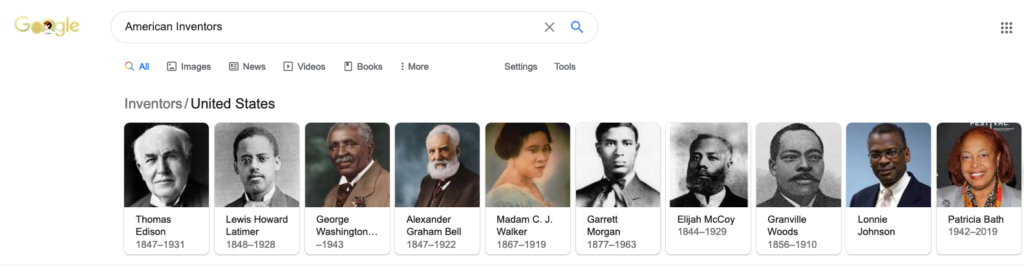
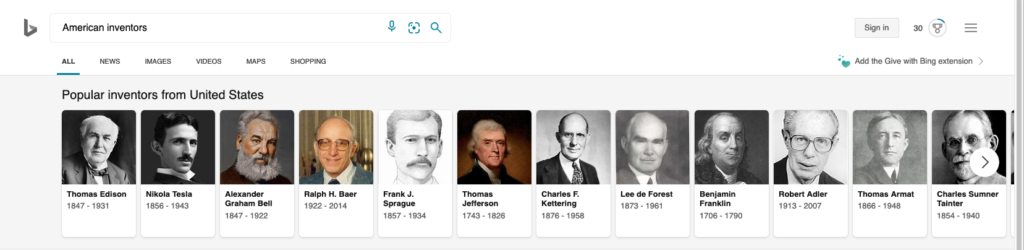
Search for “American Inventor” on Google Image Search.
Spoiler: On the first page teaser strip, you get Thomas Edison, eight black people, and a picture of Scottish-born Alexander Graham Bell with coloration that makes him look black:
Clicking on the “Images” search tab likewise seems to bring up 90% black inventors.
Missing from the first image results:
Orville and Wilbur Wright
Benjamin Franklin
Nikola Tesla
Eli Whitney
Willis Carrier
William Shockley
George Westinghouse
Thomas Jefferson
Ernest Lawrence
Of the black inventors shown, probably only George Washington Carver ranks among the top ten American inventors.
Someone has obviously gone to a great deal of time and effort to falsify history for political reason. Particularly suspicious is the elevation of Lewis Howard Latimer, an Edison underling who helped develop a better light bulb filament, to the second position on the list, shortly after Democratic president nominee Joe Biden announced that it was Latimer rather than Edison who invented the light bulb.
I can think of three possible explanations for the multiple racist results to be shown across all image search services:
Someone at Google has made the conscious decision to feature black inventors at the expense of all other races and the other search service are somehow using Google image search as their own image search engine.
Coordinated efforts across image search companies to distort the search results.
Someone is employing a web spider to automatically game image results to favor black Americans (this could explain how the dark-skinned image of Alexander Graham Bell makes the cut).
All of these are causes for concern.
We’re getting to watch the Ministry of Truth falsify history in real-time for political reasons.
Biden’s back, Bernie’s coronation is postponed, Buttigieg and Steyer are Out, Bloomberg sucks up to China, Super Tuesday looms, and Biden seeks help from the Holy Roman Empire. It’s your Democratic Presidential clown car update!
East Carolina University (North Carolina): Biden 29, Sanders 25, Bloomberg 14, Warren 11, Klobuchar 5, Buttigieg 4, Gabbard 1. Evidently both the Carolinas love them some Biden…
But from a broader perspective, the emergence of Sanders as the Democratic frontrunner mirrors the rise of Trump and the crackup of the Republican Party in 2016, and for many of the same reasons. In both cases, a significant swath of each party’s voter base rejected the party establishment after years of being pandered to or ignored altogether.
Populism cuts both ways, right and left, and the impending takeover of the Democratic Party by a left-wing populist should have been anticipated by party leaders four years ago—and maybe it would have been, if they hadn’t been busy gloating over the GOP’s apparent misfortune of being taken over by Trump.
But Trump’s triumph was a necessary corrective to a party that had lost its way. When Trump cinched the nomination in 2016, it was the end of the Republican Party as we knew it. Gone was the mild-mannered GOP of Mitt Romney, Paul Ryan, and John Boehner. Gone were the empty platitudes, repeated ad nauseum for decades, about comprehensive immigration reform and defunding Planned Parenthood. Gone was the slavish devotion to global free trade deals regardless of the toll it took on American workers. Gone, too, was the subtle deference toward the liberal media that belied the Republican establishment’s ambivalence about the issues rank-and-file Republicans really cared about.
Trump swept all of that away. Before he went to war with Democrats and the media, his candidacy was an all-out assault on the Republican establishment, which had drifted so far from its base that GOP leaders didn’t take him seriously until it was too late. They couldn’t see what he saw: Republican voters—and not a few independents and moderate Democrats—were tired of being ignored by their leaders, whom they had grown to despise. Trump was able to topple the edifice of the GOP because he saw it was rotten underneath.
Now, Sanders is poised to do the same to the Democratic Party. The media is aware of this, but only vaguely, tending to frame Sanders’s rise as a contest between a radically leftist base and a more moderate Democratic electorate at large. That’s one reason the press has so quickly glommed on to the candidacy of Bloomberg, treating him as a viable contender for the nomination and a real rival to Sanders.
“If [Sanders] is the nominee, we lose,” said one Democrat.
That lawmaker indicated that a Sanders primary win would cost Democrats their state in the fall. The lawmaker suggested that many voters could leave the top of the ticket blank. Two other vulnerable Democrats indicated that a Sanders nomination would almost certainly cede their states to President Trump, to say nothing of the impact on races down the ballot for Democratic House and Senate candidates. One Democrat said they would try to hyper-focus on local issues to serve as a counterbalance. But the lawmaker conceded it’s hard to compete with the Sanders narrative and the reverberations of impeachment.
Here’s what’s dangerous about enjoying Bernie’s early success and Dems’ early troubles: Most people say he can’t win and he’ll hand four more years to the other party. Many of those people include the alleged elites of his own party.
Sanders has a cadre of hardcore nobodies who feel alienated from both parties, especially the establishment types who inhabit the once uninhabitable swamp that Maryland so generously donated to the new nation back in 1790.
Those cadres, many of them young, ignorant and inspired, get excited at the mere mention of the name of the man who’s lived off taxpayers virtually his entire career and still managed to acquire three homes.
He’s grumpy, often angry but he is what he is, an authentic, angry grump. His disciples pack the rallies to the rafters or the farthest street corner, cheer everything he says, especially the angry stuff.
The candidate talks about implementing a most ambitious program of reforms that no one thinks can get through Congress. Many fellow party officeholders are already running for fear he’ll drag them down to defeat.
Any of this sound familiar? It’s a parallel phenomenon to the Trump Train of 2015-16. A rich guy from Queens (Bernie is a Brooklyn native) who instinctively tapped into the anger and frustrations of millions of overlooked Americans he has nothing in common with and harnessed that power to a surprise upset ticket into the White House.
The parallel is, of course, imperfect. Sanders is older, Jewish, no friend of Israel. He doesn’t know from tax cuts. There’s hardly anyone safe from the many trillions in new taxes the lifelong politician promises.
There’s a very long way to go in this process. But winning has a way of adorning anyone with campaign credibility and more admirers. You can smell it already.
“Russians Declare Election Too Chaotic For Them To Successfully Interfere.” “‘In our wildest ambitions, we never would have tried to get a straight out Communist to win the nomination in a major U.S. party,’ Putin said. ‘I don’t know how we’re supposed to interfere and add to that.’ Putin hung his head sadly. ‘It’s like people don’t even need a Russia anymore.'”
Joe Biden thumped all the competition in South Carolina. The scale of his victory there scrambles the Democratic race. And Biden’s victory takes more steam out of the candidacies of Elizabeth Warren and Pete Buttigieg. But it is not easy to imagine Biden having the stamina to take on Sanders in a long race.
The result should worry Democrats who wanted unity. There had been some evidence in the polls that black voters were warming up to Sanders. They did not do so in sufficient numbers in South Carolina to begin making Sanders into a consensus candidate.
Can Biden sustain the momentum? It’s hard to imagine that he can. This is a Saturday-night victory just days before Super Tuesday. Biden cannot mount much new campaign organization in the upcoming states or process any surge of donations into a surge of advertising. If Sanders wins the preponderance of delegates available next Tuesday, then Biden will just be another non-Sanders candidate, like Pete Buttigieg, who was given a strong look by a particular subset of voters within the Democratic Party. Meanwhile Sanders continues to put points on the board.
Biden’s biggest difficulty is the media. Biden is now depending on an avalanche of earned media gushing about his “comeback” in the race in South Carolina. But, unlike John McCain in 2008, Biden is a candidate uniquely disliked and distrusted by the liberal media apparatus that would provide him such a narrative. They are very likely not to give it to him.
Although much has been made about the continuing importance of black voters and black turnout to Democratic general-election victories, I expect to see stories in the next 48 hours about the unique nature of South Carolina’s Democratic electorate. There may be an undercurrent of internal Democratic class warfare in these accounts, emphasizing that South Carolina’s Democrats are much less educated, less Latino, and less progressive than the party as a whole. Sandersistas will emphasize that Sanders polls better with blacks in the North.
Biden’s victory raises serious questions about the role that liberal-leaning media play in the Democratic process. Black voters overwhelmingly rejected the liberal-media-approved alternatives to Bernie — Elizabeth Warren and Pete Buttigieg. That media class has been whispering about Biden’s unfitness for office.
Hey, give some credit to those of us in the Vast right Wing Conspiracy: We’ve been shouting about Biden’s unfitness for office! He works with dead people. Hey, Deng Xiaoping, Xi Jinping, they’re both Chinese leaders with Xs in their name. More worrying is the fact that there were two different Chinese leaders between the two that Biden’s mind skipped right over. (Hat tip: Instapundit.) What?
“My name’s Joe Biden, I’m a Democratic candidate for the United States senate—if you like what you see, help out, if not, vote for the other Biden”
What words ordinary people associate with Hunter Biden: corruption, Ukraine, sleaze, cocaine, strippers. What word New York Times associates with Hunter Biden: “art”:
Jobless man at center of huge political controversy rents $12k/month house, keeps Porsche in driveway, converts pool house to art studio. NYT publishes feature on art. https://t.co/4cmLtAkNFV
“Biden Wishes Some Country, Any Country, Would Try To Influence Election For Him.” “Seriously, anyone! Prussia! Czechoslovakia! The Holy Roman Empire! They’re still around, right?”
“Anytime we’ve had this before, society blows up and they do set up the guillotines and the guillotines don’t have to be chop your head off. They could be confiscatory taxes, they could be seizing the endowments of uh, educational institutions and um, philanthropic organizations, all of which those proposals are out there. You know, you’re going to have to do something about this income inequality and a lot of it comes from zero interest rates.”
The business of the New York City billionaire (yes, another one) gets significant revenue from its financial and data services in China. He is deeply enmeshed with that country’s business and government networks, and it shows.
Snip.
If Bloomberg wins, he would arguably be the most pro-China president since an avalanche of such presidents following Richard Nixon, who fatefully opened the American economy to the country in 1972….loomberg generally ignores China’s growing military and diplomatic power, instead focusing his claims on how benefit can be derived from China’s growing economy. In a 2008 Newsweek article, he wrote that a “growing Chinese economy is good for America”. He continued, “we have a stake in working together to solve common problems, rather than trying to browbeat or intimidate the other into action.”
Here he broadcasts China’s “win-win” rhetoric against “zero-sum” thinking. But in his many comments on China, Bloomberg does not adequately address the zero-sum thinking of China’s own leaders who argue that the Chinese autocratic system is superior to liberal democracy. Neither does he adequately address how China’s growing economy fuels its global military power projection, or the ongoing praxis of Maoist ideology that lauds the power of the Chinese Communist Party (CCP) as growing from the barrel of a gun.
(Caveat: Really not wild about how this website’s bandwidth-and-gimmick heavy idea of webdesign.) (Hat tip: Instapundit.) “Bloomberg’s $400 million bet looks increasingly likely to flop as he lags in Super Tuesday states.” But he’s not out of it yet:
The sub-tweeters and thumb-twitchers are writing Michael Bloomberg’s political obituary after his admittedly less than thrilling turn in Las Vegas, but the pundits were always coming not to praise him, but to bury him. Who does this rich amateur think he is? What year does this out-of-touch oligarch think we’re in, 2016?
The elites of the Democratic party and their baggage train in the media have, like an earlier elite in search of a restoration, learnt nothing and forgotten nothing. They remember only the humiliation of Trump’s victory in 2016. They refuse to consider the reasons for their repudiation by the voters, or the arrogance that led Hillary Clinton and her team to assume that the Blue Wall was theirs by hereditary right. And they refuse to accept another lesson of 2016: it’s still possible to fix a party conference, but the party no longer controls the primaries and the debates.
Remember how Democrats and Republicans alike mocked Donald Trump for even entering the Republican nomination race? Remember how the pontificators decreed that Trump’s lack of political experience disbarred him from the high office of crashing the biggest economy in the world, as the professional politicians managed to do in 2007 and 2008?
Snip.
The truth is, Bloomberg is in the Democratic nomination race for as long as he wants to be. The longer he stays in the race, the greater the amount of money he’ll spread around. The more he spends, the more the party managers and the senators and the governors and, though they’re far too high-minded to admit it, the media will come to see his candidacy as a fact that’s going to go the distance, and a reality to which the smart money should accommodate itself in case Bloomberg’s candidacy becomes a payday.
Bloomberg understands the lessons of 2016 because, like Donald Trump, he understood them long before and was prepared to act accordingly. Trump and Bloomberg know what the rest of the Democratic field know but, with the exception of Bernie Sanders, lack the integrity to say. The politicians of America are for sale to their highest donor.
Bloomberg also shares with Trump a businessman’s awareness of the price of morals and the cost of moralizing. Elizabeth Warren affected outrage about Bloomberg’s alleged jokes about ‘horse-faced lesbians’ and transvestites, but Trump has already proven that these attitudes, fatal though they may be in the politically correct kingdom of the campus, are an inverse form of recommendation: the kind of candidate who refuses to bow to the puritans might also be the kind of president who could refuse the bribes of the donors.
At first glance, this might seem counterintuitive. How does a candidate dropping out increase the likelihood of no majority? Shouldn’t it clear the field up and make it easier to achieve a majority?
The key is in how the Democrats’ delegate math works. The rules require candidates to receive at least 15 percent of the vote, typically, to win delegates statewide or at the district-level.
Buttigieg was projected to get under 15 percent in the vast majority of states and districts on Super Tuesday. Thus, his votes were essentially wasted. Redistributing his votes to other candidates will help them to meet the 15 percent threshold, however. In particular, Sen. Elizabeth Warren and former New York Mayor Michael Bloomberg were both close to the 15 percent line in many states or districts. So even an extra percentage point or two would help them get over that line in more places. For instance, both Bloomberg and Warren were projected to finish with an average of 14 percent of the vote in California before Buttigieg’s dropout. Now, they’re forecasted for 16 percent instead.
Biden was also projected to finish under 15 percent in some states and districts — so Buttigieg’s dropout helps him out also in a few places. Biden went from a projected 14 percent of the vote to 16 percent in Minnesota, for example.
Conversely, Sanders was already projected to get 15 percent almost everywhere. So although he will pick up a few Buttigieg voters, they don’t necessarily translate to more delegates.
Former First Lady, New York Senator, Secretary of State and losing 2016 presidential candidate Hillary Clinton: Probably not? Everybody who wanted a Hillary Clinton podcast, raise your hand. (pause) OK, that’s Ben Rhodes, Huma Abedin, and Bill Clinton (gets her out of the house). Also: “We Need to Talk About Hillary Clinton’s Disturbing Harvey Weinstein Ties.”
Sanders gained steady employment for the first time when he was elected mayor of Burlington, Vt., by ten votes in 1981, at the head of a coalition of leftist civic-action groups against a five-term Democrat who was tacitly endorsed by the Republicans as well. Sanders accused him of being a patronage-tainted stooge of local developers. As mayor, Sanders balanced the municipal budget, attracted a minor-league baseball team (it was called the Vermont Reds not because of Sanders, but because it was a farm team of the Cincinnati Reds). He was a pioneer in community-trust housing, sued to reduce local cable-television rates, and championed an imaginative multi-use redevelopment plan for the city’s Lake Champlain waterfront; his slogan was “Burlington is not for sale.” He worked well with all groups (except some developers) and showed no signs of the authoritarianism of the doctrinaire Left, though he admired some of their most odious exemplars, such as Fidel Castro, whom he unsuccessfully tried to visit. He was reelected three times as a declared socialist, with his vote inching up above 55 percent in 1987, and he had another try at the governor’s chair in 1986, but got only 14 percent of the vote. By this time Sanders was already focused on national government and had invited leftist professor and eminent linguist Noam Chomsky to give a speech in 1985 denouncing American foreign policy. He retired as mayor in 1989 and became a lecturer at the Kennedy School of Government at Harvard in 1989 and at Hamilton College in 1991.
In 1988, Sanders ran again as an independent for statewide office, as congressman at large for Vermont, and gained 38 percent of the vote, double the vote for the Democratic candidate, and within three points of the winner, Republican Peter Smith. Two years later, he ran again as an independent, but without a Democrat in the race, and this time he entered Congress, aged 50, as a Democratic-left independent fusion candidate. He served eight consecutive terms as a congressman and then in 2006 won the first of three terms (so far) as U.S. senator. It was unjust for Michael Bloomberg to suggest that Sanders was a Communist, as he does believe in free elections. He has stuck to his platform and doggedly fought out his career at the polls through 20 elections between 1972 and 2018, 16 of them statewide, albeit in a small state. It is correct, but unsurprising given that he sat as a socialist in the Senate, to say that he has introduced 364 bills as a senator, of which only three have passed, and two of them were to name post offices.
Bernie Sanders believes in mobilizing the less advantaged 50.1 percent of the voters in America, as in Vermont and in Burlington, by promising them a sufficient share of the wealth and status of the upper 49.9 percent of society, while assuaging any reservations about confiscating the wealth and income of others by denouncing the system and representing such redistribution as fairness. He wants an environmental revolution, no doubt to reduce pollution as a side benefit, but more importantly as a planet-saving cover for his assault on capitalism and his acquisition of the votes of the relatively disadvantaged. He is making a direct appeal to a majority of Americans by promising them economic benefits wrenched from the hands of the greedy 49.9 percent, or benignly showered upon them by a kindly state, as if the state got its money from anyone but its constituents.
Sanders keeps saying he’ll attract new voters. New York Times: Yeah, not so much. Here are 55 facts about Bernie Sanders. Nothing says “reasonable centrist” like hanging a Soviet flag in your office. Also: “Throughout his adult life he has denigrated Democrats, calling the party ‘ideologically bankrupt.'” Even Sweden’s Democratic Socialists find Bernie Sanders too far left. More media double standards:
Help me out here. Who decides which old comments "resurface" and which stay "long-buried"? pic.twitter.com/ADNKZjEjB5
It’s a 2 hr drive from Charleston to Myrtle Beach & locals do it all the time – Not @BernieSanders– He & his entourage flew from Charleston to Myrtle Beach in not 1, not 2, but 3 Gulfstream Jets today. It took them 10 minutes to fly. Who is the elitist?? #BernieIsACommunistpic.twitter.com/2CWMXVn4eE
WaPo: “Wow, Bernie sure loves him some communist dictators. Who knew?” (Hat tip: Ace of Spades HQ.) “Hey there, Mr. SuperDelegate! How do you feel about Bernie as the nominee?” “Aw, HELLS NO!” Bernie bros show up in the middle of the night with bullhorns outside the homes of DNC members Wow, that’s sure to bring them over to your side! There’s at least one outlet that’s all the way in the tank for Bernie: The Onion. Thou Shalt Not Make Funny Of Thy Holy Socialist.
Update: Billionaire Tom Steyer: Dropped Out. He dropped out February 29, 2020. The shade of John Connally can rest a little easier tonight: No longer is his spending $11 million to garner one delegate the most embarrassing waste of money in presidential campaign history. Through January 1, Steyer spent $253,718,074 to get zero delegates. Steyer’s campaign never made any sense:
Even relative to the other longshots, Tom Steyer, who dropped out of the race on Saturday night after a disappointing finish in the South Carolina primary, was a longshot. Nor was it entirely clear why he was running.
Steyer, a billionaire from his previous career as a hedge fund manager, spent the years before his presidential run pushing two causes in particular: efforts to mitigate climate change and the impeachment of President Trump. But Steyer’s presidential campaign wasn’t particularly focused on either issue — or anything else. He embraced some more liberal ideas (a wealth tax) and opposed others (Medicare for All). He cast himself as a populist while also emphasizing his business experience. He touted his electability and his commitment to fighting climate change, but not in ways that were particularly unique compared to the other candidates.
Steyer’s broader electoral strategy, skipping Iowa and New Hampshire while using his fortune to pump ads into states later in the calendar that the other candidates were not focused on yet, was fairly novel at first. And it halfway worked. According to our polling averages, Steyer eked just into the double digits in Nevada and South Carolina. He finished with 5 percent of county convention delegates in Nevada and 11 percent of the vote in South Carolina. That’s more than a lot of candidates managed.
But it’s not good. And in national polls, Steyer’s support never escaped the low single digits.
That’s why I always cheered on Steyer’s campaign: The money he spent on it was money he couldn’t spend against Republicans in races where it might have helped viable Democratic candidates win.
Warren was clearly the favorite candidate of academics and journalists — the intelligentsia. Why? Because she was the quintessential “front row” candidate, to borrow a term from author and photographer Chris Arnade. The image of her campaign will be her on a debate stage, hand raised, ready with an answer — but losing support roughly every minute she speaks.
After her dismal showing in South Carolina, there is no chance of Warren becoming the electoral alternative to Bernie Sanders. The first three states tried Pete Buttigieg in that role. South Carolina resoundingly chose Joe Biden. Her campaign fell between two stools: the young, somewhat nervous Left, and an older, aspirational center.
Her campaign persona had a funny way of playing to each. To the Left, she offered her ambition: her plans to end private health insurance, institute a wealth tax, make day care universal and free. Her promise was to give them security. To the center, she gave her ability to do homework. Every issue had an elaborate plan. Every plan was drawn up in dollars and cents. Sometimes the figures weren’t quite right. To them, she offered her competence and attention to detail.
Well, sort of. Her Medicare for All plan would send the federal budget into a new stratosphere, and she didn’t even include the cost of her plan to cover illegal aliens as well. Not to mention that her proposal includes tax increases that are unconstitutional and politically infeasible.
Both she and Gabbard are evidently flying to Michigan before either knows how badly they lost on Super Tuesday.
Out of the Running
These are people who were formerly in the roundup who have announced they’re not running, for which I’ve seen no recent signs they’re running, or who declared then dropped out:
Castro drops Out, Williamson lays everybody off, Q4 fundraising numbers drop, Biden tells coal miners to start slinging code, Klobuchar talks UFOs, and a three way tie for first in Iowa. It’s your Democratic Presidential clown car update!
Those who expected Sanders to fade after his heart attack were badly mistaken. He has enough money to fight Biden all the way to the convention, and his broad small amount donor base can continue to raise money for him without hitting any campaign contribution limits.
Biden comes in third. Has any frontrunner ever trailed so badly in the money race? It suggests an inability to find the right people to fill staff roles.
Yang’s haul is hugely impressive, considering that no one (myself included) gave him any chance early on. He’s got enough funding to stay in through at least Super Tuesday, where he has a shot at picking up at least some of California’s 416 pledged delegates.
Though relegated to second place, Buttigieg continues to punch above his weight in fundraising.
No reports yet on how much cash Bloomberg and Steyer shoveled into their own campaigns this quarter.
Hill/Harris X: Biden 28, Sanders 16, Warren 11, Bloomberg 11, Buttigieg 6, Booker 2, Klobuchar 2, Yang 2, Castro 2. Delaney 2, Gabbard 2. Bloomberg at 11 ought to terrify the other candidates. But why is Sanders called out as “Bernie” on the chart, despite everyone else being referred to by their last name?
With an unprecedented advertising spending binge, billionaire presidential wannabees Michael Bloomberg and Tom Steyer have launched themselves all the way to….the middle tier of the Democratic primary field.
The two candidates have spent a combined $200 million on television ads—with Bloomberg accounting for about $120 million of that total since he jumped into the race less than a month ago. No other candidate in the field has spent more than $18 million on ads so far, Politico reports. Bloomberg spent more than that in the first week after entering the race in late November.
Despite the advertising blitz, Bloomberg and Steyer are almost certainly wasting their money chasing political power. While it is foolish to rule out any electoral outcome in a world where Donald Trump is president, voters have responded to both Democratic billionaires with a resounding meh, and there seems to be little reason to think that will change [this] year, no matter how much money the two candidates pour into the race.
There are two lessons here. First, Bloomberg and Steyer seem to be on an inadvertent crusade to prove that progressive fears about the influence of money in politics are largely unfounded.
Secondly, the two billionaire candidates are providing a real-world lesson about opportunity costs by setting fire to their huge campaign war chests. They’ve got the means to change the world, but getting involved in politics isn’t the best way to do it.
The Atlantic offers a cheat sheet that includes the also-rans and never-rans. Most interesting tidbit: “[Deval] Patrick’s estranged father played in the alien jazz great Sun Ra’s Arkestra.”
Former Vice President Joe Biden: In. Twitter. Facebook. Biden tells coal miners to learn to code. Amazing how someone who has never mined coal or written code so confidently asserts that one who has done one job can easily do the other. “Biden touts himself as the embodiment of honesty while spreading a well-known lie. That’s an exquisite form of lying.” Speaking of indicting yourself:
A young man tells Joe Biden that his father lost his health insurance plan and the cost doubled, even though Obama promised insurances will be cheaper. He asks if Joe was lying or if he didn't understand Obamacare when he supported it.
But no matter what Biden says, his poll numbers seem unsinkable. Another editorialist points out that Biden’s immunity to his many gaffes shows why he’ll win the nomination:
It starts with the polls. Biden has been dominant. Since Real Clear Politics started its polling average in December 2018, Biden has led for all but one day. Sen. Elizabeth Warren eclipsed him by 0.2 percentage points on Oct. 2. She now trails him by 13 percent and is in third place, also trailing Sen. Bernie Sanders.
This isn’t how many political pundits expected last year to go. They chalked up Biden’s pre-announcement lead to his high name ID. He was supposed to gaffe his way into an early exit. He wasn’t progressive enough for the liberal wing of the party either.
What makes Biden’s durability look sustainable is that he hasn’t been a great candidate. Far from it. His debates have been cringeworthy. In July, he messed up the address of his campaign website. He made a bizarre reference to record players in September. In November, he forgot that Sen. Kamala Harris — who was on the stage with him — was a female, African-American senator.
The campaign trail hasn’t been much better. During a September CNN town hall, his left eye filled with blood, presumably from a blood vessel bursting. He called New Hampshire “Vermont” during a summer visit. In August, he said, “Poor kids are just as bright and just as talented as white kids.” He appeared to mean “rich” not “white,” but that mistake could have ended another candidate’s campaign.
Biden’s done a better job undercutting his own candidacy than any of his opponents ever could have — and his support has hardly budged.
He keeps promising bipartisanship. I think Republicans all remember how “bipartisan” the Obama Administration was…
As president, I'll turn the East Room into an open office plan, where I’ll sit with our team.
I’ll use the Oval Office for some official functions – never for tweeting – but the rest of the time, I’ll be where a leader should be: with the team. https://t.co/zIU3ZL5uIvpic.twitter.com/jLwWKJCmxw
He answered a Military Times questionnaire. It’s full of “on the one hand, on the other” platitudes, though he does say he’ll negotiate with the Taliban, but also leave a small force in Afghanistan, which sounds like it amounts to “stay in and lose,” with a side plate of living tripwires. He did approve of the Suleimani strike.
South Bend, Indiana Mayor Pete Buttigieg: In. Twitter. Facebook. Billionaires backing Buttigieg. “Forty billionaires and their spouses have donated to Pete Buttigieg’s presidential campaign, according to an analysis of federal election filings, making the South Bend, Indiana mayor a favorite among America’s richest people.” That includes a surprisingly high number of hedge fund managers, as well as Google founder Eric Schmidt’s wife, Instagram founder Kevin Systrom’s wife, Square founder Jim McKelvey’s wife, David Geffen, Barry Diller, Netflix’ Reed Hastings, LinkedIn’s Reid Hoffman, Blackstone’s Jonathan Gray, the wife of casino video game mogul Jon Yarbrough, members of the Ziff family, the Pritzker family, the NFL Giant’s Tisch family, etc. etc. etc. “Why Pete Buttigieg Enrages the Young Left.”
As the Iowa and New Hampshire primaries draw near and South Bend’s boy wonder, Pete Buttigieg, seems buoyant in the all-important early-state polls, “Mayor Pete” has been perpetually dogged by a major issue: the youngest and most activated voters in his party all seem to—how to put this delicately?—hate his guts.
Normally the first candidate of a generation can expect to ride a wave of youth enthusiasm, as John F. Kennedy and Bill Clinton once did. For the 37-year-old Buttigieg, it’s been quite the opposite. The newly radicalized Teen Vogue invoked a cringeworthy class-warfare pun to declare his campaign a “Lesson in ‘Petey’ Bourgeois Politics.” Jacobin, tribune of the socialist wing of the Democratic Party, has developed seemingly an entire vertical focused on slamming Mayor Pete. A writer for Out magazine, putting it in starker terms, tweeted that if he “had balls he’d run as the republican he is against trump in the primary.”
Why is the enmity from young, left-wing activists toward Buttigieg so visceral? It’s true that they favor Bernie Sanders, but Buttigieg comes in for a type of loathing that surpasses even that they hold for Sanders’ older rivals, Joe Biden and Elizabeth Warren.
But those explanations are still too general to explain the fury inspired by a fourth-place presidential contender and Midwestern college-town mayor. And it’s not his ideology: The resentment he inspires runs much deeper than that earned by the Amy Klobuchars and Michael Bennets of the world—both of whom have more politically moderate tendencies than Buttigieg, who has, among other positions, argued for raising the minimum wage to $15, introducing a public health care option, expanding the size of the Supreme Court and abolishing the Electoral College. (Asked for comment for this article, a representative from the Buttigieg campaign told Politico that staffers are occasionally vexed by the cold reception to a platform that’s well to the left of any recent Democratic presidential nominee.)
The unspoken truth about the furor Buttigieg arouses is that his success threatens a core belief of young progressives: that their ideology owns the future, and that the rise of millennials into Democratic politics is going to bring an inevitable demographic triumph for the party’s far left wing.
Snip.
It’s especially galling that the first millennial to take a serious run at the presidency is nothing like the left’s imagined savior. Buttigieg is a veteran, an outspoken Christian, a former McKinsey consultant, and, frankly, closer to Mitt Romney than Sanders or generational peer AOC in his aw shucks personal affect. In the eyes of radicalized young leftists, Buttigieg isn’t just an ideological foe, he’s worse than that: He’s a square.
Snip.
Buttigieg is a young professional with an elite pedigree who’s chosen to buy into the system as a reformer instead of attacking it as a revolutionary. To a certain class of left-wing thought leaders, he’s an unwelcome reminder of the squeaky-clean moderates with whom they once rubbed elbows. And quite possibly, his elite credentials may also be an unwelcome reminder of their own. The editor-in-chief of Current Affairs, for instance, isn’t just a random antagonist: He’s also a fellow Harvard alumnus.
The educated young people leading the left have worked closely with these overachievers throughout their careers—often at the same elite institutions they deride, rightfully or not, as venal consensus factories. Such activists are baffled by their counterparts’ optimism and adherence to tradition in the face of the Trump era’s grimness and vulgarity.
And, again, it seems many of their peers agree. Buttigieg does not enjoy considerable support among young people. In a recent New York Times/Siena poll of Iowa voters, he placed a distant third among 18-to-29-year-olds, behind Sanders and Warren. But he does appeal to a certain kind of young person, as now represented in the cultural imagination by the “High Hopes” dancers. And to the self-renouncing meritocrats who act as thought leaders to the young left, those people represent both a personal frustration and a political fear—that the institutions of tomorrow may yet be built by those with faith in yesterday’s ideals.
The path to Washington may be clearer for them than their radical counterparts, even as more millennials age into political life. The youngest Democratic member of Congress is, of course, the 30-year-old AOC, who seems all but inevitable to succeed Sanders as the standard-bearer for democratic socialism in America. But if you look at the next 10 youngest Democrats in Congress, they include mostly moderates: the venture capitalist Josh Harder, the military veteran and Blue Dog Max Rose, and Conor Lamb, whose district lies deep in Pennsylvania’s Trump country.
When it comes down to it, the hard left would rather seize control of the Democratic Party than win elections, and Buttigieg refuses to immanentize the eschaton. Another look inside those high dollar fundraisers:
At an annual charity fund-raiser in October, Anna Wintour, the editor of Vogue, shared a table with the designer Michael Kors and Pete Buttigieg, then the mayor of South Bend, Ind., who wore one of his trademark navy suits.
The event was a benefit for God’s Love We Deliver, a nonprofit that began delivering meals to New Yorkers with AIDS in 1986 and has since expanded to serve other homebound people. On the second floor of Cipriani’s South Street location, guests bid for meals with the actor Neil Patrick Harris, watched the model Iman receive an award for her philanthropic efforts and heard a short speech from Mr. Buttigieg, who was also honored that evening. He said volunteers for the organization had offered sustenance “in substance and in soul.”
Sitting at a table near the stage was the theater producer Jordan Roth, who back in April held an event for Mr. Buttigieg’s presidential campaign at his home in the West Village, at up to $2,800 per head. Nearby was the board chairman of God’s Love, Terrence Meck, who had co-hosted an event for Mr. Buttigieg in Provincetown, Mass., just after the July 4 holiday. (Tickets for that ran upward of $1,000 per person.)
Snip.
So it is perhaps unsurprising that Mr. Buttigieg’s dinners and fund-raisers — complete with cozy pictures on Instagram of Mr. Buttigieg standing beside high-net-worth bundlers — have turned into grist for his critics.
Guests at a December fund-raiser for Mr. Buttigieg held at the New York home of Kevin Ryan, an internet entrepreneur behind Gilt Groupe and Business Insider, were greeted outside by protesters who banged pots and pans and called Mr. Buttigieg “Wall Street Pete.”
The police arrived when a protester got inside. By that point, Mr. Buttigieg had left for Ms. Wintour’s West Village townhouse, where a campaign dinner was being held. Tickets cost up to $2,800 each and the actress Sienna Miller was among the attendees.
Days later, Mr. Buttigieg appeared at a fund-raiser held inside a Napa Valley wine cave. Afterward, progressive activists reached deep into political crisis history to note that one of the hosts, Craig Hall, who is now the owner of Hall Wines in Rutherford, Calif., was a real estate developer involved in the savings and loan crisis in the 1980s. Mr. Hall went to Jim Wright, then speaker of the House, for help when he was facing bankruptcy — and the cascade of events led to a bailout for Mr. Hall, a congressional ethics investigation and, ultimately, Mr. Wright’s resignation as speaker.
Mr. Hall’s wife, Kathryn Walt Hall, co-hosted the Napa benefit. She was a prolific donor to President Bill Clinton and served as ambassador to Austria from 1997 to 2001.
Snip.
Prominent donors in Los Angeles argue that Mr. Buttigieg is also approaching celebrity fund-raising differently than Hillary Clinton did four years ago.
While her campaign publicized the appearances of Katy Perry and Lena Dunham at events, he’s kept a lid on similar associations.
The fund-raiser that Gwyneth Paltrow held on his behalf last May? The campaign declined to publicize it. Instead, Mr. Buttigieg spoke in front of cameras that evening during a $25 (and up) appearance at the Abbey — sort of a gay, West Hollywood equivalent of dining at Sylvia’s in Harlem with the Rev. Al Sharpton.
“He wasn’t doing a song and dance with Gwyneth on national television,” said Simon Halls, a prominent entertainment industry publicist who in July was scheduled to co-host a reception at the television producer Ryan Murphy’s home. (That event was canceled after a white police officer fatally shot a black man in South Bend; the reception has not been rescheduled.)
An offer by the designer Tom Ford to dress Mr. Buttigieg during the course of the campaign? Declined.
In July, Mr. Buttigieg appeared at the Provincetown fund-raiser Mr. Meck hosted with Bryan Rafanelli, an event planner whose clients have included the Clintons. Although tickets cost a minimum of $1,000, Mr. Meck said the event took place after a free, packed and publicized town hall event. As Mr. Meck told it, Mr. Buttigieg told him that he wanted to spend his time in Provincetown actually meeting people. Later in the summer, he hit the Hamptons to collect more money.
Interesting approach. “I don’t want your star power, just your money.”
Former San Antonio Mayor and Obama HUD Secretary Julian Castro: Dropped out January 2, 2020. “Castro failed to make the last two debates or even achieve 2% in the polls despite promising government handouts for basically everything. Along with Sen. Cory Booker, he whined to the DNC about unfair qualifications for the January primary debate. More than likely he would not have participated in that debate.” “Dropout Julian Castro’s insufferably woke presidential campaign won’t be missed“:
Give Julian Castro some credit: In a crowded 2020 Democratic field originally featuring cringeworthy candidates such as Beto O’Rourke and New York Sen. Kirsten Gillibrand, the former housing and urban development secretary still managed to run the most insufferably woke presidential campaign of this cycle.
Thursday morning brought the official end of Castro’s campaign. But it never really got off the ground, and the candidate failed to qualify for the November debate, getting under 2% of the vote in polling averages. Outside of a few fringe Marxist professors and woke liberal activists, Castro’s campaign was so radical that even Democratic primary voters weren’t buying it.
It’s not hard to see why. Castro’s only memorable contributions to the 2020 race are viral moments where he embarrassed himself.
For one, there was his cringey decision to randomly pronounce certain words with a Spanish accent during Democratic debates, despite not actually being a native Spanish speaker. Then there was his call for completely decriminalizing illegal border crossings, and attacks on other, slightly less terrible Democrats who declined to endorse his radical proposal.
Don’t forget the countless shudder-worthy instances where Castro pandered to the woke crowd with fact-free rants about “transgender women of color” being gunned down in the street in a supposed epidemic of anti-transgender hate crimes. Castro ignored the complete lack of evidence for this narrative, instead choosing to stir up bogus outrage for votes. His pandering even included a bizarre call for expanding abortion access to transgender women (aka biological males). Castro was also the first candidate to honor “International Pronouns Day” by putting his preferred pronouns, he and him, in his Twitter profile. This was, of course, a pure virtue-signal: Everyone already knew he was a man.
(Hat tip: Stephen Green at Instapundit.) Esquire writer has a case of the sadz over his withdrawal. “Castro should have been viable all the way to the convention. (This is also true of Jay Inslee and Kamala Harris.) But the merciless criteria of polls and money worked against all three of them.” No, all three are out because all of them sucked in various ways, and all of them were terrible, inauthentic candidates spouting far-left bromides. Ace of Spades HQ: “He never stopped talking about giving trans women pap smears and abortions. Weird that he never connected with his presumptive Latino base.” 538’s postmortem talks about debate missteps but paints a picture of general suckage.
Whereas Joe Biden seems permanently diminished by his own verbal and intellectual confusion and by his son’s self-dealing, Bernie is getting stronger.
He has raised the most money of all the Democratic candidates, by far — some $95 million in 2019 from 5 million donations — though the average contribution to Bernie is $18. He raised $34.5 million in the last quarter alone. He got 40,000 new donors on the last day of the year.
When Mr. Sanders renounced bundlers and PACs it was said that he had unilaterally disarmed himself in the money race. Instead he is killing it.
Mr. Sanders is also raising money in the 200 “pivot” counties Barack Obama carried in 2012 and Democrats lost to Donald Trump in the swing states in 2016.
And he is not only acceptable to but well thought of by an astounding 75 percent of his party.
Those are singular metrics.
He is also the only candidate in a position to take either first or second in the first contests — Iowa, New Hampshire, Nevada, and South Carolina.
He polls as well as Mr. Biden in a direct matchup against Mr. Trump, though surely, as Mr. Sanders says, Donald Trump could eat Mr. Biden’s lunch on his votes in favor of NAFTA and the endless and futile Iraq War.
The money race and the size of his crowds show that Bernie Sanders is connecting, just as they show Joe Biden is not. His resilience is no fluke.
Billionaire Tom Steyer: In. Twitter. Facebook. Hits donor threshold, hasn’t hit the polling threshold. “In addition to garnering the necessary number of voters, Democratic candidates need to reach 5 percent support in at least four DNC-approved polls, or at least 7 percent support in two single-state polls in Iowa, New Hampshire, Nevada or South Carolina. So far, Steyer is polling at 5 percent in two of the four polls conducted in the early voting states of Iowa, New Hampshire, Nevada and South Carolina.”
Many Democratic presidential candidates, such as former vice president Joe Biden, former South Bend, Ind., Mayor Pete Buttigieg and Sen. Cory Booker (D-N.J.), have robust organizations. But among locals, Warren’s organization stands out.
While the campaign has declined to release exact numbers, the Massachusetts senator is believed to have more than 100 field staff fanned out across the state, including some who have been on the ground for the better part of a year. Warren staffers have become deeply embedded, showing up at high school sports games, book clubs, bingo nights and potluck dinners dressed in the campaign’s signature liberty green attire. In Fairfield, Iowa, a family recently named their newborn goat Herb, after the Warren field organizer who has prolifically canvassed that town for months. In Mason City, an organizer who was in the hospital for emergency surgery used his recovery time to pitch the ER staff on Warren’s candidacy.
The stories about Warren staffers in Iowa and how far they go to sell her candidacy regularly circulate among rival campaigns, eliciting both eye rolls but also grudging admiration. “It’s like, where did they find these kids?” marveled a longtime Iowa Democratic activist, who spoke on the condition of anonymity because she endorsed another candidate in the race.
Caveat: Every one of these borderline-admiring pieces on a female Democratic candidate’s organization (be it Warren, Harris, or Gillibrand) always seems to come from a female writer, and this one’s from Holly Bailey. Warren calls Suleimani a murderer, then backtracks due to pushback from the hate-America left. “Elizabeth Warren Opens Casino To Help Finance Campaign.”
Venture capitalist Andrew Yang: In. Twitter. Facebook. “Flush with cash, Yang wrestles with where to spend it.”
Andrew Yang has more money than his campaign knows what to do with.
He still can’t quite get accustomed to his surprising fundraising haul — Yang collected $16.5 million in the fourth quarter — or how to allocate it in the run-up to the Iowa and New Hampshire contests.
“We’re going to buy gold coins, and then put them in a vault, and then I’m going to go on top of the pile of gold coins and then wave my arms and legs up and down,” he joked in an interview.
The reality is that his newfound campaign riches are creating internal tension about whether to beef up the Iowa operation or bet it all in New Hampshire.
Yang’s strong focus has always been on New Hampshire, the first-in-the-nation primary state where he has spent more time than any of the top-tier candidates. The campaign sees it as ripe ground for him — Democratic voters relish their independent-streak and showed they were open to non-traditional candidates in the past, delivering Sen. Bernie Sanders a decisive win in the 2016 primary.
Their goal, to date, has been to finish at the top of the second-tier in order to stay relevant after the early-voting states. Suddenly though, with money to play in Iowa as well, there is a vigorous debate about where to spend the cash and Yang’s other precious commodity — his time.
“I think if we overperform expectations will have a very powerful narrative coming out of New Hampshire that people don’t expect us to be at the top four here,” Yang said after wrapping up the final of 14 events during a four-day trip here. “If we break the top four, I think people will see that we have a ton of energy behind us.”
Yang’s $16.5 million — 65 percent more than the previous quarter — placed him fifth in terms of fundraising for the Democratic presidential candidates, about $4.7 million less than Sen. Elizabeth Warren, who came in fourth. He raised almost five times more than Rep. Tulsi Gabbard, another second-tier candidate who has invested so heavily in New Hampshire that she has all but moved here.
Honestly, instead of Iowa, he should probably look to Super Tuesday and build out an organization in California and either North Carolina or Texas, all of which have significant concentrations of high tech industries, where workers seem somewhat more attuned to his issues. Texas has a bigger population, and thus is more delegate rich, and a bigger concentration of Asians, but the diverse markets are brutal for ad campaigns. On the other hand, a $5 million direct mail/TV/radio push in the Research Triangle in North Carolina might well make an impression. Ohio is going to screw him out of a place on the ballot due to a technical filing issue. Yang has pretty much the same reaction to Biden’s “Coal miners should learn to code” suggestion:
Democratic presidential candidate Andrew Yang on jobs: "Someone who suggests that coal miners become coders is generally neither of those things." pic.twitter.com/2dmBRXfKys
These are people who were formerly in the roundup who have announced they’re not running, for which I’ve seen no recent signs they’re running, or who declared then dropped out:
Although I know much of the Midwest has already been blessed with several feet of global warming, winter doesn’t officially start until tomorrow. In the meantime, finish up your Christmas shopping (if you haven’t already) and enjoy a Friday LinkSwarm!
Brexit bill passes by huge majority. Britain is set to leave the EU by January 31, 2020. I’m putting this first because Brexit is far more important in the long run than the impeachment farce.
The amazing psychic powers of Instapundit. From 2017: “Trump knows that the press isn’t trusted very much, and that the less it’s trusted, the less it can hurt him. So he’s prodding reporters to do things that will make them less trusted, and they’re constantly taking the bait. They’re taking the bait because they think he’s dumb, and impulsive, and lacking self-control — but he’s the one causing them to act in ways that are dumb and impulsive, and demonstrate lack of self-control.”
But then again, no president in modern memory has been on the receiving end of such overwhelmingly negative media coverage and a three-year effort to abort his presidency, beginning the day after his election.
Do we remember the effort to subvert the Electoral College to prevent Trump from assuming office?
The first impeachment try during his initial week in office?
Attempts to remove Trump using the ossified Logan Act or the Emoluments Clause of the Constitution?
The idea of declaring Trump unhinged, subject to removal by invoking the 25th Amendment?
Special Counsel Robert Mueller’s 22-month, $35 million investigation, which failed to find Trump guilty of collusion with Russia in the 2016 election and failed to find actionable obstruction of justice pertaining to the non-crime of collusion?
The constant endeavors to subpoena Trump’s tax returns and to investigate his family, lawyers and friends?
Now, frustrated Democrats plan to impeach Trump, even as they are scrambling to find the exact reasons why and how.
Most presidents might seem angry after three years of that. Yet in paradoxical fashion, Trump suddenly appears more composed than at any other time in his volatile presidency.
Ironically, Trump’s opponents and enemies are the ones who have become publicly unhinged.
If you want to know how it’s playing out in America, check out this tweet from PolitiBunny, who was so hardcore #NeverTrump she voted for Egg McMuffin in 2016:
No amount of persuasion, begging, or even outright harassment could convince me to vote for Trump in 2016.
Democrats not only made me a Trump voter last night, but I’m officially ready to do what I can to help him get re-elected.
The House passes the USMCA free trade deal, and I expect senate approval to be quick. USMCA will have longer and more lasting consequences than the silly theater the Democrats put on Wednesday.
Of the 65 deadliest cities in America, over 90% have Democratic mayors, and over 70% have not had Republican mayors in a long, long time. The last Republican mayor of New Orleans left office in 1872… (Hat tip: Dwight.)
Clearly Greta Thunberg is being exploited by her cynical puppetmasters, but equally clearly she’s a tiresome, bizarre Marxist scold whose exploitation of the hapless dummies who buy into the climate change hoax is part of what is an increasingly violent plot to undermine capitalism and freedom. Recently, the cretins at TIME, which shockingly still exists in 2019, named her “Person of the Year.” That’s appropriate, since 2019 has been a very annoying year.
In 2029, after the world hasn’t ended but her usefulness has, she’ll be a Jeopardy question and probably shacked up with an unemployed performance artist named Björn in an Oslo suburb. Fun fact: “Greta Thunberg” is Swedish for “Cindy Sheenhan.”
But today, we’re all supposed to fall over ourselves over Pippi Longnagging – at least that’s what our betters command – yet it’s unclear why. Teenagers are notoriously ignorant, and ones spewing recycled Marxism are the worst of all. But the idea is not that this tiresome truant is some visionary thinker. The idea is to leverage her youth and awkwardness to keep you from speaking the indisputable truth that she’s a weird brat who presses for an ideology that butchered 100 million people in the last century. And now, she is hinting she wants to run up that score.
Snip.
The other day, this malignant muppet “told cheering protesters … ‘we will make sure we put world leaders against the wall’ if they fail to take urgent action on climate change.” Now, maybe her English is bad, or maybe she’s just ignorant, but then again the murder of opponents is the Marxist way. Marxist? St. Greta? Well, let’s take a look at what was carved on the tablets she recently brought down from Mount Socialism:
“Schoolchildren, young people, and adults all over the world will stand together, demanding that our leaders take action, not because we want them to, but because the science demands it,” she said. “That action must be powerful and wide-ranging. After all, the climate crisis is not just about the environment. It is a crisis of human rights, of justice, and of political will. Colonial, racist, and patriarchal systems of oppression have created and fueled it. We need to dismantle them all. Our political leaders can no longer shirk their responsibilities.”
Wait, “the science demands” that we “dismantle” all our “[c]olonial, racist, and patriarchal systems of oppression?” Now, what science exactly is that? Is it geology? Physics? Phrenology maybe?
How stupid do they think people are? Very. And to judge by the judges at TIME, they’re often right. Maybe Greta never heard of Siberia or Cambodia, but we have. Screw that – if she wants to impose her masters’ Marxist fantasies on us, she’ll need to be packing something deadlier than “How dare you!”
Muslims across India staged angry protests over new legislation that grants citizenship rights for refugees fleeing Islamist persecution in the neighboring countries.
The Citizenship Amendment Bill, passed by the Lower House of the Indian parliament by 293 to 82 votes, opens the path to naturalization for the followers of six faiths, including Hindus, Sikhs, and Christians, but excludes Muslims.
Muslim mobs took to streets in several Indian cities, setting fire to vehicles, throwing stones, and hurling home-made bombs at security forces called in to restore order, Indian newspapers report. Left-wing student groups joined the protesters. They blockaded campuses in India’s capital New Delhi.
On the one hand, 95% of the time it is in fact Muslims who are persecuting the members of other religions. On the other, the trend in India under Modi has been toward a Hindu religious-ethno state, and things there could turn very bad, very quickly for the Muslim minority there. Muslims constitute only 14% or so of India’s population, but 14% of 1.3 billion is still some 182 million people. And by “very bad” I mean “possibly Rwanda-level bad,” only at 10 times the scale…
“Poland may have to leave EU, Supreme Court warns.” Hey, I bet I know at least a couple of countries who would be happy to sign free trade deals if they did…
I do not think it is a secret that Vox Media’s employment model has long been unsustainable. They use “contractor” designations to avoid all sorts of labor laws, including providing minimum wage and benefits — and they well exceed the intended use of “contractor.” I’ve published 1,304 articles in 8 years at Clips Nation. That’s not contract work. When I am on the site every day and have day-to-day oversight from corporate, that’s not contract work. Everyone, including SB Nation, has known that this model is unsustainable. While I won’t publicly disclose the numbers, and SB Nation limits our access to a lot of data, I am certain that Clips Nation generates enough revenue to support multiple employees, even when you account for the money that needs to support other aspects of the site (marketing, software, etc).
The state of California is cracking down on companies like SB Nation who are exploiting the “contractor” loophole, as it well should. Unfortunately, Vox Media is predictably unwilling to cease being greedy. In order to attempt to protect their disproportionate and exploitative revenue share from team sites, Vox has decided to eliminate about 200 of these contractor positions — every contractor in California, including myself, Robert, and our staff writers, editors, and podcasters in paid roles — and replace them with a handful of full-time employees who are going to work as a team to run SB Nation’s 25 team sites in California.
I doubt he knows how profitable Vox is. It’s entirely possible it loses money, like many online “media empires.” But I sincerely doubt Vox held a gun to his head those eight years. If he feels exploited for work he voluntarily agreed to do at the wages offered, he only has himself to blame. This is not to say that Vox doesn’t suck; it does. But this situation sucks not due to Vox, but due to the California state laws of which this freelancer so obviously approves.
Here’s an interview with Burt Ward, Robin on the 1960’s Batman TV show, about some of the behind-the-scenes shenanigans. Nowadays he and his wife run a dog rescue center, where they’ve eventuality saved the lives of more than 15,000. Good on you, Burt.
Bullock and Harris drop Out, Bloomberg rises (though slowly), Booker gets weepy, Tulsi sings, and Democrats have a diversity problem. It’s your Democratic Presidential clown car update!
With just under two months until the Iowa caucuses, the already-volatile Democratic presidential race has grown even more unsettled, setting the stage for a marathon nominating contest between the party’s moderate and liberal factions.
Pete Buttigieg’s surge, Bernie Sanders’s revival, Elizabeth Warren’s struggles and the exit of Kamala Harris have upended the primary and, along with Joseph R. Biden’s Jr. enduring strength with nonwhite voters, increased the possibility of a split decision after the early nominating states.
That’s when Michael R. Bloomberg aims to burst into the contest — after saturating the airwaves of the Super Tuesday states with tens of millions of dollars of television ads.
With no true front-runner and three other candidates besides Mr. Bloomberg armed with war chests of over $20 million, Democrats are confronting the prospect of a drawn-out primary reminiscent of the epic Clinton-Obama contest in 2008.
“There’s a real possibility Pete wins here, Warren takes New Hampshire, Biden South Carolina and who knows about Nevada,” said Sue Dvorsky, a former Iowa Democratic chair. “Then you go into Super Tuesday with Bloomberg throwing $30 million out of his couch cushions and this is going to go for a while.”
That’s a worrisome prospect for a party already debating whether it has a candidate strong enough to defeat President Trump next November. The contenders have recently begun to attack one another more forcefully — Ms. Warren, a nonaggressor for most of the campaign, took on Mr. Buttigieg on Thursday night — and the sparring could get uglier the longer the primary continues.
A monthslong delegate battle would also feature a lengthy public airing of the party’s ideological fissures and focus more attention on contentious policies like single-payer health care while allowing Mr. Trump to unleash millions of dollars in attack ads portraying Democrats as extreme.
The candidates are already planning for a long race, hiring staff members for contests well past the initial early states. But at the moment they are also grappling with a primary that has evolved into something of a three-dimensional chess match, in which moves that may seem puzzling are taken with an eye toward a future payoff.
Ms. Warren and Mr. Sanders, for example, are blocking each other from consolidating much of the left, but instead of attacking each other the two senators are training their fire on Mr. Buttigieg, the South Bend, Ind., mayor. He has taken a lead in Iowa polls yet spent much of the past week courting black voters in the South.
And Mr. Biden is concluding an eight-day bus tour across Iowa, during which he has said his goal is to win the caucuses, but his supporters privately say they would also be satisfied if Mr. Buttigieg won and denied Ms. Warren a victory.
It may seem a little confusing, but there’s a strategy behind the moves.
Mr. Sanders and Ms. Warren each covet the other’s progressive supporters but are wary about angering them by attacking each other. So Ms. Warren has begun drawing an implicit contrast by emphasizing her gender — a path more available now with Ms. Harris’s exit — and they are both targeting a shared opponent whom many of their fiercest backers disdain: Mr. Buttigieg.
The mayor has soared in heavily white Iowa, but has virtually no support among voters of color. So he started airing commercials in South Carolina spotlighting his faith and took his campaign there and into Alabama this past week — an acknowledgment that Iowans may be uneasy about him if he can’t demonstrate appeal with more diverse voters.
As for Mr. Biden, his supporters think he would effectively end the primary by winning Iowa. But they believe the next best outcome would be if Mr. Buttigieg fends off Ms. Warren there to keep her from sweeping both Iowa and New Hampshire and gaining too much momentum. They are convinced she’s far more of a threat than Mr. Buttigieg to build a multiracial coalition and breach the former vice president’s firewall in Nevada and South Carolina.
I don’t think Warren’s winning Iowa or New Hampshire, but since this was actually in the article, and I had to see it, now you have to see it too:
And you thought the Halloween nightmare season was over…
The Times piece didn’t mention the policy initiative upon which Harris launched her campaign: Bernie Sanders’s Medicare-for-All legislation, which would eliminate private and employer-based health insurance. Harris signed on as a cosponsor to the bill last April. It’s haunted her ever since. Medicare for All might look like the sort of “big, structural change” that sets progressive hearts aflutter. For most voters it causes arrhythmia.
The proposal is liberals’ fool’s gold. It appears valuable but is actually worthless. It gets the progressive politician coming and going: Not only do voters recoil at the notion of having their insurance canceled, but candidates look awkward and inauthentic when they begin to move away from the unpopular idea they mistakenly embraced. That’s what happened to Harris earlier this year and is happening to Elizabeth Warren today.
Harris moved into second place nationwide after her ambush of Joe Biden over busing during the first Democratic debate. But her position soon began to erode. Her wavering position on eliminating private insurance dissatisfied voters. She had raised her hand in support of the policy during the debate, but the next day she walked it back. Then she walked back the walk-back. Then, ahead of the second debate, she released an intermediary plan that allowed for certain forms of private insurance. She stumbled again when Biden called her to account for the cost of the bill. Tulsi Gabbard’s pincer move on incarceration, using data first reported by the Free Beacon, made matters worse. By September, Harris had fallen to fifth place.
This was around the time that Warren, bolstered by adoring press coverage and strong retail politics, began her ascent. For a moment in early October, she pulled slightly ahead of Biden in the RealClearPolitics average of national polls. Her rivals sensed an opportunity in her refusal to admit that middle-class taxes would have to increase to pay for Medicare for All. The attacks took their toll. Support for Warren fell. She then released an eye-popping payment scheme that failed to satisfy her critics. In early November, she released a “first term” plan that would “transition” the country to Medicare for All. In so doing, she conceded the unreality of her initial proposal. She came across as sophistical and conniving. Her descent continues.
The national front-runner, Joe Biden, and the early-state leader, Pete Buttigieg, both reject Medicare for All in favor of a public option that would allow people to buy into Medicare.
Could all this sound and fury just boil down to Bernie vs. Biden? “Warren’s early October high has worn off, while Sanders has steadily crept back up in the polls. The result is that the two are in a virtual heat for second place.”
Disappointed Democrats groused that you obviously had to be rich to compete in the 2020 race — because [Harris] was gone, while two billionaires remained — and pointed to the potentially all-white, un-diverse lineup at the party’s next debate as proof that the qualifying criteria put too much of a premium on fund-raising.
But Harris had made the cut for that debate. And she entered the presidential sweepstakes with a higher net worth ($6 million, according to Forbes) than Bernie Sanders ($2.5 million), Amy Klobuchar ($2 million) or Pete Buttigieg ($100,000), who are still in the hunt and are among the six contenders slated to be sparring onstage on Dec. 19. What’s more, Sanders and another of the six, Elizabeth Warren, have raised buckets of money without courting plutocrats.
Many Democrats blamed the media for Harris’s demise. They have a point, inasmuch as some news organizations never had the kind of romance with her that they did with Buttigieg and Beto O’Rourke, two white men. I noted as much in a column last May, pointing to O’Rourke’s placement on the cover of Vanity Fair and Buttigieg’s on the cover of Time.
But the media fell quickly out of love with O’Rourke and is picking Buttigieg apart for his lack of support among African-Americans and his past employment as a McKinsey consultant. And Harris was hardly ignored: Her initial campaign rally in Oakland, Calif., in January was covered live, in its entirety, on MSNBC and CNN. That same month, Rachel Maddow of MSNBC told her, in a face-to-face interview, “I think there is a good chance that you are going to win the nomination.” And after the Democratic debate in June, when Harris stirringly confronted Joe Biden about his past opposition to federally mandated busing to integrate schools, she received a bonanza of media attention and rapturous reviews.
I get that this Democratic primary isn’t playing out as anyone predicted or in remote accordance with the party’s image of itself and with its priorities. None of the top four candidates — Biden, Warren, Buttigieg and Sanders — is a person of color, three of them are 70 or older, and the billionaires, Tom Steyer and Mike Bloomberg, are dipping into their personal fortunes in their efforts to gain ground. For a party that celebrates diversity, pitches itself to underdogs and prides itself on being future-minded and youth-oriented, that’s a freaky, baffling turn of events.
But some of the conclusions being drawn and complaints being raised don’t fully hold water.
Take the fears about the nomination being purchased. Without question, running for office is too expensive. That dynamic can definitely favor candidates with lucrative connections. And candidates are forced — unless they’re Steyer or Bloomberg — to devote ludicrous and possibly corrupting sums of time to political panhandling.
But at least at present, neither Steyer nor Bloomberg is exactly barreling toward victory. And while Cory Booker drew a connection between Harris’s departure and a process warped by wealth, the link is tenuous. Booker, whose campaign presses on despite his failure to qualify for the December debate, said of Harris’s withdrawal, “Voters did not determine her destiny.”
Actually, they kind of did. They’re the ones who are or aren’t excited enough about a candidacy to donate money and keep it alive. They’re the ones responding to pollsters and, by flagging their preferences, determining which candidates take on the air of plausibility that often generates the next round of donations. I keep seeing, on Twitter and Facebook, laments about Harris’s fate from Democrats who chose to support candidates other than her. Well, she couldn’t succeed on generalized, ambient good will.
Former Vice President Joe Biden: In. Twitter. Facebook. Another piece warning than if Biden places out of the money in Iowa and New Hampshire his campaign dies. “Biden: ‘Nobody warned me’ about Hunter and Ukraine because Beau was dying.”
Joe Biden asserted that he never heard worries that his son Hunter Biden’s role on a Ukrainian gas company could create a conflict of interest.
“Nobody warned me about a potential conflict of interest,” Biden said Friday in an interview with NPR. “I never, never heard that once at all.”
Hunter Biden was on the board of Burisma, a Ukrainian gas company, while his father was vice president and working on Ukrainian policy. President Trump asked the Ukrainian president this year to investigate the Bidens, prompting Democrats to launch impeachment proceedings against Trump.
George Kent, a top State Department official, testified during impeachment hearings in November that he raised conflict of interest concerns after he learned Hunter Biden was on Burisma’s board.
Is pathos supposed to distract us from the fact that Biden is too incompetent to keep his own house in order? Or are we just supposed to assume that so much graft and self-dealing went on the Obama White House that Hunter’s piddling $50 grand a month Ukrainian sinecure was side hustle chump change next to the scams others were running? Speaking of Ukraine, John Kerry endorses his stepsons’s business partner’s father. “Here Are The Billionaires Backing Joe Biden’s Presidential Campaign.” Prominent names include Google’s Eric Schmidt, eBay’s Meg Whitman, Valve’s Gabe Newell, and George Lucas’ wife. He gets testy in a town hall and calls a retired farmer “fat.” Speaking of horrifying images lodged in your brain:
After two weeks in the presidential race, Mike Bloomberg now employs one of the largest campaign staff rosters, has spent more money on ads than all the top-polling Democrats combined and is simultaneously building out ground operations in 27 states.
But when the former New York mayor showed up to get the endorsement of Augusta Mayor Hardie Davis Jr. on Friday, only two of the 10 chairs initially placed before the lectern were occupied. When Bloomberg joked about his college years, saying he “was one of the students who made the top half of the class possible,” he was met by silence.
“You’re supposed to laugh at that, folks,” Bloomberg said to a room at the city’s African American history museum filled mostly with staff and media.
For a normal presidential campaign, such moments would be a worrying sign, a potentially viral metaphor for a struggling effort. But with the Bloomberg campaign, it is not at all clear what established rules apply, if any. Everything he is doing is so unlike what has been done for decades that it is difficult to decipher how voters will react.
Rather than focus on the early states, he is campaigning for votes deep in the 2020 calendar, in places where voters are less tuned in to the nominating process. Rather than worry about a budget, he has put no limit on the money he is prepared to spend. Rather than run in a Democratic primary by appealing to ideological die-hards or partisan flag bearers, he describes himself as “basically nonpartisan.”
Although far outside the box, the effort is not easily dismissed. As a former three-term New York mayor, he comes to the race with more executive governing experience and has represented more voters than most of his competitors, as well as a philanthropic record he has emphasized in campaign ads while pushing several core liberal priorities, including increased gun regulation and the reduction of carbon pollution. His campaign message is focused on his own competence and electability.
It’s ironic that he’s focusing on “competence and electability” while pushing two of the democratic Party policies most likely to lose him votes in swing states. Gun grabbing and carbon taxes are electoral poison in Ohio, Pennsylvania and Michigan. Tired of pieces that do nothing but rip into Bloomberg? Me neither:
Everyone will have their least favorite figure in the Democratic presidential primary. Mine might be Michael Bloomberg, for sheer self-regard, narcissism, condescension, and arrogance.
Bloomberg did his first televised interview as a presidential candidate with CBS This Morning co-host Gayle King. Some of the highlights, or depending upon your perspective:
No other Democrats is even remotely as good Michael Bloomberg, according to Michael Bloomberg.
MIKE BLOOMBERG: I watched all the candidates. And I just thought to myself, “Donald Trump would eat ’em up.”
GAYLE KING: You think all the candidates who are running today, he would eat them up?
MIKE BLOOMBERG: Let me rephrase it. I think that I would do the best job of competing with him and beating him.
His ego is justified because of his accomplishments, he explained.
MIKE BLOOMBERG: Does it take an ego? Yeah, I guess it takes an ego to think that you could do the job. I have 12 years of experience in City Hall. And I think if you go back today and ask most people about those 12 years, they would say that the– not me, but the team that I put together made an enormous difference in New York City. And New York City benefited from it and continues to benefit from it today from what we did then.
Even his flip-flops are a demonstration of his intelligence, competence, and guts, he explained.
GAYLE KING: Stop and frisk. You recently apologized for that. Some people are suspicious of the timing of your apology.
MIKE BLOOMBERG: The mark of an intelligent, competent person is when they make a mistake, they have the guts to stand up and say, ‘I made a mistake. I’m sorry.’
Bloomberg complimented the remaining African-American candidate in the race for being “very well-spoken.”
GAYLE KING: the next debate is December And Cory Booker– said that it could possibly be on that debate stage no one of color. There would be more billionaires in the race than black people. Is that a problem to you?
MIKE BLOOMBERG: Well, Cory Booker endorsed me a number of times. And I endorsed Cory Booker a number of times. He’s very well-spoken. He’s got some good ideas.
To be fair, if fellow New York City mayor Bill de Blasio were still in the race, Bloomberg would only be the second most loathed figure in the race…
The tears started flowing near the end of Saturday night’s town hall, as Cory Booker knew they would. The senator from New Jersey had started closing his events with a story about a mentor calling for him from his hospital bed, sharing his last six words.
“He said to me: I see you, I love you,” Booker said. “I see you. I love you.”
Some people had started wiping their eyes. “A family moving up from the South, distressed. Neighbors that didn’t know them helped my family out. I see you. I love you. Slaves trying to escape from the South find white families opening their barns up, pulling together to build the greatest infrastructure project this county has ever known, the Underground Railroad. I see you. I love you.”
The crowd of around 50 Iowans is silent, except for the sniffles and tissue packets. Booker has done this repeatedly, over a year-long campaign that has made him well-liked across the state — a popular second choice for voters whose top pick is Joe Biden or Elizabeth Warren or Pete Buttigieg.
But Booker is an infrequent first choice, and it’s about to cost him. Unless something dramatic happens by Thursday, he’ll be knocked out of the sixth Democratic debate. Even Democrats who aren’t voting for Booker say they’re upset about that, wondering how the most diverse primary field in party history could become all white. The end of Sen. Kamala D. Harris’s campaign rattled some Democrats, and Booker wants them to think about why. That starts with his own story, about a father who fought segregation to help his family, and a Stanford graduate who became a poor city’s mayor. That — hint, hint — was what would be left offstage.
White liberal Democrats will do anything for black candidates except vote for them.
“It’s unfair to voters,” Booker said about the debate rules in an interview after a stop in Iowa City. “One of the most significant campaign presences here, and not be able to be on the debate stage? That’s unacceptable. The attitude from even local media here has been saying things like: Look, if you’re polled, choose Cory Booker, he deserves to be on the stage. There’s a backlash that’s going on here, where people are turning to our campaign, saying this is not right, we want to help.”
In front of voters, Booker was even more direct: “If you sit there and you see a caller I.D. and don’t recognize the number, for the next week or so, answer the phone.”
Booker is not the only nonwhite Democrat who could get onstage. Andrew Yang and Rep. Tulsi Gabbard of Hawaii closer to qualifying than Booker is, based on polling. (Candidates must hit 4 percent in four polls, or 6 percent in two polls of early states, to qualify.) All three have hit the DNC’s fundraising marker and attracted at least 200,000 donations, as has Julián Castro, who was bumped out of the last debate.
Senator Cory Booker, one of two black Democrats still running for president, thinks the Democratic Party has created a primary contest that’s “going to have the unintended consequence of excluding people of color” while benefiting the white billionaires in the race.
“Is that really the symbol that the Democratic party wants to be sending out? That this is going to be made by money and elites’ decisions, not by the people? That’s a very problematic message to send,” Booker told BuzzFeed News in an interview outside his Cedar Rapids campaign office on Sunday morning.
After Sen. Kamala Harris dropped out of the race last week, Booker has said he thinks the primary has been hijacked by billionaires like Michael Bloomberg and Tom Steyer, who are able to use their considerable wealth to reach voters quickly. For instance, despite launching his campaign much later than other candidates, Steyer has a spot on the Democratic debate stage next week, while none of the four candidates of color have met the DNC’s requirements to qualify.
“When you watch an election, even in Iowa here when you’re staying in hotels here, you see Steyer and Bloomberg’s ads wall to wall and you see Kamala not making it now because of money,” he said.
Steyer’s spending millions to suck. Harris raised millions, and stopped raising them when people found out how badly she sucked.
Update: Montana Governor Steve Bullock: Dropped Out. Twitter. Facebook. Dropped out December 2, 2019, seemingly right after I hit publish on last week’s Clown Car update, and says he’s not running for the senate. 538 does a failure analysis of both Bullock and Sestak:
On paper, he coulda been a contender: He’s a sitting governor, and governors have historically done well in presidential nominating contests. (Although it’s likely the 2020 nominee will not be a current or former governor — with Bullock’s departure, former Massachusetts Gov. Deval Patrick is the only remaining current or former governor in the race.) And as the former chair of the Democratic Governors Association, he’s friendly with the establishment and even enjoyed the endorsement of Iowa’s most prominent statewide Democratic officeholder. He could also make a convincing case for his electability against President Trump, something that is very important to Democratic voters this cycle, as Bullock won reelection as Montana governor by 4 percentage points at the same time that Trump carried the state by 20 points.
But as with so many other candidates, former Vice President Joe Biden overshadowed Bullock. Biden has proven more durable in the primary than many pundits expected, which has limited the ability of similar candidates (center-left, white, male, perceived as electable, possessing executive experience) to get a foothold. And, for whatever reason, donors and other party leaders who are leery of Biden have chosen to recruit new candidates to enter the race rather than get behind a candidate like Bullock. And with his polling average in Iowa barely better than it was nationally, Bullock may have concluded that his path to the White House no longer existed.
Even with 12 Democratic candidates out, 16 remain in. No, Democrats do not have a quantity problem. What they have is a diversity problem – one of ideology – the only diversity problem they do not long to discuss.
To understand Democrats’ ideological diversity problem, compare two of this week’s casualties: Bullock and Sen. Kamala Harris (D-Calif.).
Bullock was a popular two-term governor from red state Montana, the kind of state Democrats hope to flip to win in 2020. Harris is a first-term senator from bluest of blue California, the kind of state Democrats could not lose if they tried. Bullock is a white man; Harris, a minority woman. Bullock’s support remained low and flat throughout his brief campaign; Harris experienced a brief boom-let.
None of those differences mattered much. The only one that mattered was the ideological one. Men and women, whites and minorities, and extreme liberals and less-extreme liberals remain in the race. Bullock was the contest’s only conservative. Harris was an undisguised liberal. Still, according to the Real Clear Politics average of national polling, just before their exits, Bullock stood at 0.5 percent; Harris was at 4 percent. That numerical difference is indicative of the race’s content.
Bullock’s exit will be written off discreetly as a failure to gain “traction.” That is no more than face-saving fiction. If “traction” means what it objectively should – a significant increase in enthusiasm for their candidacy – then the whole Democratic field lack it. By such a standard, they should all be gone.
Honestly, how many conservatives are even left in the Democratic Party?
Former Maryland Representative John Delaney: In. Twitter. Facebook. Last week we saw his beefcake, this week he’s talking about his endurance in the race. Maybe he should walk on stage to a Barry White tune. Actually, he should totally do that, because it would be hilarious, and at 1% he can’t possibly do any worse.
Hawaii Representative Tulsi Gabbard: In. Twitter. Facebook. Here’s the complete Joe Rogan interview with Gabbard (his second) that I merely posted an excerpt from last week:
She sings “imagine.” I hate that song, but she’s not cringy:
Senator Kamala Devi Harris, who survived growing up in the segregated deep south of Berkeley and then Montreal, was a sure lock to be the next President of the United States.
And then, after raising $36 million from gullible idiots and greedy special interests, she dropped out without even facing a single primary. It was her single greatest act of courage since being bused across the Mason-Dixon line from Berkeley into Thousand Oaks. Sadly, she just wasn’t bused far enough.
There were many high points in the presidential campaign of the woman who would be Obama.
Her estranged father came out to condemn her for suggesting that his family was a bunch of pot smokers. It’s not everyday a presidential candidate’s father states that her great-grandmothers are “turning in their grave” over her “identity politics” and that her Jamaican family wish to “dissociate ourselves from this travesty.” The travesty being the Kamala Harris presidential campaign.
It took a while, but Kamala Harris also disassociated herself from her travesty of a campaign.
Snip.
The problem with Kamala Harris for the People was that the people didn’t want Kamala. Toward the end, Kamala was polling at 2% in the HarrisX poll (no relation) alongside winners like Julian Castro, Andrew Yang, and the guy who promises to tell the truth about the secret UFO base on the moon.
If Moon Base Guy has a Twitter feed, I give him good odds to beat Delaney in Iowa.
By then her campaign had broken out in spasms of vicious infighting between her sister Maya and campaign manager Juan Rodriguez who were only speaking to each through media leaks. Rodriguez had run Kamala’s Senate campaign and had the requisite skills to win elections in a corrupt one-party state. He was out of his depth competing in a national election and the dysfunctional campaign showed it.
But the real brains behind Kamala Harris for the People was, predictably, a member of the family.
Maya Harris had headed the ACLU in Northern California, then had a plum spot at the Ford Foundation, before becoming a senior advisor to the Hillary Clinton campaign in 2016, and then as campaign chair for her sister. “Hillary really trusted her instincts,” John Podesta said of Maya. So did Kamala.
Too bad for her.
With her ACLU and Ford Foundation background, Maya had been billed as Kamala’s “progressive link”. It was more like the weakest link. While her campaign manager was out of his depth, her campaign chairwoman kept pushing her sister far leftward. And while that strategy worked in California where socialized medicine can pass without anyone having a clue how to pay for it: it didn’t work nationally.
Kamala Harris for the People, the campaign brand, played off Kamala’s background as a prosecutor. But under Maya, that part of her resume, the biggest part that doesn’t involve Willie Brown, got buried. Maya pushed Kamala into the same radical policy space as Bernie Sanders and Elizabeth Warren while trying to compete for Joe Biden’s black voters. But Kamala and Maya were too detached from the black community to realize that South Carolina black voters wanted a more conservative candidate.
Instead of winning over leftists and black voters, Kamala lost both.
(Hat tip: Ace of Spades HQ.) “I will admit that seeing a liberal accuse the Democratic base of being racist is a delicious and refreshing change of pace, but it’s as lazy here as it is when they lob this nonsense at Republicans. Kamala Harris’s biggest problem was always Kamala Harris.” Powerline: “The substance was Harris’s record as a prosecutor in California. The problem wasn’t just that Harris was a zealous prosecutor at times. That’s to her credit as far as I’m concerned. The biggest problem was her over-zealousness. Some of her practices were offensive even to a die hard law and order type like me.” This piece identifies four fatal flaws with her campaign:
Mismanaging Campaign Funds: “Harris raised an ample amount of cash early in the campaign but didn’t husband her resources well and failed to adjust in time when her fundraising slowed. The New York Times reported that at the time she dropped out, Harris would have had to go into debt to continue her campaign.”
Choosing the Wrong Ground on which to Fight (i.e., going after Biden for his opposition to forced busing)
Trying to Have It Both Ways on Medicare for All
Waging a Front-Runner’s Campaign When She Needed to Wage an Insurgent’s: “Biden, the de-facto front-runner from the beginning, has proven to be much more durable in national polls than many expected, and his support among African-American voters in South Carolina kept Harris from ever really taking off in the first-in-the-South primary. Yet Harris kept on campaigning as if she were leading the race, focusing on national media, limiting her early events in Iowa, sticking to stage-managed appearances, and, worst of all, appearing thoroughly scripted.”
All true, though left unsaid is the fact that she sucked as a campaigner, an uncomfortable truth papered over by a fawning media desperate to boost the candidacy of a black liberal women.
The result has been an influx of money that has allowed her to build up her Iowa staff, though not on the scale of her rivals. Still, Klobuchar had added five offices around the state to the 10 she had.
Also noteworthy, this week she added to her team veteran Iowa Democratic campaign operative Norm Sterzenbach, a former Iowa Democratic Party executive director who had been an adviser to former Rep. Beto O’Rourke’s 2020 presidential campaign.
Klobuchar was on a three-day trip through Iowa, including lightly populated counties in her quest to campaign in each of Iowa’s 99 counties before the Feb. 3 caucuses. By Saturday, she planned to have campaigned in her 70th.
Snip.
There are signs it’s got potential. The Des Moines Register-CNN-Mediacom Iowa Poll conducted last month showed Klobuchar rising to a distant fifth, behind Buttigieg, Warren, Biden and Sanders. A brighter spot for her: Nearly 40% of likely caucus participants were still considering her, a jump of more than 10 percentage points in the past month.
Of all the longshots, Klobuchar is best situated to compete in Iowa. She also campaigned in Denver.
To call Deval Patrick’s campaign a shoestring operation would be insulting to shoestrings.
Attend a Patrick event and there’s not a bumper sticker or pin to be found, let alone organizers with clipboards collecting names of would-be voters. His ground game looks to be nonexistent: The entire campaign appears to consist of a handful of volunteers and one publicly announced staffer, campaign manager Abe Rakov. In comparison, other campaigns have several hundred paid staffers and dozens of offices combined — and that’s just in New Hampshire.
Patrick has spent the first dozen days of his campaign trying to persuade senior Democratic leaders in the early voting states to take him seriously. They want to give the former Massachusetts governor with an inspirational life story and friendship with Barack Obama the benefit of the doubt. But Patrick has a way to go before they fully buy in.
“A lot of the talent has already been acquired here, professional talent to run his campaign,” said former New Hampshire Chief Justice John Broderick, a Joe Biden supporter. “He’s not going to be on the debate stage, most probably. It’s pretty damn difficult.”
The campaign hasn’t publicized the few staff hires it has made, so far divulging only two names: Rakov and LaJoia Broughton, who will serve as South Carolina state director.
Can that sort of campaign succeed in the 21st century? Possibly, if either you have an unusually compelling candidate (think Donald Trump), or message campaign that resonates with primary voters (think McGovern 72); Patrick doesn’t check either of those boxes.
Vermont Socialist Senator Bernie Sanders: In. Twitter. Facebook. It’s not just that the 2016 presidential campaign never ended, the 2016 Democratic Primary is still being fought over, with Sanders and Clinton still trading barbs. Given how far she and the DNC went to rig 2016 in her favor, she has a lot of damn gall complaining about Sanders hurting her chances, especially since he ended up campaigning for her. Another day, another Democratic staffer (Darius Khalil Gordon) fired for tweets, including “Working hard so one day i can make that Jew money.” He wants to dump $150 billion into government owned broadband. Just when you think nothing could be worse than Comcast or Spectrum, Bernie proves you wrong!
Massachusetts Senator Elizabeth Warren: In. Twitter. Facebook. By the shores of gutterrama, by the gently toppling 9 pin, by the rolling blackball thunder, confessed the sins of Liawatha:
👀 Whoa…
This is quite the admission from Elizabeth Warren on previously identifying as Native American:
“I shouldn’t have done it. I am not a person of color, I am not a citizen of a tribe. And I have apologized for confusion I have caused”pic.twitter.com/ErjPhVb62h
Gee, think maybe you should have done that four years ago? And note that she never confesses to the sin of using the benefits of Affirmative Action to advance her own career. Warren simply isn’t hard enough left for The Guardian. “Elizabeth Warren — under pressure from rival Pete Buttigieg to reveal her past compensation from corporate clients — announced Sunday that she’s received $1.9 million from private legal work since 1986.” That works out to just under $83,000 over 23 years. Pretty good money for most people (though less than I make), but (and I know this is going to sound weird coming from me) that’s really not an overwhelming amount of legal consulting billing, where good attorneys can bill $400 an hour an up, and a high profile lawyer like Warren before she ran for the senate, $1,000+ is not unheard of. On the oher hand, she hasn’t broken up how it was earned, exactly when, and for whom; maybe the bulk came after she was elected to the senate. How socialists soured on her:
It wasn’t so long ago that you could read an article in Jacobin that argued, “If Bernie Sanders weren’t running, an Elizabeth Warren presidency would probably be the best-case scenario.” In April, another Jacobin article conceded that Warren is “no socialist” but added that “she’s a tough-minded liberal who makes the right kind of enemies,” and her policy proposals “would make this country a better place.” A good showing by her in a debate this summer was seen as a clear win for the left in the movement’s grand ideological battle within, or perhaps against, the Democratic Party. Even staff writer Meagan Day, probably the biggest Bernie stan on Jacobin’s masthead, found nice things to say about Warren.
No more. A selection of Jacobin headlines from November: “Elizabeth Warren’s Head Tax Is Indefensible,” “Elizabeth Warren’s Plan to Finance Medicare for All Is a Disaster” and “Elizabeth Warren Is Jeopardizing Our Fight for Medicare for All.” In October, a story warned that a vote for Warren would be “an unconditional surrender to class dealignment.” Even a recent piece titled “Michael Bloomberg? Now They’re Just Fucking with Us” went out of its way to say that Warren is insufficiently confrontational to billionaires.
At some level, the picks and pans of an activist magazine with only a fraction of the readership of, say, pre-2016 Breitbart might not seem of much consequence as America heads into its next presidential election. But as the Democratic Party faces its intramural battle over how best to respond to the Trump presidency—with measured centrism, or an opportunistic and disruptive lurch to the left— Jacobin has emerged as a hard-to-ignore voice in defining what the latter should look like.
Actually, I’ve done a pretty good job ignoring it.
The change in the publication’s treatment of Warren, Sunkara told me, was not a conscious decision or directive from higher-ups like himself. The publication, as a 501(c)(3) nonprofit, cannot formally endorse political candidates.
But it does reflect, he said, what Jacobin’s mostly young left-wing writers and contributors, many of whom are open Sanders supporters and even campaign volunteers, are thinking. Where a previous generation might have been more than satisfied with a candidacy that would have been a socialist dream a mere decade ago, a younger generation tired of tempering its hopes is hungry for what it thinks could be a more revolutionary outcome.
Warren’s ginger concessions to the center—be it her proclamations of “ faith in markets” or her refusal to say she’d raise middle class taxes to pay for single-payer health care—thus seem like a betrayal of necessary convictions.
“There probably has been, among certain writers, a disillusioning with certain parts of the Warren approach to things, and also it’s probably an attempt to push her to be more resolute,” Sunkara said. There’s a reason, after all, why the candidate who said she is a “capitalist to her bones” was not the socialists’ favorite to begin with.
Man, the show trials where Jacobian writers purge DailyKos writers for rightist deviationism is going to be lit!
Author and spiritual advisor Marianne Williamson: In. Twitter. Facebook. She said something stupid about vaccines, but the only link choices are Vice or The Mary Sue, so, nah, I’m just telling you about it. She’s angling for an apperance on Joe Rogan, which would be a great move for her (or, honestly, probably anyone but Biden or The Billionaire Boys).
“Not a single Republican has given any indication that they’re in fact-finding mode. They’re all in defend-the-president mode. You need literally dozens of Republican senators to switch sides when the trial starts, which we’ve gotten zero indication is going to happen.”
“The more this drags on, the more danger there is of two things: Number one, Donald Trump comes out of this and says, ‘Vindicated! Totally exonerated!’ And number two, we are wasting precious time where we should be creating a positive vision that Americans are excited about solving the problems that got Donald Trump elected, and beat him in 2020,” he added.
He went on: “If all that happens is all of the Democrats are talking about impeachment that fails, then it seems like there is no vision. It seems like all we can do is throw ineffective rocks at Donald Trump, and then it ends up leading, unfortunately, toward his reelection.”
Andrew Yang expanded his presidential bid’s digital operations with two senior hires, including an alum of the Obama and Hillary Clinton White House campaigns.
Yang brought on Ally Letsky, a senior vice president and strategist at Deliver Strategies, to lead the campaign’s direct mail efforts and Julia Rosen, a partner at Fireside Campaigns, to helm the campaign’s digital strategy.
“While other campaigns are scaling back or trying to sustain their current levels, our campaign is rapidly growing and adding experience and know-how to ensure that we peak at the right time,” Yang said in a statement. “We’re absolutely thrilled that Ally and Julia — two of the most experienced and respected professionals in their fields — are bringing their expertise to the Yang Gang to help us compete and win.”
Letsky is a veteran of the Obama and Clinton presidential campaigns in 2012 and 2016, respectively. She helped former President Obama with his direct mail efforts during his reelection bid and served as the director of direct mail for Clinton’s failed 2016 bid….Rosen has also worked with several Democratic organizations and establishment groups prior to joining Fireside Campaigns, including ActBlue and MoveOn.
The piece also says that “Julián Castro laid off staffers in New Hampshire and South Carolina earlier this month to narrow his focus on Iowa and Nevada.”
Out of the Running
These are people who were formerly in the roundup who have announced they’re not running, for which I’ve seen no recent signs they’re running, who declared then dropped out, or whose campaigns are so moribund I no longer feel like wasting my time gathering updates on them:
Another week of the impeachment farce, another week of an embarrassing nothingburger and bombing ratings for Democrats:
Week one impeachment farce summary: “None of those three witnesses were have met with the President, none of them were on the July 25th phone call, and none of them have firsthand information, and none of them are aware of any criminal activity or impeachable offense. In short, why are we here?” (Hat tip: Director Blue.)
The half dozen seminal columns I published for The Hill on Ukraine were already supported by overwhelming documentation (all embedded in the story) and on-the-record interviews captured on video. They made three salient and simple points:
Hunter Biden’s hiring by the Ukrainian gas firm Burisma Holdings, while it was under a corruption investigation, posed the appearance of a conflict of interest for his father. That’s because Vice President Joe Biden oversaw US-Ukraine policy and forced the firing of the Ukrainian prosecutor overseeing the case.
Ukraine officials had an uneasy relationship with our embassy in Kiev because State Department officials exerted pressure on Ukraine prosecutors to drop certain cases against activists, including one group partly funded by George Soros.
There were efforts around Ukraine in 2016 to influence the US election, that included a request from a DNC contractor for dirt on Manafort, an OpEd from Ukraine’s US ambassador slamming Trump and the release of law enforcement evidence by Ukrainian officials that a Ukraine court concluded was an improper interference in the US election.
All three of these points have since been validated by the sworn testimony of Schiff’s witnesses this month, starting with the Bidens.
Schiff and Pelosi are racing two clocks: The narrative clock for dropping the Horowitz IG report into FISA, etc. abuse, and the judicial clock against three different court cases that might derail the farce. And since they just went into their Thanksgiving break, the House only has eight voting days in December to do it and pass a budget before leaving for the Christmas brealk.
“[Democratic] Former Baltimore Mayor Pugh indicted on 11 counts of fraud, tax evasion in ‘Healthy Holly’ book scandal.” (You only have to get six paragraphs in to learn that Pugh is a Democrat. Progress!)
Federal prosecutors have charged former Baltimore Mayor Catherine Pugh with 11 counts of fraud, tax evasion and conspiracy in what they allege was a corrupt scheme involving her sales of a self-published children’s book series.
In a grand jury indictment made public Wednesday, prosecutors allege Pugh defrauded area businesses and nonprofit organizations with nearly $800,000 in sales of her “Healthy Holly” books to unlawfully enrich herself, promote her political career and illegally fund her campaign for mayor.
Though her customers ordered more than 100,000 copies of the books, the indictment says Pugh failed to print thousands of copies, double-sold others and took some to use for self-promotion. Pugh, 69, used the profits to buy a house, pay down debt, and make illegal straw donations to her campaign, prosecutors allege.
At the same time, prosecutors said, she was evading taxes. In 2016, for instance, when she was a state senator and ran for mayor, she told the Internal Revenue Service she had made just $31,000. In fact, her income was more than $322,000 that year ― meaning she shorted the federal government of about $100,000 in taxes, according to the U.S. attorney’s office.
The charges Pugh faces carry potential sentences totaling 175 years in prison. Prosecutors are seeking to seize $769,688 of her profits, along with her current home in Ashburton, which they allege she bought and renovated with fraudulently obtained funds.
Uncle Sam is not omniscient, but if you’re a public official and you’re taking in ten times as much money as you declare, yeah, I bet they’re gonna figure that one out, Crooked Kathy.
Speaking of Democratic Party mayors being indicted, Mayors Against Illegal Guns member Dennis Tyler, mayor of Muncie, Indiana, was arrested by the FBI as part of a corruption probe. (Hat tip: Stephen Green at Instapundit.)
Last January, former Muncie Building Commissioner Craig Nichols pleaded guilty to wire fraud and money laundering. He was sentenced to two years in federal prison.
Others charged in the federal corruption probe include Muncie Sanitary District Administrator Debra Nicole Grigsby, Muncie Sanitary District official Tracy Barton; and local businessmen Jeffrey Burke, Tony Franklin and Rodney A. Barber.
The Russian government has for the past four years been fighting to keep 29-year-old alleged cybercriminal Alexei Burkov from being extradited by Israel to the United States. When Israeli authorities turned down requests to send him back to Russia — supposedly to face separate hacking charges there — the Russians then imprisoned an Israeli woman for seven years on trumped-up drug charges in a bid to trade prisoners. That effort failed as well, and Burkov had his first appearance in a U.S. court last week. What follows are some clues that might explain why the Russians are so eager to reclaim this young man.
On the surface, the charges the U.S. government has leveled against Burkov may seem fairly unremarkable: Prosecutors say he ran a credit card fraud forum called CardPlanet that sold more than 150,000 stolen cards.
However, a deep dive into the various pseudonyms allegedly used by Burkov suggests this individual may be one of the most connected and skilled malicious hackers ever apprehended by U.S. authorities, and that the Russian government is probably concerned that he simply knows too much.
There seem to be very few elite Russian hacking organizations Burkov, AKA “K0pa,” didn’t have a key administrative role in.
Speaking of hacking: “Ghost ships, crop circles, and soft gold: A GPS mystery in Shanghai.” Somebody in Shanghai has been spoofing GPS signals to make ships (and anything else using GPS) appear they’re someplace else, and GPS experts don’t understand how they’re doing it. (Hat tip: Borepatch.)
Foreign-born researchers working at U.S. agencies secretly joined China’s payroll, sending sensitive U.S.-funded research to the country while U.S. government agencies took almost no defensive measures against a major recruitment operation, a Senate investigation found.
Researchers linked to the Chinese government formed a Chinese cell within the Department of Energy, attained access to American genomic data, and recruited other U.S. researchers to join, the bipartisan report stated.
China’s Thousand Talents Plan (TTP) aims to get foreign governments to finance the communist power’s military and economy by buying off researchers who are doing work abroad. The experts apply to the program, and if approved by the Communist Party, they join China’s payroll and sign secret side agreements that the experts will share their research with that country, according to the investigation.
The Clinton Foundation suffered a $16.8 million loss in 2018. It’s a great mystery how that could have happened…
The upcoming UK election is no longer an election about Brexit, it’s an election about how incredibly unpopular Labour leader Jeremy Corbyn is. UK Prime Minister Boris Johnson enjoys a mere plus 4% favorability rating. Corbyn has a minus 43% favorability rating. “This election is no longer primarily about Brexit, it’s primarily about Corbyn and his extreme socialist policies! Corbyn is rightfully getting clobbered.”
The sudden move by the oil-rich regime to ration gasoline and hike fuel prices is a direct result of President Donald Trump’s strategy of “maximum pressure” against Tehran. While the regime thrived under the Obama administration, which handed billions of dollars to Tehran for signing the nuclear deal, the current administration has reinstated stiff sanctions against the ruling Mullahs.
After President Trump withdrew the U.S. from the 2015 deal, the sanctions have crippled Iran’s state-run oil, shipping, and banking sectors. The U.S. government implemented the sanctions against the regime’s top brass and the IRGC, which controls critical sectors of the Iranian economy.
“Reuters Deletes Story Meant to Make Trump Look Bad After Realizing it Made Obama Look Bad.” The Ministry of Truth confirms that this story has been rectified.
Biden’s going broke, Clinton accuses Gabbard of being a Russian agent, Angry Amy came to play, Tom Steyer’s the Make-A-Wish candidate, and Messam pulls in a whole $5 in Q3 campaign contributions. It’s your Democratic Presidential clown car update!
Q3 Fundraising
Updated numbers from candidate filings. One name jumps from the bottom to the top of the list, thinks to a big check from himself:
Steyer only comes out on top because he donated $47,597,697 of his own money to his campaign, as against $2,047,433 from other contributors.
Delany did not kick any of his own money in this time around, which indicates that he’s either thinking of hanging it up or just coasting to Iowa before packing it in.
Messam: SIC. See below.
I should go back and link to early actual Q3 FEC documents for early reporters for the sake of formatting consistancy, but I don’t have time right now.
Emerson (Iowa): Biden 23, Warren 23, Buttigieg 16, Sanders 13, Yang 5, Bullock 4, Booker 3, Steyer 2, Gabbard 2, Harris 2, Klobuchar 1, Williamson 1, Bennet 1. It appears that Buttigieg’s huge fundraising haul is starting to bring results from pouring organizational money into Iowa. And this is the first poll I can recall Bullock registering support above background noise.
Joe Biden: He’s old, but he looked energetic and spoke clearly. He made a few errors — who’s “clipping coupons” in “the stock market?” But in general, he was forceful and seemed knowledgeable. In particular, he nailed Sen. Elizabeth Warren on how her health care plan would increase taxes on the middle class. And he was surprisingly sensible in dismissing “court-packing” schemes. His final remarks were a bit over the top, but after three hours I’d probably have been raving, too.
Rep. Tulsi Gabbard: When she challenged her colleagues who wanted to “end endless wars” but who were also criticizing President Trump from withdrawing troops from Syria, she didn’t back down, and blasted the New York Times and a CNN contributor for calling her a “Russian asset” for criticizing what she called the “regime change war” in Syria. She then challenged Sen. Elizabeth Warren, who says we shouldn’t have troops in the Middle East at all, on the issue. On this and other issues, she was firm, clear, and was willing to buck the herd. And in her closing remarks, quoting Lincoln, she said “I don’t see deplorables, I see fellow Americans.”
Mayor Pete Buttigieg: He made mincemeat of Beto O’Rourke, who dodged a question from Anderson Cooper on how he would enforce a ban on assault weapons. Beto was left looking flustered and trying to claim that Mayor Pete was insensitive to victims of violence, which was a bad look for him.
Bernie Sanders: A guy who can have a heart attack and come back a few weeks later, yelling louder than anyone else for three hours, is winning. He was asked about his health, and he answered loudly, and then charmingly thanked his post-attack well-wishers. And he scored on Biden with his remarks about bipartisan support for the Iraq war.
Losers: O’Rourke, Warren, Castro (“Several times I forgot he was even on the stage for 30 minutes or more.”) and Steyer.
Notice that Buttigieg is at 12 percent in Iowa in the RealClearPolitics average, and 8.7 percent in New Hampshire. That may not sound like much, but nobody else outside of the big three is anywhere near double digits anywhere. The South Bend mayor’s rise is Exhibit A of counterevidence when other candidates whine that the process is rigged in favor of well-known candidates who have been in politics forever.
Yeah, but I’m convinced Buttigieg had big money recruiting and backing him before he ever got into the race.
Klobuchar had, until last night, been a strong contender for the biggest “why is she running?” status. She wasn’t the biggest centrist or the most progressive, she’s from a state that might, theoretically, be competitive this cycle but isn’t most cycles and up until last night, “Minnesota Nice” appeared to be a synonym for boring. What does Klobuchar do well? It turns out she can politely but firmly poke holes in Warren’s arguments, making the Massachusetts senator’s high-dudgeon “you’re attacking me because I’m the only one standing up for the people” schtick sound overwrought and ridiculous.
“At least Bernie’s being honest here and saying how he’s going to pay for this and that taxes are going to go up. And I’m sorry, Elizabeth, but you have not said that, and I think we owe it to the American people to tell them where we’re going to send the invoice.”
“I appreciate Elizabeth’s work. But, again, the difference between a plan and a pipe dream is something that you can actually get done.”
“I want to give a reality check here to Elizabeth, because no one on this stage wants to protect billionaires. Not even the billionaire wants to protect billionaires.”
What we saw last night — particularly in the one-on-one concern-off held by Buttigieg and Beto O’Rourke on gun violence — is that progressive Democrats get really used to being able to play the “I care about people, and you don’t” card against their opponents, and they’re really shocked and indignant when their own style of criticism is turned against them. You get the feeling that Buttigieg really sees O’Rourke as a political dilettante, play-acting at leadership having never had that much executive responsibility in office.
Winners: Elizabeth Warren, Pete Buttigieg, Bernie Sanders
Elizabeth Warren, meanwhile, was seemingly everyone’s target. Biden targeted her. Kamala Harris targeted her. Tulsi Gabbard and others seemed to think that she was the candidate to beat during the debate, and so they tried. However, none of the blows really stuck. She also had some help from the producers of the debate, covering for Warren against an attack from Gabbard in particular. Her ability to withstand the attacks helped her image a bit, and she is definitely going to come out at least breaking even here.
Pete Buttigieg stood out more than I think people expected. His shot at Beto O’Rourke knocked the Texas Democrat out. He scrapped with Warren and didn’t come across as foolish as others did. He appears now to be vying for the very base that Joe Biden has, and he looked very good doing it. If Biden falters, right now it’s not difficult to see those voters moving to Buttigieg.
Bernie Sanders was very Bernie Sanders, and that did not hurt him. In fact, a little added sympathy from his heart issues late last week helped him perhaps dodge some attacks from the others on the stage. Nothing really stood out, but like Warren and Biden, “not losing” a debate with their level of support and backing them is as good as a win IF no one else stands out. And… no one did.
The Losers: Joe Biden, Beto O’Rourke, Kamala Harris
Joe Biden was, once again, seemingly left alone for the most part. Up until the end of the debate, he wasn’t really hit too hard, and even after the divisions over Medicare For All, Biden’s record in the Senate and as Vice President, and a rather chauvinist attempt to take credit for Elizabeth Warren’s time as head of the consumer finance agency she touted as a major accomplishment, Biden still stood tall. The problem is that all of this happened to Biden as an afterthought. Everyone was focused on Warren. Everyone was worried about Sanders’ health. Everyone was looking for Buttigieg and others to step up. And no one really cared how well Biden did. That is a bad thing for him.
Beto O’Rourke has a glass jaw, and everyone knows it now. When Pete Buttigieg landed a full-on blow, saying “I don’t need a lesson in courage from you,” it was pretty much over for the furriest Democratic candidate. Beto came off as weak and, when not talking about guns, he frankly appeared to lack the backbone necessary to advocate as equally for his other unconstitutional pursuits. If he doesn’t fold this week, then he’s even more foolish than we knew.
Plus this: “What on God’s green earth is Tom Steyer even doing here? He exists on this debate stage solely to make people wish he didn’t. There is no reason for him here. He’s not even a good distraction from the other candidates. He’s just… there.”
They debated breaking up big tech. And the hill Kamala Harris died on was…Trump’s Twitter account.
There are seven other active candidates legitimate enough to make major media lists who will not be on the stage — and are very unlikely to meet the tougher criteria for the November and subsequent debates — who are nonetheless still in the field….Messam hasn’t even made some lists and has been on others because, well, he’s an elected official, not some random schmo claiming to run for president to advertise his dry-cleaning business or whatever. The city of which he is mayor, Miramar, Florida, is actually larger that Pete Buttigieg’s South Bend. But he hasn’t come within a mile of a debate stage. Nor has former congressman and retired admiral Joe Sestak, who has been in the race since June but hasn’t made much of an impression.
There are five others, though, who did make the June and July debates, but none since then, and haven’t dropped out. Of these, author and self-help guru Marianne Williamson has shown some grassroots fundraising chops (she met the donor threshold for tonight’s debate, but only had one qualifying poll); she raised a non-negligible $3.1 million in the third quarter, double her second-quarter haul. There are two barely surviving candidates with fine résumés and theoretical paths to the nomination if Joe Biden ever crashed and burned: the self-styled moderates Colorado senator Michael Bennet and Montana governor Steve Bullock. Congressman John Delaney is kind of sui generis: His personal wealth makes fundraising for anything other than debate qualification largely unnecessary, but he’s been in the race longer than anyone and had one debate (in July) in which he got lots of exposure — yet still is in nowheresville in terms of measurable support. He’s said he’ll stay in until Iowa no matter what.
When Ohio congressman Tim Ryan suspended his campaign in the wake of the Dayton shootings in August, a lot of people figured he’d be formally out of the race before long. But he hasn’t dropped out, technically, though he’s simultaneously running a House reelection campaign.
The Democratic Party’s most powerful donors are running out of options in the presidential race. Their warhorse Joe Biden is stumbling, while the other corporate-minded candidates lag far behind. For party elites, with less than four months to go before voting starts in caucuses and primaries, 2020 looks like Biden or bust.
A key problem for the Democratic establishment is that the “electability” argument is vaporizing in the political heat. Biden’s shaky performances on the campaign trail during the last few months have undermined the notion that he’s the best bet to defeat Donald Trump. The latest polling matchups say that Biden and his two strong rivals for the nomination, Elizabeth Warren and Bernie Sanders, would each hypothetically beat Trump by around 10 points.
As such realities sink in, the focus is turning to where the party’s entrenched power brokers don’t want it to go — the actual merits of the candidates in terms of political history, independence from big-money special interests, and longtime commitment to positions now favored by most Democrats.
With the electability claim diminished, Biden faces a steep climb on the merits of his record and current policy stances. The looming crisis for the Biden forces is reflected in the fact that his top campaign operatives have already publicly conceded he could lose the first two nomination contests, the Iowa caucuses and New Hampshire primary.
And in an era when small donations from the grassroots are adding up to big financial hauls, Biden is so uninspiring that he’s losing the money race by a wide margin. Despite his relentless harvesting of big checks from hedge-fund managers, rich CEOs and the like, Biden’s campaign raised a total of only about $15 million in the last quarter, compared to around $25 million that Sanders and Warren each received. The New York Times noted that the duo’s fundraising totals are markers for “the collective enthusiasm in the party for progressive candidates pushing messages of sweeping change.”
But Biden continues to greatly benefit from the orientations of corporate media outlets that loudly echo the concerns of corporate Democrats (often called “moderates” or “centrists”) and their kindred spirits in realms like Wall Street. Rarely inclined to dispel the longstanding myth of “Lunch Bucket Joe,” reporting has been sparse on his legislative legacy in service to such industries as credit-card companies, banks and the healthcare business.
Media affection for Biden is matched by the biases of corporate media that — for many years — have routinely spun coverage of Sanders in negative ways, amplifying the messages from people at the helm of huge corporations. Recent months have seen no letup of anti-Bernie salvos, with Sanders as a kind of “heat shield” for Warren, catching the vast majority of the left-baiting attacks that would otherwise be aimed at her. Yet, as Warren’s campaign gains momentum, she is becoming more of a prime target for wealthy sectors and their media echo chambers.
I haven’t seen much criticism of Warren from the MSM; mainly it’s been non-stop tongue bathes, at least since Harris faded. (Hat tip: Stephen Green at Instapundit.) Biden’s campaign blew $924,000 on private jets. That’s one out of every 16 bucks his campaign raised. Also, his warchest is down to $8.9 million. More on those implications:
Biden raised $15.7 million last quarter, spent $17.7 million and has about $9 million in the bank, according to the reports. In other words, for every $1 the campaign raised, it spent $1.12. If he continues to spend his third-quarter average of roughly $196,120 a day and continues to raise $174,904 each day, he can grind out until Election Day. But his future finances get ugly if he wants to build beyond the current footprint.
That rate of spending leaves Biden with a campaign nest egg smaller than Bernie Sanders ($33.7 million), Warren ($25.7 million), Pete Buttigieg ($23.4 million) and Kamala Harris ($10.6 million).
Biden also has a stupid gun control plan, including a restoration of the cosmetic “assault weapon” ban of 1994 and a “voluntary” gun buyback. (Hat tip: John Richardson.)
Mike Bloomberg is still considering a 2020 run — if Joe Biden’s campaign implodes, according to a new report.
The CNBC report comes just days after The Post revealed that TV’s “Judge Judy” said the billionaire would be a “perfect presidential candidate.”
The former mayor in March announced he would not run for president because he believed it would be difficult for him to prevail in a Democratic primary. He also saw former Vice President Biden as a viable moderate voice.
But a CNBC report Monday claims Bloomberg is reconsidering after seeing Biden stumble and lose ground to Elizabeth Warren.
Color me confused. In one breath, Booker has promised to repeal the [2017 Tax Cuts and Jobs Act] for the highest-earning individuals, a move that would return the top rate to 39.6%. There is, of course, the 3.8% net investment tax, meaning the top rate on interest or passive business income would reach 43.4%.
But in another breath, Booker promises to tax capital gains and dividends at ordinary rates, and states that the top rate on capital gains would become 40.8%, which would seem to indicate that the top rate on ordinary income will not increase from 37% to 39.6%.
In any event, a top rate of 41 – 44% — should that be where Booker lands — will pale in comparison to the top rate of 70%(!) proposed by both Bernie Sanders and Kamala Harris.
Pete was praised for launching the same dumb Medicare for All attack that we’ve heard from someone or another at every debate and for obliging the CNN moderators by continuing the grudge match with Beto O’Rourke that no one wanted or asked for.
But maybe my favorite take was from Van Jones, who described the desire for everyone to have health care the way every other developed country does as “wokenomics,” and then went on to outright predict the field would narrow to Warren and Pete!
Pistol Pete versus Warren the selfie queen. There is no doubt that this would be the dream matchup of every post-grad holding, Harvard envying, McKinsey-adjacent pundit in the land. Just imagine the plans and the civility and the erudition. No word on what would have happened to Bernie and his 1.4 million donors and 33 million dollars in the bank to say nothing of his working-class supporters. Or for that matter where the older black voters who have solidly supported Biden would have magically vanished to.
Guys, I think we have enough evidence to officially declare that the media has decided to pull mayor Pete off the gurney and resuscitate his failing presidential run.
The Harvard-bashing is tasty, but this is a stupid take. Buttigieg has been raising money hand-over-fist and rising in the polls before the debate, so in no way is his campaign “failing.”
Former San Antonio Mayor and Obama HUD Secretary Julian Castro: In. Twitter. Facebook. Gets a profile in The Stanford Daily, the school newspaper for the college he and his twin brother attended. It’s a fawning profile for a campaign where such things are now few and far between.
Former First Lady, New York Senator, Secretary of State and losing 2016 presidential candidate Hillary Clinton: Probably not? But see the entry for Tulsi Gabbard below. And I get an excuse to embed this:
Fifteen minutes until Hillary and Chelsea take the stage for their much-awaited Portland, Ore. tour stop. Audience is filled with middle-age white women, their husbands, and gay men. Some are wearing their “I’m with Her” shirts. Kelly Clarkson music in background. pic.twitter.com/3CyJsP2qKF
Appearing on Obama campaign manager David Plouffe’s podcast, Clinton made a number of claims regarding Russian meddling in U.S. elections, including that Gabbard’s substantial social-media support relies on Russian bots. Gabbard was the most-searched candidate after the first and second Democratic debates.
“I think they’ve got their eye on someone who’s currently in the Democratic primary and are grooming her to be the third-party candidate,” Clinton said on the podcast. “She’s the favorite of the Russians. They have a bunch of sites and bots and other ways of supporting her so far.”
Although Clinton did not explicitly mention Gabbard’s name, when asked if the accusation was leveled at the Hawaii Congresswoman, Clinton spokesman Nick Merrill said “If the nesting doll fits.”
Result:
Tulsi Gabbard told me after this event she’s taking her campaign to the Dem convention, even if she doesn’t have enough delegates to win https://t.co/vrTyLf0xNy
Notice how quickly CNN cut off Gabbard when she challenged Elizabeth Warren. “Even among the other frontrunners, Warren got almost a full 10 minutes extra vs. Biden and Sanders. That’s pretty remarkable given how absolutely boring and uncharismatic she is. But there’s a simple reason she got so much extra time. The moderators were favoring her big time.”
Tulsi Gabbard: "When I look out at our country, I don't see deplorables, I see fellow Americans. People who I treat with respect even when we disagree, and when we disagree strongly" #DemDebatepic.twitter.com/566inLxCBy
A confessed bird murderer who presided over a Senate office that former staffers described as “controlled by fear, anger, and shame,” Klobuchar (D., Minn.) traded her inside voice for her shouty voice, and lit into her Democratic opponents, accusing them of trying to deceive the American people with lies.
De facto frontrunner Senator Elizabeth Warren (D., Mass.) bore the brunt of Amy’s rage, especially when it came to the issue of health care and Warren’s refusal to admit that middle class taxes will go up under her proposed “Medicare for All” plan.
“I’m sorry, Elizabeth … I think we owe it to the American people to tell them where we’re going to send the invoice,” Klobuchar seethed. “I believe the best and boldest idea here is to not trash Obamacare, but to do exactly what Barack Obama wanted to do from the beginning, and that’s have a public option.”
Klobuchar was just getting started, accusing Warren of wanting to kick 150 million people off of their preferred health insurance plans by forcing them to enroll in Medicare.
“And I’m tired of hearing whenever I say these things, ‘Oh, it’s Republican talking points,'” Klobuchar fumed. “You are making Republican talking points right now in this room … I think there is a better way that is bold, that will cover more people, and it’s the one we should get behind.”
Klobuchar, who struggled for attention in the Democratic primary, says this week’s debate helped her catch on at exactly the right time. Her town halls are crowded, with staffers running to get more chairs to pack breweries or event centers. She leads the field in local endorsements, especially state legislators, “with more to come,” she says. She kicked off her bus tour with the support of Andy McKean, a Republican state legislator who bolted his party six months ago and who pronounced Klobuchar the kind of Democrat who could unite America again.
“If you want to peak in this race,” she said after a stop in Waterloo, “you want to peak now, instead of six months before [the caucuses].”
A few other candidates still draw larger crowds, but Klobuchar is going for a particular kind of caucus-goer: the loyal Democrat who wants to win back those mysterious Trump voters. In interviews around the events, Klobuchar-curious voters tended to list her alongside South Bend, Ind., Mayor Pete Buttigieg; Sen. Cory Booker (D-N.J.); and Sen. Kamala D. Harris (D-Calif.) as the candidates who could have the longest reach, because they were not seen as too left-wing. Craig Hinderaker, a 71-year-old farmer who saw Klobuchar in Panora (population 1,069), said he’d committed to her months earlier after becoming convinced that she had centrist appeal and real campaign skills.
“Biden was my top choice, but he’s been dropping,” Hinderaker said. “Just too many errors.”
Klobuchar, who began running TV and digital ads in Iowa only this month, had methodically introduced herself to the state as the electable, relatable neighbor who Republicans had already learned to love. On the campaign’s official bingo cards, there are squares for “bio diesel plant” and “breakfast pizza,” as well as the more evasive “bridge that crosses over the river of our divide.” Her stump speeches and town hall answers are peppered with references to Republican colleagues — “Lindsey Graham, who took up my bill with John McCain,” or “James Lankford, a very conservative senator from Oklahoma” — who have helped her pass bills. Without mentioning Sanders or Sen. Elizabeth Warren (D-Mass.), she describes the sort of Democrats she says wouldn’t win in 2020.
“People don’t really want the loudest voice in the room,” Klobuchar said in Mason City. “They want a tough voice in the room, which I think I showed I could do in the debate. They want someone that’s going to tell them the truth — look them in the eye and tell them the truth — and not make promises that they can’t keep. They want someone who understands that there’s a difference between a plan and a pipe dream, and that not everything can be free.”
Miramar, Florida Mayor Wayne Messam: In. Twitter. Facebook. Wayne Messam brought in $5 in campaign contributions in Q3. Not $5 million. Not $500,000. Not $5,000. $5. Plus a timeline of his failing campaign. He says the $5 was a mistake, but I’m going to use this opportunity to move him down to the also-rans for the next clown car update.
Bernie Sanders, just weeks after a heart attack took him off the presidential campaign trail, renewing questions about his age and health, roared back last week with a strong debate performance and the disclosure of a quarterly fundraising haul that vanquished all of his Democratic competitors.
But the 78-year old Vermont senator, whose powerful oratory and progressive message on income inequality lifted him to serious contention in the 2016 Democratic contest against Hillary Clinton, is less formidable this time, with polls in early states and beyond showing his status as a top-tier candidate at risk.
From the challenge posed by fellow progressive Elizabeth Warren to staff clashes and poor strategic communication, Sanders has struggled to compete in a larger field and a new political environment. His health scare added another major challenge.
Other than Tuesday’s televised debate in Ohio, Sanders has been largely off the trail since his heart attack Oct. 1. He held his first major campaign event since his hospitalization on Saturday, when New York Rep. Alexandria Ocasio-Cortez joined Sanders at a New York City rally to endorse his candidacy.
For months, Sanders’s campaign was largely listless. Sanders still had a devoted following, though most polls suggested what was obvious on the ground: Fans were drifting to other candidates, most obviously Senator Elizabeth Warren of Massachusetts. At events in Iowa, New Hampshire, and beyond, I heard the same comments from longtime Sanders supporters: They still loved him and were grateful for how he’d jolted Democratic politics to the left, but he was too old to be president, and it was time for someone else to step up. The heart attack seemed like a macabre metaphor for the state of Sanders’s campaign.
But contrarianism runs deep in the senator from Vermont—a 2016 campaign aide once described one of Sanders’s main animating principles to me as: “Fuck me? No, fuck you!” With his comeback, Sanders seems to be saying just that—not only to any detractors ready to write him off, but to the organ pumping inside his own chest.
And his supporters have responded.
“I kind of thought [his heart attack] was the end of the campaign, but the boost has been significant, and I’m encouraged by it,” said Quinn Miller, a 33-year-old city-government worker wearing a blue Unidos con Bernie T-shirt.
“It got everyone rallied,” said Erik Pye, a 45-year-old Army veteran and store owner from Brooklyn. “It gave everyone a sense of urgency.”
The incident seems to have made serious again all the Sanders supporters who’d recently wandered off, I observed to 28-year-old Elizabeth Johnson, who’d traveled from Rhode Island with her boyfriend. “Serious,” she joked, “as a heart attack.”
Former Pennsylvania Congressman Joe Sestak: In. Twitter. Facebook. Gets a Fox News profile on his walk across New Hampshire. “It’s a non-traditional journey. Sestak will often stop down and jump into the support vehicle to attend an event or make a campaign stop or two before heading back to the spot where he stopped his trip, so he can resume his journey. And each evening he returns to a home in southern New Hampshire, where he stays with friends.” He actually seems to be walking alone for significant portions of the trip. A candidate’s time is a campaign’s most precious resource. The fact that he’s spending it plodding alone and mostly ignored is the perfect metaphor for the Sestak 2020 campaign.
When billionaire Tom Steyer is up on the debate stage tonight and several serious-minded senators and governors are not, viewers can fairly ask what the heck is going on. Other Democratic candidates have explicitly accused Steyer of buying his way onto the debate stage. Per the Sacramento Bee: “In an email to supporters, former Texas Congressman Beto O’Rourke said Steyer has ‘succeeded in buying his way up there.’ New Jersey Sen. Cory Booker wrote to supporters in a fundraising email that Steyer’s ‘ability to spend millions of his personal wealth has helped him gain in the polls like no one else in this race.’”
Steyer has spent $20 million on television ads — boosting his name ID and poll support above that oh-so-high 2 percent threshold — and he’s collected donations from more than 165,000 individuals.
Tonight, many Americans will get their first look at Tom Steyer, and while there’s always the chance he surprises us, the odds are good that by the end of the night, viewers at home will wonder if he won his spot on the debate stage in some sort of auction or perhaps through the Make-a-Wish Foundation. If Tom Steyer did not exist, cynical conservatives would have to invent him as the embodiment of hilariously self-absorbed, hypocritical elitists who believe in wildly impractical happy-talk theories and who have only the vaguest notion of what the U.S. Constitution says.
Steyer is a billionaire hedge-fund manager who told the New York Times that he doesn’t think of himself as rich. At his hedge fund, Steyer helped “wealthy investors move their money through an offshore company to help shield their gains from U.S. taxes.” Back in 2005, he invested $34 million in Corrections Corporation of America, “which runs migrant detention centers on the U.S.-Mexico border for U.S. Immigration and Customs Enforcement.” Steyer says he regrets that past investment.
He’s an ardent environmentalist and climate-change activist who made part of his fortune in coal development projects. He has spent tens of millions of dollars on political ads because he wants to “get corporate money out of politics.” It’s unclear if he has other controversial investments, because he “declined to go into detail about significant segments of his investment portfolio, citing confidentiality agreements that bar him from publicly disclosing the underlying assets in which he is invested.” (Steyer believes President Trump has violated the emoluments clause of the Constitution because “has directly profited from dealing with foreign governments through his businesses in the U.S. and around the globe.”)
In January, he declared that he would be “dedicating 100 percent of my time, money and effort to one cause: working for Mister Trump’s impeachment and removal from office. I am not running for president at this time. Instead I am strengthening my commitment to Need to Impeach in 2019.” But by July — well before House speaker Nancy Pelosi announced the beginning of impeachment proceedings — he changed his mind and decided to run.
Heh. “The Make-A-Wish Foundation Candidate.”
“Let’s all give brave little Tommy Steyer a round of applause! And a big thank you for the DNC making a dream come true for this special little boy in recognition of his fight against Stage 4 Unearned Superiority Complex.”
“But she would never get elected,” says Lowry. “There is no chance.”
“Why do you say that?” says White, a former navy officer with a PhD in health policy.
“All the people who voted for Trump are scared to death of socialism,” she says. Warren’s policies are far too left-leaning to appeal to most Americans, Lowry says. Living in this area, she adds, she understands the importance of selecting a moderate.
When pundits question Trump’s support among women, he will often allude to the “hidden” suburban women voting block that backed him in 2016.
Warren was taken to task during the debate for evading basic questions about how she would pay for her signature Medicare-for-all health-care plan, and how she would implement her controversial—and constitutionally dubious—wealth tax. For a candidate who brags about having a policy plan for everything, it didn’t look good.
Sen. Amy Klobuchar called Warren’s health-care plan a “pipe dream” and offered her a “reality check” on her wealth tax, attacks that were echoed and reinforced by the other candidates throughout the night. When Mayor Pete Buttigieg asked Warren, “yes or no,” whether her Medicare-for-all plan would raise taxes on the middle class, Warren hemmed and hawed, talked about her “principles,” and evaded giving a yes or no answer.
Buttigieg and others seized on this, calling into question Warren’s trustworthiness. When Sen. Bernie Sanders jumped in to explain that his universal health-care plan would increase taxes, Klobuchar and Buttigieg noted that at least Sanders was being honest and straightforward about his plan. Through it all, Warren seemed defensive and taken aback that her fellow candidates were coming after her like this.
The reason all this should concern Democrats is that if Warren can’t handle pointed questions about basic aspects of her major policy proposals in a primary debate, how is she going to weather the storms of the general election? If she can’t bring herself to admit that Medicare-for-all will mean higher taxes for everyone, which it certainly will, how will general election voters already skeptical of Washington be persuaded to trust her?
Trump won a crowed GOP primary in 2016 in part by saying things no other candidate was willing to say and putting himself forward as an honest outsider who tells it like it is. If Democrats want to put someone up against Trump who can beat him at this game, their candidate had better have a credible answer for how he or she will pay for a $32 trillion program that’s steadily losing support. The most recent poll from the Kaiser Family Foundation found just 51 percent now support Medicare-for-all, a two-point drop from last month and a five-point drop since April, even as the share of those who oppose it is growing.
Questions about how Democrats plan to pay for these things are only going to intensify as we approach the general election, and as more Americans realize that they’ll certainly have to pay higher taxes for socialized health care and college, such policies will likely continue to lose support.
Author and spiritual advisor Marianne Williamson: In. Twitter. Facebook. It’s been too long since Williamson got one of those weirdly glowing profiles, so here’s one from her old ministry stomping grounds: “Soul on Fire: Marianne Williamson brings explosion of love to Encinitas town hall event.” (I saw Explosion of Love open for The String Cheese Incident at SXSW.) Williamson hits Clinton over the Gabbard smear: “The Democratic establishment has got to stop smearing women it finds inconvenient! The character assassination of women who don’t toe the party line will backfire. Stay strong @TulsiGabbard . You deserve respect and you have mine.” Also objecting to Clinton’s comments was…
Venture capitalist Andrew Yang: In. Twitter. Facebook. He says Gabbard “deserves much more respect” than Clinton gave her. “She literally just got back from serving our country abroad.” The Yang campaign is now treated seriously enough that we’re actually starting to see some hit pieces. First up: Slate: “Andrew Yang Is Full of It.” There follows a somewhat tedious and misguided discussion of automation vs. trade deals are responsible for the decline in manufacturing jobs. (Both are more wrong than right; union contracts and policies and the structure of tax laws probably had bigger effects than either.) “Andrew Yang, Snake Oil Salesman:
Not only has he exceeded expectations for his polling and fundraising, not only has he developed a cult following, not only has he got people talking about his signature idea, the universal basic income, he actually has other candidates expressing openness to it.
It’s too bad that Yang’s idea is a foolish response to a non-problem. Worse, Yang is trying to persuade people to fear and oppose something that we need more of and that is a key to economic progress and higher wages — namely, automation.
It is through technological innovation that workers become more productive — i.e., can create more with less — and society becomes richer.
To hear Yang tell it, robots are on the verge of ripping an irreparable hole in the American job market. He’s particularly alarmed by the potential advent of autonomous vehicles. According to Yang, “All you need is self-driving cars to destabilize society.” He predicts that in a few years, “we’re going to have a million truck drivers out of work,” and “all hell breaks loose.”
Not to put too fine a point on it, Yang’s fear of automation in general and self-driving cars in particular is completely insane.
It can’t be that the only thing holding our society together is the fact that cars and trucks must be operated by people. If innovations in transportation were really the enemy, we would have been done in long ago by the advent of canals, then railroads, then automobiles and highways.
At a practical level, Yang’s assumption that autonomous vehicles are going to wipe out all trucking jobs, and relatively soon, is unsupported. If progress has been made toward self-driving cars, we’ve learned that the jump to full autonomy is a vast one that will take many years to achieve. There will be time for the sector and people employed in it to adjust.
These are people who were formerly in the roundup who have announced they’re not running, for which I’ve seen no recent signs they’re running, or who declared then dropped out:
Welcome to another Friday LinkSwarm! It hit 107°F in Austin this week, but it was probably only 104° when I rode my bike. Cleared up my sinuses!
David Brock’s ShareBlue Media certainly seems to be freaking out over the Epstein “suicide,” sends out talking points to Democratic loyalists to downplay the possibility of conspiracy. Hmmmmm…
Democrats are convinced that a wave of Republican retirements is going to help them flip Texas’ congressional delegation. Don’t count on it. “If they nominate a candidate like Elizabeth Warren or Kamala Harris, or somebody like, God forbid, Bernie Sanders, if they nominate somebody who is extremely left of center, they’re not going to get there.”
Disillusioned liberal sees Obama as a lying tool of corporate greed. “Our political order is oriented around legitimizing only those who can claim some form of victimization. It’s why the woke stuff/white supremacy is so powerful. It’s a fundamentally anti-enlightenment model of politics.” (Hat tip: Director Blue.)
United States intelligence officials have said they suspect the blast involved a prototype of what NATO calls the SSC-X-9 Skyfall. That is a cruise missile that Mr. Putin has boasted can reach any corner of the earth because it is partially powered by a small nuclear reactor, eliminating the usual distance limitations of conventionally fueled missiles.
As envisioned by Mr. Putin, who played animated video of the missile at a state-of-the-union speech in 2018, the Skyfall is part of a new class of weapons designed to evade American missile defenses.
Lots of Russian military superweapons turn out to be vaporware. This one turned out to be vaporizedware. (Hat tip: Instapundit.)
Inside the Polar Star, America’s antiquated rustbucket of an icebreaker.
Speaking of ice: President Trump contemplates buying Greenland. On the one hand, in the long run, land purchases have worked out very well for the United States. On the other, Liebensraum is bunk and we’ve got plenty of development left to do with Alaska.
My instructions were to claim that all the produce was local, although nothing was or could be local: It was early June in northwestern New Jersey’s Kittatinny Mountains, and the produce had been shipped from warmer parts of the world to the distributor who’d sold it to my boss. But “local” was the magic word hand-painted on our signs; it was what made our customers, most of them New Yorkers driving to country vacation cottages, slam on their brakes and pull over.
For the first time in my life, I heard about the naturalness, tradition and superior flavor of New Jersey produce. “Taste-wise, nothing compares to Jersey Silver Queen,” the New Yorkers declared, clawing at ears of a fat-kerneled, North Carolina-grown supersweet hybrid, all sugar and no corn flavor, nothing like Silver Queen. They tossed the husks on the ground for me to rake up.
“Give me Jersey peaches over Georgia peaches any day.” Those were Georgia peaches they were palming to their kids, whispering, “eat up,” before the fruit had been weighed and paid for.
“I wait every year for the real Jersey tomatoes. You can’t get that country flavor in the city!” They couldn’t get it here, either: These were New Mexican beefsteaks, greased with mineral oil to an enticing sheen and petroleum fragrance. Didn’t they notice the absence of any roses-and-resin tomato-y perfume?
CNN’s Chris Cuomo, the lesser son of a greater father, gets called “Fredo” and hilarity ensues:
A man in NY yesterday approached CNN's Chris Cuomo and called him "Fredo"
Cuomo: "You're going to have a problem"
Man: "What are you going to do about it?"
Cuomo: "I'll fuckin ruin your shit. I'll fucking throw you down these stairs"
I gotta say that the threshold for personal insults and threats triggering an actual fistfight is somewhat higher in New York than the rest of the country
New Yorker #1: hey f*** you pal! New Yorker #2: up yours, douchebag! Texans: FIGHT FIGHT FIGHT : : *3 hours later* New Yorker #1: so's your mother! New Yorker #2: kiss my ass! Texans: fight fight *yawn* fight