It’s easy for the uninformed to get black pilled about America’s comparative advantage in technology. “China’s AI efforts are eating our lunch!” Etc. Victor Davis Hanson is always good for a grounded take, and when it comes to technology, he says America is still far and away the country to beat.
Posts Tagged ‘xAI’
VDH: America Dominates Tech
Saturday, August 22nd, 2026LinkSwarm For August 21, 2026
Friday, August 21st, 2026Trump’s winning in Iran, Russia’s losing in Ukraine, Democrats committing fraud left and right, the data center debate rages on, a crappy movie in China gain sudden popularity because it’s crappy, and Orlando PD get to wrestle an alligator.
It’s the Friday LinkSwarm!
The “rhetoric” coming from both sides of the conflict over the Strait of Hormuz has “caused considerable confusion and doubt,” CNN’s David Goldman understatedly observed. Yet, at present, “The evidence is clear,” he conceded: “Iran is losing much of its control over the critical waterway.”
One month ago, the number of commercial ships transiting through the strait via the U.S. approved route along the Omani coast was close to zero. Today, however, over 80 percent of the vessels that have made it through the strait are taking the U.S.-authorized lane. And even though the United States has not responded with kinetic force to every Iranian attack on commercial traffic in the strait, sometimes to the consternation of America’s Gulf partners, that has not dissuaded countries like Kuwait, Saudi Arabia, and the United Arab Emirates’ tankers from making “dark traffic” runs on the strait.
CNN could not independently verify Energy Secretary Chris Wright’s claim that “combined oil transits through the strait and rerouted around the waterway totaled around 15 million barrels per day,” which approaches the pre-war average of 20-million barrels. But it couldn’t gainsay the experts. As one industry analyst conceded, “It increasingly looks like Iran has at least partially lost control of the strait.”
The Iranian regime is feeling the pain. As Hot Air’s Duane Patterson explained, the economic conditions on the ground inside the Islamic Republic are catastrophic. “Iran’s economy is currently experiencing around 90 percent inflation, and it turns out the worst may be yet to come,” he wrote. Foundation for Defense of Democracies senior fellow Miad Maleki concurs. “Nearly every part of Iran’s oil economy,” he wrote, “owes massive, growing sums to each other, with no real money moving through the system to pay any of it back.”
The gas lines are growing, and the petrol that Iranians are allowed to buy may soon be rationed. Iranian authorities are triaging their resources by prescheduling hours-long blackouts. The regime is ramping up executions and cracking down on dissent as the prospect of economic collapse brings with it the risk of renewed civil unrest.
Brooklyn Assemblywoman Emily Gallagher (D-50th District) wants New Yorkers to believe that walking out of a CVS with a fistful of stolen toothpaste isn’t a crime. It’s a “biological need.”
Yes, really.
Gallagher, who represents Greenpoint and other parts of northern Brooklyn, made her case Thursday at a news conference outside Manhattan Criminal Court, flanked by fellow far-left officials and activists from Court Watch NYC. The group said it monitored 360 arraignments over four days and found that more than half involved misdemeanor offenses. Gallagher used those numbers to argue shoplifters swiping basic necessities shouldn’t be prosecuted at all.
“Most of what we saw were crimes of poverty-people who are stealing things like toothpaste, people who were stealing things like, you know, soap,” Gallagher said. “And that means if you’re stealing those things, you need them.”
Funny how all those films of riot never show people stealing soap and toothpaste, just flat screen TVs and Nikes. (Hat tip: Stephen Green at Instapundit.)
Salman Ahmed Elmi was charged last week with three counts of aiding and abetting by swindle and five counts of aiding and abetting by false representation.
He made his first court appearance on Monday. Authorities say some of Elmi’s co-conspirators at Reva Health in Golden Valley have connections to a sex trafficking ring bust last week.
Elmi is accused of billing Medicaid for more than $1 million in services that were not provided or not eligible. Reva Health provided autism services and adult rehabilitative mental health services.
“The Minnesota Department of Human Services awarded Elmi an ‘Outstanding Refugee Award’ in 2021.” Why do I have the sneaking suspicion that “Outstanding Refugee” is an award for those that stole the most taxpayer money to give to Democrats?
FBI agents seized electronic devices from former Representative Eric Swalwell (D., Calif.) at the San Francisco airport on Saturday and then raided his home in connection with an investigation into sexual assault allegations against him, according to several reports.
Federal authorities executed a search warrant at Swalwell’s home in Washington, D.C., on Sunday, law enforcement sources told CNN and the Associated Press.
The FBI declined to comment.
Swalwell resigned from Congress and suspended his campaign for California governor in April after a former staffer came forward with allegations that he had sexually assaulted her twice, including once at a hotel while he was in New York City for a charity gala in 2024.
Three other women then accused Swalwell of sexual misconduct as well. The Manhattan District Attorney’s Office and the Los Angeles Sheriff’s Department opened criminal investigations into Swalwell in response.
At the time, Manhattan District Attorney Alvin Bragg encouraged “survivors and anyone with knowledge of these allegations to contact our Special Victims Division.”
The reports that the FBI’s investigation into Swalwell is picking up steam comes days after the White House Transparency Task Force released FBI files indicating Swalwell previously admitted to having “physical relations” with suspected Chinese spy Christine Fang on a “handful of occasions,” providing confirmation of the public sphere’s longstanding suspicion that a sexual relationship had transpired.
I’m hoping the investigation also sheds light on Swalwell receiving money from communist China.
The State Department worked with World Vision to distribute $2 billion in global health foreign assistance even though an Israeli court convicted the nonprofit’s Gaza affiliate operations manager of sending up to $50 million to Hamas in 2022. Separately, the Health and Human Services Department (HHS) provided nearly $80 million to 14 organizations linked to terrorism and extremism.
The Middle East Forum (MEF) recently reported that 14 terror-linked and extremist organizations, led by CAIR, collected nearly $80 million from HHS through the Refugee Resettlement, Health, and Mosque Renovation grants. Through this fund, the Council on American-Islamic Relations’ (CAIR) California chapter received the most of any Islamist group, collecting $42.2 million in funding from the HHS to provide legal and social services to Afghan refugees.
🚨CCP intel official Philip Qiu, who is trained as a SNIPER, bought an historic building overlooking the White House.
China is surrounding our military bases & key assets. Now, they’re a stone's throw from the President and his senior team. @LenczyckiPhilip's must read 🧵👇 https://t.co/elROnd7fdt pic.twitter.com/tiS02eHLrL
— Michael Lucci (@Michael7ucci) August 13, 2026
Karen Bass is very worried about losing her mayoralty to left-winger Nithya Raman, who squeaked past Spencer Pratt in the primary election due to a bunch of election shenanigans, and Bass has an interesting campaign strategy.
Using city tax dollars to fund her campaign!…
The city of Los Angeles “donates” money to Bass’s campaign in a matching program? If you give $10, the city chips in another $60? And she’s pushing this program?
Through the foreign-donation-taking ActBlue, no less.
Per the City Ethics Commission (I kid you not), the city charter allows for “public matching funds.”
Left-wing group Common Cause California brags about “strengthening” this public match fund in 2019.
The program is intended to help less-funded candidates get access to funding, but in actuality, all it does is take YOUR tax dollars to fund politicians you hate.
The Frankfurt School. You should know what it was, what it built, and why you are still living inside it.
1. The Institute for Social Research was founded in Frankfurt in 1923 and relocated to Columbia University in 1934 when Hitler came to power. The civilization they had decided to dismantle gave them refuge when another tried to kill them. They spent the next five decades producing the theoretical infrastructure for that dismantling. Western civilization itself was the problem: reason, the Enlightenment, the family, tradition, authority. Not reformed. Dismantled.
2. They called it Critical Theory – and the name is the program. Everything is to be criticized; nothing is to be built. In The Dialectic of Enlightenment (1944), Adorno and Horkheimer argued that Western reason — the reason that produced Newton and the rule of law — contained the seeds of Auschwitz. Not that reason had been misused, but that reason itself, taken to its conclusion, produces the death camp. This was not a critique of institutions. It was an indictment of the civilization itself.
3. Adorno gave them the psychological weapon. The Authoritarian Personality (1950) classified conservatism, religious faith, patriotism, and the traditional family not as political positions but as symptoms of a proto-fascist personality. If you believe in the nation or the father’s authority, you are pre-fascist. The opponent was no longer wrong – he was sick. You don’t argue with a pathology. You treat it.
This made dialogue impossible. You don’t persuade someone who is wrong; you diagnose someone who is sick. Politics becomes therapy, and disagreement becomes pathology.
4. Marcuse gave them the political weapon. Repressive Tolerance (1965) argued that tolerating wrong ideas is itself oppression. True tolerance therefore requires suppressing intolerant ideas. The left decides which ideas are intolerant. Everyone else is silenced – not despite tolerance, but “in its name.” Censorship dressed in the vocabulary of liberation.
5. The generation that read Marcuse at Columbia, Berkeley, and Yale went on to run universities, media, foundations, NGOs, content moderation departments, and the EU regulatory apparatus. They implemented the argument sincerely because they had been taught it as philosophy. This was the Frankfurt School’s greatest achievement: it produced true believers.
6. French Theory picked up the tools and made them aesthetic. Foucault made the critique of power literary. Derrida made the critique of meaning philosophical. Deleuze made the critique of identity elegant. A political program became a cultural sensibility. You can argue with a program. A sensibility is in the air you breathe. By the time these ideas reached the American campus through the French conduit, they were no longer ideology. They were the water. The fish did not know they were wet.
7. A civilization stands on three pillars: truth exists and is accessible to reason; good is distinguishable from evil; and there is an inheritance worth transmitting. The Frankfurt School attacked all three – systematically and with considerable intellectual sophistication. It produced a generation that knows how to deconstruct and has forgotten how to build. That sees power everywhere and beauty nowhere.
The ultimate achievement was to make destruction feel like progress. Every inherited institution became suspect; every constraint became oppression; every act of preservation became reactionary. Deconstruction became the default, while construction became something that needed to justify itself.
(Hat tip: Ed Driscoll at Instapundit.)
Fake Professor Jason Arday was found dead in the wake of being exposed as a complete fraud, and if it were my choice, he would still be alive and suffering the humiliation that should be the result of his crimes. I would prefer that he did not likely choose to kill himself instead of facing the consequences of his actions. My preference is irrelevant. If he decided to do himself in, it’s crushing for his wife and kids, and that was a selfish, cruel, and stupid decision. But it was his decision, as was his decision to commit fraud upon fraud. I don’t celebrate his death, and his death changes nothing. We’re not going to stop rooting out the charlatans.
Of course, the entirely predictable response of the institutional left to his cowardly and apparent self-deletion has been to insist, loudly and with quivering outrage, that his death is our fault. You see, we normal people pointed out that he lied about his background, his achievements, his credentials, and his work. The fact that we did what a functioning institution should’ve done itself outraged his boosters, so these moral illiterates now invert the moral calculus to keep the exposure of academic fraud from happening again. Arday lied pathologically and endlessly, enabled by a ridiculously solicitous academia, then likely killed himself when his lies were exposed. Obviously, the villains are the people who did not lie and did not choose to end his life.
And you’ll never guess their key accusation in a million years.
Okay, you guessed it: RACISM!
Snip.
Regardless, it was entirely predictable that the left would use his unfortunate demise to try to shut us up, to place all criticism of woke charlatans off limits because the subject of the critique might decide to do something desperate. They can’t help themselves but act out irrationally, you see. The fact that this tactic deprives the minority of any agency is no shock; there’s no racist like a leftist, who considers minorities to be nothing more than political marionettes unable to control their own actions. We’re supposed to give them a pass because the targets of our criticism have no agency. It’s like that NSFW scene in Blazing Saddles where the sheriff keeps the townspeople from lynching him by sticking a gun to his head—“He’s just crazy enough to do it!” Except this time the townspeople were not trying to lynch an innocent man and didn’t back off, and he did pull the figurative trigger.
We’re not going to play their game. We’re not going to hold fire for fear of feelz. We’re not going to ignore the truth lest the liar lash out at himself or others. Sometimes the truth hurts, but the only people the truth hurts are people exposed doing something they shouldn’t be doing. The truth is more important than feelings. And the truth is more important than Arday’s life. If the choice we are presented with is that Jason Arday will go on living a lie and degrading our civilization by doing so, or that Jason Arday might hurt himself, it’s Option 2 every day of the week. We’re not going to be held hostage or intimidated or shamed into silence and, therefore, complicity.
(Hat tip: Ed Driscoll at Instapundit.)
Texas has three federally recognized Native American tribes: Ysleta del Sur Pueblo, located in the western part of the state in El Paso; the Kickapoo Traditional Tribe of Texas, located near Eagle Pass along the Rio Grande; and the Alabama-Coushatta Tribe of Texas, located in the eastern part of the state near Livingston.
And two of those are along the Mexican border, which means drug smuggling is a big problem.
- Anthropic
- Meta
- Amazon
- He says Elon Musk has promised that SpaceX/xAI will not to do such destructive scanning, but expresses doubt.
He also lists the company’s buying books for destructive scanning:
- Zoom Books
- Far Corner
- Last Token
- Innodata
I’m going to quote a largish chunk here just so I can tag the various companies.
In June, Abbott directed the Public Utility Commission of Texas (PUC) and the Electric Reliability Council of Texas (ERCOT) to require data centers to pay for their own electric infrastructure costs, scuttling at least one project planned for East Texas.
Then, earlier this month, Abbott asked these agencies to audit all data center projects in the process of connecting to the Texas grid. According to his directive, data centers in the pipeline must provide and verify information about their water usage; their noise, light, and traffic mitigation efforts; how they plan to obtain electricity; whether they receive taxpayer money; and the real identities of their owners.
A flurry of affirmative replies ensued, including assurances from some of the best-funded users and most prolific developers of data centers in the world.
Many of these companies have already made use of a sales tax exemption for data center equipment — a 13-year-old state law passed before the remote work boom of the COVID-19 pandemic and the rise of generative artificial intelligence (AI) this decade propelled the industry well past the state’s expectations.
Here are the data center companies that have agreed to comply with Abbott’s standards, cross-referenced with the state’s list of companies that benefit from the tax break.
QTS Data Centers
On August 6, Virginia-based Quality Technology Services (QTS) “applauded” Abbott’s “efforts to increase transparency on power use, water and resource consumption, and community considerations associated with data center development.”
QTS data centers built after 2019 use fans rather than water for cooling, according to the company.
The company operates three facilities in Texas and has three more in the pipeline, according to its website. The Texas Comptroller of Public Accounts certified one QTS facility, a 56-acre campus in Irving, to benefit from the state sales tax exemption.
Vantage Data Centers
Vantage Data Centers sent a letter of support to Abbott on August 7.
The company, based in Denver, Colorado, only lists one active data center in Texas, at an undisclosed location in Shackelford County. However, it has secured a sales tax exemption for 12 projects listed by the comptroller, all for Oracle.
Skybox
Texas-based Skybox Datacenters agreed to Abbott’s standards on August 7.
The company has built nine data centers around the state. Besides one in Wichita Falls, all are in the Dallas, Austin, and Houston metropolitan areas, according to its website. The comptroller’s list of qualifying data centers doesn’t include a project with Skybox in the name or one associated with its address at 3131 Turtle Creek Boulevard in Dallas, based on a search of the state’s franchise tax database.
Digital Realty
Digital Realty stated on August 7 that it would comply with Abbott’s standards. The Austin-based company claimed in its statement to be “the world’s largest cloud- and carrier-neutral data center platform.”
Digital Realty operates more than 300 data centers that serve companies including Microsoft, Amazon Web Services, Nvidia and IBM. Twelve of its 14 Texas data centers are in the Dallas area, its website shows.
Stream Data Centers
Dallas-based Stream Data Centers agreed to Abbott’s standards on August 7.
Altogether, nine Stream data centers are either active or in development across Texas, with one on the outskirts of Houston, three in San Antonio, one in Austin, and four in the Dallas area.
Mara
Mara agreed to abide by Abbott’s standards on August 7.
The Florida-based company operates a Bitcoin mining fleet, and it “colocates data centers with power sources to convert stranded energy into digital capital,” its website states.
The company name doesn’t appear on the comptroller’s list of qualifying data centers, nor do any subsidiary companies registered under the address of its Florida headquarters.
Rowan
Rowan Digital Infrastructure, another developer based in Denver, issued a press release in support of Abbott’s orders on August 7.
The company owns and operates four data centers in Texas that benefit from the sales tax exemption, including one in Temple for Meta and another in Cinco for Google.
Meta
Meta, the California-based parent company of Facebook, pledged to comply with Abbott’s standards on Monday.
Meta’s three Texas data centers are in Fort Worth, Temple, and El Paso, according to its map.
Multiple data centers owned or used by Meta benefit from the state’s sales tax exemption. One subsidiary company, Polmer LLC, owns the certified data center in Temple and occupies two other data centers on the comptroller’s list of certified projects. The El Paso facility is owned by a Meta subsidiary, Wurldwide LLC, which also makes use of the exemption.
OpenAI and Oracle
California-based company OpenAI, which created ChatGPT, agreed to comply with Abbott’s standards on Monday. Oracle, also based in California, made the same commitment on Tuesday.
OpenAI is collaborating with Oracle and SoftBank on Stargate, a $500 billion AI infrastructure project based in Abilene and funded in part by chipmaker Nvidia. Lancium, a company backed by New York-based investment firm Blackstone, is constructing the facility, according to its website.
Eleven Lancium data centers and projects appear on the comptroller’s list, spanning Fort Stockton, Turkey, Childress, and Abilene. Seven projects in Abilene are associated with Stargate, with Oracle listed as an occupant.
Core Scientific
Core Scientific issued a press release in support of Abbott’s directives on Monday.
The company, based in Miami, Florida, operates three data centers in Texas: one in Austin, one in Denton, and one in the Callahan County town of Cottonwood, according to its website.
All three benefit from the state tax exemption, the comptroller’s list shows.
The California-based Big Tech titan expressed support for Abbott’s standards on Monday.
The comptroller lists Google as the owner or user of nine data centers that benefit from the sales tax exemption.
CleanSpark
Data center developer CleanSpark Inc. agreed with Abbott’s standards on Monday.
The Nevada-based company doesn’t publish a comprehensive map or list of its data center locations, but as of February, it owned two plots of land in Brazoria County and Austin County with plans to develop facilities there, according to an investor relations press release.
Neither CleanSpark nor the only Texas entity registered to its corporate address, Eagles Nest 138 LLC, appear on the comptroller’s list of data centers.
EdgeConneX
Virginia-based EdgeConneX announced support for Abbott’s standards in its Tuesday press release.
The company doesn’t specify how many discrete data centers it operates in Texas, but it’s only active in the Houston and Austin areas, according to its online map.
The state has certified two EdgeConnex projects for the tax exemption, both in the Austin area.
SB Energy
SB Energy sent Abbott a letter on August 6 expressing support for his directives and publicized it on Tuesday.
The Redwood City, California-based company is building a facility in Milam County in support of Stargate, with Orion listed as an occupant on two projects that benefit from the state sales tax exemption.
Data Center Coalition
The Data Center Coalition, a trade association that represents data center companies, expressed support for Abbott’s directives on Tuesday.
David Morens, a former senior adviser at the National Institute of Allergy and Infectious Diseases, pleaded guilty on Tuesday to hiding federal records from Freedom of Information Act (FOIA) requests during the Covid-19 pandemic.
Morens, a senior adviser at NIAID’s Office of the Director from 2006 to 2022 under Dr. Anthony Fauci, was charged by the Department of Justice in April with five counts related to the scheme.
He agreed to a deal with federal prosecutors this week that would see him plead guilty to one count of conspiracy to commit offenses or to defraud the United States. The charge carries up to five years in prison.
Snip.
The indictment came after the House Select Subcommittee on the Coronavirus Pandemic found evidence that Morens had used his personal email to discuss Covid-19’s origins and National Institutes of Health grants with EcoHealth Alliance, including a terminated coronavirus grant, in an attempt to keep the communications hidden from hypothetical future FOIA requests.
The committee obtained a communication between Morens and EcoHealth President Peter Daszak in which Morens wrote, “I can either send stuff to Tony on his private gmail, or hand it to him at work or at his house. He is too smart to let colleagues send him stuff that could cause trouble.”
Why it was almost like their was a conspiracy of secrecy against the American people…
Abdulloi Toshpulodzoda left the Northern Virginia Mental Health Institute (NVMHI) on July 6 for an authorized 48-hour pass. He was required to return two days later, but he never did, FOX 5 reported, citing court documents.
Instead, Toshpulodzoda traveled to Washington Dulles International Airport and boarded a Turkish Airlines flight to Istanbul before continuing to Dushanbe, Tajikistan, court documents show.
Snip.
FOX 5 reported that Toshpulodzoda had previously been allowed to travel to Washington, D.C., in 2024 to obtain a passport, with support from the Commonwealth’s Attorney’s Office.
Sorry, a what? Passport? And then they gave him a 48-hour pass? And then they were surprised that he fled the country and never came back?
Well done, everyone.
You may not be surprised to learn that it was the office of far-left Steve Descano, the prosecutor for Fairfax County, that allowed him to get the passport.
The Trump admin is suing Descano for releasing violent criminals. You may recall that Descano went viral for allowing a registered sex offender to change in the girls’ locker room at multiple HIGH SCHOOLS because the sex offender now identifies as a woman.
Is Descano backed by George Soros? Of course he is.
On August 7th, the Bastrop City Council conducted official workshops not in Bastrop (where one might reasonably expect), but more than one hundred miles away in Fredericksburg. The posted agenda lists the location as the John Wm. Klein Meeting Room at 115 N. Crockett Street in Fredericksburg, roughly a two-hour drive from the city those officials were elected to serve.
And no, these were not informal “retreats” for city council members to relax and blow off steam. These were formal City Council workshops covering the very decisions that hit taxpayer’s wallets and daily lives hardest: the city budget, setting the tax rate, Hotel Occupancy Taxes, capital projects, the Master Transportation Plan (including an East/West connection north of Highway 71), water and wastewater planning, street projects, and “Future Goals” that include a recreation center, expanded fire and police service, data center policies, and Legislative “advocacy.” An extensive list of hot-button issues all to be discussed far away from their constituents.
State Rep. Stan Gerdes (R-Smithville), whose district includes Bastrop, correctly called out the problem: “The City of Bastrop is holding a City Council meeting hours away in Fredericksburg, making it nearly impossible for the people they represent to attend and participate.” He noted the agenda’s weight on budget, tax rate, data centers, and surveillance technology and announced plans to file legislation requiring city council meetings to be held inside the city they serve so residents can actually show up, speak, and hold officials accountable.
Security camera company Flock Safety has announced changes to its privacy safeguards amid public opposition to use of the devices and concerns about law enforcement abuse.
However, U.S. Rep. Keith Self (R–McKinney) told Texas Scorecard that although these changes are welcome, Flock is obviously “trying to gain acceptance and put lipstick on a pig amid the intense pushback they have received from Americans across the nation who are rightfully concerned about their privacy.”
“The bottom line is Americans do not want to be spied on, and they reject the surveillance state operating in America,” said Self. “The Fourth Amendment is not a suggestion. Federal and state legislation are still needed to ensure the government cannot access this data without a warrant—and that taxpayer dollars are not spent purchasing or installing this invasive spyware. That’s why Congress needs to pass my bill, the PRIVACY Act.”
Self filed the PRIVACY Act last month. It would require federal law enforcement to obtain official warrants before accessing or querying data collected by state and local systems, including automated license plate readers.
Powered by artificial intelligence, Flock cameras have been a hotly debated topic across the U.S., with concerned Texans requesting that state lawmakers create guardrails for the technology during the upcoming legislative session.
Since law enforcement officials do not need a warrant to access the Flock automated license plate reader (ALPR) database, citizens are raising concerns about potential Fourth Amendment violations.
Among the technology updates is a new default setting of 7-day data retention instead of the previous 30 days. This change is based on Flock’s analysis that all searches “without a full plate are done within a week.”

(Hat tip: According to Hoyt.

Best friends forever..🐕🐾🐈😍 pic.twitter.com/krtN5qIygD
— 𝕐o̴g̴ (@Yoda4ever) August 20, 2026
(Hat tip: Ace of Spades HQ..)
I’m still between jobs. Feel free to hit the tip jar if you’re so inclined.
Tech Giants Voltron Up Against AI Safety Threats
Monday, July 27th, 2026With nearly constant news about AI-based security threats (both within and without), it’s notable that several tech giants have banded together to address the problem.
Nvidia and a host of tech giants on Monday launched a new artificial intelligence safety initiative focused on open models, as the fallout from a cyberattack committed by rogue OpenAI models continues.
Last week, it emerged that the target of the attack, startup Hugging Face, was unable to use leading U.S. frontier models to defend itself, with guardrails not distinguishing between aggressor and defender. Instead, it turned to a self-hosted, open-weight Chinese model, which was not bound by those same restrictions.
I’ve got to say, when I read “Hugging Face,” I don’t think of an emoji, I think of this:

I don’t think I want to collaborate with a company that wants to shove a chestburster egg down my throat.
In the wake of U.S. lawmakers increasingly weighing how to curb growing adoption of Chinese AI models, the most advanced of which are open weight, tech giants have launched an initiative aimed at building and sharing open AI tools.
Open models can be downloaded, modified and self-hosted, in contrast to closed models — including frontier systems built by Anthropic and OpenAI — which can only be accessed through specific infrastructure.
“The Open Secure AI Alliance will work to remediate and disclose vulnerabilities using open technologies,” Nvidia said in a statement. “The recent Hugging Face security incident delivered a clear reminder: cyber defenders need open, frontier agentic systems for self-defense.”
Alongside Nvidia, other members of the alliance include Microsoft, SpaceX, Palantir, and dozens of other tech companies from the U.S. and Europe.
So, that’s three leading tech companies…and Microsoft, which is probably responsible for more security holes than all the rest combined.
News articles don’t seem to give the full membership list, so in a bit of irony, I asked Google’s AI.
Adobe Cadence Capital One Cisco Cloudera CloudFlare Cognition Crowdstrike Databricks Dell Technologies DoorDash Elastic Hewlett Packard Enterprise Hugging Face IBM LangChain The Linux Foundation Microsoft NAVER NetApp Nous Research OpenClaw Palantir Technologies Palo Alto Networks Red Hat (which is an IBM subsidiary) Reflection AI Salesforce SAP SK Telecom ServiceNow Siemens Snowflake SpaceXAI (xAI) Synopsys Thinking Machines Lab TrendAI
A pretty extensive list of (mostly) American tech giants (NAVER and SK Telecom are South Korean companies, and SAP and Siemens are German). Hell, I’ve even worked for three companies on that list.
Notable omissions? OpenAI, Google, and Anthropic, all of whom used closed rather than open AI models. Plus Apple, which made the conscious decision not to be a player in the AI space.
That’s an awful lot of collective brainpower to address the problem, but I wonder if the very size will make it unwieldy.
More sharing of open AI tools are probably in order.
I’m not in the, “OMG, we have to shovel a zillion dollars into AI because China!” camp. The “China is an AI giant” crowd seems to have a lot of the same crowd that always overhype China, but their tech offerings always seem to have feet of clay. My working assumption is that AI will prove similar.
AI may be untrustworthy to base core internal systems on, but it’s a champion at looking for security vulnerabilities. Companies used to worry about “script kiddies” getting access to their systems, but AI attack tools are script kiddies on steroids. They can spin up distributed resources to try every known attack and look for new ones. As I’ve noted before:
Internet applications gain usefulness from widespread adoption and the number of other components they tie into and support. You know what creates new vulnerabilities? A larger user base and the number of other components they tie into and support, which creates more attack surfaces for malicious actors to exploit.
The flaw isn’t the fault of Random Guy in Nebraska, the fault is the company adopting software that they can’t possibly test for all the use-cases they’re going to use it for. Surprise! Just about every high tech company in the world is in the same boat. Pretty much everyone uses a wide panoply of open source tools for their Internet applications, and no one can test all the permutations of how each component might be put to use.
You can’t eliminate the risk, you can only minimize and mitigate it. You can use containerization strategies (Docker, Kubernetes, Container D, etc.) to minimize attack surfaces and limit contagion. You can run all your code through security scanning tools on your CI/CD platform of choice. You can do constant testing and keep rolling backups of everything to limit risk and speed recovery…
But there still a good chance that the platform you’re using today is different than the platform you’ll be using ten years from now, and you’ll have to go through the same learning lessons discovering new vulnerabilities for the new platform all over again.
AI gives malicious actors the capability to test all potential vulnerabilities in all components virtually simultaneously, and researchers have discovered a wide variety of ways to “jailbreak” AIs to carry out such attacks, no matter what guardrails have been put in place to prevent malicious use. Theoretically, IT should do preemptive pentesting (probably with their own AI tools) to find such vulnerabilities before they can be exploited, but they were already overworked before a lot of dim executive types decided they could get by with lower headcount thanks to all this magic AI they kept hearing about.
Hopefully this grand alliance can provide quicker answers to The AI Menace, but it’s probably going to get worse before it gets better…
Musk Fab Tax Rebates Approved
Thursday, July 16th, 2026Remember our news that Elon Musk’s new Terafab semiconductor plant was going to be located in Grimes County, Texas? Well, two school districts just approved the tax abatements for the project.
Iola Independent School District (ISD) and Anderson-Shiro Consolidated Independent School District (CISD) both voted to pass a partial tax abatement deal for SpaceX’s “Terafab” project in Grimes County.
Each phase of the four-phase Jobs, Energy, Technology, and Innovation (JETI) application was approved by a vote of 5 to 2 in both Iola ISD and Anderson-Shiro CISD on Tuesday.
SpaceX is a space exploration company founded by tech magnate Elon Musk, who serves as its CEO and chairman. The company is collaborating with computer company Intel and electric vehicle company Tesla, of which Musk is also the CEO, on the Terafab project.
My previous assumption is that Musk will pay Intel to build and run the fab, while SpaceX, Tesla and xAI purchase its entire output at set prices.
Terafab is a proposed semiconductor megafacility that intends to produce chips for AI computing both on earth and in space. SpaceX calls the project “the most epic chip-building effort ever,” and aims to produce up to one terawatt — one million megawatts — of AI compute capacity annually. The project is projected to cover 100 million square feet of the Brazos Valley, with a projected investment of $119 billion.
The project will supposedly create thousands of temporary and permanent jobs in the area.
Grimes County, an agricultural county within the Brazos Valley, has a population of about 30,000. The proposed Terafab project’s reinvestment zone — the area of land proposed by SpaceX to qualify for tax abatement — would cover areas under the jurisdiction of Iola ISD and Anderson-Shiro CISD.
Last month, the Grimes County Commissioners Court agreed to a 35-year tax abatement over the proposed build, which will provide the county with $20 million per year for its 35-year duration. The abatement will be accomplished through a payment in lieu of taxes or “PILOT” program.
A multi-phased project, SpaceX’s phase one investment in Iola ISD would amount to over $6 billion, and for Anderson-Shiro ISD, phase one would bring in over $10 billion to the district.
While I’m philosophically opposed to special tax breaks for large corporations, this is a far cry from some of the old “we pay nothing forever for the privilege of placing our factory in your Podunk town” deals of the past. When you’re talking billions, that’s a considerable amount of cheddar for a rural school district. And a cutting-edge semiconductor fab is the sort of thing that’s going to be generating jobs and taxes for a long, long time, and nobody is ever going to close the fab and move those jobs to China.
Through Texas’ JETI program — created by the 88th Legislature in 2023 — Terafab is able to apply for a tax abatement deal with school districts; the company, relevant school districts, and the governor’s office enter into a 10-year agreement. If the company meets investment and job creation requirements, the agreement serves to limit the taxable value of the project for school district maintenance and operations taxes.
“The point of the JETI is the tax revenue, bringing in the investment to the local community,” stated Alec Pointer, president of Iola ISD’s school board, during a public hearing last week.
Pointer added that SpaceX will pay 92 percent of the bond debt in Iola ISD.
While there are some additional regulatory clearances, I have to assume at this point that the fab is all but a done deal.
Musk’s Terafab Going In Grimes County?
Wednesday, May 6th, 2026When last we checked, Terafab, the cutting-edge megafab being built to produce AI chips for Elon Musk’s Telsa/SpaceX/xAI consortium, was going to be built and run by Intel, but the location was up in the air. Now, according to regulatory filings, it looks like the location may well be Grimes County, Texas.
Elon Musk’s SpaceX has proposed an initial investment of $55 billion to build a semiconductor manufacturing facility, called Terafab, in Texas, according to a filing made public on Wednesday.
The facility, a joint project with Tesla, comes as Musk seeks to secure in-house access to advanced chips, though analysts say the scale of capacity he has outlined would likely require far greater investment.
SpaceX is also targeting a June IPO that could value the company at around $1.75 trillion.
Musk has been tightening integration of AI efforts across his companies, with SpaceX acquiring his startup xAI earlier this year in a deal focused on building space-based data centers for artificial intelligence processing. The combined entity was valued at $1.25 trillion.
The Terafab project would involve a multi-phase chip fabrication and advanced computing complex aimed at boosting domestic semiconductor production in the United States. SpaceX estimates total investment could rise to $119 billion if additional phases are completed.
The facility is planned in Grimes County within a newly designated reinvestment zone, where local officials are expected to consider a property tax abatement agreement at a June meeting.
The proposed facility could help reduce reliance on external suppliers such as Samsung and Taiwan Semiconductor Manufacturing Co., SpaceX flagged plans to “manufacture our own GPUs” as part of “substantial capital expenditures” outlined in its S-1 registration, according to excerpts reviewed by Reuters.
The filing also highlighted risks around supply, noting the company lacks long-term contracts with many direct chip suppliers and will continue to rely significantly on third parties. SpaceX added there is no assurance it will meet its Terafab objectives within expected timelines, or at all.
That last bit is just the usual publicly-traded stock disclaimer blather.
Grimes County is quite rural, but it’s also on the edge of the Houston exurbs (which I would say end at Magnolia), right in a triangle between Huntsville, Conroe and College Station.
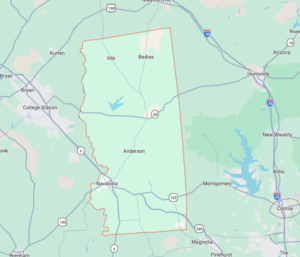
According to this tweet, the site is going to be near the Gibbons Creek Reservoir, which is between College Station and Huntsville.
SPACEX / TERAFAB: The County of Grimes, Texas, will be home to SpaceX's Multiphase, next gen, vertically integrated semiconductor manufacturing and advanced computing fabrication facility.
Estimated capital for initial phase is $55 billion. Estimated total investment of $119… https://t.co/wIsT1HwXWy pic.twitter.com/CZo8vK7B88
— S.E. Robinson, Jr. (@SERobinsonJr) May 6, 2026
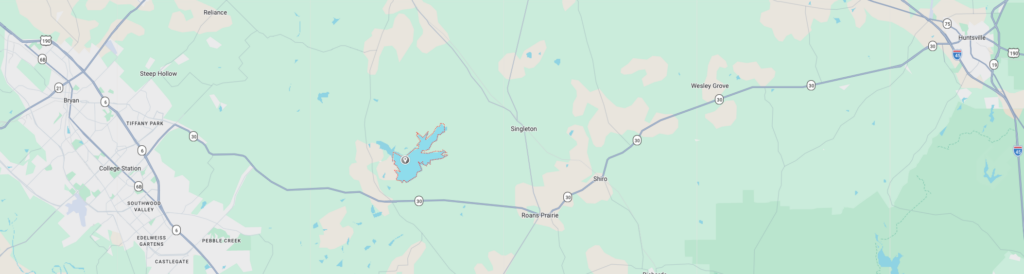
Building it in such a rural area probably means less regulatory hurdles, but building it within commuting distance of Texas A&M in College Station (and, to a lesser extent, Sam Houston State in Huntsville) is going to provide access to a technologically savvy labor pool of engineers, technicians, etc.
California’s heavy-handed Flu Manchu lockdown was the straw that finally convinced Musk to pick up stakes and move to Texas. It looks like that decision will result in Texas becoming the home for companies with market capitalizations of several trillion dollars.
Musk’s Terafab To Have Intel Inside
Thursday, April 9th, 2026After the initial report on Elon Musk’s planned Terafab project, there were a whole lot of questions about how Musk was going to get his ambitious semiconductor fab project up and running. Now a very, very big piece of the puzzle (like, 85%) has been solved: Intel is going to build it for him.
In an unexpected turn of events, Intel on Tuesday said that it had joined Elon Musk’s TeraFab project. The announcement mentions Intel’s ability to develop, produce, and package advanced processors in high volumes, which could help Tesla, SpaceX, and xAI to get enough compute performance for next-generation AI and robotics applications. However, the announcement made in an X post you can expand below does not reveal how exactly Intel will help TeraFab.
“Intel is proud to join the Terafab project with SpaceX, xAI, and Tesla to help refactor silicon fab technology,” a statement by Intel reads. “Our ability to design, fabricate, and package ultra-high-performance chips at scale will help accelerate Terafab’s aim to produce 1 TW/year of compute to power future advances in AI and robotics. It was fun hosting Elon Musk at Intel this past weekend!”
The announcement is not accompanied by any press releases or SEC filings, which raises questions about the framework of the collaboration between Intel and TeraFab, as well as any possible legal bindings. In fact, the post in X is deliberately written in a way that barely reveals any concrete details about the structure of the partnership.
Officially, TeraFab is positioned as the “most epic chip-building effort ever” that is to combine “logic, memory and advanced packaging under one roof,” which implies localized production in a massive facility. Furthermore, the company is hiring managers to build a greenfield semiconductor fabrication plant in Texas. By contrast, Intel’s wording rather implies a virtual semiconductor production ecosystem, or even a consortium that involves chip design, manufacturing, and packaging at Intel and demand from Tesla, SpaceX, and xAI. How such a consortium would differ from a typical wafer supply agreement that large companies tend to have with their suppliers is something that is unclear at this point.
It makes perfect sense for one of only three global semiconductor manufacturers (and the only American company of the three) to help Musk realize his vision. Though nobody has spelled it out, my guess is it’s going to be very similar to the way Apple funds its manufacturer ecosystem through partner build-outs: Musk is going to pay Intel to build and run the fab, and Musk’s Telsa/SpaceX/xAI consortium is going to buy the dedicated output at a given price for x number of years, after which Intel can use the fab for other projects.
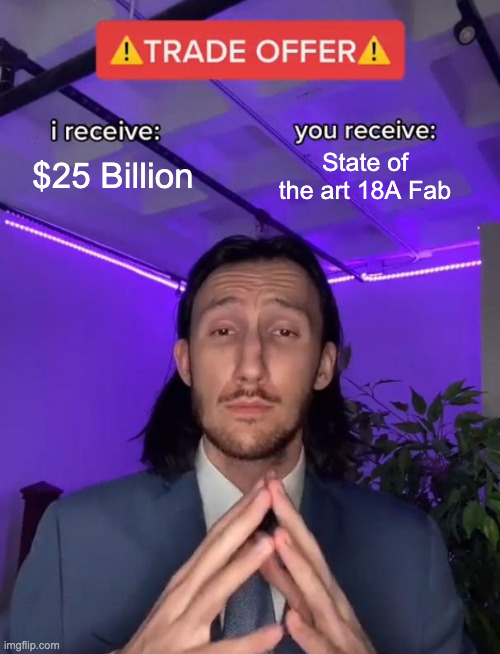
This makes a great deal of sense for both parties, especially if Intel has its 18A process dialed in. This is not a given, as Intel’s process screwups at previous nodes let TSMC and Samsung lap them in the sub-10nm race. But Intel yields at that node are reportedly rising.
And having Intel do all the heavy lifting means Musk’s new company doesn’t have to negotiate with Applied Materials, ASML, LAM, etc. Intel already has standing purchase agreements with all of them, and likely already knows what it wants and what the lead times will be to equip the new fab. Not to mention already knowing which contractors they’ll get to bid to build it.
If that’s actually what’s happening, that clears up a whole lot of questions about the project. Now, it doesn’t make Musk’s crazy “2027 volume production of 1 million wafer starts a months” any more feasible, but a fully functional Intel fab up and running at full-tilt by 2029 pumping out chips for xAI/SpaceX/Telsa is entirely feasible.
Musk’s Terafab: Half Possible, Half Pipe-Dream
Wednesday, March 25th, 2026The last few days I’ve been grappling with exactly what to say about Elon Musk’s Terafab announcement.
Elon Musk on Saturday announced that his rocket making company SpaceX and electric vehicle major Tesla will jointly run a new chip manufacturing facility in Austin, Texas, AFP reported.
The chips will be for use in artificial intelligence projects, robotics and data centres for space, with aim to produce 1 terawatt of computing power per year, it added, citing Musk. (1 terawatt = ¬1 trillion watts).
Why is Elon Musk starting his own chip manufacturing facility?
The world’s richest man said the so-called “Terafab” was necessary because Tesla and SpaceX’s demand for computing power is expected to far exceed that of global chip suppliers. While he did not disclose how much initial investment is being made, reports pegged the initial infusion between $20-25 billion, it added.
“We’re very grateful to our existing supply chain, to Samsung, TSMC, Micron, and others… but there’s a maximum rate at which they’re comfortable expanding. That rate is much less than we would like… and we need the chips, so we’re going to build the Terafab. The advanced technology fab in Austin will have the facilities to design, manufacture, test and improve each chip,” Musk said.
Other articles have made clear the the initial pilot line will be in Austin on Tesla’s Gigafab land, but that the eventual full-scale production fab may be located somewhere else.
The project aims to make chips to support 100 to 200 GW of computing power on Earth, and 1 TW in space. Musk did not share a timeline for the production or output. The AFP report noted that the billionaire has many times in the past announced timelines that his companies failed to meet, i.e. robotaxis, SDF, etc. According to Musk, the Terafab would ultimately help humanity become a “galactic civilization” capable of harnessing the resources of other planets and stars. A Bloomberg report added that Musk has said previously that the facility would produce 2 nanometer chips. It added that the Austin facility is expected to make two types of chips, one of which will be optimized for edge and inference, primarily for his vehicle, robotaxi and Optimus humanoid robots. The other will be a high-power chip, designed for space that could be used by SpaceX and xAI. Musk said he expects xAI to use the vast majority of the chips, it added. Musk also unveiled a speculative rendering of a future “mini” AI data center satellite with 100 kW power. This is part of a larger installation he wants SpaceX to build to do complex computing in space. In January, SpaceX requested a license from the Federal Communications Commission (FCC) to launch one million data center satellites into orbit around Earth. “We expect future satellites to probably go to the megawatt range,” Musk added.
Let’s skip over addressing the feasibility (or desirability) of the space half of this grand vision. Never mind that Musk has evidently been freebasing back issues of The L5 News and G. Harry Stine’s Analog columns circa 1979 to conceive his solar-powered orbital cathedrals of vast, cool machine intellects.

No, I want to focus on the task of getting a purely ground-based, cutting edge, 2nm semiconductor fab up and running. There’s nothing impossible about that part, and $25 billion is right around the current price to build a state-of-the-art fab. Other reports say:
Production targets are specific. The facility is designed to produce between 100 and 200 billion custom AI and memory chips per year, targeting an initial output of 100,000 wafer starts per month with a stated ambition to scale toward one million — roughly 70% of TSMC’s current total output, in a single US facility.
Tesla is targeting 2 nanometre process technology, the most advanced node currently in commercial production. Tesla’s fifth-generation AI chip, AI5, is among the first products Terafab is designed to produce, with small-batch production expected in 2026 and volume production projected for 2027.
And here’s where my deep skepticism kicks in, over both the output and timeline.
Having more cutting-edge fabs here in the continental United States is a great idea, and there’s nothing wrong with vertical integration for companies to combine design, fabrication and test under one roof. Indeed, Musk has merely reinvented Integrated Device Manufacturing, which used to be the norm until the foundry model took hold, and that’s still the norm with companies like Intel (though not necessarily all under one roof). And Intel, Samsung and TSMC already have their own mask manufacturing facilities in-house. So based on the little information available now, Musk’s radical new approach isn’t.
But that timeline of initial production in 2026 and volume production in 2027? Unless Musk has already placed orders for the critical semiconductor manufacturing equipment (especially however many ASML TWINSCAN EXE:5000 or TWINSCAN EXE:5200B EUV lithography systems the fab will need) long before now, that’s simply not happening. The lead time for the most critical machines are a year or more. And that’s just one machine.
There are five essential semiconductor equipment manufacturers:
If you’re building a modern, 2nm fab, chances are pretty good you need all five. You need the ASML litho machines mentioned above. You need KLA inspection tools to raise and maintain yields, and you need, at the very least, one of AMAT, LAM or TEL to provide the rest. Take away all three and you can’t equip a fab, period.
And that’s after you’ve poured the agonizingly precise, ridiculously level concrete slab for the equipment to rest on, installed huge networks of high voltage power systems (ASML machine alone now run at 1,000 watts), ultra-high purity air handling equipment and ultra-high purity de-ionized water handling systems. All that needs to be installed, up and running before you even start installing the tools. And then all the tools need to be brought up and qualified for production. And that all needs to be done before tape-out, mask production and the first wafer is run.
But the timeline isn’t the only thing that’s delusional about Musk’s announcement.
Terafab is designed for an initial output of 100,000 wafer starts per month, with ambitions to scale to 1 million wafer starts per month at full capacity. For context, that full-scale target would represent roughly 70% of TSMC’s entire current global output — from a single facility operated by companies that have never fabricated a chip.
Musk said the facility would produce between 100 and 200 billion custom AI and memory chips per year, powering Tesla’s “Full Self-Driving” software, the Cybercab robotaxi program, and the Optimus humanoid robot line. He also said millions of Optimus robots would help build and operate the facility.
Put aside the swarms of robots for now. A lot of what can be automated for a fab already has been with automated FOUP-handling equipment. What hasn’t been automated is routine maintenance, troubleshooting, etc. I’m guessing it will be quite a while before Frankie Fabbot is ready to take on any of those tasks.
100,000 wafer starts a month is around what TSMC’s cutting edge fabs produce a month. Samsung has a huge fab supposedly capable of 450,000 wafer starts a month. A million starts a month in one extremely big fab is possible, but it’s going to take multiple lines, lots of money, and throughput will still be gated by the lowest capacity machines on the line (again, I’m guessing the ASML litho machine). Modern fabs have already maxed out production speeds for modern high-yield plants. You can’t simple pull a lever to make the line go faster.
Then there are his plans to build memory chips and space-hardened versions of the xAI chips in the same megafab. Neither of those goals is impossible, but it’s going to require more equipment than his $25 billion estimate to essentially run three production lines in the same building. And preparing chips to operate in space generally involves completely different “rad-hard” processes, involving different types of wafer chemistry, that are nowhere near the 2nm process node.
Musk is a smart guy. I bet he can eek a few performance gains out of how his fabs are organized, AI line optimization, etc. But unless he’s smarter than Einstein, Thomas Edison, Tony Stark and Reed Richards combined, I’m hard-pressed to see how he can optimize more than, say, 15% over existing cutting edge fabs.
Nothing Musk has proposed for the earth-bound side of Terafab is impossible, but it is all-but-impossible to implement in the time-frames he’s alleging, for the money he’s claiming. One million wafer starts a month in a single fab? Doable, but not by 2027, and not for $25 billion. Having such a fab up and running full tilt in 2029-2030, for $100 billion, seems at least at the edge of feasibility. Whether the AI boom will still be a “thing” by then is unknown, but a fab actually capable of one million wafer starts a month (robots or no robots) is still a license to print money…