Archive for the ‘Foreign Policy’ Category

Is China Screwed? (Part 2)

Tuesday, April 19th, 2022

There more you start poking around online, the more you turn up reasons why China is screwed.

The first installment in this series was popular. Well, there’s a lot more reasons why China is screwed.

It’s screwed all the way down.

First up: Demographics:

Takeaways:

  • Remember all that talk of an “Asian Century?” Yeah, not so much.
  • “China will soon run out of people.”
  • China’s population pyramid is about to shift from a huge bulge of people in their prime earning years to one where that bulge is disproportionately elderly.
  • “Everything that made China what it is today has relied on a large, young, and productive workforce. Now, that workforce is about to succumb to biology just as every other generation has in every other country, ever.” Their demographic dividend is running out.
  • “China’s working-age cohort grew from 58% of the country in 1978 to 74% in 2010. But in less than twenty years, the UN predicts that number will be roughly back where it was in ‘78. By then, China will have twice as many seniors as children under 15.”
  • “Per capita wealth remains low, on the level of Mexico, the Maldives, and Kazakhstan. That means this mass of retirees won’t just contribute less to the economy, but will also require immense financial support — the kind China’s fractured pension and healthcare system isn’t remotely prepared for.”
  • “Unfortunately for China, the One-Child Policy has set the cultural expectation firmly at one.”
  • Replacement fertility: 2.1 children per woman. China’s official fertility rate: 1.6. “Yi Fuxian, a scientist at the University of Wisconsin-Madison [estimates] the true number at 1.18.”
  • “China’s preference for male babies means that between 2020 and 2060, there will be roughly 3 single men for every 2 single women.”
  • “China’s 2020 Census, [tallied] 14.65 million births the previous year — the lowest level since 1961.”
  • Japan, which is also aging, provides a best case scenario. “With a median age of 48.6, Japan is the 2nd oldest place on earth. Today, its share of the world’s manufacturing exports has fallen from 12.5% to just 5.2. Japan did not fade into global irrelevance. It’s still a great power. But it never fulfilled what once seemed certain: its rise to rival the U.S. as a superpower. And it never will.”
  • That’s part 1. Part 2 focuses on China’s out of control property market:

  • It starts off talking about the ghost cities, especially Ordos.
  • “Ordos does have an interesting story to tell. Just, not the one you might expect. The missing context, at the time, was far stranger than what the unimaginative pessimists concocted: Nearly all of these half-finished homes have owners — the vast majority of which have no intention of ever moving in.”
  • “All over China are millions of empty, some unfinished, but almost universally sold homes — not just in far-flung corners but also in Beijing, Shanghai, and Shenzhen. Over one-fifth of all urban homes — 65 million in all — sit vacant.”
  • Skipping over description of basic CIGNx = GDP economics.
  • China relied on “a surplus of cheap labor, which means, by definition, wages are low. You can only compete with the entire rest of the world for so long — and neither do you want to. Low-value manufacturing has long since moved South, to places like Vietnam, Laos, and Bangladesh.”
  • All the long-hanging fruits of infrastructure spending have already been built.
  • “Individually, Chinese consumers really don’t spend very much — just 32% of GDP — less than half that of the US, and far below countries like Japan and Germany. Worse, this number has actually been decreasing over time.”
  • “Chinese consumers are spending, but only on one thing, something not considered ‘consumption’: houses!”
  • China’s home ownership rate “is among the highest in the world — 90% — to much of the developed world’s mid-60s. It gets much weirder, still. If you can believe it, the majority of recent purchases have been 2nd and 3rd homes. In 2018, for instance, 87% of new home buyers already owned at least one.”
  • “Because the government tightly controls how much cash is allowed to leave the country, Chinese people simply don’t have a lot of options, and of them, housing is seen as the only sure thing.”
  • Also, given the sex imbalance mentioned above, for men, home ownership = marriage.
  • “For all of these reasons, prices have risen to extreme levels. In Shenzhen, Beijing, and Shanghai, it takes 40 years of the average income to afford a home.”
  • Most are bought before construction even begins.
  • And here’s where the demographics above provide a double whammy. “The majority of homebuyers, meanwhile, are aged between 20-50 — precisely the segment China will soon lose.”
  • One huge reason for the bubble: Local governments using their control of land to balance their budgets:

    They created what are basically state-owned shell companies called “Local Government Financing Vehicles”. They gave these LGFVs free valuable land, which they then used to take out loans that local governments themselves couldn’t. The trick is that because their debt is hidden, local governments appear far healthier than they really are, while at the same time, meeting the quotas set by Beijing. Following the 2008 crisis, LGFVs transformed from a little quirk of its financial system to the backbone of local economies. If these ‘financing vehicles’ default on their loans, or if housing prices fall too steeply, local governments now have just as much to lose as homeowners. If a local government stops taking out loans, it instantly loses over a third of its revenue, causing a different kind of doomsday. So while the central government may direct local officials to control their debt, the best they can really do is feign cooperation.

  • Flu Manchu only temporarily halted home price rises, and they’re still soaring.
  • “Solutions are far too costly to assume their implementation.”
  • There are a lot more videos of China suckage, but I’ll have to split this up and get to those another time.

    LinkSwarm for April 15, 2022

    Friday, April 15th, 2022

    Greetings, and welcome to a smallish LinkSwarm! My taxes are done, but I’m playing catchup on just about everything else.

  • The Biden Administration is all-in on grooming and mutilating children.

    While testifying before the House Budget Committee yesterday, Health and Human Services (HHS) secretary Xavier Becerra affirmed that yes, his department was in favor of taxpayer-funded sex-reassignment surgeries for minors. “So for the record, you favor HHS funding . . . for sex-reassignment surgeries for minors?” Lauren Boebert, (R, Colo.) asked. Becerra answered:

    I will do everything I can to defend any American, including children, whether or not they fit the categories you have mentioned or not. And if they talk about gender-affirming care, I am there to protect the rights of any American.

    In other words: yes.

  • Related:

  • “Black Lives Matter Secretly Bought a $6 Million House.” I’m shocked, shocked that people who encouraged riots to help out Democrats are corrupt. (Hat tip: Stephen Green at Instapundit.)
  • Biden: Surely Democrats everywhere will embrace my scaled-back Build Back Better bag of bloated bilge! Kyrsten Sinema: “LOL! Get rekt!
  • “Brian A. Benjamin, the lieutenant governor of the state of New York, has been indicted on federal bribery charges.”
  • Is Sri Lanka facing starvation?
  • Democrats on Twitter: “We’re totally going to defeat Ron DeSantis!” Deantis: [Raises $100 million for reelection.]
  • Neither snow no rain, nor gloom of night, shall stay these couriers from the swift completion of their appointed rounds. But multiple assaults? Yeah, they’re drawing the line there. So no more mail for a block of Santa Monica, California, until they fix the problem. This is your mail on one-party Democratic control.
  • Get A Rope Part 1: “Hospital Refuses Father-To-Son Kidney Transplant Over COVID Jab.”
  • Get A Rope Part 2: Two puppies stolen at gunpoint in D.C.. Actually, never mind. Hangin’s too good for ’em…
  • Ken Paxton has a 30 point lead over George P. Bush in the Texas Attorney General runoff.
  • News of Our Media Elites: “WNYC’s Jami Floyd accused of plagiarism in 45 articles dating back to 2010.” Also: “Floyd, 57, was the director of New York Public Radio’s Race & Justice Unit.” What are the odds? (Hat tip: Dwight.)
  • Speaking of media elite follies, CNN+ is sucking the farts out of dead cats.

    In theory, at least, the role of an organization such as McKinsey is to ask, “Why?” Everyone wants to start a streaming service. Why does yours make sense? If CNN were run by thoughtful people, it might have taken the opportunity to ask some fundamental questions of itself before procuring a new toy: “Who are we?” “What do we do?” “Are we good at it?” “Why do our staff keep getting themselves embroiled in scandals?” “Has anyone heard Brianna Keilar utter a single sentence that might be termed useful?”

    Had these questions been asked, it might have dawned on CNN’s leaders that the way in which Brian Stelter sees the network is not, in fact, the way in which anyone else sees the network. Had these questions been asked, it might have become apparent to CNN’s leaders that Americans do not regard CNN and its staff as brave, diligent, indispensable firefighters, that consumers do not believe Jim Acosta to be a hero, and that, when people think about America’s turbulent democracy, the last person who comes to their minds as a fix is Jim Sciutto. Had these questions been asked, CNN’s leaders might have learned that the network’s obsession with Fox is annoying to viewers, and that launching CNN+ with a flagship documentary, The Murdochs: Empire of Influence, would probably send the wrong message. As for the network’s slogan: “The Most Trusted Name in News”? One might as soon call Chris Cuomo a wit.

    Thus, the entirely predictable disaster that is unfurling before our eyes. And, thus, CNN’s bafflement that it has become a joke. And what a joke! 10,000 people a day? That’s the size of the home crowd at a Durham Bulls minor-league-baseball game. It’s the number of people who attend “MerPalooza,” a “celebration of mermaids and mermen,” or the international UFO convention and film festival, or BronyCon.

    I think this comparison is unfair to BronyCon, which has historically attracted a much lower percentage of sex offenders than CNN…

  • Is Highland Park, Michigan, the worst city in America?
  • There are numerous local corruption stories involving payoffs, but few that involve a police chief’s Earth, Wind, and Fire cover band. Take a bow, newly convicted felon Tim Vasquez!
  • “Liberals Outraged To Learn 10% Of Twitter Now Owned By African-American.”
  • “Not To Be Outdone, Bill Gates Buys 9.2% Of MySpace.”
  • Friend-of-the-blog Michael Sumbera gets gets a profile of his store, Classical Music of Spring, which I encourage you to patronize.
  • Speaking of music:

    OK, not really…

  • Is China Screwed?

    Thursday, April 14th, 2022

    Here are two videos where Peter Zeihan argues that China is screwed for many reasons, not least of which is demographics.

    Takeaways:

  • One child per couple means that China is “the fastest aging society in human history, with the largest sex imbalance in human history.”
  • “They’ve run out of people of childbearing age.”
  • They were going shrink in half by 2100. “Then they realized that they had been overcounting people for some time.” Then new data moved the date moved up to 2070. And now they’re saying it will be 2050. “For that to be true, the Chinese would have overcounted the population by 100 million.” And all of those missing people are of childbearing age.
  • Their population actually peaked 15 years ago.
  • “We’ve seen a 12-fold increase in Chinese labor costs since 1991.”
  • “China isn’t getting rich, it’s getting old.” They’re facing demographic collapse within a decade.
  • Xi’s instituted a cult of personality, and silenced anyone capable of independent thought. “He knows that the country’s current economic model has failed. And he knows he can’t guarantee economic growth, and he knows he can’t keep the lights on, and he knows he can’t win a war with the Americans.”
  • Xi’s solution? “Naked, blatant, ultra nationalism. Ethnocentric ultranationalism of the Nazi style.”
  • At the top, they don’t care about keeping the lights on. “A third of the country is facing power rationing.”
  • “These are the sorts of things that you do if you know that the bottom’s falling out and there’s nothing you can do about it, and you have to shift the conversation to remain in power.”
  • “In China, money is a political good. It exists to serve the needs of the CCP.”
  • “All of the economic growth we have seen in China since 2006 is because of debt.”
  • Corporate debt is 350% of GDP, “making China the most indebted country in human history in both absolute and relative terms.” Every country that’s come within half of this has collapsed under the debt load.
  • I’m omitting discussion of how China is screwed on semiconductors (covered enough here), and also the possibility of invading Taiwan (this video was released late last year, before Russia invaded Ukraine).
  • “The Biden administration in bits and pieces is redefining strategic ambiguity, and it’s not clear to me what the endgame is here.” Well, there’s a whole lot that isn’t clear about the Biden Administration…
  • Zeihan thinks Biden might recognize Taiwan for a foreign policy win. Zeihan also thinks that both China and Russia are so weak we can wait them out. (Remember: Pre-Ukraine invasion.)
  • Zeihan dismissive of both Obama and Trump foreign policy.
  • “Joe Biden has been on the wrong side and the right side of every foreign policy decision the U.S. has made in the last 45 years, because he doesn’t have any core beliefs he tacks with the wind.”
  • Now let’s forward to March 24, where Russia’s colossal failure in Ukraine has actually made China even more screwed.

    Takeaways:

  • The biggest damage that we are seeing from the Ukraine war (outside of Ukraine, obviously) is in China. Because in one month the Russians have pulled back the blinders on what has been a 50-year strategic program, the idea that China can come to global power with American sponsorship, with American indifference, that it can take Taiwan, that it can intimidate Japan, that they can dominate all of east Asia and yet not suffer economically at all. It was always ridiculous, but now it’s been shown to just be absolutely stupid.

  • No one can escape the power of global markets because of trade.
  • “The yuan is only traded internally because it’s the most manipulated currency in history. The euro confiscates bank deposits to pay for bailouts.”
  • Russia is the world’s second largest oil exporter, and it can’t export more to China because the pipes that go east don’t interconnect with the ones that go west. “The rail lines are already beyond capacity.”
  • In the west: “One way or another, those pipes aren’t surviving this year.” (Not sure that’s correct, but I’ve long thought that we should be seeing more structure hits inside Russia than we’ve seen thus far.)
  • “The stuff that goes to the Black Sea is in a war zone, so insurance companies will not give the indemnification that is necessary for vessels to operate in that area. So the only way a ship can go and dock it overseas right now is if a country gives its sovereign indemnification and takes all the risk.”
  • Primorsk, on the Baltic, is open. However: “Ship captains for the most part are refusing to go, and European dock workers are refusing to unload the cargo when it arrives. So that is still in use but not nearly as much, maybe a quarter of what it used to be before the war started.”
  • To get more oil to China: “You would have to build a fundamentally new infrastructure from the fields in northwest Siberia to Chinese population centers that is greater than the distance from Miami to Anchorage, most of which is through virgin territory that is very rugged. That’s a 10-year program minimum even with the Chinese building it.”
  • “We’re looking at the single largest removal of crude from the market ever, and in proportional terms it’s going to have a shock somewhat similar to World War II.”
  • We have insurance companies not doing it, shipping companies not doing it, dock workers not doing it and now Halliburton, Baker Hughes and Schlumberger have pulled out, and they do the technical work that makes a lot of this possible. All the super majors are gone, and we even have a couple of major projects out in Sakhalin that are probably just going to die because the Russians can’t make those projects work by themselves. Most of the oil and gas out of that goes to China, so we’re actually looking at an environment where the Chinese see reduced flows rather than increased, as Russia is just melon-scooped out of the market.

  • When the Russians fell under sanctions, everything that the Chinese thought was true about their future was laid bare as, at best, wishful thinking and bad analysis. So they are now looking east to the United States and west to the Russians in a little bit of a panic, because they are being tied indirectly to what’s going on in Ukraine. And they have now found out not only does the west’s and specifically the United States’ financial tools work very well, they now know they would work much better against China than against Russia, because at its core Russia is a commodities exporter, most notably oil, natural gas and food. China imports all those things, so if an equivalent sanctions regime was done against the Chinese, you’d have 500 million dead Chinese in less than a year from starvation.

    Here I think he overstates the case, as there are a lot of emergency avenues a communist government could pursue to stave off starvation. Like invading Mongolia and turning it into emergency farmland. Which is not to so they wouldn’t have some starvation, especially in worse-case scenarios…

  • “The Chinese have always seen themselves as anti-American [well, the commies, anyway -LP], they’ve always seen themselves as anti-Western, anti-democracy and now they’re realizing that the mood of the man in the White House determines whether their country exists.”
  • As tight as the sanctions are, as big as they’re getting, they’re nothing compared to the corporate boycotts. Almost every single company that left Russia was under no legal requirement to do so, they just didn’t want to be associated with the war. And we’re talking about those ESG, social goody two-shoes mammoth companies like Exxon and Halliburton, who are now gone, and everyone else followed. So if that happened to China, you know that’s all of their investment that matters. That’s all of their technology transfers, that’s all of their end markets. This system, if it turned against China, would be far more damning than anything we’ve seen out of Russia so far.

  • I think Zeihan overstates the case a bit, and probably immanizes the timeline of crisis more than warranted, but the demographic and economic challenges China faces are very real.

    Also keep in mind that no one in 1988 expected the Soviet Union to collapse as quickly as it did, either…

    I See Hungary, I See France

    Tuesday, April 12th, 2022

    Let’s clear some tabs on recent European elections of note. First up: Hungary reelects Viktor Orban.

    Viktor Orbán, who has served as prime minister of Hungary since 2010 — and spent a stint in the same office from 1998-2002 — won yet again in Sunday’s much-anticipated elections. His party, Fidesz, won two-thirds of the seats in parliament. Fidesz’s closest competitor was United for Hungary, an amalgamation of parties which included socialists, greens, and Jobbik, which was recognized as an antisemitic, neo-Nazi outfit until recently. Now, it presents itself as a moderate, “modern,” alternative to Fidesz.

    Orbán’s triumph, we are meant to believe, represents a near-fatal blow to Hungarian democracy, and a painful one to the capital L, capital W, capital O, Liberal World Order.

    Snip.

    Now, Orbán is no saint, and yes, that is an understatement. He enjoys close relationships with both Vladimir Putin’s Russia (although he has denounced the invasion of Ukraine) and Xi Jinping’s China. As Jimmy Quinn detailed here, Orbán has helped China carry out its post-pandemic propaganda program, and pursued deeper financial ties between his country and the genocidal one to the east. This is not the behavior of a man keen on being what Rod Dreher calls “the leader of the West now — the West that still remembers what the West is.”

    Moreover, Orbán’s domestic behavior can fairly be called authoritarian. He has championed what he calls “illiberal democracy,” and enacted reforms to the country’s judicial system that undermine its independence. Evidence points to significant financial corruption on his watch as well.

    But the failure of many of Orbán’s critics to accurately report on his regime points to the weakness of many of their arguments. Take this piece from The Atlantic, which, as National Review alum Daniel Foster notes, doesn’t exactly describe Orbán as an autocrat. Its author argues that the formation of a private, pro-Orbán media conglomerate that receives government funding is damning evidence of the corrosion of democracy in the country at the hands of its leader. That’s not exactly convincing to those of us who have watched NPR hold a pillow to the face of the Hunter Biden-laptop story and erroneously smear Supreme Court justices.

    Orbán is not a U.S.-style conservative fusionist or anything especially close to it, and that’s a bad thing, in this writer’s opinion. But he is, quite obviously, the kind of conservative who appeals to Hungarians, and despite his many warts, that might just be okay. People in other countries are allowed to hold different opinions on LGBT issues, European integration, etc. than your average undergrad at Middlebury. Indeed, the implementation of those policies at the public’s will represents democracy in action, not its antithesis.

    Orbán, the prime minister of a nation with a population only slightly larger than New York City’s and something approximating a friend of the Chinese Communist Party, is no more the savior of Western Civilization than Joe Biden is. But he’s also no threat to self-government across the world, and his critics’ flubbing of basic terms they proclaim to love leaves the rest of us wondering if they even know what it is that they value.

    Orban’s victory has generated much consternation among the Euroelite:

    Viktor Orbán and his brand of conservatism faced a crucial popularity test in Sunday’s general elections, a test he passed with flying colors. The Hungarian premier and his Fidesz party thumped the opposition’s unity coalition—composed of liberals, greens, Communists, and the neo-Nazi Jobbik—by a humiliating margin of nearly 20 points; opposition leader Péter Márki-Zay was defeated even in his own district.

    Orbán also struck a painful blow against his critics in Brussels. Ever since he returned to power in Budapest in 2010, and especially in recent years, Orbán has played lightning rod for seemingly the entire EU establishment, even as he has galvanized populist and national-conservative forces on the Continent. Reviled, denounced, sanctioned, and banished from the European Parliament’s center-right bloc, he has gone from internal critic of Brussels to an outright dissident.

    In this, Orbán hasn’t been alone. For the past five years, the European Union has also locked horns with the national-conservative Law and Justice party, or PiS, in neighboring Poland. Both countries allegedly fail to uphold “rule of law,” as defined by Brussels. The European Commission charges Hungary and Poland with threatening media freedom and judicial independence, with not doing enough to tackle (or actively engaging in) systemic corruption, and with violating LGBT and minority rights—charges denied by political leaders in Budapest and Warsaw.

    Some paragraphs on Hungary’s largely neutral stance on the Russo-Ukrainian War snipped.

    Still, once the Russo-Ukrainian dust settles, it is likely that the older dynamic—Budapest and Warsaw together in the anti-EU trenches—will resume. PiS might have won some temporary favor with Western hawks by toeing a hawkish line on Russia, but the underlying tensions haven’t eased. Indeed, the issue that has received the most attention in recent years is the Polish government’s decision to establish, in 2017, a new judicial disciplinary body, composed of jurists appointed by the lower house of Parliament, to hear complaints against judges facing misconduct allegations. European officials claim, not entirely without reason, that this exposes the Polish judges to political control.

    This clash is often framed by both camps in stark culture-war terms. “Pro-European” liberals and EU officials themselves present it as a conflict between the liberal-democratic values of the union and the illiberal and undemocratic practices of the two countries’ nationalist governments. Partisans of Hungary and Poland, meanwhile, frame the contest as one between two traditional and religious nations and an imperialistic Brussels bent on pushing a left-wing, globalist, and anti-Christian agenda.

    Things are a little more complex. For starters, the crimes Hungary and Poland are accused of aren’t unique to those two countries, not by EU standards, at least. The high courts of EU states, where they exist, are all highly politicized, which usually means they hardly ever dare challenge the wisdom of EU legislation.

    As for corruption, it’s notoriously hard to measure. To the extent that some institutions try to gauge it, on the basis of people’s perception of the levels of corruption in their country, Poland’s and Hungary’s governments come out as significantly less corrupt than those of other Eastern nations, such as Romania, Slovakia, Slovenia, and Bulgaria; they also come out better than governments in Spain, Portugal, and Italy.

    Paragraphs on press freedom and “LGBT” issues snipped.

    In light of all of the above, the real question isn’t whether what’s happening in these two countries is indeed worrying, or whether an a-democratic, supranational body like the European Union has any right to lecture the governments of two democratic member states and the people who elected them. The more interesting question is why Brussels has singled out Hungary and Poland for problems common to the bloc as a whole.

    The answer has relatively little to do with the charges brought against the two countries, though of course they play a role. In the eyes of the European gatekeepers, the pair has committed a much more heinous crime: Hungary and Poland have openly challenged the authority and legitimacy of the European Union itself. More specifically, they have dared to reject what is arguably the most important article of faith of EU doctrine: the primacy of EU law over national law.

    Thus, when Brussels claimed that Poland’s judicial disciplinary body, created in 2017, violated EU law and should be revoked “in accordance with the principle of the primacy of EU law,” the Polish government refused to comply, contending that the demand represented an unacceptable infringement on the country’s national sovereignty. In an attempt to resolve the dispute, Polish premier Mateusz Morawiecki asked the Polish Constitutional Tribunal in Warsaw this question: If push came to shove, and EU law were ever to clash with the Polish constitution, which should prevail?

    The tribunal delivered its verdict in 2021: It voted 12 to 2 for the national constitution, holding that “the attempt by the [European Court of Justice] to involve itself with Polish legal mechanisms violates … the rules that give priority to the [Polish] constitution and rules that respect sovereignty amid the process of European integration.”

    The Polish tribunal, in other words, insisted that national law enjoys primacy over EU law—a principle without which “the Republic of Poland cannot function as a democratic and sovereign state.” More than that, the tribunal accused the European Union and the ECJ of violating EU treaties themselves by claiming otherwise. Quite the bombshell.

    Suffice to say, EU officials and pro-EU elites didn’t take it well. Luxembourg’s foreign minister, Jean Asselborn, claimed that the tribunal’s ruling put the very existence of the European Union in jeopardy. “The primacy of European law is essential for the integration of Europe and living together in Europe”, he said. “If this principle is broken, Europe as we know it, as it has been built with the Rome treaties, will cease to exist.”

    To understand why the ruling represents such an existential threat to the EU, one must comprehend the fundamental role of EU law in the bloc’s superstate-building project. Legal scholars have contested the supposed primacy of EU law for half a century. In practice, however, national courts and governments, which tend to have an engrained pro-EU bias, have hardly ever contested the primacy principle. This has allowed the ever-expanding body of EU legislation, the so-called acquis communautaire, to become the main engine for so-called integration by law—the hollowing out from above and within of national constitutional and legal systems.

    EU legal primacy has also bestowed huge powers upon the ECJ: Despite lacking the democratic legitimacy and accountability of national courts, the European court, by constantly creating new “laws” through its rulings, almost always in favor of “more Europe,” has effectively become the bloc’s most important legislative and, indeed, constitution-writing body. Alec Stone Sweet, an international-law expert, has termed this a “juridical coup d’état.”

    By going against this principle—and by asserting the primacy of national sovereignty over EU law—Hungary and Poland have thus dealt a potentially deadly blow to one of the bloc’s main empire-building tools. This is ultimately what the two countries are being punished for. And to do so, the European Union is resorting to the most powerful tool at its disposal: money. Last year, in a move clearly aimed at Hungary and Poland, Brussels adopted for the first time ever a Rule of Law Conditionality Regulation, which allows the European Commission to withhold the payment of EU funds to member states that are found to be in breach of the rule of law—as defined by the EU/ECJ itself, of course.

    The commission has already used the new rule to refuse to approve the Next Generation EU Covid-19 recovery funds for the two countries—€7 billion for Hungary and €36 billion for Poland. And more funds may be withheld in the future. Budapest and Warsaw challenged the new rule at the ECJ, which predictably dismissed the two governments’ complaints.

    Thou Shalt Have No Other Gods Before The EU.

    How this will pan out remains to be seen. The European Union isn’t new to this kind of blackmail. The European Central Bank has repeatedly choked member states, to bring recalcitrant eurozone governments to heel or even to force regime change (the removal of Silvio Berlusconi in 2011, the shutdown of Greece’s banks in 2015). EU leaders seek a similar coup in Hungary and Poland. Only, Hungary and Poland aren’t in the eurozone; they control their own currencies. The money the pair receives from the European Union is significant, but it isn’t a lifeblood: Between 2010 and 2016, annual net transfers from Brussels—the difference between the total expenditure received and contributions to the EU budget—amounted to 2.7 percent of GDP in Poland and 4 percent in Hungary. This puts the two countries in a very different position than, say, Greece.

    Meanwhile, over in France, incumbent Emmanuel Marcon and right-wing challenger Marine Le Pen head to a runoff. (Naturally, French antifa reacted to Le Pen making the runoff by rioting. If you’re a moron and all you have is a hammer…)

    Remember how self-described “Bonapartist” Eric Zemmour was supposed to be the new hotness? Yeah, he finished a distant fourth. Le Monde describes his failure thus:

    Eric Zemmour gathered 7.07% of the votes cast in the first round of the presidential election on April 10, according to official results. This defeat can probably be explained by several factors, which the far-right candidate saw creeping up on him over the past few weeks, leading him to seek supporters in all segments of the electorate.

    Eric Zemmour failed to unite “the patriotic bourgeoisie,” apart from some who voted for François Fillon in 2017 and the Catholics in the “Manif Pour Tous” organization [a group opposing same-sex marriage] and “the working classes,” who have remained for the most part loyal to Marine Le Pen (23.15% of the vote). His Reconquête ! party was already showing these weaknesses: Eric Zemmour has in fact built a new Rassemblement National (RN) party to the right of the RN, where support from Les Républicains (LR) is rare. The only people to join him from the traditional right-wing party Les Républicains are the obscure senator Sébastien Meurant, an unknown former MP, Nicolas Dhuicq, and Guillaume Peltier, the former number two of LR, who is known for switching parties a lot (he is a former member of the Front National, of Bruno Mégret’s Mouvement National Républicain (MNR), of Philippe de Villiers’ Mouvement pour le France (MPF), and also of the UMP).

    Yeah, for the most part I don’t know who those people and parties are either.

    Eric Zemmour had reason to believe in victory: With barely 7% of intended votes in September 2021, he rose to 17% and 18% in polls in mid-October, before plunging down the rankings. He has obviously succeeded in forcing his campaign issues to the forefront, including on the traditional right, building a movement from scratch that now gathers more than 100,000 supporters who are extremely active on social media and drawing crowds to rallies like no other candidate.

    “Extremely active on social media.” That should be a big ole red flag. Twitter is not the territory.

    But the excitement that he generates among his supporters has not translated into votes. “I believe that the momentum is on my side,” he repeated on April 6 on France Inter public radio. “All the objective elements: the full rooms, the excitement, the television ratings, the number of supporters; all of that is me.” His sycophants around him have greatly elevated the hubris of a man who had no shortage of it, and who didn’t mind becoming a kind of a guru whose mere presence electrified the crowds.

    Snip.

    In the end, it is the war in Ukraine that led the candidate to plummet in the polls. Due in part to his admiration for Vladimir Putin (“I dream of a French Putin,” he had said in 2018), his inability to call him a “war criminal,” and finally his reluctance to welcome Ukrainian refugees – unlike Marine Le Pen.

    Yeah, I’m not sure how much that had to do with it, since Le Pen is hardly tough on Putin herself.

    Is Le Pen a nasty piece of work? Well, she’s certainly not my cup of tea, and I doubt she has a translated copy of The Federalist Papers on her bookshelf. (Though thankfully, she seems to have abandoned her father’s antisemitism.) Macron is arguably more “free market,” though that phrase has very little meaning in the matrix of current French politics. Yellow Vest voters seem to favor Le Pen, and she wants to lower VAT taxes. She opposes Flu Manchu passports. She’s still a Euroskeptic, wants to reform the European Commission, wants a referendum on immigration restriction, and opposes jihad. She wants to abolish the International Monetary Fund. She’s a Russo-phile who wants to remove France from NATO. Like Orban, she would be a big thorn in the side of the EU. Unlike Ortban, she would also be a big thorn in the side of the US as well.

    Damned if you do and damned if you don’t.

    Those in the chattering classes proclaiming Orban a grave threat to democracy are wrong. Those proclaiming Le Pen a threat to democracy (and American interests) are slightly less wrong, but Le Pen is less a long-term threat to democracy than the EU’s own transnational globalist elite. NATO survived over 40 years of France’s withdrawal from NATO’s command structure under de Gualle, and (to the extent the alliance is relevant to the 21st century) could survive France’s withdrawal once again.

    As National Review once said of Jean Le Pen, “we have no frog in this fight.”
    Russia Reorients

    Friday, April 8th, 2022

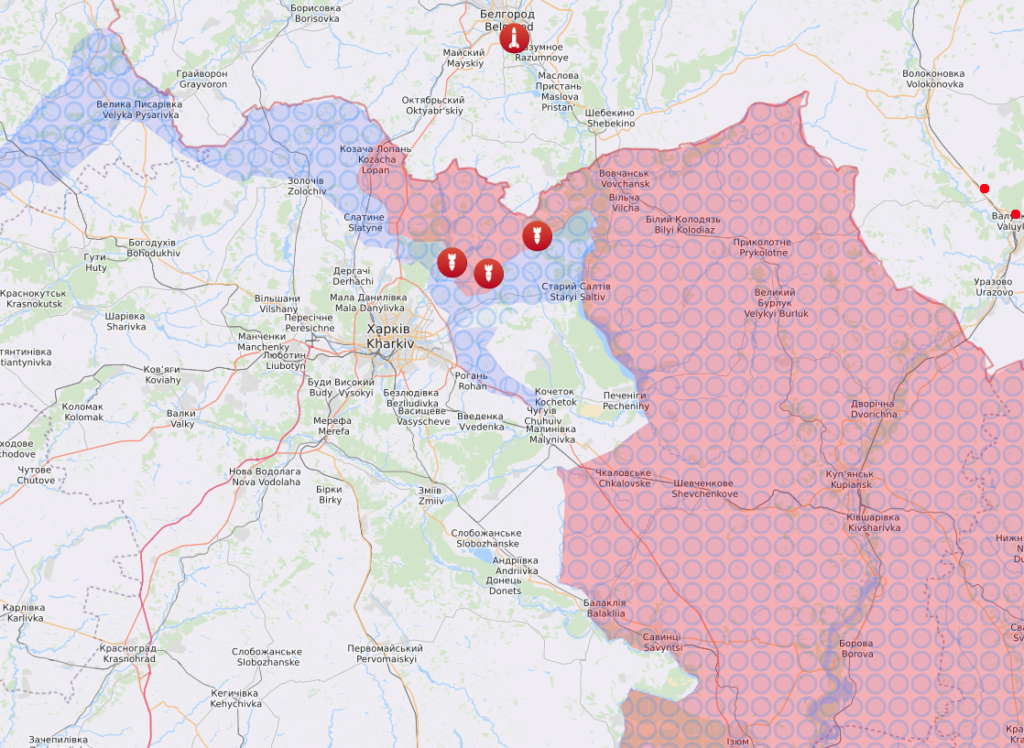
    Just because Russia is obviously retreating from Kiev due to getting mauled doesn’t mean there isn’t some truth in the argument that their biggest aims lie in eastern Ukraine. This video suggest three main remaining goals for Russian forces:

  • Restore and control the flow of water to Crimea (Ukraine dammed up the Dinappa river following the seizure of Crimea, which has put them in a world of hurt).
  • Gain control of “the Yokosuka Gas Field, which was discovered in 2010 and it has about 42 trillion cubic feet of natural gas, that could threaten Russia’s oil dominance in the region.”
  • Controlling all Ukraine’s Black Sea ports.
  • More details on each in the video.

    If they can achieve those goals, if Russia can achieve capturing those three goals they will have landlocked and absolutely wrecked Ukraine’s entire economy. So when they say that the main war is in the east, they’re actually, on some level, telling the truth. The problem for Russia, though, is that without having captured Kiev their chances of holding on to those objectives is greatly reduced.

    (Between getting my house cleaned, relatives visiting (Yes, those two are related), and tax season, no time to put up a LinkSwarm today. Tomorrow is not looking good either…)

    Know Who’s Bummed About Russia’s Military Failure In Ukraine? China

    Wednesday, April 6th, 2022

    A goodly part of the world is pleased about the manifest failure of Vlad’s Big Ukraine Adventure, some are indifferent to it, but only Russia, client-state Syria, and puppet-state Belarus really seem upset about it.

    Know who else is bummed? China.

    Operation Desert Storm was a turning point in modern Chinese military history. As military planners with the People’s Liberation Army watched U.S. and allied forces make short work of the world’s fourth-largest military (on paper), equipped with many of the same systems as the PLA, it became obvious that China’s quantitatively superior but qualitatively lacking massed infantry would stand no chance against the combination of modern weaponry, C4ISR, and joint operations seen in Iraq. The result was new military concepts and over two decades of often-difficult reforms, which produced the modern, far more capable, “informationized” PLA of today.

    Today, the PLA is no doubt closely observing its Russian contemporaries in Ukraine as they under-perform in multiple areas, from failing to take key targets or claim air supremacy to running low on fuel and supplies and possibly experiencing morale collapse, and surely taking away lessons that will shape its own future. Of note, Russia’s experience appears to have confirmed many of China’s recent assumptions behind its investments, such as the utility of unmanned aerial systems in high-intensity conflict, as well as the necessity for the PLA’s 2015 reforms, which aim to fix many of the issues driving Russian failure that the PLA recognizes in itself.

    Of the many issues that have contributed to Russia’s physical battlefield woes in Ukraine, one of the most important has been the lack of effective joint or combined arms operations, widely considered essential to any effective modern fighting force. Russia’s poor level of coordination between its various services and branches can only be generously described as incompetent. For example, it has repeatedly failed to provide effective air support to its ground forces or deconflict its air and air-defense forces to avoid friendly fire.

    The PLA has long had its own serious issues with joint operations. Traditionally dominated by the Army, the PLA had little success developing a truly joint force until a series of sweeping reforms in 2015 that replaced the former Army-dominated system with a series of joint theater commands. The PLA is thus aware of its own shortcomings and taking steps to fix it, but likely remains far off from being able to conduct truly effective, seamless joint operations. Efforts to conduct joint exercises are becoming more common, but most senior PLA leaders are still relatively inexperienced with joint operations, and even new officers typically do not receive joint education below the corps level. Further, it remains to be seen how far these reforms will go or to what extent they will “stick;” indeed, one reason the PLA did not attempt these reforms until 2015 was because of strong institutional pushback from the Army, whose leaders wished to retain their dominant status.

    To China, the Ukraine invasion will reinforce the importance of joint and combined arms operations, while also making clear that such operations are highly difficult to conduct in practice. Russia’s stumbles may give the PLA pause as to whether it is truly ready for all the joint elements that a successful Taiwan seizure would require, including close coordination between sea, air, and land forces.

    As well they should be. Russia shares a giant land border with Ukraine, was able to through something like 150,000 troops into the fight, and still got mauled while failing to meet their initial objectives. A giant land border is world’s away from having to conduct fiercely contested landing operations against the heavily defended island of a sophisticated, technological peer foe who’s had over half a century to prepare.

    Also, it can’t be encouraging that Russia was unable to hold control of Hostemel Airport during the early stages of the war, since airport seizures for an airbridge into Taiwan has played a large role in many wargamed invasion scenarios.

    Some paragraphs on conscript armies and information warfare skipped.

    China has also taken note of Russia’s disasterous logistics:

    Another ongoing issue has been Russia’s serious problems with poor logistics. The sight of broken-down or abandoned vehicles has become common as Russian forces run out of fuel and other vital supplies. To its credit, the PLA has also been rapidly reforming and modernizing its logistical system as part of the same broad set of 2015 reforms. As part of these reforms, the PLA has emphasized its logistics organizations and created the Joint Logistics Support Force. This force’s training has focused on cooperation with other branches of the PLA, and it has cut its teeth training to establish supply lines during natural disasters. In 2018, the JLSF launched its first major exercise, dubbed “Joint Logistics Support Mission 2018,” featuring medical drones, helicopter-dropped refueling depots, and operations in harsh and remote terrain.

    Hey, remember all that stuff I said about long land borders vs. amphibious and airborne invasion? It applies double (if not quadruple) for logistics. China can’t assume it will have complete air and sea control of the Taiwan strait, and it’s really hard to run an invasion if you’ve run out of ammo, food and fuel.

    However, while the outward manifestation of many of the issues faced by the Russian military appear to be logistical in nature, the true heart of the issue may be corruption. There are reports that before the invasion Russian military officers sold off their fuel and food supplies, and that these corrupt practices may be responsible for the stalling of a Russian tank column outside Kyiv. In this regard, the PLA has much to fear. Corruption has plagued the PLA for decades, with some PLA officers bluntly stating in 2015 that it could undermine China’s ability to wage war. Reportedly, more than 13,000 PLA officers have been punished in some capacity for corruption since Xi Jinping took power, including more than a hundred generals. This was a particular problem in the logistics sector, where there are more opportunities for corruption and links to the civilian economy.

    Yet, despite the reorganization of the PLA and widespread prosecution of corruption cases, it still appears to be a major issue. Anti-corruption efforts are ongoing, with Chinese Gen. Zhang Youxia recently calling for innovative measures to keep up the fight. But the fact that Fu Zhenghua, the man brought in to take down the corrupt former security chief Zhou Yongkang, is himself now under investigation for corruption does not bode well for the long-term effectiveness of China’s efforts. The troubled invasion of Ukraine provides a stark real-world example to Xi, the CCP, and PLA about the impact corruption can have on military effectiveness, and will no doubt cause them to redouble their anti-corruption efforts with a newfound urgency. However given its similar authoritarian system and emphasis on career advancement through patronage, systemic corruption may be baked into the system.

    China without corruption is like Norway without snow.

    But not everything is that’s made life difficult for Russia will apply to China.

    While China will benefit from Russia’s increasing reliance on its goods and services, Beijing can be expected to retool its geo-economic strategy to reduce its vulnerability to a similar nightmare scenario. For example, it will likely redouble its efforts to promote its Cross-Border Interbank Payment System—an alternative to the SWIFT international banking system—among its strategic partners and foreign aid recipients in the developing world.

    Likewise, China’s recent “Dual Circulation” economic strategy appears to be aimed at countering a decoupling from China’s trade partners. Further, Beijing has surely observed how easy it was for corporations to withdraw from Moscow. If China is to be exposed to the risk of global sanctions and corporate withdrawal, so too are countries and corporations exposed to dependence on the world’s second-largest economy, and thus the government will likely take efforts to make any sanctions or corporate turn against China as painful a prospect as possible. Either way, policymakers in Washington need to understand that the sanctions being used today against Russia are unlikely be as effective the next time around, as China is not just a different economy, but also will learn from the current conflict and adjust accordingly.

    This is undoubtedly true, and China has a much broader and more modern economic and industrial base with which to wage war. All the more reason for America to bring critical manufacturing and other economic business outsourced to China back home.

    For all these valuable lessons, there is little doubt that China has been watching the ongoing conflict with no small amount of chagrin. Chinese leaders are reportedly surprised and unsettled by the poor military performance of its Russian partners, Ukraine’s resistance, and the level of solidarity from the international community. The image of a much smaller state, against all odds, successfully resisting a larger neighbor surely sits uneasily in the psyches of CCP apparatchiks and PLA officials. It also counters the narrative of overwhelming force and grim inevitability Beijing has sought to instill in the psyches of the Taiwanese people. It is notable that early attempts by Chinese state media to capitalize on the Ukraine invasion in precisely this fashion, illustrating how the United States will surely abandon Taiwan when the chips are down, quietly ceased after the initial days of the war, when it became apparent that the U.S. was not, in fact, abandoning Ukraine. Beyond purely psychological factors, Ukraine also offers a blueprint for successful resistance via asymmetric warfare very similar to Taiwan’s proposed Overall Defense Concept, perhaps giving a jolt to a plan that most analysts agree offers Taiwan its best chance of success against the PLA but has stalled out in the face of bureaucratic resistance.

    While China and the PLA will surely watch Ukraine closely and try to take away the correct lessons, there is one uncomfortable parallel which China may be unable to avoid by the very nature of its authoritarian system. The runup to the Ukraine invasion featured multiple strategic miscalculations by Putin, driven at least in part by him surrounding himself with the yes-men who inevitably cling to authoritarian leaders, eager to please and afraid to speak truth to power. This was obvious in the visibly uncomfortable reaction of Russia’s SVR (foreign intelligence) chief as he was publicly pressured to agree with Putin in the days leading up to the war, as well as in the sackings and arrests of multiple military and intelligence officials after the war turned poorly. Authoritarian leaders have systemic problems in gaining reliable intelligence, oftentimes magnified by their overconfidence in their own singular understanding of a situation. As China continues its slide away from a system of intra-Party consensus toward a one-man cult of personality in which dissenting views are increasingly unwelcome, Xi is bound to encounter the same problem. It is unclear whether Xi will learn this lesson from Putin, or make his own similar miscalculations in the future towards China’s own neighbors.

    Dictatorships (especially communist dictatorships) greatly increase the possibility of a “Thermocline of Truth” building up between bad news and fawning yes-men fearful of making the dictator angry. There’s very little reason to believe that Xi Jinping’s chain of command suffers from the problem any less than Putin’s.

    In war, comforting lies will get your ass kicked.

    Is Russia Running Out Of Troops?

    Monday, April 4th, 2022

    Ukraine is often depicted as David up against Russia’ Goliath, but this analyst argues the situation is closer to the reverse when it comes to in-theater manpower:

    Some takeaways:

  • Russia didn’t anticipate Ukraine undertaking mass mobilization, and now finds itself outnumbered. “There’s a fair chance the number will get even more lopsided.”
  • Estimates for losses on each side are hard. Guestimate: 11,000 Russians dead, 9,000 Ukrainians.

  • Add in captured troops and those wounded enough to be out of combat yields about 39,000 Russians out of action. “That’s a lot. It’s about 21% of the Russian starting force.”
  • Not referenced in the video, but: “Pentagon officials say a 10 percent casualty rate, including dead and wounded, for a single unit renders it unable to carry out combat-related tasks.” Though I’ve seen higher numbers (20-30%) elsewhere.
  • Ukrainian losses are probably around 6%.
  • “Russian losses have a higher percentage of professional soldiers.”
  • Offensive operations produce higher casualties than defense.
  • “Ukraine is vast. It’s bigger than France. [It] had more than 40 million people before the war.”
  • By March 15, Ukraine had hit its planned reserve call-up troop level of 130,000. Add in volunteers, foreign fighters, National Guard, etc., Ukraine may have as many as 400,000 troops (with various levels of training) under arms.
  • Ukraine could potentially have 750,000 troops under arms by July.
  • “Russia is unable to seriously increase the number of its troops in Ukraine. That is because Russia is evidently fearful of sending its conscripts into battle.”
  • After a small number of conscript units got mauled, Putin promised that no more conscripts would be sent.
  • The “Russia has a million man army” figure is misleading. Ground troops only total some 360,000 troops across the entire country, many of which are conscripts.
  • Russia can’t afford to pull every single competent ground troop from every corner of its country and send them to Ukraine. He could maybe get another 10-20,000 professional troops, but those would only be compensating for existing losses.
  • Russia has 35,000 local fighters in Donbas, but they’re not equipped to go on big offensives.
  • Belarus is unlikely to get involved, and may be more trouble than it’s worth, because their army is heavily made up of conscripts. “Fewer than 10,000 troops.” And the political repercussions could be costly.
  • But for Russia to have some chance of continuing to push inside Ukraine under the present conditions – where arms aid is flowing into Ukraine, and where morale issues are widespread within the Russian army – many more soldiers are an absolute must. If Russia does decide to send in conscripts or even the national guard, those would likely be kept back, to keep securing the taken areas. But for that the frontline needs to fully consolidate, without so many Ukrainian pockets of resistance. And still, the domestic political fallout of such a move might be deeply destabilizing.

  • Russia currently seems to be unwilling to increase its numbers in Ukraine above 200,000.
  • “For Ukraine, this war IS what the great patriotic war was for the Soviet Union in 1941.”
  • “With time, further troops and more weapons, Ukraine’s army may try to pressure even those consolidated Russian positions in the east and south.”
  • If there’s a flaw in this analysis, it’s that Putin could change his mind about using conscripts in a heartbeat. But Russia has had huge problems feeding and resupplying it’s existing army. Until that problem is fixed. more conscripts would mean throwing more badly-trained and ill-equipped troops into the meat grinder.

    Is Russia’s Military Running Out Of Equipment And Spare Parts?

    Sunday, April 3rd, 2022

    Is Russia’s military running out of the equipment, spare parts and supplies necessary to maintain their war in Ukraine? Some reports say so, suggesting it’s because the parts are made in Ukrainian factories.

    Vladimir Putin is said to be running out of missiles, tanks and aircraft, because the parts they rely on are made in Ukraine.

    The engines of Russian military helicopters and key components for warships, cruise missiles and the majority of the nation’s fighter jets are all made in Ukrainian factories, the Telegraph reports.

    The factories, which also produce parts for tanks and ground to air missiles, no longer supply Mr Putin’s army.

    I’ve got to take this report with several grains of salt, because I assume those same factories must have stopped supplying Russia with spare parts after the seizure of Crimea and invasion of Donbas back in March of 2014. Are we to believe that Russia has failed to find alternate manufacturing sources for key military equipment for eight years? Russia’s invasion has displayed multiple levels of manifest incompetence, but it’s hard to believe they would be that incompetent for that long. (Now, could spare parts not exist due to massive corruption? That seems plausible, but it’s not the kind of thing you can count on your opponent suffering from.)

    The army is also understood to be running low on arms following five weeks of sustained bombardment of Ukrainian cities.

    This, on the other hand, seems quite plausible, given the well-documented logistical difficulties, and the furious rate at which Russian forces expended munitions during the initial assault.

    The T-72 battle tank is one of the Russian army’s main armoured vehicles but, parts for it are understood to be manufactured in Izyum, an eastern Ukrainian city that Mr Putin’s forces have failed to capture.

    The T-72 has been around since 1969. I can believe some of the high tech components for the most modern variants are in short supply, but surely they’ve have multiple source for the vast majority of mechanical parts for a long time now. And even if not, they built some 25,000 of the things, so I can’t imagine they don’t have enough mothballed tanks to provide spares, though it’s going to take time to get cannibalized parts out to field repair centers. (I’m assuming Russia has some sort of field repair capabilities, and I know Russian tank recovery vehicles were spotted on trains en-route to the theater before the war began.)

    Open-source intelligence estimates suggest that Russia has lost at least 2,000 tanks and armoured vehicles, although true figures are suspected to be higher.

    This I just flat out don’t believe. And indeed, when you go to what appears to be their primary source, they’re including a whole lot of trucks in that list, which aren’t counted as “armored vehicles.” The lesson here is “don’t believe anything that sounds too good to be true” and “always check the primary sources.”

    Speaking of primary sources, that Oryx blog list does look pretty useful, though the nature of the methodology (adding up all pictures of destroyed equipment) is certainly suspect to manipulation.

    Their summary line for Russian equipment losses as of this post “Russia – 2360, of which: destroyed: 1190, damaged: 41, abandoned: 232, captured: 897.”

    Here are the individual type breakdown lines:

    Tanks (405, of which destroyed: 190, damaged: 6, abandoned: 42, captured: 167)
    Armoured Fighting Vehicles (274, of which destroyed: 129, abandoned: 32, captured: 113)
    Infantry Fighting Vehicles (392, of which destroyed: 216, damaged: 2, abandoned: 31, captured: 142)
    Armoured Personnel Carriers (81, of which destroyed: 21, damaged: 1, abandoned: 17, captured: 42)
    Mine-Resistant Ambush Protected (MRAP) Vehicles (17, of which destroyed: 9, abandoned: 3, captured: 5)
    Infantry Mobility Vehicles (76, of which destroyed: 43, damaged: 2, abandoned: 5, captured: 24)
    Communications Stations (15, of which destroyed: 4, abandoned: 5, captured: 6)
    Engineering Vehicles And Equipment (78, of which destroyed: 23, abandoned: 13, captured: 37)
    Heavy Mortars (11, of which destroyed: 3, captured: 8)
    Towed Artillery (47, of which destroyed: 9, damaged: 4, abandoned: 5, captured: 29)
    Self-Propelled Artillery (72, of which destroyed: 25, damaged: 3, abandoned: 14, captured: 29)
    Multiple Rocket Launchers (45, of which destroyed: 18, abandoned: 5, captured: 23)
    Anti-Aircraft Guns (3, of which captured: 3)
    Self-Propelled Anti-Aircraft Guns (11, of which destroyed: 5, abandoned: 3, captured: 3)
    Surface-To-Air Missile Systems (42, of which destroyed: 22, damaged: 1, abandoned: 7, captured: 12)
    Radars (4, of which destroyed: 1, captured: 3)
    Jammers And Deception Systems (6, of which destroyed: 2, damaged: 2, captured: 2)
    Aircraft (19, of which destroyed: 18, damaged: 1)
    Helicopters (38, of which destroyed: 33, damaged: 3, abandoned: 1, captured: 1)
    Unmanned Aerial Vehicles (21, of which destroyed: 14, captured: 7)
    Naval Ships (3, of which destroyed: 1, damaged: 2)
    Logistics Trains (2, of which destroyed: 2)
    Trucks, Vehicles and Jeeps (698, of which destroyed: 401, damaged: 16, abandoned: 59, captured: 210)

    (An aside: You’ve got to hand it to those Russian miltech geeks who look at this:

    And confidently declare “Oh, those are two destroyed 120mm 2B11/2S12 heavy mortars!” That’s some #DavesCarIDService level obsession there…)

    Keep in mind that Russia only had some 2,500 tanks assigned to active units at the start of the war (though other estimates are considerably higher). But given well-documented Russian maintenance problems, I can well believe several units have sustained losses in excess of that necessary to impair combat effectiveness.

    Keep in mind that the Soviet Union lost 83,500 tanks between 1941 and 1945 in World War II. Of course, that was a much broader theater, using much more widely-produced, low-tech tanks. Hell, two-way radios didn’t become standard Soviet equipment until 1944.

    For high tech munitions like smart bombs and guided missiles, I can well believe that Russia is running low on stock that can’t easily be replenished under the current sanctions regime. And we see ample evidence that field resupply has been negatively impacted by severe logistical difficulties. But “T-72s lack spare parts because the original factory was in Ukraine” doesn’t pass the smell test.

    LinkSwarm for April 1, 2022

    Friday, April 1st, 2022

    Russia pulls back, inflation soars, and the Biden Administration is all in on grooming your kids. It’s the Friday LinkSwarm!

    Don’t forget it’s April Fools Day, so don’t take any wooden NFTs.

  • Russia has reportedly withdrawn its forces from Hostemel Airport outside Kiev.

    Russian forces have retreated from a Ukrainian airfield that was key to their original plan of overthrowing Volodymyr Zelensky’s government.

    Hostomel airport, just oustide Kyiv, was the scene of some of the fiercest fighting of the Ukraine war, as Vladimir Putin, the Russian president, sought to establish an air bridge to the capital.

    Control of the airport, 20km from Kyiv, changed hands several times, as Ukrainians at first defended fiercely and then attacked the Russian occupiers.

    Five weeks on, the Russians have moved out having failed in their mission, according to a senior US defence official, as it abandons plans to take the capital and shift forces to the east.

    This is a huge win for Ukraine, but it also means that surviving Russian forces can shift over to east Ukraine where the war is still hot.

  • Also: “Ukraine forces pulled off a rare attack on Russian soil Friday when two military helicopters destroyed a fuel depot in the city of Belgorod, situated roughly 40 miles north of the border with Ukraine.”
  • “Key Inflation Gauge Reaches 40-Year High.”

    A key inflation metric monitored by the Federal Reserve soared 6.4 percent in February compared to a a [sic] year ago, reaching a new 40-year high.

    The latest price surge, which affected the price of fuel, groceries and other consumer essentials, represents the largest year-over-year increase since January 1982, according to data released by the Commerce Department on Thursday.

    Not taking into account food and energy fluctuations, which tend to be more erratic and can overemphasize inflation, the personal consumption expenditures price index, the preferred inflation gauge of the Federal Reserve, jumped 5.4 percent in February from a year prior. Including gas and groceries, PCE surged 6.4 percent.

    It’s gonna get worse…

  • The Biden Administration is evidently all-in on tranny madness and grooming your children:


  • As is Disney.
  • DeSantis to Disney: You want to complain about teachers no longer being allowed to talk to kindergartners about anal sex? Fine. How about we just remove your special self-governing status? (Hat tip: Stephen Green at Instapundit.)
  • Speaking of DeSantis, he has some pretty sweet talent lined up for this:

  • What’s behind this creepy push for foisting transexualism on pre-teens? A long, creepy history of Marxist indoctrination.

    Through brand names like “comprehensive sex education” and one of its parent programs, “Social-Emotional Learning (SEL),” our government schools have been turned into Groomer Schools, and parents are beginning to notice. What many will not understand, however, is that this isn’t just a fluke of our weird and increasingly degenerate times. It is, in fact, a long-purposed Marxist project reaching back into the early 20th century. In this episode of the New Discourses Podcast, join James Lindsay as he explains the long history of the sexual grooming that has come into our schools through Critical Gender Theory and Queer Theory as they have crept into educational programs.

    There’s an hour long video there I haven’t watched all of yet…

  • Speaking of groomers:

  • Just how bad is the graft, waste and fraud in that $1.5 trillion porkulus bill? This bad. Look over that vast list of special subsidies and ask yourself “How many of these programs are designed to channel taxpayer money into the pockets of Democratic activists.” The answer seems to be “Most of them.”
  • 8 Joe Biden Scandals Inside Hunter Biden’s MacBook That Corporate Media Just Admitted Is Legit.” China, Ukraine, Russia, etc.
  • Republican lawmakers would like to see emails between Hunter Biden and the Obama White House.
  • White House Press Secretary Jen Psaki is leaving for MSNBC. So many angles: A.) Rats, sinking ship. B.) That revolving door between Democratic staffers and the MSM continues apace. C.) I hear she has an offer to star in Chairman of the Board 2.
  • Flu Manchu update: Asymptomatic spread is bunk.
  • BuzzFeed News union votes to strike as job cuts loom.” I suppose that would be Amalgamated Listicle Crafters Local 106…
  • Just when you thought it was safe to go back in the supply chain: “22,000 Union Workers At 29 West Coast Ports May Strike…West Coast union dockworkers may strike if they don’t come to an agreement to replace their existing contract with marine terminals. The contract is set to expire at the end of June.” Labor strikes are yet another part of the classic winter of discontent formula the Biden Administration is using to bring back the worst of the 1970s.
  • Another part of that classic 1970s discontent record is soft on crime polices, just like those pursued by George Soros-backed DA’s like Larry Krasner.

    Philadelphia district attorney Larry Krasner has presided over a surge in violent crime, and his new policy promises more of it. Krasner recently announced plans to de-prosecute crimes for offenders aged 18 to 25, ignoring how this age group tends to contain the most violent of criminal defendants.

    Krasner’s office has established a new unit that will move some 18-to-25-year-old defendants into “rehabilitative programming” instead of seeking criminal punishments. As Krasner’s data dashboard demonstrates, “rehabilitative programming” is just a euphemism for dismissing charges. Krasner promises that the program will be limited to nonviolent offenses, including drug trafficking and other offenses. (The Philadelphia Inquirer reports that gun crimes will not be included, but Krasner has previously stated that prosecutions for illegal gun possession are “not only ineffective but unjust and racially discriminatory.” The link in the district attorney’s office data dashboard about Philadelphia’s Gun Violence Task Force takes the reader to a page that states “Article Not Found.”)

    This new program reflects Krasner’s determination not to think like a prosecutor, but instead to think like the criminal defense lawyer he was. The program was developed by Sangeeta Prasad, a fellow with the district attorney’s office who previously served as a public defender in New York, New Mexico, and Philadelphia. Before assuming her current post, she had no prior experience as a prosecutor, just like Krasner. The chief public defender for Philadelphia has called the new unit “an incredible initiative,” but Philadelphia courts were not invited to the press conference announcing the plan and stated that they were not aware of the experiment.

    The new initiative comes at an awkward time. In 2021, Philadelphia experienced the highest number of homicides in its history, and the violence is continuing in 2022. Indeed, Philadelphia homicides have risen every year that Krasner has been in office, as carjackings, shootings, and drug overdoses soar. What makes the policy more bizarre is that it runs counter to decades of criminological research. One of the iron laws of criminal conduct is the so-called age-crime curve, which demonstrates that the majority of serious crimes are committed by defendants between the ages of 15 and 25. This finding obtains around the world and has been replicated time and again.

  • Speaking of repeat offenders, Millen, Georgia police Officer Larry “Ben” Thompson quit after being caught on tape having public sex while on-duty. Fair enough, but his lengthy record of misdeeds makes you wonder why he wasn’t fired long ago, since he managed to shoot another officer in the arm (“negligent discharge”) and killed a guy in a traffic accident in route to a call. (Hat tip: Dwight.)
  • Nevada/Utah Ponzi scheme leads to FBI shootout. “The alleged $300 million scheme, run by a lawyer named Matthew Beasley, came to a head when FBI agents went to his home earlier this month and Beasley drew a gun on himself, before pointing it at agents, prompting them to shoot him.”
  • “[Fort Worth Superintendent] Kent Scribner will leave the district this August instead of in 2024, when his contract ends. In response to recent outcry from parents regarding Superintendent Kent Scribner’s support of CRT-based policies, Fort Worth ISD’s school board voted 7-0 to move up Scribner’s last day as superintendent to August 31, 2022.”
  • Ouch! Texas “Taxpayers’ Property Appraisals Rising 20% to 50% as Supply Chain Disruptions Meet Population Growth.” Austin-Round Rock is slated for the biggest increase, some 35.4%.
  • Don’t look now, but there’s another big Zero Day Internet infrastructure exploit out in the wild. “Spring4Shell is a remote code execution vulnerability in Spring Framework that can be exploited for remote code execution without authentication.” Spring is a Java framework that’s almost 20 years old, so the issue could potential be lurking in a lot of places…
  • Another week, another hate crime hoax. (Hat tip: Instapundit.)
  • Speaking of false accusations of racism, Gibson’s Bakery win over Oberlin in court yet again. “A three-judge panel on the Ninth District Court of Appeals issued a unanimous decision to uphold a 2019 ruling by Lorain County Judge John Miraldi, who initially awarded the bakery more than $40 million in punitive and compensatory damages, Cleveland.com reported. However, the sum was later reduced to $25 million, though the bakery was awarded more than $6 million for lawyers’ fees.”
  • Bullet vs Newton’s Cradle at 100,000 FPS.
  • Final Destination: Schuylkill County edition:

  • The Lock-picking Lawyer fills his wife’s Beaver.
  • Huskeys be crazy:

  • Why Russian Technology Is Screwed

    Tuesday, March 29th, 2022

    Welcome to another in the continuing “Why Russia’s X Is Screwed” series! It seems that Russia’s technological infrastructure is even more screwed than their airline industry.

    Some takeaways:

  • If the sanctions are maintained, they will “almost certainly cause the collapse of Russia’s economy on short notice, and will set the country’s technological progress back by decades.”
  • Russian state entities and miltech was put in “a complete black box.”
  • “Even non-military end users were still barred from key technologies, such as semiconductors, telecommunication, encryption security, lasers, sensors, navigation, avionics and maritime technologies. Other countries from the EU to Japan and South Korea all imposed similar sanctions of their own.”
  • Even many private companies that lobbied for special carve-outs from sanctions changed their mind and suspended all business with Russia.
  • Just about every car and truck manufacturer. “95% of car parts in Russia are imported.”
  • Apple, Samsung, Dell, HP, Oracle, SAP, and Microsoft have all halted sales.
  • “Overnight, many industries in Russia are just gone.”
  • Every high tech company in Russia relies heavily on foreign inputs and expertise.
  • He talks about the embargo on semiconductors (more on this in the video below), but says that it applies even to chips made with embargoed tech. So if SMIC used an Applied Materials PVD machine, those chips couldn’t legally be shipped to Russia. I am skeptical this is actually the case (and it would be very hard to enforce on Chinese companies).
  • “The Russian economy did not prepare itself for sanctions anywhere near this severe.”
  • Two-thirds of Russia’s foreign reserves of $643 billion were parked abroad, which was all frozen when sanctions came down.
  • “Every part of the Russian economy has just received major damage, and there’s no way they can pivot everything all at once.”
  • “They’re simply not survivable in the long-term.”
  • Russia has increased interest rates to 20% to keep the ruble from collapsing further.
  • Even China has slowed-down or halted loans to Russian entities.
  • Russia is going to run out of cash “in a few weeks to a few months.”
  • Russia is heavily reliant on foreign tech, but for most tech companies, Russia is a minor market.
  • Expect a brain drain as wealthy and skilled Russians lose their jobs, then move abroad.
  • Many national industries simply cannot exist without foreign inputs. Substitutes would take years, if not decades.
  • Conclusion:

    If these sanctions continue, there will be no economy left to support the Russian military. Russian technological progress will be thrown back by years, if not decades, across the board. And in just a couple of weeks, or maybe months, the vultures will start circling, and they will start picking off every interesting
    Russian asset, every interesting Russian employee, oil fields, anything that they can get their hands on. And they’ll start transporting that out of the country as well. I cannot believe that Putin started a war expecting any sanctions anywhere near this scale.

  • Now on to semiconductors:

  • TSMC halted all shipments to Russia, as has AMD and Intel.
  • The Soviet Union had a massive technology gap between it and the United States, which only got worse as time went on.
  • All the computing power in every computer in the Soviet Union in 1991 combined would fall two generations short of a single Cray.
  • “The most advanced semiconductor production facilities were in East Germany, Belarus, Ukraine, and so on.”
  • JSC Mikron is Russia’s largest semiconductor manufacturer. “Today it fabs RFID tickets, SIM cards, and other smart card products.” They did about $260 million in business in 2020 (including government subsidies). They bought IP from STMicroelectronics.
  • In 2014, Mikron announced “the successful achievement of the 65 nanometer node at a volume of 500 200mm wafers a month.” [record scratch] 500 wafer starts a month??? That’s nothing. TSMC’s top of the line fabs generally do 120,000 wafer starts a month. It’s maybe OK if you’re running weird, demanding, high profit, low-volume processes (say, Gallium-Arsenide chips for use in satellites), but not for Mikron’s main business line (RFIDs).
  • But all that is beside the point, since they didn’t have a stepper capable of doing 65 nanometer. “Fujitsu, Toshiba, and TSMC started shipping their commercial 65 nanometer nodes in 2005. So this means that Russia’s gap with the leading edge has grown from 9 years to 15+.”
  • Russia’s Angstrem offers a wafer foundry doing “130 nanometer and 90 nanometer process nodes on 200mm wafers. Their capacity is about 180,000 wafers a year.” They declared bankruptcy around 2019. They were also hit by U.S. sanctions after the Crimean invasion. Successor company NM-Tech has a pie-in-the-sky plan to do 10nm in 10 years. Don’t hold your breath.
  • (I notice he makes no mention of “Crocus Nano Electronics,” which supposedly runs Russia’s only 300mm wafer fab (“Established in 2011, Crocus Nano Electronics is the world’s first and only 300mm fabrication facility, located in Russia”), but when you get down into their press releases, it says “The development and production of Crocus Nano Electronics ReRAM memory chips were manufactured on 55 ULP CMOS by Shanghai Huali Microelectronics Corporation (HLMC).” So either they’re a fabless design house, or they only do the metal interconnects fabrication and nothing else in the process, which is so weird a model I can’t really wrap my head around it.)
  • I’m omitting the coverage of various fabless design houses, since they’re dead-in-the-water without access to decent foundry technology or foreign markets.
  • They can probably get stuff fabbed at China’s SMIC.
  • If Russia had turned into a regular country after 1991, there’s no reason they couldn’t have launched a competitive domestic tech industry. The Soviet Union had large number of frequently bloody flaws, but they didn’t stint on STIM education, and maintained very competitive space capabilities despite numerous handicaps. But instead, they turned into a corrupt oligarchy-turned-dictatorship, and all that human capital either emigrated or withered on the vine.

    And now, thanks to Vlad’s Big Ukraine Adventure, they’re even more screwed than they were before.